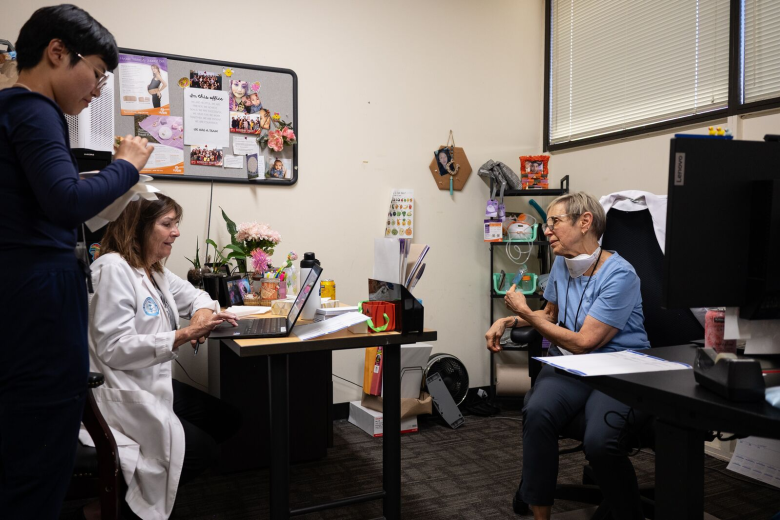
Sejal Parekh: [00:00:54] I saw a newborn this morning, fresh, it was great.
Ericka Cruz Guevarra: [00:00:56] Wow. This is Sejal Parekh. She’s a pediatrician in the Bay Area. And in her downtime, if you can imagine it, she’s a freelance health reporter for the Richmond side. And lately, Sejal has been thinking a lot about big changes coming to health insurance for low-income residents in Contra Costa County.
Sejal Parekh: [00:01:21] My personal fear is that patients in general, people in general don’t get the care they need as their health worsens.
Ericka Cruz Guevarra: [00:01:32] Californians who have Medicaid are bracing for big changes. And in Contra Costa County alone, up to 93,000 residents could lose their health insurance as a result of the One Big Beautiful Bill Act that President Donald Trump signed into law last year. Today, doctor and journalist Sejal Parekh explains how Contra Costa County is bracing for impact.
Ericka Cruz Guevarra: [00:02:11] First, what exactly was Medicaid set up to do, and who is it supposed to serve?
Sejal Parekh: [00:02:17] Medicaid was originally set up as a safety net, as a place where low-income people can get health insurance and so that their services can be appropriately paid for, that there’s not a lot of people without health insurance not getting the care that they need. Medicaid is this federal program, which is kind of a federal-state partnership, in which the federal government gives X amount of dollars and California chips in X amount of dollars. And we get the state plan called Medi-Cal, which was administered by the State Department of health care services.
Ericka Cruz Guevarra: [00:02:47] So when we are talking about Medicaid in California, we’re going to be referring to it as Medi-Cal. And you spoke with folks who rely on this program, including a woman named Lisa. Can you tell me a little bit about her and where she lives and what’s her story?
Sejal Parekh: [00:03:05] Yeah, Lisa lives in Richmond, she’s 58. She relies heavily on Medi-Cal.
Lisa: [00:03:11] I am approved for cancer treatment at UCSF, which I know is probably very expensive.
Sejal Parekh: [00:03:18] So we’re only using Lisa’s first name for privacy concerns. She has a lot of health conditions she doesn’t want others to know about. And so she requested for privacy that we only use her first name.
Lisa: [00:03:28] I’ve been diagnosed with bipolar disorder, which is very well controlled with really good, but very expensive medication. I have autoimmune disease, Hashimoto’s, thyroiditis.
Sejal Parekh: [00:03:46] She has several different health conditions, including a blood cancer, chronic back pain, several other issues, autoimmune issue affecting her thyroid. And so she needs to see a lot of doctors, get blood tests regularly, and is on many medications. And so for all of this, she relies on Medi-Cal coverage.
Lisa: [00:04:07] I see a hematologist, oncologist, cancer specialist at UCSF as well. So I am really praying I can continue to get my care there.
Sejal Parekh: [00:04:21] If she were to lose Medi-Cal, Lisa would have to figure something out, maybe she would have to move, maybe should have to find some other plan she’s covered under. But when I first talked to Lisa she told me in no uncertain terms that losing Medi Cal would be kind of the difference between life and death.
Lisa: [00:04:37] It’s not an option for me to just go get a job, even though I did work for 45 years, I’m just not able to. I definitely need to sleep 12 to 14 hours a day just to function.
Ericka Cruz Guevarra: [00:04:52] Of course, we’re talking about this now because a lot of changes are coming to Medi-Cal under Trump’s big, beautiful bill. What is changing for MediCal patients exactly? What do we know about that?
Sejal Parekh: [00:05:04] Big cuts are coming. I think that’s the biggest point. The amount people estimate might be between $900 billion to $1 trillion. This will be over the next 10 years. Another big change is going to be work requirements for those aged 18 to 64. That might mean working a certain number of hours a week, studying some hours a weak, volunteering some number of hour, but the work requirements are going to new and required in starting 2027. There’s this new determination that those with unsatisfactory immigration status will no longer be able to sign up for new Medi-Cal. What does that mean? That unsatisfactorily immigration status loosely refers to undocumented immigrants. I don’t know if you remember, but a couple of years ago, Governor Newsom made a big deal about extending MediCal to all undocumented immigrants, and so this is clearly seen as a rollback of that policy.
Ericka Cruz Guevarra: [00:06:03] Other changes coming to Medi-Cal are seen as new barriers to enrollment. Starting next year, enrollees will have to renew their benefits more frequently, every six months instead of every year. That’s expected to create more paperwork for personnel, too. And in Contra Costa County, new federal restrictions and state budget cuts could mean $307 million in losses for Medi-Cal patients there by 2029.
Ericka Cruz Guevarra: [00:06:40] This is something that Contra Costa County and really counties around the state and the Bay Area have really been preparing for these changes to Medi-Cal. What has Contra-Costa County said about the anticipated impacts?
Sejal Parekh: [00:06:54] County officials are really worried.
Grant Colfax: [00:06:57] I’m not going to sugarcoat it. Without intervention, our hospitals and clinics across the country will be in dire straits.
Sejal Parekh: [00:07:06] In public hearings, such as the Board of Supervisors meeting in December 2025, Grant Colfax, who’s the health director, said the changes coming through were unprecedented.
Grant Colfax: [00:07:17] And by the numbers, while difficult to predict, EHSD estimates that as many as 93,000 people in Contra Costa County will be subject to these new rules implemented by HR 1 and the state changes.
Sejal Parekh: [00:07:33] Changes happen to the county kind of a couple of different ways. One is that the county is required now to process all of these every six month eligibility kind of packets. So that’s doubling the work that they have to do. So there’s an increase in the amount of resources the county needs to just implement these changes. There’s also a fear that the more people that lose the Medi-Cal, those people don’t stop using health services. If you break a leg, you break leg. And so there’s a concern that, with a lot of people potentially losing MediCal, they’re still gonna need the same ER services and the hospital services, but who’s gonna pay for that?
Ericka Cruz Guevarra: [00:08:18] Coming up, what’s happening inside local clinics in Contra Costa County as they brace for changes to Medi-Cal. We’ll be right back.
Ericka Cruz Guevarra: [00:09:21] And I know you’ve actually talked with folks at local clinics in Contra Costa County about what they’re already seeing. How is it trickling down to these clinics now?
Sejal Parekh: [00:09:32] Yeah, great question. So I talked with Amit Randhawa, who is the clinic manager for RotaCare West Contra Costa County.
Amit Randhawa: [00:09:39] We are part of a larger organization called RotaCare Bay Area, serving uninsured folks throughout the Bay Area as far north as San Rafael and as far down south as Monterey.
Sejal Parekh: [00:09:51] And it’s a free clinic that he runs with volunteer doctors and other health care professionals and some social workers.
Amit Randhawa: [00:09:58] And we will serve anyone who is uninsured for any reason.
Sejal Parekh: [00:10:03] And so he said that in the first couple of months of 2026, he’s seen a big increase in the number of people asking about changes to Medi-Cal if they’re going to be eligible.
Amit Randhawa: [00:10:14] And I’ve got to say some of the calls are just a bit distressing, you know, there’s a lot of people with fear and despair, it’s very scary, you don’t really know how to navigate the systems.
Sejal Parekh: [00:10:25] He sees a lot of fear in the community of not wanting to even mention anything about immigration status. He also mentioned that as much free care as he and the clinic want to offer, it’s not gonna be able to keep up with the number of people who are gonna lose their Medi-Cal insurance.
Amit Randhawa: [00:10:42] I would hate to think that folks are going to be utilizing the emergency department more, but that is most likely what’s going to happen.
Sejal Parekh: [00:10:53] When I asked him at, you know, how ready, willing, and able are you to deal with this? He said, we’re willing, but we’re not able.
Amit Randhawa: [00:11:02] If folks don’t have any other way to access preventive care or seek treatment for things that could be managed. You know, ahead of time, they may just wait until things cannot be managed anymore and they end up in an emergency department. Who’s going to support all of these uninsured people and who’s going pay for the medical providers to provide that care? I wish I had an answer, but we’re all kind of in this together to figure out what’s gonna be next.
Sejal Parekh: [00:11:35] One of the things that’s been tough is that you may not know if you’re going to be affected by these upcoming changes to Medi-Cal. And that’s because a lot of this is handled by the state, by the Department of Health Care Services. And they’re kind of in the process of figuring out who’s going to affected and who’s not. And does that mean that you get a letter in the mail saying, hey, just so you know, you’re going to to be effected? So a lot patients, especially the patients I talk to, were fearful that they were gonna lose their medical, but they didn’t actually know if they were going to be affected or not. And that contributes to, you know, an atmosphere of fear and concern and maybe not seeking the healthcare that you need.
Ericka Cruz Guevarra: [00:12:14] Yeah, I mean, I can only imagine the anxiety that that creates, which I guess to that point, I wanna come back to Lisa, who is someone who relies very heavily on Medi-Cal. I mean, has she been told anything about what these potential changes could mean for her specifically?
Sejal Parekh: [00:12:33] She has not heard from the state if she’s gonna be affected, and I think that adds to her anxiety.
Lisa: [00:12:39] Even with a good RX, one of my psychiatric medications is about $4,000 a month.
Sejal Parekh: [00:12:46] She told me that other people on Medi-Cal might start hoarding their medications, refilling their medications on the first date it’s available, even if they haven’t run out of the medication yet.
Lisa: [00:12:56] Even if I’m not out, I am cutting some of my medications in half.
Sejal Parekh: [00:13:02] And I don’t think anyone wants to do that. I think this is a response out of fear.
Ericka Cruz Guevarra: [00:13:07] Just fear that she doesn’t know that she’ll be able to get access to those medications on the line.
Sejal Parekh: [00:13:12] Exactly, exactly.
Lisa: [00:13:16] Just trying to do the best I can with what I have, knowing what could be coming.
Ericka Cruz Guevarra: [00:13:27] I mean, how is Contra Costa County responding to all of this? It seems like there’s a lot of anticipation on their end. How are they responding to these changes at the federal level?
Sejal Parekh: [00:13:40] I think the best way to characterize it right now is that they’re taking these changes seriously. They’re also in a tough spot, because for example, they need a lot more funding for eligibility workers to check everyone’s paperwork every six months, right? And some of that also has to do with the state budget. They have started hiring more eligibility workers. They’re starting to prepare estimates for the hospital of what financial changes are coming up. And I would say the most notable thing they’re doing is there’s a ballot measure coming up in November, measure B, which would be, I think, 5 eighths a cent sales tax on goods sold in Contra Costa County. Theoretically, this money would be specifically for kind of shoring up the health care infrastructure.
[00:14:24] So, trying to fill in the gaps left by these federal cuts, essentially
Sejal Parekh: [00:14:30] It could be a stopgap measure, but there’s no way it would replace lost federal dollars.
Ericka Cruz Guevarra: [00:14:36] I mean, Sejal, I feel like you’re describing so many trickle-down impacts as a result of these federal cuts, this squeeze on the county healthcare system, but also this like very personal everyday impacts to people’s health. Looking ahead as you cover health as a journalist, but also as a doctor yourself, like what is your fear moving forward for? Your patients are just people seeking care who could be impacted by these cuts.
Sejal Parekh: [00:15:09] My personal fear is that patients in general, people in general don’t get the care they need and their health worsens. For example, for me as a pediatrician, I worry that if one of my patients who loses their health insurance doesn’t come to me for their cold that it turns into an asthma attack and then they need to be hospitalized. Another example for preventative care is mammograms. If there’s breast cancer that’s caught early, there may be an option to have quicker treatment versus if breast cancer spreads, there might not be a surgical option. Patient might have to go through chemo and radiation. I think that changes like this erode trust in the health care system, erode trust that I can just go to the hospital, I’m going to get what I need, I am going to be okay. There’s a lot of calculations people make of, well, am I going to afford my medications this month? Am I going afford rent this month. And so it creates a culture in which there’s so much uncertainty that that itself can also negatively impact people’s health.
Ericka Cruz Guevarra: [00:16:20] Well, Sejal, thank you so much for sharing your reporting with us and for joining me on the show. I really appreciate it.
Sejal Parekh: [00:16:25] Thank you so for having me.