Nancy Alberran [00:00:29] We’re here tonight because we have a responsibility to lead with care, with clarity and with courage. Leadership sometimes requires us to acknowledge painful realities even when the path forward is difficult.
Ericka Cruz Guevarra [00:00:43] Last week, San Jose Unified’s Board of Education voted three to two to close five elementary schools and relocate another. And it’s making a lot of parents really angry.
Public comment [00:00:58] We overwhelmingly do not want schools to close. We cannot be more clear. We don’t need to go fast. Don’t make this mistake. Vote no.
Ericka Cruz Guevarra [00:01:07] Today, school closures at San Jose Unified.
Ericka Cruz Guevarra [00:01:26] How would you describe San Jose Unified, especially compared to other districts in the Bay Area?
Kate DeBenedetti [00:01:31] San Jose Unified doesn’t cover the entire city, there’s actually more than a dozen school districts that make up San Jose.
Ericka Cruz Guevarra [00:01:41] Katie DeBenedetti is a reporter for KQED.
Kate DeBenedetti [00:01:47] Also it’s in an urban area like San Francisco, like Oakland, but it’s smaller than both of those districts. It’s about 25,000 students. It’s made up of about 40 schools. More than half of those are elementary schools. And the district is predominantly Latino. About 43% of the students qualify as low income, which is. Again, slightly lower than some neighboring urban districts. Like other districts around the Bay Area, San Jose Unified is struggling with declining enrollment, but it doesn’t affect their budget in the same way. The district is unique in the way that it’s funded. This is probably one of the biggest differences between San Jose and other districts in the Bay area. They actually are primarily funded by their own property taxes. Basically, this means that while their finances are still impacted by the enrollment decline and other factors that impact other schools across the state, they’re a little more stable.
Ericka Cruz Guevarra [00:03:00] And considering how expensive it is to live in San Jose, it sounds like perhaps the district might be doing actually pretty well financially or okay.
Kate DeBenedetti [00:03:10] I think they’re doing okay. They just approved their second interim budget report, which is kind of like the check-in mid-year of how the district’s doing, and they’re gonna meet their financial obligations. And so they’re kind of doing, yeah, okay.
Ericka Cruz Guevarra [00:03:29] And yeah, that seems pretty unique compared to many of the other districts that we’ve talked with you about on the show. So that said, things have been blowing up there a little bit after a San Jose Unified School Board meeting last week, what were they meeting to do?
School Board Meeting [00:03:49] We’re now gonna move on to item I-2 resolution 2026-03-2601, on consolidating existing elementary schools, redrawing attendance boundaries and relocating special programs. Before we do…
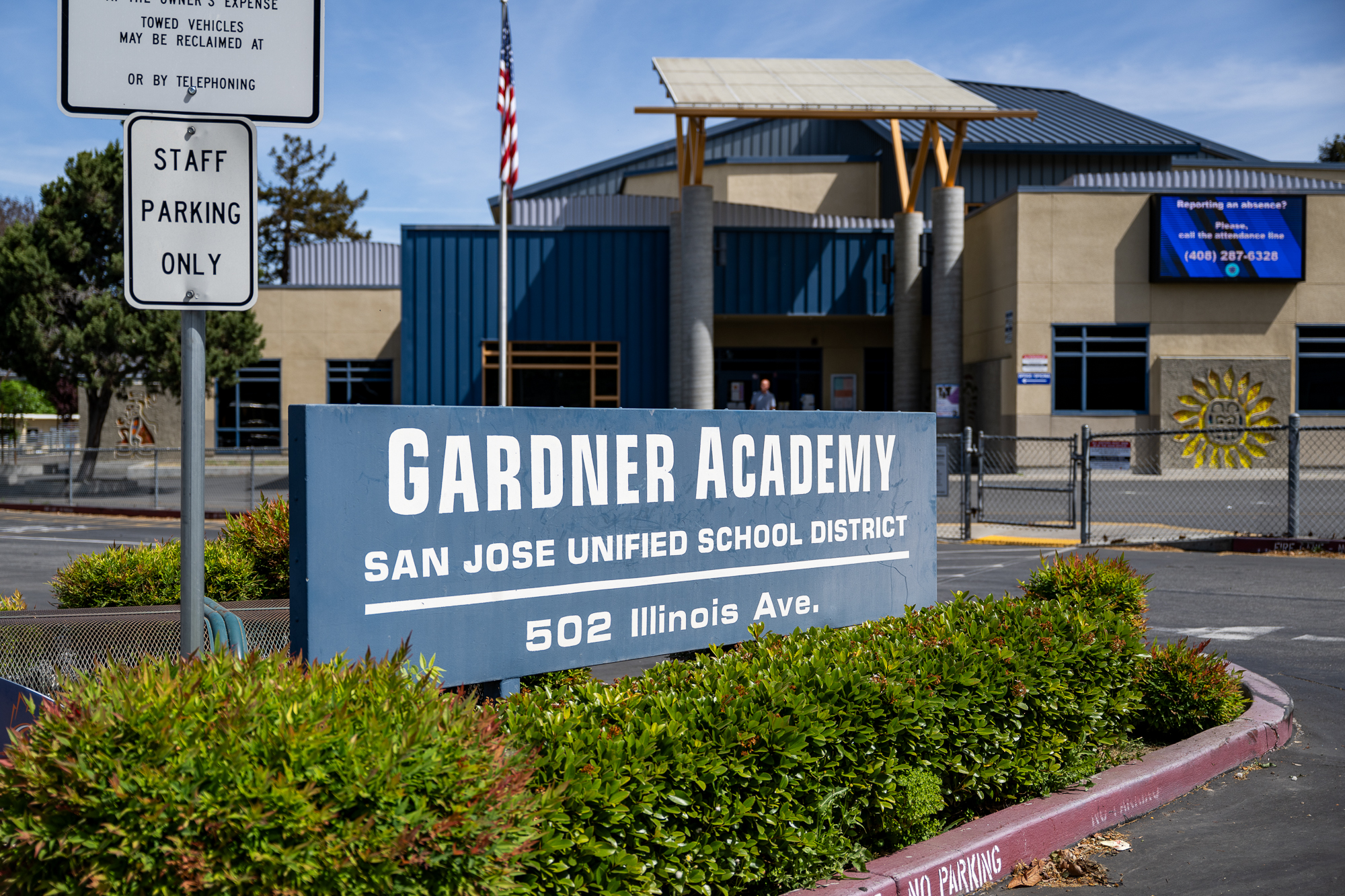
Kate DeBenedetti [00:04:00] The San Jose Unified School Board has approved closing five elementary schools and moving a sixth to a new campus. The schools that are going to close are Empire Gardens, Lowell, Gardner, Canoas, and Terrell Elementary Schools, and then they’re relocating Hammer Montessori to the Gardner campus. And they said that they chose these schools because they were lower enrolled. And they also said that when they were deciding which schools not to close, they took into account schools that had special day programs or bilingual programs.
Ericka Cruz Guevarra [00:04:34] I guess the question coming to my mind is, if the district isn’t struggling necessarily financially like other districts around the Bay Area, why close schools? What’s the district’s rationale for why this is happening?
Kate DeBenedetti [00:04:50] Yeah, I think, like you mentioned, like, we usually see a district kind of backed into a corner where they’re like, We are falling off a fiscal cliff, and so we need to do this right now. Right. But that’s not the case here. San Jose Unified has really put this on declining enrollment.
Nancy Alberran [00:05:09] If we do not act, we are not preserving quality as it exists today. Superintendent Nancy Alberran spoke about this at the school board meeting.
Nancy Alberran [00:05:19] We are allowing the effects of declining enrollment to continue shaping student experiences in ways that limit opportunity, stretch resources, and make it harder to deliver the excellent education our community expects and our students deserve.
Kate DeBenedetti [00:05:37] Since 2017, they’ve lost 6,000 students, which is 20% of their total enrollment. And this is because of the same factors that are affecting the whole state. Birth rates are down. The cost of living has forced a lot of families out. And what’s interesting is in Santa Clara County, enrollment in charter schools is actually also down about the same amount in the last decade. All that to say, they say that because they have this enrollment problem, elementary schools are falling below 350 students. They have 12 elementary schools with less than that number. And when they have fewer students, it means that they can put fewer staff at that school. And then when they had fewer staff at the school, they have to cut back on programs like art or music, science. And they might even have to pursue combination classes, combining grades with one teacher. And so basically the district is saying that the quality of the school will suffer if they don’t consolidate.
Nancy Alberran [00:06:43] Every student deserves access to quality instruction, caring adults, robust programs, collaboration among teachers, and the kind of school community that helps them thrive. That is what this recommendation is trying to protect and strengthen.
Ericka Cruz Guevarra [00:07:00] I mean, obviously, anytime you close a school, it’s gonna cause a lot of ruckus. What has the reaction been from parents in San Jose?
Kate DeBenedetti [00:07:10] I think there was a lot of anger, a lot of disappointment.
Paula Gisela-Silver [00:07:16] Hello, my name is Paula Gisela-Silver. I am appalled and saddened. I’m confused as to why you guys would want to remove Gardener and Empire. Shame on all of you. This is putting the kids at risk.
Kate DeBenedetti [00:07:33] A lot of parents kind of saying that this is going to rip their kid from a community that they have been a part of for years. Their friends are at this school. They know the teachers.
Tatiana Pineda [00:07:47] My name is Tatiana Pineda and I am a TWBI teacher and also a TWBI parent. Throughout the north side in downtown San Jose, parents are not just frustrated, they feel that their voices have not been heard and that their concerns about the proposed school closures are not being taken seriously.
Kate DeBenedetti [00:08:07] There was just a lot of emotion.
Ethan Dutra [00:08:15] I’m Ethan Dutra, a fifth grade student at Gardner Elementary. My sister goes to Gardner as well. She has a best friend and a favorite teacher. Are you willing, are you really willing to end that? I don’t know what this is, what you’re doing, but it isn’t right. Save Gardner.
Kate DeBenedetti [00:08:36] Also a lot are worried about logistics, you know, how are they gonna be able to drop off and pick up their kid if the new school that they’re assigned has different schedule times? Is it gonna be a longer commute? If their kid walks, how is their route going to be different? And is it going to safe for them to walk to school?
Dina Solnit [00:08:54] My name is Dina Solnit, I’m a teacher at Canoas Elementary, transportation is a real barrier for our families. Many of our families live far from the proposed schools. If a student misses a bus, their only options may be an unsafe walk or missing school altogether.
Kate DeBenedetti [00:09:10] The district is guaranteeing a year of transportation for students who live outside of like, a one and a half mile radius from their new school. But we don’t know if that will continue beyond that. And so I think there’s just a lot of nervousness about, you know, what will this look like?
Ericka Cruz Guevarra [00:09:26] And I know there’s also some parents who are arguing that this will actually disproportionately affect lower income students of color, right?
Kate DeBenedetti [00:09:35] Yes, so that’s kind of the big argument from parents here is that all five of the schools that have been approved for closure are Title I schools, which mean they serve a significant number of socioeconomically disadvantaged students. And all of them have higher Latino populations than the district average. Four of them have more than 70% Latino student bodies.
Elizabeth [00:10:02] Hi, my name is Elizabeth. I’ve lived in this community for the last 12 years, and I’m against these school closures. Disproportionately low-income immigrant, Latinx, black, and disabled students will suffer more with these school closure.
Kate DeBenedetti [00:10:16] And so a coalition of parents has filed a legal complaint with the school district alleging discrimination in the closure process.
David Friedlander [00:10:27] The kids in these schools deserve a district that solves hard problems with their families and not over their objections.
Kate DeBenedetti [00:10:36] David Friedlander is a parent of a student at Hammer Montessori, and he’s kind of leading this legal challenge.
David Friedlander [00:10:43] We haven’t seen that leadership tonight, and certainly tonight’s vote doesn’t change that. So we’ll be at the next board meeting and the one after that and the after that.
Kate DeBenedetti [00:10:53] The district says that some of these schools with higher percentages of disadvantaged students have lower enrollment on average because of prior consolidations, demographic changes, and the cost of living crisis already. It seems like parents
Ericka Cruz Guevarra [00:11:09] Students are also really upset about the process of how they went about deciding to close these schools. Is that right?
Kate DeBenedetti [00:11:16] Yeah, I think some parents wish that they had known what the schools were going to be sooner. I don’t think that schools started being named as options for closure until like February. So I think it can feel really abrupt. I think also there’s like questions about the language that’s used. When you started this process in September, it’s all, we’re looking at our portfolio. We’re thinking about the ideal school size and that all. Sounds very different than we are going to close schools. And I think it has felt, you know, pretty quick and these are changes that are taking effect in a matter of months.
Ericka Cruz Guevarra [00:11:56] Yeah, when exactly will these schools close? Is it gonna be for the next school year?
Kate DeBenedetti [00:12:00] Yes, the schools will close at the end of the year and then the students will move to their new campuses in the fall.
Ericka Cruz Guevarra [00:12:11] I think what’s interesting about this story is that it’s about schools closing, not necessarily because of a lack of funds. How would you say this story fits in with other districts that you’ve covered here in the Bay Area?
Kate DeBenedetti [00:12:26] The enrollment decline issue is the same. Having less students in your district and having less students in your classroom causes major problems for school districts that honestly, they don’t really have a solution for right now. The state is saying that they expect enrollment to continue declining in the next decade. So it’s kind of an open-ended question of how fundamentally are school districts in the state going to deal with this?
Ericka Cruz Guevarra [00:12:59] Katie, it sounds like this process has sort of led to a lot of mistrust and frustration among parents. How will the district know that this decision was all worth it despite all the anger?
Kate DeBenedetti [00:13:13] One good indicator will be, will they see kind of a mass exodus of families who are angry, like, will this further their enrollment decline? And two, I think, like in a few years, are they seeing that all of the elementary schools are still operating, have, you know, these thriving arts, music, enrichment programs that they’re saying are so important? Do they have full classrooms with enough teachers, campus supervisors, librarians? Or are they seeing more schools fall below the kind of 300 student threshold because they are continuing to have enrollment decline and will this need to happen again? Yeah, will this make things?
Ericka Cruz Guevarra [00:13:53] Actually better for the schools, yeah. Well, Katie, thank you so much for joining me. Appreciate it.