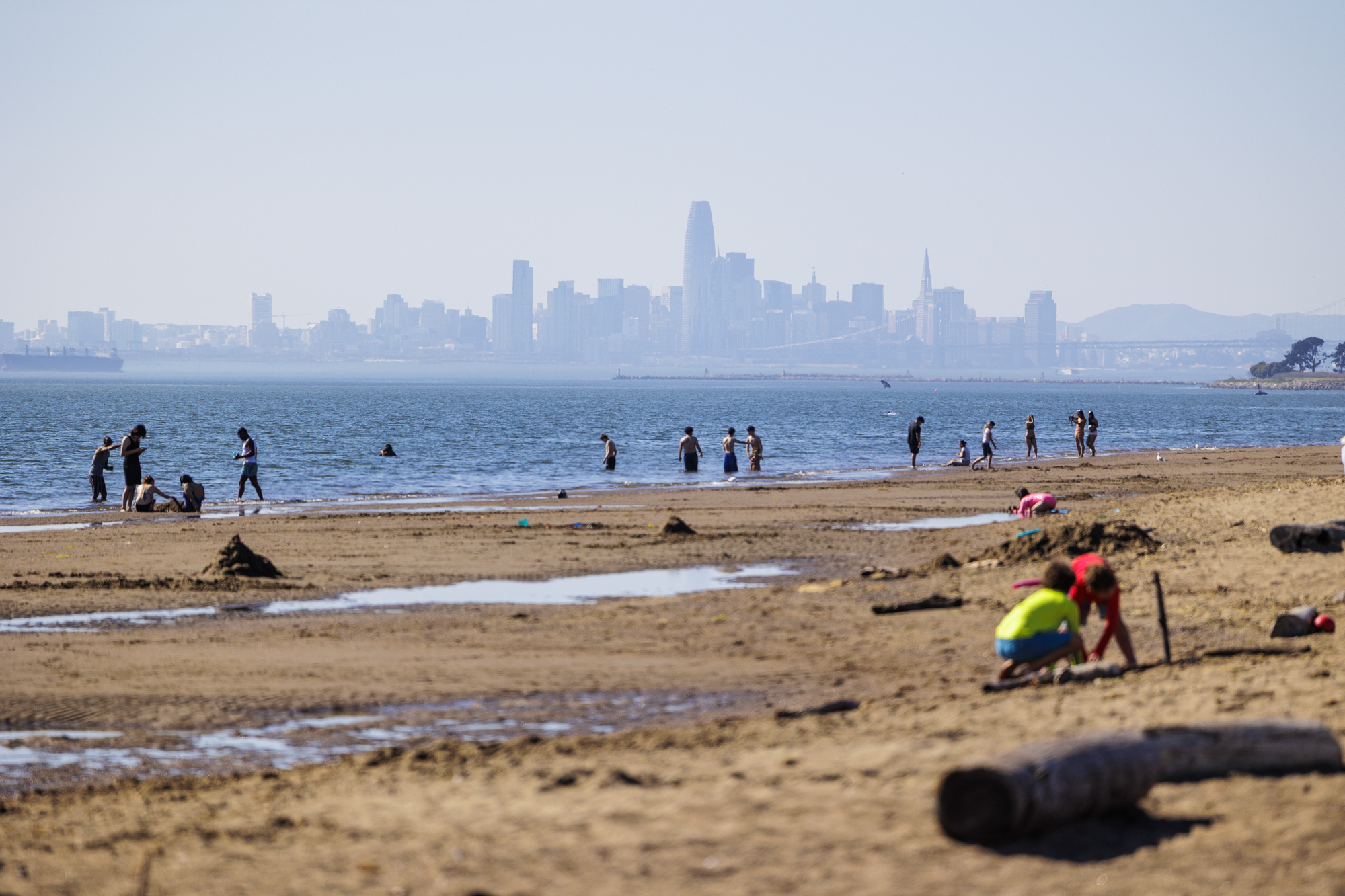
Ericka Cruz Guevarra: [00:00:36] From KQED, I’m Ericka Cruz Guevara and welcome to the Bay local news to keep you rooted. On the edge of Alameda Beach, small waves crash softly onto this man-made shore. I love this place because it feels like one of the only beaches that actually gets warm here in the Bay Area. And what happens on this beach is going to be important. Alameda is surrounded on all sides by shoreline like this, putting the city at the forefront of sea level rise.
Danielle Mieler: [00:01:19] Looking at even one foot of sea level rise, there’s a significant number of homes and businesses that would be inundated and flooded without some kind of shoreline protection measures.
Ericka Cruz Guevarra: [00:01:31] All eyes are on Alameda as it works to become one of the first cities in the Bay Area to align with state-led plans to address sea level rise. And experts say Alamed is a strong case study for the rest of the region because it’s the special task of protecting its 360 degree waterfront. Today, how Alameda plans to tackle sea level rise.
Ezra David Romero: [00:02:15] I knew that Alameda was this island, I wanted to learn more about it, and I knew it had this big flood risk.
Ericka Cruz Guevarra: [00:02:23] Ezra David Romero is a climate reporter for KQED.
Ezra David Romero: [00:02:27] So I did a tour with their sustainability and resilience manager named Danielle Mieler and Chris May, who is a scientist with Pathways Climate Institute who also lives there.
Danielle Mieler: [00:02:39] We are in Alameda, we’re at the beach, we are right next to a lot of people might know the board sport shop where a lot people go.
Ezra David Romero: [00:02:47] And they drove me around the island, showed me all these places that are at risk, and the solutions they want to put into play, and it was a really fun way to get to know Alameda by people who both work there and live there. I know, the pelicans are out. I love the pelican. They’re so big. I know.
Ericka Cruz Guevarra: [00:03:09] I know they actually took you to like a seawall there. What did that look like?
Ezra David Romero: [00:03:15] It’s this area that has this like really built up kind of beautiful seawall. It looks like a big bunch of cement that’s really high. And then just south of that, there was this like green area with like some wood that was kind of falling apart and Daniel Miller, the sustainability and resilience manager for the city of Alameda was like, yeah, that’s like a hundred year old seawalls that needs to be fixed.
Danielle Mieler: [00:03:39] The water is near the top of it at high tides and king tides. Sometimes it comes over at king tides.
Ezra David Romero: [00:03:45] There’s houses built right up to the shore and businesses, and then Oakland is just right across that little channel there. It was just a great place for juxtaposition of work they have done and work they need to do. Alameda wasn’t always an island. Like more than a hundred years ago, the leaders of that place decided to like dredge a canal between Oakland and Alameda. And then Bay Farm Island, which is just to the south, which is also part of Alameda, which is not an island at the moment. It used to be. It was like filled in. The state has mandated that every bay area city and coastal city that touches either the coast or the bay come up with like a sea level rise plan. For their jurisdiction. And Alameda was one of the first places that was doing that here in the Bay Area.
Ericka Cruz Guevarra: [00:04:38] This is a city that is surrounded by water. What impact is sea level rise already having on Alameda?
Ezra David Romero: [00:04:46] California has experienced about eight inches of sea level rise over the past century. And as the world continues to warm due to fossil fuel burning, the Bay could rise by about a foot by mid-century, like, you know, that’s 2050, or it could be like two feet to six feet by the end of the century. But Alameda is already impacted by water, right? Whether there’s king tides, you now, that happen a couple times a year, and the normal daily tides that are high and low, those tides are extra high. And when that happens… Water will crash over some shorelines there, it will fill places where people run, it’ll start to erode beaches.
Danielle Mieler: [00:05:22] We had quite a bit of flooding, a shoreline drive is kind of the road that’s along the Alameda beach.
Ezra David Romero: [00:05:30] Danielle said that during this last king tide in January, it filled shoreline drive, it kind of pulled away some sand and it also water was like kind of shooting out of some utility holes as well.
Ericka Cruz Guevarra: [00:05:42] And I understand there’s also this issue of rising groundwater in Alameda as well. Can you talk a little bit about that?
Ezra David Romero: [00:05:50] Yeah, so if you think about the ocean or the bay, it doesn’t just stop like where the water touches the land, right, like it saturates the soil underneath all the crust of the bay area. And so as the bay rises, as the ocean rises, the idea is that it will slowly push up that shallow groundwater that’s already existing in the soil and in the ground. I was told by a scientist that about 60% of the shallow groundwater in Alameda is already near the surface. And it’s already getting into people’s basements because it’s so shallow. And if you think about like an island, It’s sort of like this sponge right, sitting in a bunch of water. So it makes sense that that sponge will be quite wet if it’s surrounded by water and then it rains. And then during a king tide, there’s extra water. Kris May is a scientist with Pathways Climate Institute. She was telling me on that tour that her house, her basement floods from the inside out.
Kris May: [00:07:03] My house was built in 1908. The basement floor has multiple cracks, so the flooding will come in
Ezra David Romero: [00:07:11] That there’s these cracks in the basement and that water will come through there and she’s had to install some sump pumps. Those are like pumps that will pump water out and then she puts it into her backyard.
Ericka Cruz Guevarra: [00:07:26] So it’s like water kind of coming from all over, like the shoreline, but also underneath people’s homes.
Ezra David Romero: [00:07:36] It’s water from all directions in Alameda, right? We have water from the bay, we have water from the sky, and we have a water from beneath. Alamedia is dealing with water everywhere.
Ericka Cruz Guevarra: [00:07:51] We’ll have more with KQED climate reporter, Ezra David Romero, right after this break. We’ll be right back.
Ericka Cruz Guevarra: [00:08:06] So let’s talk about what Alameda is doing to address this problem. You mentioned they are working on a plan. Tell me a little bit more about that plan and how soon are they supposed to have that done?
Ezra David Romero: [00:08:21] They’ve already done a vulnerability assessment. That’s basically where they say like, these are all the vulnerable parts of the island. We know like this area is low, this area floods, the sand is leaving these beaches. You know, we have this marsh. They already know all that. So this next step of the plan is to create like, how do we fix this or what are the solutions? So what are some of the solutions? Well, they’re considering building seawalls and levees, for example, like on the city’s east side facing Oakland. This is an area where there’s like lots of businesses, there’s harbors, there’s boats, there is houses, there’s, they are thinking about seawall there because it’s built right up to the edge. And there’s places like on the south and the north part of the island where there is marshes or they want to restore that area, you know, to like create these like sponge-like capacity on the island. On the west side, they wanna save the beaches and make that area more of a sponge on the westside, but also figure out how to stop some of the waves from eroding and eroding the island. The solutions are far and wide, and they’re very early on in the process. They signed a letter of intent with the Bay Conservation Development Commission that they are going to do this thing, and now they actually have to develop this adaptation plan. And that plan has to be done by 2028.
Ericka Cruz Guevarra: [00:09:44] I love the Alameda beach. I feel like it is one of the only warm beaches in the Bay area. And I feel a lot of people in Alamedo, you know, really hold that place close to their heart as well. What do they plan to do about the beach?
Ezra David Romero: [00:09:59] The beach is interesting because it’s human-made. So the sand there is sort of unnatural for that area, even though it’s like something we love. Because if you think of the island, much of it is built on what we call fill. And what that means is like, leaders back in the day put dirt in the area, made the island bigger. And then during high tides or just naturally as the bay, you know, like laps over the shores, it pulls sand away. They already have these big boulders that are like lining the the cliff right there. And that’s because in past years, during like king tides, a lot of that sand got washed away and the bluff was starting to be eroded. And it’s sort of like a midterm kind of solution. So, Daniel said that they would have to study it. They have to figure out Like where’s that sand going? Is there some other way to keep the sand there?
Ericka Cruz Guevarra: [00:10:51] What about these more sort of natural, nature-based solutions? Because I’m actually kind of interested in those.
Ezra David Romero: [00:10:59] I think the one that like made me smile the most was I went to this like sea level rise fair last fall that they were throwing as like, you know, to get the community involved. And there were all these chickens there like pecking on oysters and things like that. And I was like, what is going on? What’s this about?
Jonathan DeLong: [00:11:15] But for sea level rise, it’s using oyster reefs as a mitigation for storm surge and sea level rises.
Ezra David Romero: [00:11:23] Okay, so you guys are experimenting with that? Jonathan DeLong, he’s the executive director of Alameda’s REAP Climate Center, was telling me that they have these chickens there, and what they do is they get oyster shells from restaurants around the Bay Area, they put them in the cage where the chickens are. The chickens come out and they pick off.
Jonathan DeLong: [00:11:40] All that leftover protein and the co-benefits is they get some protein and some calcium but they’re really cleaning the shells and getting them ready for the next phase.
Ezra David Romero: [00:11:48] And then they put these oyster shells out in the sun for a period of time. After they’re cured for a certain amount of time, they put them in these like bundles and they drop them in the bay.
Jonathan DeLong: [00:12:00] When the shells go back into the bay, we put them where we want to see an oyster reef created and wild oysters smell that calcium from miles away and they come running, but not really because they don’t have legs.
Ezra David Romero: [00:12:11] They swim over and they like establish themselves and create these reefs and the idea is that by having these oyster reefs of Like natural oysters in the bay. It will like slow the waves that come into the city.
Jonathan DeLong: [00:12:25] they interrupt wave action, they reduce erosion, and they create a physical barrier for sea level rise. And so it’s not always building a hard physical barrier like a concrete wall. We need adaptive solutions that work with our shorelines and with nature.
Ericka Cruz Guevarra: [00:12:46] I mean, it sounds like they’ve got a lot of stuff going on and really, as you were talking about earlier, water coming from everywhere. You have these physical barriers, but also these natural solutions. How much does all of this cost?
Ezra David Romero: [00:13:04] Probably gonna be billions of dollars to fix this.
Ericka Cruz Guevarra: [00:13:06] And where does that money come from?
Ezra David Romero: [00:13:08] That’s the big question, where is the money gonna come from? The city is trying to figure out funding, right? They’re trying to get funding from every place possible, where they can, whether that’s state funding through grants or federally or through private dollars. But Daniel Miller says it’s gonna be really tough.
Danielle Mieler: [00:13:25] Just trying to position ourselves as best we can for whatever funding opportunities are available. And I think it’s also going to require some local investment and residents to pitch in and help to fund it, because it is going to be a big cost.
Ericka Cruz Guevarra: [00:13:45] I mean, that said, Ezra, it does seem like a really, really, really big task. Like, I can’t imagine having Danielle’s job, to be honest. I mean does anyone look at all this work that needs to be done and think to themselves, like, aren’t we just delaying the inevitable here? I mean we’re talking about an island dealing with sea level rise.
Ezra David Romero: [00:14:10] Yeah, I mean there are islands in like the South Pacific and places that are, you know, abandoning ships. Alameda might become that place in the future, but I think as of right now, they still see a future on that island, right? And they see ways they can adapt. And this is an island of 80,000 people, right, it’s not like 10,000 or less living on this place, it’s 80,00 people on an island. They see a feature and they’re building a framework so that future can exist. And Daniel Miller talked about this.
Danielle Mieler: [00:14:43] I want this to be a place that people can continue to live and thrive in and enjoy, and that me or anyone here today is going to have the final say on what this island ultimately becomes.
Ezra David Romero: [00:14:55] So they’re developing this project in stages, right? So like, what can we do now to protect our city, and then let’s lay the framework so like future generations can also decide what they want for their future in Alameda.
Ericka Cruz Guevarra: [00:15:11] That’s so interesting, and I guess it makes me wonder, like, what does what’s happening in Alameda right now say about what it is gonna take to tackle sea level rise, not just in Alamita, but in the Bay Area more broadly?
Ezra David Romero: [00:15:27] All these cities are coming up with ideas around how to protect the shoreline. And it’s sort of this like, how can we all do this together, you know, even though we’re like 30 plus cities, all touching the bay, how can we protect this region together? And there’s a lot of details there they’re going to have to figure out. But I think like the biggest thing we as a Bayer are going to have to have figure out is like what we value and what we want to save. If we value this manmade beach in Alameda and we want to protect that, then we’ll come up with solutions for that. And we’ll decide. For each part of the shoreline, what we value. And so I think that’s what Alameda has to do. I think it’s what San Francisco has to, you know, with like our Embarcadero and they are doing that right now. And every part of this shoreline is gonna have to go through that process of like what we valued and what we wanna save. And then like, what can we do?
Ericka Cruz Guevarra: [00:16:15] Well Ezra, thank you so much for sharing your reporting. I appreciate it.