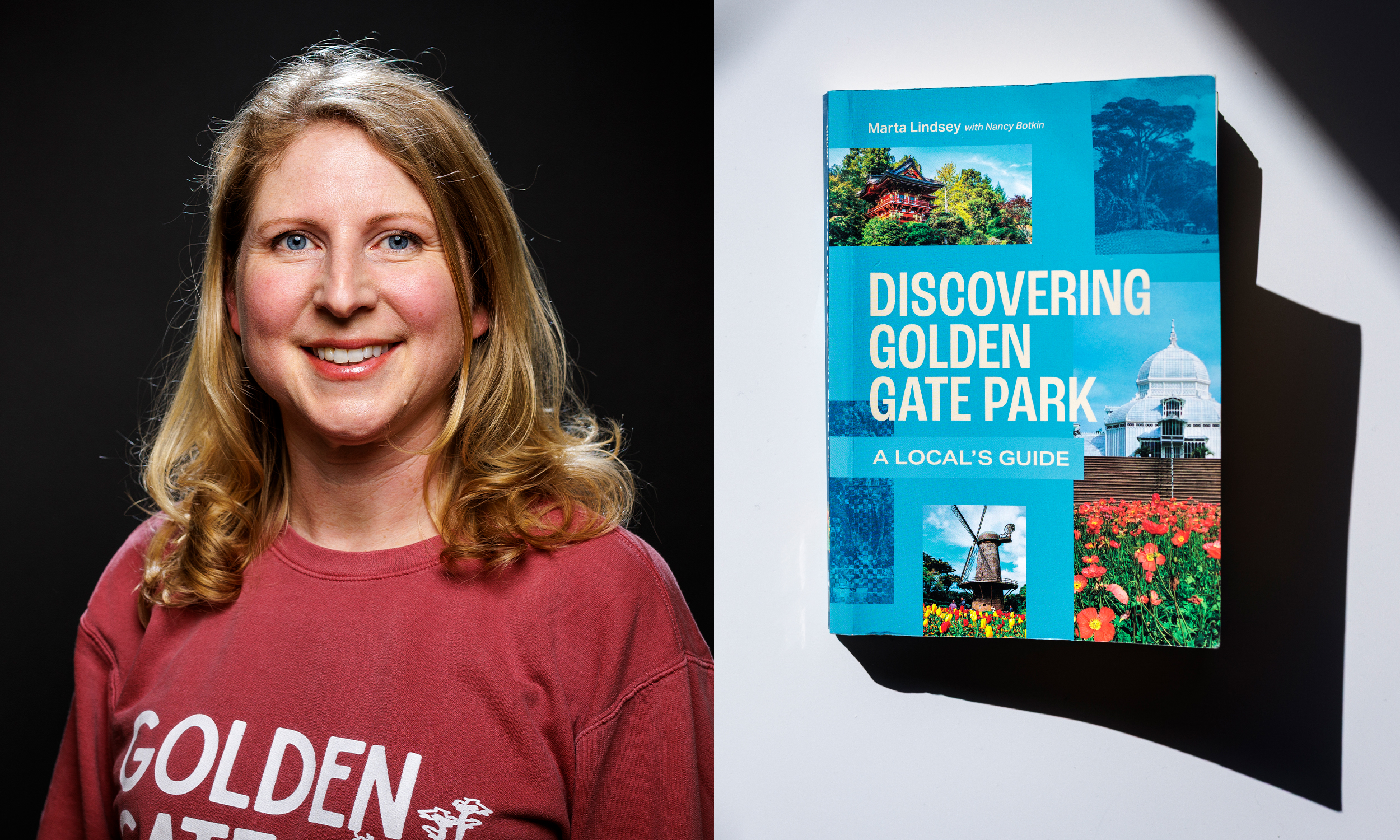
One name that people have probably heard a lot related to Golden Gate Park is John McLaren. He was an early park superintendent who served for more than 50 years, and he did a lot to make the park the special place it is today. His fingerprints are really all over it. He comes up a lot in your book. Can you tell us what it is about him that captured your imagination.
Marta Lindsey: So John McLaren oversaw the park starting in 1890. And William Hammond Hall created the canvas, but then John McLaren was the artist and he really ran with it. And at that time he took over half of the park still had nothing had happened to it yet. Half of the Park, the dunes had been reclaimed and things were starting to be planted, but that was still a whole half of park to deal with, and John McLaren oversaw it all.
His vision for the park was just right on, with wanting it to really feel like an escape into nature. And he had to fight a lot of fights during those years to try to hold to that. But he also was this master gardener with this just eye for design that was. Really special for the time too because the parks that existed at that time were mostly European parks but nature doesn’t run in a straight line was one of his quotes. His favorite thing was the dells. He loved to have flowers growing within a grove of trees somewhere so it’s like you stumble on to this little magical scene right and because he was on the job for so long he was really able to realize that. I just think of how much of what we think of as the look and feel of the park it’s John McLaren.
Olivia Allen-Price: You can find much more about John McLaren in Marta’s book, Discovering Golden Gate Park, A Local’s Guide. Find it wherever books are sold. Marta Lindsay, thank you so much for talking with us today.
Marta Lindsey:Thank you so for having me.
Olivia Allen-Price: When we return, The Making of Golden Gate park. Stay with us.
Sponsor message
Olivia Allen-Price: Next up, producer Katrina Schwartz and I are exploring the early history of how Golden Gate Park was built.
Katrina Schwartz: There are a lot of stories about how this park came to be. One tale goes that only a magical combination of horse manure and spit was enough to tame the sandy soil and make it rich enough for plants to grow.
Olivia Allen-Price: Now, I’m no gardener, but even to me, that sounds a little far-fetched. To find some definitive answers, we headed over to the northeast corner of the park.
Katrina Schwartz in scene: So this little path says Oak Woodland Path. should we go up there?
Nicole Meldahl: Yeah, let’s check it out. Yeah.
Olivia Allen-Price: The trees we walked through were here before anything else in the park. It’s one of the few areas that remains relatively unchanged.
Nicole Meldahl: This is an old-growth forest. These would be descendants of the trees that were cut down for firewood during the gold rush. It predated the park, it predated European colonization here.
Katrina Schwartz: We’re here with Nicole Meldahl, the executive director of the Western Neighborhoods Project, a community history nonprofit focused on the west side of San Francisco.
Nicole Meldahl: It’s just behind the conservatory flowers, kind of hidden.
Katrina Schwartz: We decided to start here because it was this corner of the park where trees grew naturally that gave park creators the confidence they could make the rest of the Park green.
Olivia Allen-Price: As beautiful as the Oak Grove is, we are still surrounded by the city.
Katrina Schwartz: Trucks that back up are the worst.
Olivia Allen-Price: We kept going deeper and deeper into the park, hoping to find a quiet spot for our interview.
Katrina Schwartz in scene: Sorry, we’re off-roading a little. I thought it was a path, but then it became not a path.
Katrina Schwartz: Nicole says what we now know as Golden Gate Park, a lush place with winding pathways, protected dells and lots of recreation, wasn’t even part of the city at first.
Olivia Allen-Price: What did this place look like at the beginning of the gold rush?
Nicole Meldahl: An 1853 map of this area, called it the Great Sand Bank. So yeah, it was very empty, isolated. There were a few scattered beach cottages for some adventurous folks. There were homesteaders out here.
Katrina Schwartz: San Francisco’s population skyrocketed during the years after the gold rush, and city leaders had big ambitions. But first, they needed more space. In the Outside Lands Act of 1866, the western half of the city became part of San Francisco.
Nicole Meldahl: San Francisco has always thought of itself as like a great, amazing city, right? And it is, we definitely know it is. But really it was the new kid in town. So at some point they decided they needed a park that was befitting of the amazing city that they hoped to build this into.
Katrina Schwartz: As luck would have it, the landscape architect Frederick Law Olmsted, famous for designing Central Park in New York, was traveling in California. City leaders asked for his opinion about building the new park in the newly acquired Outside Lands.
Nicole Meldahl: And he was like, oh no, no, you can never build a park here. Trees won’t grow in these sand dunes, so I recommend the other side of the city.
Katrina Schwartz: City leaders did not like that recommendation, so instead of following Olmsted’s advice, they found someone else who promised he could transform the dunes into forest. A young surveyor from Stockton named William Hammond Hall.
Olivia Allen-Price: So how did Hammond Hall turn the Great Sandy Bank into this park that we know and love?
Katrina Schwartz: Well, there’s a legend about that.
Nicole Meldahl: Some with less veritable facts…
Katrina Schwartz: Legend goes Hammond Hall is out with his team surveying the land after the city designated it for the park in 1870.
Nicole Meldahl: They’ve got their horses with them and one of the horse’s feed buckets that hangs around their nose drops, and the barley that’s in their feed spills out into the sand.
Katrina Schwartz: And then, of course, you need a little fertilizer.
You know, manure from the same horse that the barley fell out of the feed bag from landed directly on top of this little patch.
Katrina Schwartz: When Hammond hog comes back through that area in a week or so, the quick growing barley from the horse’s bucket has already taken root and is growing. And William Hammond Hall goes…
Nicole Meldahl: This is going to be the secret recipe for how we tame these dunes, because if you combine the quick growing barley with native lupine here, that will sort of stabilize the dunes long enough to allow for these trees that he wanted to put through the park as wind breaks to grow.
Olivia Allen-Price: It’s all a little convenient, isn’t it? Nicole thinks elements of this story are true, but the mythical telling leaves out some context. First, historians have recently discovered that there was a farm on the eastern edge of the park that grew barley.
Katrina Schwartz: So, Hammond Hall probably already knew barley could grow here. And second, the process of reclaiming sand by starting with small, quick-growing grasses to build up topsoil before planting trees on top of them was already a well-established practice in Europe. As for the horse manure part of the legend, that is where we get to street sweepers. And no, I’m not talking about the kind that get you a parking ticket.
Nicole Meldahl: It was common practice for the city to use horse manure they collected in the streets because this is still an era where people used horses on a daily basis so it was a sort of thrifty way to fertilize city parks and areas around town.
Olivia Allen-Price: So that’s how acres and acres of sand dunes were transformed into forest. No spit, but there was definitely manure.
Katrina Schwartz: We were just about to ask Nicole about the park’s many hills and dells, when who should come strolling by but the guy who literally wrote a book on Golden Gate Park’s history?
Nicole Meldahl: Chris Pollock?
Katrina Schwartz: Oh my god! Hi! We’re from Be Curious.
Nicole Meldahl The park’s historian in the park.
Katrina Schwartz: Hi! Lovely to meet you.
Christopher Pollock: What a coincidence!
Olivia Allen-Price: It’s a happy meeting because in addition to the land reclamation technique Nicole has been describing, Hammond Hall did something else pretty ingenious when he was superintendent of the park. Chris Pollack calls it respecting the genius of the place.
Christopher Pollock: And what the genius of the place means is utilizing what you’ve got to work with to the best ability you can.
Olivia Allen-Price: Basically respect that the landscape looks the way it does for a reason.
Christopher Pollock: What that meant was a very efficient way of using the sand dunes as the existing topography, for the most part, to create this undulating, kind of interesting landscape, because to have it just flat would have been rather boring and counterintuitive to the idea of sustainable environment.
Olivia Allen-Price: They knew that the wind coming off the ocean was their worst enemy. If they leveled the park, the wind would continue to push sand eastward and kill new plantings.
Christopher Pollock: In the area behind the sand dune, it wouldn’t be so windy there, and it might be more hospitable to plant something there as opposed to on the windy side of the sand dunes. So there was a lot of selection being done.
Olivia Allen-Price: The hidden dells, small hills, and winding paths in the park are the result of using the genius of the place in the design.
Katrina Schwartz: So Hammond Hall started greening the eastern end of the park, slowly moving westward. But he simultaneously took on the far west end near the beach. Stopping the sand dunes from encroaching was critical to the success of the project. Here’s Nicole again.
Nicole Meldahl: Like okay we’re gonna build a fence and we’re going to put the planks really close together and the dunes will come up and it will hit against that fence.
Olivia Allen-Price: As the sand piled up it made a windbreak
Nicole Meldahl: And on the other side of the fence you know where the dunes aren’t we’re start planning all these things and it’ll start growing up and the Dunes will up to the top of the fence and then we’ll build the fence higher.
Olivia Allen-Price: Today, at the far western end of the park, you can still see Hammond Hall’s idea at work. Large trees and bushes protect the intersections of the Park from the sand that comes whipping across the Great Highway, and little sand dunes sometimes pile up at the park’s edges.
Katrina Schwartz: Within five years, San Franciscans were delighted by their new park. An 1875 article in the San Francisco Examiner said,
Newspaper clip: Calling to mind the inhospitable desolate aspect of the region a few years since, we cannot but regard with favor the result.
Katrina Schwartz: Hammond Hall had the sand mostly under control, but something else had become unruly. The politics of the park.
Nicole Meldahl: In general, there was a lot of graft in the city at the time, and William Hammond Hall didn’t like it. So he tried to control what he could with his powers.
Katrina Schwartz: Superintendent of the park. He fired a blacksmith for padding his contract. A blacksmith who, unfortunately for Hammond Hall, ended up becoming a state legislator. He sought his revenge by blocking funding for the park and accused Hammond hall of misusing park resources.
Nicole Meldahl: The allegations were completely false. However, William Hammond Hall had enough. In 1876, he resigns and the entire Park Commission resigns because they’re so disgusted by what they’re seeing as politics getting in the way of a beautiful city park that the city wanted.
Katrina Schwartz: The years that followed were bad ones for Golden Gate Park. Hammond Hall’s plans were neglected.
Nicole Meldahl: All of this sort of falls to the wayside because there’s no money and more people who come to power on the Commission aren’t there for the right reason.
Katrina Schwartz: Many men with railroad interests were appointed to the Park Commission and lo and behold a railroad gets built to the park — and is barely taxed. And more buildings are popping up.
Nicole Meldahl: All these things start to materialize that aren’t the wilderness that was initially envisioned here.
Olivia Allen-Price: Though some of the park’s most beloved attractions did come from this time period.
Nicole Meldahl: You have the Conservatory of Flowers, which was a bunch of very wealthy men who purchased it from another wealthy man, James Lick, who had passed away and gifted it to the city that put it here.
Katrina Schwartz: Without a fierce defender of the initial vision for the park, tensions arose over what the park should be. A wild green space where people could connect with nature, or a cultural center to showcase the growing wealth and power of the city.
Olivia Allen-Price: In 1890, the Park Commission promoted a man named John McLaren from assistant superintendent up to superintendent.
Nicole Meldahl: John McLaren, I think he’s one of the most universally beloved city employees of all time. They built him a giant house. McLaren Lodge was built in 1896 specifically for him.
Katrina Schwartz: Many people think John McLaren was the first superintendent of the park. He wasn’t, but he did continue to build it up in line with the vision Hammond Hall set forward.
Olivia Allen-Price: He just did it without making so many enemies.
Nicole Meldahl: This is the most famous story you’re ever gonna hear when it comes to John McLaren, is he hated statues in the park, hated them. So he would let them put it wherever it was. They’ve always made a big deal. And then John McLarin would very quietly plant things around the monuments that would grow up over time and totally obscure them so you couldn’t see them.
Olivia Allen-Price You can still find statues nearly hidden by bushes around the music concourse today.
Katrina Schwartz: McLaren worked in the park for more than 50 years, overseeing its transformation into the urban gem it is today. Millions of people visit the park each year.
Olivia Allen-Price: William Hammond Hall, on the other hand, often gets forgotten. But the two men had a lot in common.
Nicole Meldahl: They really stuck to their principles. They didn’t like graft. They didn’t like to see people throwing their weight around for other reasons than making this park better.
Olivia Allen-Price: They were truly public servants who loved the park. Hammond Hall once wrote:
Voice over: With drives and rides for the rich, and pleasant rambles for the poor, quiet retreats for those who would be to themselves, and thronged promenades for the gaily disposed, and open grounds for lovers of boisterous sports, and tracks adapted to the special wants of children. The modern urban park is, indeed, the municipality’s open-air assembly room, acceptable, alike to all, and pleasing to each of her citizens.
Katrina Schwartz: During our day in the park, it was inspiring to see how vibrant this place is. We saw school kids volunteering, cyclists whizzing by, couples out for a romantic stroll, and folks enjoying a quiet moment on a bench.
Olivia Allen-Price: It was clear the park is a place for everyone, just like Hammond Hall imagined it.
Katrina Schwartz: I’m Katrina Schwartz.
Olivia Allen Price: And I’m Olivia Allen Price.
Katrina Schwartz: Special thanks to Chris Pollock, whose book, San Francisco’s Golden Gate Park, 1,017 Acres of Stories, has all kinds of fun facts about the park.
Olivia Allen-Price: And Nicole Meldahl, who you can hear on the Outside Lands San Francisco Podcast. They go deep on the history of the city western neighborhoods.
Katrina Schwartz: And thanks to Brendan Willard, Sebastian Mino-Buccelli, Kiana Mogadam, Sarah Rose Leonard, Lance Gardner.
Olivia Allen-Price: Rebekah Kao, Christopher Beale, Katie Springer, Maha Sanad, Jen Chien, and Ethan Tovan Lindsay.
We have a few Bay Curious events coming up. First up is Bay Curious Trivia on April 8th here at KQED’s headquarters in the Mission District. If you’ve been following the show for a while, you know to scoop up tickets quickly because they will sell out. Details at kqed.org slash live.
The other event we have coming up is a brand new one for us, and it’s in Golden Gate Park at the Conservatory of Flowers on June 20th and 21st. We are creating a historically-themed, immersive experience that is going to bring the past of this beautiful building and all its incredible exhibits to life. Join us for an interactive game that will allow you to explore the history of the conservatory and the people who created it. Space is limited. There are timed tours that will be running throughout the evening on both nights. So go ahead and register. That’s also at kqed.org slash live. Hope to see you there.
Some members of the KQED podcast team are represented by the Screen Actors Guild American Federation of Television and Radio Artists, San Francisco, Northern California Local.
Thanks for listening.