Episode Transcript
This is a computer-generated transcript. While our team has reviewed it, there may be errors.
Morgan Sung, Host: Hey, a quick heads up: this episode discusses abuse and grooming, which may be triggering for some people, so listen with care.
[Audio clip from Youtube User Foxboy12]
Now, as a content creator, you can see why all this is really bad because how am I supposed to communicate with my fans if Roblox just doesn’t let me hear what they have to say?
Morgan Sung: Ok, let me explain what’s going on here. This is a Roblox creator who’s complaining about the new Roblox age verification system. It limits interactions between players depending on their age. This creator, and many others, are pretty frustrated about it.
[Audio clip from Youtube User Foxboy12]
I won’t be able to chat to them! Because they’ll have no idea what I’m saying because Roblox just filters everything out.
Morgan Sung: If you have kids, or nieces or nephews or little neighbors you’ve probably heard of Roblox. If not, let me try to explain just how popular this game is among children. It has 83 million daily users, and 42% of them are under the age of 13. And it’s not actually a single game, but really a platform with lots of different games, all created with the Roblox’s game engine, Roblox Studio. And it has millions of user-created games, called experiences.
There’s Dress To Impress, where you get six minutes to put together an outfit based on a theme, and then strut down a runway with other players who vote on the best look.
[Audio clip from Youtube User CakeMiix]
She said she hated my videos and needed to learn how to dress. I decided to copy my hater’s outfits every round, but make them better.
Morgan Sung: Or there’s Siberian Coal Mining Simulator, where the only objective is to work the mines, collaborating or competing with other players. And if you don’t meet your quota, the debt collectors might come for you.
And then there’s the very popular Steal a Brainrot, which is kind of like capture the flag, but you’re stealing creatures called brainrots. The more rare the brainrot, the more valuable it is. And you can build fortresses to protect your brainrot collection.
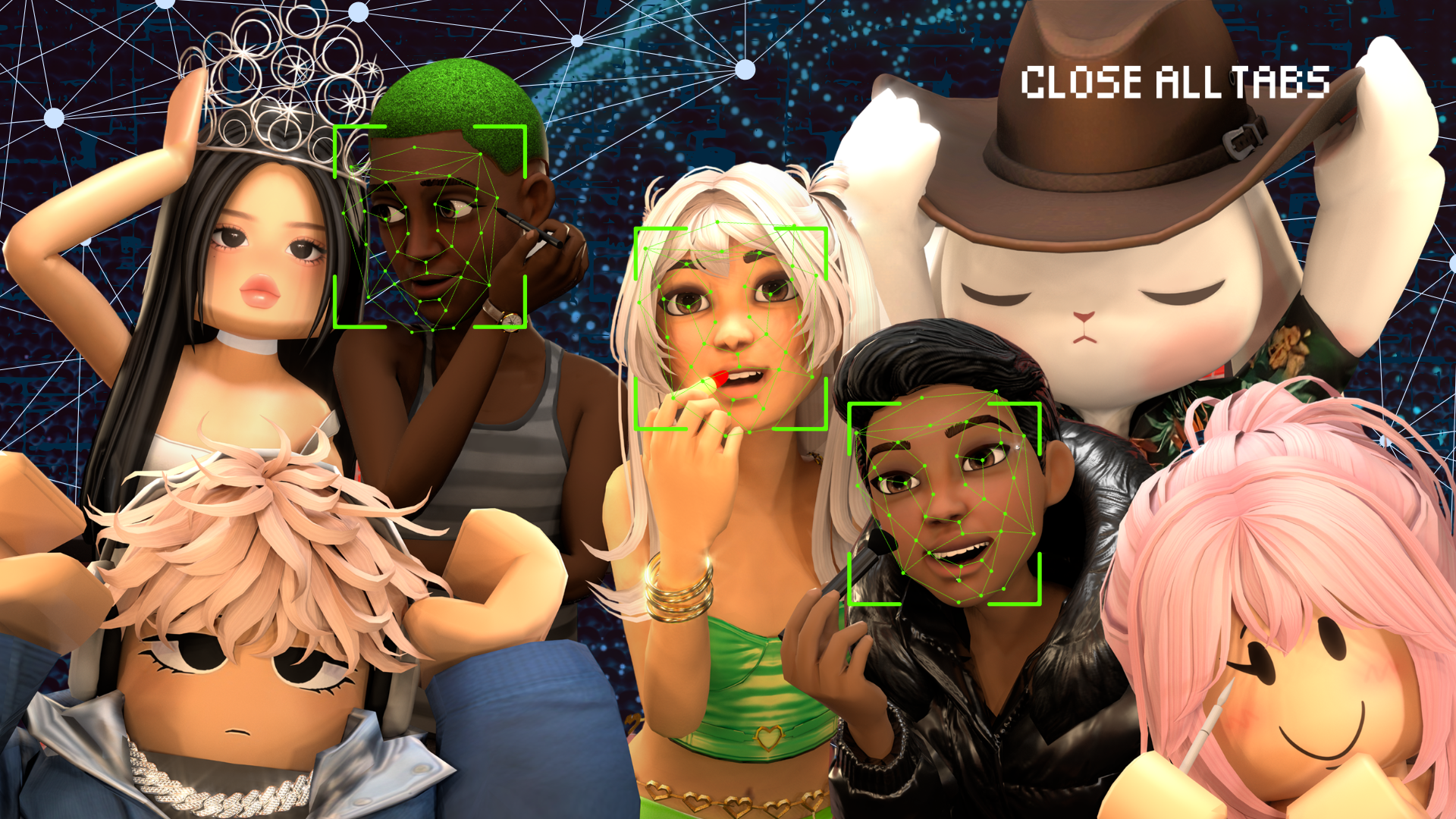
Almost all of these games are multiplayer experiences, and revolve around interaction with other players. Here’s the snag: Roblox introduced the new age verification system in select countries late last year, and in January, made it a worldwide requirement. It limits players’ ability to chat with others, based on their Roblox-determined age group.
Here’s another creator pointing out how much quieter Roblox is now.
[Audio clip from Youtube User Flamingo]
We have officially entered the new era of Roblox. We are in the silent era of Roblox. We are in the “shh” era.
Morgan Sung: Roblox rolled out age checks because the platform does have a real child safety issue on its hands. The company is facing over 80 lawsuits over allegations of child abuse and grooming. The lawsuits allege that Roblox not only markets its games to children, but also enables predators to contact underage users.
But a lot of players aren’t happy with the new system — and it’s not just because they’re siloed by age group. The way Roblox is determining players’ ages raises red flags when it comes to privacy. Many parents aren’t thrilled about the new system, either.
Today, we’re diving into the world of Roblox — and why age checks aren’t the perfect solution to child safety issues.
This is Close All Tabs. I’m Morgan Sung, tech journalist and your chronically online friend, here to open as many browser tabs as it takes to help you understand how the digital world affects our real lives. Let’s get into it.
Morgan Sung: Before we get into the privacy questions, we need to understand the Roblox landscape. Let’s open a new tab: The Roblox predator problem.
Morgan Sung: Rachel Hale is a USA Today reporter who covers youth mental health. She’s been reporting on child safety across digital platforms, and has been following the Roblox lawsuits.
She’s spoken to several parents who allege that their children were groomed by predators they met on the platform. Here’s Rachel, telling the story of Amie and her 13-year-old daughter.
Rachel Hale, Guest: In Amie’s case as well as in many others, the Predator initially reached out on Roblox and then moved the interactions and messaging to another platform. In Amie’s specific case, you know, you had someone who asked. Something that is irresistible to, to kids all around the world, “Do you wanna make Robux?”
Morgan Sung: Robux is the in-game currency that costs real money. Like a lot of freemium games, Roblox runs on micro-transactions; you get the base experience, but with Robux, you can buy cool outfits, use unique weapons, and get game passes that grant perks like accessing special areas.
After the predator reached out to Amie’s daughter through Roblox’s in-game chat feature, and told her that she could make Robux by playing a game. They told her that in order to play, they had to move to Discord.
Rachel Hale: They first asked Amie’s daughter to hold up two fingers to verify before they started the game, and then asked Amie’s daughter to send sexually explicit videos and images. But it didn’t stop there. It turned into, you know, what many people would classify as grooming. If Amie’s daughter went more than a few hours without contacting the predator, they would message, I’ve missed you.
He would shower her with affection saying, “I love you so much,” or sending her sexually explicit content of himself. “I would never leave you,” messages like that. It was relentless. And when Amie discovered what was happening to her daughter, she discontinued her daughter’s use of both Roblox and Discord and reported the username to the FBI. And this is a situation that has happened countless times and that I spoke with numerous parents about, um, with stories that sound really similar to Amie’s.
Morgan Sung: This is such a common problem that some creators have taken it upon themselves to confront predators. Like this one YouTuber, who goes by Schlep. He’s conducted Roblox sting operations, where he and other creators pretend to be minors, collect incriminating explicit messages from predators, lure them into in-person meetings and then alert police about it. To date, he’s documented six arrests in his YouTube videos.
[Audio from the account of Youtube user Schlep]
He was arrested and charged with three felony counts related to illicit material . . . I’m so proud to see our efforts at stopping predators finally make an impact beyond the screen… I don’t hate Roblox. I love it. And that’s why I care so much about this problem.
Morgan Sung: Schlep is kind of like a modern day version of Chris Hansen and To Catch A Predator. Schlep was even referenced in one of the child safety lawsuits against Roblox.
Bad actors exist on all online platforms, but child predation is especially prevalent on Roblox. Part of it is sheer volume because it’s so popular with kids — again, more than 40% of users are under 13. But other games are also popular with minors, like Fortnite or Minecraft. What makes Roblox different? Here’s Rachel again.
Rachel Hale: It’s a combination of the business model and the steps a company is willing to take towards safety, even if that could potentially harm their usage patterns and profits.
So Roblox uses a free model, some people might call it a freemium model. The game is free to download and play, and the company makes their money from players spending Robux. So from their in-game interactions. And the more time a user spends on the platform, the more likely they are to spend Robux and generate, um, money for the platform.
Minecraft, on the other hand, is a paid model and you buy it upfront, so there’s less incentive to push user interaction with each other. Take another example, like Fortnite. It’s got a similar freemium model to Roblox, but some safety advocates that I spoke with have credited Fortnite for choosing to implement it.
Kid protective features, like more options for private or controlled play zones. Roblox does have some of those same features, including parent controls, but in Fortnite, kids are usually playing with a smaller group, sometimes with their preexisting friends as opposed to roaming in these social spaces.
So Roblox is really set up based on having people, um, move through these different experiences and interacting with strangers in the public.
Morgan Sung: How has Roblox responded to this issue? How are people criticizing the way that they’ve responded?
Rachel Hale: I visited Roblox’s headquarters in San Mateo, California in December, to ask them about the steps that they’ve taken following these lawsuits and the criticism that they’ve received, and they emphasized that they take their child safety very seriously.
The biggest step that they’ve taken, uh, in this area is implementing a new facial age verification feature. It started rolling out in November in select markets and became mandatory on January 7th for anyone looking to use the chat bar feature.
Rachel Hale: So the way that it works is that once you open the app, if you wanna go to the chat bar, Roblox will now prompt any users past, present, anyone who’s on the platform to decide if they would like to go through facial age estimation or if they would like to not use the chat bar feature.
And if you choose to continue, it uses AI to take a scan of your face and estimates your age. Roblox, as executives told me that their data shows that it can estimate an age within two years of accuracy. And after that, users are placed into one of six different age groups.
They said that they were working on this feature and they wouldn’t necessarily portray it as like directly a response to these lawsuits, but of course it is in response to, um, the child safety issues that they’ve had. And they’ve really tried to emphasize that they’re the one of the largest platforms that has implemented this type of age verification. So that’s really the biggest step that they’ve taken in conjunction with their parental controls, which they say can make a big difference in how users, um, are, are engaging on the platform.
Morgan Sung: Because of Roblos’s new features, the age checks to chat now look like this and, bear with me here, you’re about to hear a lot of numbers. So if your child is under 9 years old, they can’t talk to anyone 13 or older. Kids between 10 and 13 can’t message anyone over 16. Users in the 13 to 15 group can’t chat with anyone over 17. But users who are 16 to 17 can’t chat with anyone under 13, or over 21. If you’re 18-20, you can chat with anyone over the age of 16, but not under. And if you’re over 21, you can only chat with users who are over 18.
If you’re overwhelmed right now, I don’t blame you. Roblox’s age-gating is pretty granular. It’s supposed to imitate the clusters of age groups that would interact in real life. Like, it’s appropriate for a 14 year old and 16 year old to hang out and be friends, but it would raise red flags if it was a 12 year old and a 19 year old.
Rachel Hale: I think that it is confusing for players. The way that Roblox has described it is that these groups are supposed to kind of mimic real life groups that you would see at like, a lunch table or you know, on sporting teams. So the idea is that users would be playing alongside other users who are of similar ages.
Morgan Sung: The AI estimation works by analyzing the user’s face for physiological markers that correlate with a specific age. A person’s face changes the most when they’re young, so it’s easier for the system to estimate someone’s age when they’re, say, between 6 and 10 years old as opposed to 40 or 45.
Rachel Hale: Once you go through the facial age estimation, you’re able to upload a photo of an ID if you, if it was incorrect, um, in estimating your age. But you know, as they’ve started to roll it out, there’s been a lot of talk about it online, especially in online communities like the r/roblox subreddit. So we’ve been able to already start to see some of the feedback there from current users of Roblox and I think that what users are concerned about is those cases where the facial age estimation feature is inaccurate.
And then you might have a user who’s 12, who is able to talk with 17 year olds or 18 year olds if their age is inaccurately estimated as 16. So these of course, are more the outlier cases, but there are enough of them that people have criticized it pretty heavily online.
Morgan Sung: We’re going to get into the community backlash against Roblox’s age checks in a new tab … after this break.
Morgan Sung: Welcome back! Roblox rolled out a new age verification system, but it can be inaccurate and now, Roblox players and their parents are raising concerns over it.
Let’s open a new tab: Did Roblox Age Verification flop?
Morgan Sung: Back in December, USA Today reporter Rachel Hale flew out from New York to visit the Roblox headquarters in San Mateo, California.
Rachel Hale: And when I was there, I was able to meet with multiple Roblox executives, including Matt Kaufman, who is the chief Safety Officer there, then Elizabeth Milo, Roblox Global Head of Parental Advocacy, and both of those people walked me through how they think about, uh, safety on the app. After we did our standard interviews, we did a demo of the facial age estimation feature and of the parental control features with two of the safety leads who had helped put together these features. So I was able to kind of pick their brains about how the AI was going to work in the facial age estimation feature.
So we walked through it with a phone and an iPad so that I could see what it would be like for a parent who had kids of two different ages, and I could see how that would change users experiences playing on the app.
Morgan Sung: So what did you expect going in? I know you tried the feature ahead of time and it wasn’t quite right.
Rachel Hale: I will say I was disappointed with the features accuracy, because Roblox had emphasized in prior press conferences that it would be within two years of accuracy. And because I’m under 25, so I’m still in that younger range that they said the accuracy is usually within those two years. I was hoping that it would get my age within one to two years. But when I did the demo, I tried it the night before in my hotel room, not wearing any makeup, you know, with kind of different lighting behind me. And then I did it again the next day at their office wearing a full face of makeup with much brighter, better lighting on me. I’m 24, and both times it estimated my age as 18 to 20.
So I found that that didn’t make a difference. I have seen users online talk about things like, how facial hair, things like that, how that might impact what age you’re estimated as.
Morgan Sung: Some players have complained that they were incorrectly placed in older age groups because they went through puberty earlier than their peers. And others have complained that they were incorrectly placed in younger age groups because they just look younger.
Another thing that I’ve seen anecdotally online in some of these same online forums, um, or in direct messages to me, are concerns about kids who might have different developmental markers.
So maybe someone who’s, you know, has developmental disability that might change the way that they look and that’s a valid concern. I think that that exists across platforms with age verification. So that’s not specific to roblox.
Rachel Hale: If you spend some time, like you said, in Roblox Communities online, a lot of users are really unhappy with this change. Their concern is that it hasn’t actually worked to solve child safety because of issues with accuracy.
I’ve seen parents who are concerned because their kids who are maybe 12 years old have used the feature and it’s estimated them as 15 and now they’re able to be on the platform without the parental controls. And it’s very hard for the parent to kind of roll that back, um, unless the kid is willing to cooperate with them.
Morgan Sung: And now, YouTube and TikTok are brimming with tutorials for bypassing the age check system.
[Snippet from How to unlock chat in Roblox video]
In this video, I’m going to be showing you exactly how you can verify your age on Roblox and unlock any Roblox feature you want, including the chat. And this works for all ages.
Morgan Sung: The facial recognition system isn’t that difficult to trick, either. Users have managed to pass as adults by drawing fake mustaches on themselves, or by caking on really heavy, Jersey Shore-type makeup. They’ve also gotten around it by scanning videos of other people’s faces. On YouTube, there’s this video from 12 years ago, of a woman slowly turning her face left and right, for artists to use as a figure drawing reference. Today, that video has more than half a million views … and nearly all of the 800 comments are from Roblox users who’ve used her face to pass the age check.
Rachel isn’t surprised at how far users are going to pass as adults.
Rachel Hale: I wish I could say that I was, but I think when you have a platform this big, you know, there are going to be people who will go to any links, uh, especially just at scale with how many users there are. So taken in isolation it does feel, um, pretty alarming, but put into context, it makes sense with what we know about Roblox.
We’ve also seen people start to try to work around the chat feature as a whole by making custom avatars that might say their discord username or username for another platform, which then circumvents the, the whole purpose of the safety in the feature and the idea of getting people to keep the chat in game.
I’ve also even seen things as extreme as people talking about someone selling an underage account on eBay (this was later taken down.) So we’ve definitely seen Roblox users start to try to either circumvent the system, uh, and who have been extreme in their criticisms that it hasn’t really been accurate in solving the safety issue.
Morgan Sung: The AI facial age estimator seems pretty concerning to a lot of people, especially parents. Can you explain why this technology is so controversial?
Rachel Hale: So part of the reason that the artificial intelligence is controversial is because people have data privacy concerns. The artificial intelligence here is used to estimate the user’s age after the face scan and the picture is deleted afterwards. Roblox outsources this to a company called Persona and says that users can trust that their picture is deleted afterwards.
But some families that I spoke with, and you can also find this on Reddit and online communities, people have concerns because of issues with similar features on other platforms. For example, in October of last year, the messaging platform Discord had hackers who compromised five CA, their third party vendor that they used for age verification, and stole nearly 70,000 images of government issued IDs in Australia and the UK.
So even though Roblox says that you can trust that artificial intelligence, um, I think that people have some concerns because of what’s happened on other platforms with similar features.
Rachel Hale: I think that parents who are tuned in enough to what’s happening on Roblox are already having conversations with their children about digital safety. Um, I think that the real issue is kids whose parents aren’t tuned in, and so they’re probably making decisions about whether or not to use the feature without parental input.
But I do think that a lot of parents who are already tuned into Roblox and are closely following their children’s gameplay, some of those parents have made the decision to not use the feature and to instead decide that their child won’t use the chat bar feature.
Morgan Sung: Roblox’s age checks are an attempt to prevent predators from interacting with children, but that’s not the only reason the platform rolled it out. It’s also to comply with the United Kingdom’s Online Safety Act, which went into effect last year. This law requires all internet users to be at least 18 to access quote, “harmful content.”
Certain Roblox experiences that are more graphic or have more mature themes are rated as “Restricted.” They’re for players who are at least 18. Now, only players who have verified their age with Roblox can access this content.
“Harmful content” is a very broad umbrella — and now, many websites and social platforms are enforcing age checks like Roblox. Efforts to age-gate the internet are sweeping Europe, Australia, and here, in the US, too.
But like we’ve explored in this deep dive, it’s not going great for Roblox. Surely there are other ways to protect children.
We have time to open one more tab. Right?: Is Roblox’s method the future of age verification?
Morgan Sung: Roblox CEO Dave Baszucki isn’t exactly helping the situation, either. Late last year, he went on the New York Times tech podcast Hard Fork to talk about the age-gating policy. Here’s how he responded to a question about Roblox’s predator problem:
[Hard Fork Podcast clip]
David Baszucki: We think of it not necessarily just as a problem but an opportunity as well. How do we allow young people to build, communicate and hang out together? How do we build the future of communication at the same time? So we, you know, we’ve been, I think, in a good way working on this ever since we started.
Morgan Sung: Here’s Rachel again.
Rachel Hale: I mean, there’s been a lot of criticism toward Roblox. And as you’ll see in that New York Times interview, you know, uh, a lot of head employees at the company, it’s really tense when they’re asked about it because they know that they’re pushed between a rock and a hard place.
And so, uh, Dave and other top employees there who are in charge of safety, like Matt Kaufman, have faced a lot of personal and direct criticism over the ways that they’ve led child safety on the app. And I think it’s an issue that Roblox will continue to have to deal with.
Morgan Sung: In some ways Roblox seems to be in a real lose-lose situation. Um, I mean, they had to respond to the predator issue and the lawsuits, and yet the solution that they’ve come up with has been received incredibly poorly. How do you think the company views the situation that they’re currently in?
Rachel Hale: I think that question is what they’re going to have to think about this year. And ultimately if more of these lawsuits continue to come out. I think that they will have to consider more heavily if they want to continue to prioritize profits or if they would move to implement safety features that would maybe take a hit toward the number of users on the platform. So I think that they’re going to have to think about that decision much more heavily this year than they have in the past as these lawsuits have continued to gain a lot more publicity and traction.
The other two things that the company has faced a lot of scrutiny over that I think they’ll need to consider in line with this, um, is their removal of so-called vigilantes from the platform who, you know, call themselves predator hunters. Roblox faced a lot of scrutiny over their removal of these vigilantes, uh, without more efforts put toward the actual child safety issues on the platform.
And then there’s also been a push for some legal cases to be resolved via arbitration instead of in public court. And Roblox has faced a lot of criticism over not having these cases play out more publicly, uh, because a lot of safety advocates and families feel that that’s what would be in the best interest for, for the public in terms of transparency and accountability. So I think that Roblox is going to have to really think about those different things in line with the child safety this year.
Morgan Sung: Are there any other solutions that have been suggested?
Rachel Hale: A lot of people have suggested that Roblox remove the chat feature altogether for in-game. How plausible this is? I’m not sure. Um, I think that that would change the entire nature of the game. Other people have brought up that Roblox could implement more options for private play among friends that you already know.
The way that that works right now is through something called trusted users. So you could play with someone who’s not your exact age, but who through parental controls has been listed as a trusted user, like an older cousin or an aunt or uncle, that type of thing. Um, but some safety advocates have brought up that it would be beneficial for Roblox to put more efforts into those private play places, uh, or groups as opposed to putting so much emphasis on the public gameplay, uh, between each other.
The issue there, again, is it comes back to profits and the way that the platform is set up and because the profits are based off of users, um, generating new games or experiences and using those in-game robux. The incentive is definitely to keep people playing with each other in a public space and moving through as many new games as possible.
So I think that Roblox will have to make some decisions about their priorities in terms of, um, profits compared to child safety.
Morgan Sung: As you mentioned like, earlier in our interview, Roblox really sees themselves as pioneering this technology. Do you see other companies like Fortnite, like Minecraft, um, I guess Club Penguin, if it was still around by like, also adopting a kind of facial recognition, age verification?
Rachel Hale: I think that based on how Roblox’s rollout has gone, places who may have been looking into this will probably take a longer pause to think about the best way to implement it. I do think a lot of the concerns come down to AI and how accurate it is, and even though Roblox has emphasized that they’ve been the first to do this and that they’ve been leading the way.
Roblox also has a much larger issue with child predators than Minecraft or Fortnite does. So I don’t necessarily see other platforms moving to implement this right away as a result of Roblox. If anything, I think people are probably looking at how Roblox’s user database has responded and thinking about that and how they’re shaping their responses to safety on their own platforms.
Morgan Sung: This situation with Roblox especially, it comes at a time when age verification is being pushed all over the internet, um, often through legislation in Australia and the UK, soon enough probably here in the U.S. How does that impact the larger conversation around this issue and the way that other gaming platforms will probably also have to, in some way, age-gate their content?
Rachel Hale: I think that it continues to make it so that it’s a norm of these platforms. You know, um, five years ago, hardly any platform had an age verification feature. We’re seeing the same thing with Beyond Games, things like sports betting platforms, you know. We’re seeing it go from a user-oriented age verification, where it’s just you’re putting in an email and checking and it’s very easy to just check the box they’re over 13, to an actual form of verification. What that verification looks like likely will differ between platforms, but I do think that Roblox implementing this feature has contributed to that wider norm of age verification being a more common practice on online platforms.
Morgan Sung: As a youth mental health reporter, what are you keeping your eye on when it comes to this situation?
Rachel Hale: I think that right now I am really looking at how not just the general community is responding, but how parents are responding. One thing that we did is we did an AMA, like, an ask-me-anything in the r/roblox subreddit and it was really interesting to see the questions that different families had about Roblox and about this new feature.
So I think I’m keeping my eye on how that community continues to respond and then also on how these lawsuits are going to play out. and if we’re going to see more. The other thing that I’m looking at in conjunction with Roblox is Discord and other platforms. Because even if the initial messaging with a predator happens on Roblox, it is then usually turning to other platforms that, you know, have turned into situations where a child is really unsafe. So I think that that goes hand in hand with the issues on Roblox, and it’s something that I’m continuing to look into.
Morgan Sung: Roblox’s age verification system is unique, because the platform is trying to tackle a very real problem with predators. But age gating is becoming the norm online, as platforms face increasing pressure to keep kids from seeing potentially harmful content, namely, porn. But restricting access to sexual content opens the door for broader censorship, beyond just porn.
So what does this have to do with free speech? A lot more than you’d think. For years, sex workers have been ringing the alarm bell when it comes to online surveillance and censorship. If age verification does become the norm, the internet will change for everyone and cracking down on porn is the first step.
We’re diving into that next week. But for Roblox, let’s close all these tabs.
Close All Tabs is a production of KQED Studios, and is reported and hosted by me, Morgan Sung.
This episode was produced by Maya Cueva, with support from Gabriela Glueck. It was edited by Chris Hambrick.
Our team includes our senior editor Chris Egusa, who also composed our theme song and credits music and Jen Chien, who is the Director of Podcasts. Additional music by APM. Brendan Willard is our audio engineer.
Audience engagement support from Maha Sanad. Ethan Toven-Lindsey is our Editor in Chief.
Some members of the KQED podcast team are represented by The Screen Actors Guild, American Federation of Television and Radio Artists. San Francisco Northern California Local.
This episode’s keyboard sounds were submitted by my dad, Casey Sung, and recorded on his white and blue Epomaker Aula F99 keyboard with Graywood v3 switches, and Cherry profile PBT keycaps.
Do you like these deep dives? Are you closing your tabs? Then don’t forget to rate and review us on Spotify, Apple podcasts, or wherever you listen to the show! Maybe drop a comment too! And if you really like Close All Tabs and want to support public media, go to donate dot KQED.org/podcasts
Thanks for listening!