Sponsor MessageBecome a KQED sponsor
upper waypoint

Church Members Maintain Presence at Santa Ana Immigration Court

Save ArticleSave Article
Failed to save article

Please try again

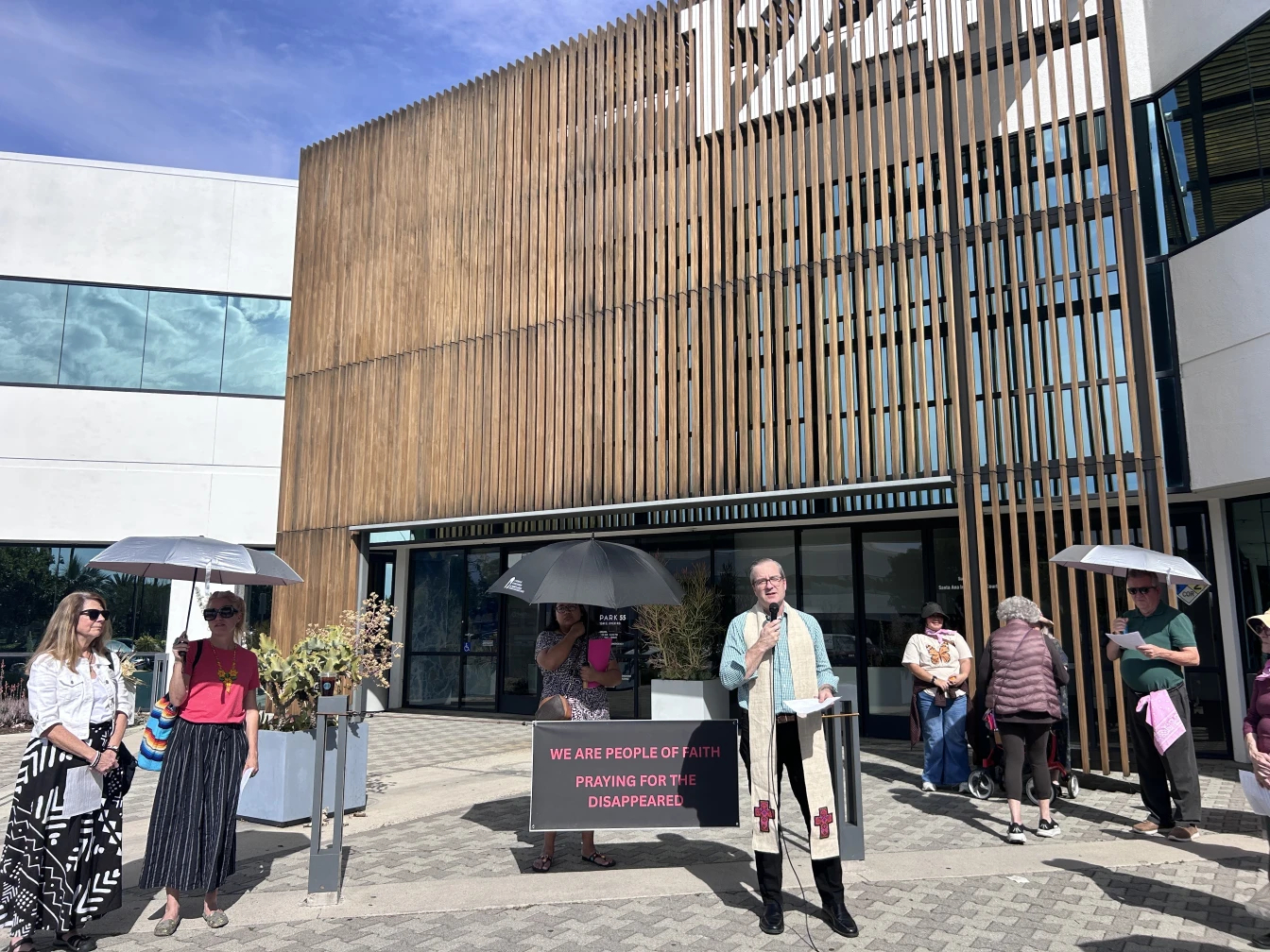
Nathan Hall, pastor at Church of the Foothills, leads a prayer vigil outside of Santa Ana Immigration Court on Feb. 5, 2026. (Jill Replogle/LAist )

Here are the morning’s top stories on Tuesday, Feb. 24, 2026

  • Since last summer, when the Trump administration ramped up deportation efforts, a group of volunteer observers has kept a constant presence at the Santa Ana Immigration Court.
  • A four-week strike by thousands of Kaiser Permanente health care workers in California and Hawaii is ending Tuesday morning, even though no contract deal has been reached.
  • Cities on the US-Mexico border remain on high alert following a weekend of violence, in response to the killing of a cartel leader.

At Santa Ana Immigration Court, church members keep a watch on changing deportation policy

There’s nothing grand about Santa Ana Immigration Court. Tucked in the corner of an office park between two county health agencies, you’d hardly know it was there. Which is why a group of volunteer court observers shows up on a daily basis — to keep tabs on immigration policies that seem to change by the week, and to channel resources to people facing deportation.

“People feel comforted by just seeing us there, especially that we are people of faith,” said Jennifer Coria, who coordinates the immigration court observer program for the group Clergy and Laity United for Economic Justice, or CLUE. Observers come from churches and other religious entities across Orange County and L.A. They’re encouraged to wear something that signals their faith, or, if they’re clergy, to show up in religious attire.

“We want the judges to know that we are coming from a faith community and they see that there’s moral presence in these spaces,” Coria said. The immigration court observer program is among dozens of grassroots efforts that have popped up around Southern California and across the country in response to the Trump administration’s mass deportation campaign. Other groups are patrolling neighborhoods to alert residents of ICE raids, delivering food boxes to immigrant families scared to leave their homes, and posting up at Home Depots to accompany day laborers who have been a frequent target of the raids.

The court observers in Santa Ana aren’t there to protest inside courtrooms or try to block deportation orders. But they say they’ll keep showing up to offer pro bono legal resources and, at the least, moral support for vulnerable members of their community. “They’re my neighbors. It’s like, why wouldn’t I defend them?” said Diedre Gaffney, one of the court observers.

Sponsored

Last summer, when the Trump administration began its crackdown in earnest, ICE officers would often sit inside, or just outside courtrooms, and take people into custody as soon as their case was dismissed. At the time, the court observers concentrated on getting personal information from the detainees so they could contact their families and help them locate their loved ones in ICE facilities. These days, observers say they haven’t seen ICE agents in courtrooms since the fall. So the observers’ mission has shifted to trying to get legal representation for people facing deportation proceedings without a lawyer.

Widespread Kaiser strike end after 4 weeks with no deal yet

A four-week strike by thousands of Kaiser Permanente health care workers in California and Hawaii ended Tuesday morning, even though no contract deal has been reached, according to the union.

The walkout initially involved up to 31,000 nurses, physician assistants, physical therapists and others. Following significant movement at the bargaining table over the weekend, according to the union, no picket lines were held on Monday as return-to-work agreements are finalized. “Returning members to their patients and their livelihoods is the clearest path to securing a final agreement and building on the progress achieved during the strike,” said a statement by United Nurses Associations of California/Union of Health Care Professionals, which notified Kaiser that the strike concluded at 7 a.m. Tuesday. Kaiser, the nation’s largest private nonprofit health care organization, did not immediately respond to a request for comment.

Pressure had been mounting on both parties to end the walkout, which began Jan. 26 and was dubbed the largest open-ended strike by nurses and other health care workers in the U.S. Top priorities in negotiations for Kaiser employees were staffing levels and compensation, common concerns for health care workers nationwide. The company tried to minimize disruptions to patients by hiring contingency staff, rescheduling non-urgent surgeries and modifying other appointments at affected locations. But some patients were frustrated by delays in their operations, especially in Southern California, where most striking union members are located.

Tijuana was calm Monday after Sunday’s violence in response to killing of cartel leader

Tijuana was left relatively unscathed after a night of cartel-fueled violence throughout Mexico Sunday.

Chaos erupted after the Mexican military, supported by U.S. intelligence, killed Nemesio Rubén Oseguera Cervantes, the leader of one of Mexico’s most powerful drug cartels , near the city of Guadalajara. Members of the Jalisco New Generation Cartel responded to the slaying of their leader, who was known as “El Mencho,” by setting businesses and vehicles ablaze throughout Guadalajara. The cartel also shut down the city’s international airport by forcing passengers of an airliner to disembark before setting the plane on fire.

Similar violence erupted in the Mexican states of Jalisco, Quintana Roo, Guanajuato, Guerrero, Michoaca, Oaxaca and Baja California.

The U.S. Consulate in Tijuana warned U.S. citizens to shelter in place, avoid unnecessary travel and stay away from large crowds. The consulate also suspended all visa and U.S. citizenship services Monday.

The Jalisco New Generation Cartel unleashed a similar wave of violence in 2022 – when the Mexican military arrested several high-level members. In Tijuana, cartel members burned 24 vehicles and blocked several roads during the mayhem. Cecilia Farfan leads the North American Observatory, Global Initiative Against Transnational Organized Crime. She said she remains “cautiously optimistic that this calm will remain.” Farfan went on to say the cartels typically respond like this whenever their high-level leaders are detained or killed. In part, they do it to put pressure on Mexican authorities to release their captured allies, she said.

lower waypoint
next waypoint
Player sponsored by