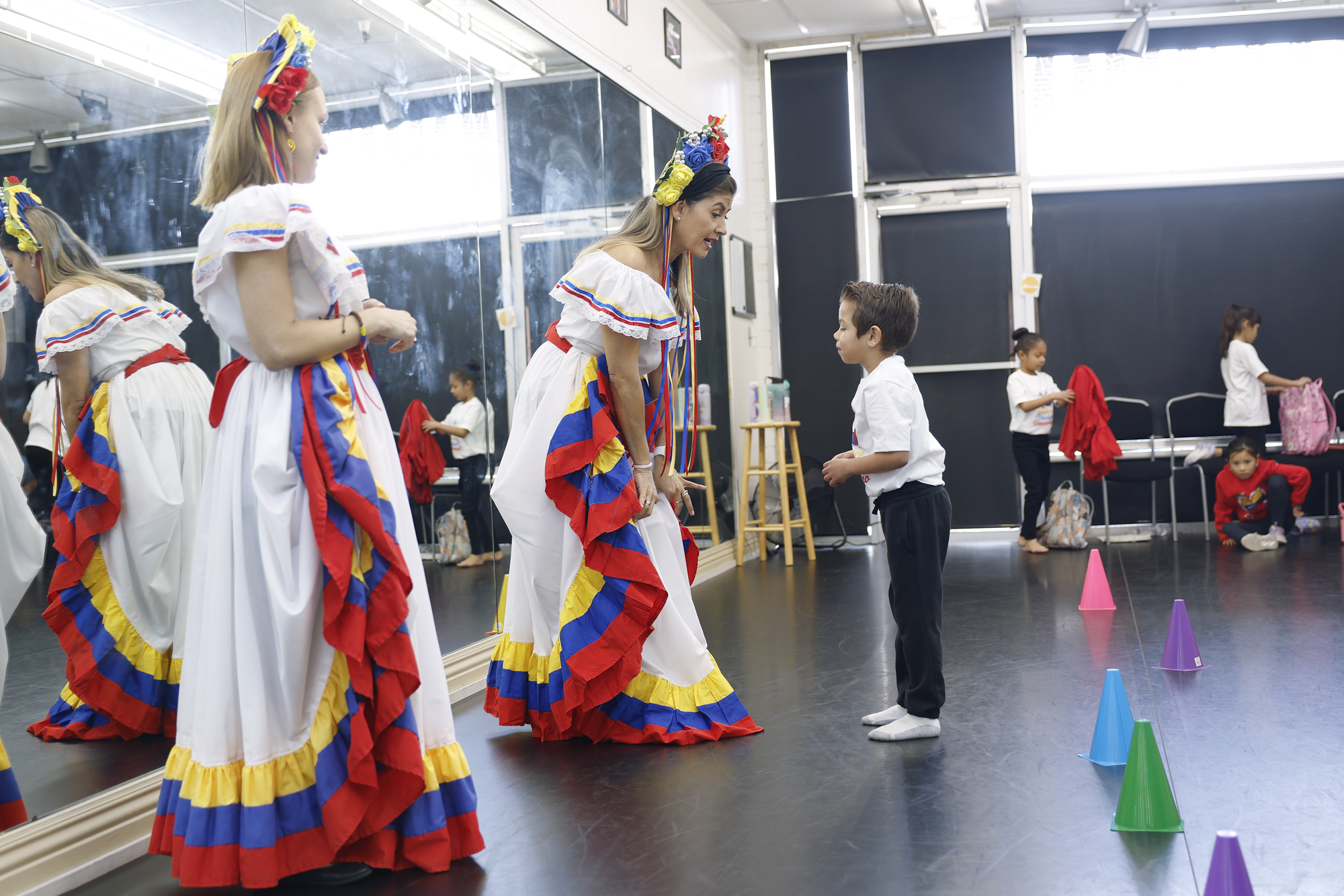
Blanca Torres: [00:01:28] I was interested in just learning more about the Venezuelan diaspora here in the Bay Area.
Ericka Cruz Guevarra: [00:01:35] This is my colleague Blanca Torres. She’s a reporter and producer here at KQED, and she went out to visit this dance studio for Que onda, KQEd’s monthly newsletter spotlighting the Bay’s Latinx community.
Blanca Torres: [00:01:54] I am of Mexican descent and feel pretty represented in the Bay Area, but I know that other groups that don’t have as big of numbers in the Latino community are often overshadowed or just don’t really have a big presence here.
Ericka Cruz Guevarra: [00:02:11] The Bay Area has a relatively small Venezuelan population, with an estimated 23,000 Venezuelans in California. So Blanca wanted to know, what does community look like for the Venezuelans who are here?
Blanca Torres: [00:02:29] I learned a lot about just what it’s been like for Venezuelan people to have a country that was once very prosperous and just see it disintegrate politically, socially, economically. And now Venezuelans are spread all over the world. It’s a very fragmented community for Venezualans.
Ericka Cruz Guevarra: [00:02:48] At Dulce Tricolor Venezolano, Venezuelans gather with that very specific understanding of fragmentation, of displacement, and they find belonging in that and connect through dance. So today we’re going to take you inside a dance class with Dulce Tricolor to hear about what this group means to the Bay’s Venezuelan community, in their own words.
Michelle Paulin: [00:03:29] So I’m Michelle Paulin and I’m the founder and executive director of Dulce Tricolor Venezuela. Dulce is sweet. These are sweet, cute, beautiful cats, so that’s where the Dulce came. And Tricolor is our flag, it’s yellow, blue and red, so it’s the tricolor of the flag. So Dulce, Tricolor, Venezuelano came from that. It’s an organization that is showing the cuteness within the country, the beautiful, the sweet of the country. And we have this flag that we feel proud of. We’re teaching traditional Venezuelan music. So in Venezuela, there are all sort of rhythms, like if you talk to the new generation, that will be merengue and salsa and reggaeton. But we also within Venezuela grow all the time listening to Joropo. That’s a traditional Venezuan dance. Listening to tambores, there is no party without tambores. And when you are a kid at school, there are always these end of the year performances. And the different grades are assigned different music that they learn. So what we are teaching us is reminding me and my older friends of when we were kids and we were at school and we had to perform the joropo or the tambores. And then that’s what we decided to do. Let’s rescue that traditional music that is still as part of parties, et cetera, but teach them the traditional steps. Well, for me, the first time I found my community, I was walking at the supermarket, and somebody hear me talking, and she approached me and she said, you are Venezuelan? Yeah, I’m Venezuelana. And she’s like, oh, come and join this WhatsApp group. And I feel the place you grew up actually define a lot of who you are. And despite, as I said, I have friends from everywhere, but being close to Venezuelans gives me a special fulfillment. I get out of being with people that speak the same language and the same culture, etc.
Michelle Paulin: [00:05:39] We decided that we wanted to make sure that our kids, some of them born in the U.S., some of the born in Venezuela, were able to carry on with the traditions that we have in Venezuela. We wanted to teach them about what Venezuela meant, how Venezuelans felt.
Sounds from the dance class: [00:05:58] Y diciendo viva dulce tricolor venezolano!
Michelle Paulin: [00:06:08] Although we speak Spanish at home and we eat arepas and all the stuff, having something more structured was better. We started back in 2019 just as, okay, friends, let’s go and practice. Let’s go dance. And we started instructing them. And then, unfortunately, six months later, COVID happened. And I was like, oh my God, what do we do now? We said we didn’t want to stop it. So we actually set classes on Zoom. And then we pivot a little bit. We were doing dance, but also Venezuelan traditional games, talking about traditions. And then when we were able to come back in person, we actually did, we started doing it in the park. We didn’t want to lose what we started.
Lara Miras: [00:06:48] My name is Lara Miras and I’m 10 years old.
Katarina Boscon: [00:06:51] My name Katarina Boscon and I am 11 years old and I think I’ve been since the dance company actually started.
Lara Miras: [00:07:01] I think it is such a wonderful thing to be able to share your culture through dance. I really like dancing and being with my friends.
Katarina Boscon: [00:07:12] When you’re in the older levels, you get to create your own dance, and it’s really fun, especially through the community and all the friends. I really like those that take a lot.
Lara Miras: [00:07:22] Well it’s definitely a life changing experience because not only do you get to represent your country and the people you love and dance for, but you also get to share a community and it’s very loving and inspiring. It will definitely change your life because when I came here I didn’t, we had like not many friends, but like once you enter it’s really good because of that community.
Katarina Boscon: [00:07:50] I feel proud of being Venezuelan because I love eating arepas. The things that I do not like is that I don’t like how social they are. It’s too overly social, but I like arepas and panadas going to the beach and I like the parties.
Sounds from the dance class: [00:08:07]
Lara Miras: [00:08:11] It’s uncommon and I’m proud to be uncommon because I get people when I was asking at my school like, oh your friend is good, what is his like, do you like the food, everything. Well I was born there but I don’t remember much. It feels like it’s such a big country but it feels like everyone knows each other there because they’re so kind. I would really recommend you to go to at least one or two shows and at least see, especially our new exclusive dances that we’re practicing. It’s going to blow your mind, and also the costumes and the community.
Michelle Paulin: [00:08:48] We bring songs to our shows that express what Venezuela is and what we hope for Venezuela. So in this event, we have plans to sing two of those songs. So one is called ‘My Illusions,’ and it refers to having all your hope and illusions in a country that hasn’t been in the best positions of all right now, but is moving towards a positive future. And the other one is call Venezuela. And it’s not the national song, but it’s kind of the national sound. Wherever you go, somebody lives in Venezuela and you cannot stop just crying. Because it just spreads the feelings of people that were born there and how you experience your country and how, no matter what, at the end of life, you want to be one way or another one back to Venezuela. I have family still in Venezuela, so I keep connected. There is still a lot of repression internally. They cannot really openly talk about what’s happening and interchange WhatsApp messages. Like my WhatsApp messages with my family in Venezuela are filled of prayers and good news because they cannot talk about was happening. While my conversation with my friends here is different. It’s like, okay, well, what’s happenin’? I saw this on the news. This is happenin’. Look at what this person say. So we have freedom of speech, which they don’t have there. So the way we feel that we support them… Being here in the U.S. Is by, again, like keeping Venezuela alive and making sure that people don’t only listen to the bad side of the news, but also to what Venezuela was and hopefully will be soon enough.
[00:10:29] What do you think is important for people who aren’t from Venezuela to know about Venezuela?
Lara Miras: [00:10:35] Just know that even apart from like all the news breaking, Venezuela is still a wonderful and beautiful place where you can go and enjoy.
Katarina Boscon: [00:10:43] It’s important for me to be exposed from Venezuela because I do not want to forget to learn the language and I do not want forget the culture.
Michelle Paulin: [00:10:52] I’d like to see the community growing, while at the same time I also feel a little nervous about some part of that community came with the TPS and those figures that were created to protect Venezuelans. And now they’re struggling a little bit because they’re in a situation where it’s not well defined. Where are they? Are they standing in safe ground or not? So that’s also a little worrisome and give us the need to also help where we can. We don’t know what the future will bring. We don’t really know if the future will be better or not, based on what happened recently. But give people, again, that hope, that feeling that hopefully we’re gonna be dancing this Oroppo in Venezuela sometime soon. But giving that space for people to express, again, let the feelings flow because it’s conflicting right now. We bring songs to our shows. That express what Venezuela is and what we hope for Venezuela. But the main objective is to get a space to express our feelings about what’s happening.