Ericka Cruz Guevarra [00:00:03] I’m Ericka Cruz Guevarra and welcome to The Bay, local news to keep you rooted, and welcome to The Bay’s monthly news roundup where we talk about some of the other stories around the Bay Area that we have been following this month. I’m joined by senior editor Alan Montecillo. And our very special guest this month is housing reporter Adhiti Bandlamudi.
Ericka Cruz Guevarra [00:00:29] Well, I mean, I think it’s probably on top of everyone’s minds this week, this month, just in general, everything that’s happening in Minnesota. Yeah, I don’t know how you all are feeling, but it is sort of, you know, one of those moments where we’re here in the Bay Area, we cover local news, but there’s sort of this big national story hanging over absolutely everything.
Alan Montecillo [00:00:52] It’s hard to believe that it’s just the end of January. We started the month right off the bat with covering Venezuela, PG&E, flooding in Marin. That already feels like a lifetime ago, honestly. And Minneapolis has dominated the headlines this week. And yeah, it’s hard not to think about it as a journalist and just as a citizen of this country, it feels bad.
Ericka Cruz Guevarra [00:01:17] Yeah, and to dive right into the stories that we’ve been following, Alan, I know you’ve been looking into local responses to what’s been happening in Minnesota, right?
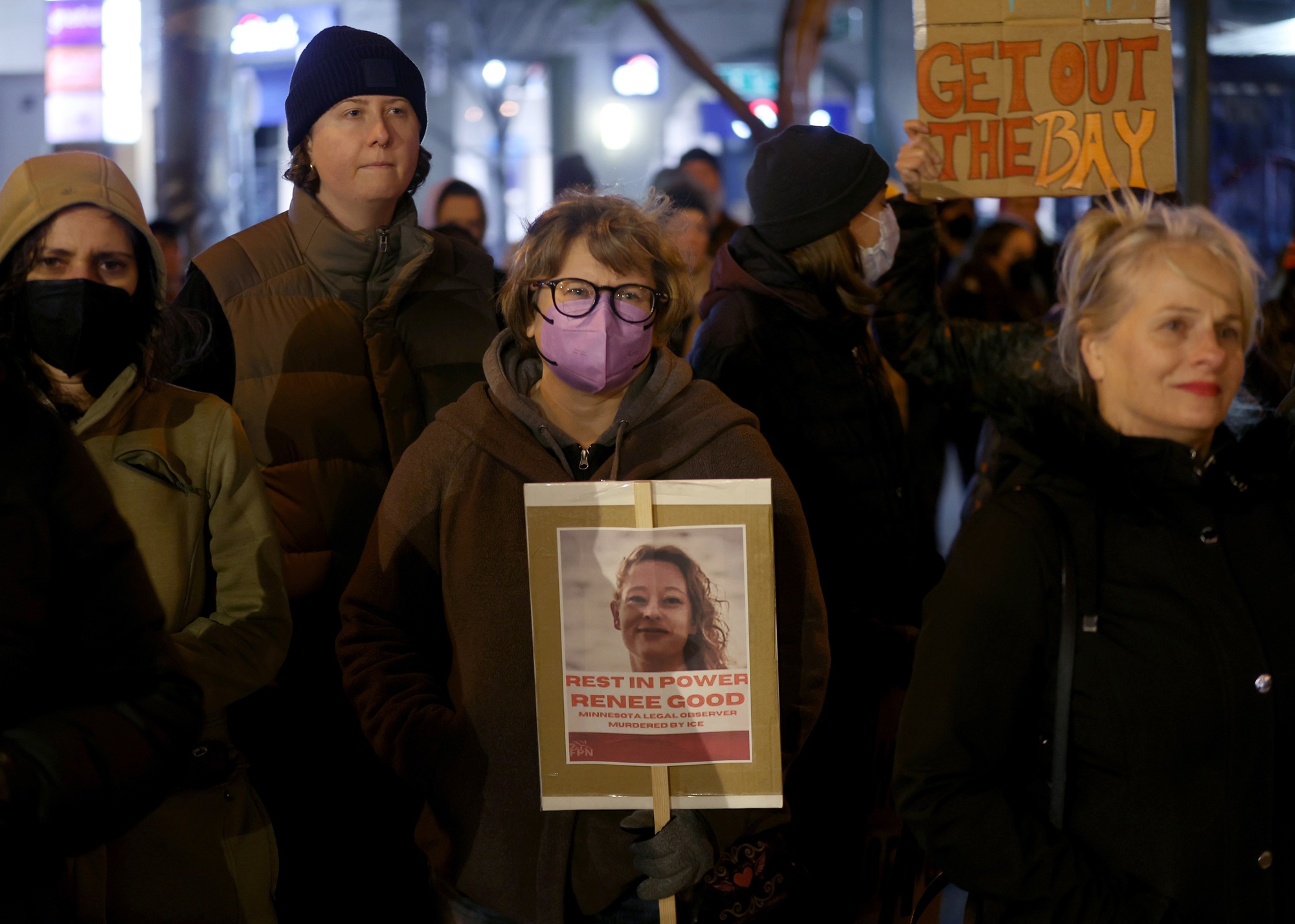
Alan Montecillo [00:01:26] Yeah, obviously, this has been top of mind for lots of people in the Bay Area. But I also wanted to highlight the response from, in particular, nurses. As people may know, Alex Pretti, who was shot and killed by two border patrol agents on the 24th, was a ICU nurse at the VA. And I think many, many nurses especially were really shaken by, you know, one of their own essentially being killed by the government. And earlier this week, our colleague Farida Jhabvala Romero attended a vigil that was held by Bay Area nurses outside Kaiser, actually, in San Francisco.
Alan Montecillo [00:02:10] Nurses there were holding up signs saying, nurses care for all people. One union organizer led a chant to abolish ICE. And one nurse who spoke to our colleague, his name is Chase Ballard. And he actually showed up right after a 16 hour shift.
Chase Ballard [00:02:27] I’m really emotional, because I’m pretty active in the community and I think it very easily could have been me. And I think that it’s just, we’ve come to a very harsh stopping point. Like we can’t let this go on in America. Like this is America, what’s happening, you know?
Alan Montecillo [00:02:40] So, yeah, I mean, you can hear his voice shaking there and yeah just this sentiment that you know, enough. You know what are we ,what what are you doing here?
Adhiti Bandlamudi [00:02:49] I feel like I was reading a story in the SF Standard about how, like, even Silicon Valley kind of sort of responded to ICE. You know, it was a kind of sorta response. It wasn’t, like full-fledged, like we are opposed to this.
Alan Montecillo [00:03:06] Yeah, I mean, and as many people know, many big tech CEOs have really lined up behind President Trump in his second term. And many have been very hesitant or cautious to criticize the president or his administration at all. You know, this week you did see some of them start to say, hey, like, I don’t normally weigh in on this stuff, but this is this is not okay. I’m very disturbed by what’s happened. Um, the other thing that’s happened that is interesting is that you’re seeing some increasing discontent among tech workers themselves, who I think have been quite politically active in the last few years, but it’s sort of quieted down over the last, you know, more recently.
Adhiti Bandlamudi [00:03:46] But I feel like the whole H1B stuff kind of like reignited concerns about their own stability in this country.
Alan Montecillo [00:03:53] Oh, totally. Yeah, definitely. And so we’ve seen a little bit more of that this week. There’s an open letter called ICE Out Tech with hundreds of tech workers who are urging CEOs to speak up more. A union that represents about 1,400 workers at Alphabet, that’s the parent company of Google, wrote a letter condemning ICE. And yeah, I mean, fair to say, many H1B visa holders as well, many people who are here from other countries who may feel very strongly about this and aren’t speaking out. For fear of repercussions. So will that pressure lead to meaningful shifts from big tech titans, CEOs? It remains to be seen, but we’re obviously seeing outrage among people in tech as well.
Ericka Cruz Guevarra [00:04:36] So you talked about nurses, Alan, you talked about the tech industry. What about our local representatives here in the Bay Area? What are they saying about what’s happening in Minneapolis? I’m sure this is top of mind for them as well.
Alan Montecillo [00:04:50] I think that in general, even before these killings, state and local officials have been talking about and proposing measures that could restrict the power of federal immigration enforcement in California. Obviously, that power is limited. This is still the federal government we’re talking about. But you know, the state does have levers to pull here. Last year, lawmakers set aside $25 million for legal nonprofits to efend residents facing detention or deportation. There was also a law passed last year that bans local and federal law enforcement from wearing masks, although that is currently facing a legal challenge from the Trump administration. And a couple of new bills in the works too. The State Senate just passed a bill making it easier to sue immigration agents and other federal officials. That was proposed by Senator Scott Weiner. Obviously, this bill is relevant because the question of accountability for federal agents is very top of mind for a lot of people. If the federal government won’t hold them accountable, can the state do that in some way? I think a lot Bay Area officials are thinking about the myriad but limited ways that they may have some leverage over immigration enforcement.
Ericka Cruz Guevarra [00:06:06] Well it’ll be interesting to see how else our legislature and our local governments respond to what’s happening in Minneapolis. So thanks for bringing that story on. And we’re gonna take a quick break, but when we come back, we’ll talk more about the stories that we have been following this month. Stay with us. And we’re back with The Bay’s local news roundup where we talk about some of the other stories that we’ve been following this month. Adhiti Bandlamudi housing reporter at KQD, I wanna turn to you. You have been following the saga that is California forever. There are just endless updates on that story, but you’re bringing us yet another one. What’s the tea? What’s latest drama on that?
Adhiti Bandlamudi [00:06:56] There is some tea. The headline is that there were these two cities, Suisun City and Rio Vista, that were embarking on these really big conversations with California Forever about doing a big project. California Forever, that name might sound familiar because this company, it’s backed by Silicon Valley billionaires, and they basically have this vision to build a big city or a mega development from scratch in southeast Solano County on land that is currently ranch land. What has happened is that these two cities are upset with each other and they’re no longer pursuing those negotiations together. And now there’s some bad blood between the two cities.
Ericka Cruz Guevarra [00:07:40] Can you remind us, Adhiti, why these two cities are so interested in getting in on the action with California forever in general? I know we talked about this with you on the show before, but can you remind a little bit more about some of the struggles that Suisun City has been going through in the last few years in terms of its economy and its city budget?
Adhiti Bandlamudi [00:08:04] Yes, around this time last year, Suisun City, they announced that because they are so small, they have a structural budget deficit and they need to grow in order to generate tax revenue and basically stay afloat. And they wanted to see if California Forever was interested in annexing some of their many thousands of acres to allow Suisun to develop land on. And Rio Vista, which is another really small town, they saw that Suisun was talking to California Forever, and they were like, wait, wait wait wait let me get on in this conversation so that I’m not left out.
Adhiti Bandlamudi [00:08:42] In April of last year, Rio Vista and Suisun were like, okay, we’re both talking to California Forever, but we wanna make sure that everybody’s on the same page. So we’re gonna enter into this like a memorandum of understanding, an MOU, basically to like say that we’re are both working together to create like a mutually beneficial agreement that everybody is on board with. That did not go as planned, cause basically. California Forever is like, yeah, like new city, urbanism. We want to build this like walkable community and like bring all these jobs. Suisun City hears that and is like yes, you are talking my language. We love your vision of like new urbanism, like let’s do it. But Rio Vista also like has its own ideas of what a development should look like. So Rio Vista is like not completely aligned with California Forever. Rio Vista’s a little bit like, okay, I hear what you’re saying about like density, but we love a small town feel and we wanna maintain that. So if you wanna build something, we can like work with you on that, but we’re gonna want to like have some control over like what it looks like and what the density looks like. So it’s like they’re not exactly speaking the same language, but we are like interested in talking. In October, California Forever submitted their like development application. On their development application, they basically put Suisun City as like the partner city. Now Rio Vista sees this and is like, what? Like, what’s going on? Like, why are you not including me in this project? Basically, long story short, Rio Vista decided to exit the MOU this past week. Now the two cities are pursuing their own projects with California Forever, but they’re like not on great terms.
Alan Montecillo [00:10:28] Is this like a love triangle situation?
Adhiti Bandlamudi [00:10:30] It’s like a breakup. Yeah, it’s like a love triangle kind of. Yeah, I think I would say that. It’s a love triangle. And two of the members of the love triangle have broken up.
Alan Montecillo [00:10:40] So Rio Vista and Suisun City have both shown interest in working with California Forever to expand their cities essentially. But Rio Vistas and Suisun City have different visions on how to make that happen. So what happens next? Could we see a situation where California Forever sort of collaborates with both cities separately and we see new developments or both cities expand with California Forever, but in different ways. Like, where is this headed?
Adhiti Bandlamudi [00:11:12] I think that sounds plausible. Yeah, what that means for the future is that like Suisun City is gonna continue looking into this like big development that could bring a lot of revenue to the city or not, we’ll see. And Rio Vista is also looking at, you know, a separate plan that could entail building something on the side, like who knows? But what is interesting about this development and this like rift between Suisun City and Rio Vista is that this is happening at a time when there’s like a lot of other drama going on. There’s a recall effort in place for like all of the Suisun city council members to like be recalled.
Ericka Cruz Guevarra [00:11:53] Yeah, and we haven’t even really talked about how people in Suisun City actually feel. I know there’s a whole protest this weekend against California Forever.
Adhiti Bandlamudi [00:12:04] It’s fascinating to watch because I think it’s, it is indicative of how people have a lot of emotions and a lot like mixed feelings about this really big thing that’s happening in one of the eastern counties of the Bay Area. So it’s just, it’s been really interesting to watch. The saga continues and I will still be watching.
Ericka Cruz Guevarra [00:12:27] Well, Aditi, thank you so much for bringing this update. Appreciate it.
Adhiti Bandlamudi [00:12:30] Thanks for having me.
Ericka Cruz Guevarra [00:12:40] And we’re gonna wrap up with the story that I’ve been following this month, which is the closure of the San Francisco Center Mall, otherwise known as the Westfield in downtown. I didn’t realize how big this property was. It’s 1.2 million square feet of property that was foreclosed on by lenders just last year at $133 million. Less than a decade ago, this mall was valued at $1.2 billion, so that just gives you any indication of how this mall has been doing. And yeah, it’s officially closed, and I’ve just been thinking a lot about, you know, being a teen, hanging out at the mall. And yeah this past weekend there was a party thrown by former teens celebrating the mall and its role in their youth.
Alan Montecillo [00:13:39] Yeah, I know the slow death of this mall has been a long running story, and you could talk about it through the lens of commercial real estate, downtown recovery, retail space, et cetera. But as a former teenager yourself, Ericka, and also someone who grew up in Solano County, what memories do you have of this mall in San Francisco?
Ericka Cruz Guevarra [00:13:58] Ooh, it was like a treat to go to this mall, I feel. It had the nation’s largest Nordstrom, you know? It was the mall that you could go to by taking BART. It was also a mall where I actually had classes when I was a student at SF State.
Alan Montecillo [00:14:16] Wait, why did you have classes there when you were at State?
Ericka Cruz Guevarra [00:14:18] So this mall was very much mixed use. They had a combination of retail, but also office space and also some space rented by the university. So there were actual classes held, like San Francisco State’s classes held downtown. And I remember specifically registering for this class because it was at the downtown location. And I was like, that’s so cool. And it was the mall. And you know, you’d get lunch downstairs at like a Panda Express. Oh yeah, that food court is like, it has some really good food. It was great. And it’s kind of crazy to think now that all of that is gone. But also at the same time, like, I haven’t been to that mall since before the pandemic. You know, have you guys?
Adhiti Bandlamudi [00:15:07] I went to the mall once and I remember feeling like, whoa, it feels kind of like, like it feels abandoned a little bit, like vacant.
Ericka Cruz Guevarra [00:15:15] You were going when it was already sort of fading out.
Adhiti Bandlamudi [00:15:17] Yeah, yeah. Well, and I’m curious, like, do you think that started, like because of the pandemic, or was it happening before that?
Ericka Cruz Guevarra [00:15:24] Yeah, absolutely. I mean, its closure was absolutely part of downtown sort of emptying out as a result of the pandemic. You know, stay at home orders. Many people who would otherwise be downtown on a lunch break at the mall were now working from home. And then you have these big shifts in online shopping after the pandemic, so its closure is definitely part of that trend.
Alan Montecillo [00:15:48] I haven’t been to this mall in a long, long time. And I feel like my, I guess, shopping behavior maybe mirrors that of a lot of people, especially on the West side of San Francisco, um, because there are malls closer to me.
Adhiti Bandlamudi [00:15:59] Yeah.
Alan Montecillo [00:16:00] Like Stone’s Town, even Serramonte in Daly City that are closer and that, you know, it’s like a lot of things. If you know that a mall has a lot of stuff, you’re gonna go check it out. If you hear that a mall is dying, you are not gonna go there to support the mall. So it’s been a long time. Um, but I want to know more Ericka about this send off. Party in front of the mall as it officially closed? Like what did that look like? Were people literally pouring one out for the mall?