Sponsor MessageBecome a KQED sponsor
upper waypoint

Still Unclear What's Behind California's Declining Crime Rate

Save ArticleSave Article
Failed to save article

Please try again

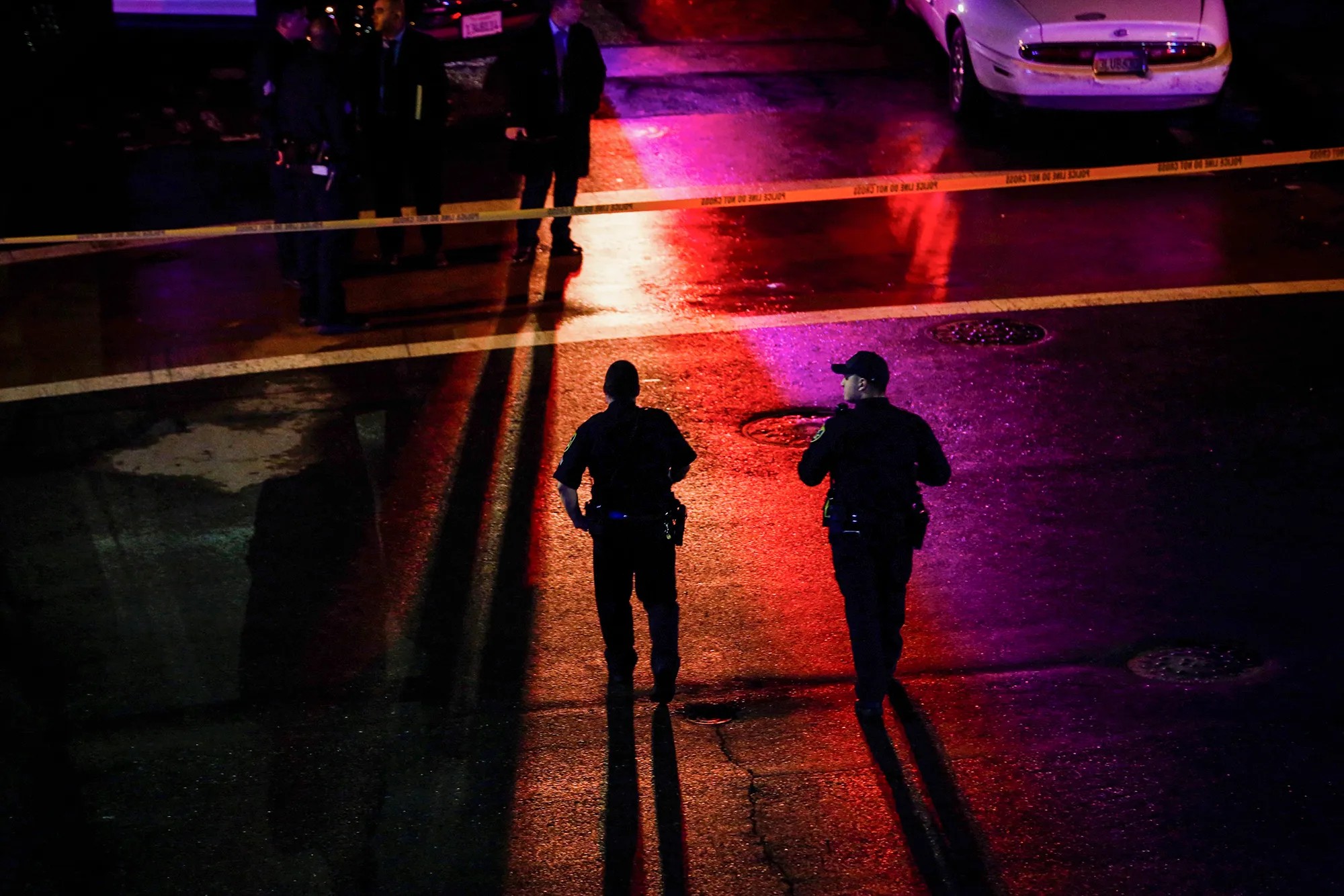
Oakland police officers walk through a crime scene outside the West Oakland BART station on Jan. 3, 2018. (Gabrielle Lurie/San Francisco Chronicle via AP)

Here are the morning’s top stories on Thursday, January 29, 2026

California Cities Just Saw Their Lowest Homicide Rates In Decades. It’s Not Clear Why

For the second year in a row, Gov. Gavin Newsom is celebrating California’s declining homicide rate while using it as a cudgel against his political foes. “Your state’s homicide rate is 117% higher than California’s,” he told a Missouri congressman who needled Newsom on social media last summer. Arkansas Gov. Sarah Huckabee Sanders caught his attention, too. “Your homicide rate is literally DOUBLE California’s,” he wrote on social media addressing her.

What’s been clear for the last three years is that homicides are down in Los Angeles and San Francisco — but also in Fresno, Oakland, Richmond and Lodi. “California cities are seeing record-low homicide rates,” Newsom said in his state of the state speech earlier this month. “Oakland, the lowest since 1967; LA, the lowest since 1966; and San Francisco, the lowest since 1954.”

The reason why is far less clear. To put it in the language of crime researchers, the answer is “multifactorial.” Magnus Lofstrom, policy director of criminal justice at nonpartisan think tank the Public Policy Institute of California, said the spike of homicides during the pandemic may have been the result of disruptions in government activities: Schools were shut down, people were out of work, community-based programs for violence prevention and many basic public services were put on pause, Lofstrom said.

The 2020 numbers were a shock. After years of decline, the homicide rate in California surged by 31% in 2020 to 5.5 homicides per 100,000 people. In 2021, it rose again, to about 6 per 100,000 people.  But that trend began to turn in 2022, when the number of homicides dropped by 7%, then in 2023 by 14% and in 2024 by another 12%. By the end of 2024, the homicide rate in California was down to 4.3 per 100,000 people.

Sponsored

A long-range look at crime statistics, particularly homicide data, shows that the 2020-21 crime rate nationally and in California was still a fraction of its highs in the early 1990s. Simply counting the year-over-year changes belies a larger truth: Crime throughout the 2020s has been down significantly compared to the rate 20 or 30 years ago. As with the long-term homicide rate declines, the recent tapering in California is part of a nationwide trend. A report published Thursday by the Council on Criminal Justice, a nonpartisan Washington, D.C., think tank found that among 35 major cities nationwide, homicides dropped by 21% between 2024 and 2025.

California Lawmakers Want To Raise Taxes On For-Profit Immigrant Detention Operators

California lawmakers are seeking to target the deep pockets of for-profit contractors key to the Trump administration’s growing deportation campaign, amid outrage over the killing of U.S. citizens by federal immigration agents in Minneapolis.

A new state bill would raise taxes on companies that contract with the federal government to run immigration detention facilities, which hold thousands of men and women in California. AB-1633, introduced by Assemblymember Matt Haney, D-San Francisco, on Tuesday, would tax operators’ detention contract revenue by 50% annually and reinvest those funds into services supporting immigrant communities.

The first-in-the-nation bill aims to mitigate economic, emotional and social harms caused to the state as immigration authorities detain more residents, businesses lose workers and students skip school due to deportation fears, Haney said during a press conference on the bill on Wednesday. “We will not allow these for-profit corporations to make hundreds of millions of dollars off of human suffering and family separation,” Haney said, flanked by Democratic lawmakers, gubernatorial candidate Tony Thurmond and immigrant advocates. “If you are going to impose this kind of terror on our state and on our people, we are going to tax you for the pain and harm that you’re causing.”

This comes as the fatal shootings of protesters Alex Pretti, an intensive care unit nurse, and Renee Macklin Good, a mother of three, have generated intense backlash in spaces as varied as professional basketball games, social media influencers’ baking feeds and Trump voter surveys.

Inland Empire Democrats Demand For DHS Secretary Kristi Noem’s Removal

Democratic members of Congress from the Inland Empire on Wednesday called for the removal of Department of Homeland Security Secretary Kristi Noem, citing what they described as aggressive and deadly immigration enforcement across the country. They’re also demanding immediate reforms to Immigration and Customs Enforcement (ICE) and Border Patrol enforcement.

At a news conference outside ICE’s field office in San Bernardino, Democratic Reps. Pete Aguilar, Raul Ruiz and Mark Takano, joined by immigrant rights advocates, called for Noem’s removal or impeachment and outlined a series of reforms. Those demands included limits on enforcement operations, greater transparency at detention facilities and accountability for agents involved in shootings.

Immigrant rights advocates who joined the news conference said federal immigration enforcement under the Trump administration has fueled fear in working-class and immigrant communities, while diverting public resources away from healthcare, education and worker protections. “Instead of investing in things that would actually improve people’s lives, this administration is using billions of our tax dollars to sponsor an agenda of brutality and violence against the most vulnerable,” said Yunuen Trujillo, director of workers’ rights and labor legal services with the Coalition for Humane Immigrant Rights.

Ruiz said he was denied entry to the Adelanto ICE Processing Center while attempting to conduct congressional oversight. Ruiz said he followed DHS protocol, which asks members of Congress to provide seven days’ notice before visiting detention facilities. He alleged ICE failed to respond to his notice and said he waited nearly an hour before receiving a response. When he did, Ruiz said he was read a scripted denial over the phone by an ICE agent. “If we’re seeing the brutality and the violence in the open, in public, then what are we not seeing inside these detention facilities?” Ruiz said.

lower waypoint
next waypoint
Player sponsored by