Daniel Lurie: [00:00:10] Welcome to City Hall and welcome to San Francisco. Today is a big day for our city. We’re here to announce.
Ericka Cruz Guevarra: [00:00:20] Last week, San Francisco Mayor Daniel Lurie held a press conference much like others he’s held since starting the job. It was his usual positive and upbeat tone, and it was a very good morning in San Francisco, he said, as he announced that Nashville-based Vanderbilt University planned to open up a San Francisco campus.
Daniel Lurie: [00:00:47] We’ve talked a lot this past year about building a city where people can live, work, play, and learn. This announcement brings the learn part of that vision into sharp focus.
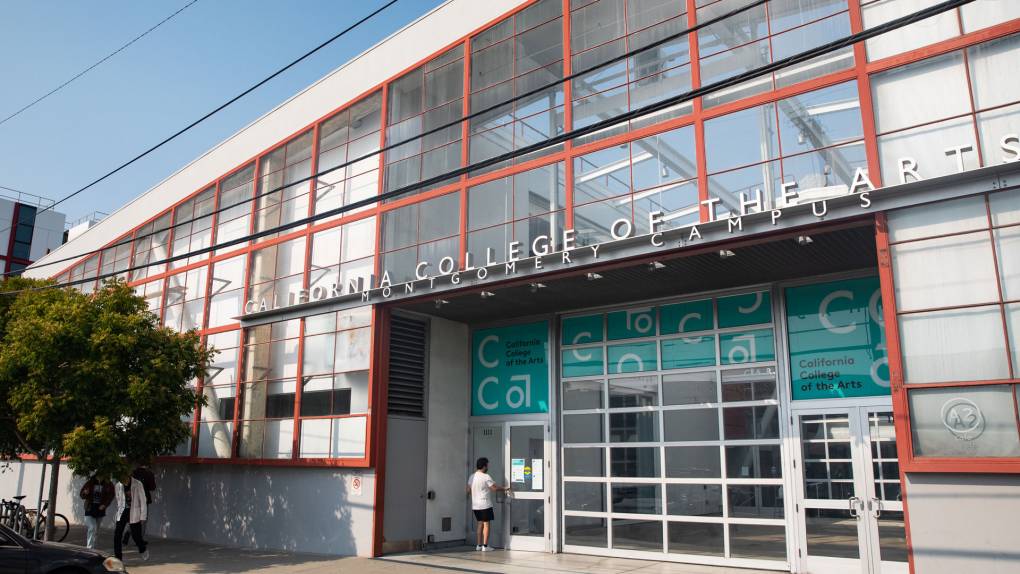
Ericka Cruz Guevarra: [00:01:01] And as Lurie marked this as another win for San Francisco’s comeback, others were heartbroken because Vanderbilt will be taking over the campus of the California College of the Arts, which will close in 2027 after more than 100 years in the Bay Area.
Sarah Hotchkiss: [00:01:24] It’s really hitting the arts community very hard right now. If you’re gonna have an arts ecosystem at all, you need to have an art school.
Ericka Cruz Guevarra: [00:01:33] Today we talk with KQED senior arts editor and CCA alum Sarah Hotchkiss about what the Bay Area will lose when the California College of the Arts closes.
Ericka Cruz Guevarra: [00:01:53] How big of a deal is the fact that CCA is now closing?
Sarah Hotchkiss: [00:01:58] This is a very big deal. This is so sad. We used to have two art schools in San Francisco. We had the San Francisco Art Institute and California College of the Arts. So CCA was always a bit more on the practical side. They had design programs. They offered architecture degrees. They had added UX design or game design. They had an MBA in design strategy. So these are things that really made CCA seem like it could continue to exist in the long run. It wasn’t just focused on its original set of programming, which was about the arts and crafts movement, which was art glass and ceramics and painting and sculpture. It had really changed over its 119-year run. And I think you also take for granted when something exists for that long that it’s gonna continue to exists.
Ericka Cruz Guevarra: [00:02:59] You mentioned 119 years in the Bay Area. I mean, I guess what is the college best known for in terms of its long history here in the bay?
Sarah Hotchkiss: [00:03:14] Craft focus is a big part of that. And just think about how many students, faculty, and staff worked there over that 119-year history. I mean, the names that came out of CCA and the people that work there are really incredible, like Viola Fry, who was a ceramics professor and is a very well-known local artist. Larry Sultan was a photography teacher at CCA. I took a class with Jeffrey Gibson, who went on to represent the United States at the Venice Biennale. So it really had an incredible cast of luminaries teaching there over the years. And then the alumni list is equally long and notable
Ericka Cruz Guevarra: [00:04:00] I mean, what do we know about why CCA is closing?
Sarah Hotchkiss: [00:04:06] The short answer is money. So in 2024, the school announced that it had a $20 million deficit, and it announced layoffs at that time. The problem in short is that CCA costs more to run than it can bring in in revenue. It relies very heavily on tuition. This is a school without a huge endowment. And the operating budget is somewhere around $100 million. So with a $20 million deficit, you just cannot sustain that in the long run. And over the past year and a half, two years, they have been able to stop gap fundraise. But that doesn’t add up, as we know, to long-term sustaining operating budget. So CCA has really been looking for a way to either merge or shift their offerings in order to be able to exist. And they just could not figure out a way to do that in the long run. What impact is this having on the current students who are enrolled? So the announcement came with some explanation. If you can finish up your degree before the end of the 2026, 2027 school year, you will graduate with a CCA diploma. But if you cannot finish your degree, say you’re a freshman in the first year of a four-year program, you’re going to have to transfer elsewhere. And that might, you know, you could apply to Vanderbilt, but there is no guarantee that you’re going to get into Vanderbilt. And they also don’t offer the same programs that CCA does.
Jack Wroten: [00:05:41] It was really good. I love the dorms. I loved the people here. My professors are great. They helped me a lot with anything I needed, I learned a lot.
Sarah Hotchkiss: [00:05:50] I talked to Jack Wroten who’s a first year illustration student in the BFA program and he learned about the closure of his school the same way everyone else did via an email.
Jack Wroten: [00:06:02] We had like absolutely no warning. It was this random Tuesday morning right before New Scalesters birds that we found out from an email.
Sarah Hotchkiss: [00:06:11] He was so excited to go to CCA. He’s there with his best friend. He’s from Northern California. We both went to art school and we started looking at schools together. And CCA was like always our top choice. And he’s one semester in to his program and now has to figure out where he can transfer that also offers an illustration degree because in that first semester, he became very committed to this as a future, as a career, super excited to work with all the teachers there. And they have to now juggle this whole existential crisis of my school will not continue to exist anymore.
Jack Wroten: [00:06:52] Now I just have to find a new school, and I don’t even know that all of my credits were gonna transfer or all that stuff. After like everything I did to get here after one semester.
Ericka Cruz Guevarra: [00:07:09] And what about CCA faculty, Sarah? How are they reacting to this news?
Sarah Hotchkiss: [00:07:15] The faculty are, you know, heartbroken, but also really focused on helping students out over the next three semesters. You know, how can we set them up to transfer, hopefully. I think I would just also add that because CCA is closing, there’s nowhere left for these people to teach and work. And we’ve had so many art programs and schools close in the Bay Area over the When SFAI closed in 2022, CCA actually was able to absorb some of that fallout.
Ericka Cruz Guevarra: [00:07:48] And that’s the San Francisco Art Institute.
Sarah Hotchkiss: [00:07:52] Yes. They accepted some of the students that needed to transfer. People got teaching jobs at CCA, probably not full-time or tenure-track jobs, but at least something. We also saw Mills College merge with Northeastern. And even though that was put forward as a merger and we had a lot of high hopes for what would remain, it’s a shell of itself. And students from Northeaster can take art classes, but no one is getting a degree in the arts.
Ericka Cruz Guevarra: [00:08:22] And obviously, one thing I’m thinking about is you don’t necessarily have to go to art school to be an artist, right? But why are these closures and these mergers that we’re talking about so significant, especially when talking about and thinking about the pathways for artists in the Bay Area?
Sarah Hotchkiss: [00:08:41] Yeah, absolutely, you don’t have to go to art school, and it’s also a very expensive and debt-ridden proposition, but it is an incredible shortcut to a life in the arts. I think art schools do something really amazing, which is draw people who don’t otherwise have a reason to be in the Bay Area to the Bay area. CCA is the reason that I am in San Francisco. It’s the reason I am an arts journalist, weirdly, even though I went to a graduate program in painting. It brings people here, it keeps them here because you have that network of the school that continues to support you after you finish a program. And it graduates a new class of young, eager, excited people into the arts every single year. And CCA wasn’t just a practicing art school, there was also a curatorial program at one point. There’s a whole fiction department, comics artists, like a very diverse ecosystem of what a life in the arts can be. It also provided so many jobs for people, not just people who are teaching the classes, but everyone else who’s supporting those classes. So like the person running the photo studio or the wood shop, those are probably artists who are sustaining a life in the Bay Area because they have this day job. Has Jack told you anything about what he plans to do in the next few months? Yeah, so Jack has been looking at Otis College of Art and Design, which is a school down in Los Angeles, to finish out his illustration degree. And so far, that’s the only school I’ve heard of that’s really set up any sort of messaging for CCA students. So they have a whole portal on their website that’s like, hey, come to us. Here’s what is an analog to the program that you were in. Here’s how we’re going to waive the application fee. It sounds like they’re gonna wave the limit on the number of credits that you can transfer. So that’s encouraging, but we’re gonna need more of that and we’re going to need CCA to do work on its own end to form those partnerships.
Ericka Cruz Guevarra: [00:10:58] So Sarah, Mayor Daniel Lurie has said the arts will lead San Francisco’s comeback, but how do you square that with CCA’s closure?
Sarah Hotchkiss: [00:11:07] What was upsetting about Mayor Daniel Lurie’s announcement and this kind of tone deafness was this misunderstanding of how the ecosystem works and how all these things fit together. Mayor Lurrie made this announcement in his office on one of his social media videos in front of a painting by a CCA alum and current faculty member. And in the video, he doesn’t mention CCA once. He just says, go Vanderbilt, anchor down, Let’s go San Francisco. If you’re gonna have an arts ecosystem at all, you need to have an art school. To lose that, to lose that momentum and that energy, it’s really hitting the arts community very hard right now. Every year, a graduating class feeds into the excitement and energy of what’s happening in this region. Young art school weirdos are the people who start up those project spaces in their garages and like, Do weird things and storefronts and keep this place reinventing itself.
Ericka Cruz Guevarra: [00:12:16] Thank you for sharing your reporting with us. I really appreciate it.
Sarah Hotchkiss: [00:12:21] Thanks for having me, Ericka.