Ericka Cruz Guevarra [00:00:00] I’m Ericka Cruz-Guevarra and welcome to The Bay, local news to keep you rooted. Santa Cruz just became the first city in California to end its contract with Flock Safety, the company behind powerful license plate readers that police say help them solve crimes. But more and more people are raising alarm bells about the cost to our privacy after reports that data collected from these cameras had been shared with the feds.
Rachael Myrow [00:00:37] We’re also all watching national democratic norms crumble and asking some really hard questions about this surveillance system that we’ve set up to protect ourselves.
Ericka Cruz Guevarra [00:00:50] Concerns around federal law enforcement have reached a fever pitch after an ICE agent shot and killed Renee Good in Minneapolis last week. And in California sanctuary cities, many worry the powerful data gathered by these surveillance tools could end up in the wrong hands. Today, how Bay Area cities are weighing the cost and benefits of automated license plate readers. Rachael, I think I actually want to start with just having you kind of telling me about the time that you were living in SoCal and you got a ticket in the mail, a speeding ticket?
Rachael Myrow [00:01:41] It wasn’t a speeding ticket. I just want to correct the record there.It was a red light camera ticket because I failed to stop completely before making a right turn. This was technically a moving violation, so I’m not trying to relitigate here, Ericka, but I do want to talk about what came with the ticket in the mail. And this is 25 years ago. This computer-generated printout that included all the details of my car. License plate, make and model, I guess a shot of it moving through the intersection, and then a close-up of my face. So it was pretty incontrovertible. Who was at fault and what happened. Today, license plate readers can track a car, track the driver across cities and the country. Which makes the surveillance an awesome tool for crime fighting, but also for oppression, especially now.
Ericka Cruz Guevarra [00:02:53] Yeah, you’re basically describing 25 years ago what was sort of a basic function of automated license plate cameras, but now they’re just so much more sophisticated as you’ve just been describing. And in the Bay Area and across the US, probably the biggest company that’s been contracting these license plate camera is this company called Flock Safety out of Atlanta, right? Tell me a little bit more about Flock and why so many cities have contracts with them.
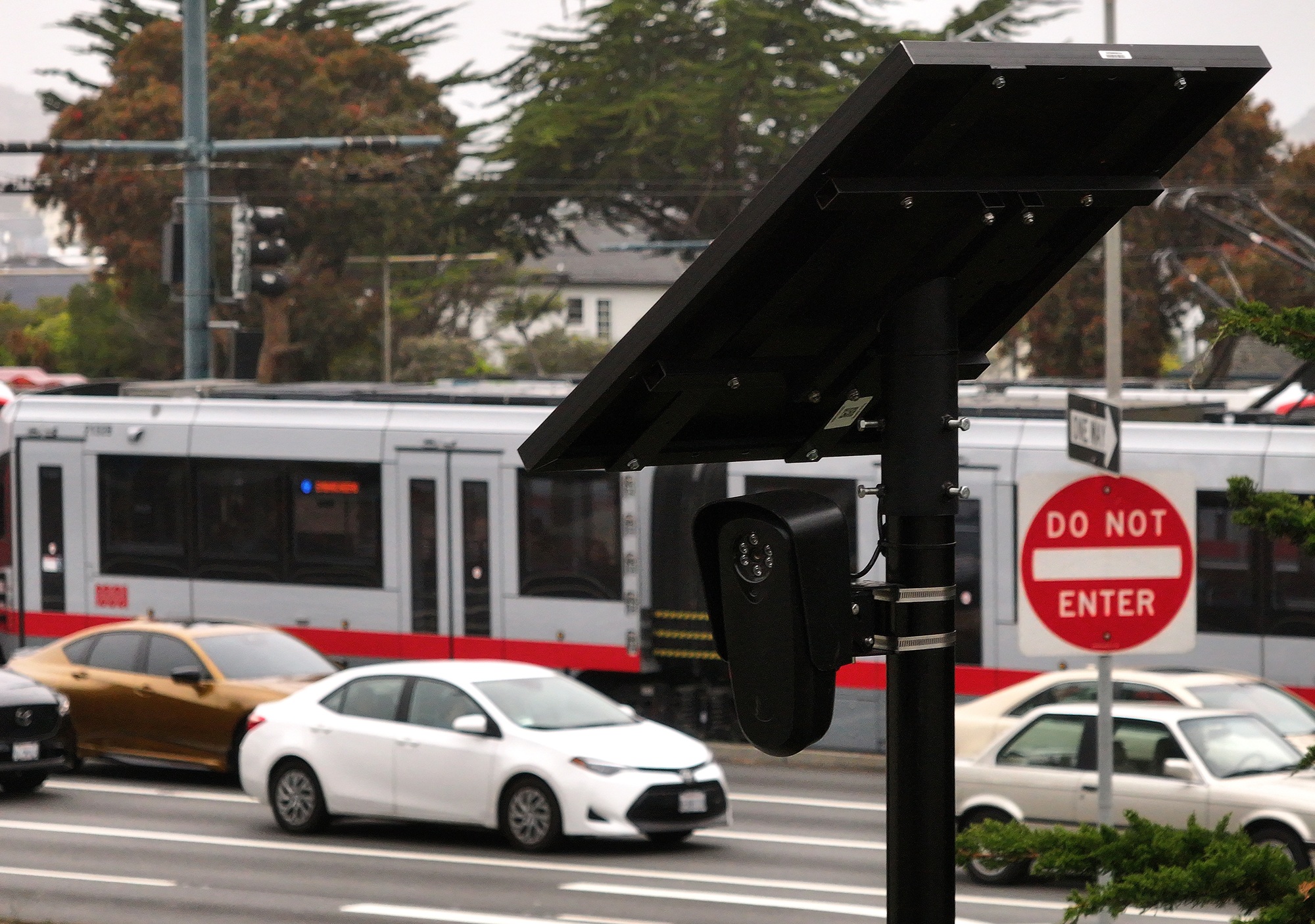
Rachael Myrow [00:03:26] So like you say, Flock Safety is based in Atlanta. It’s grown incredibly fast by selling what I would describe as a plug-and-play surveillance network. So we call them automated license plate readers, right, or ALPRs. But they capture so much more than just the license plate. Flock and its competitors in the industry use high-resolution, networked cameras powered by AI. So they log time and location of vehicles, make, model, color, roof racks, decals, dents. So you can get really granular in a way that you couldn’t with those old red light cameras. Law enforcement agencies, as you might expect, but also homeowners associations, business districts, they like Flock, too, because the cameras come with analytical tools that are really helpful, police departments say, to help solve crimes, especially car thefts and burglaries.
Ericka Cruz Guevarra [00:04:33] And I mean, there are a bunch of California cities with these automated license plate readers from Flock, right? Who are some of Flock’s biggest customers here in California?
Rachael Myrow [00:04:44] So I mentioned that it’s not just law enforcement, but also transit agencies, campus police, special districts, business districts, like the Chinatown business district in Oakland. More than 200 municipalities, so San Francisco, Oakland, San Jose, Berkeley, as well. And until recently, Santa Cruz was on that list, too.
Ericka Cruz Guevarra [00:05:13] Right, and I want to talk about Santa Cruz for a little bit, because they just made some news this week for becoming what might be the first California city to actually end its contract with Flock. What happened in Santa Cruz?
Rachael Myrow [00:05:32] So Santa Cruz learned back in November that Flock had enabled a national search feature that could allow out-of-state agencies to access California data. What really sort of pushed their push to quit Flock over the edge was a recently formed grassroots group called Get the Flock Out. They laid out a case that included the finding that between June and October of 2025, state agencies accessed Santa Cruz camera data roughly 4,000 times on behalf of federal law enforcement. So that includes ICE. That raised alarm bells. So community members organized to make the case, and city leaders said they weren’t comfortable continuing until they could guarantee that the local data wasn’t being exposed beyond what residents were told.
Mayor Fred Keeley [00:06:41] The council has, over the years, gotten more and more concerned about this, especially the last 12, 13 months.
Rachael Myrow [00:06:49] Santa Cruz Mayor Fred Keeley will tell you that he has been nervous about mass surveillance.
Mayor Fred Keeley [00:06:57] I’m one of those sort of civil libertarians, you know, yes, I do have something to worry about even if I’m not behaving badly.
Rachael Myrow [00:07:06] He basically said, even if the intent is local crime-fighting, the risk that this data could be used against Santa Cruz County residents is just too high.
Mayor Fred Keeley [00:07:18] In our country, I think we always have to wrestle with the constitutional protections which we all have and efforts to chip away at those protections citizens have from their government. For us, the threat to our civil liberties was greater than any benefit we to get from the flawed product.
Rachael Myrow [00:07:49] They voted 6-1 in favor of terminating the contract.
Ericka Cruz Guevarra [00:07:57] Santa Cruz isn’t the only place where license plate reader data has been leaked. In San Francisco, reporting from 404 Media and the San Francisco Standard showed that SFPD employees had searched local data for federal law enforcement investigations and also illegally shared city data with out-of-state cops. Now, as the Trump administration continues its immigration crackdown. Privacy advocates are even more worried.
Rachael Myrow [00:08:32] There are a growing number of cities in the Bay Area and across California that are hitting the pause button, saying, hey, let’s just reevaluate. There’s even one city, I believe it’s Eureka in Northern California, which has said, hey, we’re not going to enter into this contract because of everything we’re hearing.
Ericka Cruz Guevarra [00:08:53] How does Flock respond to these concerns?
Rachael Myrow [00:08:56] Flock says cities and counties and whoever. The client, the customer, controls who gets access, how long the data is stored, and the company does not share the data with the federal government or anybody else.
Trevor Chandler [00:09:15] Every single city, every county, every individual agency gets to choose who they share with. And if they want to reduce that kind of risk, they can choose not to share.
Rachael Myrow [00:09:25] Trevor Chandler, Director of Public Affairs for Flock, explained to me that Flock’s technology allows the customer to set the controls, how long the data is held, what other law enforcement agencies can run searches on Santa Cruz’s data.
Trevor Chandler [00:09:41] We are the most transparent tool that law enforcement uses, period. I challenge anyone to name a more transparent tool.
Rachael Myrow [00:09:48] If Flock receives, say, a warrant from a federal agency, it directs those demands to the municipality involved. They argue the problem isn’t the technology, it’s how individual customers are governing the technology.
Trevor Chandler [00:10:04] And the reason that we’re having these, you know, important conversations about data sharing and privacy and public safety is because of that transparency.
Ericka Cruz Guevarra [00:10:14] Why are people still so worried about this data if cities who have these contracts have complete control over what happens to the data?
Rachael Myrow [00:10:23] If the door is held open to a bunch of agencies in California, you can see how easy it becomes for any individual in any of those agencies to search for and or share data with anybody, including somebody out of state.
Brian Hofer [00:10:40] And people are finally recognizing that there’s real world harm here.
Rachael Myrow [00:10:44] Privacy advocate Brian Hofer of Secure Justice is suing two cities, Oakland and San Francisco, not Flock, arguing the problem isn’t just Flock’s technology, but the inability or the unwillingness of city officials and attorneys to closely monitor usage to ensure compliance with California’s privacy and sanctuary laws.
Brian Hofer [00:11:11] It’s been extra frustrating in California where we hold ourselves out as a sanctuary state. And yet when it comes to data privacy, we have these practices that are putting people in harm’s way, clearly.
Rachael Myrow [00:11:26] Any network is only as strong as its weakest link. If one agency misconfigures access or shares too broadly, that data can end up far beyond California. Separately, once data exists, it can be subpoenaed. Local laws don’t stop federal warrants. That’s the way our legal system works. But also we’re living in a world now where many federal law enforcement agencies aren’t even bothering with warrants.
Brian Hofer [00:11:59] We’re in a very different political moment than we’ve ever been before.
Ericka Cruz Guevarra [00:12:07] And there are still some several Bay Area cities that still have active contracts with Flock, right? Oakland just expanded its use of these cameras. What do you think this conversation around these automated license plate readers, what do you it says about this moment that we seem to find ourselves in?
Rachael Myrow [00:12:31] It’s a wonderful window into the tension between safety and trust. Cities are under pressure to respond to crime. And hey, I’m a Bay Area resident. I want to know if law enforcement is going to follow up if there is an incident. And if technology helps, I feel the appeal of it. But we’re also all watching national democratic norms crumble. And asking some really hard questions about this surveillance system that we’ve set up to protect ourselves. Santa Cruz stepping away, and also Oakland doubling down. I think both examples demonstrate in a really neat package of headlines how many Californians are really deeply divided right now over this question. How much monitoring is too much?
Ericka Cruz Guevarra [00:13:33] Rachael, thank you so much.