Episode Transcript
This is a computer-generated transcript. While our team has reviewed it, there may be errors.
Morgan Sung, Host: Just a note, this episode contains references to violence and strong language. Listen with care.
[Audio from 50501_Key_Largo Instagram Account]
Border Patrol Officer: If I continue to see you following me around, I’m gonna pull you over and arrest you.
Local Observer: For what? What law am I breaking?
Border Patrol Officer: You’re impeding one of the investigations, okay?
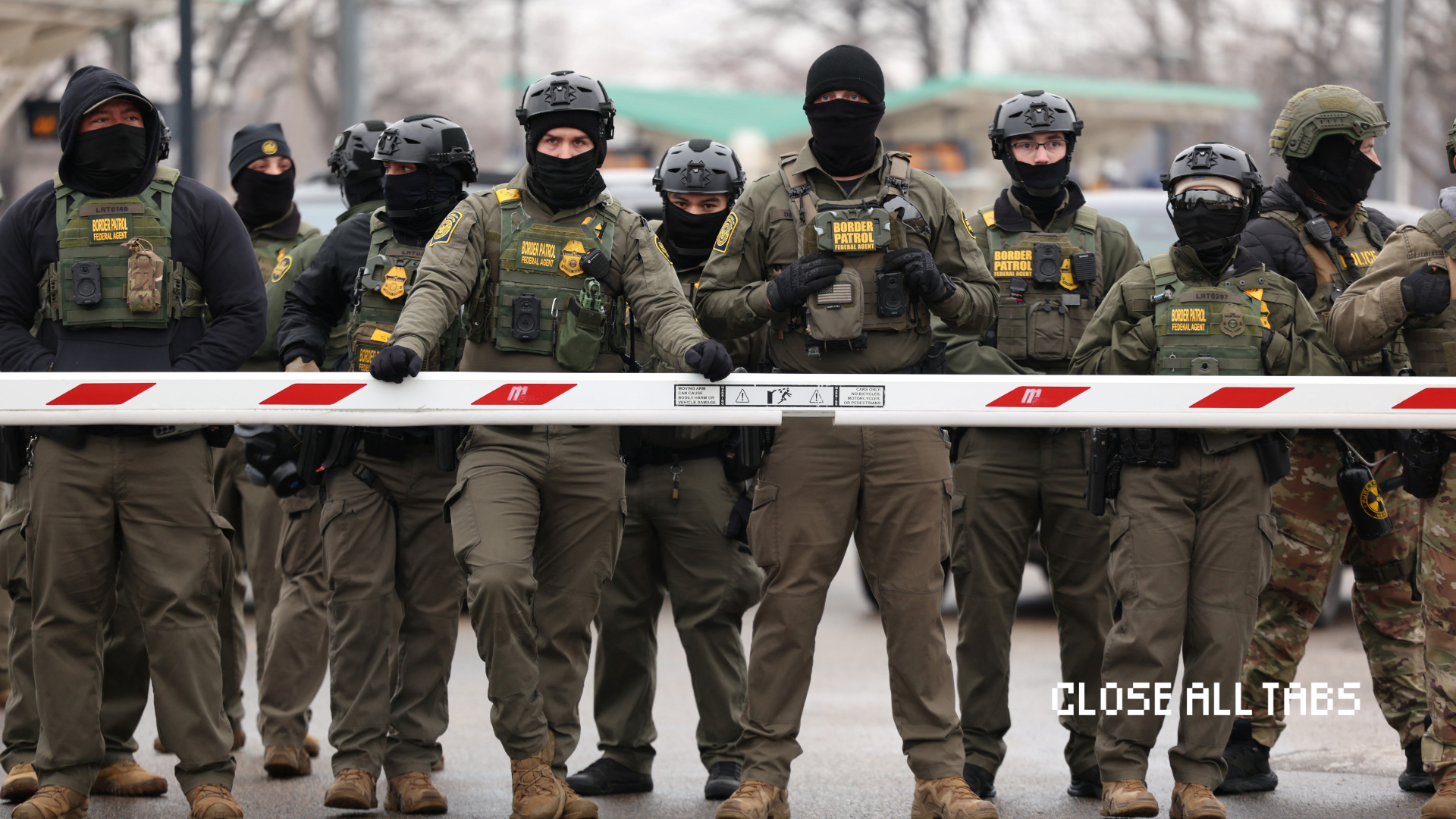
Morgan Sung: That was an interaction between a Border Patrol officer and a local observer in Key Largo, Florida, posted on Instagram on Monday morning. The officer threatened to arrest the observer for following and filming him, but didn’t say what law they were breaking.
[Audio from 50501_Key_Largo Instagram Account]
Local Observer: How am I impeding you?
Border Patrol Officer: I’m not going to argue with you.
Local Observer: Are you going to shoot me?
Border Patrol Officer: Why would I shoot you?
Local Observer: Because one of your guys, one of you federal people just shot an innocent woman and murdered her in Minneapolis.
Morgan Sung: Last week, on January 7th, federal immigration and customs enforcement officers shot and killed Renee Good in Minneapolis, Minnesota. She was 37. The Trump administration has launched an extensive immigration crackdown in Minneapolis singling out the city’s large Somali community. Last week they sent 2,000 federal agents in what ICE Acting Director Todd Lyons described as the largest immigration operation ever.
C.J. Ciaramella, Guest: In response, a lot of citizens have been protesting and following and monitoring ICE and CBP officers.
Morgan Sung: This is C.J. Ciaramella, a reporter for Reason magazine who covers criminal justice and civil liberties. He’s been reporting on the Trump administration’s crackdown on those who record or photograph ICE operations. Last Wednesday, Renee Good and her wife had just dropped their six-year-old son off at school when they came across a group of ICE agents. Bystander video shows that Renee’s car was stopped perpendicularly on the road.
C.J. Ciaramella: And an ICE, uh, a pickup of federal immigration officers stopped in front of her and went up and were shouting at her to…there were some contradictory orders to both leave and get out of her car and started tugging on her car. She started backing up first and then as she was doing that, one of the immigration officers stepped in front her car and she started moving forward and pulling out to leave with the officer in front of her. And as he was stepping around her car, as it was moving towards him, he pulled out his gun and fired three shots and killed her.
Morgan Sung: There are several bystander videos that captured different angles of Renee’s last moments and the gruesome aftermath. One shows an officer denying medical assistance for Renee after a bystander identified himself as a doctor.
[Audio from a video recorded by eyewitness Emily Heller]
Doctor: Can I go check a pulse?
ICE Officer: No! Back up! Now!
Doctor: I’m a physician!
Emily Heller: Hey, listen here! You just killed my f***ing neighbor!
Morgan Sung: Videos of the incidents immediately spread online, sparking nationwide outrage. Over the weekend, hundreds of protests gathered across the country, demanding accountability and an end to mass deportations. The Trump administration has tried to paint Renee as an agitator who was stalking and impeding upon ICE operations. On Truth Social, the president said that Renee, “Violently, willfully, and viciously ran over the ICE officer, who shot her in self-defense.” But as visual forensic analysis by the New York Times, the Washington Post, and Bellingcat shows, the officer was able to step away from the car and while still standing, fired at least 2 of the 3 shots through the window as the car turned away from him. As ICE operations continue across the country, the Trump administration has escalated retaliating against anyone who follows or records federal officers. This includes journalists, and any civilian just observing ICE. In the last year, ICE and Border Patrol officers have threatened, arrested, and detained those who document their activities or report on their whereabouts. And now, federal agents have appeared to reference the shooting of Renee Good in confrontations with observers, like in this video, which was posted on the r/minneapolis subreddit this week.
[Clip 1 from r/minnesota Reddit page]
Officer:This is your warning!
Driver: For what?
Officer: Stop f***ing following us! You are impeding operations! This is the United States Federal Government!
Driver: I live over here, I gotta get to my house!
Officer:This is- this is your warning! Go home!
Driver: Go to church.
Officer: Did you not learn from what just happened? Go home!
Driver: Learn what?
Morgan Sung: Or in this video, which was posted on the r/minnesota subreddit days after Renee was killed.
[Clip 2 from r/minnesota Reddit page]
Officer: Have y’all not learned from the past couple of days? Have you not learned?
Recorder: Learned what? What’s our lesson here? What do you want us to learn?
Officer: Following federal agents.
Recorder: Give me my phone back!
Morgan Sung: In light of all this, many people are asking, are you allowed to record federal agents? And what are your rights when it comes to recording ICE, especially as the Trump administration increasingly tries to target those who do? This is Close All Tabs. I’m Morgan Sung, tech journalist and your chronically online friend, here to open as many browser tabs as it takes to help you understand how the digital world affects our real lives. Let’s get into it. Let’s start with a new tab. Are you allowed to record ice? We’re back with C.J. Ciaramella, who reports on criminal justice and civil liberties for Reason Magazine. He’s going to put this into context for us. ICE activities have been escalating all throughout the past year, but what led up to this moment? And does it feel like a tipping point to you?
C.J. Ciaramella: It really does. This has been sort of the, I don’t want to say logical conclusion because that doesn’t put it in the right light, but over this past summer, we’ve seen escalating rhetoric from the Trump administration about people filming and recording and monitoring ICE and also trying to warn other people about ICE activities. They described this as illegal activity, saying that it’s obstruction of justice or impeding federal immigration officers and they vowed to like, prosecute people who do this. And they also made it clear to these line officers working at CBP and ICE, yeah that they consider this illegal activity. That they consider following around and monitoring these agents to be very confrontational, illegal. There are dozens of videos of ICE and CBP officers threatening to arrest people and pulling them out of the car solely for following and recording them.
Morgan Sung: One of the main reasons that this incident specifically has exploded is because there are multiple video recordings taken by bystanders that have been shared online, gone viral, you know, just been spread among news outlets. You’ve been reporting on how the Trump administration is trying to make the case that recording ICE officers in public is illegal, like you said. But just to be clear, does the public have the right to record law enforcement and specifically ICE?
C.J. Ciaramella: Well, I gotta be a little bit nuanced about this because the Supreme Court actually hasn’t put out a ruling saying there’s an unambiguous First Amendment right to film the police. But all of the seven US Federal Circuit Courts that have considered the issue have pretty much said there is a First Amendment right to record the police and observe the police, and they’ve all decided that pretty unambiguously. And this ranges from, you know, the ninth circuit, which is traditionally a pretty liberal leaning court to the fifth circuit, which has a reputation as a more conservative circuit court, you know? The fifth circuit looked at it and said, you know, based on the first amendment tradition, the Supreme court presidents, this seems pretty unambiguous to us.
Uh, so it’s not a completely like black and white issue, but it’s also not a, like, a thorny or divisive first amendment question. Every court that’s looked at, it has said, yeah. Based on our long First Amendment traditions. And in America, you have a right to record the police. Now, Minnesota is in one of the circuits that hasn’t yet ruled on this. So it’s not like black letter law in Minnesota.
Morgan Sung: Right. What protections does the public have, if any, when it comes to recording the police or recording law enforcement?
C.J. Ciaramella: You know, you do have strong First Amendment protections, especially if you’re engaged in news gathering activity, if you’re monitoring a protest or monitoring police activity. And you don’t have to be an official journalist to do this because there’s no, you know, definition of journalists in the First Amendment. There are very strong protections for news gathering.
Since about 2020, some states have passed what are called buffer laws that restrict people from recording the police within about 25 feet when they’re asked to get out of the way. And those have faced a lot of scrutiny from courts. Arizona and Indiana both had buffer laws that were overturned for being unconstitutionally vague. There would be too much of a chilling effect for preventing the public from recording police.
This is a really fundamental principle and privacy First Amendment and public record law in the United States, is that government officials doing official government work in public don’t have a reasonable expectation of privacy. You know, this is another example of a really sort of watershed moment in policing and law enforcement in America that’s based on recorded video evidence. The same as in Minneapolis with George Floyd in 2020, Rodney King, you know, is these have all had huge impacts on our nation’s history and they’re all based on people recording police activity and documenting it.
The founders really believed that we should be able to hold our government accountable. And that includes having access to popular information and knowing what our government is doing. And that’s why recording the police and creating this sort of evidence trail is such a core protected first movement activity.
Morgan Sung: In June last year, dozens of journalists were injured by law enforcement while covering the Los Angeles protests against mass deportation. Many journalists and protesters were tear gassed or shot at with pepper rounds and rubber bullets, or their phones and cameras were smashed while recording. One reporter was shot by a rubber bullet live on air.
Months later, a federal district court issued an injunction blocking the Department of Homeland Security, which includes ICE and Border Patrol from brutalizing journalists, protesters, and legal observers. That means that federal agents aren’t allowed to threaten or assault the press or protesters unless they have probable cause to believe they’ve committed a crime. They also can’t use chemical, projectile, and auditory weapons against protesters, journalists, or legal observers who don’t pose imminent harm to law enforcement. Basically, they can’t tear gas or shoot people just for exercising their First Amendment rights. Enforcement is another story, though.
C.J. Ciaramella: There were injunctions against that, if I’m remembering correctly. There were a couple of injunctions trying to restrict the sort of tactics that federal law enforcement was using. We also saw the same thing in Chicago. There was injunctions trying to restrict ICE from retaliating against protesters and reporters who were engaged in really clear-cut First Amendment activity. And the judges kind of struggled to enforce that. In Chicago we saw the plaintiffs kept coming back with new motions saying like, here’s more evidence that your injunction is not being followed.
It’s been really hard to enforce because the Trump administration has, if not an officially stated, a de facto policy that anyone who is opposing them or filming them is subject to intimidation and retaliation. There was a Cato report that came out in December that outlined dozens of instances of people who are being intimidated and threatened by federal agents for engaging in really clearly protected First Amendment activity such as just following from a distance or recording police. In fact, I wrote a story about an Oregon woman who was followed by ICE agents because she was filming them in a parking lot and they followed her after she left and her lawyer shared video with me. She stopped at an intersection and you can see the the agents come up to her window and the first thing they say is ‘Why are you filming us?’
And I want to say also as well that people who monitor police, reporters, and activists have faced First Amendment retaliation for decades. But what’s really startling and unprecedented here is that we’re hearing this coming from the top of the federal government. That is something that’s quite new, I would say. Secretary Noem was on record in July saying that, you know, violence is anything that threatens them and their safety and she included videotaping federal immigration officers. They’re equating videotaping officers with violence and domestic terrorism.
Morgan Sung: Here’s what DHS Secretary Kristi Noem said during a press conference last summer
[Department of Homeland Security Secretary Kristi Noem during July 12, 2025 Press Conference inTampa, Florida].
…And I will tell you that violence is anything that threatens them and their safety. So it is doxing them. It’s videotaping them where they’re at when they’re out on operations, encouraging other people to come and to throw things, rocks, bottles…
Morgan Sung: Notice the use of the word doxing here. That’s the act of posting private information about someone to target and harass them, usually like their home address or personal phone number. The Trump administration has equated identifying and publicly naming ICE agents to dox-ing. California recently banned federal officers from wearing masks on duty, with exceptions for medical masks like N95s, wildfire protection, and agents undercover. The ban was supposed to go into effect this month. Here’s state Senator Scott Wiener talking about the ban on Instagram.
[Senator Scott Wiener speaking on Instagram ]
I introduced and passed this law to stop ICE and any other law enforcement from covering their faces and effectively operating as secret police. It is horrifying what federal agents are doing, tearing communities apart, operating in the shadows, not identifying themselves, covering their faces so you don’t even know who you’re dealing with.
Morgan Sung: But the Trump administration has sued to block the bill, citing threats to federal officers like taunting, online doxing, and stalking. They argue that states like California have no authority to interfere with federal immigration operations, which means that state and local officials can’t enforce the mask ban. So are you allowed to record ICE? Yes, but like we’ve seen with California’s mask ban, the White House has been very opposed to any attempt at identifying federal officers. In fact, they’ve gone as far as trying to prosecute those who record and identify ICE agents. So what does this targeting and retaliation from the administration look like? And how is it holding up in courts? That’s after this break.
Morgan Sung: We’re back. Time to open a new tab: The legal battle over recording law enforcement.
The Trump administration is going as far as trying to prosecute people for following and recording ICE. And they’re using this federal statute to threaten those who get in their way. It’s called 18 USC 111. C.J. is going to tell us about it.
C.J. Ciaramella: Yeah, well, it’s both a felony and a misdemeanor depending on the severity or why they want to charge it. But it’s for assaulting, impeding, or obstructing a federal law enforcement agent and it’s pretty much what it sounds like. It’s more or less a federal analog of the obstruction laws that you see at your local level where if you, you know, if a police officer is trying to arrest someone and you get in their way and try and pull the person away or physically obstruct the officer, you can get charged with obstruction. But this also, I would mention, obstruction is a classic, what’s known as a contempt of cop charge. It’s something that’s thrown at people when they annoy cops, and the police are looking for something that they can punish them with. But it’s also used frequently for people who are being a real nuisance to police, and that’s what it’s intended for. It’s for assaulting and physically obstructing officers. And it accounts for all federal law enforcement, including immigration.
Morgan Sung: Right. How is the administration trying to use this statute specifically to target those who film ICE? Have they had any success?
C.J. Ciaramella: This is, you know, this sort of top-down order is to treat people who are opposing them through, you know, First Amendment or activities of recording or warning other people as violating this statute to sort of broaden this to include non-violent or non-physical means of obstruction. And what’s been really interesting about that is that these prosecutions have faired really poorly compared to federal prosecutors’ usual track record.
Usually when a U.S. Attorney’s office brings a case to a grand jury, they almost always get it. It is extremely rare for federal prosecutors to bring a case to a jury and have them reject it. And most cases that they do bring end in guilty pleas and plea agreements. But what we’ve seen is grand juries refusing cases in Chicago and elsewhere, refusing to indict. And those cases then getting thrown out when body cam footage and other evidence comes to light showing that these actions that people are being charged for aren’t meeting the elements of this crime which requires physically obstructing or assaulting agents and you know by that definition following an officer isn’t obstructing them you know recording them isn’t physically obstructed them even alerting other people to the presence of ICE is not obstructing them.
The law on that is a little more mixed, but there have been courts that have upheld the right to, for example, warn motorists of speed traps ahead or to flash your lights to warn people of cops in the distance. They consider that First Amendment speech as well. So what we’ve seen is a lot of these prosecutions failing at an unprecedented rate. There have been quite a few cases where they’ve charged people with a felony charge. And then when a grand jury refuses to indict them, they are refiled as a misdemeanor, which doesn’t actually require a grand-jury indictment. And some of those cases have pled out guilty after the misdemeanor charge was refiled.
But there’s been other cases where the federal prosecutors haven’t even been able to secure a misdemeanor conviction. The most famous case was the sandwich guy in DC, Sean Dunn, who threw a Subway sandwich at a CBP officer.
[Clip from WUSA 9 newscast]
The Customs and Border Patrol agent hit with the sandwich, characterized it as a profanity laced tirade, and he told the jury Dunn threw the sandwich so hard, it exploded against his bulletproof vest, “I could smell the onions and mustard.”
C.J. Ciaramella: The prosecutors were trying to convince the jury that this officer had a real fear for his safety when he got pelted with a sandwich, and the jury did not agree.
Morgan Sung: In an investigation published late last year, the Associated Press found that, since May, of the 100 people charged with felony assaults on federal agents, 55 saw their charges reduced to misdemeanors or just outright dismissed. Only 23 pleaded guilty.
C.J. Ciaramella: They’ve found that dozens of the cases have kind of fallen apart. That is a really high failure rate for federal prosecutors who nearly, when it comes to these sort of cases, are almost always batting a hundred. So it’s been a, it’s been very strange, I think, for the U.S. Prosecutor’s offices as well, who have had to face judges who are being very, well judges have to be very circumspect in their language, but are questioning these cases pretty harshly.
Morgan Sung: Even talking about this top-down almost order, right? JD Vance has made statements about how ICE agents have total immunity. How does that play into this? Like, what can you tell us about how much of the talk of ICE’s immunity can actually hold up against legal challenges?
C.J. Ciaramella: I asked DHS public affairs office in December if they considered following and recording officers to be obstruction of justice. You know, I wanted to get a straight answer from them. And the office of public affairs sent me a statement attributed to an unnamed spokesperson who said, that sure sounds like obstruction of justice, which, you know, isn’t a super clear answer, but it gives you the mindset. And like I said, that is coming and that is trickling down from the very top of DHS to the line officers who are being told that they have immunity and that anyone who is sort of bothering them is probably violating the statute.
Morgan Sung: We’ve established that recording law enforcement is a right upheld by federal courts. That’s not stopping ICE agents from continuing to target those who do record them. You had mentioned the woman in Oregon that you covered. What happened there when she was stopped?
C.J. Ciaramella: She was detained for, I believe, five or six hours. She was taken to a detention facility and detained and eventually released without charges. Last time I checked, they still not filed any charges against her. So, you know, this was, um, can almost be seen as a purely retaliatory or punishment sort of, and that’s really, I think, what this comes down to is a textbook definition of a chilling effect on free speech. When you have these statements from top officials, when you have the vice president basically saying that these agents will have immunity for what they’re doing, it makes everyone who wants to participate and exercise their First Amendment right second guess whether it’s worth it.
You know, I was out driving around in my hometown in December. Um, following ICE and CBP and taking pictures, you know, um, from a distance, but, uh, just seeing what they were doing because I’m a reporter and I had a unambiguous, crystal clear, First Amendment right to do that. But it was still in the back of my head, if these guys decided I was bothering them, they could bust out my car windows. They could detain me. They could pull their guns on me, which is all things that have happened to people for doing the same thing.
When I was a reporter at 25, that wasn’t as much of a worry, but I have a kid at home, ah, you know, you start doing…the calculus gets a lot harder. And that’s exactly what this sort of policy and what this activity does is make people self-censor under the threat of government retaliation.
Morgan Sung: There was this woman who was detained for seven in Oregon. She’s just one of many dozens at this point who have been targeted by ICE. There are all the journalists in Los Angeles who were shot up by rubber bullets and injured. Is there any recourse for victims of retaliation like this?
C.J. Ciaramella: Yeah, so it is very, very hard to hold federal law enforcement agents accountable for their actions. They do have sovereign immunity from some criminal prosecutions. In federal court, you have to file a lawsuit against the U.S. Government. You actually can’t sue them as individuals. So you basically have to go to court against the US government. And it is a very, very long and hard road to follow to successfully sue the U.S. Government for civil rights deprivations.
The best options, um, are probably more sweeping class action injunctions and sort of broader rulings against the general activity, just because it’s so hard to hold individual officers accountable even on a class action or individual level.
Morgan Sung: Considering everything we just talked about, what should people know before they consider recording ICE or other law enforcement activities?
C.J. Ciaramella: What I say you should know is that you do have the First Amendment right to do this. You have the right to record and monitor, and you even have the right to verbally oppose the police. One of the Supreme Court decisions that a lot of circuit courts have looked back on when they’re deciding these sort of questions was a 1987 Supreme Court ruling in a case called Houston v Hill, where they struck down an ordinance that made it unlawful to oppose or interrupt a police officer.
Supreme Court Justice William Brennan, Jr. wrote, “The freedom of individuals verbally to oppose or challenge police action without thereby risking arrest is one of the principle characteristics by which we distinguish a free nation from a police state.” And courts they’ll look back to that when they’re deciding things like whether you should be able to yell an obscenity at a police officer or record them.
And like I said, what the administration is trying to do is create a chilling effect here. And what people should know is that they are banking on fear and banking on you not wanting to exercise your First Amendment rights. And what we’re seeing all around the country with these protests and with people coming out and confronting ICE agents and CBP agents more is that it’s not working.
Morgan Sung: So remember, recording ICE, or any law enforcement, is your constitutional right, but it’s not without risks. We’ll link some resources for staying safe in the show notes. And check out our two-part series, The Surveillance Machine, for a deeper dive on the history of protest surveillance and how it’s used today. Okay, let’s close all these tabs.
Close All Tabs is a production of KQED Studios, and is reported and hosted by me, Morgan Sung. This episode was produced by Maya Cueva, and edited by Chris Egusa, who also composed our theme song and our credits music. Chris Hambrick is our editor. Additional music by APM. Brendan Willard is our audio engineer. Audience engagement support from Maha Sanad. Jen Chien is KQED’s director of podcasts. Katie Sprenger is our podcast operations manager, and Ethan Toven-Lindsey is our editor-in-chief.
Some members of the KQED podcast team are represented by the Screen Actors Guild, American Federation of Television and Radio Artists, San Francisco Northern California Local.
Keyboard sounds were recorded on my purple and pink dust silver K84 wired mechanical keyboard with Gateron red switches.
Okay, and I know it’s a podcast cliche, but if you like these deep dives and want us to keep making more, it would really help us out if you could rate and review us on Spotify, Apple Podcasts, or wherever you listen to the show. Thanks for listening.