This is a computer-generated transcript. While our team has reviewed it, there may be errors.
Ericka Cruz Guevarra [00:01:34] Before we really dive into this story, I wanna ask you how likely the average person is to come across the kind of countertops that we’re really talking about in this story.
Farida Jhabvala Romero [00:01:46] It’s super common. Go to a Home Depot or get this product through big box retail stores like Costco this has become one of the most popular or the most popular countertop material in the US. It’s made in a factory with different products like silica and resins and dyes that are baked together into these slabs by machines. They can add like different colors and designs, you know? So it’s very popular because it’s beautiful. It’s also very stain resistant. It can be a lot cheaper than natural stones like marble or granite. And so that’s why consumers have preferred it. Few people know, I think, among consumers, about the risks of this product. Workers who are cutting it and polishing it and grinding it are getting sick with silicosis, which is a disease that they get from breathing the dust released by the material when it’s cut. The dust has a lot of silica particles. Those particles get stuck in their lungs. And cause a lot of health problems.
Ericka Cruz Guevarra [00:03:19] And Farida, I know you met one stone worker, actually here in the Bay Area, who now has silicosis because of his work. Can you tell me a little bit more about?
Farida Jhabvala Romero [00:03:30] In his story. So we’re calling him Lopez because he’s an undocumented immigrant.
Lopez [in Spanish] [00:03:36] I’ve spent 20 years working in tile manufacturing, starting when I was 20 years old…
Farida Jhabvala Romero [00:03:45] Nearly all of the workers who’ve gotten sick with this kind of silicosis linked to engineer stone are Latino men. Lopez started working in this industry about two decades ago.
Ericka Cruz Guevarra [00:04:00] Was there a specific moment when his health really started to go south?
Farida Jhabvala Romero [00:04:07] Part of his job was also to unload these big slabs, you know, from trucks into the shop, or even when they’re gonna install the countertops in people’s homes or, you know businesses or hotels. He said he started noticing that it was really difficult for him to lift them.
Lopez [in Spanish] [00:04:26] In that year, in 2023, that’s when I started to feel like I was out of breath. We used to carry loads, but I didn’t feel like that before. We got to the point where I didn´t like it anymore.
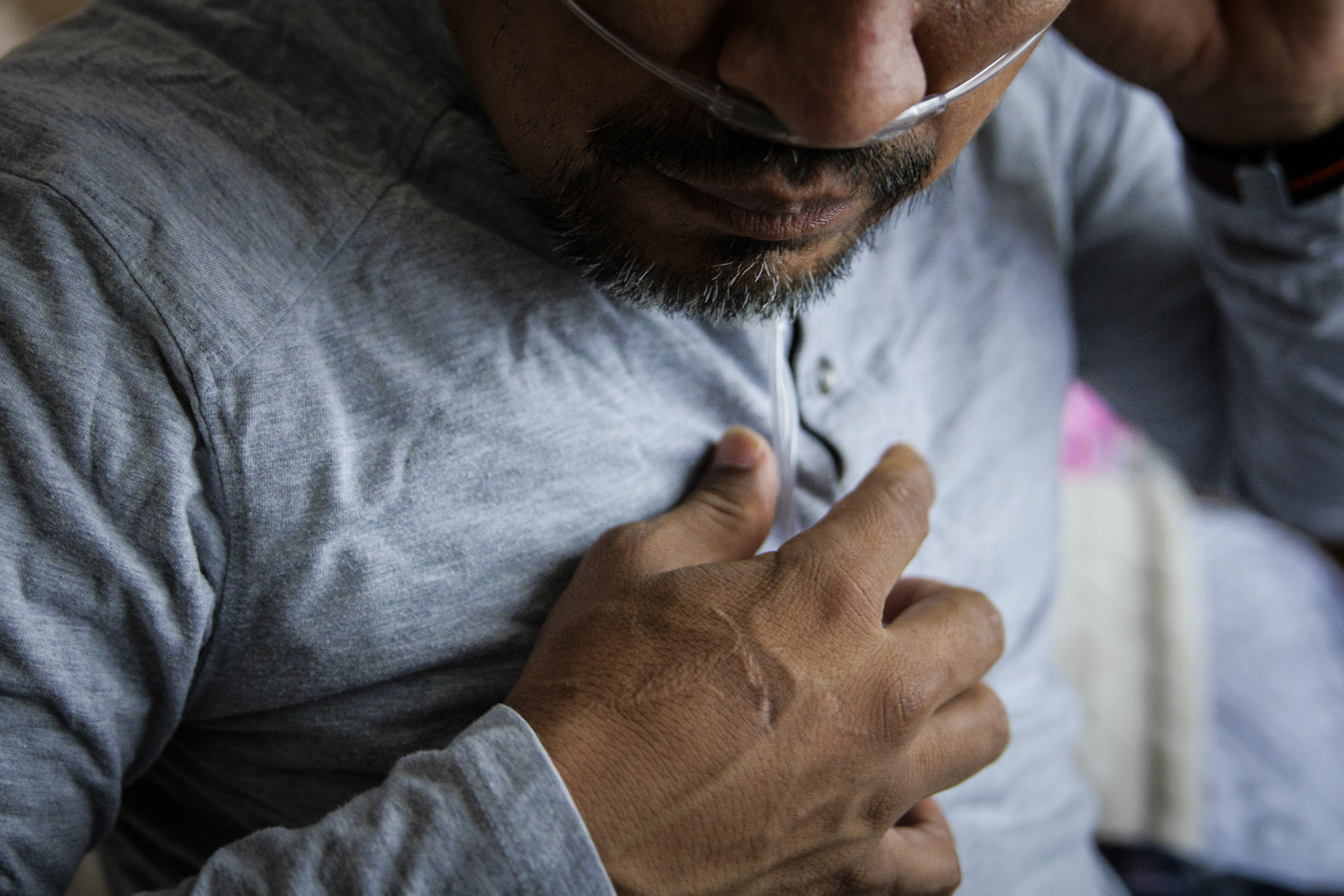
Ericka Cruz Guevarra [00:04:43] And then he was coughing a lot, trouble like breathing. So he ended up going to the doctor and he was diagnosed last year with silicosis. Now he’s confined in his home. He has to breathe 24-7 with the help of an oxygen supply machine.
Lopez [in Spanish] [00:05:05] Look, in fact, I’m not leaving my house anymore.
Farida Jhabvala Romero [00:05:14] So when I met him, he was sitting next to this machine and he had these clear tubes pronged to his nostrils and he can’t really leave his house without one of these machines to give him oxygen. He also wore masks when he was working, but they were filter masks and him and his employers thought that they were protected in that way, but now doctors are finding that this. Silica dust that is released by artificial stone is so tiny that it can penetrate the filter masks and it still lodges in the lungs and causes scarring and over time the lungs can’t expand and contract to breathe like they normally do. And he of course can no longer work. He’s run out of state disability benefits and he is on a waiting list to receive a double lung transplant and he’s only 43.
Lopez [in Spanish] [00:06:24] Right now, I feel desperate. It’s a desperation to be sitting alone, without being able to do anything. It’s anguish to be here alone, waiting for the time for them to talk to me about the hospital, so that I can receive the transplant that I’m waiting for and be able to go out and work.
Ericka Cruz Guevarra [00:06:53] I mean, Farida, how many people are there like Lopez in California now?
Farida Jhabvala Romero [00:06:59] What we know so far in California and the California Department of Public Health is now tracking this is that there are 450 confirmed cases of silicosis among stone workers linked to artificial stone since 2019.
Dr. Shephali Gandhi [00:07:18] I mean, the number of cases is exploding. I think many of us in the field expected it to.
Farida Jhabvala Romero [00:07:25] So one of the doctors I’ve spoken with is Dr. Shephali Gandhi. She’s a pulmonologist at the University of California San Francisco and she is seeing a lot of these cases be referred to her.
Dr. Shephali Gandhi [00:07:41] I have like 40 cases that are on my like waiting list right now to see and it’s just like every month my mailbox is just like full of more referrals of silicosis cases like it’s Just insane the number. 25 people have died.
Farida Jhabvala Romero [00:07:58] And there are dozens more that have received lung transplants and more workers that are waiting for them or didn’t qualify for a lung transplant. Doctors tell me all the statistics and figures we have now are definitely an undercount. This disease takes a couple of years to show up with symptoms. People may be sick already, but they don’t know it yet.
Ericka Cruz Guevarra [00:08:25] It’s so wild to hear just how, how much someone like Lopez’s life has been just irreversibly altered. What protections do stone workers have in California right now? I mean, even as it comes to safety gear, I mean is that, is that helpful at all? Or could that be helpful at for these workers?
Farida Jhabvala Romero [00:08:50] The state is now requiring countertop fabrication shops that use stone with silica to cut it wet with machines that submerge the stone underwater when they’re cutting it and sawing it to suppress dust. They also need to be wearing protective gear, like these powered air purifying respirators, which sometimes cover the worker’s full face. There’s a lot of dust suppression. And so we’ve had those in place since 2023, but most of these shops are small and don’t have the money or the capacity or the willingness to put these in place. That’s why doctors are looking at what happened in Australia, where Australia ended up banning artificial stone with high silica last year. Dr. Gandhi and other doctors have spoken with, say, it’s time for the state to start facing these products with high silica out of fabrication shops to protect workers.
Dr. Shephali Gandhi [00:10:11] You know, substitution, which is where we like really go for safer alternatives to all artificial stone is really where I think we should be concentrating our efforts, which is essentially what they did in Australia.
Ericka Cruz Guevarra [00:10:29] California’s Division of Occupational Safety and Health, or CalOSHA, has discussed whether the state should ban the use of engineered stone. And on Friday, doctors from the Western Occupation and Environmental Medical Association sent a letter urging the state to ban all fabrication and installation of engineered stone containing more than 1% silica.
Ericka Cruz Guevarra [00:11:01] I mean, what does the countertop industry think about that?
Farida Jhabvala Romero [00:11:05] So I spoke with Laurie Weber, who heads the International Service Fabricators Association.
Laurie Weber [00:11:12] Do we think there should be a product ban? Absolutely not. It’s not about the product. It is about the proper fabrication processes.
Farida Jhabvala Romero [00:11:21] She doesn’t believe that a ban is a solution. She thinks really the issue is having fabrication shops work on these products safely and following all the, you know, rules, is really important.
Laurie Weber [00:11:37] You know, I think that the easy answer for people is just to ban a product. But I mean, we want to talk about all the shops not in compliance. What about the shops that are in compliance?
Farida Jhabvala Romero [00:11:46] Especially because there may be other products produced in the future. You know, these companies are adapting and changing really fast, you know? And so there might be other toxic things that workers are exposed to. So they believe that the best thing to do is to have something like a licensing system in place.
Laurie Weber [00:12:06] There are a lot of livelihoods around that, right? A lot of jobs around that. And I think it just sounds very doomsday when at the end of the day, there are ways that we can help them become compliant and help them be better business owners.
Farida Jhabvala Romero [00:12:24] I’ve talked to fabricators. Told me that starting a basic shop that is complying with all the California safety rules would cost around $250,000. So some fabricators do it, but many others don’t.
Ericka Cruz Guevarra [00:12:40] Yeah, anyone you talk to from the companies themselves, you know, how are they responding to this crisis?
Farida Jhabvala Romero [00:12:46] Well, so there’s major manufacturers of artificial stone, Caesarstone, which is based in Israel. Another one is Cosentino, based in Spain. And then there’s a third one called Cambria, which is base in the US. But what they say is that they believe that you can cut and work on engineered stone safely if you follow proper health and safety measures. But because of the ban in Australia, Caesarstone and Cosentino have started to develop and sell alternative products with a lot less silica than traditional engineered stone. I’ve heard from doctors in California that have gone to Australia that these alternatives look pretty much the same as traditional artificial stone, that they’re a similar cost. There’s still questions whether the newer products are actually really safe or if they have other metals or resins or things that could be making workers sick. But what we know so far, for manufacturers, they say to the workers that are cutting it, they just need to follow the rules and precautions.
Ericka Cruz Guevarra [00:14:13] I mean, Farida, I wanna go back to Lopez here. I mean how is he doing? How are his spirits at this point?
Ericka Cruz Guevarra [00:14:24] I’d say it’s an illness that has completely transformed his life.
Lopez [in Spanish] [00:14:30] Yes, in fact I’ve been having my appoints the same way for a year now.
Ericka Cruz Guevarra [00:14:35] Just in the span of my conversation with him, we started and he was very animated and you know engaged and sort of by the end he was just like exhausted and I feel like I got a glimpse of what life is like for him and his family now and it’s pretty bleak.
Lopez’s wife [in Spanish] [00:15:00] Well, he’s always seen for us, he is the pillar. Now that we have it here.
Farida Jhabvala Romero [00:15:14] His wife said, you know, he’s, he was a very hardworking, active person. We go to work every day, you know, was out of the house the whole day, um, you know, busy and, and now he’s just sitting at home thinking about this. It’s an incurable illness. Uh, and even when they get a lung transplant, doctors have told me that. You know, people still need to a lot of treatment, you know. And they can’t go back to life as normal. He’s one of hundreds of workers in California that are suing major manufacturers of artificial stone, like Caesarstone, claiming injuries. And so, Caesarstone is a public company, so I listened in to one of their earnings call recently, and they said there’s more than 500 lawsuits against them, from workers, not just in… The U.S., but in Australia, in Israel. So we’ll see what happens, but there’s definitely hundreds of cases in the pipeline against these companies.
Ericka Cruz Guevarra [00:16:23] I mean, Farida, you’ve been reporting on this since 2023. What do you hope that people listening to this take away from your reporting?