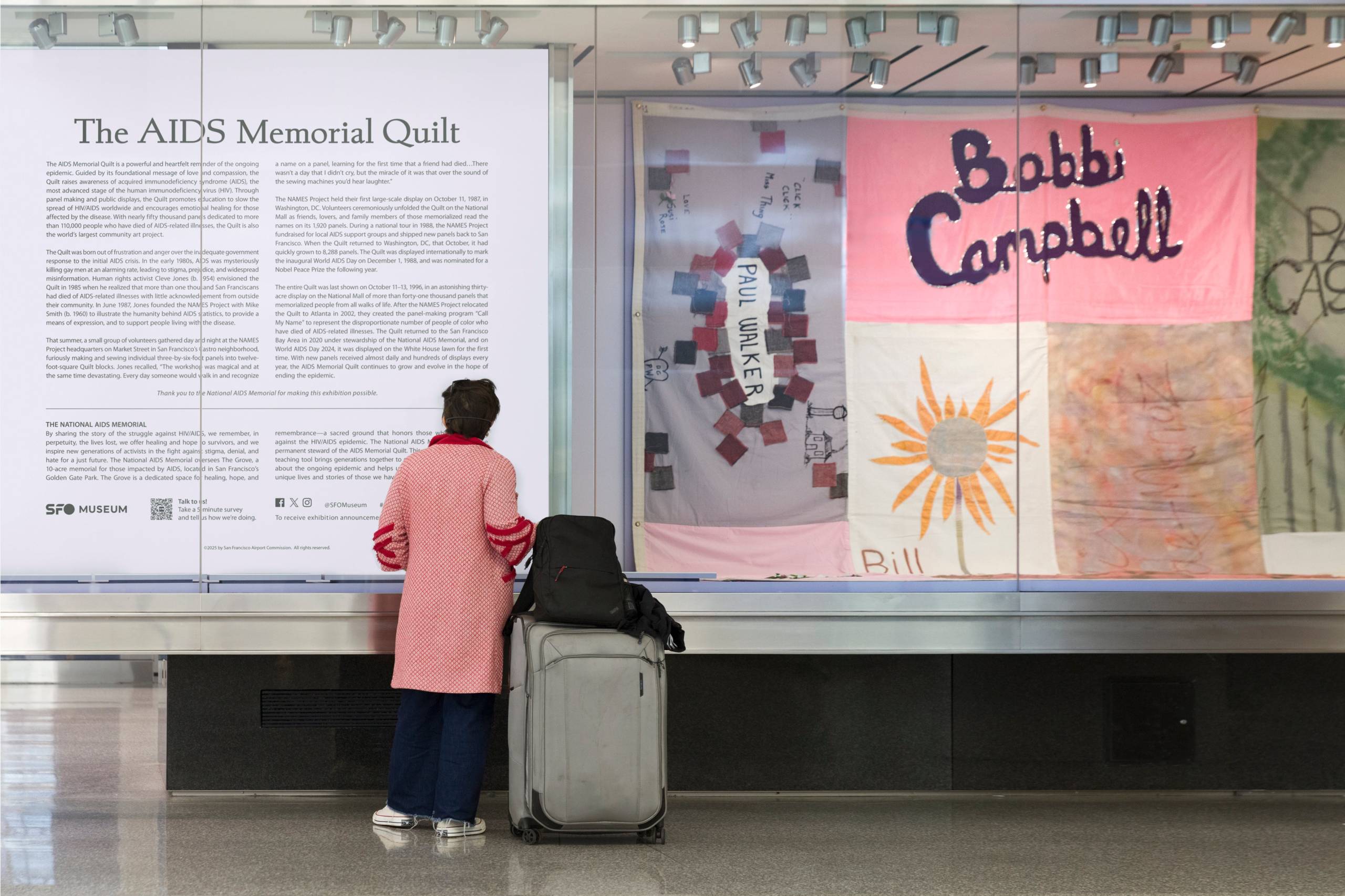
Ericka Cruz Guevarra: There’s a nice variety of buttons sort of represented there. And then it also says 1931 to 1985, my mother, my friend, I love you forever. You mentioned earlier, Daniel, that one of the things that you aim to do when you’re picking what you curate for the museum is you want things to be very colorful. And I feel like this exhibition is definitely representative of that. There’s lot of really bright. Beautiful color, very eye-catching in this otherwise very gray building. What do you want people to feel when they see this and come across this?
Daniel Calderon: I hope that, you know, being so visually beautiful, I hope they would be drawn in. Younger people now don’t even know what the Ace Memorial Quilt is, having that distance from the onset of the epidemic, right? But as they read and they learn, potentially draw inspiration from that. So, it’s a very important exhibition. We’re currently walking past the AIDS Memorial Quilt exhibition in the International Terminal Main Hall towards the A gates, International Terminals A gates on the departures level. So that we can go through the security checkpoint there to view an exhibition in Harvey Milk Terminal One on women of Afrofuturism.
Bao Li: So we’re going to go through security, we’re gonna go through security just like any normal passenger would. My name is Baoli, I’m the Associate Curator of Public Engagement at SFO Museum. I run tours for the post security exhibitions at Sfo Museum. We have scheduled tours once a week. However, we do have unscheduled tours if people can’t make the time that the scheduled tours occur. They are free, although they do require a bit of paperwork. And so there is a bit of a process that you need to go through to be able to come through TSA Security without a valid flight ticket. Everything goes in the gray bin, you do not need to take off your shoes anymore. What we will do is that this first person in line will just want to see that you have a badge, so just show them your badge. The second person at the security line will ask for both your badge and your ID. They will look at your badge, look at your ID, look at your face, scan your badge, look at the ID, your face and then scan your bag a second time. After that, we’ll go to the place with the gray bins. Everything goes in the gray bin except for your badge. Keep your badge on at all times. Okay, perfect. In the fiscal year of June 2024 to June 2025, the airport had 54 million passengers arrive and depart from the airport. And the other thing is that the airport is never not open, so we are open 24 hours a day, seven days a week, which means that pieces of art are actually blasted with light levels. 24 hours a day, 7 days a week, and they are potentially touched by 54 million passengers. We have a lot of mosaics because they are very robust, they are resilient, they are easy to clean. Much more than paintings or anything like that. And so we actually are going to have more public art in the new Terminal 3 and what has been pitched has been a lot more mosaics because they are very easy to clean.
Ericka Cruz Guevarra: Now we are walking past Security to see the Women in Afrofuturism exhibit that Nicole curated.
Nicole Mullen: Just past Security and Harvey Milk Terminal 1, we are standing outside of Green Apple Books and Ritual Coffee. And in between those two vendors, you have a beautiful intimate space where we’re currently featuring Women of Afrofuturism.
Ericka Cruz Guevarra: It is nice to know that there are these little corners of the airport that you can escape to after a stressful walk through security.
Nicole Mullen: Absolutely. You know, when we opened the space we were worried that people would just pass right by, but really people are intrigued and they’re lured into the space. And this is really fun because when you first step into the exhibition you see local Oakland Bay area based artist, Celia C. Peters, who is a filmmaker and artist. So we’re showing her proof-of-concept godspeed, you and see that. Animation and you can also interact with her lenticular print.
Ericka Cruz Guevarra: And it’s this woman who’s sort of looking over her shoulder. She’s sort blue in color, has blue lipstick, and is wearing very futuristic, aluminum-looking clothing.
Nicole Mullen: And very confident and welcoming you into the space. So it’s a special print made on plastic and it has three changes. So if you start here, you see the woman with her eyes open and if you look a little further, she turns green and gold with a pink background. So it changes a little bit. Yes, and then step again and you’ll see her. With a little bit of a smile now, and she suggested the idea to start the show like this with this strong woman in space.
Ericka Cruz Guevarra: Maybe Nicole, if you could explain this specific corner of the exhibition.
Nicole Mullen: Right now we’re looking at futuristic fashion design in the last bay of the exhibition and what you’re seeing here is work done by Afetassi, the artist. She is a local San Francisco based artist, born and raised here. She currently resides in Bayview. She’s created these kind of space helmets in a way, but you’re looking really bright red and yellow flowers that she’s created into a space helmet.
Ericka Cruz Guevarra: I wonder as the person who curated this exhibit, why was it important for you to really show and highlight Afrofuturism at SFO?
Nicole Mullen: Well, I really thought it would be wonderful for our audience. You know, when you’re talking about Afrofuturism, this is a social, political, and artistic movement. It examines the past. It questions the present. And it looks at how we can re-sculpt futures, both real and imagined. And I think doing that through the eyes of black women, especially, and their role in the movement, as Ingrid LaFleur had said, it really is like a warm hug. You know, when you come in here and you get to celebrate all these women.
Ericka Cruz Guevarra: And as we’re walking through here, it’s, I mean, a pretty short-ish. I feel like it takes you from one end of the airport to another end of the airport. You see people, some people just sort of walking through, but you also see, I see someone who’s stopping and really looking at the stuff. What is it like for you when you see people coming into this hallway and looking at the things you’ve curated?
Nicole Mullen: It’s really amazing and it’s really an honor to be able to bring this type of material to the public. We have a QR code to a visitor survey and so we get responses from the public all the time and a lot of people have been very moved by this exhibition and you don’t have to know a lot about the subject matter. You don’t need to pay a ticket to go see a museum exhibition. And a lot of times people… You know, they may have not thought about it and they stumble upon our exhibition and they feel drawn to it or excited by it. And so being able to reach that vast general audience is what I really love about the job.
Olivia Allen Price: That story was brought to you from the producers of The Bay podcast, including Ericka Cruz Guevarra, Jessica Kariisa and Alan Montecillo. Now, Barry also wanted a sneak peak into upcoming exhibits.
Daniel Calderon: We have an exhibition on low rider bicycles, that is opening in the long cases. It’ll take the place of AIDS Memorial Quilt. It’s really a special exhibition that says a lot about just community and family. Some really good surprises I think for people who may not understand the low riding community.
Olivia Allen Price: Look for that in April, Barry. And thanks for the question.
Bay Curious is made in San Francisco at member-supported KQED.
Our show is made by Katrina Schwartz, Christopher Beale and me, Olivia Allen-Price.
With extra support from Maha Sanad, Katie Sprenger, Jen Chien, Ethan Toven-Lindsey and everyone on team KQED.
Some members of the KQED podcast team are represented by The Screen Actors Guild, American Federation of Television and Radio Artists. San Francisco Northern California Local.