This is a computer-generated transcript. While our team has reviewed it, there may be errors.
Alan Montecillo [00:01:41] So, Adhiti, this story takes place in the city of Cloverdale. Tell us a little bit more about this community.
Adhiti Bandlamudi [00:01:48] Yeah, Cloverdale is a small town in northern Sonoma County, kind of on the edges of the Bay Area almost.
Adhiti Bandlamudi [00:01:59] There are a little less than 9,000 people who live there. And it’s kind of quiet. Some of the residents I spoke to there said they moved up after retirement to kind of get away from the hustle and bustle of the Bay Area cities. The average age is a bit older. And I also heard residents say it’s a little more working class than some of the other Sonoma cities like Healdsburg or Windsor even. Many of the people who lived there often work in wine country, but. You know, some are not able to partake in the luxuries of wine country living.
Alan Montecillo [00:02:34] And so we’re talking about Cloverdale because Cloverdale became a place of interest for a group called Esmeralda Land Company, which I guess is the other central character of this story. So what is Esmeralda?
Adhiti Bandlamudi [00:02:48] So Esmeralda is the name of a project which the Esmeralda Land Company was created to build. The Esmeralda Land Company is a development firm. They have not built anything yet. It’s all we know is that they were created to build Esmeralda. Esmeralda is pitched as this project, which will be this dense, walkable neighborhood to be built in the southern kind of portion of Cloverdale where there’s a vacant plot of land. You know, the renderings kind of look like what you might find in like an Italian countryside. And in terms of the people who are behind this project you know, it’s some people who have worked in development for a long time. And at the head of the company is Devon Zuegel.
Devon Zuegel [00:03:41] What I think we’re doing is really building on what makes Cloverdale awesome. I love spending time there and walking up and down the main street.
Adhiti Bandlamudi [00:03:49] And talking to people. She grew up in Mountain View, but then went on to work at some companies in Silicon Valley like GitHub, which is kind of like coding platform, and Bloom Protocol, which is like a blockchain company.
Alan Montecillo [00:04:03] As a software engineer.
Adhiti Bandlamudi [00:04:04] As a software engineer, yes.
Alan Montecillo [00:04:06] Why is Devon interested in developing land at Cloverdale?
Adhiti Bandlamudi [00:04:10] So the way that she puts it is that the vision goes back to summers spent in Chautauqua. So Chautaqua is a small town in upstate New York. Basically the city would host these like summer events, which would have like seminars and concerts and people would travel from near and far to attend them.
Devon Zuegel [00:04:31] A huge part of makes Chautauqua so wonderful is the community and the way that people really trust each other. And so, you know, the shows in little day-to-day things, like everybody sits on their front porches and waves at each other as they walked by.
Adhiti Bandlamudi [00:04:45] Devon’s grandmother lived in Chautauqua and they spent many summers going there and Devon has these fond memories of seeing seminars like one hosted by Jane Goodall and like seeing the Beach Boys perform and basically the way she tells it is that she really enjoyed her time there.
Devon Zuegel [00:05:05] There was one time when I was a kid and someone in Chautauqua lost the diamond out of their engagement ring. And the entire town spent the next 48 hours with their heads crammed down looking for the diamond. And someone found it and returned it to the person. And it’s the sort of place where like that actually happens. Like that sounds like a made up story, but that is real life.
Adhiti Bandlamudi [00:05:28] When she got older, she kind of figured like, huh, why doesn’t something like Chautauqua exist anywhere else in the United States? That became a goal, which is to kind of recreate Chautaqua, but somewhere else. And they found a plot of land in Cloverdale, where basically it seemed like all of the ingredients were kind of already assembled, and their vision could kind of come to life there.
Devon Zuegel [00:05:56] Whenever I talk to people in Cloverdale like, what would you like this place to be? It feels like they’re echoing our design principles.
Alan Montecillo [00:06:05] Okay, so that’s the inspiration, but practically speaking, what are Devon’s goals for this project?
Adhiti Bandlamudi [00:06:14] What Devon wants to do is transform this vacant piece of land into a hotel and an outdoor amphitheater and some retail spaces and around 600 homes. And it would all be walkable.
Devon Zuegel [00:06:30] People describe college as one of their favorite times in life and it’s like when they peeks or something but then I wonder like why can’t we have that experience all the time?
Adhiti Bandlamudi [00:06:41] The way that Devon has described it is that it’s almost like a college campus feel where people are kind of walking around and know each other and there are small shops that exist there. But also it would be like Chautauqua. So there would be programming that would go on year round where people could host seminars and lectures and concerts and things like that that would take place in this resort.
Devon Zuegel [00:07:07] Now that I’m an adult, I don’t personally want to live in a dorm, but living in an experience where I walk past people who I want to be friends with every single day is something that I do want in my life.
Alan Montecillo [00:07:20] So just so I’m understanding the main components of this project, there’s proposed hotel, outdoor amphitheater, I believe also a park.
Adhiti Bandlamudi [00:07:30] A huge park that they would like gift to the city.
Alan Montecillo [00:07:33] Gotcha. But then also housing. What kind of housing are we talking about?
Adhiti Bandlamudi [00:07:37] We’re talking about mixed types of housing. So you could have an apartment building next to a single family home, next to condo, next to senior living center. And what Devon says is this is a good opportunity to add not only some affordability, because her argument, and actually an argument that we’ve heard from a lot of city planners is that if you build that way, it gives people choice so that people are not forced to live in only a single-family home or only an apartment or only a condo that can kind of. Like it’s considered like multi-generational living. So you can have all kinds of people that live within the same neighborhood.
Alan Montecillo [00:08:24] Who are the investors, where’s the money coming from in order to buy and develop this land in Cloverdale.
Adhiti Bandlamudi [00:08:31] We don’t know who the investors are. We know that there are 19 investors, and Devon Zugle has described them as people who live in the Bay Area. The way that she’s phrased it is she sort of said they are small to medium size investors as opposed to large scale investors. And she has said previously that these are typically like families that live in Bay Area who want to live in Esmeralda once it is built. But she is not revealing the identity of these private individuals.
Alan Montecillo [00:09:04] One thing I’m trying to wrap my head around is how much, for lack of a better term, tech DNA is or isn’t part of this project because people propose developments all the time, but one of the reasons we’re talking about this and one of reasons this project has attracted a lot of attention is this idea that it’s some sort of tech utopia. There were a lot headlines about that, you know, around a year ago. Devin does have this sort of Tech background. How much does that factor into this vision for Esmeralda, if at all?
Adhiti Bandlamudi [00:09:34] So the company says not at all. The company says that this is a project that is merely trying to build housing in a different way that hasn’t been done before and it’s supposed to be dense and walkable and have this kind of like, you know, cultural element to it. That being said, the company has done this interesting thing where it’s hosted a pop-up village in Healdsburg, which is a little south of Cloverdale. Basically to give locals like a feel for what the development could be like if it’s eventually built.
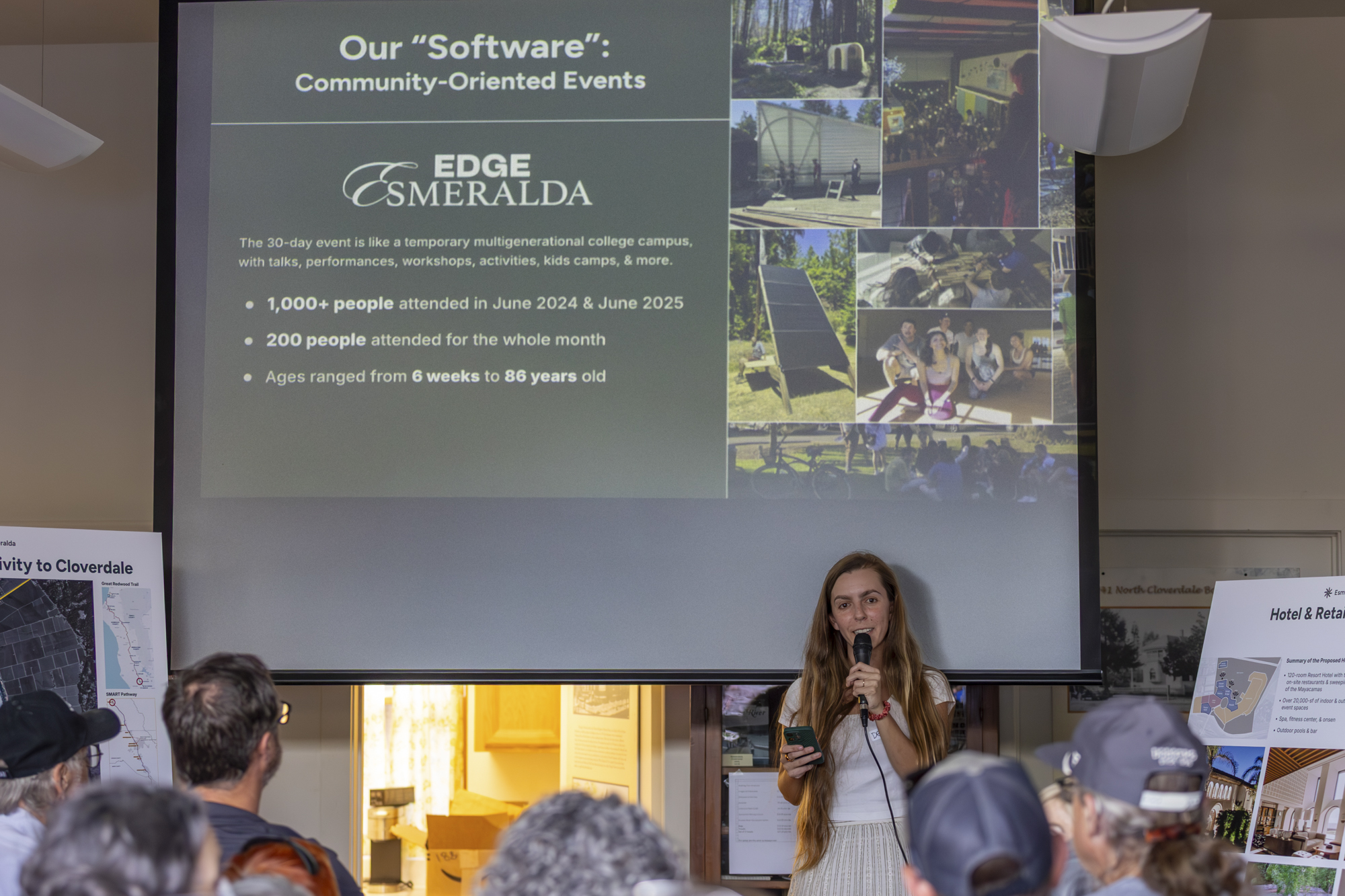
Alan Montecillo [00:10:05] I remember that. It was called Edge Esmeralda, right?
Adhiti Bandlamudi [00:10:07] That’s right, Edge Esmeralda. It happened for two summers, starting in 2024, and then again this year in 2025. And I looked at some of the programming. Is kind of tech centric? They had seminars for like cryptocurrency, talking about like techno-humanism.
Alan Montecillo [00:10:34] AI.
Adhiti Bandlamudi [00:10:34] AI, AI was another one, yep. All these ideas that you hear in Silicon Valley. Now, what Esmeralda said is like, yeah, well we’re in Silicon valley, so like we’re gonna make programming that’s relevant to people who might wanna come and stay here. But it’s also interesting that this is like the type of programming that could be at Esmeralda when it is, you know, if it’s eventually built.
Alan Montecillo [00:10:59] As the people behind Esmeralda started to share their plans, they heard a lot of questions that you’d normally hear with any new development. How big would it be? How would they handle issues like water? But they were also getting another big question. Were they connected to California Forever, a different company that wants to build a new city from scratch in Solano County? Now, California Forever bought up a bunch of land in secret. Funded by some of the biggest tech billionaires in Silicon Valley. They, too, promised a walkable community that would bring new housing and all kinds of great things to the area. And it ran into a lot of public opposition.
Alan Montecillo [00:11:43] So Devon Zuegel and Esmeralda had to address this question as they introduced themselves to the city of Cloverdale. So someone in tech wants to build a new, dense, walkable neighborhood. It reminds me a little bit of California forever, which is the effort to build new city in Solano County.
Adhiti Bandlamudi [00:12:09] Yeah, that’s like the elephant in the room, kind of. That’s the context here. These two projects sound really, really similar. They all have this kind of like new urbanist vision of like, we could build better, but they are very different. I mean, Esmeralda is a lot smaller than what California Forever was proposing. And actually when I had asked Devon Zuegel about this, she had said, She had watched California Forever present their vision, and it get a lot of backlash from locals.
Devon Zuegel [00:12:45] If the community is not part of it. But I do think like, you know, seeing the frustration that people had with California forever, definitely further underlined, okay, that’s really important to do.
Adhiti Bandlamudi [00:12:57] And she said she watched that and she was like, huh, okay, we need to do this differently than when we roll out Esmeralda.
Devon Zuegel [00:13:06] So far we feel like we’ve been welcomed and I think that’s going to make things a lot smoother and it’s going make our project more successful because we want the Cloverdale community that’s existing to, this is really a new neighborhood in Clovervale that it’s going to expand into.
Alan Montecillo [00:13:34] How do Devin Zuegel and Esmeralda try to convince the residents of Cloverdale that this is a great idea?
Adhiti Bandlamudi [00:13:42] So one of the ways that they’ve tried to do that is number one, the company has not purchased any land yet. They don’t own that land. The plot of land, that 266 acres, is privately owned and Esmeralda has like an exclusive right to purchase that land if they choose to do it, but they haven’t done it yet. Also, no official plans have been submitted on this project yet. Instead, what they’ve been doing is the company, has been like meeting with the community, holding town halls and coffees with the mayor at the senior multipurpose center. You know, at the town hall meetings, they’re actually like a little bit different because instead of Devon like standing at the front and giving this long presentation, basically people are asking questions and they’ll like cater the food from like a local restaurant and people will be eating food and talking. And generally the vibe is like really excited and upbeat. You know the vibe was also really interesting because Devon will be like kind of talking amongst the crowd and like meeting people and shaking hands. Her dad, like, comes to these meetings and is also talking to people about this event and is like, I’m so proud of my daughter.
Jim Zuegel [00:14:49] She ended up leaving tech because this is what she really wants to do. So she’s very, you know, go get her. We’re very proud.
Adhiti Bandlamudi [00:14:57] Like it feels very folksy.
Alan Montecillo [00:15:00] What about local officials, Adhiti? I mean, I think getting buy-in from the mayor, city council, I don’t think you can build this kind of project without their support. So what have you heard on that front?
Adhiti Bandlamudi [00:15:11] Yeah, you need local support. And one of the interesting differences between Esmeralda and California Forever is that California Forever did not have local support.
Alan Montecillo [00:15:22] Not enough anyway.
Adhiti Bandlamudi [00:15:23] Not enough, and even today, it’s very rare to hear an elected official say publicly that they like California forever. For Esmeralda, that is a totally different thing.
Todd Lands [00:15:33] I think it’s a great presentation and I think that this is a very good project that has worked very close with the city to this point.
Adhiti Bandlamudi [00:15:40] You know, I was talking to Mayor Todd Lands, and he told me that when he first heard about the project, he actually thought it was connected to California forever. And he was really skeptical of what they were trying to do.
Todd Lands [00:15:53] I was one of their biggest critics in the beginning. I made fun of them. They came in here with a project called Edge Esmeralda. I called them Utopia. I called the Emerald City. I was definitely not a fan until I…
Adhiti Bandlamudi [00:16:09] After talking with the company and understanding their vision, he said that he actually really likes what they’re trying to do. And he said they’ve been really receptive to changes and any concerns that city officials bring up.
Todd Lands [00:16:24] I have never had a developer come in and work with the city and work with me the way that they have with this project. To this point, every suggestion I have had, they have integrated back into the project and brought us new plans.
Adhiti Bandlamudi [00:16:36] One of the concerns that a lot of people have about this project is that it will become like a quasi gated community for like rich Silicon Valley tech types. And Todd Lands was telling me that, you know, when he heard that the project actually would try to be really cohesive with what the city already has, there are apparently like bike lanes that go from the city’s downtown into Esmeralda. There is like a bunch of open space and parks that are accessible to everyone and he said that like you know he’s really excited about that part of the city.
Todd Lands [00:17:12] They also have gone to our local stores and community restaurants and asked if they want to have pop-ups or their own little restaurants inside their own design of the hotel. So they’re trying their best to integrate with everything that we currently have and ways to make themselves fit better.
Alan Montecillo [00:17:34] So is that, everything’s all good then? No critics, no problems, we can just wrap it up?
Adhiti Bandlamudi [00:17:39] No, no, no. There are still critics, there are critics, people are skeptical, and people still have questions, yeah.
Alan Montecillo [00:17:45] Yeah, is there any organized opposition to this project in Cloverdale?
Adhiti Bandlamudi [00:17:48] So there’s no organized opposition, but there are residents who are concerned about the project and what it could be. I have heard people ask questions about like, who will this project really be for? Like on paper, you can say that it’s for everyone, but actually speaking, who will it be for. You know, I’ve also heard people still raise concerns about the fact that the investors are private. Like, why don’t we know who these investors are, who these people are?
Mary Ann Brigham [00:18:19] So I like what they’re saying, but is what they are saying true?
Adhiti Bandlamudi [00:18:22] Do you trust them right now? No, because I don’t know enough about it. I actually caught a woman, Mary Ann Brigham. She was at the town hall meeting that the company had hosted in October. She is the former mayor of Cloverdale, but she also kind of works in the nonprofit space there. I was on council for 20 years.
Mary Ann Brigham [00:18:46] And I’ve seen, this is the sixth project I think that’s come through, and they all end up wasting a lot of the city’s time and money and then they never go through.
Adhiti Bandlamudi [00:18:58] She had asked some pointed questions during the question and answer section of the meeting about who the investors are and how involved the company had really become in the community.
Mary Ann Brigham [00:19:10] It’s like I’ve seen this over, and over, and over and over. And I’ve never met a friend that’s a developer. I’m sorry, but I just have.
Adhiti Bandlamudi [00:19:21] She is first off worried that it will kind of just become home to rich Silicon Valley tech types who, you know, treat the the homes that they purchase out there as like second homes, you, know, or third homes and that like half of the neighborhood that Esmeralda builds like just will be vacant.
Mary Ann Brigham [00:19:36] We’re all working class here, business owners, working class. They talk about affordable homes in the 500,000 range. That’s not affordable to Cloverdale. And then they talk about $2 million homes, $3 million homes. That is not Cloverdale. That’s Healdsburg, or that’s Marin.
Adhiti Bandlamudi [00:19:56] Maybe it won’t be physically gated, but it could be economically gated. Asmeralda is promising a lot of things. They’re saying that like, this is gonna bring a lot of good to your town, Cloverdale. But if you don’t trust them, then you don’t trust them. And for Marianne Brigham, and some other residents who I spoke to, they just don’t trust them yet. And maybe, will never.
Alan Montecillo [00:20:27] So Adhiti, what’s the status of this project now?
Adhiti Bandlamudi [00:20:31] So right now, we’re super early on, on November 12th, Cloverdale City Council and the Planning Commission is scheduled to hold a formal hearing to review Esmeralda’s plans like officially. A number of other local agencies will review the project and the company is hoping to get final approvals by early next year. We’ll have to see what happens with this project and how like market conditions. How the local city and how the county kind of responds to this and either hastens the development or wants more reviews, but there’s a long way to go before this is built.
Alan Montecillo [00:21:12] What do you find most interesting about this story, Adhiti, and what takeaways might there be for the rest of the region?