Sarah Wright [00:02:05] Ever since January, the president’s inauguration, there has been wave after wave of issues within national parks.
Ericka Cruz Guevarra [00:02:17] Sarah Wright covers the outdoors for KQED.
Sarah Wright [00:02:22] It kind of started with the February mass firing of National Parks employees. Many of those employees were reinstated to their positions, but many chose to leave and take other opportunities because they weren’t sure about the future of their work and many others retired early. So just to start off the year, staffing kind of plummeted by 25%, according to some estimates. After that, Trump started discussing budget cuts, and then he also started to come out with this series of executive orders. And the orders attempt to change what’s going on inside national parks. And one of the main ways he’s trying to do this is by changing the stories that they tell.
Ericka Cruz Guevarra [00:03:10] I want to step back just a little bit, Sarah, and go back to March when Trump first issued this executive order that we’re talking about today. What is it exactly, and what did it do?
Sarah Wright [00:03:23] So in March, President Trump issued an executive order called Restoring Truth and Sanity to American History. And the idea was that parks everywhere across the nation had to flag anything that might be critical of U.S. History or Americans past or living. The rationale was to focus on what he calls the beauty and grandeur of America. So he’s trying to shape this narrative that What we should focus on in these celebratory places, which many parks are, is how great the US is. And that’s in line with a lot of Trump’s rhetoric, Trump’s policies, is to emphasize the good and not put too much weight or spend too much time talking about the bad.
Ericka Cruz Guevarra [00:04:12] So after this executive order, how did it actually play out in practice? Like what were park staff told to do?
Sarah Wright [00:04:19] First staff were told to post these signs with QR codes on them. That was to solicit feedback from the public about how the park is doing, anything they like or dislike, but mostly to ask them to identify anything about the park that disparages Americans. After that, over the summer, parks were told to basically document every single piece of content in the parks, maybe a wayside sign that you see on the road. That’s maybe a sign when you’re entering an exhibit. That could be a brochure you get. Even books in the bookstores and films that are shown in parks were part of this. And submit basically a big Excel sheet to their higher ups. And so that took a couple of weeks. They had a deadline to submit that over the summer and then they were told to wait. What happened next is a few parks got information back saying, thank you for flagging this. You need to come up with a plan to remove it. So they’re having to make these decisions kind of on their own with no real guidance.
Ericka Cruz Guevarra [00:05:37] Which is awkward in so many ways, including the fact that probably many of the people who are being asked to remove these things are the same people who worked really hard to put them together or put them up so that the public could understand and know about these histories of these parks, right?
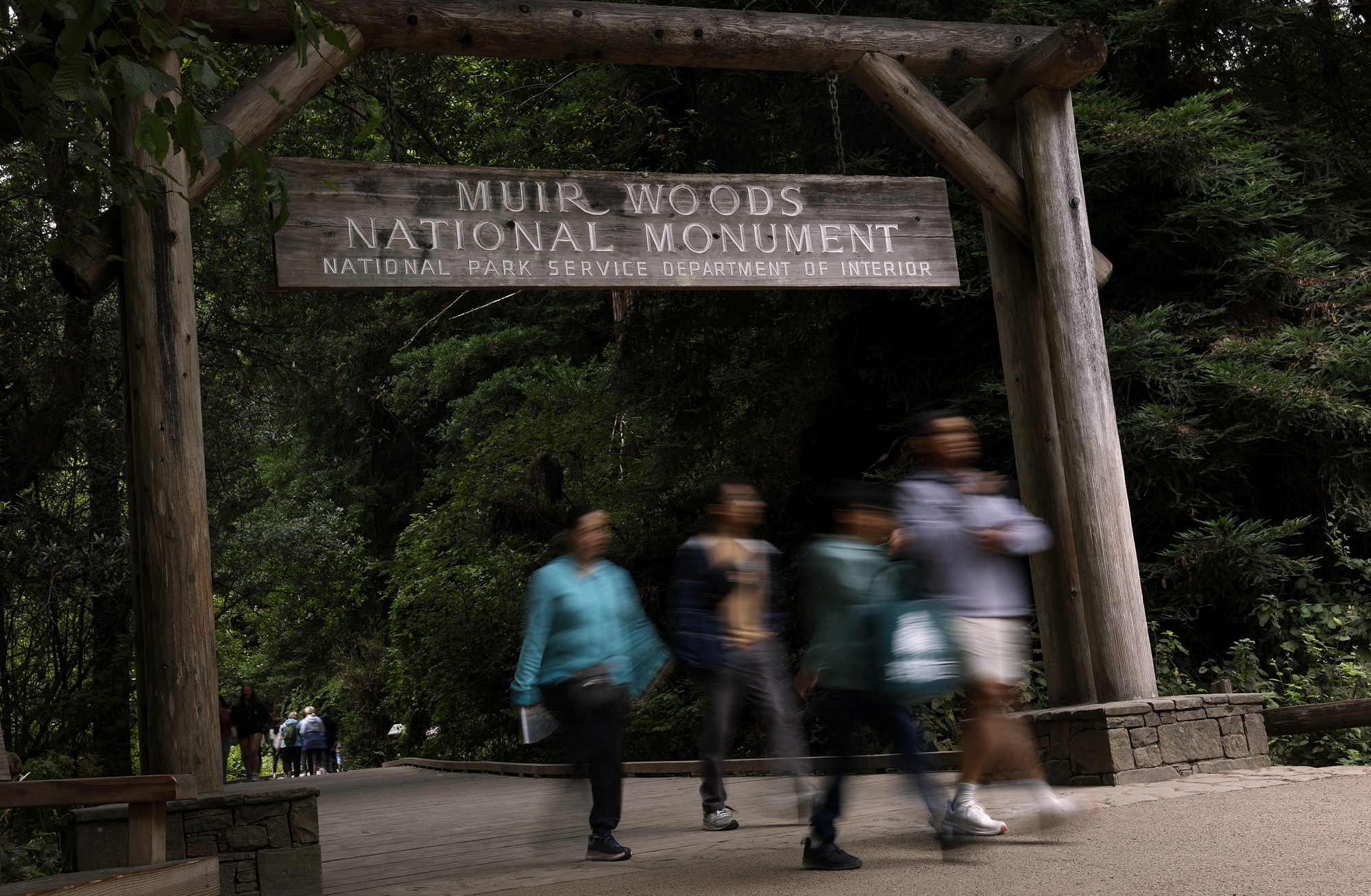
Sarah Wright [00:05:54] Yeah, in fact, that could be exactly what happened here in California at Muir Woods. There was an exhibit put up in 2021 in response to a lot of the conversations around Black Lives Matter. And staff worked really hard to create this exhibit that showed we used to have this sign, it didn’t have enough context on the history of this park. And so they added sticky notes and other information to sort of annotate the sign. To let visitors know all of this is true on this sign, but it’s not the complete story. So let’s add the contributions of women to creating this park, the contributions to the indigenous people, and some of the context around the founder’s often racist past. And so that was an effort that the whole park supported, that the park was excited about. And this year when Muir Woods staff were asked to take down those sticky notes, we don’t know if those are the exact same staff who put them up, but there was a lot of confusion, surprise, and even anger about this directive.
Chris Lehnertz [00:07:00] We were surprised that changes happened at Muir Woods so quickly.
Sarah Wright [00:07:04] Chris Lehnertz is the president and CEO of the Golden Gate National Parks Conservancy. It’s the nonprofit that partners with the Golden gate National Recreation Area. That group manages Muir Woods. It manages lots of other parks here in the Bay area.
Chris Lehnertz [00:07:20] You know, I can tell you that it’s a very big lift for parks. There are some parks that have 500 interpretive signs.
Sarah Wright [00:07:29] Chris told me that when she found out that the signage was changed at Muir Woods, it was shocking.
Chris Lehnertz [00:07:38] I don’t think that the histories told in parks are a threat to America. They share multiple human experiences. So I hope that in the coming weeks what we see come out of Washington, D.C. Is an embrace of that multifaceted history, not a judgment of it.
Ericka Cruz Guevarra [00:08:06] I know you actually talked to National Park Service workers directly about how these Trump directives are sort of playing out on the ground. But many of them only spoke with you anonymously. Why was that?
Sarah Wright [00:08:28] Yeah, so it’s a really fearful time inside of parks. Speaking with the parks superintendents who I did, they were really careful not to say anything in our interview that might be specific to their park site and they’re worried about retaliation.
Ericka Cruz Guevarra [00:08:46] What did they tell you, what did you hear from them about what it’s been like on the ground to follow these executive orders from the Trump administration? And it sounds like these are really confusing orders.
Sarah Wright [00:08:59] That was kind of the main theme of a lot of our conversations was like chaos and confusion. One superintendent told me every single week it felt like, and even every single day we were getting new directives. And we weren’t really sure which ones to act on first or how to act on them. And when we would ask follow up questions, we wouldn’t get answers. And that’s what I experienced as well in reporting this story. I asked the National Park Service to clarify a couple of points, including, who is reviewing the signage up in the national office somewhere, and I didn’t get a response to that. It’s been kind of a cloud of uncertainty, and that’s not even to mention the lack of staffing in parks right now, the fear for the future of budget cuts, and the uncertainty about whether or not parks will have the capacity to carry out their mission even next year.
Ericka Cruz Guevarra [00:09:55] What did other rangers or park staff that you talked to say about their worries around all this?
Sarah Wright [00:10:02] Yeah, so a lot of people were worried here in California about the narratives around our Indigenous history. There was a major effort to get those stories into parks. So those histories are the types of histories that sometimes discuss how genocide occurred here in California against Indigenous people, or in the case of Manzanar, how incarceration of hundred thousand people occurred here in the state.
Bruce Embrey [00:10:29] It’s dangerous because the false narratives lead to great harm to communities of color in particular.
Sarah Wright [00:10:37] I also spoke to Bruce Embrey. He co-chairs the Manzanar Committee that his mother, who is incarcerated there, co-founded in 1970.
Bruce Embrey [00:10:46] The site was created by the Paiute and Shoshoni people whose land Manzanar sits on and Japanese Americans who were incarcerated there during World War II. It took decades of work to create that site.
Sarah Wright [00:11:01] He and other Manzanar advocates have been among the most vocal against the Trump administration because they’re worried that this attempt to cover up or erase history might in fact cause it to be repeated.
Bruce Embrey [00:11:15] Our story is a cautionary tale, one that shows the dangers to our country when the constitution is torn up and tossed aside. I think the Trump administration and its allies want nothing more than to erase anything from our history that will show how what they’re doing is dangerous to our country.
Sarah Wright [00:11:44] Over in the South, they’re worried about the conversations around slavery. And in fact, the Washington Post reported this week that the Trump administration did direct some national park sites in West Virginia and Pennsylvania to start taking down signs. So it’s all of those stories are kind of what’s at stake.
Ericka Cruz Guevarra [00:12:11] I mean, I’m even thinking about myself and maybe how I might’ve taken for granted seeing some of those, these signs or these histories that are just, that were just present. When do you think it might become obvious for people like me or visitors that these changes are happening, or will they notice you?
Sarah Wright [00:12:30] That is a huge question. A lot of people told me they’re worried that people won’t notice because they won’t know what they’re missing in a park. They won’t know the stories that aren’t being told. And Jesse Chakrin, who’s the executive director for Fund for People In Parks, he told me that getting signage created is very expensive and a very lengthy process.
Jesse Chakrin [00:12:51] This is not a funded mandate. There’s no money behind this secretarial order to actually do the work that would be necessary if this were in good faith even to tell a more full and complete story.
Sarah Wright [00:13:05] A single sign can cost up to $5,000 and months of work. So more likely what you’ll see is signs starting to be covered up, which will just kind of, in my opinion, create a weird visitor experience because you’re like tempted to peel back the tape like what was there. But it might be quieter than that, in fact. It might just be a new sign that was on the docket to be created in the next year or so is just no longer gonna happen. Or a new exhibit that people have worked hard to think about is just gonna die before it can even be created.
Jesse Chakrin [00:13:40] People will stop telling full and complete stories. People will start to think about the ways that they can be careful so as to not offend. And so much of the work of the last 20, 30, 40, 60 years to really explore what it means to be an American, we’re just gonna erase those because we’re afraid.
Ericka Cruz Guevarra [00:14:02] And I mean, we’re talking about national parks, but it’s not the only place where the Trump administration has been removing history and information, right?
Sarah Wright [00:14:10] It’s part of a larger effort that we’ve seen from the Trump administration to scrub public sites. In the past, we’ve see this with the CDC, the EPA sites, and other public agencies. We saw it with websites on LGBTQ history at the Smithsonian. The worry is that if these histories aren’t in the public consciousness, people will forget. They won’t know the contributions of trans activists to Stonewall if the word trans is removed from a website. I also talked to some advocates who said, you know, the NPS isn’t the only keeper of these stories. We have a lot of private museums, we have a lotta state-run groups that, you know are really, really dedicating to holding onto these histories and so we may have to get creative in where we’re going for our sourcing. In the meantime while these sites are being edited, changed, or taken down.
Ericka Cruz Guevarra [00:15:09] It’s crazy because I guess it hadn’t even really occurred to me like how big of a role a national park might play in telling histories like this and I guess I’m curious what’s your sense of how park goers or visitors are feeling about these executive orders.