Sponsor MessageBecome a KQED sponsor
upper waypoint

Newsom, Trump and How Trolling Got Co-Opted by the Powerful

Save ArticleSave Article
Failed to save article

Please try again

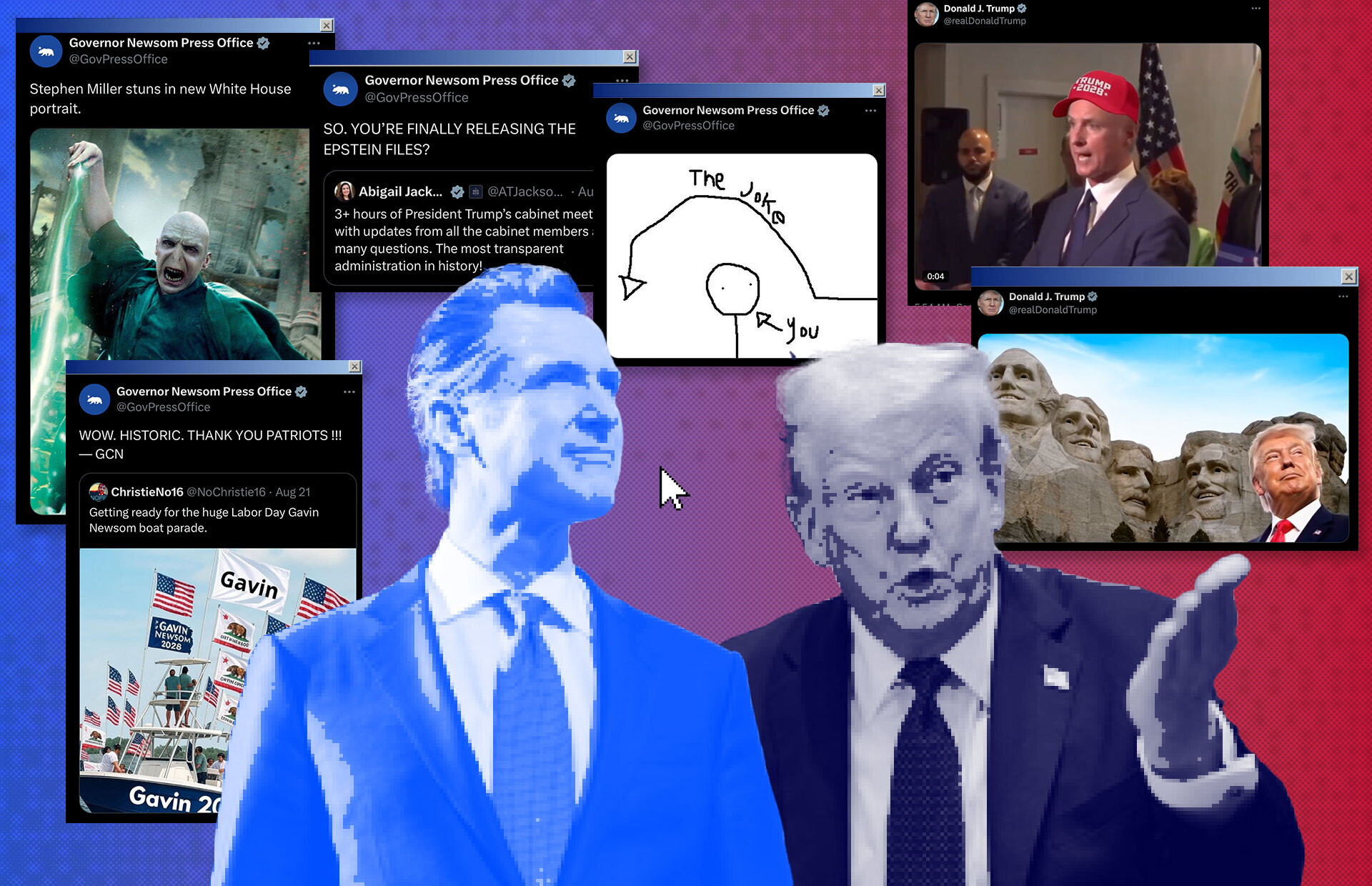
As the war of memes between Gavin Newsom and Donald Trump heats up, what happens when internet humor — once a tool for internet users to criticize the powerful — gets co-opted by those in power themselves? (Darren Tu/KQED)

He has compared senior White House officials to Voldemort, called the Speaker of the House Mike “Little Man” Johnson, and turned President Donald Trump’s signature catchphrase into “Make America Gavin Again.”

This summer, Gov. Gavin Newsom has transformed the way he talks on social media about Republicans — by deliberately adopting Trump’s own style.

As X feeds become one more front in the battle between the White House and California Democrats, who say they are now fighting “fire with fire,” Newsom keeps relentlessly posting: taunting MAGA with run-on sentences in all-caps that brim with self-promotion, in stark contrast to his previous online style.

Sponsored

Newsom’s online about-face came in the wake of Trump’s decision to send the National Guard into Los Angeles in June, in response to protests against immigration enforcement operations. This move by the White House saw the swift collapse of the delicate peace which had previously existed between the two men as Newsom sought federal funds to rebuild areas devastated by January’s California wildfires — a shift which was then supercharged by gerrymandering efforts in Texas directed by Trump and other Republican-led states.

Newsom has vigorously defended his posting style. “If you’ve got issues with what I’m putting out, you sure as hell should have concerns about what he’s putting out as president,” the governor said at an August press conference.

The governor’s office would only refer KQED to his public comments on the matter, but noted that despite public interest in who exactly was posting these tweets to his accounts, “the truth is this a reflection only of Gavin Newsom, his years of consumption of right-wing media, and now he’s using what he’s learned for good: holding a mirror to MAGA.”

But posting deliberately outrageous, provocative and hyperbolic content to provoke someone is nothing new. It’s a tactic rooted in Internet culture — trolling, memes, and what’s often called “shitposting,” or posting absurd, low-quality content as humor. And it’s all now, somewhat unexpectedly, part of Newsom’s rhetorical arsenal.

One nation under memes?

Watching Newsom spar online with Trump has undoubtedly delighted many Democrats — who are looking for someone that can fire back against the president and electrify the base — while infuriating conservative outlets like Fox News.

And it was startling for meme connoisseurs to see their medium being employed by the leader of the country’s most populous state. For Abe Woodliff, Vallejo-based writer, filmmaker and creator of meme account realbayareamemes, the trolling battle was downright disappointing.

“Politics — at least where the public is involved — is now just one person trying to dunk on another person,” he said. A millennial raised on the Internet, who identifies as a Democratic Socialist, Woodliff uses his fluency in memes and shitposting to mock California politicians for what he sees as a contradiction between the values they publicly promote and the reality that many residents experience.

“You can’t have this progressive utopia if no one can afford to live here, homelessness is rising and police brutality is out of control,” he said. “Memes became an outlet for my frustration with things here.”

Woodliff is only one out of many content creators who use rhetorical and visual styles unique to the Internet to criticize powerful individuals. Newsom’s new online persona, riffing off Trump’s own style, however, shows that those in power can also adopt this online language to advance their objectives — regardless of their political party.

“When something is manufactured like this, it loses its authenticity,” Woodliff said.

Mixing politics with trolling may help Democrats respond to Trump online, but this strategy could impact regular Internet users and voters, who must navigate an online reality — driven by algorithms that thrive on the inflammatory — where what is real, fake or shitpost gets muddled more each day.

Memes: A history of subversion online

Thanks to artificial intelligence programs, even those with no graphic design experience can now make a meme in a few moments — even one meant to resemble reality (remember Pope Francis in a stylish puffer jacket?).

But for the better part of the Internet’s existence, content poking fun at the powerful was decidedly unpolished.

Starting in the early 2000s, you could visit MySpace and chat rooms to see pixelated photos of then-president George W. Bush, pasted on top of a nuclear explosion or holding a Dr. Seuss book above the caption “his most recent foreign policy briefing book.”

Low-quality absurdist humor, albeit the kind that required rudimentary knowledge of photo editing software, became a medium for people all over the world to discuss actions out of their control — like the Bush administration’s decision to invade Iraq.

And for many, the caliber of the memes didn’t actually matter. “There’s a real value in speaking about politics in a vernacular language because a lot of people feel alienated from politics,” said Abigail De Kosnik, professor at UC Berkeley who studies performance and new media.

Memes found a home in the growing social media ecosystem of the 2010s, where regular people began to feel more comfortable expressing their opinions about the powerful with barbed humor and distinct vocabularies.

De Kosnik points to “Black Twitter” — the informal, but expansive community of Black commentators that developed on the platform now known as X in the late 2000s — as one online space that developed a universe of memes and humorous rhetoric, influenced by African American Vernacular English. “Black Twitter was a contentious, but also very funny space,” she said.

After the 2012 killing of teenager Trayvon Martin, Black Twitter translated its comical critiques of power into the real world, De Kosnik said — as commentators swiftly mobilized in support of the Black Lives Matter movement.

This online language, she said, “now questioned: “What are we doing to protect people? What are we going to critique police violence?”

MAGA welcomes the trolls

But as spaces like Black Twitter grew, a parallel trolling ecosystem on the far right grew — with accounts promoting racist, sexist and homophobic views saturating social media by the end of the 2010s. And that was due to the very algorithm these platforms run on, said UC Los Angeles professor Ramesh Srinivasan, who studies the connections between technology and democracy.

“What tends to go most viral on social media platforms is what is computationally predicted to grab attention,” he said. If someone posts something that insults certain groups and many users engage with that post — whether out of anger or agreement — the social media algorithm notices those high levels of activity and will promote similar posts in the future. Trolling your opposition to an extreme, or “ragebaiting,” has become an effective strategy to dominate online conversations.

During his first White House run in 2016, Trump consumed entire news cycles by shitposting from his Twitter account. But he wasn’t the only one trolling anyone who opposed the MAGA agenda.

Far-right trolls that supported Trump’s campaign were now bringing brought white supremacist views from platforms with no moderation, like 4chan, into the wider Internet. Pepe the Frog — a cartoon created in 2005 on MySpace by San Francisco artist Furie — became a recurring character in deeply racist and misogynistic memes that showed up on Instagram and Facebook. In October 2015, then-candidate Trump would retweet an image of himself as Pepe.

“When Trump started politicizing his shitposting during the Obama administration, I would say he was really riding this bigger wave of alt-right accounts combining this vernacular, informal language with political agendas,” UC Berkeley’s De Kosnik said. “The right wing appropriated those tactics very quickly.”

Trolling strategies were employed by the far-right to attack those they thought had become too powerful during the social justice movements of the 2010s, including women, minorities and the LGBTQ+ community. “The alt-right always has adopted this victim mentality,” De Kosnik added.

The language of Internet culture that not long ago had been used to ridicule American presidents like Bush now helped get one elected.

Where does posting end and policy begin?

As the 2016 campaign reached its final weeks, then-First Lady Michelle Obama encouraged Democrats to engage Trump with civility and respect, with the phrase: “When they go low, we go high.”

Almost 10 years later, now during a second Trump administration, Newsom’s team has learned that, “if you stay high, then it’s over,” De Kosnik said. In fact, Obama herself abandoned her old mantra by the time of the 2024 election, bashing Trump to a national audience.
But there are consequences when politicians online take up to ragebaiting to chase after the algorithm’s attention, Srinivasan said.

“If certain voices remain invisible and only the most dominant, provocative and divisive voices go viral, you can imagine how much that creates distrust in what is actually real,” Srinivasan said. “Democracy isn’t just about everybody having a vote — it’s also about dialogue.”

Big Tech companies will have to be part of any solution to address civil discourse online, he added, especially as politicians start posting more images and videos created by artificial intelligence. “We need to not let AI go down the same path that social media went down,” he said.

Woodliff of realbayareamemes also worries that there could be a degrading effect on reality when figures like Trump and Newsom mix shitposting with AI.

It’s one thing for a humorous meme page like his to post intentionally absurd AI images, he said — but it makes it harder for voters to keep elected officials accountable if blurring the line between reality and AI-generated fiction is part of their political game.

“Media literacy won’t even matter because eventually it will all look the same and everything will be so ridiculous we won’t be able to tell fact from fiction,” he said.

Ultimately, for Woodliff, Newsom and Trump’s war of words online is still just that — words. What he really cares about, he said, is not how these politicians communicate online but how their rhetoric actually matches their policies.

“Until that happens, it’s just people trolling each other with big budgets,” he said.

Sponsored

lower waypoint
next waypoint