This partial transcript was computer-generated. While our team has reviewed it, there may be errors.
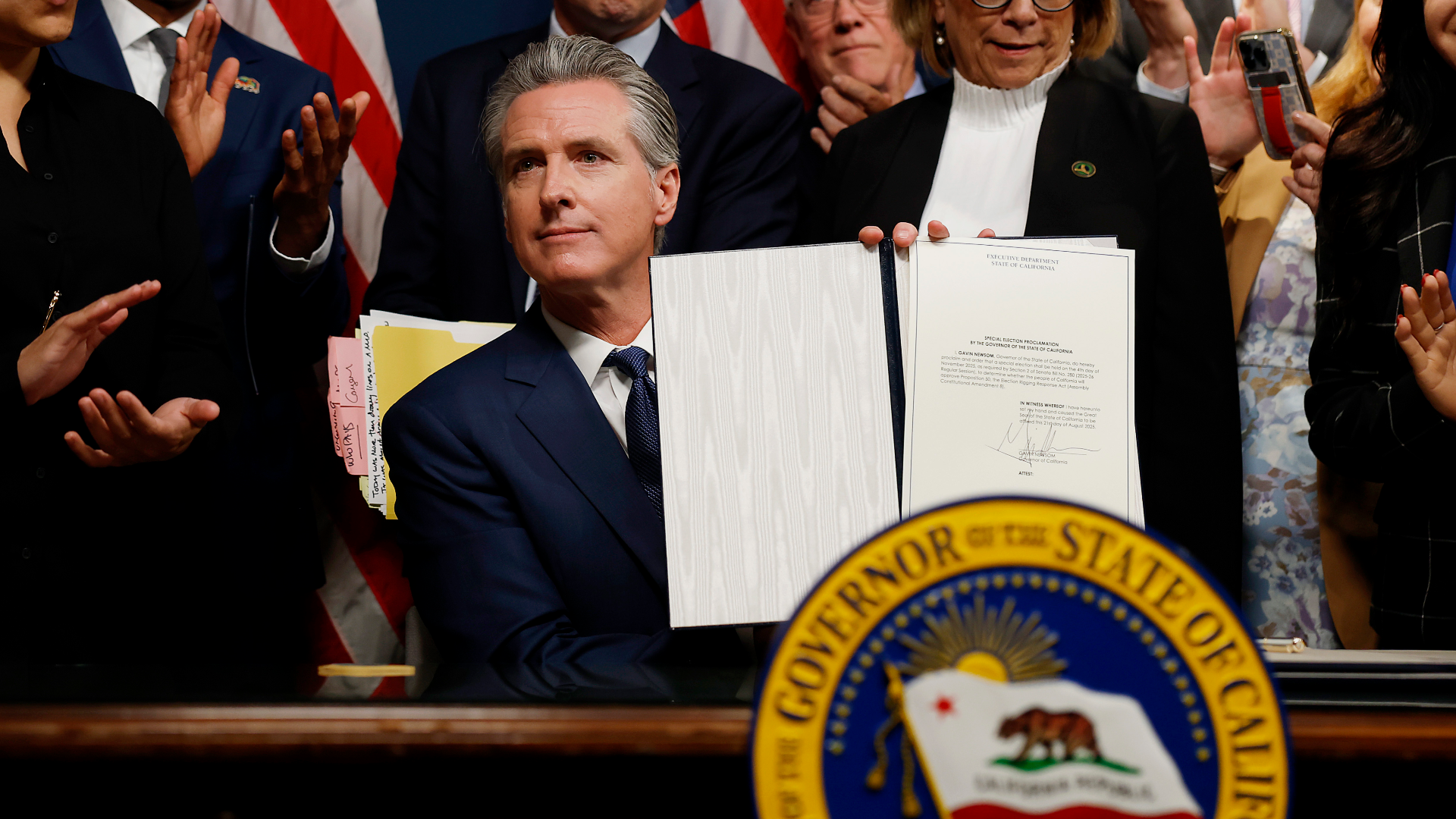
Mina Kim: Welcome to Forum. I’m Mina Kim. Governor Gavin Newsom is charging ahead with his temporary redistricting plan. State lawmakers have approved the redrawn congressional maps favoring Democrats, as well as a special election on November fourth asking voters to approve them.
Meantime, state Republicans are suing to block the ballot measure. Opposition mailers are already arriving in mailboxes. And President Trump — despite urging Texas to redraw its maps to favor Republicans — is threatening to sue over California’s plan to do it. “Bring it,” was Newsom’s reply as he makes national headlines for trolling the president and mimicking Trump’s taunting style.
We go over all of this with KQED’s politics team and with you, our listeners. The redistricting train has clearly left the station. So are you on board, or are you hoping to stop it?
Marisa Lagos is with us, correspondent for KQED’s California politics and government desk and cohost of Political Breakdown. Guy Marzorati is with us too, correspondent on KQED’s California politics and government desk as well. So, Marisa, wow. A lot has happened just in the last week, including the opposition starting to find its voice. What do you think about all this?
Marisa Lagos: I mean, you know, I think Republicans are going to try to throw everything they can at this in California to halt it. As you mentioned, it’s a little ironic seeing these lawsuits and some of the statements. I feel like up is down and down is up depending on if you’re in Texas or California and who’s on which side of which debate.
But, you know, this is an overwhelmingly Democratic state. Registration among Republicans remains low enough that we haven’t seen anybody on the GOP side win a statewide office in almost twenty years. And I do think that, with the approval ratings we’re seeing coming out just today around President Trump in California, it will be an uphill battle for Republicans if they can’t get this thrown off the ballot. Talking to some legal experts about that lawsuit, it seems semi-unlikely. Courts are usually reticent to weigh in before voters. But you know what, Mina? Who can predict anything in politics anymore?
Mina Kim: Yeah. Guy, what is that lawsuit filed by California Republicans on Monday about? It’s the second one. What arguments are they making?
Guy Marzorati: Yeah. So it’s a few different grounds. You mentioned that first lawsuit. That was really about the process by which Democrats moved this redistricting plan through the legislature. And the lawsuit challenged this process called “gut and amend,” which basically happens very often towards the end of the legislative session, when you’ve already gotten past a lot of the bill deadlines for the year.
So in order to move legislation forward, you take a bill that’s already made it past the deadline. You delete everything that’s in that bill, and you put an entirely new bill within it. That’s super common, and honestly, it’d be hard to get much business done towards the end of the year without that process. So a lawsuit challenging redistricting by saying, “Oh, you illegally used gut and amend,” was gonna be a very hard hill to climb. The Supreme Court did not take that up.
Marisa Lagos: And that would have had enormous impacts way beyond this ballot.
Guy Marzorati: Exactly. If you extrapolate that to all gut-and-amends throughout the legislative year, it would have a huge effect. So that wasn’t gonna go very far.
This new lawsuit brings that up, but it also brings up a couple of other points. Some that I’ll be very interested to see how the arguments play out. Most notably, it challenges the idea that lawmakers voted on a new map.
You know, the process by which Democrats are bringing this to voters is: there’s gonna be an election November fourth. Do you support handing this line-drawing power to the state legislature and moving it away from the independent redistricting commission for the upcoming elections? But lawmakers wanted to actually have a map to show voters. They wanted to say, “If you take this vote, if you take this step to give the legislature the power to draw the maps, here’s the map that we wanna go ahead with.”
And what the Republican lawsuit questions is: is it legal for the legislature to have voted on a map when currently they don’t have the power to enact redistricting? We have redistricting through an independent commission. They wanna give the legislature the power through this vote, but can they do it before the vote has actually taken place?
Mina Kim: Yeah. Sounds like they’re also worried about how it’s being written and presented to voters. Marisa, you know, Californians like the independent redistricting commission. Right? Is that also the core of other opposition voices like Republican donor Charles Munger and former governor Arnold Schwarzenegger, even briefly former Speaker Kevin McCarthy?
Marisa Lagos: Yeah. I mean, I would separate the sort of partisan McCarthy arguments from someone like Schwarzenegger and maybe even Munger, who I do think are very wedded to this. You know, this is one of a series of reforms that both Munger and Schwarzenegger helped push in California.
And to give them the benefit of the doubt, they truly believe that these are the right things and that this should be how government operates, not just in California but across the nation. I think that’s very different from Kevin McCarthy and Representative Kevin Kiley, who I had on Political Breakdown last week, who are making a much more partisan argument.
I mean, they’re trying to make the good-government argument, and that’s really the crux of this, right, Mina? On one side, you’re gonna have whoever is in that coalition making the case that this is not about national politics. This is not about Trump. This is about good government in California and reforms that voters put in place that they wanna see preserved.
On the other hand, you’re gonna have Newsom and Democrats really just making this all about Trump, his calls for Texas and other red states to redistrict, and crucially, about House control in 2026 and beyond. And that is where you’re gonna see such a difference. It’s almost like two different campaigns. They’re not gonna be arguing around the same issues.
And I think that’s where it’s gonna be challenging, because as much as voters on its face support the idea of this independent commission, when you ask the actual question about this ballot measure, the polling is very different. We just saw more polling come out today from IGS that found seven in ten voters disapprove of Donald Trump’s job performance. Those are highly partisan breakdowns: Republicans overwhelmingly approve, Democrats overwhelmingly disapprove. And, again, Democrats have the upper hand from an electoral standpoint.
Mina Kim: Yeah. Well, we have listeners already weighing in on whether they’re on board with the governor’s redistricting plan.
Steve on Discord writes: I hate partisan gerrymandering. At the same time, I don’t think it’s acceptable for California to become subject to a Texas-based effort toward a nationwide dictatorship. So if California can prevent that with an equal but opposite action, that’s a workable compromise.
Beth writes: While I detest what the Republicans in Texas have done, it makes me mad that Governor Newsom seems to want to have his own way. It’s actions like these that turn me off to politics and voting.
And Rick writes: I will say the same thing that elected Democratic officials are. Trump started this.
So, Guy, just remind us. Newsom is trying to say Trump started this, urged Texas, we’re responding to Texas, and this is temporary. Right? Those are his arguments. That’s the campaign right now.
Guy Marzorati: That’s right. And I think this did start with the president going to Greg Abbott and lawmakers in Texas and saying, “Hold this special session. Try to redraw your maps to pick up five Republican seats.”
Newsom then led this effort in California to do the same thing — draw a map that could potentially pick up five Democratic seats. But you’re seeing this spread far beyond California and Texas.
The Trump administration has been meeting with lawmakers in Indiana, potentially to redraw those maps. You’ve heard ideas from lawmakers in Florida to help Republicans there with a gerrymander. So this really is turning into a nationwide fight over redistricting.
And it’s one in which Democrats are kind of playing at a disadvantage. There are more hurdles for Democratic-leaning states to put aside independent redistricting commissions and squeeze out seats — in the case of states like Illinois — than there are for a lot of these Republican states. So it might be a losing proposition to go down this road for Democrats.
But I don’t think that’s the full story of what Newsom’s doing here. You have to look at it both as a strategic move to counter the seats that Texas is trying to pick up, but also as a political move in giving voters something to express their frustration with the Trump administration. Democratic voters who have sat and watched complete Republican control of Congress and the White House over these last eight months are being given an opportunity to get organized and energized. I don’t think you can put that aside from the strategy.
Mina Kim: Yeah. Marisa, the more he can make it about being anti-Trump, probably the better for him. So what do you think of Trump’s threat to sue California over this? It sounds like, politically, that sorta helps Gavin Newsom.
Marisa Lagos: Yeah. Which I think is sort of the irony of everything that’s been going on in the past few weeks with Newsom — his new posture, the social media strategy of really parroting Trump’s tone.
It does seem like Trump keeps taking the bait in some ways, the same way Democrats arguably have for a decade with him. And so I think as of now, Newsom’s riding very high politically. Substantively, I have no idea. You know, the president says things all the time that he does not follow through on. He also says things he does follow through on. So I have no idea what that means in terms of a basis.
I don’t know — do they want that fight nationally? Do they want that to go to the Supreme Court when you have places like Texas doing this in the same nakedly partisan way that California is?
I do know Democrats in Texas think they have more of a case in terms of challenging these maps on racial grounds. The Supreme Court has said you can gerrymander maps for partisan purposes, but not disenfranchise racial communities. A lot of that has been softened, obviously, as the court has gutted the Voting Rights Act. But I think those are interesting questions.
If they challenge the maps in Texas, does that hurt California or vice versa? We’ll have to see. And, of course, these are very different processes. You could argue that what California is doing, if it passes, might actually withstand more of a challenge because voters weighed in. But there are so many complicated questions here, Mina.
And I think the interesting thing is that the courts are gonna have to decide anything that’s put before them very quickly.
Mina Kim: Yeah. And that’s a good note that Texas is, in fact, facing its own legal challenge to its redistricting effort. Guy, real quick, how seriously do you think we should take Trump’s threats to sue California?
Guy Marzorati: Well, I think I wouldn’t be surprised if you saw some kind of legal action. I already saw the Republican campaign arm for House districts raising money for a potential legal fund to fight against some of these Democratic states that are redrawing maps. So I wouldn’t be surprised at all if this continues in the legal arena while you have this campaign play out in California between now and November fourth.
Mina Kim: We’re getting the latest on California’s redistricting plan and efforts to stop Newsom from following through on it. We’re talking about it with Marisa Lagos, cohost of Political Breakdown and correspondent on KQED’s California politics and government desk, along with Guy Marzorati, who’s a correspondent on the desk as well.
And we’re hearing from you, our listeners. Are you on board with Governor Newsom’s redistricting plan? Are you from a district that’s changing? What are your thoughts? What are your questions about the new maps? We’ll dig into those right after the break.
What do you think of Governor Newsom’s tactics and methods? Are they working for you? Email [email protected]. Find us on our social channels — Discord, Blue Sky, Facebook, Instagram, or Threads @kqedforum — or call us at 866-733-6786.
More after the break. I’m Mina Kim.