With Federal Money in Doubt, California's High-Speed Train Seeks a New Path Forward
The leaders of California's high-speed rail project say they've learned from past mistakes. But the troubled megaproject faces an uncertain future with $4 billion in federal funding tied up in court.
Joel Rose, NPR
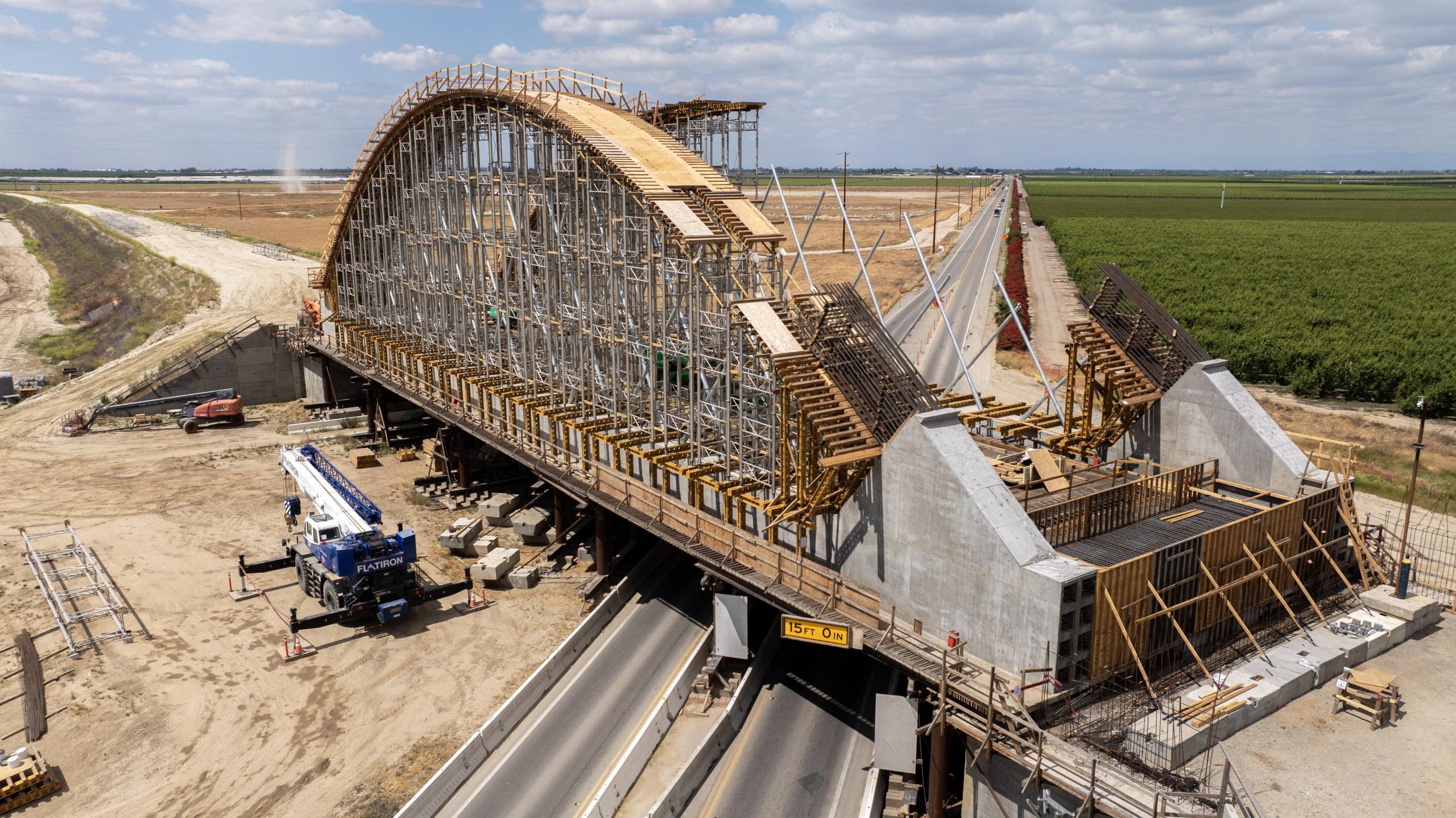
The Tied Arch Bridge construction site in Fresno County, California. (Courtesy of California High-Speed Rail Authority)
HANFORD, Calif. — Hundreds of miles from Los Angeles and San Francisco, the first leg of California’s high-speed rail line is rising above the almond trees and grape vines of the Central Valley.
This summer, construction workers put the final concrete girder in place for the Hanford Viaduct, an elevated structure more than 6,300 feet long. It’s part of a 119-mile stretch around Fresno and Bakersfield that’s already under construction, and where crews could begin laying track as soon as next year.
“This is all doable. This is all buildable,” said Ian Choudri, the CEO of the California High-Speed Rail Authority. “The hardest part is over.”
If you want to ride on a train traveling more than 180 miles per hour, you can find one in Europe. Also China, Japan, Indonesia, Turkey, even Morocco. One country where you cannot ride such a train is the United States.
California is trying to change that. But the state’s ambitious high-speed rail project faces an uncertain future as the Trump administration tries to cancel billions of dollars in federal funding.
Choudri took the top job at California’s high-speed rail authority last year after decades in the private sector, including high-speed rail projects in France and Spain. He readily acknowledges that the California project has made mistakes — but he insists the authority has learned from them.
The Hanford Viaduct stretches more than 6,300 feet in Kings County, California. (Courtesy of California High-Speed Rail Authority)
“Bureaucracy and regulations created the nightmare,” Choudri said in an interview at the authority’s headquarters in Sacramento. “That caused this program to start on the wrong foot.”
Those missteps are well documented: rushing to begin construction before all the land was acquired, committing too early to the wrong routes, endless environmental reviews.
After more than 15 years in development, a high-speed train connecting San Francisco and Los Angeles remains a distant goal. The project is years behind schedule and billions over budget. Critics, including the Trump administration, call it a boondoggle
Related Article
This is the definition of government incompetence and possibly corruption,” said U.S. Transportation Secretary Sean Duffy in a video announcing that his department would seek to revoke $4 billion in federal grants for the project. “That’s why we’re pulling the plug.”
Duffy noted that the area under construction now will only serve the Central Valley — stopping well short of the original plan to connect the line with San Francisco and traffic-clogged Southern California.
“No more federal funds for this high-speed train to nowhere,” Duffy said.
Federal transportation officials concluded that the project has “no viable path” forward. But the high-speed rail authority disputes that.
California is suing to stop the Trump administration from revoking those federal grants. And Choudri is doing all he can to push back on the “train to nowhere” narrative.
The authority released an updated report on the project last month, laying out a new strategy that could eventually connect the Central Valley to the southern edge of the San Francisco Bay Area and the northern edge of Greater Los Angeles by 2038 — if California lawmakers can find more money to finance the extensions.
Ian Choudri, CEO of the California High-Speed Rail Authority, in his office in Sacramento. (Joel Rose / NPR)
And CEO Ian Choudri has invited Trump administration officials to see the progress in person.
“I just want people to come and visit, and just go drive around and see the 70 miles that is already built,” Choudri said. “It’s not hypothetical stuff. It’s there.”
That infrastructure is already having a positive impact in places like Fresno, the fifth-largest city in California, where the rail authority recently finished one of several new tunnels under the future high-speed rail line and station.
Fresno city councilmember Miguel Arias says the Tulare Street Underpass is helping reconnect the historically disadvantaged Chinatown neighborhood with downtown Fresno.
“It’s gonna permanently reconnect the two neighborhoods back,” Arias said. “That’s been a huge significant change for us as a city. Something we could have never done on our own.”
But the Tulare Street Underpass took seven years to build. Garth Fernandez, the regional director for the high-speed rail authority, says it’s a good example of why this project is taking so long.
Garth Fernandez, the Central Valley regional director for the California High-Speed Rail Authority, in the Tulare Street Underpass in Fresno, Calif. (Joel Rose / NPR)
“We weren’t ready to go to construction. We didn’t have the right of way. We didn’t have agreements in place. We didn’t have utilities out of the way,” Fernandez said.
That’s just one of 60 at-grade crossings in the Central Valley alone — each with its own local community making its own local demands. Fernandez says the authority has learned to streamline the process.
“The next phases of the project are going to be significantly different because of all the lessons we learned,” Fernandez said.
But some Californians may have already lost patience.
“I just don’t think taxpayers are going to support it at the end of the day,” said Lee Ohanian, a professor of economics at the University of California, Los Angeles, and a senior fellow at the Hoover Institution, a conservative-leaning think-tank. “I’m not sure LA to San Francisco was ever realistically on the table once the costs rose so much.”
Even supporters of high-speed rail are skeptical that the project can recover from its early stumbles.
“At this point, the high-speed rail authority is run by professionals. It’s just that all the bad decisions are kind of baked in,” said Alon Levy, a fellow at the NYU Marron Institute who studies the costs of big public transportation projects.
Levy still thinks high-speed rail between San Francisco and Los Angeles is a good idea. But they worry that past mistakes will make it difficult to ever connect the state’s biggest population centers in under three hours, as the project’s leaders originally promised.
“It is kind of frustrating how one bad project like this can poison the entire idea for decades,” Levy said.
But rail authority CEO Ian Choudri thinks Californians are still on board. He compares the effort to other ambitious infrastructure projects like the interstate highway system, or the Big Dig in Boston, that also came in late and over budget.
“Every time we do big initiatives, the results take time to get there,” Choudri said. And he insists the project will continue — with or without federal support. “We will make progress. Regardless, we are moving forward.”
Some trains in Europe move more than 180 miles per hour. So do some trains in Japan and Indonesia, Turkey, Morocco. The trains in China move at that speed so smoothly, you would not spill a drop of a full glass of tea. One country where that definitely does not happen is the United States. California wants to change that, even as the Trump administration works to cancel billions of dollars in federal funding. NPR’s Joel Rose reports.
JOEL ROSE, BYLINE: Hundreds of miles from LA or San Francisco, the first leg of California’s high-speed rail line is rising above the almond trees and grape vines of the Central Valley.
JOAQUIN CANTU: So they’ll fly those walls in from the crane.
ROSE: Joaquin Cantu (ph) is a foreman at the Hanford Viaduct, where workers shape tons of steel, concrete and rebar into an elevated structure more than a mile long.
(SOUNDBITE OF CONSTRUCTION EQUIPMENT WHIRRING)
ROSE: It’s part of a 119-mile stretch around Fresno and Bakersfield that’s already under construction. Crews could be laying track here as soon as next year. That’s according to Ian Choudri, the CEO of the California High-Speed Rail Authority.
IAN CHOUDRI: This is all doable. This is all buildable.
ROSE: Choudri took the job last year after working in the private sector on high-speed rail in France and Spain. He readily acknowledges that the California project has made mistakes, but Choudri says the authority has learned from them.
CHOUDRI: The hardest part is over. Bureaucracy and regulations created the nightmare. That caused this program to start on the wrong foot.
ROSE: Those mistakes are, at this point, well-documented – rushing to begin construction before all the land was acquired, committing too early to the wrong routes, endless environmental reviews. After more than 15 years in development, a high-speed train connecting San Francisco and Los Angeles remains a distant goal. The project is years behind schedule and billions over budget – what critics call a boondoggle.
(SOUNDBITE OF ARCHIVED RECORDING)
SEAN DUFFY: This is the definition of government incompetence and possibly corruption. That’s why we’re pulling the plug.
ROSE: That’s U.S. Transportation Secretary Sean Duffy in a video announcing that the Trump administration would seek to revoke $4 billion in federal grants from the project. Duffy noted that the area under construction now will only serve the Central Valley, stopping well short of the original plan to connect the line with San Francisco and traffic-clogged southern California.
(SOUNDBITE OF ARCHIVED RECORDING)
DUFFY: No more federal funds for this high-speed train to nowhere.
ROSE: California is suing to stop the Trump administration from revoking those federal grants, and the High-Speed Rail Authority is doing all it can to push back on the train-to-nowhere narrative. Last month, it unveiled a new strategy, one that could eventually connect the Central Valley to the edge of the San Francisco Bay Area by 2038 if California lawmakers can find the money. And CEO Ian Choudri has invited Trump administration officials to see the progress in person.
CHOUDRI: I just want people to come and visit and just go drive around and see the 70 miles that is already built. It’s not hypothetical stuff. It’s there.
(SOUNDBITE OF CAR DRIVING)
ROSE: That infrastructure is already having a positive impact in places like Fresno, where the rail authority recently finished one of several new tunnels under the future high-speed rail line and station. City council member Miguel Arias says that’s helping reconnect the historically disadvantaged Chinatown neighborhood with downtown Fresno.
MIGUEL ARIAS: It’s going to permanently reconnect the two neighborhoods back, and that’s been a huge, significant change for us as a city. Something that we could’ve never done on our own.
ROSE: But on the downside, the Tulare Street underpass took seven years to build. Garth Fernandez is the regional director for the High-Speed Rail Authority. He says it’s a good example of why this project is taking so long.
GARTH FERNANDEZ: We weren’t ready to go to construction. We didn’t have the right of way. We didn’t have agreements in place. We didn’t have utilities out of the way.
ROSE: And this is just one of 60 at-grade crossings in the Central Valley alone, each with its own local community making its own local demands. Fernandez says the authority has learned to streamline the process, but some Californians may have already lost patience. Lee Ohanian is an economics professor at UCLA and a senior fellow at the Hoover Institution, a conservative-leaning think tank.
LEE OHANIAN: I’m not sure LA to San Francisco was ever realistically on the table once the costs rose so much. I just don’t think taxpayers are going to support it at the end of the day.
ROSE: But rail authority CEO Ian Choudri thinks Californians are still on board. He compares this to other big, ambitious projects like the interstate highway system or the Big Dig in Boston that also came in late and over budget.
CHOUDRI: Every time we do big initiatives, the results take time to get there. Regardless, we are moving forward.
ROSE: Still, Choudri says the path forward would be easier with the support of the federal government because that’s been crucial to getting high-speed rail built elsewhere in the world.