¿Qué es el kínder de transición o "TK" en las escuelas de California?
Las escuelas de California ya ofrecen kínder de transición, también conocido como "TK", a todos los niños de 4 años. ¿Qué es y cómo saber si esto es lo mejor para su familia?
Este año, todos los niños de 4 años de edad en California pueden entrar a la escuela, ya que el estado requiere que cada distrito escolar ofrezcan lo que se conoce en inglés como “transitional kindergarten” o “TK”. En español, este programa educativo también se conoce como “kínder de transición” o “jardín de infancia transicional”.
El kínder de transición forma parte del ambicioso plan de California para crear el programa de educación infantil gratuita más grande del país. Según funcionarios del estado, el TK es la primera parte de un programa de kínder que dura dos años para preparar a los niños para las exigencias de la escuela primaria.
Todo esto comenzó en 2012, cuando algunos distritos escolares formaron el TK para atender a niños que no aún no tenían la edad mínima para entrar al kínder regular.
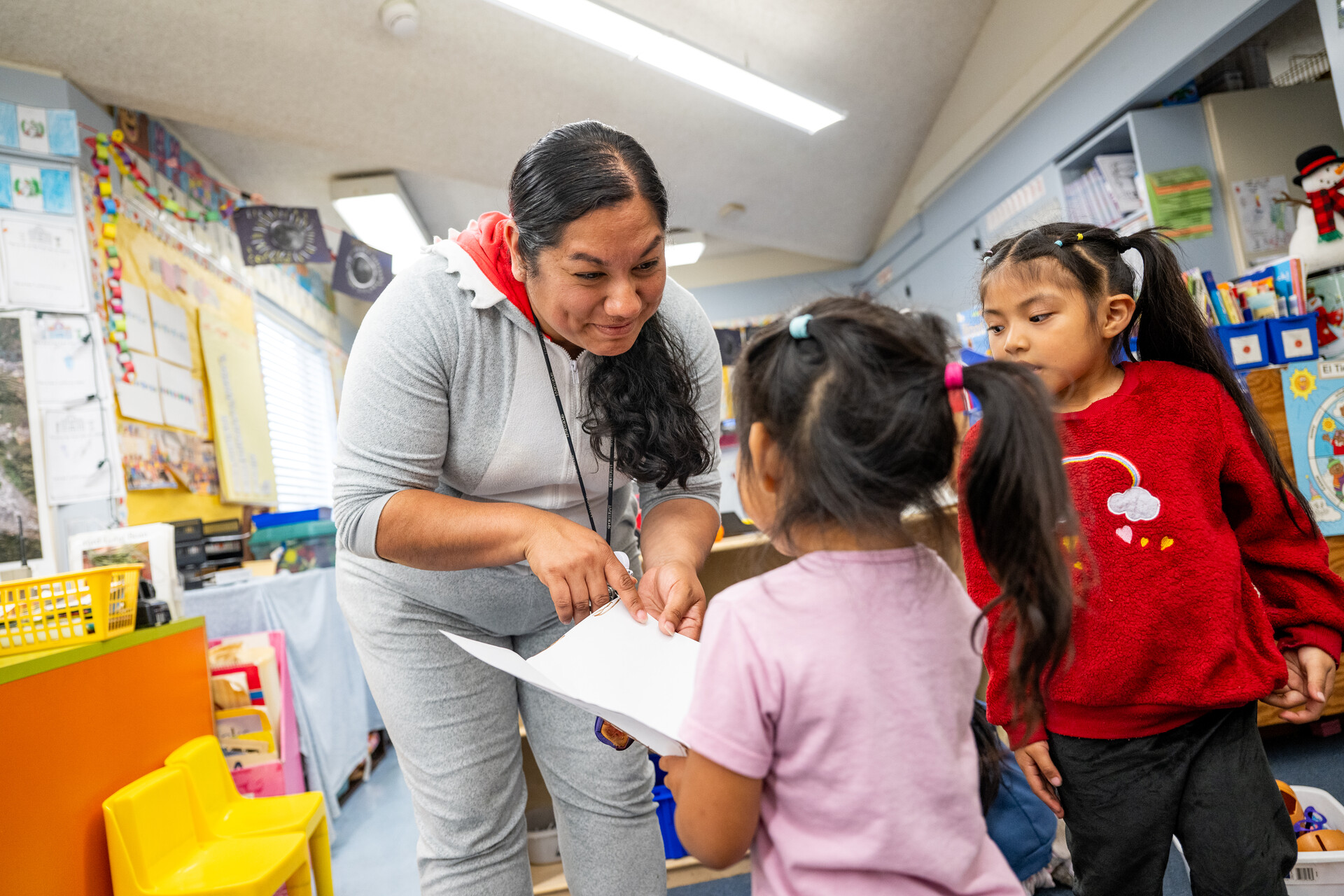
La maestra Erika Vargas supervisa a los alumnos durante el recreo en una clase de transición bilingüe de preescolar en la escuela primaria Global Family Elementary School de Oakland, el 17 de mayo de 2024. (Beth LaBerge/KQED)
En 2021, comenzaron a aceptar a más niños de 4 años ampliando cada año los límites de edad. A partir de este año escolar, todos los distritos escolares deben ofrecer acceso universal al TK. También deben limitar el tamaño de las aulas a un adulto por cada diez alumnos.
¿Cómo sé si mi hijo cumple los requisitos para acceder al TK?
Pueden inscribirse los alumnos que cumplan 4 años antes del 1 de septiembre del año escolar.
¿Qué aprenden los niños en el TK?
El TK es un programa basado en el aprendizaje a través del juego, en el que los niños aprenden jugando e interactuando entre ellos. Se espera que las escuelas se ajusten al marco estatal, el Preschool/Transitional Kindergarten Learning Foundations (Fundamentos del aprendizaje en preescolar y kínder de transición), a la hora de establecer el plan de estudios del TK.
El documento establece los conocimientos y habilidades que los niños de 3 a 5 años de edad pueden adquirir, como concentrar su attention y colaborar con los demás, si se les brinda los beneficios de una educación temprana de alta calidad.
Más en español
Erika Vargas, maestra de kínder de transición en la escuela primaria Global Family de Oakland, afirma que un año en TK ofrece a los niños un “periodo de gracia” para aprender las rutinas y expectativas de la escuela y desarrollar las habilidades necesarias para el kínder.
“Nuestro objetivo es exponerlos a la literatura, desarrollar ese amor por los libros, la lectura, la escritura y el dibujo”, explica. “En el ámbito social, queremos que aprendan a hacer amigos y a resolver conflictos”.
Los niños también comienzan con habilidades básicas, tales como aprender el alfabeto y los números, pero el enfoque se centra más en el desarrollo socioemocional, según Tanya Harris, directora de educación primaria del distrito escolar unificado de Alameda.
¿En qué se diferencia TK de otros tipos de preescolar?
TK es la única opción escolar gratuita para todos los niños de 4 años en California. Otros dos programas preescolares financiados con fondos públicos, Head Start y el Programa preescolar del estado de California (CSPP por sus siglas en inglés), dan prioridad a los alumnos en función de determinados criterios, como los ingresos y la situación familiar.
Los centros preescolares privados son empresas o organizaciones sin ánimo de lucro que deben cumplir con la normativa local en materia de salud, seguridad y zonificación. Ellos establecen su propio plan de estudios.
¿Por qué California quiere ofrecer el TK a todos los niños?
El gobernador Gavin Newsom sostiene que el objetivo de hacer universal el TK es que “todos los niños de 4 años de California puedan, a partir de ahora, comenzar su trayectoria escolar por el buen camino, preparándolos para el éxito en el futuro”.
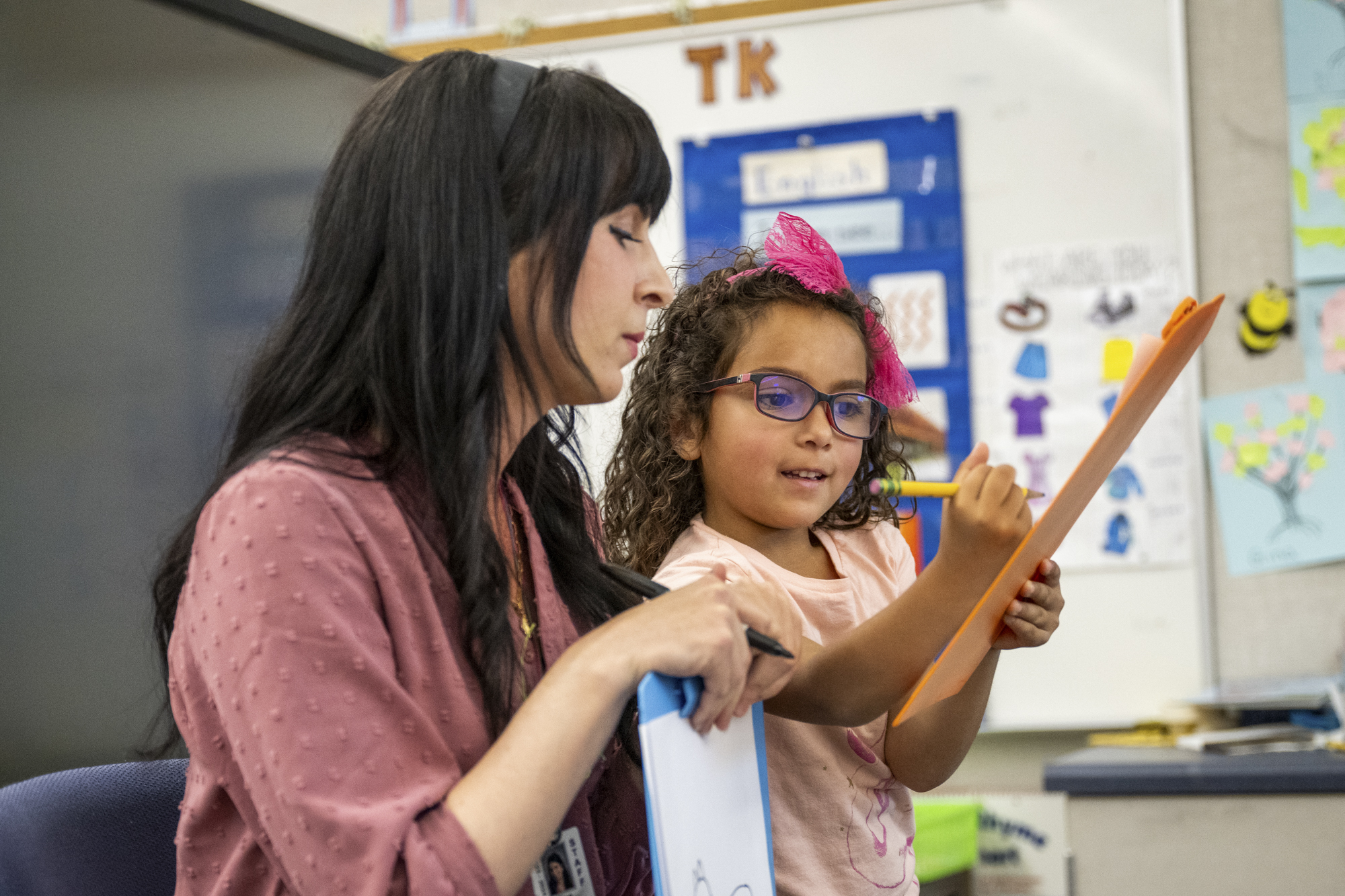
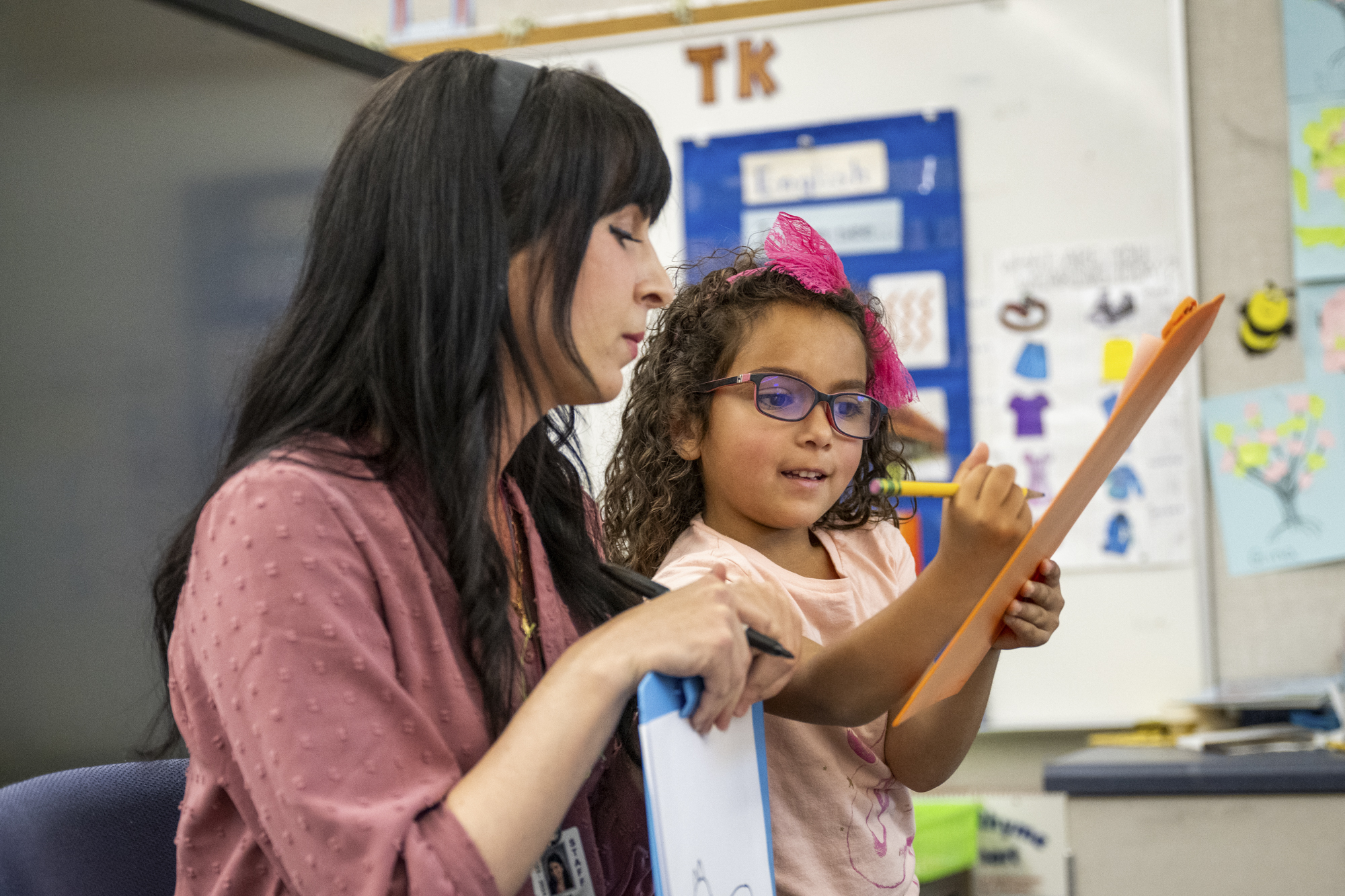
Gina Viggiano enseña a sus alumnos de kínder de transicion en la escuela Holbrook Language Academy en Concord, el 20 de mayo, 2024. (Beth LaBerge/KQED)
Los expertos también afirman que el TK permite a los alumnos incorporarse antes al sistema educativo K-12, de modo que pueden acostumbrarse a la escuela y sentirse cómodos en el aula, mientras que los padres se benefician de un año adicional de cuidado y educación gratuita para sus hijos.
¿Mi hijo tiene que asistir al TK?
No. El TK y el kínder son opcionales en California. Los niños no están obligados a matricularse en la escuela hasta el primer grado (en inglés conocido como “first grade”).
¿Cuándo debo empezar a buscar opciones de kínder de transición para mi hijo?
Muchos distritos escolares comienzan la inscripción en enero para el otoño y pueden dar prioridad a la asignación de plazas en la escuela a quienes se inscriban antes. Además, las escuelas suelen organizar visitas y sesiones informativas en primavera.
Pero no espere que su distrito escolar local se ponga en contacto con usted para recordarle que inscriba a su hijo. Muchos padres nos han dicho que se enteran del TK a través de otros padres y que ellos mismos buscan opciones y plazos.
¿Qué pasa si espero hasta el último momento para inscribir a mi hijo al TK?
Los niños pueden inscribirse en la escuela en cualquier momento, pero eso puede limitar sus opciones en cuanto a la escuela o el programa en el que puede inscribirse su hijo. Algunas escuelas pueden llenarse, lo que significa que tendrá que buscar otras opciones.
¿Cómo sé si el kínder de transición es la mejor opción para mi hija o hijo?
Dado que el TK puede no cubrir todas las horas de cuidado infantil que los padres necesitan para adaptarse a su horario de trabajo, las familias deben considerar si pueden cumplir con este compromiso y si su hijo puede adaptarse a ir a un servicio de cuidado después de la escuela (o “after school program”).
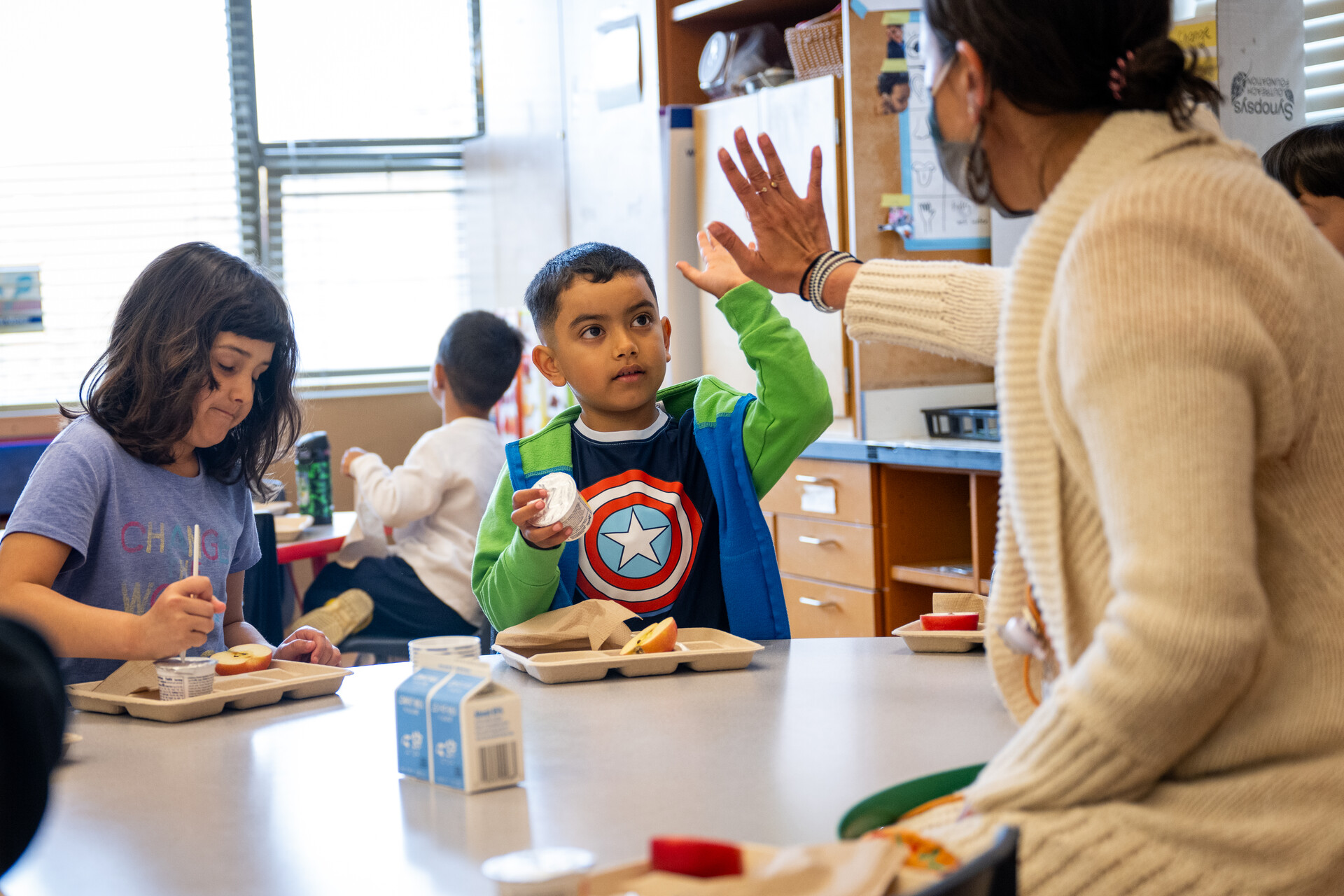
Bernadette Pilar Zermeño, una educadora multilingüe de primera infancia, se sienta con alumnos de kínder de transición durante la merienda en la Escuela comunitaria internacional de Oakland. (Beth LaBerge/KQED)
Algunas familias prefieren mantener a sus hijos en un programa que les proporcione cuidado durante todo el día, según Kym Johnson, directora ejecutiva de Bananas, una agencia que orienta a los padres sobre las opciones de cuidado infantil en el condado de Alameda.
Por otro lado, algunos padres quieren que sus hijos entren en un entorno escolar. “Los niños de cuatro años se encuentran en diferentes etapas y niveles de independencia”, afirma Johnson. “Creemos que las familias saben lo que es mejor para sus hijos”.
¿Qué debo buscar en un programa de TK?
Un aula TK de alta calidad debe tener un amplio espacio para actividades basadas en el juego, según Hanna Melnick, asesora sénior de políticas del Learning Policy Institute con sede en Palo Alto.
“Se debe ver en el aula actividades de alfabetización, matemáticas y ciencias que estén cuidadosamente planificadas”, dijo Melnick. “Y se quiere estar seguro de que el plan de estudios y las evaluaciones tengan en cuenta las necesidades del niño en su totalidad: sus necesidades socioemocionales, su desarrollo físico y lo que se considera un desarrollo académico más tradicional en matemáticas y lectura”.
Dale Farran, investigador en educación infantil y profesor emérito de la universidad de Vanderbilt, afirma que los padres deben buscar oportunidades de aprendizaje en el aula que vayan más allá de la enseñanza básica.
“Necesitan estar activos, necesitan explorar, necesitan interactuar entre ellos y con el profesor, y necesitan un entorno que facilite todo eso”, afirma Farran.
¿Qué debo preguntar a la escuela sobre su programa de TK?
¿Qué tipo de actividades al aire libre realizan los niños y qué ofrecen esos espacios?
¿Cómo se incorpora el juego en el plan de estudios?\
¿Hay baños junto al aula?
Si no es así, ¿hay un baño dentro del aula? ¿Dónde están los baños más cercanos y cómo llegan los niños hasta ellos?
¿Dónde comerán el almuerzo y la merienda? ¿Será en el aula o en la cafetería?
¿Hay algún programa adicional especial para los alumnos de TK, por ejemplo, inmersión dual?
¿Qué tipo de servicio de guardería hay después del horario escolar?
¿Puedo visitar el aula?
¿Puedo hablar con el director y los profesores?
¿Cuáles son los retos más comunes a los que se enfrentan los padres?
Para muchos padres, el mayor reto es llevar y recoger a sus hijos, dependiendo de sus horarios de trabajo. Otro gran reto es encontrar servicios de cuidado antes y después de la escuela, ya que los horarios del TK varían en duración, desde tres hasta cinco horas al día.
El estado ha proporcionado fondos a las escuelas para que añadan servicios de cuidado después de la escuela y clases de enriquecimiento en arte, STEM (ciencia, tecnología, ingeniería y matemáticas) o deportes, pero la disponibilidad varía de una escuela a otra. Algunos programas cobran cuotas, mientras que otros son gratuitos.
¿Hay algo más que deba considerar?
La siesta y el aprender a ir al baño. Algunos niños de 4 años todavía duermen la siesta por la tarde, lo cual no forma parte de la mayoría de los programas del TK. Si eso es un problema, tal vez puede cambiar la rutina de su hija o hijo para que la siesta ocurra después de la escuela.
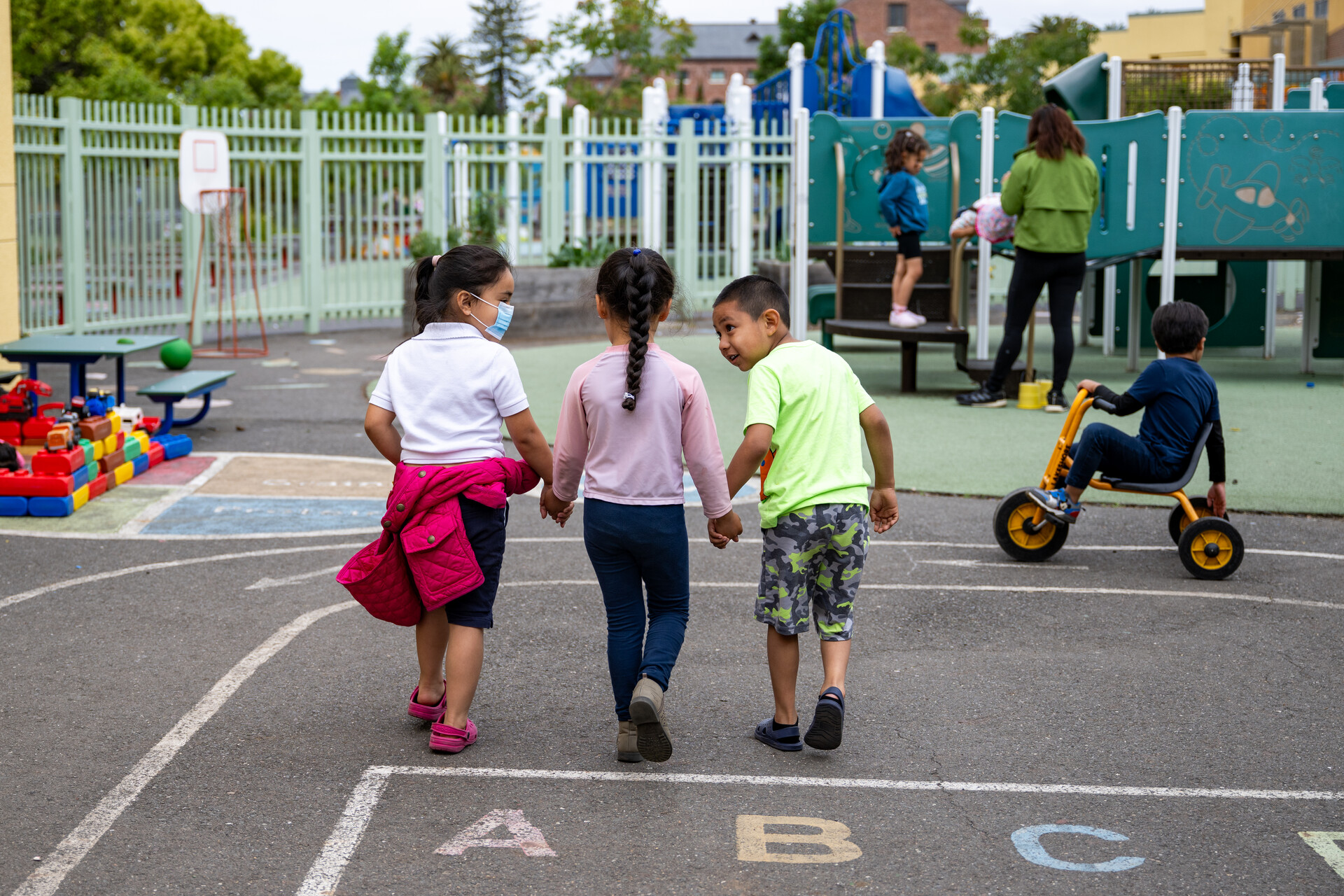
Alumnos de preescolar juegan al aire libre durante el recreo en la Escuela Comunitaria Internacional de Oakland el 17 de mayo de 2024. (Beth LaBerge/KQED)
Otra cuestión que preocupa a algunos padres es si sus hijos están preparados para ir al baño solos. Marji D. Calbeck, directora de apoyo a la educación primaria del distrito escolar unificado de Mount Diablo, recomienda a los padres que hablen con los profesores al comienzo del curso escolar sobre cualquier preocupación que tengan e incluso que preparen a sus hijos ropa de repuesto por si tienen algún accidente. Los accidentes al ir al baño ocurren en la escuela, afirma, y señala que es algo para lo que los educadores deben estar preparados.
¿Qué pasa si mi hijo no está listo para el TK? ¿Qué otras opciones tengo?
California ofrece varios programas de educación infantil financiados con fondos públicos para ayudar a satisfacer las diversas necesidades de cuidado infantil de las familias.
En el marco de la iniciativa estatal Universal Pre-Kindergarten (o UPK pos sus siglas en inglés), las familias que cumplen los requisitos de ingresos pueden inscribirse en los programas federales Head Start, el Programa preescolar del estado de California o programas de aprendizaje temprano subvencionados, como el “cuidado infantil familiar” en el hogar o los centros preescolares privados.
El Programa preescolar del estado de California ofrece opciones de medio día y día completo para niños de 2 a 4 años. Haga clic aquí para averiguar si cumple los requisitos de ingresos para inscribir a su hijo en este servicio.
¿Dónde puedo encontrar más información?
El estado ha creado un sitio web con información sobre UPK. Para encontrar un programa en su área, comience por su distrito escolar local. También puede explorar foros o grupos de padres en las redes sociales.
Los padres también pueden buscar servicios de cuidado infantil que se adapten a sus necesidades específicas a través de MyChildCarePlan.org, una herramienta de búsqueda respaldada por la red de agencias de recursos y referencias de California.
Si tiene alguna pregunta que no hayamos incluido, no dude en ponerse en contacto con nosotros, Daisy Nguyen o Elly Yu, y haremos todo lo posible por encontrar una respuesta.
Este artículo fue traducido por la periodista María Peña y esa traducción fue editada por el periodista Carlos Cabrera-Lomelí.
lower waypointnext waypoint
Player sponsored by
window.__IS_SSR__=true
window.__INITIAL_STATE__={
"attachmentsReducer": {
"audio_0": {
"type": "attachments",
"id": "audio_0",
"imgSizes": {
"kqedFullSize": {
"file": "https://ww2.kqed.org/news/wp-content/themes/KQED-unified/img/audio_bgs/background0.jpg"
}
}
},
"audio_1": {
"type": "attachments",
"id": "audio_1",
"imgSizes": {
"kqedFullSize": {
"file": "https://ww2.kqed.org/news/wp-content/themes/KQED-unified/img/audio_bgs/background1.jpg"
}
}
},
"audio_2": {
"type": "attachments",
"id": "audio_2",
"imgSizes": {
"kqedFullSize": {
"file": "https://ww2.kqed.org/news/wp-content/themes/KQED-unified/img/audio_bgs/background2.jpg"
}
}
},
"audio_3": {
"type": "attachments",
"id": "audio_3",
"imgSizes": {
"kqedFullSize": {
"file": "https://ww2.kqed.org/news/wp-content/themes/KQED-unified/img/audio_bgs/background3.jpg"
}
}
},
"audio_4": {
"type": "attachments",
"id": "audio_4",
"imgSizes": {
"kqedFullSize": {
"file": "https://ww2.kqed.org/news/wp-content/themes/KQED-unified/img/audio_bgs/background4.jpg"
}
}
},
"placeholder": {
"type": "attachments",
"id": "placeholder",
"imgSizes": {
"thumbnail": {
"file": "https://cdn.kqed.org/wp-content/uploads/2024/12/KQED-Default-Image-816638274-2000x1333-1-160x107.jpg",
"width": 160,
"height": 107,
"mimeType": "image/jpeg"
},
"medium": {
"file": "https://cdn.kqed.org/wp-content/uploads/2024/12/KQED-Default-Image-816638274-2000x1333-1-800x533.jpg",
"width": 800,
"height": 533,
"mimeType": "image/jpeg"
},
"medium_large": {
"file": "https://cdn.kqed.org/wp-content/uploads/2024/12/KQED-Default-Image-816638274-2000x1333-1-768x512.jpg",
"width": 768,
"height": 512,
"mimeType": "image/jpeg"
},
"large": {
"file": "https://cdn.kqed.org/wp-content/uploads/2024/12/KQED-Default-Image-816638274-2000x1333-1-1020x680.jpg",
"width": 1020,
"height": 680,
"mimeType": "image/jpeg"
},
"1536x1536": {
"file": "https://cdn.kqed.org/wp-content/uploads/2024/12/KQED-Default-Image-816638274-2000x1333-1-1536x1024.jpg",
"width": 1536,
"height": 1024,
"mimeType": "image/jpeg"
},
"fd-lrg": {
"file": "https://cdn.kqed.org/wp-content/uploads/2024/12/KQED-Default-Image-816638274-2000x1333-1-1536x1024.jpg",
"width": 1536,
"height": 1024,
"mimeType": "image/jpeg"
},
"fd-med": {
"file": "https://cdn.kqed.org/wp-content/uploads/2024/12/KQED-Default-Image-816638274-2000x1333-1-1020x680.jpg",
"width": 1020,
"height": 680,
"mimeType": "image/jpeg"
},
"fd-sm": {
"file": "https://cdn.kqed.org/wp-content/uploads/2024/12/KQED-Default-Image-816638274-2000x1333-1-800x533.jpg",
"width": 800,
"height": 533,
"mimeType": "image/jpeg"
},
"post-thumbnail": {
"file": "https://cdn.kqed.org/wp-content/uploads/2024/12/KQED-Default-Image-816638274-2000x1333-1-672x372.jpg",
"width": 672,
"height": 372,
"mimeType": "image/jpeg"
},
"twentyfourteen-full-width": {
"file": "https://cdn.kqed.org/wp-content/uploads/2024/12/KQED-Default-Image-816638274-2000x1333-1-1038x576.jpg",
"width": 1038,
"height": 576,
"mimeType": "image/jpeg"
},
"xxsmall": {
"file": "https://cdn.kqed.org/wp-content/uploads/2024/12/KQED-Default-Image-816638274-2000x1333-1-160x107.jpg",
"width": 160,
"height": 107,
"mimeType": "image/jpeg"
},
"xsmall": {
"file": "https://cdn.kqed.org/wp-content/uploads/2024/12/KQED-Default-Image-816638274-2000x1333-1-672x372.jpg",
"width": 672,
"height": 372,
"mimeType": "image/jpeg"
},
"small": {
"file": "https://cdn.kqed.org/wp-content/uploads/2024/12/KQED-Default-Image-816638274-2000x1333-1-672x372.jpg",
"width": 672,
"height": 372,
"mimeType": "image/jpeg"
},
"xlarge": {
"file": "https://cdn.kqed.org/wp-content/uploads/2024/12/KQED-Default-Image-816638274-2000x1333-1-1020x680.jpg",
"width": 1020,
"height": 680,
"mimeType": "image/jpeg"
},
"full-width": {
"file": "https://cdn.kqed.org/wp-content/uploads/2024/12/KQED-Default-Image-816638274-2000x1333-1-1920x1280.jpg",
"width": 1920,
"height": 1280,
"mimeType": "image/jpeg"
},
"guest-author-32": {
"file": "https://cdn.kqed.org/wp-content/uploads/2025/01/KQED-Default-Image-816638274-1333x1333-1-160x160.jpg",
"width": 32,
"height": 32,
"mimeType": "image/jpeg"
},
"guest-author-50": {
"file": "https://cdn.kqed.org/wp-content/uploads/2025/01/KQED-Default-Image-816638274-1333x1333-1-160x160.jpg",
"width": 50,
"height": 50,
"mimeType": "image/jpeg"
},
"guest-author-64": {
"file": "https://cdn.kqed.org/wp-content/uploads/2025/01/KQED-Default-Image-816638274-1333x1333-1-160x160.jpg",
"width": 64,
"height": 64,
"mimeType": "image/jpeg"
},
"guest-author-96": {
"file": "https://cdn.kqed.org/wp-content/uploads/2025/01/KQED-Default-Image-816638274-1333x1333-1-160x160.jpg",
"width": 96,
"height": 96,
"mimeType": "image/jpeg"
},
"guest-author-128": {
"file": "https://cdn.kqed.org/wp-content/uploads/2025/01/KQED-Default-Image-816638274-1333x1333-1-160x160.jpg",
"width": 128,
"height": 128,
"mimeType": "image/jpeg"
},
"detail": {
"file": "https://cdn.kqed.org/wp-content/uploads/2025/01/KQED-Default-Image-816638274-1333x1333-1-160x160.jpg",
"width": 160,
"height": 160,
"mimeType": "image/jpeg"
},
"kqedFullSize": {
"file": "https://cdn.kqed.org/wp-content/uploads/2024/12/KQED-Default-Image-816638274-2000x1333-1.jpg",
"width": 2000,
"height": 1333
}
}
},
"news_12052582": {
"type": "attachments",
"id": "news_12052582",
"meta": {
"index": "attachments_1716263798",
"site": "news",
"id": "12052582",
"found": true
},
"title": "teacher with a little girl with glasses",
"publishDate": 1755470966,
"status": "inherit",
"parent": 12052579,
"modified": 1755470987,
"caption": "Gina Viggiano imparte una clase de transición al kínder en la Holbrook Language Academy de\nConcord el 20 de mayo de 2024.",
"credit": "Beth LaBerge/KQED",
"altTag": null,
"description": null,
"imgSizes": {
"thumbnail": {
"file": "https://cdn.kqed.org/wp-content/uploads/sites/10/2025/08/teacher-with-a-little-girl-with-glasses-160x107.jpg",
"width": 160,
"height": 107,
"mimeType": "image/jpeg"
},
"1536x1536": {
"file": "https://cdn.kqed.org/wp-content/uploads/sites/10/2025/08/teacher-with-a-little-girl-with-glasses-1536x1024.jpg",
"width": 1536,
"height": 1024,
"mimeType": "image/jpeg"
},
"post-thumbnail": {
"file": "https://cdn.kqed.org/wp-content/uploads/sites/10/2025/08/teacher-with-a-little-girl-with-glasses-672x372.jpg",
"width": 672,
"height": 372,
"mimeType": "image/jpeg"
},
"twentyfourteen-full-width": {
"file": "https://cdn.kqed.org/wp-content/uploads/sites/10/2025/08/teacher-with-a-little-girl-with-glasses-1038x576.jpg",
"width": 1038,
"height": 576,
"mimeType": "image/jpeg"
},
"kqedFullSize": {
"file": "https://cdn.kqed.org/wp-content/uploads/sites/10/2025/08/teacher-with-a-little-girl-with-glasses.jpg",
"width": 2000,
"height": 1333
}
},
"isLoading": false,
"fetchFailed": false
}
},
"audioPlayerReducer": {
"postId": "stream_live",
"isPaused": true,
"isPlaying": false,
"pfsActive": false,
"pledgeModalIsOpen": true,
"playerDrawerIsOpen": false,
"liveAudioPlayStartedAt": 0,
"liveAudioPlayContext": ""
},
"authorsReducer": {
"btorres": {
"type": "authors",
"id": "11666",
"meta": {
"index": "authors_1716337520",
"id": "11666",
"found": true
},
"name": "Blanca Torres",
"firstName": "Blanca",
"lastName": "Torres",
"slug": "btorres",
"email": "btorres@kqed.org",
"display_author_email": true,
"staff_mastheads": [
"news"
],
"title": "Producer, Forum",
"bio": "Blanca Torres brings sharp news judgement and keen sense of lively conversation to her work as producer for Forum. She loves producing shows that leave listeners feeling like they heard distinctive voices, learned something new and gained a fresh perspective.\r\n\r\nShe joined KQED in January of 2020 after 16 years of working as a newspaper reporter most recently at the \u003cem>San Francisco Business Times,\u003c/em> where she wrote about real estate and economic development. Before that, she covered a variety of beats including crime, education, retail, workplace, the economy, consumer issues, and small business for the \u003cem>Contra Costa Times, Baltimore Sun\u003c/em> and\u003cem> The Seattle Times\u003c/em>. In addition to reporting, she worked as an editorial writer and columnist for the \u003cem>Seattle Times\u003c/em>. From 2017 to 2020, Blanca won a total of ten awards from the National Association of Real Estate Editors and won first place for land use reporting from the California News Publishers Association two years in a row. She is also a member and former board member for the National Association of Hispanic Journalists.\r\n\r\nA native of the Pacific Northwest, Blanca earned her bachelor's degree from Vanderbilt University in Nashville and a master's in fine arts in creative writing at Mills College. She lives in the East Bay with her family.",
"avatar": "https://secure.gravatar.com/avatar/50b49d19b14a1eed34f26ebf4681152cdd81574ed21851100871ccd29e578cdc?s=600&d=blank&r=g",
"twitter": "@blancawrites",
"bluesky": null,
"facebook": null,
"instagram": null,
"linkedin": null,
"sites": [
{
"site": "arts",
"roles": [
"editor"
]
},
{
"site": "news",
"roles": [
"editor"
]
},
{
"site": "forum",
"roles": [
"editor"
]
}
],
"headData": {
"title": "Blanca Torres | KQED",
"description": "Producer, Forum",
"ogImgSrc": "https://secure.gravatar.com/avatar/50b49d19b14a1eed34f26ebf4681152cdd81574ed21851100871ccd29e578cdc?s=600&d=blank&r=g",
"twImgSrc": "https://secure.gravatar.com/avatar/50b49d19b14a1eed34f26ebf4681152cdd81574ed21851100871ccd29e578cdc?s=600&d=blank&r=g"
},
"isLoading": false,
"link": "/author/btorres"
},
"daisynguyen": {
"type": "authors",
"id": "11829",
"meta": {
"index": "authors_1716337520",
"id": "11829",
"found": true
},
"name": "Daisy Nguyen",
"firstName": "Daisy",
"lastName": "Nguyen",
"slug": "daisynguyen",
"email": "daisynguyen@kqed.org",
"display_author_email": true,
"staff_mastheads": [
"news"
],
"title": "KQED Contributor",
"bio": "I have covered early childhood education and child care for KQED since 2022. I focus on policies aimed at increasing access to early care and education and how they shape individual lives. I've been a journalist for more than two decades, with most of that time devoted to covering breaking news throughout California for The Associated Press. I grew up in San Francisco and studied at UC Davis and Columbia University's Graduate School of Journalism. I live in Oakland with my husband and two kids.",
"avatar": "https://secure.gravatar.com/avatar/2da2127c27f7143b53ebd419800fd55f?s=600&d=blank&r=g",
"twitter": null,
"facebook": null,
"instagram": null,
"linkedin": "https://www.linkedin.com/in/daisynguyen/",
"sites": [
{
"site": "news",
"roles": [
"author"
]
},
{
"site": "liveblog",
"roles": [
"author"
]
}
],
"headData": {
"title": "Daisy Nguyen | KQED",
"description": "KQED Contributor",
"ogImgSrc": "https://secure.gravatar.com/avatar/2da2127c27f7143b53ebd419800fd55f?s=600&d=blank&r=g",
"twImgSrc": "https://secure.gravatar.com/avatar/2da2127c27f7143b53ebd419800fd55f?s=600&d=blank&r=g"
},
"isLoading": false,
"link": "/author/daisynguyen"
}
},
"pagesReducer": {},
"pfsSessionReducer": {},
"postsReducer": {
"stream_live": {
"type": "live",
"id": "stream_live",
"audioUrl": "https://streams.kqed.org/kqedradio",
"title": "Live Stream",
"excerpt": "Live Stream information currently unavailable.",
"link": "/radio",
"featImg": "",
"label": {
"name": "KQED Live",
"link": "/"
}
},
"stream_kqedNewscast": {
"type": "posts",
"id": "stream_kqedNewscast",
"audioUrl": "https://www.kqed.org/.stream/anon/radio/RDnews/newscast.mp3?_=1",
"title": "KQED Newscast",
"featImg": "",
"label": {
"name": "88.5 FM",
"link": "/"
}
},
"news_12052579": {
"type": "posts",
"id": "news_12052579",
"meta": {
"index": "posts_1716263798",
"site": "news",
"id": "12052579",
"found": true
},
"articlePosition": 0,
"guestAuthors": [],
"slug": "que-es-kinder-de-transicion-tk-california",
"title": "¿Qué es el kínder de transición o \"TK\" en las escuelas de California?",
"publishDate": 1755709433,
"format": "standard",
"headTitle": "¿Qué es el kínder de transición o “TK” en las escuelas de California? | KQED",
"labelTerm": {},
"content": "\u003cp>\u003ca href=\"https://www.kqed.org/news/11989955/what-to-expect-when-enrolling-your-child-in-transitional-kindergarten\">\u003cem>Read in English\u003c/em>\u003c/a>\u003c/p>\n\u003cp>Este año, todos los niños de 4 años de edad en California pueden entrar a la escuela, ya que el estado requiere que cada distrito escolar ofrezcan lo que se conoce en inglés como “transitional kindergarten” o “TK”. En español, este programa educativo también se conoce como “kínder de transición” o “jardín de infancia transicional”.\u003c/p>\n\u003cp>Según \u003ca href=\"https://laist.com/news/education/early-childhood-education-pre-k/california-transitional-kindergarten-awareness-research-stanford\">una encuesta realizada por el Centro sobre la primera infancia de la universidad de Stanford\u003c/a>, son pocos los padres que conocen lo que es el kínder de transición y saben que puede ser una opción para su familia.\u003c/p>\n\u003cp>A continuación, respondemos algunas preguntas frecuentes sobre este nuevo grado en \u003ca href=\"https://www.kqed.org/news/11989465/california-teacher-shortage-hinders-transitional-kindergarten-and-bilingual-education-goals\">el sistema de escuelas públicas de California\u003c/a>.\u003c/p>\n\u003ch2>\u003cstrong>¿Qué es el kínder de transición?\u003c/strong>\u003c/h2>\n\u003cp>El kínder de transición \u003ca href=\"https://www.kqed.org/forum/2010101906814/can-californias-universal-transitional-kindergarten-plan-make-the-grade\">forma parte del ambicioso plan de California\u003c/a> para crear el programa de educación infantil gratuita más grande del país. Según funcionarios del estado, el TK es la primera parte de un programa de kínder que dura dos años para preparar a los niños para las exigencias de la escuela primaria.\u003c/p>\n\u003cp>Todo esto comenzó en 2012, cuando algunos distritos escolares formaron el TK para atender a niños que no aún no tenían la edad mínima para entrar al kínder regular.\u003c/p>\n\u003cfigure id=\"attachment_12052581\" class=\"wp-caption aligncenter\" style=\"max-width: 1920px\">\u003cimg loading=\"lazy\" decoding=\"async\" class=\"size-full wp-image-12052581\" src=\"https://cdn.kqed.org/wp-content/uploads/sites/10/2025/08/teacher-with-students.jpg\" alt=\"\" width=\"1920\" height=\"1280\" srcset=\"https://cdn.kqed.org/wp-content/uploads/sites/10/2025/08/teacher-with-students.jpg 1920w, https://cdn.kqed.org/wp-content/uploads/sites/10/2025/08/teacher-with-students-160x107.jpg 160w, https://cdn.kqed.org/wp-content/uploads/sites/10/2025/08/teacher-with-students-1536x1024.jpg 1536w\" sizes=\"auto, (max-width: 1920px) 100vw, 1920px\">\u003cfigcaption class=\"wp-caption-text\">La maestra Erika Vargas supervisa a los alumnos durante el recreo en una clase de transición bilingüe de preescolar en la escuela primaria Global Family Elementary School de Oakland, el 17 de mayo de 2024. \u003ccite>(Beth LaBerge/KQED)\u003c/cite>\u003c/figcaption>\u003c/figure>\n\u003cp>En 2021, comenzaron a aceptar a más niños de 4 años ampliando cada año los límites de edad. A partir de este año escolar, todos los distritos escolares deben ofrecer acceso universal al TK. También deben limitar el tamaño de las aulas a un adulto por cada diez alumnos.\u003c/p>\n\u003ch2>\u003cstrong>¿Cómo sé si mi hijo cumple los requisitos para acceder al TK?\u003c/strong>\u003c/h2>\n\u003cp>Pueden inscribirse los alumnos que cumplan 4 años antes del 1 de septiembre del año escolar.\u003cbr>\n[ad fullwidth]\u003c/p>\n\u003ch2>\u003cstrong>¿Qué aprenden los niños en el TK?\u003c/strong>\u003c/h2>\n\u003cp>El TK es un programa basado en el aprendizaje a través del juego, en el que los niños aprenden jugando e interactuando entre ellos. Se espera que las escuelas se ajusten al marco estatal, el \u003ca href=\"https://www.cde.ca.gov/sp/cd/re/psfoundations.asp\">Preschool/Transitional Kindergarten Learning Foundations\u003c/a> (Fundamentos del aprendizaje en preescolar y kínder de transición), a la hora de establecer el plan de estudios del TK.\u003c/p>\n\u003cp>El documento establece los conocimientos y habilidades que los niños de 3 a 5 años de edad pueden adquirir, como concentrar su attention y colaborar con los demás, si se les brinda los beneficios de una educación temprana de alta calidad.[aside label='Más en español' tag='kqed-en-espanol']Erika Vargas, maestra de kínder de transición en la escuela primaria Global Family de Oakland, afirma que un año en TK ofrece a los niños un “periodo de gracia” para aprender las rutinas y expectativas de la escuela y desarrollar las habilidades necesarias para el kínder.\u003c/p>\n\u003cp>“Nuestro objetivo es exponerlos a la literatura, desarrollar ese amor por los libros, la lectura, la escritura y el dibujo”, explica. “En el ámbito social, queremos que aprendan a hacer amigos y a resolver conflictos”.\u003c/p>\n\u003cp>Los niños también comienzan con habilidades básicas, tales como aprender el alfabeto y los números, pero el enfoque se centra más en el desarrollo socioemocional, según Tanya Harris, directora de educación primaria del distrito escolar unificado de Alameda.\u003c/p>\n\u003ch2>\u003cstrong>¿En qué se diferencia TK de otros tipos de preescolar?\u003c/strong>\u003c/h2>\n\u003cp>TK es la única opción escolar gratuita para todos los niños de 4 años en California. Otros dos programas preescolares financiados con fondos públicos, \u003ca href=\"https://headstart.gov/es\">Head Start\u003c/a> y el \u003ca href=\"https://www.ccrcca.org/es/headstart/programs/california-state-preschool-program-ages-3-5/\">Programa preescolar del estado de California\u003c/a> (CSPP por sus siglas en inglés), dan prioridad a los alumnos en función de determinados criterios, como los ingresos y la situación familiar.\u003c/p>\n\u003cp>Los centros preescolares privados son empresas o organizaciones sin ánimo de lucro que deben cumplir con la normativa local en materia de salud, seguridad y zonificación. Ellos establecen su propio plan de estudios.\u003c/p>\n\u003ch2>\u003cstrong>¿Por qué California quiere ofrecer el TK a todos los niños?\u003c/strong>\u003c/h2>\n\u003cp>El gobernador Gavin Newsom sostiene que el objetivo de hacer universal el TK es que “todos los niños de 4 años de California puedan, a partir de ahora, comenzar su trayectoria escolar por el buen camino, preparándolos para el éxito en el futuro”.\u003c/p>\n\u003cfigure id=\"attachment_12052583\" class=\"wp-caption aligncenter\" style=\"max-width: 2000px\">\u003cimg loading=\"lazy\" decoding=\"async\" class=\"size-full wp-image-12052583\" src=\"https://cdn.kqed.org/wp-content/uploads/sites/10/2025/08/teacher-with-a-little-girl-with-glasses-1.jpg\" alt=\"\" width=\"2000\" height=\"1333\" srcset=\"https://cdn.kqed.org/wp-content/uploads/sites/10/2025/08/teacher-with-a-little-girl-with-glasses-1.jpg 2000w, https://cdn.kqed.org/wp-content/uploads/sites/10/2025/08/teacher-with-a-little-girl-with-glasses-1-160x107.jpg 160w, https://cdn.kqed.org/wp-content/uploads/sites/10/2025/08/teacher-with-a-little-girl-with-glasses-1-1536x1024.jpg 1536w\" sizes=\"auto, (max-width: 2000px) 100vw, 2000px\">\u003cfigcaption class=\"wp-caption-text\">Gina Viggiano enseña a sus alumnos de kínder de transicion en la escuela Holbrook Language Academy en Concord, el 20 de mayo, 2024. \u003ccite>(Beth LaBerge/KQED)\u003c/cite>\u003c/figcaption>\u003c/figure>\n\u003cp>Los expertos también afirman que el TK permite a los alumnos incorporarse antes al sistema educativo K-12, de modo que pueden acostumbrarse a la escuela y sentirse cómodos en el aula, mientras que los padres se benefician de un año adicional de cuidado y educación gratuita para sus hijos.\u003c/p>\n\u003ch2>\u003cstrong>¿Mi hijo tiene que asistir al TK?\u003c/strong>\u003c/h2>\n\u003cp>No. El TK y el kínder son opcionales en California. Los niños no están obligados a matricularse en la escuela hasta el primer grado (en inglés conocido como “first grade”).\u003c/p>\n\u003ch2>\u003cstrong>¿Cuándo debo empezar a buscar opciones de kínder de transición para mi hijo?\u003c/strong>\u003c/h2>\n\u003cp>Muchos distritos escolares comienzan la inscripción en enero para el otoño y pueden dar prioridad a la asignación de plazas en la escuela a quienes se inscriban antes. Además, las escuelas suelen organizar visitas y sesiones informativas en primavera.\u003c/p>\n\u003cp>Pero no espere que su distrito escolar local se ponga en contacto con usted para recordarle que inscriba a su hijo. Muchos padres nos han dicho que se enteran del TK a través de otros padres y que ellos mismos buscan opciones y plazos.\u003c/p>\n\u003ch2>\u003cstrong>¿Qué pasa si espero hasta el último momento para inscribir a mi hijo al TK?\u003c/strong>\u003c/h2>\n\u003cp>Los niños pueden inscribirse en la escuela en cualquier momento, pero eso puede limitar sus opciones en cuanto a la escuela o el programa en el que puede inscribirse su hijo. Algunas escuelas pueden llenarse, lo que significa que tendrá que buscar otras opciones.\u003c/p>\n\u003ch2>\u003cstrong>¿Cómo sé si el kínder de transición es la mejor opción para mi hija o hijo?\u003c/strong>\u003c/h2>\n\u003cp>Dado que el TK puede no cubrir todas las horas de cuidado infantil que los padres necesitan para adaptarse a su horario de trabajo, las familias deben considerar si pueden cumplir con este compromiso y si su hijo puede adaptarse a ir a un servicio de cuidado después de la escuela (o “after school program”).\u003c/p>\n\u003cfigure id=\"attachment_12052584\" class=\"wp-caption aligncenter\" style=\"max-width: 1920px\">\u003cimg loading=\"lazy\" decoding=\"async\" class=\"size-full wp-image-12052584\" src=\"https://cdn.kqed.org/wp-content/uploads/sites/10/2025/08/boy-giving-high-five-to-teacher.jpg\" alt=\"\" width=\"1920\" height=\"1280\" srcset=\"https://cdn.kqed.org/wp-content/uploads/sites/10/2025/08/boy-giving-high-five-to-teacher.jpg 1920w, https://cdn.kqed.org/wp-content/uploads/sites/10/2025/08/boy-giving-high-five-to-teacher-160x107.jpg 160w, https://cdn.kqed.org/wp-content/uploads/sites/10/2025/08/boy-giving-high-five-to-teacher-1536x1024.jpg 1536w\" sizes=\"auto, (max-width: 1920px) 100vw, 1920px\">\u003cfigcaption class=\"wp-caption-text\">Bernadette Pilar Zermeño, una educadora multilingüe de primera infancia, se sienta con alumnos de kínder de transición durante la merienda en la Escuela comunitaria internacional de Oakland. \u003ccite>(Beth LaBerge/KQED)\u003c/cite>\u003c/figcaption>\u003c/figure>\n\u003cp>Algunas familias prefieren mantener a sus hijos en un programa que les proporcione cuidado durante todo el día, según Kym Johnson, directora ejecutiva de Bananas, una agencia que orienta a los padres sobre las opciones de cuidado infantil en el condado de Alameda.\u003c/p>\n\u003cp>Por otro lado, algunos padres quieren que sus hijos entren en un entorno escolar. “Los niños de cuatro años se encuentran en diferentes etapas y niveles de independencia”, afirma Johnson. “Creemos que las familias saben lo que es mejor para sus hijos”.\u003c/p>\n\u003ch2>\u003cstrong>¿Qué debo buscar en un programa de TK?\u003c/strong>\u003c/h2>\n\u003cp>Un aula TK de alta calidad debe tener un amplio espacio para actividades basadas en el juego, según Hanna Melnick, asesora sénior de políticas del Learning Policy Institute con sede en Palo Alto.\u003c/p>\n\u003cp>“Se debe ver en el aula actividades de alfabetización, matemáticas y ciencias que estén cuidadosamente planificadas”, dijo Melnick. “Y se quiere estar seguro de que el plan de estudios y las evaluaciones tengan en cuenta las necesidades del niño en su totalidad: sus necesidades socioemocionales, su desarrollo físico y lo que se considera un desarrollo académico más tradicional en matemáticas y lectura”.\u003c/p>\n\u003cp>Dale Farran, investigador en educación infantil y profesor emérito de la universidad de Vanderbilt, afirma que los padres deben buscar oportunidades de aprendizaje en el aula que vayan más allá de la enseñanza básica.\u003c/p>\n\u003cp>“Necesitan estar activos, necesitan explorar, necesitan interactuar entre ellos y con el profesor, y necesitan un entorno que facilite todo eso”, afirma Farran.\u003c/p>\n\u003ch2>\u003cstrong>¿Qué debo preguntar a la escuela sobre su programa de TK?\u003c/strong>\u003c/h2>\n\u003cul>\n\u003cli>¿Qué tipo de actividades al aire libre realizan los niños y qué ofrecen esos espacios?\u003c/li>\n\u003cli>¿Cómo se incorpora el juego en el plan de estudios?\\\u003c/li>\n\u003cli>¿Hay baños junto al aula?\u003c/li>\n\u003cli>Si no es así, ¿hay un baño dentro del aula? ¿Dónde están los baños más cercanos y cómo llegan los niños hasta ellos?\u003c/li>\n\u003cli>¿Dónde comerán el almuerzo y la merienda? ¿Será en el aula o en la cafetería?\u003c/li>\n\u003cli>¿Hay algún programa adicional especial para los alumnos de TK, por ejemplo, inmersión dual?\u003c/li>\n\u003cli>¿Qué tipo de servicio de guardería hay después del horario escolar?\u003c/li>\n\u003cli>¿Puedo visitar el aula?\u003c/li>\n\u003cli>¿Puedo hablar con el director y los profesores?\u003c/li>\n\u003c/ul>\n\u003ch2>\u003cstrong>¿Cuáles son los retos más comunes a los que se enfrentan los padres?\u003c/strong>\u003c/h2>\n\u003cp>Para muchos padres, el mayor reto es llevar y recoger a sus hijos, dependiendo de sus horarios de trabajo. Otro gran reto es encontrar servicios de cuidado antes y después de la escuela, ya que los horarios del TK varían en duración, desde tres hasta cinco horas al día.\u003c/p>\n\u003cp>El estado ha proporcionado fondos a las escuelas para que añadan servicios de cuidado después de la escuela y clases de enriquecimiento en arte, STEM (ciencia, tecnología, ingeniería y matemáticas) o deportes, pero la disponibilidad varía de una escuela a otra. Algunos programas cobran cuotas, mientras que otros son gratuitos.\u003c/p>\n\u003ch2>\u003cstrong>¿Hay algo más que deba considerar?\u003c/strong>\u003c/h2>\n\u003cp>La siesta y el aprender a ir al baño. Algunos niños de 4 años todavía duermen la siesta por la tarde, lo cual no forma parte de la mayoría de los programas del TK. Si eso es un problema, tal vez puede cambiar la rutina de su hija o hijo para que la siesta ocurra después de la escuela.\u003c/p>\n\u003cfigure id=\"attachment_12052585\" class=\"wp-caption aligncenter\" style=\"max-width: 1920px\">\u003cimg loading=\"lazy\" decoding=\"async\" class=\"size-full wp-image-12052585\" src=\"https://cdn.kqed.org/wp-content/uploads/sites/10/2025/08/kids-in-school-playground.jpg\" alt=\"\" width=\"1920\" height=\"1280\" srcset=\"https://cdn.kqed.org/wp-content/uploads/sites/10/2025/08/kids-in-school-playground.jpg 1920w, https://cdn.kqed.org/wp-content/uploads/sites/10/2025/08/kids-in-school-playground-160x107.jpg 160w, https://cdn.kqed.org/wp-content/uploads/sites/10/2025/08/kids-in-school-playground-1536x1024.jpg 1536w\" sizes=\"auto, (max-width: 1920px) 100vw, 1920px\">\u003cfigcaption class=\"wp-caption-text\">Alumnos de preescolar juegan al aire libre durante el recreo en la Escuela Comunitaria Internacional de Oakland el 17 de mayo de 2024. \u003ccite>(Beth LaBerge/KQED)\u003c/cite>\u003c/figcaption>\u003c/figure>\n\u003cp>Otra cuestión que preocupa a algunos padres es si sus hijos están preparados para ir al baño solos. Marji D. Calbeck, directora de apoyo a la educación primaria del distrito escolar unificado de Mount Diablo, recomienda a los padres que hablen con los profesores al comienzo del curso escolar sobre cualquier preocupación que tengan e incluso que preparen a sus hijos ropa de repuesto por si tienen algún accidente. Los accidentes al ir al baño ocurren en la escuela, afirma, y señala que es algo para lo que los educadores deben estar preparados.\u003c/p>\n\u003ch2>\u003cstrong>¿Qué pasa si mi hijo no está listo para el TK? ¿Qué otras opciones tengo?\u003c/strong>\u003c/h2>\n\u003cp>California ofrece varios programas de educación infantil financiados con fondos públicos para ayudar a satisfacer las diversas necesidades de cuidado infantil de las familias.\u003c/p>\n\u003cp>En el marco de la iniciativa estatal \u003ca href=\"https://cauniversalprek.org/\">Universal Pre-Kindergarten\u003c/a> (o UPK pos sus siglas en inglés), las familias que cumplen los requisitos de ingresos pueden inscribirse en los programas federales Head Start, el Programa preescolar del estado de California o programas de aprendizaje temprano subvencionados, como el “cuidado infantil familiar” en el hogar o los centros preescolares privados.\u003c/p>\n\u003cp>El Programa preescolar del estado de California ofrece opciones de medio día y día completo para niños de 2 a 4 años. \u003ca href=\"https://www.cde.ca.gov/sp/cd/ci/mb2306.asp\">Haga clic aquí\u003c/a> para averiguar si cumple los requisitos de ingresos para inscribir a su hijo en este servicio.\u003c/p>\n\u003ch2>\u003cstrong>¿Dónde puedo encontrar más información?\u003c/strong>\u003c/h2>\n\u003cp>El estado ha creado un \u003ca href=\"https://cauniversalprek.org/families/\">sitio web con información sobre UPK\u003c/a>. Para encontrar un programa en su área, comience por su distrito escolar local. También puede explorar foros o grupos de padres en las redes sociales.\u003c/p>\n\u003cp>Los padres también pueden buscar servicios de cuidado infantil que se adapten a sus necesidades específicas a través de \u003ca href=\"http://mychildcareplan.org/\">MyChildCarePlan.org\u003c/a>, una herramienta de búsqueda respaldada por la red de agencias de recursos y referencias de California.\u003c/p>\n\u003cp>Si tiene alguna pregunta que no hayamos incluido, no dude en ponerse en contacto con nosotros, \u003ca href=\"http://daisynguyen@kqed.org\">Daisy Nguyen\u003c/a> o \u003ca href=\"http://eyu@laist.com\">Elly Yu\u003c/a>, y haremos todo lo posible por encontrar una respuesta.\u003c/p>\n\u003chr>\n\u003cp>\u003cem>Este artículo fue traducido por la periodista \u003ca href=\"https://www.kqed.org/author/mpena/\">María Peña\u003c/a> y esa traducción fue editada por el periodista \u003ca href=\"https://www.kqed.org/author/ccabreralomeli\">Carlos Cabrera-Lomelí\u003c/a>.\u003c/em>\u003c/p>\n\u003cp>[ad fullwidth]\u003c/p>\n\u003cp>[ad floatright]\u003c/p>\n",
"blocks": [],
"excerpt": "Las escuelas de California ya ofrecen kínder de transición, también conocido como \"TK\", a todos los niños de 4 años. ¿Qué es y cómo saber si esto es lo mejor para su familia?",
"status": "publish",
"parent": 0,
"modified": 1755712394,
"stats": {
"hasAudio": false,
"hasVideo": false,
"hasChartOrMap": false,
"iframeSrcs": [],
"hasGoogleForm": false,
"hasGallery": false,
"hasHearkenModule": false,
"hasPolis": false,
"paragraphCount": 40,
"wordCount": 2477
},
"headData": {
"title": "¿Qué es el kínder de transición o \"TK\" en las escuelas de California? | KQED",
"description": "Las escuelas de California ya ofrecen kínder de transición, también conocido como "TK", a todos los niños de 4 años. ¿Qué es y cómo saber si esto es lo mejor para su familia?",
"ogTitle": "¿Qué es el kínder de transición o "TK" en las escuelas de California?",
"ogDescription": "",
"ogImgId": "",
"twTitle": "¿Qué es el kínder de transición o "TK" en las escuelas de California?",
"twDescription": "",
"twImgId": "",
"translatedArticles": [
{
"path": "/news/11989955/what-to-expect-when-enrolling-your-child-in-transitional-kindergarten",
"lang": "en"
},
{
"path": "/news/12052579/que-es-kinder-de-transicion-tk-california",
"lang": "es"
}
],
"schema": {
"@context": "https://schema.org",
"@type": "NewsArticle",
"headline": "¿Qué es el kínder de transición o \"TK\" en las escuelas de California?",
"datePublished": "2025-08-20T10:03:53-07:00",
"dateModified": "2025-08-20T10:53:14-07:00",
"image": "https://cdn.kqed.org/wp-content/uploads/2020/02/KQED-OG-Image@1x.png",
"isAccessibleForFree": "True",
"publisher": {
"@type": "NewsMediaOrganization",
"@id": "https://www.kqed.org/#organization",
"name": "KQED",
"logo": "https://cdn.kqed.org/wp-content/uploads/2020/02/KQED-OG-Image@1x.png",
"url": "https://www.kqed.org",
"sameAs": [
"https://www.facebook.com/KQED",
"https://twitter.com/KQED",
"https://www.instagram.com/kqed/",
"https://www.tiktok.com/@kqedofficial",
"https://www.linkedin.com/company/kqed",
"https://www.youtube.com/channel/UCeC0IOo7i1P_61zVUWbJ4nw"
]
},
"author": {
"@type": "Person",
"name": "Blanca Torres",
"jobTitle": "Producer, Forum",
"url": "https://www.kqed.org/author/btorres"
}
},
"authorsData": [],
"tagData": []
},
"primaryCategory": {
"termId": 28523,
"slug": "kqed-en-espanol",
"name": "KQED en Español"
},
"source": "KQED en Español",
"sourceUrl": "https://www.kqed.org/kqedenespanol",
"sticky": false,
"nprStoryId": "kqed-12052579",
"templateType": "standard",
"featuredImageType": "standard",
"excludeFromSiteSearch": "Include",
"articleAge": "0",
"path": "/news/12052579/que-es-kinder-de-transicion-tk-california",
"audioTrackLength": null,
"parsedContent": [
{
"type": "contentString",
"content": "\u003cdiv class=\"post-body\">\u003cp>\u003cp>\u003ca href=\"https://www.kqed.org/news/11989955/what-to-expect-when-enrolling-your-child-in-transitional-kindergarten\">\u003cem>Read in English\u003c/em>\u003c/a>\u003c/p>\n\u003cp>Este año, todos los niños de 4 años de edad en California pueden entrar a la escuela, ya que el estado requiere que cada distrito escolar ofrezcan lo que se conoce en inglés como “transitional kindergarten” o “TK”. En español, este programa educativo también se conoce como “kínder de transición” o “jardín de infancia transicional”.\u003c/p>\n\u003cp>Según \u003ca href=\"https://laist.com/news/education/early-childhood-education-pre-k/california-transitional-kindergarten-awareness-research-stanford\">una encuesta realizada por el Centro sobre la primera infancia de la universidad de Stanford\u003c/a>, son pocos los padres que conocen lo que es el kínder de transición y saben que puede ser una opción para su familia.\u003c/p>\n\u003cp>A continuación, respondemos algunas preguntas frecuentes sobre este nuevo grado en \u003ca href=\"https://www.kqed.org/news/11989465/california-teacher-shortage-hinders-transitional-kindergarten-and-bilingual-education-goals\">el sistema de escuelas públicas de California\u003c/a>.\u003c/p>\n\u003ch2>\u003cstrong>¿Qué es el kínder de transición?\u003c/strong>\u003c/h2>\n\u003cp>El kínder de transición \u003ca href=\"https://www.kqed.org/forum/2010101906814/can-californias-universal-transitional-kindergarten-plan-make-the-grade\">forma parte del ambicioso plan de California\u003c/a> para crear el programa de educación infantil gratuita más grande del país. Según funcionarios del estado, el TK es la primera parte de un programa de kínder que dura dos años para preparar a los niños para las exigencias de la escuela primaria.\u003c/p>\n\u003cp>Todo esto comenzó en 2012, cuando algunos distritos escolares formaron el TK para atender a niños que no aún no tenían la edad mínima para entrar al kínder regular.\u003c/p>\n\u003cfigure id=\"attachment_12052581\" class=\"wp-caption aligncenter\" style=\"max-width: 1920px\">\u003cimg loading=\"lazy\" decoding=\"async\" class=\"size-full wp-image-12052581\" src=\"https://cdn.kqed.org/wp-content/uploads/sites/10/2025/08/teacher-with-students.jpg\" alt=\"\" width=\"1920\" height=\"1280\" srcset=\"https://cdn.kqed.org/wp-content/uploads/sites/10/2025/08/teacher-with-students.jpg 1920w, https://cdn.kqed.org/wp-content/uploads/sites/10/2025/08/teacher-with-students-160x107.jpg 160w, https://cdn.kqed.org/wp-content/uploads/sites/10/2025/08/teacher-with-students-1536x1024.jpg 1536w\" sizes=\"auto, (max-width: 1920px) 100vw, 1920px\">\u003cfigcaption class=\"wp-caption-text\">La maestra Erika Vargas supervisa a los alumnos durante el recreo en una clase de transición bilingüe de preescolar en la escuela primaria Global Family Elementary School de Oakland, el 17 de mayo de 2024. \u003ccite>(Beth LaBerge/KQED)\u003c/cite>\u003c/figcaption>\u003c/figure>\n\u003cp>En 2021, comenzaron a aceptar a más niños de 4 años ampliando cada año los límites de edad. A partir de este año escolar, todos los distritos escolares deben ofrecer acceso universal al TK. También deben limitar el tamaño de las aulas a un adulto por cada diez alumnos.\u003c/p>\n\u003ch2>\u003cstrong>¿Cómo sé si mi hijo cumple los requisitos para acceder al TK?\u003c/strong>\u003c/h2>\n\u003cp>Pueden inscribirse los alumnos que cumplan 4 años antes del 1 de septiembre del año escolar.\u003cbr>\n\u003c/p>\u003c/div>",
"attributes": {
"named": {},
"numeric": []
}
},
{
"type": "component",
"content": "",
"name": "ad",
"attributes": {
"named": {
"label": "fullwidth"
},
"numeric": [
"fullwidth"
]
}
},
{
"type": "contentString",
"content": "\u003cdiv class=\"post-body\">\u003cp>\u003c/p>\n\u003ch2>\u003cstrong>¿Qué aprenden los niños en el TK?\u003c/strong>\u003c/h2>\n\u003cp>El TK es un programa basado en el aprendizaje a través del juego, en el que los niños aprenden jugando e interactuando entre ellos. Se espera que las escuelas se ajusten al marco estatal, el \u003ca href=\"https://www.cde.ca.gov/sp/cd/re/psfoundations.asp\">Preschool/Transitional Kindergarten Learning Foundations\u003c/a> (Fundamentos del aprendizaje en preescolar y kínder de transición), a la hora de establecer el plan de estudios del TK.\u003c/p>\n\u003cp>El documento establece los conocimientos y habilidades que los niños de 3 a 5 años de edad pueden adquirir, como concentrar su attention y colaborar con los demás, si se les brinda los beneficios de una educación temprana de alta calidad.\u003c/p>\u003c/div>",
"attributes": {
"named": {},
"numeric": []
}
},
{
"type": "component",
"content": "",
"name": "aside",
"attributes": {
"named": {
"label": "Más en español ",
"tag": "kqed-en-espanol"
},
"numeric": []
}
},
{
"type": "contentString",
"content": "\u003cdiv class=\"post-body\">\u003cp>Erika Vargas, maestra de kínder de transición en la escuela primaria Global Family de Oakland, afirma que un año en TK ofrece a los niños un “periodo de gracia” para aprender las rutinas y expectativas de la escuela y desarrollar las habilidades necesarias para el kínder.\u003c/p>\n\u003cp>“Nuestro objetivo es exponerlos a la literatura, desarrollar ese amor por los libros, la lectura, la escritura y el dibujo”, explica. “En el ámbito social, queremos que aprendan a hacer amigos y a resolver conflictos”.\u003c/p>\n\u003cp>Los niños también comienzan con habilidades básicas, tales como aprender el alfabeto y los números, pero el enfoque se centra más en el desarrollo socioemocional, según Tanya Harris, directora de educación primaria del distrito escolar unificado de Alameda.\u003c/p>\n\u003ch2>\u003cstrong>¿En qué se diferencia TK de otros tipos de preescolar?\u003c/strong>\u003c/h2>\n\u003cp>TK es la única opción escolar gratuita para todos los niños de 4 años en California. Otros dos programas preescolares financiados con fondos públicos, \u003ca href=\"https://headstart.gov/es\">Head Start\u003c/a> y el \u003ca href=\"https://www.ccrcca.org/es/headstart/programs/california-state-preschool-program-ages-3-5/\">Programa preescolar del estado de California\u003c/a> (CSPP por sus siglas en inglés), dan prioridad a los alumnos en función de determinados criterios, como los ingresos y la situación familiar.\u003c/p>\n\u003cp>Los centros preescolares privados son empresas o organizaciones sin ánimo de lucro que deben cumplir con la normativa local en materia de salud, seguridad y zonificación. Ellos establecen su propio plan de estudios.\u003c/p>\n\u003ch2>\u003cstrong>¿Por qué California quiere ofrecer el TK a todos los niños?\u003c/strong>\u003c/h2>\n\u003cp>El gobernador Gavin Newsom sostiene que el objetivo de hacer universal el TK es que “todos los niños de 4 años de California puedan, a partir de ahora, comenzar su trayectoria escolar por el buen camino, preparándolos para el éxito en el futuro”.\u003c/p>\n\u003cfigure id=\"attachment_12052583\" class=\"wp-caption aligncenter\" style=\"max-width: 2000px\">\u003cimg loading=\"lazy\" decoding=\"async\" class=\"size-full wp-image-12052583\" src=\"https://cdn.kqed.org/wp-content/uploads/sites/10/2025/08/teacher-with-a-little-girl-with-glasses-1.jpg\" alt=\"\" width=\"2000\" height=\"1333\" srcset=\"https://cdn.kqed.org/wp-content/uploads/sites/10/2025/08/teacher-with-a-little-girl-with-glasses-1.jpg 2000w, https://cdn.kqed.org/wp-content/uploads/sites/10/2025/08/teacher-with-a-little-girl-with-glasses-1-160x107.jpg 160w, https://cdn.kqed.org/wp-content/uploads/sites/10/2025/08/teacher-with-a-little-girl-with-glasses-1-1536x1024.jpg 1536w\" sizes=\"auto, (max-width: 2000px) 100vw, 2000px\">\u003cfigcaption class=\"wp-caption-text\">Gina Viggiano enseña a sus alumnos de kínder de transicion en la escuela Holbrook Language Academy en Concord, el 20 de mayo, 2024. \u003ccite>(Beth LaBerge/KQED)\u003c/cite>\u003c/figcaption>\u003c/figure>\n\u003cp>Los expertos también afirman que el TK permite a los alumnos incorporarse antes al sistema educativo K-12, de modo que pueden acostumbrarse a la escuela y sentirse cómodos en el aula, mientras que los padres se benefician de un año adicional de cuidado y educación gratuita para sus hijos.\u003c/p>\n\u003ch2>\u003cstrong>¿Mi hijo tiene que asistir al TK?\u003c/strong>\u003c/h2>\n\u003cp>No. El TK y el kínder son opcionales en California. Los niños no están obligados a matricularse en la escuela hasta el primer grado (en inglés conocido como “first grade”).\u003c/p>\n\u003ch2>\u003cstrong>¿Cuándo debo empezar a buscar opciones de kínder de transición para mi hijo?\u003c/strong>\u003c/h2>\n\u003cp>Muchos distritos escolares comienzan la inscripción en enero para el otoño y pueden dar prioridad a la asignación de plazas en la escuela a quienes se inscriban antes. Además, las escuelas suelen organizar visitas y sesiones informativas en primavera.\u003c/p>\n\u003cp>Pero no espere que su distrito escolar local se ponga en contacto con usted para recordarle que inscriba a su hijo. Muchos padres nos han dicho que se enteran del TK a través de otros padres y que ellos mismos buscan opciones y plazos.\u003c/p>\n\u003ch2>\u003cstrong>¿Qué pasa si espero hasta el último momento para inscribir a mi hijo al TK?\u003c/strong>\u003c/h2>\n\u003cp>Los niños pueden inscribirse en la escuela en cualquier momento, pero eso puede limitar sus opciones en cuanto a la escuela o el programa en el que puede inscribirse su hijo. Algunas escuelas pueden llenarse, lo que significa que tendrá que buscar otras opciones.\u003c/p>\n\u003ch2>\u003cstrong>¿Cómo sé si el kínder de transición es la mejor opción para mi hija o hijo?\u003c/strong>\u003c/h2>\n\u003cp>Dado que el TK puede no cubrir todas las horas de cuidado infantil que los padres necesitan para adaptarse a su horario de trabajo, las familias deben considerar si pueden cumplir con este compromiso y si su hijo puede adaptarse a ir a un servicio de cuidado después de la escuela (o “after school program”).\u003c/p>\n\u003cfigure id=\"attachment_12052584\" class=\"wp-caption aligncenter\" style=\"max-width: 1920px\">\u003cimg loading=\"lazy\" decoding=\"async\" class=\"size-full wp-image-12052584\" src=\"https://cdn.kqed.org/wp-content/uploads/sites/10/2025/08/boy-giving-high-five-to-teacher.jpg\" alt=\"\" width=\"1920\" height=\"1280\" srcset=\"https://cdn.kqed.org/wp-content/uploads/sites/10/2025/08/boy-giving-high-five-to-teacher.jpg 1920w, https://cdn.kqed.org/wp-content/uploads/sites/10/2025/08/boy-giving-high-five-to-teacher-160x107.jpg 160w, https://cdn.kqed.org/wp-content/uploads/sites/10/2025/08/boy-giving-high-five-to-teacher-1536x1024.jpg 1536w\" sizes=\"auto, (max-width: 1920px) 100vw, 1920px\">\u003cfigcaption class=\"wp-caption-text\">Bernadette Pilar Zermeño, una educadora multilingüe de primera infancia, se sienta con alumnos de kínder de transición durante la merienda en la Escuela comunitaria internacional de Oakland. \u003ccite>(Beth LaBerge/KQED)\u003c/cite>\u003c/figcaption>\u003c/figure>\n\u003cp>Algunas familias prefieren mantener a sus hijos en un programa que les proporcione cuidado durante todo el día, según Kym Johnson, directora ejecutiva de Bananas, una agencia que orienta a los padres sobre las opciones de cuidado infantil en el condado de Alameda.\u003c/p>\n\u003cp>Por otro lado, algunos padres quieren que sus hijos entren en un entorno escolar. “Los niños de cuatro años se encuentran en diferentes etapas y niveles de independencia”, afirma Johnson. “Creemos que las familias saben lo que es mejor para sus hijos”.\u003c/p>\n\u003ch2>\u003cstrong>¿Qué debo buscar en un programa de TK?\u003c/strong>\u003c/h2>\n\u003cp>Un aula TK de alta calidad debe tener un amplio espacio para actividades basadas en el juego, según Hanna Melnick, asesora sénior de políticas del Learning Policy Institute con sede en Palo Alto.\u003c/p>\n\u003cp>“Se debe ver en el aula actividades de alfabetización, matemáticas y ciencias que estén cuidadosamente planificadas”, dijo Melnick. “Y se quiere estar seguro de que el plan de estudios y las evaluaciones tengan en cuenta las necesidades del niño en su totalidad: sus necesidades socioemocionales, su desarrollo físico y lo que se considera un desarrollo académico más tradicional en matemáticas y lectura”.\u003c/p>\n\u003cp>Dale Farran, investigador en educación infantil y profesor emérito de la universidad de Vanderbilt, afirma que los padres deben buscar oportunidades de aprendizaje en el aula que vayan más allá de la enseñanza básica.\u003c/p>\n\u003cp>“Necesitan estar activos, necesitan explorar, necesitan interactuar entre ellos y con el profesor, y necesitan un entorno que facilite todo eso”, afirma Farran.\u003c/p>\n\u003ch2>\u003cstrong>¿Qué debo preguntar a la escuela sobre su programa de TK?\u003c/strong>\u003c/h2>\n\u003cul>\n\u003cli>¿Qué tipo de actividades al aire libre realizan los niños y qué ofrecen esos espacios?\u003c/li>\n\u003cli>¿Cómo se incorpora el juego en el plan de estudios?\\\u003c/li>\n\u003cli>¿Hay baños junto al aula?\u003c/li>\n\u003cli>Si no es así, ¿hay un baño dentro del aula? ¿Dónde están los baños más cercanos y cómo llegan los niños hasta ellos?\u003c/li>\n\u003cli>¿Dónde comerán el almuerzo y la merienda? ¿Será en el aula o en la cafetería?\u003c/li>\n\u003cli>¿Hay algún programa adicional especial para los alumnos de TK, por ejemplo, inmersión dual?\u003c/li>\n\u003cli>¿Qué tipo de servicio de guardería hay después del horario escolar?\u003c/li>\n\u003cli>¿Puedo visitar el aula?\u003c/li>\n\u003cli>¿Puedo hablar con el director y los profesores?\u003c/li>\n\u003c/ul>\n\u003ch2>\u003cstrong>¿Cuáles son los retos más comunes a los que se enfrentan los padres?\u003c/strong>\u003c/h2>\n\u003cp>Para muchos padres, el mayor reto es llevar y recoger a sus hijos, dependiendo de sus horarios de trabajo. Otro gran reto es encontrar servicios de cuidado antes y después de la escuela, ya que los horarios del TK varían en duración, desde tres hasta cinco horas al día.\u003c/p>\n\u003cp>El estado ha proporcionado fondos a las escuelas para que añadan servicios de cuidado después de la escuela y clases de enriquecimiento en arte, STEM (ciencia, tecnología, ingeniería y matemáticas) o deportes, pero la disponibilidad varía de una escuela a otra. Algunos programas cobran cuotas, mientras que otros son gratuitos.\u003c/p>\n\u003ch2>\u003cstrong>¿Hay algo más que deba considerar?\u003c/strong>\u003c/h2>\n\u003cp>La siesta y el aprender a ir al baño. Algunos niños de 4 años todavía duermen la siesta por la tarde, lo cual no forma parte de la mayoría de los programas del TK. Si eso es un problema, tal vez puede cambiar la rutina de su hija o hijo para que la siesta ocurra después de la escuela.\u003c/p>\n\u003cfigure id=\"attachment_12052585\" class=\"wp-caption aligncenter\" style=\"max-width: 1920px\">\u003cimg loading=\"lazy\" decoding=\"async\" class=\"size-full wp-image-12052585\" src=\"https://cdn.kqed.org/wp-content/uploads/sites/10/2025/08/kids-in-school-playground.jpg\" alt=\"\" width=\"1920\" height=\"1280\" srcset=\"https://cdn.kqed.org/wp-content/uploads/sites/10/2025/08/kids-in-school-playground.jpg 1920w, https://cdn.kqed.org/wp-content/uploads/sites/10/2025/08/kids-in-school-playground-160x107.jpg 160w, https://cdn.kqed.org/wp-content/uploads/sites/10/2025/08/kids-in-school-playground-1536x1024.jpg 1536w\" sizes=\"auto, (max-width: 1920px) 100vw, 1920px\">\u003cfigcaption class=\"wp-caption-text\">Alumnos de preescolar juegan al aire libre durante el recreo en la Escuela Comunitaria Internacional de Oakland el 17 de mayo de 2024. \u003ccite>(Beth LaBerge/KQED)\u003c/cite>\u003c/figcaption>\u003c/figure>\n\u003cp>Otra cuestión que preocupa a algunos padres es si sus hijos están preparados para ir al baño solos. Marji D. Calbeck, directora de apoyo a la educación primaria del distrito escolar unificado de Mount Diablo, recomienda a los padres que hablen con los profesores al comienzo del curso escolar sobre cualquier preocupación que tengan e incluso que preparen a sus hijos ropa de repuesto por si tienen algún accidente. Los accidentes al ir al baño ocurren en la escuela, afirma, y señala que es algo para lo que los educadores deben estar preparados.\u003c/p>\n\u003ch2>\u003cstrong>¿Qué pasa si mi hijo no está listo para el TK? ¿Qué otras opciones tengo?\u003c/strong>\u003c/h2>\n\u003cp>California ofrece varios programas de educación infantil financiados con fondos públicos para ayudar a satisfacer las diversas necesidades de cuidado infantil de las familias.\u003c/p>\n\u003cp>En el marco de la iniciativa estatal \u003ca href=\"https://cauniversalprek.org/\">Universal Pre-Kindergarten\u003c/a> (o UPK pos sus siglas en inglés), las familias que cumplen los requisitos de ingresos pueden inscribirse en los programas federales Head Start, el Programa preescolar del estado de California o programas de aprendizaje temprano subvencionados, como el “cuidado infantil familiar” en el hogar o los centros preescolares privados.\u003c/p>\n\u003cp>El Programa preescolar del estado de California ofrece opciones de medio día y día completo para niños de 2 a 4 años. \u003ca href=\"https://www.cde.ca.gov/sp/cd/ci/mb2306.asp\">Haga clic aquí\u003c/a> para averiguar si cumple los requisitos de ingresos para inscribir a su hijo en este servicio.\u003c/p>\n\u003ch2>\u003cstrong>¿Dónde puedo encontrar más información?\u003c/strong>\u003c/h2>\n\u003cp>El estado ha creado un \u003ca href=\"https://cauniversalprek.org/families/\">sitio web con información sobre UPK\u003c/a>. Para encontrar un programa en su área, comience por su distrito escolar local. También puede explorar foros o grupos de padres en las redes sociales.\u003c/p>\n\u003cp>Los padres también pueden buscar servicios de cuidado infantil que se adapten a sus necesidades específicas a través de \u003ca href=\"http://mychildcareplan.org/\">MyChildCarePlan.org\u003c/a>, una herramienta de búsqueda respaldada por la red de agencias de recursos y referencias de California.\u003c/p>\n\u003cp>Si tiene alguna pregunta que no hayamos incluido, no dude en ponerse en contacto con nosotros, \u003ca href=\"http://daisynguyen@kqed.org\">Daisy Nguyen\u003c/a> o \u003ca href=\"http://eyu@laist.com\">Elly Yu\u003c/a>, y haremos todo lo posible por encontrar una respuesta.\u003c/p>\n\u003chr>\n\u003cp>\u003cem>Este artículo fue traducido por la periodista \u003ca href=\"https://www.kqed.org/author/mpena/\">María Peña\u003c/a> y esa traducción fue editada por el periodista \u003ca href=\"https://www.kqed.org/author/ccabreralomeli\">Carlos Cabrera-Lomelí\u003c/a>.\u003c/em>\u003c/p>\n\u003cp>\u003c/p>\u003c/div>",
"attributes": {
"named": {},
"numeric": []
}
},
{
"type": "component",
"content": "",
"name": "ad",
"attributes": {
"named": {
"label": "fullwidth"
},
"numeric": [
"fullwidth"
]
}
},
{
"type": "contentString",
"content": "\u003cdiv class=\"post-body\">\u003cp>\u003c/p>\n\u003cp>\u003c/p>\u003c/div>",
"attributes": {
"named": {},
"numeric": []
}
},
{
"type": "component",
"content": "",
"name": "ad",
"attributes": {
"named": {
"label": "floatright"
},
"numeric": [
"floatright"
]
}
},
{
"type": "contentString",
"content": "\u003cdiv class=\"post-body\">\u003cp>\u003c/p>\n\u003c/div>\u003c/p>",
"attributes": {
"named": {},
"numeric": []
}
}
],
"link": "/news/12052579/que-es-kinder-de-transicion-tk-california",
"authors": [
"11666",
"11829",
"11953"
],
"series": [
"news_28487"
],
"categories": [
"news_31795",
"news_18540",
"news_1169",
"news_28523",
"news_8"
],
"tags": [
"news_32707",
"news_20013",
"news_28586",
"news_30152",
"news_6904",
"news_20202",
"news_27775",
"news_28444",
"news_2252"
],
"featImg": "news_12052582",
"label": "source_news_12052579",
"isLoading": false,
"hasAllInfo": true
}
},
"podcastsReducer": {
"isFetching": false,
"fetchFailed": false,
"hasFetched": false,
"podcasts": {}
},
"radioProgramsReducer": {
"isFetching": false,
"fetchFailed": false,
"hasFetched": false,
"radioPrograms": {}
},
"radioSearchSegmentsReducer": {},
"programsReducer": {
"all-things-considered": {
"id": "all-things-considered",
"title": "All Things Considered",
"info": "Every weekday, \u003cem>All Things Considered\u003c/em> hosts Robert Siegel, Audie Cornish, Ari Shapiro, and Kelly McEvers present the program's trademark mix of news, interviews, commentaries, reviews, and offbeat features. Michel Martin hosts on the weekends.",
"airtime": "MON-FRI 1pm-2pm, 4:30pm-6:30pm\u003cbr />SAT-SUN 5pm-6pm",
"imageSrc": "https://cdn.kqed.org/wp-content/uploads/2024/04/All-Things-Considered-Podcast-Tile-360x360-1.jpg",
"officialWebsiteLink": "https://www.npr.org/programs/all-things-considered/",
"meta": {
"site": "news",
"source": "npr"
},
"link": "/radio/program/all-things-considered"
},
"american-suburb-podcast": {
"id": "american-suburb-podcast",
"title": "American Suburb: The Podcast",
"tagline": "The flip side of gentrification, told through one town",
"info": "Gentrification is changing cities across America, forcing people from neighborhoods they have long called home. Call them the displaced. Now those priced out of the Bay Area are looking for a better life in an unlikely place. American Suburb follows this migration to one California town along the Delta, 45 miles from San Francisco. But is this once sleepy suburb ready for them?",
"imageSrc": "https://cdn.kqed.org/wp-content/uploads/2024/04/American-Suburb-Podcast-Tile-703x703-1.jpg",
"officialWebsiteLink": "/news/series/american-suburb-podcast",
"meta": {
"site": "news",
"source": "kqed",
"order": 19
},
"link": "/news/series/american-suburb-podcast/",
"subscribe": {
"npr": "https://rpb3r.app.goo.gl/RBrW",
"apple": "https://itunes.apple.com/WebObjects/MZStore.woa/wa/viewPodcast?mt=2&id=1287748328",
"tuneIn": "https://tunein.com/radio/American-Suburb-p1086805/",
"rss": "https://ww2.kqed.org/news/series/american-suburb-podcast/feed/podcast",
"google": "https://podcasts.google.com/feed/aHR0cHM6Ly9mZWVkcy5tZWdhcGhvbmUuZm0vS1FJTkMzMDExODgxNjA5"
}
},
"baycurious": {
"id": "baycurious",
"title": "Bay Curious",
"tagline": "Exploring the Bay Area, one question at a time",
"info": "KQED’s new podcast, Bay Curious, gets to the bottom of the mysteries — both profound and peculiar — that give the Bay Area its unique identity. And we’ll do it with your help! You ask the questions. You decide what Bay Curious investigates. And you join us on the journey to find the answers.",
"imageSrc": "https://cdn.kqed.org/wp-content/uploads/2024/04/Bay-Curious-Podcast-Tile-703x703-1.jpg",
"imageAlt": "KQED Bay Curious",
"officialWebsiteLink": "/news/series/baycurious",
"meta": {
"site": "news",
"source": "kqed",
"order": 3
},
"link": "/podcasts/baycurious",
"subscribe": {
"apple": "https://podcasts.apple.com/us/podcast/bay-curious/id1172473406",
"npr": "https://www.npr.org/podcasts/500557090/bay-curious",
"rss": "https://ww2.kqed.org/news/category/bay-curious-podcast/feed/podcast",
"amazon": "https://music.amazon.com/podcasts/9a90d476-aa04-455d-9a4c-0871ed6216d4/bay-curious",
"stitcher": "https://www.stitcher.com/podcast/kqed/bay-curious",
"spotify": "https://open.spotify.com/show/6O76IdmhixfijmhTZLIJ8k"
}
},
"bbc-world-service": {
"id": "bbc-world-service",
"title": "BBC World Service",
"info": "The day's top stories from BBC News compiled twice daily in the week, once at weekends.",
"airtime": "MON-FRI 9pm-10pm, TUE-FRI 1am-2am",
"imageSrc": "https://cdn.kqed.org/wp-content/uploads/2024/04/BBC-World-Service-Podcast-Tile-360x360-1.jpg",
"officialWebsiteLink": "https://www.bbc.co.uk/sounds/play/live:bbc_world_service",
"meta": {
"site": "news",
"source": "BBC World Service"
},
"link": "/radio/program/bbc-world-service",
"subscribe": {
"apple": "https://itunes.apple.com/us/podcast/global-news-podcast/id135067274?mt=2",
"tuneIn": "https://tunein.com/radio/BBC-World-Service-p455581/",
"rss": "https://podcasts.files.bbci.co.uk/p02nq0gn.rss"
}
},
"californiareport": {
"id": "californiareport",
"title": "The California Report",
"tagline": "California, day by day",
"info": "KQED’s statewide radio news program providing daily coverage of issues, trends and public policy decisions.",
"imageSrc": "https://cdn.kqed.org/wp-content/uploads/2024/04/The-California-Report-Podcast-Tile-703x703-1.jpg",
"imageAlt": "KQED The California Report",
"officialWebsiteLink": "/californiareport",
"meta": {
"site": "news",
"source": "kqed",
"order": 8
},
"link": "/californiareport",
"subscribe": {
"apple": "https://podcasts.apple.com/us/podcast/kqeds-the-california-report/id79681292",
"amazon": "https://music.amazon.com/podcasts/26099305-72af-4542-9dde-ac1807fe36d5/kqed-s-the-california-report",
"npr": "https://www.npr.org/podcasts/432285393/the-california-report",
"stitcher": "https://www.stitcher.com/podcast/kqedfm-kqeds-the-california-report-podcast-8838",
"rss": "https://ww2.kqed.org/news/tag/tcram/feed/podcast"
}
},
"californiareportmagazine": {
"id": "californiareportmagazine",
"title": "The California Report Magazine",
"tagline": "Your state, your stories",
"info": "Every week, The California Report Magazine takes you on a road trip for the ears: to visit the places and meet the people who make California unique. The in-depth storytelling podcast from the California Report.",
"airtime": "FRI 4:30pm-5pm, 6:30pm-7pm, 11pm-11:30pm",
"imageSrc": "https://cdn.kqed.org/wp-content/uploads/2024/04/The-California-Report-Magazine-Podcast-Tile-703x703-1.jpg",
"imageAlt": "KQED The California Report Magazine",
"officialWebsiteLink": "/californiareportmagazine",
"meta": {
"site": "news",
"source": "kqed",
"order": 10
},
"link": "/californiareportmagazine",
"subscribe": {
"apple": "https://podcasts.apple.com/us/podcast/the-california-report-magazine/id1314750545",
"google": "https://podcasts.google.com/feed/aHR0cHM6Ly9mZWVkcy5tZWdhcGhvbmUuZm0vS1FJTkM3NjkwNjk1OTAz",
"npr": "https://www.npr.org/podcasts/564733126/the-california-report-magazine",
"stitcher": "https://www.stitcher.com/podcast/kqed/the-california-report-magazine",
"rss": "https://ww2.kqed.org/news/tag/tcrmag/feed/podcast"
}
},
"city-arts": {
"id": "city-arts",
"title": "City Arts & Lectures",
"info": "A one-hour radio program to hear celebrated writers, artists and thinkers address contemporary ideas and values, often discussing the creative process. Please note: tapes or transcripts are not available",
"imageSrc": "https://ww2.kqed.org/radio/wp-content/uploads/sites/50/2018/05/cityartsandlecture-300x300.jpg",
"officialWebsiteLink": "https://www.cityarts.net/",
"airtime": "SUN 1pm-2pm, TUE 10pm, WED 1am",
"meta": {
"site": "news",
"source": "City Arts & Lectures"
},
"link": "https://www.cityarts.net",
"subscribe": {
"tuneIn": "https://tunein.com/radio/City-Arts-and-Lectures-p692/",
"rss": "https://www.cityarts.net/feed/"
}
},
"closealltabs": {
"id": "closealltabs",
"title": "Close All Tabs",
"tagline": "Your irreverent guide to the trends redefining our world",
"info": "Close All Tabs breaks down how digital culture shapes our world through thoughtful insights and irreverent humor.",
"imageSrc": "https://cdn.kqed.org/wp-content/uploads/2025/02/CAT_2_Tile-scaled.jpg",
"imageAlt": "KQED Close All Tabs",
"officialWebsiteLink": "/podcasts/closealltabs",
"meta": {
"site": "news",
"source": "kqed",
"order": 1
},
"link": "/podcasts/closealltabs",
"subscribe": {
"apple": "https://podcasts.apple.com/us/podcast/close-all-tabs/id214663465",
"rss": "https://feeds.megaphone.fm/KQINC6993880386",
"amazon": "https://music.amazon.com/podcasts/92d9d4ac-67a3-4eed-b10a-fb45d45b1ef2/close-all-tabs",
"spotify": "https://open.spotify.com/show/6LAJFHnGK1pYXYzv6SIol6?si=deb0cae19813417c"
}
},
"code-switch-life-kit": {
"id": "code-switch-life-kit",
"title": "Code Switch / Life Kit",
"info": "\u003cem>Code Switch\u003c/em>, which listeners will hear in the first part of the hour, has fearless and much-needed conversations about race. Hosted by journalists of color, the show tackles the subject of race head-on, exploring how it impacts every part of society — from politics and pop culture to history, sports and more.\u003cbr />\u003cbr />\u003cem>Life Kit\u003c/em>, which will be in the second part of the hour, guides you through spaces and feelings no one prepares you for — from finances to mental health, from workplace microaggressions to imposter syndrome, from relationships to parenting. The show features experts with real world experience and shares their knowledge. Because everyone needs a little help being human.\u003cbr />\u003cbr />\u003ca href=\"https://www.npr.org/podcasts/510312/codeswitch\">\u003cem>Code Switch\u003c/em> offical site and podcast\u003c/a>\u003cbr />\u003ca href=\"https://www.npr.org/lifekit\">\u003cem>Life Kit\u003c/em> offical site and podcast\u003c/a>\u003cbr />",
"airtime": "SUN 9pm-10pm",
"imageSrc": "https://cdn.kqed.org/wp-content/uploads/2024/04/Code-Switch-Life-Kit-Podcast-Tile-360x360-1.jpg",
"meta": {
"site": "radio",
"source": "npr"
},
"link": "/radio/program/code-switch-life-kit",
"subscribe": {
"apple": "https://podcasts.apple.com/podcast/1112190608?mt=2&at=11l79Y&ct=nprdirectory",
"google": "https://podcasts.google.com/feed/aHR0cHM6Ly93d3cubnByLm9yZy9yc3MvcG9kY2FzdC5waHA_aWQ9NTEwMzEy",
"spotify": "https://open.spotify.com/show/3bExJ9JQpkwNhoHvaIIuyV",
"rss": "https://feeds.npr.org/510312/podcast.xml"
}
},
"commonwealth-club": {
"id": "commonwealth-club",
"title": "Commonwealth Club of California Podcast",
"info": "The Commonwealth Club of California is the nation's oldest and largest public affairs forum. As a non-partisan forum, The Club brings to the public airwaves diverse viewpoints on important topics. The Club's weekly radio broadcast - the oldest in the U.S., dating back to 1924 - is carried across the nation on public radio stations and is now podcasting. Our website archive features audio of our recent programs, as well as selected speeches from our long and distinguished history. This podcast feed is usually updated twice a week and is always un-edited.",
"airtime": "THU 10pm, FRI 1am",
"imageSrc": "https://cdn.kqed.org/wp-content/uploads/2024/04/Commonwealth-Club-Podcast-Tile-360x360-1.jpg",
"officialWebsiteLink": "https://www.commonwealthclub.org/podcasts",
"meta": {
"site": "news",
"source": "Commonwealth Club of California"
},
"link": "/radio/program/commonwealth-club",
"subscribe": {
"apple": "https://itunes.apple.com/us/podcast/commonwealth-club-of-california-podcast/id976334034?mt=2",
"google": "https://podcasts.google.com/feed/aHR0cDovL3d3dy5jb21tb253ZWFsdGhjbHViLm9yZy9hdWRpby9wb2RjYXN0L3dlZWtseS54bWw",
"tuneIn": "https://tunein.com/radio/Commonwealth-Club-of-California-p1060/"
}
},
"forum": {
"id": "forum",
"title": "Forum",
"tagline": "The conversation starts here",
"info": "KQED’s live call-in program discussing local, state, national and international issues, as well as in-depth interviews.",
"airtime": "MON-FRI 9am-11am, 10pm-11pm",
"imageSrc": "https://cdn.kqed.org/wp-content/uploads/2024/04/Forum-Podcast-Tile-703x703-1.jpg",
"imageAlt": "KQED Forum with Mina Kim and Alexis Madrigal",
"officialWebsiteLink": "/forum",
"meta": {
"site": "news",
"source": "kqed",
"order": 9
},
"link": "/forum",
"subscribe": {
"apple": "https://podcasts.apple.com/us/podcast/kqeds-forum/id73329719",
"google": "https://podcasts.google.com/feed/aHR0cHM6Ly9mZWVkcy5tZWdhcGhvbmUuZm0vS1FJTkM5NTU3MzgxNjMz",
"npr": "https://www.npr.org/podcasts/432307980/forum",
"stitcher": "https://www.stitcher.com/podcast/kqedfm-kqeds-forum-podcast",
"rss": "https://feeds.megaphone.fm/KQINC9557381633"
}
},
"freakonomics-radio": {
"id": "freakonomics-radio",
"title": "Freakonomics Radio",
"info": "Freakonomics Radio is a one-hour award-winning podcast and public-radio project hosted by Stephen Dubner, with co-author Steve Levitt as a regular guest. It is produced in partnership with WNYC.",
"imageSrc": "https://ww2.kqed.org/news/wp-content/uploads/sites/10/2018/05/freakonomicsRadio.png",
"officialWebsiteLink": "http://freakonomics.com/",
"airtime": "SUN 1am-2am, SAT 3pm-4pm",
"meta": {
"site": "radio",
"source": "WNYC"
},
"link": "/radio/program/freakonomics-radio",
"subscribe": {
"npr": "https://rpb3r.app.goo.gl/4s8b",
"apple": "https://itunes.apple.com/us/podcast/freakonomics-radio/id354668519",
"tuneIn": "https://tunein.com/podcasts/WNYC-Podcasts/Freakonomics-Radio-p272293/",
"rss": "https://feeds.feedburner.com/freakonomicsradio"
}
},
"fresh-air": {
"id": "fresh-air",
"title": "Fresh Air",
"info": "Hosted by Terry Gross, \u003cem>Fresh Air from WHYY\u003c/em> is the Peabody Award-winning weekday magazine of contemporary arts and issues. One of public radio's most popular programs, Fresh Air features intimate conversations with today's biggest luminaries.",
"airtime": "MON-FRI 7pm-8pm",
"imageSrc": "https://cdn.kqed.org/wp-content/uploads/2024/04/Fresh-Air-Podcast-Tile-360x360-1.jpg",
"officialWebsiteLink": "https://www.npr.org/programs/fresh-air/",
"meta": {
"site": "radio",
"source": "npr"
},
"link": "/radio/program/fresh-air",
"subscribe": {
"npr": "https://rpb3r.app.goo.gl/4s8b",
"apple": "https://itunes.apple.com/WebObjects/MZStore.woa/wa/viewPodcast?s=143441&mt=2&id=214089682&at=11l79Y&ct=nprdirectory",
"tuneIn": "https://tunein.com/radio/Fresh-Air-p17/",
"rss": "https://feeds.npr.org/381444908/podcast.xml"
}
},
"here-and-now": {
"id": "here-and-now",
"title": "Here & Now",
"info": "A live production of NPR and WBUR Boston, in collaboration with stations across the country, Here & Now reflects the fluid world of news as it's happening in the middle of the day, with timely, in-depth news, interviews and conversation. Hosted by Robin Young, Jeremy Hobson and Tonya Mosley.",
"airtime": "MON-THU 11am-12pm",
"imageSrc": "https://cdn.kqed.org/wp-content/uploads/2024/04/Here-And-Now-Podcast-Tile-360x360-1.jpg",
"officialWebsiteLink": "http://www.wbur.org/hereandnow",
"meta": {
"site": "news",
"source": "npr"
},
"link": "/radio/program/here-and-now",
"subsdcribe": {
"apple": "https://itunes.apple.com/WebObjects/MZStore.woa/wa/viewPodcast?mt=2&id=426698661",
"tuneIn": "https://tunein.com/radio/Here--Now-p211/",
"rss": "https://feeds.npr.org/510051/podcast.xml"
}
},
"hidden-brain": {
"id": "hidden-brain",
"title": "Hidden Brain",
"info": "Shankar Vedantam uses science and storytelling to reveal the unconscious patterns that drive human behavior, shape our choices and direct our relationships.",
"imageSrc": "https://ww2.kqed.org/radio/wp-content/uploads/sites/50/2018/05/hiddenbrain.jpg",
"officialWebsiteLink": "https://www.npr.org/series/423302056/hidden-brain",
"airtime": "SUN 7pm-8pm",
"meta": {
"site": "news",
"source": "NPR"
},
"link": "/radio/program/hidden-brain",
"subscribe": {
"apple": "https://itunes.apple.com/us/podcast/hidden-brain/id1028908750?mt=2",
"tuneIn": "https://tunein.com/podcasts/Science-Podcasts/Hidden-Brain-p787503/",
"rss": "https://feeds.npr.org/510308/podcast.xml"
}
},
"how-i-built-this": {
"id": "how-i-built-this",
"title": "How I Built This with Guy Raz",
"info": "Guy Raz dives into the stories behind some of the world's best known companies. How I Built This weaves a narrative journey about innovators, entrepreneurs and idealists—and the movements they built.",
"imageSrc": "https://ww2.kqed.org/news/wp-content/uploads/sites/10/2018/05/howIBuiltThis.png",
"officialWebsiteLink": "https://www.npr.org/podcasts/510313/how-i-built-this",
"airtime": "SUN 7:30pm-8pm",
"meta": {
"site": "news",
"source": "npr"
},
"link": "/radio/program/how-i-built-this",
"subscribe": {
"npr": "https://rpb3r.app.goo.gl/3zxy",
"apple": "https://itunes.apple.com/us/podcast/how-i-built-this-with-guy-raz/id1150510297?mt=2",
"tuneIn": "https://tunein.com/podcasts/Arts--Culture-Podcasts/How-I-Built-This-p910896/",
"rss": "https://feeds.npr.org/510313/podcast.xml"
}
},
"hyphenacion": {
"id": "hyphenacion",
"title": "Hyphenación",
"tagline": "Where conversation and cultura meet",
"info": "What kind of no sabo word is Hyphenación? For us, it’s about living within a hyphenation. Like being a third-gen Mexican-American from the Texas border now living that Bay Area Chicano life. Like Xorje! Each week we bring together a couple of hyphenated Latinos to talk all about personal life choices: family, careers, relationships, belonging … everything is on the table. ",
"imageSrc": "https://cdn.kqed.org/wp-content/uploads/2025/03/Hyphenacion_FinalAssets_PodcastTile.png",
"imageAlt": "KQED Hyphenación",
"officialWebsiteLink": "/podcasts/hyphenacion",
"meta": {
"site": "news",
"source": "kqed",
"order": 15
},
"link": "/podcasts/hyphenacion",
"subscribe": {
"apple": "https://podcasts.apple.com/us/podcast/hyphenaci%C3%B3n/id1191591838",
"spotify": "https://open.spotify.com/show/2p3Fifq96nw9BPcmFdIq0o?si=39209f7b25774f38",
"youtube": "https://www.youtube.com/c/kqedarts",
"amazon": "https://music.amazon.com/podcasts/6c3dd23c-93fb-4aab-97ba-1725fa6315f1/hyphenaci%C3%B3n",
"rss": "https://feeds.megaphone.fm/KQINC2275451163"
}
},
"jerrybrown": {
"id": "jerrybrown",
"title": "The Political Mind of Jerry Brown",
"tagline": "Lessons from a lifetime in politics",
"info": "The Political Mind of Jerry Brown brings listeners the wisdom of the former Governor, Mayor, and presidential candidate. Scott Shafer interviewed Brown for more than 40 hours, covering the former governor's life and half-century in the political game – and Brown has some lessons he'd like to share. ",
"imageSrc": "https://cdn.kqed.org/wp-content/uploads/2024/04/The-Political-Mind-of-Jerry-Brown-Podcast-Tile-703x703-1.jpg",
"imageAlt": "KQED The Political Mind of Jerry Brown",
"officialWebsiteLink": "/podcasts/jerrybrown",
"meta": {
"site": "news",
"source": "kqed",
"order": 18
},
"link": "/podcasts/jerrybrown",
"subscribe": {
"npr": "https://www.npr.org/podcasts/790253322/the-political-mind-of-jerry-brown",
"apple": "https://itunes.apple.com/us/podcast/id1492194549",
"rss": "https://ww2.kqed.org/news/series/jerrybrown/feed/podcast/",
"tuneIn": "http://tun.in/pjGcK",
"stitcher": "https://www.stitcher.com/podcast/kqed/the-political-mind-of-jerry-brown",
"spotify": "https://open.spotify.com/show/54C1dmuyFyKMFttY6X2j6r?si=K8SgRCoISNK6ZbjpXrX5-w",
"amazon": "https://music.amazon.com/podcasts/44420f75-3b0e-4301-ab3b-16da6b09e543/the-political-mind-of-jerry-brown"
}
},
"latino-usa": {
"id": "latino-usa",
"title": "Latino USA",
"airtime": "MON 1am-2am, SUN 6pm-7pm",
"info": "Latino USA, the radio journal of news and culture, is the only national, English-language radio program produced from a Latino perspective.",
"imageSrc": "https://ww2.kqed.org/radio/wp-content/uploads/sites/50/2018/04/latinoUsa.jpg",
"officialWebsiteLink": "http://latinousa.org/",
"meta": {
"site": "news",
"source": "npr"
},
"link": "/radio/program/latino-usa",
"subscribe": {
"npr": "https://rpb3r.app.goo.gl/xtTd",
"apple": "https://itunes.apple.com/WebObjects/MZStore.woa/wa/viewPodcast?s=143441&mt=2&id=79681317&at=11l79Y&ct=nprdirectory",
"tuneIn": "https://tunein.com/radio/Latino-USA-p621/",
"rss": "https://feeds.npr.org/510016/podcast.xml"
}
},
"marketplace": {
"id": "marketplace",
"title": "Marketplace",
"info": "Our flagship program, helmed by Kai Ryssdal, examines what the day in money delivered, through stories, conversations, newsworthy numbers and more. Updated Monday through Friday at about 3:30 p.m. PT.",
"airtime": "MON-FRI 4pm-4:30pm, MON-WED 6:30pm-7pm",
"imageSrc": "https://cdn.kqed.org/wp-content/uploads/2024/04/Marketplace-Podcast-Tile-360x360-1.jpg",
"officialWebsiteLink": "https://www.marketplace.org/",
"meta": {
"site": "news",
"source": "American Public Media"
},
"link": "/radio/program/marketplace",
"subscribe": {
"apple": "https://itunes.apple.com/WebObjects/MZStore.woa/wa/viewPodcast?s=143441&mt=2&id=201853034&at=11l79Y&ct=nprdirectory",
"tuneIn": "https://tunein.com/radio/APM-Marketplace-p88/",
"rss": "https://feeds.publicradio.org/public_feeds/marketplace-pm/rss/rss"
}
},
"masters-of-scale": {
"id": "masters-of-scale",
"title": "Masters of Scale",
"info": "Masters of Scale is an original podcast in which LinkedIn co-founder and Greylock Partner Reid Hoffman sets out to describe and prove theories that explain how great entrepreneurs take their companies from zero to a gazillion in ingenious fashion.",
"airtime": "Every other Wednesday June 12 through October 16 at 8pm (repeats Thursdays at 2am)",
"imageSrc": "https://cdn.kqed.org/wp-content/uploads/2024/04/Masters-of-Scale-Podcast-Tile-360x360-1.jpg",
"officialWebsiteLink": "https://mastersofscale.com/",
"meta": {
"site": "radio",
"source": "WaitWhat"
},
"link": "/radio/program/masters-of-scale",
"subscribe": {
"apple": "http://mastersofscale.app.link/",
"rss": "https://rss.art19.com/masters-of-scale"
}
},
"mindshift": {
"id": "mindshift",
"title": "MindShift",
"tagline": "A podcast about the future of learning and how we raise our kids",
"info": "The MindShift podcast explores the innovations in education that are shaping how kids learn. Hosts Ki Sung and Katrina Schwartz introduce listeners to educators, researchers, parents and students who are developing effective ways to improve how kids learn. We cover topics like how fed-up administrators are developing surprising tactics to deal with classroom disruptions; how listening to podcasts are helping kids develop reading skills; the consequences of overparenting; and why interdisciplinary learning can engage students on all ends of the traditional achievement spectrum. This podcast is part of the MindShift education site, a division of KQED News. KQED is an NPR/PBS member station based in San Francisco. You can also visit the MindShift website for episodes and supplemental blog posts or tweet us \u003ca href=\"https://twitter.com/MindShiftKQED\">@MindShiftKQED\u003c/a> or visit us at \u003ca href=\"/mindshift\">MindShift.KQED.org\u003c/a>",
"imageSrc": "https://cdn.kqed.org/wp-content/uploads/2024/04/Mindshift-Podcast-Tile-703x703-1.jpg",
"imageAlt": "KQED MindShift: How We Will Learn",
"officialWebsiteLink": "/mindshift/",
"meta": {
"site": "news",
"source": "kqed",
"order": 12
},
"link": "/podcasts/mindshift",
"subscribe": {
"apple": "https://podcasts.apple.com/us/podcast/mindshift-podcast/id1078765985",
"google": "https://podcasts.google.com/feed/aHR0cHM6Ly9mZWVkcy5tZWdhcGhvbmUuZm0vS1FJTkM1NzY0NjAwNDI5",
"npr": "https://www.npr.org/podcasts/464615685/mind-shift-podcast",
"stitcher": "https://www.stitcher.com/podcast/kqed/stories-teachers-share",
"spotify": "https://open.spotify.com/show/0MxSpNYZKNprFLCl7eEtyx"
}
},
"morning-edition": {
"id": "morning-edition",
"title": "Morning Edition",
"info": "\u003cem>Morning Edition\u003c/em> takes listeners around the country and the world with multi-faceted stories and commentaries every weekday. Hosts Steve Inskeep, David Greene and Rachel Martin bring you the latest breaking news and features to prepare you for the day.",
"airtime": "MON-FRI 3am-9am",
"imageSrc": "https://cdn.kqed.org/wp-content/uploads/2024/04/Morning-Edition-Podcast-Tile-360x360-1.jpg",
"officialWebsiteLink": "https://www.npr.org/programs/morning-edition/",
"meta": {
"site": "news",
"source": "npr"
},
"link": "/radio/program/morning-edition"
},
"onourwatch": {
"id": "onourwatch",
"title": "On Our Watch",
"tagline": "Deeply-reported investigative journalism",
"info": "For decades, the process for how police police themselves has been inconsistent – if not opaque. In some states, like California, these proceedings were completely hidden. After a new police transparency law unsealed scores of internal affairs files, our reporters set out to examine these cases and the shadow world of police discipline. On Our Watch brings listeners into the rooms where officers are questioned and witnesses are interrogated to find out who this system is really protecting. Is it the officers, or the public they've sworn to serve?",
"imageSrc": "https://cdn.kqed.org/wp-content/uploads/2024/04/On-Our-Watch-Podcast-Tile-703x703-1.jpg",
"imageAlt": "On Our Watch from NPR and KQED",
"officialWebsiteLink": "/podcasts/onourwatch",
"meta": {
"site": "news",
"source": "kqed",
"order": 11
},
"link": "/podcasts/onourwatch",
"subscribe": {
"apple": "https://podcasts.apple.com/podcast/id1567098962",
"google": "https://podcasts.google.com/feed/aHR0cHM6Ly9mZWVkcy5ucHIub3JnLzUxMDM2MC9wb2RjYXN0LnhtbD9zYz1nb29nbGVwb2RjYXN0cw",
"npr": "https://rpb3r.app.goo.gl/onourwatch",
"spotify": "https://open.spotify.com/show/0OLWoyizopu6tY1XiuX70x",
"tuneIn": "https://tunein.com/radio/On-Our-Watch-p1436229/",
"stitcher": "https://www.stitcher.com/show/on-our-watch",
"rss": "https://feeds.npr.org/510360/podcast.xml"
}
},
"on-the-media": {
"id": "on-the-media",
"title": "On The Media",
"info": "Our weekly podcast explores how the media 'sausage' is made, casts an incisive eye on fluctuations in the marketplace of ideas, and examines threats to the freedom of information and expression in America and abroad. For one hour a week, the show tries to lift the veil from the process of \"making media,\" especially news media, because it's through that lens that we see the world and the world sees us",
"airtime": "SUN 2pm-3pm, MON 12am-1am",
"imageSrc": "https://ww2.kqed.org/radio/wp-content/uploads/sites/50/2018/04/onTheMedia.png",
"officialWebsiteLink": "https://www.wnycstudios.org/shows/otm",
"meta": {
"site": "news",
"source": "wnyc"
},
"link": "/radio/program/on-the-media",
"subscribe": {
"apple": "https://itunes.apple.com/us/podcast/on-the-media/id73330715?mt=2",
"tuneIn": "https://tunein.com/radio/On-the-Media-p69/",
"rss": "http://feeds.wnyc.org/onthemedia"
}
},
"pbs-newshour": {
"id": "pbs-newshour",
"title": "PBS NewsHour",
"info": "Analysis, background reports and updates from the PBS NewsHour putting today's news in context.",
"airtime": "MON-FRI 3pm-4pm",
"imageSrc": "https://cdn.kqed.org/wp-content/uploads/2024/04/PBS-News-Hour-Podcast-Tile-360x360-1.jpg",
"officialWebsiteLink": "https://www.pbs.org/newshour/",
"meta": {
"site": "news",
"source": "pbs"
},
"link": "/radio/program/pbs-newshour",
"subscribe": {
"apple": "https://itunes.apple.com/us/podcast/pbs-newshour-full-show/id394432287?mt=2",
"tuneIn": "https://tunein.com/radio/PBS-NewsHour---Full-Show-p425698/",
"rss": "https://www.pbs.org/newshour/feeds/rss/podcasts/show"
}
},
"perspectives": {
"id": "perspectives",
"title": "Perspectives",
"tagline": "KQED's series of daily listener commentaries since 1991",
"info": "KQED's series of daily listener commentaries since 1991.",
"imageSrc": "https://cdn.kqed.org/wp-content/uploads/2025/01/Perspectives_Tile_Final.jpg",
"imageAlt": "KQED Perspectives",
"officialWebsiteLink": "/perspectives/",
"meta": {
"site": "radio",
"source": "kqed",
"order": 14
},
"link": "/perspectives",
"subscribe": {
"apple": "https://podcasts.apple.com/us/podcast/id73801135",
"npr": "https://www.npr.org/podcasts/432309616/perspectives",
"rss": "https://ww2.kqed.org/perspectives/category/perspectives/feed/",
"google": "https://podcasts.google.com/feed/aHR0cHM6Ly93dzIua3FlZC5vcmcvcGVyc3BlY3RpdmVzL2NhdGVnb3J5L3BlcnNwZWN0aXZlcy9mZWVkLw"
}
},
"planet-money": {
"id": "planet-money",
"title": "Planet Money",
"info": "The economy explained. Imagine you could call up a friend and say, Meet me at the bar and tell me what's going on with the economy. Now imagine that's actually a fun evening.",
"airtime": "SUN 3pm-4pm",
"imageSrc": "https://ww2.kqed.org/radio/wp-content/uploads/sites/50/2018/04/planetmoney.jpg",
"officialWebsiteLink": "https://www.npr.org/sections/money/",
"meta": {
"site": "news",
"source": "npr"
},
"link": "/radio/program/planet-money",
"subscribe": {
"npr": "https://rpb3r.app.goo.gl/M4f5",
"apple": "https://itunes.apple.com/us/podcast/planet-money/id290783428?mt=2",
"tuneIn": "https://tunein.com/podcasts/Business--Economics-Podcasts/Planet-Money-p164680/",
"rss": "https://feeds.npr.org/510289/podcast.xml"
}
},
"politicalbreakdown": {
"id": "politicalbreakdown",
"title": "Political Breakdown",
"tagline": "Politics from a personal perspective",
"info": "Political Breakdown is a new series that explores the political intersection of California and the nation. Each week hosts Scott Shafer and Marisa Lagos are joined with a new special guest to unpack politics -- with personality — and offer an insider’s glimpse at how politics happens.",
"airtime": "THU 6:30pm-7pm",
"imageSrc": "https://cdn.kqed.org/wp-content/uploads/2024/04/Political-Breakdown-2024-Podcast-Tile-703x703-1.jpg",
"imageAlt": "KQED Political Breakdown",
"officialWebsiteLink": "/podcasts/politicalbreakdown",
"meta": {
"site": "radio",
"source": "kqed",
"order": 5
},
"link": "/podcasts/politicalbreakdown",
"subscribe": {
"apple": "https://podcasts.apple.com/us/podcast/political-breakdown/id1327641087",
"amazon": "https://music.amazon.com/podcasts/e0c2d153-ad36-4c8d-901d-f1da6a724824/political-breakdown",
"npr": "https://www.npr.org/podcasts/572155894/political-breakdown",
"stitcher": "https://www.stitcher.com/podcast/kqed/political-breakdown",
"spotify": "https://open.spotify.com/show/07RVyIjIdk2WDuVehvBMoN",
"rss": "https://ww2.kqed.org/news/tag/political-breakdown/feed/podcast"
}
},
"possible": {
"id": "possible",
"title": "Possible",
"info": "Possible is hosted by entrepreneur Reid Hoffman and writer Aria Finger. Together in Possible, Hoffman and Finger lead enlightening discussions about building a brighter collective future. The show features interviews with visionary guests like Trevor Noah, Sam Altman and Janette Sadik-Khan. Possible paints an optimistic portrait of the world we can create through science, policy, business, art and our shared humanity. It asks: What if everything goes right for once? How can we get there? Each episode also includes a short fiction story generated by advanced AI GPT-4, serving as a thought-provoking springboard to speculate how humanity could leverage technology for good.",
"airtime": "SUN 2pm",
"imageSrc": "https://cdn.kqed.org/wp-content/uploads/2024/04/Possible-Podcast-Tile-360x360-1.jpg",
"officialWebsiteLink": "https://www.possible.fm/",
"meta": {
"site": "news",
"source": "Possible"
},
"link": "/radio/program/possible",
"subscribe": {
"apple": "https://podcasts.apple.com/us/podcast/possible/id1677184070",
"spotify": "https://open.spotify.com/show/730YpdUSNlMyPQwNnyjp4k"
}
},
"pri-the-world": {
"id": "pri-the-world",
"title": "PRI's The World: Latest Edition",
"info": "Each weekday, host Marco Werman and his team of producers bring you the world's most interesting stories in an hour of radio that reminds us just how small our planet really is.",
"airtime": "MON-FRI 2pm-3pm",
"imageSrc": "https://cdn.kqed.org/wp-content/uploads/2024/04/The-World-Podcast-Tile-360x360-1.jpg",
"officialWebsiteLink": "https://www.pri.org/programs/the-world",
"meta": {
"site": "news",
"source": "PRI"
},
"link": "/radio/program/pri-the-world",
"subscribe": {
"apple": "https://itunes.apple.com/us/podcast/pris-the-world-latest-edition/id278196007?mt=2",
"tuneIn": "https://tunein.com/podcasts/News--Politics-Podcasts/PRIs-The-World-p24/",
"rss": "http://feeds.feedburner.com/pri/theworld"
}
},
"radiolab": {
"id": "radiolab",
"title": "Radiolab",
"info": "A two-time Peabody Award-winner, Radiolab is an investigation told through sounds and stories, and centered around one big idea. In the Radiolab world, information sounds like music and science and culture collide. Hosted by Jad Abumrad and Robert Krulwich, the show is designed for listeners who demand skepticism, but appreciate wonder. WNYC Studios is the producer of other leading podcasts including Freakonomics Radio, Death, Sex & Money, On the Media and many more.",
"airtime": "SUN 12am-1am, SAT 2pm-3pm",
"imageSrc": "https://ww2.kqed.org/radio/wp-content/uploads/sites/50/2018/04/radiolab1400.png",
"officialWebsiteLink": "https://www.wnycstudios.org/shows/radiolab/",
"meta": {
"site": "science",
"source": "WNYC"
},
"link": "/radio/program/radiolab",
"subscribe": {
"apple": "https://itunes.apple.com/us/podcast/radiolab/id152249110?mt=2",
"tuneIn": "https://tunein.com/radio/RadioLab-p68032/",
"rss": "https://feeds.wnyc.org/radiolab"
}
},
"reveal": {
"id": "reveal",
"title": "Reveal",
"info": "Created by The Center for Investigative Reporting and PRX, Reveal is public radios first one-hour weekly radio show and podcast dedicated to investigative reporting. Credible, fact based and without a partisan agenda, Reveal combines the power and artistry of driveway moment storytelling with data-rich reporting on critically important issues. The result is stories that inform and inspire, arming our listeners with information to right injustices, hold the powerful accountable and improve lives.Reveal is hosted by Al Letson and showcases the award-winning work of CIR and newsrooms large and small across the nation. In a radio and podcast market crowded with choices, Reveal focuses on important and often surprising stories that illuminate the world for our listeners.",
"airtime": "SAT 4pm-5pm",
"imageSrc": "https://ww2.kqed.org/radio/wp-content/uploads/sites/50/2018/04/reveal300px.png",
"officialWebsiteLink": "https://www.revealnews.org/episodes/",
"meta": {
"site": "news",
"source": "npr"
},
"link": "/radio/program/reveal",
"subscribe": {
"apple": "https://itunes.apple.com/us/podcast/reveal/id886009669",
"tuneIn": "https://tunein.com/radio/Reveal-p679597/",
"rss": "http://feeds.revealradio.org/revealpodcast"
}
},
"rightnowish": {
"id": "rightnowish",
"title": "Rightnowish",
"tagline": "Art is where you find it",
"info": "Rightnowish digs into life in the Bay Area right now… ish. Journalist Pendarvis Harshaw takes us to galleries painted on the sides of liquor stores in West Oakland. We'll dance in warehouses in the Bayview, make smoothies with kids in South Berkeley, and listen to classical music in a 1984 Cutlass Supreme in Richmond. Every week, Pen talks to movers and shakers about how the Bay Area shapes what they create, and how they shape the place we call home.",
"imageSrc": "https://cdn.kqed.org/wp-content/uploads/2024/04/Rightnowish-Podcast-Tile-500x500-1.jpg",
"imageAlt": "KQED Rightnowish with Pendarvis Harshaw",
"officialWebsiteLink": "/podcasts/rightnowish",
"meta": {
"site": "arts",
"source": "kqed",
"order": 16
},
"link": "/podcasts/rightnowish",
"subscribe": {
"npr": "https://www.npr.org/podcasts/721590300/rightnowish",
"rss": "https://ww2.kqed.org/arts/programs/rightnowish/feed/podcast",
"apple": "https://podcasts.apple.com/us/podcast/rightnowish/id1482187648",
"stitcher": "https://www.stitcher.com/podcast/kqed/rightnowish",
"google": "https://podcasts.google.com/feed/aHR0cHM6Ly9mZWVkcy5tZWdhcGhvbmUuZm0vS1FJTkMxMjU5MTY3NDc4",
"spotify": "https://open.spotify.com/show/7kEJuafTzTVan7B78ttz1I"
}
},
"science-friday": {
"id": "science-friday",
"title": "Science Friday",
"info": "Science Friday is a weekly science talk show, broadcast live over public radio stations nationwide. Each week, the show focuses on science topics that are in the news and tries to bring an educated, balanced discussion to bear on the scientific issues at hand. Panels of expert guests join host Ira Flatow, a veteran science journalist, to discuss science and to take questions from listeners during the call-in portion of the program.",
"airtime": "FRI 11am-1pm",
"imageSrc": "https://cdn.kqed.org/wp-content/uploads/2024/04/Science-Friday-Podcast-Tile-360x360-1.jpg",
"officialWebsiteLink": "https://www.wnycstudios.org/shows/science-friday",
"meta": {
"site": "news",
"source": "npr"
},
"link": "/radio/program/science-friday",
"subscribe": {
"apple": "https://itunes.apple.com/WebObjects/MZStore.woa/wa/viewPodcast?s=143441&mt=2&id=73329284&at=11l79Y&ct=nprdirectory",
"tuneIn": "https://tunein.com/radio/Science-Friday-p394/",
"rss": "http://feeds.wnyc.org/science-friday"
}
},
"snap-judgment": {
"id": "snap-judgment",
"title": "Snap Judgment",
"tagline": "Real stories with killer beats",
"info": "The Snap Judgment radio show and podcast mixes real stories with killer beats to produce cinematic, dramatic radio. Snap's musical brand of storytelling dares listeners to see the world through the eyes of another. This is storytelling... with a BEAT!! Snap first aired on public radio stations nationwide in July 2010. Today, Snap Judgment airs on over 450 public radio stations and is brought to the airwaves by KQED & PRX.",
"airtime": "SAT 1pm-2pm, 9pm-10pm",
"imageSrc": "https://cdn.kqed.org/wp-content/uploads/2024/05/Snap-Judgment-Podcast-Tile-703x703-1.jpg",
"imageAlt": "KQED Snap Judgment",
"officialWebsiteLink": "https://snapjudgment.org",
"meta": {
"site": "arts",
"source": "kqed",
"order": 4
},
"link": "https://snapjudgment.org",
"subscribe": {
"apple": "https://podcasts.apple.com/us/podcast/snap-judgment/id283657561",
"npr": "https://www.npr.org/podcasts/449018144/snap-judgment",
"stitcher": "https://www.pandora.com/podcast/snap-judgment/PC:241?source=stitcher-sunset",
"spotify": "https://open.spotify.com/show/3Cct7ZWmxHNAtLgBTqjC5v",
"rss": "https://snap.feed.snapjudgment.org/"
}
},
"soldout": {
"id": "soldout",
"title": "SOLD OUT: Rethinking Housing in America",
"tagline": "A new future for housing",
"info": "Sold Out: Rethinking Housing in America",
"imageSrc": "https://cdn.kqed.org/wp-content/uploads/2024/04/Sold-Out-Podcast-Tile-703x703-1.jpg",
"imageAlt": "KQED Sold Out: Rethinking Housing in America",
"officialWebsiteLink": "/podcasts/soldout",
"meta": {
"site": "news",
"source": "kqed",
"order": 13
},
"link": "/podcasts/soldout",
"subscribe": {
"npr": "https://www.npr.org/podcasts/911586047/s-o-l-d-o-u-t-a-new-future-for-housing",
"apple": "https://podcasts.apple.com/us/podcast/introducing-sold-out-rethinking-housing-in-america/id1531354937",
"rss": "https://feeds.megaphone.fm/soldout",
"spotify": "https://open.spotify.com/show/38dTBSk2ISFoPiyYNoKn1X",
"stitcher": "https://www.stitcher.com/podcast/kqed/sold-out-rethinking-housing-in-america",
"tunein": "https://tunein.com/radio/SOLD-OUT-Rethinking-Housing-in-America-p1365871/"
}
},
"spooked": {
"id": "spooked",
"title": "Spooked",
"tagline": "True-life supernatural stories",
"info": "",
"imageSrc": "https://cdn.kqed.org/wp-content/uploads/2024/10/Spooked-Podcast-Tile-703x703-1.jpg",
"imageAlt": "KQED Spooked",
"officialWebsiteLink": "https://spookedpodcast.org/",
"meta": {
"site": "news",
"source": "kqed",
"order": 7
},
"link": "https://spookedpodcast.org/",
"subscribe": {
"apple": "https://podcasts.apple.com/us/podcast/spooked/id1279361017",
"npr": "https://www.npr.org/podcasts/549547848/snap-judgment-presents-spooked",
"spotify": "https://open.spotify.com/show/76571Rfl3m7PLJQZKQIGCT",
"rss": "https://feeds.simplecast.com/TBotaapn"
}
},
"tech-nation": {
"id": "tech-nation",
"title": "Tech Nation Radio Podcast",
"info": "Tech Nation is a weekly public radio program, hosted by Dr. Moira Gunn. Founded in 1993, it has grown from a simple interview show to a multi-faceted production, featuring conversations with noted technology and science leaders, and a weekly science and technology-related commentary.",
"airtime": "FRI 10pm",
"imageSrc": "https://cdn.kqed.org/wp-content/uploads/2024/04/Tech-Nation-Radio-Podcast-Tile-360x360-1.jpg",
"officialWebsiteLink": "http://technation.podomatic.com/",
"meta": {
"site": "science",
"source": "Tech Nation Media"
},
"link": "/radio/program/tech-nation",
"subscribe": {
"rss": "https://technation.podomatic.com/rss2.xml"
}
},
"ted-radio-hour": {
"id": "ted-radio-hour",
"title": "TED Radio Hour",
"info": "The TED Radio Hour is a journey through fascinating ideas, astonishing inventions, fresh approaches to old problems, and new ways to think and create.",
"airtime": "SUN 3pm-4pm, SAT 10pm-11pm",
"imageSrc": "https://ww2.kqed.org/radio/wp-content/uploads/sites/50/2018/04/tedRadioHour.jpg",
"officialWebsiteLink": "https://www.npr.org/programs/ted-radio-hour/?showDate=2018-06-22",
"meta": {
"site": "news",
"source": "npr"
},
"link": "/radio/program/ted-radio-hour",
"subscribe": {
"npr": "https://rpb3r.app.goo.gl/8vsS",
"apple": "https://itunes.apple.com/WebObjects/MZStore.woa/wa/viewPodcast?s=143441&mt=2&id=523121474&at=11l79Y&ct=nprdirectory",
"tuneIn": "https://tunein.com/radio/TED-Radio-Hour-p418021/",
"rss": "https://feeds.npr.org/510298/podcast.xml"
}
},
"thebay": {
"id": "thebay",
"title": "The Bay",
"tagline": "Local news to keep you rooted",
"info": "Host Devin Katayama walks you through the biggest story of the day with reporters and newsmakers.",
"imageSrc": "https://cdn.kqed.org/wp-content/uploads/2024/04/The-Bay-Podcast-Tile-703x703-1.jpg",
"imageAlt": "KQED The Bay",
"officialWebsiteLink": "/podcasts/thebay",
"meta": {
"site": "radio",
"source": "kqed",
"order": 2
},
"link": "/podcasts/thebay",
"subscribe": {
"apple": "https://podcasts.apple.com/us/podcast/the-bay/id1350043452",
"amazon": "https://music.amazon.com/podcasts/d800ea4c-7a2c-42f2-b861-edaf78a5db0b/the-bay",
"npr": "https://www.npr.org/podcasts/586725995/the-bay",
"stitcher": "https://www.stitcher.com/podcast/kqed/the-bay",
"spotify": "https://open.spotify.com/show/4BIKBKIujizLHlIlBNaAqQ",
"rss": "https://feeds.megaphone.fm/KQINC8259786327"
}
},
"thelatest": {
"id": "thelatest",
"title": "The Latest",
"tagline": "Trusted local news in real time",
"info": "",
"imageSrc": "https://cdn.kqed.org/wp-content/uploads/2025/05/The-Latest-2025-Podcast-Tile-703x703-1.jpg",
"imageAlt": "KQED The Latest",
"officialWebsiteLink": "/thelatest",
"meta": {
"site": "news",
"source": "kqed",
"order": 6
},
"link": "/thelatest",
"subscribe": {
"apple": "https://podcasts.apple.com/us/podcast/the-latest-from-kqed/id1197721799",
"npr": "https://www.npr.org/podcasts/1257949365/the-latest-from-k-q-e-d",
"spotify": "https://open.spotify.com/show/5KIIXMgM9GTi5AepwOYvIZ?si=bd3053fec7244dba",
"rss": "https://feeds.megaphone.fm/KQINC9137121918"
}
},
"theleap": {
"id": "theleap",
"title": "The Leap",
"tagline": "What if you closed your eyes, and jumped?",
"info": "Stories about people making dramatic, risky changes, told by award-winning public radio reporter Judy Campbell.",
"imageSrc": "https://cdn.kqed.org/wp-content/uploads/2024/04/The-Leap-Podcast-Tile-703x703-1.jpg",
"imageAlt": "KQED The Leap",
"officialWebsiteLink": "/podcasts/theleap",
"meta": {
"site": "news",
"source": "kqed",
"order": 17
},
"link": "/podcasts/theleap",
"subscribe": {
"apple": "https://podcasts.apple.com/us/podcast/the-leap/id1046668171",
"npr": "https://www.npr.org/podcasts/447248267/the-leap",
"stitcher": "https://www.stitcher.com/podcast/kqed/the-leap",
"spotify": "https://open.spotify.com/show/3sSlVHHzU0ytLwuGs1SD1U",
"rss": "https://ww2.kqed.org/news/programs/the-leap/feed/podcast"
}
},
"the-moth-radio-hour": {
"id": "the-moth-radio-hour",
"title": "The Moth Radio Hour",
"info": "Since its launch in 1997, The Moth has presented thousands of true stories, told live and without notes, to standing-room-only crowds worldwide. Moth storytellers stand alone, under a spotlight, with only a microphone and a roomful of strangers. The storyteller and the audience embark on a high-wire act of shared experience which is both terrifying and exhilarating. Since 2008, The Moth podcast has featured many of our favorite stories told live on Moth stages around the country. For information on all of our programs and live events, visit themoth.org.",
"airtime": "SAT 8pm-9pm and SUN 11am-12pm",
"imageSrc": "https://ww2.kqed.org/radio/wp-content/uploads/sites/50/2018/04/theMoth.jpg",
"officialWebsiteLink": "https://themoth.org/",
"meta": {
"site": "arts",
"source": "prx"
},
"link": "/radio/program/the-moth-radio-hour",
"subscribe": {
"apple": "https://itunes.apple.com/us/podcast/the-moth-podcast/id275699983?mt=2",
"tuneIn": "https://tunein.com/radio/The-Moth-p273888/",
"rss": "http://feeds.themoth.org/themothpodcast"
}
},
"the-new-yorker-radio-hour": {
"id": "the-new-yorker-radio-hour",
"title": "The New Yorker Radio Hour",
"info": "The New Yorker Radio Hour is a weekly program presented by the magazine's editor, David Remnick, and produced by WNYC Studios and The New Yorker. Each episode features a diverse mix of interviews, profiles, storytelling, and an occasional burst of humor inspired by the magazine, and shaped by its writers, artists, and editors. This isn't a radio version of a magazine, but something all its own, reflecting the rich possibilities of audio storytelling and conversation. Theme music for the show was composed and performed by Merrill Garbus of tUnE-YArDs.",
"airtime": "SAT 10am-11am",
"imageSrc": "https://cdn.kqed.org/wp-content/uploads/2024/04/The-New-Yorker-Podcast-Tile-360x360-1.jpg",
"officialWebsiteLink": "https://www.wnycstudios.org/shows/tnyradiohour",
"meta": {
"site": "arts",
"source": "WNYC"
},
"link": "/radio/program/the-new-yorker-radio-hour",
"subscribe": {
"apple": "https://itunes.apple.com/us/podcast/id1050430296",
"tuneIn": "https://tunein.com/podcasts/WNYC-Podcasts/New-Yorker-Radio-Hour-p803804/",
"rss": "https://feeds.feedburner.com/newyorkerradiohour"
}
},
"the-sam-sanders-show": {
"id": "the-sam-sanders-show",
"title": "The Sam Sanders Show",
"info": "One of public radio's most dynamic voices, Sam Sanders helped launch The NPR Politics Podcast and hosted NPR's hit show It's Been A Minute. Now, the award-winning host returns with something brand new, The Sam Sanders Show. Every week, Sam Sanders and friends dig into the culture that shapes our lives: what's driving the biggest trends, how artists really think, and even the memes you can't stop scrolling past. Sam is beloved for his way of unpacking the world and bringing you up close to fresh currents and engaging conversations. The Sam Sanders Show is smart, funny and always a good time.",
"airtime": "FRI 12-1pm AND SAT 11am-12pm",
"imageSrc": "https://cdn.kqed.org/wp-content/uploads/2025/11/The-Sam-Sanders-Show-Podcast-Tile-400x400-1.jpg",
"officialWebsiteLink": "https://www.kcrw.com/shows/the-sam-sanders-show/latest",
"meta": {
"site": "arts",
"source": "KCRW"
},
"link": "https://www.kcrw.com/shows/the-sam-sanders-show/latest",
"subscribe": {
"rss": "https://feed.cdnstream1.com/zjb/feed/download/ac/28/59/ac28594c-e1d0-4231-8728-61865cdc80e8.xml"
}
},
"the-splendid-table": {
"id": "the-splendid-table",
"title": "The Splendid Table",
"info": "\u003cem>The Splendid Table\u003c/em> hosts our nation's conversations about cooking, sustainability and food culture.",
"imageSrc": "https://cdn.kqed.org/wp-content/uploads/2024/04/The-Splendid-Table-Podcast-Tile-360x360-1.jpg",
"officialWebsiteLink": "https://www.splendidtable.org/",
"airtime": "SUN 10-11 pm",
"meta": {
"site": "radio",
"source": "npr"
},
"link": "/radio/program/the-splendid-table"
},
"this-american-life": {
"id": "this-american-life",
"title": "This American Life",
"info": "This American Life is a weekly public radio show, heard by 2.2 million people on more than 500 stations. Another 2.5 million people download the weekly podcast. It is hosted by Ira Glass, produced in collaboration with Chicago Public Media, delivered to stations by PRX The Public Radio Exchange, and has won all of the major broadcasting awards.",
"airtime": "SAT 12pm-1pm, 7pm-8pm",
"imageSrc": "https://ww2.kqed.org/radio/wp-content/uploads/sites/50/2018/04/thisAmericanLife.png",
"officialWebsiteLink": "https://www.thisamericanlife.org/",
"meta": {
"site": "news",
"source": "wbez"
},
"link": "/radio/program/this-american-life",
"subscribe": {
"apple": "https://itunes.apple.com/WebObjects/MZStore.woa/wa/viewPodcast?s=143441&mt=2&id=201671138&at=11l79Y&ct=nprdirectory",
"rss": "https://www.thisamericanlife.org/podcast/rss.xml"
}
},
"tinydeskradio": {
"id": "tinydeskradio",
"title": "Tiny Desk Radio",
"info": "We're bringing the best of Tiny Desk to the airwaves, only on public radio.",
"airtime": "SUN 8pm and SAT 9pm",
"imageSrc": "https://cdn.kqed.org/wp-content/uploads/2025/04/300x300-For-Member-Station-Logo-Tiny-Desk-Radio-@2x.png",
"officialWebsiteLink": "https://www.npr.org/series/g-s1-52030/tiny-desk-radio",
"meta": {
"site": "news",
"source": "npr"
},
"link": "/radio/program/tinydeskradio",
"subscribe": {
"rss": "https://feeds.npr.org/g-s1-52030/rss.xml"
}
},
"wait-wait-dont-tell-me": {
"id": "wait-wait-dont-tell-me",
"title": "Wait Wait... Don't Tell Me!",
"info": "Peter Sagal and Bill Kurtis host the weekly NPR News quiz show alongside some of the best and brightest news and entertainment personalities.",
"airtime": "SUN 10am-11am, SAT 11am-12pm, SAT 6pm-7pm",
"imageSrc": "https://cdn.kqed.org/wp-content/uploads/2024/04/Wait-Wait-Podcast-Tile-300x300-1.jpg",
"officialWebsiteLink": "https://www.npr.org/programs/wait-wait-dont-tell-me/",
"meta": {
"site": "news",
"source": "npr"
},
"link": "/radio/program/wait-wait-dont-tell-me",
"subscribe": {
"npr": "https://rpb3r.app.goo.gl/Xogv",
"apple": "https://itunes.apple.com/WebObjects/MZStore.woa/wa/viewPodcast?s=143441&mt=2&id=121493804&at=11l79Y&ct=nprdirectory",
"tuneIn": "https://tunein.com/radio/Wait-Wait-Dont-Tell-Me-p46/",
"rss": "https://feeds.npr.org/344098539/podcast.xml"
}
},
"weekend-edition-saturday": {
"id": "weekend-edition-saturday",
"title": "Weekend Edition Saturday",
"info": "Weekend Edition Saturday wraps up the week's news and offers a mix of analysis and features on a wide range of topics, including arts, sports, entertainment, and human interest stories. The two-hour program is hosted by NPR's Peabody Award-winning Scott Simon.",
"airtime": "SAT 5am-10am",
"imageSrc": "https://cdn.kqed.org/wp-content/uploads/2024/04/Weekend-Edition-Podcast-Tile-360x360-1.jpg",
"officialWebsiteLink": "https://www.npr.org/programs/weekend-edition-saturday/",
"meta": {
"site": "news",
"source": "npr"
},
"link": "/radio/program/weekend-edition-saturday"
},
"weekend-edition-sunday": {
"id": "weekend-edition-sunday",
"title": "Weekend Edition Sunday",
"info": "Weekend Edition Sunday features interviews with newsmakers, artists, scientists, politicians, musicians, writers, theologians and historians. The program has covered news events from Nelson Mandela's 1990 release from a South African prison to the capture of Saddam Hussein.",
"airtime": "SUN 5am-10am",
"imageSrc": "https://cdn.kqed.org/wp-content/uploads/2024/04/Weekend-Edition-Podcast-Tile-360x360-1.jpg",
"officialWebsiteLink": "https://www.npr.org/programs/weekend-edition-sunday/",
"meta": {
"site": "news",
"source": "npr"
},
"link": "/radio/program/weekend-edition-sunday"
}
},
"racesReducer": {},
"racesGenElectionReducer": {},
"racesGenElection2026Reducer": {},
"racesGenElection2026PresidentialReducer": {},
"radioSchedulesReducer": {},
"listsReducer": {},
"recallGuideReducer": {
"intros": {},
"policy": {},
"candidates": {}
},
"savedArticleReducer": {
"articles": [],
"status": {}
},
"newslettersReducer": {
"isFetching": false,
"fetchFailed": false,
"hasFetched": false,
"newsletters": {},
"isSubscribing": false,
"isUnsubscribing": false,
"subscribedNewsletters": {}
},
"termsReducer": {
"about": {
"name": "About",
"type": "terms",
"id": "about",
"slug": "about",
"link": "/about",
"taxonomy": "site"
},
"arts": {
"name": "Arts & Culture",
"grouping": [
"arts",
"pop",
"trulyca"
],
"description": "KQED Arts provides daily in-depth coverage of the Bay Area's music, art, film, performing arts, literature and arts news, as well as cultural commentary and criticism.",
"type": "terms",
"id": "arts",
"slug": "arts",
"link": "/arts",
"taxonomy": "site"
},
"artschool": {
"name": "Art School",
"parent": "arts",
"type": "terms",
"id": "artschool",
"slug": "artschool",
"link": "/artschool",
"taxonomy": "site"
},
"bayareabites": {
"name": "KQED food",
"grouping": [
"food",
"bayareabites",
"checkplease"
],
"parent": "food",
"type": "terms",
"id": "bayareabites",
"slug": "bayareabites",
"link": "/food",
"taxonomy": "site"
},
"bayareahiphop": {
"name": "Bay Area Hiphop",
"type": "terms",
"id": "bayareahiphop",
"slug": "bayareahiphop",
"link": "/bayareahiphop",
"taxonomy": "site"
},
"campaign21": {
"name": "Campaign 21",
"type": "terms",
"id": "campaign21",
"slug": "campaign21",
"link": "/campaign21",
"taxonomy": "site"
},
"careers": {
"name": "Careers",
"type": "terms",
"id": "careers",
"slug": "careers",
"link": "/careers",
"taxonomy": "site"
},
"checkplease": {
"name": "KQED food",
"grouping": [
"food",
"bayareabites",
"checkplease"
],
"parent": "food",
"type": "terms",
"id": "checkplease",
"slug": "checkplease",
"link": "/food",
"taxonomy": "site"
},
"education": {
"name": "Education",
"grouping": [
"education"
],
"type": "terms",
"id": "education",
"slug": "education",
"link": "/education",
"taxonomy": "site"
},
"elections": {
"name": "Elections",
"type": "terms",
"id": "elections",
"slug": "elections",
"link": "/elections",
"taxonomy": "site"
},
"events": {
"name": "Events",
"type": "terms",
"id": "events",
"slug": "events",
"link": "/events",
"taxonomy": "site"
},
"event": {
"name": "Event",
"alias": "events",
"type": "terms",
"id": "event",
"slug": "event",
"link": "/event",
"taxonomy": "site"
},
"filmschoolshorts": {
"name": "Film School Shorts",
"type": "terms",
"id": "filmschoolshorts",
"slug": "filmschoolshorts",
"link": "/filmschoolshorts",
"taxonomy": "site"
},
"food": {
"name": "KQED food",
"grouping": [
"food",
"bayareabites",
"checkplease"
],
"type": "terms",
"id": "food",
"slug": "food",
"link": "/food",
"taxonomy": "site"
},
"forum": {
"name": "Forum",
"relatedContentQuery": "posts/forum?",
"parent": "news",
"type": "terms",
"id": "forum",
"slug": "forum",
"link": "/forum",
"taxonomy": "site"
},
"futureofyou": {
"name": "Future of You",
"grouping": [
"science",
"futureofyou"
],
"parent": "science",
"type": "terms",
"id": "futureofyou",
"slug": "futureofyou",
"link": "/futureofyou",
"taxonomy": "site"
},
"jpepinheart": {
"name": "KQED food",
"relatedContentQuery": "posts/food,bayareabites,checkplease",
"parent": "food",
"type": "terms",
"id": "jpepinheart",
"slug": "jpepinheart",
"link": "/food",
"taxonomy": "site"
},
"liveblog": {
"name": "Live Blog",
"type": "terms",
"id": "liveblog",
"slug": "liveblog",
"link": "/liveblog",
"taxonomy": "site"
},
"livetv": {
"name": "Live TV",
"parent": "tv",
"type": "terms",
"id": "livetv",
"slug": "livetv",
"link": "/livetv",
"taxonomy": "site"
},
"lowdown": {
"name": "The Lowdown",
"relatedContentQuery": "posts/lowdown?",
"parent": "news",
"type": "terms",
"id": "lowdown",
"slug": "lowdown",
"link": "/lowdown",
"taxonomy": "site"
},
"mindshift": {
"name": "Mindshift",
"parent": "news",
"description": "MindShift explores the future of education by highlighting the innovative – and sometimes counterintuitive – ways educators and parents are helping all children succeed.",
"type": "terms",
"id": "mindshift",
"slug": "mindshift",
"link": "/mindshift",
"taxonomy": "site"
},
"news": {
"name": "News",
"grouping": [
"news",
"forum"
],
"type": "terms",
"id": "news",
"slug": "news",
"link": "/news",
"taxonomy": "site"
},
"newsletters": {
"name": "newsletters",
"type": "terms",
"id": "newsletters",
"slug": "newsletters",
"link": "/newsletters",
"taxonomy": "site"
},
"perspectives": {
"name": "Perspectives",
"parent": "radio",
"type": "terms",
"id": "perspectives",
"slug": "perspectives",
"link": "/perspectives",
"taxonomy": "site"
},
"podcasts": {
"name": "Podcasts",
"type": "terms",
"id": "podcasts",
"slug": "podcasts",
"link": "/podcasts",
"taxonomy": "site"
},
"pop": {
"name": "Pop",
"parent": "arts",
"type": "terms",
"id": "pop",
"slug": "pop",
"link": "/pop",
"taxonomy": "site"
},
"pressroom": {
"name": "Pressroom",
"type": "terms",
"id": "pressroom",
"slug": "pressroom",
"link": "/pressroom",
"taxonomy": "site"
},
"quest": {
"name": "Quest",
"parent": "science",
"type": "terms",
"id": "quest",
"slug": "quest",
"link": "/quest",
"taxonomy": "site"
},
"radio": {
"name": "Radio",
"grouping": [
"forum",
"perspectives"
],
"description": "Listen to KQED Public Radio – home of Forum and The California Report – on 88.5 FM in San Francisco, 89.3 FM in Sacramento, 88.3 FM in Santa Rosa and 88.1 FM in Martinez.",
"type": "terms",
"id": "radio",
"slug": "radio",
"link": "/radio",
"taxonomy": "site"
},
"root": {
"name": "KQED",
"image": "https://ww2.kqed.org/app/uploads/2020/02/KQED-OG-Image@1x.png",
"imageWidth": 1200,
"imageHeight": 630,
"headData": {
"title": "KQED | News, Radio, Podcasts, TV | Public Media for Northern California",
"description": "KQED provides public radio, television, and independent reporting on issues that matter to the Bay Area. We’re the NPR and PBS member station for Northern California."
},
"type": "terms",
"id": "root",
"slug": "root",
"link": "/root",
"taxonomy": "site"
},
"science": {
"name": "Science",
"grouping": [
"science",
"futureofyou"
],
"description": "KQED Science brings you award-winning science and environment coverage from the Bay Area and beyond.",
"type": "terms",
"id": "science",
"slug": "science",
"link": "/science",
"taxonomy": "site"
},
"stateofhealth": {
"name": "State of Health",
"parent": "science",
"type": "terms",
"id": "stateofhealth",
"slug": "stateofhealth",
"link": "/stateofhealth",
"taxonomy": "site"
},
"support": {
"name": "Support",
"type": "terms",
"id": "support",
"slug": "support",
"link": "/support",
"taxonomy": "site"
},
"thedolist": {
"name": "The Do List",
"parent": "arts",
"type": "terms",
"id": "thedolist",
"slug": "thedolist",
"link": "/thedolist",
"taxonomy": "site"
},
"trulyca": {
"name": "Truly CA",
"grouping": [
"arts",
"pop",
"trulyca"
],
"parent": "arts",
"type": "terms",
"id": "trulyca",
"slug": "trulyca",
"link": "/trulyca",
"taxonomy": "site"
},
"tv": {
"name": "TV",
"type": "terms",
"id": "tv",
"slug": "tv",
"link": "/tv",
"taxonomy": "site"
},
"voterguide": {
"name": "Voter Guide",
"parent": "elections",
"alias": "elections",
"type": "terms",
"id": "voterguide",
"slug": "voterguide",
"link": "/voterguide",
"taxonomy": "site"
},
"guiaelectoral": {
"name": "Guia Electoral",
"parent": "elections",
"alias": "elections",
"type": "terms",
"id": "guiaelectoral",
"slug": "guiaelectoral",
"link": "/guiaelectoral",
"taxonomy": "site"
},
"source_news_12052579": {
"type": "terms",
"id": "source_news_12052579",
"meta": {
"override": true
},
"name": "KQED en Español",
"link": "https://www.kqed.org/kqedenespanol",
"isLoading": false
},
"news_28487": {
"type": "terms",
"id": "news_28487",
"meta": {
"index": "terms_1716263798",
"site": "news",
"id": "28487",
"found": true
},
"relationships": {},
"featImg": null,
"name": "KQED en Espanol",
"description": null,
"taxonomy": "series",
"headData": {
"twImgId": null,
"twTitle": null,
"ogTitle": null,
"ogImgId": null,
"twDescription": null,
"description": null,
"title": "KQED en Espanol Archives | KQED News",
"ogDescription": null
},
"ttid": 28504,
"slug": "kqed-en-espanol",
"isLoading": false,
"link": "/news/series/kqed-en-espanol"
},
"news_31795": {
"type": "terms",
"id": "news_31795",
"meta": {
"index": "terms_1716263798",
"site": "news",
"id": "31795",
"found": true
},
"relationships": {},
"featImg": null,
"name": "California",
"description": null,
"taxonomy": "category",
"headData": {
"twImgId": null,
"twTitle": null,
"ogTitle": null,
"ogImgId": null,
"twDescription": null,
"description": null,
"title": "California Archives | KQED News",
"ogDescription": null
},
"ttid": 31812,
"slug": "california",
"isLoading": false,
"link": "/news/category/california"
},
"news_18540": {
"type": "terms",
"id": "news_18540",
"meta": {
"index": "terms_1716263798",
"site": "news",
"id": "18540",
"found": true
},
"relationships": {},
"featImg": null,
"name": "Education",
"description": null,
"taxonomy": "category",
"headData": {
"twImgId": null,
"twTitle": null,
"ogTitle": null,
"ogImgId": null,
"twDescription": null,
"description": null,
"title": "Education Archives | KQED News",
"ogDescription": null
},
"ttid": 2595,
"slug": "education",
"isLoading": false,
"link": "/news/category/education"
},
"news_1169": {
"type": "terms",
"id": "news_1169",
"meta": {
"index": "terms_1716263798",
"site": "news",
"id": "1169",
"found": true
},
"relationships": {},
"featImg": null,
"name": "Immigration",
"description": null,
"taxonomy": "category",
"headData": {
"twImgId": null,
"twTitle": null,
"ogTitle": null,
"ogImgId": null,
"twDescription": null,
"description": null,
"title": "Immigration Archives | KQED News",
"ogDescription": null
},
"ttid": 1180,
"slug": "immigration",
"isLoading": false,
"link": "/news/category/immigration"
},
"news_28523": {
"type": "terms",
"id": "news_28523",
"meta": {
"index": "terms_1716263798",
"site": "news",
"id": "28523",
"found": true
},
"relationships": {},
"featImg": null,
"name": "KQED en Español",
"description": null,
"taxonomy": "category",
"headData": {
"twImgId": null,
"twTitle": null,
"ogTitle": null,
"ogImgId": null,
"twDescription": null,
"description": null,
"title": "KQED en Español Archives | KQED News",
"ogDescription": null
},
"ttid": 28540,
"slug": "kqed-en-espanol",
"isLoading": false,
"link": "/news/category/kqed-en-espanol"
},
"news_8": {
"type": "terms",
"id": "news_8",
"meta": {
"index": "terms_1716263798",
"site": "news",
"id": "8",
"found": true
},
"relationships": {},
"featImg": null,
"name": "News",
"description": null,
"taxonomy": "category",
"headData": {
"twImgId": null,
"twTitle": null,
"ogTitle": null,
"ogImgId": null,
"twDescription": null,
"description": null,
"title": "News Archives | KQED News",
"ogDescription": null
},
"ttid": 8,
"slug": "news",
"isLoading": false,
"link": "/news/category/news"
},
"news_32707": {
"type": "terms",
"id": "news_32707",
"meta": {
"index": "terms_1716263798",
"site": "news",
"id": "32707",
"found": true
},
"relationships": {},
"featImg": null,
"name": "audience-news",
"description": null,
"taxonomy": "tag",
"headData": {
"twImgId": null,
"twTitle": null,
"ogTitle": null,
"ogImgId": null,
"twDescription": null,
"description": null,
"title": "audience-news Archives | KQED News",
"ogDescription": null
},
"ttid": 32724,
"slug": "audience-news",
"isLoading": false,
"link": "/news/tag/audience-news"
},
"news_20013": {
"type": "terms",
"id": "news_20013",
"meta": {
"index": "terms_1716263798",
"site": "news",
"id": "20013",
"found": true
},
"relationships": {},
"featImg": null,
"name": "education",
"description": null,
"taxonomy": "tag",
"headData": {
"twImgId": null,
"twTitle": null,
"ogTitle": null,
"ogImgId": null,
"twDescription": null,
"description": null,
"title": "education Archives | KQED News",
"ogDescription": null
},
"ttid": 20030,
"slug": "education",
"isLoading": false,
"link": "/news/tag/education"
},
"news_28586": {
"type": "terms",
"id": "news_28586",
"meta": {
"index": "terms_1716263798",
"site": "news",
"id": "28586",
"found": true
},
"relationships": {},
"featImg": null,
"name": "en español",
"description": null,
"taxonomy": "tag",
"headData": {
"twImgId": null,
"twTitle": null,
"ogTitle": null,
"ogImgId": null,
"twDescription": null,
"description": null,
"title": "en español Archives | KQED News",
"ogDescription": null
},
"ttid": 28603,
"slug": "en-espanol",
"isLoading": false,
"link": "/news/tag/en-espanol"
},
"news_30152": {
"type": "terms",
"id": "news_30152",
"meta": {
"index": "terms_1716263798",
"site": "news",
"id": "30152",
"found": true
},
"relationships": {},
"featImg": null,
"name": "guías de KQED",
"description": null,
"taxonomy": "tag",
"headData": {
"twImgId": null,
"twTitle": null,
"ogTitle": null,
"ogImgId": null,
"twDescription": null,
"description": null,
"title": "guías de KQED Archives | KQED News",
"ogDescription": null
},
"ttid": 30169,
"slug": "guias-de-kqed",
"isLoading": false,
"link": "/news/tag/guias-de-kqed"
},
"news_6904": {
"type": "terms",
"id": "news_6904",
"meta": {
"index": "terms_1716263798",
"site": "news",
"id": "6904",
"found": true
},
"relationships": {},
"featImg": null,
"name": "immigrant children",
"description": null,
"taxonomy": "tag",
"headData": {
"twImgId": null,
"twTitle": null,
"ogTitle": null,
"ogImgId": null,
"twDescription": null,
"description": null,
"title": "immigrant children Archives | KQED News",
"ogDescription": null
},
"ttid": 6928,
"slug": "immigrant-children",
"isLoading": false,
"link": "/news/tag/immigrant-children"
},
"news_20202": {
"type": "terms",
"id": "news_20202",
"meta": {
"index": "terms_1716263798",
"site": "news",
"id": "20202",
"found": true
},
"relationships": {},
"featImg": null,
"name": "immigration",
"description": null,
"taxonomy": "tag",
"headData": {
"twImgId": null,
"twTitle": null,
"ogTitle": null,
"ogImgId": null,
"twDescription": null,
"description": null,
"title": "immigration Archives | KQED News",
"ogDescription": null
},
"ttid": 20219,
"slug": "immigration",
"isLoading": false,
"link": "/news/tag/immigration"
},
"news_27775": {
"type": "terms",
"id": "news_27775",
"meta": {
"index": "terms_1716263798",
"site": "news",
"id": "27775",
"found": true
},
"relationships": {},
"featImg": null,
"name": "kqed en español",
"description": null,
"taxonomy": "tag",
"headData": {
"twImgId": null,
"twTitle": null,
"ogTitle": null,
"ogImgId": null,
"twDescription": null,
"description": null,
"title": "kqed en español Archives | KQED News",
"ogDescription": null
},
"ttid": 27792,
"slug": "kqed-en-espanol",
"isLoading": false,
"link": "/news/tag/kqed-en-espanol"
},
"news_28444": {
"type": "terms",
"id": "news_28444",
"meta": {
"index": "terms_1716263798",
"site": "news",
"id": "28444",
"found": true
},
"relationships": {},
"featImg": null,
"name": "kqedenespanol",
"description": null,
"taxonomy": "tag",
"headData": {
"twImgId": null,
"twTitle": null,
"ogTitle": null,
"ogImgId": null,
"twDescription": null,
"description": null,
"title": "kqedenespanol Archives | KQED News",
"ogDescription": null
},
"ttid": 28461,
"slug": "kqedenespanol",
"isLoading": false,
"link": "/news/tag/kqedenespanol"
},
"news_2252": {
"type": "terms",
"id": "news_2252",
"meta": {
"index": "terms_1716263798",
"site": "news",
"id": "2252",
"found": true
},
"relationships": {},
"featImg": null,
"name": "transitional kindergarten",
"description": null,
"taxonomy": "tag",
"headData": {
"twImgId": null,
"twTitle": null,
"ogTitle": null,
"ogImgId": null,
"twDescription": null,
"description": null,
"title": "transitional kindergarten Archives | KQED News",
"ogDescription": null
},
"ttid": 2267,
"slug": "transitional-kindergarten",
"isLoading": false,
"link": "/news/tag/transitional-kindergarten"
},
"news_33738": {
"type": "terms",
"id": "news_33738",
"meta": {
"index": "terms_1716263798",
"site": "news",
"id": "33738",
"found": true
},
"relationships": {},
"featImg": null,
"name": "California",
"description": null,
"taxonomy": "interest",
"headData": {
"twImgId": null,
"twTitle": null,
"ogTitle": null,
"ogImgId": null,
"twDescription": null,
"description": null,
"title": "California Archives | KQED News",
"ogDescription": null
},
"ttid": 33755,
"slug": "california",
"isLoading": false,
"link": "/news/interest/california"
},
"news_33746": {
"type": "terms",
"id": "news_33746",
"meta": {
"index": "terms_1716263798",
"site": "news",
"id": "33746",
"found": true
},
"relationships": {},
"featImg": null,
"name": "Education",
"description": null,
"taxonomy": "interest",
"headData": {
"twImgId": null,
"twTitle": null,
"ogTitle": null,
"ogImgId": null,
"twDescription": null,
"description": null,
"title": "Education Archives | KQED News",
"ogDescription": null
},
"ttid": 33763,
"slug": "education",
"isLoading": false,
"link": "/news/interest/education"
},
"news_33748": {
"type": "terms",
"id": "news_33748",
"meta": {
"index": "terms_1716263798",
"site": "news",
"id": "33748",
"found": true
},
"relationships": {},
"featImg": null,
"name": "Immigration",
"description": null,
"taxonomy": "interest",
"headData": {
"twImgId": null,
"twTitle": null,
"ogTitle": null,
"ogImgId": null,
"twDescription": null,
"description": null,
"title": "Immigration Archives | KQED News",
"ogDescription": null
},
"ttid": 33765,
"slug": "immigration",
"isLoading": false,
"link": "/news/interest/immigration"
}
},
"userPermissionsReducer": {
"wpLoggedIn": false
},
"eventsReducer": {},
"fssReducer": {},
"tvDailyScheduleReducer": {},
"tvWeeklyScheduleReducer": {},
"tvPrimetimeScheduleReducer": {},
"tvMonthlyScheduleReducer": {},
"userAccountReducer": {
"user": {
"email": null,
"emailStatus": "EMAIL_UNVALIDATED",
"loggedStatus": "LOGGED_OUT",
"loggingChecked": false,
"articles": [],
"firstName": null,
"lastName": null,
"phoneNumber": null,
"fetchingMembership": false,
"membershipError": false,
"memberships": [
{
"id": null,
"startDate": null,
"firstName": null,
"lastName": null,
"familyNumber": null,
"memberNumber": null,
"memberSince": null,
"expirationDate": null,
"pfsEligible": false,
"isSustaining": false,
"membershipLevel": "Prospect",
"membershipStatus": "Non Member",
"lastGiftDate": null,
"renewalDate": null,
"lastDonationAmount": null
}
]
},
"authModal": {
"isOpen": false,
"view": "LANDING_VIEW"
},
"error": null
},
"youthMediaReducer": {},
"checkPleaseReducer": {
"filterData": {
"region": {
"key": "Restaurant Region",
"filters": [
"Any Region"
]
},
"cuisine": {
"key": "Restaurant Cuisine",
"filters": [
"Any Cuisine"
]
}
},
"restaurantDataById": {},
"restaurantIdsSorted": [],
"error": null
},
"userAgentReducer": {
"userAgent": "Mozilla/5.0 AppleWebKit/537.36 (KHTML, like Gecko; compatible; ClaudeBot/1.0; +claudebot@anthropic.com)",
"isBot": true
},
"requestOutcomesReducer": {
"notFound": []
},
"navPromosReducer": {
"isFetching": false,
"fetchFailed": false,
"hasFetched": true,
"promos": {
"news": {},
"podcasts-radio": {},
"video-tv": {},
"events": {},
"support": {}
}
}
}