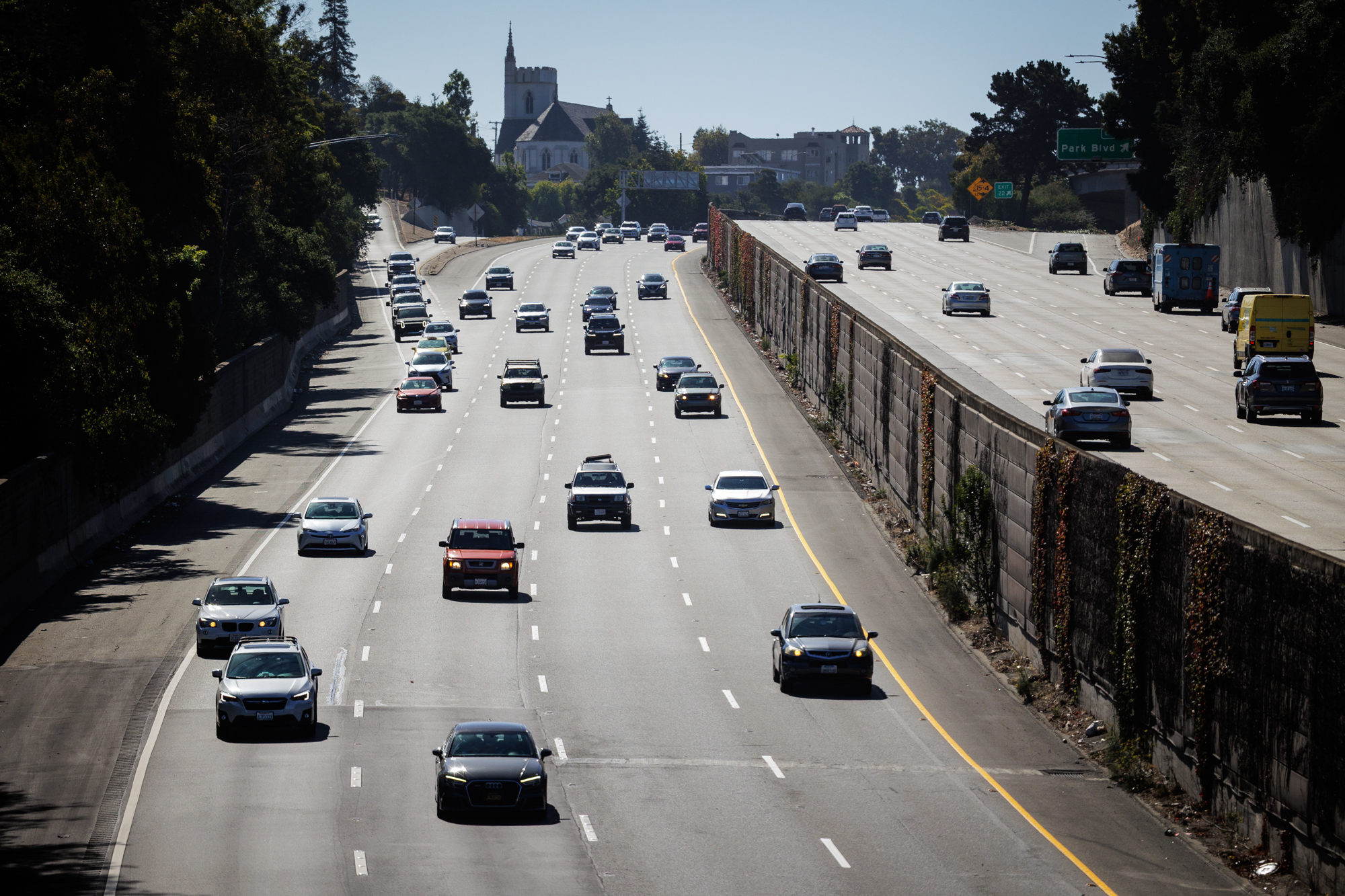
Before the pandemic, casual carpool was a completely organic system of pickup spots and patient passengers looking for a quick, comfortable way to head into San Francisco.
Casual carpool collapsed when the pandemic hit. But now it’s been relaunched.
Some members of the KQED podcast team are represented by The Screen Actors Guild, American Federation of Television and Radio Artists. San Francisco Northern California Local.
Ericka Cruz Guevarra [00:00:00] I’m Ericka Cruz-Guevarra and welcome to The Bay, local news to keep you rooted. So back in the before times, you could stand in a designated pickup spot at more than a dozen places around the Bay Area and hop into a stranger’s car, zooming towards San Francisco in the carpool lane. Casual carpool was this completely normal and organic system of strangers carpooling with other strangers. Sometimes things got weird.
Jahan Sagafi [00:00:34] I got into a car and the woman who was driving had her bird loose in the car. The bird cage was next to me in the back. There was bird sort of mess all over the place and I immediately got out and said I’m not riding in this car.
Ericka Cruz Guevarra [00:00:52] But for the most part, casual carpool was just a faster and more comfortable way of getting into the city. Until, of course, the pandemic.
Camille Bermudez [00:01:03] Just as we were told five years ago to stay home, we’re also now being told five year later, hey, time to start coming back into the office. And so that is part of why we think now is the perfect time to bring casual carpool back.
Ericka Cruz Guevarra [00:01:18] Casual carpool is making a comeback, but it’s gonna depend on how many strangers decide to do the thing again. Today, the woman who is resurrecting casual carpool and how it’s going so far. So Dan, you went to the casual carpool pickup spot in Oakland on Tuesday for the relaunch. Can you set the scene for me? What did it look like?
Dan Brekke [00:01:50] Yeah, so I got to the garage around seven o’clock, which in traditional casual carpool times was a little on the early side.
Ericka Cruz Guevarra [00:01:59] Dan Brekke is a transportation editor for KQED.
Dan Brekke [00:02:05] Where this casual carpool spot is, is in a parking garage directly under the MacArthur Freeway. It’s not a cheerful spot, right? It’s kind of dingy, but it was one of the original casual carpool spots before the pandemic happened in 2020. I saw the organizer of this relaunch of the carpool, Camille Bermudez, putting up these silver balloons near the corner of Lake Park and Lake Shore to advertise the fact that there was something going on there.
Dan Brekke [00:02:46] I saw a few people waiting in the garage and it turned out most of them were news people. There was one car waiting, and she was waiting for riders to go into the city with her. She had a limited amount of time to wait. And so after, I don’t know, 10, 15 minutes maybe, she left. Then we’re getting to around 8 o’clock. Riders were appearing, getting in the cars, and they were taking off. Getting close to 8.30 now. There was 1 car waiting. There was a passenger in the back seat and a driver.
Dan Brekke [00:03:21] I’m a reporter from KQED. If I ride along with you, can I interview you too? Yeah?
Dan Brekke [00:03:30] And so I jumped in with them and we rode over to the city together just like old times.
Jahan Sagafi [00:03:36] She’s listening to KQED right now.
Dan Brekke [00:03:39] It’s a great station.
Jahan Sagafi [00:03:41] It is!
Ericka Cruz Guevarra [00:03:46] Yeah I want to ask you about the folks that you hopped in the car with. Who did you meet?
Dan Brekke [00:03:52] So the people who picked me up turned out to be long time casual carpoolers and real fans.
Jahan Sagafi [00:03:58] I mean, it seemed like a quintessentially Bay Area thing.
Dan Brekke [00:04:01] I met Jahan Sagafi.
Jahan Sagafi [00:04:04] I was trying to do the math in my head, having done it from 2009 until the pandemic, I probably rode casual carpool, you know, 1,500 times.
Dan Brekke [00:04:12] And Melissa Abad.
Dan Brekke [00:04:14] Did you ever drive casual carpool in the past?
Melissa Abad [00:04:18] I did. I drove it quite a bit. I’ve always worked in the Presidio.
Dan Brekke [00:04:24] Melissa was the driver and Jahan was the rider and I would say they were both really committed and for both of them something that impressed me was that they’re really into it sort of as an aspect of community.
Jahan Sagafi [00:04:41] And not just a community of people who already know each other and are loyal to each other, but people who don’t know each can pull together for that one moment and help each other out. I think that’s very Bay Area.
Melissa Abad [00:04:54] There’s also some nice conversation. I have some very memorable conversations over the years and there’s nothing I’ve never felt unsafe or it’s always been a great experience.
Ericka Cruz Guevarra [00:05:07] Why not just take transit?
Dan Brekke [00:05:10] The advantages, sort of efficiency things that people talk about, are just too good. For instance, you usually don’t have to wait long for a ride. Sometimes you’re getting a ride in a really nice car. It’s cheaper for everybody, right? Because the driver in a carpool is only paying half the toll and the riders may pay nothing. And the time savings is huge. On a bad day at the Bay Bridge toll plaza, You’re saving… you know, 20, 30 minutes probably. Look, I think the main thing is comfort. I mean, people are choosing to ride in a private car that’s not crowded. Maybe somebody has some nice music on, maybe they have KQED, and it’s quiet if they want it to be, and they can talk to these strangers they’re riding with if that’s part of the ride too.
Ericka Cruz Guevarra [00:06:23] As someone who does try and use public transit when I can, I totally get the appeal of casual carpool. I mean, we’re talking about comfort. You always get a seat. You’re not dealing with big crowds on a BART train. But of course it went away because of the pandemic, but we’re taking now because of this relaunch. And I want to ask you more about the person behind it. Camille Bermudez. I mean what is her story and why is she so invested in making casual carpooling a thing again?
Dan Brekke [00:06:57] So Camille is a long time East Bay resident. She used to take the carpool with her father when she was a teenager. She went to high school in San Francisco. Her father worked on the Embarcadero downtown and she would ride in.
Camille Bermudez [00:07:14] It is very much something that brings neighborhoods together, or can bring neighborhoods together.
Dan Brekke [00:07:22] You know, she used it before the pandemic, and then for her and everybody else, it went away. And it’s never left her mind that, you know, this is something that should come back.
Camille Bermudez [00:07:34] When I did move to Alameda, knowing that I had maybe more limited options, I was looking for casual carpool and that’s when I really felt this is something that’s missing from our system.
Dan Brekke [00:07:46] You know, Camille, she is very, very determined and driven. I got this feeling every time I talked to her. And when we were out at the Lake Park Avenue Garage the other day, I mean, you can hear it in her voice. You can hear this really high-level energy in most of her exchanges.
Ericka Cruz Guevarra [00:08:10] As part of her determination around getting this thing together, I know she did this whole survey. What did her survey find exactly?
Dan Brekke [00:08:19] Well, what she was trying to find out was a general level of interest. And so she was asking people about their experience with it, whether they’d like to go back to it, where they would like to ride from, what time of day. She wanted to see what was viable for a relaunch. And I think where she started was, I want this thing to come back completely this summer. And she’s got reasons for thinking that’s possible. There are two main reasons. One is the fact that there are more return to work mandates.
Camille Bermudez [00:08:56] Just as we were told five years ago to stay home, we’re also now being told five years later, hey, time to start coming back into the office. And so that is part of why we-
Dan Brekke [00:09:05] The other thing that she sees happening, and this is also very real, is that people who have electric vehicles or other zero emission vehicles and have been able to drive in the carpool lanes solo, because they have that little sticker that we’ve all seen, they’re gonna lose that privileged access at the end of September. So if they wanna still drive in a carpool lane and not cheat, they are gonna have to get on board maybe with doing real carpooling to get in those carpool lines. So she thinks those two things will really persuade a lot of people to get back to casual carpooling. Within a few weeks of really looking at the data, she told me, well, we’re going to narrow our focus to three stations. One in Berkeley, one in Emeryville, one in Oakland, the Lake Park Avenue stop. And then by the time we actually got to her designated launch day, August 12, That was down to one. She felt like the numbers she saw in her survey really only supported the official relaunch of one site, the Lake Park Avenue site.
Ericka Cruz Guevarra [00:10:14] Could casual carpool take away from public transit? I mean, we know BART and Muni and all these other agencies are already struggling. Could casual carpool make it worse, somehow?
Dan Brekke [00:10:25] There is money that goes into the agencies from every rider, right? I mean, that is true. But if you think practically about how this works, I mean there were never that many people who used casual carpool. There was one pretty thorough study done before casual car pooling ended in 2020 that showed that Bay Area-wide there were about 6,000 people who might use it. Now that 6,000 people probably split between three or four different transit agencies. So yes, there is a cost. But if you think about how those same people are getting back home, the vast majority of them are riding transit. So it’s like you’re losing half of your transit revenue from a very small number of riders. Now, we’ll see what happens going forward. I mean, if this thing takes off and there’s mass adoption, maybe that’s something to think about.
Ericka Cruz Guevarra [00:11:19] I mean, what do you make of the return of the casual carpool this week? Was it a success? Like, is casual car pool coming back? Is it safe to say?
Dan Brekke [00:11:29] It’s a little too early to say exactly how it’s going to play out. I mean, we’re not talking big numbers. It’s like they’ve had half a dozen carpools per day. People’s commute habits have changed dramatically since March, 2020. And what we’re expecting them to do is to reverse some choices they’ve made since the pandemic started. And I’m not so sure it’s easy to do. Camille’s goal is to get more pickup spots up and running. And she imagines all 20 plus of them going full time, just like they were in the before times by a year from now. I think that could happen, but I think if it does, it’s gonna take some heavy lifting from other volunteers. Camille can’t do it all by herself. I mean, that’s just more than one person can do.
Ericka Cruz Guevarra [00:12:23] And that’s not the point, right? The whole system relies on many people buying it.
Dan Brekke [00:12:27] Exactly. There’s some kind of magic element of, like people were telling me the other morning, of, you know, community and a cooperative spirit to do this. And maybe that’s a place where you look at that and you have some optimism. Because I think people do want more of that. And to the extent that casual carpool is a community endeavor, people helping people. One person used the term mutual aid when we were talking about it. I think that may offer grounds for thinking that this could be a thing going forward.