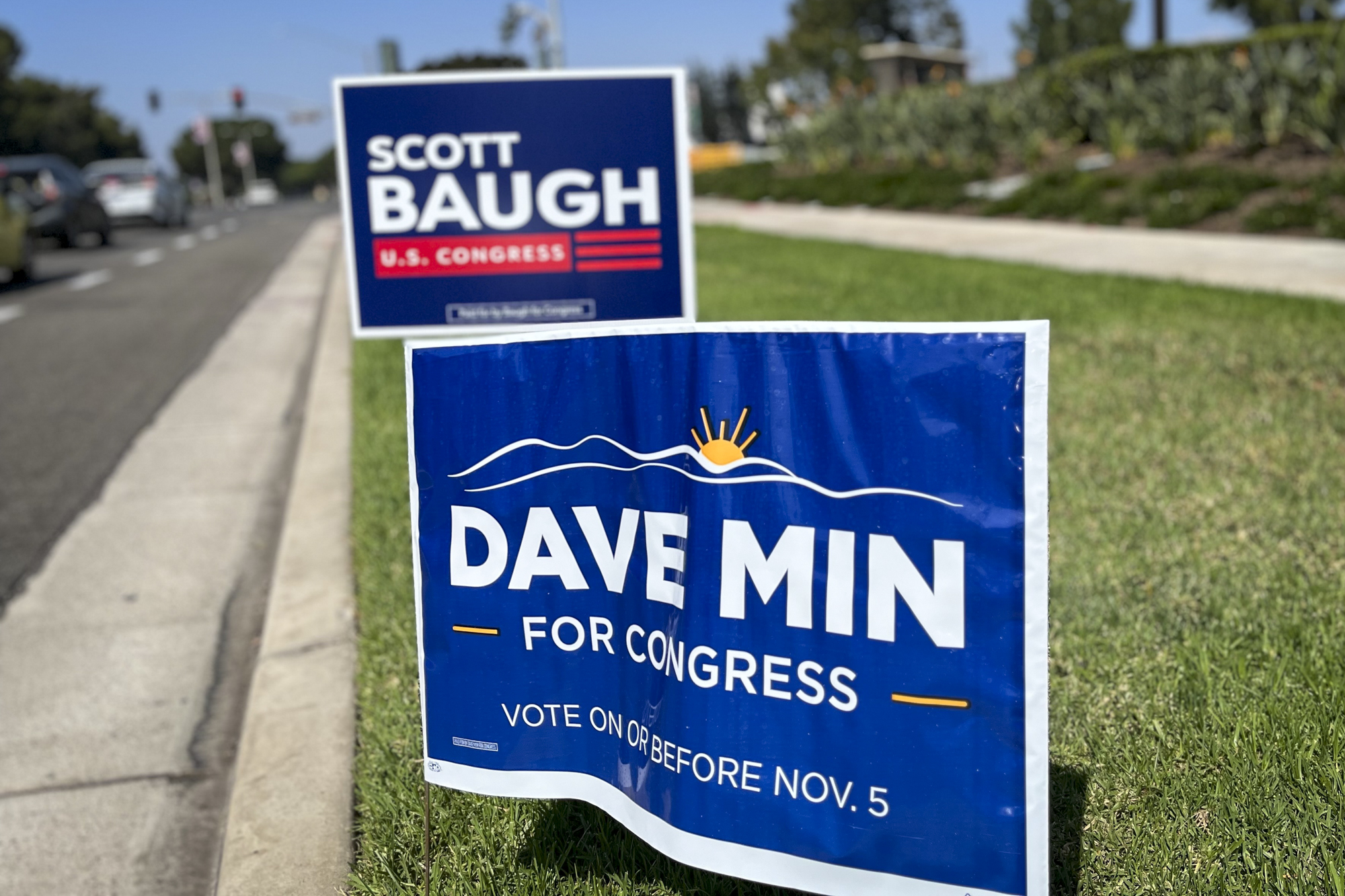
COSTA MESA — Here, along the sandy shores of Orange County, is where the Democrats’ 2018 ‘Blue Wave’ first made landfall. Six years later, California’s coastal 47th Congressional District will once again play a key role in deciding control of Congress.
The district, which includes the cities of Irvine, Huntington Beach, Newport Beach and Laguna Beach, embodies the shift of socially liberal, suburban voters away from the Republican Party since the election of Donald Trump. However, streaks of conservatism remain in the electorate, and Democrats will seek victory here without the star power of the district’s incumbent congresswoman, Rep. Katie Porter.
“Among the competitive districts in California this year, it’s the only open seat,” said Eric McGhee, a senior fellow at the Public Policy Institute of California.

Instead of seeking a fourth term, Porter ran for the U.S. Senate and placed third in the March primary. Now, Democrats hope that Dave Min, a state senator, will be able to replicate Porter’s success against Republican Scott Baugh, a former state Assembly member who narrowly lost to Porter in 2022.
Both candidates face significant hurdles: Baugh’s ties to Trump and some of the party’s conservative positions could turn off moderate voters, while Min must overcome a damaging DUI arrest that remains on voters’ minds. In this closely divided district, even small shifts in voter preferences could be decisive — Republicans currently hold a slim registration advantage of just 119 voters.
“There’s a more socially liberal bent to the district,” said political consultant Erica Kwiatkowski Nielsen, who managed Porter’s 2018 campaign. “But there is that traditional conservative values that you find in Orange County that people still adhere to … there’s a reason that [even] after Trump got elected and after 2018, this remains a battleground.”
The 2022 midterm results reflect the district’s split. Porter narrowly defeated Baugh by 3 percentage points despite outspending him significantly. In the same election, voters in the 47th supported Republican Brian Dahle for governor over Democratic incumbent Gavin Newsom. However, a ballot measure to enshrine reproductive rights into the California constitution won 61% of the vote here.
“The one thing that you’ve seen, which I think is really a part of the reason why we’re going to continue to see success for Democrats to continue to compete here, is the issue of choice and reproductive freedom,” Nielsen said.
Like Porter, Min is a former professor at the UC Irvine School of Law. He was elected to the state Senate in 2020. During his first term, Min largely voted with the Democratic supermajority, particularly on social issues. He’s been more likely to break with his caucus on legislation like rent protections and he recently declined to vote on a Newsom-backed bill regulating oil refineries.
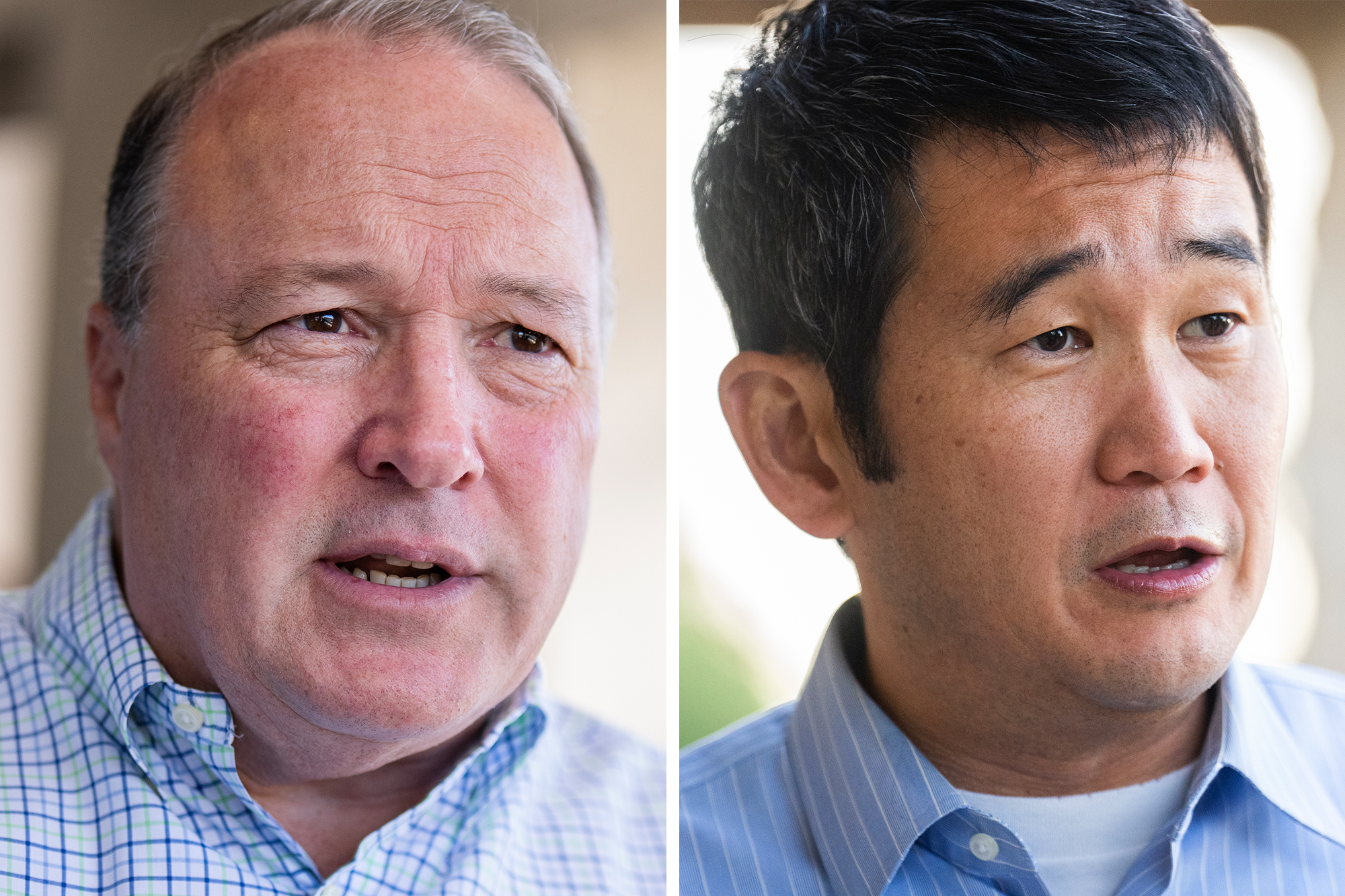
“I’ve been strong on women’s reproductive rights, on gun safety, on climate,” Min told KQED in an interview. “And you’ll note that the Republican Party’s not attacking me on those issues, right? Because they’re popular issues. I think I reflect the values of this district.”
Min and his allies have focused their attacks on Baugh’s stance on reproductive rights. While Min favors national protections for abortion, Baugh described it as a “state-by-state issue.” His current stance closely aligns with Trump’s — which, in the wake of the Supreme Court’s Dobbs decision, has led to wide abortion protections in California but outright bans in states such as Louisiana and Tennessee.
“I don’t believe Congress should be involved in banning abortions for the states,” Baugh told KQED. “The state of California has enshrined in its constitution women’s reproductive health, and so the federal government shouldn’t come over and overrule the will of the voters in California — I wouldn’t let them do that.”
Baugh’s staunch support for Trump presents another challenge for Republicans: Voters in the 47th District supported Joe Biden over Trump by a 54%–44% margin in 2020. To win, Baugh will need support from ticket splitters, who may reject Trump but still consider voting for a Republican for Congress.