Episode Transcript
Olivia Allen-Price: I’m Olivia Allen-Price. You’re listening to Bay Curious.
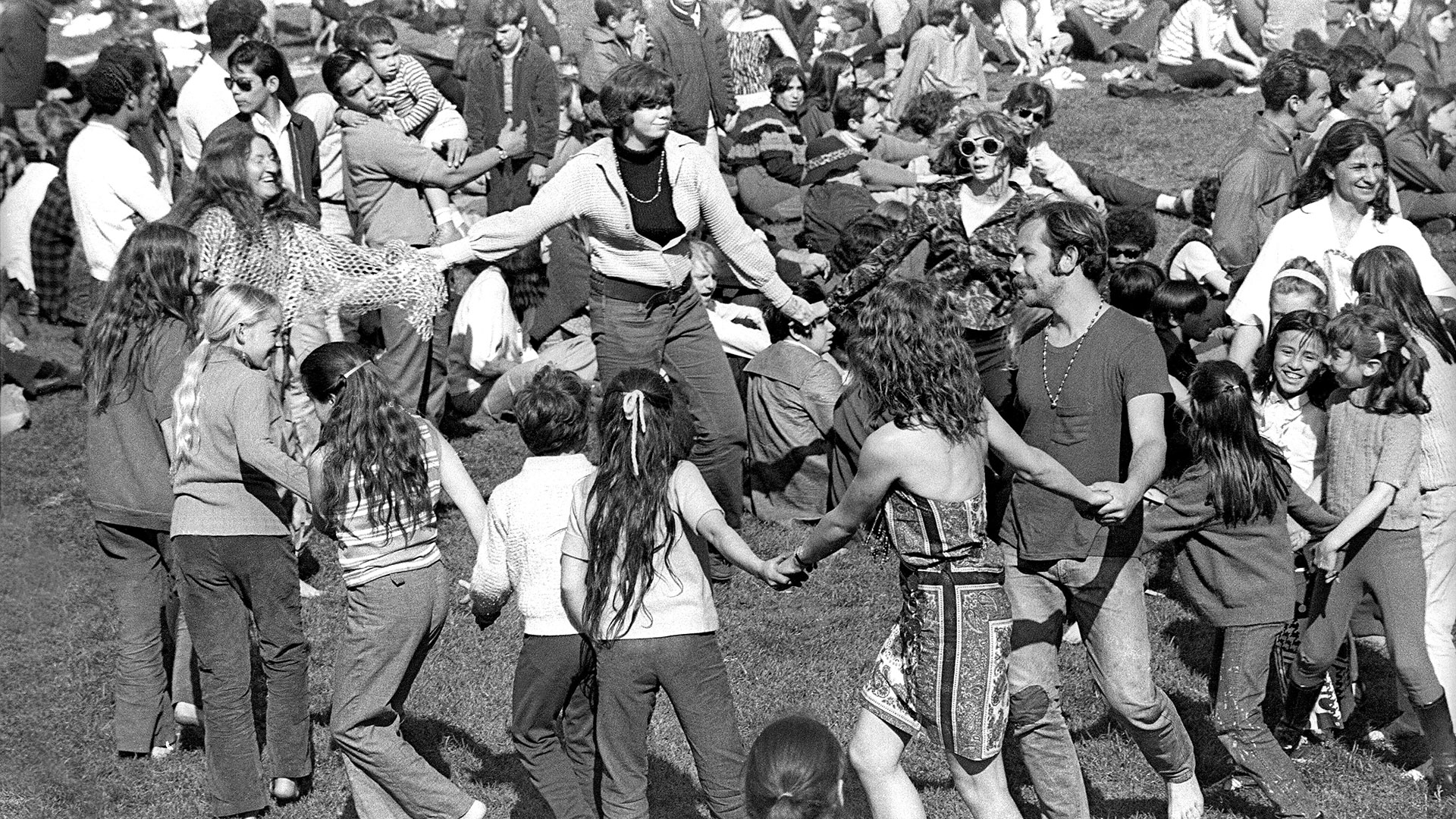
Today we’re going to venture back to the 1960s and 70s, when the Bay Area was a center for many social movements.
People took to the streets to protest the Vietnam War …
Sound pop of protest
Olivia Allen-Price: The Black Panther Party formed in response to police brutality against Black people …
Speech: We are talking about the survival of Black people, nothing else…
Olivia Allen-Price: Women were frustrated by the gender inequality they faced daily …
Chanting: Free our sisters, free ourselves
Olivia Allen-Price: And a lot of people started to think differently about how they wanted to live.
As many as a million Americans decided to join communes, group living situations, often with shared chores and finances.
Now the vast majority of those intentional communities that formed in the 60s and 70s have disappeared. But not all of them.
Reporter Jon Brooks went looking for one that survived in the suburbs of Contra Costa County, a group that has been steeped in mystery and sometimes controversy.
One note for listeners: we do talk about sex in this episode. It first aired in 2022. Here’s Jon…
Jon Brooks: If you were a high school kid growing up in the Walnut Creek area back in the 1990s, there wasn’t a lot to do. That’s one reason why Sabrina McQueen has never forgotten the big purple car she saw driving around town.
Sabrina McQueen: They’d drop people off at the grocery store. So it’s like, well, what’s that? And that’s when my mom told me, ‘Oh, those are the purple people.’
Jon Brooks: Purple people. That is fun to say. Say it once, you’re probably gonna want to say it again. Purple people.
Who could they possibly be?
That’s what Sabrina wants to know. She remembers in the seventh grade she went with a friend to pick someone up who lived on the purple people’s property…a com pound on some 20-plus acres.
Sabrina McQueen: I was so excited that I thought I was going to go inside and be able to see it. And then we got just to the gate, and that was it. You can’t get past the gate.
Jon Brooks: What exactly was going on in there? It’s one of those lingering mysteries to people who live in the area.
Jon Brooks: Now, here we should tell you, the Purple People aren’t really called the Purple People. (I know, rats.) That is just what locals call them. Why? Because they’re known to drive around in purple vehicles and live in purple-painted houses.
Jon Brooks in scene: Do you know the official name of the group?
Sabrina McQueen: No, I don’t. That’s why I asked this question.
Jon Brooks: Their real name is Lafayette Morehouse. And they are one of a very small fraction of 1960s-era communes that survive to this day. Lafayette Morehouse was so mysterious to locals like Sabrina, she and her friends on weekends would drive to this one lookout point to see if they could catch a glimpse of the property.
Sabrina McQueen: It would be kind of like, Hey, what do you guys want to go do tonight? It’s like, Oh, you guys want to go like, check out the purple people?
Jon Brooks: Sabrina’s driving me to that spot now. But she’s having a hard time finding it.
Sabrina McQueen: So, here’s where we’re going to turn. But it has been 30 years.
Jon Brooks in scene: Excuse me, we’re looking for the Purple People campus …
Man on street: Purple people campus?
Jon Brooks in scene: Yeah.
Man on street: Sorry, no idea.
Jon Brooks: You never heard that?
Sabrina McQueen: Do you think they don’t know for real?
Music post
Jon Brooks: Lafayette Morehouse has a colorful history, which we’re going to get into in a moment, but in recent decades it’s been quiet. Three years ago, the group was briefly in the news after someone left racist graffiti on their buildings. Morehouse’s reaction to the media at the time: No comment.
Naturally, I wanted very much to talk to the group, but they declined multiple interview requests.
But I did find three former Morehouse members who did want to talk. Like Rebekah Beneteau. She took courses at Lafayette Morehouse in the 1990s. The group was so successful at attracting members, Morehouse branches sprang up around the country. Beneteau says she lived for six years in one of the sister Morehouse communes in New York.
Rebekah Beneteau: Really the core of Morehouse’s philosophy is that life is better lived together and that we disrupted that in the 50s by shuttling every woman, every couple, off into their own houses. And then we invented Valium because there were all these women alone at home going nuts.
Jon Brooks: In the 1960s and 70s a lot of people were looking for new ways to live more fulfilling lives, at least more fulfilling than their parents.
One way to escape the prescribed path laid out by society – school, job, marriage, kids, death – was to live together in groups organized around political, religious, or environmental ideals.
Hundreds of thousands, up to a million, people tried their hand at communal living, says professor Tim Miller, an expert on intentional communities.
Tim Miller: Starting in 1965, I think you can date it that precisely. there was a whole new wave of communities came along… (4:00) I would say by and large these new young people’s communities were not very popular with mainstream society, and I would say that’s a very typical thing. I think it’s just that fear of what’s different.
Jon Brooks: In the 1970s ..and all the way through the 90s, Morehouse and Contra Costa County also battled over zoning issues and code violations … skirmishes that were frequently reported in the news.
Psychedelic music starts
Jon Brooks: The 1960s and 70s were also the age of … the guru. Like Timothy Leary – who urged people to take psychedelic drugs.
Timothy Leary: Turn on, tune in, and drop out.
Jon Brooks: And Werner Erhard, creator of something called E-S-T, or EST. This was a program of intense seminars supposedly leading to personal transformation. What Erhard was prescribing was… um, I don’t know…
Werner Erhard: People are…that love is attention. People are…that love is attention.
Laurie Rivlin Heller: All of these different gurus had different hooks.
Jon Brooks: This is Laurie Rivlin Heller. In the early ‘70s she dropped out of college and moved to the Bay Area. Here, she got interested in the human potential movement – the idea that people could tap into their unused abilities to reach their full potential.
That’s when she discovered someone named Victor Baranco.
Olivia Allen-Price: We’ve got to pause for a quick break. When we return … we get to know Victor Baranco.
Sponsor message
Olivia Allen-Price: Laurie Rivlin Heller met Victor Baranco in the early 70s, and found herself drawn to him.
Jon Brooks: The Berkeley-born Baranco was the founder of Morehouse, which had branches in a few Bay Area cities. Baranco had a successful career as an appliance salesman. But with Morehouse, he was offering something more than consumer goods. He was selling a new philosophy. The goal…remove the self-created obstacles between you and what you want. And he was good at it.
Laurie Rivlin Heller: He would be able to see you in a way that most people are not capable of doing. The fact that he could so clearly understand who I was and where I was coming from. And he did that to everybody. It was a unique gift.
Jon Brooks: Baranco called his program for living “responsible hedonism.” That means creating a pleasurable life for not only yourself, but for others.
Laurie Rivlin Heller: The responsible part was that you take responsibility for your life and your action. Things could change, but it was up to you to do that.
Jon Brooks: The hedonism part? That’s where the “more” in Mor ehouse comes in. And a lot of it has to do with … you guessed it … or you didn’t, because this is public media: sex.
Laurie Rivlin Heller: The sexual revolution, I guess you would say, was the hook for Victor Baranco. There were young people in this time period who were experiencing sexuality in a way that hadn’t been done previously. And there were older people who wanted a piece of it.
Jon Brooks: According to former members, one of the tenets of Baranco’s teaching was that a community functioned better when the women were happy, sexually and otherwise.
The group is famous for a 1976 demonstration of a woman reportedly having a 3-hour orgasm. Yes I said what I said. I spent a lot of time looking for that tape. Didn’t find it. But I did find some current Morehouse YouTube videos.
Lafayette Morehouse Video: In the fundamentals of sensuality course, we discuss the nature of orgasm. And in the afternoon, there’s a live demonstration of a woman in orgasm for an hour that will really blow your mind.
Jon Brooks: Rebekah Beneteau…the woman who lived in a Morehouse commune in New York… was at first put off by the emphasis on sex.
Rebekah Beneteau: They had a class where a woman was demonstrating being in orgasm for an hour. I thought that was extremely freaky. I didn’t want anything to do with them.
Jon Brooks: But she did like the group’s positive outlook and focus on people’s ability to change. Now, she offers sex and intimacy coaching. And, she changed her mind about the one-hour orgasm.
Rebekah Beneteau: They have a technique that also allowed me to sink into my body much more instead of always being up in my head.
Jon Brooks: 30:05 Can you really have a one-hour orgasm?
Rebekah Beneteau: Not yet, but I’ve gotten up to 27 minutes
Jon Brooks: Mm, 27 minutes. Pretty, pretty good.
All of this focus on sex has led to a certain reputation for Morehouse among its neighbors.
Sabrina McQueen: There’s a couple of rumors, one that it was a sex cult.
Jon Brooks: Yes, the group has definitely at times been labeled a sex cult. So much so they even have a question on their F-A-Q page … “Are you a sex cult?”
Marco Beneteau: I mean, that’s complete nonsense.
Jon Brooks: This is Marco Beneteau. He and Rebekah used to be married. He also took a lot of Morehouse courses. Then the two of them started their own commune in Philadelphia. Now he lives on a commune in Wyoming. So the man knows his communes. He says Morehouse didn’t have any of the characteristics people associate with cults.
Marco Beneteau: For instance, excommunication for leaving, financial coercion. You know, demanding that people cut off relationships with their relatives, that, you know, none of this has ever been practiced at Morehouse.
Jon Brooks: If Morehouse isn’t a cult, it has been controversial. In 1971, Rolling Stone published a pretty unflattering portrait of the group – complete with Baranco driving around in a chauffeur-driven limo. The article implied Baranco was making a lot of money off group members. But Laurie Rivlin Heller says there was nothing devious going on. Self-interest was an open part of Baranco’s philosophy.
Laurie Rivlin Heller: I would say that he put everything up front. The introductory course to Morehouse is called the Mark Group, where you are the mark. So there was no denying that he had put together a hustle, but you were voluntarily entering into the hustle and participating in it.
Jon Brooks: Still, that Rolling Stone article later appeared in a book alongside a chapter on Charles Manson. Not a good look for any leader of a commune.
Lafayette Morehouse Video: Using classical educational modes, More university is dedicated to the full realization of human potential.
Jon Brooks: Baranco later turned Lafayette Morehouse into More University. More University, more controversy.
The university offered PhDs in the humanities and of course, sensuality, including sexual research. In 1992, the San Francisco Chronicle reported at least one course cost almost 17-thousand dollars.
In the 80s and 90s Baranco sued the Chronicle and the Contra Costa Times for libel. (Hashtag please don’t sue us.) The court threw those lawsuits out. One of the decisions is not-safe-for-work reading. According to the court, a goal of More University’s Advanced Sensuality class was to “make friends with another crotch.” Which, if you’re listening Morehouse, would be an awesome bumper sticker.
The university shut down in the mid-90s.
Victor Baranco died in 2002 at the age of 68. And, eventually, the great majority of ‘60s communes faded away. Professor Timothy Miller:
Timothy Miller: Friend of mine, who still lives on one of the 60s era communes, said when their community had a great outmigration in the 80s, he thought some of them just decided they were Republicans, after all.
Jon Brooks: But Morehouse has survived. The decades come, the decades go, and they’re still doing their thing – whatever it is.
Back in the car with Sabrina, we wandered around trying to find that one view of the campus she remembers. We kept taking wrong turns, going back over the same streets. And then… …
Sabrina McQueen: It’s a purple house.
Jon Brooks: Sabrina’s excited. She’s a Purple People fan.
Sabrina McQueen: I wonder if that belongs to… Oh, yeah, I mean, that is, does that look like it’s purple?
Jon Brooks: It’s a nice property, with tennis courts and everything. But really, there’s not much to see and the group does have a right to its privacy. Sabrina, I think, is viewing it through the eyes of her high school years, when there was this mysterious aura around this counterculture group … right in her own suburban home town.
I wanted to know what she thinks of the Purple People now.
Sabrina McQueen: It is kind of interesting that this has survived so long, which I think is so amazing. I mean, hey, if that’s what they want to do and they’re peaceful and they are able to be part of our community, it sounds like they’re having fun. So good for them.
Jon Brooks: I’m a reporter. It’s my job to be skeptical. But I will say one thing. At the beginning of the coronavirus pandemic, Lafayette Morehouse went live over Facebook. They were definitely taking safety seriously. But, their aim wasn’t just to survive COVID, they said that wasn’t a high enough goal. They wanted to use the experience as a way to make their lives even better.
If life hands you really sour lemons, make even sweeter lemonade.
I got to admit, I’m still thinking about that one.
Olivia Allen-Price: That was reporter Jon Brooks.
If you like Bay Curious, I’ve got a request. Please tell your podcast listening friends about the show. We all like a good recommendation…help us grow!
And as always, consider donating to help sustain the work we do on Bay Curious. More info at KQED.org/donate.
Bay Curious is made in San Francisco at member-supported KQED.
Our show is produced by Katrina Schwartz, Christopher Beale and me, Olivia Allen-Price. Brendan Willard and Sebastian Miño-Bucheli also helped on this episode. We get extra support from: Katie Sprenger, Maha Sanad, Jen Chien, Ethan Toven-Lindsey and everyone on Team KQED.
I’m Olivia Allen-Price. Have a wonderful week.