In this episode of Sold Out, we'll go to Fresno in California's Central Valley and meet tenant advocates who are pushing for a right to counsel. And we'll also visit New York, where this movement took off, and speak to the activists behind it.
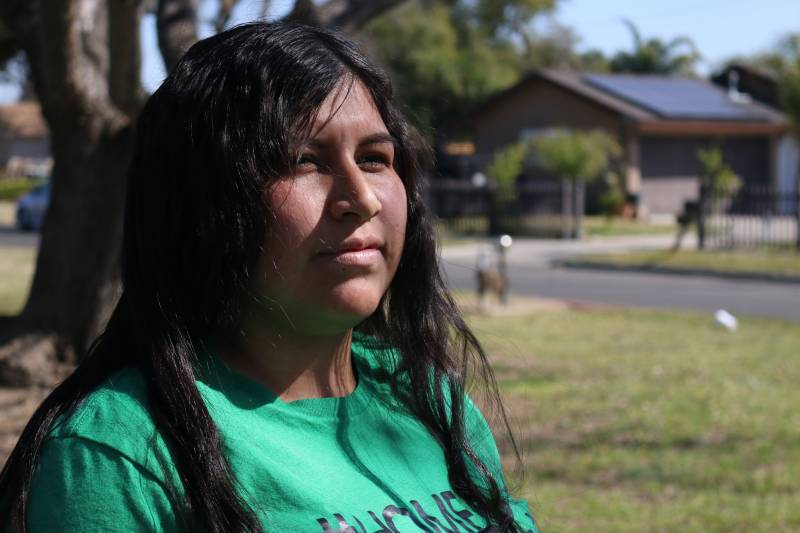
Fresno renter Jessica Ramirez has an eviction on her record and knows how hard it can be to find new housing. She's now part of a growing movement of renters in Fresno pushing for a right to counsel. (Alex Hall/KQED)
When it comes to eviction court, tenants are far less likely than property owners to be represented by an attorney. That makes it especially difficult for them to understand their rights and navigate the complex system.
The right to counsel is something that tenant advocates are pushing for across the country, and more cities and states are considering it, especially in light of the economic hardship caused by the COVID-19 pandemic.
In this episode of Sold Out, we’ll go to Fresno in California’s Central Valley, where rents are rising, and meet tenant advocates who have organized to push for a right to counsel. And we’ll also visit New York, where this movement took off, and speak to the activists behind it.
LANDLORD V. TENANT [TRANSCRIPT]
ERIKA KELLY, EDITOR: I’m Erika Kelly, the editor of Sold Out: Rethinking Housing in America, here to say thank you for listening to the show.
Our team is wrapping up the season, and we’d love to know what you thought about it, what you liked, what you didn’t like. Most importantly, we’d like to know a little more about you, our listener. What issues or stories [do] you want to hear more of in the future?
ERIN BALDASSARI, HOST: And I’m Erin Baldassari. From KQED this is Sold Out: Rethinking Housing in America.
This season we’ve been exploring evictions. If you’ve been following along, you already know the system is stacked against tenants. And that evictions have devastating consequences.
MOLLY: Nowhere is that more clear than in eviction court. It’s where most cases end up, and it’s where a push for reform is growing.
On today’s episode: a fight to balance the scales.
(Music out)
(Sounds: City streets. Molly Solomon is walking and speaks into her recorder.)
MOLLY IN FRESNO: OK. We’re on O Street, downtown Fresno.
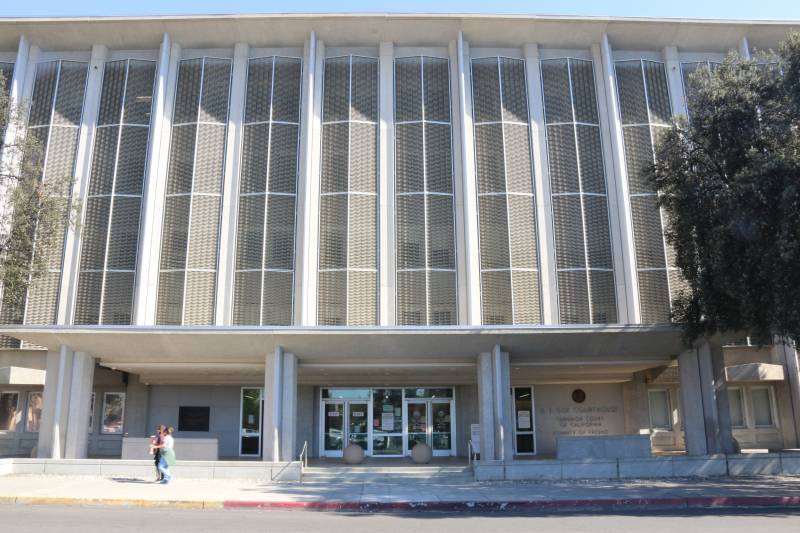
MOLLY: Last fall I drove out to California’s Central Valley, and pulled up to a mid-century modern building in the middle of downtown, the Fresno County Superior Courthouse.
MOLLY IN FRESNO: There is already a line of people that are getting ready to check in through the front door.
MOLLY: A security guard milled around outside. The crisp early morning air was starting to warm as the sun peeked out from behind the building.
I’m trying to look for Robert Cortez. He’s going to help me out today check out eviction court.
MOLLY: Are you Robert? Hi, I’m Molly.
ROBERT CORTEZ: Hi, nice to meet you.
MOLLY: Robert is an attorney who represents tenants. His law firm, Central California Legal Services, handles the vast majority of eviction defense cases in Fresno.
We head up to the fourth floor where eviction hearings start every Tuesday morning at 8:30. Today, there are about 20 cases on the docket.
The Fresno County Superior Courthouse in downtown Fresno. (Alex Hall/KQED)
ROBERT: So 90% of the time we’re in 404, which is just down the hall.
MOLLY: The room is small, no windows. There are a few rows of benches that are about half full. It’s not as packed as it was before the pandemic. Many hearings are still happening on Zoom. Robert points out some lawyers in the room. He calls them the regulars.
ROBERT: About four or five regular landlord attorneys are here every day.
MOLLY: Robert tells me one of the attorneys also serves as a debt collector for the landlords he represents. He collects past due rent from tenants who’ve been evicted.
ROBERT: He gets these unrepresented clients to agree to these deals that are payment plans basically. And they go on for years, like five, six, seven years.
(Music in)
MOLLY: I couldn’t record inside the courtroom while trials were underway. But I’ll say — you didn’t miss much. There’s a reason you never see TV shows about eviction courts. There’s not a lot of drama. Usually, you don’t call witnesses or present evidence. And a lot of times, evictions aren’t even decided in the courtroom.
(Music out)
The action is out in the hallway.
(Sounds: Door opens and closes.)
ROBERT: You’ll see a lot of dealmaking out here in the hallways. A lot of times attorneys will come outside and, you know, see if there’s a deal to be made.
ERIN: That’s how most cases end up: in deals or settlements. And that’s what Robert’s trying to do for his client Lea Esparza. Lea came to Robert after the court had already issued a default judgment against her, which is basically an automatic win for the landlord. It happens when tenants don’t show up or don’t file their paperwork in time.
In Lea’s case, she tried to file her paperwork. The problem was she’d hired a paralegal off of Craigslist to help her fill it out.
LEA ESPARZA: She charged me $500 and she didn’t turn in the paperwork. That’s why we ended up with the lockout.
ROBERT: So the sheriff is scheduled to come to the residence on Thursday. So what I’m trying to get the judge to do is delay that sheriff.
LEA: Yes, they said they were going to come at 6 a.m. and lock me out.
(Music in)
MOLLY: Lea had to stop working about a year ago after she was diagnosed with cancer.
LEA: I am battling cervical cancer and I’m also battling — I just had a surgery three months ago.
MOLLY: She says after this morning’s hearing she’s going back to the hospital for another surgery. And if her eviction goes through, she doesn’t know where she and her kids will go.
LEA: I got four daughters and myself and like I said, I do, I am battling my health, so I don’t think I have anywhere to go. I don’t got family around here.
(Music out)
MOLLY: Robert has just come out of a small mediators’ room with the landlord’s attorney. He and Lea huddle in a corner of the hallway, and keep their voices low. He’s got good news: Lea can stay through the end of the year, 109 more days. He’s also gotten her rent payments lowered to about $2 a day.
ROBERT: A lot of this work is delaying the inevitable. Sometimes eviction is inevitable. But we just try to get as much time as possible, so the client’s not on the street.
ERIN: Lea willeventually have to leave. But the deal is way better than what she could have negotiated on her own.
Most people don’t have someone like Robert on their side. These eviction cases move quickly and play out in courtrooms every day. And wherever you go, there’s the same imbalance: Landlords have attorneys. And tenants don’t.
JOHN POLLOCK: And that kind of representational imbalance yields the kind of results you would expect, which is it’s just completely one-sided.
JOHN: The tenants always lose, and half of them don’t even participate in the process because it is such a hopeless, disempowering process right now.
MOLLY: He says many tenants get pushed into deals that are on the landlord’s terms. And that’s why Pollock says tenants need attorneys, too.
(Sold Out theme song begins.)
MOLLY: Think of it this way: We grant defendants a right to an attorney in criminal cases. Why should it be any different for housing court?
JOHN: From our perspective, these are very serious proceedings on par with criminal ones in terms of the consequences.
ERIN: Now, the eviction protections put in place during the pandemic are expiring. And, eviction courts are filling up again. As they do, the calls for change are getting louder. Because tenants and their allies say the current system isn’t fair, and it needs to change.
(Sold Out theme song ends.)
Sold Out: Rethinking Housing In America is a five-part series reimagining what housing could be by examining California, the epicenter of the nation’s housing affordability crisis.
ERIN: On a windy morning last spring, a couple dozen people gathered outside Fresno City Hall.
There were tenants, faith leaders and housing advocates. And they were there to call attention to evictions in their neighborhoods.
A SPEAKER AT CITY HALL: What is a home when one is renting from a landlord who abuses their power dynamic and refuses to fix these conditions and then threatens to evict tenants who complain?
ERIN: They directed their protest to the city council, which was meeting inside the gleaming stainless steel building. On their agenda was a proposal to help tenants avoid eviction. Outside, a local pastor, D.J. Criner, took the mic.
D.J. CRINER: Are you going to hold landlords just as accountable as landlords think they’re holding residents? Are you going to give individuals an opportunity to have legal aid?
MOLLY: Renters held signs and shared their stories about the rent going up, about being forced to move, about worrying for their children. One of them was Jessica Ramirez, a mother of five who was born and raised in Fresno.
(Music in)
She was evicted a few years ago and didn’t have an attorney to help her out. Now with that on her record, it’s almost impossible to find new housing. Speaking to the crowd, she held up her eviction papers.
JESSICA RAMIREZ: This is why I’m here today, I’m here to raise my voice. You know, this voice that I have is not for one, but for many.
MOLLY: She shared how she and her family had to live in their car. How her kids had to bathe themselves in the restrooms of a public park.
JESSICA: You know, many out here in this world. You know, I live. This is a struggle. I’m in pain. You know, you guys don’t know how it is, living in the streets.
MOLLY: Pastor Criner called on the city council to protect renters like Jessica.
D.J.: This is about a call to action. Speak for this young lady and mother of five that is praying for an opportunity to raise her children in the same decent housing you’re able to raise yours in. So we studied the problem. We found the solution. We wrote the proposal, and the money has already been found. The question is now, are you listening and are you going to do something about it?
(Music out)
ERIN: Fresno City Hall is in the middle of downtown. It’s densely packed with tall office buildings. But you don’t have to drive far before you’re surrounded by farmland.
Fresno sits at the center of California’s San Joaquin Valley. Founded as a railroad town, it’s grown into an agricultural powerhouse. It’s also been an affordable city in an extremely unaffordable state, at least until recently.
CLIPS FROM FRESNO RENT NEWSCASTS: “The real estate market is buzzing in the valley.”
“According to a story in The Los Angeles Times called Fresno the hottest market in the country.”
“Monthly rent in Fresno has soared over the last year — experts cite high demand and low inventory.”
MOLLY: Driving around Fresno, you can almost feel the hype. Everywhere you go, there are these advertisements for new housing developments.
Alexandra Alvarado has felt it, too.
ALEXANDRA ALVARADO:The Central Valley has this myth of affordability that, like, people can just come in and afford it and be able to buy houses.
MOLLY: She’s always lived around Fresno. She grew up in a small town nearby, moved here for college. Alexandra is now a community organizer with a group called Faith in the Valley — the same group that organized the tenant protest outside City Hall. She says the idea of Fresno as an affordable place … is part of what’s driving up prices.
ALEXANDRA: Especially during the pandemic, when people were working from home, we were running across stories of people from the bay or from LA that were saying, oh, I could buy two houses in Fresno.
As prices rise, it’s becoming harder for people to find safe housing.
ALEXANDRA: What they end up being pushed to is what they can afford.
[HOST]: An investigation by local newspaper The Fresno Bee found that some tenants were living in terrible conditions: with no heat, leaky pipes, and mold. And when they complained, they were often threatened with an eviction.
(Music in)
MOLLY: Even before the pandemic, there are anywhere from three [thousand] to 4,000 eviction filings in Fresno each year. That’s according to a 2019 report from two researchers at Fresno State University.
AMBER CROWELL: So that’s a lot of people. And it was, you know, 200 or 300 families a month.
MOLLY: That’s Amber Crowell. She wrote the report with her colleague Janine Nkosi. They also work on housing advocacy with Faith in the Valley.
Janine and Amber spent months observing eviction hearings at the Fresno courthouse, the same place I met up with Robert and Lea. And they saw a lot of the same disparities that I did. Landlords had lawyers, and tenants didn’t. Here’s Janine:
JANINE NKOSI: I could literally cry right now when I think about it. Three, like maybe three people, were able to get some type of legal representation in housing court.
ERIN: According to the most recent data from Eviction Lab, Fresno has one of the highest eviction rates in the state. Far higher than in Los Angeles and San Francisco. But there’s only one legal aid organization in Fresno. And about half of the residents here are renters.
JANINE: The challenges that we are experiencing, they are not so different than what folks in the Bay Area, right, or Northern California, are experiencing, or in Southern California, but they are happening at an accelerated rate. We have the highest need and the fewest amount of resources.
(Music out)
[HOST]: What Janine and Amber found inspired a growing coalition of renters, faith leaders and students — one that only grew as economic shutdowns during the pandemic made it harder for tenants to pay their rent, tenants like Shar Thompson.
SHAR THOMPSON: I’m a single mom that works two jobs. So, you know, it’s really tough.
MOLLY: Shar works part time at Costco. When her shift ends in the afternoon, she heads to her second job at Walmart, where she works overnight stocking shelves. Shar’s from the Central Valley. She grew up in a small farming town nearby called Coalinga.
SHAR: If you drive down I-5 and smell the fresh air of cow manure, that’s Coalinga.
MOLLY: She moved to Fresno during the pandemic and was having trouble paying her rent. She found Faith in the Valley when she Googled local rent assistance programs.Then she started showing up at meetings, learning about her rights as a tenant, and discovered what was possible when she worked alongside other renters.
(Music in)
SHAR: There’s passion behind it from everybody. And I love the fact that we’re all from different walks of life, but we all have the same main goal and that’s to make a whole new housing system.
ERIN: Shar and the other Fresno renters had specific demands for the city. They wanted every tenant fighting an eviction to have an attorney: a right to counsel.
But they took it even further. They wanted the city to connect tenants with rent relief. And create a diversion program to help tenants andlandlords avoid the courtroom altogether. By early last year, their proposal was ready for the city council.
SPEAKER AT CITY COUNCIL: Thank you. Last item — that’s public item that we have is 4-B, it’s a workshop to discuss right-to-counsel proposal.
Fresno renter Jessica Ramirez. (Alex Hall/KQED)
MOLLY: Jessica Ramirez, the same renter who spoke outside City Hall, called into this meeting, too.
JESSICA: I am one of many that are speaking out asking for help because I know it only takes one eviction on someone’s record to change their lives forever.
MOLLY: But there’s pushback from landlords and within City Hall. Here’s City Council member Garry Bredefeld.
GARRY BREDEFELD: So I know. Imagine, I guess we’re pretty flush with money at the City of Fresno, and now we’re going into the rental tenant defense business. I don’t see any way that I will support these kinds of things. I don’t think this is what we should be doing.
[HOST]: Renters continued to pressure the city for months to vote on their proposal. But eventually, it became clear: A true right to counsel was not going to pass.
(Music out)
Here’s Amber Crowell, the eviction researcher at Fresno State.
AMBER: It was tough. It was a tough battle. And we didn’t get everything we wanted.
ERIN: What they got was something of a compromise. The city calls it the Eviction Protection Program. It’s not for all tenants — just the ones who are being wrongfully evicted, like if their landlord’s retaliating against them, or illegally locking them out.
Amber and other housing activists think only a small number of tenants will qualify or even know the program exists, leaving many still vulnerable.
MOLLY: But City Councilmember Tyler Maxwell is more optimistic.
TYLER MAXWELL: I can tell you, it is an uphill battle to get where we’re at today. I’m happy we’re able to get our foot in the door.
Nearly all of them were able to avoid trial. For the few who did go, most were able to get the eviction off their record. And that’s important, because having an eviction on your record can lock you out of new housing.
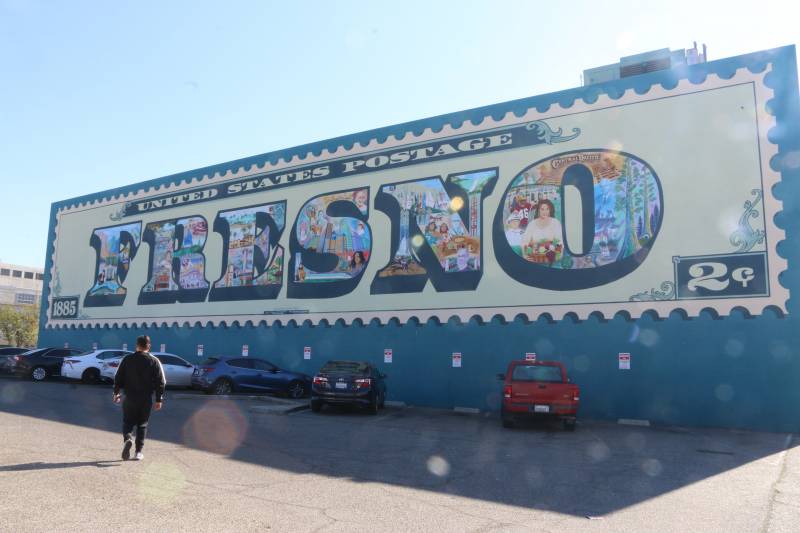
A mural in downtown Fresno. (Alex Hall/KQED)
ERIN: The program is only funded for one year and Tyler hopes they’ll extend it. But a right to counsel is still a pretty radical idea for Fresno, and he thinks there’s always going to be some people questioning whether it’s worth it.
TYLER: Why are we giving away free things? You know, why? Why are we providing something for free for people? You know they need to pick themselves up from the bootstraps, which, representing a district like I do, I know that’s a bunch of B.S. — picking yourself up by the bootstraps doesn’t work when you can’t afford the bootstraps.
Amber Crowell and Janine Nkosi say renters in Fresno can’t back down now, even if it feels like a battle between David and Goliath.
AMBER: The groups that represent property owners are much more powerful politically than the groups that represent tenants. And so that’s just an ideology that we’re always fighting against.
JANINE: You know, it’s always a battle between individual rights versus, like, collective care and collective responsibility.
MOLLY: They say it’s a battle worth fighting. And you can’t win anything if you don’t ask for it.
JANINE: We are made to believe that these are big asks, but we should be dreaming much, much bigger than we ever have been.
ERIN: Fresno isn’t the only place to fight for a right to counsel.
Coming up on Sold Out: where the movement first began.
(Music out)
CROWD CHANTING: Housing is a human right. Fight, fight, fight.
RANDY DILLARD: Good morning, good morning, good morning. My name is Randy Dillard and we are facing an eviction crisis in the Bronx.
MOLLY: Randy Dillard wears a bright orange T-shirt. On it is a fist thrust in the air. He energizes the crowd outside New York City Hall in lower Manhattan. It’s 2013 and he’s part of a tenants group in the South Bronx.
RANDY: Representation for tenants in housing court should be a right.
MOLLY: Randy was familiar with housing court. Before he was an organizer, he worked as a bricklayer. A single dad with five kids, Randy was on Section 8, but his apartment was not up to code.
RANDY: We have mold all over the apartment. We had leaks coming from up above into an open-light fixture in the bathroom that could have started a fire. We had to put plastic bags up.
ERIN: He said the leaks were so bad, sometimes they had to use an umbrella inside the house to keep from getting wet.
Because of the conditions, Randy’s home failed a Section 8 inspection, so the government program stopped making payments to his landlord. And then he developed emphysema and ended up in the hospital.
RANDY: And they was getting ready to put me on a breathing machine ’cause my lungs was getting ready to collapse. I almost, almost died.
ERIN: He was in the hospital for two months. Three days after he got out, he got a knock on his door.
RANDY: My landlord’s lawyer served me with eviction papers.
MOLLY: Randy says going to housing court to fight his eviction was confusing and scary. When he got there, he was met with long lines and little information.
RANDY: It leaves you numb, and empty inside. As soon as you get there first, you don’t know what to look for and you’ve got a long line of people. And some of them are emotional, crying, you know, while you waiting in line to go through the metal detector to get in there.
Ultimately, Randy did end up getting an attorney. He found someone through a legal help group in his neighborhood. His case took almost two years, but he eventually won, an outcome he says would have been impossible without his attorney.
RANDY: I don’t think no tenant should have to go through what me and my kids went through, and no tenant should have to stand before a judge and not know what their rights are.
CASA and a coalition of housing groups pressured the city to adopt a right to counsel. Organizers made the moral case that no one should have to face something as life-altering as losing your home without the benefit of an attorney.
Susanna Blankley was the group’s director at the time.
SUSANNA BLANKLEY: It meant the right to not face eviction alone. It meant the right to know that you would be protected. It meant the right to have power within the court system.
(Music in)
MOLLY: The coalition kept pushing, whipping up support wherever they could. First at a neighborhood board meeting, then City Council hearings, delivering a petition with 7,000 signatures to the mayor’s office. They even got the chief judge of the New York court system to testify in support of a right to counsel.
Until finally, after three years of organizing, New York City tenants made history. And won something that didn’t exist anywhere else in America: a right to counsel.
ERIN: When the program rolled out in 2017, it guaranteed most low-income tenants access to an attorney if they’re facing eviction. Former Mayor Bill de Blasio signed the legislation at CASA’s offices in the Bronx. Standing beside him was Randy Dillard.
(Sounds from the moments when Mayor Bill de Blasio was signing the legislation.)
RANDY: The reason why I’m here today, you wouldn’t be able to see me if I didn’t have an attorney. That’s why I’m standing up here. That’s why I’ve been fighting with the coalition and with CASA to make this possible.
MOLLY: In a video of the signing, Randy has this big smile on his face. Afterward, de Blasio turns to him and hands him the pen. He still has it today, framed on his wall.
RANDY: I introduced the mayor and I, and I spoke. They let me speak. It was powerful.
It was something that I had never imagined. Something that big that I will be a part of. I never looked at it starting out when we was fighting for it. I only looked at it, that is something that needed to be done.
(Music out)
MOLLY: And early results show it’s working. Since a right to counsel passed in 2017, more than half a million New Yorkers have gotten legal representation. And 84% of them were able to stay in their homes.
ERIN: Fewer evictions means fewer households falling into homelessness. A cost-benefit analysis on New York City predicted it would save $320 million, most of it in emergency shelter costs.
When a tenant is guaranteed an attorney, it also changes the way landlords use eviction courts.
SUSANNA: We’ve seen filings go down. It means landlords are suing people less. You see people show up to court way more because they believe that they have a chance to win.
MOLLY: It might not be surprising to hear that landlords don’t welcome the right-to-counsel laws. Sam Gilboard is the senior manager of public policy at the National Apartment Association.
SAM GILBOARD: It prolongs an already lengthy process. When you have a right to counsel, you’re prolonging an experience that is stressful. It’s costly.
MOLLY: Sam says landlords try to avoid evictions whenever possible.
SAM: Evictions are the only legal pathway that a housing provider has to dealing with issues of nonpayment or breach of lease. It’s a last-resort measure that is used in only the most dire of circumstances.
MOLLY: Instead, Gilboard advocates for different solutions — like more rental assistance.
ERIN: But landlord opposition isn’t the only challenge. Legal defense programs are expensive. New York City budgeted $166 million for right to counsel this year. And not every city has that kind of money.
BRANDI SNOW: It obviously costs money to pay lawyers to do that, somebody has to pay for it. And there is a resistance in some places to the idea of using taxpayer money to assist those who didn’t pay their rent.
ERIN: The other issue is bandwidth, and having enough tenant attorneys to make sure they can actually take those cases.
BRANDI: When you’re lacking enough attorneys for it now, you’ve created this right to something that you can’t provide.
MOLLY: But that isn’t stopping this idea from taking off.
BRANDI: Across the country, you’re seeing more of these right-to-counsel programs pop up that are doing amazing things. You know, New York has it, Cleveland has it, San Francisco has this also, and so does LA.
MOLLY: Last year, Washington became the first stateto pass it. John Pollock with the National Coalition for a Civil Right to Counsel says that’s a big deal.
JOHN: It’s everything. It’s the fact that we went from having no jurisdiction with the right to counsel, to having 13. So, you know, from a movement standpoint, I think it’s really come to a high point.
MOLLY: In the last year, 11 more states have introduced the idea. John says the pandemic is driving a lot of the interest.
ERIN: Even President Joe Biden is paying attention. Right to counsel and other court diversion programs were the focus of a White House summit last year.
(Music in)
And that’s the biggest win for tenants like Randy Dillard, who started this fight — that it didn’t stop with New York City.
RANDY: For other cities to follow, to me, is a great achievement, and I never knew that I would ever be a part of something so great. I feel good. I really do. And you know, knowing that somebody like me that was getting ready to go in front of a judge can sleep a little bit peaceful at night because they got somebody fighting for them.
MOLLY: It’s a reminder that movements don’t happen overnight. They’re usually built on small victories. But sometimes they turn into something bigger that shifts the power and changes the narrative, and gives tenants the right to a fighting chance to stay in their homes.
(Music out)
(Sold Out theme song begins.)
ERIN: Next time on Sold Out: We go to the root of the problem — how to keep people housed when they can’t pay the rent.
KEMANIE: Knowing that we had the housing voucher, we thought it was going to be easier because it was a guarantee.
EVA ROSEN: It can be really hard to find a place to live with that voucher at all.
EUGENE ZINCHIK: It’s like dealing with the DMV. It’s, you know, we’ve all been there, but you know, we don’t really want to do that, unless we have to.
ERIN: I’m Erin Baldassari.
MOLLY: And I’m Molly Solomon. You’ve been listening to Sold Out: Rethinking Housing in America.
If you like what you hear, please leave us a review on Apple Podcasts — and tell a friend about the show!
Sold Out is a production of KQED. This episode was written and reported by us: Molly Solomon and Erin Baldassari.
ERIN: Adhiti Bandlamudi produced this episode. Kyana Moghadam is our senior producer. Brendan Willard is our sound engineer. And Rob Speight wrote our theme song.
Natalia Aldana is our senior engagement producer and Gerald Fermin is our engagement intern.
Thank you to our editor, Erika Kelly. Additional editing from Jessica Placzek and Otis Taylor Jr.
MOLLY: We couldn’t have made this season without Ethan Toven-Lindsey, Holly Kernan, Erika Aguilar and Vinnee Tong. Thanks so much for listening. We’ll see you next week.
lower waypointnext waypoint
Player sponsored by
window.__IS_SSR__=true
window.__INITIAL_STATE__={
"attachmentsReducer": {
"audio_0": {
"type": "attachments",
"id": "audio_0",
"imgSizes": {
"kqedFullSize": {
"file": "https://ww2.kqed.org/news/wp-content/themes/KQED-unified/img/audio_bgs/background0.jpg"
}
}
},
"audio_1": {
"type": "attachments",
"id": "audio_1",
"imgSizes": {
"kqedFullSize": {
"file": "https://ww2.kqed.org/news/wp-content/themes/KQED-unified/img/audio_bgs/background1.jpg"
}
}
},
"audio_2": {
"type": "attachments",
"id": "audio_2",
"imgSizes": {
"kqedFullSize": {
"file": "https://ww2.kqed.org/news/wp-content/themes/KQED-unified/img/audio_bgs/background2.jpg"
}
}
},
"audio_3": {
"type": "attachments",
"id": "audio_3",
"imgSizes": {
"kqedFullSize": {
"file": "https://ww2.kqed.org/news/wp-content/themes/KQED-unified/img/audio_bgs/background3.jpg"
}
}
},
"audio_4": {
"type": "attachments",
"id": "audio_4",
"imgSizes": {
"kqedFullSize": {
"file": "https://ww2.kqed.org/news/wp-content/themes/KQED-unified/img/audio_bgs/background4.jpg"
}
}
},
"placeholder": {
"type": "attachments",
"id": "placeholder",
"imgSizes": {
"thumbnail": {
"file": "https://cdn.kqed.org/wp-content/uploads/2024/12/KQED-Default-Image-816638274-2000x1333-1-160x107.jpg",
"width": 160,
"height": 107,
"mimeType": "image/jpeg"
},
"medium": {
"file": "https://cdn.kqed.org/wp-content/uploads/2024/12/KQED-Default-Image-816638274-2000x1333-1-800x533.jpg",
"width": 800,
"height": 533,
"mimeType": "image/jpeg"
},
"medium_large": {
"file": "https://cdn.kqed.org/wp-content/uploads/2024/12/KQED-Default-Image-816638274-2000x1333-1-768x512.jpg",
"width": 768,
"height": 512,
"mimeType": "image/jpeg"
},
"large": {
"file": "https://cdn.kqed.org/wp-content/uploads/2024/12/KQED-Default-Image-816638274-2000x1333-1-1020x680.jpg",
"width": 1020,
"height": 680,
"mimeType": "image/jpeg"
},
"1536x1536": {
"file": "https://cdn.kqed.org/wp-content/uploads/2024/12/KQED-Default-Image-816638274-2000x1333-1-1536x1024.jpg",
"width": 1536,
"height": 1024,
"mimeType": "image/jpeg"
},
"fd-lrg": {
"file": "https://cdn.kqed.org/wp-content/uploads/2024/12/KQED-Default-Image-816638274-2000x1333-1-1536x1024.jpg",
"width": 1536,
"height": 1024,
"mimeType": "image/jpeg"
},
"fd-med": {
"file": "https://cdn.kqed.org/wp-content/uploads/2024/12/KQED-Default-Image-816638274-2000x1333-1-1020x680.jpg",
"width": 1020,
"height": 680,
"mimeType": "image/jpeg"
},
"fd-sm": {
"file": "https://cdn.kqed.org/wp-content/uploads/2024/12/KQED-Default-Image-816638274-2000x1333-1-800x533.jpg",
"width": 800,
"height": 533,
"mimeType": "image/jpeg"
},
"post-thumbnail": {
"file": "https://cdn.kqed.org/wp-content/uploads/2024/12/KQED-Default-Image-816638274-2000x1333-1-672x372.jpg",
"width": 672,
"height": 372,
"mimeType": "image/jpeg"
},
"twentyfourteen-full-width": {
"file": "https://cdn.kqed.org/wp-content/uploads/2024/12/KQED-Default-Image-816638274-2000x1333-1-1038x576.jpg",
"width": 1038,
"height": 576,
"mimeType": "image/jpeg"
},
"xxsmall": {
"file": "https://cdn.kqed.org/wp-content/uploads/2024/12/KQED-Default-Image-816638274-2000x1333-1-160x107.jpg",
"width": 160,
"height": 107,
"mimeType": "image/jpeg"
},
"xsmall": {
"file": "https://cdn.kqed.org/wp-content/uploads/2024/12/KQED-Default-Image-816638274-2000x1333-1-672x372.jpg",
"width": 672,
"height": 372,
"mimeType": "image/jpeg"
},
"small": {
"file": "https://cdn.kqed.org/wp-content/uploads/2024/12/KQED-Default-Image-816638274-2000x1333-1-672x372.jpg",
"width": 672,
"height": 372,
"mimeType": "image/jpeg"
},
"xlarge": {
"file": "https://cdn.kqed.org/wp-content/uploads/2024/12/KQED-Default-Image-816638274-2000x1333-1-1020x680.jpg",
"width": 1020,
"height": 680,
"mimeType": "image/jpeg"
},
"full-width": {
"file": "https://cdn.kqed.org/wp-content/uploads/2024/12/KQED-Default-Image-816638274-2000x1333-1-1920x1280.jpg",
"width": 1920,
"height": 1280,
"mimeType": "image/jpeg"
},
"guest-author-32": {
"file": "https://cdn.kqed.org/wp-content/uploads/2025/01/KQED-Default-Image-816638274-1333x1333-1-160x160.jpg",
"width": 32,
"height": 32,
"mimeType": "image/jpeg"
},
"guest-author-50": {
"file": "https://cdn.kqed.org/wp-content/uploads/2025/01/KQED-Default-Image-816638274-1333x1333-1-160x160.jpg",
"width": 50,
"height": 50,
"mimeType": "image/jpeg"
},
"guest-author-64": {
"file": "https://cdn.kqed.org/wp-content/uploads/2025/01/KQED-Default-Image-816638274-1333x1333-1-160x160.jpg",
"width": 64,
"height": 64,
"mimeType": "image/jpeg"
},
"guest-author-96": {
"file": "https://cdn.kqed.org/wp-content/uploads/2025/01/KQED-Default-Image-816638274-1333x1333-1-160x160.jpg",
"width": 96,
"height": 96,
"mimeType": "image/jpeg"
},
"guest-author-128": {
"file": "https://cdn.kqed.org/wp-content/uploads/2025/01/KQED-Default-Image-816638274-1333x1333-1-160x160.jpg",
"width": 128,
"height": 128,
"mimeType": "image/jpeg"
},
"detail": {
"file": "https://cdn.kqed.org/wp-content/uploads/2025/01/KQED-Default-Image-816638274-1333x1333-1-160x160.jpg",
"width": 160,
"height": 160,
"mimeType": "image/jpeg"
},
"kqedFullSize": {
"file": "https://cdn.kqed.org/wp-content/uploads/2024/12/KQED-Default-Image-816638274-2000x1333-1.jpg",
"width": 2000,
"height": 1333
}
}
},
"news_11907094": {
"type": "attachments",
"id": "news_11907094",
"meta": {
"index": "attachments_1716263798",
"site": "news",
"id": "11907094",
"found": true
},
"parent": 11907091,
"imgSizes": {
"twentyfourteen-full-width": {
"file": "https://ww2.kqed.org/app/uploads/sites/10/2022/03/IMG_7976-1-1038x576.jpg",
"width": 1038,
"mimeType": "image/jpeg",
"height": 576
},
"thumbnail": {
"file": "https://ww2.kqed.org/app/uploads/sites/10/2022/03/IMG_7976-1-160x107.jpg",
"width": 160,
"mimeType": "image/jpeg",
"height": 107
},
"post-thumbnail": {
"file": "https://ww2.kqed.org/app/uploads/sites/10/2022/03/IMG_7976-1-672x372.jpg",
"width": 672,
"mimeType": "image/jpeg",
"height": 372
},
"kqedFullSize": {
"file": "https://ww2.kqed.org/app/uploads/sites/10/2022/03/IMG_7976-1.jpg",
"width": 5472,
"height": 3648
},
"2048x2048": {
"file": "https://ww2.kqed.org/app/uploads/sites/10/2022/03/IMG_7976-1-2048x1365.jpg",
"width": 2048,
"mimeType": "image/jpeg",
"height": 1365
},
"large": {
"file": "https://ww2.kqed.org/app/uploads/sites/10/2022/03/IMG_7976-1-1020x680.jpg",
"width": 1020,
"mimeType": "image/jpeg",
"height": 680
},
"1536x1536": {
"file": "https://ww2.kqed.org/app/uploads/sites/10/2022/03/IMG_7976-1-1536x1024.jpg",
"width": 1536,
"mimeType": "image/jpeg",
"height": 1024
},
"full-width": {
"file": "https://ww2.kqed.org/app/uploads/sites/10/2022/03/IMG_7976-1-1920x1280.jpg",
"width": 1920,
"mimeType": "image/jpeg",
"height": 1280
},
"medium": {
"file": "https://ww2.kqed.org/app/uploads/sites/10/2022/03/IMG_7976-1-800x533.jpg",
"width": 800,
"mimeType": "image/jpeg",
"height": 533
}
},
"publishDate": 1646337409,
"modified": 1646337512,
"caption": "Fresno renter Jessica Ramirez has an eviction on her record and knows how hard it can be to find new housing. She's now part of a growing movement of renters in Fresno pushing for a right to counsel.",
"description": null,
"title": "SO S2 EP 4: IMG_7976 (1)",
"credit": "Alex Hall/KQED",
"status": "inherit",
"altTag": "A woman stands in a park, wearing a green shirt that says, \"#HomesGuarantee!\"\"",
"isLoading": false,
"fetchFailed": false
}
},
"audioPlayerReducer": {
"postId": "stream_live",
"isPaused": true,
"isPlaying": false,
"pfsActive": false,
"pledgeModalIsOpen": true,
"playerDrawerIsOpen": false,
"liveAudioPlayStartedAt": 0,
"liveAudioPlayContext": ""
},
"authorsReducer": {
"msolomon": {
"type": "authors",
"id": "11651",
"meta": {
"index": "authors_1716337520",
"id": "11651",
"found": true
},
"name": "Molly Solomon",
"firstName": "Molly",
"lastName": "Solomon",
"slug": "msolomon",
"email": "msolomon@KQED.org",
"display_author_email": false,
"staff_mastheads": [
"news"
],
"title": "Senior Editor",
"bio": "Molly Solomon is the senior editor of KQED's California Politics and Government Desk. Previously, she was the station's editor-at-large, with a focus on editing early childhood education, politics, and criminal justice. Before that, she managed and edited statewide election coverage for The California Newsroom, a collaboration of local public radio stations, CalMatters and NPR. Molly joined KQED in 2019 to launch the station’s housing affordability desk, where she reported on homelessness, evictions and is the co-host of KQED’s housing podcast, SOLD OUT: Rethinking Housing in America. Before that, she was the Southwest Washington Bureau Chief for Oregon Public Broadcasting and a reporter at Hawaii Public Radio. Her stories have aired on NPR’s \u003cem>Morning Edition\u003c/em>, \u003cem>All Things Considered\u003c/em>, \u003cem>Here & Now\u003c/em>, \u003cem>Science Friday\u003c/em> and \u003cem>Marketplace\u003c/em>. Molly's award-winning reporting has been honored by the Best of the West, Edward R. Murrow awards, Society of Professional Journalists, National Headliner Awards, and the Asian American Journalists Association. Born and raised in Berkeley, Molly is a big fan of burritos and her scruffy terrier, Ollie.",
"avatar": "https://secure.gravatar.com/avatar/9ad9794616923d81c9a79897161545bd?s=600&d=blank&r=g",
"twitter": "solomonout",
"facebook": null,
"instagram": null,
"linkedin": null,
"sites": [
{
"site": "news",
"roles": [
"editor"
]
},
{
"site": "science",
"roles": [
"editor"
]
}
],
"headData": {
"title": "Molly Solomon | KQED",
"description": "Senior Editor",
"ogImgSrc": "https://secure.gravatar.com/avatar/9ad9794616923d81c9a79897161545bd?s=600&d=blank&r=g",
"twImgSrc": "https://secure.gravatar.com/avatar/9ad9794616923d81c9a79897161545bd?s=600&d=blank&r=g"
},
"isLoading": false,
"link": "/author/msolomon"
},
"ebaldassari": {
"type": "authors",
"id": "11652",
"meta": {
"index": "authors_1716337520",
"id": "11652",
"found": true
},
"name": "Erin Baldassari",
"firstName": "Erin",
"lastName": "Baldassari",
"slug": "ebaldassari",
"email": "ebaldassari@KQED.org",
"display_author_email": true,
"staff_mastheads": [
"news"
],
"title": "Staff Writer",
"bio": "Erin Baldassari covers housing for KQED. She's a former print journalist and most recently worked as the transportation reporter for the \u003cem>Mercury News\u003c/em> and \u003cem>East Bay Times. \u003c/em>There, she focused on how the Bay Area’s housing shortage has changed the way people move around the region. She also served on the \u003cem>East Bay Times\u003c/em>’ 2017 Pulitzer Prize-winning team for coverage of the Ghost Ship Fire in Oakland. Prior to that, Erin worked as a breaking news and general assignment reporter for a variety of outlets in the Bay Area and the greater Boston area. A Tufts University alumna, Erin grew up in the foothills of the Sierra Nevada mountains and in Sonoma County. She is a life-long KQED listener.",
"avatar": "https://secure.gravatar.com/avatar/5e95cad64a8ca08288082212e199d2b0cbeb4fd8e8ef5339395f361032bbe005?s=600&d=blank&r=g",
"twitter": "e_baldi",
"bluesky": null,
"facebook": null,
"instagram": null,
"linkedin": null,
"sites": [
{
"site": "news",
"roles": [
"edit_others_posts",
"editor"
]
},
{
"site": "science",
"roles": [
"editor"
]
},
{
"site": "liveblog",
"roles": [
"editor"
]
}
],
"headData": {
"title": "Erin Baldassari | KQED",
"description": "Staff Writer",
"ogImgSrc": "https://secure.gravatar.com/avatar/5e95cad64a8ca08288082212e199d2b0cbeb4fd8e8ef5339395f361032bbe005?s=600&d=blank&r=g",
"twImgSrc": "https://secure.gravatar.com/avatar/5e95cad64a8ca08288082212e199d2b0cbeb4fd8e8ef5339395f361032bbe005?s=600&d=blank&r=g"
},
"isLoading": false,
"link": "/author/ebaldassari"
}
},
"pagesReducer": {},
"pfsSessionReducer": {},
"postsReducer": {
"stream_live": {
"type": "live",
"id": "stream_live",
"audioUrl": "https://streams.kqed.org/kqedradio",
"title": "Live Stream",
"excerpt": "Live Stream information currently unavailable.",
"link": "/radio",
"featImg": "",
"label": {
"name": "KQED Live",
"link": "/"
}
},
"stream_kqedNewscast": {
"type": "posts",
"id": "stream_kqedNewscast",
"audioUrl": "https://www.kqed.org/.stream/anon/radio/RDnews/newscast.mp3?_=1",
"title": "KQED Newscast",
"featImg": "",
"label": {
"name": "88.5 FM",
"link": "/"
}
},
"news_11907091": {
"type": "posts",
"id": "news_11907091",
"meta": {
"index": "posts_1716263798",
"site": "news",
"id": "11907091",
"found": true
},
"articlePosition": 0,
"guestAuthors": [],
"slug": "power-in-the-courts-when-tenants-fight-back",
"title": "Power in the Courts: When Tenants Fight Back",
"publishDate": 1646650891,
"format": "audio",
"headTitle": "Power in the Courts: When Tenants Fight Back | KQED",
"labelTerm": {},
"content": "\u003cp>\u003cspan style=\"font-weight: 400\">When it comes to eviction court, tenants are far less likely than property owners to be represented by an attorney. That makes it especially difficult for them to understand their rights and navigate the complex system. \u003c/span>\u003c/p>\n\u003cp>\u003cspan style=\"font-weight: 400\">The right to counsel is something that tenant advocates are pushing for across the country, and more cities and states are considering it, especially in light of the economic hardship caused by the COVID-19 pandemic. \u003c/span>\u003c/p>\n\u003cp>\u003cspan style=\"font-weight: 400\">In this episode of Sold Out, we’ll go to Fresno in California’s Central Valley, where rents are rising, and meet tenant advocates who have organized to push for a right to counsel. And we’ll also visit New York, where this movement took off, and speak to the activists behind it.\u003c/span>\u003c/p>\n\u003ch5 id=\"embed-code\" class=\"inconsolata\">\n\u003c!-- iframe plugin v.4.3 wordpress.org/plugins/iframe/ -->\u003cbr>\n\u003ciframe loading=\"lazy\" frameborder=\"0\" height=\"200\" scrolling=\"no\" src=\"https://playlist.megaphone.fm?e=KQINC6308765795&light=true\" width=\"100%\" class=\"iframe-class\">\u003c/iframe>\u003cbr>\n\u003c/h5>\n\u003chr>\n\u003cp>\u003cstrong>LANDLORD V. TENANT [TRANSCRIPT]\u003c/strong>\u003c/p>\n\u003cp>\u003cstrong>ERIKA KELLY, EDITOR\u003c/strong>: I’m Erika Kelly, the editor of Sold Out: Rethinking Housing in America, here to say thank you for listening to the show.\u003c/p>\n\u003cp>[ad fullwidth]\u003c/p>\n\u003cp>Our team is wrapping up the season, and we’d love to know what you thought about it, what you liked, what you didn’t like. Most importantly, we’d like to know a little more about you, our listener. What issues or stories [do] you want to hear more of in the future?\u003c/p>\n\u003cp>Head over to \u003ca href=\"https://survey.alchemer.com/s3/6755022/f959eb5782fc\">kqed.org/soldoutsurvey\u003c/a> to leave us some feedback.\u003c/p>\n\u003cp>Thanks so much!\u003c/p>\n\u003cp>\u003cem>(KQED music in)\u003c/em>\u003c/p>\n\u003cp>\u003ci>\u003cspan style=\"font-weight: 400\">(Music in)\u003c/span>\u003c/i>\u003c/p>\n\u003cp>\u003cb>MOLLY SOLOMON, HOST\u003c/b>:\u003cspan style=\"font-weight: 400\"> Hey, I’m Molly Solomon.\u003c/span>\u003c/p>\n\u003cp>\u003cb>ERIN BALDASSARI, HOST\u003c/b>:\u003cspan style=\"font-weight: 400\"> And I’m Erin Baldassari. From KQED this is Sold Out: Rethinking Housing in America.\u003c/span>\u003c/p>\n\u003cp>\u003cspan style=\"font-weight: 400\">This season we’ve been exploring evictions. If you’ve been following along, you already know the system is stacked against tenants. And that evictions have devastating consequences. \u003c/span>\u003c/p>\n\u003cp>\u003cb>MOLLY\u003c/b>:\u003cspan style=\"font-weight: 400\"> Nowhere is that more clear than in eviction court. It’s where most cases end up, and it’s where a push for reform is growing.\u003c/span>\u003c/p>\n\u003cp>\u003cspan style=\"font-weight: 400\">On today’s episode: a fight to balance the scales. \u003c/span>\u003c/p>\n\u003cp>\u003ci>\u003cspan style=\"font-weight: 400\">(Music out)\u003c/span>\u003c/i>\u003c/p>\n\u003cp>\u003ci>\u003cspan style=\"font-weight: 400\">(Sounds: City streets. \u003c/span>\u003c/i>\u003ci>\u003cspan style=\"font-weight: 400\">Molly Solomon is walking and speaks into her recorder.)\u003c/span>\u003c/i>\u003c/p>\n\u003cp>\u003cstrong>MOLLY IN FRESNO\u003c/strong>: OK. We’re on O Street, downtown Fresno.\u003c/p>\n\u003cp>\u003cspan style=\"font-weight: 400\">\u003cstrong>MOLLY\u003c/strong>: Last fall I drove out to California’s Central Valley, and pulled up to a mid-century modern building in the middle of downtown, the Fresno County Superior Courthouse.\u003c/span>\u003c/p>\n\u003cp>\u003cb>MOLLY IN FRESNO\u003c/b>: \u003cspan style=\"font-weight: 400\">There is already a line of people that are getting ready to check in through the front door.\u003c/span>\u003c/p>\n\u003cp>\u003cb>MOLLY\u003c/b>: \u003cspan style=\"font-weight: 400\">A security guard milled around outside. The crisp early morning air was starting to warm as the sun peeked out from behind the building. \u003c/span>\u003c/p>\n\u003cp>\u003cspan style=\"font-weight: 400\">I’m trying to look for Robert Cortez. He’s going to help me out today check out eviction court. \u003c/span>\u003c/p>\n\u003cp>\u003cb>MOLLY\u003c/b>: \u003cspan style=\"font-weight: 400\">Are you Robert? Hi, I’m Molly. \u003c/span>\u003c/p>\n\u003cp>\u003cb>ROBERT CORTEZ\u003c/b>: \u003cspan style=\"font-weight: 400\">Hi, nice to meet you.\u003c/span>\u003c/p>\n\u003cp>\u003cb>MOLLY\u003c/b>: \u003cspan style=\"font-weight: 400\">Robert is an attorney who represents tenants. His law firm, \u003ca href=\"https://www.centralcallegal.org/\">Central California Legal Services\u003c/a>, handles the vast majority of eviction defense cases in Fresno.\u003c/span>\u003c/p>\n\u003cp>\u003cspan style=\"font-weight: 400\">We head up to the fourth floor where eviction hearings start every Tuesday morning at 8:30. Today, there are about 20 cases on the docket. \u003c/span>\u003c/p>\n\u003cfigure id=\"attachment_11907099\" class=\"wp-caption alignnone\" style=\"max-width: 800px\">\u003cimg loading=\"lazy\" decoding=\"async\" class=\"size-medium wp-image-11907099\" src=\"https://ww2.kqed.org/app/uploads/sites/10/2022/03/IMG_7937-1-800x533.jpg\" alt=\"A gray and tan building with various columns, and two people passing in front of it.\" width=\"800\" height=\"533\" srcset=\"https://cdn.kqed.org/wp-content/uploads/sites/10/2022/03/IMG_7937-1-800x533.jpg 800w, https://cdn.kqed.org/wp-content/uploads/sites/10/2022/03/IMG_7937-1-1020x680.jpg 1020w, https://cdn.kqed.org/wp-content/uploads/sites/10/2022/03/IMG_7937-1-160x107.jpg 160w, https://cdn.kqed.org/wp-content/uploads/sites/10/2022/03/IMG_7937-1-1536x1024.jpg 1536w, https://cdn.kqed.org/wp-content/uploads/sites/10/2022/03/IMG_7937-1-2048x1365.jpg 2048w, https://cdn.kqed.org/wp-content/uploads/sites/10/2022/03/IMG_7937-1-1920x1280.jpg 1920w\" sizes=\"auto, (max-width: 800px) 100vw, 800px\">\u003cfigcaption class=\"wp-caption-text\">The Fresno County Superior Courthouse in downtown Fresno. \u003ccite>(Alex Hall/KQED)\u003c/cite>\u003c/figcaption>\u003c/figure>\n\u003cp>\u003cb>ROBERT\u003c/b>: \u003cspan style=\"font-weight: 400\">So 90% of the time we’re in 404, which is just down the hall.\u003c/span>\u003c/p>\n\u003cp>\u003cb>MOLLY\u003c/b>: \u003cspan style=\"font-weight: 400\">The room is small, no windows. There are a few rows of benches that are about half full. It’s not as packed as it was before the pandemic. Many hearings are still happening on Zoom. Robert points out some lawyers in the room. He calls them the regulars.\u003c/span>\u003c/p>\n\u003cp>\u003cb>ROBERT\u003c/b>: A\u003cspan style=\"font-weight: 400\">bout four or five regular landlord attorneys are here every day.\u003c/span>\u003c/p>\n\u003cp>\u003cb>MOLLY\u003c/b>: \u003cspan style=\"font-weight: 400\">Robert tells me one of the attorneys also serves as a debt collector for the landlords he represents. He collects past due rent from tenants who’ve been evicted. \u003c/span>\u003c/p>\n\u003cp>\u003cb>ROBERT\u003c/b>: \u003cspan style=\"font-weight: 400\">He gets these unrepresented clients to agree to these deals that are payment plans basically. And they go on for years, like five, six, seven years. \u003c/span>\u003c/p>\n\u003cp>\u003ci>\u003cspan style=\"font-weight: 400\">(Music in)\u003c/span>\u003c/i>\u003c/p>\n\u003cp>\u003cb>MOLLY\u003c/b>: \u003cspan style=\"font-weight: 400\">I couldn’t record inside the courtroom while trials were underway. But I’ll say — you didn’t miss much. There’s a reason you never see TV shows about eviction courts. There’s not a lot of drama. Usually, you don’t call witnesses or present evidence. And a lot of times, evictions aren’t even decided in the courtroom.\u003c/span>\u003c/p>\n\u003cp>\u003cem>(Music out)\u003c/em>\u003c/p>\n\u003cp>\u003cspan style=\"font-weight: 400\">The action is out in the hallway.\u003c/span>\u003c/p>\n\u003cp>\u003ci>\u003cspan style=\"font-weight: 400\">(Sounds: Door opens and closes.)\u003c/span>\u003c/i>\u003c/p>\n\u003cp>\u003cb>ROBERT\u003c/b>: \u003cspan style=\"font-weight: 400\">You’ll see a lot of dealmaking out here in the hallways. A lot of times attorneys will come outside and, you know, see if there’s a deal to be made. \u003c/span>\u003c/p>\n\u003cp>\u003cb>ERIN\u003c/b>:\u003cspan style=\"font-weight: 400\"> That’s how most cases end up: in deals or settlements. And that’s what Robert’s trying to do for his client Lea Esparza. Lea came to Robert after the court had already issued a default judgment against her, which is basically an automatic win for the landlord. It happens when tenants don’t show up or don’t file their paperwork in time. \u003c/span>\u003c/p>\n\u003cp>\u003cspan style=\"font-weight: 400\">In Lea’s case, she tried to file her paperwork. The problem was she’d hired a paralegal off of Craigslist to help her fill it out.\u003c/span>\u003c/p>\n\u003cp>\u003cb>LEA ESPARZA\u003c/b>: \u003cspan style=\"font-weight: 400\">She charged me $500 and she didn’t turn in the paperwork. That’s why we ended up with the lockout.\u003c/span>\u003c/p>\n\u003cp>\u003cb>ROBERT\u003c/b>: \u003cspan style=\"font-weight: 400\">So the sheriff is scheduled to come to the residence on Thursday. So what I’m trying to get the judge to do is delay that sheriff.\u003c/span>\u003c/p>\n\u003cp>\u003cb>LEA\u003c/b>: \u003cspan style=\"font-weight: 400\">Yes, they said they were going to come at 6 a.m. and lock me out.\u003c/span>\u003c/p>\n\u003cp>\u003ci>\u003cspan style=\"font-weight: 400\">(Music in) \u003c/span>\u003c/i>\u003c/p>\n\u003cp>\u003cb>MOLLY\u003c/b>:\u003cspan style=\"font-weight: 400\"> Lea had to stop working about a year ago after she was diagnosed with cancer.\u003c/span>\u003c/p>\n\u003cp>\u003cb>LEA\u003c/b>: \u003cspan style=\"font-weight: 400\">I am battling cervical cancer and I’m also battling — I just had a surgery three months ago.\u003c/span>\u003c/p>\n\u003cp>\u003cb>MOLLY\u003c/b>: \u003cspan style=\"font-weight: 400\">She says after this morning’s hearing she’s going back to the hospital for another surgery. And if her eviction goes through, she doesn’t know where she and her kids will go.\u003c/span>\u003c/p>\n\u003cp>\u003cb>LEA\u003c/b>: \u003cspan style=\"font-weight: 400\">I got four daughters and myself and like I said, I do, I am battling my health, so I don’t think I have anywhere to go. I don’t got family around here.\u003c/span>\u003c/p>\n\u003cp>\u003ci>\u003cspan style=\"font-weight: 400\">(Music out)\u003c/span>\u003c/i>\u003c/p>\n\u003cp>\u003cb>MOLLY\u003c/b>: \u003cspan style=\"font-weight: 400\">Robert has just come out of a small mediators’ room with the landlord’s attorney. He and Lea huddle in a corner of the hallway, and keep their voices low. He’s got good news: Lea can stay through the end of the year, 109 more days. He’s also gotten her rent payments lowered to about $2 a day.\u003c/span>\u003c/p>\n\u003cp>\u003cb>ROBERT\u003c/b>: \u003cspan style=\"font-weight: 400\">A lot of this work is delaying the inevitable. Sometimes eviction is inevitable. But we just try to get as much time as possible, so the client’s not on the street.\u003c/span>\u003c/p>\n\u003cp>\u003cb>ERIN\u003c/b>: \u003cspan style=\"font-weight: 400\">Lea will\u003c/span> \u003cspan style=\"font-weight: 400\">eventually \u003c/span>\u003cspan style=\"font-weight: 400\">have to leave. But the deal is way better than what she could have negotiated on her own.\u003c/span>\u003c/p>\n\u003cp>\u003cspan style=\"font-weight: 400\">Most people don’t have someone like Robert on their side. These eviction cases move quickly and play out in courtrooms every day. And wherever you go, there’s the same imbalance: Landlords have attorneys. And tenants don’t.\u003c/span>\u003c/p>\n\u003cp>\u003cb>JOHN POLLOCK\u003c/b>: \u003cspan style=\"font-weight: 400\">And that kind of representational imbalance yields the kind of results you would expect, which is it’s just completely one-sided.\u003c/span>\u003c/p>\n\u003cp>\u003cb>MOLLY\u003c/b>:\u003cspan style=\"font-weight: 400\"> John Pollock is with the \u003c/span>\u003ca href=\"http://civilrighttocounsel.org/\">\u003cspan style=\"font-weight: 400\">National Coalition for a Civil Right to Counsel\u003c/span>\u003c/a>\u003cspan style=\"font-weight: 400\">. Their data shows that across the country, 81% of landlords have a lawyer, but only 3% of tenants do.\u003c/span>\u003cb> \u003c/b>\u003c/p>\n\u003cp>\u003cb>JOHN\u003c/b>: \u003cspan style=\"font-weight: 400\">The tenants always lose, and half of them don’t even participate in the process because it is such a hopeless, disempowering process right now.\u003c/span>\u003c/p>\n\u003cp>\u003cb>MOLLY\u003c/b>:\u003cspan style=\"font-weight: 400\"> He says many tenants get pushed into deals that are on the landlord’s terms. And that’s why Pollock says tenants need attorneys, too. \u003c/span>\u003c/p>\n\u003cp>\u003ci>\u003cspan style=\"font-weight: 400\">(Sold Out theme song begins.)\u003c/span>\u003c/i>\u003c/p>\n\u003cp>\u003cspan style=\"font-weight: 400\">\u003cstrong>MOLLY\u003c/strong>: Think of it this way: We grant defendants a right to an attorney in criminal cases. Why should it be any different for housing court?\u003c/span>\u003c/p>\n\u003cp>\u003cb>JOHN\u003c/b>: \u003cspan style=\"font-weight: 400\">From our perspective, these are very serious proceedings on par with criminal ones in terms of the consequences. \u003c/span>\u003c/p>\n\u003cp>\u003cb>ERIN\u003c/b>: \u003cspan style=\"font-weight: 400\">Now, the eviction protections put in place during the pandemic are expiring. And, eviction courts are filling up again. As they do, the calls for change are getting louder. \u003c/span>\u003cspan style=\"font-weight: 400\">Because tenants and their allies say the current system isn’t fair, and it needs to change.\u003c/span>\u003c/p>\n\u003cp>\u003ci>\u003cspan style=\"font-weight: 400\">(Sold Out theme song ends.)\u003c/span>\u003c/i>\u003c/p>\n\u003cfigure id=\"attachment_11843281\" class=\"wp-caption alignnone\" style=\"max-width: 657px\">\u003cimg loading=\"lazy\" decoding=\"async\" class=\"size-full wp-image-11843281\" src=\"https://ww2.kqed.org/app/uploads/sites/10/2020/10/SOLD-OUT-Web-Banners__Tune-In_656x336.png\" alt=\"\" width=\"657\" height=\"337\" srcset=\"https://cdn.kqed.org/wp-content/uploads/sites/10/2020/10/SOLD-OUT-Web-Banners__Tune-In_656x336.png 657w, https://cdn.kqed.org/wp-content/uploads/sites/10/2020/10/SOLD-OUT-Web-Banners__Tune-In_656x336-160x82.png 160w\" sizes=\"auto, (max-width: 657px) 100vw, 657px\">\u003cfigcaption class=\"wp-caption-text\">Sold Out: Rethinking Housing In America is a five-part series reimagining what housing could be by examining California, the epicenter of the nation’s housing affordability crisis.\u003c/figcaption>\u003c/figure>\n\u003cp>\u003cb>ERIN\u003c/b>: \u003cspan style=\"font-weight: 400\">On a windy morning last spring, a couple dozen people gathered outside Fresno City Hall.\u003c/span>\u003c/p>\n\u003cp>\u003cspan style=\"font-weight: 400\">There were tenants, faith leaders and housing advocates. And they were there to call attention to evictions in their neighborhoods.\u003c/span>\u003c/p>\n\u003cp>\u003cb>A SPEAKER AT CITY HALL\u003c/b>: \u003cspan style=\"font-weight: 400\">What is a home when one is renting from a landlord who abuses their power dynamic and refuses to fix these conditions and then threatens to evict tenants who complain? \u003c/span>\u003c/p>\n\u003cp>\u003cb>ERIN\u003c/b>: \u003cspan style=\"font-weight: 400\">They directed their protest to the city council, which was meeting inside the gleaming stainless steel building. On their agenda was a proposal to help tenants avoid eviction. Outside, a local pastor, D.J. Criner, took the mic.\u003c/span>\u003c/p>\n\u003cp>\u003cb>D.J. CRINER\u003c/b>: \u003cspan style=\"font-weight: 400\">Are you going to hold landlords just as accountable as landlords think they’re holding residents? Are you going to give individuals an opportunity to have legal aid? \u003c/span>\u003c/p>\n\u003cp>\u003cb>MOLLY\u003c/b>:\u003cspan style=\"font-weight: 400\"> Renters held signs and shared their stories about the rent going up, about being forced to move, about worrying for their children. One of them was Jessica Ramirez, a mother of five who was born and raised in Fresno.\u003c/span>\u003c/p>\n\u003cp>\u003ci>\u003cspan style=\"font-weight: 400\">(Music in)\u003c/span>\u003c/i>\u003c/p>\n\u003cp>\u003cspan style=\"font-weight: 400\">She was evicted a few years ago and didn’t have an attorney to help her out. Now with that on her record, it’s almost impossible to find new housing. Speaking to the crowd, she held up her eviction papers. \u003c/span>\u003c/p>\n\u003cp>\u003cb>JESSICA RAMIREZ\u003c/b>: \u003cspan style=\"font-weight: 400\">This is why I’m here today, I’m here to raise my voice. You know, this voice that I have is not for one, but for many.\u003c/span>\u003c/p>\n\u003cp>\u003cb>MOLLY\u003c/b>: \u003cspan style=\"font-weight: 400\">She shared how she and her family had to live in their car. How her kids had to bathe themselves in the restrooms of a public park.\u003c/span>\u003c/p>\n\u003cp>\u003cb>JESSICA\u003c/b>: \u003cspan style=\"font-weight: 400\">You know, many out here in this world. You know, I live. This is a struggle. I’m in pain. You know, you guys don’t know how it is, living in the streets. \u003c/span>\u003c/p>\n\u003cp>\u003cb>MOLLY\u003c/b>: \u003cspan style=\"font-weight: 400\">Pastor Criner called on the city council to protect renters like Jessica. \u003c/span>\u003c/p>\n\u003cp>\u003cb>D.J.\u003c/b>: \u003cspan style=\"font-weight: 400\">This is about a call to action. Speak for this young lady and mother of five that is praying for an opportunity to raise her children in the same decent housing you’re able to raise yours in. So we studied the problem. We found the solution. We wrote the proposal, and the money has already been found. The question is now, are you listening and are you going to do something about it?\u003c/span>\u003c/p>\n\u003cp>\u003ci>\u003cspan style=\"font-weight: 400\">(Music out)\u003c/span>\u003c/i>\u003c/p>\n\u003cp>\u003cb>ERIN\u003c/b>:\u003cspan style=\"font-weight: 400\"> Fresno City Hall is in the middle of downtown. It’s densely packed with tall office buildings. But you don’t have to drive far before you’re surrounded by farmland.\u003c/span>\u003c/p>\n\u003cp>\u003cspan style=\"font-weight: 400\">Fresno sits at the center of California’s San Joaquin Valley. Founded as a railroad town, it’s grown into an agricultural powerhouse. It’s also been an affordable city in an extremely unaffordable state, at least until recently.\u003c/span>\u003c/p>\n\u003cp>\u003cb>CLIPS FROM FRESNO RENT NEWSCASTS\u003c/b>: “\u003cem>The real estate market is buzzing in the valley.”\u003c/em>\u003c/p>\n\u003cp>\u003cem>“According to a story in The Los Angeles Times called Fresno the hottest market in the country.”\u003c/em>\u003c/p>\n\u003cp>\u003cem>“\u003c/em>\u003cem>Monthly rent in Fresno has soared over the last year — experts cite high demand and low inventory.”\u003c/em>\u003c/p>\n\u003cp>\u003cb>ERIN\u003c/b>:\u003cspan style=\"font-weight: 400\"> In the last year alone, \u003c/span>\u003ca href=\"https://www.fresnobee.com/fresnoland/article258073823.html\">\u003cspan style=\"font-weight: 400\">rents spiked 28%\u003c/span>\u003c/a>\u003cspan style=\"font-weight: 400\">. Now, the average one-bedroom is over \u003c/span>\u003ca href=\"https://www.zumper.com/rent-research/fresno-ca\">\u003cspan style=\"font-weight: 400\">$1,400 a month\u003c/span>\u003c/a>\u003cspan style=\"font-weight: 400\">. \u003c/span>\u003ca href=\"https://www.fresnobee.com/article252425493.html\">\u003cspan style=\"font-weight: 400\">And home prices are way up, too\u003c/span>\u003c/a>\u003cspan style=\"font-weight: 400\">. \u003c/span>\u003c/p>\n\u003cp>\u003cb>MOLLY\u003c/b>: \u003cspan style=\"font-weight: 400\">Driving around Fresno, you can almost feel the hype. Everywhere you go, there are these advertisements for new housing developments. \u003c/span>\u003c/p>\n\u003cp>\u003cspan style=\"font-weight: 400\">Alexandra Alvarado has felt it, too. \u003c/span>\u003c/p>\n\u003cp>\u003cb>ALEXANDRA ALVARADO\u003c/b>:\u003cb> \u003cspan style=\"font-weight: 400\">The Central Valley has this myth of affordability that, like, people can just come in and afford it and be able to buy houses.\u003c/span>\u003c/b>\u003c/p>\n\u003cp>\u003cb>MOLLY\u003c/b>: \u003cspan style=\"font-weight: 400\">She’s always lived around Fresno. She grew up in a small town nearby, moved here for college. Alexandra is now a community organizer with a group called \u003c/span>\u003ca href=\"https://faithinthevalley.org/\">\u003cspan style=\"font-weight: 400\">Faith in the Valley\u003c/span>\u003c/a>\u003cspan style=\"font-weight: 400\"> — the same group that organized the tenant protest outside City Hall. She says the idea of Fresno as an affordable place … is part of what’s driving up prices.\u003c/span>\u003c/p>\n\u003cp>\u003cb>ALEXANDRA\u003c/b>: \u003cspan style=\"font-weight: 400\">Especially during the pandemic, when people were working from home, we were running across stories of people from the bay or from LA that were saying, oh, I could buy two houses in Fresno.\u003c/span>\u003c/p>\n\u003cp>\u003cb>ERIN\u003c/b>: \u003cspan style=\"font-weight: 400\">Fresno might be cheaper than San Francisco or Los Angeles, but it’s also \u003c/span>\u003ca href=\"https://www.fresnobee.com/news/local/article209826869.html\">\u003cspan style=\"font-weight: 400\">one of the poorest cities in the country\u003c/span>\u003c/a>\u003cspan style=\"font-weight: 400\">. \u003c/span>\u003ca href=\"https://www.census.gov/quickfacts/fact/table/fresnocitycalifornia/INC110219\">\u003cspan style=\"font-weight: 400\">One in four families\u003c/span>\u003c/a>\u003cspan style=\"font-weight: 400\"> here live below the federal poverty line.\u003c/span>\u003c/p>\n\u003cp>\u003cspan style=\"font-weight: 400\">As prices rise, it’s becoming harder for people to find safe housing. \u003c/span>\u003c/p>\n\u003cp>\u003cb>ALEXANDRA\u003c/b>: \u003cspan style=\"font-weight: 400\">What they end up being pushed to is what they can afford.\u003c/span>\u003c/p>\n\u003cp>\u003cb>[HOST]\u003c/b>: \u003cspan style=\"font-weight: 400\">An investigation\u003c/span>\u003cspan style=\"font-weight: 400\"> by local newspaper The Fresno Bee found that \u003ca href=\"https://www.fresnobee.com/fresnoland/article249299005.html\">some tenants were living in terrible conditions\u003c/a>: with no heat, leaky pipes, and mold. And when they complained, they were often threatened with an eviction.\u003c/span>\u003c/p>\n\u003cp>\u003ci>\u003cspan style=\"font-weight: 400\">(Music in)\u003c/span>\u003c/i>\u003c/p>\n\u003cp>\u003cb>MOLLY\u003c/b>:\u003cspan style=\"font-weight: 400\"> Even before the pandemic, there are anywhere from three [thousand] to 4,000 eviction filings in Fresno each year. That’s according to a 2019 report from two researchers at Fresno State University.\u003c/span>\u003c/p>\n\u003cp>\u003cb>AMBER CROWELL\u003c/b>: \u003cspan style=\"font-weight: 400\">So that’s a lot of people. And it was, you know, 200 or 300 families a month. \u003c/span>\u003c/p>\n\u003cp>\u003cb>MOLLY\u003c/b>: \u003cspan style=\"font-weight: 400\">That’s Amber Crowell. She wrote the report with her colleague Janine Nkosi. They also work on housing advocacy with Faith in the Valley.\u003c/span>\u003c/p>\n\u003cp>\u003cspan style=\"font-weight: 400\">Janine and Amber spent months observing eviction hearings at the Fresno courthouse, the same place I met up with Robert and Lea. And they saw a lot of the same disparities that I did. Landlords had lawyers, and tenants didn’t. Here’s Janine:\u003c/span>\u003c/p>\n\u003cp>\u003cb>JANINE NKOSI\u003c/b>: \u003cspan style=\"font-weight: 400\">I could literally cry right now when I think about it. Three, like maybe three people, were able to get some type of legal representation in housing court.\u003c/span>\u003c/p>\n\u003cp>\u003cb>ERIN\u003c/b>: \u003cspan style=\"font-weight: 400\">According to the \u003c/span>\u003cspan style=\"font-weight: 400\">most recent data from Eviction Lab\u003c/span>\u003cspan style=\"font-weight: 400\">, \u003ca href=\"https://evictionlab.org/map/#/2016?geography=counties&bounds=-122.192,35.603,-116.28,37.847&type=er&locations=06019,-119.443,36.916\">Fresno has one of the highest eviction rates in the state\u003c/a>. Far higher than in Los Angeles and San Francisco. \u003c/span>\u003cspan style=\"font-weight: 400\">But there’s only one legal aid organization in Fresno. And about half of the residents here are renters. \u003c/span>\u003c/p>\n\u003cp>\u003cb>JANINE\u003c/b>: \u003cspan style=\"font-weight: 400\">The challenges that we are experiencing, they are not so different than what folks in the Bay Area, right, or Northern California, are experiencing, or in Southern California, but they are happening at an accelerated rate. We have the highest need and the fewest amount of resources.\u003c/span>\u003c/p>\n\u003cp>\u003ci>\u003cspan style=\"font-weight: 400\">(Music out)\u003c/span>\u003c/i>\u003c/p>\n\u003cp>\u003cb>[HOST]\u003c/b>: \u003cspan style=\"font-weight: 400\">What Janine and Amber found inspired a growing coalition of renters, faith leaders and students — one that only grew as economic shutdowns during the pandemic made it harder for tenants to pay their rent, tenants like Shar Thompson.\u003c/span>\u003c/p>\n\u003cp>\u003cb>SHAR THOMPSON\u003c/b>: \u003cspan style=\"font-weight: 400\">I’m a single mom that works two jobs. So, you know, it’s really tough.\u003c/span>\u003c/p>\n\u003cp>\u003cb>MOLLY\u003c/b>: \u003cspan style=\"font-weight: 400\">Shar works part time at Costco. When her shift ends in the afternoon, she heads to her second job at Walmart, where she works overnight stocking shelves. Shar’s from the Central Valley. She grew up in a small farming town nearby called Coalinga.\u003c/span>\u003c/p>\n\u003cp>\u003cb>SHAR\u003c/b>: \u003cspan style=\"font-weight: 400\">If you drive down I-5 and smell the fresh air of cow manure, that’s Coalinga. \u003c/span>\u003c/p>\n\u003cp>\u003cb>MOLLY\u003c/b>: \u003cspan style=\"font-weight: 400\">She moved to Fresno during the pandemic and was having trouble paying her rent. She found Faith in the Valley when she Googled local rent assistance programs.\u003c/span> \u003cspan style=\"font-weight: 400\">Then she started showing up at meetings, learning about her rights as a tenant, and discovered what was possible when she worked alongside other renters.\u003c/span>\u003c/p>\n\u003cp>\u003ci>\u003cspan style=\"font-weight: 400\">(Music in)\u003c/span>\u003c/i>\u003c/p>\n\u003cp>\u003cb>SHAR\u003c/b>: There’s passion behind it from everybody. And I love the fact that we’re all from different walks of life, but we all have the same main goal and that’s to make a whole new housing system.\u003c/p>\n\u003cp>\u003cb>ERIN\u003c/b>: Shar and the ot\u003cspan style=\"font-weight: 400\">her Fresno renters had specific demands for the city. They wanted every tenant fighting an eviction to have an attorney: a\u003c/span>\u003ca href=\"https://leadershipcounsel.org/wp-content/uploads/2021/01/Fresno-Right-to-Counsel-Coalition-Community-Proposal.pdf\">\u003cspan style=\"font-weight: 400\"> right to counsel\u003c/span>\u003c/a>\u003cspan style=\"font-weight: 400\">. \u003c/span>\u003c/p>\n\u003cp>\u003cspan style=\"font-weight: 400\">But they took it even further. They wanted the city to connect tenants with rent relief. And create a diversion program to help tenants and\u003c/span> \u003cspan style=\"font-weight: 400\">landlords avoid the courtroom altogether. By early last year, their proposal was ready for the city council.\u003c/span>\u003c/p>\n\u003cp>\u003cb>SPEAKER AT CITY COUNCIL\u003c/b>: \u003cspan style=\"font-weight: 400\">Thank you. Last item — that’s public item that we have is 4-B, it’s a workshop to discuss right-to-counsel proposal.\u003c/span>\u003c/p>\n\u003cfigure id=\"attachment_11907097\" class=\"wp-caption alignnone\" style=\"max-width: 800px\">\u003cimg loading=\"lazy\" decoding=\"async\" class=\"wp-image-11907097 size-medium\" src=\"https://ww2.kqed.org/app/uploads/sites/10/2022/03/IMG_7983-800x533.jpg\" alt=\"A woman stares pensively off into the distance, she wears a green shirt.\" width=\"800\" height=\"533\" srcset=\"https://cdn.kqed.org/wp-content/uploads/sites/10/2022/03/IMG_7983-800x533.jpg 800w, https://cdn.kqed.org/wp-content/uploads/sites/10/2022/03/IMG_7983-1020x680.jpg 1020w, https://cdn.kqed.org/wp-content/uploads/sites/10/2022/03/IMG_7983-160x107.jpg 160w, https://cdn.kqed.org/wp-content/uploads/sites/10/2022/03/IMG_7983-1536x1024.jpg 1536w, https://cdn.kqed.org/wp-content/uploads/sites/10/2022/03/IMG_7983-2048x1365.jpg 2048w, https://cdn.kqed.org/wp-content/uploads/sites/10/2022/03/IMG_7983-1920x1280.jpg 1920w\" sizes=\"auto, (max-width: 800px) 100vw, 800px\">\u003cfigcaption class=\"wp-caption-text\">Fresno renter Jessica Ramirez. \u003ccite>(Alex Hall/KQED)\u003c/cite>\u003c/figcaption>\u003c/figure>\n\u003cp>\u003cb>MOLLY\u003c/b>: \u003cspan style=\"font-weight: 400\">Jessica Ramirez, the same renter who spoke outside City Hall, called into this meeting, too. \u003c/span>\u003c/p>\n\u003cp>\u003cb>JESSICA\u003c/b>: \u003cspan style=\"font-weight: 400\">I am one of many that are speaking out asking for help because I know it only takes one eviction on someone’s record to change their lives forever.\u003c/span>\u003c/p>\n\u003cp>\u003cb>MOLLY\u003c/b>: \u003cspan style=\"font-weight: 400\">But there’s pushback from landlords and within City Hall. Here’s City Council member Garry Bredefeld.\u003c/span>\u003c/p>\n\u003cp>\u003cb>GARRY BREDEFELD\u003c/b>: \u003cspan style=\"font-weight: 400\">So I know. Imagine, I guess we’re pretty flush with money at the City of Fresno, and now we’re going into the rental tenant defense business. I don’t see any way that I will support these kinds of things. I don’t think this is what we should be doing. \u003c/span>\u003c/p>\n\u003cp>\u003cb>[HOST]\u003c/b>: \u003cspan style=\"font-weight: 400\">Renters continued to pressure the city for months to vote on their proposal. But eventually, it became clear: A true right to counsel was not going to pass. \u003c/span>\u003c/p>\n\u003cp>\u003ci>\u003cspan style=\"font-weight: 400\">(Music out)\u003c/span>\u003c/i>\u003c/p>\n\u003cp>\u003cspan style=\"font-weight: 400\">Here’s Amber Crowell, the eviction researcher at Fresno State.\u003c/span>\u003c/p>\n\u003cp>\u003cb>AMBER\u003c/b>: It was tough. It was a tough battle. And we didn’t get everything we wanted.\u003c/p>\n\u003cp>\u003cb>ERIN\u003c/b>:\u003cspan style=\"font-weight: 400\"> What they got was something of a compromise. The city calls it the Eviction Protection Program. \u003c/span>\u003cspan style=\"font-weight: 400\">It’s not for all tenants — just the ones who are being wrongfully evicted, like if their landlord’s retaliating against them, or illegally locking them out. \u003c/span>\u003c/p>\n\u003cp>\u003cspan style=\"font-weight: 400\">Amber and other housing activists think only a small number of tenants will qualify or even know the program exists, leaving many still vulnerable.\u003c/span>\u003c/p>\n\u003cp>\u003cb>MOLLY\u003c/b>: \u003cspan style=\"font-weight: 400\">But City Councilmember Tyler Maxwell is more optimistic.\u003c/span>\u003c/p>\n\u003cp>\u003cb>TYLER MAXWELL\u003c/b>: \u003cspan style=\"font-weight: 400\">I can tell you, it is an uphill battle to get where we’re at today. I’m happy we’re able to get our foot in the door.\u003c/span>\u003c/p>\n\u003cp>\u003cb>MOLLY\u003c/b>: \u003cspan style=\"font-weight: 400\">He helped introduce the Eviction Protection Program. \u003c/span>\u003ca href=\"https://www.fresnobee.com/fresnoland/article258184263.html\">\u003cspan style=\"font-weight: 400\">It’s already helped 180 people get free legal help.\u003c/span>\u003c/a>\u003cspan style=\"font-weight: 400\"> \u003c/span>\u003c/p>\n\u003cp>\u003cspan style=\"font-weight: 400\">Nearly all of them were able to avoid trial. For the few who did go, most were able to get the eviction off their record. And that’s important, because having an eviction on your record can lock you out of new housing. \u003c/span>\u003c/p>\n\u003cfigure id=\"attachment_11907096\" class=\"wp-caption alignnone\" style=\"max-width: 800px\">\u003cimg loading=\"lazy\" decoding=\"async\" class=\"size-medium wp-image-11907096\" src=\"https://ww2.kqed.org/app/uploads/sites/10/2022/03/IMG_7874-800x533.jpg\" alt=\"\" width=\"800\" height=\"533\" srcset=\"https://cdn.kqed.org/wp-content/uploads/sites/10/2022/03/IMG_7874-800x533.jpg 800w, https://cdn.kqed.org/wp-content/uploads/sites/10/2022/03/IMG_7874-1020x680.jpg 1020w, https://cdn.kqed.org/wp-content/uploads/sites/10/2022/03/IMG_7874-160x107.jpg 160w, https://cdn.kqed.org/wp-content/uploads/sites/10/2022/03/IMG_7874-1536x1024.jpg 1536w, https://cdn.kqed.org/wp-content/uploads/sites/10/2022/03/IMG_7874-2048x1365.jpg 2048w, https://cdn.kqed.org/wp-content/uploads/sites/10/2022/03/IMG_7874-1920x1280.jpg 1920w\" sizes=\"auto, (max-width: 800px) 100vw, 800px\">\u003cfigcaption class=\"wp-caption-text\">A mural in downtown Fresno. \u003ccite>(Alex Hall/KQED)\u003c/cite>\u003c/figcaption>\u003c/figure>\n\u003cp>\u003cb>ERIN\u003c/b>:\u003cspan style=\"font-weight: 400\"> The program is only funded for one year and Tyler hopes they’ll extend it. But a right to counsel is still a pretty radical idea for Fresno, and he thinks there’s always going to be some people questioning whether it’s worth it.\u003c/span>\u003c/p>\n\u003cp>\u003cb>TYLER\u003c/b>: \u003cspan style=\"font-weight: 400\">Why are we giving away free things? You know, why? Why are we providing something for free for people? You know they need to pick themselves up from the bootstraps, which, representing a district like I do, I know that’s a bunch of B.S. — picking yourself up by the bootstraps doesn’t work when you can’t afford the bootstraps. \u003c/span>\u003c/p>\n\u003cp>\u003ci>\u003cspan style=\"font-weight: 400\">(Music in)\u003c/span>\u003c/i>\u003c/p>\n\u003cp>\u003cb>MOLLY\u003c/b>: \u003cspan style=\"font-weight: 400\">This story isn’t over. \u003c/span>\u003c/p>\n\u003cp>\u003cspan style=\"font-weight: 400\">A couple months ago, \u003c/span>\u003ca href=\"https://www.fresnobee.com/news/politics-government/article256467491.html\">\u003cspan style=\"font-weight: 400\">150 people showed up at City Hall to demand the city use federal COVID dollars\u003c/span>\u003c/a>\u003cspan style=\"font-weight: 400\"> to pass a true right to counsel, rent control and more eviction protections. \u003c/span>\u003c/p>\n\u003cp>\u003cspan style=\"font-weight: 400\">Amber Crowell and Janine Nkosi say renters in Fresno can’t back down now, even if it feels like a battle between David and Goliath. \u003c/span>\u003c/p>\n\u003cp>\u003cb>AMBER\u003c/b>: \u003cspan style=\"font-weight: 400\">The groups that represent property owners are much more powerful politically than the groups that represent tenants. And so that’s just an ideology that we’re always fighting against.\u003c/span>\u003c/p>\n\u003cp>\u003cb>JANINE\u003c/b>: \u003cspan style=\"font-weight: 400\">You know, it’s always a battle between individual rights versus, like, collective care and collective responsibility. \u003c/span>\u003c/p>\n\u003cp>\u003cb>MOLLY\u003c/b>: \u003cspan style=\"font-weight: 400\">They say it’s a battle worth fighting. And you can’t win anything if you don’t ask for it.\u003c/span>\u003c/p>\n\u003cp>\u003cb>JANINE\u003c/b>: \u003cspan style=\"font-weight: 400\">We are made to believe that these are big asks, but we should be dreaming much, much bigger than we ever have been. \u003c/span>\u003c/p>\n\u003cp>\u003cb>ERIN\u003c/b>:\u003cspan style=\"font-weight: 400\"> Fresno isn’t the only place to fight for a right to counsel. \u003c/span>\u003c/p>\n\u003cp>\u003cspan style=\"font-weight: 400\">Coming up on Sold Out: where the movement first began.\u003c/span>\u003c/p>\n\u003cp>\u003ci>\u003cspan style=\"font-weight: 400\">(Music out)\u003c/span>\u003c/i>\u003c/p>\n\u003cp>\u003cb>CROWD CHANTING\u003c/b>: \u003cspan style=\"font-weight: 400\">Housing is a human right. Fight, fight, fight.\u003c/span>\u003c/p>\n\u003cp>\u003cb>RANDY DILLARD\u003c/b>: \u003cspan style=\"font-weight: 400\">Good morning, good morning, good morning. My name is Randy Dillard and we are facing an eviction crisis in the Bronx.\u003c/span>\u003c/p>\n\u003cp>\u003cb>MOLLY\u003c/b>: \u003cspan style=\"font-weight: 400\">Randy Dillard wears a bright orange T-shirt. On it is a fist thrust in the air. He energizes the crowd outside New York City Hall in lower Manhattan. It’s 2013 and he’s part of a tenants group in the South Bronx.\u003c/span>\u003c/p>\n\u003cp>\u003cb>RANDY\u003c/b>: \u003cspan style=\"font-weight: 400\">Representation for tenants in housing court should be a right.\u003c/span>\u003c/p>\n\u003cp>\u003cb>MOLLY\u003c/b>: \u003cspan style=\"font-weight: 400\">Randy was familiar with housing court. Before he was an organizer, he worked as a bricklayer. A single dad with five kids, Randy was on Section 8, but his apartment was not up to code. \u003c/span>\u003c/p>\n\u003cp>\u003cb>RANDY\u003c/b>: \u003cspan style=\"font-weight: 400\">We have mold all over the apartment. We had leaks coming from up above into an open-light fixture in the bathroom that could have started a fire. We had to put plastic bags up.\u003c/span>\u003c/p>\n\u003cp>\u003cb>ERIN\u003c/b>: \u003cspan style=\"font-weight: 400\">He said the leaks were so bad, sometimes they had to use an umbrella inside the house to keep from getting wet. \u003c/span>\u003c/p>\n\u003cp>\u003cspan style=\"font-weight: 400\">Because of the conditions, Randy’s home failed a Section 8 inspection, so the government program stopped making payments to his landlord. And then he developed emphysema and ended up in the hospital. \u003c/span>\u003c/p>\n\u003cp>\u003cb>RANDY\u003c/b>: \u003cspan style=\"font-weight: 400\">And they was getting ready to put me on a breathing machine ’cause my lungs was getting ready to collapse. I almost, almost died.\u003c/span>\u003c/p>\n\u003cp>\u003cb>ERIN\u003c/b>: \u003cspan style=\"font-weight: 400\">He was in the hospital for two months. Three days after he got out, he got a knock on his door.\u003c/span>\u003c/p>\n\u003cp>\u003cb>RANDY\u003c/b>: \u003cspan style=\"font-weight: 400\">My landlord’s lawyer served me with eviction papers.\u003c/span>\u003c/p>\n\u003cp>\u003cb>MOLLY\u003c/b>: \u003cspan style=\"font-weight: 400\">Randy says going to housing court to fight his eviction was confusing and scary. When he got there, he was met with long lines and little information.\u003c/span>\u003c/p>\n\u003cp>\u003cb>RANDY\u003c/b>: \u003cspan style=\"font-weight: 400\">It leaves you numb, and empty inside. As soon as you get there first, you don’t know what to look for and you’ve got a long line of people. And some of them are emotional, crying, you know, while you waiting in line to go through the metal detector to get in there.\u003c/span>\u003c/p>\n\u003cp>\u003cb>MOLLY\u003c/b>: \u003cspan style=\"font-weight: 400\">At that time, \u003c/span>\u003ca href=\"https://newsettlement.org/wp-content/uploads/2018/01/CDP.WEB_.doc_Report_CASA-TippingScales-full_201303.pdf\">\u003cspan style=\"font-weight: 400\">about 2,000 tenants were showing up at the Bronx housing court \u003c/span>\u003c/a>\u003cspan style=\"font-weight: 400\">every day. It was the busiest eviction courtroom in all five boroughs. \u003c/span>\u003c/p>\n\u003cp>\u003cspan style=\"font-weight: 400\">Ultimately, Randy did end up getting an attorney. He found someone through a legal help group in his neighborhood. His case took almost two years, but he eventually won, an outcome he says would have been impossible without his attorney. \u003c/span>\u003c/p>\n\u003cp>\u003cb>RANDY\u003c/b>: \u003cspan style=\"font-weight: 400\">I don’t think no tenant should have to go through what me and my kids went through, and no tenant should have to stand before a judge and not know what their rights are. \u003c/span>\u003c/p>\n\u003cp>\u003cb>ERIN\u003c/b>:\u003cspan style=\"font-weight: 400\"> Randy got involved with the group \u003c/span>\u003ca href=\"https://newsettlement.org/casa/\">\u003cspan style=\"font-weight: 400\">Community Action for Safe Apartments, or CASA\u003c/span>\u003c/a>\u003cspan style=\"font-weight: 400\">. \u003c/span>\u003c/p>\n\u003cp>\u003cspan style=\"font-weight: 400\">CASA and a coalition of housing groups pressured the city to adopt a right to counsel. Organizers made the moral case that no one should have to face something as life-altering as losing your home without the benefit of an attorney.\u003c/span>\u003c/p>\n\u003cp>\u003cspan style=\"font-weight: 400\">Susanna Blankley was the group’s director at the time.\u003c/span>\u003c/p>\n\u003cp>\u003cb>SUSANNA BLANKLEY\u003c/b>: \u003cspan style=\"font-weight: 400\">It meant the right to not face eviction alone. It meant the right to know that you would be protected. It meant the right to have power within the court system.\u003c/span>\u003c/p>\n\u003cp>\u003ci>\u003cspan style=\"font-weight: 400\">(Music in)\u003c/span>\u003c/i>\u003c/p>\n\u003cp>\u003cb>MOLLY\u003c/b>: \u003cspan style=\"font-weight: 400\">The coalition kept pushing, whipping up support wherever they could. First at a neighborhood board meeting, then City Council hearings, delivering a petition with 7,000 signatures to the mayor’s office. They even got the chief judge of the New York court system to testify in support of a right to counsel.\u003c/span>\u003c/p>\n\u003cp>\u003cspan style=\"font-weight: 400\">Until finally, after three years of organizing, New York City tenants made history. And won something that didn’t exist anywhere else in America: a right to counsel.\u003c/span>\u003c/p>\n\u003cp>\u003cb>ERIN\u003c/b>: \u003cspan style=\"font-weight: 400\">When the program rolled out in 2017, it guaranteed most low-income tenants access to an attorney if they’re facing eviction. Former Mayor Bill de Blasio signed the legislation at CASA’s offices in the Bronx. Standing beside him was Randy Dillard.\u003c/span>\u003c/p>\n\u003cp>\u003ci>\u003cspan style=\"font-weight: 400\">(Sounds from the moments when Mayor Bill de Blasio was signing the legislation.) \u003c/span>\u003c/i>\u003c/p>\n\u003cp>\u003cb>RANDY\u003c/b>: \u003cspan style=\"font-weight: 400\">The reason why I’m here today, you wouldn’t be able to see me if I didn’t have an attorney. That’s why I’m standing up here. That’s why I’ve been fighting with the coalition and with CASA to make this possible.\u003c/span>\u003c/p>\n\u003cp>\u003cb>MOLLY\u003c/b>:\u003cspan style=\"font-weight: 400\"> In a video of the signing, Randy has this big smile on his face. Afterward, de Blasio turns to him and hands him the pen. He still has it today, framed on his wall.\u003c/span>\u003c/p>\n\u003cp>\u003cb>RANDY\u003c/b>: \u003cspan style=\"font-weight: 400\">I introduced the mayor and I, and I spoke. They let me speak. It was powerful. \u003c/span>\u003c/p>\n\u003cp>\u003cspan style=\"font-weight: 400\">It was something that I had never imagined. Something that big that I will be a part of. I never looked at it starting out when we was fighting for it. I only looked at it, that is something that needed to be done. \u003c/span>\u003c/p>\n\u003cp>\u003ci>\u003cspan style=\"font-weight: 400\">(Music out)\u003c/span>\u003c/i>\u003c/p>\n\u003cp>\u003cb>MOLLY\u003c/b>: \u003ca href=\"https://protect-us.mimecast.com/s/EKYbCM890xsxzEyOiQa3O9?domain=www1.nyc.gov\">\u003cspan style=\"font-weight: 400\">And early results show it’s working.\u003c/span>\u003c/a>\u003cspan style=\"font-weight: 400\"> Since a right to counsel passed in 2017, more than half a million New Yorkers have gotten legal representation. And 84% of them were able to stay in their homes.\u003c/span>\u003c/p>\n\u003cp>\u003cb>ERIN\u003c/b>:\u003cspan style=\"font-weight: 400\"> Fewer evictions means fewer households falling into homelessness.\u003c/span>\u003ca href=\"https://cdn2.hubspot.net/hubfs/4408380/PDF/Cost-Benefit-Impact-Studies/SRR%20Report%20-%20Eviction%20Right%20to%20Counsel%20%203%2016%2016.pdf\">\u003cspan style=\"font-weight: 400\"> A cost-benefit analysis\u003c/span>\u003c/a>\u003cspan style=\"font-weight: 400\"> on New York City predicted it would save $320 million, most of it in emergency shelter costs.\u003c/span>\u003c/p>\n\u003cp>\u003cspan style=\"font-weight: 400\">When a tenant is guaranteed an attorney, it also changes the way landlords use eviction courts. \u003c/span>\u003c/p>\n\u003cp>\u003ca href=\"https://protect-us.mimecast.com/s/EKYbCM890xsxzEyOiQa3O9?domain=www1.nyc.gov\">\u003cspan style=\"font-weight: 400\">Since 2013, eviction filings have dropped by about 40%, and bogus cases are thrown out quickly.\u003c/span>\u003c/a>\u003cspan style=\"font-weight: 400\"> \u003c/span>\u003c/p>\n\u003cp>\u003cspan style=\"font-weight: 400\">Again, here’s Susanna Blankley:\u003c/span>\u003c/p>\n\u003cp>\u003cb>SUSANNA\u003c/b>: \u003cspan style=\"font-weight: 400\">We’ve seen filings go down. It means landlords are suing people less. You see people show up to court way more because they believe that they have a chance to win. \u003c/span>\u003c/p>\n\u003cp>\u003cb>MOLLY\u003c/b>:\u003cspan style=\"font-weight: 400\"> It might not be surprising to hear that landlords don’t welcome the right-to-counsel laws. Sam Gilboard is the senior manager of public policy at the \u003c/span>\u003ca href=\"https://apartmentalize.naahq.org/?utm_medium=cpc&utm_source=google&utm_campaign=apt22&utm_term=national-apartment-association&utm_content=responsive-search&gclid=Cj0KCQiA64GRBhCZARIsAHOLriL66LfyCp8d1UMwyleBNAQfzwlSf7ohYlCMaPJNOEqaQm5f-RJEuUoaAiYpEALw_wcB\">\u003cspan style=\"font-weight: 400\">National Apartment Association\u003c/span>\u003c/a>.\u003c/p>\n\u003cp>\u003cb>SAM GILBOARD\u003c/b>:\u003cspan style=\"font-weight: 400\"> It prolongs an already lengthy process. When you have a right to counsel, you’re prolonging an experience that is stressful. It’s costly. \u003c/span>\u003c/p>\n\u003cp>\u003cb>MOLLY\u003c/b>: \u003cspan style=\"font-weight: 400\">Sam says landlords try to avoid evictions whenever possible.\u003c/span>\u003c/p>\n\u003cp>\u003cb>SAM\u003c/b>: \u003cspan style=\"font-weight: 400\">Evictions are the only legal pathway that a housing provider has to dealing with issues of nonpayment or breach of lease. It’s a last-resort measure that is used in only the most dire of circumstances. \u003c/span>\u003c/p>\n\u003cp>\u003cb>MOLLY\u003c/b>: \u003cspan style=\"font-weight: 400\">Instead, Gilboard advocates for different solutions — like more rental assistance. \u003c/span>\u003c/p>\n\u003cp>\u003cb>ERIN\u003c/b>: \u003cspan style=\"font-weight: 400\">But landlord opposition isn’t the only challenge. Legal defense programs are expensive. New York City budgeted $166 million for right to counsel this year. And not every city has that kind of money.\u003c/span>\u003c/p>\n\u003cp>\u003cspan style=\"font-weight: 400\">Brandi Snow is the legal director with \u003c/span>\u003ca href=\"https://www.centralcallegal.org/\">\u003cspan style=\"font-weight: 400\">Central California Legal Services.\u003c/span>\u003c/a>\u003c/p>\n\u003cp>\u003cb>BRANDI SNOW\u003c/b>: \u003cspan style=\"font-weight: 400\">It obviously costs money to pay lawyers to do that, somebody has to pay for it. And there is a resistance in some places to the idea of using taxpayer money to assist those who didn’t pay their rent.\u003c/span>\u003c/p>\n\u003cp>\u003cb>ERIN\u003c/b>: \u003cspan style=\"font-weight: 400\">The other issue is bandwidth, and having enough tenant attorneys to make sure they can actually take those cases. \u003c/span>\u003c/p>\n\u003cp>\u003cb>BRANDI\u003c/b>: \u003cspan style=\"font-weight: 400\">When you’re lacking enough attorneys for it now, you’ve created this right to something that you can’t provide.\u003c/span>\u003c/p>\n\u003cp>\u003cb>MOLLY\u003c/b>:\u003cspan style=\"font-weight: 400\"> But that isn’t stopping this idea from taking off.\u003c/span>\u003c/p>\n\u003cp>\u003cb>BRANDI\u003c/b>: \u003cspan style=\"font-weight: 400\">Across the country, you’re seeing more of these right-to-counsel programs pop up that are doing amazing things. You know, New York has it, Cleveland has it, San Francisco has this also, and so does LA.\u003c/span>\u003c/p>\n\u003cp>\u003cb>MOLLY\u003c/b>: \u003cspan style=\"font-weight: 400\">Last year\u003c/span>\u003cspan style=\"font-weight: 400\">, \u003c/span>\u003cspan style=\"font-weight: 400\">Washington became the first state\u003c/span> \u003cspan style=\"font-weight: 400\">to pass it. John Pollock with the National Coalition for a Civil Right to Counsel says that’s a big deal. \u003c/span>\u003c/p>\n\u003cp>\u003cb>JOHN\u003c/b>: \u003cspan style=\"font-weight: 400\">It’s everything. It’s the fact that we went from having no jurisdiction with the right to counsel, to having 13. \u003c/span>\u003cspan style=\"font-weight: 400\">So, you know, from a movement standpoint, I think it’s really come to a high point.\u003c/span>\u003c/p>\n\u003cp>\u003cb>MOLLY\u003c/b>: \u003cspan style=\"font-weight: 400\">In the last year, 11 more states have introduced the idea. John says the pandemic is driving a lot of the interest.\u003c/span>\u003c/p>\n\u003cp>\u003cb>ERIN\u003c/b>:\u003cspan style=\"font-weight: 400\"> Even President Joe Biden is paying attention. Right to counsel and other court diversion programs were the focus of a White House summit last year.\u003c/span>\u003c/p>\n\u003cp>\u003ci>\u003cspan style=\"font-weight: 400\">(Music in)\u003c/span>\u003c/i>\u003c/p>\n\u003cp>\u003cspan style=\"font-weight: 400\">And that’s the biggest win for tenants like Randy Dillard, who started this fight — that it didn’t stop with New York City.\u003c/span>\u003c/p>\n\u003cp>\u003cb>RANDY\u003c/b>: For other cities to follow, to me, is a great achievement, and I never knew that I would ever be a part of something so great. I feel good. I really do. And you know, knowing that somebody like me that was getting ready to go in front of a judge can sleep a little bit peaceful at night because they got somebody fighting for them.\u003c/p>\n\u003cp>\u003cb>MOLLY\u003c/b>:\u003cspan style=\"font-weight: 400\"> It’s a reminder that movements don’t happen overnight. They’re usually built on small victories. But sometimes they turn into something bigger that shifts the power and changes the narrative, and gives tenants the right to a fighting chance to stay in their homes.\u003c/span>\u003c/p>\n\u003cp>\u003ci>\u003c/i>\u003ci>\u003cspan style=\"font-weight: 400\">(Music out)\u003c/span>\u003c/i>\u003c/p>\n\u003cp>\u003ci>\u003cspan style=\"font-weight: 400\">(Sold Out theme song begins.)\u003c/span>\u003c/i>\u003c/p>\n\u003cp>\u003cb>ERIN\u003c/b>:\u003cspan style=\"font-weight: 400\"> Next time on Sold Out: We go to the root of the problem — how to keep people housed when they can’t pay the rent.\u003c/span>\u003c/p>\n\u003cp>\u003cb>KEMANIE\u003c/b>: \u003cspan style=\"font-weight: 400\">Knowing that we had the housing voucher, we thought it was going to be easier because it was a guarantee.\u003c/span>\u003c/p>\n\u003cp>\u003cb>EVA ROSEN\u003c/b>: \u003cspan style=\"font-weight: 400\">It can be really hard to find a place to live with that voucher at all.\u003c/span>\u003c/p>\n\u003cp>\u003cb>EUGENE ZINCHIK\u003c/b>:\u003cspan style=\"font-weight: 400\"> It’s like dealing with the DMV. It’s, you know, we’ve all been there, but you know, we don’t really want to do that, unless we have to.\u003c/span>\u003c/p>\n\u003cp>\u003cb>ERIN\u003c/b>: \u003cspan style=\"font-weight: 400\">I’m Erin Baldassari.\u003c/span>\u003c/p>\n\u003cp>\u003cb>MOLLY\u003c/b>: \u003cspan style=\"font-weight: 400\">And I’m Molly Solomon. You’ve been listening to Sold Out: Rethinking Housing in America. \u003c/span>\u003c/p>\n\u003cp>\u003cspan style=\"font-weight: 400\">If you like what you hear, please leave us a review on Apple Podcasts — and tell a friend about the show!\u003c/span>\u003c/p>\n\u003cp>\u003cspan style=\"font-weight: 400\">Sold Out is a production of KQED. This episode was written and reported by us: Molly Solomon and Erin Baldassari.\u003c/span>\u003c/p>\n\u003cp>\u003cb>ERIN\u003c/b>: \u003cspan style=\"font-weight: 400\">Adhiti Bandlamudi produced this episode. Kyana Moghadam is our senior producer. Brendan Willard is our sound engineer. And Rob Speight wrote our theme song. \u003c/span>\u003c/p>\n\u003cp>\u003cspan style=\"font-weight: 400\">Natalia Aldana is our senior engagement producer and Gerald Fermin is our engagement intern.\u003c/span>\u003c/p>\n\u003cp>\u003cspan style=\"font-weight: 400\">Thank you to our editor, Erika Kelly. Additional editing from Jessica Placzek and Otis Taylor Jr.\u003c/span>\u003c/p>\n\u003cp>[ad floatright]\u003c/p>\n\u003cp>\u003cb>MOLLY\u003c/b>: \u003cspan style=\"font-weight: 400\">We couldn’t have made this season without Ethan Toven-Lindsey, Holly Kernan, Erika Aguilar and Vinnee Tong. Thanks so much for listening. We’ll see you next week.\u003c/span>\u003c/p>\n\n",
"blocks": [],
"excerpt": "In this episode of Sold Out, we'll go to Fresno in California's Central Valley and meet tenant advocates who are pushing for a right to counsel. And we'll also visit New York, where this movement took off, and speak to the activists behind it.",
"status": "publish",
"parent": 0,
"modified": 1739919841,
"stats": {
"hasAudio": true,
"hasVideo": false,
"hasChartOrMap": false,
"iframeSrcs": [],
"hasGoogleForm": false,
"hasGallery": false,
"hasHearkenModule": false,
"hasPolis": false,
"paragraphCount": 208,
"wordCount": 5510
},
"headData": {
"title": "Power in the Courts: When Tenants Fight Back | KQED",
"description": "In this episode of Sold Out, we'll go to Fresno in California's Central Valley and meet tenant advocates who are pushing for a right to counsel. And we'll also visit New York, where this movement took off, and speak to the activists behind it.",
"ogTitle": "",
"ogDescription": "",
"ogImgId": "",
"twTitle": "",
"twDescription": "",
"twImgId": "",
"schema": {
"@context": "https://schema.org",
"@type": "PodcastEpisode",
"datePublished": "2022-03-07T03:01:31-08:00",
"dateModified": "2025-02-18T15:04:01-08:00",
"image": "https://ww2.kqed.org/app/uploads/sites/10/2022/03/IMG_7976-1-1020x680.jpg",
"isAccessibleForFree": "True",
"author": {
"@type": "Person",
"name": "Molly Solomon",
"jobTitle": "Senior Editor",
"url": "https://www.kqed.org/author/msolomon"
},
"name": "Power in the Courts: When Tenants Fight Back | KQED",
"url": "https://www.kqed.org/news/11907091/power-in-the-courts-when-tenants-fight-back",
"description": "In this episode of Sold Out, we'll go to Fresno in California's Central Valley and meet tenant advocates who are pushing for a right to counsel. And we'll also visit New York, where this movement took off, and speak to the activists behind it.",
"associatedMedia": {
"@type": "MediaObject",
"contentUrl": "https://www.podtrac.com/pts/redirect.mp3/traffic.megaphone.fm/KQINC6308765795.mp3?updated=1646440197",
"encodingFormat": "audio/mpeg"
},
"partOfSeries": {
"@type": "PodcastSeries",
"name": "SOLD OUT",
"url": "https://www.kqed.org/podcasts/soldout",
"description": "",
"image": "",
"publisher": {
"@type": "NewsMediaOrganization",
"name": "KQED Inc.",
"logo": "https://cdn.kqed.org/wp-content/uploads/2023/04/KQED-logo_Black-01.png",
"url": "https://www.kqed.org",
"sameAs": [
"https://www.facebook.com/KQED",
"https://twitter.com/KQED",
"https://www.instagram.com/kqed/",
"https://www.tiktok.com/@kqedofficial",
"https://www.linkedin.com/company/kqed",
"https://www.youtube.com/channel/UCeC0IOo7i1P_61zVUWbJ4nw"
]
}
}
},
"authorsData": [],
"tagData": []
},
"source": "SOLD OUT",
"sourceUrl": "https://www.kqed.org/podcasts/soldout",
"audioUrl": "https://www.podtrac.com/pts/redirect.mp3/traffic.megaphone.fm/KQINC6308765795.mp3?updated=1646440197",
"sticky": false,
"excludeFromSiteSearch": "Include",
"path": "/news/11907091/power-in-the-courts-when-tenants-fight-back",
"audioTrackLength": null,
"parsedContent": [
{
"type": "contentString",
"content": "\u003cdiv class=\"post-body\">\u003cp>\u003cp>\u003cspan style=\"font-weight: 400\">When it comes to eviction court, tenants are far less likely than property owners to be represented by an attorney. That makes it especially difficult for them to understand their rights and navigate the complex system. \u003c/span>\u003c/p>\n\u003cp>\u003cspan style=\"font-weight: 400\">The right to counsel is something that tenant advocates are pushing for across the country, and more cities and states are considering it, especially in light of the economic hardship caused by the COVID-19 pandemic. \u003c/span>\u003c/p>\n\u003cp>\u003cspan style=\"font-weight: 400\">In this episode of Sold Out, we’ll go to Fresno in California’s Central Valley, where rents are rising, and meet tenant advocates who have organized to push for a right to counsel. And we’ll also visit New York, where this movement took off, and speak to the activists behind it.\u003c/span>\u003c/p>\n\u003ch5 id=\"embed-code\" class=\"inconsolata\">\n\u003c!-- iframe plugin v.4.3 wordpress.org/plugins/iframe/ -->\u003cbr>\n\u003ciframe loading=\"lazy\" frameborder=\"0\" height=\"200\" scrolling=\"no\" src=\"https://playlist.megaphone.fm?e=KQINC6308765795&light=true\" width=\"100%\" class=\"iframe-class\">\u003c/iframe>\u003cbr>\n\u003c/h5>\n\u003chr>\n\u003cp>\u003cstrong>LANDLORD V. TENANT [TRANSCRIPT]\u003c/strong>\u003c/p>\n\u003cp>\u003cstrong>ERIKA KELLY, EDITOR\u003c/strong>: I’m Erika Kelly, the editor of Sold Out: Rethinking Housing in America, here to say thank you for listening to the show.\u003c/p>\n\u003cp>\u003c/p>\u003c/div>",
"attributes": {
"named": {},
"numeric": []
}
},
{
"type": "component",
"content": "",
"name": "ad",
"attributes": {
"named": {
"label": "fullwidth"
},
"numeric": [
"fullwidth"
]
}
},
{
"type": "contentString",
"content": "\u003cdiv class=\"post-body\">\u003cp>\u003c/p>\n\u003cp>Our team is wrapping up the season, and we’d love to know what you thought about it, what you liked, what you didn’t like. Most importantly, we’d like to know a little more about you, our listener. What issues or stories [do] you want to hear more of in the future?\u003c/p>\n\u003cp>Head over to \u003ca href=\"https://survey.alchemer.com/s3/6755022/f959eb5782fc\">kqed.org/soldoutsurvey\u003c/a> to leave us some feedback.\u003c/p>\n\u003cp>Thanks so much!\u003c/p>\n\u003cp>\u003cem>(KQED music in)\u003c/em>\u003c/p>\n\u003cp>\u003ci>\u003cspan style=\"font-weight: 400\">(Music in)\u003c/span>\u003c/i>\u003c/p>\n\u003cp>\u003cb>MOLLY SOLOMON, HOST\u003c/b>:\u003cspan style=\"font-weight: 400\"> Hey, I’m Molly Solomon.\u003c/span>\u003c/p>\n\u003cp>\u003cb>ERIN BALDASSARI, HOST\u003c/b>:\u003cspan style=\"font-weight: 400\"> And I’m Erin Baldassari. From KQED this is Sold Out: Rethinking Housing in America.\u003c/span>\u003c/p>\n\u003cp>\u003cspan style=\"font-weight: 400\">This season we’ve been exploring evictions. If you’ve been following along, you already know the system is stacked against tenants. And that evictions have devastating consequences. \u003c/span>\u003c/p>\n\u003cp>\u003cb>MOLLY\u003c/b>:\u003cspan style=\"font-weight: 400\"> Nowhere is that more clear than in eviction court. It’s where most cases end up, and it’s where a push for reform is growing.\u003c/span>\u003c/p>\n\u003cp>\u003cspan style=\"font-weight: 400\">On today’s episode: a fight to balance the scales. \u003c/span>\u003c/p>\n\u003cp>\u003ci>\u003cspan style=\"font-weight: 400\">(Music out)\u003c/span>\u003c/i>\u003c/p>\n\u003cp>\u003ci>\u003cspan style=\"font-weight: 400\">(Sounds: City streets. \u003c/span>\u003c/i>\u003ci>\u003cspan style=\"font-weight: 400\">Molly Solomon is walking and speaks into her recorder.)\u003c/span>\u003c/i>\u003c/p>\n\u003cp>\u003cstrong>MOLLY IN FRESNO\u003c/strong>: OK. We’re on O Street, downtown Fresno.\u003c/p>\n\u003cp>\u003cspan style=\"font-weight: 400\">\u003cstrong>MOLLY\u003c/strong>: Last fall I drove out to California’s Central Valley, and pulled up to a mid-century modern building in the middle of downtown, the Fresno County Superior Courthouse.\u003c/span>\u003c/p>\n\u003cp>\u003cb>MOLLY IN FRESNO\u003c/b>: \u003cspan style=\"font-weight: 400\">There is already a line of people that are getting ready to check in through the front door.\u003c/span>\u003c/p>\n\u003cp>\u003cb>MOLLY\u003c/b>: \u003cspan style=\"font-weight: 400\">A security guard milled around outside. The crisp early morning air was starting to warm as the sun peeked out from behind the building. \u003c/span>\u003c/p>\n\u003cp>\u003cspan style=\"font-weight: 400\">I’m trying to look for Robert Cortez. He’s going to help me out today check out eviction court. \u003c/span>\u003c/p>\n\u003cp>\u003cb>MOLLY\u003c/b>: \u003cspan style=\"font-weight: 400\">Are you Robert? Hi, I’m Molly. \u003c/span>\u003c/p>\n\u003cp>\u003cb>ROBERT CORTEZ\u003c/b>: \u003cspan style=\"font-weight: 400\">Hi, nice to meet you.\u003c/span>\u003c/p>\n\u003cp>\u003cb>MOLLY\u003c/b>: \u003cspan style=\"font-weight: 400\">Robert is an attorney who represents tenants. His law firm, \u003ca href=\"https://www.centralcallegal.org/\">Central California Legal Services\u003c/a>, handles the vast majority of eviction defense cases in Fresno.\u003c/span>\u003c/p>\n\u003cp>\u003cspan style=\"font-weight: 400\">We head up to the fourth floor where eviction hearings start every Tuesday morning at 8:30. Today, there are about 20 cases on the docket. \u003c/span>\u003c/p>\n\u003cfigure id=\"attachment_11907099\" class=\"wp-caption alignnone\" style=\"max-width: 800px\">\u003cimg loading=\"lazy\" decoding=\"async\" class=\"size-medium wp-image-11907099\" src=\"https://ww2.kqed.org/app/uploads/sites/10/2022/03/IMG_7937-1-800x533.jpg\" alt=\"A gray and tan building with various columns, and two people passing in front of it.\" width=\"800\" height=\"533\" srcset=\"https://cdn.kqed.org/wp-content/uploads/sites/10/2022/03/IMG_7937-1-800x533.jpg 800w, https://cdn.kqed.org/wp-content/uploads/sites/10/2022/03/IMG_7937-1-1020x680.jpg 1020w, https://cdn.kqed.org/wp-content/uploads/sites/10/2022/03/IMG_7937-1-160x107.jpg 160w, https://cdn.kqed.org/wp-content/uploads/sites/10/2022/03/IMG_7937-1-1536x1024.jpg 1536w, https://cdn.kqed.org/wp-content/uploads/sites/10/2022/03/IMG_7937-1-2048x1365.jpg 2048w, https://cdn.kqed.org/wp-content/uploads/sites/10/2022/03/IMG_7937-1-1920x1280.jpg 1920w\" sizes=\"auto, (max-width: 800px) 100vw, 800px\">\u003cfigcaption class=\"wp-caption-text\">The Fresno County Superior Courthouse in downtown Fresno. \u003ccite>(Alex Hall/KQED)\u003c/cite>\u003c/figcaption>\u003c/figure>\n\u003cp>\u003cb>ROBERT\u003c/b>: \u003cspan style=\"font-weight: 400\">So 90% of the time we’re in 404, which is just down the hall.\u003c/span>\u003c/p>\n\u003cp>\u003cb>MOLLY\u003c/b>: \u003cspan style=\"font-weight: 400\">The room is small, no windows. There are a few rows of benches that are about half full. It’s not as packed as it was before the pandemic. Many hearings are still happening on Zoom. Robert points out some lawyers in the room. He calls them the regulars.\u003c/span>\u003c/p>\n\u003cp>\u003cb>ROBERT\u003c/b>: A\u003cspan style=\"font-weight: 400\">bout four or five regular landlord attorneys are here every day.\u003c/span>\u003c/p>\n\u003cp>\u003cb>MOLLY\u003c/b>: \u003cspan style=\"font-weight: 400\">Robert tells me one of the attorneys also serves as a debt collector for the landlords he represents. He collects past due rent from tenants who’ve been evicted. \u003c/span>\u003c/p>\n\u003cp>\u003cb>ROBERT\u003c/b>: \u003cspan style=\"font-weight: 400\">He gets these unrepresented clients to agree to these deals that are payment plans basically. And they go on for years, like five, six, seven years. \u003c/span>\u003c/p>\n\u003cp>\u003ci>\u003cspan style=\"font-weight: 400\">(Music in)\u003c/span>\u003c/i>\u003c/p>\n\u003cp>\u003cb>MOLLY\u003c/b>: \u003cspan style=\"font-weight: 400\">I couldn’t record inside the courtroom while trials were underway. But I’ll say — you didn’t miss much. There’s a reason you never see TV shows about eviction courts. There’s not a lot of drama. Usually, you don’t call witnesses or present evidence. And a lot of times, evictions aren’t even decided in the courtroom.\u003c/span>\u003c/p>\n\u003cp>\u003cem>(Music out)\u003c/em>\u003c/p>\n\u003cp>\u003cspan style=\"font-weight: 400\">The action is out in the hallway.\u003c/span>\u003c/p>\n\u003cp>\u003ci>\u003cspan style=\"font-weight: 400\">(Sounds: Door opens and closes.)\u003c/span>\u003c/i>\u003c/p>\n\u003cp>\u003cb>ROBERT\u003c/b>: \u003cspan style=\"font-weight: 400\">You’ll see a lot of dealmaking out here in the hallways. A lot of times attorneys will come outside and, you know, see if there’s a deal to be made. \u003c/span>\u003c/p>\n\u003cp>\u003cb>ERIN\u003c/b>:\u003cspan style=\"font-weight: 400\"> That’s how most cases end up: in deals or settlements. And that’s what Robert’s trying to do for his client Lea Esparza. Lea came to Robert after the court had already issued a default judgment against her, which is basically an automatic win for the landlord. It happens when tenants don’t show up or don’t file their paperwork in time. \u003c/span>\u003c/p>\n\u003cp>\u003cspan style=\"font-weight: 400\">In Lea’s case, she tried to file her paperwork. The problem was she’d hired a paralegal off of Craigslist to help her fill it out.\u003c/span>\u003c/p>\n\u003cp>\u003cb>LEA ESPARZA\u003c/b>: \u003cspan style=\"font-weight: 400\">She charged me $500 and she didn’t turn in the paperwork. That’s why we ended up with the lockout.\u003c/span>\u003c/p>\n\u003cp>\u003cb>ROBERT\u003c/b>: \u003cspan style=\"font-weight: 400\">So the sheriff is scheduled to come to the residence on Thursday. So what I’m trying to get the judge to do is delay that sheriff.\u003c/span>\u003c/p>\n\u003cp>\u003cb>LEA\u003c/b>: \u003cspan style=\"font-weight: 400\">Yes, they said they were going to come at 6 a.m. and lock me out.\u003c/span>\u003c/p>\n\u003cp>\u003ci>\u003cspan style=\"font-weight: 400\">(Music in) \u003c/span>\u003c/i>\u003c/p>\n\u003cp>\u003cb>MOLLY\u003c/b>:\u003cspan style=\"font-weight: 400\"> Lea had to stop working about a year ago after she was diagnosed with cancer.\u003c/span>\u003c/p>\n\u003cp>\u003cb>LEA\u003c/b>: \u003cspan style=\"font-weight: 400\">I am battling cervical cancer and I’m also battling — I just had a surgery three months ago.\u003c/span>\u003c/p>\n\u003cp>\u003cb>MOLLY\u003c/b>: \u003cspan style=\"font-weight: 400\">She says after this morning’s hearing she’s going back to the hospital for another surgery. And if her eviction goes through, she doesn’t know where she and her kids will go.\u003c/span>\u003c/p>\n\u003cp>\u003cb>LEA\u003c/b>: \u003cspan style=\"font-weight: 400\">I got four daughters and myself and like I said, I do, I am battling my health, so I don’t think I have anywhere to go. I don’t got family around here.\u003c/span>\u003c/p>\n\u003cp>\u003ci>\u003cspan style=\"font-weight: 400\">(Music out)\u003c/span>\u003c/i>\u003c/p>\n\u003cp>\u003cb>MOLLY\u003c/b>: \u003cspan style=\"font-weight: 400\">Robert has just come out of a small mediators’ room with the landlord’s attorney. He and Lea huddle in a corner of the hallway, and keep their voices low. He’s got good news: Lea can stay through the end of the year, 109 more days. He’s also gotten her rent payments lowered to about $2 a day.\u003c/span>\u003c/p>\n\u003cp>\u003cb>ROBERT\u003c/b>: \u003cspan style=\"font-weight: 400\">A lot of this work is delaying the inevitable. Sometimes eviction is inevitable. But we just try to get as much time as possible, so the client’s not on the street.\u003c/span>\u003c/p>\n\u003cp>\u003cb>ERIN\u003c/b>: \u003cspan style=\"font-weight: 400\">Lea will\u003c/span> \u003cspan style=\"font-weight: 400\">eventually \u003c/span>\u003cspan style=\"font-weight: 400\">have to leave. But the deal is way better than what she could have negotiated on her own.\u003c/span>\u003c/p>\n\u003cp>\u003cspan style=\"font-weight: 400\">Most people don’t have someone like Robert on their side. These eviction cases move quickly and play out in courtrooms every day. And wherever you go, there’s the same imbalance: Landlords have attorneys. And tenants don’t.\u003c/span>\u003c/p>\n\u003cp>\u003cb>JOHN POLLOCK\u003c/b>: \u003cspan style=\"font-weight: 400\">And that kind of representational imbalance yields the kind of results you would expect, which is it’s just completely one-sided.\u003c/span>\u003c/p>\n\u003cp>\u003cb>MOLLY\u003c/b>:\u003cspan style=\"font-weight: 400\"> John Pollock is with the \u003c/span>\u003ca href=\"http://civilrighttocounsel.org/\">\u003cspan style=\"font-weight: 400\">National Coalition for a Civil Right to Counsel\u003c/span>\u003c/a>\u003cspan style=\"font-weight: 400\">. Their data shows that across the country, 81% of landlords have a lawyer, but only 3% of tenants do.\u003c/span>\u003cb> \u003c/b>\u003c/p>\n\u003cp>\u003cb>JOHN\u003c/b>: \u003cspan style=\"font-weight: 400\">The tenants always lose, and half of them don’t even participate in the process because it is such a hopeless, disempowering process right now.\u003c/span>\u003c/p>\n\u003cp>\u003cb>MOLLY\u003c/b>:\u003cspan style=\"font-weight: 400\"> He says many tenants get pushed into deals that are on the landlord’s terms. And that’s why Pollock says tenants need attorneys, too. \u003c/span>\u003c/p>\n\u003cp>\u003ci>\u003cspan style=\"font-weight: 400\">(Sold Out theme song begins.)\u003c/span>\u003c/i>\u003c/p>\n\u003cp>\u003cspan style=\"font-weight: 400\">\u003cstrong>MOLLY\u003c/strong>: Think of it this way: We grant defendants a right to an attorney in criminal cases. Why should it be any different for housing court?\u003c/span>\u003c/p>\n\u003cp>\u003cb>JOHN\u003c/b>: \u003cspan style=\"font-weight: 400\">From our perspective, these are very serious proceedings on par with criminal ones in terms of the consequences. \u003c/span>\u003c/p>\n\u003cp>\u003cb>ERIN\u003c/b>: \u003cspan style=\"font-weight: 400\">Now, the eviction protections put in place during the pandemic are expiring. And, eviction courts are filling up again. As they do, the calls for change are getting louder. \u003c/span>\u003cspan style=\"font-weight: 400\">Because tenants and their allies say the current system isn’t fair, and it needs to change.\u003c/span>\u003c/p>\n\u003cp>\u003ci>\u003cspan style=\"font-weight: 400\">(Sold Out theme song ends.)\u003c/span>\u003c/i>\u003c/p>\n\u003cfigure id=\"attachment_11843281\" class=\"wp-caption alignnone\" style=\"max-width: 657px\">\u003cimg loading=\"lazy\" decoding=\"async\" class=\"size-full wp-image-11843281\" src=\"https://ww2.kqed.org/app/uploads/sites/10/2020/10/SOLD-OUT-Web-Banners__Tune-In_656x336.png\" alt=\"\" width=\"657\" height=\"337\" srcset=\"https://cdn.kqed.org/wp-content/uploads/sites/10/2020/10/SOLD-OUT-Web-Banners__Tune-In_656x336.png 657w, https://cdn.kqed.org/wp-content/uploads/sites/10/2020/10/SOLD-OUT-Web-Banners__Tune-In_656x336-160x82.png 160w\" sizes=\"auto, (max-width: 657px) 100vw, 657px\">\u003cfigcaption class=\"wp-caption-text\">Sold Out: Rethinking Housing In America is a five-part series reimagining what housing could be by examining California, the epicenter of the nation’s housing affordability crisis.\u003c/figcaption>\u003c/figure>\n\u003cp>\u003cb>ERIN\u003c/b>: \u003cspan style=\"font-weight: 400\">On a windy morning last spring, a couple dozen people gathered outside Fresno City Hall.\u003c/span>\u003c/p>\n\u003cp>\u003cspan style=\"font-weight: 400\">There were tenants, faith leaders and housing advocates. And they were there to call attention to evictions in their neighborhoods.\u003c/span>\u003c/p>\n\u003cp>\u003cb>A SPEAKER AT CITY HALL\u003c/b>: \u003cspan style=\"font-weight: 400\">What is a home when one is renting from a landlord who abuses their power dynamic and refuses to fix these conditions and then threatens to evict tenants who complain? \u003c/span>\u003c/p>\n\u003cp>\u003cb>ERIN\u003c/b>: \u003cspan style=\"font-weight: 400\">They directed their protest to the city council, which was meeting inside the gleaming stainless steel building. On their agenda was a proposal to help tenants avoid eviction. Outside, a local pastor, D.J. Criner, took the mic.\u003c/span>\u003c/p>\n\u003cp>\u003cb>D.J. CRINER\u003c/b>: \u003cspan style=\"font-weight: 400\">Are you going to hold landlords just as accountable as landlords think they’re holding residents? Are you going to give individuals an opportunity to have legal aid? \u003c/span>\u003c/p>\n\u003cp>\u003cb>MOLLY\u003c/b>:\u003cspan style=\"font-weight: 400\"> Renters held signs and shared their stories about the rent going up, about being forced to move, about worrying for their children. One of them was Jessica Ramirez, a mother of five who was born and raised in Fresno.\u003c/span>\u003c/p>\n\u003cp>\u003ci>\u003cspan style=\"font-weight: 400\">(Music in)\u003c/span>\u003c/i>\u003c/p>\n\u003cp>\u003cspan style=\"font-weight: 400\">She was evicted a few years ago and didn’t have an attorney to help her out. Now with that on her record, it’s almost impossible to find new housing. Speaking to the crowd, she held up her eviction papers. \u003c/span>\u003c/p>\n\u003cp>\u003cb>JESSICA RAMIREZ\u003c/b>: \u003cspan style=\"font-weight: 400\">This is why I’m here today, I’m here to raise my voice. You know, this voice that I have is not for one, but for many.\u003c/span>\u003c/p>\n\u003cp>\u003cb>MOLLY\u003c/b>: \u003cspan style=\"font-weight: 400\">She shared how she and her family had to live in their car. How her kids had to bathe themselves in the restrooms of a public park.\u003c/span>\u003c/p>\n\u003cp>\u003cb>JESSICA\u003c/b>: \u003cspan style=\"font-weight: 400\">You know, many out here in this world. You know, I live. This is a struggle. I’m in pain. You know, you guys don’t know how it is, living in the streets. \u003c/span>\u003c/p>\n\u003cp>\u003cb>MOLLY\u003c/b>: \u003cspan style=\"font-weight: 400\">Pastor Criner called on the city council to protect renters like Jessica. \u003c/span>\u003c/p>\n\u003cp>\u003cb>D.J.\u003c/b>: \u003cspan style=\"font-weight: 400\">This is about a call to action. Speak for this young lady and mother of five that is praying for an opportunity to raise her children in the same decent housing you’re able to raise yours in. So we studied the problem. We found the solution. We wrote the proposal, and the money has already been found. The question is now, are you listening and are you going to do something about it?\u003c/span>\u003c/p>\n\u003cp>\u003ci>\u003cspan style=\"font-weight: 400\">(Music out)\u003c/span>\u003c/i>\u003c/p>\n\u003cp>\u003cb>ERIN\u003c/b>:\u003cspan style=\"font-weight: 400\"> Fresno City Hall is in the middle of downtown. It’s densely packed with tall office buildings. But you don’t have to drive far before you’re surrounded by farmland.\u003c/span>\u003c/p>\n\u003cp>\u003cspan style=\"font-weight: 400\">Fresno sits at the center of California’s San Joaquin Valley. Founded as a railroad town, it’s grown into an agricultural powerhouse. It’s also been an affordable city in an extremely unaffordable state, at least until recently.\u003c/span>\u003c/p>\n\u003cp>\u003cb>CLIPS FROM FRESNO RENT NEWSCASTS\u003c/b>: “\u003cem>The real estate market is buzzing in the valley.”\u003c/em>\u003c/p>\n\u003cp>\u003cem>“According to a story in The Los Angeles Times called Fresno the hottest market in the country.”\u003c/em>\u003c/p>\n\u003cp>\u003cem>“\u003c/em>\u003cem>Monthly rent in Fresno has soared over the last year — experts cite high demand and low inventory.”\u003c/em>\u003c/p>\n\u003cp>\u003cb>ERIN\u003c/b>:\u003cspan style=\"font-weight: 400\"> In the last year alone, \u003c/span>\u003ca href=\"https://www.fresnobee.com/fresnoland/article258073823.html\">\u003cspan style=\"font-weight: 400\">rents spiked 28%\u003c/span>\u003c/a>\u003cspan style=\"font-weight: 400\">. Now, the average one-bedroom is over \u003c/span>\u003ca href=\"https://www.zumper.com/rent-research/fresno-ca\">\u003cspan style=\"font-weight: 400\">$1,400 a month\u003c/span>\u003c/a>\u003cspan style=\"font-weight: 400\">. \u003c/span>\u003ca href=\"https://www.fresnobee.com/article252425493.html\">\u003cspan style=\"font-weight: 400\">And home prices are way up, too\u003c/span>\u003c/a>\u003cspan style=\"font-weight: 400\">. \u003c/span>\u003c/p>\n\u003cp>\u003cb>MOLLY\u003c/b>: \u003cspan style=\"font-weight: 400\">Driving around Fresno, you can almost feel the hype. Everywhere you go, there are these advertisements for new housing developments. \u003c/span>\u003c/p>\n\u003cp>\u003cspan style=\"font-weight: 400\">Alexandra Alvarado has felt it, too. \u003c/span>\u003c/p>\n\u003cp>\u003cb>ALEXANDRA ALVARADO\u003c/b>:\u003cb> \u003cspan style=\"font-weight: 400\">The Central Valley has this myth of affordability that, like, people can just come in and afford it and be able to buy houses.\u003c/span>\u003c/b>\u003c/p>\n\u003cp>\u003cb>MOLLY\u003c/b>: \u003cspan style=\"font-weight: 400\">She’s always lived around Fresno. She grew up in a small town nearby, moved here for college. Alexandra is now a community organizer with a group called \u003c/span>\u003ca href=\"https://faithinthevalley.org/\">\u003cspan style=\"font-weight: 400\">Faith in the Valley\u003c/span>\u003c/a>\u003cspan style=\"font-weight: 400\"> — the same group that organized the tenant protest outside City Hall. She says the idea of Fresno as an affordable place … is part of what’s driving up prices.\u003c/span>\u003c/p>\n\u003cp>\u003cb>ALEXANDRA\u003c/b>: \u003cspan style=\"font-weight: 400\">Especially during the pandemic, when people were working from home, we were running across stories of people from the bay or from LA that were saying, oh, I could buy two houses in Fresno.\u003c/span>\u003c/p>\n\u003cp>\u003cb>ERIN\u003c/b>: \u003cspan style=\"font-weight: 400\">Fresno might be cheaper than San Francisco or Los Angeles, but it’s also \u003c/span>\u003ca href=\"https://www.fresnobee.com/news/local/article209826869.html\">\u003cspan style=\"font-weight: 400\">one of the poorest cities in the country\u003c/span>\u003c/a>\u003cspan style=\"font-weight: 400\">. \u003c/span>\u003ca href=\"https://www.census.gov/quickfacts/fact/table/fresnocitycalifornia/INC110219\">\u003cspan style=\"font-weight: 400\">One in four families\u003c/span>\u003c/a>\u003cspan style=\"font-weight: 400\"> here live below the federal poverty line.\u003c/span>\u003c/p>\n\u003cp>\u003cspan style=\"font-weight: 400\">As prices rise, it’s becoming harder for people to find safe housing. \u003c/span>\u003c/p>\n\u003cp>\u003cb>ALEXANDRA\u003c/b>: \u003cspan style=\"font-weight: 400\">What they end up being pushed to is what they can afford.\u003c/span>\u003c/p>\n\u003cp>\u003cb>[HOST]\u003c/b>: \u003cspan style=\"font-weight: 400\">An investigation\u003c/span>\u003cspan style=\"font-weight: 400\"> by local newspaper The Fresno Bee found that \u003ca href=\"https://www.fresnobee.com/fresnoland/article249299005.html\">some tenants were living in terrible conditions\u003c/a>: with no heat, leaky pipes, and mold. And when they complained, they were often threatened with an eviction.\u003c/span>\u003c/p>\n\u003cp>\u003ci>\u003cspan style=\"font-weight: 400\">(Music in)\u003c/span>\u003c/i>\u003c/p>\n\u003cp>\u003cb>MOLLY\u003c/b>:\u003cspan style=\"font-weight: 400\"> Even before the pandemic, there are anywhere from three [thousand] to 4,000 eviction filings in Fresno each year. That’s according to a 2019 report from two researchers at Fresno State University.\u003c/span>\u003c/p>\n\u003cp>\u003cb>AMBER CROWELL\u003c/b>: \u003cspan style=\"font-weight: 400\">So that’s a lot of people. And it was, you know, 200 or 300 families a month. \u003c/span>\u003c/p>\n\u003cp>\u003cb>MOLLY\u003c/b>: \u003cspan style=\"font-weight: 400\">That’s Amber Crowell. She wrote the report with her colleague Janine Nkosi. They also work on housing advocacy with Faith in the Valley.\u003c/span>\u003c/p>\n\u003cp>\u003cspan style=\"font-weight: 400\">Janine and Amber spent months observing eviction hearings at the Fresno courthouse, the same place I met up with Robert and Lea. And they saw a lot of the same disparities that I did. Landlords had lawyers, and tenants didn’t. Here’s Janine:\u003c/span>\u003c/p>\n\u003cp>\u003cb>JANINE NKOSI\u003c/b>: \u003cspan style=\"font-weight: 400\">I could literally cry right now when I think about it. Three, like maybe three people, were able to get some type of legal representation in housing court.\u003c/span>\u003c/p>\n\u003cp>\u003cb>ERIN\u003c/b>: \u003cspan style=\"font-weight: 400\">According to the \u003c/span>\u003cspan style=\"font-weight: 400\">most recent data from Eviction Lab\u003c/span>\u003cspan style=\"font-weight: 400\">, \u003ca href=\"https://evictionlab.org/map/#/2016?geography=counties&bounds=-122.192,35.603,-116.28,37.847&type=er&locations=06019,-119.443,36.916\">Fresno has one of the highest eviction rates in the state\u003c/a>. Far higher than in Los Angeles and San Francisco. \u003c/span>\u003cspan style=\"font-weight: 400\">But there’s only one legal aid organization in Fresno. And about half of the residents here are renters. \u003c/span>\u003c/p>\n\u003cp>\u003cb>JANINE\u003c/b>: \u003cspan style=\"font-weight: 400\">The challenges that we are experiencing, they are not so different than what folks in the Bay Area, right, or Northern California, are experiencing, or in Southern California, but they are happening at an accelerated rate. We have the highest need and the fewest amount of resources.\u003c/span>\u003c/p>\n\u003cp>\u003ci>\u003cspan style=\"font-weight: 400\">(Music out)\u003c/span>\u003c/i>\u003c/p>\n\u003cp>\u003cb>[HOST]\u003c/b>: \u003cspan style=\"font-weight: 400\">What Janine and Amber found inspired a growing coalition of renters, faith leaders and students — one that only grew as economic shutdowns during the pandemic made it harder for tenants to pay their rent, tenants like Shar Thompson.\u003c/span>\u003c/p>\n\u003cp>\u003cb>SHAR THOMPSON\u003c/b>: \u003cspan style=\"font-weight: 400\">I’m a single mom that works two jobs. So, you know, it’s really tough.\u003c/span>\u003c/p>\n\u003cp>\u003cb>MOLLY\u003c/b>: \u003cspan style=\"font-weight: 400\">Shar works part time at Costco. When her shift ends in the afternoon, she heads to her second job at Walmart, where she works overnight stocking shelves. Shar’s from the Central Valley. She grew up in a small farming town nearby called Coalinga.\u003c/span>\u003c/p>\n\u003cp>\u003cb>SHAR\u003c/b>: \u003cspan style=\"font-weight: 400\">If you drive down I-5 and smell the fresh air of cow manure, that’s Coalinga. \u003c/span>\u003c/p>\n\u003cp>\u003cb>MOLLY\u003c/b>: \u003cspan style=\"font-weight: 400\">She moved to Fresno during the pandemic and was having trouble paying her rent. She found Faith in the Valley when she Googled local rent assistance programs.\u003c/span> \u003cspan style=\"font-weight: 400\">Then she started showing up at meetings, learning about her rights as a tenant, and discovered what was possible when she worked alongside other renters.\u003c/span>\u003c/p>\n\u003cp>\u003ci>\u003cspan style=\"font-weight: 400\">(Music in)\u003c/span>\u003c/i>\u003c/p>\n\u003cp>\u003cb>SHAR\u003c/b>: There’s passion behind it from everybody. And I love the fact that we’re all from different walks of life, but we all have the same main goal and that’s to make a whole new housing system.\u003c/p>\n\u003cp>\u003cb>ERIN\u003c/b>: Shar and the ot\u003cspan style=\"font-weight: 400\">her Fresno renters had specific demands for the city. They wanted every tenant fighting an eviction to have an attorney: a\u003c/span>\u003ca href=\"https://leadershipcounsel.org/wp-content/uploads/2021/01/Fresno-Right-to-Counsel-Coalition-Community-Proposal.pdf\">\u003cspan style=\"font-weight: 400\"> right to counsel\u003c/span>\u003c/a>\u003cspan style=\"font-weight: 400\">. \u003c/span>\u003c/p>\n\u003cp>\u003cspan style=\"font-weight: 400\">But they took it even further. They wanted the city to connect tenants with rent relief. And create a diversion program to help tenants and\u003c/span> \u003cspan style=\"font-weight: 400\">landlords avoid the courtroom altogether. By early last year, their proposal was ready for the city council.\u003c/span>\u003c/p>\n\u003cp>\u003cb>SPEAKER AT CITY COUNCIL\u003c/b>: \u003cspan style=\"font-weight: 400\">Thank you. Last item — that’s public item that we have is 4-B, it’s a workshop to discuss right-to-counsel proposal.\u003c/span>\u003c/p>\n\u003cfigure id=\"attachment_11907097\" class=\"wp-caption alignnone\" style=\"max-width: 800px\">\u003cimg loading=\"lazy\" decoding=\"async\" class=\"wp-image-11907097 size-medium\" src=\"https://ww2.kqed.org/app/uploads/sites/10/2022/03/IMG_7983-800x533.jpg\" alt=\"A woman stares pensively off into the distance, she wears a green shirt.\" width=\"800\" height=\"533\" srcset=\"https://cdn.kqed.org/wp-content/uploads/sites/10/2022/03/IMG_7983-800x533.jpg 800w, https://cdn.kqed.org/wp-content/uploads/sites/10/2022/03/IMG_7983-1020x680.jpg 1020w, https://cdn.kqed.org/wp-content/uploads/sites/10/2022/03/IMG_7983-160x107.jpg 160w, https://cdn.kqed.org/wp-content/uploads/sites/10/2022/03/IMG_7983-1536x1024.jpg 1536w, https://cdn.kqed.org/wp-content/uploads/sites/10/2022/03/IMG_7983-2048x1365.jpg 2048w, https://cdn.kqed.org/wp-content/uploads/sites/10/2022/03/IMG_7983-1920x1280.jpg 1920w\" sizes=\"auto, (max-width: 800px) 100vw, 800px\">\u003cfigcaption class=\"wp-caption-text\">Fresno renter Jessica Ramirez. \u003ccite>(Alex Hall/KQED)\u003c/cite>\u003c/figcaption>\u003c/figure>\n\u003cp>\u003cb>MOLLY\u003c/b>: \u003cspan style=\"font-weight: 400\">Jessica Ramirez, the same renter who spoke outside City Hall, called into this meeting, too. \u003c/span>\u003c/p>\n\u003cp>\u003cb>JESSICA\u003c/b>: \u003cspan style=\"font-weight: 400\">I am one of many that are speaking out asking for help because I know it only takes one eviction on someone’s record to change their lives forever.\u003c/span>\u003c/p>\n\u003cp>\u003cb>MOLLY\u003c/b>: \u003cspan style=\"font-weight: 400\">But there’s pushback from landlords and within City Hall. Here’s City Council member Garry Bredefeld.\u003c/span>\u003c/p>\n\u003cp>\u003cb>GARRY BREDEFELD\u003c/b>: \u003cspan style=\"font-weight: 400\">So I know. Imagine, I guess we’re pretty flush with money at the City of Fresno, and now we’re going into the rental tenant defense business. I don’t see any way that I will support these kinds of things. I don’t think this is what we should be doing. \u003c/span>\u003c/p>\n\u003cp>\u003cb>[HOST]\u003c/b>: \u003cspan style=\"font-weight: 400\">Renters continued to pressure the city for months to vote on their proposal. But eventually, it became clear: A true right to counsel was not going to pass. \u003c/span>\u003c/p>\n\u003cp>\u003ci>\u003cspan style=\"font-weight: 400\">(Music out)\u003c/span>\u003c/i>\u003c/p>\n\u003cp>\u003cspan style=\"font-weight: 400\">Here’s Amber Crowell, the eviction researcher at Fresno State.\u003c/span>\u003c/p>\n\u003cp>\u003cb>AMBER\u003c/b>: It was tough. It was a tough battle. And we didn’t get everything we wanted.\u003c/p>\n\u003cp>\u003cb>ERIN\u003c/b>:\u003cspan style=\"font-weight: 400\"> What they got was something of a compromise. The city calls it the Eviction Protection Program. \u003c/span>\u003cspan style=\"font-weight: 400\">It’s not for all tenants — just the ones who are being wrongfully evicted, like if their landlord’s retaliating against them, or illegally locking them out. \u003c/span>\u003c/p>\n\u003cp>\u003cspan style=\"font-weight: 400\">Amber and other housing activists think only a small number of tenants will qualify or even know the program exists, leaving many still vulnerable.\u003c/span>\u003c/p>\n\u003cp>\u003cb>MOLLY\u003c/b>: \u003cspan style=\"font-weight: 400\">But City Councilmember Tyler Maxwell is more optimistic.\u003c/span>\u003c/p>\n\u003cp>\u003cb>TYLER MAXWELL\u003c/b>: \u003cspan style=\"font-weight: 400\">I can tell you, it is an uphill battle to get where we’re at today. I’m happy we’re able to get our foot in the door.\u003c/span>\u003c/p>\n\u003cp>\u003cb>MOLLY\u003c/b>: \u003cspan style=\"font-weight: 400\">He helped introduce the Eviction Protection Program. \u003c/span>\u003ca href=\"https://www.fresnobee.com/fresnoland/article258184263.html\">\u003cspan style=\"font-weight: 400\">It’s already helped 180 people get free legal help.\u003c/span>\u003c/a>\u003cspan style=\"font-weight: 400\"> \u003c/span>\u003c/p>\n\u003cp>\u003cspan style=\"font-weight: 400\">Nearly all of them were able to avoid trial. For the few who did go, most were able to get the eviction off their record. And that’s important, because having an eviction on your record can lock you out of new housing. \u003c/span>\u003c/p>\n\u003cfigure id=\"attachment_11907096\" class=\"wp-caption alignnone\" style=\"max-width: 800px\">\u003cimg loading=\"lazy\" decoding=\"async\" class=\"size-medium wp-image-11907096\" src=\"https://ww2.kqed.org/app/uploads/sites/10/2022/03/IMG_7874-800x533.jpg\" alt=\"\" width=\"800\" height=\"533\" srcset=\"https://cdn.kqed.org/wp-content/uploads/sites/10/2022/03/IMG_7874-800x533.jpg 800w, https://cdn.kqed.org/wp-content/uploads/sites/10/2022/03/IMG_7874-1020x680.jpg 1020w, https://cdn.kqed.org/wp-content/uploads/sites/10/2022/03/IMG_7874-160x107.jpg 160w, https://cdn.kqed.org/wp-content/uploads/sites/10/2022/03/IMG_7874-1536x1024.jpg 1536w, https://cdn.kqed.org/wp-content/uploads/sites/10/2022/03/IMG_7874-2048x1365.jpg 2048w, https://cdn.kqed.org/wp-content/uploads/sites/10/2022/03/IMG_7874-1920x1280.jpg 1920w\" sizes=\"auto, (max-width: 800px) 100vw, 800px\">\u003cfigcaption class=\"wp-caption-text\">A mural in downtown Fresno. \u003ccite>(Alex Hall/KQED)\u003c/cite>\u003c/figcaption>\u003c/figure>\n\u003cp>\u003cb>ERIN\u003c/b>:\u003cspan style=\"font-weight: 400\"> The program is only funded for one year and Tyler hopes they’ll extend it. But a right to counsel is still a pretty radical idea for Fresno, and he thinks there’s always going to be some people questioning whether it’s worth it.\u003c/span>\u003c/p>\n\u003cp>\u003cb>TYLER\u003c/b>: \u003cspan style=\"font-weight: 400\">Why are we giving away free things? You know, why? Why are we providing something for free for people? You know they need to pick themselves up from the bootstraps, which, representing a district like I do, I know that’s a bunch of B.S. — picking yourself up by the bootstraps doesn’t work when you can’t afford the bootstraps. \u003c/span>\u003c/p>\n\u003cp>\u003ci>\u003cspan style=\"font-weight: 400\">(Music in)\u003c/span>\u003c/i>\u003c/p>\n\u003cp>\u003cb>MOLLY\u003c/b>: \u003cspan style=\"font-weight: 400\">This story isn’t over. \u003c/span>\u003c/p>\n\u003cp>\u003cspan style=\"font-weight: 400\">A couple months ago, \u003c/span>\u003ca href=\"https://www.fresnobee.com/news/politics-government/article256467491.html\">\u003cspan style=\"font-weight: 400\">150 people showed up at City Hall to demand the city use federal COVID dollars\u003c/span>\u003c/a>\u003cspan style=\"font-weight: 400\"> to pass a true right to counsel, rent control and more eviction protections. \u003c/span>\u003c/p>\n\u003cp>\u003cspan style=\"font-weight: 400\">Amber Crowell and Janine Nkosi say renters in Fresno can’t back down now, even if it feels like a battle between David and Goliath. \u003c/span>\u003c/p>\n\u003cp>\u003cb>AMBER\u003c/b>: \u003cspan style=\"font-weight: 400\">The groups that represent property owners are much more powerful politically than the groups that represent tenants. And so that’s just an ideology that we’re always fighting against.\u003c/span>\u003c/p>\n\u003cp>\u003cb>JANINE\u003c/b>: \u003cspan style=\"font-weight: 400\">You know, it’s always a battle between individual rights versus, like, collective care and collective responsibility. \u003c/span>\u003c/p>\n\u003cp>\u003cb>MOLLY\u003c/b>: \u003cspan style=\"font-weight: 400\">They say it’s a battle worth fighting. And you can’t win anything if you don’t ask for it.\u003c/span>\u003c/p>\n\u003cp>\u003cb>JANINE\u003c/b>: \u003cspan style=\"font-weight: 400\">We are made to believe that these are big asks, but we should be dreaming much, much bigger than we ever have been. \u003c/span>\u003c/p>\n\u003cp>\u003cb>ERIN\u003c/b>:\u003cspan style=\"font-weight: 400\"> Fresno isn’t the only place to fight for a right to counsel. \u003c/span>\u003c/p>\n\u003cp>\u003cspan style=\"font-weight: 400\">Coming up on Sold Out: where the movement first began.\u003c/span>\u003c/p>\n\u003cp>\u003ci>\u003cspan style=\"font-weight: 400\">(Music out)\u003c/span>\u003c/i>\u003c/p>\n\u003cp>\u003cb>CROWD CHANTING\u003c/b>: \u003cspan style=\"font-weight: 400\">Housing is a human right. Fight, fight, fight.\u003c/span>\u003c/p>\n\u003cp>\u003cb>RANDY DILLARD\u003c/b>: \u003cspan style=\"font-weight: 400\">Good morning, good morning, good morning. My name is Randy Dillard and we are facing an eviction crisis in the Bronx.\u003c/span>\u003c/p>\n\u003cp>\u003cb>MOLLY\u003c/b>: \u003cspan style=\"font-weight: 400\">Randy Dillard wears a bright orange T-shirt. On it is a fist thrust in the air. He energizes the crowd outside New York City Hall in lower Manhattan. It’s 2013 and he’s part of a tenants group in the South Bronx.\u003c/span>\u003c/p>\n\u003cp>\u003cb>RANDY\u003c/b>: \u003cspan style=\"font-weight: 400\">Representation for tenants in housing court should be a right.\u003c/span>\u003c/p>\n\u003cp>\u003cb>MOLLY\u003c/b>: \u003cspan style=\"font-weight: 400\">Randy was familiar with housing court. Before he was an organizer, he worked as a bricklayer. A single dad with five kids, Randy was on Section 8, but his apartment was not up to code. \u003c/span>\u003c/p>\n\u003cp>\u003cb>RANDY\u003c/b>: \u003cspan style=\"font-weight: 400\">We have mold all over the apartment. We had leaks coming from up above into an open-light fixture in the bathroom that could have started a fire. We had to put plastic bags up.\u003c/span>\u003c/p>\n\u003cp>\u003cb>ERIN\u003c/b>: \u003cspan style=\"font-weight: 400\">He said the leaks were so bad, sometimes they had to use an umbrella inside the house to keep from getting wet. \u003c/span>\u003c/p>\n\u003cp>\u003cspan style=\"font-weight: 400\">Because of the conditions, Randy’s home failed a Section 8 inspection, so the government program stopped making payments to his landlord. And then he developed emphysema and ended up in the hospital. \u003c/span>\u003c/p>\n\u003cp>\u003cb>RANDY\u003c/b>: \u003cspan style=\"font-weight: 400\">And they was getting ready to put me on a breathing machine ’cause my lungs was getting ready to collapse. I almost, almost died.\u003c/span>\u003c/p>\n\u003cp>\u003cb>ERIN\u003c/b>: \u003cspan style=\"font-weight: 400\">He was in the hospital for two months. Three days after he got out, he got a knock on his door.\u003c/span>\u003c/p>\n\u003cp>\u003cb>RANDY\u003c/b>: \u003cspan style=\"font-weight: 400\">My landlord’s lawyer served me with eviction papers.\u003c/span>\u003c/p>\n\u003cp>\u003cb>MOLLY\u003c/b>: \u003cspan style=\"font-weight: 400\">Randy says going to housing court to fight his eviction was confusing and scary. When he got there, he was met with long lines and little information.\u003c/span>\u003c/p>\n\u003cp>\u003cb>RANDY\u003c/b>: \u003cspan style=\"font-weight: 400\">It leaves you numb, and empty inside. As soon as you get there first, you don’t know what to look for and you’ve got a long line of people. And some of them are emotional, crying, you know, while you waiting in line to go through the metal detector to get in there.\u003c/span>\u003c/p>\n\u003cp>\u003cb>MOLLY\u003c/b>: \u003cspan style=\"font-weight: 400\">At that time, \u003c/span>\u003ca href=\"https://newsettlement.org/wp-content/uploads/2018/01/CDP.WEB_.doc_Report_CASA-TippingScales-full_201303.pdf\">\u003cspan style=\"font-weight: 400\">about 2,000 tenants were showing up at the Bronx housing court \u003c/span>\u003c/a>\u003cspan style=\"font-weight: 400\">every day. It was the busiest eviction courtroom in all five boroughs. \u003c/span>\u003c/p>\n\u003cp>\u003cspan style=\"font-weight: 400\">Ultimately, Randy did end up getting an attorney. He found someone through a legal help group in his neighborhood. His case took almost two years, but he eventually won, an outcome he says would have been impossible without his attorney. \u003c/span>\u003c/p>\n\u003cp>\u003cb>RANDY\u003c/b>: \u003cspan style=\"font-weight: 400\">I don’t think no tenant should have to go through what me and my kids went through, and no tenant should have to stand before a judge and not know what their rights are. \u003c/span>\u003c/p>\n\u003cp>\u003cb>ERIN\u003c/b>:\u003cspan style=\"font-weight: 400\"> Randy got involved with the group \u003c/span>\u003ca href=\"https://newsettlement.org/casa/\">\u003cspan style=\"font-weight: 400\">Community Action for Safe Apartments, or CASA\u003c/span>\u003c/a>\u003cspan style=\"font-weight: 400\">. \u003c/span>\u003c/p>\n\u003cp>\u003cspan style=\"font-weight: 400\">CASA and a coalition of housing groups pressured the city to adopt a right to counsel. Organizers made the moral case that no one should have to face something as life-altering as losing your home without the benefit of an attorney.\u003c/span>\u003c/p>\n\u003cp>\u003cspan style=\"font-weight: 400\">Susanna Blankley was the group’s director at the time.\u003c/span>\u003c/p>\n\u003cp>\u003cb>SUSANNA BLANKLEY\u003c/b>: \u003cspan style=\"font-weight: 400\">It meant the right to not face eviction alone. It meant the right to know that you would be protected. It meant the right to have power within the court system.\u003c/span>\u003c/p>\n\u003cp>\u003ci>\u003cspan style=\"font-weight: 400\">(Music in)\u003c/span>\u003c/i>\u003c/p>\n\u003cp>\u003cb>MOLLY\u003c/b>: \u003cspan style=\"font-weight: 400\">The coalition kept pushing, whipping up support wherever they could. First at a neighborhood board meeting, then City Council hearings, delivering a petition with 7,000 signatures to the mayor’s office. They even got the chief judge of the New York court system to testify in support of a right to counsel.\u003c/span>\u003c/p>\n\u003cp>\u003cspan style=\"font-weight: 400\">Until finally, after three years of organizing, New York City tenants made history. And won something that didn’t exist anywhere else in America: a right to counsel.\u003c/span>\u003c/p>\n\u003cp>\u003cb>ERIN\u003c/b>: \u003cspan style=\"font-weight: 400\">When the program rolled out in 2017, it guaranteed most low-income tenants access to an attorney if they’re facing eviction. Former Mayor Bill de Blasio signed the legislation at CASA’s offices in the Bronx. Standing beside him was Randy Dillard.\u003c/span>\u003c/p>\n\u003cp>\u003ci>\u003cspan style=\"font-weight: 400\">(Sounds from the moments when Mayor Bill de Blasio was signing the legislation.) \u003c/span>\u003c/i>\u003c/p>\n\u003cp>\u003cb>RANDY\u003c/b>: \u003cspan style=\"font-weight: 400\">The reason why I’m here today, you wouldn’t be able to see me if I didn’t have an attorney. That’s why I’m standing up here. That’s why I’ve been fighting with the coalition and with CASA to make this possible.\u003c/span>\u003c/p>\n\u003cp>\u003cb>MOLLY\u003c/b>:\u003cspan style=\"font-weight: 400\"> In a video of the signing, Randy has this big smile on his face. Afterward, de Blasio turns to him and hands him the pen. He still has it today, framed on his wall.\u003c/span>\u003c/p>\n\u003cp>\u003cb>RANDY\u003c/b>: \u003cspan style=\"font-weight: 400\">I introduced the mayor and I, and I spoke. They let me speak. It was powerful. \u003c/span>\u003c/p>\n\u003cp>\u003cspan style=\"font-weight: 400\">It was something that I had never imagined. Something that big that I will be a part of. I never looked at it starting out when we was fighting for it. I only looked at it, that is something that needed to be done. \u003c/span>\u003c/p>\n\u003cp>\u003ci>\u003cspan style=\"font-weight: 400\">(Music out)\u003c/span>\u003c/i>\u003c/p>\n\u003cp>\u003cb>MOLLY\u003c/b>: \u003ca href=\"https://protect-us.mimecast.com/s/EKYbCM890xsxzEyOiQa3O9?domain=www1.nyc.gov\">\u003cspan style=\"font-weight: 400\">And early results show it’s working.\u003c/span>\u003c/a>\u003cspan style=\"font-weight: 400\"> Since a right to counsel passed in 2017, more than half a million New Yorkers have gotten legal representation. And 84% of them were able to stay in their homes.\u003c/span>\u003c/p>\n\u003cp>\u003cb>ERIN\u003c/b>:\u003cspan style=\"font-weight: 400\"> Fewer evictions means fewer households falling into homelessness.\u003c/span>\u003ca href=\"https://cdn2.hubspot.net/hubfs/4408380/PDF/Cost-Benefit-Impact-Studies/SRR%20Report%20-%20Eviction%20Right%20to%20Counsel%20%203%2016%2016.pdf\">\u003cspan style=\"font-weight: 400\"> A cost-benefit analysis\u003c/span>\u003c/a>\u003cspan style=\"font-weight: 400\"> on New York City predicted it would save $320 million, most of it in emergency shelter costs.\u003c/span>\u003c/p>\n\u003cp>\u003cspan style=\"font-weight: 400\">When a tenant is guaranteed an attorney, it also changes the way landlords use eviction courts. \u003c/span>\u003c/p>\n\u003cp>\u003ca href=\"https://protect-us.mimecast.com/s/EKYbCM890xsxzEyOiQa3O9?domain=www1.nyc.gov\">\u003cspan style=\"font-weight: 400\">Since 2013, eviction filings have dropped by about 40%, and bogus cases are thrown out quickly.\u003c/span>\u003c/a>\u003cspan style=\"font-weight: 400\"> \u003c/span>\u003c/p>\n\u003cp>\u003cspan style=\"font-weight: 400\">Again, here’s Susanna Blankley:\u003c/span>\u003c/p>\n\u003cp>\u003cb>SUSANNA\u003c/b>: \u003cspan style=\"font-weight: 400\">We’ve seen filings go down. It means landlords are suing people less. You see people show up to court way more because they believe that they have a chance to win. \u003c/span>\u003c/p>\n\u003cp>\u003cb>MOLLY\u003c/b>:\u003cspan style=\"font-weight: 400\"> It might not be surprising to hear that landlords don’t welcome the right-to-counsel laws. Sam Gilboard is the senior manager of public policy at the \u003c/span>\u003ca href=\"https://apartmentalize.naahq.org/?utm_medium=cpc&utm_source=google&utm_campaign=apt22&utm_term=national-apartment-association&utm_content=responsive-search&gclid=Cj0KCQiA64GRBhCZARIsAHOLriL66LfyCp8d1UMwyleBNAQfzwlSf7ohYlCMaPJNOEqaQm5f-RJEuUoaAiYpEALw_wcB\">\u003cspan style=\"font-weight: 400\">National Apartment Association\u003c/span>\u003c/a>.\u003c/p>\n\u003cp>\u003cb>SAM GILBOARD\u003c/b>:\u003cspan style=\"font-weight: 400\"> It prolongs an already lengthy process. When you have a right to counsel, you’re prolonging an experience that is stressful. It’s costly. \u003c/span>\u003c/p>\n\u003cp>\u003cb>MOLLY\u003c/b>: \u003cspan style=\"font-weight: 400\">Sam says landlords try to avoid evictions whenever possible.\u003c/span>\u003c/p>\n\u003cp>\u003cb>SAM\u003c/b>: \u003cspan style=\"font-weight: 400\">Evictions are the only legal pathway that a housing provider has to dealing with issues of nonpayment or breach of lease. It’s a last-resort measure that is used in only the most dire of circumstances. \u003c/span>\u003c/p>\n\u003cp>\u003cb>MOLLY\u003c/b>: \u003cspan style=\"font-weight: 400\">Instead, Gilboard advocates for different solutions — like more rental assistance. \u003c/span>\u003c/p>\n\u003cp>\u003cb>ERIN\u003c/b>: \u003cspan style=\"font-weight: 400\">But landlord opposition isn’t the only challenge. Legal defense programs are expensive. New York City budgeted $166 million for right to counsel this year. And not every city has that kind of money.\u003c/span>\u003c/p>\n\u003cp>\u003cspan style=\"font-weight: 400\">Brandi Snow is the legal director with \u003c/span>\u003ca href=\"https://www.centralcallegal.org/\">\u003cspan style=\"font-weight: 400\">Central California Legal Services.\u003c/span>\u003c/a>\u003c/p>\n\u003cp>\u003cb>BRANDI SNOW\u003c/b>: \u003cspan style=\"font-weight: 400\">It obviously costs money to pay lawyers to do that, somebody has to pay for it. And there is a resistance in some places to the idea of using taxpayer money to assist those who didn’t pay their rent.\u003c/span>\u003c/p>\n\u003cp>\u003cb>ERIN\u003c/b>: \u003cspan style=\"font-weight: 400\">The other issue is bandwidth, and having enough tenant attorneys to make sure they can actually take those cases. \u003c/span>\u003c/p>\n\u003cp>\u003cb>BRANDI\u003c/b>: \u003cspan style=\"font-weight: 400\">When you’re lacking enough attorneys for it now, you’ve created this right to something that you can’t provide.\u003c/span>\u003c/p>\n\u003cp>\u003cb>MOLLY\u003c/b>:\u003cspan style=\"font-weight: 400\"> But that isn’t stopping this idea from taking off.\u003c/span>\u003c/p>\n\u003cp>\u003cb>BRANDI\u003c/b>: \u003cspan style=\"font-weight: 400\">Across the country, you’re seeing more of these right-to-counsel programs pop up that are doing amazing things. You know, New York has it, Cleveland has it, San Francisco has this also, and so does LA.\u003c/span>\u003c/p>\n\u003cp>\u003cb>MOLLY\u003c/b>: \u003cspan style=\"font-weight: 400\">Last year\u003c/span>\u003cspan style=\"font-weight: 400\">, \u003c/span>\u003cspan style=\"font-weight: 400\">Washington became the first state\u003c/span> \u003cspan style=\"font-weight: 400\">to pass it. John Pollock with the National Coalition for a Civil Right to Counsel says that’s a big deal. \u003c/span>\u003c/p>\n\u003cp>\u003cb>JOHN\u003c/b>: \u003cspan style=\"font-weight: 400\">It’s everything. It’s the fact that we went from having no jurisdiction with the right to counsel, to having 13. \u003c/span>\u003cspan style=\"font-weight: 400\">So, you know, from a movement standpoint, I think it’s really come to a high point.\u003c/span>\u003c/p>\n\u003cp>\u003cb>MOLLY\u003c/b>: \u003cspan style=\"font-weight: 400\">In the last year, 11 more states have introduced the idea. John says the pandemic is driving a lot of the interest.\u003c/span>\u003c/p>\n\u003cp>\u003cb>ERIN\u003c/b>:\u003cspan style=\"font-weight: 400\"> Even President Joe Biden is paying attention. Right to counsel and other court diversion programs were the focus of a White House summit last year.\u003c/span>\u003c/p>\n\u003cp>\u003ci>\u003cspan style=\"font-weight: 400\">(Music in)\u003c/span>\u003c/i>\u003c/p>\n\u003cp>\u003cspan style=\"font-weight: 400\">And that’s the biggest win for tenants like Randy Dillard, who started this fight — that it didn’t stop with New York City.\u003c/span>\u003c/p>\n\u003cp>\u003cb>RANDY\u003c/b>: For other cities to follow, to me, is a great achievement, and I never knew that I would ever be a part of something so great. I feel good. I really do. And you know, knowing that somebody like me that was getting ready to go in front of a judge can sleep a little bit peaceful at night because they got somebody fighting for them.\u003c/p>\n\u003cp>\u003cb>MOLLY\u003c/b>:\u003cspan style=\"font-weight: 400\"> It’s a reminder that movements don’t happen overnight. They’re usually built on small victories. But sometimes they turn into something bigger that shifts the power and changes the narrative, and gives tenants the right to a fighting chance to stay in their homes.\u003c/span>\u003c/p>\n\u003cp>\u003ci>\u003c/i>\u003ci>\u003cspan style=\"font-weight: 400\">(Music out)\u003c/span>\u003c/i>\u003c/p>\n\u003cp>\u003ci>\u003cspan style=\"font-weight: 400\">(Sold Out theme song begins.)\u003c/span>\u003c/i>\u003c/p>\n\u003cp>\u003cb>ERIN\u003c/b>:\u003cspan style=\"font-weight: 400\"> Next time on Sold Out: We go to the root of the problem — how to keep people housed when they can’t pay the rent.\u003c/span>\u003c/p>\n\u003cp>\u003cb>KEMANIE\u003c/b>: \u003cspan style=\"font-weight: 400\">Knowing that we had the housing voucher, we thought it was going to be easier because it was a guarantee.\u003c/span>\u003c/p>\n\u003cp>\u003cb>EVA ROSEN\u003c/b>: \u003cspan style=\"font-weight: 400\">It can be really hard to find a place to live with that voucher at all.\u003c/span>\u003c/p>\n\u003cp>\u003cb>EUGENE ZINCHIK\u003c/b>:\u003cspan style=\"font-weight: 400\"> It’s like dealing with the DMV. It’s, you know, we’ve all been there, but you know, we don’t really want to do that, unless we have to.\u003c/span>\u003c/p>\n\u003cp>\u003cb>ERIN\u003c/b>: \u003cspan style=\"font-weight: 400\">I’m Erin Baldassari.\u003c/span>\u003c/p>\n\u003cp>\u003cb>MOLLY\u003c/b>: \u003cspan style=\"font-weight: 400\">And I’m Molly Solomon. You’ve been listening to Sold Out: Rethinking Housing in America. \u003c/span>\u003c/p>\n\u003cp>\u003cspan style=\"font-weight: 400\">If you like what you hear, please leave us a review on Apple Podcasts — and tell a friend about the show!\u003c/span>\u003c/p>\n\u003cp>\u003cspan style=\"font-weight: 400\">Sold Out is a production of KQED. This episode was written and reported by us: Molly Solomon and Erin Baldassari.\u003c/span>\u003c/p>\n\u003cp>\u003cb>ERIN\u003c/b>: \u003cspan style=\"font-weight: 400\">Adhiti Bandlamudi produced this episode. Kyana Moghadam is our senior producer. Brendan Willard is our sound engineer. And Rob Speight wrote our theme song. \u003c/span>\u003c/p>\n\u003cp>\u003cspan style=\"font-weight: 400\">Natalia Aldana is our senior engagement producer and Gerald Fermin is our engagement intern.\u003c/span>\u003c/p>\n\u003cp>\u003cspan style=\"font-weight: 400\">Thank you to our editor, Erika Kelly. Additional editing from Jessica Placzek and Otis Taylor Jr.\u003c/span>\u003c/p>\n\u003cp>\u003c/p>\u003c/div>",
"attributes": {
"named": {},
"numeric": []
}
},
{
"type": "component",
"content": "",
"name": "ad",
"attributes": {
"named": {
"label": "floatright"
},
"numeric": [
"floatright"
]
}
},
{
"type": "contentString",
"content": "\u003cdiv class=\"post-body\">\u003cp>\u003c/p>\n\u003cp>\u003cb>MOLLY\u003c/b>: \u003cspan style=\"font-weight: 400\">We couldn’t have made this season without Ethan Toven-Lindsey, Holly Kernan, Erika Aguilar and Vinnee Tong. Thanks so much for listening. We’ll see you next week.\u003c/span>\u003c/p>\n\n\u003c/div>\u003c/p>",
"attributes": {
"named": {},
"numeric": []
}
}
],
"link": "/news/11907091/power-in-the-courts-when-tenants-fight-back",
"authors": [
"11651",
"11652"
],
"programs": [
"news_33522"
],
"categories": [
"news_6266",
"news_8",
"news_33520"
],
"tags": [
"news_3921",
"news_18538",
"news_18372",
"news_27626",
"news_37",
"news_21216",
"news_1775",
"news_9",
"news_28426",
"news_28541"
],
"featImg": "news_11907094",
"label": "source_news_11907091",
"isLoading": false,
"hasAllInfo": true
}
},
"podcastsReducer": {
"isFetching": false,
"fetchFailed": false,
"hasFetched": false,
"podcasts": {}
},
"radioProgramsReducer": {
"isFetching": false,
"fetchFailed": false,
"hasFetched": false,
"radioPrograms": {}
},
"radioSearchSegmentsReducer": {},
"programsReducer": {
"all-things-considered": {
"id": "all-things-considered",
"title": "All Things Considered",
"info": "Every weekday, \u003cem>All Things Considered\u003c/em> hosts Robert Siegel, Audie Cornish, Ari Shapiro, and Kelly McEvers present the program's trademark mix of news, interviews, commentaries, reviews, and offbeat features. Michel Martin hosts on the weekends.",
"airtime": "MON-FRI 1pm-2pm, 4:30pm-6:30pm\u003cbr />SAT-SUN 5pm-6pm",
"imageSrc": "https://cdn.kqed.org/wp-content/uploads/2024/04/All-Things-Considered-Podcast-Tile-360x360-1.jpg",
"officialWebsiteLink": "https://www.npr.org/programs/all-things-considered/",
"meta": {
"site": "news",
"source": "npr"
},
"link": "/radio/program/all-things-considered"
},
"american-suburb-podcast": {
"id": "american-suburb-podcast",
"title": "American Suburb: The Podcast",
"tagline": "The flip side of gentrification, told through one town",
"info": "Gentrification is changing cities across America, forcing people from neighborhoods they have long called home. Call them the displaced. Now those priced out of the Bay Area are looking for a better life in an unlikely place. American Suburb follows this migration to one California town along the Delta, 45 miles from San Francisco. But is this once sleepy suburb ready for them?",
"imageSrc": "https://cdn.kqed.org/wp-content/uploads/2024/04/American-Suburb-Podcast-Tile-703x703-1.jpg",
"officialWebsiteLink": "/news/series/american-suburb-podcast",
"meta": {
"site": "news",
"source": "kqed",
"order": 19
},
"link": "/news/series/american-suburb-podcast/",
"subscribe": {
"npr": "https://rpb3r.app.goo.gl/RBrW",
"apple": "https://itunes.apple.com/WebObjects/MZStore.woa/wa/viewPodcast?mt=2&id=1287748328",
"tuneIn": "https://tunein.com/radio/American-Suburb-p1086805/",
"rss": "https://ww2.kqed.org/news/series/american-suburb-podcast/feed/podcast",
"google": "https://podcasts.google.com/feed/aHR0cHM6Ly9mZWVkcy5tZWdhcGhvbmUuZm0vS1FJTkMzMDExODgxNjA5"
}
},
"baycurious": {
"id": "baycurious",
"title": "Bay Curious",
"tagline": "Exploring the Bay Area, one question at a time",
"info": "KQED’s new podcast, Bay Curious, gets to the bottom of the mysteries — both profound and peculiar — that give the Bay Area its unique identity. And we’ll do it with your help! You ask the questions. You decide what Bay Curious investigates. And you join us on the journey to find the answers.",
"imageSrc": "https://cdn.kqed.org/wp-content/uploads/2024/04/Bay-Curious-Podcast-Tile-703x703-1.jpg",
"imageAlt": "KQED Bay Curious",
"officialWebsiteLink": "/news/series/baycurious",
"meta": {
"site": "news",
"source": "kqed",
"order": 3
},
"link": "/podcasts/baycurious",
"subscribe": {
"apple": "https://podcasts.apple.com/us/podcast/bay-curious/id1172473406",
"npr": "https://www.npr.org/podcasts/500557090/bay-curious",
"rss": "https://ww2.kqed.org/news/category/bay-curious-podcast/feed/podcast",
"amazon": "https://music.amazon.com/podcasts/9a90d476-aa04-455d-9a4c-0871ed6216d4/bay-curious",
"stitcher": "https://www.stitcher.com/podcast/kqed/bay-curious",
"spotify": "https://open.spotify.com/show/6O76IdmhixfijmhTZLIJ8k"
}
},
"bbc-world-service": {
"id": "bbc-world-service",
"title": "BBC World Service",
"info": "The day's top stories from BBC News compiled twice daily in the week, once at weekends.",
"airtime": "MON-FRI 9pm-10pm, TUE-FRI 1am-2am",
"imageSrc": "https://cdn.kqed.org/wp-content/uploads/2024/04/BBC-World-Service-Podcast-Tile-360x360-1.jpg",
"officialWebsiteLink": "https://www.bbc.co.uk/sounds/play/live:bbc_world_service",
"meta": {
"site": "news",
"source": "BBC World Service"
},
"link": "/radio/program/bbc-world-service",
"subscribe": {
"apple": "https://itunes.apple.com/us/podcast/global-news-podcast/id135067274?mt=2",
"tuneIn": "https://tunein.com/radio/BBC-World-Service-p455581/",
"rss": "https://podcasts.files.bbci.co.uk/p02nq0gn.rss"
}
},
"californiareport": {
"id": "californiareport",
"title": "The California Report",
"tagline": "California, day by day",
"info": "KQED’s statewide radio news program providing daily coverage of issues, trends and public policy decisions.",
"imageSrc": "https://cdn.kqed.org/wp-content/uploads/2024/04/The-California-Report-Podcast-Tile-703x703-1.jpg",
"imageAlt": "KQED The California Report",
"officialWebsiteLink": "/californiareport",
"meta": {
"site": "news",
"source": "kqed",
"order": 8
},
"link": "/californiareport",
"subscribe": {
"apple": "https://podcasts.apple.com/us/podcast/kqeds-the-california-report/id79681292",
"amazon": "https://music.amazon.com/podcasts/26099305-72af-4542-9dde-ac1807fe36d5/kqed-s-the-california-report",
"npr": "https://www.npr.org/podcasts/432285393/the-california-report",
"stitcher": "https://www.stitcher.com/podcast/kqedfm-kqeds-the-california-report-podcast-8838",
"rss": "https://ww2.kqed.org/news/tag/tcram/feed/podcast"
}
},
"californiareportmagazine": {
"id": "californiareportmagazine",
"title": "The California Report Magazine",
"tagline": "Your state, your stories",
"info": "Every week, The California Report Magazine takes you on a road trip for the ears: to visit the places and meet the people who make California unique. The in-depth storytelling podcast from the California Report.",
"airtime": "FRI 4:30pm-5pm, 6:30pm-7pm, 11pm-11:30pm",
"imageSrc": "https://cdn.kqed.org/wp-content/uploads/2024/04/The-California-Report-Magazine-Podcast-Tile-703x703-1.jpg",
"imageAlt": "KQED The California Report Magazine",
"officialWebsiteLink": "/californiareportmagazine",
"meta": {
"site": "news",
"source": "kqed",
"order": 10
},
"link": "/californiareportmagazine",
"subscribe": {
"apple": "https://podcasts.apple.com/us/podcast/the-california-report-magazine/id1314750545",
"google": "https://podcasts.google.com/feed/aHR0cHM6Ly9mZWVkcy5tZWdhcGhvbmUuZm0vS1FJTkM3NjkwNjk1OTAz",
"npr": "https://www.npr.org/podcasts/564733126/the-california-report-magazine",
"stitcher": "https://www.stitcher.com/podcast/kqed/the-california-report-magazine",
"rss": "https://ww2.kqed.org/news/tag/tcrmag/feed/podcast"
}
},
"city-arts": {
"id": "city-arts",
"title": "City Arts & Lectures",
"info": "A one-hour radio program to hear celebrated writers, artists and thinkers address contemporary ideas and values, often discussing the creative process. Please note: tapes or transcripts are not available",
"imageSrc": "https://ww2.kqed.org/radio/wp-content/uploads/sites/50/2018/05/cityartsandlecture-300x300.jpg",
"officialWebsiteLink": "https://www.cityarts.net/",
"airtime": "SUN 1pm-2pm, TUE 10pm, WED 1am",
"meta": {
"site": "news",
"source": "City Arts & Lectures"
},
"link": "https://www.cityarts.net",
"subscribe": {
"tuneIn": "https://tunein.com/radio/City-Arts-and-Lectures-p692/",
"rss": "https://www.cityarts.net/feed/"
}
},
"closealltabs": {
"id": "closealltabs",
"title": "Close All Tabs",
"tagline": "Your irreverent guide to the trends redefining our world",
"info": "Close All Tabs breaks down how digital culture shapes our world through thoughtful insights and irreverent humor.",
"imageSrc": "https://cdn.kqed.org/wp-content/uploads/2025/02/CAT_2_Tile-scaled.jpg",
"imageAlt": "KQED Close All Tabs",
"officialWebsiteLink": "/podcasts/closealltabs",
"meta": {
"site": "news",
"source": "kqed",
"order": 1
},
"link": "/podcasts/closealltabs",
"subscribe": {
"apple": "https://podcasts.apple.com/us/podcast/close-all-tabs/id214663465",
"rss": "https://feeds.megaphone.fm/KQINC6993880386",
"amazon": "https://music.amazon.com/podcasts/92d9d4ac-67a3-4eed-b10a-fb45d45b1ef2/close-all-tabs",
"spotify": "https://open.spotify.com/show/6LAJFHnGK1pYXYzv6SIol6?si=deb0cae19813417c"
}
},
"code-switch-life-kit": {
"id": "code-switch-life-kit",
"title": "Code Switch / Life Kit",
"info": "\u003cem>Code Switch\u003c/em>, which listeners will hear in the first part of the hour, has fearless and much-needed conversations about race. Hosted by journalists of color, the show tackles the subject of race head-on, exploring how it impacts every part of society — from politics and pop culture to history, sports and more.\u003cbr />\u003cbr />\u003cem>Life Kit\u003c/em>, which will be in the second part of the hour, guides you through spaces and feelings no one prepares you for — from finances to mental health, from workplace microaggressions to imposter syndrome, from relationships to parenting. The show features experts with real world experience and shares their knowledge. Because everyone needs a little help being human.\u003cbr />\u003cbr />\u003ca href=\"https://www.npr.org/podcasts/510312/codeswitch\">\u003cem>Code Switch\u003c/em> offical site and podcast\u003c/a>\u003cbr />\u003ca href=\"https://www.npr.org/lifekit\">\u003cem>Life Kit\u003c/em> offical site and podcast\u003c/a>\u003cbr />",
"airtime": "SUN 9pm-10pm",
"imageSrc": "https://cdn.kqed.org/wp-content/uploads/2024/04/Code-Switch-Life-Kit-Podcast-Tile-360x360-1.jpg",
"meta": {
"site": "radio",
"source": "npr"
},
"link": "/radio/program/code-switch-life-kit",
"subscribe": {
"apple": "https://podcasts.apple.com/podcast/1112190608?mt=2&at=11l79Y&ct=nprdirectory",
"google": "https://podcasts.google.com/feed/aHR0cHM6Ly93d3cubnByLm9yZy9yc3MvcG9kY2FzdC5waHA_aWQ9NTEwMzEy",
"spotify": "https://open.spotify.com/show/3bExJ9JQpkwNhoHvaIIuyV",
"rss": "https://feeds.npr.org/510312/podcast.xml"
}
},
"commonwealth-club": {
"id": "commonwealth-club",
"title": "Commonwealth Club of California Podcast",
"info": "The Commonwealth Club of California is the nation's oldest and largest public affairs forum. As a non-partisan forum, The Club brings to the public airwaves diverse viewpoints on important topics. The Club's weekly radio broadcast - the oldest in the U.S., dating back to 1924 - is carried across the nation on public radio stations and is now podcasting. Our website archive features audio of our recent programs, as well as selected speeches from our long and distinguished history. This podcast feed is usually updated twice a week and is always un-edited.",
"airtime": "THU 10pm, FRI 1am",
"imageSrc": "https://cdn.kqed.org/wp-content/uploads/2024/04/Commonwealth-Club-Podcast-Tile-360x360-1.jpg",
"officialWebsiteLink": "https://www.commonwealthclub.org/podcasts",
"meta": {
"site": "news",
"source": "Commonwealth Club of California"
},
"link": "/radio/program/commonwealth-club",
"subscribe": {
"apple": "https://itunes.apple.com/us/podcast/commonwealth-club-of-california-podcast/id976334034?mt=2",
"google": "https://podcasts.google.com/feed/aHR0cDovL3d3dy5jb21tb253ZWFsdGhjbHViLm9yZy9hdWRpby9wb2RjYXN0L3dlZWtseS54bWw",
"tuneIn": "https://tunein.com/radio/Commonwealth-Club-of-California-p1060/"
}
},
"forum": {
"id": "forum",
"title": "Forum",
"tagline": "The conversation starts here",
"info": "KQED’s live call-in program discussing local, state, national and international issues, as well as in-depth interviews.",
"airtime": "MON-FRI 9am-11am, 10pm-11pm",
"imageSrc": "https://cdn.kqed.org/wp-content/uploads/2024/04/Forum-Podcast-Tile-703x703-1.jpg",
"imageAlt": "KQED Forum with Mina Kim and Alexis Madrigal",
"officialWebsiteLink": "/forum",
"meta": {
"site": "news",
"source": "kqed",
"order": 9
},
"link": "/forum",
"subscribe": {
"apple": "https://podcasts.apple.com/us/podcast/kqeds-forum/id73329719",
"google": "https://podcasts.google.com/feed/aHR0cHM6Ly9mZWVkcy5tZWdhcGhvbmUuZm0vS1FJTkM5NTU3MzgxNjMz",
"npr": "https://www.npr.org/podcasts/432307980/forum",
"stitcher": "https://www.stitcher.com/podcast/kqedfm-kqeds-forum-podcast",
"rss": "https://feeds.megaphone.fm/KQINC9557381633"
}
},
"freakonomics-radio": {
"id": "freakonomics-radio",
"title": "Freakonomics Radio",
"info": "Freakonomics Radio is a one-hour award-winning podcast and public-radio project hosted by Stephen Dubner, with co-author Steve Levitt as a regular guest. It is produced in partnership with WNYC.",
"imageSrc": "https://ww2.kqed.org/news/wp-content/uploads/sites/10/2018/05/freakonomicsRadio.png",
"officialWebsiteLink": "http://freakonomics.com/",
"airtime": "SUN 1am-2am, SAT 3pm-4pm",
"meta": {
"site": "radio",
"source": "WNYC"
},
"link": "/radio/program/freakonomics-radio",
"subscribe": {
"npr": "https://rpb3r.app.goo.gl/4s8b",
"apple": "https://itunes.apple.com/us/podcast/freakonomics-radio/id354668519",
"tuneIn": "https://tunein.com/podcasts/WNYC-Podcasts/Freakonomics-Radio-p272293/",
"rss": "https://feeds.feedburner.com/freakonomicsradio"
}
},
"fresh-air": {
"id": "fresh-air",
"title": "Fresh Air",
"info": "Hosted by Terry Gross, \u003cem>Fresh Air from WHYY\u003c/em> is the Peabody Award-winning weekday magazine of contemporary arts and issues. One of public radio's most popular programs, Fresh Air features intimate conversations with today's biggest luminaries.",
"airtime": "MON-FRI 7pm-8pm",
"imageSrc": "https://cdn.kqed.org/wp-content/uploads/2024/04/Fresh-Air-Podcast-Tile-360x360-1.jpg",
"officialWebsiteLink": "https://www.npr.org/programs/fresh-air/",
"meta": {
"site": "radio",
"source": "npr"
},
"link": "/radio/program/fresh-air",
"subscribe": {
"npr": "https://rpb3r.app.goo.gl/4s8b",
"apple": "https://itunes.apple.com/WebObjects/MZStore.woa/wa/viewPodcast?s=143441&mt=2&id=214089682&at=11l79Y&ct=nprdirectory",
"tuneIn": "https://tunein.com/radio/Fresh-Air-p17/",
"rss": "https://feeds.npr.org/381444908/podcast.xml"
}
},
"here-and-now": {
"id": "here-and-now",
"title": "Here & Now",
"info": "A live production of NPR and WBUR Boston, in collaboration with stations across the country, Here & Now reflects the fluid world of news as it's happening in the middle of the day, with timely, in-depth news, interviews and conversation. Hosted by Robin Young, Jeremy Hobson and Tonya Mosley.",
"airtime": "MON-THU 11am-12pm",
"imageSrc": "https://cdn.kqed.org/wp-content/uploads/2024/04/Here-And-Now-Podcast-Tile-360x360-1.jpg",
"officialWebsiteLink": "http://www.wbur.org/hereandnow",
"meta": {
"site": "news",
"source": "npr"
},
"link": "/radio/program/here-and-now",
"subsdcribe": {
"apple": "https://itunes.apple.com/WebObjects/MZStore.woa/wa/viewPodcast?mt=2&id=426698661",
"tuneIn": "https://tunein.com/radio/Here--Now-p211/",
"rss": "https://feeds.npr.org/510051/podcast.xml"
}
},
"hidden-brain": {
"id": "hidden-brain",
"title": "Hidden Brain",
"info": "Shankar Vedantam uses science and storytelling to reveal the unconscious patterns that drive human behavior, shape our choices and direct our relationships.",
"imageSrc": "https://ww2.kqed.org/radio/wp-content/uploads/sites/50/2018/05/hiddenbrain.jpg",
"officialWebsiteLink": "https://www.npr.org/series/423302056/hidden-brain",
"airtime": "SUN 7pm-8pm",
"meta": {
"site": "news",
"source": "NPR"
},
"link": "/radio/program/hidden-brain",
"subscribe": {
"apple": "https://itunes.apple.com/us/podcast/hidden-brain/id1028908750?mt=2",
"tuneIn": "https://tunein.com/podcasts/Science-Podcasts/Hidden-Brain-p787503/",
"rss": "https://feeds.npr.org/510308/podcast.xml"
}
},
"how-i-built-this": {
"id": "how-i-built-this",
"title": "How I Built This with Guy Raz",
"info": "Guy Raz dives into the stories behind some of the world's best known companies. How I Built This weaves a narrative journey about innovators, entrepreneurs and idealists—and the movements they built.",
"imageSrc": "https://ww2.kqed.org/news/wp-content/uploads/sites/10/2018/05/howIBuiltThis.png",
"officialWebsiteLink": "https://www.npr.org/podcasts/510313/how-i-built-this",
"airtime": "SUN 7:30pm-8pm",
"meta": {
"site": "news",
"source": "npr"
},
"link": "/radio/program/how-i-built-this",
"subscribe": {
"npr": "https://rpb3r.app.goo.gl/3zxy",
"apple": "https://itunes.apple.com/us/podcast/how-i-built-this-with-guy-raz/id1150510297?mt=2",
"tuneIn": "https://tunein.com/podcasts/Arts--Culture-Podcasts/How-I-Built-This-p910896/",
"rss": "https://feeds.npr.org/510313/podcast.xml"
}
},
"hyphenacion": {
"id": "hyphenacion",
"title": "Hyphenación",
"tagline": "Where conversation and cultura meet",
"info": "What kind of no sabo word is Hyphenación? For us, it’s about living within a hyphenation. Like being a third-gen Mexican-American from the Texas border now living that Bay Area Chicano life. Like Xorje! Each week we bring together a couple of hyphenated Latinos to talk all about personal life choices: family, careers, relationships, belonging … everything is on the table. ",
"imageSrc": "https://cdn.kqed.org/wp-content/uploads/2025/03/Hyphenacion_FinalAssets_PodcastTile.png",
"imageAlt": "KQED Hyphenación",
"officialWebsiteLink": "/podcasts/hyphenacion",
"meta": {
"site": "news",
"source": "kqed",
"order": 15
},
"link": "/podcasts/hyphenacion",
"subscribe": {
"apple": "https://podcasts.apple.com/us/podcast/hyphenaci%C3%B3n/id1191591838",
"spotify": "https://open.spotify.com/show/2p3Fifq96nw9BPcmFdIq0o?si=39209f7b25774f38",
"youtube": "https://www.youtube.com/c/kqedarts",
"amazon": "https://music.amazon.com/podcasts/6c3dd23c-93fb-4aab-97ba-1725fa6315f1/hyphenaci%C3%B3n",
"rss": "https://feeds.megaphone.fm/KQINC2275451163"
}
},
"jerrybrown": {
"id": "jerrybrown",
"title": "The Political Mind of Jerry Brown",
"tagline": "Lessons from a lifetime in politics",
"info": "The Political Mind of Jerry Brown brings listeners the wisdom of the former Governor, Mayor, and presidential candidate. Scott Shafer interviewed Brown for more than 40 hours, covering the former governor's life and half-century in the political game – and Brown has some lessons he'd like to share. ",
"imageSrc": "https://cdn.kqed.org/wp-content/uploads/2024/04/The-Political-Mind-of-Jerry-Brown-Podcast-Tile-703x703-1.jpg",
"imageAlt": "KQED The Political Mind of Jerry Brown",
"officialWebsiteLink": "/podcasts/jerrybrown",
"meta": {
"site": "news",
"source": "kqed",
"order": 18
},
"link": "/podcasts/jerrybrown",
"subscribe": {
"npr": "https://www.npr.org/podcasts/790253322/the-political-mind-of-jerry-brown",
"apple": "https://itunes.apple.com/us/podcast/id1492194549",
"rss": "https://ww2.kqed.org/news/series/jerrybrown/feed/podcast/",
"tuneIn": "http://tun.in/pjGcK",
"stitcher": "https://www.stitcher.com/podcast/kqed/the-political-mind-of-jerry-brown",
"spotify": "https://open.spotify.com/show/54C1dmuyFyKMFttY6X2j6r?si=K8SgRCoISNK6ZbjpXrX5-w",
"amazon": "https://music.amazon.com/podcasts/44420f75-3b0e-4301-ab3b-16da6b09e543/the-political-mind-of-jerry-brown"
}
},
"latino-usa": {
"id": "latino-usa",
"title": "Latino USA",
"airtime": "MON 1am-2am, SUN 6pm-7pm",
"info": "Latino USA, the radio journal of news and culture, is the only national, English-language radio program produced from a Latino perspective.",
"imageSrc": "https://ww2.kqed.org/radio/wp-content/uploads/sites/50/2018/04/latinoUsa.jpg",
"officialWebsiteLink": "http://latinousa.org/",
"meta": {
"site": "news",
"source": "npr"
},
"link": "/radio/program/latino-usa",
"subscribe": {
"npr": "https://rpb3r.app.goo.gl/xtTd",
"apple": "https://itunes.apple.com/WebObjects/MZStore.woa/wa/viewPodcast?s=143441&mt=2&id=79681317&at=11l79Y&ct=nprdirectory",
"tuneIn": "https://tunein.com/radio/Latino-USA-p621/",
"rss": "https://feeds.npr.org/510016/podcast.xml"
}
},
"marketplace": {
"id": "marketplace",
"title": "Marketplace",
"info": "Our flagship program, helmed by Kai Ryssdal, examines what the day in money delivered, through stories, conversations, newsworthy numbers and more. Updated Monday through Friday at about 3:30 p.m. PT.",
"airtime": "MON-FRI 4pm-4:30pm, MON-WED 6:30pm-7pm",
"imageSrc": "https://cdn.kqed.org/wp-content/uploads/2024/04/Marketplace-Podcast-Tile-360x360-1.jpg",
"officialWebsiteLink": "https://www.marketplace.org/",
"meta": {
"site": "news",
"source": "American Public Media"
},
"link": "/radio/program/marketplace",
"subscribe": {
"apple": "https://itunes.apple.com/WebObjects/MZStore.woa/wa/viewPodcast?s=143441&mt=2&id=201853034&at=11l79Y&ct=nprdirectory",
"tuneIn": "https://tunein.com/radio/APM-Marketplace-p88/",
"rss": "https://feeds.publicradio.org/public_feeds/marketplace-pm/rss/rss"
}
},
"masters-of-scale": {
"id": "masters-of-scale",
"title": "Masters of Scale",
"info": "Masters of Scale is an original podcast in which LinkedIn co-founder and Greylock Partner Reid Hoffman sets out to describe and prove theories that explain how great entrepreneurs take their companies from zero to a gazillion in ingenious fashion.",
"airtime": "Every other Wednesday June 12 through October 16 at 8pm (repeats Thursdays at 2am)",
"imageSrc": "https://cdn.kqed.org/wp-content/uploads/2024/04/Masters-of-Scale-Podcast-Tile-360x360-1.jpg",
"officialWebsiteLink": "https://mastersofscale.com/",
"meta": {
"site": "radio",
"source": "WaitWhat"
},
"link": "/radio/program/masters-of-scale",
"subscribe": {
"apple": "http://mastersofscale.app.link/",
"rss": "https://rss.art19.com/masters-of-scale"
}
},
"mindshift": {
"id": "mindshift",
"title": "MindShift",
"tagline": "A podcast about the future of learning and how we raise our kids",
"info": "The MindShift podcast explores the innovations in education that are shaping how kids learn. Hosts Ki Sung and Katrina Schwartz introduce listeners to educators, researchers, parents and students who are developing effective ways to improve how kids learn. We cover topics like how fed-up administrators are developing surprising tactics to deal with classroom disruptions; how listening to podcasts are helping kids develop reading skills; the consequences of overparenting; and why interdisciplinary learning can engage students on all ends of the traditional achievement spectrum. This podcast is part of the MindShift education site, a division of KQED News. KQED is an NPR/PBS member station based in San Francisco. You can also visit the MindShift website for episodes and supplemental blog posts or tweet us \u003ca href=\"https://twitter.com/MindShiftKQED\">@MindShiftKQED\u003c/a> or visit us at \u003ca href=\"/mindshift\">MindShift.KQED.org\u003c/a>",
"imageSrc": "https://cdn.kqed.org/wp-content/uploads/2024/04/Mindshift-Podcast-Tile-703x703-1.jpg",
"imageAlt": "KQED MindShift: How We Will Learn",
"officialWebsiteLink": "/mindshift/",
"meta": {
"site": "news",
"source": "kqed",
"order": 12
},
"link": "/podcasts/mindshift",
"subscribe": {
"apple": "https://podcasts.apple.com/us/podcast/mindshift-podcast/id1078765985",
"google": "https://podcasts.google.com/feed/aHR0cHM6Ly9mZWVkcy5tZWdhcGhvbmUuZm0vS1FJTkM1NzY0NjAwNDI5",
"npr": "https://www.npr.org/podcasts/464615685/mind-shift-podcast",
"stitcher": "https://www.stitcher.com/podcast/kqed/stories-teachers-share",
"spotify": "https://open.spotify.com/show/0MxSpNYZKNprFLCl7eEtyx"
}
},
"morning-edition": {
"id": "morning-edition",
"title": "Morning Edition",
"info": "\u003cem>Morning Edition\u003c/em> takes listeners around the country and the world with multi-faceted stories and commentaries every weekday. Hosts Steve Inskeep, David Greene and Rachel Martin bring you the latest breaking news and features to prepare you for the day.",
"airtime": "MON-FRI 3am-9am",
"imageSrc": "https://cdn.kqed.org/wp-content/uploads/2024/04/Morning-Edition-Podcast-Tile-360x360-1.jpg",
"officialWebsiteLink": "https://www.npr.org/programs/morning-edition/",
"meta": {
"site": "news",
"source": "npr"
},
"link": "/radio/program/morning-edition"
},
"onourwatch": {
"id": "onourwatch",
"title": "On Our Watch",
"tagline": "Deeply-reported investigative journalism",
"info": "For decades, the process for how police police themselves has been inconsistent – if not opaque. In some states, like California, these proceedings were completely hidden. After a new police transparency law unsealed scores of internal affairs files, our reporters set out to examine these cases and the shadow world of police discipline. On Our Watch brings listeners into the rooms where officers are questioned and witnesses are interrogated to find out who this system is really protecting. Is it the officers, or the public they've sworn to serve?",
"imageSrc": "https://cdn.kqed.org/wp-content/uploads/2024/04/On-Our-Watch-Podcast-Tile-703x703-1.jpg",
"imageAlt": "On Our Watch from NPR and KQED",
"officialWebsiteLink": "/podcasts/onourwatch",
"meta": {
"site": "news",
"source": "kqed",
"order": 11
},
"link": "/podcasts/onourwatch",
"subscribe": {
"apple": "https://podcasts.apple.com/podcast/id1567098962",
"google": "https://podcasts.google.com/feed/aHR0cHM6Ly9mZWVkcy5ucHIub3JnLzUxMDM2MC9wb2RjYXN0LnhtbD9zYz1nb29nbGVwb2RjYXN0cw",
"npr": "https://rpb3r.app.goo.gl/onourwatch",
"spotify": "https://open.spotify.com/show/0OLWoyizopu6tY1XiuX70x",
"tuneIn": "https://tunein.com/radio/On-Our-Watch-p1436229/",
"stitcher": "https://www.stitcher.com/show/on-our-watch",
"rss": "https://feeds.npr.org/510360/podcast.xml"
}
},
"on-the-media": {
"id": "on-the-media",
"title": "On The Media",
"info": "Our weekly podcast explores how the media 'sausage' is made, casts an incisive eye on fluctuations in the marketplace of ideas, and examines threats to the freedom of information and expression in America and abroad. For one hour a week, the show tries to lift the veil from the process of \"making media,\" especially news media, because it's through that lens that we see the world and the world sees us",
"airtime": "SUN 2pm-3pm, MON 12am-1am",
"imageSrc": "https://ww2.kqed.org/radio/wp-content/uploads/sites/50/2018/04/onTheMedia.png",
"officialWebsiteLink": "https://www.wnycstudios.org/shows/otm",
"meta": {
"site": "news",
"source": "wnyc"
},
"link": "/radio/program/on-the-media",
"subscribe": {
"apple": "https://itunes.apple.com/us/podcast/on-the-media/id73330715?mt=2",
"tuneIn": "https://tunein.com/radio/On-the-Media-p69/",
"rss": "http://feeds.wnyc.org/onthemedia"
}
},
"pbs-newshour": {
"id": "pbs-newshour",
"title": "PBS NewsHour",
"info": "Analysis, background reports and updates from the PBS NewsHour putting today's news in context.",
"airtime": "MON-FRI 3pm-4pm",
"imageSrc": "https://cdn.kqed.org/wp-content/uploads/2024/04/PBS-News-Hour-Podcast-Tile-360x360-1.jpg",
"officialWebsiteLink": "https://www.pbs.org/newshour/",
"meta": {
"site": "news",
"source": "pbs"
},
"link": "/radio/program/pbs-newshour",
"subscribe": {
"apple": "https://itunes.apple.com/us/podcast/pbs-newshour-full-show/id394432287?mt=2",
"tuneIn": "https://tunein.com/radio/PBS-NewsHour---Full-Show-p425698/",
"rss": "https://www.pbs.org/newshour/feeds/rss/podcasts/show"
}
},
"perspectives": {
"id": "perspectives",
"title": "Perspectives",
"tagline": "KQED's series of daily listener commentaries since 1991",
"info": "KQED's series of daily listener commentaries since 1991.",
"imageSrc": "https://cdn.kqed.org/wp-content/uploads/2025/01/Perspectives_Tile_Final.jpg",
"imageAlt": "KQED Perspectives",
"officialWebsiteLink": "/perspectives/",
"meta": {
"site": "radio",
"source": "kqed",
"order": 14
},
"link": "/perspectives",
"subscribe": {
"apple": "https://podcasts.apple.com/us/podcast/id73801135",
"npr": "https://www.npr.org/podcasts/432309616/perspectives",
"rss": "https://ww2.kqed.org/perspectives/category/perspectives/feed/",
"google": "https://podcasts.google.com/feed/aHR0cHM6Ly93dzIua3FlZC5vcmcvcGVyc3BlY3RpdmVzL2NhdGVnb3J5L3BlcnNwZWN0aXZlcy9mZWVkLw"
}
},
"planet-money": {
"id": "planet-money",
"title": "Planet Money",
"info": "The economy explained. Imagine you could call up a friend and say, Meet me at the bar and tell me what's going on with the economy. Now imagine that's actually a fun evening.",
"airtime": "SUN 3pm-4pm",
"imageSrc": "https://ww2.kqed.org/radio/wp-content/uploads/sites/50/2018/04/planetmoney.jpg",
"officialWebsiteLink": "https://www.npr.org/sections/money/",
"meta": {
"site": "news",
"source": "npr"
},
"link": "/radio/program/planet-money",
"subscribe": {
"npr": "https://rpb3r.app.goo.gl/M4f5",
"apple": "https://itunes.apple.com/us/podcast/planet-money/id290783428?mt=2",
"tuneIn": "https://tunein.com/podcasts/Business--Economics-Podcasts/Planet-Money-p164680/",
"rss": "https://feeds.npr.org/510289/podcast.xml"
}
},
"politicalbreakdown": {
"id": "politicalbreakdown",
"title": "Political Breakdown",
"tagline": "Politics from a personal perspective",
"info": "Political Breakdown is a new series that explores the political intersection of California and the nation. Each week hosts Scott Shafer and Marisa Lagos are joined with a new special guest to unpack politics -- with personality — and offer an insider’s glimpse at how politics happens.",
"airtime": "THU 6:30pm-7pm",
"imageSrc": "https://cdn.kqed.org/wp-content/uploads/2024/04/Political-Breakdown-2024-Podcast-Tile-703x703-1.jpg",
"imageAlt": "KQED Political Breakdown",
"officialWebsiteLink": "/podcasts/politicalbreakdown",
"meta": {
"site": "radio",
"source": "kqed",
"order": 5
},
"link": "/podcasts/politicalbreakdown",
"subscribe": {
"apple": "https://podcasts.apple.com/us/podcast/political-breakdown/id1327641087",
"amazon": "https://music.amazon.com/podcasts/e0c2d153-ad36-4c8d-901d-f1da6a724824/political-breakdown",
"npr": "https://www.npr.org/podcasts/572155894/political-breakdown",
"stitcher": "https://www.stitcher.com/podcast/kqed/political-breakdown",
"spotify": "https://open.spotify.com/show/07RVyIjIdk2WDuVehvBMoN",
"rss": "https://ww2.kqed.org/news/tag/political-breakdown/feed/podcast"
}
},
"possible": {
"id": "possible",
"title": "Possible",
"info": "Possible is hosted by entrepreneur Reid Hoffman and writer Aria Finger. Together in Possible, Hoffman and Finger lead enlightening discussions about building a brighter collective future. The show features interviews with visionary guests like Trevor Noah, Sam Altman and Janette Sadik-Khan. Possible paints an optimistic portrait of the world we can create through science, policy, business, art and our shared humanity. It asks: What if everything goes right for once? How can we get there? Each episode also includes a short fiction story generated by advanced AI GPT-4, serving as a thought-provoking springboard to speculate how humanity could leverage technology for good.",
"airtime": "SUN 2pm",
"imageSrc": "https://cdn.kqed.org/wp-content/uploads/2024/04/Possible-Podcast-Tile-360x360-1.jpg",
"officialWebsiteLink": "https://www.possible.fm/",
"meta": {
"site": "news",
"source": "Possible"
},
"link": "/radio/program/possible",
"subscribe": {
"apple": "https://podcasts.apple.com/us/podcast/possible/id1677184070",
"spotify": "https://open.spotify.com/show/730YpdUSNlMyPQwNnyjp4k"
}
},
"pri-the-world": {
"id": "pri-the-world",
"title": "PRI's The World: Latest Edition",
"info": "Each weekday, host Marco Werman and his team of producers bring you the world's most interesting stories in an hour of radio that reminds us just how small our planet really is.",
"airtime": "MON-FRI 2pm-3pm",
"imageSrc": "https://cdn.kqed.org/wp-content/uploads/2024/04/The-World-Podcast-Tile-360x360-1.jpg",
"officialWebsiteLink": "https://www.pri.org/programs/the-world",
"meta": {
"site": "news",
"source": "PRI"
},
"link": "/radio/program/pri-the-world",
"subscribe": {
"apple": "https://itunes.apple.com/us/podcast/pris-the-world-latest-edition/id278196007?mt=2",
"tuneIn": "https://tunein.com/podcasts/News--Politics-Podcasts/PRIs-The-World-p24/",
"rss": "http://feeds.feedburner.com/pri/theworld"
}
},
"radiolab": {
"id": "radiolab",
"title": "Radiolab",
"info": "A two-time Peabody Award-winner, Radiolab is an investigation told through sounds and stories, and centered around one big idea. In the Radiolab world, information sounds like music and science and culture collide. Hosted by Jad Abumrad and Robert Krulwich, the show is designed for listeners who demand skepticism, but appreciate wonder. WNYC Studios is the producer of other leading podcasts including Freakonomics Radio, Death, Sex & Money, On the Media and many more.",
"airtime": "SUN 12am-1am, SAT 2pm-3pm",
"imageSrc": "https://ww2.kqed.org/radio/wp-content/uploads/sites/50/2018/04/radiolab1400.png",
"officialWebsiteLink": "https://www.wnycstudios.org/shows/radiolab/",
"meta": {
"site": "science",
"source": "WNYC"
},
"link": "/radio/program/radiolab",
"subscribe": {
"apple": "https://itunes.apple.com/us/podcast/radiolab/id152249110?mt=2",
"tuneIn": "https://tunein.com/radio/RadioLab-p68032/",
"rss": "https://feeds.wnyc.org/radiolab"
}
},
"reveal": {
"id": "reveal",
"title": "Reveal",
"info": "Created by The Center for Investigative Reporting and PRX, Reveal is public radios first one-hour weekly radio show and podcast dedicated to investigative reporting. Credible, fact based and without a partisan agenda, Reveal combines the power and artistry of driveway moment storytelling with data-rich reporting on critically important issues. The result is stories that inform and inspire, arming our listeners with information to right injustices, hold the powerful accountable and improve lives.Reveal is hosted by Al Letson and showcases the award-winning work of CIR and newsrooms large and small across the nation. In a radio and podcast market crowded with choices, Reveal focuses on important and often surprising stories that illuminate the world for our listeners.",
"airtime": "SAT 4pm-5pm",
"imageSrc": "https://ww2.kqed.org/radio/wp-content/uploads/sites/50/2018/04/reveal300px.png",
"officialWebsiteLink": "https://www.revealnews.org/episodes/",
"meta": {
"site": "news",
"source": "npr"
},
"link": "/radio/program/reveal",
"subscribe": {
"apple": "https://itunes.apple.com/us/podcast/reveal/id886009669",
"tuneIn": "https://tunein.com/radio/Reveal-p679597/",
"rss": "http://feeds.revealradio.org/revealpodcast"
}
},
"rightnowish": {
"id": "rightnowish",
"title": "Rightnowish",
"tagline": "Art is where you find it",
"info": "Rightnowish digs into life in the Bay Area right now… ish. Journalist Pendarvis Harshaw takes us to galleries painted on the sides of liquor stores in West Oakland. We'll dance in warehouses in the Bayview, make smoothies with kids in South Berkeley, and listen to classical music in a 1984 Cutlass Supreme in Richmond. Every week, Pen talks to movers and shakers about how the Bay Area shapes what they create, and how they shape the place we call home.",
"imageSrc": "https://cdn.kqed.org/wp-content/uploads/2024/04/Rightnowish-Podcast-Tile-500x500-1.jpg",
"imageAlt": "KQED Rightnowish with Pendarvis Harshaw",
"officialWebsiteLink": "/podcasts/rightnowish",
"meta": {
"site": "arts",
"source": "kqed",
"order": 16
},
"link": "/podcasts/rightnowish",
"subscribe": {
"npr": "https://www.npr.org/podcasts/721590300/rightnowish",
"rss": "https://ww2.kqed.org/arts/programs/rightnowish/feed/podcast",
"apple": "https://podcasts.apple.com/us/podcast/rightnowish/id1482187648",
"stitcher": "https://www.stitcher.com/podcast/kqed/rightnowish",
"google": "https://podcasts.google.com/feed/aHR0cHM6Ly9mZWVkcy5tZWdhcGhvbmUuZm0vS1FJTkMxMjU5MTY3NDc4",
"spotify": "https://open.spotify.com/show/7kEJuafTzTVan7B78ttz1I"
}
},
"science-friday": {
"id": "science-friday",
"title": "Science Friday",
"info": "Science Friday is a weekly science talk show, broadcast live over public radio stations nationwide. Each week, the show focuses on science topics that are in the news and tries to bring an educated, balanced discussion to bear on the scientific issues at hand. Panels of expert guests join host Ira Flatow, a veteran science journalist, to discuss science and to take questions from listeners during the call-in portion of the program.",
"airtime": "FRI 11am-1pm",
"imageSrc": "https://cdn.kqed.org/wp-content/uploads/2024/04/Science-Friday-Podcast-Tile-360x360-1.jpg",
"officialWebsiteLink": "https://www.wnycstudios.org/shows/science-friday",
"meta": {
"site": "news",
"source": "npr"
},
"link": "/radio/program/science-friday",
"subscribe": {
"apple": "https://itunes.apple.com/WebObjects/MZStore.woa/wa/viewPodcast?s=143441&mt=2&id=73329284&at=11l79Y&ct=nprdirectory",
"tuneIn": "https://tunein.com/radio/Science-Friday-p394/",
"rss": "http://feeds.wnyc.org/science-friday"
}
},
"snap-judgment": {
"id": "snap-judgment",
"title": "Snap Judgment",
"tagline": "Real stories with killer beats",
"info": "The Snap Judgment radio show and podcast mixes real stories with killer beats to produce cinematic, dramatic radio. Snap's musical brand of storytelling dares listeners to see the world through the eyes of another. This is storytelling... with a BEAT!! Snap first aired on public radio stations nationwide in July 2010. Today, Snap Judgment airs on over 450 public radio stations and is brought to the airwaves by KQED & PRX.",
"airtime": "SAT 1pm-2pm, 9pm-10pm",
"imageSrc": "https://cdn.kqed.org/wp-content/uploads/2024/05/Snap-Judgment-Podcast-Tile-703x703-1.jpg",
"imageAlt": "KQED Snap Judgment",
"officialWebsiteLink": "https://snapjudgment.org",
"meta": {
"site": "arts",
"source": "kqed",
"order": 4
},
"link": "https://snapjudgment.org",
"subscribe": {
"apple": "https://podcasts.apple.com/us/podcast/snap-judgment/id283657561",
"npr": "https://www.npr.org/podcasts/449018144/snap-judgment",
"stitcher": "https://www.pandora.com/podcast/snap-judgment/PC:241?source=stitcher-sunset",
"spotify": "https://open.spotify.com/show/3Cct7ZWmxHNAtLgBTqjC5v",
"rss": "https://snap.feed.snapjudgment.org/"
}
},
"soldout": {
"id": "soldout",
"title": "SOLD OUT: Rethinking Housing in America",
"tagline": "A new future for housing",
"info": "Sold Out: Rethinking Housing in America",
"imageSrc": "https://cdn.kqed.org/wp-content/uploads/2024/04/Sold-Out-Podcast-Tile-703x703-1.jpg",
"imageAlt": "KQED Sold Out: Rethinking Housing in America",
"officialWebsiteLink": "/podcasts/soldout",
"meta": {
"site": "news",
"source": "kqed",
"order": 13
},
"link": "/podcasts/soldout",
"subscribe": {
"npr": "https://www.npr.org/podcasts/911586047/s-o-l-d-o-u-t-a-new-future-for-housing",
"apple": "https://podcasts.apple.com/us/podcast/introducing-sold-out-rethinking-housing-in-america/id1531354937",
"rss": "https://feeds.megaphone.fm/soldout",
"spotify": "https://open.spotify.com/show/38dTBSk2ISFoPiyYNoKn1X",
"stitcher": "https://www.stitcher.com/podcast/kqed/sold-out-rethinking-housing-in-america",
"tunein": "https://tunein.com/radio/SOLD-OUT-Rethinking-Housing-in-America-p1365871/"
}
},
"spooked": {
"id": "spooked",
"title": "Spooked",
"tagline": "True-life supernatural stories",
"info": "",
"imageSrc": "https://cdn.kqed.org/wp-content/uploads/2024/10/Spooked-Podcast-Tile-703x703-1.jpg",
"imageAlt": "KQED Spooked",
"officialWebsiteLink": "https://spookedpodcast.org/",
"meta": {
"site": "news",
"source": "kqed",
"order": 7
},
"link": "https://spookedpodcast.org/",
"subscribe": {
"apple": "https://podcasts.apple.com/us/podcast/spooked/id1279361017",
"npr": "https://www.npr.org/podcasts/549547848/snap-judgment-presents-spooked",
"spotify": "https://open.spotify.com/show/76571Rfl3m7PLJQZKQIGCT",
"rss": "https://feeds.simplecast.com/TBotaapn"
}
},
"tech-nation": {
"id": "tech-nation",
"title": "Tech Nation Radio Podcast",
"info": "Tech Nation is a weekly public radio program, hosted by Dr. Moira Gunn. Founded in 1993, it has grown from a simple interview show to a multi-faceted production, featuring conversations with noted technology and science leaders, and a weekly science and technology-related commentary.",
"airtime": "FRI 10pm",
"imageSrc": "https://cdn.kqed.org/wp-content/uploads/2024/04/Tech-Nation-Radio-Podcast-Tile-360x360-1.jpg",
"officialWebsiteLink": "http://technation.podomatic.com/",
"meta": {
"site": "science",
"source": "Tech Nation Media"
},
"link": "/radio/program/tech-nation",
"subscribe": {
"rss": "https://technation.podomatic.com/rss2.xml"
}
},
"ted-radio-hour": {
"id": "ted-radio-hour",
"title": "TED Radio Hour",
"info": "The TED Radio Hour is a journey through fascinating ideas, astonishing inventions, fresh approaches to old problems, and new ways to think and create.",
"airtime": "SUN 3pm-4pm, SAT 10pm-11pm",
"imageSrc": "https://ww2.kqed.org/radio/wp-content/uploads/sites/50/2018/04/tedRadioHour.jpg",
"officialWebsiteLink": "https://www.npr.org/programs/ted-radio-hour/?showDate=2018-06-22",
"meta": {
"site": "news",
"source": "npr"
},
"link": "/radio/program/ted-radio-hour",
"subscribe": {
"npr": "https://rpb3r.app.goo.gl/8vsS",
"apple": "https://itunes.apple.com/WebObjects/MZStore.woa/wa/viewPodcast?s=143441&mt=2&id=523121474&at=11l79Y&ct=nprdirectory",
"tuneIn": "https://tunein.com/radio/TED-Radio-Hour-p418021/",
"rss": "https://feeds.npr.org/510298/podcast.xml"
}
},
"thebay": {
"id": "thebay",
"title": "The Bay",
"tagline": "Local news to keep you rooted",
"info": "Host Devin Katayama walks you through the biggest story of the day with reporters and newsmakers.",
"imageSrc": "https://cdn.kqed.org/wp-content/uploads/2024/04/The-Bay-Podcast-Tile-703x703-1.jpg",
"imageAlt": "KQED The Bay",
"officialWebsiteLink": "/podcasts/thebay",
"meta": {
"site": "radio",
"source": "kqed",
"order": 2
},
"link": "/podcasts/thebay",
"subscribe": {
"apple": "https://podcasts.apple.com/us/podcast/the-bay/id1350043452",
"amazon": "https://music.amazon.com/podcasts/d800ea4c-7a2c-42f2-b861-edaf78a5db0b/the-bay",
"npr": "https://www.npr.org/podcasts/586725995/the-bay",
"stitcher": "https://www.stitcher.com/podcast/kqed/the-bay",
"spotify": "https://open.spotify.com/show/4BIKBKIujizLHlIlBNaAqQ",
"rss": "https://feeds.megaphone.fm/KQINC8259786327"
}
},
"thelatest": {
"id": "thelatest",
"title": "The Latest",
"tagline": "Trusted local news in real time",
"info": "",
"imageSrc": "https://cdn.kqed.org/wp-content/uploads/2025/05/The-Latest-2025-Podcast-Tile-703x703-1.jpg",
"imageAlt": "KQED The Latest",
"officialWebsiteLink": "/thelatest",
"meta": {
"site": "news",
"source": "kqed",
"order": 6
},
"link": "/thelatest",
"subscribe": {
"apple": "https://podcasts.apple.com/us/podcast/the-latest-from-kqed/id1197721799",
"npr": "https://www.npr.org/podcasts/1257949365/the-latest-from-k-q-e-d",
"spotify": "https://open.spotify.com/show/5KIIXMgM9GTi5AepwOYvIZ?si=bd3053fec7244dba",
"rss": "https://feeds.megaphone.fm/KQINC9137121918"
}
},
"theleap": {
"id": "theleap",
"title": "The Leap",
"tagline": "What if you closed your eyes, and jumped?",
"info": "Stories about people making dramatic, risky changes, told by award-winning public radio reporter Judy Campbell.",
"imageSrc": "https://cdn.kqed.org/wp-content/uploads/2024/04/The-Leap-Podcast-Tile-703x703-1.jpg",
"imageAlt": "KQED The Leap",
"officialWebsiteLink": "/podcasts/theleap",
"meta": {
"site": "news",
"source": "kqed",
"order": 17
},
"link": "/podcasts/theleap",
"subscribe": {
"apple": "https://podcasts.apple.com/us/podcast/the-leap/id1046668171",
"npr": "https://www.npr.org/podcasts/447248267/the-leap",
"stitcher": "https://www.stitcher.com/podcast/kqed/the-leap",
"spotify": "https://open.spotify.com/show/3sSlVHHzU0ytLwuGs1SD1U",
"rss": "https://ww2.kqed.org/news/programs/the-leap/feed/podcast"
}
},
"the-moth-radio-hour": {
"id": "the-moth-radio-hour",
"title": "The Moth Radio Hour",
"info": "Since its launch in 1997, The Moth has presented thousands of true stories, told live and without notes, to standing-room-only crowds worldwide. Moth storytellers stand alone, under a spotlight, with only a microphone and a roomful of strangers. The storyteller and the audience embark on a high-wire act of shared experience which is both terrifying and exhilarating. Since 2008, The Moth podcast has featured many of our favorite stories told live on Moth stages around the country. For information on all of our programs and live events, visit themoth.org.",
"airtime": "SAT 8pm-9pm and SUN 11am-12pm",
"imageSrc": "https://ww2.kqed.org/radio/wp-content/uploads/sites/50/2018/04/theMoth.jpg",
"officialWebsiteLink": "https://themoth.org/",
"meta": {
"site": "arts",
"source": "prx"
},
"link": "/radio/program/the-moth-radio-hour",
"subscribe": {
"apple": "https://itunes.apple.com/us/podcast/the-moth-podcast/id275699983?mt=2",
"tuneIn": "https://tunein.com/radio/The-Moth-p273888/",
"rss": "http://feeds.themoth.org/themothpodcast"
}
},
"the-new-yorker-radio-hour": {
"id": "the-new-yorker-radio-hour",
"title": "The New Yorker Radio Hour",
"info": "The New Yorker Radio Hour is a weekly program presented by the magazine's editor, David Remnick, and produced by WNYC Studios and The New Yorker. Each episode features a diverse mix of interviews, profiles, storytelling, and an occasional burst of humor inspired by the magazine, and shaped by its writers, artists, and editors. This isn't a radio version of a magazine, but something all its own, reflecting the rich possibilities of audio storytelling and conversation. Theme music for the show was composed and performed by Merrill Garbus of tUnE-YArDs.",
"airtime": "SAT 10am-11am",
"imageSrc": "https://cdn.kqed.org/wp-content/uploads/2024/04/The-New-Yorker-Podcast-Tile-360x360-1.jpg",
"officialWebsiteLink": "https://www.wnycstudios.org/shows/tnyradiohour",
"meta": {
"site": "arts",
"source": "WNYC"
},
"link": "/radio/program/the-new-yorker-radio-hour",
"subscribe": {
"apple": "https://itunes.apple.com/us/podcast/id1050430296",
"tuneIn": "https://tunein.com/podcasts/WNYC-Podcasts/New-Yorker-Radio-Hour-p803804/",
"rss": "https://feeds.feedburner.com/newyorkerradiohour"
}
},
"the-sam-sanders-show": {
"id": "the-sam-sanders-show",
"title": "The Sam Sanders Show",
"info": "One of public radio's most dynamic voices, Sam Sanders helped launch The NPR Politics Podcast and hosted NPR's hit show It's Been A Minute. Now, the award-winning host returns with something brand new, The Sam Sanders Show. Every week, Sam Sanders and friends dig into the culture that shapes our lives: what's driving the biggest trends, how artists really think, and even the memes you can't stop scrolling past. Sam is beloved for his way of unpacking the world and bringing you up close to fresh currents and engaging conversations. The Sam Sanders Show is smart, funny and always a good time.",
"airtime": "FRI 12-1pm AND SAT 11am-12pm",
"imageSrc": "https://cdn.kqed.org/wp-content/uploads/2025/11/The-Sam-Sanders-Show-Podcast-Tile-400x400-1.jpg",
"officialWebsiteLink": "https://www.kcrw.com/shows/the-sam-sanders-show/latest",
"meta": {
"site": "arts",
"source": "KCRW"
},
"link": "https://www.kcrw.com/shows/the-sam-sanders-show/latest",
"subscribe": {
"rss": "https://feed.cdnstream1.com/zjb/feed/download/ac/28/59/ac28594c-e1d0-4231-8728-61865cdc80e8.xml"
}
},
"the-splendid-table": {
"id": "the-splendid-table",
"title": "The Splendid Table",
"info": "\u003cem>The Splendid Table\u003c/em> hosts our nation's conversations about cooking, sustainability and food culture.",
"imageSrc": "https://cdn.kqed.org/wp-content/uploads/2024/04/The-Splendid-Table-Podcast-Tile-360x360-1.jpg",
"officialWebsiteLink": "https://www.splendidtable.org/",
"airtime": "SUN 10-11 pm",
"meta": {
"site": "radio",
"source": "npr"
},
"link": "/radio/program/the-splendid-table"
},
"this-american-life": {
"id": "this-american-life",
"title": "This American Life",
"info": "This American Life is a weekly public radio show, heard by 2.2 million people on more than 500 stations. Another 2.5 million people download the weekly podcast. It is hosted by Ira Glass, produced in collaboration with Chicago Public Media, delivered to stations by PRX The Public Radio Exchange, and has won all of the major broadcasting awards.",
"airtime": "SAT 12pm-1pm, 7pm-8pm",
"imageSrc": "https://ww2.kqed.org/radio/wp-content/uploads/sites/50/2018/04/thisAmericanLife.png",
"officialWebsiteLink": "https://www.thisamericanlife.org/",
"meta": {
"site": "news",
"source": "wbez"
},
"link": "/radio/program/this-american-life",
"subscribe": {
"apple": "https://itunes.apple.com/WebObjects/MZStore.woa/wa/viewPodcast?s=143441&mt=2&id=201671138&at=11l79Y&ct=nprdirectory",
"rss": "https://www.thisamericanlife.org/podcast/rss.xml"
}
},
"tinydeskradio": {
"id": "tinydeskradio",
"title": "Tiny Desk Radio",
"info": "We're bringing the best of Tiny Desk to the airwaves, only on public radio.",
"airtime": "SUN 8pm and SAT 9pm",
"imageSrc": "https://cdn.kqed.org/wp-content/uploads/2025/04/300x300-For-Member-Station-Logo-Tiny-Desk-Radio-@2x.png",
"officialWebsiteLink": "https://www.npr.org/series/g-s1-52030/tiny-desk-radio",
"meta": {
"site": "news",
"source": "npr"
},
"link": "/radio/program/tinydeskradio",
"subscribe": {
"rss": "https://feeds.npr.org/g-s1-52030/rss.xml"
}
},
"wait-wait-dont-tell-me": {
"id": "wait-wait-dont-tell-me",
"title": "Wait Wait... Don't Tell Me!",
"info": "Peter Sagal and Bill Kurtis host the weekly NPR News quiz show alongside some of the best and brightest news and entertainment personalities.",
"airtime": "SUN 10am-11am, SAT 11am-12pm, SAT 6pm-7pm",
"imageSrc": "https://cdn.kqed.org/wp-content/uploads/2024/04/Wait-Wait-Podcast-Tile-300x300-1.jpg",
"officialWebsiteLink": "https://www.npr.org/programs/wait-wait-dont-tell-me/",
"meta": {
"site": "news",
"source": "npr"
},
"link": "/radio/program/wait-wait-dont-tell-me",
"subscribe": {
"npr": "https://rpb3r.app.goo.gl/Xogv",
"apple": "https://itunes.apple.com/WebObjects/MZStore.woa/wa/viewPodcast?s=143441&mt=2&id=121493804&at=11l79Y&ct=nprdirectory",
"tuneIn": "https://tunein.com/radio/Wait-Wait-Dont-Tell-Me-p46/",
"rss": "https://feeds.npr.org/344098539/podcast.xml"
}
},
"weekend-edition-saturday": {
"id": "weekend-edition-saturday",
"title": "Weekend Edition Saturday",
"info": "Weekend Edition Saturday wraps up the week's news and offers a mix of analysis and features on a wide range of topics, including arts, sports, entertainment, and human interest stories. The two-hour program is hosted by NPR's Peabody Award-winning Scott Simon.",
"airtime": "SAT 5am-10am",
"imageSrc": "https://cdn.kqed.org/wp-content/uploads/2024/04/Weekend-Edition-Podcast-Tile-360x360-1.jpg",
"officialWebsiteLink": "https://www.npr.org/programs/weekend-edition-saturday/",
"meta": {
"site": "news",
"source": "npr"
},
"link": "/radio/program/weekend-edition-saturday"
},
"weekend-edition-sunday": {
"id": "weekend-edition-sunday",
"title": "Weekend Edition Sunday",
"info": "Weekend Edition Sunday features interviews with newsmakers, artists, scientists, politicians, musicians, writers, theologians and historians. The program has covered news events from Nelson Mandela's 1990 release from a South African prison to the capture of Saddam Hussein.",
"airtime": "SUN 5am-10am",
"imageSrc": "https://cdn.kqed.org/wp-content/uploads/2024/04/Weekend-Edition-Podcast-Tile-360x360-1.jpg",
"officialWebsiteLink": "https://www.npr.org/programs/weekend-edition-sunday/",
"meta": {
"site": "news",
"source": "npr"
},
"link": "/radio/program/weekend-edition-sunday"
}
},
"racesReducer": {},
"racesGenElectionReducer": {},
"racesGenElection2026Reducer": {},
"racesGenElection2026PresidentialReducer": {},
"radioSchedulesReducer": {},
"listsReducer": {},
"recallGuideReducer": {
"intros": {},
"policy": {},
"candidates": {}
},
"savedArticleReducer": {
"articles": [],
"status": {}
},
"newslettersReducer": {
"isFetching": false,
"fetchFailed": false,
"hasFetched": false,
"newsletters": {},
"isSubscribing": false,
"isUnsubscribing": false,
"subscribedNewsletters": {}
},
"termsReducer": {
"about": {
"name": "About",
"type": "terms",
"id": "about",
"slug": "about",
"link": "/about",
"taxonomy": "site"
},
"arts": {
"name": "Arts & Culture",
"grouping": [
"arts",
"pop",
"trulyca"
],
"description": "KQED Arts provides daily in-depth coverage of the Bay Area's music, art, film, performing arts, literature and arts news, as well as cultural commentary and criticism.",
"type": "terms",
"id": "arts",
"slug": "arts",
"link": "/arts",
"taxonomy": "site"
},
"artschool": {
"name": "Art School",
"parent": "arts",
"type": "terms",
"id": "artschool",
"slug": "artschool",
"link": "/artschool",
"taxonomy": "site"
},
"bayareabites": {
"name": "KQED food",
"grouping": [
"food",
"bayareabites",
"checkplease"
],
"parent": "food",
"type": "terms",
"id": "bayareabites",
"slug": "bayareabites",
"link": "/food",
"taxonomy": "site"
},
"bayareahiphop": {
"name": "Bay Area Hiphop",
"type": "terms",
"id": "bayareahiphop",
"slug": "bayareahiphop",
"link": "/bayareahiphop",
"taxonomy": "site"
},
"campaign21": {
"name": "Campaign 21",
"type": "terms",
"id": "campaign21",
"slug": "campaign21",
"link": "/campaign21",
"taxonomy": "site"
},
"careers": {
"name": "Careers",
"type": "terms",
"id": "careers",
"slug": "careers",
"link": "/careers",
"taxonomy": "site"
},
"checkplease": {
"name": "KQED food",
"grouping": [
"food",
"bayareabites",
"checkplease"
],
"parent": "food",
"type": "terms",
"id": "checkplease",
"slug": "checkplease",
"link": "/food",
"taxonomy": "site"
},
"education": {
"name": "Education",
"grouping": [
"education"
],
"type": "terms",
"id": "education",
"slug": "education",
"link": "/education",
"taxonomy": "site"
},
"elections": {
"name": "Elections",
"type": "terms",
"id": "elections",
"slug": "elections",
"link": "/elections",
"taxonomy": "site"
},
"events": {
"name": "Events",
"type": "terms",
"id": "events",
"slug": "events",
"link": "/events",
"taxonomy": "site"
},
"event": {
"name": "Event",
"alias": "events",
"type": "terms",
"id": "event",
"slug": "event",
"link": "/event",
"taxonomy": "site"
},
"filmschoolshorts": {
"name": "Film School Shorts",
"type": "terms",
"id": "filmschoolshorts",
"slug": "filmschoolshorts",
"link": "/filmschoolshorts",
"taxonomy": "site"
},
"food": {
"name": "KQED food",
"grouping": [
"food",
"bayareabites",
"checkplease"
],
"type": "terms",
"id": "food",
"slug": "food",
"link": "/food",
"taxonomy": "site"
},
"forum": {
"name": "Forum",
"relatedContentQuery": "posts/forum?",
"parent": "news",
"type": "terms",
"id": "forum",
"slug": "forum",
"link": "/forum",
"taxonomy": "site"
},
"futureofyou": {
"name": "Future of You",
"grouping": [
"science",
"futureofyou"
],
"parent": "science",
"type": "terms",
"id": "futureofyou",
"slug": "futureofyou",
"link": "/futureofyou",
"taxonomy": "site"
},
"jpepinheart": {
"name": "KQED food",
"relatedContentQuery": "posts/food,bayareabites,checkplease",
"parent": "food",
"type": "terms",
"id": "jpepinheart",
"slug": "jpepinheart",
"link": "/food",
"taxonomy": "site"
},
"liveblog": {
"name": "Live Blog",
"type": "terms",
"id": "liveblog",
"slug": "liveblog",
"link": "/liveblog",
"taxonomy": "site"
},
"livetv": {
"name": "Live TV",
"parent": "tv",
"type": "terms",
"id": "livetv",
"slug": "livetv",
"link": "/livetv",
"taxonomy": "site"
},
"lowdown": {
"name": "The Lowdown",
"relatedContentQuery": "posts/lowdown?",
"parent": "news",
"type": "terms",
"id": "lowdown",
"slug": "lowdown",
"link": "/lowdown",
"taxonomy": "site"
},
"mindshift": {
"name": "Mindshift",
"parent": "news",
"description": "MindShift explores the future of education by highlighting the innovative – and sometimes counterintuitive – ways educators and parents are helping all children succeed.",
"type": "terms",
"id": "mindshift",
"slug": "mindshift",
"link": "/mindshift",
"taxonomy": "site"
},
"news": {
"name": "News",
"grouping": [
"news",
"forum"
],
"type": "terms",
"id": "news",
"slug": "news",
"link": "/news",
"taxonomy": "site"
},
"newsletters": {
"name": "newsletters",
"type": "terms",
"id": "newsletters",
"slug": "newsletters",
"link": "/newsletters",
"taxonomy": "site"
},
"perspectives": {
"name": "Perspectives",
"parent": "radio",
"type": "terms",
"id": "perspectives",
"slug": "perspectives",
"link": "/perspectives",
"taxonomy": "site"
},
"podcasts": {
"name": "Podcasts",
"type": "terms",
"id": "podcasts",
"slug": "podcasts",
"link": "/podcasts",
"taxonomy": "site"
},
"pop": {
"name": "Pop",
"parent": "arts",
"type": "terms",
"id": "pop",
"slug": "pop",
"link": "/pop",
"taxonomy": "site"
},
"pressroom": {
"name": "Pressroom",
"type": "terms",
"id": "pressroom",
"slug": "pressroom",
"link": "/pressroom",
"taxonomy": "site"
},
"quest": {
"name": "Quest",
"parent": "science",
"type": "terms",
"id": "quest",
"slug": "quest",
"link": "/quest",
"taxonomy": "site"
},
"radio": {
"name": "Radio",
"grouping": [
"forum",
"perspectives"
],
"description": "Listen to KQED Public Radio – home of Forum and The California Report – on 88.5 FM in San Francisco, 89.3 FM in Sacramento, 88.3 FM in Santa Rosa and 88.1 FM in Martinez.",
"type": "terms",
"id": "radio",
"slug": "radio",
"link": "/radio",
"taxonomy": "site"
},
"root": {
"name": "KQED",
"image": "https://ww2.kqed.org/app/uploads/2020/02/KQED-OG-Image@1x.png",
"imageWidth": 1200,
"imageHeight": 630,
"headData": {
"title": "KQED | News, Radio, Podcasts, TV | Public Media for Northern California",
"description": "KQED provides public radio, television, and independent reporting on issues that matter to the Bay Area. We’re the NPR and PBS member station for Northern California."
},
"type": "terms",
"id": "root",
"slug": "root",
"link": "/root",
"taxonomy": "site"
},
"science": {
"name": "Science",
"grouping": [
"science",
"futureofyou"
],
"description": "KQED Science brings you award-winning science and environment coverage from the Bay Area and beyond.",
"type": "terms",
"id": "science",
"slug": "science",
"link": "/science",
"taxonomy": "site"
},
"stateofhealth": {
"name": "State of Health",
"parent": "science",
"type": "terms",
"id": "stateofhealth",
"slug": "stateofhealth",
"link": "/stateofhealth",
"taxonomy": "site"
},
"support": {
"name": "Support",
"type": "terms",
"id": "support",
"slug": "support",
"link": "/support",
"taxonomy": "site"
},
"thedolist": {
"name": "The Do List",
"parent": "arts",
"type": "terms",
"id": "thedolist",
"slug": "thedolist",
"link": "/thedolist",
"taxonomy": "site"
},
"trulyca": {
"name": "Truly CA",
"grouping": [
"arts",
"pop",
"trulyca"
],
"parent": "arts",
"type": "terms",
"id": "trulyca",
"slug": "trulyca",
"link": "/trulyca",
"taxonomy": "site"
},
"tv": {
"name": "TV",
"type": "terms",
"id": "tv",
"slug": "tv",
"link": "/tv",
"taxonomy": "site"
},
"voterguide": {
"name": "Voter Guide",
"parent": "elections",
"alias": "elections",
"type": "terms",
"id": "voterguide",
"slug": "voterguide",
"link": "/voterguide",
"taxonomy": "site"
},
"guiaelectoral": {
"name": "Guia Electoral",
"parent": "elections",
"alias": "elections",
"type": "terms",
"id": "guiaelectoral",
"slug": "guiaelectoral",
"link": "/guiaelectoral",
"taxonomy": "site"
},
"source_news_11907091": {
"type": "terms",
"id": "source_news_11907091",
"meta": {
"override": true
},
"name": "SOLD OUT",
"link": "https://www.kqed.org/podcasts/soldout",
"isLoading": false
},
"news_33522": {
"type": "terms",
"id": "news_33522",
"meta": {
"index": "terms_1716263798",
"site": "news",
"id": "33522",
"found": true
},
"relationships": {},
"featImg": null,
"name": "SOLD OUT",
"description": null,
"taxonomy": "program",
"headData": {
"twImgId": null,
"twTitle": null,
"ogTitle": null,
"ogImgId": null,
"twDescription": null,
"description": null,
"title": "SOLD OUT Archives | KQED News",
"ogDescription": null
},
"ttid": 33539,
"slug": "sold-out",
"isLoading": false,
"link": "/news/program/sold-out"
},
"news_6266": {
"type": "terms",
"id": "news_6266",
"meta": {
"index": "terms_1716263798",
"site": "news",
"id": "6266",
"found": true
},
"relationships": {},
"featImg": null,
"name": "Housing",
"description": null,
"taxonomy": "category",
"headData": {
"twImgId": null,
"twTitle": null,
"ogTitle": null,
"ogImgId": null,
"twDescription": null,
"description": null,
"title": "Housing Archives | KQED News",
"ogDescription": null
},
"ttid": 6290,
"slug": "housing",
"isLoading": false,
"link": "/news/category/housing"
},
"news_8": {
"type": "terms",
"id": "news_8",
"meta": {
"index": "terms_1716263798",
"site": "news",
"id": "8",
"found": true
},
"relationships": {},
"featImg": null,
"name": "News",
"description": null,
"taxonomy": "category",
"headData": {
"twImgId": null,
"twTitle": null,
"ogTitle": null,
"ogImgId": null,
"twDescription": null,
"description": null,
"title": "News Archives | KQED News",
"ogDescription": null
},
"ttid": 8,
"slug": "news",
"isLoading": false,
"link": "/news/category/news"
},
"news_33520": {
"type": "terms",
"id": "news_33520",
"meta": {
"index": "terms_1716263798",
"site": "news",
"id": "33520",
"found": true
},
"relationships": {},
"featImg": null,
"name": "Podcast",
"description": null,
"taxonomy": "category",
"headData": {
"twImgId": null,
"twTitle": null,
"ogTitle": null,
"ogImgId": null,
"twDescription": null,
"description": null,
"title": "Podcast Archives | KQED News",
"ogDescription": null
},
"ttid": 33537,
"slug": "podcast",
"isLoading": false,
"link": "/news/category/podcast"
},
"news_3921": {
"type": "terms",
"id": "news_3921",
"meta": {
"index": "terms_1716263798",
"site": "news",
"id": "3921",
"found": true
},
"relationships": {},
"featImg": null,
"name": "affordable housing",
"description": null,
"taxonomy": "tag",
"headData": {
"twImgId": null,
"twTitle": null,
"ogTitle": null,
"ogImgId": null,
"twDescription": null,
"description": null,
"title": "affordable housing Archives | KQED News",
"ogDescription": null
},
"ttid": 3940,
"slug": "affordable-housing",
"isLoading": false,
"link": "/news/tag/affordable-housing"
},
"news_18538": {
"type": "terms",
"id": "news_18538",
"meta": {
"index": "terms_1716263798",
"site": "news",
"id": "18538",
"found": true
},
"relationships": {},
"featImg": null,
"name": "California",
"description": null,
"taxonomy": "tag",
"headData": {
"twImgId": null,
"twTitle": null,
"ogTitle": null,
"ogImgId": null,
"twDescription": null,
"description": null,
"title": "California Archives | KQED News",
"ogDescription": null
},
"ttid": 31,
"slug": "california",
"isLoading": false,
"link": "/news/tag/california"
},
"news_18372": {
"type": "terms",
"id": "news_18372",
"meta": {
"index": "terms_1716263798",
"site": "news",
"id": "18372",
"found": true
},
"relationships": {},
"featImg": null,
"name": "evictions",
"description": null,
"taxonomy": "tag",
"headData": {
"twImgId": null,
"twTitle": null,
"ogTitle": null,
"ogImgId": null,
"twDescription": null,
"description": null,
"title": "evictions Archives | KQED News",
"ogDescription": null
},
"ttid": 18406,
"slug": "evictions",
"isLoading": false,
"link": "/news/tag/evictions"
},
"news_27626": {
"type": "terms",
"id": "news_27626",
"meta": {
"index": "terms_1716263798",
"site": "news",
"id": "27626",
"found": true
},
"relationships": {},
"featImg": null,
"name": "featured-news",
"description": null,
"taxonomy": "tag",
"headData": {
"twImgId": null,
"twTitle": null,
"ogTitle": null,
"ogImgId": null,
"twDescription": null,
"description": null,
"title": "featured-news Archives | KQED News",
"ogDescription": null
},
"ttid": 27643,
"slug": "featured-news",
"isLoading": false,
"link": "/news/tag/featured-news"
},
"news_37": {
"type": "terms",
"id": "news_37",
"meta": {
"index": "terms_1716263798",
"site": "news",
"id": "37",
"found": true
},
"relationships": {},
"featImg": null,
"name": "Fresno",
"description": null,
"taxonomy": "tag",
"headData": {
"twImgId": null,
"twTitle": null,
"ogTitle": null,
"ogImgId": null,
"twDescription": null,
"description": null,
"title": "Fresno Archives | KQED News",
"ogDescription": null
},
"ttid": 37,
"slug": "fresno",
"isLoading": false,
"link": "/news/tag/fresno"
},
"news_21216": {
"type": "terms",
"id": "news_21216",
"meta": {
"index": "terms_1716263798",
"site": "news",
"id": "21216",
"found": true
},
"relationships": {},
"featImg": null,
"name": "Fresno County",
"description": null,
"taxonomy": "tag",
"headData": {
"twImgId": null,
"twTitle": null,
"ogTitle": null,
"ogImgId": null,
"twDescription": null,
"description": null,
"title": "Fresno County Archives | KQED News",
"ogDescription": null
},
"ttid": 21233,
"slug": "fresno-county",
"isLoading": false,
"link": "/news/tag/fresno-county"
},
"news_1775": {
"type": "terms",
"id": "news_1775",
"meta": {
"index": "terms_1716263798",
"site": "news",
"id": "1775",
"found": true
},
"relationships": {},
"featImg": null,
"name": "housing",
"description": null,
"taxonomy": "tag",
"headData": {
"twImgId": null,
"twTitle": null,
"ogTitle": null,
"ogImgId": null,
"twDescription": null,
"description": null,
"title": "housing Archives | KQED News",
"ogDescription": null
},
"ttid": 1790,
"slug": "housing",
"isLoading": false,
"link": "/news/tag/housing"
},
"news_9": {
"type": "terms",
"id": "news_9",
"meta": {
"index": "terms_1716263798",
"site": "news",
"id": "9",
"found": true
},
"relationships": {},
"featImg": null,
"name": "KQED",
"description": null,
"taxonomy": "tag",
"headData": {
"twImgId": null,
"twTitle": null,
"ogTitle": null,
"ogImgId": null,
"twDescription": null,
"description": null,
"title": "KQED Archives | KQED News",
"ogDescription": null
},
"ttid": 150,
"slug": "kqed",
"isLoading": false,
"link": "/news/tag/kqed"
},
"news_28426": {
"type": "terms",
"id": "news_28426",
"meta": {
"index": "terms_1716263798",
"site": "news",
"id": "28426",
"found": true
},
"relationships": {},
"featImg": null,
"name": "podcast",
"description": null,
"taxonomy": "tag",
"headData": {
"twImgId": null,
"twTitle": null,
"ogTitle": null,
"ogImgId": null,
"twDescription": null,
"description": null,
"title": "podcast Archives | KQED News",
"ogDescription": null
},
"ttid": 28443,
"slug": "podcast",
"isLoading": false,
"link": "/news/tag/podcast"
},
"news_28541": {
"type": "terms",
"id": "news_28541",
"meta": {
"index": "terms_1716263798",
"site": "news",
"id": "28541",
"found": true
},
"relationships": {},
"featImg": null,
"name": "sold out",
"description": null,
"taxonomy": "tag",
"headData": {
"twImgId": null,
"twTitle": null,
"ogTitle": null,
"ogImgId": null,
"twDescription": null,
"description": null,
"title": "sold out Archives | KQED News",
"ogDescription": null
},
"ttid": 28558,
"slug": "sold-out",
"isLoading": false,
"link": "/news/tag/sold-out"
}
},
"userPermissionsReducer": {
"wpLoggedIn": false
},
"eventsReducer": {},
"fssReducer": {},
"tvDailyScheduleReducer": {},
"tvWeeklyScheduleReducer": {},
"tvPrimetimeScheduleReducer": {},
"tvMonthlyScheduleReducer": {},
"userAccountReducer": {
"user": {
"email": null,
"emailStatus": "EMAIL_UNVALIDATED",
"loggedStatus": "LOGGED_OUT",
"loggingChecked": false,
"articles": [],
"firstName": null,
"lastName": null,
"phoneNumber": null,
"fetchingMembership": false,
"membershipError": false,
"memberships": [
{
"id": null,
"startDate": null,
"firstName": null,
"lastName": null,
"familyNumber": null,
"memberNumber": null,
"memberSince": null,
"expirationDate": null,
"pfsEligible": false,
"isSustaining": false,
"membershipLevel": "Prospect",
"membershipStatus": "Non Member",
"lastGiftDate": null,
"renewalDate": null,
"lastDonationAmount": null
}
]
},
"authModal": {
"isOpen": false,
"view": "LANDING_VIEW"
},
"error": null
},
"youthMediaReducer": {},
"checkPleaseReducer": {
"filterData": {
"region": {
"key": "Restaurant Region",
"filters": [
"Any Region"
]
},
"cuisine": {
"key": "Restaurant Cuisine",
"filters": [
"Any Cuisine"
]
}
},
"restaurantDataById": {},
"restaurantIdsSorted": [],
"error": null
},
"userAgentReducer": {
"userAgent": "Mozilla/5.0 AppleWebKit/537.36 (KHTML, like Gecko; compatible; ClaudeBot/1.0; +claudebot@anthropic.com)",
"isBot": true
},
"requestOutcomesReducer": {
"notFound": []
},
"navPromosReducer": {
"isFetching": false,
"fetchFailed": false,
"hasFetched": true,
"promos": {
"news": {
"name": "2026 Voter Guide",
"link": "/voterguide",
"imageURL": "https://cdn.kqed.org/wp-content/uploads/2026/10/Nav-News-Nov2026ElectionCoverage@2x-7bd4aad4.png",
"description": "Get informed in minutes with our Voter Guide for California’s November 3 election."
},
"podcasts-radio": {},
"video-tv": {},
"events": {},
"support": {}
}
}
}