Comunidades LGBTQ+ quedan fuera de la planificación de catástrofes
Las comunidades LGBTQ+ pueden ser especialmente vulnerables a los efectos de los desastres climáticos debido a la discriminación, la pobreza, el racismo y otros factores.
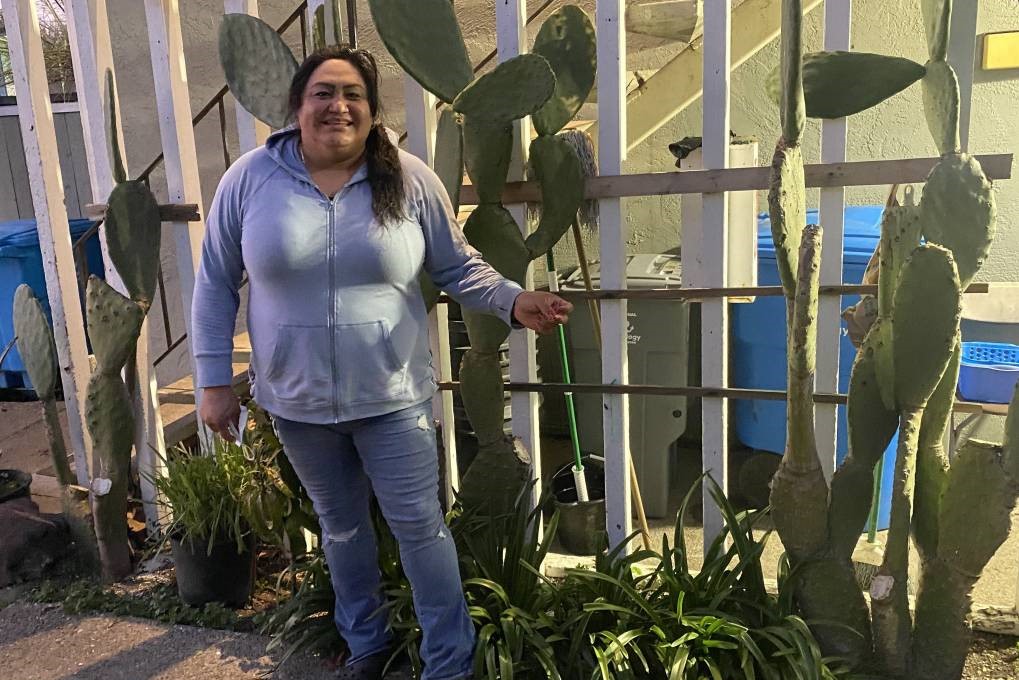
Paloma Reyes, una mujer trans y trabajadora agrícola de Santa Rosa, ayuda a dirigir un grupo que defiende los derechos de trabajadores agrícolas trans. (Ezra David Romero/KQED)
Cuando el incendio Tubbs se desató en 2017, las manos enguantadas de Paloma Reyes no rozaron la suave textura de los racimos de uva en las viñas durante varias semanas.
“En ese tiempo de los incendios, no trabajamos”, dijo Reyes, quien acababa de llegar de un viñedo en Napa donde había estado preparando las vides para la primavera.
Durante meses el aire lleno de humo y la amenaza de que los incendios quemaran los viñedos mantuvieron a Reyes y a otros trabajadores agrícolas fuera de los campos el tiempo suficiente como para que les afectara.
“En esos meses en los que se produjo el incendio, no ahorramos lo suficiente para mantenernos a nosotros mismos durante el invierno”, dijo.
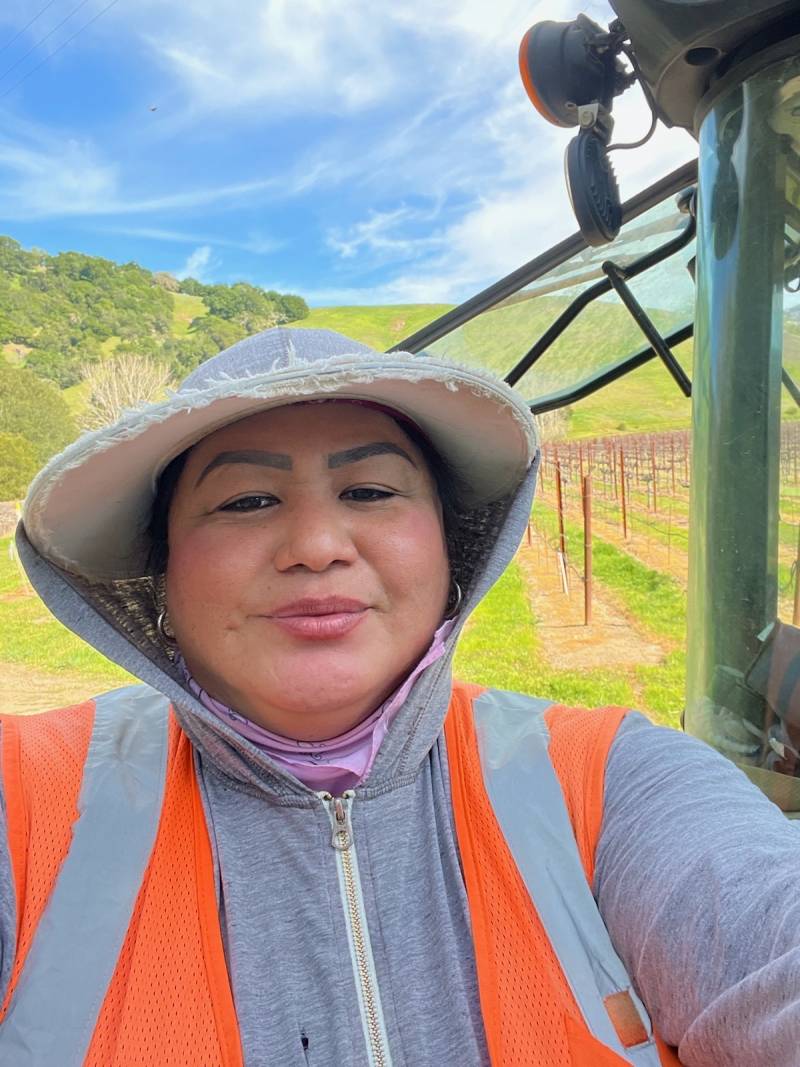
Paloma Reyes dice que no está preparada mentalmente para otro incendio forestal, pero sabe que cuando el próximo fuego se encienda se unirá a su grupo de amistades trans. (Cortesía de Paloma Reyes)
El incendio Tubbs fue el primer fuego que obligó a Reyes a salir de los viñedos abarrotados de humo y a refugiarse en su apartamento ubicado cerca de una línea de tren para pasajeros en Santa Rosa, en el condado de Sonoma.
“El 2017 fue el año que nos marcó a todas las chicas”, dijo.
Lo que mantuvo a Reyes de pie durante ese incendio, y la serie de incendios en los años posteriores, es la comunidad que ella trabajó durante seis años para fomentar Santa Rosa Trans Latinas, una red de apoyo de personas transgénero, incluidas las trabajadoras agrícolas que se defienden mutuamente en la región vinícola de California. Reyes lleva más de dos décadas viviendo en Santa Rosa.
“Nos apoyamos mutuamente”, dijo sobre las semanas después del incendio Tubbs que impidió a su comunidad trabajar. “No fue fácil para nosotras, las chicas trans que trabajamos en la agricultura”.
La vida de Reyes es un ejemplo de cómo las personas LGBTQ+ a menudo tienen que crear un espacio para sí mismas, especialmente durante las catástrofes climáticas, porque los servicios que se ofrecen a la mayoría de la gente pueden no existir o no estar disponibles para este otro grupo. Y cuando hay una catástrofe climática, las personas LGBTQ+ suelen ser más vulnerables debido a factores que se entrecruzan, como la pobreza, el encarcelamiento, la falta de vivienda, el estatus migratorio y la discriminación.
Related Article
“Cuando se planifica para una vulnerabilidad social, se descarta totalmente a la comunidad LGBTQ+ porque es caracterizada de raza blanca y rica”, afirmó Michael Méndez, profesor de política y planificación medioambiental de la Universidad de California en Irvine.
Los investigadores de la Universidad de Yale, la Universidad de Georgia y la Universidad de Irvine han formulado recomendaciones sobre cómo los gobiernos y los grupos de ayuda pueden hacer que la preparación y la recuperación de las catástrofes sean inclusivas y seguras para las personas LGBTQ+.
‘Invisibilizados’
Méndez afirma que hay demasiados casos de personas LGBTQ+ que son abandonadas, maltratadas o directamente discriminadas cuando intentan obtener ayuda. En un caso, una pareja de lesbianas fingió que eran hermanas para compartir una habitación en un refugio de emergencia.
“También hubo varios casos que demostraron que las personas transgénero fueron detenidas durante algunos de los huracanes por usar una ducha que no coincidía con su nacimiento biológico”, dijo.
En el 2012, la Campaña de Derechos Humanos detalló la mejor manera de trabajar en colaboración con las personas LGBTQ+ (sólo disponible en inglés) y eliminar la discriminación en la preparación y respuesta a los desastres. Méndez dice que, a nivel nacional, muy pocos grupos de asistencia utilizan la guía.
Dice que la ley no es lo suficientemente explícita y tiene poca responsabilidad. Por ejemplo, no exige que los planificadores de catástrofes sepan dónde se concentran las comunidades LGBTQ+. Le gustaría que los legisladores presentaran un proyecto de ley que obligará a los gobiernos a analizar dónde viven las personas LGBTQ+ y a utilizar esos datos para planificar las catástrofes.
“Esos son los puntos ciegos que tiene incluso California”, dijo. “Esencialmente, la comunidad LGBTQ+ aquí en California y en toda la nación se vuelve invisible en el contexto de los desastres, las políticas públicas y la planificación”.
El hogar es una “dura batalla”
Méndez y los demás investigadores también recomiendan encarecidamente que los planes de catástrofe reflejen las estructuras únicas de las familias LGBTQ+.
“Algunos individuos LGBTQ+ siguen siendo rechazados por sus familiares”, dijo. “Tienen una familia elegida que consideran parte de su familia inmediata, y debería ser reconocida”.
Cuando las comunidades LGBTQ+ participan en la reducción de su propio riesgo, Méndez afirma que las pérdidas derivadas de una catástrofe son mucho menores. Dice que prevenir más daños es vital para las personas LGBTQ+ porque a menudo ya no tienen un sentido de hogar.
Los incendios en el condado de Sonoma han reavivado la necesidad de comunidad y de hogar para Freddie Francis, quien se trasladó en el 2017 del condado de Butte a Sebastopol, una zona que acoge a la comunidad LGBTQ+.
“Como persona trans, siempre me he sentido un poco excluido”, dijo Francis. “Cuando encuentro un hogar, eso es algo muy difícil de conseguir. Así que, cuando algo que está fuera de mi control llega y pone eso en peligro, por supuesto que activa esos profundos temores y heridas de no tener un hogar estable.”
Lo que ha salvado a Francis del trauma anual de tener que evacuar al Área de la Bahía cuando el cielo se oscurece con el humo, es su comunidad de amistades LGBTQ+ en la zona occidental del Condado de Sonoma.
“Realmente hay un valor de cubrirse las espaldas unos a otros”, dijo Francis. “Sentir esa conexión es un buen antídoto contra el aislamiento y la desesperación a veces, y tratar de cultivar pequeños momentos de alegría y conexión a lo largo de todo esto”.
A medida que la crisis climática empeora, Francis dice que la población LGBTQ+ será más resistente gracias a que ya existe una cultura de ayuda mutua dentro de esa comunidad.
“Estoy trabajando para construir una comunidad y amistades que son más fuertes, y cultivar esas relaciones”, dijo Francis. “Creo que si algo nos va a ayudar, será esa conexión”.
Más allá de la religión como herramienta de ayuda
Los investigadores universitarios detrás del estudio también recomiendan que servicios de ayuda sean prestados por una amplia gama de fuentes comunitarias, las cuales no sean únicamente religiosas y que también se incluya a grupos que ya trabajan con poblaciones LGBTQ+. Esto podría incluir la financiación y la formación de centros comunitarios LGBTQ+ que ya existen para que estos puedan calificarse como refugios de emergencia federales y estatales.
El estudio señala que la gran cantidad de ayuda proviene de fuentes religiosas y que muchas personas LGBTQ+ no se sienten cómodas recibiendo apoyo de individuos que se niegan a reconocer esta comunidad.
Los investigadores se refieren a una encuesta del Pew Research Center de 2013 (sólo disponible en inglés) en la que la mayoría de los encuestados “por márgenes abrumadores” calificaron a las seis principales religiones “como más antipáticas que amistosas” hacia la comunidad LGBTQ+. También encontraron que el 73% de los encuestados dicen que las iglesias evangélicas son poco amigables.
La reverenda Lindsey Bell-Kerr, pastora de la iglesia Christ Church United Methodist de Santa Rosa, está trabajando activamente para socavar los estereotipos sobre las iglesias y las personas LGBTQ+ para que puedan acceder fácilmente a la ayuda cuando se produzcan catástrofes.
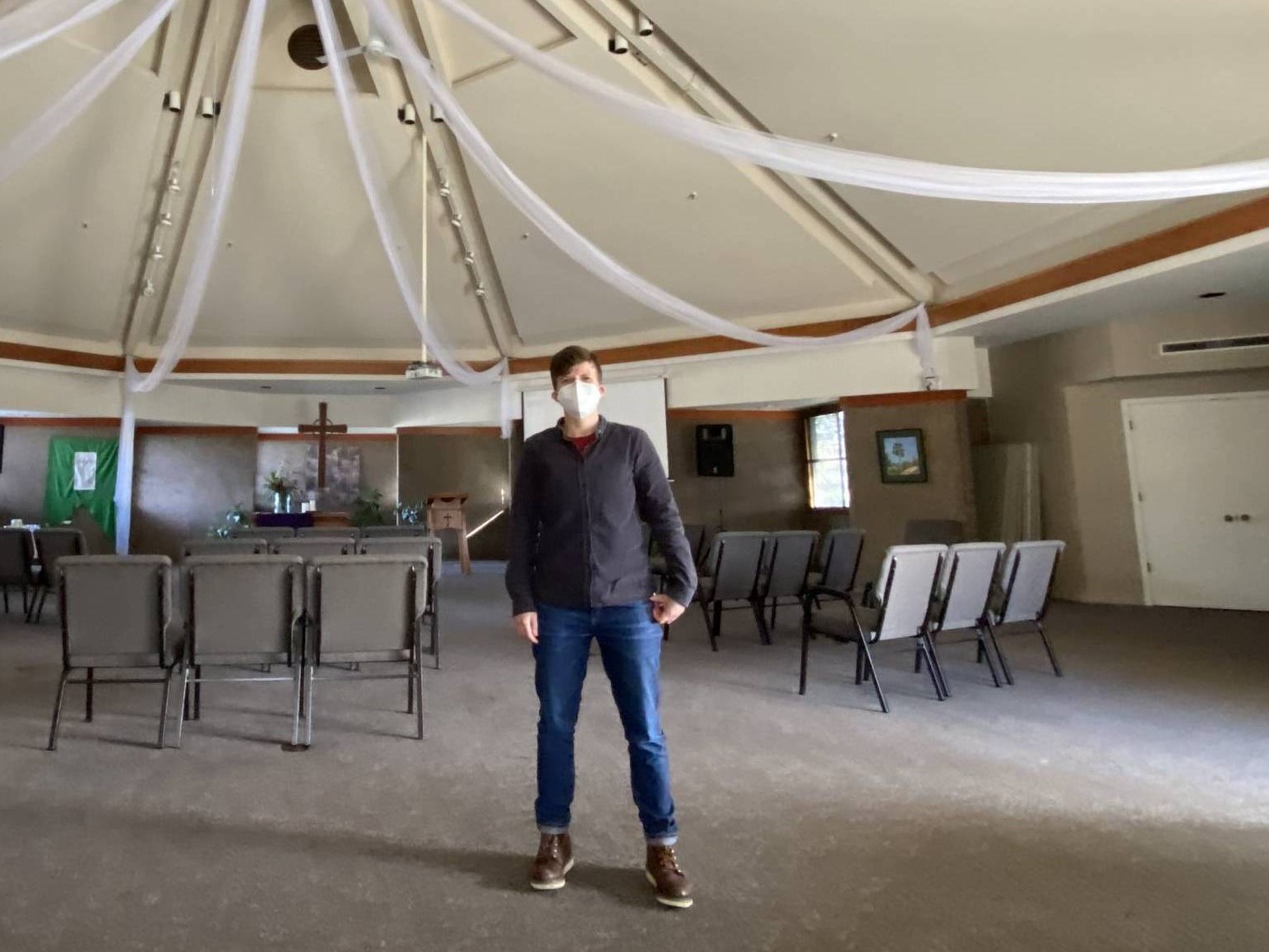
La reverenda Lindsey Bell-Kerr dice que se desviven por trabajar con la gente de Santa Rosa, para que cuando surjan necesidades sepan que pueden acudir a su congregación en busca de ayuda. (Ezra David Romero/KQED)
“Santa Rosa es un lugar en el que todavía me encuentro con gente que me pregunta qué significan esas letras en LGBTQAI+”, dijo. “Es una oportunidad para enseñar. Es una oportunidad para mover la aguja de la aceptación”.
Bell-Kerr entiende que, aunque su iglesia apoya a las personas LGBTQ+, muchas personas de esta comunidad todavía no se sienten seguros en recibir ayuda de cualquier entidad de carácter religioso.
“En realidad, para mí es muy útil que alguien me identifique como una persona queer”, dijo. “Porque no parezco el tipo de persona que va a hacer que se arrepientan [por sus pecados] antes de recibir un sandwich”.
Nadie necesita creer en ningún poder superior para recibir ayuda a través de esta iglesia. Su estacionamiento está siempre abierto para que las personas sin hogar pasen la noche en sus vehículos, y la iglesia da de comer y alberga a las personas afectadas durante los incendios forestales.
“Si la gente no se siente segura entrando en el edificio de la iglesia, y estamos ofreciendo comidas, tenemos contenedores para llevar y se los llevaré”, dijo Bell-Kerr. “Ese tipo de alojamiento sólo requiere prestar atención a cómo se siente la gente y cómo van llegando a ese lugar”.
“Ya no soy una prisionera”
Después de los incendios de 2017, Reyes, la trabajadora agrícola de Santa Rosa, y algunos de sus amistades finalmente recibieron alimentos y fondos de algunas organizaciones locales para pagar sus facturas pendientes.
Pero después de cuatro años de vivir a lado de la amenaza constante que representan los incendios forestales, la pandemia del coronavirus y la discriminación como persona LGBTQ+, Reyes dice que la idea de otro incendio es desalentadora.
Más de KQED en Español
“No creo que esté mentalmente preparada para otro incendio”, dijo. “Ni mis compañeros ni mi grupo trans están preparados para otro incendio de la magnitud del que ocurrió en 2017”.
Pese a que no se siente preparada mentalmente para ver los cielos del Condado de Sonoma llenos de humo otra vez, Reyes dice que su comunidad de amistades y compañeros trans es la red en la que se apoyará y proveerá en los momentos de crisis.
Dice que su labor de acoger a otros trabajadores agrícolas trans en su grupo la ha liberado aún más.
“Ya no tengo miedo”, dijo. “El grupo me ha dado mucha fuerza para poder hablar, para no perderme en el miedo. Ya no soy una prisionera. Seguiré haciéndolo mientras viva”.
Este artículo fue traducido por la periodista, María Peña.
lower waypointnext waypoint
Player sponsored by
window.__IS_SSR__=true
window.__INITIAL_STATE__={
"attachmentsReducer": {
"audio_0": {
"type": "attachments",
"id": "audio_0",
"imgSizes": {
"kqedFullSize": {
"file": "https://ww2.kqed.org/news/wp-content/themes/KQED-unified/img/audio_bgs/background0.jpg"
}
}
},
"audio_1": {
"type": "attachments",
"id": "audio_1",
"imgSizes": {
"kqedFullSize": {
"file": "https://ww2.kqed.org/news/wp-content/themes/KQED-unified/img/audio_bgs/background1.jpg"
}
}
},
"audio_2": {
"type": "attachments",
"id": "audio_2",
"imgSizes": {
"kqedFullSize": {
"file": "https://ww2.kqed.org/news/wp-content/themes/KQED-unified/img/audio_bgs/background2.jpg"
}
}
},
"audio_3": {
"type": "attachments",
"id": "audio_3",
"imgSizes": {
"kqedFullSize": {
"file": "https://ww2.kqed.org/news/wp-content/themes/KQED-unified/img/audio_bgs/background3.jpg"
}
}
},
"audio_4": {
"type": "attachments",
"id": "audio_4",
"imgSizes": {
"kqedFullSize": {
"file": "https://ww2.kqed.org/news/wp-content/themes/KQED-unified/img/audio_bgs/background4.jpg"
}
}
},
"placeholder": {
"type": "attachments",
"id": "placeholder",
"imgSizes": {
"thumbnail": {
"file": "https://cdn.kqed.org/wp-content/uploads/2024/12/KQED-Default-Image-816638274-2000x1333-1-160x107.jpg",
"width": 160,
"height": 107,
"mimeType": "image/jpeg"
},
"medium": {
"file": "https://cdn.kqed.org/wp-content/uploads/2024/12/KQED-Default-Image-816638274-2000x1333-1-800x533.jpg",
"width": 800,
"height": 533,
"mimeType": "image/jpeg"
},
"medium_large": {
"file": "https://cdn.kqed.org/wp-content/uploads/2024/12/KQED-Default-Image-816638274-2000x1333-1-768x512.jpg",
"width": 768,
"height": 512,
"mimeType": "image/jpeg"
},
"large": {
"file": "https://cdn.kqed.org/wp-content/uploads/2024/12/KQED-Default-Image-816638274-2000x1333-1-1020x680.jpg",
"width": 1020,
"height": 680,
"mimeType": "image/jpeg"
},
"1536x1536": {
"file": "https://cdn.kqed.org/wp-content/uploads/2024/12/KQED-Default-Image-816638274-2000x1333-1-1536x1024.jpg",
"width": 1536,
"height": 1024,
"mimeType": "image/jpeg"
},
"fd-lrg": {
"file": "https://cdn.kqed.org/wp-content/uploads/2024/12/KQED-Default-Image-816638274-2000x1333-1-1536x1024.jpg",
"width": 1536,
"height": 1024,
"mimeType": "image/jpeg"
},
"fd-med": {
"file": "https://cdn.kqed.org/wp-content/uploads/2024/12/KQED-Default-Image-816638274-2000x1333-1-1020x680.jpg",
"width": 1020,
"height": 680,
"mimeType": "image/jpeg"
},
"fd-sm": {
"file": "https://cdn.kqed.org/wp-content/uploads/2024/12/KQED-Default-Image-816638274-2000x1333-1-800x533.jpg",
"width": 800,
"height": 533,
"mimeType": "image/jpeg"
},
"post-thumbnail": {
"file": "https://cdn.kqed.org/wp-content/uploads/2024/12/KQED-Default-Image-816638274-2000x1333-1-672x372.jpg",
"width": 672,
"height": 372,
"mimeType": "image/jpeg"
},
"twentyfourteen-full-width": {
"file": "https://cdn.kqed.org/wp-content/uploads/2024/12/KQED-Default-Image-816638274-2000x1333-1-1038x576.jpg",
"width": 1038,
"height": 576,
"mimeType": "image/jpeg"
},
"xxsmall": {
"file": "https://cdn.kqed.org/wp-content/uploads/2024/12/KQED-Default-Image-816638274-2000x1333-1-160x107.jpg",
"width": 160,
"height": 107,
"mimeType": "image/jpeg"
},
"xsmall": {
"file": "https://cdn.kqed.org/wp-content/uploads/2024/12/KQED-Default-Image-816638274-2000x1333-1-672x372.jpg",
"width": 672,
"height": 372,
"mimeType": "image/jpeg"
},
"small": {
"file": "https://cdn.kqed.org/wp-content/uploads/2024/12/KQED-Default-Image-816638274-2000x1333-1-672x372.jpg",
"width": 672,
"height": 372,
"mimeType": "image/jpeg"
},
"xlarge": {
"file": "https://cdn.kqed.org/wp-content/uploads/2024/12/KQED-Default-Image-816638274-2000x1333-1-1020x680.jpg",
"width": 1020,
"height": 680,
"mimeType": "image/jpeg"
},
"full-width": {
"file": "https://cdn.kqed.org/wp-content/uploads/2024/12/KQED-Default-Image-816638274-2000x1333-1-1920x1280.jpg",
"width": 1920,
"height": 1280,
"mimeType": "image/jpeg"
},
"guest-author-32": {
"file": "https://cdn.kqed.org/wp-content/uploads/2025/01/KQED-Default-Image-816638274-1333x1333-1-160x160.jpg",
"width": 32,
"height": 32,
"mimeType": "image/jpeg"
},
"guest-author-50": {
"file": "https://cdn.kqed.org/wp-content/uploads/2025/01/KQED-Default-Image-816638274-1333x1333-1-160x160.jpg",
"width": 50,
"height": 50,
"mimeType": "image/jpeg"
},
"guest-author-64": {
"file": "https://cdn.kqed.org/wp-content/uploads/2025/01/KQED-Default-Image-816638274-1333x1333-1-160x160.jpg",
"width": 64,
"height": 64,
"mimeType": "image/jpeg"
},
"guest-author-96": {
"file": "https://cdn.kqed.org/wp-content/uploads/2025/01/KQED-Default-Image-816638274-1333x1333-1-160x160.jpg",
"width": 96,
"height": 96,
"mimeType": "image/jpeg"
},
"guest-author-128": {
"file": "https://cdn.kqed.org/wp-content/uploads/2025/01/KQED-Default-Image-816638274-1333x1333-1-160x160.jpg",
"width": 128,
"height": 128,
"mimeType": "image/jpeg"
},
"detail": {
"file": "https://cdn.kqed.org/wp-content/uploads/2025/01/KQED-Default-Image-816638274-1333x1333-1-160x160.jpg",
"width": 160,
"height": 160,
"mimeType": "image/jpeg"
},
"kqedFullSize": {
"file": "https://cdn.kqed.org/wp-content/uploads/2024/12/KQED-Default-Image-816638274-2000x1333-1.jpg",
"width": 2000,
"height": 1333
}
}
},
"news_11906812": {
"type": "attachments",
"id": "news_11906812",
"meta": {
"index": "attachments_1716263798",
"site": "news",
"id": "11906812",
"found": true
},
"parent": 11906800,
"imgSizes": {
"twentyfourteen-full-width": {
"file": "https://ww2.kqed.org/app/uploads/sites/10/2022/02/Paloma-Reyes-1020x765-1-1019x576.jpg",
"width": 1019,
"mimeType": "image/jpeg",
"height": 576
},
"thumbnail": {
"file": "https://ww2.kqed.org/app/uploads/sites/10/2022/02/Paloma-Reyes-1020x765-1-160x107.jpg",
"width": 160,
"mimeType": "image/jpeg",
"height": 107
},
"post-thumbnail": {
"file": "https://ww2.kqed.org/app/uploads/sites/10/2022/02/Paloma-Reyes-1020x765-1-672x372.jpg",
"width": 672,
"mimeType": "image/jpeg",
"height": 372
},
"kqedFullSize": {
"file": "https://ww2.kqed.org/app/uploads/sites/10/2022/02/Paloma-Reyes-1020x765-1.jpg",
"width": 1019,
"height": 680
},
"medium": {
"file": "https://ww2.kqed.org/app/uploads/sites/10/2022/02/Paloma-Reyes-1020x765-1-800x534.jpg",
"width": 800,
"mimeType": "image/jpeg",
"height": 534
}
},
"publishDate": 1646092447,
"modified": 1646092572,
"caption": "Paloma Reyes, una mujer trans y trabajadora agrícola de Santa Rosa, ayuda a dirigir un grupo que defiende los derechos de trabajadores agrícolas trans.",
"description": "Paloma Reyes, una mujer trans y trabajadora agrícola de Santa Rosa, ayuda a dirigir un grupo que defiende los derechos de trabajadores agrícolas trans.",
"title": "Paloma-Reyes-1020x765",
"credit": "Ezra David Romero/KQED",
"status": "inherit",
"altTag": "Una persona aparece parada afuera de un hogar y posa a lado de unos nopales.",
"isLoading": false,
"fetchFailed": false
}
},
"audioPlayerReducer": {
"postId": "stream_live",
"isPaused": true,
"isPlaying": false,
"pfsActive": false,
"pledgeModalIsOpen": true,
"playerDrawerIsOpen": false,
"liveAudioPlayStartedAt": 0,
"liveAudioPlayContext": ""
},
"authorsReducer": {
"eromero": {
"type": "authors",
"id": "11746",
"meta": {
"index": "authors_1716337520",
"id": "11746",
"found": true
},
"name": "Ezra David Romero",
"firstName": "Ezra David",
"lastName": "Romero",
"slug": "eromero",
"email": "eromero@kqed.org",
"display_author_email": true,
"staff_mastheads": [
"news",
"science"
],
"title": "Climate Reporter",
"bio": "Ezra David Romero is a climate reporter for KQED News. He covers the absence and excess of water in the Bay Area — think sea level rise, flooding and drought. For nearly a decade he’s covered how warming temperatures are altering the lives of Californians. He’s reported on farmers worried their pistachio trees aren’t getting enough sleep, families desperate for water, scientists studying dying giant sequoias, and alongside firefighters containing wildfires. His work has appeared on local stations across California and nationally on public radio shows like Morning Edition, Here and Now, All Things Considered and Science Friday. ",
"avatar": "https://secure.gravatar.com/avatar/c76404d287c10ed40224227551ac36e24352c7306f106632caf6fead76f8801f?s=600&d=blank&r=g",
"twitter": "ezraromero",
"bluesky": null,
"facebook": null,
"instagram": null,
"linkedin": null,
"sites": [
{
"site": "arts",
"roles": [
"editor"
]
},
{
"site": "news",
"roles": [
"editor"
]
},
{
"site": "science",
"roles": [
"editor"
]
},
{
"site": "liveblog",
"roles": [
"author"
]
}
],
"headData": {
"title": "Ezra David Romero | KQED",
"description": "Climate Reporter",
"ogImgSrc": "https://secure.gravatar.com/avatar/c76404d287c10ed40224227551ac36e24352c7306f106632caf6fead76f8801f?s=600&d=blank&r=g",
"twImgSrc": "https://secure.gravatar.com/avatar/c76404d287c10ed40224227551ac36e24352c7306f106632caf6fead76f8801f?s=600&d=blank&r=g"
},
"isLoading": false,
"link": "/author/eromero"
}
},
"pagesReducer": {},
"pfsSessionReducer": {},
"postsReducer": {
"stream_live": {
"type": "live",
"id": "stream_live",
"audioUrl": "https://hls.kqed.org/hls/kqed_app/playlist.m3u8",
"title": "Live Stream",
"excerpt": "Live Stream information currently unavailable.",
"link": "/radio",
"featImg": "",
"label": {
"name": "KQED Live",
"link": "/"
}
},
"stream_kqedNewscast": {
"type": "posts",
"id": "stream_kqedNewscast",
"audioUrl": "https://www.kqed.org/.stream/anon/radio/RDnews/newscast.mp3?_=1",
"title": "KQED Newscast",
"featImg": "",
"label": {
"name": "88.5 FM",
"link": "/"
}
},
"news_11906800": {
"type": "posts",
"id": "news_11906800",
"meta": {
"index": "posts_1716263798",
"site": "news",
"id": "11906800",
"found": true
},
"articlePosition": 0,
"guestAuthors": [],
"slug": "comunidades-lgbtq-quedan-fuera-de-la-planificacion-de-catastrofes",
"title": "Comunidades LGBTQ+ quedan fuera de la planificación de catástrofes",
"publishDate": 1646143219,
"format": "audio",
"headTitle": "Comunidades LGBTQ+ quedan fuera de la planificación de catástrofes | KQED",
"labelTerm": {},
"content": "\u003cp>\u003ca href=\"https://www.kqed.org/science/1978439/queer-communities-often-left-out-of-disaster-planning-research-shows\">\u003cem>Read in English\u003c/em>\u003c/a>\u003c/p>\n\u003cp>Cuando el incendio Tubbs se desató en 2017, las manos enguantadas de Paloma Reyes no rozaron la suave textura de los racimos de uva en las viñas durante varias semanas.\u003c/p>\n\u003cp>“En ese tiempo de los incendios, no trabajamos”, dijo Reyes, quien acababa de llegar de un viñedo en Napa donde había estado preparando las vides para la primavera.\u003c/p>\n\u003cp>Durante meses el aire lleno de humo y la amenaza de que los incendios quemaran los viñedos mantuvieron a Reyes y a otros trabajadores agrícolas fuera de los campos el tiempo suficiente como para que les afectara.\u003c/p>\n\u003cp>“En esos meses en los que se produjo el incendio, no ahorramos lo suficiente para mantenernos a nosotros mismos durante el invierno”, dijo.\u003c/p>\n\u003cfigure id=\"attachment_11906828\" class=\"wp-caption alignright\" style=\"max-width: 800px\">\u003cimg loading=\"lazy\" decoding=\"async\" class=\"size-full wp-image-11906828\" src=\"https://ww2.kqed.org/app/uploads/sites/10/2022/02/IMG_5589-800x1067-1.jpg\" alt='Imagen estilo \"selfie\" de Paloma Reyes, quien viste ropa para trabajar en el campo.' width=\"800\" height=\"1067\" srcset=\"https://cdn.kqed.org/wp-content/uploads/sites/10/2022/02/IMG_5589-800x1067-1.jpg 800w, https://cdn.kqed.org/wp-content/uploads/sites/10/2022/02/IMG_5589-800x1067-1-160x213.jpg 160w\" sizes=\"auto, (max-width: 800px) 100vw, 800px\">\u003cfigcaption class=\"wp-caption-text\">Paloma Reyes dice que no está preparada mentalmente para otro incendio forestal, pero sabe que cuando el próximo fuego se encienda se unirá a su grupo de amistades trans. \u003ccite>(Cortesía de Paloma Reyes)\u003c/cite>\u003c/figcaption>\u003c/figure>\n\u003cp>El incendio Tubbs fue el primer fuego que obligó a Reyes a salir de los viñedos abarrotados de humo y a refugiarse en su apartamento ubicado cerca de una línea de tren para pasajeros en Santa Rosa, en el condado de Sonoma.\u003c/p>\n\u003cp>“El 2017 fue el año que nos marcó a todas las chicas”, dijo.\u003c/p>\n\u003cp>Lo que mantuvo a Reyes de pie durante ese incendio, y la serie de incendios en los años posteriores, es la comunidad que ella trabajó durante seis años para fomentar \u003ca href=\"https://www.facebook.com/santarosatranslatinas\">Santa Rosa Trans Latinas\u003c/a>, una red de apoyo de personas transgénero, incluidas las trabajadoras agrícolas que se defienden mutuamente en la región vinícola de California. Reyes lleva más de dos décadas viviendo en Santa Rosa.\u003c/p>\n\u003cp>“Nos apoyamos mutuamente”, dijo sobre las semanas después del incendio Tubbs que impidió a su comunidad trabajar. “No fue fácil para nosotras, las chicas trans que trabajamos en la agricultura”.\u003c/p>\n\u003cp>La vida de Reyes es un ejemplo de cómo las personas LGBTQ+ a menudo tienen que crear un espacio para sí mismas, especialmente durante las catástrofes climáticas, porque los servicios que se ofrecen a la mayoría de la gente pueden no existir o no estar disponibles para este otro grupo. Y cuando hay una catástrofe climática, las personas LGBTQ+ suelen ser más vulnerables debido a factores que se entrecruzan, como la pobreza, el encarcelamiento, la falta de vivienda, el estatus migratorio y la discriminación.\u003c/p>\n\u003cp>[aside postID=\"news_11881727\" hero=\"https://ww2.kqed.org/app/uploads/sites/43/2020/05/GettyImages-1059463226-2-1920x1080.jpg\"]“Cuando se planifica para una vulnerabilidad social, se descarta totalmente a la comunidad LGBTQ+ porque es caracterizada de raza blanca y rica”, afirmó \u003ca href=\"http://www.michaelanthonymendez.com/\">Michael Méndez\u003c/a>, profesor de política y planificación medioambiental de la Universidad de California en Irvine.\u003c/p>\n\u003cp>Méndez forma parte de un grupo de profesores LGBTQ+ cuya nueva investigación demuestra que \u003ca href=\"https://drive.google.com/file/d/1T2vODQCT_XOXvXW4q61WZ5ksus0fDm2A/view\">los esfuerzos para prepararse y recuperarse de las catástrofes excluyen habitualmente a las personas LGBTQ+\u003c/a> (sólo disponible en inglés).\u003c/p>\n\u003cp>Los investigadores de la Universidad de Yale, la Universidad de Georgia y la Universidad de Irvine han formulado recomendaciones sobre cómo los gobiernos y los grupos de ayuda pueden hacer que la preparación y la recuperación de las catástrofes sean inclusivas y seguras para las personas LGBTQ+.\u003cbr>\nhttps://youtu.be/0xHTa7dAwkE\u003c/p>\n\u003ch2>\u003cstrong>‘Invisibilizados’\u003c/strong>\u003c/h2>\n\u003cp>Méndez afirma que hay demasiados casos de personas LGBTQ+ que son abandonadas, maltratadas o directamente discriminadas cuando intentan obtener ayuda. En un caso, una pareja de lesbianas fingió que eran hermanas para compartir una habitación en un refugio de emergencia.\u003c/p>\n\u003cp>“También hubo varios casos que demostraron que las personas transgénero fueron detenidas durante algunos de los huracanes por usar una ducha que no coincidía con su nacimiento biológico”, dijo.\u003c/p>\n\u003cp>En el 2012, la Campaña de Derechos Humanos detalló \u003ca href=\"https://www.hrc.org/press-releases/hrc-releases-competency-guide-for-emergency-responders\">la mejor manera de trabajar en colaboración con las personas LGBTQ+\u003c/a> (sólo disponible en inglés) y eliminar la discriminación en la preparación y respuesta a los desastres. Méndez dice que, a nivel nacional, muy pocos grupos de asistencia utilizan la guía.\u003c/p>\n\u003cp>[aside postID=\"news_11852044\"]En el 2019, California aprobó una ley que obliga a los gobiernos locales a incluir \u003ca href=\"https://leginfo.legislature.ca.gov/faces/billTextClient.xhtml?bill_id=201920200SB160\">la competencia cultural en la planificación de la preparación ante desastres\u003c/a> (sólo disponible en inglés). Méndez dice que esta legislación proporciona “protecciones LGBTQ+ mínimas”.\u003c/p>\n\u003cp>Dice que la ley no es lo suficientemente explícita y tiene poca responsabilidad. Por ejemplo, no exige que los planificadores de catástrofes sepan dónde se concentran las comunidades LGBTQ+. Le gustaría que los legisladores presentaran un proyecto de ley que obligará a los gobiernos a analizar dónde viven las personas LGBTQ+ y a utilizar esos datos para planificar las catástrofes.\u003c/p>\n\u003cp>“Esos son los puntos ciegos que tiene incluso California”, dijo. “Esencialmente, la comunidad LGBTQ+ aquí en California y en toda la nación se vuelve invisible en el contexto de los desastres, las políticas públicas y la planificación”.\u003c/p>\n\u003ch2>\u003cstrong>El hogar es una “dura batalla”\u003c/strong>\u003c/h2>\n\u003cp>Méndez y los demás investigadores también recomiendan encarecidamente que los planes de catástrofe reflejen las estructuras únicas de las familias LGBTQ+.\u003c/p>\n\u003cp>“Algunos individuos LGBTQ+ siguen siendo rechazados por sus familiares”, dijo. “Tienen una familia elegida que consideran parte de su familia inmediata, y debería ser reconocida”.\u003c/p>\n\u003cp>Cuando las comunidades LGBTQ+ participan en la reducción de su propio riesgo, Méndez afirma que las pérdidas derivadas de una catástrofe son mucho menores. Dice que prevenir más daños es vital para las personas LGBTQ+ porque a menudo ya no tienen un sentido de hogar.\u003c/p>\n\u003cp>[pullquote align=\"right\" size=\"medium\" citation=\"Freddie Francis, Activista\"]‘Estoy trabajando para construir una comunidad y amistades que son más fuertes … creo que si algo nos va a ayudar, será esa conexión.’[/pullquote]Los incendios en el condado de Sonoma han reavivado la necesidad de comunidad y de hogar para \u003ca href=\"https://twitter.com/silverspeakers\">Freddie Francis\u003c/a>, quien se trasladó en el 2017 del condado de Butte a Sebastopol, una zona que acoge a la comunidad LGBTQ+.\u003c/p>\n\u003cp>“Como persona trans, siempre me he sentido un poco excluido”, dijo Francis. “Cuando encuentro un hogar, eso es algo muy difícil de conseguir. Así que, cuando algo que está fuera de mi control llega y pone eso en peligro, por supuesto que activa esos profundos temores y heridas de no tener un hogar estable.”\u003c/p>\n\u003cp>Lo que ha salvado a Francis del trauma anual de tener que evacuar al Área de la Bahía cuando el cielo se oscurece con el humo, es su comunidad de amistades LGBTQ+ en la zona occidental del Condado de Sonoma.\u003c/p>\n\u003cp>“Realmente hay un valor de cubrirse las espaldas unos a otros”, dijo Francis. “Sentir esa conexión es un buen antídoto contra el aislamiento y la desesperación a veces, y tratar de cultivar pequeños momentos de alegría y conexión a lo largo de todo esto”.\u003c/p>\n\u003cp>A medida que la crisis climática empeora, Francis dice que la población LGBTQ+ será más resistente gracias a que ya existe una cultura de ayuda mutua dentro de esa comunidad.\u003c/p>\n\u003cp>“Estoy trabajando para construir una comunidad y amistades que son más fuertes, y cultivar esas relaciones”, dijo Francis. “Creo que si algo nos va a ayudar, será esa conexión”.\u003c/p>\n\u003cp>[ad fullwidth]\u003c/p>\n\u003ch2>\u003cstrong>Más allá de la religión como herramienta de ayuda\u003c/strong>\u003c/h2>\n\u003cp>Los investigadores universitarios detrás del estudio también recomiendan que servicios de ayuda sean prestados por una amplia gama de fuentes comunitarias, las cuales no sean únicamente religiosas y que también se incluya a grupos que ya trabajan con poblaciones LGBTQ+. Esto podría incluir la financiación y la formación de centros comunitarios LGBTQ+ que ya existen para que estos puedan calificarse como refugios de emergencia federales y estatales.\u003c/p>\n\u003cp>El estudio señala que la gran cantidad de ayuda proviene de fuentes religiosas y que muchas personas LGBTQ+ no se sienten cómodas recibiendo apoyo de individuos que se niegan a reconocer esta comunidad.\u003c/p>\n\u003cp>Los investigadores se refieren a \u003ca href=\"https://www.pewresearch.org/social-trends/2013/06/13/a-survey-of-lgbt-americans/\">una encuesta del Pew Research Center de 2013\u003c/a> (sólo disponible en inglés) en la que la mayoría de los encuestados “por márgenes abrumadores” calificaron a las seis principales religiones “como más antipáticas que amistosas” hacia la comunidad LGBTQ+. También encontraron que el 73% de los encuestados dicen que las iglesias evangélicas son poco amigables.\u003c/p>\n\u003cp>La reverenda Lindsey Bell-Kerr, pastora de la iglesia \u003ca href=\"https://www.srchristchurch.org/\">Christ Church United Methodist de Santa Rosa\u003c/a>, está trabajando activamente para socavar los estereotipos sobre las iglesias y las personas LGBTQ+ para que puedan acceder fácilmente a la ayuda cuando se produzcan catástrofes.\u003c/p>\n\u003cfigure id=\"attachment_11906832\" class=\"wp-caption alignright\" style=\"max-width: 1543px\">\u003cimg loading=\"lazy\" decoding=\"async\" class=\"size-full wp-image-11906832\" src=\"https://ww2.kqed.org/app/uploads/sites/10/2022/02/IMG_7223-scaled-e1645572428462-1.jpg\" alt=\"Una persona aparece parada dentro de una iglesia y lleva puesto un cubrebocas.\" width=\"1543\" height=\"1158\" srcset=\"https://cdn.kqed.org/wp-content/uploads/sites/10/2022/02/IMG_7223-scaled-e1645572428462-1.jpg 1543w, https://cdn.kqed.org/wp-content/uploads/sites/10/2022/02/IMG_7223-scaled-e1645572428462-1-800x600.jpg 800w, https://cdn.kqed.org/wp-content/uploads/sites/10/2022/02/IMG_7223-scaled-e1645572428462-1-1020x765.jpg 1020w, https://cdn.kqed.org/wp-content/uploads/sites/10/2022/02/IMG_7223-scaled-e1645572428462-1-160x120.jpg 160w, https://cdn.kqed.org/wp-content/uploads/sites/10/2022/02/IMG_7223-scaled-e1645572428462-1-1536x1153.jpg 1536w\" sizes=\"auto, (max-width: 1543px) 100vw, 1543px\">\u003cfigcaption class=\"wp-caption-text\">La reverenda Lindsey Bell-Kerr dice que se desviven por trabajar con la gente de Santa Rosa, para que cuando surjan necesidades sepan que pueden acudir a su congregación en busca de ayuda. \u003ccite>(Ezra David Romero/KQED)\u003c/cite>\u003c/figcaption>\u003c/figure>\n\u003cp>“Santa Rosa es un lugar en el que todavía me encuentro con gente que me pregunta qué significan esas letras en LGBTQAI+”, dijo. “Es una oportunidad para enseñar. Es una oportunidad para mover la aguja de la aceptación”.\u003c/p>\n\u003cp>Bell-Kerr entiende que, aunque su iglesia apoya a las personas LGBTQ+, muchas personas de esta comunidad todavía no se sienten seguros en recibir ayuda de cualquier entidad de carácter religioso.\u003c/p>\n\u003cp>“En realidad, para mí es muy útil que alguien me identifique como una persona queer”, dijo. “Porque no parezco el tipo de persona que va a hacer que se arrepientan [por sus pecados] antes de recibir un sandwich”.\u003c/p>\n\u003cp>[pullquote align=\"right\" size=\"medium\" citation=\"Rev. Lindsey Bell-Kerr\"]‘Para mí es muy útil que alguien me identifique como una persona queer … porque no parezco el tipo de persona que va a hacer que se arrepientan [por sus pecados] antes de recibir un sandwich.’[/pullquote]Nadie necesita creer en ningún poder superior para recibir ayuda a través de esta iglesia. Su estacionamiento está siempre abierto para que las personas sin hogar pasen la noche en sus vehículos, y la iglesia da de comer y alberga a las personas afectadas durante los incendios forestales.\u003c/p>\n\u003cp>“Si la gente no se siente segura entrando en el edificio de la iglesia, y estamos ofreciendo comidas, tenemos contenedores para llevar y se los llevaré”, dijo Bell-Kerr. “Ese tipo de alojamiento sólo requiere prestar atención a cómo se siente la gente y cómo van llegando a ese lugar”.\u003c/p>\n\u003ch2>\u003cstrong>“Ya no soy una prisionera”\u003c/strong>\u003c/h2>\n\u003cp>Después de los incendios de 2017, Reyes, la trabajadora agrícola de Santa Rosa, y algunos de sus amistades finalmente recibieron alimentos y fondos de algunas organizaciones locales para pagar sus facturas pendientes.\u003c/p>\n\u003cp>Pero después de cuatro años de vivir a lado de la amenaza constante que representan los incendios forestales, la pandemia del coronavirus y la discriminación como persona LGBTQ+, Reyes dice que la idea de otro incendio es desalentadora.\u003c/p>\n\u003cp>[aside label='Más de KQED en Español' tag='incendios-forestales']“No creo que esté mentalmente preparada para otro incendio”, dijo. “Ni mis compañeros ni mi grupo trans están preparados para otro incendio de la magnitud del que ocurrió en 2017”.\u003c/p>\n\u003cp>Pese a que no se siente preparada mentalmente para ver los cielos del Condado de Sonoma llenos de humo otra vez, Reyes dice que su comunidad de amistades y compañeros trans es la red en la que se apoyará y proveerá en los momentos de crisis.\u003c/p>\n\u003cp>Dice que su labor de acoger a otros trabajadores agrícolas trans en su grupo la ha liberado aún más.\u003c/p>\n\u003cp>“Ya no tengo miedo”, dijo. “El grupo me ha dado mucha fuerza para poder hablar, para no perderme en el miedo. Ya no soy una prisionera. Seguiré haciéndolo mientras viva”.\u003c/p>\n\u003cp>\u003cem>Este artículo fue traducido por la periodista, \u003ca href=\"https://www.kqed.org/author/mpena/\">María Peña\u003c/a>.\u003c/em>\u003c/p>\n\u003cp>[ad fullwidth]\u003c/p>\n\u003cp>[ad floatright]\u003c/p>\n",
"blocks": [],
"excerpt": "Las comunidades LGBTQ+ pueden ser especialmente vulnerables a los efectos de los desastres climáticos debido a la discriminación, la pobreza, el racismo y otros factores.",
"status": "publish",
"parent": 0,
"modified": 1738777349,
"stats": {
"hasAudio": false,
"hasVideo": false,
"hasChartOrMap": false,
"iframeSrcs": [],
"hasGoogleForm": false,
"hasGallery": false,
"hasHearkenModule": false,
"hasPolis": false,
"paragraphCount": 47,
"wordCount": 2280
},
"headData": {
"title": "Comunidades LGBTQ+ quedan fuera de la planificación de catástrofes | KQED",
"description": "Las comunidades LGBTQ+ pueden ser especialmente vulnerables a los efectos de los desastres climáticos debido a la discriminación, la pobreza, el racismo y otros factores.",
"ogTitle": "",
"ogDescription": "",
"ogImgId": "",
"twTitle": "",
"twDescription": "",
"twImgId": "",
"schema": {
"@context": "https://schema.org",
"@type": "NewsArticle",
"headline": "Comunidades LGBTQ+ quedan fuera de la planificación de catástrofes",
"datePublished": "2022-03-01T06:00:19-08:00",
"dateModified": "2025-02-05T09:42:29-08:00",
"image": "https://cdn.kqed.org/wp-content/uploads/2020/02/KQED-OG-Image@1x.png",
"isAccessibleForFree": "True",
"publisher": {
"@type": "NewsMediaOrganization",
"@id": "https://www.kqed.org/#organization",
"name": "KQED",
"logo": "https://cdn.kqed.org/wp-content/uploads/2020/02/KQED-OG-Image@1x.png",
"url": "https://www.kqed.org",
"sameAs": [
"https://www.facebook.com/KQED",
"https://twitter.com/KQED",
"https://www.instagram.com/kqed/",
"https://www.tiktok.com/@kqedofficial",
"https://www.linkedin.com/company/kqed",
"https://www.youtube.com/channel/UCeC0IOo7i1P_61zVUWbJ4nw"
]
},
"author": {
"@type": "Person",
"name": "Ezra David Romero",
"jobTitle": "Climate Reporter",
"url": "https://www.kqed.org/author/eromero"
}
},
"authorsData": [],
"tagData": []
},
"source": "KQED en Español",
"sourceUrl": "https://www.kqed.org/kqedenespanol/",
"audioUrl": "https://omny.fm/shows/kqed-segmented-audio/new-research-shows-when-disaster-strikes-lgbtq-fol",
"sticky": false,
"excludeFromSiteSearch": "Include",
"path": "/news/11906800/comunidades-lgbtq-quedan-fuera-de-la-planificacion-de-catastrofes",
"audioTrackLength": null,
"parsedContent": [
{
"type": "contentString",
"content": "\u003cdiv class=\"post-body\">\u003cp>\u003cp>\u003ca href=\"https://www.kqed.org/science/1978439/queer-communities-often-left-out-of-disaster-planning-research-shows\">\u003cem>Read in English\u003c/em>\u003c/a>\u003c/p>\n\u003cp>Cuando el incendio Tubbs se desató en 2017, las manos enguantadas de Paloma Reyes no rozaron la suave textura de los racimos de uva en las viñas durante varias semanas.\u003c/p>\n\u003cp>“En ese tiempo de los incendios, no trabajamos”, dijo Reyes, quien acababa de llegar de un viñedo en Napa donde había estado preparando las vides para la primavera.\u003c/p>\n\u003cp>Durante meses el aire lleno de humo y la amenaza de que los incendios quemaran los viñedos mantuvieron a Reyes y a otros trabajadores agrícolas fuera de los campos el tiempo suficiente como para que les afectara.\u003c/p>\n\u003cp>“En esos meses en los que se produjo el incendio, no ahorramos lo suficiente para mantenernos a nosotros mismos durante el invierno”, dijo.\u003c/p>\n\u003cfigure id=\"attachment_11906828\" class=\"wp-caption alignright\" style=\"max-width: 800px\">\u003cimg loading=\"lazy\" decoding=\"async\" class=\"size-full wp-image-11906828\" src=\"https://ww2.kqed.org/app/uploads/sites/10/2022/02/IMG_5589-800x1067-1.jpg\" alt='Imagen estilo \"selfie\" de Paloma Reyes, quien viste ropa para trabajar en el campo.' width=\"800\" height=\"1067\" srcset=\"https://cdn.kqed.org/wp-content/uploads/sites/10/2022/02/IMG_5589-800x1067-1.jpg 800w, https://cdn.kqed.org/wp-content/uploads/sites/10/2022/02/IMG_5589-800x1067-1-160x213.jpg 160w\" sizes=\"auto, (max-width: 800px) 100vw, 800px\">\u003cfigcaption class=\"wp-caption-text\">Paloma Reyes dice que no está preparada mentalmente para otro incendio forestal, pero sabe que cuando el próximo fuego se encienda se unirá a su grupo de amistades trans. \u003ccite>(Cortesía de Paloma Reyes)\u003c/cite>\u003c/figcaption>\u003c/figure>\n\u003cp>El incendio Tubbs fue el primer fuego que obligó a Reyes a salir de los viñedos abarrotados de humo y a refugiarse en su apartamento ubicado cerca de una línea de tren para pasajeros en Santa Rosa, en el condado de Sonoma.\u003c/p>\n\u003cp>“El 2017 fue el año que nos marcó a todas las chicas”, dijo.\u003c/p>\n\u003cp>Lo que mantuvo a Reyes de pie durante ese incendio, y la serie de incendios en los años posteriores, es la comunidad que ella trabajó durante seis años para fomentar \u003ca href=\"https://www.facebook.com/santarosatranslatinas\">Santa Rosa Trans Latinas\u003c/a>, una red de apoyo de personas transgénero, incluidas las trabajadoras agrícolas que se defienden mutuamente en la región vinícola de California. Reyes lleva más de dos décadas viviendo en Santa Rosa.\u003c/p>\n\u003cp>“Nos apoyamos mutuamente”, dijo sobre las semanas después del incendio Tubbs que impidió a su comunidad trabajar. “No fue fácil para nosotras, las chicas trans que trabajamos en la agricultura”.\u003c/p>\n\u003cp>La vida de Reyes es un ejemplo de cómo las personas LGBTQ+ a menudo tienen que crear un espacio para sí mismas, especialmente durante las catástrofes climáticas, porque los servicios que se ofrecen a la mayoría de la gente pueden no existir o no estar disponibles para este otro grupo. Y cuando hay una catástrofe climática, las personas LGBTQ+ suelen ser más vulnerables debido a factores que se entrecruzan, como la pobreza, el encarcelamiento, la falta de vivienda, el estatus migratorio y la discriminación.\u003c/p>\n\u003cp>\u003c/p>\u003c/div>",
"attributes": {
"named": {},
"numeric": []
}
},
{
"type": "component",
"content": "",
"name": "aside",
"attributes": {
"named": {
"postid": "news_11881727",
"hero": "https://ww2.kqed.org/app/uploads/sites/43/2020/05/GettyImages-1059463226-2-1920x1080.jpg",
"label": ""
},
"numeric": []
}
},
{
"type": "contentString",
"content": "\u003cdiv class=\"post-body\">\u003cp>“Cuando se planifica para una vulnerabilidad social, se descarta totalmente a la comunidad LGBTQ+ porque es caracterizada de raza blanca y rica”, afirmó \u003ca href=\"http://www.michaelanthonymendez.com/\">Michael Méndez\u003c/a>, profesor de política y planificación medioambiental de la Universidad de California en Irvine.\u003c/p>\n\u003cp>Méndez forma parte de un grupo de profesores LGBTQ+ cuya nueva investigación demuestra que \u003ca href=\"https://drive.google.com/file/d/1T2vODQCT_XOXvXW4q61WZ5ksus0fDm2A/view\">los esfuerzos para prepararse y recuperarse de las catástrofes excluyen habitualmente a las personas LGBTQ+\u003c/a> (sólo disponible en inglés).\u003c/p>\n\u003cp>Los investigadores de la Universidad de Yale, la Universidad de Georgia y la Universidad de Irvine han formulado recomendaciones sobre cómo los gobiernos y los grupos de ayuda pueden hacer que la preparación y la recuperación de las catástrofes sean inclusivas y seguras para las personas LGBTQ+.\u003cbr>\u003c/p>\u003cp>\u003cspan class='utils-parseShortcode-shortcodes-__youtubeShortcode__embedYoutube'>\n \u003cspan class='utils-parseShortcode-shortcodes-__youtubeShortcode__embedYoutubeInside'>\n \u003ciframe\n loading='lazy'\n class='utils-parseShortcode-shortcodes-__youtubeShortcode__youtubePlayer'\n type='text/html'\n src='//www.youtube.com/embed/0xHTa7dAwkE'\n title='//www.youtube.com/embed/0xHTa7dAwkE'\n allowfullscreen='true'\n style='border:0;'>\u003c/iframe>\n \u003c/span>\n \u003c/span>\u003c/p>\u003cp>\u003ch2>\u003cstrong>‘Invisibilizados’\u003c/strong>\u003c/h2>\n\u003cp>Méndez afirma que hay demasiados casos de personas LGBTQ+ que son abandonadas, maltratadas o directamente discriminadas cuando intentan obtener ayuda. En un caso, una pareja de lesbianas fingió que eran hermanas para compartir una habitación en un refugio de emergencia.\u003c/p>\n\u003cp>“También hubo varios casos que demostraron que las personas transgénero fueron detenidas durante algunos de los huracanes por usar una ducha que no coincidía con su nacimiento biológico”, dijo.\u003c/p>\n\u003cp>En el 2012, la Campaña de Derechos Humanos detalló \u003ca href=\"https://www.hrc.org/press-releases/hrc-releases-competency-guide-for-emergency-responders\">la mejor manera de trabajar en colaboración con las personas LGBTQ+\u003c/a> (sólo disponible en inglés) y eliminar la discriminación en la preparación y respuesta a los desastres. Méndez dice que, a nivel nacional, muy pocos grupos de asistencia utilizan la guía.\u003c/p>\n\u003cp>\u003c/p>\u003c/div>",
"attributes": {
"named": {},
"numeric": []
}
},
{
"type": "component",
"content": "",
"name": "aside",
"attributes": {
"named": {
"postid": "news_11852044",
"label": ""
},
"numeric": []
}
},
{
"type": "contentString",
"content": "\u003cdiv class=\"post-body\">\u003cp>En el 2019, California aprobó una ley que obliga a los gobiernos locales a incluir \u003ca href=\"https://leginfo.legislature.ca.gov/faces/billTextClient.xhtml?bill_id=201920200SB160\">la competencia cultural en la planificación de la preparación ante desastres\u003c/a> (sólo disponible en inglés). Méndez dice que esta legislación proporciona “protecciones LGBTQ+ mínimas”.\u003c/p>\n\u003cp>Dice que la ley no es lo suficientemente explícita y tiene poca responsabilidad. Por ejemplo, no exige que los planificadores de catástrofes sepan dónde se concentran las comunidades LGBTQ+. Le gustaría que los legisladores presentaran un proyecto de ley que obligará a los gobiernos a analizar dónde viven las personas LGBTQ+ y a utilizar esos datos para planificar las catástrofes.\u003c/p>\n\u003cp>“Esos son los puntos ciegos que tiene incluso California”, dijo. “Esencialmente, la comunidad LGBTQ+ aquí en California y en toda la nación se vuelve invisible en el contexto de los desastres, las políticas públicas y la planificación”.\u003c/p>\n\u003ch2>\u003cstrong>El hogar es una “dura batalla”\u003c/strong>\u003c/h2>\n\u003cp>Méndez y los demás investigadores también recomiendan encarecidamente que los planes de catástrofe reflejen las estructuras únicas de las familias LGBTQ+.\u003c/p>\n\u003cp>“Algunos individuos LGBTQ+ siguen siendo rechazados por sus familiares”, dijo. “Tienen una familia elegida que consideran parte de su familia inmediata, y debería ser reconocida”.\u003c/p>\n\u003cp>Cuando las comunidades LGBTQ+ participan en la reducción de su propio riesgo, Méndez afirma que las pérdidas derivadas de una catástrofe son mucho menores. Dice que prevenir más daños es vital para las personas LGBTQ+ porque a menudo ya no tienen un sentido de hogar.\u003c/p>\n\u003cp>\u003c/p>\u003c/div>",
"attributes": {
"named": {},
"numeric": []
}
},
{
"type": "component",
"content": "‘Estoy trabajando para construir una comunidad y amistades que son más fuertes … creo que si algo nos va a ayudar, será esa conexión.’",
"name": "pullquote",
"attributes": {
"named": {
"align": "right",
"size": "medium",
"citation": "Freddie Francis, Activista",
"label": ""
},
"numeric": []
}
},
{
"type": "contentString",
"content": "\u003cdiv class=\"post-body\">\u003cp>Los incendios en el condado de Sonoma han reavivado la necesidad de comunidad y de hogar para \u003ca href=\"https://twitter.com/silverspeakers\">Freddie Francis\u003c/a>, quien se trasladó en el 2017 del condado de Butte a Sebastopol, una zona que acoge a la comunidad LGBTQ+.\u003c/p>\n\u003cp>“Como persona trans, siempre me he sentido un poco excluido”, dijo Francis. “Cuando encuentro un hogar, eso es algo muy difícil de conseguir. Así que, cuando algo que está fuera de mi control llega y pone eso en peligro, por supuesto que activa esos profundos temores y heridas de no tener un hogar estable.”\u003c/p>\n\u003cp>Lo que ha salvado a Francis del trauma anual de tener que evacuar al Área de la Bahía cuando el cielo se oscurece con el humo, es su comunidad de amistades LGBTQ+ en la zona occidental del Condado de Sonoma.\u003c/p>\n\u003cp>“Realmente hay un valor de cubrirse las espaldas unos a otros”, dijo Francis. “Sentir esa conexión es un buen antídoto contra el aislamiento y la desesperación a veces, y tratar de cultivar pequeños momentos de alegría y conexión a lo largo de todo esto”.\u003c/p>\n\u003cp>A medida que la crisis climática empeora, Francis dice que la población LGBTQ+ será más resistente gracias a que ya existe una cultura de ayuda mutua dentro de esa comunidad.\u003c/p>\n\u003cp>“Estoy trabajando para construir una comunidad y amistades que son más fuertes, y cultivar esas relaciones”, dijo Francis. “Creo que si algo nos va a ayudar, será esa conexión”.\u003c/p>\n\u003cp>\u003c/p>\u003c/div>",
"attributes": {
"named": {},
"numeric": []
}
},
{
"type": "component",
"content": "",
"name": "ad",
"attributes": {
"named": {
"label": "fullwidth"
},
"numeric": [
"fullwidth"
]
}
},
{
"type": "contentString",
"content": "\u003cdiv class=\"post-body\">\u003cp>\u003c/p>\n\u003ch2>\u003cstrong>Más allá de la religión como herramienta de ayuda\u003c/strong>\u003c/h2>\n\u003cp>Los investigadores universitarios detrás del estudio también recomiendan que servicios de ayuda sean prestados por una amplia gama de fuentes comunitarias, las cuales no sean únicamente religiosas y que también se incluya a grupos que ya trabajan con poblaciones LGBTQ+. Esto podría incluir la financiación y la formación de centros comunitarios LGBTQ+ que ya existen para que estos puedan calificarse como refugios de emergencia federales y estatales.\u003c/p>\n\u003cp>El estudio señala que la gran cantidad de ayuda proviene de fuentes religiosas y que muchas personas LGBTQ+ no se sienten cómodas recibiendo apoyo de individuos que se niegan a reconocer esta comunidad.\u003c/p>\n\u003cp>Los investigadores se refieren a \u003ca href=\"https://www.pewresearch.org/social-trends/2013/06/13/a-survey-of-lgbt-americans/\">una encuesta del Pew Research Center de 2013\u003c/a> (sólo disponible en inglés) en la que la mayoría de los encuestados “por márgenes abrumadores” calificaron a las seis principales religiones “como más antipáticas que amistosas” hacia la comunidad LGBTQ+. También encontraron que el 73% de los encuestados dicen que las iglesias evangélicas son poco amigables.\u003c/p>\n\u003cp>La reverenda Lindsey Bell-Kerr, pastora de la iglesia \u003ca href=\"https://www.srchristchurch.org/\">Christ Church United Methodist de Santa Rosa\u003c/a>, está trabajando activamente para socavar los estereotipos sobre las iglesias y las personas LGBTQ+ para que puedan acceder fácilmente a la ayuda cuando se produzcan catástrofes.\u003c/p>\n\u003cfigure id=\"attachment_11906832\" class=\"wp-caption alignright\" style=\"max-width: 1543px\">\u003cimg loading=\"lazy\" decoding=\"async\" class=\"size-full wp-image-11906832\" src=\"https://ww2.kqed.org/app/uploads/sites/10/2022/02/IMG_7223-scaled-e1645572428462-1.jpg\" alt=\"Una persona aparece parada dentro de una iglesia y lleva puesto un cubrebocas.\" width=\"1543\" height=\"1158\" srcset=\"https://cdn.kqed.org/wp-content/uploads/sites/10/2022/02/IMG_7223-scaled-e1645572428462-1.jpg 1543w, https://cdn.kqed.org/wp-content/uploads/sites/10/2022/02/IMG_7223-scaled-e1645572428462-1-800x600.jpg 800w, https://cdn.kqed.org/wp-content/uploads/sites/10/2022/02/IMG_7223-scaled-e1645572428462-1-1020x765.jpg 1020w, https://cdn.kqed.org/wp-content/uploads/sites/10/2022/02/IMG_7223-scaled-e1645572428462-1-160x120.jpg 160w, https://cdn.kqed.org/wp-content/uploads/sites/10/2022/02/IMG_7223-scaled-e1645572428462-1-1536x1153.jpg 1536w\" sizes=\"auto, (max-width: 1543px) 100vw, 1543px\">\u003cfigcaption class=\"wp-caption-text\">La reverenda Lindsey Bell-Kerr dice que se desviven por trabajar con la gente de Santa Rosa, para que cuando surjan necesidades sepan que pueden acudir a su congregación en busca de ayuda. \u003ccite>(Ezra David Romero/KQED)\u003c/cite>\u003c/figcaption>\u003c/figure>\n\u003cp>“Santa Rosa es un lugar en el que todavía me encuentro con gente que me pregunta qué significan esas letras en LGBTQAI+”, dijo. “Es una oportunidad para enseñar. Es una oportunidad para mover la aguja de la aceptación”.\u003c/p>\n\u003cp>Bell-Kerr entiende que, aunque su iglesia apoya a las personas LGBTQ+, muchas personas de esta comunidad todavía no se sienten seguros en recibir ayuda de cualquier entidad de carácter religioso.\u003c/p>\n\u003cp>“En realidad, para mí es muy útil que alguien me identifique como una persona queer”, dijo. “Porque no parezco el tipo de persona que va a hacer que se arrepientan [por sus pecados] antes de recibir un sandwich”.\u003c/p>\n\u003cp>\u003c/p>\u003c/div>",
"attributes": {
"named": {},
"numeric": []
}
},
{
"type": "component",
"content": "‘Para mí es muy útil que alguien me identifique como una persona queer … porque no parezco el tipo de persona que va a hacer que se arrepientan [por sus pecados] antes de recibir un sandwich.’",
"name": "pullquote",
"attributes": {
"named": {
"align": "right",
"size": "medium",
"citation": "Rev. Lindsey Bell-Kerr",
"label": ""
},
"numeric": []
}
},
{
"type": "contentString",
"content": "\u003cdiv class=\"post-body\">\u003cp>Nadie necesita creer en ningún poder superior para recibir ayuda a través de esta iglesia. Su estacionamiento está siempre abierto para que las personas sin hogar pasen la noche en sus vehículos, y la iglesia da de comer y alberga a las personas afectadas durante los incendios forestales.\u003c/p>\n\u003cp>“Si la gente no se siente segura entrando en el edificio de la iglesia, y estamos ofreciendo comidas, tenemos contenedores para llevar y se los llevaré”, dijo Bell-Kerr. “Ese tipo de alojamiento sólo requiere prestar atención a cómo se siente la gente y cómo van llegando a ese lugar”.\u003c/p>\n\u003ch2>\u003cstrong>“Ya no soy una prisionera”\u003c/strong>\u003c/h2>\n\u003cp>Después de los incendios de 2017, Reyes, la trabajadora agrícola de Santa Rosa, y algunos de sus amistades finalmente recibieron alimentos y fondos de algunas organizaciones locales para pagar sus facturas pendientes.\u003c/p>\n\u003cp>Pero después de cuatro años de vivir a lado de la amenaza constante que representan los incendios forestales, la pandemia del coronavirus y la discriminación como persona LGBTQ+, Reyes dice que la idea de otro incendio es desalentadora.\u003c/p>\n\u003cp>\u003c/p>\u003c/div>",
"attributes": {
"named": {},
"numeric": []
}
},
{
"type": "component",
"content": "",
"name": "aside",
"attributes": {
"named": {
"label": "Más de KQED en Español ",
"tag": "incendios-forestales"
},
"numeric": []
}
},
{
"type": "contentString",
"content": "\u003cdiv class=\"post-body\">\u003cp>“No creo que esté mentalmente preparada para otro incendio”, dijo. “Ni mis compañeros ni mi grupo trans están preparados para otro incendio de la magnitud del que ocurrió en 2017”.\u003c/p>\n\u003cp>Pese a que no se siente preparada mentalmente para ver los cielos del Condado de Sonoma llenos de humo otra vez, Reyes dice que su comunidad de amistades y compañeros trans es la red en la que se apoyará y proveerá en los momentos de crisis.\u003c/p>\n\u003cp>Dice que su labor de acoger a otros trabajadores agrícolas trans en su grupo la ha liberado aún más.\u003c/p>\n\u003cp>“Ya no tengo miedo”, dijo. “El grupo me ha dado mucha fuerza para poder hablar, para no perderme en el miedo. Ya no soy una prisionera. Seguiré haciéndolo mientras viva”.\u003c/p>\n\u003cp>\u003cem>Este artículo fue traducido por la periodista, \u003ca href=\"https://www.kqed.org/author/mpena/\">María Peña\u003c/a>.\u003c/em>\u003c/p>\n\u003cp>\u003c/p>\u003c/div>",
"attributes": {
"named": {},
"numeric": []
}
},
{
"type": "component",
"content": "",
"name": "ad",
"attributes": {
"named": {
"label": "fullwidth"
},
"numeric": [
"fullwidth"
]
}
},
{
"type": "contentString",
"content": "\u003cdiv class=\"post-body\">\u003cp>\u003c/p>\n\u003cp>\u003c/p>\u003c/div>",
"attributes": {
"named": {},
"numeric": []
}
},
{
"type": "component",
"content": "",
"name": "ad",
"attributes": {
"named": {
"label": "floatright"
},
"numeric": [
"floatright"
]
}
},
{
"type": "contentString",
"content": "\u003cdiv class=\"post-body\">\u003cp>\u003c/p>\n\u003c/div>\u003c/p>",
"attributes": {
"named": {},
"numeric": []
}
}
],
"link": "/news/11906800/comunidades-lgbtq-quedan-fuera-de-la-planificacion-de-catastrofes",
"authors": [
"11746"
],
"categories": [
"news_19906",
"news_28523",
"news_8",
"news_356"
],
"tags": [
"news_28586",
"news_28423",
"news_28462",
"news_27775",
"news_28444",
"news_82",
"news_20004",
"news_20003",
"news_19345",
"news_856",
"news_4981",
"news_2486"
],
"featImg": "news_11906812",
"label": "source_news_11906800",
"isLoading": false,
"hasAllInfo": true
}
},
"podcastsReducer": {
"isFetching": false,
"fetchFailed": false,
"hasFetched": false,
"podcasts": {}
},
"radioProgramsReducer": {
"isFetching": false,
"fetchFailed": false,
"hasFetched": false,
"radioPrograms": {}
},
"radioSearchSegmentsReducer": {},
"programsReducer": {
"all-things-considered": {
"id": "all-things-considered",
"title": "All Things Considered",
"info": "Every weekday, \u003cem>All Things Considered\u003c/em> hosts Robert Siegel, Audie Cornish, Ari Shapiro, and Kelly McEvers present the program's trademark mix of news, interviews, commentaries, reviews, and offbeat features. Michel Martin hosts on the weekends.",
"airtime": "MON-FRI 1pm-2pm, 4:30pm-6:30pm\u003cbr />SAT-SUN 5pm-6pm",
"imageSrc": "https://cdn.kqed.org/wp-content/uploads/2024/04/All-Things-Considered-Podcast-Tile-360x360-1.jpg",
"officialWebsiteLink": "https://www.npr.org/programs/all-things-considered/",
"meta": {
"site": "news",
"source": "npr"
},
"link": "/radio/program/all-things-considered"
},
"american-suburb-podcast": {
"id": "american-suburb-podcast",
"title": "American Suburb: The Podcast",
"tagline": "The flip side of gentrification, told through one town",
"info": "Gentrification is changing cities across America, forcing people from neighborhoods they have long called home. Call them the displaced. Now those priced out of the Bay Area are looking for a better life in an unlikely place. American Suburb follows this migration to one California town along the Delta, 45 miles from San Francisco. But is this once sleepy suburb ready for them?",
"imageSrc": "https://cdn.kqed.org/wp-content/uploads/2024/04/American-Suburb-Podcast-Tile-703x703-1.jpg",
"officialWebsiteLink": "/news/series/american-suburb-podcast",
"meta": {
"site": "news",
"source": "kqed",
"order": 19
},
"link": "/news/series/american-suburb-podcast/",
"subscribe": {
"npr": "https://rpb3r.app.goo.gl/RBrW",
"apple": "https://itunes.apple.com/WebObjects/MZStore.woa/wa/viewPodcast?mt=2&id=1287748328",
"tuneIn": "https://tunein.com/radio/American-Suburb-p1086805/",
"rss": "https://ww2.kqed.org/news/series/american-suburb-podcast/feed/podcast",
"google": "https://podcasts.google.com/feed/aHR0cHM6Ly9mZWVkcy5tZWdhcGhvbmUuZm0vS1FJTkMzMDExODgxNjA5"
}
},
"baycurious": {
"id": "baycurious",
"title": "Bay Curious",
"tagline": "Exploring the Bay Area, one question at a time",
"info": "KQED’s new podcast, Bay Curious, gets to the bottom of the mysteries — both profound and peculiar — that give the Bay Area its unique identity. And we’ll do it with your help! You ask the questions. You decide what Bay Curious investigates. And you join us on the journey to find the answers.",
"imageSrc": "https://cdn.kqed.org/wp-content/uploads/2024/04/Bay-Curious-Podcast-Tile-703x703-1.jpg",
"imageAlt": "KQED Bay Curious",
"officialWebsiteLink": "/news/series/baycurious",
"meta": {
"site": "news",
"source": "kqed",
"order": 3
},
"link": "/podcasts/baycurious",
"subscribe": {
"apple": "https://podcasts.apple.com/us/podcast/bay-curious/id1172473406",
"npr": "https://www.npr.org/podcasts/500557090/bay-curious",
"rss": "https://ww2.kqed.org/news/category/bay-curious-podcast/feed/podcast",
"amazon": "https://music.amazon.com/podcasts/9a90d476-aa04-455d-9a4c-0871ed6216d4/bay-curious",
"stitcher": "https://www.stitcher.com/podcast/kqed/bay-curious",
"spotify": "https://open.spotify.com/show/6O76IdmhixfijmhTZLIJ8k"
}
},
"bbc-world-service": {
"id": "bbc-world-service",
"title": "BBC World Service",
"info": "The day's top stories from BBC News compiled twice daily in the week, once at weekends.",
"airtime": "MON-FRI 9pm-10pm, TUE-FRI 1am-2am",
"imageSrc": "https://cdn.kqed.org/wp-content/uploads/2024/04/BBC-World-Service-Podcast-Tile-360x360-1.jpg",
"officialWebsiteLink": "https://www.bbc.co.uk/sounds/play/live:bbc_world_service",
"meta": {
"site": "news",
"source": "BBC World Service"
},
"link": "/radio/program/bbc-world-service",
"subscribe": {
"apple": "https://itunes.apple.com/us/podcast/global-news-podcast/id135067274?mt=2",
"tuneIn": "https://tunein.com/radio/BBC-World-Service-p455581/",
"rss": "https://podcasts.files.bbci.co.uk/p02nq0gn.rss"
}
},
"californiareport": {
"id": "californiareport",
"title": "The California Report",
"tagline": "California, day by day",
"info": "KQED’s statewide radio news program providing daily coverage of issues, trends and public policy decisions.",
"imageSrc": "https://cdn.kqed.org/wp-content/uploads/2024/04/The-California-Report-Podcast-Tile-703x703-1.jpg",
"imageAlt": "KQED The California Report",
"officialWebsiteLink": "/californiareport",
"meta": {
"site": "news",
"source": "kqed",
"order": 8
},
"link": "/californiareport",
"subscribe": {
"apple": "https://podcasts.apple.com/us/podcast/kqeds-the-california-report/id79681292",
"amazon": "https://music.amazon.com/podcasts/26099305-72af-4542-9dde-ac1807fe36d5/kqed-s-the-california-report",
"npr": "https://www.npr.org/podcasts/432285393/the-california-report",
"stitcher": "https://www.stitcher.com/podcast/kqedfm-kqeds-the-california-report-podcast-8838",
"rss": "https://ww2.kqed.org/news/tag/tcram/feed/podcast"
}
},
"californiareportmagazine": {
"id": "californiareportmagazine",
"title": "The California Report Magazine",
"tagline": "Your state, your stories",
"info": "Every week, The California Report Magazine takes you on a road trip for the ears: to visit the places and meet the people who make California unique. The in-depth storytelling podcast from the California Report.",
"airtime": "FRI 4:30pm-5pm, 6:30pm-7pm, 11pm-11:30pm",
"imageSrc": "https://cdn.kqed.org/wp-content/uploads/2024/04/The-California-Report-Magazine-Podcast-Tile-703x703-1.jpg",
"imageAlt": "KQED The California Report Magazine",
"officialWebsiteLink": "/californiareportmagazine",
"meta": {
"site": "news",
"source": "kqed",
"order": 10
},
"link": "/californiareportmagazine",
"subscribe": {
"apple": "https://podcasts.apple.com/us/podcast/the-california-report-magazine/id1314750545",
"google": "https://podcasts.google.com/feed/aHR0cHM6Ly9mZWVkcy5tZWdhcGhvbmUuZm0vS1FJTkM3NjkwNjk1OTAz",
"npr": "https://www.npr.org/podcasts/564733126/the-california-report-magazine",
"stitcher": "https://www.stitcher.com/podcast/kqed/the-california-report-magazine",
"rss": "https://ww2.kqed.org/news/tag/tcrmag/feed/podcast"
}
},
"city-arts": {
"id": "city-arts",
"title": "City Arts & Lectures",
"info": "A one-hour radio program to hear celebrated writers, artists and thinkers address contemporary ideas and values, often discussing the creative process. Please note: tapes or transcripts are not available",
"imageSrc": "https://ww2.kqed.org/radio/wp-content/uploads/sites/50/2018/05/cityartsandlecture-300x300.jpg",
"officialWebsiteLink": "https://www.cityarts.net/",
"airtime": "SUN 1pm-2pm, TUE 10pm, WED 1am",
"meta": {
"site": "news",
"source": "City Arts & Lectures"
},
"link": "https://www.cityarts.net",
"subscribe": {
"tuneIn": "https://tunein.com/radio/City-Arts-and-Lectures-p692/",
"rss": "https://www.cityarts.net/feed/"
}
},
"closealltabs": {
"id": "closealltabs",
"title": "Close All Tabs",
"tagline": "Your irreverent guide to the trends redefining our world",
"info": "Close All Tabs breaks down how digital culture shapes our world through thoughtful insights and irreverent humor.",
"imageSrc": "https://cdn.kqed.org/wp-content/uploads/2025/02/CAT_2_Tile-scaled.jpg",
"imageAlt": "KQED Close All Tabs",
"officialWebsiteLink": "/podcasts/closealltabs",
"meta": {
"site": "news",
"source": "kqed",
"order": 1
},
"link": "/podcasts/closealltabs",
"subscribe": {
"apple": "https://podcasts.apple.com/us/podcast/close-all-tabs/id214663465",
"rss": "https://feeds.megaphone.fm/KQINC6993880386",
"amazon": "https://music.amazon.com/podcasts/92d9d4ac-67a3-4eed-b10a-fb45d45b1ef2/close-all-tabs",
"spotify": "https://open.spotify.com/show/6LAJFHnGK1pYXYzv6SIol6?si=deb0cae19813417c"
}
},
"code-switch-life-kit": {
"id": "code-switch-life-kit",
"title": "Code Switch / Life Kit",
"info": "\u003cem>Code Switch\u003c/em>, which listeners will hear in the first part of the hour, has fearless and much-needed conversations about race. Hosted by journalists of color, the show tackles the subject of race head-on, exploring how it impacts every part of society — from politics and pop culture to history, sports and more.\u003cbr />\u003cbr />\u003cem>Life Kit\u003c/em>, which will be in the second part of the hour, guides you through spaces and feelings no one prepares you for — from finances to mental health, from workplace microaggressions to imposter syndrome, from relationships to parenting. The show features experts with real world experience and shares their knowledge. Because everyone needs a little help being human.\u003cbr />\u003cbr />\u003ca href=\"https://www.npr.org/podcasts/510312/codeswitch\">\u003cem>Code Switch\u003c/em> offical site and podcast\u003c/a>\u003cbr />\u003ca href=\"https://www.npr.org/lifekit\">\u003cem>Life Kit\u003c/em> offical site and podcast\u003c/a>\u003cbr />",
"airtime": "SUN 9pm-10pm",
"imageSrc": "https://cdn.kqed.org/wp-content/uploads/2024/04/Code-Switch-Life-Kit-Podcast-Tile-360x360-1.jpg",
"meta": {
"site": "radio",
"source": "npr"
},
"link": "/radio/program/code-switch-life-kit",
"subscribe": {
"apple": "https://podcasts.apple.com/podcast/1112190608?mt=2&at=11l79Y&ct=nprdirectory",
"google": "https://podcasts.google.com/feed/aHR0cHM6Ly93d3cubnByLm9yZy9yc3MvcG9kY2FzdC5waHA_aWQ9NTEwMzEy",
"spotify": "https://open.spotify.com/show/3bExJ9JQpkwNhoHvaIIuyV",
"rss": "https://feeds.npr.org/510312/podcast.xml"
}
},
"commonwealth-club": {
"id": "commonwealth-club",
"title": "Commonwealth Club of California Podcast",
"info": "The Commonwealth Club of California is the nation's oldest and largest public affairs forum. As a non-partisan forum, The Club brings to the public airwaves diverse viewpoints on important topics. The Club's weekly radio broadcast - the oldest in the U.S., dating back to 1924 - is carried across the nation on public radio stations and is now podcasting. Our website archive features audio of our recent programs, as well as selected speeches from our long and distinguished history. This podcast feed is usually updated twice a week and is always un-edited.",
"airtime": "THU 10pm, FRI 1am",
"imageSrc": "https://cdn.kqed.org/wp-content/uploads/2024/04/Commonwealth-Club-Podcast-Tile-360x360-1.jpg",
"officialWebsiteLink": "https://www.commonwealthclub.org/podcasts",
"meta": {
"site": "news",
"source": "Commonwealth Club of California"
},
"link": "/radio/program/commonwealth-club",
"subscribe": {
"apple": "https://itunes.apple.com/us/podcast/commonwealth-club-of-california-podcast/id976334034?mt=2",
"google": "https://podcasts.google.com/feed/aHR0cDovL3d3dy5jb21tb253ZWFsdGhjbHViLm9yZy9hdWRpby9wb2RjYXN0L3dlZWtseS54bWw",
"tuneIn": "https://tunein.com/radio/Commonwealth-Club-of-California-p1060/"
}
},
"forum": {
"id": "forum",
"title": "Forum",
"tagline": "The conversation starts here",
"info": "KQED’s live call-in program discussing local, state, national and international issues, as well as in-depth interviews.",
"airtime": "MON-FRI 9am-11am, 10pm-11pm",
"imageSrc": "https://cdn.kqed.org/wp-content/uploads/2024/04/Forum-Podcast-Tile-703x703-1.jpg",
"imageAlt": "KQED Forum with Mina Kim and Alexis Madrigal",
"officialWebsiteLink": "/forum",
"meta": {
"site": "news",
"source": "kqed",
"order": 9
},
"link": "/forum",
"subscribe": {
"apple": "https://podcasts.apple.com/us/podcast/kqeds-forum/id73329719",
"google": "https://podcasts.google.com/feed/aHR0cHM6Ly9mZWVkcy5tZWdhcGhvbmUuZm0vS1FJTkM5NTU3MzgxNjMz",
"npr": "https://www.npr.org/podcasts/432307980/forum",
"stitcher": "https://www.stitcher.com/podcast/kqedfm-kqeds-forum-podcast",
"rss": "https://feeds.megaphone.fm/KQINC9557381633"
}
},
"freakonomics-radio": {
"id": "freakonomics-radio",
"title": "Freakonomics Radio",
"info": "Freakonomics Radio is a one-hour award-winning podcast and public-radio project hosted by Stephen Dubner, with co-author Steve Levitt as a regular guest. It is produced in partnership with WNYC.",
"imageSrc": "https://ww2.kqed.org/news/wp-content/uploads/sites/10/2018/05/freakonomicsRadio.png",
"officialWebsiteLink": "http://freakonomics.com/",
"airtime": "SUN 1am-2am, SAT 3pm-4pm",
"meta": {
"site": "radio",
"source": "WNYC"
},
"link": "/radio/program/freakonomics-radio",
"subscribe": {
"npr": "https://rpb3r.app.goo.gl/4s8b",
"apple": "https://itunes.apple.com/us/podcast/freakonomics-radio/id354668519",
"tuneIn": "https://tunein.com/podcasts/WNYC-Podcasts/Freakonomics-Radio-p272293/",
"rss": "https://feeds.feedburner.com/freakonomicsradio"
}
},
"fresh-air": {
"id": "fresh-air",
"title": "Fresh Air",
"info": "Hosted by Terry Gross, \u003cem>Fresh Air from WHYY\u003c/em> is the Peabody Award-winning weekday magazine of contemporary arts and issues. One of public radio's most popular programs, Fresh Air features intimate conversations with today's biggest luminaries.",
"airtime": "MON-FRI 7pm-8pm",
"imageSrc": "https://cdn.kqed.org/wp-content/uploads/2024/04/Fresh-Air-Podcast-Tile-360x360-1.jpg",
"officialWebsiteLink": "https://www.npr.org/programs/fresh-air/",
"meta": {
"site": "radio",
"source": "npr"
},
"link": "/radio/program/fresh-air",
"subscribe": {
"npr": "https://rpb3r.app.goo.gl/4s8b",
"apple": "https://itunes.apple.com/WebObjects/MZStore.woa/wa/viewPodcast?s=143441&mt=2&id=214089682&at=11l79Y&ct=nprdirectory",
"tuneIn": "https://tunein.com/radio/Fresh-Air-p17/",
"rss": "https://feeds.npr.org/381444908/podcast.xml"
}
},
"here-and-now": {
"id": "here-and-now",
"title": "Here & Now",
"info": "A live production of NPR and WBUR Boston, in collaboration with stations across the country, Here & Now reflects the fluid world of news as it's happening in the middle of the day, with timely, in-depth news, interviews and conversation. Hosted by Robin Young, Jeremy Hobson and Tonya Mosley.",
"airtime": "MON-THU 11am-12pm",
"imageSrc": "https://cdn.kqed.org/wp-content/uploads/2024/04/Here-And-Now-Podcast-Tile-360x360-1.jpg",
"officialWebsiteLink": "http://www.wbur.org/hereandnow",
"meta": {
"site": "news",
"source": "npr"
},
"link": "/radio/program/here-and-now",
"subsdcribe": {
"apple": "https://itunes.apple.com/WebObjects/MZStore.woa/wa/viewPodcast?mt=2&id=426698661",
"tuneIn": "https://tunein.com/radio/Here--Now-p211/",
"rss": "https://feeds.npr.org/510051/podcast.xml"
}
},
"hidden-brain": {
"id": "hidden-brain",
"title": "Hidden Brain",
"info": "Shankar Vedantam uses science and storytelling to reveal the unconscious patterns that drive human behavior, shape our choices and direct our relationships.",
"imageSrc": "https://ww2.kqed.org/radio/wp-content/uploads/sites/50/2018/05/hiddenbrain.jpg",
"officialWebsiteLink": "https://www.npr.org/series/423302056/hidden-brain",
"airtime": "SUN 7pm-8pm",
"meta": {
"site": "news",
"source": "NPR"
},
"link": "/radio/program/hidden-brain",
"subscribe": {
"apple": "https://itunes.apple.com/us/podcast/hidden-brain/id1028908750?mt=2",
"tuneIn": "https://tunein.com/podcasts/Science-Podcasts/Hidden-Brain-p787503/",
"rss": "https://feeds.npr.org/510308/podcast.xml"
}
},
"how-i-built-this": {
"id": "how-i-built-this",
"title": "How I Built This with Guy Raz",
"info": "Guy Raz dives into the stories behind some of the world's best known companies. How I Built This weaves a narrative journey about innovators, entrepreneurs and idealists—and the movements they built.",
"imageSrc": "https://ww2.kqed.org/news/wp-content/uploads/sites/10/2018/05/howIBuiltThis.png",
"officialWebsiteLink": "https://www.npr.org/podcasts/510313/how-i-built-this",
"airtime": "SUN 7:30pm-8pm",
"meta": {
"site": "news",
"source": "npr"
},
"link": "/radio/program/how-i-built-this",
"subscribe": {
"npr": "https://rpb3r.app.goo.gl/3zxy",
"apple": "https://itunes.apple.com/us/podcast/how-i-built-this-with-guy-raz/id1150510297?mt=2",
"tuneIn": "https://tunein.com/podcasts/Arts--Culture-Podcasts/How-I-Built-This-p910896/",
"rss": "https://feeds.npr.org/510313/podcast.xml"
}
},
"hyphenacion": {
"id": "hyphenacion",
"title": "Hyphenación",
"tagline": "Where conversation and cultura meet",
"info": "What kind of no sabo word is Hyphenación? For us, it’s about living within a hyphenation. Like being a third-gen Mexican-American from the Texas border now living that Bay Area Chicano life. Like Xorje! Each week we bring together a couple of hyphenated Latinos to talk all about personal life choices: family, careers, relationships, belonging … everything is on the table. ",
"imageSrc": "https://cdn.kqed.org/wp-content/uploads/2025/03/Hyphenacion_FinalAssets_PodcastTile.png",
"imageAlt": "KQED Hyphenación",
"officialWebsiteLink": "/podcasts/hyphenacion",
"meta": {
"site": "news",
"source": "kqed",
"order": 15
},
"link": "/podcasts/hyphenacion",
"subscribe": {
"apple": "https://podcasts.apple.com/us/podcast/hyphenaci%C3%B3n/id1191591838",
"spotify": "https://open.spotify.com/show/2p3Fifq96nw9BPcmFdIq0o?si=39209f7b25774f38",
"youtube": "https://www.youtube.com/c/kqedarts",
"amazon": "https://music.amazon.com/podcasts/6c3dd23c-93fb-4aab-97ba-1725fa6315f1/hyphenaci%C3%B3n",
"rss": "https://feeds.megaphone.fm/KQINC2275451163"
}
},
"jerrybrown": {
"id": "jerrybrown",
"title": "The Political Mind of Jerry Brown",
"tagline": "Lessons from a lifetime in politics",
"info": "The Political Mind of Jerry Brown brings listeners the wisdom of the former Governor, Mayor, and presidential candidate. Scott Shafer interviewed Brown for more than 40 hours, covering the former governor's life and half-century in the political game – and Brown has some lessons he'd like to share. ",
"imageSrc": "https://cdn.kqed.org/wp-content/uploads/2024/04/The-Political-Mind-of-Jerry-Brown-Podcast-Tile-703x703-1.jpg",
"imageAlt": "KQED The Political Mind of Jerry Brown",
"officialWebsiteLink": "/podcasts/jerrybrown",
"meta": {
"site": "news",
"source": "kqed",
"order": 18
},
"link": "/podcasts/jerrybrown",
"subscribe": {
"npr": "https://www.npr.org/podcasts/790253322/the-political-mind-of-jerry-brown",
"apple": "https://itunes.apple.com/us/podcast/id1492194549",
"rss": "https://ww2.kqed.org/news/series/jerrybrown/feed/podcast/",
"tuneIn": "http://tun.in/pjGcK",
"stitcher": "https://www.stitcher.com/podcast/kqed/the-political-mind-of-jerry-brown",
"spotify": "https://open.spotify.com/show/54C1dmuyFyKMFttY6X2j6r?si=K8SgRCoISNK6ZbjpXrX5-w",
"amazon": "https://music.amazon.com/podcasts/44420f75-3b0e-4301-ab3b-16da6b09e543/the-political-mind-of-jerry-brown"
}
},
"latino-usa": {
"id": "latino-usa",
"title": "Latino USA",
"airtime": "MON 1am-2am, SUN 6pm-7pm",
"info": "Latino USA, the radio journal of news and culture, is the only national, English-language radio program produced from a Latino perspective.",
"imageSrc": "https://ww2.kqed.org/radio/wp-content/uploads/sites/50/2018/04/latinoUsa.jpg",
"officialWebsiteLink": "http://latinousa.org/",
"meta": {
"site": "news",
"source": "npr"
},
"link": "/radio/program/latino-usa",
"subscribe": {
"npr": "https://rpb3r.app.goo.gl/xtTd",
"apple": "https://itunes.apple.com/WebObjects/MZStore.woa/wa/viewPodcast?s=143441&mt=2&id=79681317&at=11l79Y&ct=nprdirectory",
"tuneIn": "https://tunein.com/radio/Latino-USA-p621/",
"rss": "https://feeds.npr.org/510016/podcast.xml"
}
},
"marketplace": {
"id": "marketplace",
"title": "Marketplace",
"info": "Our flagship program, helmed by Kai Ryssdal, examines what the day in money delivered, through stories, conversations, newsworthy numbers and more. Updated Monday through Friday at about 3:30 p.m. PT.",
"airtime": "MON-FRI 4pm-4:30pm, MON-WED 6:30pm-7pm",
"imageSrc": "https://cdn.kqed.org/wp-content/uploads/2024/04/Marketplace-Podcast-Tile-360x360-1.jpg",
"officialWebsiteLink": "https://www.marketplace.org/",
"meta": {
"site": "news",
"source": "American Public Media"
},
"link": "/radio/program/marketplace",
"subscribe": {
"apple": "https://itunes.apple.com/WebObjects/MZStore.woa/wa/viewPodcast?s=143441&mt=2&id=201853034&at=11l79Y&ct=nprdirectory",
"tuneIn": "https://tunein.com/radio/APM-Marketplace-p88/",
"rss": "https://feeds.publicradio.org/public_feeds/marketplace-pm/rss/rss"
}
},
"masters-of-scale": {
"id": "masters-of-scale",
"title": "Masters of Scale",
"info": "Masters of Scale is an original podcast in which LinkedIn co-founder and Greylock Partner Reid Hoffman sets out to describe and prove theories that explain how great entrepreneurs take their companies from zero to a gazillion in ingenious fashion.",
"airtime": "Every other Wednesday June 12 through October 16 at 8pm (repeats Thursdays at 2am)",
"imageSrc": "https://cdn.kqed.org/wp-content/uploads/2024/04/Masters-of-Scale-Podcast-Tile-360x360-1.jpg",
"officialWebsiteLink": "https://mastersofscale.com/",
"meta": {
"site": "radio",
"source": "WaitWhat"
},
"link": "/radio/program/masters-of-scale",
"subscribe": {
"apple": "http://mastersofscale.app.link/",
"rss": "https://rss.art19.com/masters-of-scale"
}
},
"mindshift": {
"id": "mindshift",
"title": "MindShift",
"tagline": "A podcast about the future of learning and how we raise our kids",
"info": "The MindShift podcast explores the innovations in education that are shaping how kids learn. Hosts Ki Sung and Katrina Schwartz introduce listeners to educators, researchers, parents and students who are developing effective ways to improve how kids learn. We cover topics like how fed-up administrators are developing surprising tactics to deal with classroom disruptions; how listening to podcasts are helping kids develop reading skills; the consequences of overparenting; and why interdisciplinary learning can engage students on all ends of the traditional achievement spectrum. This podcast is part of the MindShift education site, a division of KQED News. KQED is an NPR/PBS member station based in San Francisco. You can also visit the MindShift website for episodes and supplemental blog posts or tweet us \u003ca href=\"https://twitter.com/MindShiftKQED\">@MindShiftKQED\u003c/a> or visit us at \u003ca href=\"/mindshift\">MindShift.KQED.org\u003c/a>",
"imageSrc": "https://cdn.kqed.org/wp-content/uploads/2024/04/Mindshift-Podcast-Tile-703x703-1.jpg",
"imageAlt": "KQED MindShift: How We Will Learn",
"officialWebsiteLink": "/mindshift/",
"meta": {
"site": "news",
"source": "kqed",
"order": 12
},
"link": "/podcasts/mindshift",
"subscribe": {
"apple": "https://podcasts.apple.com/us/podcast/mindshift-podcast/id1078765985",
"google": "https://podcasts.google.com/feed/aHR0cHM6Ly9mZWVkcy5tZWdhcGhvbmUuZm0vS1FJTkM1NzY0NjAwNDI5",
"npr": "https://www.npr.org/podcasts/464615685/mind-shift-podcast",
"stitcher": "https://www.stitcher.com/podcast/kqed/stories-teachers-share",
"spotify": "https://open.spotify.com/show/0MxSpNYZKNprFLCl7eEtyx"
}
},
"morning-edition": {
"id": "morning-edition",
"title": "Morning Edition",
"info": "\u003cem>Morning Edition\u003c/em> takes listeners around the country and the world with multi-faceted stories and commentaries every weekday. Hosts Steve Inskeep, David Greene and Rachel Martin bring you the latest breaking news and features to prepare you for the day.",
"airtime": "MON-FRI 3am-9am",
"imageSrc": "https://cdn.kqed.org/wp-content/uploads/2024/04/Morning-Edition-Podcast-Tile-360x360-1.jpg",
"officialWebsiteLink": "https://www.npr.org/programs/morning-edition/",
"meta": {
"site": "news",
"source": "npr"
},
"link": "/radio/program/morning-edition"
},
"onourwatch": {
"id": "onourwatch",
"title": "On Our Watch",
"tagline": "Deeply-reported investigative journalism",
"info": "For decades, the process for how police police themselves has been inconsistent – if not opaque. In some states, like California, these proceedings were completely hidden. After a new police transparency law unsealed scores of internal affairs files, our reporters set out to examine these cases and the shadow world of police discipline. On Our Watch brings listeners into the rooms where officers are questioned and witnesses are interrogated to find out who this system is really protecting. Is it the officers, or the public they've sworn to serve?",
"imageSrc": "https://cdn.kqed.org/wp-content/uploads/2024/04/On-Our-Watch-Podcast-Tile-703x703-1.jpg",
"imageAlt": "On Our Watch from NPR and KQED",
"officialWebsiteLink": "/podcasts/onourwatch",
"meta": {
"site": "news",
"source": "kqed",
"order": 11
},
"link": "/podcasts/onourwatch",
"subscribe": {
"apple": "https://podcasts.apple.com/podcast/id1567098962",
"google": "https://podcasts.google.com/feed/aHR0cHM6Ly9mZWVkcy5ucHIub3JnLzUxMDM2MC9wb2RjYXN0LnhtbD9zYz1nb29nbGVwb2RjYXN0cw",
"npr": "https://rpb3r.app.goo.gl/onourwatch",
"spotify": "https://open.spotify.com/show/0OLWoyizopu6tY1XiuX70x",
"tuneIn": "https://tunein.com/radio/On-Our-Watch-p1436229/",
"stitcher": "https://www.stitcher.com/show/on-our-watch",
"rss": "https://feeds.npr.org/510360/podcast.xml"
}
},
"on-the-media": {
"id": "on-the-media",
"title": "On The Media",
"info": "Our weekly podcast explores how the media 'sausage' is made, casts an incisive eye on fluctuations in the marketplace of ideas, and examines threats to the freedom of information and expression in America and abroad. For one hour a week, the show tries to lift the veil from the process of \"making media,\" especially news media, because it's through that lens that we see the world and the world sees us",
"airtime": "SUN 2pm-3pm, MON 12am-1am",
"imageSrc": "https://ww2.kqed.org/radio/wp-content/uploads/sites/50/2018/04/onTheMedia.png",
"officialWebsiteLink": "https://www.wnycstudios.org/shows/otm",
"meta": {
"site": "news",
"source": "wnyc"
},
"link": "/radio/program/on-the-media",
"subscribe": {
"apple": "https://itunes.apple.com/us/podcast/on-the-media/id73330715?mt=2",
"tuneIn": "https://tunein.com/radio/On-the-Media-p69/",
"rss": "http://feeds.wnyc.org/onthemedia"
}
},
"pbs-newshour": {
"id": "pbs-newshour",
"title": "PBS NewsHour",
"info": "Analysis, background reports and updates from the PBS NewsHour putting today's news in context.",
"airtime": "MON-FRI 3pm-4pm",
"imageSrc": "https://cdn.kqed.org/wp-content/uploads/2024/04/PBS-News-Hour-Podcast-Tile-360x360-1.jpg",
"officialWebsiteLink": "https://www.pbs.org/newshour/",
"meta": {
"site": "news",
"source": "pbs"
},
"link": "/radio/program/pbs-newshour",
"subscribe": {
"apple": "https://itunes.apple.com/us/podcast/pbs-newshour-full-show/id394432287?mt=2",
"tuneIn": "https://tunein.com/radio/PBS-NewsHour---Full-Show-p425698/",
"rss": "https://www.pbs.org/newshour/feeds/rss/podcasts/show"
}
},
"perspectives": {
"id": "perspectives",
"title": "Perspectives",
"tagline": "KQED's series of daily listener commentaries since 1991",
"info": "KQED's series of daily listener commentaries since 1991.",
"imageSrc": "https://cdn.kqed.org/wp-content/uploads/2025/01/Perspectives_Tile_Final.jpg",
"imageAlt": "KQED Perspectives",
"officialWebsiteLink": "/perspectives/",
"meta": {
"site": "radio",
"source": "kqed",
"order": 14
},
"link": "/perspectives",
"subscribe": {
"apple": "https://podcasts.apple.com/us/podcast/id73801135",
"npr": "https://www.npr.org/podcasts/432309616/perspectives",
"rss": "https://ww2.kqed.org/perspectives/category/perspectives/feed/",
"google": "https://podcasts.google.com/feed/aHR0cHM6Ly93dzIua3FlZC5vcmcvcGVyc3BlY3RpdmVzL2NhdGVnb3J5L3BlcnNwZWN0aXZlcy9mZWVkLw"
}
},
"planet-money": {
"id": "planet-money",
"title": "Planet Money",
"info": "The economy explained. Imagine you could call up a friend and say, Meet me at the bar and tell me what's going on with the economy. Now imagine that's actually a fun evening.",
"airtime": "SUN 3pm-4pm",
"imageSrc": "https://ww2.kqed.org/radio/wp-content/uploads/sites/50/2018/04/planetmoney.jpg",
"officialWebsiteLink": "https://www.npr.org/sections/money/",
"meta": {
"site": "news",
"source": "npr"
},
"link": "/radio/program/planet-money",
"subscribe": {
"npr": "https://rpb3r.app.goo.gl/M4f5",
"apple": "https://itunes.apple.com/us/podcast/planet-money/id290783428?mt=2",
"tuneIn": "https://tunein.com/podcasts/Business--Economics-Podcasts/Planet-Money-p164680/",
"rss": "https://feeds.npr.org/510289/podcast.xml"
}
},
"politicalbreakdown": {
"id": "politicalbreakdown",
"title": "Political Breakdown",
"tagline": "Politics from a personal perspective",
"info": "Political Breakdown is a new series that explores the political intersection of California and the nation. Each week hosts Scott Shafer and Marisa Lagos are joined with a new special guest to unpack politics -- with personality — and offer an insider’s glimpse at how politics happens.",
"airtime": "THU 6:30pm-7pm",
"imageSrc": "https://cdn.kqed.org/wp-content/uploads/2024/04/Political-Breakdown-2024-Podcast-Tile-703x703-1.jpg",
"imageAlt": "KQED Political Breakdown",
"officialWebsiteLink": "/podcasts/politicalbreakdown",
"meta": {
"site": "radio",
"source": "kqed",
"order": 5
},
"link": "/podcasts/politicalbreakdown",
"subscribe": {
"apple": "https://podcasts.apple.com/us/podcast/political-breakdown/id1327641087",
"amazon": "https://music.amazon.com/podcasts/e0c2d153-ad36-4c8d-901d-f1da6a724824/political-breakdown",
"npr": "https://www.npr.org/podcasts/572155894/political-breakdown",
"stitcher": "https://www.stitcher.com/podcast/kqed/political-breakdown",
"spotify": "https://open.spotify.com/show/07RVyIjIdk2WDuVehvBMoN",
"rss": "https://ww2.kqed.org/news/tag/political-breakdown/feed/podcast"
}
},
"possible": {
"id": "possible",
"title": "Possible",
"info": "Possible is hosted by entrepreneur Reid Hoffman and writer Aria Finger. Together in Possible, Hoffman and Finger lead enlightening discussions about building a brighter collective future. The show features interviews with visionary guests like Trevor Noah, Sam Altman and Janette Sadik-Khan. Possible paints an optimistic portrait of the world we can create through science, policy, business, art and our shared humanity. It asks: What if everything goes right for once? How can we get there? Each episode also includes a short fiction story generated by advanced AI GPT-4, serving as a thought-provoking springboard to speculate how humanity could leverage technology for good.",
"airtime": "SUN 2pm",
"imageSrc": "https://cdn.kqed.org/wp-content/uploads/2024/04/Possible-Podcast-Tile-360x360-1.jpg",
"officialWebsiteLink": "https://www.possible.fm/",
"meta": {
"site": "news",
"source": "Possible"
},
"link": "/radio/program/possible",
"subscribe": {
"apple": "https://podcasts.apple.com/us/podcast/possible/id1677184070",
"spotify": "https://open.spotify.com/show/730YpdUSNlMyPQwNnyjp4k"
}
},
"pri-the-world": {
"id": "pri-the-world",
"title": "PRI's The World: Latest Edition",
"info": "Each weekday, host Marco Werman and his team of producers bring you the world's most interesting stories in an hour of radio that reminds us just how small our planet really is.",
"airtime": "MON-FRI 2pm-3pm",
"imageSrc": "https://cdn.kqed.org/wp-content/uploads/2024/04/The-World-Podcast-Tile-360x360-1.jpg",
"officialWebsiteLink": "https://www.pri.org/programs/the-world",
"meta": {
"site": "news",
"source": "PRI"
},
"link": "/radio/program/pri-the-world",
"subscribe": {
"apple": "https://itunes.apple.com/us/podcast/pris-the-world-latest-edition/id278196007?mt=2",
"tuneIn": "https://tunein.com/podcasts/News--Politics-Podcasts/PRIs-The-World-p24/",
"rss": "http://feeds.feedburner.com/pri/theworld"
}
},
"radiolab": {
"id": "radiolab",
"title": "Radiolab",
"info": "A two-time Peabody Award-winner, Radiolab is an investigation told through sounds and stories, and centered around one big idea. In the Radiolab world, information sounds like music and science and culture collide. Hosted by Jad Abumrad and Robert Krulwich, the show is designed for listeners who demand skepticism, but appreciate wonder. WNYC Studios is the producer of other leading podcasts including Freakonomics Radio, Death, Sex & Money, On the Media and many more.",
"airtime": "SUN 12am-1am, SAT 2pm-3pm",
"imageSrc": "https://ww2.kqed.org/radio/wp-content/uploads/sites/50/2018/04/radiolab1400.png",
"officialWebsiteLink": "https://www.wnycstudios.org/shows/radiolab/",
"meta": {
"site": "science",
"source": "WNYC"
},
"link": "/radio/program/radiolab",
"subscribe": {
"apple": "https://itunes.apple.com/us/podcast/radiolab/id152249110?mt=2",
"tuneIn": "https://tunein.com/radio/RadioLab-p68032/",
"rss": "https://feeds.wnyc.org/radiolab"
}
},
"reveal": {
"id": "reveal",
"title": "Reveal",
"info": "Created by The Center for Investigative Reporting and PRX, Reveal is public radios first one-hour weekly radio show and podcast dedicated to investigative reporting. Credible, fact based and without a partisan agenda, Reveal combines the power and artistry of driveway moment storytelling with data-rich reporting on critically important issues. The result is stories that inform and inspire, arming our listeners with information to right injustices, hold the powerful accountable and improve lives.Reveal is hosted by Al Letson and showcases the award-winning work of CIR and newsrooms large and small across the nation. In a radio and podcast market crowded with choices, Reveal focuses on important and often surprising stories that illuminate the world for our listeners.",
"airtime": "SAT 4pm-5pm",
"imageSrc": "https://ww2.kqed.org/radio/wp-content/uploads/sites/50/2018/04/reveal300px.png",
"officialWebsiteLink": "https://www.revealnews.org/episodes/",
"meta": {
"site": "news",
"source": "npr"
},
"link": "/radio/program/reveal",
"subscribe": {
"apple": "https://itunes.apple.com/us/podcast/reveal/id886009669",
"tuneIn": "https://tunein.com/radio/Reveal-p679597/",
"rss": "http://feeds.revealradio.org/revealpodcast"
}
},
"rightnowish": {
"id": "rightnowish",
"title": "Rightnowish",
"tagline": "Art is where you find it",
"info": "Rightnowish digs into life in the Bay Area right now… ish. Journalist Pendarvis Harshaw takes us to galleries painted on the sides of liquor stores in West Oakland. We'll dance in warehouses in the Bayview, make smoothies with kids in South Berkeley, and listen to classical music in a 1984 Cutlass Supreme in Richmond. Every week, Pen talks to movers and shakers about how the Bay Area shapes what they create, and how they shape the place we call home.",
"imageSrc": "https://cdn.kqed.org/wp-content/uploads/2024/04/Rightnowish-Podcast-Tile-500x500-1.jpg",
"imageAlt": "KQED Rightnowish with Pendarvis Harshaw",
"officialWebsiteLink": "/podcasts/rightnowish",
"meta": {
"site": "arts",
"source": "kqed",
"order": 16
},
"link": "/podcasts/rightnowish",
"subscribe": {
"npr": "https://www.npr.org/podcasts/721590300/rightnowish",
"rss": "https://ww2.kqed.org/arts/programs/rightnowish/feed/podcast",
"apple": "https://podcasts.apple.com/us/podcast/rightnowish/id1482187648",
"stitcher": "https://www.stitcher.com/podcast/kqed/rightnowish",
"google": "https://podcasts.google.com/feed/aHR0cHM6Ly9mZWVkcy5tZWdhcGhvbmUuZm0vS1FJTkMxMjU5MTY3NDc4",
"spotify": "https://open.spotify.com/show/7kEJuafTzTVan7B78ttz1I"
}
},
"science-friday": {
"id": "science-friday",
"title": "Science Friday",
"info": "Science Friday is a weekly science talk show, broadcast live over public radio stations nationwide. Each week, the show focuses on science topics that are in the news and tries to bring an educated, balanced discussion to bear on the scientific issues at hand. Panels of expert guests join host Ira Flatow, a veteran science journalist, to discuss science and to take questions from listeners during the call-in portion of the program.",
"airtime": "FRI 11am-1pm",
"imageSrc": "https://cdn.kqed.org/wp-content/uploads/2024/04/Science-Friday-Podcast-Tile-360x360-1.jpg",
"officialWebsiteLink": "https://www.wnycstudios.org/shows/science-friday",
"meta": {
"site": "news",
"source": "npr"
},
"link": "/radio/program/science-friday",
"subscribe": {
"apple": "https://itunes.apple.com/WebObjects/MZStore.woa/wa/viewPodcast?s=143441&mt=2&id=73329284&at=11l79Y&ct=nprdirectory",
"tuneIn": "https://tunein.com/radio/Science-Friday-p394/",
"rss": "http://feeds.wnyc.org/science-friday"
}
},
"snap-judgment": {
"id": "snap-judgment",
"title": "Snap Judgment",
"tagline": "Real stories with killer beats",
"info": "The Snap Judgment radio show and podcast mixes real stories with killer beats to produce cinematic, dramatic radio. Snap's musical brand of storytelling dares listeners to see the world through the eyes of another. This is storytelling... with a BEAT!! Snap first aired on public radio stations nationwide in July 2010. Today, Snap Judgment airs on over 450 public radio stations and is brought to the airwaves by KQED & PRX.",
"airtime": "SAT 1pm-2pm, 9pm-10pm",
"imageSrc": "https://cdn.kqed.org/wp-content/uploads/2024/05/Snap-Judgment-Podcast-Tile-703x703-1.jpg",
"imageAlt": "KQED Snap Judgment",
"officialWebsiteLink": "https://snapjudgment.org",
"meta": {
"site": "arts",
"source": "kqed",
"order": 4
},
"link": "https://snapjudgment.org",
"subscribe": {
"apple": "https://podcasts.apple.com/us/podcast/snap-judgment/id283657561",
"npr": "https://www.npr.org/podcasts/449018144/snap-judgment",
"stitcher": "https://www.pandora.com/podcast/snap-judgment/PC:241?source=stitcher-sunset",
"spotify": "https://open.spotify.com/show/3Cct7ZWmxHNAtLgBTqjC5v",
"rss": "https://snap.feed.snapjudgment.org/"
}
},
"soldout": {
"id": "soldout",
"title": "SOLD OUT: Rethinking Housing in America",
"tagline": "A new future for housing",
"info": "Sold Out: Rethinking Housing in America",
"imageSrc": "https://cdn.kqed.org/wp-content/uploads/2024/04/Sold-Out-Podcast-Tile-703x703-1.jpg",
"imageAlt": "KQED Sold Out: Rethinking Housing in America",
"officialWebsiteLink": "/podcasts/soldout",
"meta": {
"site": "news",
"source": "kqed",
"order": 13
},
"link": "/podcasts/soldout",
"subscribe": {
"npr": "https://www.npr.org/podcasts/911586047/s-o-l-d-o-u-t-a-new-future-for-housing",
"apple": "https://podcasts.apple.com/us/podcast/introducing-sold-out-rethinking-housing-in-america/id1531354937",
"rss": "https://feeds.megaphone.fm/soldout",
"spotify": "https://open.spotify.com/show/38dTBSk2ISFoPiyYNoKn1X",
"stitcher": "https://www.stitcher.com/podcast/kqed/sold-out-rethinking-housing-in-america",
"tunein": "https://tunein.com/radio/SOLD-OUT-Rethinking-Housing-in-America-p1365871/"
}
},
"spooked": {
"id": "spooked",
"title": "Spooked",
"tagline": "True-life supernatural stories",
"info": "",
"imageSrc": "https://cdn.kqed.org/wp-content/uploads/2024/10/Spooked-Podcast-Tile-703x703-1.jpg",
"imageAlt": "KQED Spooked",
"officialWebsiteLink": "https://spookedpodcast.org/",
"meta": {
"site": "news",
"source": "kqed",
"order": 7
},
"link": "https://spookedpodcast.org/",
"subscribe": {
"apple": "https://podcasts.apple.com/us/podcast/spooked/id1279361017",
"npr": "https://www.npr.org/podcasts/549547848/snap-judgment-presents-spooked",
"spotify": "https://open.spotify.com/show/76571Rfl3m7PLJQZKQIGCT",
"rss": "https://feeds.simplecast.com/TBotaapn"
}
},
"tech-nation": {
"id": "tech-nation",
"title": "Tech Nation Radio Podcast",
"info": "Tech Nation is a weekly public radio program, hosted by Dr. Moira Gunn. Founded in 1993, it has grown from a simple interview show to a multi-faceted production, featuring conversations with noted technology and science leaders, and a weekly science and technology-related commentary.",
"airtime": "FRI 10pm",
"imageSrc": "https://cdn.kqed.org/wp-content/uploads/2024/04/Tech-Nation-Radio-Podcast-Tile-360x360-1.jpg",
"officialWebsiteLink": "http://technation.podomatic.com/",
"meta": {
"site": "science",
"source": "Tech Nation Media"
},
"link": "/radio/program/tech-nation",
"subscribe": {
"rss": "https://technation.podomatic.com/rss2.xml"
}
},
"ted-radio-hour": {
"id": "ted-radio-hour",
"title": "TED Radio Hour",
"info": "The TED Radio Hour is a journey through fascinating ideas, astonishing inventions, fresh approaches to old problems, and new ways to think and create.",
"airtime": "SUN 3pm-4pm, SAT 10pm-11pm",
"imageSrc": "https://ww2.kqed.org/radio/wp-content/uploads/sites/50/2018/04/tedRadioHour.jpg",
"officialWebsiteLink": "https://www.npr.org/programs/ted-radio-hour/?showDate=2018-06-22",
"meta": {
"site": "news",
"source": "npr"
},
"link": "/radio/program/ted-radio-hour",
"subscribe": {
"npr": "https://rpb3r.app.goo.gl/8vsS",
"apple": "https://itunes.apple.com/WebObjects/MZStore.woa/wa/viewPodcast?s=143441&mt=2&id=523121474&at=11l79Y&ct=nprdirectory",
"tuneIn": "https://tunein.com/radio/TED-Radio-Hour-p418021/",
"rss": "https://feeds.npr.org/510298/podcast.xml"
}
},
"thebay": {
"id": "thebay",
"title": "The Bay",
"tagline": "Local news to keep you rooted",
"info": "Host Devin Katayama walks you through the biggest story of the day with reporters and newsmakers.",
"imageSrc": "https://cdn.kqed.org/wp-content/uploads/2024/04/The-Bay-Podcast-Tile-703x703-1.jpg",
"imageAlt": "KQED The Bay",
"officialWebsiteLink": "/podcasts/thebay",
"meta": {
"site": "radio",
"source": "kqed",
"order": 2
},
"link": "/podcasts/thebay",
"subscribe": {
"apple": "https://podcasts.apple.com/us/podcast/the-bay/id1350043452",
"amazon": "https://music.amazon.com/podcasts/d800ea4c-7a2c-42f2-b861-edaf78a5db0b/the-bay",
"npr": "https://www.npr.org/podcasts/586725995/the-bay",
"stitcher": "https://www.stitcher.com/podcast/kqed/the-bay",
"spotify": "https://open.spotify.com/show/4BIKBKIujizLHlIlBNaAqQ",
"rss": "https://feeds.megaphone.fm/KQINC8259786327"
}
},
"thelatest": {
"id": "thelatest",
"title": "The Latest",
"tagline": "Trusted local news in real time",
"info": "",
"imageSrc": "https://cdn.kqed.org/wp-content/uploads/2025/05/The-Latest-2025-Podcast-Tile-703x703-1.jpg",
"imageAlt": "KQED The Latest",
"officialWebsiteLink": "/thelatest",
"meta": {
"site": "news",
"source": "kqed",
"order": 6
},
"link": "/thelatest",
"subscribe": {
"apple": "https://podcasts.apple.com/us/podcast/the-latest-from-kqed/id1197721799",
"npr": "https://www.npr.org/podcasts/1257949365/the-latest-from-k-q-e-d",
"spotify": "https://open.spotify.com/show/5KIIXMgM9GTi5AepwOYvIZ?si=bd3053fec7244dba",
"rss": "https://feeds.megaphone.fm/KQINC9137121918"
}
},
"theleap": {
"id": "theleap",
"title": "The Leap",
"tagline": "What if you closed your eyes, and jumped?",
"info": "Stories about people making dramatic, risky changes, told by award-winning public radio reporter Judy Campbell.",
"imageSrc": "https://cdn.kqed.org/wp-content/uploads/2024/04/The-Leap-Podcast-Tile-703x703-1.jpg",
"imageAlt": "KQED The Leap",
"officialWebsiteLink": "/podcasts/theleap",
"meta": {
"site": "news",
"source": "kqed",
"order": 17
},
"link": "/podcasts/theleap",
"subscribe": {
"apple": "https://podcasts.apple.com/us/podcast/the-leap/id1046668171",
"npr": "https://www.npr.org/podcasts/447248267/the-leap",
"stitcher": "https://www.stitcher.com/podcast/kqed/the-leap",
"spotify": "https://open.spotify.com/show/3sSlVHHzU0ytLwuGs1SD1U",
"rss": "https://ww2.kqed.org/news/programs/the-leap/feed/podcast"
}
},
"the-moth-radio-hour": {
"id": "the-moth-radio-hour",
"title": "The Moth Radio Hour",
"info": "Since its launch in 1997, The Moth has presented thousands of true stories, told live and without notes, to standing-room-only crowds worldwide. Moth storytellers stand alone, under a spotlight, with only a microphone and a roomful of strangers. The storyteller and the audience embark on a high-wire act of shared experience which is both terrifying and exhilarating. Since 2008, The Moth podcast has featured many of our favorite stories told live on Moth stages around the country. For information on all of our programs and live events, visit themoth.org.",
"airtime": "SAT 8pm-9pm and SUN 11am-12pm",
"imageSrc": "https://ww2.kqed.org/radio/wp-content/uploads/sites/50/2018/04/theMoth.jpg",
"officialWebsiteLink": "https://themoth.org/",
"meta": {
"site": "arts",
"source": "prx"
},
"link": "/radio/program/the-moth-radio-hour",
"subscribe": {
"apple": "https://itunes.apple.com/us/podcast/the-moth-podcast/id275699983?mt=2",
"tuneIn": "https://tunein.com/radio/The-Moth-p273888/",
"rss": "http://feeds.themoth.org/themothpodcast"
}
},
"the-new-yorker-radio-hour": {
"id": "the-new-yorker-radio-hour",
"title": "The New Yorker Radio Hour",
"info": "The New Yorker Radio Hour is a weekly program presented by the magazine's editor, David Remnick, and produced by WNYC Studios and The New Yorker. Each episode features a diverse mix of interviews, profiles, storytelling, and an occasional burst of humor inspired by the magazine, and shaped by its writers, artists, and editors. This isn't a radio version of a magazine, but something all its own, reflecting the rich possibilities of audio storytelling and conversation. Theme music for the show was composed and performed by Merrill Garbus of tUnE-YArDs.",
"airtime": "SAT 10am-11am",
"imageSrc": "https://cdn.kqed.org/wp-content/uploads/2024/04/The-New-Yorker-Podcast-Tile-360x360-1.jpg",
"officialWebsiteLink": "https://www.wnycstudios.org/shows/tnyradiohour",
"meta": {
"site": "arts",
"source": "WNYC"
},
"link": "/radio/program/the-new-yorker-radio-hour",
"subscribe": {
"apple": "https://itunes.apple.com/us/podcast/id1050430296",
"tuneIn": "https://tunein.com/podcasts/WNYC-Podcasts/New-Yorker-Radio-Hour-p803804/",
"rss": "https://feeds.feedburner.com/newyorkerradiohour"
}
},
"the-sam-sanders-show": {
"id": "the-sam-sanders-show",
"title": "The Sam Sanders Show",
"info": "One of public radio's most dynamic voices, Sam Sanders helped launch The NPR Politics Podcast and hosted NPR's hit show It's Been A Minute. Now, the award-winning host returns with something brand new, The Sam Sanders Show. Every week, Sam Sanders and friends dig into the culture that shapes our lives: what's driving the biggest trends, how artists really think, and even the memes you can't stop scrolling past. Sam is beloved for his way of unpacking the world and bringing you up close to fresh currents and engaging conversations. The Sam Sanders Show is smart, funny and always a good time.",
"airtime": "FRI 12-1pm AND SAT 11am-12pm",
"imageSrc": "https://cdn.kqed.org/wp-content/uploads/2025/11/The-Sam-Sanders-Show-Podcast-Tile-400x400-1.jpg",
"officialWebsiteLink": "https://www.kcrw.com/shows/the-sam-sanders-show/latest",
"meta": {
"site": "arts",
"source": "KCRW"
},
"link": "https://www.kcrw.com/shows/the-sam-sanders-show/latest",
"subscribe": {
"rss": "https://feed.cdnstream1.com/zjb/feed/download/ac/28/59/ac28594c-e1d0-4231-8728-61865cdc80e8.xml"
}
},
"the-splendid-table": {
"id": "the-splendid-table",
"title": "The Splendid Table",
"info": "\u003cem>The Splendid Table\u003c/em> hosts our nation's conversations about cooking, sustainability and food culture.",
"imageSrc": "https://cdn.kqed.org/wp-content/uploads/2024/04/The-Splendid-Table-Podcast-Tile-360x360-1.jpg",
"officialWebsiteLink": "https://www.splendidtable.org/",
"airtime": "SUN 10-11 pm",
"meta": {
"site": "radio",
"source": "npr"
},
"link": "/radio/program/the-splendid-table"
},
"this-american-life": {
"id": "this-american-life",
"title": "This American Life",
"info": "This American Life is a weekly public radio show, heard by 2.2 million people on more than 500 stations. Another 2.5 million people download the weekly podcast. It is hosted by Ira Glass, produced in collaboration with Chicago Public Media, delivered to stations by PRX The Public Radio Exchange, and has won all of the major broadcasting awards.",
"airtime": "SAT 12pm-1pm, 7pm-8pm",
"imageSrc": "https://ww2.kqed.org/radio/wp-content/uploads/sites/50/2018/04/thisAmericanLife.png",
"officialWebsiteLink": "https://www.thisamericanlife.org/",
"meta": {
"site": "news",
"source": "wbez"
},
"link": "/radio/program/this-american-life",
"subscribe": {
"apple": "https://itunes.apple.com/WebObjects/MZStore.woa/wa/viewPodcast?s=143441&mt=2&id=201671138&at=11l79Y&ct=nprdirectory",
"rss": "https://www.thisamericanlife.org/podcast/rss.xml"
}
},
"tinydeskradio": {
"id": "tinydeskradio",
"title": "Tiny Desk Radio",
"info": "We're bringing the best of Tiny Desk to the airwaves, only on public radio.",
"airtime": "SUN 8pm and SAT 9pm",
"imageSrc": "https://cdn.kqed.org/wp-content/uploads/2025/04/300x300-For-Member-Station-Logo-Tiny-Desk-Radio-@2x.png",
"officialWebsiteLink": "https://www.npr.org/series/g-s1-52030/tiny-desk-radio",
"meta": {
"site": "news",
"source": "npr"
},
"link": "/radio/program/tinydeskradio",
"subscribe": {
"rss": "https://feeds.npr.org/g-s1-52030/rss.xml"
}
},
"wait-wait-dont-tell-me": {
"id": "wait-wait-dont-tell-me",
"title": "Wait Wait... Don't Tell Me!",
"info": "Peter Sagal and Bill Kurtis host the weekly NPR News quiz show alongside some of the best and brightest news and entertainment personalities.",
"airtime": "SUN 10am-11am, SAT 11am-12pm, SAT 6pm-7pm",
"imageSrc": "https://cdn.kqed.org/wp-content/uploads/2024/04/Wait-Wait-Podcast-Tile-300x300-1.jpg",
"officialWebsiteLink": "https://www.npr.org/programs/wait-wait-dont-tell-me/",
"meta": {
"site": "news",
"source": "npr"
},
"link": "/radio/program/wait-wait-dont-tell-me",
"subscribe": {
"npr": "https://rpb3r.app.goo.gl/Xogv",
"apple": "https://itunes.apple.com/WebObjects/MZStore.woa/wa/viewPodcast?s=143441&mt=2&id=121493804&at=11l79Y&ct=nprdirectory",
"tuneIn": "https://tunein.com/radio/Wait-Wait-Dont-Tell-Me-p46/",
"rss": "https://feeds.npr.org/344098539/podcast.xml"
}
},
"weekend-edition-saturday": {
"id": "weekend-edition-saturday",
"title": "Weekend Edition Saturday",
"info": "Weekend Edition Saturday wraps up the week's news and offers a mix of analysis and features on a wide range of topics, including arts, sports, entertainment, and human interest stories. The two-hour program is hosted by NPR's Peabody Award-winning Scott Simon.",
"airtime": "SAT 5am-10am",
"imageSrc": "https://cdn.kqed.org/wp-content/uploads/2024/04/Weekend-Edition-Podcast-Tile-360x360-1.jpg",
"officialWebsiteLink": "https://www.npr.org/programs/weekend-edition-saturday/",
"meta": {
"site": "news",
"source": "npr"
},
"link": "/radio/program/weekend-edition-saturday"
},
"weekend-edition-sunday": {
"id": "weekend-edition-sunday",
"title": "Weekend Edition Sunday",
"info": "Weekend Edition Sunday features interviews with newsmakers, artists, scientists, politicians, musicians, writers, theologians and historians. The program has covered news events from Nelson Mandela's 1990 release from a South African prison to the capture of Saddam Hussein.",
"airtime": "SUN 5am-10am",
"imageSrc": "https://cdn.kqed.org/wp-content/uploads/2024/04/Weekend-Edition-Podcast-Tile-360x360-1.jpg",
"officialWebsiteLink": "https://www.npr.org/programs/weekend-edition-sunday/",
"meta": {
"site": "news",
"source": "npr"
},
"link": "/radio/program/weekend-edition-sunday"
}
},
"racesReducer": {},
"racesGenElectionReducer": {},
"racesGenElection2026Reducer": {},
"racesGenElection2026PresidentialReducer": {},
"radioSchedulesReducer": {},
"listsReducer": {},
"recallGuideReducer": {
"intros": {},
"policy": {},
"candidates": {}
},
"savedArticleReducer": {
"articles": [],
"status": {}
},
"newslettersReducer": {
"isFetching": false,
"fetchFailed": false,
"hasFetched": false,
"newsletters": {},
"isSubscribing": false,
"isUnsubscribing": false,
"subscribedNewsletters": {}
},
"termsReducer": {
"about": {
"name": "About",
"type": "terms",
"id": "about",
"slug": "about",
"link": "/about",
"taxonomy": "site"
},
"arts": {
"name": "Arts & Culture",
"grouping": [
"arts",
"pop",
"trulyca"
],
"description": "KQED Arts provides daily in-depth coverage of the Bay Area's music, art, film, performing arts, literature and arts news, as well as cultural commentary and criticism.",
"type": "terms",
"id": "arts",
"slug": "arts",
"link": "/arts",
"taxonomy": "site"
},
"artschool": {
"name": "Art School",
"parent": "arts",
"type": "terms",
"id": "artschool",
"slug": "artschool",
"link": "/artschool",
"taxonomy": "site"
},
"bayareabites": {
"name": "KQED food",
"grouping": [
"food",
"bayareabites",
"checkplease"
],
"parent": "food",
"type": "terms",
"id": "bayareabites",
"slug": "bayareabites",
"link": "/food",
"taxonomy": "site"
},
"bayareahiphop": {
"name": "Bay Area Hiphop",
"type": "terms",
"id": "bayareahiphop",
"slug": "bayareahiphop",
"link": "/bayareahiphop",
"taxonomy": "site"
},
"campaign21": {
"name": "Campaign 21",
"type": "terms",
"id": "campaign21",
"slug": "campaign21",
"link": "/campaign21",
"taxonomy": "site"
},
"careers": {
"name": "Careers",
"type": "terms",
"id": "careers",
"slug": "careers",
"link": "/careers",
"taxonomy": "site"
},
"checkplease": {
"name": "KQED food",
"grouping": [
"food",
"bayareabites",
"checkplease"
],
"parent": "food",
"type": "terms",
"id": "checkplease",
"slug": "checkplease",
"link": "/food",
"taxonomy": "site"
},
"education": {
"name": "Education",
"grouping": [
"education"
],
"type": "terms",
"id": "education",
"slug": "education",
"link": "/education",
"taxonomy": "site"
},
"elections": {
"name": "Elections",
"type": "terms",
"id": "elections",
"slug": "elections",
"link": "/elections",
"taxonomy": "site"
},
"events": {
"name": "Events",
"type": "terms",
"id": "events",
"slug": "events",
"link": "/events",
"taxonomy": "site"
},
"event": {
"name": "Event",
"alias": "events",
"type": "terms",
"id": "event",
"slug": "event",
"link": "/event",
"taxonomy": "site"
},
"filmschoolshorts": {
"name": "Film School Shorts",
"type": "terms",
"id": "filmschoolshorts",
"slug": "filmschoolshorts",
"link": "/filmschoolshorts",
"taxonomy": "site"
},
"food": {
"name": "KQED food",
"grouping": [
"food",
"bayareabites",
"checkplease"
],
"type": "terms",
"id": "food",
"slug": "food",
"link": "/food",
"taxonomy": "site"
},
"forum": {
"name": "Forum",
"relatedContentQuery": "posts/forum?",
"parent": "news",
"type": "terms",
"id": "forum",
"slug": "forum",
"link": "/forum",
"taxonomy": "site"
},
"futureofyou": {
"name": "Future of You",
"grouping": [
"science",
"futureofyou"
],
"parent": "science",
"type": "terms",
"id": "futureofyou",
"slug": "futureofyou",
"link": "/futureofyou",
"taxonomy": "site"
},
"jpepinheart": {
"name": "KQED food",
"relatedContentQuery": "posts/food,bayareabites,checkplease",
"parent": "food",
"type": "terms",
"id": "jpepinheart",
"slug": "jpepinheart",
"link": "/food",
"taxonomy": "site"
},
"liveblog": {
"name": "Live Blog",
"type": "terms",
"id": "liveblog",
"slug": "liveblog",
"link": "/liveblog",
"taxonomy": "site"
},
"livetv": {
"name": "Live TV",
"parent": "tv",
"type": "terms",
"id": "livetv",
"slug": "livetv",
"link": "/livetv",
"taxonomy": "site"
},
"lowdown": {
"name": "The Lowdown",
"relatedContentQuery": "posts/lowdown?",
"parent": "news",
"type": "terms",
"id": "lowdown",
"slug": "lowdown",
"link": "/lowdown",
"taxonomy": "site"
},
"mindshift": {
"name": "Mindshift",
"parent": "news",
"description": "MindShift explores the future of education by highlighting the innovative – and sometimes counterintuitive – ways educators and parents are helping all children succeed.",
"type": "terms",
"id": "mindshift",
"slug": "mindshift",
"link": "/mindshift",
"taxonomy": "site"
},
"news": {
"name": "News",
"grouping": [
"news",
"forum"
],
"type": "terms",
"id": "news",
"slug": "news",
"link": "/news",
"taxonomy": "site"
},
"newsletters": {
"name": "newsletters",
"type": "terms",
"id": "newsletters",
"slug": "newsletters",
"link": "/newsletters",
"taxonomy": "site"
},
"perspectives": {
"name": "Perspectives",
"parent": "radio",
"type": "terms",
"id": "perspectives",
"slug": "perspectives",
"link": "/perspectives",
"taxonomy": "site"
},
"podcasts": {
"name": "Podcasts",
"type": "terms",
"id": "podcasts",
"slug": "podcasts",
"link": "/podcasts",
"taxonomy": "site"
},
"pop": {
"name": "Pop",
"parent": "arts",
"type": "terms",
"id": "pop",
"slug": "pop",
"link": "/pop",
"taxonomy": "site"
},
"pressroom": {
"name": "Pressroom",
"type": "terms",
"id": "pressroom",
"slug": "pressroom",
"link": "/pressroom",
"taxonomy": "site"
},
"quest": {
"name": "Quest",
"parent": "science",
"type": "terms",
"id": "quest",
"slug": "quest",
"link": "/quest",
"taxonomy": "site"
},
"radio": {
"name": "Radio",
"grouping": [
"forum",
"perspectives"
],
"description": "Listen to KQED Public Radio – home of Forum and The California Report – on 88.5 FM in San Francisco, 89.3 FM in Sacramento, 88.3 FM in Santa Rosa and 88.1 FM in Martinez.",
"type": "terms",
"id": "radio",
"slug": "radio",
"link": "/radio",
"taxonomy": "site"
},
"root": {
"name": "KQED",
"image": "https://ww2.kqed.org/app/uploads/2020/02/KQED-OG-Image@1x.png",
"imageWidth": 1200,
"imageHeight": 630,
"headData": {
"title": "KQED | News, Radio, Podcasts, TV | Public Media for Northern California",
"description": "KQED provides public radio, television, and independent reporting on issues that matter to the Bay Area. We’re the NPR and PBS member station for Northern California."
},
"type": "terms",
"id": "root",
"slug": "root",
"link": "/root",
"taxonomy": "site"
},
"science": {
"name": "Science",
"grouping": [
"science",
"futureofyou"
],
"description": "KQED Science brings you award-winning science and environment coverage from the Bay Area and beyond.",
"type": "terms",
"id": "science",
"slug": "science",
"link": "/science",
"taxonomy": "site"
},
"stateofhealth": {
"name": "State of Health",
"parent": "science",
"type": "terms",
"id": "stateofhealth",
"slug": "stateofhealth",
"link": "/stateofhealth",
"taxonomy": "site"
},
"support": {
"name": "Support",
"type": "terms",
"id": "support",
"slug": "support",
"link": "/support",
"taxonomy": "site"
},
"thedolist": {
"name": "The Do List",
"parent": "arts",
"type": "terms",
"id": "thedolist",
"slug": "thedolist",
"link": "/thedolist",
"taxonomy": "site"
},
"trulyca": {
"name": "Truly CA",
"grouping": [
"arts",
"pop",
"trulyca"
],
"parent": "arts",
"type": "terms",
"id": "trulyca",
"slug": "trulyca",
"link": "/trulyca",
"taxonomy": "site"
},
"tv": {
"name": "TV",
"type": "terms",
"id": "tv",
"slug": "tv",
"link": "/tv",
"taxonomy": "site"
},
"voterguide": {
"name": "Voter Guide",
"parent": "elections",
"alias": "elections",
"type": "terms",
"id": "voterguide",
"slug": "voterguide",
"link": "/voterguide",
"taxonomy": "site"
},
"guiaelectoral": {
"name": "Guia Electoral",
"parent": "elections",
"alias": "elections",
"type": "terms",
"id": "guiaelectoral",
"slug": "guiaelectoral",
"link": "/guiaelectoral",
"taxonomy": "site"
},
"source_news_11906800": {
"type": "terms",
"id": "source_news_11906800",
"meta": {
"override": true
},
"name": "KQED en Español",
"link": "https://www.kqed.org/kqedenespanol/",
"isLoading": false
},
"news_19906": {
"type": "terms",
"id": "news_19906",
"meta": {
"index": "terms_1716263798",
"site": "news",
"id": "19906",
"found": true
},
"relationships": {},
"featImg": null,
"name": "Environment",
"description": null,
"taxonomy": "category",
"headData": {
"twImgId": null,
"twTitle": null,
"ogTitle": null,
"ogImgId": null,
"twDescription": null,
"description": null,
"title": "Environment Archives | KQED News",
"ogDescription": null
},
"ttid": 19923,
"slug": "environment",
"isLoading": false,
"link": "/news/category/environment"
},
"news_28523": {
"type": "terms",
"id": "news_28523",
"meta": {
"index": "terms_1716263798",
"site": "news",
"id": "28523",
"found": true
},
"relationships": {},
"featImg": null,
"name": "KQED en Español",
"description": null,
"taxonomy": "category",
"headData": {
"twImgId": null,
"twTitle": null,
"ogTitle": null,
"ogImgId": null,
"twDescription": null,
"description": null,
"title": "KQED en Español Archives | KQED News",
"ogDescription": null
},
"ttid": 28540,
"slug": "kqed-en-espanol",
"isLoading": false,
"link": "/news/category/kqed-en-espanol"
},
"news_8": {
"type": "terms",
"id": "news_8",
"meta": {
"index": "terms_1716263798",
"site": "news",
"id": "8",
"found": true
},
"relationships": {},
"featImg": null,
"name": "News",
"description": null,
"taxonomy": "category",
"headData": {
"twImgId": null,
"twTitle": null,
"ogTitle": null,
"ogImgId": null,
"twDescription": null,
"description": null,
"title": "News Archives | KQED News",
"ogDescription": null
},
"ttid": 8,
"slug": "news",
"isLoading": false,
"link": "/news/category/news"
},
"news_356": {
"type": "terms",
"id": "news_356",
"meta": {
"index": "terms_1716263798",
"site": "news",
"id": "356",
"found": true
},
"relationships": {},
"featImg": null,
"name": "Science",
"description": null,
"taxonomy": "category",
"headData": {
"twImgId": null,
"twTitle": null,
"ogTitle": null,
"ogImgId": null,
"twDescription": null,
"description": null,
"title": "Science Archives | KQED News",
"ogDescription": null
},
"ttid": 364,
"slug": "science",
"isLoading": false,
"link": "/news/category/science"
},
"news_28586": {
"type": "terms",
"id": "news_28586",
"meta": {
"index": "terms_1716263798",
"site": "news",
"id": "28586",
"found": true
},
"relationships": {},
"featImg": null,
"name": "en español",
"description": null,
"taxonomy": "tag",
"headData": {
"twImgId": null,
"twTitle": null,
"ogTitle": null,
"ogImgId": null,
"twDescription": null,
"description": null,
"title": "en español Archives | KQED News",
"ogDescription": null
},
"ttid": 28603,
"slug": "en-espanol",
"isLoading": false,
"link": "/news/tag/en-espanol"
},
"news_28423": {
"type": "terms",
"id": "news_28423",
"meta": {
"index": "terms_1716263798",
"site": "news",
"id": "28423",
"found": true
},
"relationships": {},
"featImg": null,
"name": "incendios",
"description": null,
"taxonomy": "tag",
"headData": {
"twImgId": null,
"twTitle": null,
"ogTitle": null,
"ogImgId": null,
"twDescription": null,
"description": null,
"title": "incendios Archives | KQED News",
"ogDescription": null
},
"ttid": 28440,
"slug": "incendios",
"isLoading": false,
"link": "/news/tag/incendios"
},
"news_28462": {
"type": "terms",
"id": "news_28462",
"meta": {
"index": "terms_1716263798",
"site": "news",
"id": "28462",
"found": true
},
"relationships": {},
"featImg": null,
"name": "incendios forestales",
"description": null,
"taxonomy": "tag",
"headData": {
"twImgId": null,
"twTitle": null,
"ogTitle": null,
"ogImgId": null,
"twDescription": null,
"description": null,
"title": "incendios forestales Archives | KQED News",
"ogDescription": null
},
"ttid": 28479,
"slug": "incendios-forestales",
"isLoading": false,
"link": "/news/tag/incendios-forestales"
},
"news_27775": {
"type": "terms",
"id": "news_27775",
"meta": {
"index": "terms_1716263798",
"site": "news",
"id": "27775",
"found": true
},
"relationships": {},
"featImg": null,
"name": "kqed en español",
"description": null,
"taxonomy": "tag",
"headData": {
"twImgId": null,
"twTitle": null,
"ogTitle": null,
"ogImgId": null,
"twDescription": null,
"description": null,
"title": "kqed en español Archives | KQED News",
"ogDescription": null
},
"ttid": 27792,
"slug": "kqed-en-espanol",
"isLoading": false,
"link": "/news/tag/kqed-en-espanol"
},
"news_28444": {
"type": "terms",
"id": "news_28444",
"meta": {
"index": "terms_1716263798",
"site": "news",
"id": "28444",
"found": true
},
"relationships": {},
"featImg": null,
"name": "kqedenespanol",
"description": null,
"taxonomy": "tag",
"headData": {
"twImgId": null,
"twTitle": null,
"ogTitle": null,
"ogImgId": null,
"twDescription": null,
"description": null,
"title": "kqedenespanol Archives | KQED News",
"ogDescription": null
},
"ttid": 28461,
"slug": "kqedenespanol",
"isLoading": false,
"link": "/news/tag/kqedenespanol"
},
"news_82": {
"type": "terms",
"id": "news_82",
"meta": {
"index": "terms_1716263798",
"site": "news",
"id": "82",
"found": true
},
"relationships": {},
"featImg": null,
"name": "LGBT",
"description": null,
"taxonomy": "tag",
"headData": {
"twImgId": null,
"twTitle": null,
"ogTitle": null,
"ogImgId": null,
"twDescription": null,
"description": null,
"title": "LGBT Archives | KQED News",
"ogDescription": null
},
"ttid": 83,
"slug": "lgbt",
"isLoading": false,
"link": "/news/tag/lgbt"
},
"news_20004": {
"type": "terms",
"id": "news_20004",
"meta": {
"index": "terms_1716263798",
"site": "news",
"id": "20004",
"found": true
},
"relationships": {},
"featImg": null,
"name": "LGBTQ",
"description": null,
"taxonomy": "tag",
"headData": {
"twImgId": null,
"twTitle": null,
"ogTitle": null,
"ogImgId": null,
"twDescription": null,
"description": null,
"title": "LGBTQ Archives | KQED News",
"ogDescription": null
},
"ttid": 20021,
"slug": "lgbtq",
"isLoading": false,
"link": "/news/tag/lgbtq"
},
"news_20003": {
"type": "terms",
"id": "news_20003",
"meta": {
"index": "terms_1716263798",
"site": "news",
"id": "20003",
"found": true
},
"relationships": {},
"featImg": null,
"name": "LGBTQ community",
"description": null,
"taxonomy": "tag",
"headData": {
"twImgId": null,
"twTitle": null,
"ogTitle": null,
"ogImgId": null,
"twDescription": null,
"description": null,
"title": "LGBTQ community Archives | KQED News",
"ogDescription": null
},
"ttid": 20020,
"slug": "lgbtq-community",
"isLoading": false,
"link": "/news/tag/lgbtq-community"
},
"news_19345": {
"type": "terms",
"id": "news_19345",
"meta": {
"index": "terms_1716263798",
"site": "news",
"id": "19345",
"found": true
},
"relationships": {},
"featImg": null,
"name": "LGBTQ rights",
"description": null,
"taxonomy": "tag",
"headData": {
"twImgId": null,
"twTitle": null,
"ogTitle": null,
"ogImgId": null,
"twDescription": null,
"description": null,
"title": "LGBTQ rights Archives | KQED News",
"ogDescription": null
},
"ttid": 19362,
"slug": "lgbtq-rights",
"isLoading": false,
"link": "/news/tag/lgbtq-rights"
},
"news_856": {
"type": "terms",
"id": "news_856",
"meta": {
"index": "terms_1716263798",
"site": "news",
"id": "856",
"found": true
},
"relationships": {},
"featImg": null,
"name": "Religion",
"description": null,
"taxonomy": "tag",
"headData": {
"twImgId": null,
"twTitle": null,
"ogTitle": null,
"ogImgId": null,
"twDescription": null,
"description": null,
"title": "Religion Archives | KQED News",
"ogDescription": null
},
"ttid": 866,
"slug": "religion",
"isLoading": false,
"link": "/news/tag/religion"
},
"news_4981": {
"type": "terms",
"id": "news_4981",
"meta": {
"index": "terms_1716263798",
"site": "news",
"id": "4981",
"found": true
},
"relationships": {},
"featImg": null,
"name": "Sonoma County",
"description": null,
"taxonomy": "tag",
"headData": {
"twImgId": null,
"twTitle": null,
"ogTitle": null,
"ogImgId": null,
"twDescription": null,
"description": null,
"title": "Sonoma County Archives | KQED News",
"ogDescription": null
},
"ttid": 5000,
"slug": "sonoma-county",
"isLoading": false,
"link": "/news/tag/sonoma-county"
},
"news_2486": {
"type": "terms",
"id": "news_2486",
"meta": {
"index": "terms_1716263798",
"site": "news",
"id": "2486",
"found": true
},
"relationships": {},
"featImg": null,
"name": "transgender",
"description": null,
"taxonomy": "tag",
"headData": {
"twImgId": null,
"twTitle": null,
"ogTitle": null,
"ogImgId": null,
"twDescription": null,
"description": null,
"title": "transgender Archives | KQED News",
"ogDescription": null
},
"ttid": 2501,
"slug": "transgender",
"isLoading": false,
"link": "/news/tag/transgender"
}
},
"userPermissionsReducer": {
"wpLoggedIn": false
},
"eventsReducer": {},
"fssReducer": {},
"tvDailyScheduleReducer": {},
"tvWeeklyScheduleReducer": {},
"tvPrimetimeScheduleReducer": {},
"tvMonthlyScheduleReducer": {},
"userAccountReducer": {
"user": {
"email": null,
"emailStatus": "EMAIL_UNVALIDATED",
"loggedStatus": "LOGGED_OUT",
"loggingChecked": false,
"articles": [],
"firstName": null,
"lastName": null,
"phoneNumber": null,
"fetchingMembership": false,
"membershipError": false,
"memberships": [
{
"id": null,
"startDate": null,
"firstName": null,
"lastName": null,
"familyNumber": null,
"memberNumber": null,
"memberSince": null,
"expirationDate": null,
"pfsEligible": false,
"isSustaining": false,
"membershipLevel": "Prospect",
"membershipStatus": "Non Member",
"lastGiftDate": null,
"renewalDate": null,
"lastDonationAmount": null
}
]
},
"authModal": {
"isOpen": false,
"view": "LANDING_VIEW"
},
"error": null
},
"youthMediaReducer": {},
"checkPleaseReducer": {
"filterData": {
"region": {
"key": "Restaurant Region",
"filters": [
"Any Region"
]
},
"cuisine": {
"key": "Restaurant Cuisine",
"filters": [
"Any Cuisine"
]
}
},
"restaurantDataById": {},
"restaurantIdsSorted": [],
"error": null
},
"userAgentReducer": {
"userAgent": "Mozilla/5.0 AppleWebKit/537.36 (KHTML, like Gecko; compatible; ClaudeBot/1.0; +claudebot@anthropic.com)",
"isBot": true
},
"requestOutcomesReducer": {
"notFound": []
},
"navPromosReducer": {
"isFetching": false,
"fetchFailed": false,
"hasFetched": true,
"promos": {
"news": {
"name": "2026 Voter Guide",
"link": "/voterguide",
"imageURL": "https://cdn.kqed.org/wp-content/uploads/2026/10/Nav-News-Nov2026ElectionCoverage@2x-7bd4aad4.png",
"description": "Get informed in minutes with our Voter Guide for California’s November 3 election."
},
"podcasts-radio": {},
"video-tv": {},
"events": {},
"support": {}
}
}
}