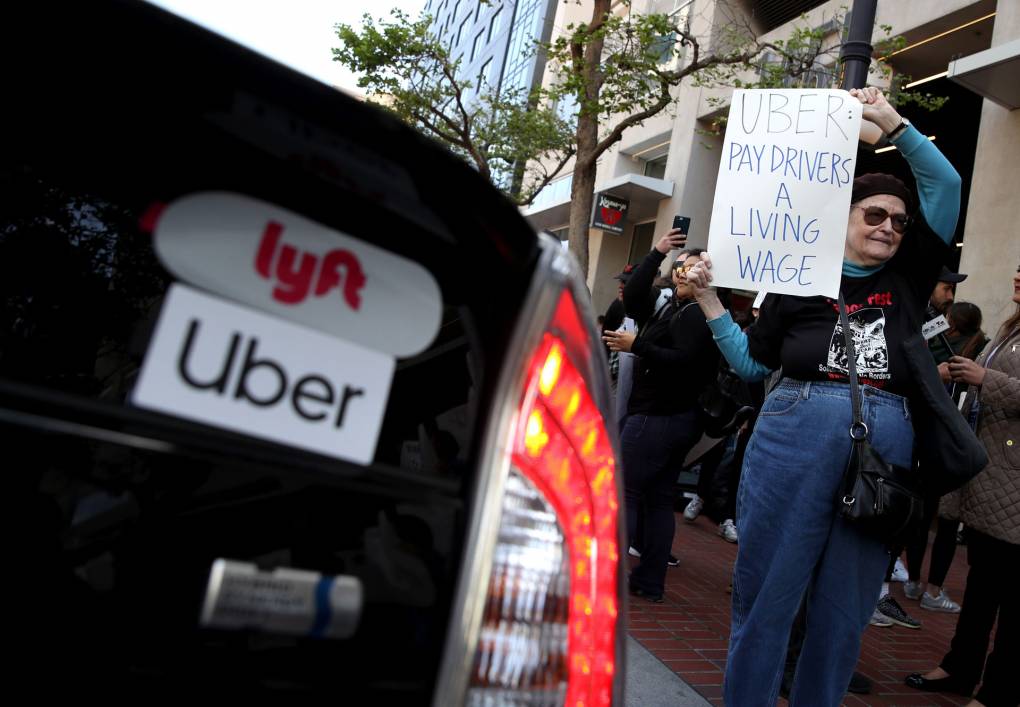
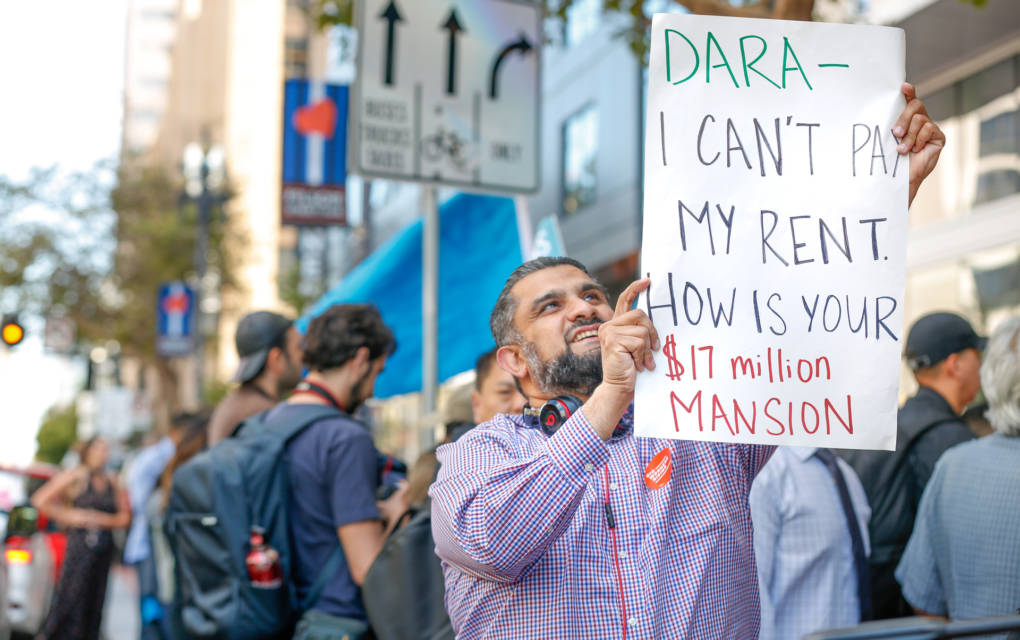
A supporter of ride-hail drivers holds a sign during a protest in front of Uber headquarters in May 2019. Prop. 22, backed by huge amounts of cash from gig companies, would create a new class of worker in California. (Justin Sullivan/Getty Images)
The decision California voters face on Proposition 22 boils down to this: should a handful of companies be allowed to create a new gig contractor category for their workers that doesn’t include employee protections and benefits, like unemployment insurance and workers compensation? Or should companies like Uber, Lyft and DoorDash have to follow state labor law and classify their drivers as employees, which could mean directing more revenue to workers, higher prices for consumers and increased requirements for more casual drivers?
That's the choice on the ballot. But there’s so much more going on with this unprecedented and far-reaching proposition — a proposition that recent polling indicates will come down to Californians who are still undecided. As of Oct. 26, polling of likely voters shows 46% in favor, 42% opposed and 12% undecided. Here's everything you'd need to know about the proposition and its backstory before you vote.
Skip to:
The Backstory: How companies like Lyft, Uber and DoorDash have avoided employee classification for eight years despite pressure from workers, labor groups and every branch of state government
What's Actually in Prop. 22?: An explanation of the limited worker benefits and why the "7/8ths provision" would make it nearly impossible to change this law in the future
Unprecedented Money: Gig companies are spending record amounts of cash to market Prop. 22 — and it's being framed as a social justice issue
Unprecedented Direct-to-Voter Connection: Millions of apps in millions of pockets, workers asked to deliver political ads and pop ups galore — win or lose, a new election playbook is being written
The Ramifications: If Prop. 22 passes, what will it mean for gig work, labor protections, election campaigning and local governance?
The Backstory
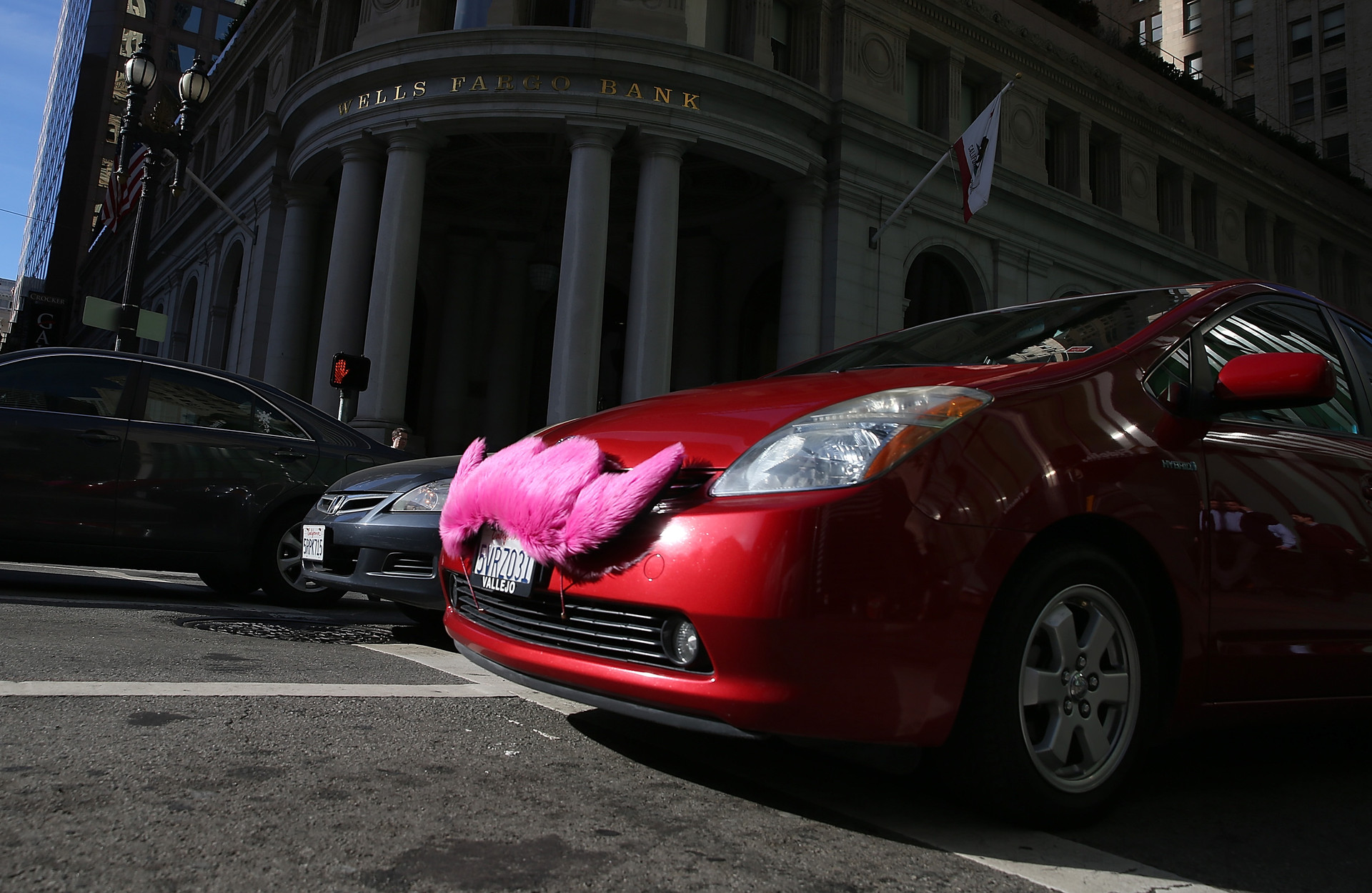
A Lyft driver with one of the early fuzzy pink mustaches drives in downtown San Francisco in January, 2014. (Justin Sullivan/Getty Images)
It all began in 2012 with a fuzzy pink mustache and a fist bump. It was Lyft, not Uber, that first started paying drivers to use their own cars to do taxi work. Both companies cast themselves not as taxi companies, but platforms to connect riders to drivers, and tech journalists helped propel this image. Here's the even deeper backstory on how that all went down.
Using the platform argument, the gig companies classified their workers as contractors, which shielded them from liability and allowed them to avoid paying for protections like overtime and unemployment insurance. Regulators and the government at the state and federal levels did not stop Uber and Lyft, and soon, companies like Instacart, DoorDash and Postmates began following suit.
It was arguable that under those parameters, gig workers were not independent entrepreneurs running their own businesses on a platform provided by "tech" companies, but instead, employees of a transportation company in the case of Uber and Lyft, a service company in the case of TaskRabbit and a delivery company in the case of Postmates or DoorDash. Lawyers began trying to make the case with big lawsuits against gig companies.
Workers were and still are fighting almost all the battles over employee protections and benefits behind closed doors. That’s because gig companies make workers sign arbitration clauses, which prevent them from taking any grievance to court. That has helped preempt and neutralize class-action lawsuits. Law professor Charlotte Garden wrote a whole academic paper on how the gig economy relies on mandatory arbitration.
In 2014, as Uber and Lyft began to slash wages in a price war, workers increased their protest, but they could make no headway toward employment status. Gig companies leaned on customer support for political support, and consumers loved these cheap rides, which were kept low by the contractor model and venture capital. It took six years for any notable action from California's government. And it came first from the judicial branch.
Sponsored
In a ruling on a case known as Dynamex in 2018, California's Supreme Court simplified the Borello test, boiling it down to just three factors, called the ABCs. A worker could now only be classified as a contractor if they:
A) Were free from the control and direction of the hirer
B) Performed work outside the hirer's normal course of business
C) Had their own independently established trade, occupation or business
The ruling made it much more difficult for gig companies to deny workers employee benefits and protections. But still, gig companies kept classifying workers as contractors.
After the state Supreme Court, the Legislature took up the fight. Lawmakers passed Assembly Bill 5, which went into effect on Jan. 1, 2020. AB 5 codified the Dynamex ruling and was designed with gig companies in mind.
However, the new law also affected a number of other industries that have come to rely on contractors. The bill was amended after a backlash, and a number of professions got exemptions, like fine artists, foresters and translators — but not gig workers. Still, gig companies kept classifying workers as contractors.
Then in May, several months into the coronavirus pandemic, with tens of thousands of Uber and Lyft drivers seeking unemployment funds that didn’t exist because the companies had never paid into the state unemployment fund, the executive branch got involved. California Attorney General Xavier Becerra, along with a handful of city attorneys, sued Uber and Lyft for misclassifying workers. On Oct. 22 Uber and Lyft lost an appeal, and will have to start classifying workers as employees in 30 days — unless Proposition 22 passes.
After AB 5 passed, the gig companies started their ballot initiative campaign, hoping that voters would enshrine their gig contractor model into law. Now, with all three branches of California’s government pressuring them to classify workers as employees, they are pouring money into Proposition 22. It's become the most well-funded ballot initiative in California history. And it's designed to be a conclusive victory for gig companies.
What's Actually in Prop. 22?
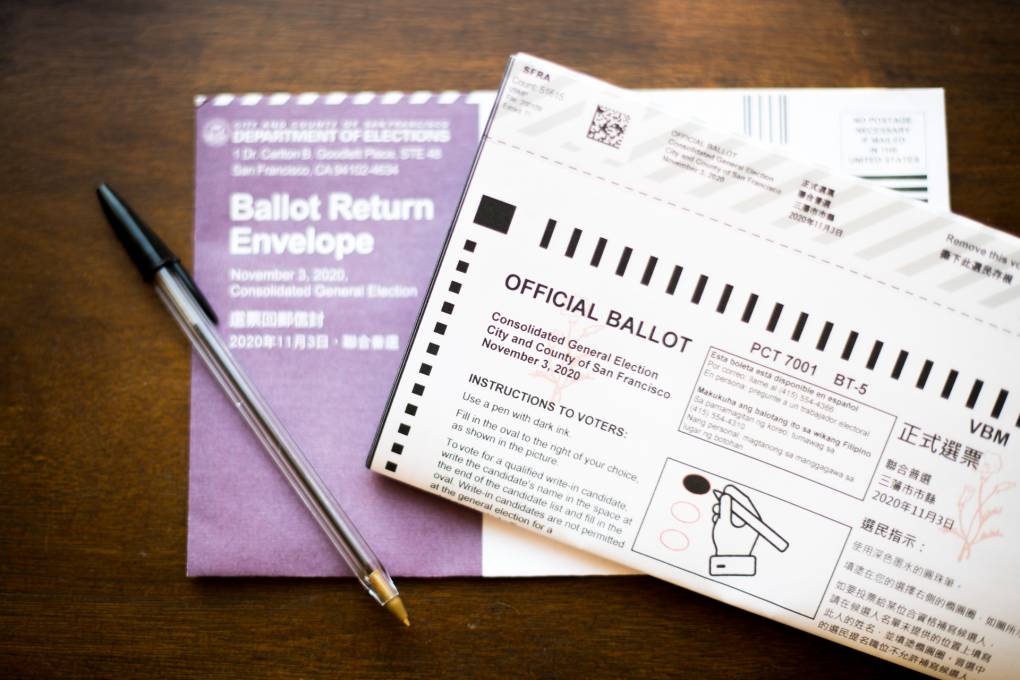
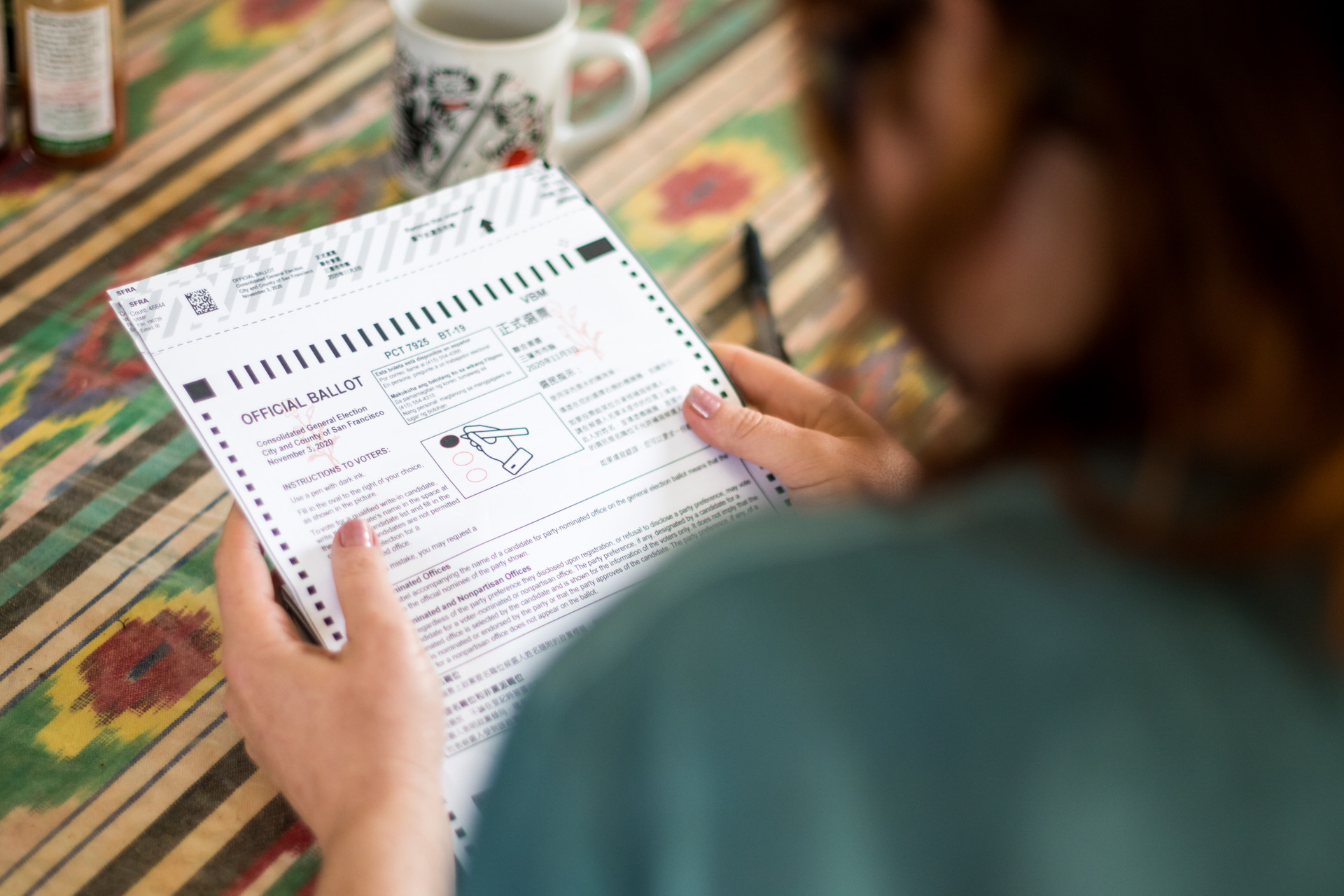
A San Francisco resident fills out their mail-in ballot on Oct. 6, 2020. (Beth LaBerge/KQED)
Proposition 22 is written as an exemption from AB 5 for any company that provides transportation or delivery services through an app. It would enshrine in law a kind of third employment category: the contract gig worker. This has been a goal of gig companies for years. They have pursued it at the federal level, and have already had success in getting legislation on the books in a number of states.
But the measure has several other provisions built around the central premise of exempting gig companies from AB 5.
Limited Employee Benefits
Prop. 22 would guarantee gig workers some limited benefits and protections. As contractors, they currently have none. But the benefits are not as straightforward as they appear at first read.
The most murky benefit is the guaranteed wage floor. Prop. 22 would ensure 120% of minimum wage and 30 cents per mile for drivers, adjusted for inflation. But there’s a pretty big catch. The guarantee is only for "engaged" driving time, defined as the time between "accepting a service request and completing the request."
Much of gig work is spent waiting for a job in the app. UC Berkeley’s Labor Center did a study where they tried to take time between rides into account, along with wear and tear on the vehicle. Adding those factors in the mix, the study found the wage guarantee drops to just $5.64 an hour, a drastic pay cut from the $13 minimum wage they would be guaranteed as employees in California. Uber and Lyft disputed the findings in the study, and they commissioned another study that put the earnings at between $25 and $27 an hour. That prompted a rebuttal from UC Berkeley.
Aside from the wage floor, Prop. 22 includes a number of benefits that are substitutes for protections guaranteed by traditional employment. In each case, these protections are weaker than what workers would get as employees, and some are contingent on driving a certain number of hours.
Instead of health care, drivers who put in over 25 hours per week of engaged driving time would get health care subsidies. Instead of workers compensation, companies would offer occupational accident insurance for medical expenses, lost income and disability. Companies would also offer accidental death insurance. It is not clear if these insurance plans would be given to workers automatically, or if they would only be guaranteed the opportunity to purchase them.
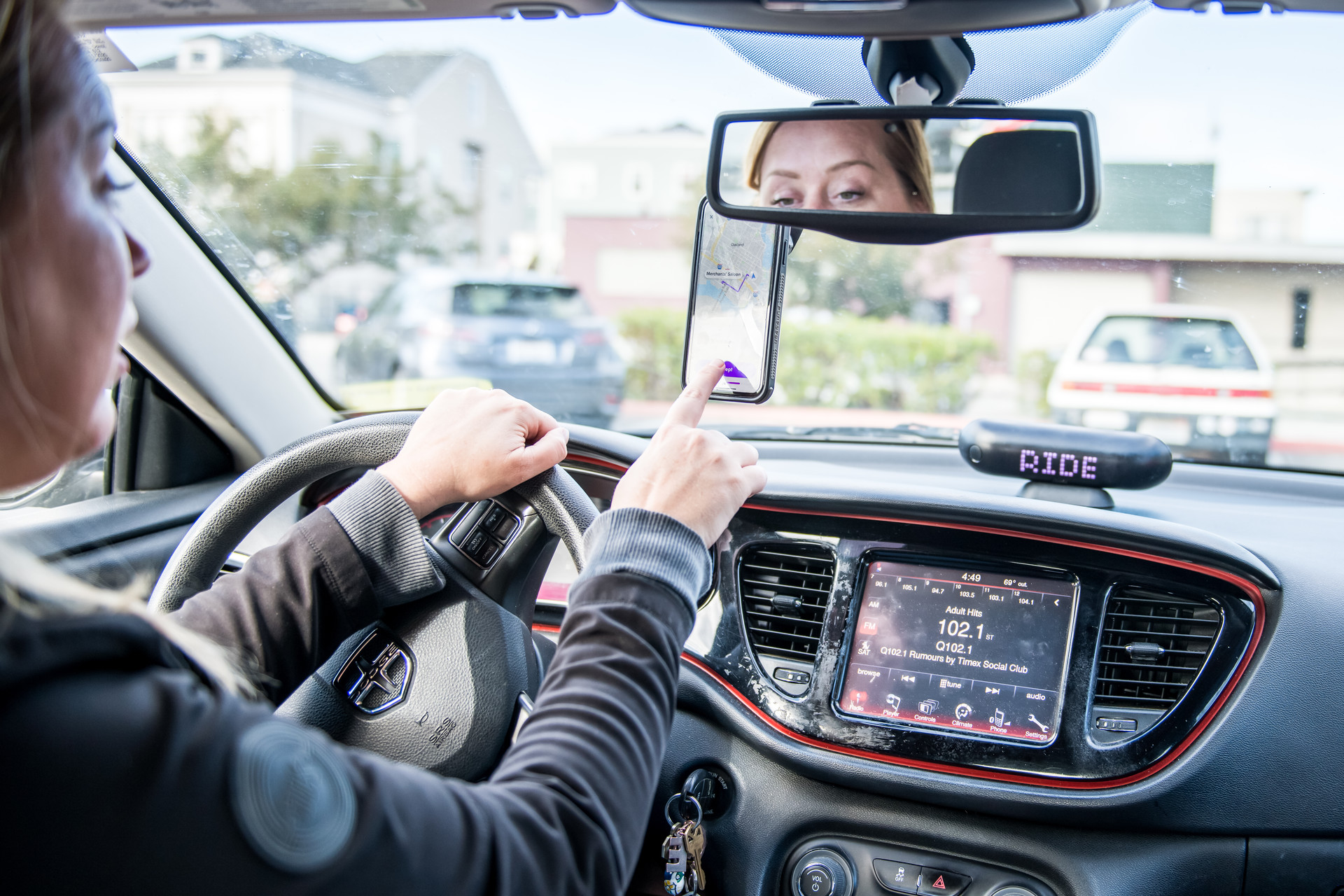
A ride-hail driver in Oakland In March, 2020. Prop. 22 would guarantee gig workers some limited benefits and protections. As contractors, they currently have none. (Beth LaBerge/KQED)
Prop. 22 also includes provisions to address long-term accountability issues in the gig industry, like discrimination, sexual misconduct, a lack of background checks and drivers working more than 12 hours a day. Gig companies would be required to create anti-discrimination and sexual harassment policies, develop training programs for drivers and require criminal background checks — all things that the companies have been criticized for lacking in the past.
Many of the issues these final provisions would address are things that are exacerbated by the contractor status of workers. If these workers were actually employees, gig companies would be far more liable for things like car accidents, sexual misconduct and criminal activity.
Prop. 22 Would Be Nearly Impossible to Change
If Proposition 22 passes, it would prevent local governments from passing laws that require companies to provide additional benefits and protections for gig workers not included in Prop. 22. It would also be the hardest statute for the Legislature to alter, aside from a handful of propositions that bar any amendment whatsoever. That's because of the 7/8ths provision.
A single sentence on page 18 of the initiative requires a 7/8ths vote of both the state Assembly and Senate in order to amend Prop. 22 in any way. This particular requirement is unprecedented. Some propositions have required 2/3rds or 3/5s — but never 7/8ths.
If it passes, Prop. 22 would be harder to amend than the state’s Wildlife Protection Act, the Clean Air and Transportation Improvement Act or the Cruelty to Farm Animals Act. Amending it would take eight more votes than are needed to override a governor’s veto or revise the state Constitution, according to data provided to KQED by Alex Vassar, communications manager at the California State Library.
Election 2020 Resources
In California, a proposition can only be undone by another ballot initiative. So why is the threshold for amendment so high on Prop. 22? Part of the reason is that a section of the proposition's stated purpose is contradictory to the wishes of gig companies.
Proposition 22 states that it would "require rideshare and delivery network companies to offer new protections and benefits for app-based rideshare and delivery drivers." That might sound good to voters who want more protections for workers, but it could cause problems for gig companies. The Legislature could, for example, alter Prop. 22 once it becomes statute or pass new laws to increase benefits for workers beyond what gig companies want. The 7/8ths provision presents a very high barrier to that.
Prop. 22 would also stop local governments from requiring gig companies to increase benefits and protections to gig workers.
"Proposition 22 lops off the top by cutting off the state Legislature’s ability to amend the law, and it lops off the bottom [by] preventing local governments from ever modifying its requirements," said Rey Fuentes, a fellow at The Partnership for Working Families, an advocacy group for workers.
Cities in California are often where laws that grant the most rigorous worker benefits and protections start: things like the Healthy SF program, or San Francisco's mandatory sick leave. Cities have also been the most proactive in requiring gig companies to provide additional benefits to workers. San Francisco and San Jose, for instance, extended COVID-19 emergency benefits to gig workers. Seattle passed a similar ordinance. Prop. 22 has a clause that would preempt future measures like these.
Yes on Prop. 22 Spokesperson Geoff Vetter said the issue is consistency for workers who cross city and county lines.
"Given the cross-jurisdictional nature of the service," Vetter said, "it would be impossible to allow all 58 counties and 480+ cities to establish separate requirements. Prop. 22 establishes uniform statewide standards for app-based driver scheduling, benefits."
Unprecedented Money
Uber and Lyft have spent nearly $100 million combined in support of Prop. 22. (ROBYN BECK/AFP via Getty Images)
Proposition 22 is on track to become the most well-funded ballot initiative in California history.
It has already drawn about $200 million, most of it on the pro side. As of 10 days before the election, the anti-side had around $19 million, coming mainly from labor organizations. The pro-side has over $199 million coming from gig companies. As of the beginning of October, Uber had contributed over $50 million; Lyft, $48 million; DoorDash, $47 million; InstaCart, $28 million; and Postmates, $11 million.
That money is not just being spent on TV and digital advertising. The Yes on Prop. 22 campaign has also contributed to political parties, including $2 million to the California Republican Party. It has spent millions hiring consultants, lobbyists and PR firms like MB Public Affairs, which is known for working with tobacco companies. These firms have launched personal and intrusive attacks on academics like Veena Dubal, a UC Hastings law professor who has been critical of gig companies and Proposition 22.
The Yes on Prop. 22 campaign has also sent money to newsrooms in return for digital advertising. By the middle of September, it had sent almost $48,000 to the Sacramento Bee, $13,500 to the San Diego Union Tribune and a little over $36,000 to the San Francisco Chronicle. Both the Tribune and the Chronicle endorsed the measure, but in their endorsements made no mention of the ad revenue they had received.
Marketing Prop. 22 as a Social Justice Measure
Many workers in the gig economy in California are people of color – a fact reflected in the advertising campaign for Prop. 22, which presents the initiative as a boon for social justice. In the past, Lyft had leaned heavily on social justice messaging to appeal to liberals and distinguish itself from Uber, especially after Trump was elected. Now, this tactic has become a major thrust of the entire Yes on Prop. 22 campaign.
PR firms working for the campaign have created a number of political mailers that urge people to vote yes on Prop. 22 and are designed to look like voter guides coming from progressive sources. In small letters at the bottom of these mailers it says the guides are prepared by organizations like “Feel the Bern, Progressive Voter Guide,” "Council of Concerned Women Voters Guide" and "Our Voice, Latino Voter Guide," which are all fake progressive organizations. They don’t actually exist. After these mailers were reported, Bernie Sanders came out publicly against Proposition 22.
Many of the ads in the Yes on Prop. 22 campaign feature people of color, like Aisha A. from Los Angeles, who say they need this flexible job to survive. Uber ran an ad campaign this summer with billboards in many major cities that said “If you tolerate racism, delete Uber.” Lyft created a television ad using a recording of Maya Angelou reading her poem, “On the Pulse of Morning.”
The Lyft ad begins with a voiceover of Angelou saying “Lift up your eyes upon / This day breaking for you.” You see Black and brown people getting ready for work. And then it transitions to the inside of a Lyft. There’s a montage of drivers, all people of color, picking up passengers. “Each new hour holds new chances / For a new beginning.” Angelou says “Do not be wedded forever / To fear, yoked eternally / To brutishness.”
Getting the California NAACP to endorse Proposition 22 was a big win for gig companies. The organization has authored voter guides telling people to vote yes, and Alice Huffman, head of the California NAACP, has been writing editorials in support of the proposition. Huffman also happens to run a consulting firm called AC Public Affairs. That firm has so far received $85,000 from the Yes on Prop. 22 Campaign. Huffman has a history of receiving contributions from corporations to support their ballot initiatives. The Yes on Prop. 22 money is part of $1.2 million her firm has already received this year.
Many Black and Latino leaders in California have come out against Proposition 22; Rep. Barbara Lee from Oakland, Stockton Mayor Michael Tubbs and members of both the Latino and Black California Legislative Caucus were part of a group that publicly denounced Proposition 22 in mid-October.
Addressing the gig companies on the call, Lee said, “You have very clearly crossed the line when you try to claim the equity mantle for a campaign that has always been about allowing multi-billion-dollar app companies to write their own law so they can keep exploiting the drivers.”
In response, Vetter said "Prop. 22 not only protects the jobs of drivers of color and their freedom to work independently, it would provide drivers an earnings guarantee, access to benefits like health care and provide drivers and passengers alike with new safety protections."
Those Driver Surveys, and What's Wrong With Them
Uber driver Sergei Fyodorov, in Oakland, holds a flyer suggesting his riders ask him about why he supports Proposition 22. (JOSH EDELSON/AFP via Getty Images)
Many ads from the Yes on Prop. 22 campaign say four out of five drivers prefer being independent contractors. This data comes from a survey done on the blog of Harry the Rideshare Guy. It’s one of a slew of surveys the gig companies have been using to advocate for Prop. 22. These surveys are often methodologically flawed, and they never tell the whole story of what drivers want.
While the Harry the Rideshare Guy survey has been a central piece of advertising for Proposition 22 and used in legal arguments, it is a non-scientific, informal poll done on a blog. There was no guarantee that respondents were drivers, let alone that there was a representative sample in terms of demographics, hours driven or political leanings.
Harry Campbell, CEO of The Rideshare Guy blog, said he believes the site’s survey reflects what he has been hearing from drivers. Yes on Prop. 22 campaign spokesperson Geoff Vetter agreed.
"The Rideshare Guy polled app-based drivers in California and did it without offering payment to the respondents," Vetter said. "All this makes for a much fuller, more accurate data set and one that correctly demonstrates how drivers feel about Prop. 22 and independent contractor v. employee status."
But The Rideshare Guy survey is indicative of a number of the broader issues that the No on Prop. 22 campaign and scholars studying the gig economy have with how drivers are being surveyed. Juliet Schor, a professor of sociology at Boston College who has spent years studying the gig economy, said these surveys don't capture the full picture. There is often bias in the sample, flawed and misleading questions and information presented that influences responses.
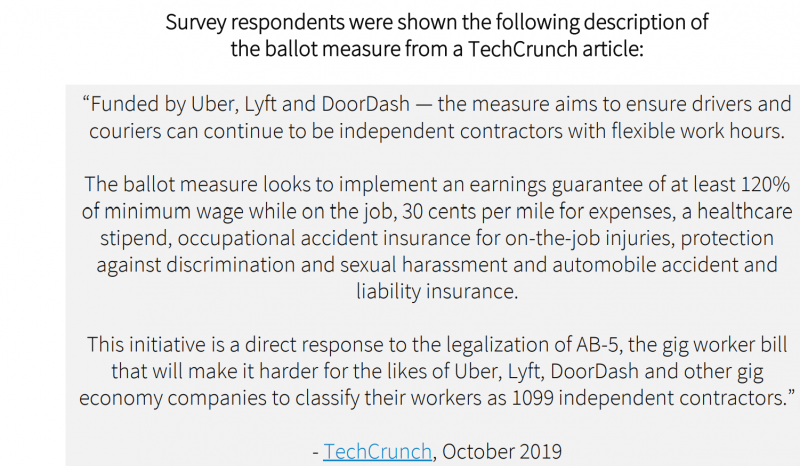
Drivers got this prompt before being asked if they supported Proposition 22. (Edelson Survey Screenshot)
This survey from Edelman is a good example. In a question about Prop. 22, the survey included a snippet from a TechCrunch article that cast the proposition in positive light. Given that prompt, 72 percent of respondents said they supported the measure. On August 19, Lyft issued a survey that had a common flaw in the questioning, equating contractor status to freedom. The survey asked if “the freedom of being an independent contractor outweighs the benefits of being an employee.” Conflating freedom with being an independent contractor is misleading. Employees can have autonomy and freedom, and likewise contractors can be constrained and coerced.
Finally, there is the sample issue. The surveys give equal weight to those who drive only a few hours a week with those who drive much more. And the surveys only poll active workers, which could have a distorting effect on the results. There have been tens or even hundreds of thousands of people in California who have done some work for these gig companies and then stopped. These workers represent a large percentage of the labor that has been done for these companies, yet their opinions are being left out.
“It’s a big methodological weakness of the surveys,” Schor said.
Schor and her research team have interviewed hundreds of gig workers over the years, ethnographic data that can capture what a survey doesn't. She says there is actually a lot of consistency in what drivers want. They want to be autonomous and have flexibility, but they also want to earn enough that they can pay their bills, buy insurance, and have money set aside if something goes wrong. Schor said she thinks a lot of gig workers in California are answering surveys with what they wish they could have: independent status and enough money to truly be their own bosses. Veena Dubal wrote an entire academic paper unpacking all of this.
Driver Noemi Torres agreed with Schor's conclusions.
“We want to be independent contractors, but Uber doesn’t treat us like independent contractors," said Torres, who has been driving for seven years outside of North Hollywood. "Initially, we would get paid enough to support ourselves in terms of getting our own health insurance, but since they keep lowering the rates, you don’t have the flexibility." She opposes Proposition 22.
Drivers who support Proposition 22 often don't sound that different when it comes to what they want. They just believe the ballot proposition can get it for them.
"I decided to vote yes on Prop. 22, because it would allow me and my fellow drivers to retain the flexibility we need while ensuring we get the benefits and protections we deserve," said Dave Thomasson, a driver from West Covina.
Unprecedented Direct-to-Voter Connection
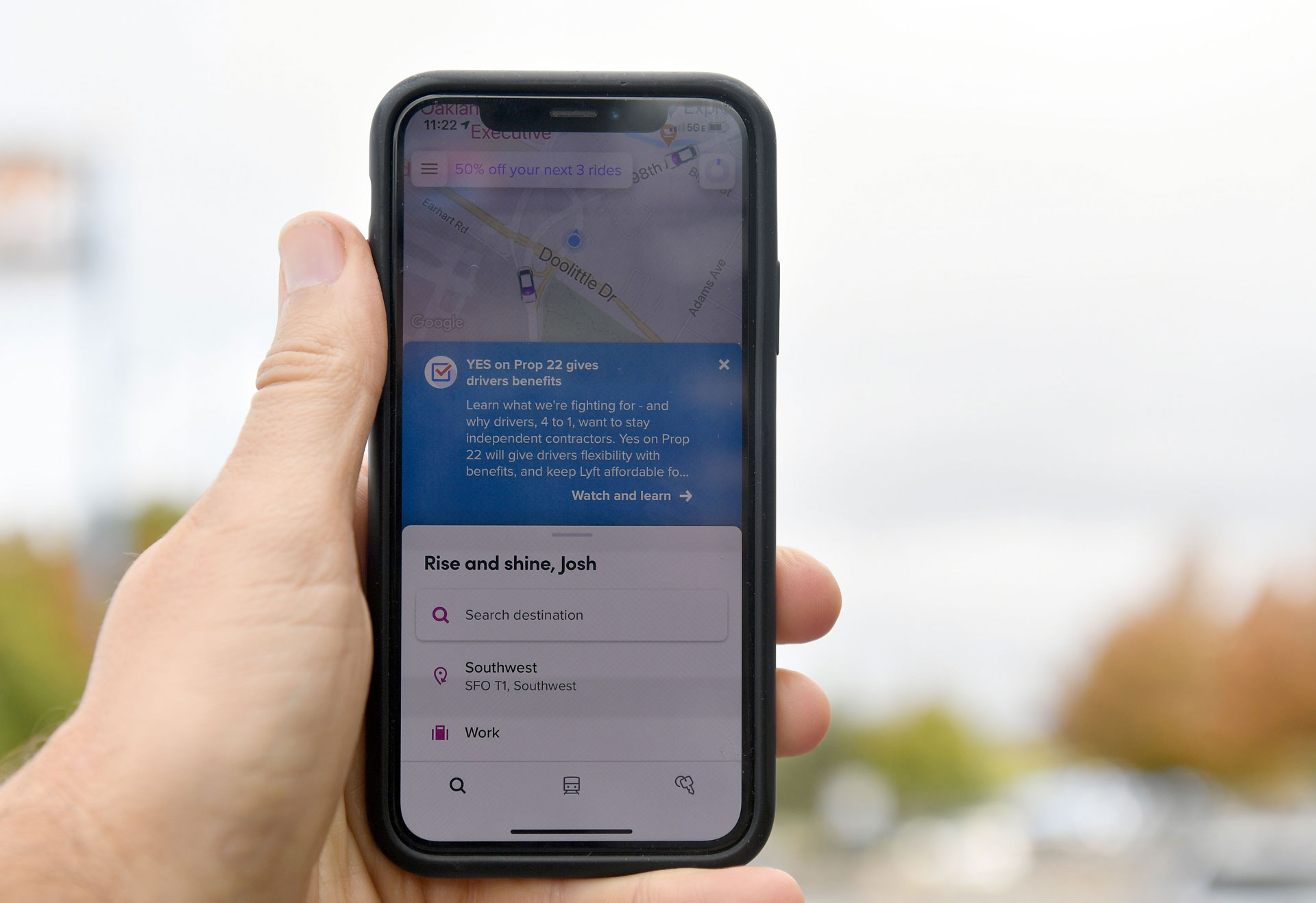
A Lyft app displays a message asking users to vote yes on Proposition 22. (JOSH EDELSON/AFP via Getty Images)
Last month, Hector Castellanos started seeing the pop-ups while driving for Uber. Under a dialog box emblazoned with “Prop. 22 is progress,” Castellanos had to click either “Yes on Prop. 22” or “OK” to proceed with his ride. At the same time, his riders were getting pop ups that said their drivers support Prop. 22 and that they should talk with them about it.
Castellanos drives full-time, and throughout the day kept seeing the pop up again and again. Castellanos opposes Proposition 22 and he didn’t want to have to click yes or OK, but he had no option. “Drivers have to click ‘yes’ even if they don’t want it,” he said. “They have to click yes or OK.”
Uber spokesperson Davis White said Castellanos’s experience is not the norm, and that drivers should only see the pop up once when signing off the app, and that the pop up has been changed so drivers can just close it without selecting an answer. Castellanos and another driver are now suing Uber for allegedly infringing on their right to be free of political coercion at work.
Uber's popups are an example of the unprecedented advantage gig companies have in this ballot campaign: their own apps.
With their apps already used by millions of California workers and consumers, proponents of no other ballot proposition have ever had direct-to-voter connection at this scale — and gig companies are using the opportunity. They're sending emails, push notifications to phones and using pop-ups to continually send the pro-Prop. 22 message directly to their customers and workers.
Lyft and Uber have been particularly aggressive in using apps to market Prop. 22 to customers. In the Uber app, riders will see a little blue text bubble coming out of the car image that says “Yes on 22.” Uber is sending push notifications that pop up on phones saying things like “Vote early on Prop. 22. Support drivers and help keep Uber in your city.”
Other gig companies are also pressuring their workers to spread pro-Prop. 22 messages to consumers. In October, Instacart asked workers through the app to put pro-Prop. 22 stickers in customers' orders at a Bay Area store. The sticker said “Yes 22, Save App-Based Jobs and Services.” DoorDash is providing free delivery bags to restaurants that have Prop. 22 ads on their sides. Then workers have to use these bags to bring food to customers.
After backlash online, Instacart is no longer asking workers to add stickers to orders. But DoorDash is continuing to send pro-Prop. 22 delivery bags to restaurants. The company says restaurants have requested over 4 million bags.
This widespread use of apps to spread messages is unprecedented in a proposition campaign, and it could prove to be a powerful tactic that other corporations want to emulate.
“It is the holy grail of political communication,” said David McCuan, professor of political science at Sonoma State University who has been studying ballot propositions for decades.
If the gig companies are successful in getting Prop. 22 passed, McCuan said it could change the way ballot initiatives are fought in California. Companies with apps and money to leverage them may see ballot initiatives as a worthwhile way to get their policies enacted if this campaign shows that apps can be used to sway voters.
The Ramifications
If Proposition 22 fails, gig companies would have to reclassify workers as employees. That could mean redirecting more revenue to pay for basic employee protections, increasing fares and increased requirements to work on these apps, especially for more casual, part-time drivers.
Gig companies could be responsible for years of back pay, lost benefits, taxes and unpaid unemployment insurance, which could be an especially big deal for Uber and Lyft. A report from UC Berkeley's Labor Center estimates they could owe as much as $413 million for the period between 2014 to 2019.
Uber has said prices could double in small cities. The Yes on Prop. 22 campaign has suggested that 80% to 90% of drivers could lose work. Given the lack of data from gig companies, it is hard to know how much each would have to change their prices or operations. Also Uber and Lyft are still not profitable, so some change is bound to happen to their services regardless of what happens with Proposition 22.
Gig companies have also said they could leave California temporarily. In the past, Uber and Lyft have left places like Austin in order to urge lawmakers to overturn regulations they didn't like. The companies have always come back, and they've never pulled out of a market as big as California. Bradley Tusk is a former political advisor to Uber, and he assumes gig companies would use their billions of dollars to continue appealing to the Legislature and to voters to find a way to maintain their gig contractor model if Prop. 22 fails.
If Proposition 22 passes, California would have a third category of worker — the gig contractor — enshrined in law.
Gig companies like Uber, Lyft, DoorDash, Postmates and Instacart would get a carve out from state labor law and would be allowed to classify workers as gig contractors, thereby denying them basic employee benefits. The door would be open for other companies to develop apps to take advantage of this new gig worker category.
The measure would become the hardest statute to amend in California history, and local governments would have no power to enact laws that provide gig workers with additional benefits.
It would establish a playbook for other companies that want to use an app to market a ballot initiative.
A handful of companies will have proven that they can use a ballot initiative to maintain a business practice that has been deemed illegal either directly or indirectly by all three branches of California’s government.
There would certainly be lawsuits over things like the 7/8ths provision, but barring a new ballot proposition or a major legal victory, gig workers would have to continue working without basic employee protections.
Sponsored
lower waypoint
Stay in touch. Sign up for our daily newsletter.
To learn more about how we use your information, please read our privacy policy.
window.__IS_SSR__=true
window.__INITIAL_STATE__={"attachmentsReducer":{"audio_0":{"type":"attachments","id":"audio_0","imgSizes":{"kqedFullSize":{"file":"https://ww2.kqed.org/news/wp-content/themes/KQED-unified/img/audio_bgs/background0.jpg"}}},"audio_1":{"type":"attachments","id":"audio_1","imgSizes":{"kqedFullSize":{"file":"https://ww2.kqed.org/news/wp-content/themes/KQED-unified/img/audio_bgs/background1.jpg"}}},"audio_2":{"type":"attachments","id":"audio_2","imgSizes":{"kqedFullSize":{"file":"https://ww2.kqed.org/news/wp-content/themes/KQED-unified/img/audio_bgs/background2.jpg"}}},"audio_3":{"type":"attachments","id":"audio_3","imgSizes":{"kqedFullSize":{"file":"https://ww2.kqed.org/news/wp-content/themes/KQED-unified/img/audio_bgs/background3.jpg"}}},"audio_4":{"type":"attachments","id":"audio_4","imgSizes":{"kqedFullSize":{"file":"https://ww2.kqed.org/news/wp-content/themes/KQED-unified/img/audio_bgs/background4.jpg"}}},"placeholder":{"type":"attachments","id":"placeholder","imgSizes":{"thumbnail":{"file":"https://ww2.kqed.org/wp-content/uploads/sites/10/2018/01/GettyImages-896326950-160x96.jpg","width":160,"height":96,"mimeType":"image/jpeg"},"medium":{"file":"https://ww2.kqed.org/wp-content/uploads/sites/10/2018/01/GettyImages-896326950-800x478.jpg","width":800,"height":478,"mimeType":"image/jpeg"},"large":{"file":"https://ww2.kqed.org/wp-content/uploads/sites/10/2018/01/GettyImages-896326950-1020x610.jpg","width":1020,"height":610,"mimeType":"image/jpeg"},"fd-lrg":{"file":"https://ww2.kqed.org/wp-content/uploads/sites/10/2018/01/GettyImages-896326950-1920x1148.jpg","width":1920,"height":1148,"mimeType":"image/jpeg"},"fd-med":{"file":"https://ww2.kqed.org/wp-content/uploads/sites/10/2018/01/GettyImages-896326950-1180x705.jpg","width":1180,"height":705,"mimeType":"image/jpeg"},"fd-sm":{"file":"https://ww2.kqed.org/wp-content/uploads/sites/10/2018/01/GettyImages-896326950-960x574.jpg","width":960,"height":574,"mimeType":"image/jpeg"},"post-thumbnail":{"file":"https://ww2.kqed.org/wp-content/uploads/sites/10/2018/01/GettyImages-896326950-672x372.jpg","width":672,"height":372,"mimeType":"image/jpeg"},"twentyfourteen-full-width":{"file":"https://ww2.kqed.org/wp-content/uploads/sites/10/2018/01/GettyImages-896326950-1038x576.jpg","width":1038,"height":576,"mimeType":"image/jpeg"},"xxsmall":{"file":"https://ww2.kqed.org/wp-content/uploads/sites/10/2018/01/GettyImages-896326950-240x143.jpg","width":240,"height":143,"mimeType":"image/jpeg"},"xsmall":{"file":"https://ww2.kqed.org/wp-content/uploads/sites/10/2018/01/GettyImages-896326950-375x224.jpg","width":375,"height":224,"mimeType":"image/jpeg"},"small":{"file":"https://ww2.kqed.org/wp-content/uploads/sites/10/2018/01/GettyImages-896326950-520x311.jpg","width":520,"height":311,"mimeType":"image/jpeg"},"xlarge":{"file":"https://ww2.kqed.org/wp-content/uploads/sites/10/2018/01/GettyImages-896326950-1180x705.jpg","width":1180,"height":705,"mimeType":"image/jpeg"},"full-width":{"file":"https://ww2.kqed.org/wp-content/uploads/sites/10/2018/01/GettyImages-896326950-1920x1148.jpg","width":1920,"height":1148,"mimeType":"image/jpeg"},"guest-author-32":{"file":"https://ww2.kqed.org/wp-content/uploads/sites/10/2018/01/GettyImages-896326950-32x32.jpg","width":32,"height":32,"mimeType":"image/jpeg"},"guest-author-50":{"file":"https://ww2.kqed.org/wp-content/uploads/sites/10/2018/01/GettyImages-896326950-50x50.jpg","width":50,"height":50,"mimeType":"image/jpeg"},"guest-author-64":{"file":"https://ww2.kqed.org/wp-content/uploads/sites/10/2018/01/GettyImages-896326950-64x64.jpg","width":64,"height":64,"mimeType":"image/jpeg"},"guest-author-96":{"file":"https://ww2.kqed.org/wp-content/uploads/sites/10/2018/01/GettyImages-896326950-96x96.jpg","width":96,"height":96,"mimeType":"image/jpeg"},"guest-author-128":{"file":"https://ww2.kqed.org/wp-content/uploads/sites/10/2018/01/GettyImages-896326950-128x128.jpg","width":128,"height":128,"mimeType":"image/jpeg"},"detail":{"file":"https://ww2.kqed.org/wp-content/uploads/sites/10/2018/01/GettyImages-896326950-150x150.jpg","width":150,"height":150,"mimeType":"image/jpeg"},"kqedFullSize":{"file":"https://ww2.kqed.org/wp-content/uploads/sites/10/2018/01/GettyImages-896326950-e1514998105161.jpg","width":1920,"height":1148}}},"news_11984986":{"type":"attachments","id":"news_11984986","meta":{"index":"attachments_1591205162","site":"news","id":"11984986","found":true},"title":"Karina Ceballos at her home in Castro Valley on May 2, 2024.","publishDate":1714756349,"status":"inherit","parent":11985277,"modified":1715189712,"caption":"Karina Ceballos at her home in Castro Valley on May 2, 2024. Ceballos works at two fast-food restaurants and recently received a pay increase due to California's new higher minimum wage for most fast-food workers.","credit":"Martin do Nascimento/KQED","altTag":"A Latina woman wearing glasses and a black short-sleeved shirt stands on the balcony of an apartment building with her hands resting on the rails.","description":null,"imgSizes":{"medium":{"file":"https://cdn.kqed.org/wp-content/uploads/sites/10/2024/05/240501-FAST-FOOD-MIN-WAGE-HIKE-MD-01-KQED-1-800x533.jpg","width":800,"height":533,"mimeType":"image/jpeg"},"large":{"file":"https://cdn.kqed.org/wp-content/uploads/sites/10/2024/05/240501-FAST-FOOD-MIN-WAGE-HIKE-MD-01-KQED-1-1020x680.jpg","width":1020,"height":680,"mimeType":"image/jpeg"},"thumbnail":{"file":"https://cdn.kqed.org/wp-content/uploads/sites/10/2024/05/240501-FAST-FOOD-MIN-WAGE-HIKE-MD-01-KQED-1-160x107.jpg","width":160,"height":107,"mimeType":"image/jpeg"},"1536x1536":{"file":"https://cdn.kqed.org/wp-content/uploads/sites/10/2024/05/240501-FAST-FOOD-MIN-WAGE-HIKE-MD-01-KQED-1-1536x1024.jpg","width":1536,"height":1024,"mimeType":"image/jpeg"},"post-thumbnail":{"file":"https://cdn.kqed.org/wp-content/uploads/sites/10/2024/05/240501-FAST-FOOD-MIN-WAGE-HIKE-MD-01-KQED-1-672x372.jpg","width":672,"height":372,"mimeType":"image/jpeg"},"twentyfourteen-full-width":{"file":"https://cdn.kqed.org/wp-content/uploads/sites/10/2024/05/240501-FAST-FOOD-MIN-WAGE-HIKE-MD-01-KQED-1-1038x576.jpg","width":1038,"height":576,"mimeType":"image/jpeg"},"full-width":{"file":"https://cdn.kqed.org/wp-content/uploads/sites/10/2024/05/240501-FAST-FOOD-MIN-WAGE-HIKE-MD-01-KQED-1-1920x1280.jpg","width":1920,"height":1280,"mimeType":"image/jpeg"},"kqedFullSize":{"file":"https://cdn.kqed.org/wp-content/uploads/sites/10/2024/05/240501-FAST-FOOD-MIN-WAGE-HIKE-MD-01-KQED-1.jpg","width":2000,"height":1333}},"fetchFailed":false,"isLoading":false},"news_11985409":{"type":"attachments","id":"news_11985409","meta":{"index":"attachments_1591205162","site":"news","id":"11985409","found":true},"title":"240416-NontraditionalFamilies-02-BL_qut","publishDate":1715201509,"status":"inherit","parent":11985408,"modified":1715201523,"caption":"John Owens speaks with his partners Emily Savage (left) and Alejandra Bravo Ducey at a celebration party at the East Bay Community Space in Oakland on April 16, 2024, after a bill prohibiting discrimination of non-monogamous families passed in the Oakland City Council.","credit":"Beth LaBerge/KQED","altTag":null,"description":null,"imgSizes":{"medium":{"file":"https://cdn.kqed.org/wp-content/uploads/sites/10/2024/05/240416-NontraditionalFamilies-02-BL_qut-800x533.jpg","width":800,"height":533,"mimeType":"image/jpeg"},"large":{"file":"https://cdn.kqed.org/wp-content/uploads/sites/10/2024/05/240416-NontraditionalFamilies-02-BL_qut-1020x680.jpg","width":1020,"height":680,"mimeType":"image/jpeg"},"thumbnail":{"file":"https://cdn.kqed.org/wp-content/uploads/sites/10/2024/05/240416-NontraditionalFamilies-02-BL_qut-160x107.jpg","width":160,"height":107,"mimeType":"image/jpeg"},"1536x1536":{"file":"https://cdn.kqed.org/wp-content/uploads/sites/10/2024/05/240416-NontraditionalFamilies-02-BL_qut-1536x1024.jpg","width":1536,"height":1024,"mimeType":"image/jpeg"},"post-thumbnail":{"file":"https://cdn.kqed.org/wp-content/uploads/sites/10/2024/05/240416-NontraditionalFamilies-02-BL_qut-672x372.jpg","width":672,"height":372,"mimeType":"image/jpeg"},"twentyfourteen-full-width":{"file":"https://cdn.kqed.org/wp-content/uploads/sites/10/2024/05/240416-NontraditionalFamilies-02-BL_qut-1038x576.jpg","width":1038,"height":576,"mimeType":"image/jpeg"},"kqedFullSize":{"file":"https://cdn.kqed.org/wp-content/uploads/sites/10/2024/05/240416-NontraditionalFamilies-02-BL_qut.jpg","width":1920,"height":1280}},"fetchFailed":false,"isLoading":false},"news_11985440":{"type":"attachments","id":"news_11985440","meta":{"index":"attachments_1591205162","site":"news","id":"11985440","found":true},"title":"20240508_WHATTOMAKETOBUYHOMECA-6-KQED","publishDate":1715205593,"status":"inherit","parent":0,"modified":1715274778,"caption":"A home for sale in San Carlos on May 8, 2024.","credit":"Gina Castro/KQED","altTag":"A blue, one-story home with a 'For Sale' sign in the front yard.","description":null,"imgSizes":{"medium":{"file":"https://cdn.kqed.org/wp-content/uploads/sites/10/2024/05/20240508_WHATTOMAKETOBUYHOMECA-6-KQED-800x533.jpg","width":800,"height":533,"mimeType":"image/jpeg"},"large":{"file":"https://cdn.kqed.org/wp-content/uploads/sites/10/2024/05/20240508_WHATTOMAKETOBUYHOMECA-6-KQED-1020x680.jpg","width":1020,"height":680,"mimeType":"image/jpeg"},"thumbnail":{"file":"https://cdn.kqed.org/wp-content/uploads/sites/10/2024/05/20240508_WHATTOMAKETOBUYHOMECA-6-KQED-160x107.jpg","width":160,"height":107,"mimeType":"image/jpeg"},"1536x1536":{"file":"https://cdn.kqed.org/wp-content/uploads/sites/10/2024/05/20240508_WHATTOMAKETOBUYHOMECA-6-KQED-1536x1024.jpg","width":1536,"height":1024,"mimeType":"image/jpeg"},"post-thumbnail":{"file":"https://cdn.kqed.org/wp-content/uploads/sites/10/2024/05/20240508_WHATTOMAKETOBUYHOMECA-6-KQED-672x372.jpg","width":672,"height":372,"mimeType":"image/jpeg"},"twentyfourteen-full-width":{"file":"https://cdn.kqed.org/wp-content/uploads/sites/10/2024/05/20240508_WHATTOMAKETOBUYHOMECA-6-KQED-1038x576.jpg","width":1038,"height":576,"mimeType":"image/jpeg"},"full-width":{"file":"https://cdn.kqed.org/wp-content/uploads/sites/10/2024/05/20240508_WHATTOMAKETOBUYHOMECA-6-KQED-1920x1280.jpg","width":1920,"height":1280,"mimeType":"image/jpeg"},"kqedFullSize":{"file":"https://cdn.kqed.org/wp-content/uploads/sites/10/2024/05/20240508_WHATTOMAKETOBUYHOMECA-6-KQED.jpg","width":2000,"height":1333}},"fetchFailed":false,"isLoading":false},"news_11985356":{"type":"attachments","id":"news_11985356","meta":{"index":"attachments_1591205162","site":"news","id":"11985356","found":true},"title":"Matthew Souzis outside his home in San Francisco on May 7, 2024.","publishDate":1715193961,"status":"inherit","parent":0,"modified":1715193976,"caption":"Matthew Souzis outside his home in San Francisco on May 7, 2024.","credit":"Martin do Nascimento/KQED","altTag":null,"description":null,"imgSizes":{"medium":{"file":"https://cdn.kqed.org/wp-content/uploads/sites/10/2024/05/240507-FORECLOSED-HOMES-FUND-MD-03-KQED-1-800x533.jpg","width":800,"height":533,"mimeType":"image/jpeg"},"large":{"file":"https://cdn.kqed.org/wp-content/uploads/sites/10/2024/05/240507-FORECLOSED-HOMES-FUND-MD-03-KQED-1-1020x680.jpg","width":1020,"height":680,"mimeType":"image/jpeg"},"thumbnail":{"file":"https://cdn.kqed.org/wp-content/uploads/sites/10/2024/05/240507-FORECLOSED-HOMES-FUND-MD-03-KQED-1-160x107.jpg","width":160,"height":107,"mimeType":"image/jpeg"},"1536x1536":{"file":"https://cdn.kqed.org/wp-content/uploads/sites/10/2024/05/240507-FORECLOSED-HOMES-FUND-MD-03-KQED-1-1536x1024.jpg","width":1536,"height":1024,"mimeType":"image/jpeg"},"post-thumbnail":{"file":"https://cdn.kqed.org/wp-content/uploads/sites/10/2024/05/240507-FORECLOSED-HOMES-FUND-MD-03-KQED-1-672x372.jpg","width":672,"height":372,"mimeType":"image/jpeg"},"twentyfourteen-full-width":{"file":"https://cdn.kqed.org/wp-content/uploads/sites/10/2024/05/240507-FORECLOSED-HOMES-FUND-MD-03-KQED-1-1038x576.jpg","width":1038,"height":576,"mimeType":"image/jpeg"},"full-width":{"file":"https://cdn.kqed.org/wp-content/uploads/sites/10/2024/05/240507-FORECLOSED-HOMES-FUND-MD-03-KQED-1-1920x1280.jpg","width":1920,"height":1280,"mimeType":"image/jpeg"},"kqedFullSize":{"file":"https://cdn.kqed.org/wp-content/uploads/sites/10/2024/05/240507-FORECLOSED-HOMES-FUND-MD-03-KQED-1.jpg","width":2000,"height":1333}},"fetchFailed":false,"isLoading":false},"news_11985352":{"type":"attachments","id":"news_11985352","meta":{"index":"attachments_1591205162","site":"news","id":"11985352","found":true},"title":"terry williams","publishDate":1715193348,"status":"inherit","parent":11985347,"modified":1715193397,"caption":"Terry Williams has worked as a dog walker in the San Francisco neighborhood of Alamo Square for more than 30 years.","credit":"Courtesy of Terry Williams","altTag":"A man stands in a park with five dogs on leashes","description":null,"imgSizes":{"medium":{"file":"https://cdn.kqed.org/wp-content/uploads/sites/10/2024/05/terry-williams-800x600.png","width":800,"height":600,"mimeType":"image/png"},"thumbnail":{"file":"https://cdn.kqed.org/wp-content/uploads/sites/10/2024/05/terry-williams-160x120.png","width":160,"height":120,"mimeType":"image/png"},"post-thumbnail":{"file":"https://cdn.kqed.org/wp-content/uploads/sites/10/2024/05/terry-williams-672x372.png","width":672,"height":372,"mimeType":"image/png"},"twentyfourteen-full-width":{"file":"https://cdn.kqed.org/wp-content/uploads/sites/10/2024/05/terry-williams-1000x576.png","width":1000,"height":576,"mimeType":"image/png"},"kqedFullSize":{"file":"https://cdn.kqed.org/wp-content/uploads/sites/10/2024/05/terry-williams.png","width":1000,"height":750}},"fetchFailed":false,"isLoading":false},"news_11985375":{"type":"attachments","id":"news_11985375","meta":{"index":"attachments_1591205162","site":"news","id":"11985375","found":true},"title":"House Committee Holds Hearing Examining Antisemitism In K-12 Schools","publishDate":1715196832,"status":"inherit","parent":11985335,"modified":1715200335,"caption":"Enikia Ford Morthel, superintendent of the Berkeley Unified School District, listens during a hearing with subcommittee members of the House Education and the Workforce Committee on May 8, 2024, in Washington, D.C.","credit":"Anna Moneymaker/Getty Images","altTag":"A Black woman in a red dress sits in front of a microphone.","description":null,"imgSizes":{"medium":{"file":"https://cdn.kqed.org/wp-content/uploads/sites/10/2024/05/GettyImages-2152066925-800x534.jpg","width":800,"height":534,"mimeType":"image/jpeg"},"large":{"file":"https://cdn.kqed.org/wp-content/uploads/sites/10/2024/05/GettyImages-2152066925-1020x680.jpg","width":1020,"height":680,"mimeType":"image/jpeg"},"thumbnail":{"file":"https://cdn.kqed.org/wp-content/uploads/sites/10/2024/05/GettyImages-2152066925-160x107.jpg","width":160,"height":107,"mimeType":"image/jpeg"},"post-thumbnail":{"file":"https://cdn.kqed.org/wp-content/uploads/sites/10/2024/05/GettyImages-2152066925-672x372.jpg","width":672,"height":372,"mimeType":"image/jpeg"},"twentyfourteen-full-width":{"file":"https://cdn.kqed.org/wp-content/uploads/sites/10/2024/05/GettyImages-2152066925-1024x576.jpg","width":1024,"height":576,"mimeType":"image/jpeg"},"kqedFullSize":{"file":"https://cdn.kqed.org/wp-content/uploads/sites/10/2024/05/GettyImages-2152066925.jpg","width":1024,"height":683}},"fetchFailed":false,"isLoading":false},"news_11985260":{"type":"attachments","id":"news_11985260","meta":{"index":"attachments_1591205162","site":"news","id":"11985260","found":true},"title":"240423-BERKELEY GAZA ENCAMPMENT-MD-07_qut","publishDate":1715120452,"status":"inherit","parent":11985245,"modified":1715120671,"caption":"Malak Afaneh, a Berkeley Law third-year student and co-president of Berkeley Law Students for Justice in Palestine, at the UC Berkeley Gaza Solidarity Encampment in front of Sproul Hall on April 23, 2024.","credit":"Martin do Nascimento/KQED","altTag":null,"description":null,"imgSizes":{"medium":{"file":"https://cdn.kqed.org/wp-content/uploads/sites/10/2024/05/240423-BERKELEY-GAZA-ENCAMPMENT-MD-07_qut-800x533.jpg","width":800,"height":533,"mimeType":"image/jpeg"},"large":{"file":"https://cdn.kqed.org/wp-content/uploads/sites/10/2024/05/240423-BERKELEY-GAZA-ENCAMPMENT-MD-07_qut-1020x680.jpg","width":1020,"height":680,"mimeType":"image/jpeg"},"thumbnail":{"file":"https://cdn.kqed.org/wp-content/uploads/sites/10/2024/05/240423-BERKELEY-GAZA-ENCAMPMENT-MD-07_qut-160x107.jpg","width":160,"height":107,"mimeType":"image/jpeg"},"1536x1536":{"file":"https://cdn.kqed.org/wp-content/uploads/sites/10/2024/05/240423-BERKELEY-GAZA-ENCAMPMENT-MD-07_qut-1536x1024.jpg","width":1536,"height":1024,"mimeType":"image/jpeg"},"post-thumbnail":{"file":"https://cdn.kqed.org/wp-content/uploads/sites/10/2024/05/240423-BERKELEY-GAZA-ENCAMPMENT-MD-07_qut-672x372.jpg","width":672,"height":372,"mimeType":"image/jpeg"},"twentyfourteen-full-width":{"file":"https://cdn.kqed.org/wp-content/uploads/sites/10/2024/05/240423-BERKELEY-GAZA-ENCAMPMENT-MD-07_qut-1038x576.jpg","width":1038,"height":576,"mimeType":"image/jpeg"},"kqedFullSize":{"file":"https://cdn.kqed.org/wp-content/uploads/sites/10/2024/05/240423-BERKELEY-GAZA-ENCAMPMENT-MD-07_qut.jpg","width":1920,"height":1280}},"fetchFailed":false,"isLoading":false},"forum_2010101905700":{"type":"attachments","id":"forum_2010101905700","meta":{"index":"attachments_1591205162","site":"forum","id":"2010101905700","found":true},"title":"GettyImages-1244061942 colorblind casting crop","publishDate":1715211297,"status":"inherit","parent":2010101905679,"modified":1715211365,"caption":"A woman dressed as Queen Charlotte poses on a throne in Cinespace Studios in Toronto during the \"Queen's Ball: Bridgerton Experience\" on October 12, 2022.","credit":"Katherine Cheng/SOPA Images/LightRocket via Getty Images","altTag":null,"description":null,"imgSizes":{"medium":{"file":"https://cdn.kqed.org/wp-content/uploads/sites/43/2024/05/GettyImages-1244061942-colorblind-casting-crop-800x450.jpg","width":800,"height":450,"mimeType":"image/jpeg"},"large":{"file":"https://cdn.kqed.org/wp-content/uploads/sites/43/2024/05/GettyImages-1244061942-colorblind-casting-crop-1020x574.jpg","width":1020,"height":574,"mimeType":"image/jpeg"},"thumbnail":{"file":"https://cdn.kqed.org/wp-content/uploads/sites/43/2024/05/GettyImages-1244061942-colorblind-casting-crop-160x90.jpg","width":160,"height":90,"mimeType":"image/jpeg"},"medium_large":{"file":"https://cdn.kqed.org/wp-content/uploads/sites/43/2024/05/GettyImages-1244061942-colorblind-casting-crop-768x432.jpg","width":768,"height":432,"mimeType":"image/jpeg"},"1536x1536":{"file":"https://cdn.kqed.org/wp-content/uploads/sites/43/2024/05/GettyImages-1244061942-colorblind-casting-crop-1536x864.jpg","width":1536,"height":864,"mimeType":"image/jpeg"},"post-thumbnail":{"file":"https://cdn.kqed.org/wp-content/uploads/sites/43/2024/05/GettyImages-1244061942-colorblind-casting-crop-672x372.jpg","width":672,"height":372,"mimeType":"image/jpeg"},"twentyfourteen-full-width":{"file":"https://cdn.kqed.org/wp-content/uploads/sites/43/2024/05/GettyImages-1244061942-colorblind-casting-crop-1038x576.jpg","width":1038,"height":576,"mimeType":"image/jpeg"},"kqedFullSize":{"file":"https://cdn.kqed.org/wp-content/uploads/sites/43/2024/05/GettyImages-1244061942-colorblind-casting-crop.jpg","width":1920,"height":1080}},"fetchFailed":false,"isLoading":false},"news_11985401":{"type":"attachments","id":"news_11985401","meta":{"index":"attachments_1591205162","site":"news","id":"11985401","found":true},"title":"SealsPier39_006_qut","publishDate":1715199652,"status":"inherit","parent":11985399,"modified":1715203972,"caption":"Seals gathered at the docks in groups at Pier 39 in San Francisco on Feb. 11, 2019.","credit":"Lindsey Moore/KQED","altTag":null,"description":null,"imgSizes":{"medium":{"file":"https://cdn.kqed.org/wp-content/uploads/sites/10/2024/05/SealsPier39_006_qut-800x546.jpg","width":800,"height":546,"mimeType":"image/jpeg"},"large":{"file":"https://cdn.kqed.org/wp-content/uploads/sites/10/2024/05/SealsPier39_006_qut-1020x696.jpg","width":1020,"height":696,"mimeType":"image/jpeg"},"thumbnail":{"file":"https://cdn.kqed.org/wp-content/uploads/sites/10/2024/05/SealsPier39_006_qut-160x109.jpg","width":160,"height":109,"mimeType":"image/jpeg"},"1536x1536":{"file":"https://cdn.kqed.org/wp-content/uploads/sites/10/2024/05/SealsPier39_006_qut-1536x1048.jpg","width":1536,"height":1048,"mimeType":"image/jpeg"},"post-thumbnail":{"file":"https://cdn.kqed.org/wp-content/uploads/sites/10/2024/05/SealsPier39_006_qut-672x372.jpg","width":672,"height":372,"mimeType":"image/jpeg"},"twentyfourteen-full-width":{"file":"https://cdn.kqed.org/wp-content/uploads/sites/10/2024/05/SealsPier39_006_qut-1038x576.jpg","width":1038,"height":576,"mimeType":"image/jpeg"},"kqedFullSize":{"file":"https://cdn.kqed.org/wp-content/uploads/sites/10/2024/05/SealsPier39_006_qut.jpg","width":1920,"height":1310}},"fetchFailed":false,"isLoading":false},"news_11985361":{"type":"attachments","id":"news_11985361","meta":{"index":"attachments_1591205162","site":"news","id":"11985361","found":true},"title":"Baths-1_qut","publishDate":1715194985,"status":"inherit","parent":11985359,"modified":1715204998,"caption":"Nature is reclaiming the ruins of the once grand Sutro Baths, although the site is still a popular tourist attraction and hiking spot.","credit":"Tamuna Chkareuli/KQED","altTag":"Looking out to the ocean, a set of stairs descend the cliff leading to a wide rectangular pool at the bottom, next to the ocean.","description":null,"imgSizes":{"medium":{"file":"https://cdn.kqed.org/wp-content/uploads/sites/10/2024/05/Baths-1_qut-800x533.jpg","width":800,"height":533,"mimeType":"image/jpeg"},"large":{"file":"https://cdn.kqed.org/wp-content/uploads/sites/10/2024/05/Baths-1_qut-1020x680.jpg","width":1020,"height":680,"mimeType":"image/jpeg"},"thumbnail":{"file":"https://cdn.kqed.org/wp-content/uploads/sites/10/2024/05/Baths-1_qut-160x107.jpg","width":160,"height":107,"mimeType":"image/jpeg"},"1536x1536":{"file":"https://cdn.kqed.org/wp-content/uploads/sites/10/2024/05/Baths-1_qut-1536x1024.jpg","width":1536,"height":1024,"mimeType":"image/jpeg"},"post-thumbnail":{"file":"https://cdn.kqed.org/wp-content/uploads/sites/10/2024/05/Baths-1_qut-672x372.jpg","width":672,"height":372,"mimeType":"image/jpeg"},"twentyfourteen-full-width":{"file":"https://cdn.kqed.org/wp-content/uploads/sites/10/2024/05/Baths-1_qut-1038x576.jpg","width":1038,"height":576,"mimeType":"image/jpeg"},"kqedFullSize":{"file":"https://cdn.kqed.org/wp-content/uploads/sites/10/2024/05/Baths-1_qut.jpg","width":1920,"height":1280}},"fetchFailed":false,"isLoading":false},"news_11843813":{"type":"attachments","id":"news_11843813","meta":{"index":"attachments_1591205162","site":"news","id":"11843813","found":true},"title":"uber-lyft-protest-sign","publishDate":1603753946,"status":"inherit","parent":11843123,"modified":1678823724,"caption":"A supporter of ride-hail drivers holds a sign during a protest in front of Uber headquarters in May 2019. Prop. 22, backed by huge amounts of cash from gig companies, would create a new class of worker in California.","credit":"Justin Sullivan/Getty Images","altTag":"Protesters stand on a sidewalk in front of an office, and next to a car with Lyft and Uber stickers on the back. A woman holds a sign that says: Uber: 'Pay Drivers a Living Wage.'","description":"A supporter of ride-hail drivers holds a sign during a protest in front of Uber headquarters in May, 2019. Prop. 22, backed by huge amounts of cash from gig companies, would create a new class of worker in California.","imgSizes":{"medium":{"file":"https://ww2.kqed.org/app/uploads/sites/10/2020/10/uber-lyft-protest-sign-800x554.jpg","width":800,"height":554,"mimeType":"image/jpeg"},"large":{"file":"https://ww2.kqed.org/app/uploads/sites/10/2020/10/uber-lyft-protest-sign-1020x707.jpg","width":1020,"height":707,"mimeType":"image/jpeg"},"thumbnail":{"file":"https://ww2.kqed.org/app/uploads/sites/10/2020/10/uber-lyft-protest-sign-160x111.jpg","width":160,"height":111,"mimeType":"image/jpeg"},"1536x1536":{"file":"https://ww2.kqed.org/app/uploads/sites/10/2020/10/uber-lyft-protest-sign-1536x1064.jpg","width":1536,"height":1064,"mimeType":"image/jpeg"},"post-thumbnail":{"file":"https://ww2.kqed.org/app/uploads/sites/10/2020/10/uber-lyft-protest-sign-672x372.jpg","width":672,"height":372,"mimeType":"image/jpeg"},"twentyfourteen-full-width":{"file":"https://ww2.kqed.org/app/uploads/sites/10/2020/10/uber-lyft-protest-sign-1038x576.jpg","width":1038,"height":576,"mimeType":"image/jpeg"},"apple_news_ca_landscape_12_9":{"file":"https://ww2.kqed.org/app/uploads/sites/10/2020/10/uber-lyft-protest-sign-1832x1330.jpg","width":1832,"height":1330,"mimeType":"image/jpeg"},"apple_news_ca_landscape_9_7":{"file":"https://ww2.kqed.org/app/uploads/sites/10/2020/10/uber-lyft-protest-sign-1376x1032.jpg","width":1376,"height":1032,"mimeType":"image/jpeg"},"apple_news_ca_landscape_5_5":{"file":"https://ww2.kqed.org/app/uploads/sites/10/2020/10/uber-lyft-protest-sign-1044x783.jpg","width":1044,"height":783,"mimeType":"image/jpeg"},"apple_news_ca_landscape_4_7":{"file":"https://ww2.kqed.org/app/uploads/sites/10/2020/10/uber-lyft-protest-sign-632x474.jpg","width":632,"height":474,"mimeType":"image/jpeg"},"apple_news_ca_landscape_4_0":{"file":"https://ww2.kqed.org/app/uploads/sites/10/2020/10/uber-lyft-protest-sign-536x402.jpg","width":536,"height":402,"mimeType":"image/jpeg"},"apple_news_ca_portrait_12_9":{"file":"https://ww2.kqed.org/app/uploads/sites/10/2020/10/uber-lyft-protest-sign-1122x1330.jpg","width":1122,"height":1330,"mimeType":"image/jpeg"},"apple_news_ca_portrait_9_7":{"file":"https://ww2.kqed.org/app/uploads/sites/10/2020/10/uber-lyft-protest-sign-840x1120.jpg","width":840,"height":1120,"mimeType":"image/jpeg"},"apple_news_ca_portrait_5_5":{"file":"https://ww2.kqed.org/app/uploads/sites/10/2020/10/uber-lyft-protest-sign-687x916.jpg","width":687,"height":916,"mimeType":"image/jpeg"},"apple_news_ca_portrait_4_7":{"file":"https://ww2.kqed.org/app/uploads/sites/10/2020/10/uber-lyft-protest-sign-414x552.jpg","width":414,"height":552,"mimeType":"image/jpeg"},"apple_news_ca_portrait_4_0":{"file":"https://ww2.kqed.org/app/uploads/sites/10/2020/10/uber-lyft-protest-sign-354x472.jpg","width":354,"height":472,"mimeType":"image/jpeg"},"apple_news_ca_square_12_9":{"file":"https://ww2.kqed.org/app/uploads/sites/10/2020/10/uber-lyft-protest-sign-1472x1330.jpg","width":1472,"height":1330,"mimeType":"image/jpeg"},"apple_news_ca_square_9_7":{"file":"https://ww2.kqed.org/app/uploads/sites/10/2020/10/uber-lyft-protest-sign-1104x1104.jpg","width":1104,"height":1104,"mimeType":"image/jpeg"},"apple_news_ca_square_5_5":{"file":"https://ww2.kqed.org/app/uploads/sites/10/2020/10/uber-lyft-protest-sign-912x912.jpg","width":912,"height":912,"mimeType":"image/jpeg"},"apple_news_ca_square_4_7":{"file":"https://ww2.kqed.org/app/uploads/sites/10/2020/10/uber-lyft-protest-sign-550x550.jpg","width":550,"height":550,"mimeType":"image/jpeg"},"apple_news_ca_square_4_0":{"file":"https://ww2.kqed.org/app/uploads/sites/10/2020/10/uber-lyft-protest-sign-470x470.jpg","width":470,"height":470,"mimeType":"image/jpeg"},"kqedFullSize":{"file":"https://ww2.kqed.org/app/uploads/sites/10/2020/10/uber-lyft-protest-sign.jpg","width":1920,"height":1330}},"fetchFailed":false,"isLoading":false}},"audioPlayerReducer":{"postId":"stream_live"},"authorsReducer":{"byline_news_11985399":{"type":"authors","id":"byline_news_11985399","meta":{"override":true},"slug":"byline_news_11985399","name":"\u003ca href=\"https://twitter.com/katie_debe?lang=en\">Katie DeBenedetti\u003c/a>","isLoading":false},"katrinaschwartz":{"type":"authors","id":"234","meta":{"index":"authors_1591205172","id":"234","found":true},"name":"Katrina Schwartz","firstName":"Katrina","lastName":"Schwartz","slug":"katrinaschwartz","email":"kschwartz@kqed.org","display_author_email":false,"staff_mastheads":["news"],"title":"Producer","bio":"Katrina Schwartz is a journalist based in San Francisco. She's worked at KPCC public radio in LA and has reported on air and online for KQED since 2010. She covered how teaching and learning is changing for MindShift between 2012 and 2020. She is the co-host of the MindShift podcast and now produces KQED's Bay Curious podcast.","avatar":"https://secure.gravatar.com/avatar/a6a567574dafefa959593925eead665c?s=600&d=blank&r=g","twitter":"kschwart","facebook":null,"instagram":null,"linkedin":null,"sites":[{"site":"news","roles":["editor"]},{"site":"mindshift","roles":["administrator"]},{"site":"stateofhealth","roles":["author"]},{"site":"science","roles":["editor"]}],"headData":{"title":"Katrina Schwartz | KQED","description":"Producer","ogImgSrc":"https://secure.gravatar.com/avatar/a6a567574dafefa959593925eead665c?s=600&d=blank&r=g","twImgSrc":"https://secure.gravatar.com/avatar/a6a567574dafefa959593925eead665c?s=600&d=blank&r=g"},"isLoading":false,"link":"/author/katrinaschwartz"},"kqednewsstaffandwires":{"type":"authors","id":"237","meta":{"index":"authors_1591205172","id":"237","found":true},"name":"KQED News Staff and Wires","firstName":"KQED News Staff and Wires","lastName":null,"slug":"kqednewsstaffandwires","email":"onlinenewsstaff@kqed.org","display_author_email":false,"staff_mastheads":[],"title":null,"bio":null,"avatar":"https://secure.gravatar.com/avatar/72295af8ebbfbd19a4948f5271285664?s=600&d=blank&r=g","twitter":null,"facebook":null,"instagram":null,"linkedin":null,"sites":[{"site":"arts","roles":["contributor"]},{"site":"news","roles":["contributor"]},{"site":"lowdown","roles":["author"]},{"site":"stateofhealth","roles":["contributor"]},{"site":"food","roles":["author"]}],"headData":{"title":"KQED News Staff and Wires | KQED","description":null,"ogImgSrc":"https://secure.gravatar.com/avatar/72295af8ebbfbd19a4948f5271285664?s=600&d=blank&r=g","twImgSrc":"https://secure.gravatar.com/avatar/72295af8ebbfbd19a4948f5271285664?s=600&d=blank&r=g"},"isLoading":false,"link":"/author/kqednewsstaffandwires"},"minakim":{"type":"authors","id":"243","meta":{"index":"authors_1591205172","id":"243","found":true},"name":"Mina Kim","firstName":"Mina","lastName":"Kim","slug":"minakim","email":"mkim@kqed.org","display_author_email":false,"staff_mastheads":["news"],"title":"Host, Forum","bio":"Mina Kim is host of the 10 a.m. statewide hour of Forum; a live daily talk show for curious Californians on issues that matter to the state and nation, with a particular emphasis on race and equity.\r\n\r\nBefore joining the Forum team, Mina was KQED’s evening news anchor, and health reporter for The California Report. Her award-winning work has included natural disasters in Napa and gun violence in Oakland. Mina grew up in St. John’s, Newfoundland.","avatar":"https://secure.gravatar.com/avatar/145ce657a2d08cb86d93686beb958982?s=600&d=blank&r=g","twitter":"mkimreporter","facebook":null,"instagram":null,"linkedin":null,"sites":[{"site":"news","roles":["contributor"]},{"site":"stateofhealth","roles":["author"]},{"site":"forum","roles":["editor"]}],"headData":{"title":"Mina Kim | KQED","description":"Host, Forum","ogImgSrc":"https://secure.gravatar.com/avatar/145ce657a2d08cb86d93686beb958982?s=600&d=blank&r=g","twImgSrc":"https://secure.gravatar.com/avatar/145ce657a2d08cb86d93686beb958982?s=600&d=blank&r=g"},"isLoading":false,"link":"/author/minakim"},"fjhabvala":{"type":"authors","id":"8659","meta":{"index":"authors_1591205172","id":"8659","found":true},"name":"Farida Jhabvala Romero","firstName":"Farida","lastName":"Jhabvala Romero","slug":"fjhabvala","email":"fjhabvala@kqed.org","display_author_email":true,"staff_mastheads":["news"],"title":"KQED Contributor","bio":"\u003cspan style=\"font-weight: 400;\">Farida Jhabvala Romero is a Labor Correspondent for KQED. She previously covered immigration. Farida was \u003ca href=\"https://www.ccnma.org/2022-most-influential-latina-journalists\">named\u003c/a> one of the 10 Most Influential Latina Journalists in California in 2022 by the California Chicano News Media Association. Her work has won awards from the Society of Professional Journalists (Northern California), as well as a national and regional Edward M. Murrow Award for the collaborative reporting projects “Dangerous Air” and “Graying California.” \u003c/span>\u003cspan style=\"font-weight: 400;\">Before joining KQED, Farida worked as a producer at Radio Bilingüe, a national public radio network. Farida earned her master’s degree in journalism from Stanford University.\u003c/span>","avatar":"https://secure.gravatar.com/avatar/c3ab27c5554b67b478f80971e515aa02?s=600&d=blank&r=g","twitter":"FaridaJhabvala","facebook":null,"instagram":null,"linkedin":"https://www.linkedin.com/in/faridajhabvala/","sites":[{"site":"news","roles":["editor"]},{"site":"stateofhealth","roles":["author"]}],"headData":{"title":"Farida Jhabvala Romero | KQED","description":"KQED Contributor","ogImgSrc":"https://secure.gravatar.com/avatar/c3ab27c5554b67b478f80971e515aa02?s=600&d=blank&r=g","twImgSrc":"https://secure.gravatar.com/avatar/c3ab27c5554b67b478f80971e515aa02?s=600&d=blank&r=g"},"isLoading":false,"link":"/author/fjhabvala"},"lesleymcclurg":{"type":"authors","id":"11229","meta":{"index":"authors_1591205172","id":"11229","found":true},"name":"Lesley McClurg","firstName":"Lesley","lastName":"McClurg","slug":"lesleymcclurg","email":"lmcclurg@KQED.org","display_author_email":false,"staff_mastheads":["news","science"],"title":"KQED Health Correspondent","bio":"Lesley McClurg is a health correspondent and fill-in host. Her work is regularly rebroadcast on numerous NPR and PBS shows. She has won several regional Emmy awards, a regional and a national Edward R. Murrow award. The Association for Health Journalists awarded Lesley best beat coverage. The Society of Professional Journalists has recognized her reporting several times. The Society of Environmental Journalists spotlighted her ongoing coverage of California's historic drought. Before joining KQED in 2016, she covered food and sustainability for Capital Public Radio, the environment for Colorado Public Radio, and reported for both KUOW and KCTS9 in Seattle. When not hunched over her laptop Lesley enjoys skiing with her daughter, cycling with her partner or scheming their next globetrotting adventure. Before motherhood she relished dancing tango till sunrise. When on deadline she fuels herself almost exclusively on chocolate chips.\r\n\r\n ","avatar":"https://secure.gravatar.com/avatar/3fb78e873af3312f34d0bc1d60a07c7f?s=600&d=blank&r=g","twitter":"lesleywmcclurg","facebook":null,"instagram":null,"linkedin":null,"sites":[{"site":"arts","roles":["author"]},{"site":"news","roles":["editor"]},{"site":"futureofyou","roles":["editor"]},{"site":"stateofhealth","roles":["author"]},{"site":"science","roles":["editor"]},{"site":"forum","roles":["administrator"]}],"headData":{"title":"Lesley McClurg | KQED","description":"KQED Health Correspondent","ogImgSrc":"https://secure.gravatar.com/avatar/3fb78e873af3312f34d0bc1d60a07c7f?s=600&d=blank&r=g","twImgSrc":"https://secure.gravatar.com/avatar/3fb78e873af3312f34d0bc1d60a07c7f?s=600&d=blank&r=g"},"isLoading":false,"link":"/author/lesleymcclurg"},"ebaldassari":{"type":"authors","id":"11652","meta":{"index":"authors_1591205172","id":"11652","found":true},"name":"Erin Baldassari","firstName":"Erin","lastName":"Baldassari","slug":"ebaldassari","email":"ebaldassari@KQED.org","display_author_email":true,"staff_mastheads":["news"],"title":"Staff Writer","bio":"Erin Baldassari covers housing for KQED. She's a former print journalist and most recently worked as the transportation reporter for the \u003cem>Mercury News\u003c/em> and \u003cem>East Bay Times. \u003c/em>There, she focused on how the Bay Area’s housing shortage has changed the way people move around the region. She also served on the \u003cem>East Bay Times\u003c/em>’ 2017 Pulitzer Prize-winning team for coverage of the Ghost Ship Fire in Oakland. Prior to that, Erin worked as a breaking news and general assignment reporter for a variety of outlets in the Bay Area and the greater Boston area. A Tufts University alumna, Erin grew up in the foothills of the Sierra Nevada mountains and in Sonoma County. She is a life-long KQED listener.","avatar":"https://secure.gravatar.com/avatar/660ce35d088ca54ad606d7e941abc652?s=600&d=blank&r=g","twitter":"e_baldi","facebook":null,"instagram":null,"linkedin":null,"sites":[{"site":"news","roles":["author","edit_others_posts"]},{"site":"science","roles":["editor"]}],"headData":{"title":"Erin Baldassari | KQED","description":"Staff Writer","ogImgSrc":"https://secure.gravatar.com/avatar/660ce35d088ca54ad606d7e941abc652?s=600&d=blank&r=g","twImgSrc":"https://secure.gravatar.com/avatar/660ce35d088ca54ad606d7e941abc652?s=600&d=blank&r=g"},"isLoading":false,"link":"/author/ebaldassari"},"jrodriguez":{"type":"authors","id":"11690","meta":{"index":"authors_1591205172","id":"11690","found":true},"name":"Joe Fitzgerald Rodriguez","firstName":"Joe","lastName":"Fitzgerald Rodriguez","slug":"jrodriguez","email":"jrodriguez@kqed.org","display_author_email":true,"staff_mastheads":["news"],"title":"Reporter and Producer","bio":"Joe Fitzgerald Rodriguez is a reporter and digital producer for KQED covering politics. Joe most recently wrote for the \u003cem>San Francisco Examiner\u003c/em> as a political columnist covering The City. He was raised in San Francisco and has spent his reporting career in his beloved, foggy, city by the bay. Joe was 12-years-old when he conducted his first interview in journalism, grilling former San Francisco Mayor Willie Brown for the Marina Middle School newspaper, \u003cem>The Penguin Press, \u003c/em>and he continues to report on the San Francisco Bay Area to this day.","avatar":"https://secure.gravatar.com/avatar/2247beb0564c1e9c62228d5649d2edac?s=600&d=blank&r=g","twitter":"FitztheReporter","facebook":null,"instagram":"https://www.instagram.com/fitzthereporter/","linkedin":null,"sites":[{"site":"","roles":["editor"]},{"site":"arts","roles":["editor"]},{"site":"news","roles":["editor"]},{"site":"science","roles":["editor"]},{"site":"elections","roles":["editor"]},{"site":"liveblog","roles":["editor"]}],"headData":{"title":"Joe Fitzgerald Rodriguez | KQED","description":"Reporter and Producer","ogImgSrc":"https://secure.gravatar.com/avatar/2247beb0564c1e9c62228d5649d2edac?s=600&d=blank&r=g","twImgSrc":"https://secure.gravatar.com/avatar/2247beb0564c1e9c62228d5649d2edac?s=600&d=blank&r=g"},"isLoading":false,"link":"/author/jrodriguez"},"sjohnson":{"type":"authors","id":"11840","meta":{"index":"authors_1591205172","id":"11840","found":true},"name":"Sydney Johnson","firstName":"Sydney","lastName":"Johnson","slug":"sjohnson","email":"sjohnson@kqed.org","display_author_email":false,"staff_mastheads":["news"],"title":"KQED Reporter","bio":"Sydney Johnson is a general assignment reporter at KQED. She previously reported on public health and city government at the San Francisco Examiner, and before that, she covered statewide education policy for EdSource. Her reporting has won multiple local, state and national awards. Sydney is a graduate of the University of California, Berkeley and lives in San Francisco.","avatar":"https://secure.gravatar.com/avatar/97855f2719b72ad6190b7c535fe642c8?s=600&d=blank&r=g","twitter":"sydneyfjohnson","facebook":null,"instagram":null,"linkedin":null,"sites":[{"site":"news","roles":["editor"]}],"headData":{"title":"Sydney Johnson | KQED","description":"KQED Reporter","ogImgSrc":"https://secure.gravatar.com/avatar/97855f2719b72ad6190b7c535fe642c8?s=600&d=blank&r=g","twImgSrc":"https://secure.gravatar.com/avatar/97855f2719b72ad6190b7c535fe642c8?s=600&d=blank&r=g"},"isLoading":false,"link":"/author/sjohnson"},"naltenberg":{"type":"authors","id":"11896","meta":{"index":"authors_1591205172","id":"11896","found":true},"name":"Nik Altenberg","firstName":"Nik","lastName":"Altenberg","slug":"naltenberg","email":"naltenberg@kqed.org","display_author_email":false,"staff_mastheads":[],"title":"KQED Contributor","bio":"Nik Altenberg is a newscast intern for KQED and a copy editor and fact checker for Santa Cruz Local. Nik’s reporting interests include policing, public health, environment, immigration, housing and the points where these issues intersect.","avatar":"https://secure.gravatar.com/avatar/e391b3a18ce4a53a7ca3f3065c74418b?s=600&d=blank&r=g","twitter":null,"facebook":null,"instagram":"https://www.instagram.com/nikaltenberg/","linkedin":null,"sites":[{"site":"news","roles":["author"]}],"headData":{"title":"Nik Altenberg | KQED","description":"KQED Contributor","ogImgSrc":"https://secure.gravatar.com/avatar/e391b3a18ce4a53a7ca3f3065c74418b?s=600&d=blank&r=g","twImgSrc":"https://secure.gravatar.com/avatar/e391b3a18ce4a53a7ca3f3065c74418b?s=600&d=blank&r=g"},"isLoading":false,"link":"/author/naltenberg"},"samharnett":{"type":"authors","id":"253","meta":{"index":"authors_1591205172","id":"253","found":true},"name":"Sam Harnett","firstName":"Sam","lastName":"Harnett","slug":"samharnett","email":"samharnett@gmail.com","display_author_email":false,"staff_mastheads":[],"title":"KQED Contributor","bio":"Sam Harnett covered tech and work at KQED. He is the co-creator of \u003cem>\u003ca href=\"http://www.theworldaccordingtosound.org\">The World According to Sound\u003c/a>,\u003c/em> a 90-second podcast that features different sounds and the stories behind them.\r\n\r\nBefore coming to KQED, Sam worked as an independent reporter who contributed regularly to \u003cem>The California Report, Marketplace,\u003c/em> \u003cem>The World \u003c/em>and NPR.","avatar":"https://secure.gravatar.com/avatar/2538b972ac02f2b9546c7a6c59a0f3d0?s=600&d=blank&r=g","twitter":"Samwharnett","facebook":null,"instagram":null,"linkedin":null,"sites":[{"site":"news","roles":["edit_others_posts","subscriber"]},{"site":"stateofhealth","roles":["author"]},{"site":"science","roles":["editor"]},{"site":"quest","roles":["subscriber"]}],"headData":{"title":"Sam Harnett | KQED","description":"KQED Contributor","ogImgSrc":"https://secure.gravatar.com/avatar/2538b972ac02f2b9546c7a6c59a0f3d0?s=600&d=blank&r=g","twImgSrc":"https://secure.gravatar.com/avatar/2538b972ac02f2b9546c7a6c59a0f3d0?s=600&d=blank&r=g"},"isLoading":false,"link":"/author/samharnett"}},"breakingNewsReducer":{},"campaignFinanceReducer":{},"firebase":{"requesting":{},"requested":{},"timestamps":{},"data":{},"ordered":{},"auth":{"isLoaded":false,"isEmpty":true},"authError":null,"profile":{"isLoaded":false,"isEmpty":true},"listeners":{"byId":{},"allIds":[]},"isInitializing":false,"errors":[]},"navBarReducer":{"navBarId":"news","fullView":true,"showPlayer":false},"navMenuReducer":{"menus":[{"key":"menu1","items":[{"name":"News","link":"/","type":"title"},{"name":"Politics","link":"/politics"},{"name":"Science","link":"/science"},{"name":"Education","link":"/educationnews"},{"name":"Housing","link":"/housing"},{"name":"Immigration","link":"/immigration"},{"name":"Criminal Justice","link":"/criminaljustice"},{"name":"Silicon Valley","link":"/siliconvalley"},{"name":"Forum","link":"/forum"},{"name":"The California Report","link":"/californiareport"}]},{"key":"menu2","items":[{"name":"Arts & Culture","link":"/arts","type":"title"},{"name":"Critics’ Picks","link":"/thedolist"},{"name":"Cultural Commentary","link":"/artscommentary"},{"name":"Food & Drink","link":"/food"},{"name":"Bay Area Hip-Hop","link":"/bayareahiphop"},{"name":"Rebel Girls","link":"/rebelgirls"},{"name":"Arts Video","link":"/artsvideos"}]},{"key":"menu3","items":[{"name":"Podcasts","link":"/podcasts","type":"title"},{"name":"Bay Curious","link":"/podcasts/baycurious"},{"name":"Rightnowish","link":"/podcasts/rightnowish"},{"name":"The Bay","link":"/podcasts/thebay"},{"name":"On Our Watch","link":"/podcasts/onourwatch"},{"name":"Mindshift","link":"/podcasts/mindshift"},{"name":"Consider This","link":"/podcasts/considerthis"},{"name":"Political Breakdown","link":"/podcasts/politicalbreakdown"}]},{"key":"menu4","items":[{"name":"Live Radio","link":"/radio","type":"title"},{"name":"TV","link":"/tv","type":"title"},{"name":"Events","link":"/events","type":"title"},{"name":"For Educators","link":"/education","type":"title"},{"name":"Support KQED","link":"/support","type":"title"},{"name":"About","link":"/about","type":"title"},{"name":"Help Center","link":"https://kqed-helpcenter.kqed.org/s","type":"title"}]}]},"pagesReducer":{},"postsReducer":{"stream_live":{"type":"live","id":"stream_live","audioUrl":"https://streams.kqed.org/kqedradio","title":"Live Stream","excerpt":"Live Stream information currently unavailable.","link":"/radio","featImg":"","label":{"name":"KQED Live","link":"/"}},"stream_kqedNewscast":{"type":"posts","id":"stream_kqedNewscast","audioUrl":"https://www.kqed.org/.stream/anon/radio/RDnews/newscast.mp3?_=1","title":"KQED Newscast","featImg":"","label":{"name":"88.5 FM","link":"/"}},"news_11985277":{"type":"posts","id":"news_11985277","meta":{"index":"posts_1591205157","site":"news","id":"11985277","found":true},"guestAuthors":[],"slug":"impact-of-california-fast-food-worker-wage-increase-still-too-early-to-gauge","title":"Impact of California Fast Food Worker Wage Increase Still Too Early to Gauge","publishDate":1715166017,"format":"standard","headTitle":"Impact of California Fast Food Worker Wage Increase Still Too Early to Gauge | KQED","labelTerm":{"site":"news"},"content":"\u003cp>When Karina Ceballos received her first paycheck reflecting California’s new minimum wage for fast-food workers, she felt a big wave of relief. The single mom said she earned about $400 extra last month, which made it much easier to pay bills and rent for her family’s apartment in Castro Valley.\u003c/p>\n\u003cp>Ceballos’ fridge is now packed with green vegetables, fresh mangoes and other fruits — healthier foods for her kids that she couldn’t buy much of before, she said, even as she worked more than 60 hours weekly holding two fast food jobs at a Jack in the Box and a TOGO’s.\u003c/p>\n\u003cp>“I can really feel the change,” said Ceballos, 43, one of the many workers who has marched and advocated for the wage increase in recent years as state lawmakers weighed the issue. “I feel less stressed out. Before, it was really tight financially. Now, I might be able to even save some money.”\u003c/p>\n\u003cp>About a month after California began requiring most fast food employers to pay their workers \u003ca href=\"https://www.dir.ca.gov/dlse/Fast-Food-Minimum-Wage-FAQ.htm#:~:text=Starting%20April%201%2C%202024%2C%20all,Yes.\">at least $20 an hour\u003c/a>, as compared to the state’s $16 general minimum wage, economists said it’s still too early to determine the wage hike’s broader impact on the industry, particularly in light of changing inflation rates and other economic trends.\u003c/p>\n\u003cp>While some fast food workers, like Ceballos, have reported quality-of-life improvements because of the increase, others said they’ve had their hours cut and actually lost income as quick-service restaurants adjust to more expensive payrolls.\u003c/p>\n\u003cp>Alejandra Aguilar Perez said her employer at a Taco Bell in downtown Los Angeles cut her hours from about full-time to half-time last month, a drastic drop in overall earnings that left her scrambling to support her 7-year-old daughter.\u003c/p>\n\u003cfigure id=\"attachment_11984987\" class=\"wp-caption alignnone\" style=\"max-width: 2000px\">\u003ca href=\"https://cdn.kqed.org/wp-content/uploads/sites/10/2024/05/240501-FAST-FOOD-MIN-WAGE-HIKE-MD-04-KQED-1.jpg\">\u003cimg loading=\"lazy\" decoding=\"async\" class=\"size-full wp-image-11984987\" src=\"https://cdn.kqed.org/wp-content/uploads/sites/10/2024/05/240501-FAST-FOOD-MIN-WAGE-HIKE-MD-04-KQED-1.jpg\" alt=\"An outside view of a Jack in the Box restaurant.\" width=\"2000\" height=\"1333\" srcset=\"https://cdn.kqed.org/wp-content/uploads/sites/10/2024/05/240501-FAST-FOOD-MIN-WAGE-HIKE-MD-04-KQED-1.jpg 2000w, https://cdn.kqed.org/wp-content/uploads/sites/10/2024/05/240501-FAST-FOOD-MIN-WAGE-HIKE-MD-04-KQED-1-800x533.jpg 800w, https://cdn.kqed.org/wp-content/uploads/sites/10/2024/05/240501-FAST-FOOD-MIN-WAGE-HIKE-MD-04-KQED-1-1020x680.jpg 1020w, https://cdn.kqed.org/wp-content/uploads/sites/10/2024/05/240501-FAST-FOOD-MIN-WAGE-HIKE-MD-04-KQED-1-160x107.jpg 160w, https://cdn.kqed.org/wp-content/uploads/sites/10/2024/05/240501-FAST-FOOD-MIN-WAGE-HIKE-MD-04-KQED-1-1536x1024.jpg 1536w, https://cdn.kqed.org/wp-content/uploads/sites/10/2024/05/240501-FAST-FOOD-MIN-WAGE-HIKE-MD-04-KQED-1-1920x1280.jpg 1920w\" sizes=\"(max-width: 2000px) 100vw, 2000px\">\u003c/a>\u003cfigcaption class=\"wp-caption-text\">A Jack in the Box restaurant in Castro Valley on May 1, 2024. \u003ccite>(Martin do Nascimento/KQED)\u003c/cite>\u003c/figcaption>\u003c/figure>\n\u003cp>“I’ve been struggling,” said Aguilar Perez, 28, who is now looking for a second job. “It’s hard to pay bills. It’s hard to pay rent.”\u003c/p>\n\u003cp>Still, Aguilar Perez notes the long lines at the Taco Bell where she works and said she believes the industry will stabilize in the coming months, prompting employers to restore staffing hours.\u003c/p>\n\u003cp>“The bosses right now are mad,” she said. “But eventually, they are going to have to give in, and they are going to have to give us our hours.”\u003c/p>\n\u003cp>The majority of California’s roughly half a million fast food workers are women of color, most of whom previously made close to the state’s $16 an hour minimum wage, according to\u003ca href=\"https://laborcenter.berkeley.edu/fast-recovery-act-will-raise-labor-standards-and-open-new-opportunities-for-fast-food-worker-organizing-in-california/\"> the UC Berkeley Labor Center\u003c/a>.[aside label=\"more on California's fast food industry\" tag=\"fast-food-workers\"]The \u003ca href=\"https://leginfo.legislature.ca.gov/faces/billNavClient.xhtml?bill_id=202320240AB1228\">state law\u003c/a> that instituted the $20 hourly minimum wage, which went into effect last month, also created a first-in-the-nation \u003ca href=\"https://www.dir.ca.gov/AB1228/AB1228.html\">Fast Food Council\u003c/a>, made up of worker and employer representatives, that can keep raising the minimum wage by about 3.5% each year through 2029. The law resulted from a compromise between the industry and labor groups and applies only to large chains with more than 60 establishments nationwide.\u003c/p>\n\u003cp>Most fast food restaurants in the state are franchises, meaning that small business owners pay fees to corporations like McDonald’s to represent their brand. Almost none of the franchisees at the handful of Bay Area fast food restaurants that KQED visited responded to requests for comment.\u003c/p>\n\u003cp>Brian Hom, who owns two San José Vitality Bowls franchise restaurants that sell acai bowls and salads — and the one franchisee who did respond to KQED — said he does not foresee increasing staff hours any time soon.\u003c/p>\n\u003cp>To address higher labor costs, Hom, 66, reduced the morning and late afternoon shifts at one of his restaurants from three to two employees and increased menu prices. He sees the new wage requirement as another challenge for his business, which is navigating higher food costs and expensive Silicon Valley rents.\u003c/p>\n\u003cp>“I’m happy for my employees getting the $20 minimum wage. But they know that if we can’t continue having good sales because of price increases, they may not have a job,” said Hom, a former IBM employee who opened his first restaurant seven years ago. “I’ve talked to my wife. … If things get really bad, we’ll just close the business.”\u003c/p>\n\u003cp>[ad fullwidth]\u003c/p>\n\u003cp>He won’t know if his sales have dropped until a bookkeeper’s report comes later this month, he said. But some customers have told him that the new prices — including $13.99 for a popular acai, strawberry and banana bowl — are getting too high.\u003c/p>\n\u003cp>A spokeswoman for the California Restaurant Association, which represents some franchise owners, pointed to recent headlines chronicling \u003ca href=\"https://www.wsj.com/business/hospitality/california-fast-food-chains-are-now-serving-sticker-shock-64009282\">higher fast food prices\u003c/a> and reduced working hours, which she attributed to the minimum wage increase.\u003c/p>\n\u003cp>“Feedback from our members suggests this has become a breaking point for many small restaurant businesses,” Megan Gamble, a spokesperson for the association, said in a statement.\u003c/p>\n\u003cp>However, economist Michael Reich said it’s still too soon to tell how the wage hike will impact employment or menu prices. Reliable data from the U.S. Bureau of Labor Statistics and other sources will start becoming available in about a month, offering more evidence, he said.\u003c/p>\n\u003cfigure id=\"attachment_11984991\" class=\"wp-caption alignnone\" style=\"max-width: 2000px\">\u003ca href=\"https://cdn.kqed.org/wp-content/uploads/sites/10/2024/05/240501-FAST-FOOD-MIN-WAGE-HIKE-MD-02-KQED-1.jpg\">\u003cimg loading=\"lazy\" decoding=\"async\" class=\"size-full wp-image-11984991\" src=\"https://cdn.kqed.org/wp-content/uploads/sites/10/2024/05/240501-FAST-FOOD-MIN-WAGE-HIKE-MD-02-KQED-1.jpg\" alt=\"A Latina woman wearing glasses and a black short-sleeve shirt stands in front of a kitchen stove cooking eggs. \" width=\"2000\" height=\"1333\" srcset=\"https://cdn.kqed.org/wp-content/uploads/sites/10/2024/05/240501-FAST-FOOD-MIN-WAGE-HIKE-MD-02-KQED-1.jpg 2000w, https://cdn.kqed.org/wp-content/uploads/sites/10/2024/05/240501-FAST-FOOD-MIN-WAGE-HIKE-MD-02-KQED-1-800x533.jpg 800w, https://cdn.kqed.org/wp-content/uploads/sites/10/2024/05/240501-FAST-FOOD-MIN-WAGE-HIKE-MD-02-KQED-1-1020x680.jpg 1020w, https://cdn.kqed.org/wp-content/uploads/sites/10/2024/05/240501-FAST-FOOD-MIN-WAGE-HIKE-MD-02-KQED-1-160x107.jpg 160w, https://cdn.kqed.org/wp-content/uploads/sites/10/2024/05/240501-FAST-FOOD-MIN-WAGE-HIKE-MD-02-KQED-1-1536x1024.jpg 1536w, https://cdn.kqed.org/wp-content/uploads/sites/10/2024/05/240501-FAST-FOOD-MIN-WAGE-HIKE-MD-02-KQED-1-1920x1280.jpg 1920w\" sizes=\"(max-width: 2000px) 100vw, 2000px\">\u003c/a>\u003cfigcaption class=\"wp-caption-text\">Karina Ceballos cooks chorizo with eggs in her home in Castro Valley on May 2, 2024. \u003ccite>(Martin do Nascimento/KQED)\u003c/cite>\u003c/figcaption>\u003c/figure>\n\u003cp>More data — as opposed to anecdotal reports — is also needed to determine the cause of fast food industry shifts, Reich said, particularly amid rising inflation rates and as more restaurants use self-order kiosks and other technologies to save on labor costs.\u003c/p>\n\u003cp>“The cost of food has gone up by 20-something percent in the last three years, so that’s another reason that prices have been going up. It doesn’t mean the minimum wage has caused the price increase,” said Reich, who chairs UC Berkeley’s Center on Wage and Employment Dynamics.\u003c/p>\n\u003cp>The fast food industry has absorbed past state and local minimum wage hikes by moderately raising prices at levels that didn’t scare customers away, he said. Reich’s research on the impact of California’s previous minimum wage increase found no statistically significant cutbacks in hours or jobs in the fast food industry. But a study he’s conducting on the new fast-food minimum wage could yield different results, he added.\u003c/p>\n\u003cp>“Fast Food is the biggest user of low-wage workers, and a minimum wage does what it’s intended to do — to raise their living standards. And it does so, at least at the levels we’ve been studying, without causing job loss,” Reich said. “I’ll be very interested to see what happens with $20.”\u003c/p>\n\u003cp>[ad floatright]\u003c/p>\n","blocks":[],"excerpt":"A month after most California fast food workers started earning at least $20 an hour, economists say it’s too early to determine industry impact. While some workers report improved quality of life, others see cuts in work hours and less income as employers adjust to more expensive payroll.","status":"publish","parent":0,"modified":1715193659,"stats":{"hasAudio":false,"hasVideo":false,"hasChartOrMap":false,"iframeSrcs":[],"hasGoogleForm":false,"hasGallery":false,"hasHearkenModule":false,"hasPolis":false,"paragraphCount":24,"wordCount":1192},"headData":{"title":"Impact of California Fast Food Worker Wage Increase Still Too Early to Gauge | KQED","description":"A month after most California fast food workers started earning at least $20 an hour, economists say it’s too early to determine industry impact. While some workers report improved quality of life, others see cuts in work hours and less income as employers adjust to more expensive payroll.","ogTitle":"","ogDescription":"","ogImgId":"","twTitle":"","twDescription":"","twImgId":"","schema":{"@context":"http://schema.org","@type":"NewsArticle","headline":"Impact of California Fast Food Worker Wage Increase Still Too Early to Gauge","datePublished":"2024-05-08T11:00:17.000Z","dateModified":"2024-05-08T18:40:59.000Z","image":"https://cdn.kqed.org/wp-content/uploads/2020/02/KQED-OG-Image@1x.png","isAccessibleForFree":"Y","publisher":{"@type":"NewsMediaOrganization","@id":"https://www.kqed.org/#organization","name":"KQED","url":"https://www.kqed.org","logo":"https://cdn.kqed.org/wp-content/uploads/2020/02/KQED-OG-Image@1x.png"}}},"audioUrl":"https://traffic.omny.fm/d/clips/0af137ef-751e-4b19-a055-aaef00d2d578/ffca7e9f-6831-41c5-bcaf-aaef00f5a073/6093c868-fb88-43ce-b13e-b16901054df3/audio.mp3","sticky":false,"nprStoryId":"kqed-11985277","excludeFromSiteSearch":"Include","articleAge":"0","path":"/news/11985277/impact-of-california-fast-food-worker-wage-increase-still-too-early-to-gauge","audioTrackLength":null,"parsedContent":[{"type":"contentString","content":"\u003cdiv class=\"post-body\">\u003cp>\u003cp>When Karina Ceballos received her first paycheck reflecting California’s new minimum wage for fast-food workers, she felt a big wave of relief. The single mom said she earned about $400 extra last month, which made it much easier to pay bills and rent for her family’s apartment in Castro Valley.\u003c/p>\n\u003cp>Ceballos’ fridge is now packed with green vegetables, fresh mangoes and other fruits — healthier foods for her kids that she couldn’t buy much of before, she said, even as she worked more than 60 hours weekly holding two fast food jobs at a Jack in the Box and a TOGO’s.\u003c/p>\n\u003cp>“I can really feel the change,” said Ceballos, 43, one of the many workers who has marched and advocated for the wage increase in recent years as state lawmakers weighed the issue. “I feel less stressed out. Before, it was really tight financially. Now, I might be able to even save some money.”\u003c/p>\n\u003cp>About a month after California began requiring most fast food employers to pay their workers \u003ca href=\"https://www.dir.ca.gov/dlse/Fast-Food-Minimum-Wage-FAQ.htm#:~:text=Starting%20April%201%2C%202024%2C%20all,Yes.\">at least $20 an hour\u003c/a>, as compared to the state’s $16 general minimum wage, economists said it’s still too early to determine the wage hike’s broader impact on the industry, particularly in light of changing inflation rates and other economic trends.\u003c/p>\n\u003cp>While some fast food workers, like Ceballos, have reported quality-of-life improvements because of the increase, others said they’ve had their hours cut and actually lost income as quick-service restaurants adjust to more expensive payrolls.\u003c/p>\n\u003cp>Alejandra Aguilar Perez said her employer at a Taco Bell in downtown Los Angeles cut her hours from about full-time to half-time last month, a drastic drop in overall earnings that left her scrambling to support her 7-year-old daughter.\u003c/p>\n\u003cfigure id=\"attachment_11984987\" class=\"wp-caption alignnone\" style=\"max-width: 2000px\">\u003ca href=\"https://cdn.kqed.org/wp-content/uploads/sites/10/2024/05/240501-FAST-FOOD-MIN-WAGE-HIKE-MD-04-KQED-1.jpg\">\u003cimg loading=\"lazy\" decoding=\"async\" class=\"size-full wp-image-11984987\" src=\"https://cdn.kqed.org/wp-content/uploads/sites/10/2024/05/240501-FAST-FOOD-MIN-WAGE-HIKE-MD-04-KQED-1.jpg\" alt=\"An outside view of a Jack in the Box restaurant.\" width=\"2000\" height=\"1333\" srcset=\"https://cdn.kqed.org/wp-content/uploads/sites/10/2024/05/240501-FAST-FOOD-MIN-WAGE-HIKE-MD-04-KQED-1.jpg 2000w, https://cdn.kqed.org/wp-content/uploads/sites/10/2024/05/240501-FAST-FOOD-MIN-WAGE-HIKE-MD-04-KQED-1-800x533.jpg 800w, https://cdn.kqed.org/wp-content/uploads/sites/10/2024/05/240501-FAST-FOOD-MIN-WAGE-HIKE-MD-04-KQED-1-1020x680.jpg 1020w, https://cdn.kqed.org/wp-content/uploads/sites/10/2024/05/240501-FAST-FOOD-MIN-WAGE-HIKE-MD-04-KQED-1-160x107.jpg 160w, https://cdn.kqed.org/wp-content/uploads/sites/10/2024/05/240501-FAST-FOOD-MIN-WAGE-HIKE-MD-04-KQED-1-1536x1024.jpg 1536w, https://cdn.kqed.org/wp-content/uploads/sites/10/2024/05/240501-FAST-FOOD-MIN-WAGE-HIKE-MD-04-KQED-1-1920x1280.jpg 1920w\" sizes=\"(max-width: 2000px) 100vw, 2000px\">\u003c/a>\u003cfigcaption class=\"wp-caption-text\">A Jack in the Box restaurant in Castro Valley on May 1, 2024. \u003ccite>(Martin do Nascimento/KQED)\u003c/cite>\u003c/figcaption>\u003c/figure>\n\u003cp>“I’ve been struggling,” said Aguilar Perez, 28, who is now looking for a second job. “It’s hard to pay bills. It’s hard to pay rent.”\u003c/p>\n\u003cp>Still, Aguilar Perez notes the long lines at the Taco Bell where she works and said she believes the industry will stabilize in the coming months, prompting employers to restore staffing hours.\u003c/p>\n\u003cp>“The bosses right now are mad,” she said. “But eventually, they are going to have to give in, and they are going to have to give us our hours.”\u003c/p>\n\u003cp>The majority of California’s roughly half a million fast food workers are women of color, most of whom previously made close to the state’s $16 an hour minimum wage, according to\u003ca href=\"https://laborcenter.berkeley.edu/fast-recovery-act-will-raise-labor-standards-and-open-new-opportunities-for-fast-food-worker-organizing-in-california/\"> the UC Berkeley Labor Center\u003c/a>.\u003c/p>\u003c/div>","attributes":{"named":{},"numeric":[]}},{"type":"component","content":"","name":"aside","attributes":{"named":{"label":"more on California's fast food industry ","tag":"fast-food-workers"},"numeric":[]}},{"type":"contentString","content":"\u003cdiv class=\"post-body\">\u003cp>The \u003ca href=\"https://leginfo.legislature.ca.gov/faces/billNavClient.xhtml?bill_id=202320240AB1228\">state law\u003c/a> that instituted the $20 hourly minimum wage, which went into effect last month, also created a first-in-the-nation \u003ca href=\"https://www.dir.ca.gov/AB1228/AB1228.html\">Fast Food Council\u003c/a>, made up of worker and employer representatives, that can keep raising the minimum wage by about 3.5% each year through 2029. The law resulted from a compromise between the industry and labor groups and applies only to large chains with more than 60 establishments nationwide.\u003c/p>\n\u003cp>Most fast food restaurants in the state are franchises, meaning that small business owners pay fees to corporations like McDonald’s to represent their brand. Almost none of the franchisees at the handful of Bay Area fast food restaurants that KQED visited responded to requests for comment.\u003c/p>\n\u003cp>Brian Hom, who owns two San José Vitality Bowls franchise restaurants that sell acai bowls and salads — and the one franchisee who did respond to KQED — said he does not foresee increasing staff hours any time soon.\u003c/p>\n\u003cp>To address higher labor costs, Hom, 66, reduced the morning and late afternoon shifts at one of his restaurants from three to two employees and increased menu prices. He sees the new wage requirement as another challenge for his business, which is navigating higher food costs and expensive Silicon Valley rents.\u003c/p>\n\u003cp>“I’m happy for my employees getting the $20 minimum wage. But they know that if we can’t continue having good sales because of price increases, they may not have a job,” said Hom, a former IBM employee who opened his first restaurant seven years ago. “I’ve talked to my wife. … If things get really bad, we’ll just close the business.”\u003c/p>\n\u003cp>\u003c/p>\u003c/div>","attributes":{"named":{},"numeric":[]}},{"type":"component","content":"","name":"ad","attributes":{"named":{"label":"fullwidth"},"numeric":["fullwidth"]}},{"type":"contentString","content":"\u003cdiv class=\"post-body\">\u003cp>\u003c/p>\n\u003cp>He won’t know if his sales have dropped until a bookkeeper’s report comes later this month, he said. But some customers have told him that the new prices — including $13.99 for a popular acai, strawberry and banana bowl — are getting too high.\u003c/p>\n\u003cp>A spokeswoman for the California Restaurant Association, which represents some franchise owners, pointed to recent headlines chronicling \u003ca href=\"https://www.wsj.com/business/hospitality/california-fast-food-chains-are-now-serving-sticker-shock-64009282\">higher fast food prices\u003c/a> and reduced working hours, which she attributed to the minimum wage increase.\u003c/p>\n\u003cp>“Feedback from our members suggests this has become a breaking point for many small restaurant businesses,” Megan Gamble, a spokesperson for the association, said in a statement.\u003c/p>\n\u003cp>However, economist Michael Reich said it’s still too soon to tell how the wage hike will impact employment or menu prices. Reliable data from the U.S. Bureau of Labor Statistics and other sources will start becoming available in about a month, offering more evidence, he said.\u003c/p>\n\u003cfigure id=\"attachment_11984991\" class=\"wp-caption alignnone\" style=\"max-width: 2000px\">\u003ca href=\"https://cdn.kqed.org/wp-content/uploads/sites/10/2024/05/240501-FAST-FOOD-MIN-WAGE-HIKE-MD-02-KQED-1.jpg\">\u003cimg loading=\"lazy\" decoding=\"async\" class=\"size-full wp-image-11984991\" src=\"https://cdn.kqed.org/wp-content/uploads/sites/10/2024/05/240501-FAST-FOOD-MIN-WAGE-HIKE-MD-02-KQED-1.jpg\" alt=\"A Latina woman wearing glasses and a black short-sleeve shirt stands in front of a kitchen stove cooking eggs. \" width=\"2000\" height=\"1333\" srcset=\"https://cdn.kqed.org/wp-content/uploads/sites/10/2024/05/240501-FAST-FOOD-MIN-WAGE-HIKE-MD-02-KQED-1.jpg 2000w, https://cdn.kqed.org/wp-content/uploads/sites/10/2024/05/240501-FAST-FOOD-MIN-WAGE-HIKE-MD-02-KQED-1-800x533.jpg 800w, https://cdn.kqed.org/wp-content/uploads/sites/10/2024/05/240501-FAST-FOOD-MIN-WAGE-HIKE-MD-02-KQED-1-1020x680.jpg 1020w, https://cdn.kqed.org/wp-content/uploads/sites/10/2024/05/240501-FAST-FOOD-MIN-WAGE-HIKE-MD-02-KQED-1-160x107.jpg 160w, https://cdn.kqed.org/wp-content/uploads/sites/10/2024/05/240501-FAST-FOOD-MIN-WAGE-HIKE-MD-02-KQED-1-1536x1024.jpg 1536w, https://cdn.kqed.org/wp-content/uploads/sites/10/2024/05/240501-FAST-FOOD-MIN-WAGE-HIKE-MD-02-KQED-1-1920x1280.jpg 1920w\" sizes=\"(max-width: 2000px) 100vw, 2000px\">\u003c/a>\u003cfigcaption class=\"wp-caption-text\">Karina Ceballos cooks chorizo with eggs in her home in Castro Valley on May 2, 2024. \u003ccite>(Martin do Nascimento/KQED)\u003c/cite>\u003c/figcaption>\u003c/figure>\n\u003cp>More data — as opposed to anecdotal reports — is also needed to determine the cause of fast food industry shifts, Reich said, particularly amid rising inflation rates and as more restaurants use self-order kiosks and other technologies to save on labor costs.\u003c/p>\n\u003cp>“The cost of food has gone up by 20-something percent in the last three years, so that’s another reason that prices have been going up. It doesn’t mean the minimum wage has caused the price increase,” said Reich, who chairs UC Berkeley’s Center on Wage and Employment Dynamics.\u003c/p>\n\u003cp>The fast food industry has absorbed past state and local minimum wage hikes by moderately raising prices at levels that didn’t scare customers away, he said. Reich’s research on the impact of California’s previous minimum wage increase found no statistically significant cutbacks in hours or jobs in the fast food industry. But a study he’s conducting on the new fast-food minimum wage could yield different results, he added.\u003c/p>\n\u003cp>“Fast Food is the biggest user of low-wage workers, and a minimum wage does what it’s intended to do — to raise their living standards. And it does so, at least at the levels we’ve been studying, without causing job loss,” Reich said. “I’ll be very interested to see what happens with $20.”\u003c/p>\n\u003cp>\u003c/p>\u003c/div>","attributes":{"named":{},"numeric":[]}},{"type":"component","content":"","name":"ad","attributes":{"named":{"label":"floatright"},"numeric":["floatright"]}},{"type":"contentString","content":"\u003cdiv class=\"post-body\">\u003cp>\u003c/p>\n\u003c/div>\u003c/p>","attributes":{"named":{},"numeric":[]}}],"link":"/news/11985277/impact-of-california-fast-food-worker-wage-increase-still-too-early-to-gauge","authors":["8659"],"categories":["news_8"],"tags":["news_18545","news_31573","news_32236","news_29044","news_27626","news_19904"],"featImg":"news_11984986","label":"news"},"news_11985408":{"type":"posts","id":"news_11985408","meta":{"index":"posts_1591205157","site":"news","id":"11985408","found":true},"guestAuthors":[],"slug":"berkeley-passes-legal-protections-for-polyamory-joining-oakland","title":"Berkeley Passes Legal Protections for Polyamory, Joining Oakland","publishDate":1715209298,"format":"standard","headTitle":"Berkeley Passes Legal Protections for Polyamory, Joining Oakland | KQED","labelTerm":{"site":"news"},"content":"\u003cp>Berkeley is on tap to approve legal protections for polyamorous families, moving to shield people in “diverse family structures” from discrimination in housing, businesses, and civil services.\u003c/p>\n\u003cp>On first reading Tuesday night the regulations passed the City Council. They cover multi-partner families, step-families, single parents, multi-generational households and \u003ca href=\"https://lgbt.ucsf.edu/glossary-terms#:~:text=Asexuality%3A%20Generally%20characterized%20by%20not,deliberate%20abstention%20from%20sexual%20activity.\">asexual relationships\u003c/a>. A final vote on the legislation is next Tuesday, May 14.\u003c/p>\n\u003cp>“Berkeley must stand united against discrimination of all kinds,” said Berkeley City Councilmember Terry Taplin, who introduced the bill. “As a gay Black Berkeleyan raised by a single mother, protecting our community’s diversity will always be a key goal in my public service, and families with nontraditional structures deserve our protection.”\u003c/p>\n\u003cp>Similar legislation \u003ca href=\"https://www.kqed.org/science/1992460/bay-area-cities-push-to-legally-validate-polyamorous-families\">passed in Oakland last month\u003c/a>, spearheaded by Janani Ramachandran, the city’s first LGBTQ councilwoman of color. The votes are believed to be the first of their kind on the West Coast. In recent years, the Massachusetts cities of Somerville and Cambridge passed \u003ca href=\"https://www.nytimes.com/2023/05/16/style/polyamory-somerville.html\">laws granting rights to nontraditional families\u003c/a>.\u003c/p>\n\u003cp>“This is a really exciting moment for the nonmonogamy movement because it helps validate and protect families and relationships that for a long time have existed in the shadows or at the margins of societies,” said Brett Chamberlin, founder and executive director of the Organization for Polyamory and Ethical Non-monogamy, a nonprofit advocacy group.\u003c/p>\n\u003cp>[ad fullwidth]\u003c/p>\n\u003cp>Research shows that \u003ca href=\"https://url.us.m.mimecastprotect.com/s/6E8_Cqx2JmsXW3ozsZT-YX?domain=journals.sagepub.com\">two-thirds of people engaged in consensual nonmonogamy report feeling stigmatized\u003c/a>, which leads many to hide that they are polyamorous because they fear \u003ca href=\"https://deepblue.lib.umich.edu/bitstream/handle/2027.42/102091/asap1286.pdf;jsessionid=85415879310B01D865F7EF9FB330883F?sequence=1\">negative perceptions\u003c/a>.\u003c/p>\n\u003cp>“Stigma and discrimination can show up in a range of domains: housing, employment, \u003ca href=\"https://pubmed.ncbi.nlm.nih.gov/30621924/\">health care\u003c/a> and immigration,” Chamberlin said. “Courts have \u003ca href=\"https://casetext.com/case/vb-v-jeb\">revoked custody from parents\u003c/a> who have multiple partners.”\u003c/p>\n\u003cp>Some religious groups are openly critical of nontraditional family structures. The California Family Council, a Christian faith-based organization, is vehemently opposed to any measure that affirms polyamorous relationships.\u003c/p>\n\u003cp>“The push by Oakland and Berkeley to formalize polyamorous families is cultural suicide,” Greg Burt, vice president of CFC, \u003ca href=\"https://www.californiafamily.org/2024/02/two-ca-cities-push-to-formally-recognize-polyamory/\">said in a statement\u003c/a>. “History and experience have shown children thrive best in nuclear father, mother and child families. A civilization that rejects this biblical model for family life is hell-bent on its own destruction.”\u003c/p>\n\u003cp>Yet the country may be trending away from the nuclear family.\u003c/p>\n\u003cp>\u003ca href=\"https://www.tandfonline.com/doi/abs/10.1080/0092623X.2016.1178675?journalCode=usmt20\">Research shows\u003c/a> that one in five single people in the U.S. have participated in some type of nonmonogamy. A \u003ca href=\"https://d3nkl3psvxxpe9.cloudfront.net/documents/Monogamy_NonMonogamy_Relationships_Toplines_crosstabs.pdf\">2023 poll conducted by YouGov\u003c/a>, an international analytics group, found that approximately a third of U.S. adults said that their ideal relationship is nonmonogamous to some degree.\u003c/p>\n\u003cp>\u003c/p>\n\u003cp>“These laws raise awareness about the many forms of modern family and declares discrimination against them unacceptable and unlawful,” said Diana Adams, the executive director of Chosen Family Law Center. “That reduces stigma for us everywhere.”\u003c/p>\n\n","blocks":[],"excerpt":"Advocates see the legal protections for people in \"diverse family structures\" as a significant step to reduce stigma.","status":"publish","parent":0,"modified":1715294017,"stats":{"hasAudio":false,"hasVideo":false,"hasChartOrMap":false,"iframeSrcs":[],"hasGoogleForm":false,"hasGallery":false,"hasHearkenModule":false,"hasPolis":false,"paragraphCount":14,"wordCount":482},"headData":{"title":"Berkeley Passes Legal Protections for Polyamory, Joining Oakland | KQED","description":"Advocates see the legal protections for people in "diverse family structures" as a significant step to reduce stigma.","ogTitle":"","ogDescription":"","ogImgId":"","twTitle":"","twDescription":"","twImgId":"","schema":{"@context":"http://schema.org","@type":"NewsArticle","headline":"Berkeley Passes Legal Protections for Polyamory, Joining Oakland","datePublished":"2024-05-08T23:01:38.000Z","dateModified":"2024-05-09T22:33:37.000Z","image":"https://cdn.kqed.org/wp-content/uploads/2020/02/KQED-OG-Image@1x.png","isAccessibleForFree":"Y","publisher":{"@type":"NewsMediaOrganization","@id":"https://www.kqed.org/#organization","name":"KQED","url":"https://www.kqed.org","logo":"https://cdn.kqed.org/wp-content/uploads/2020/02/KQED-OG-Image@1x.png"}}},"sticky":false,"nprStoryId":"kqed-11985408","excludeFromSiteSearch":"Include","articleAge":"0","path":"/news/11985408/berkeley-passes-legal-protections-for-polyamory-joining-oakland","audioTrackLength":null,"parsedContent":[{"type":"contentString","content":"\u003cdiv class=\"post-body\">\u003cp>\u003cp>Berkeley is on tap to approve legal protections for polyamorous families, moving to shield people in “diverse family structures” from discrimination in housing, businesses, and civil services.\u003c/p>\n\u003cp>On first reading Tuesday night the regulations passed the City Council. They cover multi-partner families, step-families, single parents, multi-generational households and \u003ca href=\"https://lgbt.ucsf.edu/glossary-terms#:~:text=Asexuality%3A%20Generally%20characterized%20by%20not,deliberate%20abstention%20from%20sexual%20activity.\">asexual relationships\u003c/a>. A final vote on the legislation is next Tuesday, May 14.\u003c/p>\n\u003cp>“Berkeley must stand united against discrimination of all kinds,” said Berkeley City Councilmember Terry Taplin, who introduced the bill. “As a gay Black Berkeleyan raised by a single mother, protecting our community’s diversity will always be a key goal in my public service, and families with nontraditional structures deserve our protection.”\u003c/p>\n\u003cp>Similar legislation \u003ca href=\"https://www.kqed.org/science/1992460/bay-area-cities-push-to-legally-validate-polyamorous-families\">passed in Oakland last month\u003c/a>, spearheaded by Janani Ramachandran, the city’s first LGBTQ councilwoman of color. The votes are believed to be the first of their kind on the West Coast. In recent years, the Massachusetts cities of Somerville and Cambridge passed \u003ca href=\"https://www.nytimes.com/2023/05/16/style/polyamory-somerville.html\">laws granting rights to nontraditional families\u003c/a>.\u003c/p>\n\u003cp>“This is a really exciting moment for the nonmonogamy movement because it helps validate and protect families and relationships that for a long time have existed in the shadows or at the margins of societies,” said Brett Chamberlin, founder and executive director of the Organization for Polyamory and Ethical Non-monogamy, a nonprofit advocacy group.\u003c/p>\n\u003cp>\u003c/p>\u003c/div>","attributes":{"named":{},"numeric":[]}},{"type":"component","content":"","name":"ad","attributes":{"named":{"label":"fullwidth"},"numeric":["fullwidth"]}},{"type":"contentString","content":"\u003cdiv class=\"post-body\">\u003cp>\u003c/p>\n\u003cp>Research shows that \u003ca href=\"https://url.us.m.mimecastprotect.com/s/6E8_Cqx2JmsXW3ozsZT-YX?domain=journals.sagepub.com\">two-thirds of people engaged in consensual nonmonogamy report feeling stigmatized\u003c/a>, which leads many to hide that they are polyamorous because they fear \u003ca href=\"https://deepblue.lib.umich.edu/bitstream/handle/2027.42/102091/asap1286.pdf;jsessionid=85415879310B01D865F7EF9FB330883F?sequence=1\">negative perceptions\u003c/a>.\u003c/p>\n\u003cp>“Stigma and discrimination can show up in a range of domains: housing, employment, \u003ca href=\"https://pubmed.ncbi.nlm.nih.gov/30621924/\">health care\u003c/a> and immigration,” Chamberlin said. “Courts have \u003ca href=\"https://casetext.com/case/vb-v-jeb\">revoked custody from parents\u003c/a> who have multiple partners.”\u003c/p>\n\u003cp>Some religious groups are openly critical of nontraditional family structures. The California Family Council, a Christian faith-based organization, is vehemently opposed to any measure that affirms polyamorous relationships.\u003c/p>\n\u003cp>“The push by Oakland and Berkeley to formalize polyamorous families is cultural suicide,” Greg Burt, vice president of CFC, \u003ca href=\"https://www.californiafamily.org/2024/02/two-ca-cities-push-to-formally-recognize-polyamory/\">said in a statement\u003c/a>. “History and experience have shown children thrive best in nuclear father, mother and child families. A civilization that rejects this biblical model for family life is hell-bent on its own destruction.”\u003c/p>\n\u003cp>Yet the country may be trending away from the nuclear family.\u003c/p>\n\u003cp>\u003ca href=\"https://www.tandfonline.com/doi/abs/10.1080/0092623X.2016.1178675?journalCode=usmt20\">Research shows\u003c/a> that one in five single people in the U.S. have participated in some type of nonmonogamy. A \u003ca href=\"https://d3nkl3psvxxpe9.cloudfront.net/documents/Monogamy_NonMonogamy_Relationships_Toplines_crosstabs.pdf\">2023 poll conducted by YouGov\u003c/a>, an international analytics group, found that approximately a third of U.S. adults said that their ideal relationship is nonmonogamous to some degree.\u003c/p>\n\u003cp>\u003c/p>\n\u003cp>“These laws raise awareness about the many forms of modern family and declares discrimination against them unacceptable and unlawful,” said Diana Adams, the executive director of Chosen Family Law Center. “That reduces stigma for us everywhere.”\u003c/p>\n\n\u003c/div>\u003c/p>","attributes":{"named":{},"numeric":[]}}],"link":"/news/11985408/berkeley-passes-legal-protections-for-polyamory-joining-oakland","authors":["11229"],"categories":["news_457","news_8","news_13"],"tags":["news_129","news_18543","news_1775"],"featImg":"news_11985409","label":"news"},"news_11985468":{"type":"posts","id":"news_11985468","meta":{"index":"posts_1591205157","site":"news","id":"11985468","found":true},"guestAuthors":[],"slug":"map-what-you-need-to-earn-to-afford-a-median-priced-home-in-your-county-in-california","title":"Map: What You Need to Earn to Afford a Median-Priced Home in Your County in California","publishDate":1715270400,"format":"standard","headTitle":"Map: What You Need to Earn to Afford a Median-Priced Home in Your County in California | KQED","labelTerm":{"site":"news"},"content":"\u003cp style=\"text-align: left\">In San Mateo County, homebuyers need to make an annual income of $511,000 to afford a median-priced home — the highest in the state, according to data released Thursday by the California Association of Realtors.\u003c/p>\n\u003cp>That eye-popping figure is being driven primarily by persistently high interest rates, which show little sign of abating — at least through the summer, said Oscar Wei, the association’s deputy chief economist, who tracked home buying affordability figures for almost every county in the state.\u003c/p>\n\u003cp>“I understand in the Bay Area, income levels tend to be a little bit higher compared to other parts of the country,” he said. “But $500,000 or over $500,000 — that’s still a huge number.”\u003c/p>\n\u003cp>Wei said the lack of affordability is due, in part, to high borrowing costs, which have more than doubled over the past few years, along with already-high home prices, a shortage of supply, and incomes that haven’t grown in tandem with rising costs.\u003c/p>\n\u003cp>“With interest rates rising that fast — and also, home prices not dropping much — that’s caused housing affordability to come down,” he said.\u003c/p>\n\u003cp>\u003c!-- iframe plugin v.4.3 wordpress.org/plugins/iframe/ -->\u003cbr>\n\u003ciframe loading=\"lazy\" title=\"Minimum Income Needed to Afford a Median-Priced Home\" aria-label=\"Map\" id=\"datawrapper-chart-i9PEb\" src=\"https://datawrapper.dwcdn.net/i9PEb/6/\" scrolling=\"no\" frameborder=\"0\" style=\"border: none;\" width=\"800\" height=\"834\" data-external=\"1\" class=\"iframe-class\">\u003c/iframe>\u003c/p>\n\u003cp>Three other Bay Area counties — Santa Clara, Marin and San Francisco — fell just behind San Mateo County in terms of the annual income needed for a median-priced home.\u003c/p>\n\u003cp>The estimates are based on the median price for a detached, single-family home for the first quarter of 2024 and assume a 30-year mortgage, a 20% down payment and a 6.86% interest rate, along with projected taxes and insurance costs.\u003c/p>\n\u003cp>Across California, only 17% of earners could afford to purchase a median-priced home in their county, according to the realtors association. That’s a steep drop from 2012, \u003ca href=\"https://www.car.org/marketdata/data/haitraditional\">when 56% of earners\u003c/a> could afford their county’s median-priced home, and a far cry from the current national average of 37%.\u003c/p>\n\u003cp>[aside label=\"more housing coverage\" tag=\"housing\"]\u003c/p>\n\u003cp>Interest rates are expected to come down sometime before the fall, the traditional end to peak home-buying season, Wei said. But a continued shortage of supply is still likely to keep home prices high, he noted.\u003c/p>\n\u003cp>“I wouldn’t expect a significant increase [in affordability],” he said, adding that he expected the year to end with less than 20% of earners in California being able to afford their county’s median-priced home. “That’s what we can hope for.”\u003c/p>\n\u003cp>Seeing San Mateo and Santa Clara counties at the top of the list of least affordable counties is no surprise to Ahmad Thomas, CEO of the Silicon Valley Leadership Group, a business advocacy organization. The region’s tech companies have long drawn workers from across the country, leading to a high cost of living for at least the last two decades, he said.\u003c/p>\n\u003cp>But those higher costs could be justified because they allowed workers to live in close proximity to good-paying jobs, Thomas said. Now, though, as remote work enables many employees to live anywhere, he said the Bay Area’s high housing costs are becoming a vulnerability for the companies that first attracted those workers — and for the region as a whole.\u003c/p>\n\u003cp>“The advantage that we have versus other regions … it’s not as pronounced,” Thomas said. “It is very hard for working families to make ends meet here, which is not what any of us wanted to see.”\u003c/p>\n\u003cp>The growth in home prices didn’t just come from tech companies adding new jobs; it was also a product of cities not allowing enough new housing to be built, said Greg Magofña, chief strategy officer at California Community Builders, a housing advocacy group focused on closing the \u003ca href=\"https://www.brookings.edu/articles/black-wealth-is-increasing-but-so-is-the-racial-wealth-gap/\">racial wealth gap\u003c/a>.\u003c/p>\n\u003cp>“We just stopped building and stopped acknowledging that [children born in the region are] going to have to move out of our parents homes at some point,” he said. “Or, if you’re like me and are displaced from the Bay Area, you move back into your parents’ front bedroom.”\u003c/p>\n\u003cp>From 2010 to 2019, the Bay Area added \u003ca href=\"https://www.apartmentlist.com/research/where-did-we-build-housing-this-decade\">six new jobs for every new home\u003c/a>, according to a 2021 report from the rental listings site, Apartment List. In the San Francisco-Oakland-Berkeley and San Jose-Sunnyvale-Santa Clara metropolitan regions, jobs grew by 29% and 33%, respectively, between 2010 and 2020. During the same time, the number of housing units grew by just 5% and 7%, respectively.\u003c/p>\n\u003cp>[ad fullwidth]\u003c/p>\n\u003cp>For those with family members who already own a home in the area, rising home prices are not necessarily a problem, Magofña said. But it does present a formidable barrier for anyone trying to enter the market without \u003ca href=\"https://www.redfin.com/news/gen-z-millennial-down-payment-family-help/\">access to generational wealth\u003c/a>.\u003c/p>\n\u003cp>“If you have that intergenerational wealth, then [homeownership] is more open to you as a middle-class person. But, I think a majority of Californians of color don’t have that background,” he said. “It’s really out of reach.”\u003c/p>\n\u003cp>California Community Builders recently \u003ca href=\"https://www.kqed.org/news/11975039/californias-middle-class-declines-as-low-and-high-incomes-surge-study-shows\">released a report\u003c/a> showing an exodus of middle-class earners from the state. The report didn’t look into reasons why people were leaving, but the organization’s CEO, Adam Briones, pointed to high housing costs as a primary driver.\u003c/p>\n\u003cp>“The dream of home ownership is very much alive, and it’s very much something that working families are pursuing,” Briones said. “People really want to buy a home, and they’re more than willing to leave the Bay Area in California to do so.”\u003c/p>\n\u003cp>\u003c/p>\n","blocks":[],"excerpt":"San Mateo, Santa Clara and Marin topped the list of California counties that required the highest incomes to afford a median-priced home.","status":"publish","parent":0,"modified":1715275488,"stats":{"hasAudio":false,"hasVideo":false,"hasChartOrMap":true,"iframeSrcs":["https://datawrapper.dwcdn.net/i9PEb/6/"],"hasGoogleForm":false,"hasGallery":false,"hasHearkenModule":false,"hasPolis":false,"paragraphCount":23,"wordCount":963},"headData":{"title":"Map: What You Need to Earn to Afford a Median-Priced Home in Your County in California | KQED","description":"San Mateo, Santa Clara and Marin topped the list of California counties that required the highest incomes to afford a median-priced home.","ogTitle":"","ogDescription":"","ogImgId":"","twTitle":"","twDescription":"","twImgId":"","schema":{"@context":"http://schema.org","@type":"NewsArticle","headline":"Map: What You Need to Earn to Afford a Median-Priced Home in Your County in California","datePublished":"2024-05-09T16:00:00.000Z","dateModified":"2024-05-09T17:24:48.000Z","image":"https://cdn.kqed.org/wp-content/uploads/2020/02/KQED-OG-Image@1x.png","isAccessibleForFree":"Y","publisher":{"@type":"NewsMediaOrganization","@id":"https://www.kqed.org/#organization","name":"KQED","url":"https://www.kqed.org","logo":"https://cdn.kqed.org/wp-content/uploads/2020/02/KQED-OG-Image@1x.png"}}},"sticky":false,"nprStoryId":"kqed-11985468","excludeFromSiteSearch":"Include","articleAge":"0","path":"/news/11985468/map-what-you-need-to-earn-to-afford-a-median-priced-home-in-your-county-in-california","audioTrackLength":null,"parsedContent":[{"type":"contentString","content":"\u003cdiv class=\"post-body\">\u003cp>\u003cp style=\"text-align: left\">In San Mateo County, homebuyers need to make an annual income of $511,000 to afford a median-priced home — the highest in the state, according to data released Thursday by the California Association of Realtors.\u003c/p>\n\u003cp>That eye-popping figure is being driven primarily by persistently high interest rates, which show little sign of abating — at least through the summer, said Oscar Wei, the association’s deputy chief economist, who tracked home buying affordability figures for almost every county in the state.\u003c/p>\n\u003cp>“I understand in the Bay Area, income levels tend to be a little bit higher compared to other parts of the country,” he said. “But $500,000 or over $500,000 — that’s still a huge number.”\u003c/p>\n\u003cp>Wei said the lack of affordability is due, in part, to high borrowing costs, which have more than doubled over the past few years, along with already-high home prices, a shortage of supply, and incomes that haven’t grown in tandem with rising costs.\u003c/p>\n\u003cp>“With interest rates rising that fast — and also, home prices not dropping much — that’s caused housing affordability to come down,” he said.\u003c/p>\n\u003cp>\u003c!-- iframe plugin v.4.3 wordpress.org/plugins/iframe/ -->\u003cbr>\n\u003ciframe loading=\"lazy\" title=\"Minimum Income Needed to Afford a Median-Priced Home\" aria-label=\"Map\" id=\"datawrapper-chart-i9PEb\" src=\"https://datawrapper.dwcdn.net/i9PEb/6/\" scrolling=\"no\" frameborder=\"0\" style=\"border: none;\" width=\"800\" height=\"834\" data-external=\"1\" class=\"iframe-class\">\u003c/iframe>\u003c/p>\n\u003cp>Three other Bay Area counties — Santa Clara, Marin and San Francisco — fell just behind San Mateo County in terms of the annual income needed for a median-priced home.\u003c/p>\n\u003cp>The estimates are based on the median price for a detached, single-family home for the first quarter of 2024 and assume a 30-year mortgage, a 20% down payment and a 6.86% interest rate, along with projected taxes and insurance costs.\u003c/p>\n\u003cp>Across California, only 17% of earners could afford to purchase a median-priced home in their county, according to the realtors association. That’s a steep drop from 2012, \u003ca href=\"https://www.car.org/marketdata/data/haitraditional\">when 56% of earners\u003c/a> could afford their county’s median-priced home, and a far cry from the current national average of 37%.\u003c/p>\n\u003cp>\u003c/p>\u003c/div>","attributes":{"named":{},"numeric":[]}},{"type":"component","content":"","name":"aside","attributes":{"named":{"label":"more housing coverage ","tag":"housing"},"numeric":[]}},{"type":"contentString","content":"\u003cdiv class=\"post-body\">\u003cp>\u003c/p>\n\u003cp>Interest rates are expected to come down sometime before the fall, the traditional end to peak home-buying season, Wei said. But a continued shortage of supply is still likely to keep home prices high, he noted.\u003c/p>\n\u003cp>“I wouldn’t expect a significant increase [in affordability],” he said, adding that he expected the year to end with less than 20% of earners in California being able to afford their county’s median-priced home. “That’s what we can hope for.”\u003c/p>\n\u003cp>Seeing San Mateo and Santa Clara counties at the top of the list of least affordable counties is no surprise to Ahmad Thomas, CEO of the Silicon Valley Leadership Group, a business advocacy organization. The region’s tech companies have long drawn workers from across the country, leading to a high cost of living for at least the last two decades, he said.\u003c/p>\n\u003cp>But those higher costs could be justified because they allowed workers to live in close proximity to good-paying jobs, Thomas said. Now, though, as remote work enables many employees to live anywhere, he said the Bay Area’s high housing costs are becoming a vulnerability for the companies that first attracted those workers — and for the region as a whole.\u003c/p>\n\u003cp>“The advantage that we have versus other regions … it’s not as pronounced,” Thomas said. “It is very hard for working families to make ends meet here, which is not what any of us wanted to see.”\u003c/p>\n\u003cp>The growth in home prices didn’t just come from tech companies adding new jobs; it was also a product of cities not allowing enough new housing to be built, said Greg Magofña, chief strategy officer at California Community Builders, a housing advocacy group focused on closing the \u003ca href=\"https://www.brookings.edu/articles/black-wealth-is-increasing-but-so-is-the-racial-wealth-gap/\">racial wealth gap\u003c/a>.\u003c/p>\n\u003cp>“We just stopped building and stopped acknowledging that [children born in the region are] going to have to move out of our parents homes at some point,” he said. “Or, if you’re like me and are displaced from the Bay Area, you move back into your parents’ front bedroom.”\u003c/p>\n\u003cp>From 2010 to 2019, the Bay Area added \u003ca href=\"https://www.apartmentlist.com/research/where-did-we-build-housing-this-decade\">six new jobs for every new home\u003c/a>, according to a 2021 report from the rental listings site, Apartment List. In the San Francisco-Oakland-Berkeley and San Jose-Sunnyvale-Santa Clara metropolitan regions, jobs grew by 29% and 33%, respectively, between 2010 and 2020. During the same time, the number of housing units grew by just 5% and 7%, respectively.\u003c/p>\n\u003cp>\u003c/p>\u003c/div>","attributes":{"named":{},"numeric":[]}},{"type":"component","content":"","name":"ad","attributes":{"named":{"label":"fullwidth"},"numeric":["fullwidth"]}},{"type":"contentString","content":"\u003cdiv class=\"post-body\">\u003cp>\u003c/p>\n\u003cp>For those with family members who already own a home in the area, rising home prices are not necessarily a problem, Magofña said. But it does present a formidable barrier for anyone trying to enter the market without \u003ca href=\"https://www.redfin.com/news/gen-z-millennial-down-payment-family-help/\">access to generational wealth\u003c/a>.\u003c/p>\n\u003cp>“If you have that intergenerational wealth, then [homeownership] is more open to you as a middle-class person. But, I think a majority of Californians of color don’t have that background,” he said. “It’s really out of reach.”\u003c/p>\n\u003cp>California Community Builders recently \u003ca href=\"https://www.kqed.org/news/11975039/californias-middle-class-declines-as-low-and-high-incomes-surge-study-shows\">released a report\u003c/a> showing an exodus of middle-class earners from the state. The report didn’t look into reasons why people were leaving, but the organization’s CEO, Adam Briones, pointed to high housing costs as a primary driver.\u003c/p>\n\u003cp>“The dream of home ownership is very much alive, and it’s very much something that working families are pursuing,” Briones said. “People really want to buy a home, and they’re more than willing to leave the Bay Area in California to do so.”\u003c/p>\n\u003cp>\u003c/p>\n\u003c/div>\u003c/p>","attributes":{"named":{},"numeric":[]}}],"link":"/news/11985468/map-what-you-need-to-earn-to-afford-a-median-priced-home-in-your-county-in-california","authors":["11652"],"categories":["news_6266","news_8"],"tags":["news_3567","news_1775","news_27208"],"featImg":"news_11985440","label":"news"},"news_11985420":{"type":"posts","id":"news_11985420","meta":{"index":"posts_1591205157","site":"news","id":"11985420","found":true},"guestAuthors":[],"slug":"newsom-eyes-cuts-to-californias-500m-anti-foreclosure-fund-for-renters","title":"Newsom Eyes Cuts to California’s $500M Anti-Foreclosure Fund for Renters","publishDate":1715252422,"format":"standard","headTitle":"Newsom Eyes Cuts to California’s $500M Anti-Foreclosure Fund for Renters | KQED","labelTerm":{"site":"news"},"content":"\u003cp>A program aimed at preserving existing affordable housing is on the chopping block — before the state has spent any of the nearly $500 million set aside for it.\u003c/p>\n\u003cp>In 2021, California created the \u003ca href=\"https://leginfo.legislature.ca.gov/faces/billNavClient.xhtml?bill_id=202120220AB128#:~:text=Bill%20Text%20-%20AB-128%20Budget%20Act%20of%202021.,state%20budget%2C%20to%20take%20effect%20immediately%2C%20budget%20bill\">Foreclosure Intervention Housing Preservation Program (FIHPP)\u003c/a>, a $485 million program funded through 2027, as economic fallout from the COVID-19 pandemic put many low-income households at greater risk of foreclosure. The program sought to keep affordable homes and buildings under 25 units \u003ca href=\"https://www.kqed.org/news/11842392/how-moms-4-housing-changed-laws-and-inspired-a-movement\">out of the hands of corporations\u003c/a> by allowing nonprofits and community land trusts, as well as \u003ca href=\"https://www.kqed.org/news/11868037/grandma-challenges-real-estate-giant-in-early-test-of-new-california-law\">tenants of the foreclosed home\u003c/a>, the opportunity to purchase them.\u003c/p>\n\u003cp>With a state budget deficit looming, Gov. Gavin Newsom froze the program in January 2024 before any dollars in the program were spent. Now, he’s proposing to cut the program in half — even as \u003ca href=\"https://www.ocregister.com/2024/01/17/california-foreclosure-filings-climb-41-off-pandemic-era-lows/\">foreclosure rates have climbed\u003c/a> and\u003ca href=\"https://laist.com/news/housing-homelessness/across-california-eviction-cases-have-returned-to-or-surpassed-pre-pandemic-levels\"> evictions have surpassed their pre-pandemic levels\u003c/a> in California. Nationwide, eviction filings are associated with increases in the number of people experiencing homelessness, according to a \u003ca href=\"https://nlihc.org/resource/eviction-filings-associated-increases-homelessness#:~:text=For%20every%20one%20percentage%20point,sheltered%20homelessness%20per%2010%2C000%20people.\">2023 study\u003c/a>.\u003c/p>\n\u003cp>“When rents become unaffordable and tenants are pushed out, those folks are at the highest risk of homelessness,” said Leo Goldberg, co-director for policy and capacity building at the California Community Land Trust Network.\u003c/p>\n\u003cp>[ad fullwidth]\u003c/p>\n\u003cp>The organization supports 26 nonprofits around the state that help residents collectively own their properties through land trusts to preserve affordability.\u003c/p>\n\u003cp>“This intervention comes in before people are completely priced out of the community before they live on the streets, where interventions are extremely costly,” Goldberg said.\u003c/p>\n\u003cp>The program allows nonprofits or community groups to purchase affordable buildings at their lowest price, giving residents split ownership and responsibility. And, Goldberg said, \u003ca href=\"https://www.kqed.org/news/11828243/neighbors-rally-to-help-warriors-fan-keep-his-iconic-home\">there are plenty of properties that fit the bill\u003c/a>. California had more than 32,000 foreclosure filings in 2023 alone, according to an \u003ca href=\"https://www.ocregister.com/2024/01/17/california-foreclosure-filings-climb-41-off-pandemic-era-lows/?clearUserState=true\">Orange County Register\u003c/a> analysis of ATTOM data.\u003c/p>\n\u003cfigure id=\"attachment_11985344\" class=\"wp-caption aligncenter\" style=\"max-width: 2000px\">\u003cimg loading=\"lazy\" decoding=\"async\" class=\"size-full wp-image-11985344\" src=\"https://cdn.kqed.org/wp-content/uploads/sites/10/2024/05/240507-FORECLOSED-HOMES-FUND-MD-05-KQED.jpg\" alt=\"\" width=\"2000\" height=\"1333\" srcset=\"https://cdn.kqed.org/wp-content/uploads/sites/10/2024/05/240507-FORECLOSED-HOMES-FUND-MD-05-KQED.jpg 2000w, https://cdn.kqed.org/wp-content/uploads/sites/10/2024/05/240507-FORECLOSED-HOMES-FUND-MD-05-KQED-800x533.jpg 800w, https://cdn.kqed.org/wp-content/uploads/sites/10/2024/05/240507-FORECLOSED-HOMES-FUND-MD-05-KQED-1020x680.jpg 1020w, https://cdn.kqed.org/wp-content/uploads/sites/10/2024/05/240507-FORECLOSED-HOMES-FUND-MD-05-KQED-160x107.jpg 160w, https://cdn.kqed.org/wp-content/uploads/sites/10/2024/05/240507-FORECLOSED-HOMES-FUND-MD-05-KQED-1536x1024.jpg 1536w, https://cdn.kqed.org/wp-content/uploads/sites/10/2024/05/240507-FORECLOSED-HOMES-FUND-MD-05-KQED-1920x1280.jpg 1920w\" sizes=\"(max-width: 2000px) 100vw, 2000px\">\u003cfigcaption class=\"wp-caption-text\">Matthew Souzis’ building in San Francisco is covered for paint work on May 7, 2024. \u003ccite>(Martin do Nascimento/KQED)\u003c/cite>\u003c/figcaption>\u003c/figure>\n\u003cp>Advocates with land trusts and other nonprofit community organizations said they need state funding to compete on the market with for-profit house-flippers, who in some cases have \u003ca href=\"https://www.kqed.org/news/11923467/how-nonprofits-use-a-legal-loophole-to-flip-california-homes-for-a-profit\">abused the state law\u003c/a> that allows tenants of foreclosed homes, the government or nonprofits an exclusive 45-day window to match the winning bid in a foreclosure auction.\u003c/p>\n\u003cp>San Francisco artist Matthew Souzis and his apartment building neighbors believe an injection of this foreclosure-intervention funding could help transform their living situation.\u003c/p>\n\u003cp>Souzis said he’s seen rents skyrocket in the area surrounding his apartment in the Mission since he first moved there in 2007. The building has also amassed a number of habitability issues that have yet to be addressed, he said. The building has frequent plumbing challenges, and Souzis said a sign notifying residents about the need to upgrade the building seismically only recently came down after being up for almost eight years.\u003c/p>\n\u003cp>“It’s a real liability for the owners. Most of the tenants are low-income. It’s a rent-controlled building and has a lot of infrastructure problems,” Souzis said. “If the objective is to make money, they’re going to do everything in their power to force people out so they can bring in people at market rate.”\u003c/p>\n\u003cp>The Prado Group, which owns the building, did not immediately return a request for comment.\u003c/p>\n\u003cfigure id=\"attachment_11985345\" class=\"wp-caption aligncenter\" style=\"max-width: 2000px\">\u003cimg loading=\"lazy\" decoding=\"async\" class=\"size-full wp-image-11985345\" src=\"https://cdn.kqed.org/wp-content/uploads/sites/10/2024/05/240507-FORECLOSED-HOMES-FUND-MD-06-KQED.jpg\" alt=\"\" width=\"2000\" height=\"1333\" srcset=\"https://cdn.kqed.org/wp-content/uploads/sites/10/2024/05/240507-FORECLOSED-HOMES-FUND-MD-06-KQED.jpg 2000w, https://cdn.kqed.org/wp-content/uploads/sites/10/2024/05/240507-FORECLOSED-HOMES-FUND-MD-06-KQED-800x533.jpg 800w, https://cdn.kqed.org/wp-content/uploads/sites/10/2024/05/240507-FORECLOSED-HOMES-FUND-MD-06-KQED-1020x680.jpg 1020w, https://cdn.kqed.org/wp-content/uploads/sites/10/2024/05/240507-FORECLOSED-HOMES-FUND-MD-06-KQED-160x107.jpg 160w, https://cdn.kqed.org/wp-content/uploads/sites/10/2024/05/240507-FORECLOSED-HOMES-FUND-MD-06-KQED-1536x1024.jpg 1536w, https://cdn.kqed.org/wp-content/uploads/sites/10/2024/05/240507-FORECLOSED-HOMES-FUND-MD-06-KQED-1920x1280.jpg 1920w\" sizes=\"(max-width: 2000px) 100vw, 2000px\">\u003cfigcaption class=\"wp-caption-text\">Signs on Matthew Souzis’ building in San Francisco, which is covered for paint work on May 7, 2024. \u003ccite>(Martin do Nascimento/KQED)\u003c/cite>\u003c/figcaption>\u003c/figure>\n\u003cp>The urgent need for repairs makes the rent-controlled building at 324 14th St. a strong candidate for foreclosure intervention funding. The San Francisco Community Land Trust is interested in purchasing the property, giving residents collective ownership, and using the funding to complete necessary repairs.\u003c/p>\n\u003cp>“The best case for this building would be if the land trust bought it,” Souzis said. “There’s no way I could possibly live in San Francisco if I lose this place. And most of the people in the building are in the same boat.”\u003c/p>\n\u003cp>But now, that option is uncertain.\u003c/p>\n\u003cp>Without additional funding support, representatives for the land trust told KQED that financing the purchase would be near impossible.\u003c/p>\n\u003cp>“Opportunities to prevent displacement and stop further homelessness will evaporate without the funding. That’s a concern across the board,” said Kyle Smeallie, policy director for the San Francisco Community Land Trust. “We believe in a model that lifts up community ownership but, first and foremost, prevents displacement of our residents. And that’s why the funding is so critical.”\u003c/p>\n\u003cp>By the time state agencies completed \u003ca href=\"https://url.us.m.mimecastprotect.com/s/nP2DCpYzGliAj8E9SDFAb4?domain=hcd.ca.gov\">guidelines\u003c/a> to implement the foreclosure intervention program in 2023, the state faced a major budget shortfall. Areas across government are facing cuts, including affordable housing.\u003c/p>\n\u003cp>The governor will release an updated state budget proposal, called the May Revise, on May 10, and supporters are now rallying to maintain the current funding and see the money actually begin to be used.\u003c/p>\n\u003cp>“The size of the shortfall in January has necessitated reductions across nearly every aspect of city government, and some housing programs are part of that,” said H.D. Palmer, a spokesperson for the State Department of Finance. Cutting funding for the foreclosure program, he said, was part of “reducing proposed spending over a multi-year period.”\u003c/p>\n\u003cfigure id=\"attachment_11985346\" class=\"wp-caption aligncenter\" style=\"max-width: 2000px\">\u003cimg loading=\"lazy\" decoding=\"async\" class=\"size-full wp-image-11985346\" src=\"https://cdn.kqed.org/wp-content/uploads/sites/10/2024/05/240507-FORECLOSED-HOMES-FUND-MD-07-KQED.jpg\" alt=\"\" width=\"2000\" height=\"1333\" srcset=\"https://cdn.kqed.org/wp-content/uploads/sites/10/2024/05/240507-FORECLOSED-HOMES-FUND-MD-07-KQED.jpg 2000w, https://cdn.kqed.org/wp-content/uploads/sites/10/2024/05/240507-FORECLOSED-HOMES-FUND-MD-07-KQED-800x533.jpg 800w, https://cdn.kqed.org/wp-content/uploads/sites/10/2024/05/240507-FORECLOSED-HOMES-FUND-MD-07-KQED-1020x680.jpg 1020w, https://cdn.kqed.org/wp-content/uploads/sites/10/2024/05/240507-FORECLOSED-HOMES-FUND-MD-07-KQED-160x107.jpg 160w, https://cdn.kqed.org/wp-content/uploads/sites/10/2024/05/240507-FORECLOSED-HOMES-FUND-MD-07-KQED-1536x1024.jpg 1536w, https://cdn.kqed.org/wp-content/uploads/sites/10/2024/05/240507-FORECLOSED-HOMES-FUND-MD-07-KQED-1920x1280.jpg 1920w\" sizes=\"(max-width: 2000px) 100vw, 2000px\">\u003cfigcaption class=\"wp-caption-text\">A recently built condo building up the block from Matthew Souzis’ building in San Francisco in May 2024. \u003ccite>(Martin do Nascimento/KQED)\u003c/cite>\u003c/figcaption>\u003c/figure>\n\u003cp>San Francisco Supervisor Dean Preston is hoping the legislature can find a way to preserve the program in this year’s budget, and on Tuesday, he \u003ca href=\"https://www.documentcloud.org/documents/24654800-reso-supporting-fihpp-state-allocations\">introduced a city resolution\u003c/a> urging the governor to avoid any cuts.\u003c/p>\n\u003cp>“Acquiring sites through this kind of program is really essential to meeting affordable housing goals and to create stability for folks who are vulnerable to displacement,” he said. “There are plenty of sites in my district and across San Francisco that could be acquired with this funding.”\u003c/p>\n\u003cp>Affordable housing nonprofits have submitted applications to preserve more than 300 homes in San Francisco, totaling $124 million, according to the resolution.\u003c/p>\n\u003cp>Across California, nearly 30% of surveyed affordable housing providers — such as land trusts, Habitat for Humanity chapters, tribes and other organizations — have already identified projects that could use foreclosure-intervention funding, according to research by the California Community Land Trust Network. Those organizations shared plans for a total of 162 properties, ranging from 1-25 units each, that could be acquired should the funding become available.[aside postID=news_11985194 hero='https://cdn.kqed.org/wp-content/uploads/sites/10/2024/05/230808-SanFranciscoCityHall-25-BL_qut-1020x680.jpg']“There has never been a greater need for these funds. We are facing the double crisis of homelessness and displacement of low-income, predominantly Black and brown households,” reads \u003ca href=\"https://www.documentcloud.org/documents/24654801-community-support-letter-fihpp-funding-2024\">a letter in support\u003c/a> of the program signed by dozens of affordable housing providers, advocates and other experts. “We urgently call on the Legislature and the Governor to provide [the] Foreclosure Intervention Housing Preservation Program the resources that have been promised for three years and to avoid any further delays in implementing this innovative program.”\u003c/p>\n\u003cp>As lawmakers negotiate the state budget, affordable housing advocates are pushing ahead with the model at smaller scales — and seeing success.\u003c/p>\n\u003cp>\u003ca href=\"https://www.kqed.org/news/11871064/east-bay-tenant-land-trust-buy-foreclosed-home-in-early-test-of-new-california-law\">East Bay grandmother Jocelyn Foreman’s house\u003c/a> was a catalyst for the funding in 2021 after she partnered with a land trust to fundraise and buy the home she was renting, staving off her eviction and displacement.\u003c/p>\n\u003cp>In Los Angeles County, a $14 million pilot program has funded efforts to purchase and rehabilitate eight properties housing around 110 people across the county.\u003c/p>\n\u003cp>“I see this as a success story and a learning opportunity,” said Kasey Ventura, an organizer at the Beverly Vermont Community Land Trust in Los Angeles. “There are residents now who no longer have to fear evictions, and all of these buildings are being brought up to code so they have safer standards.”\u003c/p>\n\u003cp>Back in San Francisco, Souzis is hoping his building could be next.\u003c/p>\n\u003cp>“There’s a sense that an ax is going to come down on us,” Souzis said about why he hopes the building will soon turn over to the land trust. “We all agree, in our tenants association, that this would just be much, much better.”\u003c/p>\n\u003cp>[ad floatright]\u003c/p>\n","blocks":[],"excerpt":"The governor is proposing to freeze a program aimed at keeping families facing foreclosure in their homes before any of the dollars ever get spent. ","status":"publish","parent":0,"modified":1715216540,"stats":{"hasAudio":false,"hasVideo":false,"hasChartOrMap":false,"iframeSrcs":[],"hasGoogleForm":false,"hasGallery":false,"hasHearkenModule":false,"hasPolis":false,"paragraphCount":32,"wordCount":1425},"headData":{"title":"Newsom Eyes Cuts to California’s $500M Anti-Foreclosure Fund for Renters | KQED","description":"The governor is proposing to freeze a program aimed at keeping families facing foreclosure in their homes before any of the dollars ever get spent. ","ogTitle":"","ogDescription":"","ogImgId":"","twTitle":"","twDescription":"","twImgId":"","schema":{"@context":"http://schema.org","@type":"NewsArticle","headline":"Newsom Eyes Cuts to California’s $500M Anti-Foreclosure Fund for Renters","datePublished":"2024-05-09T11:00:22.000Z","dateModified":"2024-05-09T01:02:20.000Z","image":"https://cdn.kqed.org/wp-content/uploads/2020/02/KQED-OG-Image@1x.png","isAccessibleForFree":"Y","publisher":{"@type":"NewsMediaOrganization","@id":"https://www.kqed.org/#organization","name":"KQED","url":"https://www.kqed.org","logo":"https://cdn.kqed.org/wp-content/uploads/2020/02/KQED-OG-Image@1x.png"}}},"sticky":false,"excludeFromSiteSearch":"Include","articleAge":"0","path":"/news/11985420/newsom-eyes-cuts-to-californias-500m-anti-foreclosure-fund-for-renters","audioTrackLength":null,"parsedContent":[{"type":"contentString","content":"\u003cdiv class=\"post-body\">\u003cp>\u003cp>A program aimed at preserving existing affordable housing is on the chopping block — before the state has spent any of the nearly $500 million set aside for it.\u003c/p>\n\u003cp>In 2021, California created the \u003ca href=\"https://leginfo.legislature.ca.gov/faces/billNavClient.xhtml?bill_id=202120220AB128#:~:text=Bill%20Text%20-%20AB-128%20Budget%20Act%20of%202021.,state%20budget%2C%20to%20take%20effect%20immediately%2C%20budget%20bill\">Foreclosure Intervention Housing Preservation Program (FIHPP)\u003c/a>, a $485 million program funded through 2027, as economic fallout from the COVID-19 pandemic put many low-income households at greater risk of foreclosure. The program sought to keep affordable homes and buildings under 25 units \u003ca href=\"https://www.kqed.org/news/11842392/how-moms-4-housing-changed-laws-and-inspired-a-movement\">out of the hands of corporations\u003c/a> by allowing nonprofits and community land trusts, as well as \u003ca href=\"https://www.kqed.org/news/11868037/grandma-challenges-real-estate-giant-in-early-test-of-new-california-law\">tenants of the foreclosed home\u003c/a>, the opportunity to purchase them.\u003c/p>\n\u003cp>With a state budget deficit looming, Gov. Gavin Newsom froze the program in January 2024 before any dollars in the program were spent. Now, he’s proposing to cut the program in half — even as \u003ca href=\"https://www.ocregister.com/2024/01/17/california-foreclosure-filings-climb-41-off-pandemic-era-lows/\">foreclosure rates have climbed\u003c/a> and\u003ca href=\"https://laist.com/news/housing-homelessness/across-california-eviction-cases-have-returned-to-or-surpassed-pre-pandemic-levels\"> evictions have surpassed their pre-pandemic levels\u003c/a> in California. Nationwide, eviction filings are associated with increases in the number of people experiencing homelessness, according to a \u003ca href=\"https://nlihc.org/resource/eviction-filings-associated-increases-homelessness#:~:text=For%20every%20one%20percentage%20point,sheltered%20homelessness%20per%2010%2C000%20people.\">2023 study\u003c/a>.\u003c/p>\n\u003cp>“When rents become unaffordable and tenants are pushed out, those folks are at the highest risk of homelessness,” said Leo Goldberg, co-director for policy and capacity building at the California Community Land Trust Network.\u003c/p>\n\u003cp>\u003c/p>\u003c/div>","attributes":{"named":{},"numeric":[]}},{"type":"component","content":"","name":"ad","attributes":{"named":{"label":"fullwidth"},"numeric":["fullwidth"]}},{"type":"contentString","content":"\u003cdiv class=\"post-body\">\u003cp>\u003c/p>\n\u003cp>The organization supports 26 nonprofits around the state that help residents collectively own their properties through land trusts to preserve affordability.\u003c/p>\n\u003cp>“This intervention comes in before people are completely priced out of the community before they live on the streets, where interventions are extremely costly,” Goldberg said.\u003c/p>\n\u003cp>The program allows nonprofits or community groups to purchase affordable buildings at their lowest price, giving residents split ownership and responsibility. And, Goldberg said, \u003ca href=\"https://www.kqed.org/news/11828243/neighbors-rally-to-help-warriors-fan-keep-his-iconic-home\">there are plenty of properties that fit the bill\u003c/a>. California had more than 32,000 foreclosure filings in 2023 alone, according to an \u003ca href=\"https://www.ocregister.com/2024/01/17/california-foreclosure-filings-climb-41-off-pandemic-era-lows/?clearUserState=true\">Orange County Register\u003c/a> analysis of ATTOM data.\u003c/p>\n\u003cfigure id=\"attachment_11985344\" class=\"wp-caption aligncenter\" style=\"max-width: 2000px\">\u003cimg loading=\"lazy\" decoding=\"async\" class=\"size-full wp-image-11985344\" src=\"https://cdn.kqed.org/wp-content/uploads/sites/10/2024/05/240507-FORECLOSED-HOMES-FUND-MD-05-KQED.jpg\" alt=\"\" width=\"2000\" height=\"1333\" srcset=\"https://cdn.kqed.org/wp-content/uploads/sites/10/2024/05/240507-FORECLOSED-HOMES-FUND-MD-05-KQED.jpg 2000w, https://cdn.kqed.org/wp-content/uploads/sites/10/2024/05/240507-FORECLOSED-HOMES-FUND-MD-05-KQED-800x533.jpg 800w, https://cdn.kqed.org/wp-content/uploads/sites/10/2024/05/240507-FORECLOSED-HOMES-FUND-MD-05-KQED-1020x680.jpg 1020w, https://cdn.kqed.org/wp-content/uploads/sites/10/2024/05/240507-FORECLOSED-HOMES-FUND-MD-05-KQED-160x107.jpg 160w, https://cdn.kqed.org/wp-content/uploads/sites/10/2024/05/240507-FORECLOSED-HOMES-FUND-MD-05-KQED-1536x1024.jpg 1536w, https://cdn.kqed.org/wp-content/uploads/sites/10/2024/05/240507-FORECLOSED-HOMES-FUND-MD-05-KQED-1920x1280.jpg 1920w\" sizes=\"(max-width: 2000px) 100vw, 2000px\">\u003cfigcaption class=\"wp-caption-text\">Matthew Souzis’ building in San Francisco is covered for paint work on May 7, 2024. \u003ccite>(Martin do Nascimento/KQED)\u003c/cite>\u003c/figcaption>\u003c/figure>\n\u003cp>Advocates with land trusts and other nonprofit community organizations said they need state funding to compete on the market with for-profit house-flippers, who in some cases have \u003ca href=\"https://www.kqed.org/news/11923467/how-nonprofits-use-a-legal-loophole-to-flip-california-homes-for-a-profit\">abused the state law\u003c/a> that allows tenants of foreclosed homes, the government or nonprofits an exclusive 45-day window to match the winning bid in a foreclosure auction.\u003c/p>\n\u003cp>San Francisco artist Matthew Souzis and his apartment building neighbors believe an injection of this foreclosure-intervention funding could help transform their living situation.\u003c/p>\n\u003cp>Souzis said he’s seen rents skyrocket in the area surrounding his apartment in the Mission since he first moved there in 2007. The building has also amassed a number of habitability issues that have yet to be addressed, he said. The building has frequent plumbing challenges, and Souzis said a sign notifying residents about the need to upgrade the building seismically only recently came down after being up for almost eight years.\u003c/p>\n\u003cp>“It’s a real liability for the owners. Most of the tenants are low-income. It’s a rent-controlled building and has a lot of infrastructure problems,” Souzis said. “If the objective is to make money, they’re going to do everything in their power to force people out so they can bring in people at market rate.”\u003c/p>\n\u003cp>The Prado Group, which owns the building, did not immediately return a request for comment.\u003c/p>\n\u003cfigure id=\"attachment_11985345\" class=\"wp-caption aligncenter\" style=\"max-width: 2000px\">\u003cimg loading=\"lazy\" decoding=\"async\" class=\"size-full wp-image-11985345\" src=\"https://cdn.kqed.org/wp-content/uploads/sites/10/2024/05/240507-FORECLOSED-HOMES-FUND-MD-06-KQED.jpg\" alt=\"\" width=\"2000\" height=\"1333\" srcset=\"https://cdn.kqed.org/wp-content/uploads/sites/10/2024/05/240507-FORECLOSED-HOMES-FUND-MD-06-KQED.jpg 2000w, https://cdn.kqed.org/wp-content/uploads/sites/10/2024/05/240507-FORECLOSED-HOMES-FUND-MD-06-KQED-800x533.jpg 800w, https://cdn.kqed.org/wp-content/uploads/sites/10/2024/05/240507-FORECLOSED-HOMES-FUND-MD-06-KQED-1020x680.jpg 1020w, https://cdn.kqed.org/wp-content/uploads/sites/10/2024/05/240507-FORECLOSED-HOMES-FUND-MD-06-KQED-160x107.jpg 160w, https://cdn.kqed.org/wp-content/uploads/sites/10/2024/05/240507-FORECLOSED-HOMES-FUND-MD-06-KQED-1536x1024.jpg 1536w, https://cdn.kqed.org/wp-content/uploads/sites/10/2024/05/240507-FORECLOSED-HOMES-FUND-MD-06-KQED-1920x1280.jpg 1920w\" sizes=\"(max-width: 2000px) 100vw, 2000px\">\u003cfigcaption class=\"wp-caption-text\">Signs on Matthew Souzis’ building in San Francisco, which is covered for paint work on May 7, 2024. \u003ccite>(Martin do Nascimento/KQED)\u003c/cite>\u003c/figcaption>\u003c/figure>\n\u003cp>The urgent need for repairs makes the rent-controlled building at 324 14th St. a strong candidate for foreclosure intervention funding. The San Francisco Community Land Trust is interested in purchasing the property, giving residents collective ownership, and using the funding to complete necessary repairs.\u003c/p>\n\u003cp>“The best case for this building would be if the land trust bought it,” Souzis said. “There’s no way I could possibly live in San Francisco if I lose this place. And most of the people in the building are in the same boat.”\u003c/p>\n\u003cp>But now, that option is uncertain.\u003c/p>\n\u003cp>Without additional funding support, representatives for the land trust told KQED that financing the purchase would be near impossible.\u003c/p>\n\u003cp>“Opportunities to prevent displacement and stop further homelessness will evaporate without the funding. That’s a concern across the board,” said Kyle Smeallie, policy director for the San Francisco Community Land Trust. “We believe in a model that lifts up community ownership but, first and foremost, prevents displacement of our residents. And that’s why the funding is so critical.”\u003c/p>\n\u003cp>By the time state agencies completed \u003ca href=\"https://url.us.m.mimecastprotect.com/s/nP2DCpYzGliAj8E9SDFAb4?domain=hcd.ca.gov\">guidelines\u003c/a> to implement the foreclosure intervention program in 2023, the state faced a major budget shortfall. Areas across government are facing cuts, including affordable housing.\u003c/p>\n\u003cp>The governor will release an updated state budget proposal, called the May Revise, on May 10, and supporters are now rallying to maintain the current funding and see the money actually begin to be used.\u003c/p>\n\u003cp>“The size of the shortfall in January has necessitated reductions across nearly every aspect of city government, and some housing programs are part of that,” said H.D. Palmer, a spokesperson for the State Department of Finance. Cutting funding for the foreclosure program, he said, was part of “reducing proposed spending over a multi-year period.”\u003c/p>\n\u003cfigure id=\"attachment_11985346\" class=\"wp-caption aligncenter\" style=\"max-width: 2000px\">\u003cimg loading=\"lazy\" decoding=\"async\" class=\"size-full wp-image-11985346\" src=\"https://cdn.kqed.org/wp-content/uploads/sites/10/2024/05/240507-FORECLOSED-HOMES-FUND-MD-07-KQED.jpg\" alt=\"\" width=\"2000\" height=\"1333\" srcset=\"https://cdn.kqed.org/wp-content/uploads/sites/10/2024/05/240507-FORECLOSED-HOMES-FUND-MD-07-KQED.jpg 2000w, https://cdn.kqed.org/wp-content/uploads/sites/10/2024/05/240507-FORECLOSED-HOMES-FUND-MD-07-KQED-800x533.jpg 800w, https://cdn.kqed.org/wp-content/uploads/sites/10/2024/05/240507-FORECLOSED-HOMES-FUND-MD-07-KQED-1020x680.jpg 1020w, https://cdn.kqed.org/wp-content/uploads/sites/10/2024/05/240507-FORECLOSED-HOMES-FUND-MD-07-KQED-160x107.jpg 160w, https://cdn.kqed.org/wp-content/uploads/sites/10/2024/05/240507-FORECLOSED-HOMES-FUND-MD-07-KQED-1536x1024.jpg 1536w, https://cdn.kqed.org/wp-content/uploads/sites/10/2024/05/240507-FORECLOSED-HOMES-FUND-MD-07-KQED-1920x1280.jpg 1920w\" sizes=\"(max-width: 2000px) 100vw, 2000px\">\u003cfigcaption class=\"wp-caption-text\">A recently built condo building up the block from Matthew Souzis’ building in San Francisco in May 2024. \u003ccite>(Martin do Nascimento/KQED)\u003c/cite>\u003c/figcaption>\u003c/figure>\n\u003cp>San Francisco Supervisor Dean Preston is hoping the legislature can find a way to preserve the program in this year’s budget, and on Tuesday, he \u003ca href=\"https://www.documentcloud.org/documents/24654800-reso-supporting-fihpp-state-allocations\">introduced a city resolution\u003c/a> urging the governor to avoid any cuts.\u003c/p>\n\u003cp>“Acquiring sites through this kind of program is really essential to meeting affordable housing goals and to create stability for folks who are vulnerable to displacement,” he said. “There are plenty of sites in my district and across San Francisco that could be acquired with this funding.”\u003c/p>\n\u003cp>Affordable housing nonprofits have submitted applications to preserve more than 300 homes in San Francisco, totaling $124 million, according to the resolution.\u003c/p>\n\u003cp>Across California, nearly 30% of surveyed affordable housing providers — such as land trusts, Habitat for Humanity chapters, tribes and other organizations — have already identified projects that could use foreclosure-intervention funding, according to research by the California Community Land Trust Network. Those organizations shared plans for a total of 162 properties, ranging from 1-25 units each, that could be acquired should the funding become available.\u003c/p>\u003c/div>","attributes":{"named":{},"numeric":[]}},{"type":"component","content":"","name":"aside","attributes":{"named":{"postid":"news_11985194","hero":"https://cdn.kqed.org/wp-content/uploads/sites/10/2024/05/230808-SanFranciscoCityHall-25-BL_qut-1020x680.jpg","label":""},"numeric":[]}},{"type":"contentString","content":"\u003cdiv class=\"post-body\">\u003cp>“There has never been a greater need for these funds. We are facing the double crisis of homelessness and displacement of low-income, predominantly Black and brown households,” reads \u003ca href=\"https://www.documentcloud.org/documents/24654801-community-support-letter-fihpp-funding-2024\">a letter in support\u003c/a> of the program signed by dozens of affordable housing providers, advocates and other experts. “We urgently call on the Legislature and the Governor to provide [the] Foreclosure Intervention Housing Preservation Program the resources that have been promised for three years and to avoid any further delays in implementing this innovative program.”\u003c/p>\n\u003cp>As lawmakers negotiate the state budget, affordable housing advocates are pushing ahead with the model at smaller scales — and seeing success.\u003c/p>\n\u003cp>\u003ca href=\"https://www.kqed.org/news/11871064/east-bay-tenant-land-trust-buy-foreclosed-home-in-early-test-of-new-california-law\">East Bay grandmother Jocelyn Foreman’s house\u003c/a> was a catalyst for the funding in 2021 after she partnered with a land trust to fundraise and buy the home she was renting, staving off her eviction and displacement.\u003c/p>\n\u003cp>In Los Angeles County, a $14 million pilot program has funded efforts to purchase and rehabilitate eight properties housing around 110 people across the county.\u003c/p>\n\u003cp>“I see this as a success story and a learning opportunity,” said Kasey Ventura, an organizer at the Beverly Vermont Community Land Trust in Los Angeles. “There are residents now who no longer have to fear evictions, and all of these buildings are being brought up to code so they have safer standards.”\u003c/p>\n\u003cp>Back in San Francisco, Souzis is hoping his building could be next.\u003c/p>\n\u003cp>“There’s a sense that an ax is going to come down on us,” Souzis said about why he hopes the building will soon turn over to the land trust. “We all agree, in our tenants association, that this would just be much, much better.”\u003c/p>\n\u003cp>\u003c/p>\u003c/div>","attributes":{"named":{},"numeric":[]}},{"type":"component","content":"","name":"ad","attributes":{"named":{"label":"floatright"},"numeric":["floatright"]}},{"type":"contentString","content":"\u003cdiv class=\"post-body\">\u003cp>\u003c/p>\n\u003c/div>\u003c/p>","attributes":{"named":{},"numeric":[]}}],"link":"/news/11985420/newsom-eyes-cuts-to-californias-500m-anti-foreclosure-fund-for-renters","authors":["11840"],"categories":["news_6266","news_8"],"tags":["news_18538","news_27626","news_1776","news_1775","news_21358"],"featImg":"news_11985356","label":"news"},"news_11985347":{"type":"posts","id":"news_11985347","meta":{"index":"posts_1591205157","site":"news","id":"11985347","found":true},"guestAuthors":[],"slug":"san-francisco-police-urged-to-take-alarming-racist-threats-seriously","title":"Neighbors to Rally in Support of Black SF Man Who Received Racist Threats","publishDate":1715196649,"format":"standard","headTitle":"Neighbors to Rally in Support of Black SF Man Who Received Racist Threats | KQED","labelTerm":{"site":"news"},"content":"\u003cp>Terry Williams is a born-and-raised San Franciscan — he’s called Alamo Square home his whole life. But on Sunday, he found a package containing racist slurs, death threats and a doll painted in blackface outside his house, telling him to “get out.”\u003c/p>\n\u003cp>“They said they’re going to exterminate me, eradicate me, that I don’t belong in this neighborhood,” said Williams, 49. The essence of the message, he said, was, “It’s not a Black neighborhood no more — get out of here, you don’t belong here.”\u003c/p>\n\u003cp>The doll had the words “Get out of the Alamo Square district” on the front, as well as a small plastic grenade and Ku Klux Klan imagery.\u003c/p>\n\u003cfigure id=\"attachment_11985353\" class=\"wp-caption alignright\" style=\"max-width: 710px\">\u003cimg loading=\"lazy\" decoding=\"async\" class=\"size-full wp-image-11985353\" src=\"https://cdn.kqed.org/wp-content/uploads/sites/10/2024/05/terry-williams-suspect.png\" alt=\"A person wearing all black walks on a sidewalk\" width=\"710\" height=\"554\" srcset=\"https://cdn.kqed.org/wp-content/uploads/sites/10/2024/05/terry-williams-suspect.png 710w, https://cdn.kqed.org/wp-content/uploads/sites/10/2024/05/terry-williams-suspect-160x125.png 160w\" sizes=\"(max-width: 710px) 100vw, 710px\">\u003cfigcaption class=\"wp-caption-text\">A neighbor’s security camera footage shows an individual suspected of leaving the racist package at Terry Williams’ home on April 26. A similarly dressed individual was seen on security camera footage after the May 5 incident, but police have not yet retrieved the footage, Katrina Queirolo told KQED.\u003c/figcaption>\u003c/figure>\n\u003cp>It was the second threatening package left at Williams’ home in the last two weeks; early on April 26, he found the first, which also contained a doll painted in blackface — a racist caricature of Black people stemming from 19th-century minstrel shows — with a noose around its neck, racist slurs written on the doll and printouts of racist imagery.\u003c/p>\n\u003cp>Since then, Williams said life has been more stressful for him and his parents.\u003c/p>\n\u003cp>“I see it in my mom; she’s smoking cigarettes,” Williams said. “And it’s just little things like she’ll tell me, ‘Where are you going? You call me when you get where you’re going.’”\u003c/p>\n\u003cp>On each occasion, Williams called the police, who came and retrieved the packages. Officers are investigating both incidents as potential hate crimes but are “unable to confirm that these incidents are connected,” a San Francisco Police Department spokesperson wrote in an email.\u003c/p>\n\u003cp>Supporters plan to rally in Alamo Square Park at 10:30 a.m. Saturday to “raise awareness” of the racist threats against Williams and pressure police to prioritize the investigations, Williams’ neighbor Katrina Queirolo told KQED.\u003c/p>\n\u003cp>“I hope they do their job, but in my opinion — what I’ve been through with SFPD and my history with trying to report stuff and get stuff handled for Black people — they don’t do it,” Williams said.\u003c/p>\n\u003cp>[ad fullwidth]\u003c/p>\n\u003cp>After Williams found the first doll, Queirolo started an online fundraiser to “install a great security system (with cameras)” and “help take some financial pressure off the family during a very difficult and scary time,” according to the GoFundMe page. The fundraiser had more than $10,000 by Wednesday.\u003c/p>\n\u003cp>“When it happened, I think myself and quite a few other neighbors were, obviously, absolutely horrified,” Queirolo said in an interview. “It’s such a disgusting thing that someone would have this much hatred and also just extremely scary that they could be in our neighborhood.”\u003c/p>\n\u003cp>Williams runs a dog walking business and said he has had racist and unfriendly encounters with dog owners and residents over the years.\u003c/p>\n\u003cp>“I’ve been called n— a few times, countless times. I had a lady call the police on me up here before, tried to say my dogs attacked her and her 18-pound yorkie. She called the police on me, tried to get me arrested three times for assault and battery,” Williams said. The\u003ca href=\"https://sfbayview.com/2021/06/dog-walking-while-black-in-sf-parks-why-we-need-the-caren-act/\"> \u003cem>San Francisco Bay View\u003c/em>, a local Black newspaper, reported\u003c/a> the alleged 2021 incident.\u003c/p>\n\u003cp>Williams said he wanted the woman to be charged under \u003ca href=\"https://www.kqed.org/arts/13883048/the-caren-act-is-real-and-its-coming-for-racist-911-callers\">the CAREN Act\u003c/a>, a local ordinance against racially biased 911 calls and was concerned to find months later that no report had been filed. San Francisco police did not immediately respond to questions about the incident.\u003c/p>\n\u003cp>The Rev. Amos Brown, president of the San Francisco branch of the NAACP and pastor of the Third Baptist Church near Alamo Square, said it’s important to keep in mind the neighborhood’s history when discussing racist acts.\u003c/p>\n\u003cp>“Take note that this area has been gentrified. Here in Western Addition, \u003ca href=\"https://www.kqed.org/news/11957757/why-san-franciscos-fillmore-district-is-no-longer-the-harlem-of-the-west\">the Old Fillmore, the Harlem of the West\u003c/a>,” Brown said. “Black folks were pushed out under that so-called redevelopment program that was started in 1948.”\u003c/p>\n\u003cp>Brown added: “That was not about redevelopment, urban renewal — it was about Black removal.”\u003c/p>\n\u003cp>On Sunday, Williams showed up at Third Baptist Church “to find refuge in the midst of his trauma,” Brown said. The church prayed for him, and Williams spoke passionately about what he had experienced, Brown said. Williams said he hadn’t planned to speak when he went to the church but felt moved to.\u003c/p>\n\u003cp>“There have always been different acts of injustice and discrimination against Blacks in this city,” Brown said. He mentioned \u003ca href=\"https://sfstandard.com/2024/04/30/racist-slurs-show-blind-eye-san-francisco-schools/\">a recent incident at Lakeshore Elementary School\u003c/a> in which a white parent threatened a 10-year-old Black child and said he’s received many calls from parents of Black children about racist incidents at San Francisco schools in recent weeks.\u003c/p>\n\u003cp>“San Francisco is not as progressive and liberal as it claims to be.”\u003c/p>\n\u003cp>\u003c/p>\n","blocks":[],"excerpt":"Police are investigating packages containing racist slurs, death threats and dolls painted in blackface as potential hate crimes against a dog walker in Alamo Square.","status":"publish","parent":0,"modified":1715197652,"stats":{"hasAudio":false,"hasVideo":false,"hasChartOrMap":false,"iframeSrcs":[],"hasGoogleForm":false,"hasGallery":false,"hasHearkenModule":false,"hasPolis":false,"paragraphCount":22,"wordCount":916},"headData":{"title":"Neighbors to Rally in Support of Black SF Man Who Received Racist Threats | KQED","description":"Police are investigating packages containing racist slurs, death threats and dolls painted in blackface as potential hate crimes against a dog walker in Alamo Square.","ogTitle":"","ogDescription":"","ogImgId":"","twTitle":"","twDescription":"","twImgId":"","schema":{"@context":"http://schema.org","@type":"NewsArticle","headline":"Neighbors to Rally in Support of Black SF Man Who Received Racist Threats","datePublished":"2024-05-08T19:30:49.000Z","dateModified":"2024-05-08T19:47:32.000Z","image":"https://cdn.kqed.org/wp-content/uploads/2020/02/KQED-OG-Image@1x.png","isAccessibleForFree":"Y","publisher":{"@type":"NewsMediaOrganization","@id":"https://www.kqed.org/#organization","name":"KQED","url":"https://www.kqed.org","logo":"https://cdn.kqed.org/wp-content/uploads/2020/02/KQED-OG-Image@1x.png"}}},"sticky":false,"nprStoryId":"kqed-11985347","excludeFromSiteSearch":"Include","articleAge":"0","path":"/news/11985347/san-francisco-police-urged-to-take-alarming-racist-threats-seriously","audioTrackLength":null,"parsedContent":[{"type":"contentString","content":"\u003cdiv class=\"post-body\">\u003cp>\u003cp>Terry Williams is a born-and-raised San Franciscan — he’s called Alamo Square home his whole life. But on Sunday, he found a package containing racist slurs, death threats and a doll painted in blackface outside his house, telling him to “get out.”\u003c/p>\n\u003cp>“They said they’re going to exterminate me, eradicate me, that I don’t belong in this neighborhood,” said Williams, 49. The essence of the message, he said, was, “It’s not a Black neighborhood no more — get out of here, you don’t belong here.”\u003c/p>\n\u003cp>The doll had the words “Get out of the Alamo Square district” on the front, as well as a small plastic grenade and Ku Klux Klan imagery.\u003c/p>\n\u003cfigure id=\"attachment_11985353\" class=\"wp-caption alignright\" style=\"max-width: 710px\">\u003cimg loading=\"lazy\" decoding=\"async\" class=\"size-full wp-image-11985353\" src=\"https://cdn.kqed.org/wp-content/uploads/sites/10/2024/05/terry-williams-suspect.png\" alt=\"A person wearing all black walks on a sidewalk\" width=\"710\" height=\"554\" srcset=\"https://cdn.kqed.org/wp-content/uploads/sites/10/2024/05/terry-williams-suspect.png 710w, https://cdn.kqed.org/wp-content/uploads/sites/10/2024/05/terry-williams-suspect-160x125.png 160w\" sizes=\"(max-width: 710px) 100vw, 710px\">\u003cfigcaption class=\"wp-caption-text\">A neighbor’s security camera footage shows an individual suspected of leaving the racist package at Terry Williams’ home on April 26. A similarly dressed individual was seen on security camera footage after the May 5 incident, but police have not yet retrieved the footage, Katrina Queirolo told KQED.\u003c/figcaption>\u003c/figure>\n\u003cp>It was the second threatening package left at Williams’ home in the last two weeks; early on April 26, he found the first, which also contained a doll painted in blackface — a racist caricature of Black people stemming from 19th-century minstrel shows — with a noose around its neck, racist slurs written on the doll and printouts of racist imagery.\u003c/p>\n\u003cp>Since then, Williams said life has been more stressful for him and his parents.\u003c/p>\n\u003cp>“I see it in my mom; she’s smoking cigarettes,” Williams said. “And it’s just little things like she’ll tell me, ‘Where are you going? You call me when you get where you’re going.’”\u003c/p>\n\u003cp>On each occasion, Williams called the police, who came and retrieved the packages. Officers are investigating both incidents as potential hate crimes but are “unable to confirm that these incidents are connected,” a San Francisco Police Department spokesperson wrote in an email.\u003c/p>\n\u003cp>Supporters plan to rally in Alamo Square Park at 10:30 a.m. Saturday to “raise awareness” of the racist threats against Williams and pressure police to prioritize the investigations, Williams’ neighbor Katrina Queirolo told KQED.\u003c/p>\n\u003cp>“I hope they do their job, but in my opinion — what I’ve been through with SFPD and my history with trying to report stuff and get stuff handled for Black people — they don’t do it,” Williams said.\u003c/p>\n\u003cp>\u003c/p>\u003c/div>","attributes":{"named":{},"numeric":[]}},{"type":"component","content":"","name":"ad","attributes":{"named":{"label":"fullwidth"},"numeric":["fullwidth"]}},{"type":"contentString","content":"\u003cdiv class=\"post-body\">\u003cp>\u003c/p>\n\u003cp>After Williams found the first doll, Queirolo started an online fundraiser to “install a great security system (with cameras)” and “help take some financial pressure off the family during a very difficult and scary time,” according to the GoFundMe page. The fundraiser had more than $10,000 by Wednesday.\u003c/p>\n\u003cp>“When it happened, I think myself and quite a few other neighbors were, obviously, absolutely horrified,” Queirolo said in an interview. “It’s such a disgusting thing that someone would have this much hatred and also just extremely scary that they could be in our neighborhood.”\u003c/p>\n\u003cp>Williams runs a dog walking business and said he has had racist and unfriendly encounters with dog owners and residents over the years.\u003c/p>\n\u003cp>“I’ve been called n— a few times, countless times. I had a lady call the police on me up here before, tried to say my dogs attacked her and her 18-pound yorkie. She called the police on me, tried to get me arrested three times for assault and battery,” Williams said. The\u003ca href=\"https://sfbayview.com/2021/06/dog-walking-while-black-in-sf-parks-why-we-need-the-caren-act/\"> \u003cem>San Francisco Bay View\u003c/em>, a local Black newspaper, reported\u003c/a> the alleged 2021 incident.\u003c/p>\n\u003cp>Williams said he wanted the woman to be charged under \u003ca href=\"https://www.kqed.org/arts/13883048/the-caren-act-is-real-and-its-coming-for-racist-911-callers\">the CAREN Act\u003c/a>, a local ordinance against racially biased 911 calls and was concerned to find months later that no report had been filed. San Francisco police did not immediately respond to questions about the incident.\u003c/p>\n\u003cp>The Rev. Amos Brown, president of the San Francisco branch of the NAACP and pastor of the Third Baptist Church near Alamo Square, said it’s important to keep in mind the neighborhood’s history when discussing racist acts.\u003c/p>\n\u003cp>“Take note that this area has been gentrified. Here in Western Addition, \u003ca href=\"https://www.kqed.org/news/11957757/why-san-franciscos-fillmore-district-is-no-longer-the-harlem-of-the-west\">the Old Fillmore, the Harlem of the West\u003c/a>,” Brown said. “Black folks were pushed out under that so-called redevelopment program that was started in 1948.”\u003c/p>\n\u003cp>Brown added: “That was not about redevelopment, urban renewal — it was about Black removal.”\u003c/p>\n\u003cp>On Sunday, Williams showed up at Third Baptist Church “to find refuge in the midst of his trauma,” Brown said. The church prayed for him, and Williams spoke passionately about what he had experienced, Brown said. Williams said he hadn’t planned to speak when he went to the church but felt moved to.\u003c/p>\n\u003cp>“There have always been different acts of injustice and discrimination against Blacks in this city,” Brown said. He mentioned \u003ca href=\"https://sfstandard.com/2024/04/30/racist-slurs-show-blind-eye-san-francisco-schools/\">a recent incident at Lakeshore Elementary School\u003c/a> in which a white parent threatened a 10-year-old Black child and said he’s received many calls from parents of Black children about racist incidents at San Francisco schools in recent weeks.\u003c/p>\n\u003cp>“San Francisco is not as progressive and liberal as it claims to be.”\u003c/p>\n\u003cp>\u003c/p>\n\u003c/div>\u003c/p>","attributes":{"named":{},"numeric":[]}}],"link":"/news/11985347/san-francisco-police-urged-to-take-alarming-racist-threats-seriously","authors":["11896"],"categories":["news_8"],"tags":["news_17725","news_5660","news_19216","news_38"],"featImg":"news_11985352","label":"news"},"news_11985335":{"type":"posts","id":"news_11985335","meta":{"index":"posts_1591205157","site":"news","id":"11985335","found":true},"guestAuthors":[],"slug":"berkeley-schools-chief-rejects-allegations-of-pervasive-antisemitism-in-capitol-hill-testimony","title":"Berkeley Schools Chief Rejects Allegations of 'Pervasive' Antisemitism in Capitol Hill Testimony","publishDate":1715200247,"format":"standard","headTitle":"Berkeley Schools Chief Rejects Allegations of ‘Pervasive’ Antisemitism in Capitol Hill Testimony | KQED","labelTerm":{"site":"news"},"content":"\u003cp>The head of Berkeley public schools firmly denied accusations that antisemitism has become “pervasive” in her district, telling a congressional panel on Wednesday that any alleged incidents of discrimination were being proactively addressed through education, restorative justice and, when necessary, discipline.\u003c/p>\n\u003cp>“We take action to teach, correct and redirect our students,” Superintendent Enikia Ford Morthel told members of a House Education and Workforce subcommittee.\u003c/p>\n\u003cp>Ford Morthel testified in Washington, D.C., alongside the leaders of the New York City Public Schools and the Montgomery County Public Schools in Maryland as part of a series of Republican-led hearings on antisemitism. The first such congressional hearing to focus on K-12 education, it comes amid a wave of pro-Palestinian student protests taking place at dozens of U.S. universities and a growing number of middle and high schools.\u003c/p>\n\u003cp>The tense hearing follows a series of similar inquiries into antisemitism on university campuses, the first of which, in December, \u003ca href=\"https://apnews.com/article/ivy-league-presidents-backlash-women-021ec60af6a5a5279c644376de065738\">contributed to the resignations\u003c/a> of the presidents of Harvard University and the University of Pennsylvania. Most recently, the \u003ca href=\"https://www.cnn.com/2024/04/17/business/takeaways-columbia-antisemitism-hearing/index.html\">testimony of Columbia University’s president\u003c/a> last month precipitated weeks of escalated student protests that spread well beyond her campus.\u003c/p>\n\u003cp>In an opening statement on Wednesday, Rep. Aaron Bean, a Florida Republican who leads the subcommittee, said antisemitism has become a “dominant force” in America’s schools, with students as young as second-graders “spewing Nazi propaganda.”\u003c/p>\n\u003cp>“You’ve been accused of doing nothing and turning a blind eye,” he said.\u003c/p>\n\u003cp>All three district leaders took issue with that claim and repeatedly stressed their dedication to the education, well-being and safety of their students.\u003c/p>\n\u003cp>“We recognize the need to teach students to express themselves with respect and compassion,” said Ford Morthel, noting that her district approved a policy against hate speech last year.\u003c/p>\n\u003cp>“Our babies sometimes say hurtful things. We are mindful that all kids make mistakes,” she said. “We know that our staff are not immune to missteps either, and we don’t ignore them when they occur.”\u003c/p>\n\u003cfigure id=\"attachment_11985339\" class=\"wp-caption aligncenter\" style=\"max-width: 2000px\">\u003cimg loading=\"lazy\" decoding=\"async\" class=\"size-full wp-image-11985339\" src=\"https://cdn.kqed.org/wp-content/uploads/sites/10/2024/05/240508-BERKELEY-HIGH-FILE-MD-03-KQED.jpg\" alt=\"\" width=\"2000\" height=\"1333\" srcset=\"https://cdn.kqed.org/wp-content/uploads/sites/10/2024/05/240508-BERKELEY-HIGH-FILE-MD-03-KQED.jpg 2000w, https://cdn.kqed.org/wp-content/uploads/sites/10/2024/05/240508-BERKELEY-HIGH-FILE-MD-03-KQED-800x533.jpg 800w, https://cdn.kqed.org/wp-content/uploads/sites/10/2024/05/240508-BERKELEY-HIGH-FILE-MD-03-KQED-1020x680.jpg 1020w, https://cdn.kqed.org/wp-content/uploads/sites/10/2024/05/240508-BERKELEY-HIGH-FILE-MD-03-KQED-160x107.jpg 160w, https://cdn.kqed.org/wp-content/uploads/sites/10/2024/05/240508-BERKELEY-HIGH-FILE-MD-03-KQED-1536x1024.jpg 1536w, https://cdn.kqed.org/wp-content/uploads/sites/10/2024/05/240508-BERKELEY-HIGH-FILE-MD-03-KQED-1920x1280.jpg 1920w\" sizes=\"(max-width: 2000px) 100vw, 2000px\">\u003cfigcaption class=\"wp-caption-text\">Berkeley High School in Berkeley on May 8, 2024. \u003ccite>(Martin do Nascimento/KQED)\u003c/cite>\u003c/figcaption>\u003c/figure>\n\u003cp>\u003ca href=\"https://www.kqed.org/news/11985234/berkeley-schools-chief-set-to-testify-at-congressional-hearing-on-antisemitism\">Berkeley’s progressive school district\u003c/a> came to the attention of conservative lawmakers in February when the Louis D. Brandeis Center for Human Rights Under Law and the Anti-Defamation League \u003ca href=\"https://url.us.m.mimecastprotect.com/s/IcqICVON1KCgYly7hQ-Uf_?domain=brandeiscenter.com\">filed a federal complaint\u003c/a> with the Department of Education’s Office for Civil Rights. The groups alleged that Jewish students in Berkeley schools had been subject to “severe and persistent” discrimination, citing incidents of bullying and harassment, including one instance in which the phrase “Kill Jews” was found written in a high school bathroom. School leaders “knowingly allowed” a “viciously hostile” anti-Jewish environment and failed to respond to student and parent concerns, the complaint said.\u003c/p>\n\u003cp>The Brandeis Center, run by a former education department official under former President Trump, has filed similar complaints against several universities. It also sued the University of California and UC Berkeley officials in November \u003ca href=\"https://www.latimes.com/california/story/2023-12-01/lawsuit-accuses-uc-berkeley-of-fostering-anti-semitism-dean-calls-accusations-inaccurate\">over allegations of antisemitism on campus\u003c/a>.\u003c/p>\n\u003cp>On Tuesday, the Office for Civil Rights announced it had opened a formal investigation into the Berkeley complaint — consistent with its ongoing investigations of similar complaints at New York City and Montgomery Public Schools. The cases center on whether the districts responded to harassment of students in a manner consistent with Title VI, which prevents harassment based on shared ancestry.\u003c/p>\n\u003cp>Since the Israel-Hamas war began on Oct. 7, Berkeley Unified has received complaints of antisemitism arising from nine incidents, said Ford Morthel, who has led the district for two years.\u003c/p>\n\u003cp>“We do not publish our actions because student information is private and legally protected under federal and state law,” she said. “As a result, some believe we do nothing. This is not true.”\u003c/p>\n\u003cp>Echoing a tactic from the previous hearings, Republican lawmakers peppered the school leaders with questions about what they consider antisemitic. Asked if the phrase “from the river to the sea, Palestine will be free” is antisemitic, all three generally said yes, though with some equivocation.\u003c/p>\n\u003cp>“It is if it is calling for the elimination of the Jewish people in Israel,” Ford Morthel said. “And I will also say that I recognize that it does have different meanings.”\u003c/p>\n\u003cp>In a letter to Berkeley families, sent out just before the start of Wednesday’s hearing, Ford Morthel acknowledged that reports of antisemitism in the district have increased since Oct. 7. But she reiterated that antisemitism was by no means pervasive in Berkeley schools.\u003c/p>\n\u003cp>“Antisemitic incidents in our schools are deeply concerning and unacceptable, as are incidents of Islamophobia, racism, homophobia, bullying, othering, and all forms of hate,” she said in the letter. “As a district, and a community, we stand against hate. This is a deeply held value in Berkeley. Every student deserves to be in schools that are nurturing, responsive, and safe.”\u003c/p>\n\u003cp>[ad fullwidth]\u003c/p>\n\u003cp>All three districts, in predominantly liberal areas, have diverse student populations and a sizable Jewish American community. All three have also seen student-led pro-Palestinian protests. The demonstrations, including several at Berkeley High and some middle schools in the district, have included walkouts during school hours, in which students have chanted certain phrases — including “From the river to the sea, Palestine will be free!” — that can mean widely \u003ca href=\"https://apnews.com/article/river-sea-israel-gaza-hamas-protests-d7abbd756f481fe50b6fa5c0b907cd49\">different things\u003c/a> to different people, and that some argue, cross the line into antisemitism.\u003c/p>\n\u003cp>Throughout the hearing, Republicans demanded tougher consequences for teachers and principals accused of antisemitism. They repeatedly confronted New York City Schools Chancellor David Banks over the case of a high school principal in his district who was reassigned but not fired after a chaotic student demonstration against a pro-Israel teacher.\u003c/p>\n\u003cp>Banks said it was “clearly an act of antisemitism,” and some students were suspended. The principal was removed from the school “for a lack of leadership” and moved to an administrative role, he said.\u003c/p>\n\u003cp>Rep. Burgess Owens, R-Utah, questioned that outcome, saying, “We want results.”\u003c/p>\n\u003cp>“I’m hearing nice words, really nice words here: teaching, redirecting, directing,” Owens said. “What I’m missing is discipline, and I’m missing the word ‘fired.’”\u003c/p>\n\u003cp>Banks cited his district’s actions, including student suspensions and employee terminations. But he also emphasized the role of education, saying the district is building a new curriculum on the contributions of the Jewish community, along with separate lessons about hate crimes and bias.\u003c/p>\n\u003cp>“We cannot simply discipline our way out of this problem,” Banks said. “The true antidote to ignorance and bias is to teach.”\u003c/p>\n\u003cp>[aside label=\"Related Coverage\" postID=\"news_11985234,news_11982697,news_11969165\"]Karla Silvestre, the board president of Montgomery County Public Schools, described a similar approach in her suburban Maryland district. Classrooms have more lessons on the Jewish experience, and the district will now require “hate-based training” for all staff, she said, adding that teachers who don’t provide a safe learning environment “will not remain in Montgomery County public schools.”\u003c/p>\n\u003cp>“Let me be clear — we do not shy away from imposing consequences for hateful behavior, including antisemitism,” Silvestre said.\u003c/p>\n\u003cp>Pressed on firings and suspensions, Silvestre said Montgomery County has taken “disciplinary action” against some teachers, but none has been fired. Bean suggested that wasn’t good enough: “So you allow them to continue to teach hate,” he said.\u003c/p>\n\u003cp>Banks questioned whether the panel’s actions had brought schools any closer to addressing antisemitism on campuses.\u003c/p>\n\u003cp>“This convening feels like the ultimate ‘gotcha’ moment,” he said. “It doesn’t sound like people trying to solve for something we actually solve for.”\u003c/p>\n\u003cp>Speaking to reporters last week, Banks acknowledged that his district had not been perfect in handling issues in schools that have emerged since the start of the war in Gaza but that he was proud of how leadership had responded.\u003c/p>\n\u003cp>Banks seemed critical of how previous hearings were quickly reduced to viral moments and video clips.\u003c/p>\n\u003cp>“I fundamentally believe that if we truly care about solving for antisemitism, you don’t do it through cheap political theater and cheap soundbites,” he said. “Putting a spotlight on any particular individual and sometimes trying to create gotcha moments and viral moments is not how you ultimately solve problems you deeply care about.”\u003c/p>\n\u003cp>\u003cem>This story includes reporting from The Associated Press and KQED’s Sara Hossaini and Matthew Green.\u003c/em>\u003c/p>\n\u003cp>[ad floatright]\u003c/p>\n","blocks":[],"excerpt":"Berkeley Superintendent Enikia Ford Morthel testified alongside the leaders of the New York City Public Schools and the Montgomery County Public Schools in Maryland as part of a series of Republican-led hearings on antisemitism.","status":"publish","parent":0,"modified":1715217200,"stats":{"hasAudio":false,"hasVideo":false,"hasChartOrMap":false,"iframeSrcs":[],"hasGoogleForm":false,"hasGallery":false,"hasHearkenModule":false,"hasPolis":false,"paragraphCount":36,"wordCount":1469},"headData":{"title":"Berkeley Schools Chief Rejects Allegations of 'Pervasive' Antisemitism in Capitol Hill Testimony | KQED","description":"Berkeley Superintendent Enikia Ford Morthel testified alongside the leaders of the New York City Public Schools and the Montgomery County Public Schools in Maryland as part of a series of Republican-led hearings on antisemitism.","ogTitle":"","ogDescription":"","ogImgId":"","twTitle":"","twDescription":"","twImgId":"","schema":{"@context":"http://schema.org","@type":"NewsArticle","headline":"Berkeley Schools Chief Rejects Allegations of 'Pervasive' Antisemitism in Capitol Hill Testimony","datePublished":"2024-05-08T20:30:47.000Z","dateModified":"2024-05-09T01:13:20.000Z","image":"https://cdn.kqed.org/wp-content/uploads/2020/02/KQED-OG-Image@1x.png","isAccessibleForFree":"Y","publisher":{"@type":"NewsMediaOrganization","@id":"https://www.kqed.org/#organization","name":"KQED","url":"https://www.kqed.org","logo":"https://cdn.kqed.org/wp-content/uploads/2020/02/KQED-OG-Image@1x.png"}}},"sticky":false,"nprStoryId":"kqed-11985335","excludeFromSiteSearch":"Include","articleAge":"0","path":"/news/11985335/berkeley-schools-chief-rejects-allegations-of-pervasive-antisemitism-in-capitol-hill-testimony","audioTrackLength":null,"parsedContent":[{"type":"contentString","content":"\u003cdiv class=\"post-body\">\u003cp>\u003cp>The head of Berkeley public schools firmly denied accusations that antisemitism has become “pervasive” in her district, telling a congressional panel on Wednesday that any alleged incidents of discrimination were being proactively addressed through education, restorative justice and, when necessary, discipline.\u003c/p>\n\u003cp>“We take action to teach, correct and redirect our students,” Superintendent Enikia Ford Morthel told members of a House Education and Workforce subcommittee.\u003c/p>\n\u003cp>Ford Morthel testified in Washington, D.C., alongside the leaders of the New York City Public Schools and the Montgomery County Public Schools in Maryland as part of a series of Republican-led hearings on antisemitism. The first such congressional hearing to focus on K-12 education, it comes amid a wave of pro-Palestinian student protests taking place at dozens of U.S. universities and a growing number of middle and high schools.\u003c/p>\n\u003cp>The tense hearing follows a series of similar inquiries into antisemitism on university campuses, the first of which, in December, \u003ca href=\"https://apnews.com/article/ivy-league-presidents-backlash-women-021ec60af6a5a5279c644376de065738\">contributed to the resignations\u003c/a> of the presidents of Harvard University and the University of Pennsylvania. Most recently, the \u003ca href=\"https://www.cnn.com/2024/04/17/business/takeaways-columbia-antisemitism-hearing/index.html\">testimony of Columbia University’s president\u003c/a> last month precipitated weeks of escalated student protests that spread well beyond her campus.\u003c/p>\n\u003cp>In an opening statement on Wednesday, Rep. Aaron Bean, a Florida Republican who leads the subcommittee, said antisemitism has become a “dominant force” in America’s schools, with students as young as second-graders “spewing Nazi propaganda.”\u003c/p>\n\u003cp>“You’ve been accused of doing nothing and turning a blind eye,” he said.\u003c/p>\n\u003cp>All three district leaders took issue with that claim and repeatedly stressed their dedication to the education, well-being and safety of their students.\u003c/p>\n\u003cp>“We recognize the need to teach students to express themselves with respect and compassion,” said Ford Morthel, noting that her district approved a policy against hate speech last year.\u003c/p>\n\u003cp>“Our babies sometimes say hurtful things. We are mindful that all kids make mistakes,” she said. “We know that our staff are not immune to missteps either, and we don’t ignore them when they occur.”\u003c/p>\n\u003cfigure id=\"attachment_11985339\" class=\"wp-caption aligncenter\" style=\"max-width: 2000px\">\u003cimg loading=\"lazy\" decoding=\"async\" class=\"size-full wp-image-11985339\" src=\"https://cdn.kqed.org/wp-content/uploads/sites/10/2024/05/240508-BERKELEY-HIGH-FILE-MD-03-KQED.jpg\" alt=\"\" width=\"2000\" height=\"1333\" srcset=\"https://cdn.kqed.org/wp-content/uploads/sites/10/2024/05/240508-BERKELEY-HIGH-FILE-MD-03-KQED.jpg 2000w, https://cdn.kqed.org/wp-content/uploads/sites/10/2024/05/240508-BERKELEY-HIGH-FILE-MD-03-KQED-800x533.jpg 800w, https://cdn.kqed.org/wp-content/uploads/sites/10/2024/05/240508-BERKELEY-HIGH-FILE-MD-03-KQED-1020x680.jpg 1020w, https://cdn.kqed.org/wp-content/uploads/sites/10/2024/05/240508-BERKELEY-HIGH-FILE-MD-03-KQED-160x107.jpg 160w, https://cdn.kqed.org/wp-content/uploads/sites/10/2024/05/240508-BERKELEY-HIGH-FILE-MD-03-KQED-1536x1024.jpg 1536w, https://cdn.kqed.org/wp-content/uploads/sites/10/2024/05/240508-BERKELEY-HIGH-FILE-MD-03-KQED-1920x1280.jpg 1920w\" sizes=\"(max-width: 2000px) 100vw, 2000px\">\u003cfigcaption class=\"wp-caption-text\">Berkeley High School in Berkeley on May 8, 2024. \u003ccite>(Martin do Nascimento/KQED)\u003c/cite>\u003c/figcaption>\u003c/figure>\n\u003cp>\u003ca href=\"https://www.kqed.org/news/11985234/berkeley-schools-chief-set-to-testify-at-congressional-hearing-on-antisemitism\">Berkeley’s progressive school district\u003c/a> came to the attention of conservative lawmakers in February when the Louis D. Brandeis Center for Human Rights Under Law and the Anti-Defamation League \u003ca href=\"https://url.us.m.mimecastprotect.com/s/IcqICVON1KCgYly7hQ-Uf_?domain=brandeiscenter.com\">filed a federal complaint\u003c/a> with the Department of Education’s Office for Civil Rights. The groups alleged that Jewish students in Berkeley schools had been subject to “severe and persistent” discrimination, citing incidents of bullying and harassment, including one instance in which the phrase “Kill Jews” was found written in a high school bathroom. School leaders “knowingly allowed” a “viciously hostile” anti-Jewish environment and failed to respond to student and parent concerns, the complaint said.\u003c/p>\n\u003cp>The Brandeis Center, run by a former education department official under former President Trump, has filed similar complaints against several universities. It also sued the University of California and UC Berkeley officials in November \u003ca href=\"https://www.latimes.com/california/story/2023-12-01/lawsuit-accuses-uc-berkeley-of-fostering-anti-semitism-dean-calls-accusations-inaccurate\">over allegations of antisemitism on campus\u003c/a>.\u003c/p>\n\u003cp>On Tuesday, the Office for Civil Rights announced it had opened a formal investigation into the Berkeley complaint — consistent with its ongoing investigations of similar complaints at New York City and Montgomery Public Schools. The cases center on whether the districts responded to harassment of students in a manner consistent with Title VI, which prevents harassment based on shared ancestry.\u003c/p>\n\u003cp>Since the Israel-Hamas war began on Oct. 7, Berkeley Unified has received complaints of antisemitism arising from nine incidents, said Ford Morthel, who has led the district for two years.\u003c/p>\n\u003cp>“We do not publish our actions because student information is private and legally protected under federal and state law,” she said. “As a result, some believe we do nothing. This is not true.”\u003c/p>\n\u003cp>Echoing a tactic from the previous hearings, Republican lawmakers peppered the school leaders with questions about what they consider antisemitic. Asked if the phrase “from the river to the sea, Palestine will be free” is antisemitic, all three generally said yes, though with some equivocation.\u003c/p>\n\u003cp>“It is if it is calling for the elimination of the Jewish people in Israel,” Ford Morthel said. “And I will also say that I recognize that it does have different meanings.”\u003c/p>\n\u003cp>In a letter to Berkeley families, sent out just before the start of Wednesday’s hearing, Ford Morthel acknowledged that reports of antisemitism in the district have increased since Oct. 7. But she reiterated that antisemitism was by no means pervasive in Berkeley schools.\u003c/p>\n\u003cp>“Antisemitic incidents in our schools are deeply concerning and unacceptable, as are incidents of Islamophobia, racism, homophobia, bullying, othering, and all forms of hate,” she said in the letter. “As a district, and a community, we stand against hate. This is a deeply held value in Berkeley. Every student deserves to be in schools that are nurturing, responsive, and safe.”\u003c/p>\n\u003cp>\u003c/p>\u003c/div>","attributes":{"named":{},"numeric":[]}},{"type":"component","content":"","name":"ad","attributes":{"named":{"label":"fullwidth"},"numeric":["fullwidth"]}},{"type":"contentString","content":"\u003cdiv class=\"post-body\">\u003cp>\u003c/p>\n\u003cp>All three districts, in predominantly liberal areas, have diverse student populations and a sizable Jewish American community. All three have also seen student-led pro-Palestinian protests. The demonstrations, including several at Berkeley High and some middle schools in the district, have included walkouts during school hours, in which students have chanted certain phrases — including “From the river to the sea, Palestine will be free!” — that can mean widely \u003ca href=\"https://apnews.com/article/river-sea-israel-gaza-hamas-protests-d7abbd756f481fe50b6fa5c0b907cd49\">different things\u003c/a> to different people, and that some argue, cross the line into antisemitism.\u003c/p>\n\u003cp>Throughout the hearing, Republicans demanded tougher consequences for teachers and principals accused of antisemitism. They repeatedly confronted New York City Schools Chancellor David Banks over the case of a high school principal in his district who was reassigned but not fired after a chaotic student demonstration against a pro-Israel teacher.\u003c/p>\n\u003cp>Banks said it was “clearly an act of antisemitism,” and some students were suspended. The principal was removed from the school “for a lack of leadership” and moved to an administrative role, he said.\u003c/p>\n\u003cp>Rep. Burgess Owens, R-Utah, questioned that outcome, saying, “We want results.”\u003c/p>\n\u003cp>“I’m hearing nice words, really nice words here: teaching, redirecting, directing,” Owens said. “What I’m missing is discipline, and I’m missing the word ‘fired.’”\u003c/p>\n\u003cp>Banks cited his district’s actions, including student suspensions and employee terminations. But he also emphasized the role of education, saying the district is building a new curriculum on the contributions of the Jewish community, along with separate lessons about hate crimes and bias.\u003c/p>\n\u003cp>“We cannot simply discipline our way out of this problem,” Banks said. “The true antidote to ignorance and bias is to teach.”\u003c/p>\n\u003cp>\u003c/p>\u003c/div>","attributes":{"named":{},"numeric":[]}},{"type":"component","content":"","name":"aside","attributes":{"named":{"label":"Related Coverage ","postid":"news_11985234,news_11982697,news_11969165"},"numeric":[]}},{"type":"contentString","content":"\u003cdiv class=\"post-body\">\u003cp>Karla Silvestre, the board president of Montgomery County Public Schools, described a similar approach in her suburban Maryland district. Classrooms have more lessons on the Jewish experience, and the district will now require “hate-based training” for all staff, she said, adding that teachers who don’t provide a safe learning environment “will not remain in Montgomery County public schools.”\u003c/p>\n\u003cp>“Let me be clear — we do not shy away from imposing consequences for hateful behavior, including antisemitism,” Silvestre said.\u003c/p>\n\u003cp>Pressed on firings and suspensions, Silvestre said Montgomery County has taken “disciplinary action” against some teachers, but none has been fired. Bean suggested that wasn’t good enough: “So you allow them to continue to teach hate,” he said.\u003c/p>\n\u003cp>Banks questioned whether the panel’s actions had brought schools any closer to addressing antisemitism on campuses.\u003c/p>\n\u003cp>“This convening feels like the ultimate ‘gotcha’ moment,” he said. “It doesn’t sound like people trying to solve for something we actually solve for.”\u003c/p>\n\u003cp>Speaking to reporters last week, Banks acknowledged that his district had not been perfect in handling issues in schools that have emerged since the start of the war in Gaza but that he was proud of how leadership had responded.\u003c/p>\n\u003cp>Banks seemed critical of how previous hearings were quickly reduced to viral moments and video clips.\u003c/p>\n\u003cp>“I fundamentally believe that if we truly care about solving for antisemitism, you don’t do it through cheap political theater and cheap soundbites,” he said. “Putting a spotlight on any particular individual and sometimes trying to create gotcha moments and viral moments is not how you ultimately solve problems you deeply care about.”\u003c/p>\n\u003cp>\u003cem>This story includes reporting from The Associated Press and KQED’s Sara Hossaini and Matthew Green.\u003c/em>\u003c/p>\n\u003cp>\u003c/p>\u003c/div>","attributes":{"named":{},"numeric":[]}},{"type":"component","content":"","name":"ad","attributes":{"named":{"label":"floatright"},"numeric":["floatright"]}},{"type":"contentString","content":"\u003cdiv class=\"post-body\">\u003cp>\u003c/p>\n\u003c/div>\u003c/p>","attributes":{"named":{},"numeric":[]}}],"link":"/news/11985335/berkeley-schools-chief-rejects-allegations-of-pervasive-antisemitism-in-capitol-hill-testimony","authors":["237"],"categories":["news_18540","news_8"],"tags":["news_32415","news_129","news_20013","news_27626","news_6631"],"featImg":"news_11985375","label":"news"},"news_11985245":{"type":"posts","id":"news_11985245","meta":{"index":"posts_1591205157","site":"news","id":"11985245","found":true},"guestAuthors":[],"slug":"uc-berkeley-opens-civil-rights-investigation-into-confrontation-at-deans-home","title":"UC Berkeley Opens Civil Rights Investigation Into Confrontation at Dean’s Home","publishDate":1715119736,"format":"standard","headTitle":"UC Berkeley Opens Civil Rights Investigation Into Confrontation at Dean’s Home | KQED","labelTerm":{"site":"news"},"content":"\u003cp>UC Berkeley has opened a civil rights investigation into a professor who was seen in a viral video trying to \u003ca href=\"https://www.kqed.org/news/11982697/confrontation-at-uc-berkeley-law-school-deans-home-highlights-campus-tensions\">wrench a microphone away from a Muslim student\u003c/a> giving a pro-Palestinian protest speech at the professor’s home last month.\u003c/p>\n\u003cp>The Title IX investigation follows a complaint filed by the student, Malak Afaneh, who is Palestinian American and wears a hijab, with the university’s Office for the Prevention of Harassment and Discrimination. Afaneh hopes the investigation leads to the professor’s dismissal.\u003c/p>\n\u003cp>“I frankly don’t believe that a professor that is able to put her hands on a student should be allowed in the classroom, especially near other visibly Muslim, pro-Palestinian students,” Afaneh, 24, told KQED. She first learned of the investigation on April 26.\u003c/p>\n\u003cp>The confrontation took place at an April 9 dinner hosted by Berkeley Law professor Catherine Fisk and her husband, Erwin Chemerinsky, dean of the law school, in the backyard of their Oakland home to celebrate graduating students. As \u003ca href=\"https://www.instagram.com/p/C5lAhZ0r-kF/\">shown in the video\u003c/a>, Afaneh, a third-year UC Berkeley law student, stands on the home’s garden steps wearing a red hijab and black and white keffiyeh and begins speaking into a microphone.\u003c/p>\n\u003cp>Reading from her phone, she begins a traditional Muslim greeting of peace to mark the final night of the Islamic holy month of Ramadan. Fisk approaches Afaneh from behind, wraps one arm around her shoulders, and, with her other hand, attempts to wrestle Afaneh’s phone and microphone from her hands mid-speech.\u003c/p>\n\u003cp>[ad fullwidth]\u003c/p>\n\u003cp>“This is not your house. It is my house. And I want you to leave,” shouts Fisk, who threatens to call the police.\u003c/p>\n\u003cp>In a statement, Chemerinsky called the university’s investigation a routine response to a complaint.\u003c/p>\n\u003cp>“It is no more than that,” Chemerinsky said. “It is disturbing that the student who deliberately disrupted a dinner party at my home and refused to cease the disruption or leave when asked repeatedly to do so then had the audacity to file a complaint with the campus that she was mistreated.”\u003c/p>\n\u003cp>Afaneh is co-president of the group Law Students for Justice in Palestine, which has long demanded that UC Berkeley divest from manufacturing companies that supply weapons to Israel and called for a boycott of the dinner at Fisk and Chemerinsky’s house. After the altercation, it \u003ca href=\"https://www.instagram.com/p/C5m4-4gro1_/?igsh=MTc4MmM1YmI2Ng%3D%3D\">released a statement\u003c/a> demanding the couple’s resignations.\u003c/p>\n\u003cp>Chemerinsky, who is Jewish, has said a poster that Afaneh’s group distributed, which included a caricature of him holding a bloody knife and fork and the words “No dinner with Zionist Chem while Gaza starves,” was blatantly antisemitic.\u003c/p>\n\u003cfigure id=\"attachment_11985256\" class=\"wp-caption alignnone\" style=\"max-width: 800px\">\u003cimg loading=\"lazy\" decoding=\"async\" class=\"wp-image-11985256 size-medium\" src=\"https://cdn.kqed.org/wp-content/uploads/sites/10/2024/05/uc-berkeley-malak-afaneh-handout_qut-800x533.jpg\" alt=\"\" width=\"800\" height=\"533\" srcset=\"https://cdn.kqed.org/wp-content/uploads/sites/10/2024/05/uc-berkeley-malak-afaneh-handout_qut-800x533.jpg 800w, https://cdn.kqed.org/wp-content/uploads/sites/10/2024/05/uc-berkeley-malak-afaneh-handout_qut-1020x680.jpg 1020w, https://cdn.kqed.org/wp-content/uploads/sites/10/2024/05/uc-berkeley-malak-afaneh-handout_qut-160x107.jpg 160w, https://cdn.kqed.org/wp-content/uploads/sites/10/2024/05/uc-berkeley-malak-afaneh-handout_qut-1536x1024.jpg 1536w, https://cdn.kqed.org/wp-content/uploads/sites/10/2024/05/uc-berkeley-malak-afaneh-handout_qut.jpg 1920w\" sizes=\"(max-width: 800px) 100vw, 800px\">\u003cfigcaption class=\"wp-caption-text\">Malak Afaneh, a third-year UC Berkeley law student, speaks during a protest at the university. \u003ccite>(Courtesy of UC Berkeley Free Palestine Encampment Organizers)\u003c/cite>\u003c/figcaption>\u003c/figure>\n\u003cp>UC Berkeley Chancellor Carol Christ said in a statement last month that she was “appalled and deeply disturbed” by what happened and offered her support to Chemerinsky. “While our support for free speech is unwavering, we cannot condone using a social occasion at a person’s private residence as a platform for protest,” Christ said.\u003c/p>\n\u003cp>The San Francisco Bay Area office of the Council on American-Islamic Relations, a Muslim civil rights and advocacy organization, praised the university’s Title IX investigation.\u003c/p>\n\u003cp>“It is crucial that all students, regardless of their religious or political beliefs, are safe and respected at university-sanctioned events,” Zahra Billoo, the group’s executive director, said in a statement on Tuesday.\u003c/p>\n\u003cp>Meanwhile, pro-Palestinian student protests continue at UC Berkeley, with 170 tents at the steps of Sproul Hall as of last Friday, \u003ca href=\"https://www.berkeleyside.org/2024/05/03/free-palestine-camp-uc-berkeley-divestment-gaza\">according to local news site Berkeleyside\u003c/a>. There were at least 14 pro-Palestinian encampments on college campuses in California as of last week.\u003c/p>\n\u003cp>[aside label=\"Related Stories\" postID=\"news_11982697,forum_2010101905545,news_11978998,news_11979412\"]Israeli troops seized control of Gaza’s Rafah border crossing this week, \u003ca href=\"https://apnews.com/article/israel-palestinians-gaza-hamas-war-05-07-2024-113bf4ee5dad87dc5c003d76ed2785bf\">according to the Associated Press\u003c/a>, raising concerns of a full-scale invasion and the collapse of aid as Cindy McCain, the American director of the U.N. World Food Program, said northern Gaza is experiencing “full-blown famine.” The war in Gaza has killed more than 34,700 Palestinians, \u003ca href=\"https://apnews.com/article/gaza-israel-famine-humanitarian-aid-children-8a4cb5736c42caf50b6e204f40d83a91\">the AP reported\u003c/a>.\u003c/p>\n\u003cp>The devastation is personal for Afaneh, whose parents immigrated to the United States in 2001 from Abu Ghosh, an Arab town in Israel, and Al-Khalil, in the West Bank. Afaneh grew up in Chicago and “all over,” she said and came to Berkeley in 2021 to attend law school.\u003c/p>\n\u003cp>Since the incident in Fisk and Chemerinsky’s backyard, Afaneh has continued to protest with the UC Berkeley encampment. She played an early role in negotiations with school administrators but has since pulled back as she prepares for her next steps: graduation, the bar exam and a job at a New York City civil rights law firm.\u003c/p>\n\u003cp>The faculty member who will hand Afaneh her diploma when she walks the stage on Friday is Chemerinsky, the Berkeley Law dean who threw her out of his home.\u003c/p>\n\u003cp>Afaneh unsuccessfully asked the school to allow her to accept her diploma from another faculty member. At her graduation, Afaneh intends to wear a keffiyeh, a black-and-white checkered scarf \u003ca href=\"https://www.npr.org/2023/12/06/1216150515/keffiyeh-hamas-palestinians-israel-gaza\">that demonstrates support for Palestinian nationalism\u003c/a>.\u003c/p>\n\u003cp>She will also refuse to shake Chemerinsky’s hand.\u003c/p>\n\u003cp>\u003c/p>\n\u003cp>“I’m going to handle it as I’ve always handled it,” Afaneh said. ”I’m going to hold my head up high with grace and dignity, as I have been doing.”\u003c/p>\n\n","blocks":[],"excerpt":"The Title IX investigation follows a complaint by a Palestinian American student against a Berkeley Law professor who tried to wrench a microphone away from her.","status":"publish","parent":0,"modified":1715122666,"stats":{"hasAudio":false,"hasVideo":false,"hasChartOrMap":false,"iframeSrcs":[],"hasGoogleForm":false,"hasGallery":false,"hasHearkenModule":false,"hasPolis":false,"paragraphCount":23,"wordCount":955},"headData":{"title":"UC Berkeley Opens Civil Rights Investigation Into Confrontation at Dean’s Home | KQED","description":"The Title IX investigation follows a complaint by a Palestinian American student against a Berkeley Law professor who tried to wrench a microphone away from her.","ogTitle":"","ogDescription":"","ogImgId":"","twTitle":"","twDescription":"","twImgId":"","schema":{"@context":"http://schema.org","@type":"NewsArticle","headline":"UC Berkeley Opens Civil Rights Investigation Into Confrontation at Dean’s Home","datePublished":"2024-05-07T22:08:56.000Z","dateModified":"2024-05-07T22:57:46.000Z","image":"https://cdn.kqed.org/wp-content/uploads/2020/02/KQED-OG-Image@1x.png","isAccessibleForFree":"Y","publisher":{"@type":"NewsMediaOrganization","@id":"https://www.kqed.org/#organization","name":"KQED","url":"https://www.kqed.org","logo":"https://cdn.kqed.org/wp-content/uploads/2020/02/KQED-OG-Image@1x.png"}}},"sticky":false,"nprStoryId":"kqed-11985245","excludeFromSiteSearch":"Include","articleAge":"0","path":"/news/11985245/uc-berkeley-opens-civil-rights-investigation-into-confrontation-at-deans-home","audioTrackLength":null,"parsedContent":[{"type":"contentString","content":"\u003cdiv class=\"post-body\">\u003cp>\u003cp>UC Berkeley has opened a civil rights investigation into a professor who was seen in a viral video trying to \u003ca href=\"https://www.kqed.org/news/11982697/confrontation-at-uc-berkeley-law-school-deans-home-highlights-campus-tensions\">wrench a microphone away from a Muslim student\u003c/a> giving a pro-Palestinian protest speech at the professor’s home last month.\u003c/p>\n\u003cp>The Title IX investigation follows a complaint filed by the student, Malak Afaneh, who is Palestinian American and wears a hijab, with the university’s Office for the Prevention of Harassment and Discrimination. Afaneh hopes the investigation leads to the professor’s dismissal.\u003c/p>\n\u003cp>“I frankly don’t believe that a professor that is able to put her hands on a student should be allowed in the classroom, especially near other visibly Muslim, pro-Palestinian students,” Afaneh, 24, told KQED. She first learned of the investigation on April 26.\u003c/p>\n\u003cp>The confrontation took place at an April 9 dinner hosted by Berkeley Law professor Catherine Fisk and her husband, Erwin Chemerinsky, dean of the law school, in the backyard of their Oakland home to celebrate graduating students. As \u003ca href=\"https://www.instagram.com/p/C5lAhZ0r-kF/\">shown in the video\u003c/a>, Afaneh, a third-year UC Berkeley law student, stands on the home’s garden steps wearing a red hijab and black and white keffiyeh and begins speaking into a microphone.\u003c/p>\n\u003cp>Reading from her phone, she begins a traditional Muslim greeting of peace to mark the final night of the Islamic holy month of Ramadan. Fisk approaches Afaneh from behind, wraps one arm around her shoulders, and, with her other hand, attempts to wrestle Afaneh’s phone and microphone from her hands mid-speech.\u003c/p>\n\u003cp>\u003c/p>\u003c/div>","attributes":{"named":{},"numeric":[]}},{"type":"component","content":"","name":"ad","attributes":{"named":{"label":"fullwidth"},"numeric":["fullwidth"]}},{"type":"contentString","content":"\u003cdiv class=\"post-body\">\u003cp>\u003c/p>\n\u003cp>“This is not your house. It is my house. And I want you to leave,” shouts Fisk, who threatens to call the police.\u003c/p>\n\u003cp>In a statement, Chemerinsky called the university’s investigation a routine response to a complaint.\u003c/p>\n\u003cp>“It is no more than that,” Chemerinsky said. “It is disturbing that the student who deliberately disrupted a dinner party at my home and refused to cease the disruption or leave when asked repeatedly to do so then had the audacity to file a complaint with the campus that she was mistreated.”\u003c/p>\n\u003cp>Afaneh is co-president of the group Law Students for Justice in Palestine, which has long demanded that UC Berkeley divest from manufacturing companies that supply weapons to Israel and called for a boycott of the dinner at Fisk and Chemerinsky’s house. After the altercation, it \u003ca href=\"https://www.instagram.com/p/C5m4-4gro1_/?igsh=MTc4MmM1YmI2Ng%3D%3D\">released a statement\u003c/a> demanding the couple’s resignations.\u003c/p>\n\u003cp>Chemerinsky, who is Jewish, has said a poster that Afaneh’s group distributed, which included a caricature of him holding a bloody knife and fork and the words “No dinner with Zionist Chem while Gaza starves,” was blatantly antisemitic.\u003c/p>\n\u003cfigure id=\"attachment_11985256\" class=\"wp-caption alignnone\" style=\"max-width: 800px\">\u003cimg loading=\"lazy\" decoding=\"async\" class=\"wp-image-11985256 size-medium\" src=\"https://cdn.kqed.org/wp-content/uploads/sites/10/2024/05/uc-berkeley-malak-afaneh-handout_qut-800x533.jpg\" alt=\"\" width=\"800\" height=\"533\" srcset=\"https://cdn.kqed.org/wp-content/uploads/sites/10/2024/05/uc-berkeley-malak-afaneh-handout_qut-800x533.jpg 800w, https://cdn.kqed.org/wp-content/uploads/sites/10/2024/05/uc-berkeley-malak-afaneh-handout_qut-1020x680.jpg 1020w, https://cdn.kqed.org/wp-content/uploads/sites/10/2024/05/uc-berkeley-malak-afaneh-handout_qut-160x107.jpg 160w, https://cdn.kqed.org/wp-content/uploads/sites/10/2024/05/uc-berkeley-malak-afaneh-handout_qut-1536x1024.jpg 1536w, https://cdn.kqed.org/wp-content/uploads/sites/10/2024/05/uc-berkeley-malak-afaneh-handout_qut.jpg 1920w\" sizes=\"(max-width: 800px) 100vw, 800px\">\u003cfigcaption class=\"wp-caption-text\">Malak Afaneh, a third-year UC Berkeley law student, speaks during a protest at the university. \u003ccite>(Courtesy of UC Berkeley Free Palestine Encampment Organizers)\u003c/cite>\u003c/figcaption>\u003c/figure>\n\u003cp>UC Berkeley Chancellor Carol Christ said in a statement last month that she was “appalled and deeply disturbed” by what happened and offered her support to Chemerinsky. “While our support for free speech is unwavering, we cannot condone using a social occasion at a person’s private residence as a platform for protest,” Christ said.\u003c/p>\n\u003cp>The San Francisco Bay Area office of the Council on American-Islamic Relations, a Muslim civil rights and advocacy organization, praised the university’s Title IX investigation.\u003c/p>\n\u003cp>“It is crucial that all students, regardless of their religious or political beliefs, are safe and respected at university-sanctioned events,” Zahra Billoo, the group’s executive director, said in a statement on Tuesday.\u003c/p>\n\u003cp>Meanwhile, pro-Palestinian student protests continue at UC Berkeley, with 170 tents at the steps of Sproul Hall as of last Friday, \u003ca href=\"https://www.berkeleyside.org/2024/05/03/free-palestine-camp-uc-berkeley-divestment-gaza\">according to local news site Berkeleyside\u003c/a>. There were at least 14 pro-Palestinian encampments on college campuses in California as of last week.\u003c/p>\n\u003cp>\u003c/p>\u003c/div>","attributes":{"named":{},"numeric":[]}},{"type":"component","content":"","name":"aside","attributes":{"named":{"label":"Related Stories ","postid":"news_11982697,forum_2010101905545,news_11978998,news_11979412"},"numeric":[]}},{"type":"contentString","content":"\u003cdiv class=\"post-body\">\u003cp>Israeli troops seized control of Gaza’s Rafah border crossing this week, \u003ca href=\"https://apnews.com/article/israel-palestinians-gaza-hamas-war-05-07-2024-113bf4ee5dad87dc5c003d76ed2785bf\">according to the Associated Press\u003c/a>, raising concerns of a full-scale invasion and the collapse of aid as Cindy McCain, the American director of the U.N. World Food Program, said northern Gaza is experiencing “full-blown famine.” The war in Gaza has killed more than 34,700 Palestinians, \u003ca href=\"https://apnews.com/article/gaza-israel-famine-humanitarian-aid-children-8a4cb5736c42caf50b6e204f40d83a91\">the AP reported\u003c/a>.\u003c/p>\n\u003cp>The devastation is personal for Afaneh, whose parents immigrated to the United States in 2001 from Abu Ghosh, an Arab town in Israel, and Al-Khalil, in the West Bank. Afaneh grew up in Chicago and “all over,” she said and came to Berkeley in 2021 to attend law school.\u003c/p>\n\u003cp>Since the incident in Fisk and Chemerinsky’s backyard, Afaneh has continued to protest with the UC Berkeley encampment. She played an early role in negotiations with school administrators but has since pulled back as she prepares for her next steps: graduation, the bar exam and a job at a New York City civil rights law firm.\u003c/p>\n\u003cp>The faculty member who will hand Afaneh her diploma when she walks the stage on Friday is Chemerinsky, the Berkeley Law dean who threw her out of his home.\u003c/p>\n\u003cp>Afaneh unsuccessfully asked the school to allow her to accept her diploma from another faculty member. At her graduation, Afaneh intends to wear a keffiyeh, a black-and-white checkered scarf \u003ca href=\"https://www.npr.org/2023/12/06/1216150515/keffiyeh-hamas-palestinians-israel-gaza\">that demonstrates support for Palestinian nationalism\u003c/a>.\u003c/p>\n\u003cp>She will also refuse to shake Chemerinsky’s hand.\u003c/p>\n\u003cp>\u003c/p>\n\u003cp>“I’m going to handle it as I’ve always handled it,” Afaneh said. ”I’m going to hold my head up high with grace and dignity, as I have been doing.”\u003c/p>\n\n\u003c/div>\u003c/p>","attributes":{"named":{},"numeric":[]}}],"link":"/news/11985245/uc-berkeley-opens-civil-rights-investigation-into-confrontation-at-deans-home","authors":["11690"],"categories":["news_18540","news_8"],"tags":["news_27626","news_33333","news_17597"],"featImg":"news_11985260","label":"news"},"forum_2010101905679":{"type":"posts","id":"forum_2010101905679","meta":{"index":"posts_1591205157","site":"forum","id":"2010101905679","found":true},"guestAuthors":[],"slug":"is-hollywoods-new-magical-colorblind-past-a-good-thing","title":"Is Hollywood’s New ‘Magical, Colorblind Past’ a Good Thing?","publishDate":1715211374,"format":"audio","headTitle":"Is Hollywood’s New ‘Magical, Colorblind Past’ a Good Thing? | KQED","labelTerm":{"site":"forum"},"content":"\u003cp>Recent Hollywood films and TV shows have taken to presenting a “Magical Multiracial Past,” according to filmmaker Kabir Chibber in a \u003ca href=\"https://www.nytimes.com/2024/03/31/magazine/hollywood-movies-race-diversity.html\">recent New York Times Magazine article\u003c/a>. It’s a past where “every race exists, cheerfully and seemingly as equals, in the same place at the same time. History becomes an emoji, its flesh tone changing as needed.” Some of the backlash to so-called colorblind casting has been outright racist. But some of the pushback has come from artists of color who feel uncomfortable with utopic depictions that erase the racism of past eras. As Chibber argues, “the problem, for viewers, isn’t wokeness run amok; it’s the incoherence of the world we are watching.” We’ll talk about the benefits and drawbacks of colorblind and color-conscious casting — and the uncomfortable truths it forces us to address.\u003c/p>\n\u003cp>\u003cstrong>Related link(s):\u003c/strong>\u003c/p>\n\u003cp>\u003ca href=\"https://www.nytimes.com/2024/03/31/magazine/hollywood-movies-race-diversity.html\">Hollywood’s New Fantasy: A Magical, Colorblind Past\u003c/a>\u003c/p>\n\u003cp>\u003ca href=\"https://www.rogerebert.com/black-writers-week/redacting-racism-some-thoughts-on-race-blind-casting\">Redacting Racism: Some Thoughts on Race-Blind Casting\u003c/a>\u003c/p>\n\u003cp>\u003ca href=\"https://now.tufts.edu/2022/04/19/bridgertons-diverse-casting-color-blind-or-color-conscious\">Is Bridgerton’s Diverse Casting Color-Blind, or Color-Conscious?\u003c/a>\u003c/p>\n\u003cp>[ad fullwidth]\u003c/p>\u003cp>\u003c/p>\n","blocks":[],"excerpt":null,"status":"publish","parent":0,"modified":1715282089,"stats":{"hasAudio":false,"hasVideo":false,"hasChartOrMap":false,"iframeSrcs":[],"hasGoogleForm":false,"hasGallery":false,"hasHearkenModule":false,"hasPolis":false,"paragraphCount":7,"wordCount":184},"headData":{"title":"Is Hollywood’s New ‘Magical, Colorblind Past’ a Good Thing? | KQED","description":"Recent Hollywood films and TV shows have taken to presenting a “Magical Multiracial Past,” according to filmmaker Kabir Chibber in a recent New York Times Magazine article. It’s a past where “every race exists, cheerfully and seemingly as equals, in the same place at the same time. History becomes an emoji, its flesh tone changing as needed.” Some of the backlash to so-called colorblind casting has been outright racist. But some of the pushback has come from artists of color who feel uncomfortable with utopic depictions that erase the racism of past eras. As Chibber argues, “the problem, for viewers,","ogTitle":"","ogDescription":"","ogImgId":"","twTitle":"","twDescription":"","twImgId":"","schema":{"@context":"http://schema.org","@type":"Article","headline":"Is Hollywood’s New ‘Magical, Colorblind Past’ a Good Thing?","datePublished":"2024-05-08T23:36:14.000Z","dateModified":"2024-05-09T19:14:49.000Z","image":"https://cdn.kqed.org/wp-content/uploads/2020/02/KQED-OG-Image@1x.png"}},"audioUrl":"https://www.podtrac.com/pts/redirect.mp3/pdst.fm/e/chrt.fm/track/G6C7C3/traffic.megaphone.fm/KQINC4175525583.mp3?updated=1715281975","airdate":1715274000,"forumGuests":[{"name":"Kabir Chibber","bio":"writer and filmmaker"},{"name":"Brandon David Wilson","bio":"writer; educator; filmmaker "},{"name":"Maurice Emmanuel Parent","bio":"actor, director and professor of Theatre, Dance, and Performance Studies, Tufts University\u003cbr />\r\n"}],"sticky":false,"excludeFromSiteSearch":"Include","articleAge":"0","path":"/forum/2010101905679/is-hollywoods-new-magical-colorblind-past-a-good-thing","audioTrackLength":null,"parsedContent":[{"type":"contentString","content":"\u003cdiv class=\"post-body\">\u003cp>\u003cp>Recent Hollywood films and TV shows have taken to presenting a “Magical Multiracial Past,” according to filmmaker Kabir Chibber in a \u003ca href=\"https://www.nytimes.com/2024/03/31/magazine/hollywood-movies-race-diversity.html\">recent New York Times Magazine article\u003c/a>. It’s a past where “every race exists, cheerfully and seemingly as equals, in the same place at the same time. History becomes an emoji, its flesh tone changing as needed.” Some of the backlash to so-called colorblind casting has been outright racist. But some of the pushback has come from artists of color who feel uncomfortable with utopic depictions that erase the racism of past eras. As Chibber argues, “the problem, for viewers, isn’t wokeness run amok; it’s the incoherence of the world we are watching.” We’ll talk about the benefits and drawbacks of colorblind and color-conscious casting — and the uncomfortable truths it forces us to address.\u003c/p>\n\u003cp>\u003cstrong>Related link(s):\u003c/strong>\u003c/p>\n\u003cp>\u003ca href=\"https://www.nytimes.com/2024/03/31/magazine/hollywood-movies-race-diversity.html\">Hollywood’s New Fantasy: A Magical, Colorblind Past\u003c/a>\u003c/p>\n\u003cp>\u003ca href=\"https://www.rogerebert.com/black-writers-week/redacting-racism-some-thoughts-on-race-blind-casting\">Redacting Racism: Some Thoughts on Race-Blind Casting\u003c/a>\u003c/p>\n\u003cp>\u003ca href=\"https://now.tufts.edu/2022/04/19/bridgertons-diverse-casting-color-blind-or-color-conscious\">Is Bridgerton’s Diverse Casting Color-Blind, or Color-Conscious?\u003c/a>\u003c/p>\n\u003cp>\u003c/p>\u003c/div>","attributes":{"named":{},"numeric":[]}},{"type":"component","content":"","name":"ad","attributes":{"named":{"label":"fullwidth"},"numeric":["fullwidth"]}},{"type":"contentString","content":"\u003cdiv class=\"post-body\">\u003cp>\u003c/p>\u003cp>\u003c/p>\n\u003c/div>\u003c/p>","attributes":{"named":{},"numeric":[]}}],"link":"/forum/2010101905679/is-hollywoods-new-magical-colorblind-past-a-good-thing","authors":["243"],"categories":["forum_165"],"featImg":"forum_2010101905700","label":"forum"},"news_11985399":{"type":"posts","id":"news_11985399","meta":{"index":"posts_1591205157","site":"news","id":"11985399","found":true},"guestAuthors":[],"slug":"sfs-biggest-sea-lion-gathering-in-years-is-broken-up-by-dock-work","title":"SF's Biggest Sea Lion Gathering in Years is Broken Up by Dock Work","publishDate":1715200304,"format":"standard","headTitle":"SF’s Biggest Sea Lion Gathering in Years is Broken Up by Dock Work | KQED","labelTerm":{"site":"news"},"content":"\u003cp>Last week, more than a thousand sea lions sunned on the docks at San Francisco’s Fisherman’s Wharf, forming the largest herd in over a decade. On Tuesday, though, the area was noticeably devoid of their barks.\u003c/p>\n\u003cp>According to Sue Muzzin, vice president of public relations for Pier 39, the sea lions were temporarily spurred away by marina staff tightening bolts on multiple floating docks as part of routine maintenance work — though it’s possible all that extra weight over the last week put more wear and tear on the docks.\u003c/p>\n\u003cp>“The sea lions jump into the water, they don’t freak out, they’re used to this,” Muzzin told KQED. “It’s a regular routine maintenance check that we always do. And — there’s a little bit more stress on the floats these days.”\u003c/p>\n\u003cp>By Wednesday morning, \u003ca href=\"https://www.pier39.com/sealions/\">Pier 39’s live webcam\u003c/a> showed the sea lions back to their normal behavior, though in slightly lower numbers than last week.\u003c/p>\n\u003cp>The pier typically hosts between 300 and 400 sea lions in the winter and up to 700 in the summer, harbormaster Sheila Candor \u003ca href=\"https://apnews.com/article/sea-lions-san-francisco-pier-a55d8e3627e6c23eb550e60937a15510\">told the Associated Press\u003c/a>. Last week’s surge to over 1,000 is the highest recorded number at the site in the last 15 years.\u003c/p>\n\u003cp>[ad fullwidth]\u003c/p>\n\u003cp>Why did so many pinnipeds decide to take a pit stop at Pier 39 this year? A large school of anchovies swimming by the Farallon Island, it seems.\u003c/p>\n\u003cp>The San Francisco Bay is often a rest stop for male sea lions migrating south for summer’s mating season in the Channel Islands, according to Adam Ratner, the director of conservation engagement at the Marine Mammal Center in Sausalito.\u003c/p>\n\u003cp>“Pier 39 provides a good place to rest, relax and take in the sun, and it’s just a quick swim from where there’s lots of yummy food,” Ratner said. “Right now, we’re seeing the animals kind of fattening up, getting ready for that breeding season.”\u003c/p>\n\u003cp>[aside label='More Science Coverage' tag='science']This year, they’ve found more food than normal close to the pier. Why there are so many anchovies present is a “great mystery,” the Marine Mammal Center’s team is still trying to figure out, according to Ratner.\u003c/p>\n\u003cp>“It could be that there are more fish, and that’s just great for the health of the ecosystem. Or, it could be that it’s not that there’s more fish, but the fish are in a different location than usual, closer to shore,” Ratner said.\u003c/p>\n\u003cp>The latter could be a bad sign — it might mean that more of the anchovy population is congregating in one place, increasing competition for food down in the Channel Islands, where the sea lions are heading.\u003c/p>\n\u003cp>\u003c/p>\n\u003cp>“If there’s no food down there, we’re going to see a lot of animals that are actually struggling to find food and washing up on the shores sick and in need of help. But it’s hard to make that judgment call right now,” Ratner said.\u003c/p>\n\n","blocks":[],"excerpt":"More than 1,000 sea lions had gathered at Pier 39, but on Tuesday, marina crews needed to tighten bolts on the floating docks. By Wednesday, many of the sea lions had returned.","status":"publish","parent":0,"modified":1715203974,"stats":{"hasAudio":false,"hasVideo":false,"hasChartOrMap":false,"iframeSrcs":[],"hasGoogleForm":false,"hasGallery":false,"hasHearkenModule":false,"hasPolis":false,"paragraphCount":14,"wordCount":542},"headData":{"title":"SF's Biggest Sea Lion Gathering in Years is Broken Up by Dock Work | KQED","description":"More than 1,000 sea lions had gathered at Pier 39, but on Tuesday, marina crews needed to tighten bolts on the floating docks. By Wednesday, many of the sea lions had returned.","ogTitle":"","ogDescription":"","ogImgId":"","twTitle":"","twDescription":"","twImgId":"","schema":{"@context":"http://schema.org","@type":"NewsArticle","headline":"SF's Biggest Sea Lion Gathering in Years is Broken Up by Dock Work","datePublished":"2024-05-08T20:31:44.000Z","dateModified":"2024-05-08T21:32:54.000Z","image":"https://cdn.kqed.org/wp-content/uploads/2020/02/KQED-OG-Image@1x.png","isAccessibleForFree":"Y","publisher":{"@type":"NewsMediaOrganization","@id":"https://www.kqed.org/#organization","name":"KQED","url":"https://www.kqed.org","logo":"https://cdn.kqed.org/wp-content/uploads/2020/02/KQED-OG-Image@1x.png"}}},"sticky":false,"nprByline":"\u003ca href=\"https://twitter.com/katie_debe?lang=en\">Katie DeBenedetti\u003c/a>","nprStoryId":"kqed-11985399","excludeFromSiteSearch":"Include","showOnAuthorArchivePages":"No","articleAge":"0","path":"/news/11985399/sfs-biggest-sea-lion-gathering-in-years-is-broken-up-by-dock-work","audioTrackLength":null,"parsedContent":[{"type":"contentString","content":"\u003cdiv class=\"post-body\">\u003cp>\u003cp>Last week, more than a thousand sea lions sunned on the docks at San Francisco’s Fisherman’s Wharf, forming the largest herd in over a decade. On Tuesday, though, the area was noticeably devoid of their barks.\u003c/p>\n\u003cp>According to Sue Muzzin, vice president of public relations for Pier 39, the sea lions were temporarily spurred away by marina staff tightening bolts on multiple floating docks as part of routine maintenance work — though it’s possible all that extra weight over the last week put more wear and tear on the docks.\u003c/p>\n\u003cp>“The sea lions jump into the water, they don’t freak out, they’re used to this,” Muzzin told KQED. “It’s a regular routine maintenance check that we always do. And — there’s a little bit more stress on the floats these days.”\u003c/p>\n\u003cp>By Wednesday morning, \u003ca href=\"https://www.pier39.com/sealions/\">Pier 39’s live webcam\u003c/a> showed the sea lions back to their normal behavior, though in slightly lower numbers than last week.\u003c/p>\n\u003cp>The pier typically hosts between 300 and 400 sea lions in the winter and up to 700 in the summer, harbormaster Sheila Candor \u003ca href=\"https://apnews.com/article/sea-lions-san-francisco-pier-a55d8e3627e6c23eb550e60937a15510\">told the Associated Press\u003c/a>. Last week’s surge to over 1,000 is the highest recorded number at the site in the last 15 years.\u003c/p>\n\u003cp>\u003c/p>\u003c/div>","attributes":{"named":{},"numeric":[]}},{"type":"component","content":"","name":"ad","attributes":{"named":{"label":"fullwidth"},"numeric":["fullwidth"]}},{"type":"contentString","content":"\u003cdiv class=\"post-body\">\u003cp>\u003c/p>\n\u003cp>Why did so many pinnipeds decide to take a pit stop at Pier 39 this year? A large school of anchovies swimming by the Farallon Island, it seems.\u003c/p>\n\u003cp>The San Francisco Bay is often a rest stop for male sea lions migrating south for summer’s mating season in the Channel Islands, according to Adam Ratner, the director of conservation engagement at the Marine Mammal Center in Sausalito.\u003c/p>\n\u003cp>“Pier 39 provides a good place to rest, relax and take in the sun, and it’s just a quick swim from where there’s lots of yummy food,” Ratner said. “Right now, we’re seeing the animals kind of fattening up, getting ready for that breeding season.”\u003c/p>\n\u003cp>\u003c/p>\u003c/div>","attributes":{"named":{},"numeric":[]}},{"type":"component","content":"","name":"aside","attributes":{"named":{"label":"More Science Coverage ","tag":"science"},"numeric":[]}},{"type":"contentString","content":"\u003cdiv class=\"post-body\">\u003cp>This year, they’ve found more food than normal close to the pier. Why there are so many anchovies present is a “great mystery,” the Marine Mammal Center’s team is still trying to figure out, according to Ratner.\u003c/p>\n\u003cp>“It could be that there are more fish, and that’s just great for the health of the ecosystem. Or, it could be that it’s not that there’s more fish, but the fish are in a different location than usual, closer to shore,” Ratner said.\u003c/p>\n\u003cp>The latter could be a bad sign — it might mean that more of the anchovy population is congregating in one place, increasing competition for food down in the Channel Islands, where the sea lions are heading.\u003c/p>\n\u003cp>\u003c/p>\n\u003cp>“If there’s no food down there, we’re going to see a lot of animals that are actually struggling to find food and washing up on the shores sick and in need of help. But it’s hard to make that judgment call right now,” Ratner said.\u003c/p>\n\n\u003c/div>\u003c/p>","attributes":{"named":{},"numeric":[]}}],"link":"/news/11985399/sfs-biggest-sea-lion-gathering-in-years-is-broken-up-by-dock-work","authors":["byline_news_11985399"],"categories":["news_19906","news_8"],"tags":["news_18132","news_18538","news_17996","news_28017","news_38"],"featImg":"news_11985401","label":"news"},"news_11985359":{"type":"posts","id":"news_11985359","meta":{"index":"posts_1591205157","site":"news","id":"11985359","found":true},"guestAuthors":[],"slug":"inside-sutro-baths-san-franciscos-once-grand-bathing-palace","title":"Inside Sutro Baths, San Francisco's Once Grand Bathing Palace","publishDate":1715248822,"format":"standard","headTitle":"Inside Sutro Baths, San Francisco’s Once Grand Bathing Palace | KQED","labelTerm":{},"content":"\u003cp>\u003ca href=\"#episode-transcript\">View the full episode transcript.\u003c/a>\u003c/p>\n\u003cp>Standing at the Lands’ End parking lot, overlooking the ruins of Sutro Baths, it feels like the edge of the world. To the left, Point Lobos Road winds down towards the straight stretch of Ocean Beach, past the Cliff House restaurant perched atop an overlook. And out in front is the wild Pacific Ocean, crashing against a man-made seawall stretching across the bottom of the cove. A faint outline of square pools can still be seen, but it looks more like a playland for the ducks and cormorants than a place humans would want to swim.\u003c/p>\n\u003cp>[baycuriouspodcastinfo]\u003c/p>\n\u003cp>It’s hard to tell now, but Sutro Baths was \u003ci>the place to be\u003c/i> at the turn of the 19th century. Seven massive baths were built into the cove, each filled with seawater and heated to different temperatures. A beautiful glass pavilion covered the pools to shield swimmers from the wind and fog. So, what happened to the grand establishment? How did it go from a glittering bathing palace to wild ruins?\u003c/p>\n\u003cp>To understand the history of Sutro Baths, we first need to learn about the man for whom they are named — Adolph Sutro.\u003c/p>\n\u003cfigure id=\"attachment_11985364\" class=\"wp-caption aligncenter\" style=\"max-width: 1920px\">\u003cimg loading=\"lazy\" decoding=\"async\" class=\"size-full wp-image-11985364\" src=\"https://cdn.kqed.org/wp-content/uploads/sites/10/2024/05/Baths-6_qut.jpg\" alt=\"A black cormorant spreads its wings on the remnants of a wall. The ocean crashes in the distance.\" width=\"1920\" height=\"1280\" srcset=\"https://cdn.kqed.org/wp-content/uploads/sites/10/2024/05/Baths-6_qut.jpg 1920w, https://cdn.kqed.org/wp-content/uploads/sites/10/2024/05/Baths-6_qut-800x533.jpg 800w, https://cdn.kqed.org/wp-content/uploads/sites/10/2024/05/Baths-6_qut-1020x680.jpg 1020w, https://cdn.kqed.org/wp-content/uploads/sites/10/2024/05/Baths-6_qut-160x107.jpg 160w, https://cdn.kqed.org/wp-content/uploads/sites/10/2024/05/Baths-6_qut-1536x1024.jpg 1536w\" sizes=\"(max-width: 1920px) 100vw, 1920px\">\u003cfigcaption class=\"wp-caption-text\">Seagulls, cormorants and ducks have made the remnants of the Sutro Baths their home now. The ruins are a beautiful place to explore and imagine what once stood here. \u003ccite>(Tamuna Chkareuli/KQED)\u003c/cite>\u003c/figcaption>\u003c/figure>\n\u003ch2>\u003cb>A self-made man\u003c/b>\u003c/h2>\n\u003cp>Born in 1830, Adolph Sutro was a German Jewish immigrant to San Francisco. He arrived in 1850, at the height of the Gold Rush, and set up a shop selling dry goods — mostly tobacco. When news of a silver deposit in Nevada hit the newspapers, he dropped everything and headed out to work on the Comstock Lode. First, he ran a refining mill but kept thinking about one of mining’s biggest problems — surface water. It would seep down from above, sometimes drowning miners deep below the earth’s surface.\u003c/p>\n\u003cfigure id=\"attachment_11985371\" class=\"wp-caption aligncenter\" style=\"max-width: 394px\">\u003cimg loading=\"lazy\" decoding=\"async\" class=\"size-full wp-image-11985371\" src=\"https://cdn.kqed.org/wp-content/uploads/sites/10/2024/05/adolph-sutro-cropped.jpg\" alt=\"Black and white portrait of a white man with white hair and mutton chops whiskers.\" width=\"394\" height=\"444\" srcset=\"https://cdn.kqed.org/wp-content/uploads/sites/10/2024/05/adolph-sutro-cropped.jpg 394w, https://cdn.kqed.org/wp-content/uploads/sites/10/2024/05/adolph-sutro-cropped-160x180.jpg 160w\" sizes=\"(max-width: 394px) 100vw, 394px\">\u003cfigcaption class=\"wp-caption-text\">Adolph Sutro, 1830–98. He served as mayor of San Francisco from 1895–97. \u003ccite>(\u003ca href=\"https://digitalsf.org/islandora/object/islandora%3A143030?solr_nav%5Bid%5D=50b41f01b154203e6a0f&solr_nav%5Bpage%5D=0&solr_nav%5Boffset%5D=0\">San Francisco History Center/San Francisco Public Library\u003c/a>)\u003c/cite>\u003c/figcaption>\u003c/figure>\n\u003cp>Sutro’s solution was to build a big tunnel that would carry water away from workers, making the conditions much safer. He opened his Sutro Tunnel in 1878 to much acclaim. Not only did it make mining safer, but it also offered an easier way to extract the silver ore and offered another escape route for miners in an emergency.\u003c/p>\n\u003cp>[ad fullwidth]\u003c/p>\n\u003cp>“He was able to eventually patent this and became kind of a mythical figure among the silver miners in that part of Nevada,” said Hector Falero, a former education manager for the Golden Gate National Recreation Area, \u003ca href=\"https://www.nps.gov/goga/learn/historyculture/upload/sutro_history.pdf\">the National Park that manages the Sutro Baths site now\u003c/a>.\u003c/p>\n\u003cp>Sutro returned to San Francisco a rich man and began investing in real estate. He loved the “Outside Lands” at the far western edge of the city, \u003ca href=\"https://www.foundsf.org/index.php?title=How_Many_Cliff_Houses%3F\">near the Cliff House\u003c/a>, and bought close to 22 acres of oceanfront property overlooking a nearby cove. He built his mansion there at Sutro Heights and began planning for a grand attraction in the cove itself. Just a few years later, he also bought the Cliff House and started planning to redesign it.\u003c/p>\n\u003cfigure id=\"attachment_11985365\" class=\"wp-caption aligncenter\" style=\"max-width: 1423px\">\u003cimg loading=\"lazy\" decoding=\"async\" class=\"size-full wp-image-11985365\" src=\"https://cdn.kqed.org/wp-content/uploads/sites/10/2024/05/Sutros-cliff-house.png\" alt=\"Black and white photo of a massive Victorian-era structure perched on a cliff overlooking the ocean.\" width=\"1423\" height=\"557\" srcset=\"https://cdn.kqed.org/wp-content/uploads/sites/10/2024/05/Sutros-cliff-house.png 1423w, https://cdn.kqed.org/wp-content/uploads/sites/10/2024/05/Sutros-cliff-house-800x313.png 800w, https://cdn.kqed.org/wp-content/uploads/sites/10/2024/05/Sutros-cliff-house-1020x399.png 1020w, https://cdn.kqed.org/wp-content/uploads/sites/10/2024/05/Sutros-cliff-house-160x63.png 160w\" sizes=\"(max-width: 1423px) 100vw, 1423px\">\u003cfigcaption class=\"wp-caption-text\">After purchasing the Cliff House, Sutro rebuilt it in grand style. Soon after it opened, a fire destroyed it. \u003ccite>(\u003ca href=\"https://digitalsf.org/islandora/object/islandora%3A129779?solr_nav%5Bid%5D=6afb3a4aaad152445a8c&solr_nav%5Bpage%5D=0&solr_nav%5Boffset%5D=5\">San Francisco History Center/San Francisco Public Library\u003c/a>)\u003c/cite>\u003c/figcaption>\u003c/figure>\n\u003ch2>\u003cb>Building Sutro Baths\u003c/b>\u003c/h2>\n\u003cp>Before Sutro got hold of it, the cove below the Cliff House was a quiet little beach surrounded by steep cliffs. Sutro was fascinated by marine life and loved watching sea lions play on the rocks. Legend has it, that’s what gave him the idea of creating an aquarium in the cove. He first built a circular pool on the northwest end that would be filled by seawater rushing in from a large tunnel he bore through the rock. He planned to fill the aquarium pool with ocean water and sea creatures — like a man-made tidepool — and then, as the water gradually seeped through a drainage canal he built, the sea creatures would be left behind and easy to view.\u003c/p>\n\u003cp>The tunnel and pool worked so well that Sutro kept building. He refocused his efforts on building an attraction for saltwater swimming, which was booming in popularity. The round aquarium pool became a settling tank, a place for any sediment from the ocean water to separate out. He added a seawall to protect the cove from the waves and built a massive swimming pool across the entire cove. It was subdivided into seven pools, each holding water of a different temperature. Cold seawater would rush through the tunnel, past a boiler house where it would mix with very hot water, and then stream down through the various pools, getting cooler as it went. The largest pool was the coldest — the temperature of the sea.\u003c/p>\n\u003cfigure id=\"attachment_11985373\" class=\"wp-caption aligncenter\" style=\"max-width: 700px\">\u003cimg loading=\"lazy\" decoding=\"async\" class=\"size-full wp-image-11985373\" src=\"https://cdn.kqed.org/wp-content/uploads/sites/10/2024/05/Sutro-interior-baths-OpenSF.jpg\" alt=\"Huge glass and steel structure covers a bathing facility with seven pools.\" width=\"700\" height=\"549\" srcset=\"https://cdn.kqed.org/wp-content/uploads/sites/10/2024/05/Sutro-interior-baths-OpenSF.jpg 700w, https://cdn.kqed.org/wp-content/uploads/sites/10/2024/05/Sutro-interior-baths-OpenSF-160x125.jpg 160w\" sizes=\"(max-width: 700px) 100vw, 700px\">\u003cfigcaption class=\"wp-caption-text\">Inside Sutro Baths circa 1910 looking north towards the promenade. \u003ccite>(\u003ca href=\"https://opensfhistory.org/Display/wnp4/wnp4.0211.jpg\">OpenSFHistory / wnp4/wnp4.0211\u003c/a>)\u003c/cite>\u003c/figcaption>\u003c/figure>\n\u003cp>A prospectus from the San Francisco-based Floating Sea-Bath Company touted the positive effects of seawater bathing:\u003c/p>\n\u003cblockquote>\u003cp>\u003ci>Pleasure is an essential item of the real bath, and among the most active of its beneficial forces. There can be no doubt that a great number of our citizens would seek to enjoy the tonic effects of sea bathing, but for the low temperatures of the water.\u003c/i>\u003c/p>\u003c/blockquote>\n\u003cp>Sutro solved that problem. And he didn’t stop there. He built a massive pavilion over the baths to protect swimmers from cold sea air and fog. Made of iron girders, wood and glass, it was a giant white building with a 3-acre footprint. Visitors entered from above, off Point Lobos Avenue, and descended a grand stairway to the baths below.\u003c/p>\n\u003cp>Sutro Baths wasn’t just a swimming facility — it was a place to be seen. There were several levels to stop and promenade, restaurants, bars, and a museum of curios Sutro had collected while traveling all over the world, including some rare mummies. For 25 cents, visitors could enter the baths, rent a bathing suit and towel, use the changing rooms and swim all day.\u003c/p>\n\u003cp>https://www.youtube.com/watch?v=8o4JS0d_qyY\u003c/p>\n\u003cp>Sutro knew getting people out to his new attraction would be challenging since the neighborhoods near Golden Gate Park were not built up yet, and most people lived much further east. So, he waged war with the railroad companies to keep the streetcar fares low, enabling the average working person to afford a visit to the baths. This egalitarian fight won him a lot of goodwill with San Franciscans, who eventually elected him mayor in 1895. For a while, there was even a train that went along the cliff at Lands’ End, offering spectacular views of the Bay.\u003c/p>\n\u003cp>https://www.youtube.com/watch?v=9qgapRWmiUY\u003c/p>\n\u003ch3>\u003cb>Sutro Baths officially open in 1896\u003c/b>\u003c/h3>\n\u003cp>After more than a decade of construction, the baths officially opened in 1896. They were an immediate hit. The space was big enough for an orchestra to play, and Sutro regularly hosted large events at the baths. There were competitions, concerts and diving displays.\u003c/p>\n\u003cfigure id=\"attachment_11985382\" class=\"wp-caption aligncenter\" style=\"max-width: 1423px\">\u003cimg loading=\"lazy\" decoding=\"async\" class=\"size-full wp-image-11985382\" src=\"https://cdn.kqed.org/wp-content/uploads/sites/10/2024/05/aerial-view-sutros-history-center.png\" alt=\"Black and white aerial view of the massive Sutro Baths pavilion.\" width=\"1423\" height=\"557\" srcset=\"https://cdn.kqed.org/wp-content/uploads/sites/10/2024/05/aerial-view-sutros-history-center.png 1423w, https://cdn.kqed.org/wp-content/uploads/sites/10/2024/05/aerial-view-sutros-history-center-800x313.png 800w, https://cdn.kqed.org/wp-content/uploads/sites/10/2024/05/aerial-view-sutros-history-center-1020x399.png 1020w, https://cdn.kqed.org/wp-content/uploads/sites/10/2024/05/aerial-view-sutros-history-center-160x63.png 160w\" sizes=\"(max-width: 1423px) 100vw, 1423px\">\u003cfigcaption class=\"wp-caption-text\">An aerial view shows just how massive the baths and pavilion were when finished. \u003ccite>(\u003ca href=\"https://digitalsf.org/islandora/object/islandora%3A130128?solr_nav%5Bid%5D=950123d10c91ec349686&solr_nav%5Bpage%5D=2&solr_nav%5Boffset%5D=8\">San Francisco History Center/San Francisco Public Library\u003c/a>)\u003c/cite>\u003c/figcaption>\u003c/figure>\n\u003ch2>\u003cb>Site of an early civil rights lawsuit\u003c/b>\u003c/h2>\n\u003cp>Sutro Baths advertised itself as a place for \u003ci>all San Franciscans\u003c/i> to enjoy the salubrious effects of sea bathing, but that wasn’t actually true.\u003c/p>\n\u003cp>On July 4, 1897, just a few months after the baths officially opened, John Harris, an African American waiter, paid to enter the baths with a group of his white friends. He was told he was not allowed to swim because of the color of his skin. A week later, he tried again and was once again rebuffed. So, he sued the Sutro family.\u003c/p>\n\u003cp>“To challenge the former mayor of San Francisco really took a lot of chutzpah, bravado,” said historian and writer Elaine Elinson. \u003ca href=\"https://www.nps.gov/goga/learn/historyculture/john-harris-civil-rights.htm\">She researched John Harris’ story for the National Park Service. \u003c/a>\u003c/p>\n\u003cp>Just a year before, \u003ca href=\"https://www.nps.gov/goga/learn/historyculture/john-harris-civil-rights.htm\">California passed the Dibble Civil Rights Act, the first of its kind in the state\u003c/a>, which made it illegal to discriminate in public places based on race. Harris used the new law to challenge his treatment at Sutro Baths.\u003c/p>\n\u003cfigure id=\"attachment_11985391\" class=\"wp-caption aligncenter\" style=\"max-width: 750px\">\u003cimg loading=\"lazy\" decoding=\"async\" class=\"size-full wp-image-11985391\" src=\"https://cdn.kqed.org/wp-content/uploads/sites/10/2024/05/opensfhistory_wnp4_wnp4.0298.jpg\" alt=\"Large group of white swimmers in old fashioned swim suits.\" width=\"750\" height=\"601\" srcset=\"https://cdn.kqed.org/wp-content/uploads/sites/10/2024/05/opensfhistory_wnp4_wnp4.0298.jpg 750w, https://cdn.kqed.org/wp-content/uploads/sites/10/2024/05/opensfhistory_wnp4_wnp4.0298-160x128.jpg 160w\" sizes=\"(max-width: 750px) 100vw, 750px\">\u003cfigcaption class=\"wp-caption-text\">A crowd of all-white swimmers at Sutro Baths, circa 1910. \u003ccite>(\u003ca href=\"https://opensfhistory.org/Display/wnp4/wnp4.0298.jpg\">OpenSFHistory / wnp4/wnp4.0298\u003c/a>)\u003c/cite>\u003c/figcaption>\u003c/figure>\n\u003cp>A group of Black activists, known as the African American Assembly, supported Harris’ suit by paying his legal fees. They hoped this early test of the new civil rights law would give it teeth.\u003c/p>\n\u003ch2>\u003cb>A deeper history of Black activism in California\u003c/b>\u003c/h2>\n\u003cp>The Dibble Civil Rights Act was the result of many years of organizing by California’s Black residents.\u003c/p>\n\u003cp>“A lot of the people who ended up as civic leaders or church leaders were already highly experienced and skilled in the abolitionist movement,” said Susan Anderson, the history curator at the \u003ca href=\"https://caamuseum.org/\">African American Museum in Los Angeles\u003c/a>. She’s writing a book about how Black Californians have influenced civic culture and institutions going back to before statehood.\u003c/p>\n\u003cp>“It was significant to Black people to have their rights enshrined,” Anderson said. “They worked together to influence Assembly Member [Henry Clay] Dibble to sponsor the Dibble Act, California’s first civil rights act, in 1896.”\u003c/p>\n\u003cp>It’s likely Black activists wrote the law, Anderson said and lobbied other legislators to pass it. At a time when racist attitudes and policies limited Black Californians to only the most menial jobs — porters, waiters, clerks — this was a tremendous feat. Black people used the connections they made through these serving jobs to push the causes important to them, Anderson said.\u003c/p>\n\u003cp id=\"embed-code\" class=\"inconsolata\">\n\u003c!-- iframe plugin v.4.3 wordpress.org/plugins/iframe/ -->\u003cbr>\n\u003ciframe loading=\"lazy\" frameborder=\"0\" height=\"200\" scrolling=\"no\" src=\"https://playlist.megaphone.fm/?e=KQINC8581019303&light=true\" width=\"100%\" class=\"iframe-class\">\u003c/iframe>\n\u003c/p>\n\u003cp>“So if you’re a porter or clerk in a court, and you’re an activist, you find comrades and allies and people you can network with who are powerful for your cause,” Anderson said.\u003c/p>\n\u003cp>She points out that the African American organizations of the time were very organized. Members across California met once a year to set their agenda, and then local chapters worked to implement them. Before California even became a state, they worked on issues like the right to vote, the right to testify in court, equal access to education and, of course, anti-discrimination laws.\u003c/p>\n\u003cp>After the Dibble Civil Rights Law passed in 1896, local groups, like the African American Assembly Club in San Francisco, started testing the law. That’s what John Harris did at Sutro Baths.\u003c/p>\n\u003cp>“John Harris won his case, but he only earned $100 for the two times he was refused entrance to the baths,” said Elaine Elinson. “So it wasn’t a monetary victory, but it was a very, very important civil rights victory.”\u003c/p>\n\u003cp>Despite this historic victory, very little changed at Sutro Baths. \u003ca href=\"http://www.outsidelands.org/sutro-baths-segregation.php\">It remained segregated in practice, if not by law\u003c/a>, until the Civil Rights era of the 1950s and ‘60s. There are cases of other non-white San Franciscans being denied entry, too, including members of the city’s large Chinese American community.\u003c/p>\n\u003cp>“It is interesting to see that these cases [were] challenged and won, but often did not change public attitudes or public policy,” Elinson said.\u003c/p>\n\u003ch2>\u003cb>Sutro Baths’ slow decline\u003c/b>\u003c/h2>\n\u003cfigure id=\"attachment_11985394\" class=\"wp-caption aligncenter\" style=\"max-width: 1423px\">\u003cimg loading=\"lazy\" decoding=\"async\" class=\"size-full wp-image-11985394\" src=\"https://cdn.kqed.org/wp-content/uploads/sites/10/2024/05/inside-sutros-tropical-history-center.png\" alt=\"Black and white photo of cabanas with straw roofs inside a large glass pavilion.\" width=\"1423\" height=\"557\" srcset=\"https://cdn.kqed.org/wp-content/uploads/sites/10/2024/05/inside-sutros-tropical-history-center.png 1423w, https://cdn.kqed.org/wp-content/uploads/sites/10/2024/05/inside-sutros-tropical-history-center-800x313.png 800w, https://cdn.kqed.org/wp-content/uploads/sites/10/2024/05/inside-sutros-tropical-history-center-1020x399.png 1020w, https://cdn.kqed.org/wp-content/uploads/sites/10/2024/05/inside-sutros-tropical-history-center-160x63.png 160w\" sizes=\"(max-width: 1423px) 100vw, 1423px\">\u003cfigcaption class=\"wp-caption-text\">The Sutro family revamped the interior of the baths several times, including this tropical version circa 1935. \u003ccite>(\u003ca href=\"https://digitalsf.org/islandora/object/islandora%3A130193?solr_nav%5Bid%5D=5c559fc2d23fe6107f55&solr_nav%5Bpage%5D=0&solr_nav%5Boffset%5D=5\">San Francisco History Center/San Francisco Public Library\u003c/a>)\u003c/cite>\u003c/figcaption>\u003c/figure>\n\u003cp>Adolph Sutro died just a few years after the baths officially opened in 1898. He was 68 years old and left Sutro Baths to his children. They continued to operate the site, even though it didn’t make much money. Sutro had sunk a lot of cash into constructing the grand facility, costing a fortune to run.\u003c/p>\n\u003cp>In the 1930s, when the Great Depression hit, many San Franciscans didn’t have the money for a leisure day out, and the baths began to fall into disrepair. Adolph Sutro’s grandson tried revamping the business in 1936 by covering some of the pools and building an ice skating rink. That was a popular move but it didn’t do enough to save the business. Eventually, in 1952, the Sutros announced they would close the facility. That’s when one of their competitors — George Whitney — swooped in and bought it for a bargain.\u003c/p>\n\u003cp>https://www.youtube.com/watch?v=JklqpaDdYX0\u003c/p>\n\u003cp> \u003c/p>\n\u003cp>Whitney owned \u003ca href=\"https://www.kqed.org/news/11925112/idora-park-and-playland-at-the-beach-bay-area-amusement-parks-of-a-bygone-era\">Playland-at-the-Beach, a popular amusement park on Ocean Beach\u003c/a>. He thought he could squeeze a little more money out of Sutros and use the space to house his collection of mechanical oddities. But his family couldn’t make a go of it either and ended up selling the property to a developer who planned to build condominiums on the site.\u003c/p>\n\u003cp>Sutros finally closed for good in 1966. Just a few months later, a fire burned the grand structure to the ground. People from the neighborhood came out and watched the iconic building burn. The police suspected arson but could never prove it.\u003c/p>\n\u003cp> \u003c/p>\n\u003cfigure id=\"attachment_11985395\" class=\"wp-caption aligncenter\" style=\"max-width: 1423px\">\u003cimg loading=\"lazy\" decoding=\"async\" class=\"size-full wp-image-11985395\" src=\"https://cdn.kqed.org/wp-content/uploads/sites/10/2024/05/Sutro-fire-history-center.png\" alt=\"Smoke billows from the skeleton of a building built on a cliff overlooking the ocean.\" width=\"1423\" height=\"557\" srcset=\"https://cdn.kqed.org/wp-content/uploads/sites/10/2024/05/Sutro-fire-history-center.png 1423w, https://cdn.kqed.org/wp-content/uploads/sites/10/2024/05/Sutro-fire-history-center-800x313.png 800w, https://cdn.kqed.org/wp-content/uploads/sites/10/2024/05/Sutro-fire-history-center-1020x399.png 1020w, https://cdn.kqed.org/wp-content/uploads/sites/10/2024/05/Sutro-fire-history-center-160x63.png 160w\" sizes=\"(max-width: 1423px) 100vw, 1423px\">\u003cfigcaption class=\"wp-caption-text\">The Sutro Baths pavilion burned to the ground in 1966. Neighbors came out to watch the iconic building burn. \u003ccite>(\u003ca href=\"https://digitalsf.org/islandora/object/islandora%3A130156?solr_nav%5Bid%5D=2fad4a0f6ccdbd8148f8&solr_nav%5Bpage%5D=6&solr_nav%5Boffset%5D=14\">San Francisco History Center/San Francisco Public Library\u003c/a>)\u003c/cite>\u003c/figcaption>\u003c/figure>\n\u003cp>About a decade later, the National Park Service bought the property for open space. The community didn’t want the park to build interpretive services at the site of the old baths, instead preferring its current state — a set of ruins that hearken back to a grand past but that are free and open for all to explore.\u003c/p>\n\u003cp>[baycuriousquestion]\u003c/p>\n\u003ch2 id=\"episode-transcript\">Episode Transcript\u003c/h2>\n\u003cp>\u003ci>Sounds of birds, distant waves crashing, people talking, wind\u003c/i>\u003c/p>\n\u003cp>\u003cb>Olivia Allen-Price (in scene):\u003c/b> Wow. Okay, so I’ve been to this place a few times, but never on a day quite like today. It is a stunner out here.\u003c/p>\n\u003cp>\u003cb>Katrina Schwartz (in scene):\u003c/b> Beautiful weather, perfect May day.\u003c/p>\n\u003cp>\u003cb>Olivia Allen-Price (in scene): \u003c/b>Hey, everyone. Olivia Allen-Price here with Katrina Schwartz, producer extraordinaire of Bay Curious.\u003c/p>\n\u003cp>\u003cb>Katrina Schwartz (in scene): \u003c/b>Hello.\u003c/p>\n\u003cp>\u003cb>Olivia Allen-Price (in scene): \u003c/b>And we are at Sutro Baths. So right at the entrance of Land’s End, the hiking trail, if you’ve done that. We’re looking at the Cliff House to our left, a long-time-running restaurant, currently not running, but hopefully will come back again soon. But down in this cove is really why we are here. There is something pretty interesting down there.\u003c/p>\n\u003cp>\u003cb>Katrina Schwartz (in scene): \u003c/b>It looks like a massive pool, except the edges of it are more like a pond with moss growing and ducks and seagulls. People are walking out on that retaining wall, but it has this air of mystery because you can tell something was once here, but now nature is reclaiming it.\u003c/p>\n\u003cp>\u003cb>Olivia Allen-Price:\u003c/b> Today on Bay Curious, we’re going on a field trip to a spot many of you have been requesting over the years! We’ll learn why and how Sutro Baths were built, what visiting would have felt like back in the day, and while researching this story, we stumbled upon a lesser known piece of civil rights history — so we’ll be sharing that. This story first appeared in the Bay Curious book — available now wherever books are sold. We’re diving in — literally — just ahead on Bay Curious.\u003c/p>\n\u003cp>\u003cb>Olivia Allen-Price:\u003c/b> San Francisco has a lot of historic places, many of which have been rebuilt or repurposed in modern ways. But the ruins of Sutro Baths remain wild and untouched. Bay Curious editor and producer Katrina Schwartz brings us the story of the rise and fall of this iconic bathing palace.\u003c/p>\n\u003cp>\u003cb>Katrina Schwartz:\u003c/b> To understand why these somewhat sparse ruins have captivated the imaginations of locals and visitors alike, we need to learn a bit more about the man behind them. Adolph Sutro.\u003c/p>\n\u003cp>\u003cb>Hector Falero: \u003c/b>He was born in Germany in 1830 to a Jewish family.\u003c/p>\n\u003cp>\u003cb>Katrina Schwartz: \u003c/b>Hector Falero is a former education manager for the Golden Gate Recreation Area — the National Park that manages the Sutro Baths site now. He says Sutro arrived in San Francisco as a young man in 1850, right as the Gold Rush was kicking off.\u003c/p>\n\u003cp>\u003cb>Hector Falero: \u003c/b>He’s living in San Francisco and mostly selling tobacco.\u003c/p>\n\u003cp>\u003cb>Katrina Schwartz: \u003c/b>Many of his customers were miners, and he learned as much as he could about the business. When news of a massive silver discovery in Nevada hit the papers, he decided to join the fray and try to make his fortune on the Comstock Lode. He first opened a refining mill, but he’d long been thinking about one of mining’s biggest problems — surface water. It would seep down, sometimes drowning miners. Adolph Sutro’s solution was to build a huge tunnel deep in the mine that ran downhill and carried water away from the workmen. The Sutro Tunnel.\u003c/p>\n\u003cp>\u003cb>Hector Falero: \u003c/b>He was able to eventually patent this and became kind of like a mythical figure among the silver miners in that part of Nevada.\u003c/p>\n\u003cp>\u003cb>Katrina Schwartz: \u003c/b>Sutro made millions on his invention. He returned to San Francisco a rich man and began investing in real estate. He especially liked the wind-swept “Outside Lands” near the Pacific Ocean. Not many people lived out there yet, but Sutro wanted to change that. In 1881, he bought 22 acres of oceanfront property overlooking the Cliff House, which was already operating as an inn and restaurant. Sutro would buy the Cliff House just a few years later and incorporate it into his grand vision for the area.\u003c/p>\n\u003cp>\u003cb>Hector Falero: \u003c/b>Where he saw a gap was in bathing or swimming.\u003cb> \u003c/b>\u003c/p>\n\u003cp>\u003cb>Katrina Schwartz: \u003c/b>In the late 1800s, most people lived crowded into boarding houses and rented rooms in downtown San Francisco. Saltwater swimming was all the rage, a welcome respite from these cramped interiors.\u003c/p>\n\u003cp>\u003cb>Hector Falero: \u003c/b>There was some sort of like concept of health associated with Pacific waters. But it’s very cold. And so the need that Adolfo Sutro saw was, hey, I would love to create some baths and I would love to create them to be sort of temperature controlled.\u003c/p>\n\u003cp>\u003cb>Katrina Schwartz: \u003c/b>Sutro put his engineering brain to work designing a series of pools and tunnels that would harness the tides to create a swimming facility.\u003c/p>\n\u003cp>The first problem to solve was how to bring seawater into a protected pool away from crashing ocean waves. So, Sutro did what he did best. He built a massive tunnel.\u003c/p>\n\u003cp>\u003cb>Hector Falero: \u003c/b>The water would rush in at high tide and be able to fill the pools almost instantly. This was one of the technological aspects that was incredible.\u003c/p>\n\u003cp>\u003cb>Katrina Schwartz: \u003c/b>He demonstrated the system to reporters nearly a decade \u003ci>before\u003c/i> the baths would officially open. An article in the \u003cem>San Francisco Chronicle\u003c/em> reads:\u003c/p>\n\u003cp>\u003cb>Voice-over reads newspaper clipping: \u003c/b>At great expense, a tunnel was excavated, 8 feet high and 15 feet long, through the solid rock. It is through this tunnel that the water comes at extreme high tide and for about two hours before and after.\u003c/p>\n\u003cp>\u003cb>Katrina Schwartz: \u003c/b>Over the next many years, Sutro transformed this quiet cove into a massive engineering project. He built a seawall across the entire span to keep the waves out.\u003c/p>\n\u003cp>\u003cb>John Martini: \u003c/b>He lined most of the cove with concrete.\u003c/p>\n\u003cp>\u003cb>Katrina Schwartz: \u003c/b>John Martini is the author of \u003ci>Sutro’s Glass Palace: The Story of Sutro Baths.\u003c/i> He presented his research to the San Francisco Historical Society.\u003c/p>\n\u003cp>\u003cb>John Martini: \u003c/b>So he literally subdivided the cove into what he called swimming tanks. We’d call ‘em pools.\u003c/p>\n\u003cp>\u003cb>Katrina Schwartz: \u003c/b>There were seven pools in all. Seawater would rush in through the tunnel and mix with extremely hot water coming out of a boiler house. Then, the rush of water would flow into the pools, each a different temperature.\u003c/p>\n\u003cp>\u003cb>John Martini: \u003c/b>The warmest pool was about 85, 86 degrees, maybe up to 90. And then they were sequentially cooler until the biggest pool that was ocean temperature. They didn’t bother to heat it.\u003c/p>\n\u003cp>\u003cb>Katrina Schwartz: \u003c/b>But that’s not all. Anyone who’s been out to Lands End knows how cold and windy it can be, so Sutro decided to build a huge glass pavilion to cover the pools.\u003c/p>\n\u003cp>\u003cb>John Martini: \u003c/b>So, instead of an open-air swimming establishment, you ended up with the world’s largest indoor swimming complex.\u003c/p>\n\u003cp>\u003cb>Katrina Schwartz: \u003c/b>When it was finished, the baths had a footprint of 3 acres, about the same size as the ferry building — 10,000 people could pack inside.\u003c/p>\n\u003cp>\u003cb>John Martini: \u003c/b>People entered, and they descended a flight of stairs. The first level that you hit is called a promenade level, and the promenade level is where a lot of the museum displays were. You walked under a giant vestibule and then down a grand staircase that led you all the way down to the water on either side.\u003c/p>\n\u003cp>\u003cb>Katrina Schwartz: \u003c/b>After more than a decade of construction, the baths formally opened in 1896. The \u003cem>San Francisco Examiner\u003c/em> described the event.\u003c/p>\n\u003cp>\u003cb>Voice over reading newspaper excerpt: \u003c/b>Nearly 7,000 people gathered at the immense pavilion yesterday to witness the dedication of the magnificent structure, which Adolph Sutro has built on his land near the ocean.\u003c/p>\n\u003cp>\u003cb>Katrina Schwartz: \u003c/b>There were restaurants and bars, curiosities from around the world — like mummies and a stuffed polar — space for a large band to play, an amphitheater and lots of areas to promenade. It was a place to be seen.\u003c/p>\n\u003cp>\u003cb>John Martini: \u003c/b>Those were colored panes of glass in the domes overhead so that sunlight gave multicolored, rippling effects on the water, especially when thousands and thousands of people at a time, making waves in the water, kids screams, music playing. It was an overwhelming sensation.\u003c/p>\n\u003cp>\u003cb>Katrina Schwartz: \u003c/b>Sutro wanted the working classes to be able to enjoy a day at his leisure palace. … and to spend their money there. … so he pushed the railroads to keep the streetcar fares to Outside Lands low.\u003c/p>\n\u003cp>\u003cb>Hector Falero: He had this sort of egalitarian slant.\u003c/b>\u003c/p>\n\u003cp>\u003cb>Katrina Schwartz: \u003c/b>Hector Falero says his populist streak made him popular with the people. They even elected him mayor!\u003c/p>\n\u003cp>\u003cb>Hector Falero:\u003c/b> He wanted people Of various class backgrounds to be able to access the place equitably.\u003c/p>\n\u003cp>\u003cb>Katrina Schwartz: \u003c/b>For 25 cents, visitors could rent a bathing suit, use the lockers, visit the attractions, swim and stay all day. Advertising campaigns at the time said Sutro Baths welcomed ALL San Franciscans.\u003c/p>\n\u003cp>But that wasn’t actually true.\u003c/p>\n\u003cp>\u003ci>Somber music starts\u003c/i>\u003c/p>\n\u003cp>\u003cb>Katrina Schwartz: \u003c/b>One day, a group of friends took the streetcar from downtown out to enjoy a day at the new attraction. It was the fourth of July 1897, just a few months after the baths officially opened.\u003c/p>\n\u003cp>\u003cb>Elaine Ellnson: \u003c/b>John Harris, who is an African American man, went with his several white friends to the baths.\u003c/p>\n\u003cp>\u003cb>Katrina Schwartz: \u003c/b>Writer and historian Elaine Elinson researched this history for the National Park Service.\u003c/p>\n\u003cp>\u003cb>Elaine Elinson: \u003c/b>He was a waiter in San Francisco, and he paid his $0.25. And his white friends got their bathing suits and went in the pools. And he was told he could not go into the pools. Only his white friends could go into the pools.\u003c/p>\n\u003cp>\u003cb>Katrina Schwartz:\u003c/b> John Harris tried to enter the baths again a week later. Again, he was not allowed to swim because of the color of his skin. So, he sued the Sutro family.\u003c/p>\n\u003cp>\u003cb>Elaine Elinson: \u003c/b>To challenge the former mayor of San Francisco really took a lot of chutzpah, bravado.\u003c/p>\n\u003cp>\u003cb>Katrina Schwartz: \u003c/b>John Harris used a new California law called The Dibble Civil Rights Act to challenge his treatment at the baths. The law prohibited discrimination in public places based on race.\u003c/p>\n\u003cp>\u003cb>Susan Anderson: \u003c/b>That all came out of black California.\u003c/p>\n\u003cp>Susan Anderson is the history curator for the California African American Museum.\u003c/p>\n\u003cp>\u003cb>Susan Anderson: \u003c/b>It was significant to black people to have their rights enshrined. They worked together to influence Assembly Member Dibble to sponsor the Dibble Act, California’s first civil rights act, in 1896.\u003c/p>\n\u003cp>\u003cb>Katrina Schwartz: \u003c/b>Many Black migrants to California were already skilled leaders in the abolitionist movement. Racist policies and attitudes limited them to low-paying jobs — hotel waiters, railroad porters, clerks — but through their work, they got to know powerful men like Dibble.\u003c/p>\n\u003cp>\u003cb>Susan Anderson: \u003c/b>Enterprising people make the most of it. So, if you’re a porter or clerk in a court. And you’re an activist; you find comrades and allies and people you can network with people who are powerful for your cause.\u003c/p>\n\u003cp>\u003cb>Katrina Schwartz: \u003c/b>Black activists likely \u003ci>wrote\u003c/i> the Dibble Civil Rights Act and lobbied other legislators to pass it. Then, local groups like the African American Assembly in San Francisco tested the law, trying to give it teeth. That’s what John Harris did at Sutro Baths.\u003c/p>\n\u003cp>\u003cb>Elaine Elinson: \u003c/b>We don’t have any exact testimony from John Harris himself.\u003c/p>\n\u003cp>\u003cb>Katrina Schwartz: \u003c/b>Historian Elaine Elinson again. She says the court records burned in the 1906 fire. And mainstream newspapers of the day didn’t bother interviewing the central figure in the case, John Harris himself.\u003c/p>\n\u003cp>\u003cb>Elaine Ellinson: \u003c/b>I have to say that the mainstream press was really vitriolic against John Harris and the judge.\u003c/p>\n\u003cp>\u003cb>Katrina Schwartz: \u003c/b>Elaine pieced together her account from lawyers’ notes, newspaper articles and personal letters. She says the African American Assembly paid Harris’ legal fees.\u003c/p>\n\u003cp>\u003cb>Elaine Elinson: \u003c/b>John Harris won his case, but, you know, he only earned $100 for the two times he was refused entrance to the baths. So it wasn’t a monetary victory, but it was a very, very important civil rights victory.\u003c/p>\n\u003cp>\u003cb>Katrina Schwartz: \u003c/b>The Sutro family and Bath managers were unrepentant. They continued to make racist remarks that the mainstream newspapers published.\u003c/p>\n\u003cp>\u003cb>Elaine Elinson: \u003c/b>It is interesting to see that these cases challenged and won but often did not change public attitudes or public policy.\u003c/p>\n\u003cp>\u003cb>Katrina Schwartz: \u003c/b>Two years after Sutro Baths opened, Adolph Sutro died. He was 68. He left his estate and properties to his children, who continued to run the baths. And the attraction remained incredibly popular, but the Sutro family was ready to unload the property.\u003c/p>\n\u003cp>\u003cb>John Martini: \u003c/b>They kept trying to sell it. No one wanted to buy it.\u003c/p>\n\u003cp>\u003cb>Katrina Schwartz: \u003c/b>John Martini says Sutro sunk a lot of cash into constructing the baths, and they cost a fortune to run. His children wanted to recoup that investment.\u003c/p>\n\u003cp>\u003cb>John Martini: \u003c/b>In 1913, the family tried to get the city to buy it. No dice. The city turned it down.\u003c/p>\n\u003cp>\u003cb>Katrina Schwartz: \u003c/b>Then, in the ’30s, the Great Depression hit. Many San Franciscans didn’t have money for a leisure day at the baths, and slowly, the facilities began to fall into disrepair. Adolph Sutro’s grandson was in charge at the time.\u003c/p>\n\u003cp>\u003cb>John Martini: \u003c/b>He decided to rebuild part of the baths and turn it into an indoor ice skating rink, and it opened in 1936 and it was immensely popular. Immediately popular.\u003c/p>\n\u003cp>\u003cb>Katrina Schwartz: \u003c/b>John Martini remembers going there as a kid in the 1950s.\u003c/p>\n\u003cp>\u003cb>John Martini: \u003c/b>The ice rink was actually quite dark inside. It turned out that all that great glass. It tended to melt the ice. So, they intentionally blanked out the glass roof over the ice skating rink.\u003c/p>\n\u003cp>\u003cb>Katrina Schwartz: \u003c/b>In 1952, the Sutro family announced they were closing the facility. It just cost too much to run. That’s when one of their competitors, George Whitney, swooped in and bought it for a bargain. Whitney owned Playland-at-the-Beach, the popular amusement park on Ocean Beach.\u003c/p>\n\u003cp>\u003cb>John Martini: \u003c/b>George Whitney revamped the baths one more time. He recognized that there was still a few nickels to be made out of the old place, and that he would be the perfect place for him to display all of his personal collections.\u003c/p>\n\u003cp>\u003cb>Katrina Schwartz: \u003c/b>Antique carriages, historic photographs, pinball machines and other novelties that can now be found in the Musee Mecanique started out at Sutros.\u003c/p>\n\u003cp>\u003cb>John Martini: \u003c/b>Much of what was in Sutro still exists. It’s just moved all over the world now.\u003c/p>\n\u003cp>\u003cb>Katrina Schwartz: \u003c/b>Sutros finally closed for good in the 1960s. A \u003cem>San Francisco Examiner\u003c/em> article marks the occasion:\u003c/p>\n\u003cp>\u003cb>Voice over reading newspaper excerpt: \u003c/b>The second half of the 20th century at last caught up with an old San Francisco legend. Sutro Baths, created 70 years ago, closed forever.\u003c/p>\n\u003cp>\u003cb>Katrina Schwartz: \u003c/b>The Whitney family sold the Sutro Bath property to a developer who planned to build condominiums on the site.\u003c/p>\n\u003cp>\u003cb>John Martini: \u003c/b>Demolition began in early June of 1966. And on June 26, 1966, a very convenient fire broke out that, in one long afternoon, destroyed the building.\u003c/p>\n\u003cp>\u003cb>Katrina Schwartz: \u003c/b>Police suspected arson but could never prove it. In any case, the fire destroyed the building much faster than work crews ever could. People from the neighborhood came out to watch as the iconic white pavilion burned to the ground. Sutros creation up in smoke.\u003c/p>\n\u003cp>\u003ci>Sounds of waves, birds singing, the crunching of footsteps\u003c/i>\u003c/p>\n\u003cp>\u003cb>Katrina Schwartz (in scene): \u003c/b>Honestly, I can almost imagine what it looked like to Sutro when he came here.\u003c/p>\n\u003cp>\u003cb>Olivia Allen-Price (in scene):\u003c/b> Yeah?\u003c/p>\n\u003cp>\u003cb>Katrina Schwartz (in scene): \u003c/b>Yeah, like, with the beach out past the retaining wall and the big rock out there, you can almost imagine him, like, walking on the beach. More than 100 years ago.\u003c/p>\n\u003cp>\u003cb>Olivia Allen-Price (in scene):\u003c/b> I mean, I can definitely understand how somebody would see this. And if you had the money to buy it, think this must be mine! Once you kind of get down closer to the baths, as you look up, you can really get a sense of where the rest of the building used to be. If you look up at the hillside that’s kind of underneath the Cliff house, there’s a number of just like slabs of concrete that probably indicate different levels of what was once here.\u003c/p>\n\u003cp>\u003cb>Katrina Schwartz (in scene): \u003c/b>Clearly man-made.\u003c/p>\n\u003cp>\u003cb>Olivia Allen-Price (in scene): \u003c/b>Yeah. All right. So we’ve made it down to the ruins, and we’re standing on the retaining wall. That really is a wall between two worlds. On one side, we have the wild Pacific battering the coastline. And on the other side of the wall, the world that Sutro built, which these days looks more like a home for the birds.\u003c/p>\n\u003cp>\u003cb>Katrina Schwartz (in scene): \u003c/b>Yeah, this may be a swimming hole for the birds now, but standing here on the wall, you could almost imagine diving in, back in the 1920s, in your really heavy bathing suit, with a slide.\u003c/p>\n\u003cp>\u003cb>Olivia Allen-Price (in scene): \u003c/b>And how majestic it would have been to be able to swim and also look at the ocean at the same time. But it was a complicated story. This wasn’t an amazing space for everyone.\u003c/p>\n\u003cp>\u003cb>Katrina Schwartz (in scene): \u003c/b>Right. It’s got a nostalgic element to it for some people, a lot of happy memories. But for other people, this place is a symbol of pain and rejection.\u003c/p>\n\u003cp>\u003cb>Olivia Allen-Price (in scene): \u003c/b>Now I can’t help but notice. But there are not condominiums here, as was once the plan. What happened with that?\u003c/p>\n\u003cp>\u003cb>Katrina Schwartz (in scene): \u003c/b>Well, so after the fire, the property kind of just languished for about a decade. Then, the National Park Service bought it, and they turned it into open space. And they asked San Franciscans what they wanted done with the new park. And people basically said they wanted to leave it as it was — ruins. Something that they could explore on their own terms, not interpreted with any park signs or pathways or anything like that. Just a place you could explore, which is what we’re doing right now.\u003c/p>\n\u003cp>\u003cb>Olivia Allen-Price (in scene): \u003c/b>In a way, that’s really the most perfect ending for this story, because it’s still an attraction people come to for its beauty, for the experience of being here. But now it’s a truly public space that’s free and open for everyone.\u003c/p>\n\u003cp>\u003ci>Music starts\u003c/i>\u003c/p>\n\u003cp>This episode of Bay Curious was made by…\u003c/p>\n\u003cp>\u003cb>Katrina Schwartz (in scene): \u003c/b>Katrina Schwartz\u003c/p>\n\u003cp>\u003cb>Olivia Allen-Price (in scene): \u003c/b>Our engineer, Christopher Beale, and me, Olivia Ellen Price. Extra special thanks to our field recording team this week…\u003c/p>\n\u003cp>\u003cb>Tamuna Chkareuli (in scene):\u003c/b> Tamuna Chkareuli\u003c/p>\n\u003cp>\u003cb>Lusen Mendel (in scene):\u003c/b> Lusen Mendel\u003c/p>\n\u003cp>\u003cb>Katrina Schwartz (in scene):\u003c/b> Katrina Schwartz\u003c/p>\n\u003cp>\u003cb>Olivia Allen-Price (in scene):\u003c/b> And me, Olivia Allen-Price. We had a blast at Sutro Baths. If you haven’t been, go check it out.\u003c/p>\n\u003cp>Bay Curious is made in San Francisco at member-supported KQED. Lots of folks to thank this week, including the San Francisco Historical Society, for letting us use John Martini’s presentation. The people behind this podcast include:\u003c/p>\n\u003cp>\u003cb>Jen Chien:\u003c/b> Jen Chien\u003c/p>\n\u003cp>\u003cb>Cesar Saldaña:\u003c/b> Cesar Saldaña\u003c/p>\n\u003cp>\u003cb>Katie Sprenger:\u003c/b> Katie Sprenger\u003c/p>\n\u003cp>\u003cb>Maha Sanad:\u003c/b> Maha Sanad\u003c/p>\n\u003cp>\u003cb>Holly Kernan:\u003c/b> Holly Kernan\u003c/p>\n\u003cp>\u003cb>Crowd:\u003c/b> And the whole KQED family.\u003c/p>\n\u003cp>[ad floatright]\u003c/p>\n\u003cp>\u003cb>Olivia Allen-Price:\u003c/b> This story first appeared in the Bay Curious Book, which has just celebrated its one-year birthday of being out in the world. To celebrate, we’ve got a sweet deal for listeners of this podcast for the month of May. You can buy the e-book for $1.99. I mean, that’s almost free, right? We’ll pop some links in our show notes on how you can get that deal, or you can always drop by your local bookstore and pick up the beautiful, colorful paperback copy. Whichever you choose, we love you for it. Thanks. Have a great week!\u003c/p>\n\n","blocks":[],"excerpt":"On San Francisco’s far western edge, Sutro Baths was once one of the city’s hottest destinations. But it was also the site of a little-known civil rights battle.","status":"publish","parent":0,"modified":1715216064,"stats":{"hasAudio":true,"hasVideo":true,"hasChartOrMap":false,"iframeSrcs":[],"hasGoogleForm":false,"hasGallery":false,"hasHearkenModule":true,"hasPolis":false,"paragraphCount":151,"wordCount":5728},"headData":{"title":"Inside Sutro Baths, San Francisco's Once Grand Bathing Palace | KQED","description":"On San Francisco’s far western edge, Sutro Baths was once one of the city’s hottest destinations. But it was also the site of a little-known civil rights battle.","ogTitle":"","ogDescription":"","ogImgId":"","twTitle":"","twDescription":"","twImgId":"","schema":{"@context":"http://schema.org","@type":"NewsArticle","headline":"Inside Sutro Baths, San Francisco's Once Grand Bathing Palace","datePublished":"2024-05-09T10:00:22.000Z","dateModified":"2024-05-09T00:54:24.000Z","image":"https://cdn.kqed.org/wp-content/uploads/2020/02/KQED-OG-Image@1x.png","isAccessibleForFree":"Y","publisher":{"@type":"NewsMediaOrganization","@id":"https://www.kqed.org/#organization","name":"KQED","url":"https://www.kqed.org","logo":"https://cdn.kqed.org/wp-content/uploads/2020/02/KQED-OG-Image@1x.png"}}},"source":"Bay Curious","sourceUrl":"https://www.kqed.org/podcasts/baycurious/","audioUrl":"https://dcs.megaphone.fm/KQINC8581019303.mp3?key=f12ca2f75249075693b11715f06ec214&request_event_id=2d9cffbf-ea54-48dd-b978-96f947e20b25","sticky":false,"excludeFromSiteSearch":"Include","articleAge":"0","path":"/news/11985359/inside-sutro-baths-san-franciscos-once-grand-bathing-palace","audioTrackLength":null,"parsedContent":[{"type":"contentString","content":"\u003cdiv class=\"post-body\">\u003cp>\u003cp>\u003ca href=\"#episode-transcript\">View the full episode transcript.\u003c/a>\u003c/p>\n\u003cp>Standing at the Lands’ End parking lot, overlooking the ruins of Sutro Baths, it feels like the edge of the world. To the left, Point Lobos Road winds down towards the straight stretch of Ocean Beach, past the Cliff House restaurant perched atop an overlook. And out in front is the wild Pacific Ocean, crashing against a man-made seawall stretching across the bottom of the cove. A faint outline of square pools can still be seen, but it looks more like a playland for the ducks and cormorants than a place humans would want to swim.\u003c/p>\n\u003cp>\u003c/p>\u003cp>\u003caside class=\"alignleft utils-parseShortcode-shortcodes-__bayCuriousPodcastShortcode__bayCurious\">\u003cimg src=https://cdn.kqed.org/wp-content/uploads/2023/02/bayCuriousLogo.png alt=\"Bay Curious Podcast\" loading=\"lazy\" />\n \u003ca href=\"/news/series/baycurious\">Bay Curious\u003c/a> is a podcast that answers your questions about the Bay Area.\n Subscribe on \u003ca href=\"https://itunes.apple.com/us/podcast/bay-curious/id1172473406\" target=\"_blank\" rel=\"noopener noreferrer\">Apple Podcasts\u003c/a>,\n \u003ca href=\"http://www.npr.org/podcasts/500557090/bay-curious\" target=\"_blank\" rel=\"noopener noreferrer\">NPR One\u003c/a> or your favorite podcast platform.\u003c/aside>\u003c/p>\u003cp>\u003c/p>\n\u003cp>It’s hard to tell now, but Sutro Baths was \u003ci>the place to be\u003c/i> at the turn of the 19th century. Seven massive baths were built into the cove, each filled with seawater and heated to different temperatures. A beautiful glass pavilion covered the pools to shield swimmers from the wind and fog. So, what happened to the grand establishment? How did it go from a glittering bathing palace to wild ruins?\u003c/p>\n\u003cp>To understand the history of Sutro Baths, we first need to learn about the man for whom they are named — Adolph Sutro.\u003c/p>\n\u003cfigure id=\"attachment_11985364\" class=\"wp-caption aligncenter\" style=\"max-width: 1920px\">\u003cimg loading=\"lazy\" decoding=\"async\" class=\"size-full wp-image-11985364\" src=\"https://cdn.kqed.org/wp-content/uploads/sites/10/2024/05/Baths-6_qut.jpg\" alt=\"A black cormorant spreads its wings on the remnants of a wall. The ocean crashes in the distance.\" width=\"1920\" height=\"1280\" srcset=\"https://cdn.kqed.org/wp-content/uploads/sites/10/2024/05/Baths-6_qut.jpg 1920w, https://cdn.kqed.org/wp-content/uploads/sites/10/2024/05/Baths-6_qut-800x533.jpg 800w, https://cdn.kqed.org/wp-content/uploads/sites/10/2024/05/Baths-6_qut-1020x680.jpg 1020w, https://cdn.kqed.org/wp-content/uploads/sites/10/2024/05/Baths-6_qut-160x107.jpg 160w, https://cdn.kqed.org/wp-content/uploads/sites/10/2024/05/Baths-6_qut-1536x1024.jpg 1536w\" sizes=\"(max-width: 1920px) 100vw, 1920px\">\u003cfigcaption class=\"wp-caption-text\">Seagulls, cormorants and ducks have made the remnants of the Sutro Baths their home now. The ruins are a beautiful place to explore and imagine what once stood here. \u003ccite>(Tamuna Chkareuli/KQED)\u003c/cite>\u003c/figcaption>\u003c/figure>\n\u003ch2>\u003cb>A self-made man\u003c/b>\u003c/h2>\n\u003cp>Born in 1830, Adolph Sutro was a German Jewish immigrant to San Francisco. He arrived in 1850, at the height of the Gold Rush, and set up a shop selling dry goods — mostly tobacco. When news of a silver deposit in Nevada hit the newspapers, he dropped everything and headed out to work on the Comstock Lode. First, he ran a refining mill but kept thinking about one of mining’s biggest problems — surface water. It would seep down from above, sometimes drowning miners deep below the earth’s surface.\u003c/p>\n\u003cfigure id=\"attachment_11985371\" class=\"wp-caption aligncenter\" style=\"max-width: 394px\">\u003cimg loading=\"lazy\" decoding=\"async\" class=\"size-full wp-image-11985371\" src=\"https://cdn.kqed.org/wp-content/uploads/sites/10/2024/05/adolph-sutro-cropped.jpg\" alt=\"Black and white portrait of a white man with white hair and mutton chops whiskers.\" width=\"394\" height=\"444\" srcset=\"https://cdn.kqed.org/wp-content/uploads/sites/10/2024/05/adolph-sutro-cropped.jpg 394w, https://cdn.kqed.org/wp-content/uploads/sites/10/2024/05/adolph-sutro-cropped-160x180.jpg 160w\" sizes=\"(max-width: 394px) 100vw, 394px\">\u003cfigcaption class=\"wp-caption-text\">Adolph Sutro, 1830–98. He served as mayor of San Francisco from 1895–97. \u003ccite>(\u003ca href=\"https://digitalsf.org/islandora/object/islandora%3A143030?solr_nav%5Bid%5D=50b41f01b154203e6a0f&solr_nav%5Bpage%5D=0&solr_nav%5Boffset%5D=0\">San Francisco History Center/San Francisco Public Library\u003c/a>)\u003c/cite>\u003c/figcaption>\u003c/figure>\n\u003cp>Sutro’s solution was to build a big tunnel that would carry water away from workers, making the conditions much safer. He opened his Sutro Tunnel in 1878 to much acclaim. Not only did it make mining safer, but it also offered an easier way to extract the silver ore and offered another escape route for miners in an emergency.\u003c/p>\n\u003cp>\u003c/p>\u003c/div>","attributes":{"named":{},"numeric":[]}},{"type":"component","content":"","name":"ad","attributes":{"named":{"label":"fullwidth"},"numeric":["fullwidth"]}},{"type":"contentString","content":"\u003cdiv class=\"post-body\">\u003cp>\u003c/p>\n\u003cp>“He was able to eventually patent this and became kind of a mythical figure among the silver miners in that part of Nevada,” said Hector Falero, a former education manager for the Golden Gate National Recreation Area, \u003ca href=\"https://www.nps.gov/goga/learn/historyculture/upload/sutro_history.pdf\">the National Park that manages the Sutro Baths site now\u003c/a>.\u003c/p>\n\u003cp>Sutro returned to San Francisco a rich man and began investing in real estate. He loved the “Outside Lands” at the far western edge of the city, \u003ca href=\"https://www.foundsf.org/index.php?title=How_Many_Cliff_Houses%3F\">near the Cliff House\u003c/a>, and bought close to 22 acres of oceanfront property overlooking a nearby cove. He built his mansion there at Sutro Heights and began planning for a grand attraction in the cove itself. Just a few years later, he also bought the Cliff House and started planning to redesign it.\u003c/p>\n\u003cfigure id=\"attachment_11985365\" class=\"wp-caption aligncenter\" style=\"max-width: 1423px\">\u003cimg loading=\"lazy\" decoding=\"async\" class=\"size-full wp-image-11985365\" src=\"https://cdn.kqed.org/wp-content/uploads/sites/10/2024/05/Sutros-cliff-house.png\" alt=\"Black and white photo of a massive Victorian-era structure perched on a cliff overlooking the ocean.\" width=\"1423\" height=\"557\" srcset=\"https://cdn.kqed.org/wp-content/uploads/sites/10/2024/05/Sutros-cliff-house.png 1423w, https://cdn.kqed.org/wp-content/uploads/sites/10/2024/05/Sutros-cliff-house-800x313.png 800w, https://cdn.kqed.org/wp-content/uploads/sites/10/2024/05/Sutros-cliff-house-1020x399.png 1020w, https://cdn.kqed.org/wp-content/uploads/sites/10/2024/05/Sutros-cliff-house-160x63.png 160w\" sizes=\"(max-width: 1423px) 100vw, 1423px\">\u003cfigcaption class=\"wp-caption-text\">After purchasing the Cliff House, Sutro rebuilt it in grand style. Soon after it opened, a fire destroyed it. \u003ccite>(\u003ca href=\"https://digitalsf.org/islandora/object/islandora%3A129779?solr_nav%5Bid%5D=6afb3a4aaad152445a8c&solr_nav%5Bpage%5D=0&solr_nav%5Boffset%5D=5\">San Francisco History Center/San Francisco Public Library\u003c/a>)\u003c/cite>\u003c/figcaption>\u003c/figure>\n\u003ch2>\u003cb>Building Sutro Baths\u003c/b>\u003c/h2>\n\u003cp>Before Sutro got hold of it, the cove below the Cliff House was a quiet little beach surrounded by steep cliffs. Sutro was fascinated by marine life and loved watching sea lions play on the rocks. Legend has it, that’s what gave him the idea of creating an aquarium in the cove. He first built a circular pool on the northwest end that would be filled by seawater rushing in from a large tunnel he bore through the rock. He planned to fill the aquarium pool with ocean water and sea creatures — like a man-made tidepool — and then, as the water gradually seeped through a drainage canal he built, the sea creatures would be left behind and easy to view.\u003c/p>\n\u003cp>The tunnel and pool worked so well that Sutro kept building. He refocused his efforts on building an attraction for saltwater swimming, which was booming in popularity. The round aquarium pool became a settling tank, a place for any sediment from the ocean water to separate out. He added a seawall to protect the cove from the waves and built a massive swimming pool across the entire cove. It was subdivided into seven pools, each holding water of a different temperature. Cold seawater would rush through the tunnel, past a boiler house where it would mix with very hot water, and then stream down through the various pools, getting cooler as it went. The largest pool was the coldest — the temperature of the sea.\u003c/p>\n\u003cfigure id=\"attachment_11985373\" class=\"wp-caption aligncenter\" style=\"max-width: 700px\">\u003cimg loading=\"lazy\" decoding=\"async\" class=\"size-full wp-image-11985373\" src=\"https://cdn.kqed.org/wp-content/uploads/sites/10/2024/05/Sutro-interior-baths-OpenSF.jpg\" alt=\"Huge glass and steel structure covers a bathing facility with seven pools.\" width=\"700\" height=\"549\" srcset=\"https://cdn.kqed.org/wp-content/uploads/sites/10/2024/05/Sutro-interior-baths-OpenSF.jpg 700w, https://cdn.kqed.org/wp-content/uploads/sites/10/2024/05/Sutro-interior-baths-OpenSF-160x125.jpg 160w\" sizes=\"(max-width: 700px) 100vw, 700px\">\u003cfigcaption class=\"wp-caption-text\">Inside Sutro Baths circa 1910 looking north towards the promenade. \u003ccite>(\u003ca href=\"https://opensfhistory.org/Display/wnp4/wnp4.0211.jpg\">OpenSFHistory / wnp4/wnp4.0211\u003c/a>)\u003c/cite>\u003c/figcaption>\u003c/figure>\n\u003cp>A prospectus from the San Francisco-based Floating Sea-Bath Company touted the positive effects of seawater bathing:\u003c/p>\n\u003cblockquote>\u003cp>\u003ci>Pleasure is an essential item of the real bath, and among the most active of its beneficial forces. There can be no doubt that a great number of our citizens would seek to enjoy the tonic effects of sea bathing, but for the low temperatures of the water.\u003c/i>\u003c/p>\u003c/blockquote>\n\u003cp>Sutro solved that problem. And he didn’t stop there. He built a massive pavilion over the baths to protect swimmers from cold sea air and fog. Made of iron girders, wood and glass, it was a giant white building with a 3-acre footprint. Visitors entered from above, off Point Lobos Avenue, and descended a grand stairway to the baths below.\u003c/p>\n\u003cp>Sutro Baths wasn’t just a swimming facility — it was a place to be seen. There were several levels to stop and promenade, restaurants, bars, and a museum of curios Sutro had collected while traveling all over the world, including some rare mummies. For 25 cents, visitors could enter the baths, rent a bathing suit and towel, use the changing rooms and swim all day.\u003c/p>\u003c/p>\u003cp>\u003cspan class='utils-parseShortcode-shortcodes-__youtubeShortcode__embedYoutube'>\n \u003cspan class='utils-parseShortcode-shortcodes-__youtubeShortcode__embedYoutubeInside'>\n \u003ciframe\n loading='lazy'\n class='utils-parseShortcode-shortcodes-__youtubeShortcode__youtubePlayer'\n type='text/html'\n src='//www.youtube.com/embed/8o4JS0d_qyY'\n title='//www.youtube.com/embed/8o4JS0d_qyY'\n allowfullscreen='true'\n style='border:0;'>\u003c/iframe>\n \u003c/span>\n \u003c/span>\u003c/p>\u003cp>\u003cp>Sutro knew getting people out to his new attraction would be challenging since the neighborhoods near Golden Gate Park were not built up yet, and most people lived much further east. So, he waged war with the railroad companies to keep the streetcar fares low, enabling the average working person to afford a visit to the baths. This egalitarian fight won him a lot of goodwill with San Franciscans, who eventually elected him mayor in 1895. For a while, there was even a train that went along the cliff at Lands’ End, offering spectacular views of the Bay.\u003c/p>\u003c/p>\u003cp>\u003cspan class='utils-parseShortcode-shortcodes-__youtubeShortcode__embedYoutube'>\n \u003cspan class='utils-parseShortcode-shortcodes-__youtubeShortcode__embedYoutubeInside'>\n \u003ciframe\n loading='lazy'\n class='utils-parseShortcode-shortcodes-__youtubeShortcode__youtubePlayer'\n type='text/html'\n src='//www.youtube.com/embed/9qgapRWmiUY'\n title='//www.youtube.com/embed/9qgapRWmiUY'\n allowfullscreen='true'\n style='border:0;'>\u003c/iframe>\n \u003c/span>\n \u003c/span>\u003c/p>\u003cp>\u003ch3>\u003cb>Sutro Baths officially open in 1896\u003c/b>\u003c/h3>\n\u003cp>After more than a decade of construction, the baths officially opened in 1896. They were an immediate hit. The space was big enough for an orchestra to play, and Sutro regularly hosted large events at the baths. There were competitions, concerts and diving displays.\u003c/p>\n\u003cfigure id=\"attachment_11985382\" class=\"wp-caption aligncenter\" style=\"max-width: 1423px\">\u003cimg loading=\"lazy\" decoding=\"async\" class=\"size-full wp-image-11985382\" src=\"https://cdn.kqed.org/wp-content/uploads/sites/10/2024/05/aerial-view-sutros-history-center.png\" alt=\"Black and white aerial view of the massive Sutro Baths pavilion.\" width=\"1423\" height=\"557\" srcset=\"https://cdn.kqed.org/wp-content/uploads/sites/10/2024/05/aerial-view-sutros-history-center.png 1423w, https://cdn.kqed.org/wp-content/uploads/sites/10/2024/05/aerial-view-sutros-history-center-800x313.png 800w, https://cdn.kqed.org/wp-content/uploads/sites/10/2024/05/aerial-view-sutros-history-center-1020x399.png 1020w, https://cdn.kqed.org/wp-content/uploads/sites/10/2024/05/aerial-view-sutros-history-center-160x63.png 160w\" sizes=\"(max-width: 1423px) 100vw, 1423px\">\u003cfigcaption class=\"wp-caption-text\">An aerial view shows just how massive the baths and pavilion were when finished. \u003ccite>(\u003ca href=\"https://digitalsf.org/islandora/object/islandora%3A130128?solr_nav%5Bid%5D=950123d10c91ec349686&solr_nav%5Bpage%5D=2&solr_nav%5Boffset%5D=8\">San Francisco History Center/San Francisco Public Library\u003c/a>)\u003c/cite>\u003c/figcaption>\u003c/figure>\n\u003ch2>\u003cb>Site of an early civil rights lawsuit\u003c/b>\u003c/h2>\n\u003cp>Sutro Baths advertised itself as a place for \u003ci>all San Franciscans\u003c/i> to enjoy the salubrious effects of sea bathing, but that wasn’t actually true.\u003c/p>\n\u003cp>On July 4, 1897, just a few months after the baths officially opened, John Harris, an African American waiter, paid to enter the baths with a group of his white friends. He was told he was not allowed to swim because of the color of his skin. A week later, he tried again and was once again rebuffed. So, he sued the Sutro family.\u003c/p>\n\u003cp>“To challenge the former mayor of San Francisco really took a lot of chutzpah, bravado,” said historian and writer Elaine Elinson. \u003ca href=\"https://www.nps.gov/goga/learn/historyculture/john-harris-civil-rights.htm\">She researched John Harris’ story for the National Park Service. \u003c/a>\u003c/p>\n\u003cp>Just a year before, \u003ca href=\"https://www.nps.gov/goga/learn/historyculture/john-harris-civil-rights.htm\">California passed the Dibble Civil Rights Act, the first of its kind in the state\u003c/a>, which made it illegal to discriminate in public places based on race. Harris used the new law to challenge his treatment at Sutro Baths.\u003c/p>\n\u003cfigure id=\"attachment_11985391\" class=\"wp-caption aligncenter\" style=\"max-width: 750px\">\u003cimg loading=\"lazy\" decoding=\"async\" class=\"size-full wp-image-11985391\" src=\"https://cdn.kqed.org/wp-content/uploads/sites/10/2024/05/opensfhistory_wnp4_wnp4.0298.jpg\" alt=\"Large group of white swimmers in old fashioned swim suits.\" width=\"750\" height=\"601\" srcset=\"https://cdn.kqed.org/wp-content/uploads/sites/10/2024/05/opensfhistory_wnp4_wnp4.0298.jpg 750w, https://cdn.kqed.org/wp-content/uploads/sites/10/2024/05/opensfhistory_wnp4_wnp4.0298-160x128.jpg 160w\" sizes=\"(max-width: 750px) 100vw, 750px\">\u003cfigcaption class=\"wp-caption-text\">A crowd of all-white swimmers at Sutro Baths, circa 1910. \u003ccite>(\u003ca href=\"https://opensfhistory.org/Display/wnp4/wnp4.0298.jpg\">OpenSFHistory / wnp4/wnp4.0298\u003c/a>)\u003c/cite>\u003c/figcaption>\u003c/figure>\n\u003cp>A group of Black activists, known as the African American Assembly, supported Harris’ suit by paying his legal fees. They hoped this early test of the new civil rights law would give it teeth.\u003c/p>\n\u003ch2>\u003cb>A deeper history of Black activism in California\u003c/b>\u003c/h2>\n\u003cp>The Dibble Civil Rights Act was the result of many years of organizing by California’s Black residents.\u003c/p>\n\u003cp>“A lot of the people who ended up as civic leaders or church leaders were already highly experienced and skilled in the abolitionist movement,” said Susan Anderson, the history curator at the \u003ca href=\"https://caamuseum.org/\">African American Museum in Los Angeles\u003c/a>. She’s writing a book about how Black Californians have influenced civic culture and institutions going back to before statehood.\u003c/p>\n\u003cp>“It was significant to Black people to have their rights enshrined,” Anderson said. “They worked together to influence Assembly Member [Henry Clay] Dibble to sponsor the Dibble Act, California’s first civil rights act, in 1896.”\u003c/p>\n\u003cp>It’s likely Black activists wrote the law, Anderson said and lobbied other legislators to pass it. At a time when racist attitudes and policies limited Black Californians to only the most menial jobs — porters, waiters, clerks — this was a tremendous feat. Black people used the connections they made through these serving jobs to push the causes important to them, Anderson said.\u003c/p>\n\u003cp id=\"embed-code\" class=\"inconsolata\">\n\u003c!-- iframe plugin v.4.3 wordpress.org/plugins/iframe/ -->\u003cbr>\n\u003ciframe loading=\"lazy\" frameborder=\"0\" height=\"200\" scrolling=\"no\" src=\"https://playlist.megaphone.fm/?e=KQINC8581019303&light=true\" width=\"100%\" class=\"iframe-class\">\u003c/iframe>\n\u003c/p>\n\u003cp>“So if you’re a porter or clerk in a court, and you’re an activist, you find comrades and allies and people you can network with who are powerful for your cause,” Anderson said.\u003c/p>\n\u003cp>She points out that the African American organizations of the time were very organized. Members across California met once a year to set their agenda, and then local chapters worked to implement them. Before California even became a state, they worked on issues like the right to vote, the right to testify in court, equal access to education and, of course, anti-discrimination laws.\u003c/p>\n\u003cp>After the Dibble Civil Rights Law passed in 1896, local groups, like the African American Assembly Club in San Francisco, started testing the law. That’s what John Harris did at Sutro Baths.\u003c/p>\n\u003cp>“John Harris won his case, but he only earned $100 for the two times he was refused entrance to the baths,” said Elaine Elinson. “So it wasn’t a monetary victory, but it was a very, very important civil rights victory.”\u003c/p>\n\u003cp>Despite this historic victory, very little changed at Sutro Baths. \u003ca href=\"http://www.outsidelands.org/sutro-baths-segregation.php\">It remained segregated in practice, if not by law\u003c/a>, until the Civil Rights era of the 1950s and ‘60s. There are cases of other non-white San Franciscans being denied entry, too, including members of the city’s large Chinese American community.\u003c/p>\n\u003cp>“It is interesting to see that these cases [were] challenged and won, but often did not change public attitudes or public policy,” Elinson said.\u003c/p>\n\u003ch2>\u003cb>Sutro Baths’ slow decline\u003c/b>\u003c/h2>\n\u003cfigure id=\"attachment_11985394\" class=\"wp-caption aligncenter\" style=\"max-width: 1423px\">\u003cimg loading=\"lazy\" decoding=\"async\" class=\"size-full wp-image-11985394\" src=\"https://cdn.kqed.org/wp-content/uploads/sites/10/2024/05/inside-sutros-tropical-history-center.png\" alt=\"Black and white photo of cabanas with straw roofs inside a large glass pavilion.\" width=\"1423\" height=\"557\" srcset=\"https://cdn.kqed.org/wp-content/uploads/sites/10/2024/05/inside-sutros-tropical-history-center.png 1423w, https://cdn.kqed.org/wp-content/uploads/sites/10/2024/05/inside-sutros-tropical-history-center-800x313.png 800w, https://cdn.kqed.org/wp-content/uploads/sites/10/2024/05/inside-sutros-tropical-history-center-1020x399.png 1020w, https://cdn.kqed.org/wp-content/uploads/sites/10/2024/05/inside-sutros-tropical-history-center-160x63.png 160w\" sizes=\"(max-width: 1423px) 100vw, 1423px\">\u003cfigcaption class=\"wp-caption-text\">The Sutro family revamped the interior of the baths several times, including this tropical version circa 1935. \u003ccite>(\u003ca href=\"https://digitalsf.org/islandora/object/islandora%3A130193?solr_nav%5Bid%5D=5c559fc2d23fe6107f55&solr_nav%5Bpage%5D=0&solr_nav%5Boffset%5D=5\">San Francisco History Center/San Francisco Public Library\u003c/a>)\u003c/cite>\u003c/figcaption>\u003c/figure>\n\u003cp>Adolph Sutro died just a few years after the baths officially opened in 1898. He was 68 years old and left Sutro Baths to his children. They continued to operate the site, even though it didn’t make much money. Sutro had sunk a lot of cash into constructing the grand facility, costing a fortune to run.\u003c/p>\n\u003cp>In the 1930s, when the Great Depression hit, many San Franciscans didn’t have the money for a leisure day out, and the baths began to fall into disrepair. Adolph Sutro’s grandson tried revamping the business in 1936 by covering some of the pools and building an ice skating rink. That was a popular move but it didn’t do enough to save the business. Eventually, in 1952, the Sutros announced they would close the facility. That’s when one of their competitors — George Whitney — swooped in and bought it for a bargain.\u003c/p>\u003c/p>\u003cp>\u003cspan class='utils-parseShortcode-shortcodes-__youtubeShortcode__embedYoutube'>\n \u003cspan class='utils-parseShortcode-shortcodes-__youtubeShortcode__embedYoutubeInside'>\n \u003ciframe\n loading='lazy'\n class='utils-parseShortcode-shortcodes-__youtubeShortcode__youtubePlayer'\n type='text/html'\n src='//www.youtube.com/embed/JklqpaDdYX0'\n title='//www.youtube.com/embed/JklqpaDdYX0'\n allowfullscreen='true'\n style='border:0;'>\u003c/iframe>\n \u003c/span>\n \u003c/span>\u003c/p>\u003cp>\u003cp> \u003c/p>\n\u003cp>Whitney owned \u003ca href=\"https://www.kqed.org/news/11925112/idora-park-and-playland-at-the-beach-bay-area-amusement-parks-of-a-bygone-era\">Playland-at-the-Beach, a popular amusement park on Ocean Beach\u003c/a>. He thought he could squeeze a little more money out of Sutros and use the space to house his collection of mechanical oddities. But his family couldn’t make a go of it either and ended up selling the property to a developer who planned to build condominiums on the site.\u003c/p>\n\u003cp>Sutros finally closed for good in 1966. Just a few months later, a fire burned the grand structure to the ground. People from the neighborhood came out and watched the iconic building burn. The police suspected arson but could never prove it.\u003c/p>\n\u003cp> \u003c/p>\n\u003cfigure id=\"attachment_11985395\" class=\"wp-caption aligncenter\" style=\"max-width: 1423px\">\u003cimg loading=\"lazy\" decoding=\"async\" class=\"size-full wp-image-11985395\" src=\"https://cdn.kqed.org/wp-content/uploads/sites/10/2024/05/Sutro-fire-history-center.png\" alt=\"Smoke billows from the skeleton of a building built on a cliff overlooking the ocean.\" width=\"1423\" height=\"557\" srcset=\"https://cdn.kqed.org/wp-content/uploads/sites/10/2024/05/Sutro-fire-history-center.png 1423w, https://cdn.kqed.org/wp-content/uploads/sites/10/2024/05/Sutro-fire-history-center-800x313.png 800w, https://cdn.kqed.org/wp-content/uploads/sites/10/2024/05/Sutro-fire-history-center-1020x399.png 1020w, https://cdn.kqed.org/wp-content/uploads/sites/10/2024/05/Sutro-fire-history-center-160x63.png 160w\" sizes=\"(max-width: 1423px) 100vw, 1423px\">\u003cfigcaption class=\"wp-caption-text\">The Sutro Baths pavilion burned to the ground in 1966. Neighbors came out to watch the iconic building burn. \u003ccite>(\u003ca href=\"https://digitalsf.org/islandora/object/islandora%3A130156?solr_nav%5Bid%5D=2fad4a0f6ccdbd8148f8&solr_nav%5Bpage%5D=6&solr_nav%5Boffset%5D=14\">San Francisco History Center/San Francisco Public Library\u003c/a>)\u003c/cite>\u003c/figcaption>\u003c/figure>\n\u003cp>About a decade later, the National Park Service bought the property for open space. The community didn’t want the park to build interpretive services at the site of the old baths, instead preferring its current state — a set of ruins that hearken back to a grand past but that are free and open for all to explore.\u003c/p>\n\u003cp>\u003c/p>\u003c/div>","attributes":{"named":{},"numeric":[]}},{"type":"component","content":"","name":"baycuriousquestion","attributes":{"named":{"label":""},"numeric":[]}},{"type":"contentString","content":"\u003cdiv class=\"post-body\">\u003cp>\u003c/p>\n\u003ch2 id=\"episode-transcript\">Episode Transcript\u003c/h2>\n\u003cp>\u003ci>Sounds of birds, distant waves crashing, people talking, wind\u003c/i>\u003c/p>\n\u003cp>\u003cb>Olivia Allen-Price (in scene):\u003c/b> Wow. Okay, so I’ve been to this place a few times, but never on a day quite like today. It is a stunner out here.\u003c/p>\n\u003cp>\u003cb>Katrina Schwartz (in scene):\u003c/b> Beautiful weather, perfect May day.\u003c/p>\n\u003cp>\u003cb>Olivia Allen-Price (in scene): \u003c/b>Hey, everyone. Olivia Allen-Price here with Katrina Schwartz, producer extraordinaire of Bay Curious.\u003c/p>\n\u003cp>\u003cb>Katrina Schwartz (in scene): \u003c/b>Hello.\u003c/p>\n\u003cp>\u003cb>Olivia Allen-Price (in scene): \u003c/b>And we are at Sutro Baths. So right at the entrance of Land’s End, the hiking trail, if you’ve done that. We’re looking at the Cliff House to our left, a long-time-running restaurant, currently not running, but hopefully will come back again soon. But down in this cove is really why we are here. There is something pretty interesting down there.\u003c/p>\n\u003cp>\u003cb>Katrina Schwartz (in scene): \u003c/b>It looks like a massive pool, except the edges of it are more like a pond with moss growing and ducks and seagulls. People are walking out on that retaining wall, but it has this air of mystery because you can tell something was once here, but now nature is reclaiming it.\u003c/p>\n\u003cp>\u003cb>Olivia Allen-Price:\u003c/b> Today on Bay Curious, we’re going on a field trip to a spot many of you have been requesting over the years! We’ll learn why and how Sutro Baths were built, what visiting would have felt like back in the day, and while researching this story, we stumbled upon a lesser known piece of civil rights history — so we’ll be sharing that. This story first appeared in the Bay Curious book — available now wherever books are sold. We’re diving in — literally — just ahead on Bay Curious.\u003c/p>\n\u003cp>\u003cb>Olivia Allen-Price:\u003c/b> San Francisco has a lot of historic places, many of which have been rebuilt or repurposed in modern ways. But the ruins of Sutro Baths remain wild and untouched. Bay Curious editor and producer Katrina Schwartz brings us the story of the rise and fall of this iconic bathing palace.\u003c/p>\n\u003cp>\u003cb>Katrina Schwartz:\u003c/b> To understand why these somewhat sparse ruins have captivated the imaginations of locals and visitors alike, we need to learn a bit more about the man behind them. Adolph Sutro.\u003c/p>\n\u003cp>\u003cb>Hector Falero: \u003c/b>He was born in Germany in 1830 to a Jewish family.\u003c/p>\n\u003cp>\u003cb>Katrina Schwartz: \u003c/b>Hector Falero is a former education manager for the Golden Gate Recreation Area — the National Park that manages the Sutro Baths site now. He says Sutro arrived in San Francisco as a young man in 1850, right as the Gold Rush was kicking off.\u003c/p>\n\u003cp>\u003cb>Hector Falero: \u003c/b>He’s living in San Francisco and mostly selling tobacco.\u003c/p>\n\u003cp>\u003cb>Katrina Schwartz: \u003c/b>Many of his customers were miners, and he learned as much as he could about the business. When news of a massive silver discovery in Nevada hit the papers, he decided to join the fray and try to make his fortune on the Comstock Lode. He first opened a refining mill, but he’d long been thinking about one of mining’s biggest problems — surface water. It would seep down, sometimes drowning miners. Adolph Sutro’s solution was to build a huge tunnel deep in the mine that ran downhill and carried water away from the workmen. The Sutro Tunnel.\u003c/p>\n\u003cp>\u003cb>Hector Falero: \u003c/b>He was able to eventually patent this and became kind of like a mythical figure among the silver miners in that part of Nevada.\u003c/p>\n\u003cp>\u003cb>Katrina Schwartz: \u003c/b>Sutro made millions on his invention. He returned to San Francisco a rich man and began investing in real estate. He especially liked the wind-swept “Outside Lands” near the Pacific Ocean. Not many people lived out there yet, but Sutro wanted to change that. In 1881, he bought 22 acres of oceanfront property overlooking the Cliff House, which was already operating as an inn and restaurant. Sutro would buy the Cliff House just a few years later and incorporate it into his grand vision for the area.\u003c/p>\n\u003cp>\u003cb>Hector Falero: \u003c/b>Where he saw a gap was in bathing or swimming.\u003cb> \u003c/b>\u003c/p>\n\u003cp>\u003cb>Katrina Schwartz: \u003c/b>In the late 1800s, most people lived crowded into boarding houses and rented rooms in downtown San Francisco. Saltwater swimming was all the rage, a welcome respite from these cramped interiors.\u003c/p>\n\u003cp>\u003cb>Hector Falero: \u003c/b>There was some sort of like concept of health associated with Pacific waters. But it’s very cold. And so the need that Adolfo Sutro saw was, hey, I would love to create some baths and I would love to create them to be sort of temperature controlled.\u003c/p>\n\u003cp>\u003cb>Katrina Schwartz: \u003c/b>Sutro put his engineering brain to work designing a series of pools and tunnels that would harness the tides to create a swimming facility.\u003c/p>\n\u003cp>The first problem to solve was how to bring seawater into a protected pool away from crashing ocean waves. So, Sutro did what he did best. He built a massive tunnel.\u003c/p>\n\u003cp>\u003cb>Hector Falero: \u003c/b>The water would rush in at high tide and be able to fill the pools almost instantly. This was one of the technological aspects that was incredible.\u003c/p>\n\u003cp>\u003cb>Katrina Schwartz: \u003c/b>He demonstrated the system to reporters nearly a decade \u003ci>before\u003c/i> the baths would officially open. An article in the \u003cem>San Francisco Chronicle\u003c/em> reads:\u003c/p>\n\u003cp>\u003cb>Voice-over reads newspaper clipping: \u003c/b>At great expense, a tunnel was excavated, 8 feet high and 15 feet long, through the solid rock. It is through this tunnel that the water comes at extreme high tide and for about two hours before and after.\u003c/p>\n\u003cp>\u003cb>Katrina Schwartz: \u003c/b>Over the next many years, Sutro transformed this quiet cove into a massive engineering project. He built a seawall across the entire span to keep the waves out.\u003c/p>\n\u003cp>\u003cb>John Martini: \u003c/b>He lined most of the cove with concrete.\u003c/p>\n\u003cp>\u003cb>Katrina Schwartz: \u003c/b>John Martini is the author of \u003ci>Sutro’s Glass Palace: The Story of Sutro Baths.\u003c/i> He presented his research to the San Francisco Historical Society.\u003c/p>\n\u003cp>\u003cb>John Martini: \u003c/b>So he literally subdivided the cove into what he called swimming tanks. We’d call ‘em pools.\u003c/p>\n\u003cp>\u003cb>Katrina Schwartz: \u003c/b>There were seven pools in all. Seawater would rush in through the tunnel and mix with extremely hot water coming out of a boiler house. Then, the rush of water would flow into the pools, each a different temperature.\u003c/p>\n\u003cp>\u003cb>John Martini: \u003c/b>The warmest pool was about 85, 86 degrees, maybe up to 90. And then they were sequentially cooler until the biggest pool that was ocean temperature. They didn’t bother to heat it.\u003c/p>\n\u003cp>\u003cb>Katrina Schwartz: \u003c/b>But that’s not all. Anyone who’s been out to Lands End knows how cold and windy it can be, so Sutro decided to build a huge glass pavilion to cover the pools.\u003c/p>\n\u003cp>\u003cb>John Martini: \u003c/b>So, instead of an open-air swimming establishment, you ended up with the world’s largest indoor swimming complex.\u003c/p>\n\u003cp>\u003cb>Katrina Schwartz: \u003c/b>When it was finished, the baths had a footprint of 3 acres, about the same size as the ferry building — 10,000 people could pack inside.\u003c/p>\n\u003cp>\u003cb>John Martini: \u003c/b>People entered, and they descended a flight of stairs. The first level that you hit is called a promenade level, and the promenade level is where a lot of the museum displays were. You walked under a giant vestibule and then down a grand staircase that led you all the way down to the water on either side.\u003c/p>\n\u003cp>\u003cb>Katrina Schwartz: \u003c/b>After more than a decade of construction, the baths formally opened in 1896. The \u003cem>San Francisco Examiner\u003c/em> described the event.\u003c/p>\n\u003cp>\u003cb>Voice over reading newspaper excerpt: \u003c/b>Nearly 7,000 people gathered at the immense pavilion yesterday to witness the dedication of the magnificent structure, which Adolph Sutro has built on his land near the ocean.\u003c/p>\n\u003cp>\u003cb>Katrina Schwartz: \u003c/b>There were restaurants and bars, curiosities from around the world — like mummies and a stuffed polar — space for a large band to play, an amphitheater and lots of areas to promenade. It was a place to be seen.\u003c/p>\n\u003cp>\u003cb>John Martini: \u003c/b>Those were colored panes of glass in the domes overhead so that sunlight gave multicolored, rippling effects on the water, especially when thousands and thousands of people at a time, making waves in the water, kids screams, music playing. It was an overwhelming sensation.\u003c/p>\n\u003cp>\u003cb>Katrina Schwartz: \u003c/b>Sutro wanted the working classes to be able to enjoy a day at his leisure palace. … and to spend their money there. … so he pushed the railroads to keep the streetcar fares to Outside Lands low.\u003c/p>\n\u003cp>\u003cb>Hector Falero: He had this sort of egalitarian slant.\u003c/b>\u003c/p>\n\u003cp>\u003cb>Katrina Schwartz: \u003c/b>Hector Falero says his populist streak made him popular with the people. They even elected him mayor!\u003c/p>\n\u003cp>\u003cb>Hector Falero:\u003c/b> He wanted people Of various class backgrounds to be able to access the place equitably.\u003c/p>\n\u003cp>\u003cb>Katrina Schwartz: \u003c/b>For 25 cents, visitors could rent a bathing suit, use the lockers, visit the attractions, swim and stay all day. Advertising campaigns at the time said Sutro Baths welcomed ALL San Franciscans.\u003c/p>\n\u003cp>But that wasn’t actually true.\u003c/p>\n\u003cp>\u003ci>Somber music starts\u003c/i>\u003c/p>\n\u003cp>\u003cb>Katrina Schwartz: \u003c/b>One day, a group of friends took the streetcar from downtown out to enjoy a day at the new attraction. It was the fourth of July 1897, just a few months after the baths officially opened.\u003c/p>\n\u003cp>\u003cb>Elaine Ellnson: \u003c/b>John Harris, who is an African American man, went with his several white friends to the baths.\u003c/p>\n\u003cp>\u003cb>Katrina Schwartz: \u003c/b>Writer and historian Elaine Elinson researched this history for the National Park Service.\u003c/p>\n\u003cp>\u003cb>Elaine Elinson: \u003c/b>He was a waiter in San Francisco, and he paid his $0.25. And his white friends got their bathing suits and went in the pools. And he was told he could not go into the pools. Only his white friends could go into the pools.\u003c/p>\n\u003cp>\u003cb>Katrina Schwartz:\u003c/b> John Harris tried to enter the baths again a week later. Again, he was not allowed to swim because of the color of his skin. So, he sued the Sutro family.\u003c/p>\n\u003cp>\u003cb>Elaine Elinson: \u003c/b>To challenge the former mayor of San Francisco really took a lot of chutzpah, bravado.\u003c/p>\n\u003cp>\u003cb>Katrina Schwartz: \u003c/b>John Harris used a new California law called The Dibble Civil Rights Act to challenge his treatment at the baths. The law prohibited discrimination in public places based on race.\u003c/p>\n\u003cp>\u003cb>Susan Anderson: \u003c/b>That all came out of black California.\u003c/p>\n\u003cp>Susan Anderson is the history curator for the California African American Museum.\u003c/p>\n\u003cp>\u003cb>Susan Anderson: \u003c/b>It was significant to black people to have their rights enshrined. They worked together to influence Assembly Member Dibble to sponsor the Dibble Act, California’s first civil rights act, in 1896.\u003c/p>\n\u003cp>\u003cb>Katrina Schwartz: \u003c/b>Many Black migrants to California were already skilled leaders in the abolitionist movement. Racist policies and attitudes limited them to low-paying jobs — hotel waiters, railroad porters, clerks — but through their work, they got to know powerful men like Dibble.\u003c/p>\n\u003cp>\u003cb>Susan Anderson: \u003c/b>Enterprising people make the most of it. So, if you’re a porter or clerk in a court. And you’re an activist; you find comrades and allies and people you can network with people who are powerful for your cause.\u003c/p>\n\u003cp>\u003cb>Katrina Schwartz: \u003c/b>Black activists likely \u003ci>wrote\u003c/i> the Dibble Civil Rights Act and lobbied other legislators to pass it. Then, local groups like the African American Assembly in San Francisco tested the law, trying to give it teeth. That’s what John Harris did at Sutro Baths.\u003c/p>\n\u003cp>\u003cb>Elaine Elinson: \u003c/b>We don’t have any exact testimony from John Harris himself.\u003c/p>\n\u003cp>\u003cb>Katrina Schwartz: \u003c/b>Historian Elaine Elinson again. She says the court records burned in the 1906 fire. And mainstream newspapers of the day didn’t bother interviewing the central figure in the case, John Harris himself.\u003c/p>\n\u003cp>\u003cb>Elaine Ellinson: \u003c/b>I have to say that the mainstream press was really vitriolic against John Harris and the judge.\u003c/p>\n\u003cp>\u003cb>Katrina Schwartz: \u003c/b>Elaine pieced together her account from lawyers’ notes, newspaper articles and personal letters. She says the African American Assembly paid Harris’ legal fees.\u003c/p>\n\u003cp>\u003cb>Elaine Elinson: \u003c/b>John Harris won his case, but, you know, he only earned $100 for the two times he was refused entrance to the baths. So it wasn’t a monetary victory, but it was a very, very important civil rights victory.\u003c/p>\n\u003cp>\u003cb>Katrina Schwartz: \u003c/b>The Sutro family and Bath managers were unrepentant. They continued to make racist remarks that the mainstream newspapers published.\u003c/p>\n\u003cp>\u003cb>Elaine Elinson: \u003c/b>It is interesting to see that these cases challenged and won but often did not change public attitudes or public policy.\u003c/p>\n\u003cp>\u003cb>Katrina Schwartz: \u003c/b>Two years after Sutro Baths opened, Adolph Sutro died. He was 68. He left his estate and properties to his children, who continued to run the baths. And the attraction remained incredibly popular, but the Sutro family was ready to unload the property.\u003c/p>\n\u003cp>\u003cb>John Martini: \u003c/b>They kept trying to sell it. No one wanted to buy it.\u003c/p>\n\u003cp>\u003cb>Katrina Schwartz: \u003c/b>John Martini says Sutro sunk a lot of cash into constructing the baths, and they cost a fortune to run. His children wanted to recoup that investment.\u003c/p>\n\u003cp>\u003cb>John Martini: \u003c/b>In 1913, the family tried to get the city to buy it. No dice. The city turned it down.\u003c/p>\n\u003cp>\u003cb>Katrina Schwartz: \u003c/b>Then, in the ’30s, the Great Depression hit. Many San Franciscans didn’t have money for a leisure day at the baths, and slowly, the facilities began to fall into disrepair. Adolph Sutro’s grandson was in charge at the time.\u003c/p>\n\u003cp>\u003cb>John Martini: \u003c/b>He decided to rebuild part of the baths and turn it into an indoor ice skating rink, and it opened in 1936 and it was immensely popular. Immediately popular.\u003c/p>\n\u003cp>\u003cb>Katrina Schwartz: \u003c/b>John Martini remembers going there as a kid in the 1950s.\u003c/p>\n\u003cp>\u003cb>John Martini: \u003c/b>The ice rink was actually quite dark inside. It turned out that all that great glass. It tended to melt the ice. So, they intentionally blanked out the glass roof over the ice skating rink.\u003c/p>\n\u003cp>\u003cb>Katrina Schwartz: \u003c/b>In 1952, the Sutro family announced they were closing the facility. It just cost too much to run. That’s when one of their competitors, George Whitney, swooped in and bought it for a bargain. Whitney owned Playland-at-the-Beach, the popular amusement park on Ocean Beach.\u003c/p>\n\u003cp>\u003cb>John Martini: \u003c/b>George Whitney revamped the baths one more time. He recognized that there was still a few nickels to be made out of the old place, and that he would be the perfect place for him to display all of his personal collections.\u003c/p>\n\u003cp>\u003cb>Katrina Schwartz: \u003c/b>Antique carriages, historic photographs, pinball machines and other novelties that can now be found in the Musee Mecanique started out at Sutros.\u003c/p>\n\u003cp>\u003cb>John Martini: \u003c/b>Much of what was in Sutro still exists. It’s just moved all over the world now.\u003c/p>\n\u003cp>\u003cb>Katrina Schwartz: \u003c/b>Sutros finally closed for good in the 1960s. A \u003cem>San Francisco Examiner\u003c/em> article marks the occasion:\u003c/p>\n\u003cp>\u003cb>Voice over reading newspaper excerpt: \u003c/b>The second half of the 20th century at last caught up with an old San Francisco legend. Sutro Baths, created 70 years ago, closed forever.\u003c/p>\n\u003cp>\u003cb>Katrina Schwartz: \u003c/b>The Whitney family sold the Sutro Bath property to a developer who planned to build condominiums on the site.\u003c/p>\n\u003cp>\u003cb>John Martini: \u003c/b>Demolition began in early June of 1966. And on June 26, 1966, a very convenient fire broke out that, in one long afternoon, destroyed the building.\u003c/p>\n\u003cp>\u003cb>Katrina Schwartz: \u003c/b>Police suspected arson but could never prove it. In any case, the fire destroyed the building much faster than work crews ever could. People from the neighborhood came out to watch as the iconic white pavilion burned to the ground. Sutros creation up in smoke.\u003c/p>\n\u003cp>\u003ci>Sounds of waves, birds singing, the crunching of footsteps\u003c/i>\u003c/p>\n\u003cp>\u003cb>Katrina Schwartz (in scene): \u003c/b>Honestly, I can almost imagine what it looked like to Sutro when he came here.\u003c/p>\n\u003cp>\u003cb>Olivia Allen-Price (in scene):\u003c/b> Yeah?\u003c/p>\n\u003cp>\u003cb>Katrina Schwartz (in scene): \u003c/b>Yeah, like, with the beach out past the retaining wall and the big rock out there, you can almost imagine him, like, walking on the beach. More than 100 years ago.\u003c/p>\n\u003cp>\u003cb>Olivia Allen-Price (in scene):\u003c/b> I mean, I can definitely understand how somebody would see this. And if you had the money to buy it, think this must be mine! Once you kind of get down closer to the baths, as you look up, you can really get a sense of where the rest of the building used to be. If you look up at the hillside that’s kind of underneath the Cliff house, there’s a number of just like slabs of concrete that probably indicate different levels of what was once here.\u003c/p>\n\u003cp>\u003cb>Katrina Schwartz (in scene): \u003c/b>Clearly man-made.\u003c/p>\n\u003cp>\u003cb>Olivia Allen-Price (in scene): \u003c/b>Yeah. All right. So we’ve made it down to the ruins, and we’re standing on the retaining wall. That really is a wall between two worlds. On one side, we have the wild Pacific battering the coastline. And on the other side of the wall, the world that Sutro built, which these days looks more like a home for the birds.\u003c/p>\n\u003cp>\u003cb>Katrina Schwartz (in scene): \u003c/b>Yeah, this may be a swimming hole for the birds now, but standing here on the wall, you could almost imagine diving in, back in the 1920s, in your really heavy bathing suit, with a slide.\u003c/p>\n\u003cp>\u003cb>Olivia Allen-Price (in scene): \u003c/b>And how majestic it would have been to be able to swim and also look at the ocean at the same time. But it was a complicated story. This wasn’t an amazing space for everyone.\u003c/p>\n\u003cp>\u003cb>Katrina Schwartz (in scene): \u003c/b>Right. It’s got a nostalgic element to it for some people, a lot of happy memories. But for other people, this place is a symbol of pain and rejection.\u003c/p>\n\u003cp>\u003cb>Olivia Allen-Price (in scene): \u003c/b>Now I can’t help but notice. But there are not condominiums here, as was once the plan. What happened with that?\u003c/p>\n\u003cp>\u003cb>Katrina Schwartz (in scene): \u003c/b>Well, so after the fire, the property kind of just languished for about a decade. Then, the National Park Service bought it, and they turned it into open space. And they asked San Franciscans what they wanted done with the new park. And people basically said they wanted to leave it as it was — ruins. Something that they could explore on their own terms, not interpreted with any park signs or pathways or anything like that. Just a place you could explore, which is what we’re doing right now.\u003c/p>\n\u003cp>\u003cb>Olivia Allen-Price (in scene): \u003c/b>In a way, that’s really the most perfect ending for this story, because it’s still an attraction people come to for its beauty, for the experience of being here. But now it’s a truly public space that’s free and open for everyone.\u003c/p>\n\u003cp>\u003ci>Music starts\u003c/i>\u003c/p>\n\u003cp>This episode of Bay Curious was made by…\u003c/p>\n\u003cp>\u003cb>Katrina Schwartz (in scene): \u003c/b>Katrina Schwartz\u003c/p>\n\u003cp>\u003cb>Olivia Allen-Price (in scene): \u003c/b>Our engineer, Christopher Beale, and me, Olivia Ellen Price. Extra special thanks to our field recording team this week…\u003c/p>\n\u003cp>\u003cb>Tamuna Chkareuli (in scene):\u003c/b> Tamuna Chkareuli\u003c/p>\n\u003cp>\u003cb>Lusen Mendel (in scene):\u003c/b> Lusen Mendel\u003c/p>\n\u003cp>\u003cb>Katrina Schwartz (in scene):\u003c/b> Katrina Schwartz\u003c/p>\n\u003cp>\u003cb>Olivia Allen-Price (in scene):\u003c/b> And me, Olivia Allen-Price. We had a blast at Sutro Baths. If you haven’t been, go check it out.\u003c/p>\n\u003cp>Bay Curious is made in San Francisco at member-supported KQED. Lots of folks to thank this week, including the San Francisco Historical Society, for letting us use John Martini’s presentation. The people behind this podcast include:\u003c/p>\n\u003cp>\u003cb>Jen Chien:\u003c/b> Jen Chien\u003c/p>\n\u003cp>\u003cb>Cesar Saldaña:\u003c/b> Cesar Saldaña\u003c/p>\n\u003cp>\u003cb>Katie Sprenger:\u003c/b> Katie Sprenger\u003c/p>\n\u003cp>\u003cb>Maha Sanad:\u003c/b> Maha Sanad\u003c/p>\n\u003cp>\u003cb>Holly Kernan:\u003c/b> Holly Kernan\u003c/p>\n\u003cp>\u003cb>Crowd:\u003c/b> And the whole KQED family.\u003c/p>\n\u003cp>\u003c/p>\u003c/div>","attributes":{"named":{},"numeric":[]}},{"type":"component","content":"","name":"ad","attributes":{"named":{"label":"floatright"},"numeric":["floatright"]}},{"type":"contentString","content":"\u003cdiv class=\"post-body\">\u003cp>\u003c/p>\n\u003cp>\u003cb>Olivia Allen-Price:\u003c/b> This story first appeared in the Bay Curious Book, which has just celebrated its one-year birthday of being out in the world. To celebrate, we’ve got a sweet deal for listeners of this podcast for the month of May. You can buy the e-book for $1.99. I mean, that’s almost free, right? We’ll pop some links in our show notes on how you can get that deal, or you can always drop by your local bookstore and pick up the beautiful, colorful paperback copy. Whichever you choose, we love you for it. Thanks. Have a great week!\u003c/p>\n\n\u003c/div>\u003c/p>","attributes":{"named":{},"numeric":[]}}],"link":"/news/11985359/inside-sutro-baths-san-franciscos-once-grand-bathing-palace","authors":["234"],"programs":["news_33523"],"series":["news_17986"],"categories":["news_223","news_28250","news_8"],"tags":["news_4750","news_34029","news_6627","news_34028","news_22761"],"featImg":"news_11985361","label":"source_news_11985359"},"news_11843123":{"type":"posts","id":"news_11843123","meta":{"index":"posts_1591205157","site":"news","id":"11843123","found":true},"guestAuthors":[],"slug":"prop-22-explained-why-gig-companies-are-spending-huge-money-on-an-unprecedented-measure","title":"Prop. 22 Explained: Why Gig Companies Are Spending Huge Money on an Unprecedented Measure","publishDate":1603759727,"format":"image","headTitle":"KQED News","labelTerm":{"site":"news"},"content":"\u003cp>\u003ci data-stringify-type=\"italic\">This story was updated Wednesday, Nov. 4 at 12:40pm\u003c/i>\u003c/p>\n\u003cp>\u003cb data-stringify-type=\"bold\">UPDATE: Proposition 22 was approved by California voters Tuesday, Nov. 3. \u003c/b>\u003cb data-stringify-type=\"bold\">\u003ca class=\"c-link\" href=\"https://www.kqed.org/news/11844725/proposition-22-passes-locking-in-sub-employee-status-for-gig-workers\" target=\"_blank\" rel=\"noopener noreferrer\" data-stringify-link=\"https://www.kqed.org/news/11844725/proposition-22-passes-locking-in-sub-employee-status-for-gig-workers\" data-sk=\"tooltip_parent\">Read the full details here\u003c/a>\u003c/b>\u003cb data-stringify-type=\"bold\">.\u003c/b>\u003c/p>\n\u003cp>\u003ci data-stringify-type=\"italic\">Original story:\u003c/i>\u003c/p>\n\u003cp>The decision California voters face on Proposition 22 boils down to this: should a handful of companies be allowed to create a new gig contractor category for their workers that doesn’t include employee protections and benefits, like unemployment insurance and workers compensation? Or should companies like Uber, Lyft and DoorDash have to follow state labor law and classify their drivers as employees, which could mean directing more revenue to workers, higher prices for consumers and increased requirements for more casual drivers?\u003c/p>\n\u003cp>That's the choice on the ballot. But there’s so much more going on with this unprecedented and far-reaching proposition — a proposition that recent polling indicates will come down to Californians who are still undecided. As of Oct. 26, \u003ca href=\"https://www.kqed.org/news/11843691/poll-measure-pushed-by-uber-lyft-falling-just-short-of-passage-many-voters-still-undecided\">polling of likely voters\u003c/a> shows 46% in favor, 42% opposed and 12% undecided. Here's everything you'd need to know about the proposition and its backstory before you vote.\u003c/p>\n\u003cp>\u003cstrong>Skip to:\u003c/strong>\u003c/p>\n\u003cul>\n\u003cli>\u003cstrong>\u003ca href=\"#backstory\">The Backstory\u003c/a>\u003c/strong>: How companies like Lyft, Uber and DoorDash have avoided employee classification for eight years despite pressure from workers, labor groups and every branch of state government\u003c/li>\n\u003cli>\u003cstrong>\u003ca href=\"#written\">What's Actually in Prop. 22?\u003c/a>\u003c/strong>: An explanation of the limited worker benefits and why the \"7/8ths provision\" would make it nearly impossible to change this law in the future\u003c/li>\n\u003cli>\u003cstrong>\u003ca href=\"#money\">Unprecedented Money\u003c/a>\u003c/strong>: Gig companies are spending record amounts of cash to market Prop. 22 — and it's being framed as a social justice issue\u003c/li>\n\u003cli>\u003cstrong>\u003ca href=\"#surveys\">Those Driver Surveys, and What's Wrong With Them\u003c/a>\u003c/strong>: What do drivers want? Surveys used to market Prop. 22 are often flawed and don't tell the full story\u003c/li>\n\u003cli>\u003cstrong>\u003ca href=\"#directtovoter\">Unprecedented Direct-to-Voter Connection\u003c/a>\u003c/strong>: Millions of apps in millions of pockets, workers asked to deliver political ads and pop ups galore — win or lose, a new election playbook is being written\u003c/li>\n\u003cli>\u003cstrong>\u003ca href=\"#ramifications\">The Ramifications\u003c/a>\u003c/strong>: If Prop. 22 passes, what will it mean for gig work, labor protections, election campaigning and local governance?\u003c/li>\n\u003c/ul>\n\u003ch1>\u003ca id=\"backstory\">\u003c/a>The Backstory\u003c/h1>\n\u003cfigure id=\"attachment_11843145\" class=\"wp-caption aligncenter\" style=\"max-width: 1920px\">\u003cimg class=\"size-full wp-image-11843145\" src=\"https://ww2.kqed.org/app/uploads/sites/10/2020/10/Lyft-moustache.jpg\" alt=\"Lyft car with mustache\" width=\"1920\" height=\"1250\" srcset=\"https://ww2.kqed.org/app/uploads/sites/10/2020/10/Lyft-moustache.jpg 1920w, https://ww2.kqed.org/app/uploads/sites/10/2020/10/Lyft-moustache-800x521.jpg 800w, https://ww2.kqed.org/app/uploads/sites/10/2020/10/Lyft-moustache-1020x664.jpg 1020w, https://ww2.kqed.org/app/uploads/sites/10/2020/10/Lyft-moustache-160x104.jpg 160w, https://ww2.kqed.org/app/uploads/sites/10/2020/10/Lyft-moustache-1536x1000.jpg 1536w\" sizes=\"(max-width: 1920px) 100vw, 1920px\">\u003cfigcaption class=\"wp-caption-text\">A Lyft driver with one of the early fuzzy pink mustaches drives in downtown San Francisco in January, 2014. \u003ccite>(Justin Sullivan/Getty Images)\u003c/cite>\u003c/figcaption>\u003c/figure>\n\u003cp>It all began in 2012 with a fuzzy pink mustache and a fist bump. It was Lyft, not Uber, that first started paying drivers to use their own cars to do taxi work. Both companies cast themselves not as taxi companies, but platforms to connect riders to drivers, and tech journalists helped propel this image. \u003ca href=\"https://papers.ssrn.com/sol3/papers.cfm?abstract_id=3668606\">Here's the even deeper backstory on how that all went down\u003c/a>.\u003c/p>\n\u003cp>Using the platform argument, the gig companies classified their workers as contractors, which shielded them from liability and allowed them to avoid paying for protections like overtime and unemployment insurance. Regulators and the government at the state and federal levels did not stop Uber and Lyft, and soon, companies like Instacart, DoorDash and Postmates began following suit.\u003c/p>\n\u003cp>But this contractor model was legally suspect from the start. In California, the determination of whether a worker was a contractor or an employee was made by the Borello test, which is a \u003ca href=\"https://caselaw.findlaw.com/ca-supreme-court/1774638.html\">complex set of 11 factors established by a 1989 California Supreme Court case\u003c/a>.\u003c/p>\n\u003cp>[aside label=\"Election 2020\" link1=\"https://www.kqed.org/voterguide,KQED's California Voter Guide\" hero=\"https://ww2.kqed.org/app/uploads/sites/10/2020/10/RS45342_001_KQED_SanFrancisco_Election2020_MailinBallot_10122020-qut-1020x680.jpg\"]\u003c/p>\n\u003cp>It was arguable that under those parameters, gig workers were not independent entrepreneurs running their own businesses on a platform provided by \"tech\" companies, but instead, employees of a transportation company in the case of Uber and Lyft, a service company in the case of TaskRabbit and a delivery company in the case of Postmates or DoorDash.\u003ca href=\"https://www.reuters.com/article/us-uber-tech-drivers-lawsuit/uber-drivers-granted-class-action-status-in-lawsuit-over-employment-idUSKCN0R14O920150901\"> Lawyers began trying to make the case\u003c/a> with big lawsuits against gig companies.\u003c/p>\n\u003cp>Workers were and still are fighting almost all the battles over employee protections and benefits behind closed doors. That’s because gig companies make workers sign arbitration clauses, which prevent them from taking any grievance to court. That has helped preempt and neutralize class-action lawsuits. Law professor Charlotte Garden \u003ca href=\"https://digitalcommons.law.seattleu.edu/cgi/viewcontent.cgi?article=1794&context=faculty\">wrote a whole academic paper\u003c/a> on how the gig economy relies on mandatory arbitration.\u003c/p>\n\u003cp>In 2014, as Uber and Lyft began to slash wages in a price war, workers increased their protest, but they could make no headway toward employment status. Gig companies leaned on customer support for political support, and consumers loved these cheap rides, which were kept low by the contractor model and venture capital. It took six years for any notable action from California's government. And it came first from the judicial branch.\u003c/p>\n\u003cp>[ad fullwidth]\u003c/p>\n\u003cp>In a ruling on a case known as \u003ca href=\"https://scocal.stanford.edu/opinion/dynamex-operations-west-inc-v-superior-court-34584\">Dynamex in 2018\u003c/a>, California's Supreme Court simplified the Borello test, boiling it down to just three factors, called the ABCs. A worker could now only be classified as a contractor if they:\u003c/p>\n\u003cul>\n\u003cli>A) Were free from the control and direction of the hirer\u003c/li>\n\u003cli>B) Performed work outside the hirer's normal course of business\u003c/li>\n\u003cli>C) Had their own independently established trade, occupation or business\u003c/li>\n\u003c/ul>\n\u003cp>The ruling made it much more difficult for gig companies to deny workers employee benefits and protections. But still, gig companies kept classifying workers as contractors.\u003c/p>\n\u003cp>After the state Supreme Court, the Legislature took up the fight. Lawmakers passed \u003ca href=\"https://leginfo.legislature.ca.gov/faces/billTextClient.xhtml?bill_id=201920200AB5\">Assembly Bill 5\u003c/a>, which went into effect on Jan. 1, 2020. AB 5 codified the Dynamex ruling and was designed with gig companies in mind.\u003c/p>\n\u003cp>However, the new law also affected a number of other industries that have come to rely on contractors. The bill was amended after a backlash, and a number of professions got exemptions, like fine artists, foresters and translators — but not gig workers. Still, gig companies kept classifying workers as contractors.\u003c/p>\n\u003cp>[aside postID=news_11833598 hero='https://ww2.kqed.org/app/uploads/sites/10/2019/09/09182019_uber-lyft-qut-1020x640.jpg']\u003c/p>\n\u003cp>Then in May, several months into the coronavirus pandemic, with tens of thousands of Uber and Lyft drivers seeking unemployment funds that didn’t exist because the companies had never paid into the state unemployment fund, the executive branch got involved. California Attorney General Xavier Becerra, along with a handful of city attorneys, \u003ca href=\"https://www.kqed.org/news/11816321/california-city-attorneys-sue-uber-and-lyft-over-worker-misclassification\">sued Uber and Lyft for misclassifying workers\u003c/a>. On Oct. 22 Uber and Lyft \u003ca href=\"https://www.latimes.com/business/story/2020-10-22/uber-and-lyft-must-comply-with-labor-law-ab-5-appeals-court-orders\">lost an appeal\u003c/a>, and will have to start classifying workers as employees in 30 days — unless Proposition 22 passes.\u003c/p>\n\u003cp>After AB 5 passed, the gig companies started their ballot initiative campaign, hoping that voters would enshrine their gig contractor model into law. Now, with all three branches of California’s government pressuring them to classify workers as employees, they are pouring money into Proposition 22. It's become \u003ca href=\"https://ballotpedia.org/What_were_the_most_expensive_ballot_measures_in_California\">the most well-funded ballot initiative in California history\u003c/a>. And it's designed to be a conclusive victory for gig companies.\u003c/p>\n\u003ch1>\u003ca id=\"written\">\u003c/a>What's Actually in Prop. 22?\u003c/h1>\n\u003cfigure id=\"attachment_11843210\" class=\"wp-caption aligncenter\" style=\"max-width: 1920px\">\u003cimg class=\"size-full wp-image-11843210\" src=\"https://ww2.kqed.org/app/uploads/sites/10/2020/10/RS45263_001_KQED_ElectionStockPhotos_TikaHall_10062020-qut.jpg\" alt=\"\" width=\"1920\" height=\"1280\" srcset=\"https://ww2.kqed.org/app/uploads/sites/10/2020/10/RS45263_001_KQED_ElectionStockPhotos_TikaHall_10062020-qut.jpg 1920w, https://ww2.kqed.org/app/uploads/sites/10/2020/10/RS45263_001_KQED_ElectionStockPhotos_TikaHall_10062020-qut-800x533.jpg 800w, https://ww2.kqed.org/app/uploads/sites/10/2020/10/RS45263_001_KQED_ElectionStockPhotos_TikaHall_10062020-qut-1020x680.jpg 1020w, https://ww2.kqed.org/app/uploads/sites/10/2020/10/RS45263_001_KQED_ElectionStockPhotos_TikaHall_10062020-qut-160x107.jpg 160w, https://ww2.kqed.org/app/uploads/sites/10/2020/10/RS45263_001_KQED_ElectionStockPhotos_TikaHall_10062020-qut-1536x1024.jpg 1536w\" sizes=\"(max-width: 1920px) 100vw, 1920px\">\u003cfigcaption class=\"wp-caption-text\">A San Francisco resident fills out their mail-in ballot on Oct. 6, 2020. \u003ccite>(Beth LaBerge/KQED)\u003c/cite>\u003c/figcaption>\u003c/figure>\n\u003cp>Proposition 22 is written as an exemption from AB 5 for any company that provides transportation or delivery services through an app. It would enshrine in law a kind of third employment category: the contract gig worker. This has been a goal of gig companies for years. They have pursued it at the federal level, and have already \u003ca href=\"https://www.nelp.org/publication/rights-at-risk-gig-companies-campaign-to-upend-employment-as-we-know-it/\">had success in getting legislation on the books in a number of states\u003c/a>.\u003c/p>\n\u003cp>But the measure has several other provisions built around the central premise of exempting gig companies from AB 5.\u003c/p>\n\u003ch3>Limited Employee Benefits\u003c/h3>\n\u003cp>Prop. 22 would guarantee gig workers some limited benefits and protections. As contractors, they currently have none. But the benefits are not as straightforward as they appear at first read.\u003c/p>\n\u003cp>The most murky benefit is the guaranteed wage floor. Prop. 22 would ensure 120% of minimum wage and 30 cents per mile for drivers, adjusted for inflation. But there’s a pretty big catch. The guarantee is only for \"engaged\" driving time, defined as the time between \"accepting a service request and completing the request.\"\u003c/p>\n\u003cp>Much of gig work is spent waiting for a job in the app. \u003ca href=\"https://laborcenter.berkeley.edu/the-uber-lyft-ballot-initiative-guarantees-only-5-64-an-hour-2/\">UC Berkeley’s Labor Center did a study\u003c/a> where they tried to take time between rides into account, along with wear and tear on the vehicle. Adding those factors in the mix, the study found the wage guarantee drops to just $5.64 an hour, a drastic pay cut from the $13 minimum wage they would be guaranteed as employees in California. Uber and Lyft disputed the findings in the study, and \u003ca href=\"https://ucreconomicforecast.org/wp-content/uploads/2020/08/Prop22_Driver_Earnings_Analysis_August2020.pdf\">they commissioned another study\u003c/a> that put the earnings at between $25 and $27 an hour. That prompted \u003ca href=\"https://laborcenter.berkeley.edu/the-effects-of-proposition-22-on-driver-earnings-response-to-a-lyft-funded-report-by-dr-christopher-thornberg/#_edn5\">a rebuttal from UC Berkeley.\u003c/a>\u003c/p>\n\u003cp>Aside from the wage floor, Prop. 22 includes a number of benefits that are substitutes for protections guaranteed by traditional employment. In each case, these protections are weaker than what workers would get as employees, and some are contingent on driving a certain number of hours.\u003c/p>\n\u003cp>Instead of health care, drivers who put in over 25 hours per week of engaged driving time would get health care subsidies. Instead of workers compensation, companies would offer occupational accident insurance for medical expenses, lost income and disability. Companies would also offer accidental death insurance. It is not clear if these insurance plans would be given to workers automatically, or if they would only be guaranteed the opportunity to purchase them.\u003c/p>\n\u003cfigure id=\"attachment_11843841\" class=\"wp-caption aligncenter\" style=\"max-width: 1920px\">\u003cimg class=\"size-full wp-image-11843841\" src=\"https://ww2.kqed.org/app/uploads/sites/10/2020/10/RS41942_005_KQED_Oakland_RideHail_03102020_-qut.jpg\" alt=\"ride-hail driver in Oakland\" width=\"1920\" height=\"1280\" srcset=\"https://ww2.kqed.org/app/uploads/sites/10/2020/10/RS41942_005_KQED_Oakland_RideHail_03102020_-qut.jpg 1920w, https://ww2.kqed.org/app/uploads/sites/10/2020/10/RS41942_005_KQED_Oakland_RideHail_03102020_-qut-800x533.jpg 800w, https://ww2.kqed.org/app/uploads/sites/10/2020/10/RS41942_005_KQED_Oakland_RideHail_03102020_-qut-1020x680.jpg 1020w, https://ww2.kqed.org/app/uploads/sites/10/2020/10/RS41942_005_KQED_Oakland_RideHail_03102020_-qut-160x107.jpg 160w, https://ww2.kqed.org/app/uploads/sites/10/2020/10/RS41942_005_KQED_Oakland_RideHail_03102020_-qut-1536x1024.jpg 1536w\" sizes=\"(max-width: 1920px) 100vw, 1920px\">\u003cfigcaption class=\"wp-caption-text\">A ride-hail driver in Oakland In March, 2020. Prop. 22 would guarantee gig workers some limited benefits and protections. As contractors, they currently have none. \u003ccite>(Beth LaBerge/KQED)\u003c/cite>\u003c/figcaption>\u003c/figure>\n\u003cp>Prop. 22 also includes provisions to address long-term accountability issues in the gig industry, like discrimination, sexual misconduct, a lack of background checks and drivers working more than 12 hours a day. Gig companies would be required to create anti-discrimination and sexual harassment policies, develop training programs for drivers and require criminal background checks — all things that the companies have been criticized for lacking in the past.\u003c/p>\n\u003cp>Many of the issues these final provisions would address are things that are exacerbated by the contractor status of workers. If these workers were actually employees, gig companies would be far more liable for things like car accidents, sexual misconduct and criminal activity.\u003c/p>\n\u003ch3>Prop. 22 Would Be Nearly Impossible to Change\u003c/h3>\n\u003cp>If Proposition 22 passes, it would prevent local governments from passing laws that require companies to provide additional benefits and protections for gig workers not included in Prop. 22. It would also be the hardest statute for the Legislature to alter, aside from a handful of propositions that bar any amendment whatsoever. That's because of the 7/8ths provision.\u003c/p>\n\u003cp>A single sentence on page 18 of the initiative requires a 7/8ths vote of both the state Assembly and Senate in order to amend Prop. 22 in any way. \u003ca href=\"https://calmatters.org/politics/post-it/2020/10/california-amendment-threshold-proposition-22/\">This particular requirement is unprecedented\u003c/a>. Some propositions have required 2/3rds or 3/5s — but never 7/8ths.\u003c/p>\n\u003cp>If it passes, Prop. 22 would be harder to amend than the state’s Wildlife Protection Act, the Clean Air and Transportation Improvement Act or the Cruelty to Farm Animals Act. Amending it would take eight more votes than are needed to override a governor’s veto or revise the state Constitution, according to data provided to KQED by Alex Vassar, communications manager at the California State Library.\u003c/p>\n\u003cp>[aside postID=news_11840343,news_11841547,news_11841059 label='Election 2020 Resources']In California, a proposition can only be undone by another ballot initiative. So why is the threshold for amendment so high on Prop. 22? Part of the reason is that a section of the proposition's stated purpose is contradictory to the wishes of gig companies.\u003c/p>\n\u003cp>Proposition 22 states that it would \"require rideshare and delivery network companies to offer new protections and benefits for app-based rideshare and delivery drivers.\" That might sound good to voters who want more protections for workers, but it could cause problems for gig companies. The Legislature could, for example, alter Prop. 22 once it becomes statute or pass new laws to increase benefits for workers beyond what gig companies want. The 7/8ths provision presents a very high barrier to that.\u003c/p>\n\u003cp>Prop. 22 would also stop local governments from requiring gig companies to increase benefits and protections to gig workers.\u003c/p>\n\u003cp>\"Proposition 22 lops off the top by cutting off the state Legislature’s ability to amend the law, and it lops off the bottom [by] preventing local governments from ever modifying its requirements,\" said Rey Fuentes, a fellow at The Partnership for Working Families, an advocacy group for workers.\u003c/p>\n\u003cp>Cities in California are often where laws that grant the most rigorous worker benefits and protections start: things like the Healthy SF program, or San Francisco's mandatory sick leave. Cities have also been the most proactive in requiring gig companies to provide additional benefits to workers. San Francisco and San Jose, for instance, \u003ca href=\"https://www.sfchronicle.com/bayarea/article/Two-Bay-Area-cities-poised-to-approve-paid-sick-15185145.php\">extended COVID-19 emergency benefits to gig workers\u003c/a>. \u003ca href=\"https://www.capitolhillseattle.com/2020/06/seattle-extends-sick-leave-to-gig-workers-including-food-delivery-workers-more-heroes-of-the-covid-19-crisis/\">Seattle passed a similar ordinance\u003c/a>. Prop. 22 has a clause that would preempt future measures like these.\u003c/p>\n\u003cp>Yes on Prop. 22 Spokesperson Geoff Vetter said the issue is consistency for workers who cross city and county lines.\u003c/p>\n\u003cp>\"Given the cross-jurisdictional nature of the service,\" Vetter said, \"it would be impossible to allow all 58 counties and 480+ cities to establish separate requirements. Prop. 22 establishes uniform statewide standards for app-based driver scheduling, benefits.\"\u003c/p>\n\u003ch1>\u003ca id=\"money\">\u003c/a>Unprecedented Money\u003c/h1>\n\u003cfigure id=\"attachment_11843334\" class=\"wp-caption aligncenter\" style=\"max-width: 1920px\">\u003cimg class=\"size-full wp-image-11843334\" src=\"https://ww2.kqed.org/app/uploads/sites/10/2020/10/UberLyftWindshield.jpg\" alt=\"A driver who drives for both Uber and Lyft\" width=\"1920\" height=\"1280\" srcset=\"https://ww2.kqed.org/app/uploads/sites/10/2020/10/UberLyftWindshield.jpg 1920w, https://ww2.kqed.org/app/uploads/sites/10/2020/10/UberLyftWindshield-800x533.jpg 800w, https://ww2.kqed.org/app/uploads/sites/10/2020/10/UberLyftWindshield-1020x680.jpg 1020w, https://ww2.kqed.org/app/uploads/sites/10/2020/10/UberLyftWindshield-160x107.jpg 160w, https://ww2.kqed.org/app/uploads/sites/10/2020/10/UberLyftWindshield-1536x1024.jpg 1536w\" sizes=\"(max-width: 1920px) 100vw, 1920px\">\u003cfigcaption class=\"wp-caption-text\">Uber and Lyft have spent nearly $100 million combined in support of Prop. 22. \u003ccite>(ROBYN BECK/AFP via Getty Images)\u003c/cite>\u003c/figcaption>\u003c/figure>\n\u003cp>Proposition 22 is on track to become the most well-funded ballot initiative in California history.\u003c/p>\n\u003cp>It has already drawn about $200 million, most of it on the pro side. As of 10 days before the election, the anti-side had around $19 million, coming mainly from labor organizations. The pro-side has over $199 million coming from gig companies. As of the beginning of October, Uber had contributed over $50 million; Lyft, $48 million; DoorDash, $47 million; InstaCart, $28 million; and Postmates, $11 million.\u003c/p>\n\u003cp>That money is not just being spent on TV and digital advertising. The Yes on Prop. 22 campaign has also contributed to political parties, including $2 million to the California Republican Party. It has spent millions hiring consultants, lobbyists and PR firms like MB Public Affairs, which is known for working with tobacco companies. These firms have launched personal and \u003ca href=\"https://www.cnet.com/features/uber-lyfts-fight-over-gig-worker-status-as-campaign-against-labor-activists-mounts/\">intrusive attacks on academics like Veena Dubal\u003c/a>, a UC Hastings law professor who has been critical of gig companies and Proposition 22.\u003c/p>\n\u003cp>The Yes on Prop. 22 campaign has also sent money to newsrooms in return for digital advertising. By the middle of September, it had sent almost $48,000 to the Sacramento Bee, $13,500 to the San Diego Union Tribune and a little over $36,000 to the San Francisco Chronicle. Both the Tribune and the Chronicle endorsed the measure, but in their endorsements made no mention of the ad revenue they had received.\u003c/p>\n\u003ch3>Marketing Prop. 22 as a Social Justice Measure\u003c/h3>\n\u003cp>Many workers in the gig economy in California are people of color – a fact reflected in the advertising campaign for Prop. 22, which presents the initiative as a boon for social justice. In the past, \u003ca href=\"https://www.kqed.org/news/11643681/lyft-gains-on-uber-by-appealing-to-progressive-political-ideals\">Lyft had leaned heavily on social justice messaging\u003c/a> to appeal to liberals and distinguish itself from Uber, especially after Trump was elected. Now, this tactic has become a major thrust of the entire Yes on Prop. 22 campaign.\u003c/p>\n\u003cp>[pullquote size=\"medium\" align=\"right\" citation=\"Rep Barbara Lee\"]'You have very clearly crossed the line when you try to claim the equity mantle for a campaign that has always been about allowing multi-billion-dollar app companies to write their own law so they can keep exploiting drivers.'[/pullquote]PR firms working for the campaign \u003ca href=\"https://www.sfgate.com/politics/article/Fake-progressive-mailers-urge-yes-on-Uber-Lyft-15635173.php\">have created a number of political mailers\u003c/a> that urge people to vote yes on Prop. 22 and are designed to look like voter guides coming from progressive sources. In small letters at the bottom of these mailers it says the guides are prepared by organizations like “Feel the Bern, Progressive Voter Guide,” \"Council of Concerned Women Voters Guide\" and \"Our Voice, Latino Voter Guide,\" which are all fake progressive organizations. They don’t actually exist. After these mailers were reported, Bernie Sanders \u003ca href=\"https://twitter.com/BernieSanders/status/1315650084567121920?s=20\">came out publicly against\u003c/a> Proposition 22.\u003c/p>\n\u003cp>Many of the ads in the Yes on Prop. 22 campaign feature people of color, like Aisha A. from Los Angeles, who say they need this flexible job to survive. Uber ran an ad campaign this summer with billboards in many major cities that said “If you tolerate racism, delete Uber.” Lyft \u003ca href=\"https://www.youtube.com/watch?v=yImMyOkeaKQ\">created a television ad\u003c/a> using a recording of Maya Angelou reading her poem, “On the Pulse of Morning.”\u003c/p>\n\u003cp>https://www.youtube.com/watch?v=yImMyOkeaKQ\u003c/p>\n\u003cp>The Lyft ad begins with a voiceover of Angelou saying “Lift up your eyes upon / This day breaking for you.” You see Black and brown people getting ready for work. And then it transitions to the inside of a Lyft. There’s a montage of drivers, all people of color, picking up passengers. “Each new hour holds new chances / For a new beginning.” Angelou says “Do not be wedded forever / To fear, yoked eternally / To brutishness.”\u003c/p>\n\u003cp>Getting the California NAACP to endorse Proposition 22 was a big win for gig companies. The organization has authored voter guides telling people to vote yes, and Alice Huffman, head of the California NAACP, has been writing editorials in support of the proposition. Huffman also happens to run a consulting firm called AC Public Affairs. That firm has so far received $85,000 from the Yes on Prop. 22 Campaign. Huffman has a history of receiving contributions from corporations to support their ballot initiatives. The Yes on Prop. 22 money \u003ca href=\"https://calmatters.org/politics/2020/09/california-naacp-president-helps-corporate-ballot-measure-campaigns/\">is part of $1.2 million her firm has already received this year\u003c/a>.\u003c/p>\n\u003cp>Many Black and Latino leaders in California have come out against Proposition 22; Rep. Barbara Lee from Oakland, Stockton Mayor Michael Tubbs and members of both the Latino and Black California Legislative Caucus were part of a group that \u003ca href=\"https://thehill.com/policy/technology/520671-democrats-accuse-tech-companies-of-deceitful-tactics-in-campaign-against\">publicly denounced\u003c/a> Proposition 22 in mid-October.\u003c/p>\n\u003cp>Addressing the gig companies on the call, Lee said, “You have very clearly crossed the line when you try to claim the equity mantle for a campaign that has always been about allowing multi-billion-dollar app companies to write their own law so they can keep exploiting the drivers.”\u003c/p>\n\u003cp>In response, Vetter said \"Prop. 22 not only protects the jobs of drivers of color and their freedom to work independently, it would provide drivers an earnings guarantee, access to benefits like health care and provide drivers and passengers alike with new safety protections.\"\u003c/p>\n\u003ch1>\u003ca id=\"surveys\">\u003c/a>Those Driver Surveys, and What's Wrong With Them\u003c/h1>\n\u003cfigure id=\"attachment_11843323\" class=\"wp-caption aligncenter\" style=\"max-width: 1920px\">\u003cimg class=\"size-full wp-image-11843323\" src=\"https://ww2.kqed.org/app/uploads/sites/10/2020/10/YesOn22Driver.jpg\" alt=\"Uber driver Sergei Fyodorov holds a flyer supporting a yes vote on Proposition 22 in Oakland.\" width=\"1920\" height=\"1290\" srcset=\"https://ww2.kqed.org/app/uploads/sites/10/2020/10/YesOn22Driver.jpg 1920w, https://ww2.kqed.org/app/uploads/sites/10/2020/10/YesOn22Driver-800x538.jpg 800w, https://ww2.kqed.org/app/uploads/sites/10/2020/10/YesOn22Driver-1020x685.jpg 1020w, https://ww2.kqed.org/app/uploads/sites/10/2020/10/YesOn22Driver-160x108.jpg 160w, https://ww2.kqed.org/app/uploads/sites/10/2020/10/YesOn22Driver-1536x1032.jpg 1536w\" sizes=\"(max-width: 1920px) 100vw, 1920px\">\u003cfigcaption class=\"wp-caption-text\">Uber driver Sergei Fyodorov, in Oakland, holds a flyer suggesting his riders ask him about why he supports Proposition 22. \u003ccite>(JOSH EDELSON/AFP via Getty Images)\u003c/cite>\u003c/figcaption>\u003c/figure>\n\u003cp>Many ads from the Yes on Prop. 22 campaign say four out of five drivers prefer being independent contractors. This data comes from a survey done on the blog of \u003ca href=\"https://therideshareguy.com/\">Harry the Rideshare Guy\u003c/a>. It’s one of a slew of surveys the gig companies have been using to advocate for Prop. 22. These surveys are often methodologically flawed, and they never tell the whole story of what drivers want.\u003c/p>\n\u003cp>While the Harry the Rideshare Guy survey has been a central piece of advertising for Proposition 22 and used in legal arguments, it is a non-scientific, informal poll done on a blog. There was no guarantee that respondents were drivers, let alone that there was a representative sample in terms of demographics, hours driven or political leanings.\u003c/p>\n\u003cp>Harry Campbell, CEO of The Rideshare Guy blog, said he believes the site’s survey reflects what he has been hearing from drivers. Yes on Prop. 22 campaign spokesperson Geoff Vetter agreed.\u003c/p>\n\u003cp>\"The Rideshare Guy polled app-based drivers in California and did it without offering payment to the respondents,\" Vetter said. \"All this makes for a much fuller, more accurate data set and one that correctly demonstrates how drivers feel about Prop. 22 and independent contractor v. employee status.\"\u003c/p>\n\u003cp>But The Rideshare Guy survey is indicative of a number of the broader issues that the No on Prop. 22 campaign and scholars studying the gig economy have with how drivers are being surveyed. Juliet Schor, a professor of sociology at Boston College who has spent years studying the gig economy, said these surveys don't capture the full picture. There is often bias in the sample, flawed and misleading questions and information presented that influences responses.\u003c/p>\n\u003cfigure id=\"attachment_11843775\" class=\"wp-caption aligncenter\" style=\"max-width: 411px\">\u003cimg class=\" wp-image-11843775\" src=\"https://ww2.kqed.org/app/uploads/sites/10/2020/10/edelson-survey-800x466.png\" alt=\"\" width=\"411\" height=\"239\" srcset=\"https://ww2.kqed.org/app/uploads/sites/10/2020/10/edelson-survey-800x466.png 800w, https://ww2.kqed.org/app/uploads/sites/10/2020/10/edelson-survey-1020x595.png 1020w, https://ww2.kqed.org/app/uploads/sites/10/2020/10/edelson-survey-160x93.png 160w, https://ww2.kqed.org/app/uploads/sites/10/2020/10/edelson-survey.png 1501w\" sizes=\"(max-width: 411px) 100vw, 411px\">\u003cfigcaption class=\"wp-caption-text\">Drivers got this prompt before being asked if they supported Proposition 22. \u003ccite>(Edelson Survey Screenshot)\u003c/cite>\u003c/figcaption>\u003c/figure>\n\u003cp>This \u003ca href=\"https://d3n8a8pro7vhmx.cloudfront.net/themes/5ef0e34fc294806719977470/attachments/original/1592866174/cadriversurvey.pdf?1592866174\">survey from Edelman\u003c/a> is a good example. In a question about Prop. 22, the survey included a snippet from a TechCrunch article that cast the proposition in positive light. Given that prompt, 72 percent of respondents said they supported the measure. On August 19, Lyft issued a survey that had a common flaw in the questioning, equating contractor status to freedom. The survey asked if “the freedom of being an independent contractor outweighs the benefits of being an employee.” Conflating freedom with being an independent contractor is misleading. Employees can have autonomy and freedom, and likewise contractors can be constrained and coerced.\u003c/p>\n\u003cp>Finally, there is the sample issue. The surveys give equal weight to those who drive only a few hours a week with those who drive much more. And the surveys only poll active workers, which could have a distorting effect on the results. There have been tens or even hundreds of thousands of people in California who have done some work for these gig companies and then stopped. These workers represent a large percentage of the labor that has been done for these companies, yet their opinions are being left out.\u003c/p>\n\u003cp>“It’s a big methodological weakness of the surveys,” Schor said.\u003c/p>\n\u003cp>Schor and her research team have interviewed hundreds of gig workers over the years, ethnographic data that can capture what a survey doesn't. She says there is actually a lot of consistency in what drivers want. They want to be autonomous and have flexibility, but they also want to earn enough that they can pay their bills, buy insurance, and have money set aside if something goes wrong. Schor said she thinks a lot of gig workers in California are answering surveys with what they wish they could have: independent status and enough money to truly be their own bosses. \u003ca href=\"https://papers.ssrn.com/sol3/papers.cfm?abstract_id=3488009\">Veena Dubal wrote an entire academic paper unpacking all of this\u003c/a>.\u003c/p>\n\u003cp>Driver Noemi Torres agreed with Schor's conclusions.\u003c/p>\n\u003cp>“We want to be independent contractors, but Uber doesn’t treat us like independent contractors,\" said Torres, who has been driving for seven years outside of North Hollywood. \"Initially, we would get paid enough to support ourselves in terms of getting our own health insurance, but since they keep lowering the rates, you don’t have the flexibility.\" She opposes Proposition 22.\u003c/p>\n\u003cp>Drivers who support Proposition 22 often don't sound that different when it comes to what they want. They just believe the ballot proposition can get it for them.\u003c/p>\n\u003cp>\"I decided to vote yes on Prop. 22, because it would allow me and my fellow drivers to retain the flexibility we need while ensuring we get the benefits and protections we deserve,\" said Dave Thomasson, a driver from West Covina.\u003c/p>\n\u003ch1>\u003ca id=\"directtovoter\">\u003c/a>Unprecedented Direct-to-Voter Connection\u003c/h1>\n\u003cfigure id=\"attachment_11843415\" class=\"wp-caption aligncenter\" style=\"max-width: 1920px\">\u003cimg class=\"size-full wp-image-11843415\" src=\"https://ww2.kqed.org/app/uploads/sites/10/2020/10/LyftAppProp22Ad.jpg\" alt=\"\" width=\"1920\" height=\"1317\" srcset=\"https://ww2.kqed.org/app/uploads/sites/10/2020/10/LyftAppProp22Ad.jpg 1920w, https://ww2.kqed.org/app/uploads/sites/10/2020/10/LyftAppProp22Ad-800x549.jpg 800w, https://ww2.kqed.org/app/uploads/sites/10/2020/10/LyftAppProp22Ad-1020x700.jpg 1020w, https://ww2.kqed.org/app/uploads/sites/10/2020/10/LyftAppProp22Ad-160x110.jpg 160w, https://ww2.kqed.org/app/uploads/sites/10/2020/10/LyftAppProp22Ad-1536x1054.jpg 1536w\" sizes=\"(max-width: 1920px) 100vw, 1920px\">\u003cfigcaption class=\"wp-caption-text\">A Lyft app displays a message asking users to vote yes on Proposition 22. \u003ccite>(JOSH EDELSON/AFP via Getty Images)\u003c/cite>\u003c/figcaption>\u003c/figure>\n\u003cp>Last month, Hector Castellanos started seeing the pop-ups while driving for Uber. Under a dialog box emblazoned with “Prop. 22 is progress,” Castellanos had to click either “Yes on Prop. 22” or “OK” to proceed with his ride. At the same time, his riders were getting pop ups that said their drivers support Prop. 22 and that they should talk with them about it.\u003c/p>\n\u003cp>Castellanos drives full-time, and throughout the day kept seeing the pop up again and again. Castellanos opposes Proposition 22 and he didn’t want to have to click yes or OK, but he had no option. “Drivers have to click ‘yes’ even if they don’t want it,” he said. “They have to click yes or OK.”\u003c/p>\n\u003cp>[aside postID=news_11842964 hero='https://ww2.kqed.org/app/uploads/sites/10/2020/10/Uber-Driver-1020x701.jpg']Uber spokesperson Davis White said Castellanos’s experience is not the norm, and that drivers should only see the pop up once when signing off the app, and that the pop up has been changed so drivers can just close it without selecting an answer. \u003ca href=\"https://beta.documentcloud.org/documents/20398520-uber-prop-22-complaint\">Castellanos and another driver are now suing\u003c/a> Uber for allegedly infringing on their right to be free of political coercion at work.\u003c/p>\n\u003cp>Uber's popups are an example of the unprecedented advantage gig companies have in this ballot campaign: their own apps.\u003c/p>\n\u003cp>With their apps already used by millions of California workers and consumers, proponents of no other ballot proposition have ever had direct-to-voter connection at this scale — and gig companies are using the opportunity. They're sending emails, push notifications to phones and using pop-ups to continually send the pro-Prop. 22 message directly to their customers and workers.\u003c/p>\n\u003cp>[pullquote size=\"medium\" align=\"right\" citation=\"David McCuan, Sonoma State University\"]'It is the holy grail of political communication.'[/pullquote]Lyft and Uber have been particularly aggressive in using apps to market Prop. 22 to customers. In the Uber app, riders will see a little blue text bubble coming out of the car image that says “Yes on 22.” Uber is sending push notifications that pop up on phones saying things like “Vote early on Prop. 22. Support drivers and help keep Uber in your city.”\u003c/p>\n\u003cp>Other \u003ca href=\"https://www.kqed.org/news/11842964/gig-companies-are-making-their-workers-promote-prop-22\">gig companies are also pressuring their workers\u003c/a> to spread pro-Prop. 22 messages to consumers. In October, Instacart asked workers through the app to put pro-Prop. 22 stickers in customers' orders at a Bay Area store. The sticker said “Yes 22, Save App-Based Jobs and Services.” DoorDash is providing free delivery bags to restaurants that have Prop. 22 ads on their sides. Then workers have to use these bags to bring food to customers.\u003c/p>\n\u003cp>After backlash online, Instacart is no longer asking workers to add stickers to orders. But DoorDash is continuing to send pro-Prop. 22 delivery bags to restaurants. The company says restaurants have requested over 4 million bags.\u003c/p>\n\u003cp>This widespread use of apps to spread messages is unprecedented in a proposition campaign, and it could prove to be a powerful tactic that other corporations want to emulate.\u003c/p>\n\u003cp>“It is the holy grail of political communication,” said David McCuan, professor of political science at Sonoma State University who has been studying ballot propositions for decades.\u003c/p>\n\u003cp>If the gig companies are successful in getting Prop. 22 passed, McCuan said it could change the way ballot initiatives are fought in California. Companies with apps and money to leverage them may see ballot initiatives as a worthwhile way to get their policies enacted if this campaign shows that apps can be used to sway voters.\u003c/p>\n\u003ch1>\u003ca id=\"ramifications\">\u003c/a>The Ramifications\u003c/h1>\n\u003cp>If Proposition 22 fails, gig companies would have to reclassify workers as employees. That could mean redirecting more revenue to pay for basic employee protections, increasing fares and increased requirements to work on these apps, especially for more casual, part-time drivers.\u003c/p>\n\u003cp>Gig companies could be responsible for years of back pay, lost benefits, taxes and unpaid unemployment insurance, which could be an especially big deal for Uber and Lyft. \u003ca href=\"https://laborcenter.berkeley.edu/press-release-what-would-uber-and-lyft-owe-to-the-state-unemployment-insurance-fund/#:~:text=BERKELEY%2C%20CA%20%E2%80%94%20A%20new%20report,Fund%20between%202014%20and%202019.\">A report from UC Berkeley's Labor Center\u003c/a> estimates they could owe as much as $413 million for the period between 2014 to 2019.\u003c/p>\n\u003cp>Uber has said prices \u003ca href=\"https://www.businessinsider.com/uber-fares-double-small-cities-if-voters-reject-prop-22-2020-10\">could double in small cities\u003c/a>. The Yes on Prop. 22 campaign has suggested that 80% to 90% of drivers could lose work. Given the lack of data from gig companies, it is hard to know how much each would have to change their prices or operations. Also Uber and Lyft are still not profitable, so some change is bound to happen to their services regardless of what happens with Proposition 22.\u003c/p>\n\u003cp>Gig companies have also said they could leave California temporarily. In the past, Uber and Lyft have left places like Austin in order to urge lawmakers to overturn regulations they didn't like. The companies have always come back, and they've never pulled out of a market as big as California. \u003ca href=\"https://medium.com/tusk-venture-partners/initial-thoughts-on-what-the-2020-election-means-for-you-b7d8200b1bf6\">Bradley Tusk is a former political advisor to Uber, and he assumes\u003c/a> gig companies would use their billions of dollars to continue appealing to the Legislature and to voters to find a way to maintain their gig contractor model if Prop. 22 fails.\u003c/p>\n\u003cp>If Proposition 22 passes, California would have a third category of worker — the gig contractor — enshrined in law.\u003c/p>\n\u003cp>Gig companies like Uber, Lyft, DoorDash, Postmates and Instacart would get a carve out from state labor law and would be allowed to classify workers as gig contractors, thereby denying them basic employee benefits. The door would be open for other companies to develop apps to take advantage of this new gig worker category.\u003c/p>\n\u003cp>The measure would become the \u003ca href=\"#written\">hardest statute to amend\u003c/a> in California history, and local governments would have no power to enact laws that provide gig workers with additional benefits.\u003c/p>\n\u003cp>It would \u003ca href=\"#directtovoter\">establish a playbook\u003c/a> for other companies that want to use an app to market a ballot initiative.\u003c/p>\n\u003cp>A handful of companies will have proven that they can use a ballot initiative to maintain a business practice that has been deemed illegal either directly or indirectly by all three branches of California’s government.\u003c/p>\n\u003cp>There would certainly be lawsuits over things like the 7/8ths provision, but barring a new ballot proposition or a major legal victory, gig workers would have to continue working without basic employee protections.\u003c/p>\n\u003cp>[ad floatright]\u003c/p>\n","blocks":[],"excerpt":"The state's most expensive ballot measure ever would lock-in a new category of worker in California - and it would be nearly impossible to change.","status":"publish","parent":0,"modified":1604522374,"stats":{"hasAudio":false,"hasVideo":true,"hasChartOrMap":false,"iframeSrcs":[],"hasGoogleForm":false,"hasGallery":false,"hasHearkenModule":false,"hasPolis":false,"paragraphCount":87,"wordCount":5073},"headData":{"title":"Prop. 22 Explained: Why Gig Companies Are Spending Huge Money on an Unprecedented Measure | KQED","description":"The state's most expensive ballot measure ever would lock-in a new category of worker in California - and it would be nearly impossible to change.","ogTitle":"","ogDescription":"","ogImgId":"","twTitle":"","twDescription":"","twImgId":"","schema":{"@context":"http://schema.org","@type":"NewsArticle","headline":"Prop. 22 Explained: Why Gig Companies Are Spending Huge Money on an Unprecedented Measure","datePublished":"2020-10-27T00:48:47.000Z","dateModified":"2020-11-04T20:39:34.000Z","image":"https://cdn.kqed.org/wp-content/uploads/2020/02/KQED-OG-Image@1x.png","isAccessibleForFree":"Y","publisher":{"@type":"NewsMediaOrganization","@id":"https://www.kqed.org/#organization","name":"KQED","url":"https://www.kqed.org","logo":"https://cdn.kqed.org/wp-content/uploads/2020/02/KQED-OG-Image@1x.png"}},"authorsData":[{"type":"authors","id":"253","meta":{"index":"authors_1591205172","id":"253","found":true},"name":"Sam Harnett","firstName":"Sam","lastName":"Harnett","slug":"samharnett","email":"samharnett@gmail.com","display_author_email":false,"staff_mastheads":[],"title":"KQED Contributor","bio":"Sam Harnett covered tech and work at KQED. He is the co-creator of \u003cem>\u003ca href=\"http://www.theworldaccordingtosound.org\">The World According to Sound\u003c/a>,\u003c/em> a 90-second podcast that features different sounds and the stories behind them.\r\n\r\nBefore coming to KQED, Sam worked as an independent reporter who contributed regularly to \u003cem>The California Report, Marketplace,\u003c/em> \u003cem>The World \u003c/em>and NPR.","avatar":"https://secure.gravatar.com/avatar/2538b972ac02f2b9546c7a6c59a0f3d0?s=600&d=blank&r=g","twitter":"Samwharnett","facebook":null,"instagram":null,"linkedin":null,"sites":[{"site":"news","roles":["edit_others_posts","subscriber"]},{"site":"stateofhealth","roles":["author"]},{"site":"science","roles":["editor"]},{"site":"quest","roles":["subscriber"]}],"headData":{"title":"Sam Harnett | KQED","description":"KQED Contributor","ogImgSrc":"https://secure.gravatar.com/avatar/2538b972ac02f2b9546c7a6c59a0f3d0?s=600&d=blank&r=g","twImgSrc":"https://secure.gravatar.com/avatar/2538b972ac02f2b9546c7a6c59a0f3d0?s=600&d=blank&r=g"},"isLoading":false,"link":"/author/samharnett"}],"imageData":{"ogImageSize":{"file":"https://ww2.kqed.org/app/uploads/sites/10/2020/10/uber-lyft-protest-sign-1020x707.jpg","width":1020,"height":707,"mimeType":"image/jpeg"},"ogImageWidth":"1020","ogImageHeight":"707","twitterImageUrl":"https://ww2.kqed.org/app/uploads/sites/10/2020/10/uber-lyft-protest-sign-1020x707.jpg","twImageSize":{"file":"https://ww2.kqed.org/app/uploads/sites/10/2020/10/uber-lyft-protest-sign-1020x707.jpg","width":1020,"height":707,"mimeType":"image/jpeg"},"twitterCard":"summary_large_image"},"tagData":{"tags":["AB5","California","doordash","Election 2020","featured-news","gig economy","gig workers","Instacart","labor","Lyft","politics","prop 22","proposition 22","ride-hailing","Sam Harnett","Silicon Valley","Uber"]}},"disqusIdentifier":"11843123 https://ww2.kqed.org/news/?p=11843123","disqusUrl":"https://ww2.kqed.org/news/2020/10/26/prop-22-explained-why-gig-companies-are-spending-huge-money-on-an-unprecedented-measure/","disqusTitle":"Prop. 22 Explained: Why Gig Companies Are Spending Huge Money on an Unprecedented Measure","path":"/news/11843123/prop-22-explained-why-gig-companies-are-spending-huge-money-on-an-unprecedented-measure","audioTrackLength":null,"parsedContent":[{"type":"contentString","content":"\u003cdiv class=\"post-body\">\u003cp>\u003cp>\u003ci data-stringify-type=\"italic\">This story was updated Wednesday, Nov. 4 at 12:40pm\u003c/i>\u003c/p>\n\u003cp>\u003cb data-stringify-type=\"bold\">UPDATE: Proposition 22 was approved by California voters Tuesday, Nov. 3. \u003c/b>\u003cb data-stringify-type=\"bold\">\u003ca class=\"c-link\" href=\"https://www.kqed.org/news/11844725/proposition-22-passes-locking-in-sub-employee-status-for-gig-workers\" target=\"_blank\" rel=\"noopener noreferrer\" data-stringify-link=\"https://www.kqed.org/news/11844725/proposition-22-passes-locking-in-sub-employee-status-for-gig-workers\" data-sk=\"tooltip_parent\">Read the full details here\u003c/a>\u003c/b>\u003cb data-stringify-type=\"bold\">.\u003c/b>\u003c/p>\n\u003cp>\u003ci data-stringify-type=\"italic\">Original story:\u003c/i>\u003c/p>\n\u003cp>The decision California voters face on Proposition 22 boils down to this: should a handful of companies be allowed to create a new gig contractor category for their workers that doesn’t include employee protections and benefits, like unemployment insurance and workers compensation? Or should companies like Uber, Lyft and DoorDash have to follow state labor law and classify their drivers as employees, which could mean directing more revenue to workers, higher prices for consumers and increased requirements for more casual drivers?\u003c/p>\n\u003cp>That's the choice on the ballot. But there’s so much more going on with this unprecedented and far-reaching proposition — a proposition that recent polling indicates will come down to Californians who are still undecided. As of Oct. 26, \u003ca href=\"https://www.kqed.org/news/11843691/poll-measure-pushed-by-uber-lyft-falling-just-short-of-passage-many-voters-still-undecided\">polling of likely voters\u003c/a> shows 46% in favor, 42% opposed and 12% undecided. Here's everything you'd need to know about the proposition and its backstory before you vote.\u003c/p>\n\u003cp>\u003cstrong>Skip to:\u003c/strong>\u003c/p>\n\u003cul>\n\u003cli>\u003cstrong>\u003ca href=\"#backstory\">The Backstory\u003c/a>\u003c/strong>: How companies like Lyft, Uber and DoorDash have avoided employee classification for eight years despite pressure from workers, labor groups and every branch of state government\u003c/li>\n\u003cli>\u003cstrong>\u003ca href=\"#written\">What's Actually in Prop. 22?\u003c/a>\u003c/strong>: An explanation of the limited worker benefits and why the \"7/8ths provision\" would make it nearly impossible to change this law in the future\u003c/li>\n\u003cli>\u003cstrong>\u003ca href=\"#money\">Unprecedented Money\u003c/a>\u003c/strong>: Gig companies are spending record amounts of cash to market Prop. 22 — and it's being framed as a social justice issue\u003c/li>\n\u003cli>\u003cstrong>\u003ca href=\"#surveys\">Those Driver Surveys, and What's Wrong With Them\u003c/a>\u003c/strong>: What do drivers want? Surveys used to market Prop. 22 are often flawed and don't tell the full story\u003c/li>\n\u003cli>\u003cstrong>\u003ca href=\"#directtovoter\">Unprecedented Direct-to-Voter Connection\u003c/a>\u003c/strong>: Millions of apps in millions of pockets, workers asked to deliver political ads and pop ups galore — win or lose, a new election playbook is being written\u003c/li>\n\u003cli>\u003cstrong>\u003ca href=\"#ramifications\">The Ramifications\u003c/a>\u003c/strong>: If Prop. 22 passes, what will it mean for gig work, labor protections, election campaigning and local governance?\u003c/li>\n\u003c/ul>\n\u003ch1>\u003ca id=\"backstory\">\u003c/a>The Backstory\u003c/h1>\n\u003cfigure id=\"attachment_11843145\" class=\"wp-caption aligncenter\" style=\"max-width: 1920px\">\u003cimg class=\"size-full wp-image-11843145\" src=\"https://ww2.kqed.org/app/uploads/sites/10/2020/10/Lyft-moustache.jpg\" alt=\"Lyft car with mustache\" width=\"1920\" height=\"1250\" srcset=\"https://ww2.kqed.org/app/uploads/sites/10/2020/10/Lyft-moustache.jpg 1920w, https://ww2.kqed.org/app/uploads/sites/10/2020/10/Lyft-moustache-800x521.jpg 800w, https://ww2.kqed.org/app/uploads/sites/10/2020/10/Lyft-moustache-1020x664.jpg 1020w, https://ww2.kqed.org/app/uploads/sites/10/2020/10/Lyft-moustache-160x104.jpg 160w, https://ww2.kqed.org/app/uploads/sites/10/2020/10/Lyft-moustache-1536x1000.jpg 1536w\" sizes=\"(max-width: 1920px) 100vw, 1920px\">\u003cfigcaption class=\"wp-caption-text\">A Lyft driver with one of the early fuzzy pink mustaches drives in downtown San Francisco in January, 2014. \u003ccite>(Justin Sullivan/Getty Images)\u003c/cite>\u003c/figcaption>\u003c/figure>\n\u003cp>It all began in 2012 with a fuzzy pink mustache and a fist bump. It was Lyft, not Uber, that first started paying drivers to use their own cars to do taxi work. Both companies cast themselves not as taxi companies, but platforms to connect riders to drivers, and tech journalists helped propel this image. \u003ca href=\"https://papers.ssrn.com/sol3/papers.cfm?abstract_id=3668606\">Here's the even deeper backstory on how that all went down\u003c/a>.\u003c/p>\n\u003cp>Using the platform argument, the gig companies classified their workers as contractors, which shielded them from liability and allowed them to avoid paying for protections like overtime and unemployment insurance. Regulators and the government at the state and federal levels did not stop Uber and Lyft, and soon, companies like Instacart, DoorDash and Postmates began following suit.\u003c/p>\n\u003cp>But this contractor model was legally suspect from the start. In California, the determination of whether a worker was a contractor or an employee was made by the Borello test, which is a \u003ca href=\"https://caselaw.findlaw.com/ca-supreme-court/1774638.html\">complex set of 11 factors established by a 1989 California Supreme Court case\u003c/a>.\u003c/p>\n\u003cp>\u003c/p>\u003c/div>","attributes":{"named":{},"numeric":[]}},{"type":"component","content":"","name":"aside","attributes":{"named":{"label":"Election 2020 ","link1":"https://www.kqed.org/voterguide,KQED's California Voter Guide","hero":"https://ww2.kqed.org/app/uploads/sites/10/2020/10/RS45342_001_KQED_SanFrancisco_Election2020_MailinBallot_10122020-qut-1020x680.jpg"},"numeric":[]}},{"type":"contentString","content":"\u003cdiv class=\"post-body\">\u003cp>\u003c/p>\n\u003cp>It was arguable that under those parameters, gig workers were not independent entrepreneurs running their own businesses on a platform provided by \"tech\" companies, but instead, employees of a transportation company in the case of Uber and Lyft, a service company in the case of TaskRabbit and a delivery company in the case of Postmates or DoorDash.\u003ca href=\"https://www.reuters.com/article/us-uber-tech-drivers-lawsuit/uber-drivers-granted-class-action-status-in-lawsuit-over-employment-idUSKCN0R14O920150901\"> Lawyers began trying to make the case\u003c/a> with big lawsuits against gig companies.\u003c/p>\n\u003cp>Workers were and still are fighting almost all the battles over employee protections and benefits behind closed doors. That’s because gig companies make workers sign arbitration clauses, which prevent them from taking any grievance to court. That has helped preempt and neutralize class-action lawsuits. Law professor Charlotte Garden \u003ca href=\"https://digitalcommons.law.seattleu.edu/cgi/viewcontent.cgi?article=1794&context=faculty\">wrote a whole academic paper\u003c/a> on how the gig economy relies on mandatory arbitration.\u003c/p>\n\u003cp>In 2014, as Uber and Lyft began to slash wages in a price war, workers increased their protest, but they could make no headway toward employment status. Gig companies leaned on customer support for political support, and consumers loved these cheap rides, which were kept low by the contractor model and venture capital. It took six years for any notable action from California's government. And it came first from the judicial branch.\u003c/p>\n\u003cp>\u003c/p>\u003c/div>","attributes":{"named":{},"numeric":[]}},{"type":"component","content":"","name":"ad","attributes":{"named":{"label":"fullwidth"},"numeric":["fullwidth"]}},{"type":"contentString","content":"\u003cdiv class=\"post-body\">\u003cp>\u003c/p>\n\u003cp>In a ruling on a case known as \u003ca href=\"https://scocal.stanford.edu/opinion/dynamex-operations-west-inc-v-superior-court-34584\">Dynamex in 2018\u003c/a>, California's Supreme Court simplified the Borello test, boiling it down to just three factors, called the ABCs. A worker could now only be classified as a contractor if they:\u003c/p>\n\u003cul>\n\u003cli>A) Were free from the control and direction of the hirer\u003c/li>\n\u003cli>B) Performed work outside the hirer's normal course of business\u003c/li>\n\u003cli>C) Had their own independently established trade, occupation or business\u003c/li>\n\u003c/ul>\n\u003cp>The ruling made it much more difficult for gig companies to deny workers employee benefits and protections. But still, gig companies kept classifying workers as contractors.\u003c/p>\n\u003cp>After the state Supreme Court, the Legislature took up the fight. Lawmakers passed \u003ca href=\"https://leginfo.legislature.ca.gov/faces/billTextClient.xhtml?bill_id=201920200AB5\">Assembly Bill 5\u003c/a>, which went into effect on Jan. 1, 2020. AB 5 codified the Dynamex ruling and was designed with gig companies in mind.\u003c/p>\n\u003cp>However, the new law also affected a number of other industries that have come to rely on contractors. The bill was amended after a backlash, and a number of professions got exemptions, like fine artists, foresters and translators — but not gig workers. Still, gig companies kept classifying workers as contractors.\u003c/p>\n\u003cp>\u003c/p>\u003c/div>","attributes":{"named":{},"numeric":[]}},{"type":"component","content":"","name":"aside","attributes":{"named":{"postid":"news_11833598","hero":"https://ww2.kqed.org/app/uploads/sites/10/2019/09/09182019_uber-lyft-qut-1020x640.jpg","label":""},"numeric":[]}},{"type":"contentString","content":"\u003cdiv class=\"post-body\">\u003cp>\u003c/p>\n\u003cp>Then in May, several months into the coronavirus pandemic, with tens of thousands of Uber and Lyft drivers seeking unemployment funds that didn’t exist because the companies had never paid into the state unemployment fund, the executive branch got involved. California Attorney General Xavier Becerra, along with a handful of city attorneys, \u003ca href=\"https://www.kqed.org/news/11816321/california-city-attorneys-sue-uber-and-lyft-over-worker-misclassification\">sued Uber and Lyft for misclassifying workers\u003c/a>. On Oct. 22 Uber and Lyft \u003ca href=\"https://www.latimes.com/business/story/2020-10-22/uber-and-lyft-must-comply-with-labor-law-ab-5-appeals-court-orders\">lost an appeal\u003c/a>, and will have to start classifying workers as employees in 30 days — unless Proposition 22 passes.\u003c/p>\n\u003cp>After AB 5 passed, the gig companies started their ballot initiative campaign, hoping that voters would enshrine their gig contractor model into law. Now, with all three branches of California’s government pressuring them to classify workers as employees, they are pouring money into Proposition 22. It's become \u003ca href=\"https://ballotpedia.org/What_were_the_most_expensive_ballot_measures_in_California\">the most well-funded ballot initiative in California history\u003c/a>. And it's designed to be a conclusive victory for gig companies.\u003c/p>\n\u003ch1>\u003ca id=\"written\">\u003c/a>What's Actually in Prop. 22?\u003c/h1>\n\u003cfigure id=\"attachment_11843210\" class=\"wp-caption aligncenter\" style=\"max-width: 1920px\">\u003cimg class=\"size-full wp-image-11843210\" src=\"https://ww2.kqed.org/app/uploads/sites/10/2020/10/RS45263_001_KQED_ElectionStockPhotos_TikaHall_10062020-qut.jpg\" alt=\"\" width=\"1920\" height=\"1280\" srcset=\"https://ww2.kqed.org/app/uploads/sites/10/2020/10/RS45263_001_KQED_ElectionStockPhotos_TikaHall_10062020-qut.jpg 1920w, https://ww2.kqed.org/app/uploads/sites/10/2020/10/RS45263_001_KQED_ElectionStockPhotos_TikaHall_10062020-qut-800x533.jpg 800w, https://ww2.kqed.org/app/uploads/sites/10/2020/10/RS45263_001_KQED_ElectionStockPhotos_TikaHall_10062020-qut-1020x680.jpg 1020w, https://ww2.kqed.org/app/uploads/sites/10/2020/10/RS45263_001_KQED_ElectionStockPhotos_TikaHall_10062020-qut-160x107.jpg 160w, https://ww2.kqed.org/app/uploads/sites/10/2020/10/RS45263_001_KQED_ElectionStockPhotos_TikaHall_10062020-qut-1536x1024.jpg 1536w\" sizes=\"(max-width: 1920px) 100vw, 1920px\">\u003cfigcaption class=\"wp-caption-text\">A San Francisco resident fills out their mail-in ballot on Oct. 6, 2020. \u003ccite>(Beth LaBerge/KQED)\u003c/cite>\u003c/figcaption>\u003c/figure>\n\u003cp>Proposition 22 is written as an exemption from AB 5 for any company that provides transportation or delivery services through an app. It would enshrine in law a kind of third employment category: the contract gig worker. This has been a goal of gig companies for years. They have pursued it at the federal level, and have already \u003ca href=\"https://www.nelp.org/publication/rights-at-risk-gig-companies-campaign-to-upend-employment-as-we-know-it/\">had success in getting legislation on the books in a number of states\u003c/a>.\u003c/p>\n\u003cp>But the measure has several other provisions built around the central premise of exempting gig companies from AB 5.\u003c/p>\n\u003ch3>Limited Employee Benefits\u003c/h3>\n\u003cp>Prop. 22 would guarantee gig workers some limited benefits and protections. As contractors, they currently have none. But the benefits are not as straightforward as they appear at first read.\u003c/p>\n\u003cp>The most murky benefit is the guaranteed wage floor. Prop. 22 would ensure 120% of minimum wage and 30 cents per mile for drivers, adjusted for inflation. But there’s a pretty big catch. The guarantee is only for \"engaged\" driving time, defined as the time between \"accepting a service request and completing the request.\"\u003c/p>\n\u003cp>Much of gig work is spent waiting for a job in the app. \u003ca href=\"https://laborcenter.berkeley.edu/the-uber-lyft-ballot-initiative-guarantees-only-5-64-an-hour-2/\">UC Berkeley’s Labor Center did a study\u003c/a> where they tried to take time between rides into account, along with wear and tear on the vehicle. Adding those factors in the mix, the study found the wage guarantee drops to just $5.64 an hour, a drastic pay cut from the $13 minimum wage they would be guaranteed as employees in California. Uber and Lyft disputed the findings in the study, and \u003ca href=\"https://ucreconomicforecast.org/wp-content/uploads/2020/08/Prop22_Driver_Earnings_Analysis_August2020.pdf\">they commissioned another study\u003c/a> that put the earnings at between $25 and $27 an hour. That prompted \u003ca href=\"https://laborcenter.berkeley.edu/the-effects-of-proposition-22-on-driver-earnings-response-to-a-lyft-funded-report-by-dr-christopher-thornberg/#_edn5\">a rebuttal from UC Berkeley.\u003c/a>\u003c/p>\n\u003cp>Aside from the wage floor, Prop. 22 includes a number of benefits that are substitutes for protections guaranteed by traditional employment. In each case, these protections are weaker than what workers would get as employees, and some are contingent on driving a certain number of hours.\u003c/p>\n\u003cp>Instead of health care, drivers who put in over 25 hours per week of engaged driving time would get health care subsidies. Instead of workers compensation, companies would offer occupational accident insurance for medical expenses, lost income and disability. Companies would also offer accidental death insurance. It is not clear if these insurance plans would be given to workers automatically, or if they would only be guaranteed the opportunity to purchase them.\u003c/p>\n\u003cfigure id=\"attachment_11843841\" class=\"wp-caption aligncenter\" style=\"max-width: 1920px\">\u003cimg class=\"size-full wp-image-11843841\" src=\"https://ww2.kqed.org/app/uploads/sites/10/2020/10/RS41942_005_KQED_Oakland_RideHail_03102020_-qut.jpg\" alt=\"ride-hail driver in Oakland\" width=\"1920\" height=\"1280\" srcset=\"https://ww2.kqed.org/app/uploads/sites/10/2020/10/RS41942_005_KQED_Oakland_RideHail_03102020_-qut.jpg 1920w, https://ww2.kqed.org/app/uploads/sites/10/2020/10/RS41942_005_KQED_Oakland_RideHail_03102020_-qut-800x533.jpg 800w, https://ww2.kqed.org/app/uploads/sites/10/2020/10/RS41942_005_KQED_Oakland_RideHail_03102020_-qut-1020x680.jpg 1020w, https://ww2.kqed.org/app/uploads/sites/10/2020/10/RS41942_005_KQED_Oakland_RideHail_03102020_-qut-160x107.jpg 160w, https://ww2.kqed.org/app/uploads/sites/10/2020/10/RS41942_005_KQED_Oakland_RideHail_03102020_-qut-1536x1024.jpg 1536w\" sizes=\"(max-width: 1920px) 100vw, 1920px\">\u003cfigcaption class=\"wp-caption-text\">A ride-hail driver in Oakland In March, 2020. Prop. 22 would guarantee gig workers some limited benefits and protections. As contractors, they currently have none. \u003ccite>(Beth LaBerge/KQED)\u003c/cite>\u003c/figcaption>\u003c/figure>\n\u003cp>Prop. 22 also includes provisions to address long-term accountability issues in the gig industry, like discrimination, sexual misconduct, a lack of background checks and drivers working more than 12 hours a day. Gig companies would be required to create anti-discrimination and sexual harassment policies, develop training programs for drivers and require criminal background checks — all things that the companies have been criticized for lacking in the past.\u003c/p>\n\u003cp>Many of the issues these final provisions would address are things that are exacerbated by the contractor status of workers. If these workers were actually employees, gig companies would be far more liable for things like car accidents, sexual misconduct and criminal activity.\u003c/p>\n\u003ch3>Prop. 22 Would Be Nearly Impossible to Change\u003c/h3>\n\u003cp>If Proposition 22 passes, it would prevent local governments from passing laws that require companies to provide additional benefits and protections for gig workers not included in Prop. 22. It would also be the hardest statute for the Legislature to alter, aside from a handful of propositions that bar any amendment whatsoever. That's because of the 7/8ths provision.\u003c/p>\n\u003cp>A single sentence on page 18 of the initiative requires a 7/8ths vote of both the state Assembly and Senate in order to amend Prop. 22 in any way. \u003ca href=\"https://calmatters.org/politics/post-it/2020/10/california-amendment-threshold-proposition-22/\">This particular requirement is unprecedented\u003c/a>. Some propositions have required 2/3rds or 3/5s — but never 7/8ths.\u003c/p>\n\u003cp>If it passes, Prop. 22 would be harder to amend than the state’s Wildlife Protection Act, the Clean Air and Transportation Improvement Act or the Cruelty to Farm Animals Act. Amending it would take eight more votes than are needed to override a governor’s veto or revise the state Constitution, according to data provided to KQED by Alex Vassar, communications manager at the California State Library.\u003c/p>\n\u003cp>\u003c/p>\u003c/div>","attributes":{"named":{},"numeric":[]}},{"type":"component","content":"","name":"aside","attributes":{"named":{"postid":"news_11840343,news_11841547,news_11841059","label":"Election 2020 Resources "},"numeric":[]}},{"type":"contentString","content":"\u003cdiv class=\"post-body\">\u003cp>In California, a proposition can only be undone by another ballot initiative. So why is the threshold for amendment so high on Prop. 22? Part of the reason is that a section of the proposition's stated purpose is contradictory to the wishes of gig companies.\u003c/p>\n\u003cp>Proposition 22 states that it would \"require rideshare and delivery network companies to offer new protections and benefits for app-based rideshare and delivery drivers.\" That might sound good to voters who want more protections for workers, but it could cause problems for gig companies. The Legislature could, for example, alter Prop. 22 once it becomes statute or pass new laws to increase benefits for workers beyond what gig companies want. The 7/8ths provision presents a very high barrier to that.\u003c/p>\n\u003cp>Prop. 22 would also stop local governments from requiring gig companies to increase benefits and protections to gig workers.\u003c/p>\n\u003cp>\"Proposition 22 lops off the top by cutting off the state Legislature’s ability to amend the law, and it lops off the bottom [by] preventing local governments from ever modifying its requirements,\" said Rey Fuentes, a fellow at The Partnership for Working Families, an advocacy group for workers.\u003c/p>\n\u003cp>Cities in California are often where laws that grant the most rigorous worker benefits and protections start: things like the Healthy SF program, or San Francisco's mandatory sick leave. Cities have also been the most proactive in requiring gig companies to provide additional benefits to workers. San Francisco and San Jose, for instance, \u003ca href=\"https://www.sfchronicle.com/bayarea/article/Two-Bay-Area-cities-poised-to-approve-paid-sick-15185145.php\">extended COVID-19 emergency benefits to gig workers\u003c/a>. \u003ca href=\"https://www.capitolhillseattle.com/2020/06/seattle-extends-sick-leave-to-gig-workers-including-food-delivery-workers-more-heroes-of-the-covid-19-crisis/\">Seattle passed a similar ordinance\u003c/a>. Prop. 22 has a clause that would preempt future measures like these.\u003c/p>\n\u003cp>Yes on Prop. 22 Spokesperson Geoff Vetter said the issue is consistency for workers who cross city and county lines.\u003c/p>\n\u003cp>\"Given the cross-jurisdictional nature of the service,\" Vetter said, \"it would be impossible to allow all 58 counties and 480+ cities to establish separate requirements. Prop. 22 establishes uniform statewide standards for app-based driver scheduling, benefits.\"\u003c/p>\n\u003ch1>\u003ca id=\"money\">\u003c/a>Unprecedented Money\u003c/h1>\n\u003cfigure id=\"attachment_11843334\" class=\"wp-caption aligncenter\" style=\"max-width: 1920px\">\u003cimg class=\"size-full wp-image-11843334\" src=\"https://ww2.kqed.org/app/uploads/sites/10/2020/10/UberLyftWindshield.jpg\" alt=\"A driver who drives for both Uber and Lyft\" width=\"1920\" height=\"1280\" srcset=\"https://ww2.kqed.org/app/uploads/sites/10/2020/10/UberLyftWindshield.jpg 1920w, https://ww2.kqed.org/app/uploads/sites/10/2020/10/UberLyftWindshield-800x533.jpg 800w, https://ww2.kqed.org/app/uploads/sites/10/2020/10/UberLyftWindshield-1020x680.jpg 1020w, https://ww2.kqed.org/app/uploads/sites/10/2020/10/UberLyftWindshield-160x107.jpg 160w, https://ww2.kqed.org/app/uploads/sites/10/2020/10/UberLyftWindshield-1536x1024.jpg 1536w\" sizes=\"(max-width: 1920px) 100vw, 1920px\">\u003cfigcaption class=\"wp-caption-text\">Uber and Lyft have spent nearly $100 million combined in support of Prop. 22. \u003ccite>(ROBYN BECK/AFP via Getty Images)\u003c/cite>\u003c/figcaption>\u003c/figure>\n\u003cp>Proposition 22 is on track to become the most well-funded ballot initiative in California history.\u003c/p>\n\u003cp>It has already drawn about $200 million, most of it on the pro side. As of 10 days before the election, the anti-side had around $19 million, coming mainly from labor organizations. The pro-side has over $199 million coming from gig companies. As of the beginning of October, Uber had contributed over $50 million; Lyft, $48 million; DoorDash, $47 million; InstaCart, $28 million; and Postmates, $11 million.\u003c/p>\n\u003cp>That money is not just being spent on TV and digital advertising. The Yes on Prop. 22 campaign has also contributed to political parties, including $2 million to the California Republican Party. It has spent millions hiring consultants, lobbyists and PR firms like MB Public Affairs, which is known for working with tobacco companies. These firms have launched personal and \u003ca href=\"https://www.cnet.com/features/uber-lyfts-fight-over-gig-worker-status-as-campaign-against-labor-activists-mounts/\">intrusive attacks on academics like Veena Dubal\u003c/a>, a UC Hastings law professor who has been critical of gig companies and Proposition 22.\u003c/p>\n\u003cp>The Yes on Prop. 22 campaign has also sent money to newsrooms in return for digital advertising. By the middle of September, it had sent almost $48,000 to the Sacramento Bee, $13,500 to the San Diego Union Tribune and a little over $36,000 to the San Francisco Chronicle. Both the Tribune and the Chronicle endorsed the measure, but in their endorsements made no mention of the ad revenue they had received.\u003c/p>\n\u003ch3>Marketing Prop. 22 as a Social Justice Measure\u003c/h3>\n\u003cp>Many workers in the gig economy in California are people of color – a fact reflected in the advertising campaign for Prop. 22, which presents the initiative as a boon for social justice. In the past, \u003ca href=\"https://www.kqed.org/news/11643681/lyft-gains-on-uber-by-appealing-to-progressive-political-ideals\">Lyft had leaned heavily on social justice messaging\u003c/a> to appeal to liberals and distinguish itself from Uber, especially after Trump was elected. Now, this tactic has become a major thrust of the entire Yes on Prop. 22 campaign.\u003c/p>\n\u003cp>\u003c/p>\u003c/div>","attributes":{"named":{},"numeric":[]}},{"type":"component","content":"'You have very clearly crossed the line when you try to claim the equity mantle for a campaign that has always been about allowing multi-billion-dollar app companies to write their own law so they can keep exploiting drivers.'","name":"pullquote","attributes":{"named":{"size":"medium","align":"right","citation":"Rep Barbara Lee","label":""},"numeric":[]}},{"type":"contentString","content":"\u003cdiv class=\"post-body\">\u003cp>PR firms working for the campaign \u003ca href=\"https://www.sfgate.com/politics/article/Fake-progressive-mailers-urge-yes-on-Uber-Lyft-15635173.php\">have created a number of political mailers\u003c/a> that urge people to vote yes on Prop. 22 and are designed to look like voter guides coming from progressive sources. In small letters at the bottom of these mailers it says the guides are prepared by organizations like “Feel the Bern, Progressive Voter Guide,” \"Council of Concerned Women Voters Guide\" and \"Our Voice, Latino Voter Guide,\" which are all fake progressive organizations. They don’t actually exist. After these mailers were reported, Bernie Sanders \u003ca href=\"https://twitter.com/BernieSanders/status/1315650084567121920?s=20\">came out publicly against\u003c/a> Proposition 22.\u003c/p>\n\u003cp>Many of the ads in the Yes on Prop. 22 campaign feature people of color, like Aisha A. from Los Angeles, who say they need this flexible job to survive. Uber ran an ad campaign this summer with billboards in many major cities that said “If you tolerate racism, delete Uber.” Lyft \u003ca href=\"https://www.youtube.com/watch?v=yImMyOkeaKQ\">created a television ad\u003c/a> using a recording of Maya Angelou reading her poem, “On the Pulse of Morning.”\u003c/p>\u003c/p>\u003cp>\u003cspan class='utils-parseShortcode-shortcodes-__youtubeShortcode__embedYoutube'>\n \u003cspan class='utils-parseShortcode-shortcodes-__youtubeShortcode__embedYoutubeInside'>\n \u003ciframe\n loading='lazy'\n class='utils-parseShortcode-shortcodes-__youtubeShortcode__youtubePlayer'\n type='text/html'\n src='//www.youtube.com/embed/yImMyOkeaKQ'\n title='//www.youtube.com/embed/yImMyOkeaKQ'\n allowfullscreen='true'\n style='border:0;'>\u003c/iframe>\n \u003c/span>\n \u003c/span>\u003c/p>\u003cp>\u003cp>The Lyft ad begins with a voiceover of Angelou saying “Lift up your eyes upon / This day breaking for you.” You see Black and brown people getting ready for work. And then it transitions to the inside of a Lyft. There’s a montage of drivers, all people of color, picking up passengers. “Each new hour holds new chances / For a new beginning.” Angelou says “Do not be wedded forever / To fear, yoked eternally / To brutishness.”\u003c/p>\n\u003cp>Getting the California NAACP to endorse Proposition 22 was a big win for gig companies. The organization has authored voter guides telling people to vote yes, and Alice Huffman, head of the California NAACP, has been writing editorials in support of the proposition. Huffman also happens to run a consulting firm called AC Public Affairs. That firm has so far received $85,000 from the Yes on Prop. 22 Campaign. Huffman has a history of receiving contributions from corporations to support their ballot initiatives. The Yes on Prop. 22 money \u003ca href=\"https://calmatters.org/politics/2020/09/california-naacp-president-helps-corporate-ballot-measure-campaigns/\">is part of $1.2 million her firm has already received this year\u003c/a>.\u003c/p>\n\u003cp>Many Black and Latino leaders in California have come out against Proposition 22; Rep. Barbara Lee from Oakland, Stockton Mayor Michael Tubbs and members of both the Latino and Black California Legislative Caucus were part of a group that \u003ca href=\"https://thehill.com/policy/technology/520671-democrats-accuse-tech-companies-of-deceitful-tactics-in-campaign-against\">publicly denounced\u003c/a> Proposition 22 in mid-October.\u003c/p>\n\u003cp>Addressing the gig companies on the call, Lee said, “You have very clearly crossed the line when you try to claim the equity mantle for a campaign that has always been about allowing multi-billion-dollar app companies to write their own law so they can keep exploiting the drivers.”\u003c/p>\n\u003cp>In response, Vetter said \"Prop. 22 not only protects the jobs of drivers of color and their freedom to work independently, it would provide drivers an earnings guarantee, access to benefits like health care and provide drivers and passengers alike with new safety protections.\"\u003c/p>\n\u003ch1>\u003ca id=\"surveys\">\u003c/a>Those Driver Surveys, and What's Wrong With Them\u003c/h1>\n\u003cfigure id=\"attachment_11843323\" class=\"wp-caption aligncenter\" style=\"max-width: 1920px\">\u003cimg class=\"size-full wp-image-11843323\" src=\"https://ww2.kqed.org/app/uploads/sites/10/2020/10/YesOn22Driver.jpg\" alt=\"Uber driver Sergei Fyodorov holds a flyer supporting a yes vote on Proposition 22 in Oakland.\" width=\"1920\" height=\"1290\" srcset=\"https://ww2.kqed.org/app/uploads/sites/10/2020/10/YesOn22Driver.jpg 1920w, https://ww2.kqed.org/app/uploads/sites/10/2020/10/YesOn22Driver-800x538.jpg 800w, https://ww2.kqed.org/app/uploads/sites/10/2020/10/YesOn22Driver-1020x685.jpg 1020w, https://ww2.kqed.org/app/uploads/sites/10/2020/10/YesOn22Driver-160x108.jpg 160w, https://ww2.kqed.org/app/uploads/sites/10/2020/10/YesOn22Driver-1536x1032.jpg 1536w\" sizes=\"(max-width: 1920px) 100vw, 1920px\">\u003cfigcaption class=\"wp-caption-text\">Uber driver Sergei Fyodorov, in Oakland, holds a flyer suggesting his riders ask him about why he supports Proposition 22. \u003ccite>(JOSH EDELSON/AFP via Getty Images)\u003c/cite>\u003c/figcaption>\u003c/figure>\n\u003cp>Many ads from the Yes on Prop. 22 campaign say four out of five drivers prefer being independent contractors. This data comes from a survey done on the blog of \u003ca href=\"https://therideshareguy.com/\">Harry the Rideshare Guy\u003c/a>. It’s one of a slew of surveys the gig companies have been using to advocate for Prop. 22. These surveys are often methodologically flawed, and they never tell the whole story of what drivers want.\u003c/p>\n\u003cp>While the Harry the Rideshare Guy survey has been a central piece of advertising for Proposition 22 and used in legal arguments, it is a non-scientific, informal poll done on a blog. There was no guarantee that respondents were drivers, let alone that there was a representative sample in terms of demographics, hours driven or political leanings.\u003c/p>\n\u003cp>Harry Campbell, CEO of The Rideshare Guy blog, said he believes the site’s survey reflects what he has been hearing from drivers. Yes on Prop. 22 campaign spokesperson Geoff Vetter agreed.\u003c/p>\n\u003cp>\"The Rideshare Guy polled app-based drivers in California and did it without offering payment to the respondents,\" Vetter said. \"All this makes for a much fuller, more accurate data set and one that correctly demonstrates how drivers feel about Prop. 22 and independent contractor v. employee status.\"\u003c/p>\n\u003cp>But The Rideshare Guy survey is indicative of a number of the broader issues that the No on Prop. 22 campaign and scholars studying the gig economy have with how drivers are being surveyed. Juliet Schor, a professor of sociology at Boston College who has spent years studying the gig economy, said these surveys don't capture the full picture. There is often bias in the sample, flawed and misleading questions and information presented that influences responses.\u003c/p>\n\u003cfigure id=\"attachment_11843775\" class=\"wp-caption aligncenter\" style=\"max-width: 411px\">\u003cimg class=\" wp-image-11843775\" src=\"https://ww2.kqed.org/app/uploads/sites/10/2020/10/edelson-survey-800x466.png\" alt=\"\" width=\"411\" height=\"239\" srcset=\"https://ww2.kqed.org/app/uploads/sites/10/2020/10/edelson-survey-800x466.png 800w, https://ww2.kqed.org/app/uploads/sites/10/2020/10/edelson-survey-1020x595.png 1020w, https://ww2.kqed.org/app/uploads/sites/10/2020/10/edelson-survey-160x93.png 160w, https://ww2.kqed.org/app/uploads/sites/10/2020/10/edelson-survey.png 1501w\" sizes=\"(max-width: 411px) 100vw, 411px\">\u003cfigcaption class=\"wp-caption-text\">Drivers got this prompt before being asked if they supported Proposition 22. \u003ccite>(Edelson Survey Screenshot)\u003c/cite>\u003c/figcaption>\u003c/figure>\n\u003cp>This \u003ca href=\"https://d3n8a8pro7vhmx.cloudfront.net/themes/5ef0e34fc294806719977470/attachments/original/1592866174/cadriversurvey.pdf?1592866174\">survey from Edelman\u003c/a> is a good example. In a question about Prop. 22, the survey included a snippet from a TechCrunch article that cast the proposition in positive light. Given that prompt, 72 percent of respondents said they supported the measure. On August 19, Lyft issued a survey that had a common flaw in the questioning, equating contractor status to freedom. The survey asked if “the freedom of being an independent contractor outweighs the benefits of being an employee.” Conflating freedom with being an independent contractor is misleading. Employees can have autonomy and freedom, and likewise contractors can be constrained and coerced.\u003c/p>\n\u003cp>Finally, there is the sample issue. The surveys give equal weight to those who drive only a few hours a week with those who drive much more. And the surveys only poll active workers, which could have a distorting effect on the results. There have been tens or even hundreds of thousands of people in California who have done some work for these gig companies and then stopped. These workers represent a large percentage of the labor that has been done for these companies, yet their opinions are being left out.\u003c/p>\n\u003cp>“It’s a big methodological weakness of the surveys,” Schor said.\u003c/p>\n\u003cp>Schor and her research team have interviewed hundreds of gig workers over the years, ethnographic data that can capture what a survey doesn't. She says there is actually a lot of consistency in what drivers want. They want to be autonomous and have flexibility, but they also want to earn enough that they can pay their bills, buy insurance, and have money set aside if something goes wrong. Schor said she thinks a lot of gig workers in California are answering surveys with what they wish they could have: independent status and enough money to truly be their own bosses. \u003ca href=\"https://papers.ssrn.com/sol3/papers.cfm?abstract_id=3488009\">Veena Dubal wrote an entire academic paper unpacking all of this\u003c/a>.\u003c/p>\n\u003cp>Driver Noemi Torres agreed with Schor's conclusions.\u003c/p>\n\u003cp>“We want to be independent contractors, but Uber doesn’t treat us like independent contractors,\" said Torres, who has been driving for seven years outside of North Hollywood. \"Initially, we would get paid enough to support ourselves in terms of getting our own health insurance, but since they keep lowering the rates, you don’t have the flexibility.\" She opposes Proposition 22.\u003c/p>\n\u003cp>Drivers who support Proposition 22 often don't sound that different when it comes to what they want. They just believe the ballot proposition can get it for them.\u003c/p>\n\u003cp>\"I decided to vote yes on Prop. 22, because it would allow me and my fellow drivers to retain the flexibility we need while ensuring we get the benefits and protections we deserve,\" said Dave Thomasson, a driver from West Covina.\u003c/p>\n\u003ch1>\u003ca id=\"directtovoter\">\u003c/a>Unprecedented Direct-to-Voter Connection\u003c/h1>\n\u003cfigure id=\"attachment_11843415\" class=\"wp-caption aligncenter\" style=\"max-width: 1920px\">\u003cimg class=\"size-full wp-image-11843415\" src=\"https://ww2.kqed.org/app/uploads/sites/10/2020/10/LyftAppProp22Ad.jpg\" alt=\"\" width=\"1920\" height=\"1317\" srcset=\"https://ww2.kqed.org/app/uploads/sites/10/2020/10/LyftAppProp22Ad.jpg 1920w, https://ww2.kqed.org/app/uploads/sites/10/2020/10/LyftAppProp22Ad-800x549.jpg 800w, https://ww2.kqed.org/app/uploads/sites/10/2020/10/LyftAppProp22Ad-1020x700.jpg 1020w, https://ww2.kqed.org/app/uploads/sites/10/2020/10/LyftAppProp22Ad-160x110.jpg 160w, https://ww2.kqed.org/app/uploads/sites/10/2020/10/LyftAppProp22Ad-1536x1054.jpg 1536w\" sizes=\"(max-width: 1920px) 100vw, 1920px\">\u003cfigcaption class=\"wp-caption-text\">A Lyft app displays a message asking users to vote yes on Proposition 22. \u003ccite>(JOSH EDELSON/AFP via Getty Images)\u003c/cite>\u003c/figcaption>\u003c/figure>\n\u003cp>Last month, Hector Castellanos started seeing the pop-ups while driving for Uber. Under a dialog box emblazoned with “Prop. 22 is progress,” Castellanos had to click either “Yes on Prop. 22” or “OK” to proceed with his ride. At the same time, his riders were getting pop ups that said their drivers support Prop. 22 and that they should talk with them about it.\u003c/p>\n\u003cp>Castellanos drives full-time, and throughout the day kept seeing the pop up again and again. Castellanos opposes Proposition 22 and he didn’t want to have to click yes or OK, but he had no option. “Drivers have to click ‘yes’ even if they don’t want it,” he said. “They have to click yes or OK.”\u003c/p>\n\u003cp>\u003c/p>\u003c/div>","attributes":{"named":{},"numeric":[]}},{"type":"component","content":"","name":"aside","attributes":{"named":{"postid":"news_11842964","hero":"https://ww2.kqed.org/app/uploads/sites/10/2020/10/Uber-Driver-1020x701.jpg","label":""},"numeric":[]}},{"type":"contentString","content":"\u003cdiv class=\"post-body\">\u003cp>Uber spokesperson Davis White said Castellanos’s experience is not the norm, and that drivers should only see the pop up once when signing off the app, and that the pop up has been changed so drivers can just close it without selecting an answer. \u003ca href=\"https://beta.documentcloud.org/documents/20398520-uber-prop-22-complaint\">Castellanos and another driver are now suing\u003c/a> Uber for allegedly infringing on their right to be free of political coercion at work.\u003c/p>\n\u003cp>Uber's popups are an example of the unprecedented advantage gig companies have in this ballot campaign: their own apps.\u003c/p>\n\u003cp>With their apps already used by millions of California workers and consumers, proponents of no other ballot proposition have ever had direct-to-voter connection at this scale — and gig companies are using the opportunity. They're sending emails, push notifications to phones and using pop-ups to continually send the pro-Prop. 22 message directly to their customers and workers.\u003c/p>\n\u003cp>\u003c/p>\u003c/div>","attributes":{"named":{},"numeric":[]}},{"type":"component","content":"'It is the holy grail of political communication.'","name":"pullquote","attributes":{"named":{"size":"medium","align":"right","citation":"David McCuan, Sonoma State University","label":""},"numeric":[]}},{"type":"contentString","content":"\u003cdiv class=\"post-body\">\u003cp>Lyft and Uber have been particularly aggressive in using apps to market Prop. 22 to customers. In the Uber app, riders will see a little blue text bubble coming out of the car image that says “Yes on 22.” Uber is sending push notifications that pop up on phones saying things like “Vote early on Prop. 22. Support drivers and help keep Uber in your city.”\u003c/p>\n\u003cp>Other \u003ca href=\"https://www.kqed.org/news/11842964/gig-companies-are-making-their-workers-promote-prop-22\">gig companies are also pressuring their workers\u003c/a> to spread pro-Prop. 22 messages to consumers. In October, Instacart asked workers through the app to put pro-Prop. 22 stickers in customers' orders at a Bay Area store. The sticker said “Yes 22, Save App-Based Jobs and Services.” DoorDash is providing free delivery bags to restaurants that have Prop. 22 ads on their sides. Then workers have to use these bags to bring food to customers.\u003c/p>\n\u003cp>After backlash online, Instacart is no longer asking workers to add stickers to orders. But DoorDash is continuing to send pro-Prop. 22 delivery bags to restaurants. The company says restaurants have requested over 4 million bags.\u003c/p>\n\u003cp>This widespread use of apps to spread messages is unprecedented in a proposition campaign, and it could prove to be a powerful tactic that other corporations want to emulate.\u003c/p>\n\u003cp>“It is the holy grail of political communication,” said David McCuan, professor of political science at Sonoma State University who has been studying ballot propositions for decades.\u003c/p>\n\u003cp>If the gig companies are successful in getting Prop. 22 passed, McCuan said it could change the way ballot initiatives are fought in California. Companies with apps and money to leverage them may see ballot initiatives as a worthwhile way to get their policies enacted if this campaign shows that apps can be used to sway voters.\u003c/p>\n\u003ch1>\u003ca id=\"ramifications\">\u003c/a>The Ramifications\u003c/h1>\n\u003cp>If Proposition 22 fails, gig companies would have to reclassify workers as employees. That could mean redirecting more revenue to pay for basic employee protections, increasing fares and increased requirements to work on these apps, especially for more casual, part-time drivers.\u003c/p>\n\u003cp>Gig companies could be responsible for years of back pay, lost benefits, taxes and unpaid unemployment insurance, which could be an especially big deal for Uber and Lyft. \u003ca href=\"https://laborcenter.berkeley.edu/press-release-what-would-uber-and-lyft-owe-to-the-state-unemployment-insurance-fund/#:~:text=BERKELEY%2C%20CA%20%E2%80%94%20A%20new%20report,Fund%20between%202014%20and%202019.\">A report from UC Berkeley's Labor Center\u003c/a> estimates they could owe as much as $413 million for the period between 2014 to 2019.\u003c/p>\n\u003cp>Uber has said prices \u003ca href=\"https://www.businessinsider.com/uber-fares-double-small-cities-if-voters-reject-prop-22-2020-10\">could double in small cities\u003c/a>. The Yes on Prop. 22 campaign has suggested that 80% to 90% of drivers could lose work. Given the lack of data from gig companies, it is hard to know how much each would have to change their prices or operations. Also Uber and Lyft are still not profitable, so some change is bound to happen to their services regardless of what happens with Proposition 22.\u003c/p>\n\u003cp>Gig companies have also said they could leave California temporarily. In the past, Uber and Lyft have left places like Austin in order to urge lawmakers to overturn regulations they didn't like. The companies have always come back, and they've never pulled out of a market as big as California. \u003ca href=\"https://medium.com/tusk-venture-partners/initial-thoughts-on-what-the-2020-election-means-for-you-b7d8200b1bf6\">Bradley Tusk is a former political advisor to Uber, and he assumes\u003c/a> gig companies would use their billions of dollars to continue appealing to the Legislature and to voters to find a way to maintain their gig contractor model if Prop. 22 fails.\u003c/p>\n\u003cp>If Proposition 22 passes, California would have a third category of worker — the gig contractor — enshrined in law.\u003c/p>\n\u003cp>Gig companies like Uber, Lyft, DoorDash, Postmates and Instacart would get a carve out from state labor law and would be allowed to classify workers as gig contractors, thereby denying them basic employee benefits. The door would be open for other companies to develop apps to take advantage of this new gig worker category.\u003c/p>\n\u003cp>The measure would become the \u003ca href=\"#written\">hardest statute to amend\u003c/a> in California history, and local governments would have no power to enact laws that provide gig workers with additional benefits.\u003c/p>\n\u003cp>It would \u003ca href=\"#directtovoter\">establish a playbook\u003c/a> for other companies that want to use an app to market a ballot initiative.\u003c/p>\n\u003cp>A handful of companies will have proven that they can use a ballot initiative to maintain a business practice that has been deemed illegal either directly or indirectly by all three branches of California’s government.\u003c/p>\n\u003cp>There would certainly be lawsuits over things like the 7/8ths provision, but barring a new ballot proposition or a major legal victory, gig workers would have to continue working without basic employee protections.\u003c/p>\n\u003cp>\u003c/p>\u003c/div>","attributes":{"named":{},"numeric":[]}},{"type":"component","content":"","name":"ad","attributes":{"named":{"label":"floatright"},"numeric":["floatright"]}},{"type":"contentString","content":"\u003cdiv class=\"post-body\">\u003cp>\u003c/p>\n\u003c/div>\u003c/p>","attributes":{"named":{},"numeric":[]}}],"link":"/news/11843123/prop-22-explained-why-gig-companies-are-spending-huge-money-on-an-unprecedented-measure","authors":["253"],"categories":["news_1758","news_8","news_13","news_248","news_1397"],"tags":["news_26512","news_18538","news_26532","news_27370","news_27626","news_17994","news_26585","news_25039","news_19904","news_4524","news_17968","news_28581","news_28695","news_23667","news_22800","news_353","news_4523"],"featImg":"news_11843813","label":"news","isLoading":false,"hasAllInfo":true}},"programsReducer":{"possible":{"id":"possible","title":"Possible","info":"Possible is hosted by entrepreneur Reid Hoffman and writer Aria Finger. Together in Possible, Hoffman and Finger lead enlightening discussions about building a brighter collective future. The show features interviews with visionary guests like Trevor Noah, Sam Altman and Janette Sadik-Khan. Possible paints an optimistic portrait of the world we can create through science, policy, business, art and our shared humanity. It asks: What if everything goes right for once? How can we get there? Each episode also includes a short fiction story generated by advanced AI GPT-4, serving as a thought-provoking springboard to speculate how humanity could leverage technology for good.","airtime":"SUN 2pm","imageSrc":"https://cdn.kqed.org/wp-content/uploads/2024/04/Possible-Podcast-Tile-360x360-1.jpg","officialWebsiteLink":"https://www.possible.fm/","meta":{"site":"news","source":"Possible"},"link":"/radio/program/possible","subscribe":{"apple":"https://podcasts.apple.com/us/podcast/possible/id1677184070","spotify":"https://open.spotify.com/show/730YpdUSNlMyPQwNnyjp4k"}},"1a":{"id":"1a","title":"1A","info":"1A is home to the national conversation. 1A brings on great guests and frames the best debate in ways that make you think, share and engage.","airtime":"MON-THU 11pm-12am","imageSrc":"https://ww2.kqed.org/radio/wp-content/uploads/sites/50/2018/04/1a.jpg","officialWebsiteLink":"https://the1a.org/","meta":{"site":"news","source":"npr"},"link":"/radio/program/1a","subscribe":{"npr":"https://rpb3r.app.goo.gl/RBrW","apple":"https://itunes.apple.com/WebObjects/MZStore.woa/wa/viewPodcast?s=143441&mt=2&id=1188724250&at=11l79Y&ct=nprdirectory","tuneIn":"https://tunein.com/radio/1A-p947376/","rss":"https://feeds.npr.org/510316/podcast.xml"}},"all-things-considered":{"id":"all-things-considered","title":"All Things Considered","info":"Every weekday, \u003cem>All Things Considered\u003c/em> hosts Robert Siegel, Audie Cornish, Ari Shapiro, and Kelly McEvers present the program's trademark mix of news, interviews, commentaries, reviews, and offbeat features. Michel Martin hosts on the weekends.","airtime":"MON-FRI 1pm-2pm, 4:30pm-6:30pm\u003cbr />SAT-SUN 5pm-6pm","imageSrc":"https://cdn.kqed.org/wp-content/uploads/2024/04/All-Things-Considered-Podcast-Tile-360x360-1.jpg","officialWebsiteLink":"https://www.npr.org/programs/all-things-considered/","meta":{"site":"news","source":"npr"},"link":"/radio/program/all-things-considered"},"american-suburb-podcast":{"id":"american-suburb-podcast","title":"American Suburb: The Podcast","tagline":"The flip side of gentrification, told through one town","info":"Gentrification is changing cities across America, forcing people from neighborhoods they have long called home. Call them the displaced. Now those priced out of the Bay Area are looking for a better life in an unlikely place. American Suburb follows this migration to one California town along the Delta, 45 miles from San Francisco. But is this once sleepy suburb ready for them?","imageSrc":"https://cdn.kqed.org/wp-content/uploads/2024/04/American-Suburb-Podcast-Tile-703x703-1.jpg","officialWebsiteLink":"/news/series/american-suburb-podcast","meta":{"site":"news","source":"kqed","order":"13"},"link":"/news/series/american-suburb-podcast/","subscribe":{"npr":"https://rpb3r.app.goo.gl/RBrW","apple":"https://itunes.apple.com/WebObjects/MZStore.woa/wa/viewPodcast?mt=2&id=1287748328","tuneIn":"https://tunein.com/radio/American-Suburb-p1086805/","rss":"https://ww2.kqed.org/news/series/american-suburb-podcast/feed/podcast","google":"https://podcasts.google.com/feed/aHR0cHM6Ly9mZWVkcy5tZWdhcGhvbmUuZm0vS1FJTkMzMDExODgxNjA5"}},"baycurious":{"id":"baycurious","title":"Bay Curious","tagline":"Exploring the Bay Area, one question at a time","info":"KQED’s new podcast, Bay Curious, gets to the bottom of the mysteries — both profound and peculiar — that give the Bay Area its unique identity. And we’ll do it with your help! You ask the questions. You decide what Bay Curious investigates. And you join us on the journey to find the answers.","imageSrc":"https://cdn.kqed.org/wp-content/uploads/2024/04/Bay-Curious-Podcast-Tile-703x703-1.jpg","imageAlt":"\"KQED Bay Curious","officialWebsiteLink":"/news/series/baycurious","meta":{"site":"news","source":"kqed","order":"4"},"link":"/podcasts/baycurious","subscribe":{"apple":"https://podcasts.apple.com/us/podcast/bay-curious/id1172473406","npr":"https://www.npr.org/podcasts/500557090/bay-curious","rss":"https://ww2.kqed.org/news/category/bay-curious-podcast/feed/podcast","google":"https://podcasts.google.com/feed/aHR0cHM6Ly93dzIua3FlZC5vcmcvbmV3cy9jYXRlZ29yeS9iYXktY3VyaW91cy1wb2RjYXN0L2ZlZWQvcG9kY2FzdA","stitcher":"https://www.stitcher.com/podcast/kqed/bay-curious","spotify":"https://open.spotify.com/show/6O76IdmhixfijmhTZLIJ8k"}},"bbc-world-service":{"id":"bbc-world-service","title":"BBC World Service","info":"The day's top stories from BBC News compiled twice daily in the week, once at weekends.","airtime":"MON-FRI 9pm-10pm, TUE-FRI 1am-2am","imageSrc":"https://cdn.kqed.org/wp-content/uploads/2024/04/BBC-World-Service-Podcast-Tile-360x360-1.jpg","officialWebsiteLink":"https://www.bbc.co.uk/sounds/play/live:bbc_world_service","meta":{"site":"news","source":"BBC World Service"},"link":"/radio/program/bbc-world-service","subscribe":{"apple":"https://itunes.apple.com/us/podcast/global-news-podcast/id135067274?mt=2","tuneIn":"https://tunein.com/radio/BBC-World-Service-p455581/","rss":"https://podcasts.files.bbci.co.uk/p02nq0gn.rss"}},"code-switch-life-kit":{"id":"code-switch-life-kit","title":"Code Switch / Life Kit","info":"\u003cem>Code Switch\u003c/em>, which listeners will hear in the first part of the hour, has fearless and much-needed conversations about race. Hosted by journalists of color, the show tackles the subject of race head-on, exploring how it impacts every part of society — from politics and pop culture to history, sports and more.\u003cbr />\u003cbr />\u003cem>Life Kit\u003c/em>, which will be in the second part of the hour, guides you through spaces and feelings no one prepares you for — from finances to mental health, from workplace microaggressions to imposter syndrome, from relationships to parenting. The show features experts with real world experience and shares their knowledge. Because everyone needs a little help being human.\u003cbr />\u003cbr />\u003ca href=\"https://www.npr.org/podcasts/510312/codeswitch\">\u003cem>Code Switch\u003c/em> offical site and podcast\u003c/a>\u003cbr />\u003ca href=\"https://www.npr.org/lifekit\">\u003cem>Life Kit\u003c/em> offical site and podcast\u003c/a>\u003cbr />","airtime":"SUN 9pm-10pm","imageSrc":"https://cdn.kqed.org/wp-content/uploads/2024/04/Code-Switch-Life-Kit-Podcast-Tile-360x360-1.jpg","meta":{"site":"radio","source":"npr"},"link":"/radio/program/code-switch-life-kit","subscribe":{"apple":"https://podcasts.apple.com/podcast/1112190608?mt=2&at=11l79Y&ct=nprdirectory","google":"https://podcasts.google.com/feed/aHR0cHM6Ly93d3cubnByLm9yZy9yc3MvcG9kY2FzdC5waHA_aWQ9NTEwMzEy","spotify":"https://open.spotify.com/show/3bExJ9JQpkwNhoHvaIIuyV","rss":"https://feeds.npr.org/510312/podcast.xml"}},"commonwealth-club":{"id":"commonwealth-club","title":"Commonwealth Club of California Podcast","info":"The Commonwealth Club of California is the nation's oldest and largest public affairs forum. As a non-partisan forum, The Club brings to the public airwaves diverse viewpoints on important topics. The Club's weekly radio broadcast - the oldest in the U.S., dating back to 1924 - is carried across the nation on public radio stations and is now podcasting. Our website archive features audio of our recent programs, as well as selected speeches from our long and distinguished history. This podcast feed is usually updated twice a week and is always un-edited.","airtime":"THU 10pm, FRI 1am","imageSrc":"https://cdn.kqed.org/wp-content/uploads/2024/04/Commonwealth-Club-Podcast-Tile-360x360-1.jpg","officialWebsiteLink":"https://www.commonwealthclub.org/podcasts","meta":{"site":"news","source":"Commonwealth Club of California"},"link":"/radio/program/commonwealth-club","subscribe":{"apple":"https://itunes.apple.com/us/podcast/commonwealth-club-of-california-podcast/id976334034?mt=2","google":"https://podcasts.google.com/feed/aHR0cDovL3d3dy5jb21tb253ZWFsdGhjbHViLm9yZy9hdWRpby9wb2RjYXN0L3dlZWtseS54bWw","tuneIn":"https://tunein.com/radio/Commonwealth-Club-of-California-p1060/"}},"considerthis":{"id":"considerthis","title":"Consider This","tagline":"Make sense of the day","info":"Make sense of the day. Every weekday afternoon, Consider This helps you consider the major stories of the day in less than 15 minutes, featuring the reporting and storytelling resources of NPR. Plus, KQED’s Bianca Taylor brings you the local KQED news you need to know.","imageSrc":"https://cdn.kqed.org/wp-content/uploads/2024/04/Consider-This-Podcast-Tile-703x703-1.jpg","imageAlt":"Consider This from NPR and KQED","officialWebsiteLink":"/podcasts/considerthis","meta":{"site":"news","source":"kqed","order":"7"},"link":"/podcasts/considerthis","subscribe":{"apple":"https://podcasts.apple.com/podcast/id1503226625?mt=2&at=11l79Y&ct=nprdirectory","npr":"https://rpb3r.app.goo.gl/coronavirusdaily","google":"https://podcasts.google.com/feed/aHR0cHM6Ly9mZWVkcy5ucHIub3JnLzUxMDM1NS9wb2RjYXN0LnhtbA","spotify":"https://open.spotify.com/show/3Z6JdCS2d0eFEpXHKI6WqH"}},"forum":{"id":"forum","title":"Forum","tagline":"The conversation starts here","info":"KQED’s live call-in program discussing local, state, national and international issues, as well as in-depth interviews.","airtime":"MON-FRI 9am-11am, 10pm-11pm","imageSrc":"https://cdn.kqed.org/wp-content/uploads/2024/04/Forum-Podcast-Tile-703x703-1.jpg","imageAlt":"KQED Forum with Mina Kim and Alexis Madrigal","officialWebsiteLink":"/forum","meta":{"site":"news","source":"kqed","order":"8"},"link":"/forum","subscribe":{"apple":"https://podcasts.apple.com/us/podcast/kqeds-forum/id73329719","google":"https://podcasts.google.com/feed/aHR0cHM6Ly9mZWVkcy5tZWdhcGhvbmUuZm0vS1FJTkM5NTU3MzgxNjMz","npr":"https://www.npr.org/podcasts/432307980/forum","stitcher":"https://www.stitcher.com/podcast/kqedfm-kqeds-forum-podcast","rss":"https://feeds.megaphone.fm/KQINC9557381633"}},"freakonomics-radio":{"id":"freakonomics-radio","title":"Freakonomics Radio","info":"Freakonomics Radio is a one-hour award-winning podcast and public-radio project hosted by Stephen Dubner, with co-author Steve Levitt as a regular guest. It is produced in partnership with WNYC.","imageSrc":"https://ww2.kqed.org/news/wp-content/uploads/sites/10/2018/05/freakonomicsRadio.png","officialWebsiteLink":"http://freakonomics.com/","airtime":"SUN 1am-2am, SAT 3pm-4pm","meta":{"site":"radio","source":"WNYC"},"link":"/radio/program/freakonomics-radio","subscribe":{"npr":"https://rpb3r.app.goo.gl/4s8b","apple":"https://itunes.apple.com/us/podcast/freakonomics-radio/id354668519","tuneIn":"https://tunein.com/podcasts/WNYC-Podcasts/Freakonomics-Radio-p272293/","rss":"https://feeds.feedburner.com/freakonomicsradio"}},"fresh-air":{"id":"fresh-air","title":"Fresh Air","info":"Hosted by Terry Gross, \u003cem>Fresh Air from WHYY\u003c/em> is the Peabody Award-winning weekday magazine of contemporary arts and issues. One of public radio's most popular programs, Fresh Air features intimate conversations with today's biggest luminaries.","airtime":"MON-FRI 7pm-8pm","imageSrc":"https://cdn.kqed.org/wp-content/uploads/2024/04/Fresh-Air-Podcast-Tile-360x360-1.jpg","officialWebsiteLink":"https://www.npr.org/programs/fresh-air/","meta":{"site":"radio","source":"npr"},"link":"/radio/program/fresh-air","subscribe":{"npr":"https://rpb3r.app.goo.gl/4s8b","apple":"https://itunes.apple.com/WebObjects/MZStore.woa/wa/viewPodcast?s=143441&mt=2&id=214089682&at=11l79Y&ct=nprdirectory","tuneIn":"https://tunein.com/radio/Fresh-Air-p17/","rss":"https://feeds.npr.org/381444908/podcast.xml"}},"here-and-now":{"id":"here-and-now","title":"Here & Now","info":"A live production of NPR and WBUR Boston, in collaboration with stations across the country, Here & Now reflects the fluid world of news as it's happening in the middle of the day, with timely, in-depth news, interviews and conversation. Hosted by Robin Young, Jeremy Hobson and Tonya Mosley.","airtime":"MON-THU 11am-12pm","imageSrc":"https://cdn.kqed.org/wp-content/uploads/2024/04/Here-And-Now-Podcast-Tile-360x360-1.jpg","officialWebsiteLink":"http://www.wbur.org/hereandnow","meta":{"site":"news","source":"npr"},"link":"/radio/program/here-and-now","subsdcribe":{"apple":"https://itunes.apple.com/WebObjects/MZStore.woa/wa/viewPodcast?mt=2&id=426698661","tuneIn":"https://tunein.com/radio/Here--Now-p211/","rss":"https://feeds.npr.org/510051/podcast.xml"}},"how-i-built-this":{"id":"how-i-built-this","title":"How I Built This with Guy Raz","info":"Guy Raz dives into the stories behind some of the world's best known companies. How I Built This weaves a narrative journey about innovators, entrepreneurs and idealists—and the movements they built.","imageSrc":"https://ww2.kqed.org/news/wp-content/uploads/sites/10/2018/05/howIBuiltThis.png","officialWebsiteLink":"https://www.npr.org/podcasts/510313/how-i-built-this","airtime":"SUN 7:30pm-8pm","meta":{"site":"news","source":"npr"},"link":"/radio/program/how-i-built-this","subscribe":{"npr":"https://rpb3r.app.goo.gl/3zxy","apple":"https://itunes.apple.com/us/podcast/how-i-built-this-with-guy-raz/id1150510297?mt=2","tuneIn":"https://tunein.com/podcasts/Arts--Culture-Podcasts/How-I-Built-This-p910896/","rss":"https://feeds.npr.org/510313/podcast.xml"}},"inside-europe":{"id":"inside-europe","title":"Inside Europe","info":"Inside Europe, a one-hour weekly news magazine hosted by Helen Seeney and Keith Walker, explores the topical issues shaping the continent. No other part of the globe has experienced such dynamic political and social change in recent years.","airtime":"SAT 3am-4am","imageSrc":"https://cdn.kqed.org/wp-content/uploads/2024/04/Inside-Europe-Podcast-Tile-300x300-1.jpg","meta":{"site":"news","source":"Deutsche Welle"},"link":"/radio/program/inside-europe","subscribe":{"apple":"https://itunes.apple.com/us/podcast/inside-europe/id80106806?mt=2","tuneIn":"https://tunein.com/radio/Inside-Europe-p731/","rss":"https://partner.dw.com/xml/podcast_inside-europe"}},"latino-usa":{"id":"latino-usa","title":"Latino USA","airtime":"MON 1am-2am, SUN 6pm-7pm","info":"Latino USA, the radio journal of news and culture, is the only national, English-language radio program produced from a Latino perspective.","imageSrc":"https://ww2.kqed.org/radio/wp-content/uploads/sites/50/2018/04/latinoUsa.jpg","officialWebsiteLink":"http://latinousa.org/","meta":{"site":"news","source":"npr"},"link":"/radio/program/latino-usa","subscribe":{"npr":"https://rpb3r.app.goo.gl/xtTd","apple":"https://itunes.apple.com/WebObjects/MZStore.woa/wa/viewPodcast?s=143441&mt=2&id=79681317&at=11l79Y&ct=nprdirectory","tuneIn":"https://tunein.com/radio/Latino-USA-p621/","rss":"https://feeds.npr.org/510016/podcast.xml"}},"live-from-here-highlights":{"id":"live-from-here-highlights","title":"Live from Here Highlights","info":"Chris Thile steps to the mic as the host of Live from Here (formerly A Prairie Home Companion), a live public radio variety show. Download Chris’s Song of the Week plus other highlights from the broadcast. Produced by American Public Media.","airtime":"SAT 6pm-8pm, SUN 11am-1pm","imageSrc":"https://cdn.kqed.org/wp-content/uploads/2024/04/Live-From-Here-Podcast-Tile-360x360-1.jpg","officialWebsiteLink":"https://www.livefromhere.org/","meta":{"site":"arts","source":"american public media"},"link":"/radio/program/live-from-here-highlights","subscribe":{"apple":"https://itunes.apple.com/us/podcast/id1167173941","tuneIn":"https://tunein.com/radio/Live-from-Here-Highlights-p921744/","rss":"https://feeds.publicradio.org/public_feeds/a-prairie-home-companion-highlights/rss/rss"}},"marketplace":{"id":"marketplace","title":"Marketplace","info":"Our flagship program, helmed by Kai Ryssdal, examines what the day in money delivered, through stories, conversations, newsworthy numbers and more. Updated Monday through Friday at about 3:30 p.m. PT.","airtime":"MON-FRI 4pm-4:30pm, MON-WED 6:30pm-7pm","imageSrc":"https://cdn.kqed.org/wp-content/uploads/2024/04/Marketplace-Podcast-Tile-360x360-1.jpg","officialWebsiteLink":"https://www.marketplace.org/","meta":{"site":"news","source":"American Public Media"},"link":"/radio/program/marketplace","subscribe":{"apple":"https://itunes.apple.com/WebObjects/MZStore.woa/wa/viewPodcast?s=143441&mt=2&id=201853034&at=11l79Y&ct=nprdirectory","tuneIn":"https://tunein.com/radio/APM-Marketplace-p88/","rss":"https://feeds.publicradio.org/public_feeds/marketplace-pm/rss/rss"}},"mindshift":{"id":"mindshift","title":"MindShift","tagline":"A podcast about the future of learning and how we raise our kids","info":"The MindShift podcast explores the innovations in education that are shaping how kids learn. Hosts Ki Sung and Katrina Schwartz introduce listeners to educators, researchers, parents and students who are developing effective ways to improve how kids learn. We cover topics like how fed-up administrators are developing surprising tactics to deal with classroom disruptions; how listening to podcasts are helping kids develop reading skills; the consequences of overparenting; and why interdisciplinary learning can engage students on all ends of the traditional achievement spectrum. This podcast is part of the MindShift education site, a division of KQED News. KQED is an NPR/PBS member station based in San Francisco. You can also visit the MindShift website for episodes and supplemental blog posts or tweet us \u003ca href=\"https://twitter.com/MindShiftKQED\">@MindShiftKQED\u003c/a> or visit us at \u003ca href=\"/mindshift\">MindShift.KQED.org\u003c/a>","imageSrc":"https://cdn.kqed.org/wp-content/uploads/2024/04/Mindshift-Podcast-Tile-703x703-1.jpg","imageAlt":"KQED MindShift: How We Will Learn","officialWebsiteLink":"/mindshift/","meta":{"site":"news","source":"kqed","order":"2"},"link":"/podcasts/mindshift","subscribe":{"apple":"https://podcasts.apple.com/us/podcast/mindshift-podcast/id1078765985","google":"https://podcasts.google.com/feed/aHR0cHM6Ly9mZWVkcy5tZWdhcGhvbmUuZm0vS1FJTkM1NzY0NjAwNDI5","npr":"https://www.npr.org/podcasts/464615685/mind-shift-podcast","stitcher":"https://www.stitcher.com/podcast/kqed/stories-teachers-share","spotify":"https://open.spotify.com/show/0MxSpNYZKNprFLCl7eEtyx"}},"morning-edition":{"id":"morning-edition","title":"Morning Edition","info":"\u003cem>Morning Edition\u003c/em> takes listeners around the country and the world with multi-faceted stories and commentaries every weekday. Hosts Steve Inskeep, David Greene and Rachel Martin bring you the latest breaking news and features to prepare you for the day.","airtime":"MON-FRI 3am-9am","imageSrc":"https://cdn.kqed.org/wp-content/uploads/2024/04/Morning-Edition-Podcast-Tile-360x360-1.jpg","officialWebsiteLink":"https://www.npr.org/programs/morning-edition/","meta":{"site":"news","source":"npr"},"link":"/radio/program/morning-edition"},"onourwatch":{"id":"onourwatch","title":"On Our Watch","tagline":"Police secrets, unsealed","info":"For decades, the process for how police police themselves has been inconsistent – if not opaque. In some states, like California, these proceedings were completely hidden. After a new police transparency law unsealed scores of internal affairs files, our reporters set out to examine these cases and the shadow world of police discipline. On Our Watch brings listeners into the rooms where officers are questioned and witnesses are interrogated to find out who this system is really protecting. Is it the officers, or the public they've sworn to serve?","imageSrc":"https://cdn.kqed.org/wp-content/uploads/2024/04/On-Our-Watch-Podcast-Tile-703x703-1.jpg","imageAlt":"On Our Watch from NPR and KQED","officialWebsiteLink":"/podcasts/onourwatch","meta":{"site":"news","source":"kqed","order":"1"},"link":"/podcasts/onourwatch","subscribe":{"apple":"https://podcasts.apple.com/podcast/id1567098962","google":"https://podcasts.google.com/feed/aHR0cHM6Ly9mZWVkcy5ucHIub3JnLzUxMDM2MC9wb2RjYXN0LnhtbD9zYz1nb29nbGVwb2RjYXN0cw","npr":"https://rpb3r.app.goo.gl/onourwatch","spotify":"https://open.spotify.com/show/0OLWoyizopu6tY1XiuX70x","tuneIn":"https://tunein.com/radio/On-Our-Watch-p1436229/","stitcher":"https://www.stitcher.com/show/on-our-watch","rss":"https://feeds.npr.org/510360/podcast.xml"}},"on-the-media":{"id":"on-the-media","title":"On The Media","info":"Our weekly podcast explores how the media 'sausage' is made, casts an incisive eye on fluctuations in the marketplace of ideas, and examines threats to the freedom of information and expression in America and abroad. For one hour a week, the show tries to lift the veil from the process of \"making media,\" especially news media, because it's through that lens that we see the world and the world sees us","airtime":"SUN 2pm-3pm, MON 12am-1am","imageSrc":"https://ww2.kqed.org/radio/wp-content/uploads/sites/50/2018/04/onTheMedia.png","officialWebsiteLink":"https://www.wnycstudios.org/shows/otm","meta":{"site":"news","source":"wnyc"},"link":"/radio/program/on-the-media","subscribe":{"apple":"https://itunes.apple.com/us/podcast/on-the-media/id73330715?mt=2","tuneIn":"https://tunein.com/radio/On-the-Media-p69/","rss":"http://feeds.wnyc.org/onthemedia"}},"our-body-politic":{"id":"our-body-politic","title":"Our Body Politic","info":"Presented by KQED, KCRW and KPCC, and created and hosted by award-winning journalist Farai Chideya, Our Body Politic is unapologetically centered on reporting on not just how women of color experience the major political events of today, but how they’re impacting those very issues.","airtime":"SAT 6pm-7pm, SUN 1am-2am","imageSrc":"https://cdn.kqed.org/wp-content/uploads/2024/04/Our-Body-Politic-Podcast-Tile-360x360-1.jpg","officialWebsiteLink":"https://our-body-politic.simplecast.com/","meta":{"site":"news","source":"kcrw"},"link":"/radio/program/our-body-politic","subscribe":{"apple":"https://podcasts.apple.com/us/podcast/our-body-politic/id1533069868","google":"https://podcasts.google.com/feed/aHR0cHM6Ly9mZWVkcy5zaW1wbGVjYXN0LmNvbS9feGFQaHMxcw","spotify":"https://open.spotify.com/show/4ApAiLT1kV153TttWAmqmc","rss":"https://feeds.simplecast.com/_xaPhs1s","tuneIn":"https://tunein.com/podcasts/News--Politics-Podcasts/Our-Body-Politic-p1369211/"}},"pbs-newshour":{"id":"pbs-newshour","title":"PBS NewsHour","info":"Analysis, background reports and updates from the PBS NewsHour putting today's news in context.","airtime":"MON-FRI 3pm-4pm","imageSrc":"https://cdn.kqed.org/wp-content/uploads/2024/04/PBS-News-Hour-Podcast-Tile-360x360-1.jpg","officialWebsiteLink":"https://www.pbs.org/newshour/","meta":{"site":"news","source":"pbs"},"link":"/radio/program/pbs-newshour","subscribe":{"apple":"https://itunes.apple.com/us/podcast/pbs-newshour-full-show/id394432287?mt=2","tuneIn":"https://tunein.com/radio/PBS-NewsHour---Full-Show-p425698/","rss":"https://www.pbs.org/newshour/feeds/rss/podcasts/show"}},"perspectives":{"id":"perspectives","title":"Perspectives","tagline":"KQED's series of of daily listener commentaries since 1991","info":"KQED's series of of daily listener commentaries since 1991.","imageSrc":"https://cdn.kqed.org/wp-content/uploads/2024/04/Perspectives-Podcast-Tile-703x703-1.jpg","officialWebsiteLink":"/perspectives/","meta":{"site":"radio","source":"kqed","order":"15"},"link":"/perspectives","subscribe":{"apple":"https://podcasts.apple.com/us/podcast/id73801135","npr":"https://www.npr.org/podcasts/432309616/perspectives","rss":"https://ww2.kqed.org/perspectives/category/perspectives/feed/","google":"https://podcasts.google.com/feed/aHR0cHM6Ly93dzIua3FlZC5vcmcvcGVyc3BlY3RpdmVzL2NhdGVnb3J5L3BlcnNwZWN0aXZlcy9mZWVkLw"}},"planet-money":{"id":"planet-money","title":"Planet Money","info":"The economy explained. Imagine you could call up a friend and say, Meet me at the bar and tell me what's going on with the economy. Now imagine that's actually a fun evening.","airtime":"SUN 3pm-4pm","imageSrc":"https://ww2.kqed.org/radio/wp-content/uploads/sites/50/2018/04/planetmoney.jpg","officialWebsiteLink":"https://www.npr.org/sections/money/","meta":{"site":"news","source":"npr"},"link":"/radio/program/planet-money","subscribe":{"npr":"https://rpb3r.app.goo.gl/M4f5","apple":"https://itunes.apple.com/us/podcast/planet-money/id290783428?mt=2","tuneIn":"https://tunein.com/podcasts/Business--Economics-Podcasts/Planet-Money-p164680/","rss":"https://feeds.npr.org/510289/podcast.xml"}},"politicalbreakdown":{"id":"politicalbreakdown","title":"Political Breakdown","tagline":"Politics from a personal perspective","info":"Political Breakdown is a new series that explores the political intersection of California and the nation. Each week hosts Scott Shafer and Marisa Lagos are joined with a new special guest to unpack politics -- with personality — and offer an insider’s glimpse at how politics happens.","airtime":"THU 6:30pm-7pm","imageSrc":"https://cdn.kqed.org/wp-content/uploads/2024/04/Political-Breakdown-2024-Podcast-Tile-703x703-1.jpg","imageAlt":"KQED Political Breakdown","officialWebsiteLink":"/podcasts/politicalbreakdown","meta":{"site":"radio","source":"kqed","order":"11"},"link":"/podcasts/politicalbreakdown","subscribe":{"apple":"https://podcasts.apple.com/us/podcast/political-breakdown/id1327641087","google":"https://podcasts.google.com/feed/aHR0cHM6Ly9mZWVkcy5tZWdhcGhvbmUuZm0vS1FJTkM5Nzk2MzI2MTEx","npr":"https://www.npr.org/podcasts/572155894/political-breakdown","stitcher":"https://www.stitcher.com/podcast/kqed/political-breakdown","spotify":"https://open.spotify.com/show/07RVyIjIdk2WDuVehvBMoN","rss":"https://ww2.kqed.org/news/tag/political-breakdown/feed/podcast"}},"pri-the-world":{"id":"pri-the-world","title":"PRI's The World: Latest Edition","info":"Each weekday, host Marco Werman and his team of producers bring you the world's most interesting stories in an hour of radio that reminds us just how small our planet really is.","airtime":"MON-FRI 2pm-3pm","imageSrc":"https://cdn.kqed.org/wp-content/uploads/2024/04/The-World-Podcast-Tile-360x360-1.jpg","officialWebsiteLink":"https://www.pri.org/programs/the-world","meta":{"site":"news","source":"PRI"},"link":"/radio/program/pri-the-world","subscribe":{"apple":"https://itunes.apple.com/us/podcast/pris-the-world-latest-edition/id278196007?mt=2","tuneIn":"https://tunein.com/podcasts/News--Politics-Podcasts/PRIs-The-World-p24/","rss":"http://feeds.feedburner.com/pri/theworld"}},"radiolab":{"id":"radiolab","title":"Radiolab","info":"A two-time Peabody Award-winner, Radiolab is an investigation told through sounds and stories, and centered around one big idea. In the Radiolab world, information sounds like music and science and culture collide. Hosted by Jad Abumrad and Robert Krulwich, the show is designed for listeners who demand skepticism, but appreciate wonder. WNYC Studios is the producer of other leading podcasts including Freakonomics Radio, Death, Sex & Money, On the Media and many more.","airtime":"SUN 12am-1am, SAT 2pm-3pm","imageSrc":"https://ww2.kqed.org/radio/wp-content/uploads/sites/50/2018/04/radiolab1400.png","officialWebsiteLink":"https://www.wnycstudios.org/shows/radiolab/","meta":{"site":"science","source":"WNYC"},"link":"/radio/program/radiolab","subscribe":{"apple":"https://itunes.apple.com/us/podcast/radiolab/id152249110?mt=2","tuneIn":"https://tunein.com/radio/RadioLab-p68032/","rss":"https://feeds.wnyc.org/radiolab"}},"reveal":{"id":"reveal","title":"Reveal","info":"Created by The Center for Investigative Reporting and PRX, Reveal is public radios first one-hour weekly radio show and podcast dedicated to investigative reporting. Credible, fact based and without a partisan agenda, Reveal combines the power and artistry of driveway moment storytelling with data-rich reporting on critically important issues. The result is stories that inform and inspire, arming our listeners with information to right injustices, hold the powerful accountable and improve lives.Reveal is hosted by Al Letson and showcases the award-winning work of CIR and newsrooms large and small across the nation. In a radio and podcast market crowded with choices, Reveal focuses on important and often surprising stories that illuminate the world for our listeners.","airtime":"SAT 4pm-5pm","imageSrc":"https://ww2.kqed.org/radio/wp-content/uploads/sites/50/2018/04/reveal300px.png","officialWebsiteLink":"https://www.revealnews.org/episodes/","meta":{"site":"news","source":"npr"},"link":"/radio/program/reveal","subscribe":{"apple":"https://itunes.apple.com/us/podcast/reveal/id886009669","tuneIn":"https://tunein.com/radio/Reveal-p679597/","rss":"http://feeds.revealradio.org/revealpodcast"}},"says-you":{"id":"says-you","title":"Says You!","info":"Public radio's game show of bluff and bluster, words and whimsy. The warmest, wittiest cocktail party - it's spirited and civil, brainy and boisterous, peppered with musical interludes. Fast paced and playful, it's the most fun you can have with language without getting your mouth washed out with soap. Our motto: It's not important to know the answers, it's important to like the answers!","airtime":"SUN 4pm-5pm","imageSrc":"https://cdn.kqed.org/wp-content/uploads/2024/04/Says-You-Podcast-Tile-360x360-1.jpg","officialWebsiteLink":"http://www.saysyouradio.com/","meta":{"site":"comedy","source":"Pipit and Finch"},"link":"/radio/program/says-you","subscribe":{"apple":"https://itunes.apple.com/us/podcast/says-you!/id1050199826","tuneIn":"https://tunein.com/radio/Says-You-p480/","rss":"https://saysyou.libsyn.com/rss"}},"science-friday":{"id":"science-friday","title":"Science Friday","info":"Science Friday is a weekly science talk show, broadcast live over public radio stations nationwide. Each week, the show focuses on science topics that are in the news and tries to bring an educated, balanced discussion to bear on the scientific issues at hand. Panels of expert guests join host Ira Flatow, a veteran science journalist, to discuss science and to take questions from listeners during the call-in portion of the program.","airtime":"FRI 11am-1pm","imageSrc":"https://cdn.kqed.org/wp-content/uploads/2024/04/Science-Friday-Podcast-Tile-360x360-1.jpg","officialWebsiteLink":"https://www.wnycstudios.org/shows/science-friday","meta":{"site":"news","source":"npr"},"link":"/radio/program/science-friday","subscribe":{"apple":"https://itunes.apple.com/WebObjects/MZStore.woa/wa/viewPodcast?s=143441&mt=2&id=73329284&at=11l79Y&ct=nprdirectory","tuneIn":"https://tunein.com/radio/Science-Friday-p394/","rss":"http://feeds.wnyc.org/science-friday"}},"science-podcast":{"id":"science-podcast","title":"KQED Science News","tagline":"From the lab, to your ears","info":"KQED Science explores science and environment news, trends, and events from the Bay Area and beyond.","imageSrc":"https://cdn.kqed.org/wp-content/uploads/2024/04/Science-News-Podcast-Tile-703x703-1.jpg","officialWebsiteLink":"https://ww2.kqed.org/science/category/science-podcast/","meta":{"site":"science","source":"kqed","order":"17"},"link":"/science/category/science-podcast","subscribe":{"apple":"https://podcasts.apple.com/us/podcast/kqed-science-news/id214663465","google":"https://podcasts.google.com/feed/aHR0cDovL2Jsb2dzLmtxZWQub3JnL3NjaWVuY2UvZmVlZC8","stitcher":"https://www.stitcher.com/podcast/kqed-science-news","rss":"https://ww2.kqed.org/science/category/science-podcast/feed/podcast"}},"selected-shorts":{"id":"selected-shorts","title":"Selected Shorts","info":"Spellbinding short stories by established and emerging writers take on a new life when they are performed by stars of the stage and screen.","airtime":"SAT 8pm-9pm","imageSrc":"https://cdn.kqed.org/wp-content/uploads/2024/04/Selected-Shorts-Podcast-Tile-360x360-1.jpg","officialWebsiteLink":"https://www.pri.org/programs/selected-shorts","meta":{"site":"arts","source":"pri"},"link":"/radio/program/selected-shorts","subscribe":{"apple":"https://itunes.apple.com/WebObjects/MZStore.woa/wa/viewPodcast?s=143441&mt=2&id=253191824&at=11l79Y&ct=nprdirectory","tuneIn":"https://tunein.com/radio/Selected-Shorts-p31792/","rss":"https://feeds.megaphone.fm/selectedshorts"}},"snap-judgment":{"id":"snap-judgment","title":"Snap Judgment","info":"The Snap Judgment radio show and podcast mixes real stories with killer beats to produce cinematic, dramatic radio. Snap's musical brand of storytelling dares listeners to see the world through the eyes of another. This is storytelling... with a BEAT!! Snap first aired on public radio stations nationwide in July 2010. Today, Snap Judgment airs on over 450 public radio stations and is brought to the airwaves by KQED & PRX.","airtime":"SAT 1pm-2pm, 9pm-10pm","imageSrc":"https://cdn.kqed.org/wp-content/uploads/2024/05/Snap-Judgment-Podcast-Tile-703x703-1.jpg","officialWebsiteLink":"https://snapjudgment.org","meta":{"site":"arts","source":"WNYC"},"link":"/radio/program/snap-judgment","subscribe":{"apple":"https://itunes.apple.com/WebObjects/MZStore.woa/wa/viewPodcast?s=143441&mt=2&id=283657561&at=11l79Y&ct=nprdirectory","tuneIn":"https://tunein.com/radio/Snap-Judgment-p243817/","rss":"https://feeds.feedburner.com/snapjudgment-wnyc"}},"soldout":{"id":"soldout","title":"SOLD OUT: Rethinking Housing in America","tagline":"A new future for housing","info":"Sold Out: Rethinking Housing in America","imageSrc":"https://cdn.kqed.org/wp-content/uploads/2024/04/Sold-Out-Podcast-Tile-703x703-1.jpg","imageAlt":"KQED Sold Out: Rethinking Housing in America","officialWebsiteLink":"/podcasts/soldout","meta":{"site":"news","source":"kqed","order":3},"link":"/podcasts/soldout","subscribe":{"npr":"https://www.npr.org/podcasts/911586047/s-o-l-d-o-u-t-a-new-future-for-housing","apple":"https://podcasts.apple.com/us/podcast/introducing-sold-out-rethinking-housing-in-america/id1531354937","rss":"https://feeds.megaphone.fm/soldout","spotify":"https://open.spotify.com/show/38dTBSk2ISFoPiyYNoKn1X","stitcher":"https://www.stitcher.com/podcast/kqed/sold-out-rethinking-housing-in-america","tunein":"https://tunein.com/radio/SOLD-OUT-Rethinking-Housing-in-America-p1365871/","google":"https://podcasts.google.com/feed/aHR0cHM6Ly9mZWVkcy5tZWdhcGhvbmUuZm0vc29sZG91dA"}},"ted-radio-hour":{"id":"ted-radio-hour","title":"TED Radio Hour","info":"The TED Radio Hour is a journey through fascinating ideas, astonishing inventions, fresh approaches to old problems, and new ways to think and create.","airtime":"SUN 3pm-4pm, SAT 10pm-11pm","imageSrc":"https://ww2.kqed.org/radio/wp-content/uploads/sites/50/2018/04/tedRadioHour.jpg","officialWebsiteLink":"https://www.npr.org/programs/ted-radio-hour/?showDate=2018-06-22","meta":{"site":"news","source":"npr"},"link":"/radio/program/ted-radio-hour","subscribe":{"npr":"https://rpb3r.app.goo.gl/8vsS","apple":"https://itunes.apple.com/WebObjects/MZStore.woa/wa/viewPodcast?s=143441&mt=2&id=523121474&at=11l79Y&ct=nprdirectory","tuneIn":"https://tunein.com/radio/TED-Radio-Hour-p418021/","rss":"https://feeds.npr.org/510298/podcast.xml"}},"tech-nation":{"id":"tech-nation","title":"Tech Nation Radio Podcast","info":"Tech Nation is a weekly public radio program, hosted by Dr. Moira Gunn. Founded in 1993, it has grown from a simple interview show to a multi-faceted production, featuring conversations with noted technology and science leaders, and a weekly science and technology-related commentary.","airtime":"FRI 10pm","imageSrc":"https://cdn.kqed.org/wp-content/uploads/2024/04/Tech-Nation-Radio-Podcast-Tile-360x360-1.jpg","officialWebsiteLink":"http://technation.podomatic.com/","meta":{"site":"science","source":"Tech Nation Media"},"link":"/radio/program/tech-nation","subscribe":{"rss":"https://technation.podomatic.com/rss2.xml"}},"thebay":{"id":"thebay","title":"The Bay","tagline":"Local news to keep you rooted","info":"Host Devin Katayama walks you through the biggest story of the day with reporters and newsmakers.","imageSrc":"https://cdn.kqed.org/wp-content/uploads/2024/04/The-Bay-Podcast-Tile-703x703-1.jpg","imageAlt":"\"KQED The Bay","officialWebsiteLink":"/podcasts/thebay","meta":{"site":"radio","source":"kqed","order":"6"},"link":"/podcasts/thebay","subscribe":{"apple":"https://podcasts.apple.com/us/podcast/the-bay/id1350043452","google":"https://podcasts.google.com/feed/aHR0cHM6Ly9mZWVkcy5tZWdhcGhvbmUuZm0vS1FJTkM4MjU5Nzg2MzI3","npr":"https://www.npr.org/podcasts/586725995/the-bay","stitcher":"https://www.stitcher.com/podcast/kqed/the-bay","spotify":"https://open.spotify.com/show/4BIKBKIujizLHlIlBNaAqQ","rss":"https://feeds.megaphone.fm/KQINC8259786327"}},"californiareport":{"id":"californiareport","title":"The California Report","tagline":"California, day by day","info":"KQED’s statewide radio news program providing daily coverage of issues, trends and public policy decisions.","imageSrc":"https://cdn.kqed.org/wp-content/uploads/2024/04/The-California-Report-Podcast-Tile-703x703-1.jpg","imageAlt":"KQED The California Report","officialWebsiteLink":"/californiareport","meta":{"site":"news","source":"kqed","order":"9"},"link":"/californiareport","subscribe":{"apple":"https://podcasts.apple.com/us/podcast/kqeds-the-california-report/id79681292","google":"https://podcasts.google.com/feed/aHR0cHM6Ly9mZWVkcy5tZWdhcGhvbmUuZm0vS1FJTkM1MDAyODE4NTgz","npr":"https://www.npr.org/podcasts/432285393/the-california-report","stitcher":"https://www.stitcher.com/podcast/kqedfm-kqeds-the-california-report-podcast-8838","rss":"https://ww2.kqed.org/news/tag/tcram/feed/podcast"}},"californiareportmagazine":{"id":"californiareportmagazine","title":"The California Report Magazine","tagline":"Your state, your stories","info":"Every week, The California Report Magazine takes you on a road trip for the ears: to visit the places and meet the people who make California unique. The in-depth storytelling podcast from the California Report.","airtime":"FRI 4:30pm-5pm, 6:30pm-7pm, 11pm-11:30pm","imageSrc":"https://cdn.kqed.org/wp-content/uploads/2024/04/The-California-Report-Magazine-Podcast-Tile-703x703-1.jpg","officialWebsiteLink":"/californiareportmagazine","meta":{"site":"news","source":"kqed","order":"10"},"link":"/californiareportmagazine","subscribe":{"apple":"https://podcasts.apple.com/us/podcast/the-california-report-magazine/id1314750545","google":"https://podcasts.google.com/feed/aHR0cHM6Ly9mZWVkcy5tZWdhcGhvbmUuZm0vS1FJTkM3NjkwNjk1OTAz","npr":"https://www.npr.org/podcasts/564733126/the-california-report-magazine","stitcher":"https://www.stitcher.com/podcast/kqed/the-california-report-magazine","rss":"https://ww2.kqed.org/news/tag/tcrmag/feed/podcast"}},"theleap":{"id":"theleap","title":"The Leap","tagline":"What if you closed your eyes, and jumped?","info":"Stories about people making dramatic, risky changes, told by award-winning public radio reporter Judy Campbell.","imageSrc":"https://cdn.kqed.org/wp-content/uploads/2024/04/The-Leap-Podcast-Tile-703x703-1.jpg","imageAlt":"KQED The Leap","officialWebsiteLink":"/podcasts/theleap","meta":{"site":"news","source":"kqed","order":"14"},"link":"/podcasts/theleap","subscribe":{"apple":"https://podcasts.apple.com/us/podcast/the-leap/id1046668171","google":"https://podcasts.google.com/feed/aHR0cHM6Ly9mZWVkcy5tZWdhcGhvbmUuZm0vS1FJTkM0NTcwODQ2MjY2","npr":"https://www.npr.org/podcasts/447248267/the-leap","stitcher":"https://www.stitcher.com/podcast/kqed/the-leap","spotify":"https://open.spotify.com/show/3sSlVHHzU0ytLwuGs1SD1U","rss":"https://ww2.kqed.org/news/programs/the-leap/feed/podcast"}},"masters-of-scale":{"id":"masters-of-scale","title":"Masters of Scale","info":"Masters of Scale is an original podcast in which LinkedIn co-founder and Greylock Partner Reid Hoffman sets out to describe and prove theories that explain how great entrepreneurs take their companies from zero to a gazillion in ingenious fashion.","airtime":"Every other Wednesday June 12 through October 16 at 8pm (repeats Thursdays at 2am)","imageSrc":"https://cdn.kqed.org/wp-content/uploads/2024/04/Masters-of-Scale-Podcast-Tile-360x360-1.jpg","officialWebsiteLink":"https://mastersofscale.com/","meta":{"site":"radio","source":"WaitWhat"},"link":"/radio/program/masters-of-scale","subscribe":{"apple":"http://mastersofscale.app.link/","rss":"https://rss.art19.com/masters-of-scale"}},"the-moth-radio-hour":{"id":"the-moth-radio-hour","title":"The Moth Radio Hour","info":"Since its launch in 1997, The Moth has presented thousands of true stories, told live and without notes, to standing-room-only crowds worldwide. Moth storytellers stand alone, under a spotlight, with only a microphone and a roomful of strangers. The storyteller and the audience embark on a high-wire act of shared experience which is both terrifying and exhilarating. Since 2008, The Moth podcast has featured many of our favorite stories told live on Moth stages around the country. For information on all of our programs and live events, visit themoth.org.","airtime":"SAT 8pm-9pm and SUN 11am-12pm","imageSrc":"https://ww2.kqed.org/radio/wp-content/uploads/sites/50/2018/04/theMoth.jpg","officialWebsiteLink":"https://themoth.org/","meta":{"site":"arts","source":"prx"},"link":"/radio/program/the-moth-radio-hour","subscribe":{"apple":"https://itunes.apple.com/us/podcast/the-moth-podcast/id275699983?mt=2","tuneIn":"https://tunein.com/radio/The-Moth-p273888/","rss":"http://feeds.themoth.org/themothpodcast"}},"the-new-yorker-radio-hour":{"id":"the-new-yorker-radio-hour","title":"The New Yorker Radio Hour","info":"The New Yorker Radio Hour is a weekly program presented by the magazine's editor, David Remnick, and produced by WNYC Studios and The New Yorker. Each episode features a diverse mix of interviews, profiles, storytelling, and an occasional burst of humor inspired by the magazine, and shaped by its writers, artists, and editors. This isn't a radio version of a magazine, but something all its own, reflecting the rich possibilities of audio storytelling and conversation. Theme music for the show was composed and performed by Merrill Garbus of tUnE-YArDs.","airtime":"SAT 10am-11am","imageSrc":"https://cdn.kqed.org/wp-content/uploads/2024/04/The-New-Yorker-Podcast-Tile-360x360-1.jpg","officialWebsiteLink":"https://www.wnycstudios.org/shows/tnyradiohour","meta":{"site":"arts","source":"WNYC"},"link":"/radio/program/the-new-yorker-radio-hour","subscribe":{"apple":"https://itunes.apple.com/us/podcast/id1050430296","tuneIn":"https://tunein.com/podcasts/WNYC-Podcasts/New-Yorker-Radio-Hour-p803804/","rss":"https://feeds.feedburner.com/newyorkerradiohour"}},"the-takeaway":{"id":"the-takeaway","title":"The Takeaway","info":"The Takeaway is produced in partnership with its national audience. It delivers perspective and analysis to help us better understand the day’s news. Be a part of the American conversation on-air and online.","airtime":"MON-THU 12pm-1pm","imageSrc":"https://cdn.kqed.org/wp-content/uploads/2024/04/The-Takeaway-Podcast-Tile-360x360-1.jpg","officialWebsiteLink":"https://www.wnycstudios.org/shows/takeaway","meta":{"site":"news","source":"WNYC"},"link":"/radio/program/the-takeaway","subscribe":{"apple":"https://itunes.apple.com/us/podcast/the-takeaway/id363143310?mt=2","tuneIn":"http://tunein.com/radio/The-Takeaway-p150731/","rss":"https://feeds.feedburner.com/takeawaypodcast"}},"this-american-life":{"id":"this-american-life","title":"This American Life","info":"This American Life is a weekly public radio show, heard by 2.2 million people on more than 500 stations. Another 2.5 million people download the weekly podcast. It is hosted by Ira Glass, produced in collaboration with Chicago Public Media, delivered to stations by PRX The Public Radio Exchange, and has won all of the major broadcasting awards.","airtime":"SAT 12pm-1pm, 7pm-8pm","imageSrc":"https://ww2.kqed.org/radio/wp-content/uploads/sites/50/2018/04/thisAmericanLife.png","officialWebsiteLink":"https://www.thisamericanlife.org/","meta":{"site":"news","source":"wbez"},"link":"/radio/program/this-american-life","subscribe":{"apple":"https://itunes.apple.com/WebObjects/MZStore.woa/wa/viewPodcast?s=143441&mt=2&id=201671138&at=11l79Y&ct=nprdirectory","rss":"https://www.thisamericanlife.org/podcast/rss.xml"}},"truthbetold":{"id":"truthbetold","title":"Truth Be Told","tagline":"Advice by and for people of color","info":"We’re the friend you call after a long day, the one who gets it. Through wisdom from some of the greatest thinkers of our time, host Tonya Mosley explores what it means to grow and thrive as a Black person in America, while discovering new ways of being that serve as a portal to more love, more healing, and more joy.","airtime":"","imageSrc":"https://cdn.kqed.org/wp-content/uploads/2024/04/Truth-Be-Told-Podcast-Tile-360x360-1.jpg","imageAlt":"KQED Truth Be Told with Tonya Mosley","officialWebsiteLink":"https://www.kqed.ord/podcasts/truthbetold","meta":{"site":"news","source":"npr","order":"12"},"link":"/podcasts/truthbetold","subscribe":{"apple":"https://podcasts.apple.com/us/podcast/truth-be-told/id1462216572","google":"https://podcasts.google.com/feed/aHR0cHM6Ly93dzIua3FlZC5vcmcvbmV3cy9jYXRlZ29yeS90cnV0aC1iZS10b2xkLXBvZGNhc3QvZmVlZA","npr":"https://www.npr.org/podcasts/719210818/truth-be-told","stitcher":"https://www.stitcher.com/s?fid=398170&refid=stpr","spotify":"https://open.spotify.com/show/587DhwTBxke6uvfwDfaV5N"}},"wait-wait-dont-tell-me":{"id":"wait-wait-dont-tell-me","title":"Wait Wait... Don't Tell Me!","info":"Peter Sagal and Bill Kurtis host the weekly NPR News quiz show alongside some of the best and brightest news and entertainment personalities.","airtime":"SUN 10am-11am, SAT 11am-12pm, SAT 6pm-7pm","imageSrc":"https://cdn.kqed.org/wp-content/uploads/2024/04/Wait-Wait-Podcast-Tile-300x300-1.jpg","officialWebsiteLink":"https://www.npr.org/programs/wait-wait-dont-tell-me/","meta":{"site":"news","source":"npr"},"link":"/radio/program/wait-wait-dont-tell-me","subscribe":{"npr":"https://rpb3r.app.goo.gl/Xogv","apple":"https://itunes.apple.com/WebObjects/MZStore.woa/wa/viewPodcast?s=143441&mt=2&id=121493804&at=11l79Y&ct=nprdirectory","tuneIn":"https://tunein.com/radio/Wait-Wait-Dont-Tell-Me-p46/","rss":"https://feeds.npr.org/344098539/podcast.xml"}},"washington-week":{"id":"washington-week","title":"Washington Week","info":"For 50 years, Washington Week has been the most intelligent and up to date conversation about the most important news stories of the week. Washington Week is the longest-running news and public affairs program on PBS and features journalists -- not pundits -- lending insight and perspective to the week's important news stories.","airtime":"SAT 1:30am-2am","imageSrc":"https://ww2.kqed.org/radio/wp-content/uploads/sites/50/2018/04/washington-week.jpg","officialWebsiteLink":"http://www.pbs.org/weta/washingtonweek/","meta":{"site":"news","source":"pbs"},"link":"/radio/program/washington-week","subscribe":{"apple":"https://itunes.apple.com/us/podcast/washington-week-audio-pbs/id83324702?mt=2","tuneIn":"https://tunein.com/podcasts/Current-Affairs/Washington-Week-p693/","rss":"http://feeds.pbs.org/pbs/weta/washingtonweek-audio"}},"weekend-edition-saturday":{"id":"weekend-edition-saturday","title":"Weekend Edition Saturday","info":"Weekend Edition Saturday wraps up the week's news and offers a mix of analysis and features on a wide range of topics, including arts, sports, entertainment, and human interest stories. The two-hour program is hosted by NPR's Peabody Award-winning Scott Simon.","airtime":"SAT 5am-10am","imageSrc":"https://cdn.kqed.org/wp-content/uploads/2024/04/Weekend-Edition-Podcast-Tile-360x360-1.jpg","officialWebsiteLink":"https://www.npr.org/programs/weekend-edition-saturday/","meta":{"site":"news","source":"npr"},"link":"/radio/program/weekend-edition-saturday"},"weekend-edition-sunday":{"id":"weekend-edition-sunday","title":"Weekend Edition Sunday","info":"Weekend Edition Sunday features interviews with newsmakers, artists, scientists, politicians, musicians, writers, theologians and historians. The program has covered news events from Nelson Mandela's 1990 release from a South African prison to the capture of Saddam Hussein.","airtime":"SUN 5am-10am","imageSrc":"https://cdn.kqed.org/wp-content/uploads/2024/04/Weekend-Edition-Podcast-Tile-360x360-1.jpg","officialWebsiteLink":"https://www.npr.org/programs/weekend-edition-sunday/","meta":{"site":"news","source":"npr"},"link":"/radio/program/weekend-edition-sunday"},"world-affairs":{"id":"world-affairs","title":"World Affairs","info":"The world as we knew it is undergoing a rapid transformation…so what's next? Welcome to WorldAffairs, your guide to a changing world. We give you the context you need to navigate across borders and ideologies. Through sound-rich stories and in-depth interviews, we break down what it means to be a global citizen on a hot, crowded planet. Our hosts, Ray Suarez, Teresa Cotsirilos and Philip Yun help you make sense of an uncertain world, one story at a time.","airtime":"MON 10pm, TUE 1am, SAT 3am","imageSrc":"https://cdn.kqed.org/wp-content/uploads/2024/04/World-Affairs-Podcast-Tile-360x360-1.jpg ","officialWebsiteLink":"https://www.worldaffairs.org/","meta":{"site":"news","source":"World Affairs"},"link":"/radio/program/world-affairs","subscribe":{"apple":"https://itunes.apple.com/us/podcast/world-affairs/id101215657?mt=2","tuneIn":"https://tunein.com/radio/WorldAffairs-p1665/","rss":"https://worldaffairs.libsyn.com/rss"}},"on-shifting-ground":{"id":"on-shifting-ground","title":"On Shifting Ground with Ray Suarez","info":"Geopolitical turmoil. A warming planet. Authoritarians on the rise. We live in a chaotic world that’s rapidly shifting around us. “On Shifting Ground with Ray Suarez” explores international fault lines and how they impact us all. Each week, NPR veteran Ray Suarez hosts conversations with journalists, leaders and policy experts to help us read between the headlines – and give us hope for human resilience.","airtime":"MON 10pm, TUE 1am, SAT 3am","imageSrc":"https://ww2.kqed.org/app/uploads/2022/12/onshiftingground-600x600-1.png","officialWebsiteLink":"https://worldaffairs.org/radio-podcast/","meta":{"site":"news","source":"On Shifting Ground"},"link":"/radio/program/on-shifting-ground","subscribe":{"apple":"https://podcasts.apple.com/ie/podcast/on-shifting-ground/id101215657","rss":"https://feeds.libsyn.com/36668/rss"}},"hidden-brain":{"id":"hidden-brain","title":"Hidden Brain","info":"Shankar Vedantam uses science and storytelling to reveal the unconscious patterns that drive human behavior, shape our choices and direct our relationships.","imageSrc":"https://ww2.kqed.org/radio/wp-content/uploads/sites/50/2018/05/hiddenbrain.jpg","officialWebsiteLink":"https://www.npr.org/series/423302056/hidden-brain","airtime":"SUN 7pm-8pm","meta":{"site":"news","source":"NPR"},"link":"/radio/program/hidden-brain","subscribe":{"apple":"https://itunes.apple.com/us/podcast/hidden-brain/id1028908750?mt=2","tuneIn":"https://tunein.com/podcasts/Science-Podcasts/Hidden-Brain-p787503/","rss":"https://feeds.npr.org/510308/podcast.xml"}},"city-arts":{"id":"city-arts","title":"City Arts & Lectures","info":"A one-hour radio program to hear celebrated writers, artists and thinkers address contemporary ideas and values, often discussing the creative process. Please note: tapes or transcripts are not available","imageSrc":"https://ww2.kqed.org/radio/wp-content/uploads/sites/50/2018/05/cityartsandlecture-300x300.jpg","officialWebsiteLink":"https://www.cityarts.net/","airtime":"SUN 1pm-2pm, TUE 10pm, WED 1am","meta":{"site":"news","source":"City Arts & Lectures"},"link":"https://www.cityarts.net","subscribe":{"tuneIn":"https://tunein.com/radio/City-Arts-and-Lectures-p692/","rss":"https://www.cityarts.net/feed/"}},"white-lies":{"id":"white-lies","title":"White Lies","info":"In 1965, Rev. James Reeb was murdered in Selma, Alabama. Three men were tried and acquitted, but no one was ever held to account. Fifty years later, two journalists from Alabama return to the city where it happened, expose the lies that kept the murder from being solved and uncover a story about guilt and memory that says as much about America today as it does about the past.","imageSrc":"https://cdn.kqed.org/wp-content/uploads/2024/04/White-Lies-Podcast-Tile-360x360-1.jpg","officialWebsiteLink":"https://www.npr.org/podcasts/510343/white-lies","meta":{"site":"news","source":"npr"},"link":"/radio/program/white-lies","subscribe":{"npr":"https://rpb3r.app.goo.gl/whitelies","apple":"https://podcasts.apple.com/podcast/id1462650519?mt=2&at=11l79Y&ct=nprdirectory","google":"https://podcasts.google.com/feed/aHR0cHM6Ly9mZWVkcy5ucHIub3JnLzUxMDM0My9wb2RjYXN0LnhtbA","spotify":"https://open.spotify.com/show/12yZ2j8vxqhc0QZyRES3ft?si=LfWYEK6URA63hueKVxRLAw","rss":"https://feeds.npr.org/510343/podcast.xml"}},"rightnowish":{"id":"rightnowish","title":"Rightnowish","tagline":"Art is where you find it","info":"Rightnowish digs into life in the Bay Area right now… ish. Journalist Pendarvis Harshaw takes us to galleries painted on the sides of liquor stores in West Oakland. We'll dance in warehouses in the Bayview, make smoothies with kids in South Berkeley, and listen to classical music in a 1984 Cutlass Supreme in Richmond. Every week, Pen talks to movers and shakers about how the Bay Area shapes what they create, and how they shape the place we call home.","imageSrc":"https://cdn.kqed.org/wp-content/uploads/2024/04/Rightnowish-Podcast-Tile-500x500-1.jpg","imageAlt":"KQED Rightnowish with Pendarvis Harshaw","officialWebsiteLink":"/podcasts/rightnowish","meta":{"site":"arts","source":"kqed","order":"5"},"link":"/podcasts/rightnowish","subscribe":{"npr":"https://www.npr.org/podcasts/721590300/rightnowish","rss":"https://ww2.kqed.org/arts/programs/rightnowish/feed/podcast","apple":"https://podcasts.apple.com/us/podcast/rightnowish/id1482187648","stitcher":"https://www.stitcher.com/podcast/kqed/rightnowish","google":"https://podcasts.google.com/feed/aHR0cHM6Ly9mZWVkcy5tZWdhcGhvbmUuZm0vS1FJTkMxMjU5MTY3NDc4","spotify":"https://open.spotify.com/show/7kEJuafTzTVan7B78ttz1I"}},"jerrybrown":{"id":"jerrybrown","title":"The Political Mind of Jerry Brown","tagline":"Lessons from a lifetime in politics","info":"The Political Mind of Jerry Brown brings listeners the wisdom of the former Governor, Mayor, and presidential candidate. Scott Shafer interviewed Brown for more than 40 hours, covering the former governor's life and half-century in the political game – and Brown has some lessons he'd like to share. ","imageSrc":"https://cdn.kqed.org/wp-content/uploads/2024/04/The-Political-Mind-of-Jerry-Brown-Podcast-Tile-703x703-1.jpg","imageAlt":"KQED The Political Mind of Jerry Brown","officialWebsiteLink":"/podcasts/jerrybrown","meta":{"site":"news","source":"kqed","order":"16"},"link":"/podcasts/jerrybrown","subscribe":{"npr":"https://www.npr.org/podcasts/790253322/the-political-mind-of-jerry-brown","apple":"https://itunes.apple.com/us/podcast/id1492194549","rss":"https://ww2.kqed.org/news/series/jerrybrown/feed/podcast/","tuneIn":"http://tun.in/pjGcK","stitcher":"https://www.stitcher.com/podcast/kqed/the-political-mind-of-jerry-brown","spotify":"https://open.spotify.com/show/54C1dmuyFyKMFttY6X2j6r?si=K8SgRCoISNK6ZbjpXrX5-w","google":"https://podcasts.google.com/feed/aHR0cHM6Ly93dzIua3FlZC5vcmcvbmV3cy9zZXJpZXMvamVycnlicm93bi9mZWVkL3BvZGNhc3Qv"}},"the-splendid-table":{"id":"the-splendid-table","title":"The Splendid Table","info":"\u003cem>The Splendid Table\u003c/em> hosts our nation's conversations about cooking, sustainability and food culture.","imageSrc":"https://cdn.kqed.org/wp-content/uploads/2024/04/The-Splendid-Table-Podcast-Tile-360x360-1.jpg","officialWebsiteLink":"https://www.splendidtable.org/","airtime":"SUN 10-11 pm","meta":{"site":"radio","source":"npr"},"link":"/radio/program/the-splendid-table"}},"racesReducer":{"5921":{"id":"5921","type":"apRace","location":"State of California","raceName":"U.S. House of Representatives, District 7","raceDescription":"Top candidate wins seat.","raceType":"top2","totalVotes":158422,"precinctsReportPercentage":100,"eevp":99.96,"tabulationStatus":"Vote Certified","dateUpdated":"May 9, 2024","timeUpdated":"2:18 PM","source":"AP","candidates":[{"candidateName":"Doris Matsui","candidateIncumbent":true,"candidateParty":"D","voteCount":89456,"isWinner":true},{"candidateName":"Tom Silva","candidateIncumbent":false,"candidateParty":"R","voteCount":48920,"isWinner":true},{"candidateName":"David Mandel","candidateIncumbent":false,"candidateParty":"D","voteCount":20046,"isWinner":false}],"winnerDateTime":"2024-03-09T01:00:38.194Z"},"5922":{"id":"5922","type":"apRace","location":"State of California","raceName":"U.S. House of Representatives, District 8","raceDescription":"Top candidate wins seat.","raceType":"top2","totalVotes":0,"uncontested":true,"precinctsReportPercentage":100,"eevp":0,"tabulationStatus":"Vote Certified","dateUpdated":"May 9, 2024","timeUpdated":"2:18 PM","source":"AP","candidates":[{"candidateName":"Rudy Recile","candidateIncumbent":false,"candidateParty":"R","voteCount":0,"isWinner":true},{"candidateName":"John Garamendi","candidateIncumbent":true,"candidateParty":"D","voteCount":0,"isWinner":true}],"winnerDateTime":"2024-03-06T04:00:30.000Z"},"5924":{"id":"5924","type":"apRace","location":"State of California","raceName":"U.S. House of Representatives, District 10","raceDescription":"Top candidate wins seat.","raceType":"top2","totalVotes":185034,"precinctsReportPercentage":100,"eevp":99.95,"tabulationStatus":"Vote Certified","dateUpdated":"May 9, 2024","timeUpdated":"2:18 PM","source":"AP","candidates":[{"candidateName":"Mark DeSaulnier","candidateIncumbent":true,"candidateParty":"D","voteCount":121265,"isWinner":true},{"candidateName":"Katherine Piccinini","candidateIncumbent":false,"candidateParty":"R","voteCount":34883,"isWinner":true},{"candidateName":"Nolan Chen","candidateIncumbent":false,"candidateParty":"R","voteCount":19459,"isWinner":false},{"candidateName":"Joe Sweeney","candidateIncumbent":false,"candidateParty":"NPP","voteCount":7606,"isWinner":false},{"candidateName":"Mohamed Elsherbini","candidateIncumbent":false,"candidateParty":"NPP","voteCount":1821,"isWinner":false}],"winnerDateTime":"2024-03-09T01:02:32.415Z"},"5926":{"id":"5926","type":"apRace","location":"State of California","raceName":"U.S. House of Representatives, District 12","raceDescription":"Top candidate wins seat.","raceType":"top2","totalVotes":153801,"precinctsReportPercentage":100,"eevp":99.85,"tabulationStatus":"Vote Certified","dateUpdated":"May 9, 2024","timeUpdated":"2:18 PM","source":"AP","candidates":[{"candidateName":"Lateefah Simon","candidateIncumbent":false,"candidateParty":"D","voteCount":85905,"isWinner":true},{"candidateName":"Jennifer Tran","candidateIncumbent":false,"candidateParty":"D","voteCount":22964,"isWinner":true},{"candidateName":"Tony Daysog","candidateIncumbent":false,"candidateParty":"D","voteCount":17197,"isWinner":false},{"candidateName":"Stephen Slauson","candidateIncumbent":false,"candidateParty":"R","voteCount":9699,"isWinner":false},{"candidateName":"Glenn Kaplan","candidateIncumbent":false,"candidateParty":"D","voteCount":6785,"isWinner":false},{"candidateName":"Eric Wilson","candidateIncumbent":false,"candidateParty":"D","voteCount":4243,"isWinner":false},{"candidateName":"Abdur Sikder","candidateIncumbent":false,"candidateParty":"D","voteCount":2847,"isWinner":false},{"candidateName":"Ned Nuerge","candidateIncumbent":false,"candidateParty":"R","voteCount":2532,"isWinner":false},{"candidateName":"Andre Todd","candidateIncumbent":false,"candidateParty":"D","voteCount":1629,"isWinner":false}],"winnerDateTime":"2024-03-16T00:22:36.062Z"},"5928":{"id":"5928","type":"apRace","location":"State of California","raceName":"U.S. House of Representatives, District 14","raceDescription":"Top candidate wins seat.","raceType":"top2","totalVotes":125831,"precinctsReportPercentage":100,"eevp":99.89,"tabulationStatus":"Vote Certified","dateUpdated":"May 9, 2024","timeUpdated":"2:18 PM","source":"AP","candidates":[{"candidateName":"Eric Swalwell","candidateIncumbent":true,"candidateParty":"D","voteCount":83989,"isWinner":true},{"candidateName":"Vin Kruttiventi","candidateIncumbent":false,"candidateParty":"R","voteCount":22106,"isWinner":true},{"candidateName":"Alison Hayden","candidateIncumbent":false,"candidateParty":"R","voteCount":11928,"isWinner":false},{"candidateName":"Luis Reynoso","candidateIncumbent":false,"candidateParty":"R","voteCount":7808,"isWinner":false}],"winnerDateTime":"2024-03-12T00:51:36.366Z"},"5930":{"id":"5930","type":"apRace","location":"State of California","raceName":"U.S. House of Representatives, District 16","raceDescription":"Top candidate wins seat.","raceType":"top2","totalVotes":182188,"precinctsReportPercentage":100,"eevp":100,"tabulationStatus":"Vote Certified","dateUpdated":"May 9, 2024","timeUpdated":"2:18 PM","source":"AP","candidates":[{"candidateName":"Sam Liccardo","candidateIncumbent":false,"candidateParty":"D","voteCount":38492,"isWinner":true},{"candidateName":"Evan Low","candidateIncumbent":false,"candidateParty":"D","voteCount":30261,"isWinner":true},{"candidateName":"Joe Simitian","candidateIncumbent":false,"candidateParty":"D","voteCount":30256,"isWinner":false},{"candidateName":"Peter Ohtaki","candidateIncumbent":false,"candidateParty":"R","voteCount":23283,"isWinner":false},{"candidateName":"Peter Dixon","candidateIncumbent":false,"candidateParty":"D","voteCount":14677,"isWinner":false},{"candidateName":"Rishi Kumar","candidateIncumbent":false,"candidateParty":"D","voteCount":12383,"isWinner":false},{"candidateName":"Karl Ryan","candidateIncumbent":false,"candidateParty":"R","voteCount":11563,"isWinner":false},{"candidateName":"Julie Lythcott-Haims","candidateIncumbent":false,"candidateParty":"D","voteCount":11386,"isWinner":false},{"candidateName":"Ahmed Mostafa","candidateIncumbent":false,"candidateParty":"D","voteCount":5814,"isWinner":false},{"candidateName":"Greg Tanaka","candidateIncumbent":false,"candidateParty":"D","voteCount":2421,"isWinner":false},{"candidateName":"Joby Bernstein","candidateIncumbent":false,"candidateParty":"D","voteCount":1652,"isWinner":false}],"winnerDateTime":"2024-05-02T14:15:13.232Z"},"5931":{"id":"5931","type":"apRace","location":"State of California","raceName":"U.S. House of Representatives, District 17","raceDescription":"Top candidate wins seat.","raceType":"top2","totalVotes":117534,"precinctsReportPercentage":100,"eevp":99.9,"tabulationStatus":"Vote Certified","dateUpdated":"May 9, 2024","timeUpdated":"2:18 PM","source":"AP","candidates":[{"candidateName":"Ro Khanna","candidateIncumbent":true,"candidateParty":"D","voteCount":73941,"isWinner":true},{"candidateName":"Anita Chen","candidateIncumbent":false,"candidateParty":"R","voteCount":31539,"isWinner":true},{"candidateName":"Ritesh Tandon","candidateIncumbent":false,"candidateParty":"D","voteCount":5728,"isWinner":false},{"candidateName":"Mario Ramirez","candidateIncumbent":false,"candidateParty":"D","voteCount":4491,"isWinner":false},{"candidateName":"Joe Dehn","candidateIncumbent":false,"candidateParty":"Lib","voteCount":1835,"isWinner":false}],"winnerDateTime":"2024-03-08T01:50:53.956Z"},"5932":{"id":"5932","type":"apRace","location":"State of California","raceName":"U.S. House of Representatives, District 18","raceDescription":"Top candidate wins seat.","raceType":"top2","totalVotes":96302,"precinctsReportPercentage":100,"eevp":99.88,"tabulationStatus":"Vote Certified","dateUpdated":"May 9, 2024","timeUpdated":"2:18 PM","source":"AP","candidates":[{"candidateName":"Zoe Lofgren","candidateIncumbent":true,"candidateParty":"D","voteCount":49323,"isWinner":true},{"candidateName":"Peter Hernandez","candidateIncumbent":false,"candidateParty":"R","voteCount":31622,"isWinner":true},{"candidateName":"Charlene Nijmeh","candidateIncumbent":false,"candidateParty":"D","voteCount":10614,"isWinner":false},{"candidateName":"Lawrence Milan","candidateIncumbent":false,"candidateParty":"D","voteCount":2712,"isWinner":false},{"candidateName":"Luele Kifle","candidateIncumbent":false,"candidateParty":"D","voteCount":2031,"isWinner":false}],"winnerDateTime":"2024-03-12T00:26:02.706Z"},"5963":{"id":"5963","type":"apRace","location":"State of California","raceName":"State House, District 2","raceDescription":"Top candidate wins seat.","raceType":"top2","totalVotes":139085,"precinctsReportPercentage":100,"eevp":100,"tabulationStatus":"Vote Certified","dateUpdated":"May 9, 2024","timeUpdated":"2:18 PM","source":"AP","candidates":[{"candidateName":"Michael Greer","candidateIncumbent":false,"candidateParty":"R","voteCount":38079,"isWinner":true},{"candidateName":"Chris Rogers","candidateIncumbent":false,"candidateParty":"D","voteCount":27126,"isWinner":true},{"candidateName":"Rusty Hicks","candidateIncumbent":false,"candidateParty":"D","voteCount":25615,"isWinner":false},{"candidateName":"Ariel Kelley","candidateIncumbent":false,"candidateParty":"D","voteCount":19483,"isWinner":false},{"candidateName":"Frankie Myers","candidateIncumbent":false,"candidateParty":"D","voteCount":17694,"isWinner":false},{"candidateName":"Ted Williams","candidateIncumbent":false,"candidateParty":"D","voteCount":9550,"isWinner":false},{"candidateName":"Cynthia Click","candidateIncumbent":false,"candidateParty":"D","voteCount":1538,"isWinner":false}],"winnerDateTime":"2024-03-22T21:38:36.711Z"},"5972":{"id":"5972","type":"apRace","location":"State of California","raceName":"State House, District 11","raceDescription":"Top candidate wins seat.","raceType":"top2","totalVotes":99775,"precinctsReportPercentage":100,"eevp":100,"tabulationStatus":"Vote Certified","dateUpdated":"May 9, 2024","timeUpdated":"2:18 PM","source":"AP","candidates":[{"candidateName":"Lori Wilson","candidateIncumbent":true,"candidateParty":"D","voteCount":50085,"isWinner":true},{"candidateName":"Dave Ennis","candidateIncumbent":false,"candidateParty":"R","voteCount":26074,"isWinner":true},{"candidateName":"Wanda Wallis","candidateIncumbent":false,"candidateParty":"R","voteCount":14638,"isWinner":false},{"candidateName":"Jeffrey Flack","candidateIncumbent":false,"candidateParty":"D","voteCount":8978,"isWinner":false}],"winnerDateTime":"2024-03-08T02:01:24.524Z"},"5973":{"id":"5973","type":"apRace","location":"State of California","raceName":"State House, District 12","raceDescription":"Top candidate wins seat.","raceType":"top2","totalVotes":143532,"precinctsReportPercentage":100,"eevp":100,"tabulationStatus":"Vote Certified","dateUpdated":"May 9, 2024","timeUpdated":"2:18 PM","source":"AP","candidates":[{"candidateName":"Damon Connolly","candidateIncumbent":true,"candidateParty":"D","voteCount":111275,"isWinner":true},{"candidateName":"Andy Podshadley","candidateIncumbent":false,"candidateParty":"R","voteCount":17240,"isWinner":true},{"candidateName":"Eryn Cervantes","candidateIncumbent":false,"candidateParty":"R","voteCount":15017,"isWinner":false}],"winnerDateTime":"2024-03-21T00:25:32.262Z"},"5975":{"id":"5975","type":"apRace","location":"State of California","raceName":"State House, District 14","raceDescription":"Top candidate wins seat.","raceType":"top2","totalVotes":106997,"precinctsReportPercentage":100,"eevp":100,"tabulationStatus":"Vote Certified","dateUpdated":"May 9, 2024","timeUpdated":"2:18 PM","source":"AP","candidates":[{"candidateName":"Buffy Wicks","candidateIncumbent":true,"candidateParty":"D","voteCount":78678,"isWinner":true},{"candidateName":"Margot Smith","candidateIncumbent":false,"candidateParty":"D","voteCount":18251,"isWinner":true},{"candidateName":"Utkarsh Jain","candidateIncumbent":false,"candidateParty":"R","voteCount":10068,"isWinner":false}],"winnerDateTime":"2024-03-15T01:30:34.539Z"},"5976":{"id":"5976","type":"apRace","location":"State of California","raceName":"State House, District 15","raceDescription":"Top candidate wins seat.","raceType":"top2","totalVotes":97144,"precinctsReportPercentage":100,"eevp":100,"tabulationStatus":"Vote Certified","dateUpdated":"May 9, 2024","timeUpdated":"2:18 PM","source":"AP","candidates":[{"candidateName":"Sonia Ledo","candidateIncumbent":false,"candidateParty":"R","voteCount":30946,"isWinner":true},{"candidateName":"Anamarie Farias","candidateIncumbent":false,"candidateParty":"D","voteCount":29512,"isWinner":true},{"candidateName":"Monica Wilson","candidateIncumbent":false,"candidateParty":"D","voteCount":24775,"isWinner":false},{"candidateName":"Karen Mitchoff","candidateIncumbent":false,"candidateParty":"D","voteCount":11911,"isWinner":false}],"winnerDateTime":"2024-03-14T00:19:38.858Z"},"5977":{"id":"5977","type":"apRace","location":"State of California","raceName":"State House, District 16","raceDescription":"Top candidate wins seat.","raceType":"top2","totalVotes":0,"uncontested":true,"precinctsReportPercentage":0,"eevp":0,"tabulationStatus":"Vote Certified","dateUpdated":"May 9, 2024","timeUpdated":"2:18 PM","source":"AP","candidates":[{"candidateName":"Joseph Rubay","candidateIncumbent":false,"candidateParty":"R","voteCount":0,"isWinner":true},{"candidateName":"Rebecca Bauer-Kahan","candidateIncumbent":true,"candidateParty":"D","voteCount":0,"isWinner":true}],"winnerDateTime":"2024-03-06T04:00:30.000Z"},"5978":{"id":"5978","type":"apRace","location":"State of California","raceName":"State House, District 17","raceDescription":"Top candidate wins seat.","raceType":"top2","totalVotes":111003,"precinctsReportPercentage":100,"eevp":100,"tabulationStatus":"Vote Certified","dateUpdated":"May 9, 2024","timeUpdated":"2:18 PM","source":"AP","candidates":[{"candidateName":"Matt Haney","candidateIncumbent":true,"candidateParty":"D","voteCount":90915,"isWinner":true},{"candidateName":"Manuel Noris-Barrera","candidateIncumbent":false,"candidateParty":"R","voteCount":13843,"isWinner":true},{"candidateName":"Otto Duke","candidateIncumbent":false,"candidateParty":"D","voteCount":6245,"isWinner":false}],"winnerDateTime":"2024-03-12T00:36:19.697Z"},"5979":{"id":"5979","type":"apRace","location":"State of California","raceName":"State House, District 18","raceDescription":"Top candidate wins seat.","raceType":"top2","totalVotes":86008,"precinctsReportPercentage":100,"eevp":100,"tabulationStatus":"Vote Certified","dateUpdated":"May 9, 2024","timeUpdated":"2:18 PM","source":"AP","candidates":[{"candidateName":"Mia Bonta","candidateIncumbent":true,"candidateParty":"D","voteCount":73040,"isWinner":true},{"candidateName":"Andre Sandford","candidateIncumbent":false,"candidateParty":"AIP","voteCount":4575,"isWinner":true},{"candidateName":"Mindy Pechenuk","candidateIncumbent":false,"candidateParty":"R","voteCount":4389,"isWinner":false},{"candidateName":"Cheyenne Kenney","candidateIncumbent":false,"candidateParty":"R","voteCount":4004,"isWinner":false}],"winnerDateTime":"2024-05-02T14:13:20.724Z"},"5980":{"id":"5980","type":"apRace","location":"State of California","raceName":"State House, District 19","raceDescription":"Top candidate wins seat.","raceType":"top2","totalVotes":113959,"precinctsReportPercentage":100,"eevp":100,"tabulationStatus":"Vote Certified","dateUpdated":"May 9, 2024","timeUpdated":"2:18 PM","source":"AP","candidates":[{"candidateName":"Catherine Stefani","candidateIncumbent":false,"candidateParty":"D","voteCount":64960,"isWinner":true},{"candidateName":"David Lee","candidateIncumbent":false,"candidateParty":"D","voteCount":33035,"isWinner":true},{"candidateName":"Nadia Flamenco","candidateIncumbent":false,"candidateParty":"R","voteCount":8335,"isWinner":false},{"candidateName":"Arjun Sodhani","candidateIncumbent":false,"candidateParty":"R","voteCount":7629,"isWinner":false}],"winnerDateTime":"2024-03-11T23:50:23.109Z"},"5981":{"id":"5981","type":"apRace","location":"State of California","raceName":"State House, District 20","raceDescription":"Top candidate wins seat.","raceType":"top2","totalVotes":0,"uncontested":true,"precinctsReportPercentage":0,"eevp":0,"tabulationStatus":"Vote Certified","dateUpdated":"May 9, 2024","timeUpdated":"2:18 PM","source":"AP","candidates":[{"candidateName":"Liz Ortega","candidateIncumbent":true,"candidateParty":"D","voteCount":0,"isWinner":true}],"winnerDateTime":"2024-03-06T04:00:30.000Z"},"5982":{"id":"5982","type":"apRace","location":"State of California","raceName":"State House, District 21","raceDescription":"Top candidate wins seat.","raceType":"top2","totalVotes":0,"uncontested":true,"precinctsReportPercentage":0,"eevp":0,"tabulationStatus":"Vote Certified","dateUpdated":"May 9, 2024","timeUpdated":"2:18 PM","source":"AP","candidates":[{"candidateName":"Mark Gilham","candidateIncumbent":false,"candidateParty":"R","voteCount":0,"isWinner":true},{"candidateName":"Diane Papan","candidateIncumbent":true,"candidateParty":"D","voteCount":0,"isWinner":true}],"winnerDateTime":"2024-03-06T04:00:30.000Z"},"5984":{"id":"5984","type":"apRace","location":"State of California","raceName":"State House, District 23","raceDescription":"Top candidate wins seat.","raceType":"top2","totalVotes":116963,"precinctsReportPercentage":100,"eevp":100,"tabulationStatus":"Vote Certified","dateUpdated":"May 9, 2024","timeUpdated":"2:18 PM","source":"AP","candidates":[{"candidateName":"Marc Berman","candidateIncumbent":true,"candidateParty":"D","voteCount":67106,"isWinner":true},{"candidateName":"Lydia Kou","candidateIncumbent":false,"candidateParty":"D","voteCount":23699,"isWinner":true},{"candidateName":"Gus Mattammal","candidateIncumbent":false,"candidateParty":"R","voteCount":13277,"isWinner":false},{"candidateName":"Allan Marson","candidateIncumbent":false,"candidateParty":"R","voteCount":12881,"isWinner":false}],"winnerDateTime":"2024-03-12T01:13:06.280Z"},"5987":{"id":"5987","type":"apRace","location":"State of California","raceName":"State House, District 26","raceDescription":"Top candidate wins seat.","raceType":"top2","totalVotes":72753,"precinctsReportPercentage":100,"eevp":100,"tabulationStatus":"Vote Certified","dateUpdated":"May 9, 2024","timeUpdated":"2:18 PM","source":"AP","candidates":[{"candidateName":"Patrick Ahrens","candidateIncumbent":false,"candidateParty":"D","voteCount":25036,"isWinner":true},{"candidateName":"Tara Sreekrishnan","candidateIncumbent":false,"candidateParty":"D","voteCount":19600,"isWinner":true},{"candidateName":"Sophie Song","candidateIncumbent":false,"candidateParty":"R","voteCount":15954,"isWinner":false},{"candidateName":"Omar Din","candidateIncumbent":false,"candidateParty":"D","voteCount":8772,"isWinner":false},{"candidateName":"Bob Goodwyn","candidateIncumbent":false,"candidateParty":"Lib","voteCount":2170,"isWinner":false},{"candidateName":"Ashish Garg","candidateIncumbent":false,"candidateParty":"NPP","voteCount":1221,"isWinner":false}],"winnerDateTime":"2024-03-13T21:06:29.070Z"},"5989":{"id":"5989","type":"apRace","location":"State of California","raceName":"State House, District 28","raceDescription":"Top candidate wins seat.","raceType":"top2","totalVotes":0,"uncontested":true,"precinctsReportPercentage":0,"eevp":0,"tabulationStatus":"Vote Certified","dateUpdated":"May 9, 2024","timeUpdated":"2:18 PM","source":"AP","candidates":[{"candidateName":"Gail Pellerin","candidateIncumbent":true,"candidateParty":"D","voteCount":0,"isWinner":true},{"candidateName":"Liz Lawler","candidateIncumbent":false,"candidateParty":"R","voteCount":0,"isWinner":true}],"winnerDateTime":"2024-03-06T04:00:30.000Z"},"6010":{"id":"6010","type":"apRace","location":"State of California","raceName":"State House, District 49","raceDescription":"Top candidate wins seat.","raceType":"top2","totalVotes":0,"uncontested":true,"precinctsReportPercentage":0,"eevp":0,"tabulationStatus":"Vote Certified","dateUpdated":"May 9, 2024","timeUpdated":"2:18 PM","source":"AP","candidates":[{"candidateName":"Mike Fong","candidateIncumbent":true,"candidateParty":"D","voteCount":0,"isWinner":true},{"candidateName":"Long Liu","candidateIncumbent":false,"candidateParty":"R","voteCount":0,"isWinner":true}],"winnerDateTime":"2024-03-06T04:00:30.000Z"},"6018":{"id":"6018","type":"apRace","location":"State of California","raceName":"U.S. House of Representatives, District 2","raceDescription":"Top candidate wins seat.","raceType":"top2","totalVotes":229348,"precinctsReportPercentage":100,"eevp":98.93,"tabulationStatus":"Vote Certified","dateUpdated":"May 9, 2024","timeUpdated":"2:18 PM","source":"AP","candidates":[{"candidateName":"Jared Huffman","candidateIncumbent":true,"candidateParty":"D","voteCount":169005,"isWinner":true},{"candidateName":"Chris Coulombe","candidateIncumbent":false,"candidateParty":"R","voteCount":37372,"isWinner":true},{"candidateName":"Tief Gibbs","candidateIncumbent":false,"candidateParty":"R","voteCount":18437,"isWinner":false},{"candidateName":"Jolian Kangas","candidateIncumbent":false,"candidateParty":"NPP","voteCount":3166,"isWinner":false},{"candidateName":"Jason Brisendine","candidateIncumbent":false,"candidateParty":"NPP","voteCount":1368,"isWinner":false}],"winnerDateTime":"2024-03-12T00:46:10.103Z"},"6020":{"id":"6020","type":"apRace","location":"State of California","raceName":"U.S. House of Representatives, District 4","raceDescription":"Top candidate wins seat.","raceType":"top2","totalVotes":187640,"precinctsReportPercentage":100,"eevp":97.16,"tabulationStatus":"Vote Certified","dateUpdated":"May 9, 2024","timeUpdated":"2:18 PM","source":"AP","candidates":[{"candidateName":"Mike Thompson","candidateIncumbent":true,"candidateParty":"D","voteCount":118147,"isWinner":true},{"candidateName":"John Munn","candidateIncumbent":false,"candidateParty":"R","voteCount":56232,"isWinner":true},{"candidateName":"Andrew Engdahl","candidateIncumbent":false,"candidateParty":"D","voteCount":11202,"isWinner":false},{"candidateName":"Niket Patwardhan","candidateIncumbent":false,"candidateParty":"NPP","voteCount":2059,"isWinner":false}],"winnerDateTime":"2024-03-07T00:30:57.980Z"},"6025":{"id":"6025","type":"apRace","location":"State of California","raceName":"U.S. House of Representatives, District 9","raceDescription":"Top candidate wins seat.","raceType":"top2","totalVotes":121271,"precinctsReportPercentage":100,"eevp":98.93,"tabulationStatus":"Vote Certified","dateUpdated":"May 9, 2024","timeUpdated":"2:18 PM","source":"AP","candidates":[{"candidateName":"Josh Harder","candidateIncumbent":true,"candidateParty":"D","voteCount":60396,"isWinner":true},{"candidateName":"Kevin Lincoln","candidateIncumbent":false,"candidateParty":"R","voteCount":36346,"isWinner":true},{"candidateName":"John McBride","candidateIncumbent":false,"candidateParty":"R","voteCount":15525,"isWinner":false},{"candidateName":"Khalid Jafri","candidateIncumbent":false,"candidateParty":"R","voteCount":9004,"isWinner":false}],"winnerDateTime":"2024-03-12T00:49:44.113Z"},"6031":{"id":"6031","type":"apRace","location":"State of California","raceName":"U.S. House of Representatives, District 15","raceDescription":"Top candidate wins seat.","raceType":"top2","totalVotes":0,"uncontested":true,"precinctsReportPercentage":100,"eevp":0,"tabulationStatus":"Vote Certified","dateUpdated":"May 9, 2024","timeUpdated":"2:18 PM","source":"AP","candidates":[{"candidateName":"Anna Kramer","candidateIncumbent":false,"candidateParty":"R","voteCount":0,"isWinner":true},{"candidateName":"Kevin Mullin","candidateIncumbent":true,"candidateParty":"D","voteCount":0,"isWinner":true}],"winnerDateTime":"2024-03-06T04:00:30.000Z"},"6035":{"id":"6035","type":"apRace","location":"State of California","raceName":"U.S. House of Representatives, District 19","raceDescription":"Top candidate wins seat.","raceType":"top2","totalVotes":203670,"precinctsReportPercentage":100,"eevp":99.8,"tabulationStatus":"Vote Certified","dateUpdated":"May 9, 2024","timeUpdated":"2:18 PM","source":"AP","candidates":[{"candidateName":"Jimmy Panetta","candidateIncumbent":true,"candidateParty":"D","voteCount":132540,"isWinner":true},{"candidateName":"Jason Anderson","candidateIncumbent":false,"candidateParty":"R","voteCount":58120,"isWinner":true},{"candidateName":"Sean Dougherty","candidateIncumbent":false,"candidateParty":"Grn","voteCount":13010,"isWinner":false}],"winnerDateTime":"2024-03-07T00:23:46.779Z"},"6066":{"id":"6066","type":"apRace","location":"State of California","raceName":"State House, District 3","raceDescription":"Top candidate wins seat.","raceType":"top2","totalVotes":0,"uncontested":true,"precinctsReportPercentage":0,"eevp":0,"tabulationStatus":"Vote Certified","dateUpdated":"May 9, 2024","timeUpdated":"2:18 PM","source":"AP","candidates":[{"candidateName":"Jamie Gallagher","candidateIncumbent":true,"candidateParty":"R","voteCount":0,"isWinner":true},{"candidateName":"Aaron Draper","candidateIncumbent":false,"candidateParty":"D","voteCount":0,"isWinner":true}],"winnerDateTime":"2024-03-06T04:00:30.000Z"},"6067":{"id":"6067","type":"apRace","location":"State of California","raceName":"State House, District 4","raceDescription":"Top candidate wins seat.","raceType":"top2","totalVotes":0,"uncontested":true,"precinctsReportPercentage":0,"eevp":0,"tabulationStatus":"Vote Certified","dateUpdated":"May 9, 2024","timeUpdated":"2:18 PM","source":"AP","candidates":[{"candidateName":"Cecilia Aguiar-Curry","candidateIncumbent":true,"candidateParty":"D","voteCount":0,"isWinner":true}],"winnerDateTime":"2024-03-06T04:00:30.000Z"},"6087":{"id":"6087","type":"apRace","location":"State of California","raceName":"State House, District 24","raceDescription":"Top candidate wins seat.","raceType":"top2","totalVotes":66643,"precinctsReportPercentage":100,"eevp":100,"tabulationStatus":"Vote Certified","dateUpdated":"May 9, 2024","timeUpdated":"2:18 PM","source":"AP","candidates":[{"candidateName":"Alex Lee","candidateIncumbent":true,"candidateParty":"D","voteCount":45544,"isWinner":true},{"candidateName":"Bob Brunton","candidateIncumbent":false,"candidateParty":"R","voteCount":14951,"isWinner":true},{"candidateName":"Marti Souza","candidateIncumbent":false,"candidateParty":"R","voteCount":6148,"isWinner":false}],"winnerDateTime":"2024-03-14T23:23:49.770Z"},"6088":{"id":"6088","type":"apRace","location":"State of California","raceName":"State House, District 25","raceDescription":"Top candidate wins seat.","raceType":"top2","totalVotes":69560,"precinctsReportPercentage":100,"eevp":100,"tabulationStatus":"Vote Certified","dateUpdated":"May 9, 2024","timeUpdated":"2:18 PM","source":"AP","candidates":[{"candidateName":"Ash Kalra","candidateIncumbent":true,"candidateParty":"D","voteCount":35821,"isWinner":true},{"candidateName":"Ted Stroll","candidateIncumbent":false,"candidateParty":"R","voteCount":18255,"isWinner":true},{"candidateName":"Lan Ngo","candidateIncumbent":false,"candidateParty":"D","voteCount":15484,"isWinner":false}],"winnerDateTime":"2024-03-14T02:40:57.200Z"},"6092":{"id":"6092","type":"apRace","location":"State of California","raceName":"State House, District 29","raceDescription":"Top candidate wins seat.","raceType":"top2","totalVotes":0,"uncontested":true,"precinctsReportPercentage":0,"eevp":0,"tabulationStatus":"Vote Certified","dateUpdated":"May 9, 2024","timeUpdated":"2:18 PM","source":"AP","candidates":[{"candidateName":"Robert Rivas","candidateIncumbent":true,"candidateParty":"D","voteCount":0,"isWinner":true},{"candidateName":"J.W. Paine","candidateIncumbent":false,"candidateParty":"R","voteCount":0,"isWinner":true}],"winnerDateTime":"2024-03-06T04:00:30.000Z"},"6223":{"id":"6223","type":"apRace","location":"State of California","raceName":"U.S. House of Representatives, District 46","raceDescription":"Top candidate wins seat.","raceType":"top2","totalVotes":0,"uncontested":true,"precinctsReportPercentage":100,"eevp":0,"tabulationStatus":"Vote Certified","dateUpdated":"May 9, 2024","timeUpdated":"2:18 PM","source":"AP","candidates":[{"candidateName":"Lou Correa","candidateIncumbent":true,"candidateParty":"D","voteCount":0,"isWinner":true},{"candidateName":"David Pan","candidateIncumbent":false,"candidateParty":"R","voteCount":0,"isWinner":true}],"winnerDateTime":"2024-03-06T04:00:30.000Z"},"6530":{"id":"6530","type":"apRace","location":"State of California","raceName":"State Senate, District 3","raceDescription":"Top candidate wins seat.","raceType":"top2","totalVotes":222193,"precinctsReportPercentage":100,"eevp":100,"tabulationStatus":"Vote Certified","dateUpdated":"May 9, 2024","timeUpdated":"2:18 PM","source":"AP","candidates":[{"candidateName":"Thom Bogue","candidateIncumbent":false,"candidateParty":"R","voteCount":61776,"isWinner":true},{"candidateName":"Christopher Cabaldon","candidateIncumbent":false,"candidateParty":"D","voteCount":59041,"isWinner":true},{"candidateName":"Rozzana Verder-Aliga","candidateIncumbent":false,"candidateParty":"D","voteCount":45546,"isWinner":false},{"candidateName":"Jackie Elward","candidateIncumbent":false,"candidateParty":"D","voteCount":41127,"isWinner":false},{"candidateName":"Jimih Jones","candidateIncumbent":false,"candidateParty":"R","voteCount":14703,"isWinner":false}],"winnerDateTime":"2024-03-15T01:24:31.539Z"},"6531":{"id":"6531","type":"apRace","location":"State of California","raceName":"State Senate, District 5","raceDescription":"Top candidate wins seat.","raceType":"top2","totalVotes":171623,"precinctsReportPercentage":100,"eevp":100,"tabulationStatus":"Vote Certified","dateUpdated":"May 9, 2024","timeUpdated":"2:18 PM","source":"AP","candidates":[{"candidateName":"Jim Shoemaker","candidateIncumbent":false,"candidateParty":"R","voteCount":74935,"isWinner":true},{"candidateName":"Jerry McNerney","candidateIncumbent":false,"candidateParty":"D","voteCount":57040,"isWinner":true},{"candidateName":"Carlos Villapudua","candidateIncumbent":false,"candidateParty":"D","voteCount":39648,"isWinner":false}],"winnerDateTime":"2024-03-13T20:07:46.382Z"},"6532":{"id":"6532","type":"apRace","location":"State of California","raceName":"State Senate, District 7","raceDescription":"Top candidate wins seat.","raceType":"top2","totalVotes":192446,"precinctsReportPercentage":100,"eevp":100,"tabulationStatus":"Vote Certified","dateUpdated":"May 9, 2024","timeUpdated":"2:18 PM","source":"AP","candidates":[{"candidateName":"Jesse Arreguín","candidateIncumbent":false,"candidateParty":"D","voteCount":61837,"isWinner":true},{"candidateName":"Jovanka Beckles","candidateIncumbent":false,"candidateParty":"D","voteCount":34025,"isWinner":true},{"candidateName":"Dan Kalb","candidateIncumbent":false,"candidateParty":"D","voteCount":28842,"isWinner":false},{"candidateName":"Kathryn Lybarger","candidateIncumbent":false,"candidateParty":"D","voteCount":28041,"isWinner":false},{"candidateName":"Sandre Swanson","candidateIncumbent":false,"candidateParty":"D","voteCount":22862,"isWinner":false},{"candidateName":"Jeanne Solnordal","candidateIncumbent":false,"candidateParty":"R","voteCount":16839,"isWinner":false}],"winnerDateTime":"2024-03-16T00:58:11.533Z"},"6533":{"id":"6533","type":"apRace","location":"State of California","raceName":"State Senate, District 9","raceDescription":"Top candidate wins seat.","raceType":"top2","totalVotes":0,"uncontested":true,"precinctsReportPercentage":0,"eevp":0,"tabulationStatus":"Vote Certified","dateUpdated":"May 9, 2024","timeUpdated":"2:18 PM","source":"AP","candidates":[{"candidateName":"Tim Grayson","candidateIncumbent":false,"candidateParty":"D","voteCount":0,"isWinner":true},{"candidateName":"Marisol Rubio","candidateIncumbent":false,"candidateParty":"D","voteCount":0,"isWinner":true}],"winnerDateTime":"2024-03-06T04:00:30.000Z"},"6534":{"id":"6534","type":"apRace","location":"State of California","raceName":"State Senate, District 11","raceDescription":"Top candidate wins seat.","raceType":"top2","totalVotes":228260,"precinctsReportPercentage":100,"eevp":100,"tabulationStatus":"Vote Certified","dateUpdated":"May 9, 2024","timeUpdated":"2:18 PM","source":"AP","candidates":[{"candidateName":"Scott Wiener","candidateIncumbent":true,"candidateParty":"D","voteCount":166592,"isWinner":true},{"candidateName":"Yvette Corkrean","candidateIncumbent":false,"candidateParty":"R","voteCount":34438,"isWinner":true},{"candidateName":"Cynthia Cravens","candidateIncumbent":false,"candidateParty":"D","voteCount":18513,"isWinner":false},{"candidateName":"Jing Xiong","candidateIncumbent":false,"candidateParty":"NPP","voteCount":8717,"isWinner":false}],"winnerDateTime":"2024-03-12T02:01:51.597Z"},"6535":{"id":"6535","type":"apRace","location":"State of California","raceName":"State Senate, District 13","raceDescription":"Top candidate wins seat.","raceType":"top2","totalVotes":227191,"precinctsReportPercentage":100,"eevp":100,"tabulationStatus":"Vote Certified","dateUpdated":"May 9, 2024","timeUpdated":"2:18 PM","source":"AP","candidates":[{"candidateName":"Josh Becker","candidateIncumbent":true,"candidateParty":"D","voteCount":167127,"isWinner":true},{"candidateName":"Alexander Glew","candidateIncumbent":false,"candidateParty":"R","voteCount":42788,"isWinner":true},{"candidateName":"Christina Laskowski","candidateIncumbent":false,"candidateParty":"R","voteCount":17276,"isWinner":false}],"winnerDateTime":"2024-03-12T01:56:24.964Z"},"6536":{"id":"6536","type":"apRace","location":"State of California","raceName":"State Senate, District 15","raceDescription":"Top candidate wins seat.","raceType":"top2","totalVotes":180231,"precinctsReportPercentage":100,"eevp":100,"tabulationStatus":"Vote Certified","dateUpdated":"May 9, 2024","timeUpdated":"2:18 PM","source":"AP","candidates":[{"candidateName":"Dave Cortese","candidateIncumbent":true,"candidateParty":"D","voteCount":124440,"isWinner":true},{"candidateName":"Robert Howell","candidateIncumbent":false,"candidateParty":"R","voteCount":34173,"isWinner":true},{"candidateName":"Tony Loaiza","candidateIncumbent":false,"candidateParty":"R","voteCount":21618,"isWinner":false}],"winnerDateTime":"2024-03-13T01:15:45.365Z"},"6548":{"id":"6548","type":"apRace","location":"State of California","raceName":"State Senate, District 39","raceDescription":"Top candidate wins seat.","raceType":"top2","totalVotes":0,"uncontested":true,"precinctsReportPercentage":0,"eevp":0,"tabulationStatus":"Vote Certified","dateUpdated":"May 9, 2024","timeUpdated":"2:18 PM","source":"AP","candidates":[{"candidateName":"Akilah Weber","candidateIncumbent":false,"candidateParty":"D","voteCount":0,"isWinner":true},{"candidateName":"Bob Divine","candidateIncumbent":false,"candidateParty":"R","voteCount":0,"isWinner":true}],"winnerDateTime":"2024-03-06T04:00:30.000Z"},"6611":{"id":"6611","type":"apRace","location":"State of California","raceName":"U.S. House of Representatives, District 11","raceDescription":"Top candidate wins seat.","raceType":"top2","totalVotes":188732,"precinctsReportPercentage":100,"eevp":100,"tabulationStatus":"Vote Certified","dateUpdated":"May 9, 2024","timeUpdated":"2:18 PM","source":"AP","candidates":[{"candidateName":"Nancy Pelosi","candidateIncumbent":true,"candidateParty":"D","voteCount":138285,"isWinner":true},{"candidateName":"Bruce Lou","candidateIncumbent":false,"candidateParty":"R","voteCount":16285,"isWinner":true},{"candidateName":"Marjorie Mikels","candidateIncumbent":false,"candidateParty":"D","voteCount":9363,"isWinner":false},{"candidateName":"Bianca Von Krieg","candidateIncumbent":false,"candidateParty":"D","voteCount":7634,"isWinner":false},{"candidateName":"Jason Zeng","candidateIncumbent":false,"candidateParty":"R","voteCount":6607,"isWinner":false},{"candidateName":"Jason Boyce","candidateIncumbent":false,"candidateParty":"D","voteCount":4325,"isWinner":false},{"candidateName":"Larry Nichelson","candidateIncumbent":false,"candidateParty":"R","voteCount":3482,"isWinner":false},{"candidateName":"Eve Del Castello","candidateIncumbent":false,"candidateParty":"R","voteCount":2751,"isWinner":false}],"winnerDateTime":"2024-03-12T00:31:55.445Z"},"8589":{"id":"8589","type":"apRace","location":"State of California","raceName":"U.S. Senate, Class I","raceDescription":"Top candidate wins seat.","raceType":"top2","totalVotes":7276537,"precinctsReportPercentage":100,"eevp":99.66,"tabulationStatus":"Vote Certified","dateUpdated":"May 9, 2024","timeUpdated":"2:18 PM","source":"AP","candidates":[{"candidateName":"Adam Schiff","candidateIncumbent":false,"candidateParty":"D","voteCount":2299507,"isWinner":true},{"candidateName":"Steve Garvey","candidateIncumbent":false,"candidateParty":"R","voteCount":2292414,"isWinner":true},{"candidateName":"Katie Porter","candidateIncumbent":false,"candidateParty":"D","voteCount":1115606,"isWinner":false},{"candidateName":"Barbara Lee","candidateIncumbent":false,"candidateParty":"D","voteCount":714408,"isWinner":false},{"candidateName":"Eric Early","candidateIncumbent":false,"candidateParty":"R","voteCount":240723,"isWinner":false},{"candidateName":"James Bradley","candidateIncumbent":false,"candidateParty":"R","voteCount":98180,"isWinner":false},{"candidateName":"Christina Pascucci","candidateIncumbent":false,"candidateParty":"D","voteCount":61755,"isWinner":false},{"candidateName":"Sharleta Bassett","candidateIncumbent":false,"candidateParty":"R","voteCount":54422,"isWinner":false},{"candidateName":"Sarah Liew","candidateIncumbent":false,"candidateParty":"R","voteCount":38483,"isWinner":false},{"candidateName":"Laura Garza ","candidateIncumbent":false,"candidateParty":"NPP","voteCount":34320,"isWinner":false},{"candidateName":"Jonathan Reiss","candidateIncumbent":false,"candidateParty":"R","voteCount":34283,"isWinner":false},{"candidateName":"Sepi Gilani","candidateIncumbent":false,"candidateParty":"D","voteCount":34056,"isWinner":false},{"candidateName":"Gail Lightfoot","candidateIncumbent":false,"candidateParty":"Lib","voteCount":33046,"isWinner":false},{"candidateName":"Denice Gary-Pandol","candidateIncumbent":false,"candidateParty":"R","voteCount":25494,"isWinner":false},{"candidateName":"James Macauley","candidateIncumbent":false,"candidateParty":"R","voteCount":23168,"isWinner":false},{"candidateName":"Harmesh Kumar","candidateIncumbent":false,"candidateParty":"D","voteCount":21522,"isWinner":false},{"candidateName":"David Peterson","candidateIncumbent":false,"candidateParty":"D","voteCount":21076,"isWinner":false},{"candidateName":"Douglas Pierce","candidateIncumbent":false,"candidateParty":"D","voteCount":19371,"isWinner":false},{"candidateName":"Major Singh","candidateIncumbent":false,"candidateParty":"NPP","voteCount":16965,"isWinner":false},{"candidateName":"John Rose","candidateIncumbent":false,"candidateParty":"D","voteCount":14577,"isWinner":false},{"candidateName":"Perry Pound","candidateIncumbent":false,"candidateParty":"D","voteCount":14134,"isWinner":false},{"candidateName":"Raji Rab","candidateIncumbent":false,"candidateParty":"D","voteCount":13558,"isWinner":false},{"candidateName":"Mark Ruzon","candidateIncumbent":false,"candidateParty":"NPP","voteCount":13429,"isWinner":false},{"candidateName":"Forrest Jones","candidateIncumbent":false,"candidateParty":"AIP","voteCount":13027,"isWinner":false},{"candidateName":"Stefan Simchowitz","candidateIncumbent":false,"candidateParty":"R","voteCount":12717,"isWinner":false},{"candidateName":"Martin Veprauskas","candidateIncumbent":false,"candidateParty":"R","voteCount":9714,"isWinner":false},{"candidateName":"Don Grundmann","candidateIncumbent":false,"candidateParty":"NPP","voteCount":6582,"isWinner":false}],"winnerDateTime":"2024-03-06T05:01:46.589Z"},"8686":{"id":"8686","type":"apRace","location":"State of California","raceName":"President,","raceDescription":"Top candidate wins seat.","raceType":"top1","totalVotes":3589127,"precinctsReportPercentage":100,"eevp":99.75,"tabulationStatus":"Vote Certified","dateUpdated":"May 9, 2024","timeUpdated":"2:18 PM","source":"AP","candidates":[{"candidateName":"Joe Biden","candidateIncumbent":true,"candidateParty":"D","voteCount":3200188,"isWinner":true},{"candidateName":"Marianne Williamson","candidateIncumbent":false,"candidateParty":"D","voteCount":145690,"isWinner":false},{"candidateName":"Dean Phillips","candidateIncumbent":false,"candidateParty":"D","voteCount":99981,"isWinner":false},{"candidateName":"Armando Perez-Serrato","candidateIncumbent":false,"candidateParty":"D","voteCount":42925,"isWinner":false},{"candidateName":"Gabriel Cornejo","candidateIncumbent":false,"candidateParty":"D","voteCount":41261,"isWinner":false},{"candidateName":"President Boddie","candidateIncumbent":false,"candidateParty":"D","voteCount":25373,"isWinner":false},{"candidateName":"Stephen Lyons","candidateIncumbent":false,"candidateParty":"D","voteCount":21008,"isWinner":false},{"candidateName":"Eban Cambridge","candidateIncumbent":false,"candidateParty":"D","voteCount":12701,"isWinner":false}],"winnerDateTime":"2024-03-06T04:12:27.559Z"},"8688":{"id":"8688","type":"apRace","location":"State of California","raceName":"President,","raceDescription":"Top candidate wins seat.","raceType":"top1","totalVotes":2466569,"precinctsReportPercentage":100,"eevp":99.58,"tabulationStatus":"Vote Certified","dateUpdated":"May 9, 2024","timeUpdated":"2:18 PM","source":"AP","candidates":[{"candidateName":"Donald Trump","candidateIncumbent":false,"candidateParty":"R","voteCount":1953947,"isWinner":true},{"candidateName":"Nikki Haley","candidateIncumbent":false,"candidateParty":"R","voteCount":430792,"isWinner":false},{"candidateName":"Ron DeSantis","candidateIncumbent":false,"candidateParty":"R","voteCount":35581,"isWinner":false},{"candidateName":"Chris Christie","candidateIncumbent":false,"candidateParty":"R","voteCount":20164,"isWinner":false},{"candidateName":"Vivek Ramaswamy","candidateIncumbent":false,"candidateParty":"R","voteCount":11069,"isWinner":false},{"candidateName":"Rachel Swift","candidateIncumbent":false,"candidateParty":"R","voteCount":4231,"isWinner":false},{"candidateName":"David Stuckenberg","candidateIncumbent":false,"candidateParty":"R","voteCount":3895,"isWinner":false},{"candidateName":"Ryan Binkley","candidateIncumbent":false,"candidateParty":"R","voteCount":3563,"isWinner":false},{"candidateName":"Asa Hutchinson","candidateIncumbent":false,"candidateParty":"R","voteCount":3327,"isWinner":false}],"winnerDateTime":"2024-03-06T04:13:19.766Z"},"81993":{"id":"81993","type":"apRace","location":"State of California","raceName":"U.S. Senate, Class I Unexpired Term","raceDescription":"Top candidate wins seat.","raceType":"top2","totalVotes":7358837,"precinctsReportPercentage":100,"eevp":99.66,"tabulationStatus":"Vote Certified","dateUpdated":"May 9, 2024","timeUpdated":"2:18 PM","source":"AP","candidates":[{"candidateName":"Steve Garvey","candidateIncumbent":false,"candidateParty":"R","voteCount":2444940,"isWinner":true},{"candidateName":"Adam Schiff","candidateIncumbent":false,"candidateParty":"D","voteCount":2155146,"isWinner":true},{"candidateName":"Katie Porter","candidateIncumbent":false,"candidateParty":"D","voteCount":1269194,"isWinner":false},{"candidateName":"Barbara Lee","candidateIncumbent":false,"candidateParty":"D","voteCount":863278,"isWinner":false},{"candidateName":"Eric Early","candidateIncumbent":false,"candidateParty":"R","voteCount":448788,"isWinner":false},{"candidateName":"Christina Pascucci","candidateIncumbent":false,"candidateParty":"D","voteCount":109421,"isWinner":false},{"candidateName":"Sepi Gilani","candidateIncumbent":false,"candidateParty":"D","voteCount":68070,"isWinner":false}],"winnerDateTime":"2024-03-06T04:31:08.186Z"},"82014":{"id":"82014","type":"apRace","location":"State of California","raceName":"Proposition, 1 - Behavioral Health Services Program","raceDescription":"Top candidate wins seat.","raceType":"top1","totalVotes":7221972,"precinctsReportPercentage":100,"eevp":100,"tabulationStatus":"Vote Certified","dateUpdated":"May 9, 2024","timeUpdated":"2:18 PM","source":"AP","candidates":[{"candidateName":"Yes","candidateIncumbent":false,"candidateParty":null,"voteCount":3624998,"isWinner":true},{"candidateName":"No","candidateIncumbent":false,"candidateParty":null,"voteCount":3596974,"isWinner":false}],"winnerDateTime":"2024-03-21T00:11:06.265Z"},"timeLoaded":"May 9, 2024 10:46 PM","nationalRacesLoaded":true,"localRacesLoaded":true,"overrides":[{"id":"5921","raceName":"U.S. House of Representatives, District 7","raceDescription":"Top two candidates advance to general election.","raceReadTheStory":""},{"id":"5922","raceName":"U.S. House of Representatives, District 8","raceDescription":"Top two candidates advance to general election.","raceReadTheStory":""},{"id":"5924","raceName":"U.S. House of Representatives, District 10","raceDescription":"Top two candidates advance to general election.","raceReadTheStory":""},{"id":"5926","raceName":"U.S. House of Representatives, District 12","raceDescription":"Top two candidates advance to general election.","raceReadTheStory":"https://www.kqed.org/elections/results/alameda/congress-12th-district"},{"id":"5928","raceName":"U.S. House of Representatives, District 14","raceDescription":"Top two candidates advance to general election.","raceReadTheStory":""},{"id":"5930","raceName":"U.S. House of Representatives, District 16","raceDescription":"Top two candidates advance to general election.","raceReadTheStory":"https://www.kqed.org/elections/results/california/congress-16th-district"},{"id":"5931","raceName":"U.S. House of Representatives, District 17","raceDescription":"Top two candidates advance to general election.","raceReadTheStory":""},{"id":"5932","raceName":"U.S. House of Representatives, District 18","raceDescription":"Top two candidates advance to general election.","raceReadTheStory":""},{"id":"5963","raceName":"State Assembly, District 2","raceDescription":"Top two candidates advance to general election.","raceReadTheStory":""},{"id":"5972","raceName":"State Assembly, District 11","raceDescription":"Top two candidates advance to general election.","raceReadTheStory":""},{"id":"5973","raceName":"State Assembly, District 12","raceDescription":"Top two candidates advance to general election.","raceReadTheStory":""},{"id":"5975","raceName":"State Assembly, District 14","raceDescription":"Top two candidates advance to general election.","raceReadTheStory":""},{"id":"5976","raceName":"State Assembly, District 15","raceDescription":"Top two candidates advance to general election.","raceReadTheStory":"https://www.kqed.org/elections/results/contracosta/state-assembly"},{"id":"5977","raceName":"State Assembly, District 16","raceDescription":"Top two candidates advance to general election.","raceReadTheStory":""},{"id":"5978","raceName":"State Assembly, District 17","raceDescription":"Top two candidates advance to general election.","raceReadTheStory":""},{"id":"5979","raceName":"State Assembly, District 18","raceDescription":"Top two candidates advance to general election.","raceReadTheStory":""},{"id":"5980","raceName":"State Assembly, District 19","raceDescription":"Top two candidates advance to general election.","raceReadTheStory":""},{"id":"5981","raceName":"State Assembly, District 20","raceDescription":"Top two candidates advance to general election.","raceReadTheStory":""},{"id":"5982","raceName":"State Assembly, District 21","raceDescription":"Top two candidates advance to general election.","raceReadTheStory":""},{"id":"5984","raceName":"State Assembly, District 23","raceDescription":"Top two candidates advance to general election.","raceReadTheStory":"https://www.kqed.org/elections/results/california/state-assembly-23rd-district"},{"id":"5987","raceName":"State Assembly, District 26","raceDescription":"Top two candidates advance to general election.","raceReadTheStory":"https://www.kqed.org/elections/results/santaclara/state-assembly-26th-district"},{"id":"5989","raceName":"State Assembly, District 28","raceDescription":"Top two candidates advance to general election.","raceReadTheStory":""},{"id":"6010","raceName":"State Assembly, District 4","raceDescription":"Top two candidates advance to general election.","raceReadTheStory":""},{"id":"6018","raceName":"U.S. House of Representatives, District 2","raceDescription":"Top two candidates advance to general election.","raceReadTheStory":""},{"id":"6020","raceName":"U.S. House of Representatives, District 4","raceDescription":"Top two candidates advance to general election.","raceReadTheStory":""},{"id":"6025","raceName":"U.S. House of Representatives, District 9","raceDescription":"Top two candidates advance to general election.","raceReadTheStory":""},{"id":"6031","raceName":"U.S. House of Representatives, District 15","raceDescription":"Top two candidates advance to general election.","raceReadTheStory":""},{"id":"6035","raceName":"U.S. House of Representatives, District 19","raceDescription":"Top two candidates advance to general election.","raceReadTheStory":""},{"id":"6067","raceName":"State Assembly, District 4","raceDescription":"Top two candidates advance to general election.","raceReadTheStory":""},{"id":"6087","raceName":"State Assembly, District 24","raceDescription":"Top two candidates advance to general election.","raceReadTheStory":""},{"id":"6088","raceName":"State Assembly, District 25","raceDescription":"Top two candidates advance to general election.","raceReadTheStory":""},{"id":"6092","raceName":"State Assembly, District 29","raceDescription":"Top two candidates advance to general election.","raceReadTheStory":""},{"id":"6223","raceName":"U.S. House of Representatives, District 4","raceDescription":"Top two candidates advance to general election.","raceReadTheStory":""},{"id":"6530","raceName":"State Senate, District 3","raceDescription":"Top two candidates advance to general election.","raceReadTheStory":"https://www.kqed.org/elections/results/california/state-senate-3rd-district"},{"id":"6531","raceName":"State Senate, District 5","raceDescription":"Top two candidates advance to general election.","raceReadTheStory":""},{"id":"6532","raceName":"State Senate, District 7","raceDescription":"Top two candidates advance to general election.","raceReadTheStory":"https://www.kqed.org/elections/results/california/state-senate-7th-district"},{"id":"6533","raceName":"State Senate, District 9","raceDescription":"Top two candidates advance to general election.","raceReadTheStory":""},{"id":"6534","raceName":"State Senate, District 11","raceDescription":"Top two candidates advance to general election.","raceReadTheStory":""},{"id":"6535","raceName":"State Senate, District 13","raceDescription":"Top two candidates advance to general election.","raceReadTheStory":""},{"id":"6536","raceName":"State Senate, District 15","raceDescription":"Top two candidates advance to general election.","raceReadTheStory":""},{"id":"6611","raceName":"U.S. House of Representatives, District 11","raceDescription":"Top two candidates advance to general election.","raceReadTheStory":""},{"id":"8589","raceName":"U.S. Senate (Full Term)","raceDescription":"Top two candidates advance to general election.","raceReadTheStory":"https://www.kqed.org/elections/results/california/senator"},{"id":"8686","raceName":"California Democratic Presidential Primary","raceDescription":"Candidates are competing for 496 delegates.","raceReadTheStory":"https://www.kqed.org/elections/results/president/democrat"},{"id":"8688","raceName":"California Republican Presidential Primary","raceDescription":"Candidates are competing for 169 delegates.","raceReadTheStory":"https://kqed.org/elections/results/president/republican"},{"id":"81993","raceName":"U.S. Senate (Partial/Unexpired Term)","raceDescription":"Top two candidates advance to general election."},{"id":"82014","raceName":"Proposition 1","raceDescription":"Bond and mental health reforms. Passes with majority vote.","raceReadTheStory":"https://www.kqed.org/elections/results/california/proposition-1"}],"AlamedaJudge5":{"id":"AlamedaJudge5","type":"localRace","location":"Alameda","raceName":"Superior Court Judge, Office 5","raceDescription":"Top candidate wins seat.","raceReadTheStory":"","raceType":"top1","timeUpdated":"7:02 PM","dateUpdated":"April 1, 2024","totalVotes":200601,"candidates":[{"candidateName":"Terry Wiley","candidateIncumbent":true,"candidateParty":"","voteCount":200601}]},"AlamedaJudge12":{"id":"AlamedaJudge12","type":"localRace","location":"Alameda","raceName":"Superior Court Judge, Office 12","raceDescription":"Top candidate wins seat.","raceReadTheStory":"","raceType":"top1","timeUpdated":"7:02 PM","dateUpdated":"April 1, 2024","totalVotes":240853,"candidates":[{"candidateName":"Mark Fickes","candidateIncumbent":false,"candidateParty":"","voteCount":133009},{"candidateName":"Michael P. Johnson","candidateIncumbent":false,"candidateParty":"","voteCount":107844}]},"AlamedaBoard2":{"id":"AlamedaBoard2","type":"localRace","location":"Alameda","raceName":"Board of Education, Trustee Area 2","raceDescription":"Top candidate wins seat.","raceReadTheStory":"","raceType":"top1","timeUpdated":"7:02 PM","dateUpdated":"April 1, 2024","totalVotes":33580,"candidates":[{"candidateName":"John Lewis","candidateIncumbent":false,"candidateParty":"","voteCount":6943},{"candidateName":"Angela Normand","candidateIncumbent":true,"candidateParty":"","voteCount":26637}]},"AlamedaBoard5":{"id":"AlamedaBoard5","type":"localRace","location":"Alameda","raceName":"Board of Education, Trustee Area 5","raceDescription":"Top candidate wins seat.","raceReadTheStory":"","raceType":"top1","timeUpdated":"7:02 PM","dateUpdated":"April 1, 2024","totalVotes":26072,"candidates":[{"candidateName":"Guadalupe \"Lupe\" Angulo","candidateIncumbent":false,"candidateParty":"","voteCount":7521},{"candidateName":"Janevette Cole","candidateIncumbent":true,"candidateParty":"","voteCount":13338},{"candidateName":"Joe Orlando Ramos","candidateIncumbent":false,"candidateParty":"","voteCount":5213}]},"AlamedaBoard6":{"id":"AlamedaBoard6","type":"localRace","location":"Alameda","raceName":"Board of Education, Trustee Area 6","raceDescription":"Top candidate wins seat.","raceReadTheStory":"","raceType":"top1","timeUpdated":"7:02 PM","dateUpdated":"April 1, 2024","totalVotes":30864,"candidates":[{"candidateName":"John Guerrero","candidateIncumbent":false,"candidateParty":"","voteCount":9989},{"candidateName":"Eileen McDonald","candidateIncumbent":true,"candidateParty":"","voteCount":20875}]},"AlamedaSup1":{"id":"AlamedaSup1","type":"localRace","location":"Alameda","raceName":"Board of Supervisors, District 1","raceDescription":"Candidate with majority vote wins seat. If no candidate reaches majority, top two candidates advance to runoff in general election.","raceReadTheStory":"","raceType":"top1","timeUpdated":"7:02 PM","dateUpdated":"April 1, 2024","totalVotes":41038,"candidates":[{"candidateName":"David Haubert","candidateIncumbent":true,"candidateParty":"","voteCount":41038}]},"AlamedaSup2":{"id":"AlamedaSup2","type":"localRace","location":"Alameda","raceName":"Board of Supervisors, District 2","raceDescription":"Candidate with majority vote wins seat. If no candidate reaches majority, top two candidates advance to runoff in general election.","raceReadTheStory":"","raceType":"top2","timeUpdated":"7:02 PM","dateUpdated":"April 1, 2024","totalVotes":31034,"candidates":[{"candidateName":"Elisa Márquez","candidateIncumbent":true,"candidateParty":"","voteCount":31034}]},"AlamedaSup4":{"id":"AlamedaSup4","type":"localRace","location":"Alameda","raceName":"Board of Supervisors, District 4","raceDescription":"Candidate with majority vote wins seat. If no candidate reaches majority, top two candidates advance to runoff in general election.","raceReadTheStory":"https://www.kqed.org/elections/results/alameda/supervisor-4th-district","raceType":"top2","timeUpdated":"7:02 PM","dateUpdated":"April 1, 2024","totalVotes":57007,"candidates":[{"candidateName":"Jennifer Esteen","candidateIncumbent":false,"candidateParty":"","voteCount":22400},{"candidateName":"Nate Miley","candidateIncumbent":true,"candidateParty":"","voteCount":34607}]},"AlamedaSup5":{"id":"AlamedaSup5","type":"localRace","location":"Alameda","raceName":"Board of Supervisors, District 5","raceDescription":"Candidate with majority vote wins seat. If no candidate reaches majority, top two candidates advance to runoff in general election.","raceReadTheStory":"https://www.kqed.org/elections/results/alameda/supervisor-5th-district","raceType":"top2","timeUpdated":"7:02 PM","dateUpdated":"April 1, 2024","totalVotes":81059,"candidates":[{"candidateName":"Ben Bartlett","candidateIncumbent":false,"candidateParty":"","voteCount":13518},{"candidateName":"Nikki Fortunato Bas","candidateIncumbent":false,"candidateParty":"","voteCount":27597},{"candidateName":"John J. Bauters","candidateIncumbent":false,"candidateParty":"","voteCount":16783},{"candidateName":"Ken Berrick","candidateIncumbent":false,"candidateParty":"","voteCount":7520},{"candidateName":"Omar Farmer","candidateIncumbent":false,"candidateParty":"","voteCount":1240},{"candidateName":"Gregory Hodge","candidateIncumbent":false,"candidateParty":"","voteCount":3419},{"candidateName":"Chris Moore","candidateIncumbent":false,"candidateParty":"","voteCount":7428},{"candidateName":"Gerald Pechenuk","candidateIncumbent":false,"candidateParty":"","voteCount":305},{"candidateName":"Lorrel Plimier","candidateIncumbent":false,"candidateParty":"","voteCount":3249}]},"AlamedaBoard7":{"id":"AlamedaBoard7","type":"localRace","location":"Alameda","raceName":"Flood Control & Water Conservation District Director, Zone 7, Full Term","raceDescription":"Top three candidates win seat.","raceReadTheStory":"","raceType":"top3","timeUpdated":"7:02 PM","dateUpdated":"April 1, 2024","totalVotes":134340,"candidates":[{"candidateName":"Alan Burnham","candidateIncumbent":false,"candidateParty":"","voteCount":15723},{"candidateName":"Sandy Figuers","candidateIncumbent":false,"candidateParty":"","voteCount":22454},{"candidateName":"Laurene K. Green","candidateIncumbent":false,"candidateParty":"","voteCount":30343},{"candidateName":"Kathy Narum","candidateIncumbent":true,"candidateParty":"","voteCount":23833},{"candidateName":"Seema Badar","candidateIncumbent":false,"candidateParty":"","voteCount":7468},{"candidateName":"Catherine Brown","candidateIncumbent":false,"candidateParty":"","voteCount":34519}]},"AlamedaAuditor":{"id":"AlamedaAuditor","type":"localRace","location":"Alameda","raceName":"Oakland Auditor","raceDescription":"Top candidate wins seat.","raceReadTheStory":"","raceType":"top1","timeUpdated":"7:02 PM","dateUpdated":"April 1, 2024","totalVotes":59227,"candidates":[{"candidateName":"Michael Houston","candidateIncumbent":true,"candidateParty":"","voteCount":59227}]},"AlamedaMeasureA":{"id":"AlamedaMeasureA","type":"localRace","location":"Alameda","raceName":"Measure A","raceDescription":"Alameda County. Civil service. Passes with majority vote.","raceReadTheStory":"","raceType":"yesNo","timeUpdated":"7:02 PM","dateUpdated":"April 1, 2024","totalVotes":282335,"candidates":[{"candidateName":"Yes","candidateIncumbent":false,"candidateParty":"","voteCount":167903},{"candidateName":"No","candidateIncumbent":false,"candidateParty":"","voteCount":114432}]},"AlamedaMeasureB":{"id":"AlamedaMeasureB","type":"localRace","location":"Alameda","raceName":"Measure B","raceDescription":"Alameda County. Recall rules. Passes with majority vote.","raceReadTheStory":"https://www.kqed.org/elections/results/alameda/measure-b","raceType":"yesNo","timeUpdated":"7:02 PM","dateUpdated":"April 1, 2024","totalVotes":282683,"candidates":[{"candidateName":"Yes","candidateIncumbent":false,"candidateParty":"","voteCount":182200},{"candidateName":"No","candidateIncumbent":false,"candidateParty":"","voteCount":100483}]},"AlamedaMeasureD":{"id":"AlamedaMeasureD","type":"localRace","location":"Alameda","raceName":"Measure D","raceDescription":"Oakland. Appropriations limit. Passes with majority vote.","raceReadTheStory":"","raceType":"yesNo","timeUpdated":"7:02 PM","dateUpdated":"April 1, 2024","totalVotes":79797,"candidates":[{"candidateName":"Yes","candidateIncumbent":false,"candidateParty":"","voteCount":59852},{"candidateName":"No","candidateIncumbent":false,"candidateParty":"","voteCount":19945}]},"AlamedaMeasureE":{"id":"AlamedaMeasureE","type":"localRace","location":"Alameda","raceName":"Measure E","raceDescription":"Alameda Unified School District. Parcel tax. Passes with 2/3 vote.","raceReadTheStory":"","raceType":"yesNo","timeUpdated":"7:02 PM","dateUpdated":"April 1, 2024","totalVotes":22692,"candidates":[{"candidateName":"Yes","candidateIncumbent":false,"candidateParty":"","voteCount":17280},{"candidateName":"No","candidateIncumbent":false,"candidateParty":"","voteCount":5412}]},"AlamedaMeasureF":{"id":"AlamedaMeasureF","type":"localRace","location":"Alameda","raceName":"Measure F","raceDescription":"Piedmont. Parcel tax. Passes with 2/3 vote.","raceReadTheStory":"","raceType":"yesNo","timeUpdated":"7:02 PM","dateUpdated":"April 1, 2024","totalVotes":4855,"candidates":[{"candidateName":"Yes","candidateIncumbent":false,"candidateParty":"","voteCount":3673},{"candidateName":"No","candidateIncumbent":false,"candidateParty":"","voteCount":1182}]},"AlamedaMeasureG":{"id":"AlamedaMeasureG","type":"localRace","location":"Alameda","raceName":"Measure G","raceDescription":"Albany Unified School District. Parcel tax. Passes with 2/3 vote. ","raceReadTheStory":"","raceType":"yesNo","timeUpdated":"7:02 PM","dateUpdated":"April 1, 2024","totalVotes":5898,"candidates":[{"candidateName":"Yes","candidateIncumbent":false,"candidateParty":"","voteCount":4651},{"candidateName":"No","candidateIncumbent":false,"candidateParty":"","voteCount":1247}]},"AlamedaMeasureH":{"id":"AlamedaMeasureH","type":"localRace","location":"Alameda","raceName":"Measure H","raceDescription":"Berkeley Unified School District. Parcel tax. Passes with 2/3 vote.","raceReadTheStory":"","raceType":"yesNo","timeUpdated":"7:02 PM","dateUpdated":"April 1, 2024","totalVotes":33331,"candidates":[{"candidateName":"Yes","candidateIncumbent":false,"candidateParty":"","voteCount":29418},{"candidateName":"No","candidateIncumbent":false,"candidateParty":"","voteCount":3913}]},"AlamedaMeasureI":{"id":"AlamedaMeasureI","type":"localRace","location":"Alameda","raceName":"Measure I","raceDescription":"Hayward Unified School District. School bond. Passes with 55% vote.","raceReadTheStory":"","raceType":"yesNo","timeUpdated":"7:02 PM","dateUpdated":"April 1, 2024","totalVotes":21929,"candidates":[{"candidateName":"Yes","candidateIncumbent":false,"candidateParty":"","voteCount":14151},{"candidateName":"No","candidateIncumbent":false,"candidateParty":"","voteCount":7778}]},"AlamedaMeasureJ":{"id":"AlamedaMeasureJ","type":"localRace","location":"Alameda","raceName":"Measure J","raceDescription":"San Leandro Unified School District. School bond. Passes with 55% vote.","raceReadTheStory":"","raceType":"yesNo","timeUpdated":"7:02 PM","dateUpdated":"April 1, 2024","totalVotes":12338,"candidates":[{"candidateName":"Yes","candidateIncumbent":false,"candidateParty":"","voteCount":7784},{"candidateName":"No","candidateIncumbent":false,"candidateParty":"","voteCount":4554}]},"CCD2":{"id":"CCD2","type":"localRace","location":"Contra Costa","raceName":"Board of Supervisors, District 2","raceDescription":"Candidate with majority vote wins seat. If no candidate reaches majority, top two candidates advance to runoff in general election.","raceReadTheStory":"","raceType":"yesNo","timeUpdated":"6:45 PM","dateUpdated":"March 28, 2024","totalVotes":45776,"candidates":[{"candidateName":"Candace Andersen","candidateIncumbent":true,"candidateParty":"","voteCount":45776}]},"CCD3":{"id":"CCD3","type":"localRace","location":"Contra Costa","raceName":"Board of Supervisors, District 3","raceDescription":"Candidate with majority vote wins seat. If no candidate reaches majority, top two candidates advance to runoff in general election.","raceReadTheStory":"","raceType":"top1","timeUpdated":"6:45 PM","dateUpdated":"March 28, 2024","totalVotes":25120,"candidates":[{"candidateName":"Diane Burgis","candidateIncumbent":true,"candidateParty":"","voteCount":25120}]},"CCD5":{"id":"CCD5","type":"localRace","location":"Contra Costa","raceName":"Board of Supervisors, District 5","raceDescription":"Candidate with majority vote wins seat. If no candidate reaches majority, top two candidates advance to runoff in general election.","raceReadTheStory":"https://www.kqed.org/elections/results/contracosta/supervisor-5th-district","raceType":"top2","timeUpdated":"6:45 PM","dateUpdated":"March 28, 2024","totalVotes":37045,"candidates":[{"candidateName":"Mike Barbanica","candidateIncumbent":false,"candidateParty":"","voteCount":14338},{"candidateName":"Jelani Killings","candidateIncumbent":false,"candidateParty":"","voteCount":5683},{"candidateName":"Shanelle Scales-Preston","candidateIncumbent":false,"candidateParty":"","voteCount":12993},{"candidateName":"Iztaccuauhtli Hector Gonzalez","candidateIncumbent":false,"candidateParty":"","voteCount":4031}]},"CCMeasureA":{"id":"CCMeasureA","type":"localRace","location":"Contra Costa","raceName":"Measure A","raceDescription":"Martinez. Appoint City Clerk. Passes with a majority vote.","raceReadTheStory":"","raceType":"yesNo","timeUpdated":"6:45 PM","dateUpdated":"March 28, 2024","totalVotes":11513,"candidates":[{"candidateName":"Yes","candidateIncumbent":false,"candidateParty":"","voteCount":7554},{"candidateName":"No","candidateIncumbent":false,"candidateParty":"","voteCount":3959}]},"CCMeasureB":{"id":"CCMeasureB","type":"localRace","location":"Contra Costa","raceName":"Measure B","raceDescription":"Antioch Unified School District. School bond. Passes with 55% vote.","raceReadTheStory":"","raceType":"yesNo","timeUpdated":"6:45 PM","dateUpdated":"March 28, 2024","totalVotes":17971,"candidates":[{"candidateName":"Yes","candidateIncumbent":false,"candidateParty":"","voteCount":10397},{"candidateName":"No","candidateIncumbent":false,"candidateParty":"","voteCount":7574}]},"CCMeasureC":{"id":"CCMeasureC","type":"localRace","location":"Contra Costa","raceName":"Measure C","raceDescription":"Martinez Unified School District. Parcel tax. Passes with 2/3 vote.","raceReadTheStory":"","raceType":"yesNo","timeUpdated":"6:45 PM","dateUpdated":"March 28, 2024","totalVotes":9230,"candidates":[{"candidateName":"Yes","candidateIncumbent":false,"candidateParty":"","voteCount":6917},{"candidateName":"No","candidateIncumbent":false,"candidateParty":"","voteCount":2313}]},"CCMeasureD":{"id":"CCMeasureD","type":"localRace","location":"Contra Costa","raceName":"Measure D","raceDescription":"Moraga School District. School bond. Passes with 55% vote.","raceReadTheStory":"","raceType":"yesNo","timeUpdated":"6:45 PM","dateUpdated":"March 28, 2024","totalVotes":6007,"candidates":[{"candidateName":"Yes","candidateIncumbent":false,"candidateParty":"","voteCount":4052},{"candidateName":"No","candidateIncumbent":false,"candidateParty":"","voteCount":1955}]},"MarinD2":{"id":"MarinD2","type":"localRace","location":"Marin","raceName":"Board of Supervisors, District 2","raceDescription":"Candidate with majority vote wins seat. If no candidate reaches majority, top two candidates advance to runoff in general election.","raceReadTheStory":"https://www.kqed.org/elections/results/marin/supervisor-2nd-district","raceType":"top2","timeUpdated":"6:54 PM","dateUpdated":"March 27, 2024","totalVotes":18466,"candidates":[{"candidateName":"Brian Colbert","candidateIncumbent":false,"candidateParty":"","voteCount":7971},{"candidateName":"Heather McPhail Sridharan","candidateIncumbent":false,"candidateParty":"","voteCount":4851},{"candidateName":"Ryan O'Neil","candidateIncumbent":false,"candidateParty":"","voteCount":2647},{"candidateName":"Gabe Paulson","candidateIncumbent":false,"candidateParty":"","voteCount":2997}]},"MarinD3":{"id":"MarinD3","type":"localRace","location":"Marin","raceName":"Board of Supervisors, District 3","raceDescription":"Candidate with majority vote wins seat. If no candidate reaches majority, top two candidates advance to runoff in general election.","raceReadTheStory":"","raceType":"top1","timeUpdated":"6:54 PM","dateUpdated":"March 27, 2024","totalVotes":13274,"candidates":[{"candidateName":"Stephanie Moulton-Peters","candidateIncumbent":true,"candidateParty":"","voteCount":13274}]},"MarinD4":{"id":"MarinD4","type":"localRace","location":"Marin","raceName":"Board of Supervisors, District 4","raceDescription":"Candidate with majority vote wins seat. If no candidate reaches majority, top two candidates advance to runoff in general election.","raceReadTheStory":"","raceType":"top1","timeUpdated":"6:54 PM","dateUpdated":"March 27, 2024","totalVotes":12986,"candidates":[{"candidateName":"Dennis Rodoni","candidateIncumbent":true,"candidateParty":"","voteCount":10086},{"candidateName":"Francis Drouillard","candidateIncumbent":false,"candidateParty":"","voteCount":2900}]},"MarinLarkspurCC":{"id":"MarinLarkspurCC","type":"localRace","location":"Marin","raceName":"Larkspur City Council (Short Term)","raceDescription":"Top candidate wins seat.","raceReadTheStory":"","raceType":"top1","timeUpdated":"6:54 PM","dateUpdated":"March 27, 2024","totalVotes":4176,"candidates":[{"candidateName":"Stephanie Andre","candidateIncumbent":false,"candidateParty":"","voteCount":2514},{"candidateName":"Claire Paquette","candidateIncumbent":false,"candidateParty":"","voteCount":1008},{"candidateName":"Lana Scott","candidateIncumbent":false,"candidateParty":"","voteCount":654}]},"MarinRossCouncil":{"id":"MarinRossCouncil","type":"localRace","location":"Marin","raceName":"Ross Town Council","raceDescription":"Top three candidates win seat.","raceReadTheStory":"","raceType":"top3","timeUpdated":"6:54 PM","dateUpdated":"March 27, 2024","totalVotes":1740,"candidates":[{"candidateName":"Charles William \"Bill\" Kircher, Jr.","candidateIncumbent":false,"candidateParty":"","voteCount":536},{"candidateName":"Mathew Salter","candidateIncumbent":false,"candidateParty":"","voteCount":502},{"candidateName":"Shadi Aboukhater","candidateIncumbent":false,"candidateParty":"","voteCount":187},{"candidateName":"Teri Dowling","candidateIncumbent":false,"candidateParty":"","voteCount":515}]},"MarinMeasureA":{"id":"MarinMeasureA","type":"localRace","location":"Marin","raceName":"Measure A","raceDescription":"Tamalpais Union High School District. School bond. Passes with 55% vote.","raceReadTheStory":"","raceType":"yesNo","timeUpdated":"6:54 PM","dateUpdated":"March 27, 2024","totalVotes":45345,"candidates":[{"candidateName":"Yes","candidateIncumbent":false,"candidateParty":"","voteCount":24376},{"candidateName":"No","candidateIncumbent":false,"candidateParty":"","voteCount":20969}]},"MarinMeasureB":{"id":"MarinMeasureB","type":"localRace","location":"Marin","raceName":"Measure B","raceDescription":"Petaluma Joint Union High School District. Parcel tax. Passes with 2/3 vote.","raceReadTheStory":"","raceType":"yesNo","timeUpdated":"6:54 PM","dateUpdated":"March 27, 2024","totalVotes":132,"candidates":[{"candidateName":"Yes","candidateIncumbent":false,"candidateParty":"","voteCount":62},{"candidateName":"No","candidateIncumbent":false,"candidateParty":"","voteCount":70}]},"MarinMeasureC":{"id":"MarinMeasureC","type":"localRace","location":"Marin","raceName":"Measure C","raceDescription":"Belvedere. Appropriation limit. Passes with majority vote.","raceReadTheStory":"","raceType":"yesNo","timeUpdated":"6:54 PM","dateUpdated":"March 27, 2024","totalVotes":870,"candidates":[{"candidateName":"Yes","candidateIncumbent":false,"candidateParty":"","voteCount":679},{"candidateName":"No","candidateIncumbent":false,"candidateParty":"","voteCount":191}]},"MarinMeasureD":{"id":"MarinMeasureD","type":"localRace","location":"Marin","raceName":"Measure D","raceDescription":"Larkspur. Rent stabilization. Passes with majority vote.","raceReadTheStory":"https://www.kqed.org/elections/results/marin/measure-d","raceType":"yesNo","timeUpdated":"6:54 PM","dateUpdated":"March 27, 2024","totalVotes":4955,"candidates":[{"candidateName":"Yes","candidateIncumbent":false,"candidateParty":"","voteCount":2573},{"candidateName":"No","candidateIncumbent":false,"candidateParty":"","voteCount":2382}]},"MarinMeasureE":{"id":"MarinMeasureE","type":"localRace","location":"Marin","raceName":"Measure E","raceDescription":"Ross. Special tax. Passes with 2/3 vote.","raceReadTheStory":"https://www.kqed.org/elections/results/marin/measure-e","raceType":"yesNo","timeUpdated":"6:54 PM","dateUpdated":"March 27, 2024","totalVotes":874,"candidates":[{"candidateName":"Yes","candidateIncumbent":false,"candidateParty":"","voteCount":683},{"candidateName":"No","candidateIncumbent":false,"candidateParty":"","voteCount":191}]},"MarinMeasureF":{"id":"MarinMeasureF","type":"localRace","location":"Marin","raceName":"Measure F","raceDescription":"San Anselmo. Flood Control and Water Conservation District. Passes with majority vote.","raceReadTheStory":"","raceType":"yesNo","timeUpdated":"6:54 PM","dateUpdated":"March 27, 2024","totalVotes":5193,"candidates":[{"candidateName":"Yes","candidateIncumbent":false,"candidateParty":"","voteCount":3083},{"candidateName":"No","candidateIncumbent":false,"candidateParty":"","voteCount":2110}]},"MarinMeasureG":{"id":"MarinMeasureG","type":"localRace","location":"Marin","raceName":"Measure G","raceDescription":"Bel Marin Keys Community Services District. Special tax. Passes with 2/3 vote.","raceReadTheStory":"","raceType":"yesNo","timeUpdated":"6:54 PM","dateUpdated":"March 27, 2024","totalVotes":830,"candidates":[{"candidateName":"Yes","candidateIncumbent":false,"candidateParty":"","voteCount":661},{"candidateName":"No","candidateIncumbent":false,"candidateParty":"","voteCount":169}]},"MarinMeasureH":{"id":"MarinMeasureH","type":"localRace","location":"Marin","raceName":"Measure H","raceDescription":"Marinwood Community Services District. Appropriations limit, fire protection. Passes with a majority vote.","raceReadTheStory":"","raceType":"yesNo","timeUpdated":"6:54 PM","dateUpdated":"March 27, 2024","totalVotes":1738,"candidates":[{"candidateName":"Yes","candidateIncumbent":false,"candidateParty":"","voteCount":1369},{"candidateName":"No","candidateIncumbent":false,"candidateParty":"","voteCount":369}]},"MarinMeasureI":{"id":"MarinMeasureI","type":"localRace","location":"Marin","raceName":"Measure I","raceDescription":"Marinwood Community Services District. Appropriations limit, parks. Passes with a majority vote.","raceReadTheStory":"","raceType":"yesNo","timeUpdated":"6:54 PM","dateUpdated":"March 27, 2024","totalVotes":1735,"candidates":[{"candidateName":"Yes","candidateIncumbent":false,"candidateParty":"","voteCount":1336},{"candidateName":"No","candidateIncumbent":false,"candidateParty":"","voteCount":399}]},"NapaD2":{"id":"NapaD2","type":"localRace","location":"Napa","raceName":"Board of Supervisors, District 2","raceDescription":"Candidate with majority vote wins seat. If no candidate reaches majority, top two candidates advance to runoff in general election.","raceReadTheStory":"","raceType":"top1","timeUpdated":"6:50 PM","dateUpdated":"April 3, 2024","totalVotes":8351,"candidates":[{"candidateName":"Liz Alessio","candidateIncumbent":false,"candidateParty":"","voteCount":6340},{"candidateName":"Doris Gentry","candidateIncumbent":false,"candidateParty":"","voteCount":2011}]},"NapaD4":{"id":"NapaD4","type":"localRace","location":"Napa","raceName":"Board of Supervisors, District 4","raceDescription":"Candidate with majority vote wins seat. If no candidate reaches majority, top two candidates advance to runoff in general election.","raceReadTheStory":"https://www.kqed.org/elections/results/napa/supervisor-4th-district","raceType":"top1","timeUpdated":"6:50 PM","dateUpdated":"April 3, 2024","totalVotes":7306,"candidates":[{"candidateName":"Amber Manfree","candidateIncumbent":false,"candidateParty":"","voteCount":3913},{"candidateName":"Pete Mott","candidateIncumbent":false,"candidateParty":"","voteCount":3393}]},"NapaD5":{"id":"NapaD5","type":"localRace","location":"Napa","raceName":"Board of Supervisors, District 5","raceDescription":"Candidate with majority vote wins seat. If no candidate reaches majority, top two candidates advance to runoff in general election.","raceReadTheStory":"https://www.kqed.org/elections/results/napa/supervisor-5th-district","raceType":"top1","timeUpdated":"6:50 PM","dateUpdated":"April 3, 2024","totalVotes":5356,"candidates":[{"candidateName":"Mariam Aboudamous","candidateIncumbent":false,"candidateParty":"","voteCount":2379},{"candidateName":"Belia Ramos","candidateIncumbent":true,"candidateParty":"","voteCount":2977}]},"NapaMeasureD":{"id":"NapaMeasureD","type":"localRace","location":"Napa","raceName":"Measure D","raceDescription":"Howell Mountain Elementary School District. School bond. Passes with 55% vote.","raceReadTheStory":"","raceType":"yesNo","timeUpdated":"6:50 PM","dateUpdated":"April 3, 2024","totalVotes":741,"candidates":[{"candidateName":"Yes","candidateIncumbent":false,"candidateParty":"","voteCount":367},{"candidateName":"No","candidateIncumbent":false,"candidateParty":"","voteCount":374}]},"NapaMeasureU":{"id":"NapaMeasureU","type":"localRace","location":"Napa","raceName":"Measure U","raceDescription":"Lake Berryessa Resort Improvement District. Appropriations limit. Passes with majority vote. ","raceReadTheStory":"","raceType":"yesNo","timeUpdated":"6:50 PM","dateUpdated":"April 3, 2024","totalVotes":86,"candidates":[{"candidateName":"Yes","candidateIncumbent":false,"candidateParty":"","voteCount":63},{"candidateName":"No","candidateIncumbent":false,"candidateParty":"","voteCount":23}]},"NapaMeasureU1":{"id":"NapaMeasureU1","type":"localRace","location":"Napa","raceName":"Measure U","raceDescription":"Yountville. Appropriations limit. Passes with majority vote. ","raceReadTheStory":"","raceType":"yesNo","timeUpdated":"6:50 PM","dateUpdated":"April 3, 2024","totalVotes":925,"candidates":[{"candidateName":"Yes","candidateIncumbent":false,"candidateParty":"","voteCount":793},{"candidateName":"No","candidateIncumbent":false,"candidateParty":"","voteCount":132}]},"SFJudge1":{"id":"SFJudge1","type":"localRace","location":"San Francisco","raceName":"Superior Court Judge, Seat 1","raceDescription":"Candidate with majority vote wins seat. If no candidate reaches majority, top two candidates advance to runoff in general election.","raceReadTheStory":"https://www.kqed.org/elections/results/sanfrancisco/superior-court-seat-1","raceType":"top1","timeUpdated":"6:50 PM","dateUpdated":"March 21, 2024","totalVotes":202960,"candidates":[{"candidateName":"Michael Begert","candidateIncumbent":true,"candidateParty":"","voteCount":124943},{"candidateName":"Chip Zecher","candidateIncumbent":false,"candidateParty":"","voteCount":78017}]},"SFJudge13":{"id":"SFJudge13","type":"localRace","location":"San Francisco","raceName":"Superior Court Judge, Seat 13","raceDescription":"Candidate with majority vote wins seat. If no candidate reaches majority, top two candidates advance to runoff in general election.","raceReadTheStory":"https://www.kqed.org/elections/results/sanfrancisco/superior-court-seat-13","raceType":"top1","timeUpdated":"6:50 PM","dateUpdated":"March 21, 2024","totalVotes":202386,"candidates":[{"candidateName":"Jean Myungjin Roland","candidateIncumbent":false,"candidateParty":"","voteCount":90012},{"candidateName":"Patrick S. Thompson","candidateIncumbent":true,"candidateParty":"","voteCount":112374}]},"SFPropA":{"id":"SFPropA","type":"localRace","location":"San Francisco","raceName":"Proposition A","raceDescription":"Housing bond. Passes with 2/3 vote.","raceReadTheStory":"https://www.kqed.org/elections/results/sanfrancisco/proposition-a","raceType":"yesNo","timeUpdated":"6:50 PM","dateUpdated":"March 21, 2024","totalVotes":225187,"candidates":[{"candidateName":"Yes","candidateIncumbent":false,"candidateParty":"","voteCount":158497},{"candidateName":"No","candidateIncumbent":false,"candidateParty":"","voteCount":66690}]},"SFPropB":{"id":"SFPropB","type":"localRace","location":"San Francisco","raceName":"Proposition B","raceDescription":"Police staffing. Passes with majority vote.","raceReadTheStory":"","raceType":"yesNo","timeUpdated":"6:50 PM","dateUpdated":"March 21, 2024","totalVotes":222954,"candidates":[{"candidateName":"Yes","candidateIncumbent":false,"candidateParty":"","voteCount":61580},{"candidateName":"No","candidateIncumbent":false,"candidateParty":"","voteCount":161374}]},"SFPropC":{"id":"SFPropC","type":"localRace","location":"San Francisco","raceName":"Proposition C","raceDescription":"Transfer tax exemption. Passes with majority vote.","raceReadTheStory":"","raceType":"yesNo","timeUpdated":"6:50 PM","dateUpdated":"March 21, 2024","totalVotes":220349,"candidates":[{"candidateName":"Yes","candidateIncumbent":false,"candidateParty":"","voteCount":116311},{"candidateName":"No","candidateIncumbent":false,"candidateParty":"","voteCount":104038}]},"SFPropD":{"id":"SFPropD","type":"localRace","location":"San Francisco","raceName":"Proposition D","raceDescription":"Ethics laws. Passes with majority vote.","raceReadTheStory":"","raceType":"yesNo","timeUpdated":"6:50 PM","dateUpdated":"March 21, 2024","totalVotes":222615,"candidates":[{"candidateName":"Yes","candidateIncumbent":false,"candidateParty":"","voteCount":198584},{"candidateName":"No","candidateIncumbent":false,"candidateParty":"","voteCount":24031}]},"SFPropE":{"id":"SFPropE","type":"localRace","location":"San Francisco","raceName":"Proposition E","raceDescription":"Police policies. Passes with majority vote.","raceReadTheStory":"https://www.kqed.org/elections/results/sanfrancisco/proposition-e","raceType":"yesNo","timeUpdated":"6:50 PM","dateUpdated":"March 21, 2024","totalVotes":222817,"candidates":[{"candidateName":"Yes","candidateIncumbent":false,"candidateParty":"","voteCount":120529},{"candidateName":"No","candidateIncumbent":false,"candidateParty":"","voteCount":102288}]},"SFPropF":{"id":"SFPropF","type":"localRace","location":"San Francisco","raceName":"Proposition F","raceDescription":"Drug screening. Passes with majority vote.","raceReadTheStory":"https://www.kqed.org/elections/results/sanfrancisco/proposition-f","raceType":"yesNo","timeUpdated":"6:50 PM","dateUpdated":"March 21, 2024","totalVotes":224004,"candidates":[{"candidateName":"Yes","candidateIncumbent":false,"candidateParty":"","voteCount":130214},{"candidateName":"No","candidateIncumbent":false,"candidateParty":"","voteCount":93790}]},"SFPropG":{"id":"SFPropG","type":"localRace","location":"San Francisco","raceName":"Proposition G","raceDescription":"Eighth-grade algebra. Passes with majority vote.","raceReadTheStory":"","raceType":"yesNo","timeUpdated":"6:50 PM","dateUpdated":"March 21, 2024","totalVotes":222704,"candidates":[{"candidateName":"Yes","candidateIncumbent":false,"candidateParty":"","voteCount":182066},{"candidateName":"No","candidateIncumbent":false,"candidateParty":"","voteCount":40638}]},"SMJudge4":{"id":"SMJudge4","type":"localRace","location":"San Mateo","raceName":"Superior Court Judge, Office 4","raceDescription":"Candidate with majority vote wins seat. If no candidate reaches majority, top two candidates advance to runoff in general election.","raceReadTheStory":"","raceType":"top1","timeUpdated":"6:56 PM","dateUpdated":"April 4, 2024","totalVotes":108919,"candidates":[{"candidateName":"Sarah Burdick","candidateIncumbent":false,"candidateParty":"","voteCount":108919}]},"SMD1":{"id":"SMD1","type":"localRace","location":"San Mateo","raceName":"Board of Supervisors, District 1","raceDescription":"Candidate with majority vote wins seat. If no candidate reaches majority, top two candidates advance to runoff in general election.","raceReadTheStory":"https://www.kqed.org/elections/results/sanmateo/supervisor-1st-district","raceType":"top1","timeUpdated":"6:56 PM","dateUpdated":"April 4, 2024","totalVotes":29650,"candidates":[{"candidateName":"Jackie Speier","candidateIncumbent":false,"candidateParty":"","voteCount":20353},{"candidateName":"Ann Schneider","candidateIncumbent":false,"candidateParty":"","voteCount":9297}]},"SMD4":{"id":"SMD4","type":"localRace","location":"San Mateo","raceName":"Board of Supervisors, District 4","raceDescription":"Candidate with majority vote wins seat. If no candidate reaches majority, top two candidates advance to runoff in general election.","raceReadTheStory":"https://www.kqed.org/elections/results/sanmateo/supervisor-4th-district","raceType":"top2","timeUpdated":"6:56 PM","dateUpdated":"April 4, 2024","totalVotes":22725,"candidates":[{"candidateName":"Antonio Lopez","candidateIncumbent":false,"candidateParty":"","voteCount":5730},{"candidateName":"Lisa Gauthier","candidateIncumbent":false,"candidateParty":"","voteCount":10358},{"candidateName":"Celeste Brevard","candidateIncumbent":false,"candidateParty":"","voteCount":1268},{"candidateName":"Paul Bocanegra","candidateIncumbent":false,"candidateParty":"","voteCount":1909},{"candidateName":"Maggie Cornejo","candidateIncumbent":false,"candidateParty":"","voteCount":3460}]},"SMD5":{"id":"SMD5","type":"localRace","location":"San Mateo","raceName":"Board of Supervisors, District 5","raceDescription":"Candidate with majority vote wins seat. If no candidate reaches majority, top two candidates advance to runoff in general election.","raceReadTheStory":"","raceType":"top1","timeUpdated":"6:56 PM","dateUpdated":"April 4, 2024","totalVotes":19937,"candidates":[{"candidateName":"David Canepa","candidateIncumbent":true,"candidateParty":"","voteCount":19937}]},"SMMeasureB":{"id":"SMMeasureB","type":"localRace","location":"San Mateo","raceName":"Measure B","raceDescription":"County Service Area #1 (Highlands). Special tax. Passes with 2/3 vote.","raceReadTheStory":"","raceType":"yesNo","timeUpdated":"6:56 PM","dateUpdated":"April 4, 2024","totalVotes":1549,"candidates":[{"candidateName":"Yes","candidateIncumbent":false,"candidateParty":"","voteCount":1360},{"candidateName":"No","candidateIncumbent":false,"candidateParty":"","voteCount":189}]},"SMMeasureC":{"id":"SMMeasureC","type":"localRace","location":"San Mateo","raceName":"Measure C","raceDescription":"Jefferson Elementary School District. Parcel tax. Passes with 2/3 vote","raceReadTheStory":"","raceType":"yesNo","timeUpdated":"6:56 PM","dateUpdated":"April 4, 2024","totalVotes":12234,"candidates":[{"candidateName":"Yes","candidateIncumbent":false,"candidateParty":"","voteCount":8543},{"candidateName":"No","candidateIncumbent":false,"candidateParty":"","voteCount":3691}]},"SMMeasureE":{"id":"SMMeasureE","type":"localRace","location":"San Mateo","raceName":"Measure E","raceDescription":"Woodside Elementary School District. School bond. Passes with 55% vote.","raceReadTheStory":"","raceType":"yesNo","timeUpdated":"6:56 PM","dateUpdated":"April 4, 2024","totalVotes":1392,"candidates":[{"candidateName":"Yes","candidateIncumbent":false,"candidateParty":"","voteCount":910},{"candidateName":"No","candidateIncumbent":false,"candidateParty":"","voteCount":482}]},"SMMeasureG":{"id":"SMMeasureG","type":"localRace","location":"San Mateo","raceName":"Measure G","raceDescription":"Pacifica School District. School bond. Passes with 55% vote.","raceReadTheStory":"","raceType":"yesNo","timeUpdated":"6:56 PM","dateUpdated":"April 4, 2024","totalVotes":11548,"candidates":[{"candidateName":"Yes","candidateIncumbent":false,"candidateParty":"","voteCount":7067},{"candidateName":"No","candidateIncumbent":false,"candidateParty":"","voteCount":4481}]},"SMMeasureH":{"id":"SMMeasureH","type":"localRace","location":"San Mateo","raceName":"Measure H","raceDescription":"San Carlos School District. School bond. Passes with 55% vote.","raceReadTheStory":"","raceType":"yesNo","timeUpdated":"6:56 PM","dateUpdated":"April 4, 2024","totalVotes":9938,"candidates":[{"candidateName":"Yes","candidateIncumbent":false,"candidateParty":"","voteCount":6283},{"candidateName":"No","candidateIncumbent":false,"candidateParty":"","voteCount":3655}]},"SCJudge5":{"id":"SCJudge5","type":"localRace","location":"Santa Clara","raceName":"Superior Court Judge, Office 5","raceDescription":"Candidate with majority vote wins seat. If no candidate reaches majority, top two candidates advance to runoff in general election.","raceReadTheStory":"","raceType":"top1","timeUpdated":"7:05 PM","dateUpdated":"April 4, 2024","totalVotes":301953,"candidates":[{"candidateName":"Jay Boyarsky","candidateIncumbent":false,"candidateParty":"","voteCount":142549},{"candidateName":"Nicole M. Ford","candidateIncumbent":false,"candidateParty":"","voteCount":52147},{"candidateName":"Johnene Linda Stebbins","candidateIncumbent":false,"candidateParty":"","voteCount":107257}]},"SCD2":{"id":"SCD2","type":"localRace","location":"Santa Clara","raceName":"Board of Supervisors, District 2","raceDescription":"Candidate with majority vote wins seat. If no candidate reaches majority, top two candidates advance to runoff in general election.","raceReadTheStory":"https://www.kqed.org/elections/results/santaclara/supervisor-2nd-district","raceType":"top2","timeUpdated":"7:05 PM","dateUpdated":"April 4, 2024","totalVotes":44059,"candidates":[{"candidateName":"Corina Herrera-Loera","candidateIncumbent":false,"candidateParty":"","voteCount":10519},{"candidateName":"Jennifer Margaret Celaya","candidateIncumbent":false,"candidateParty":"","voteCount":2394},{"candidateName":"Madison Nguyen","candidateIncumbent":false,"candidateParty":"","voteCount":12794},{"candidateName":"Betty Duong","candidateIncumbent":false,"candidateParty":"","voteCount":14031},{"candidateName":"Nelson McElmurry","candidateIncumbent":false,"candidateParty":"","voteCount":4321}]},"SCD3":{"id":"SCD3","type":"localRace","location":"Santa Clara","raceName":"Board of Supervisors, District 3","raceDescription":"Candidate with majority vote wins seat. If no candidate reaches majority, top two candidates advance to runoff in general election.","raceReadTheStory":"","raceType":"top1","timeUpdated":"7:05 PM","dateUpdated":"April 4, 2024","totalVotes":42549,"candidates":[{"candidateName":"Otto Lee","candidateIncumbent":true,"candidateParty":"","voteCount":42549}]},"SCD5":{"id":"SCD5","type":"localRace","location":"Santa Clara","raceName":"Board of Supervisors, District 5","raceDescription":"Candidate with majority vote wins seat. If no candidate reaches majority, top two candidates advance to runoff in general election.","raceReadTheStory":"https://www.kqed.org/elections/results/santaclara/supervisor-5th-district","raceType":"top2","timeUpdated":"7:05 PM","dateUpdated":"April 4, 2024","totalVotes":88712,"candidates":[{"candidateName":"Margaret Abe-Koga","candidateIncumbent":false,"candidateParty":"","voteCount":37172},{"candidateName":"Sally J. Lieber","candidateIncumbent":false,"candidateParty":"","voteCount":21962},{"candidateName":"Barry Chang","candidateIncumbent":false,"candidateParty":"","voteCount":6164},{"candidateName":"Peter C. Fung","candidateIncumbent":false,"candidateParty":"","voteCount":17892},{"candidateName":"Sandy Sans","candidateIncumbent":false,"candidateParty":"","voteCount":5522}]},"SCSJMayor":{"id":"SCSJMayor","type":"localRace","location":"Santa Clara","raceName":"San José Mayor","raceDescription":"Candidate with majority vote wins seat. If no candidate reaches majority, top two candidates advance to runoff in general election.","raceReadTheStory":"","raceType":"top1","timeUpdated":"7:05 PM","dateUpdated":"April 4, 2024","totalVotes":167064,"candidates":[{"candidateName":"Matt Mahan","candidateIncumbent":true,"candidateParty":"","voteCount":144701},{"candidateName":"Tyrone Wade","candidateIncumbent":false,"candidateParty":"","voteCount":22363}]},"SCSJD2":{"id":"SCSJD2","type":"localRace","location":"Santa Clara","raceName":"San José City Council, District 2","raceDescription":"Candidate with majority vote wins seat. If no candidate reaches majority, top two candidates advance to runoff in general election.","raceReadTheStory":"","raceType":"top2","timeUpdated":"7:05 PM","dateUpdated":"April 4, 2024","totalVotes":14131,"candidates":[{"candidateName":"Joe Lopez","candidateIncumbent":false,"candidateParty":"","voteCount":4950},{"candidateName":"Pamela Campos","candidateIncumbent":false,"candidateParty":"","voteCount":3436},{"candidateName":"Vanessa Sandoval","candidateIncumbent":false,"candidateParty":"","voteCount":2719},{"candidateName":"Babu Prasad","candidateIncumbent":false,"candidateParty":"","voteCount":3026}]},"SCSJD4":{"id":"SCSJD4","type":"localRace","location":"Santa Clara","raceName":"San José City Council, District 4","raceDescription":"Candidate with majority vote wins seat. If no candidate reaches majority, top two candidates advance to runoff in general election.","raceReadTheStory":"","raceType":"top1","timeUpdated":"7:05 PM","dateUpdated":"April 4, 2024","totalVotes":14322,"candidates":[{"candidateName":"Kansen Chu","candidateIncumbent":false,"candidateParty":"","voteCount":5931},{"candidateName":"David Cohen","candidateIncumbent":true,"candidateParty":"","voteCount":8391}]},"SCSJD6":{"id":"SCSJD6","type":"localRace","location":"Santa Clara","raceName":"San José City Council, District 6","raceDescription":"Candidate with majority vote wins seat. If no candidate reaches majority, top two candidates advance to runoff in general election.","raceReadTheStory":"","raceType":"top2","timeUpdated":"7:05 PM","dateUpdated":"April 4, 2024","totalVotes":25108,"candidates":[{"candidateName":"David Cohen","candidateIncumbent":false,"candidateParty":"","voteCount":9875},{"candidateName":"Alex Shoor","candidateIncumbent":false,"candidateParty":"","voteCount":3850},{"candidateName":"Angelo \"A.J.\" Pasciuti","candidateIncumbent":false,"candidateParty":"","voteCount":2688},{"candidateName":"Michael Mulcahy","candidateIncumbent":false,"candidateParty":"","voteCount":8695}]},"SCSJD8":{"id":"SCSJD8","type":"localRace","location":"Santa Clara","raceName":"San José City Council, District 8","raceDescription":"Candidate with majority vote wins seat. If no candidate reaches majority, top two candidates advance to runoff in general election.","raceReadTheStory":"","raceType":"top2","timeUpdated":"7:05 PM","dateUpdated":"April 4, 2024","totalVotes":21462,"candidates":[{"candidateName":"Tam Truong","candidateIncumbent":false,"candidateParty":"","voteCount":6982},{"candidateName":"Domingo Candelas","candidateIncumbent":true,"candidateParty":"","voteCount":8466},{"candidateName":"Sukhdev Singh Bainiwal","candidateIncumbent":false,"candidateParty":"","voteCount":5513},{"candidateName":"Surinder Kaur Dhaliwal","candidateIncumbent":false,"candidateParty":"","voteCount":501}]},"SCSJD10":{"id":"SCSJD10","type":"localRace","location":"Santa Clara","raceName":"San José City Council, District 10","raceDescription":"Candidate with majority vote wins seat. If no candidate reaches majority, top two candidates advance to runoff in general election.","raceReadTheStory":"","raceType":"top2","timeUpdated":"7:05 PM","dateUpdated":"April 4, 2024","totalVotes":22799,"candidates":[{"candidateName":"George Casey","candidateIncumbent":false,"candidateParty":"","voteCount":8805},{"candidateName":"Arjun Batra","candidateIncumbent":true,"candidateParty":"","voteCount":8354},{"candidateName":"Lenka Wright","candidateIncumbent":false,"candidateParty":"","voteCount":5640}]},"SCMeasureA":{"id":"SCMeasureA","type":"localRace","location":"Santa Clara","raceName":"Measure A","raceDescription":"Santa Clara. Appointed city clerk. Passes with majority vote.","raceReadTheStory":"","raceType":"yesNo","timeUpdated":"7:05 PM","dateUpdated":"April 4, 2024","totalVotes":20315,"candidates":[{"candidateName":"Yes","candidateIncumbent":false,"candidateParty":"","voteCount":6580},{"candidateName":"No","candidateIncumbent":false,"candidateParty":"","voteCount":13735}]},"SCMeasureB":{"id":"SCMeasureB","type":"localRace","location":"Santa Clara","raceName":"Measure B","raceDescription":"Santa Clara. Appointed police chief. Passes with majority vote.","raceReadTheStory":"","raceType":"yesNo","timeUpdated":"7:05 PM","dateUpdated":"April 4, 2024","totalVotes":20567,"candidates":[{"candidateName":"Yes","candidateIncumbent":false,"candidateParty":"","voteCount":5680},{"candidateName":"No","candidateIncumbent":false,"candidateParty":"","voteCount":14887}]},"SCMeasureC":{"id":"SCMeasureC","type":"localRace","location":"Santa Clara","raceName":"Measure C","raceDescription":"Sunnyvale School District. School bond. Passes with 55% vote.","raceReadTheStory":"","raceType":"yesNo","timeUpdated":"7:05 PM","dateUpdated":"April 4, 2024","totalVotes":14656,"candidates":[{"candidateName":"Yes","candidateIncumbent":false,"candidateParty":"","voteCount":10261},{"candidateName":"No","candidateIncumbent":false,"candidateParty":"","voteCount":4395}]},"SolanoD15":{"id":"SolanoD15","type":"localRace","location":"Solano","raceName":"Superior Court Judge, Department 15","raceDescription":"Candidate with majority vote wins seat. If no candidate reaches majority, top two candidates advance to runoff in general election.","raceReadTheStory":"","raceType":"","timeUpdated":"7:08 PM","dateUpdated":"March 28, 2024","totalVotes":81709,"candidates":[{"candidateName":"Mike Thompson","candidateIncumbent":false,"candidateParty":"","voteCount":36844},{"candidateName":"Bryan J. Kim","candidateIncumbent":false,"candidateParty":"","voteCount":44865}]},"SolanoD1":{"id":"SolanoD1","type":"localRace","location":"Solano","raceName":"Board of Supervisors, District 1","raceDescription":"Candidate with majority vote wins seat. If no candidate reaches majority, top two candidates advance to runoff in general election.","raceReadTheStory":"https://www.kqed.org/elections/results/solano/supervisor-1st-district","raceType":"","timeUpdated":"7:08 PM","dateUpdated":"March 28, 2024","totalVotes":13786,"candidates":[{"candidateName":"Michael Wilson","candidateIncumbent":false,"candidateParty":"","voteCount":6401},{"candidateName":"Cassandra James","candidateIncumbent":false,"candidateParty":"","voteCount":7385}]},"SolanoD2":{"id":"SolanoD2","type":"localRace","location":"Solano","raceName":"Board of Supervisors, District 2","raceDescription":"Candidate with majority vote wins seat. If no candidate reaches majority, top two candidates advance to runoff in general election.","raceReadTheStory":"","raceType":"","timeUpdated":"7:08 PM","dateUpdated":"March 28, 2024","totalVotes":19903,"candidates":[{"candidateName":"Monica Brown","candidateIncumbent":true,"candidateParty":"","voteCount":10951},{"candidateName":"Nora Dizon","candidateIncumbent":false,"candidateParty":"","voteCount":3135},{"candidateName":"Rochelle Sherlock","candidateIncumbent":false,"candidateParty":"","voteCount":5817}]},"SolanoD5":{"id":"SolanoD5","type":"localRace","location":"Solano","raceName":"Board of Supervisors, District 5","raceDescription":"Candidate with majority vote wins seat. If no candidate reaches majority, top two candidates advance to runoff in general election.","raceReadTheStory":"","raceType":"","timeUpdated":"7:08 PM","dateUpdated":"March 28, 2024","totalVotes":17888,"candidates":[{"candidateName":"Mitch Mashburn","candidateIncumbent":true,"candidateParty":"","voteCount":11210},{"candidateName":"Chadwick J. Ledoux","candidateIncumbent":false,"candidateParty":"","voteCount":6678}]},"SolanoEducation":{"id":"SolanoEducation","type":"localRace","location":"Solano","raceName":"Sacramento County Board of Education","raceDescription":"Candidate with majority vote wins seat. If no candidate reaches majority, top two candidates advance to runoff in general election.","raceReadTheStory":"","raceType":"","timeUpdated":"7:08 PM","dateUpdated":"March 28, 2024","totalVotes":3650,"candidates":[{"candidateName":"Heather Davis","candidateIncumbent":true,"candidateParty":"","voteCount":2960},{"candidateName":"Shazleen Khan","candidateIncumbent":false,"candidateParty":"","voteCount":690}]},"SolanoMeasureA":{"id":"SolanoMeasureA","type":"localRace","location":"Solano","raceName":"Measure A","raceDescription":"Benicia. Hotel tax. Passes with majority vote.","raceReadTheStory":"https://www.kqed.org/elections/results/solano/measure-a","raceType":"yesNo","timeUpdated":"7:08 PM","dateUpdated":"March 28, 2024","totalVotes":10136,"candidates":[{"candidateName":"Yes","candidateIncumbent":false,"candidateParty":"","voteCount":7869},{"candidateName":"No","candidateIncumbent":false,"candidateParty":"","voteCount":2267}]},"SolanoMeasureB":{"id":"SolanoMeasureB","type":"localRace","location":"Solano","raceName":"Measure B","raceDescription":"Benicia. Sales tax. Passes with majority vote.","raceReadTheStory":"https://www.kqed.org/elections/results/solano/measure-b","raceType":"yesNo","timeUpdated":"7:08 PM","dateUpdated":"March 28, 2024","totalVotes":10164,"candidates":[{"candidateName":"Yes","candidateIncumbent":false,"candidateParty":"","voteCount":7335},{"candidateName":"No","candidateIncumbent":false,"candidateParty":"","voteCount":2829}]},"SolanoMeasureC":{"id":"SolanoMeasureC","type":"localRace","location":"Solano","raceName":"Measure C","raceDescription":"Benicia Unified School District. School bond. Passes with 55% vote.","raceReadTheStory":"","raceType":"yesNo","timeUpdated":"7:08 PM","dateUpdated":"March 28, 2024","totalVotes":10112,"candidates":[{"candidateName":"Yes","candidateIncumbent":false,"candidateParty":"","voteCount":6316},{"candidateName":"No","candidateIncumbent":false,"candidateParty":"","voteCount":3796}]},"SolanoMeasureN":{"id":"SolanoMeasureN","type":"localRace","location":"Solano","raceName":"Measure N","raceDescription":"Davis Joint Unified School District. Parcel tax. Passes with 2/3 vote.","raceReadTheStory":"","raceType":"yesNo","timeUpdated":"7:08 PM","dateUpdated":"March 28, 2024","totalVotes":15,"candidates":[{"candidateName":"Yes","candidateIncumbent":false,"candidateParty":"","voteCount":5},{"candidateName":"No","candidateIncumbent":false,"candidateParty":"","voteCount":10}]},"SonomaJudge3":{"id":"SonomaJudge3","type":"localRace","location":"Sonoma","raceName":"Superior Court Judge, Office 3","raceDescription":"Candidate with majority vote wins seat. If no candidate reaches majority, top two candidates advance to runoff in general election.","raceReadTheStory":"","raceType":"top1","timeUpdated":"6:51 PM","dateUpdated":"March 29, 2024","totalVotes":115405,"candidates":[{"candidateName":"Kristine M. Burk","candidateIncumbent":false,"candidateParty":"","voteCount":79498},{"candidateName":"Beki Berrey","candidateIncumbent":false,"candidateParty":"","voteCount":35907}]},"SonomaJudge4":{"id":"SonomaJudge4","type":"localRace","location":"Sonoma","raceName":"Superior Court Judge, Office 4","raceDescription":"Candidate with majority vote wins seat. If no candidate reaches majority, top two candidates advance to runoff in general election.","raceReadTheStory":"","raceType":"top1","timeUpdated":"6:51 PM","dateUpdated":"March 29, 2024","totalVotes":86789,"candidates":[{"candidateName":"Paul J. Lozada","candidateIncumbent":false,"candidateParty":"","voteCount":86789}]},"SonomaJudge6":{"id":"SonomaJudge6","type":"localRace","location":"Sonoma","raceName":"Superior Court Judge, Office 6","raceDescription":"Candidate with majority vote wins seat. If no candidate reaches majority, top two candidates advance to runoff in general election.","raceReadTheStory":"","raceType":"top1","timeUpdated":"6:51 PM","dateUpdated":"March 29, 2024","totalVotes":117990,"candidates":[{"candidateName":"Omar Figueroa","candidateIncumbent":false,"candidateParty":"","voteCount":42236},{"candidateName":"Kenneth English","candidateIncumbent":false,"candidateParty":"","voteCount":75754}]},"SonomaD1":{"id":"SonomaD1","type":"localRace","location":"Sonoma","raceName":"Board of Supervisors, District 1","raceDescription":"Candidate with majority vote wins seat. If no candidate reaches majority, top two candidates advance to runoff in general election.","raceReadTheStory":"","raceType":"top1","timeUpdated":"6:51 PM","dateUpdated":"March 29, 2024","totalVotes":30348,"candidates":[{"candidateName":"Rebecca Hermosillo","candidateIncumbent":false,"candidateParty":"","voteCount":23958},{"candidateName":"Jonathan Mathieu","candidateIncumbent":false,"candidateParty":"","voteCount":6390}]},"SonomaD3":{"id":"SonomaD3","type":"localRace","location":"Sonoma","raceName":"Board of Supervisors, District 3","raceDescription":"Candidate with majority vote wins seat. If no candidate reaches majority, top two candidates advance to runoff in general election.","raceReadTheStory":"https://www.kqed.org/elections/results/sonoma/supervisor-3rd-district","raceType":"top1","timeUpdated":"6:51 PM","dateUpdated":"March 29, 2024","totalVotes":16312,"candidates":[{"candidateName":"Chris Coursey","candidateIncumbent":true,"candidateParty":"","voteCount":11346},{"candidateName":"Omar Medina","candidateIncumbent":false,"candidateParty":"","voteCount":4966}]},"SonomaD5":{"id":"SonomaD5","type":"localRace","location":"Sonoma","raceName":"Board of Supervisors, District 5","raceDescription":"Candidate with majority vote wins seat. If no candidate reaches majority, top two candidates advance to runoff in general election.","raceReadTheStory":"","raceType":"top1","timeUpdated":"6:51 PM","dateUpdated":"March 29, 2024","totalVotes":23356,"candidates":[{"candidateName":"Lynda Hopkins","candidateIncumbent":true,"candidateParty":"","voteCount":23356}]},"SonomaMeasureA":{"id":"SonomaMeasureA","type":"localRace","location":"Sonoma","raceName":"Measure A","raceDescription":"Cotati-Rohnert Park Unified School District. Parcel tax. Passes with 2/3 vote.","raceReadTheStory":"","raceType":"yesNo","timeUpdated":"6:51 PM","dateUpdated":"March 29, 2024","totalVotes":13756,"candidates":[{"candidateName":"Yes","candidateIncumbent":false,"candidateParty":"","voteCount":10320},{"candidateName":"No","candidateIncumbent":false,"candidateParty":"","voteCount":3436}]},"SonomaMeasureB":{"id":"SonomaMeasureB","type":"localRace","location":"Sonoma","raceName":"Measure B","raceDescription":"Petaluma Joint Union High School District. Parcel tax. Passes with 2/3 vote.","raceReadTheStory":"","raceType":"yesNo","timeUpdated":"6:51 PM","dateUpdated":"March 29, 2024","totalVotes":24877,"candidates":[{"candidateName":"Yes","candidateIncumbent":false,"candidateParty":"","voteCount":15795},{"candidateName":"No","candidateIncumbent":false,"candidateParty":"","voteCount":9082}]},"SonomaMeasureC":{"id":"SonomaMeasureC","type":"localRace","location":"Sonoma","raceName":"Measure C","raceDescription":"Fort Ross School District. School bond. Passes with 55% vote.","raceReadTheStory":"","raceType":"yesNo","timeUpdated":"6:51 PM","dateUpdated":"March 29, 2024","totalVotes":286,"candidates":[{"candidateName":"Yes","candidateIncumbent":false,"candidateParty":"","voteCount":159},{"candidateName":"No","candidateIncumbent":false,"candidateParty":"","voteCount":127}]},"SonomaMeasureD":{"id":"SonomaMeasureD","type":"localRace","location":"Sonoma","raceName":"Measure D","raceDescription":"Harmony Union School District. School bond. Passes with 55% vote.","raceReadTheStory":"","raceType":"yesNo","timeUpdated":"6:51 PM","dateUpdated":"March 29, 2024","totalVotes":1925,"candidates":[{"candidateName":"Yes","candidateIncumbent":false,"candidateParty":"","voteCount":1089},{"candidateName":"No","candidateIncumbent":false,"candidateParty":"","voteCount":836}]},"SonomaMeasureE":{"id":"SonomaMeasureE","type":"localRace","location":"Sonoma","raceName":"Measure E","raceDescription":"Petaluma City (Elementary) School District. Parcel tax. Passes with 2/3 vote.","raceReadTheStory":"","raceType":"yesNo","timeUpdated":"6:51 PM","dateUpdated":"March 29, 2024","totalVotes":11133,"candidates":[{"candidateName":"Yes","candidateIncumbent":false,"candidateParty":"","voteCount":7622},{"candidateName":"No","candidateIncumbent":false,"candidateParty":"","voteCount":3511}]},"SonomaMeasureG":{"id":"SonomaMeasureG","type":"localRace","location":"Sonoma","raceName":"Measure G","raceDescription":"Rincon Valley Union School District. School bond. Passes with 55% vote.","raceReadTheStory":"","raceType":"yesNo","timeUpdated":"6:51 PM","dateUpdated":"March 29, 2024","totalVotes":14577,"candidates":[{"candidateName":"Yes","candidateIncumbent":false,"candidateParty":"","voteCount":8668},{"candidateName":"No","candidateIncumbent":false,"candidateParty":"","voteCount":5909}]},"SonomaMeasureH":{"id":"SonomaMeasureH","type":"localRace","location":"Sonoma","raceName":"Measure H","raceDescription":"Sonoma County. Sales tax. Passes with majority vote.","raceReadTheStory":"https://www.kqed.org/elections/results/sonoma/measure-h","raceType":"yesNo","timeUpdated":"6:51 PM","dateUpdated":"March 29, 2024","totalVotes":145261,"candidates":[{"candidateName":"Yes","candidateIncumbent":false,"candidateParty":"","voteCount":89646},{"candidateName":"No","candidateIncumbent":false,"candidateParty":"","voteCount":55615}]}},"radioSchedulesReducer":{},"listsReducer":{"trending/news,forum?daysPublished=2":{"isFetching":false,"latestQuery":{"from":0,"postsToRender":10},"tag":null,"vitalsOnly":true,"totalRequested":10,"isLoading":false,"isLoadingMore":false,"total":10,"items":["news_11985277","news_11985408","news_11985468","news_11985420","news_11985347","news_11985335","news_11985245","forum_2010101905679","news_11985399","news_11985359"]}},"recallGuideReducer":{"intros":{},"policy":{},"candidates":{}},"savedPostsReducer":{},"pfsSessionReducer":{},"siteSettingsReducer":{},"subscriptionsReducer":{},"termsReducer":{"about":{"name":"About","type":"terms","id":"about","slug":"about","link":"/about","taxonomy":"site"},"arts":{"name":"Arts & Culture","grouping":["arts","pop","trulyca"],"description":"KQED Arts provides daily in-depth coverage of the Bay Area's music, art, film, performing arts, literature and arts news, as well as cultural commentary and criticism.","type":"terms","id":"arts","slug":"arts","link":"/arts","taxonomy":"site"},"artschool":{"name":"Art School","parent":"arts","type":"terms","id":"artschool","slug":"artschool","link":"/artschool","taxonomy":"site"},"bayareabites":{"name":"KQED food","grouping":["food","bayareabites","checkplease"],"parent":"food","type":"terms","id":"bayareabites","slug":"bayareabites","link":"/food","taxonomy":"site"},"bayareahiphop":{"name":"Bay Area Hiphop","type":"terms","id":"bayareahiphop","slug":"bayareahiphop","link":"/bayareahiphop","taxonomy":"site"},"campaign21":{"name":"Campaign 21","type":"terms","id":"campaign21","slug":"campaign21","link":"/campaign21","taxonomy":"site"},"checkplease":{"name":"KQED food","grouping":["food","bayareabites","checkplease"],"parent":"food","type":"terms","id":"checkplease","slug":"checkplease","link":"/food","taxonomy":"site"},"education":{"name":"Education","grouping":["education"],"type":"terms","id":"education","slug":"education","link":"/education","taxonomy":"site"},"elections":{"name":"Elections","type":"terms","id":"elections","slug":"elections","link":"/elections","taxonomy":"site"},"events":{"name":"Events","type":"terms","id":"events","slug":"events","link":"/events","taxonomy":"site"},"event":{"name":"Event","alias":"events","type":"terms","id":"event","slug":"event","link":"/event","taxonomy":"site"},"filmschoolshorts":{"name":"Film School Shorts","type":"terms","id":"filmschoolshorts","slug":"filmschoolshorts","link":"/filmschoolshorts","taxonomy":"site"},"food":{"name":"KQED food","grouping":["food","bayareabites","checkplease"],"type":"terms","id":"food","slug":"food","link":"/food","taxonomy":"site"},"forum":{"name":"Forum","relatedContentQuery":"posts/forum?","parent":"news","type":"terms","id":"forum","slug":"forum","link":"/forum","taxonomy":"site"},"futureofyou":{"name":"Future of You","grouping":["science","futureofyou"],"parent":"science","type":"terms","id":"futureofyou","slug":"futureofyou","link":"/futureofyou","taxonomy":"site"},"jpepinheart":{"name":"KQED food","relatedContentQuery":"trending/food,bayareabites,checkplease","parent":"food","type":"terms","id":"jpepinheart","slug":"jpepinheart","link":"/food","taxonomy":"site"},"liveblog":{"name":"Live Blog","type":"terms","id":"liveblog","slug":"liveblog","link":"/liveblog","taxonomy":"site"},"livetv":{"name":"Live TV","parent":"tv","type":"terms","id":"livetv","slug":"livetv","link":"/livetv","taxonomy":"site"},"lowdown":{"name":"The Lowdown","relatedContentQuery":"posts/lowdown?","parent":"news","type":"terms","id":"lowdown","slug":"lowdown","link":"/lowdown","taxonomy":"site"},"mindshift":{"name":"Mindshift","parent":"news","description":"MindShift explores the future of education by highlighting the innovative – and sometimes counterintuitive – ways educators and parents are helping all children succeed.","type":"terms","id":"mindshift","slug":"mindshift","link":"/mindshift","taxonomy":"site"},"news":{"name":"News","grouping":["news","forum"],"type":"terms","id":"news","slug":"news","link":"/news","taxonomy":"site"},"perspectives":{"name":"Perspectives","parent":"radio","type":"terms","id":"perspectives","slug":"perspectives","link":"/perspectives","taxonomy":"site"},"podcasts":{"name":"Podcasts","type":"terms","id":"podcasts","slug":"podcasts","link":"/podcasts","taxonomy":"site"},"pop":{"name":"Pop","parent":"arts","type":"terms","id":"pop","slug":"pop","link":"/pop","taxonomy":"site"},"pressroom":{"name":"Pressroom","type":"terms","id":"pressroom","slug":"pressroom","link":"/pressroom","taxonomy":"site"},"quest":{"name":"Quest","parent":"science","type":"terms","id":"quest","slug":"quest","link":"/quest","taxonomy":"site"},"radio":{"name":"Radio","grouping":["forum","perspectives"],"description":"Listen to KQED Public Radio – home of Forum and The California Report – on 88.5 FM in San Francisco, 89.3 FM in Sacramento, 88.3 FM in Santa Rosa and 88.1 FM in Martinez.","type":"terms","id":"radio","slug":"radio","link":"/radio","taxonomy":"site"},"root":{"name":"KQED","image":"https://ww2.kqed.org/app/uploads/2020/02/KQED-OG-Image@1x.png","imageWidth":1200,"imageHeight":630,"headData":{"title":"KQED | News, Radio, Podcasts, TV | Public Media for Northern California","description":"KQED provides public radio, television, and independent reporting on issues that matter to the Bay Area. We’re the NPR and PBS member station for Northern California."},"type":"terms","id":"root","slug":"root","link":"/root","taxonomy":"site"},"science":{"name":"Science","grouping":["science","futureofyou"],"description":"KQED Science brings you award-winning science and environment coverage from the Bay Area and beyond.","type":"terms","id":"science","slug":"science","link":"/science","taxonomy":"site"},"stateofhealth":{"name":"State of Health","parent":"science","type":"terms","id":"stateofhealth","slug":"stateofhealth","link":"/stateofhealth","taxonomy":"site"},"support":{"name":"Support","type":"terms","id":"support","slug":"support","link":"/support","taxonomy":"site"},"thedolist":{"name":"The Do List","parent":"arts","type":"terms","id":"thedolist","slug":"thedolist","link":"/thedolist","taxonomy":"site"},"trulyca":{"name":"Truly CA","grouping":["arts","pop","trulyca"],"parent":"arts","type":"terms","id":"trulyca","slug":"trulyca","link":"/trulyca","taxonomy":"site"},"tv":{"name":"TV","type":"terms","id":"tv","slug":"tv","link":"/tv","taxonomy":"site"},"voterguide":{"name":"Voter Guide","parent":"elections","alias":"elections","type":"terms","id":"voterguide","slug":"voterguide","link":"/voterguide","taxonomy":"site"},"source_news_11985359":{"type":"terms","id":"source_news_11985359","meta":{"override":true},"name":"Bay Curious","link":"https://www.kqed.org/podcasts/baycurious/","isLoading":false},"news_8":{"type":"terms","id":"news_8","meta":{"index":"terms_1591234321","site":"news","id":"8","found":true},"relationships":{},"included":{},"name":"News","slug":"news","taxonomy":"category","description":null,"featImg":null,"headData":{"title":"News Archives | KQED News","description":null,"ogTitle":null,"ogDescription":null,"ogImgId":null,"twTitle":null,"twDescription":null,"twImgId":null},"ttid":8,"isLoading":false,"link":"/news/category/news"},"news_18545":{"type":"terms","id":"news_18545","meta":{"index":"terms_1591234321","site":"news","id":"18545","found":true},"relationships":{},"included":{},"name":"Economy","slug":"economy","taxonomy":"tag","description":null,"featImg":null,"headData":{"title":"Economy Archives | KQED News","description":null,"ogTitle":null,"ogDescription":null,"ogImgId":null,"twTitle":null,"twDescription":null,"twImgId":null},"ttid":1771,"isLoading":false,"link":"/news/tag/economy"},"news_31573":{"type":"terms","id":"news_31573","meta":{"index":"terms_1591234321","site":"news","id":"31573","found":true},"relationships":{},"included":{},"name":"fast food","slug":"fast-food","taxonomy":"tag","description":null,"featImg":null,"headData":{"title":"fast food Archives | KQED News","description":null,"ogTitle":null,"ogDescription":null,"ogImgId":null,"twTitle":null,"twDescription":null,"twImgId":null},"ttid":31590,"isLoading":false,"link":"/news/tag/fast-food"},"news_32236":{"type":"terms","id":"news_32236","meta":{"index":"terms_1591234321","site":"news","id":"32236","found":true},"relationships":{},"included":{},"name":"fast food wages","slug":"fast-food-wages","taxonomy":"tag","description":null,"featImg":null,"headData":{"title":"fast food wages Archives | KQED News","description":null,"ogTitle":null,"ogDescription":null,"ogImgId":null,"twTitle":null,"twDescription":null,"twImgId":null},"ttid":32253,"isLoading":false,"link":"/news/tag/fast-food-wages"},"news_29044":{"type":"terms","id":"news_29044","meta":{"index":"terms_1591234321","site":"news","id":"29044","found":true},"relationships":{},"included":{},"name":"fast food workers","slug":"fast-food-workers","taxonomy":"tag","description":null,"featImg":null,"headData":{"title":"fast food workers Archives | KQED News","description":null,"ogTitle":null,"ogDescription":null,"ogImgId":null,"twTitle":null,"twDescription":null,"twImgId":null},"ttid":29061,"isLoading":false,"link":"/news/tag/fast-food-workers"},"news_27626":{"type":"terms","id":"news_27626","meta":{"index":"terms_1591234321","site":"news","id":"27626","found":true},"relationships":{},"included":{},"name":"featured-news","slug":"featured-news","taxonomy":"tag","description":null,"featImg":null,"headData":{"title":"featured-news Archives | KQED News","description":null,"ogTitle":null,"ogDescription":null,"ogImgId":null,"twTitle":null,"twDescription":null,"twImgId":null},"ttid":27643,"isLoading":false,"link":"/news/tag/featured-news"},"news_19904":{"type":"terms","id":"news_19904","meta":{"index":"terms_1591234321","site":"news","id":"19904","found":true},"relationships":{},"included":{},"name":"labor","slug":"labor","taxonomy":"tag","description":null,"featImg":null,"headData":{"title":"labor Archives | KQED News","description":null,"ogTitle":null,"ogDescription":null,"ogImgId":null,"twTitle":null,"twDescription":null,"twImgId":null},"ttid":19921,"isLoading":false,"link":"/news/tag/labor"},"news_33738":{"type":"terms","id":"news_33738","meta":{"index":"terms_1591234321","site":"news","id":"33738","found":true},"relationships":{},"included":{},"name":"California","slug":"california","taxonomy":"interest","description":null,"featImg":null,"headData":{"title":"California Archives | KQED News","description":null,"ogTitle":null,"ogDescription":null,"ogImgId":null,"twTitle":null,"twDescription":null,"twImgId":null},"ttid":33755,"isLoading":false,"link":"/news/interest/california"},"news_33733":{"type":"terms","id":"news_33733","meta":{"index":"terms_1591234321","site":"news","id":"33733","found":true},"relationships":{},"included":{},"name":"News","slug":"news","taxonomy":"interest","description":null,"featImg":null,"headData":{"title":"News Archives | KQED News","description":null,"ogTitle":null,"ogDescription":null,"ogImgId":null,"twTitle":null,"twDescription":null,"twImgId":null},"ttid":33750,"isLoading":false,"link":"/news/interest/news"},"news_457":{"type":"terms","id":"news_457","meta":{"index":"terms_1591234321","site":"news","id":"457","found":true},"relationships":{},"included":{},"name":"Health","slug":"health","taxonomy":"category","description":null,"featImg":null,"headData":{"title":"Health Archives | KQED News","description":null,"ogTitle":null,"ogDescription":null,"ogImgId":null,"twTitle":null,"twDescription":null,"twImgId":null},"ttid":16998,"isLoading":false,"link":"/news/category/health"},"news_13":{"type":"terms","id":"news_13","meta":{"index":"terms_1591234321","site":"news","id":"13","found":true},"relationships":{},"included":{},"name":"Politics and Government","slug":"politics-and-government","taxonomy":"category","description":null,"featImg":null,"headData":{"title":"Politics and Government Archives | KQED News","description":null,"ogTitle":null,"ogDescription":null,"ogImgId":null,"twTitle":null,"twDescription":null,"twImgId":null},"ttid":13,"isLoading":false,"link":"/news/category/politics-and-government"},"news_129":{"type":"terms","id":"news_129","meta":{"index":"terms_1591234321","site":"news","id":"129","found":true},"relationships":{},"included":{},"name":"Berkeley","slug":"berkeley","taxonomy":"tag","description":null,"featImg":null,"headData":{"title":"Berkeley Archives | KQED News","description":null,"ogTitle":null,"ogDescription":null,"ogImgId":null,"twTitle":null,"twDescription":null,"twImgId":null},"ttid":133,"isLoading":false,"link":"/news/tag/berkeley"},"news_18543":{"type":"terms","id":"news_18543","meta":{"index":"terms_1591234321","site":"news","id":"18543","found":true},"relationships":{},"included":{},"name":"Health","slug":"health","taxonomy":"tag","description":null,"featImg":null,"headData":{"title":"Health Archives | KQED News","description":null,"ogTitle":null,"ogDescription":null,"ogImgId":null,"twTitle":null,"twDescription":null,"twImgId":null},"ttid":466,"isLoading":false,"link":"/news/tag/health"},"news_1775":{"type":"terms","id":"news_1775","meta":{"index":"terms_1591234321","site":"news","id":"1775","found":true},"relationships":{},"included":{},"name":"housing","slug":"housing","taxonomy":"tag","description":null,"featImg":null,"headData":{"title":"housing Archives | KQED News","description":null,"ogTitle":null,"ogDescription":null,"ogImgId":null,"twTitle":null,"twDescription":null,"twImgId":null},"ttid":1790,"isLoading":false,"link":"/news/tag/housing"},"news_33742":{"type":"terms","id":"news_33742","meta":{"index":"terms_1591234321","site":"news","id":"33742","found":true},"relationships":{},"included":{},"name":"Berkeley","slug":"berkeley","taxonomy":"interest","description":null,"featImg":null,"headData":{"title":"Berkeley Archives | KQED News","description":null,"ogTitle":null,"ogDescription":null,"ogImgId":null,"twTitle":null,"twDescription":null,"twImgId":null},"ttid":33759,"isLoading":false,"link":"/news/interest/berkeley"},"news_33741":{"type":"terms","id":"news_33741","meta":{"index":"terms_1591234321","site":"news","id":"33741","found":true},"relationships":{},"included":{},"name":"East Bay","slug":"east-bay","taxonomy":"interest","description":null,"featImg":null,"headData":{"title":"East Bay Archives | KQED News","description":null,"ogTitle":null,"ogDescription":null,"ogImgId":null,"twTitle":null,"twDescription":null,"twImgId":null},"ttid":33758,"isLoading":false,"link":"/news/interest/east-bay"},"news_33747":{"type":"terms","id":"news_33747","meta":{"index":"terms_1591234321","site":"news","id":"33747","found":true},"relationships":{},"included":{},"name":"Health","slug":"health","taxonomy":"interest","description":null,"featImg":null,"headData":{"title":"Health Archives | KQED News","description":null,"ogTitle":null,"ogDescription":null,"ogImgId":null,"twTitle":null,"twDescription":null,"twImgId":null},"ttid":33764,"isLoading":false,"link":"/news/interest/health"},"news_33739":{"type":"terms","id":"news_33739","meta":{"index":"terms_1591234321","site":"news","id":"33739","found":true},"relationships":{},"included":{},"name":"Housing","slug":"housing","taxonomy":"interest","description":null,"featImg":null,"headData":{"title":"Housing Archives | KQED News","description":null,"ogTitle":null,"ogDescription":null,"ogImgId":null,"twTitle":null,"twDescription":null,"twImgId":null},"ttid":33756,"isLoading":false,"link":"/news/interest/housing"},"news_33730":{"type":"terms","id":"news_33730","meta":{"index":"terms_1591234321","site":"news","id":"33730","found":true},"relationships":{},"included":{},"name":"Oakland","slug":"oakland","taxonomy":"interest","description":null,"featImg":null,"headData":{"title":"Oakland Archives | KQED News","description":null,"ogTitle":null,"ogDescription":null,"ogImgId":null,"twTitle":null,"twDescription":null,"twImgId":null},"ttid":33747,"isLoading":false,"link":"/news/interest/oakland"},"news_6266":{"type":"terms","id":"news_6266","meta":{"index":"terms_1591234321","site":"news","id":"6266","found":true},"relationships":{},"included":{},"name":"Housing","slug":"housing","taxonomy":"category","description":null,"featImg":null,"headData":{"title":"Housing Archives | KQED News","description":null,"ogTitle":null,"ogDescription":null,"ogImgId":null,"twTitle":null,"twDescription":null,"twImgId":null},"ttid":6290,"isLoading":false,"link":"/news/category/housing"},"news_3567":{"type":"terms","id":"news_3567","meta":{"index":"terms_1591234321","site":"news","id":"3567","found":true},"relationships":{},"included":{},"name":"home prices","slug":"home-prices","taxonomy":"tag","description":null,"featImg":null,"headData":{"title":"home prices Archives | KQED News","description":null,"ogTitle":null,"ogDescription":null,"ogImgId":null,"twTitle":null,"twDescription":null,"twImgId":null},"ttid":3585,"isLoading":false,"link":"/news/tag/home-prices"},"news_27208":{"type":"terms","id":"news_27208","meta":{"index":"terms_1591234321","site":"news","id":"27208","found":true},"relationships":{},"included":{},"name":"housing affordability","slug":"housing-affordability","taxonomy":"tag","description":null,"featImg":null,"headData":{"title":"housing affordability Archives | KQED News","description":null,"ogTitle":null,"ogDescription":null,"ogImgId":null,"twTitle":null,"twDescription":null,"twImgId":null},"ttid":27225,"isLoading":false,"link":"/news/tag/housing-affordability"},"news_18538":{"type":"terms","id":"news_18538","meta":{"index":"terms_1591234321","site":"news","id":"18538","found":true},"relationships":{},"included":{},"name":"California","slug":"california","taxonomy":"tag","description":null,"featImg":null,"headData":{"title":"California Archives | KQED News","description":null,"ogTitle":null,"ogDescription":null,"ogImgId":null,"twTitle":null,"twDescription":null,"twImgId":null},"ttid":31,"isLoading":false,"link":"/news/tag/california"},"news_1776":{"type":"terms","id":"news_1776","meta":{"index":"terms_1591234321","site":"news","id":"1776","found":true},"relationships":{},"included":{},"name":"foreclosure","slug":"foreclosure","taxonomy":"tag","description":null,"featImg":null,"headData":{"title":"foreclosure Archives | KQED News","description":null,"ogTitle":null,"ogDescription":null,"ogImgId":null,"twTitle":null,"twDescription":null,"twImgId":null},"ttid":1791,"isLoading":false,"link":"/news/tag/foreclosure"},"news_21358":{"type":"terms","id":"news_21358","meta":{"index":"terms_1591234321","site":"news","id":"21358","found":true},"relationships":{},"included":{},"name":"housing crisis","slug":"housing-crisis","taxonomy":"tag","description":null,"featImg":null,"headData":{"title":"housing crisis Archives | KQED News","description":null,"ogTitle":null,"ogDescription":null,"ogImgId":null,"twTitle":null,"twDescription":null,"twImgId":null},"ttid":21375,"isLoading":false,"link":"/news/tag/housing-crisis"},"news_17725":{"type":"terms","id":"news_17725","meta":{"index":"terms_1591234321","site":"news","id":"17725","found":true},"relationships":{},"included":{},"name":"criminal justice","slug":"criminal-justice","taxonomy":"tag","description":null,"featImg":null,"headData":{"title":"criminal justice Archives | KQED News","description":null,"ogTitle":null,"ogDescription":null,"ogImgId":null,"twTitle":null,"twDescription":null,"twImgId":null},"ttid":17759,"isLoading":false,"link":"/news/tag/criminal-justice"},"news_5660":{"type":"terms","id":"news_5660","meta":{"index":"terms_1591234321","site":"news","id":"5660","found":true},"relationships":{},"included":{},"name":"hate crime","slug":"hate-crime","taxonomy":"tag","description":null,"featImg":null,"headData":{"title":"hate crime Archives | KQED News","description":null,"ogTitle":null,"ogDescription":null,"ogImgId":null,"twTitle":null,"twDescription":null,"twImgId":null},"ttid":5684,"isLoading":false,"link":"/news/tag/hate-crime"},"news_19216":{"type":"terms","id":"news_19216","meta":{"index":"terms_1591234321","site":"news","id":"19216","found":true},"relationships":{},"included":{},"name":"racism","slug":"racism","taxonomy":"tag","description":null,"featImg":null,"headData":{"title":"racism Archives | KQED News","description":null,"ogTitle":null,"ogDescription":null,"ogImgId":null,"twTitle":null,"twDescription":null,"twImgId":null},"ttid":19233,"isLoading":false,"link":"/news/tag/racism"},"news_38":{"type":"terms","id":"news_38","meta":{"index":"terms_1591234321","site":"news","id":"38","found":true},"relationships":{},"included":{},"name":"San Francisco","slug":"san-francisco","taxonomy":"tag","description":null,"featImg":null,"headData":{"title":"San Francisco Archives | KQED News","description":null,"ogTitle":null,"ogDescription":null,"ogImgId":null,"twTitle":null,"twDescription":null,"twImgId":null},"ttid":58,"isLoading":false,"link":"/news/tag/san-francisco"},"news_33745":{"type":"terms","id":"news_33745","meta":{"index":"terms_1591234321","site":"news","id":"33745","found":true},"relationships":{},"included":{},"name":"Criminal Justice","slug":"criminal-justice","taxonomy":"interest","description":null,"featImg":null,"headData":{"title":"Criminal Justice Archives | KQED News","description":null,"ogTitle":null,"ogDescription":null,"ogImgId":null,"twTitle":null,"twDescription":null,"twImgId":null},"ttid":33762,"isLoading":false,"link":"/news/interest/criminal-justice"},"news_33729":{"type":"terms","id":"news_33729","meta":{"index":"terms_1591234321","site":"news","id":"33729","found":true},"relationships":{},"included":{},"name":"San Francisco","slug":"san-francisco","taxonomy":"interest","description":null,"featImg":null,"headData":{"title":"San Francisco Archives | KQED News","description":null,"ogTitle":null,"ogDescription":null,"ogImgId":null,"twTitle":null,"twDescription":null,"twImgId":null},"ttid":33746,"isLoading":false,"link":"/news/interest/san-francisco"},"news_18540":{"type":"terms","id":"news_18540","meta":{"index":"terms_1591234321","site":"news","id":"18540","found":true},"relationships":{},"included":{},"name":"Education","slug":"education","taxonomy":"category","description":null,"featImg":null,"headData":{"title":"Education Archives | KQED News","description":null,"ogTitle":null,"ogDescription":null,"ogImgId":null,"twTitle":null,"twDescription":null,"twImgId":null},"ttid":2595,"isLoading":false,"link":"/news/category/education"},"news_32415":{"type":"terms","id":"news_32415","meta":{"index":"terms_1591234321","site":"news","id":"32415","found":true},"relationships":{},"included":{},"name":"Antisemitism","slug":"antisemitism","taxonomy":"tag","description":null,"featImg":null,"headData":{"title":"Antisemitism Archives | KQED News","description":null,"ogTitle":null,"ogDescription":null,"ogImgId":null,"twTitle":null,"twDescription":null,"twImgId":null},"ttid":32432,"isLoading":false,"link":"/news/tag/antisemitism"},"news_20013":{"type":"terms","id":"news_20013","meta":{"index":"terms_1591234321","site":"news","id":"20013","found":true},"relationships":{},"included":{},"name":"education","slug":"education","taxonomy":"tag","description":null,"featImg":null,"headData":{"title":"education Archives | KQED News","description":null,"ogTitle":null,"ogDescription":null,"ogImgId":null,"twTitle":null,"twDescription":null,"twImgId":null},"ttid":20030,"isLoading":false,"link":"/news/tag/education"},"news_6631":{"type":"terms","id":"news_6631","meta":{"index":"terms_1591234321","site":"news","id":"6631","found":true},"relationships":{},"included":{},"name":"Gaza","slug":"gaza","taxonomy":"tag","description":null,"featImg":null,"headData":{"title":"Gaza Archives | KQED News","description":null,"ogTitle":null,"ogDescription":null,"ogImgId":null,"twTitle":null,"twDescription":null,"twImgId":null},"ttid":6655,"isLoading":false,"link":"/news/tag/gaza"},"news_33746":{"type":"terms","id":"news_33746","meta":{"index":"terms_1591234321","site":"news","id":"33746","found":true},"relationships":{},"included":{},"name":"Education","slug":"education","taxonomy":"interest","description":null,"featImg":null,"headData":{"title":"Education Archives | KQED News","description":null,"ogTitle":null,"ogDescription":null,"ogImgId":null,"twTitle":null,"twDescription":null,"twImgId":null},"ttid":33763,"isLoading":false,"link":"/news/interest/education"},"news_33333":{"type":"terms","id":"news_33333","meta":{"index":"terms_1591234321","site":"news","id":"33333","found":true},"relationships":{},"included":{},"name":"Israel-Hamas War","slug":"israel-hamas-war","taxonomy":"tag","description":null,"featImg":null,"headData":{"title":"Israel-Hamas War Archives | KQED News","description":null,"ogTitle":null,"ogDescription":null,"ogImgId":null,"twTitle":null,"twDescription":null,"twImgId":null},"ttid":33350,"isLoading":false,"link":"/news/tag/israel-hamas-war"},"news_17597":{"type":"terms","id":"news_17597","meta":{"index":"terms_1591234321","site":"news","id":"17597","found":true},"relationships":{},"included":{},"name":"UC Berkeley","slug":"uc-berkeley","taxonomy":"tag","description":null,"featImg":null,"headData":{"title":"UC Berkeley Archives | KQED News","description":null,"ogTitle":null,"ogDescription":null,"ogImgId":null,"twTitle":null,"twDescription":null,"twImgId":null},"ttid":17631,"isLoading":false,"link":"/news/tag/uc-berkeley"},"forum_165":{"type":"terms","id":"forum_165","meta":{"index":"terms_1591234321","site":"forum","id":"165","found":true},"relationships":{},"included":{},"name":"Default","slug":"default","taxonomy":"category","description":null,"featImg":null,"headData":{"title":"Default Archives | KQED Forum","description":null,"ogTitle":null,"ogDescription":null,"ogImgId":null,"twTitle":null,"twDescription":null,"twImgId":null},"ttid":165,"isLoading":false,"link":"/forum/category/default"},"news_19906":{"type":"terms","id":"news_19906","meta":{"index":"terms_1591234321","site":"news","id":"19906","found":true},"relationships":{},"included":{},"name":"Environment","slug":"environment","taxonomy":"category","description":null,"featImg":null,"headData":{"title":"Environment Archives | KQED News","description":null,"ogTitle":null,"ogDescription":null,"ogImgId":null,"twTitle":null,"twDescription":null,"twImgId":null},"ttid":19923,"isLoading":false,"link":"/news/category/environment"},"news_18132":{"type":"terms","id":"news_18132","meta":{"index":"terms_1591234321","site":"news","id":"18132","found":true},"relationships":{},"included":{},"name":"animals","slug":"animals","taxonomy":"tag","description":null,"featImg":null,"headData":{"title":"animals Archives | KQED News","description":null,"ogTitle":null,"ogDescription":null,"ogImgId":null,"twTitle":null,"twDescription":null,"twImgId":null},"ttid":18166,"isLoading":false,"link":"/news/tag/animals"},"news_17996":{"type":"terms","id":"news_17996","meta":{"index":"terms_1591234321","site":"news","id":"17996","found":true},"relationships":{},"included":{},"name":"News","slug":"news","taxonomy":"tag","description":null,"featImg":null,"headData":{"title":"News Archives | KQED News","description":null,"ogTitle":null,"ogDescription":null,"ogImgId":null,"twTitle":null,"twDescription":null,"twImgId":null},"ttid":18030,"isLoading":false,"link":"/news/tag/news"},"news_28017":{"type":"terms","id":"news_28017","meta":{"index":"terms_1591234321","site":"news","id":"28017","found":true},"relationships":{},"included":{},"name":"pier 39","slug":"pier-39","taxonomy":"tag","description":null,"featImg":null,"headData":{"title":"pier 39 Archives | KQED News","description":null,"ogTitle":null,"ogDescription":null,"ogImgId":null,"twTitle":null,"twDescription":null,"twImgId":null},"ttid":28034,"isLoading":false,"link":"/news/tag/pier-39"},"news_33523":{"type":"terms","id":"news_33523","meta":{"index":"terms_1591234321","site":"news","id":"33523","found":true},"relationships":{},"included":{},"name":"Bay Curious","slug":"bay-curious","taxonomy":"program","description":null,"featImg":null,"headData":{"title":"Bay Curious Archives | KQED News","description":null,"ogTitle":null,"ogDescription":null,"ogImgId":null,"twTitle":null,"twDescription":null,"twImgId":null},"ttid":33540,"isLoading":false,"link":"/news/program/bay-curious"},"news_17986":{"type":"terms","id":"news_17986","meta":{"index":"terms_1591234321","site":"news","id":"17986","found":true},"relationships":{},"included":{},"name":"Bay Curious","slug":"baycurious","taxonomy":"series","description":"\u003ch2>A podcast exploring the Bay Area one question at a time\u003c/h2>\r\n\r\n\u003caside>\r\n\u003cdiv style=\"width: 100%; padding-right: 20px;\">\r\n\r\nKQED’s \u003cstrong>Bay Curious\u003c/strong> gets to the bottom of the mysteries — both profound and peculiar — that give the Bay Area its unique identity. And we’ll do it with your help! You ask the questions. You decide what Bay Curious investigates. And you join us on the journey to find the answers.\r\n\u003cbr />\r\n\u003cspan class=\"alignleft\">\u003ca href=\"https://itunes.apple.com/us/podcast/id1172473406\">\u003cimg width=\"75px\" src=\"https://ww2.kqed.org/news/wp-content/uploads/sites/10/2016/11/DownloadOniTunes_100x100.png\">\u003c/a> \u003ca href=\"https://goo.gl/app/playmusic?ibi=com.google.PlayMusic&isi=691797987&ius=googleplaymusic&link=https://play.google.com/music/m/Ipi2mc5aqfen4nr2daayiziiyuy?t%3DBay_Curious\">\u003cimg width=\"75px\" src=\"https://ww2.kqed.org/news/wp-content/uploads/sites/10/2016/11/Google_Play_100x100.png\">\u003c/a>\u003c/span>\u003c/div>\r\n\u003c/aside> \r\n\u003ch2>What's your question?\u003c/h2>\r\n\u003cdiv id=\"huxq6\" class=\"curiosity-module\" data-pym-src=\"//modules.wearehearken.com/kqed/curiosity_modules/133\">\u003c/div>\r\n\u003cscript src=\"//assets.wearehearken.com/production/thirdparty/p.m.js\">\u003c/script>\r\n\u003ch2>Bay Curious monthly newsletter\u003c/h2>\r\nWe're launching it soon! \u003ca href=\"https://docs.google.com/forms/d/e/1FAIpQLSdEtzbyNbSQkRHCCAkKhoGiAl3Bd0zWxhk0ZseJ1KH_o_ZDjQ/viewform\" target=\"_blank\">Sign up\u003c/a> so you don't miss it when it drops.\r\n","featImg":"https://ww2.kqed.org/app/uploads/sites/10/2016/11/BayCuriousLogoFinal01-e1493662037229.png","headData":{"title":"Bay Curious Archives | KQED News","description":"A podcast exploring the Bay Area one question at a time KQED’s Bay Curious gets to the bottom of the mysteries — both profound and peculiar — that give the Bay Area its unique identity. And we’ll do it with your help! You ask the questions. You decide what Bay Curious investigates. And you join us on the journey to find the answers. What's your question? Bay Curious monthly newsletter We're launching it soon! Sign up so you don't miss it when it drops.","ogTitle":null,"ogDescription":null,"ogImgId":null,"twTitle":null,"twDescription":null,"twImgId":null},"ttid":18020,"isLoading":false,"link":"/news/series/baycurious"},"news_223":{"type":"terms","id":"news_223","meta":{"index":"terms_1591234321","site":"news","id":"223","found":true},"relationships":{},"included":{},"name":"Arts and Culture","slug":"arts-and-culture","taxonomy":"category","description":null,"featImg":null,"headData":{"title":"Arts and Culture Archives | KQED News","description":null,"ogTitle":null,"ogDescription":null,"ogImgId":null,"twTitle":null,"twDescription":null,"twImgId":null},"ttid":231,"isLoading":false,"link":"/news/category/arts-and-culture"},"news_28250":{"type":"terms","id":"news_28250","meta":{"index":"terms_1591234321","site":"news","id":"28250","found":true},"relationships":{},"included":{},"name":"Local","slug":"local","taxonomy":"category","description":null,"featImg":null,"headData":{"title":"Local Archives | KQED News","description":null,"ogTitle":null,"ogDescription":null,"ogImgId":null,"twTitle":null,"twDescription":null,"twImgId":null},"ttid":28267,"isLoading":false,"link":"/news/category/local"},"news_4750":{"type":"terms","id":"news_4750","meta":{"index":"terms_1591234321","site":"news","id":"4750","found":true},"relationships":{},"included":{},"name":"civil rights","slug":"civil-rights","taxonomy":"tag","description":null,"featImg":null,"headData":{"title":"civil rights Archives | KQED News","description":null,"ogTitle":null,"ogDescription":null,"ogImgId":null,"twTitle":null,"twDescription":null,"twImgId":null},"ttid":4769,"isLoading":false,"link":"/news/tag/civil-rights"},"news_34029":{"type":"terms","id":"news_34029","meta":{"index":"terms_1591234321","site":"news","id":"34029","found":true},"relationships":{},"included":{},"name":"John Harris","slug":"john-harris","taxonomy":"tag","description":null,"featImg":null,"headData":{"title":"John Harris Archives | KQED News","description":null,"ogTitle":null,"ogDescription":null,"ogImgId":null,"twTitle":null,"twDescription":null,"twImgId":null},"ttid":34046,"isLoading":false,"link":"/news/tag/john-harris"},"news_6627":{"type":"terms","id":"news_6627","meta":{"index":"terms_1591234321","site":"news","id":"6627","found":true},"relationships":{},"included":{},"name":"San Francisco history","slug":"san-francisco-history","taxonomy":"tag","description":null,"featImg":null,"headData":{"title":"San Francisco history Archives | KQED News","description":null,"ogTitle":null,"ogDescription":null,"ogImgId":null,"twTitle":null,"twDescription":null,"twImgId":null},"ttid":6651,"isLoading":false,"link":"/news/tag/san-francisco-history"},"news_34028":{"type":"terms","id":"news_34028","meta":{"index":"terms_1591234321","site":"news","id":"34028","found":true},"relationships":{},"included":{},"name":"Sutro Baths","slug":"sutro-baths","taxonomy":"tag","description":null,"featImg":null,"headData":{"title":"Sutro Baths Archives | KQED News","description":null,"ogTitle":null,"ogDescription":null,"ogImgId":null,"twTitle":null,"twDescription":null,"twImgId":null},"ttid":34045,"isLoading":false,"link":"/news/tag/sutro-baths"},"news_22761":{"type":"terms","id":"news_22761","meta":{"index":"terms_1591234321","site":"news","id":"22761","found":true},"relationships":{},"included":{},"name":"The Gold Rush","slug":"the-gold-rush","taxonomy":"tag","description":null,"featImg":null,"headData":{"title":"The Gold Rush Archives | KQED News","description":null,"ogTitle":null,"ogDescription":null,"ogImgId":null,"twTitle":null,"twDescription":null,"twImgId":null},"ttid":22778,"isLoading":false,"link":"/news/tag/the-gold-rush"},"news_33736":{"type":"terms","id":"news_33736","meta":{"index":"terms_1591234321","site":"news","id":"33736","found":true},"relationships":{},"included":{},"name":"Arts and Culture","slug":"arts-and-culture","taxonomy":"interest","description":null,"featImg":null,"headData":{"title":"Arts and Culture Archives | KQED News","description":null,"ogTitle":null,"ogDescription":null,"ogImgId":null,"twTitle":null,"twDescription":null,"twImgId":null},"ttid":33753,"isLoading":false,"link":"/news/interest/arts-and-culture"},"news_1758":{"type":"terms","id":"news_1758","meta":{"index":"terms_1591234321","site":"news","id":"1758","found":true},"relationships":{},"included":{},"name":"Economy","slug":"economy","taxonomy":"category","description":null,"featImg":null,"headData":{"title":"Economy Archives | KQED News","description":"Full coverage of the economy","ogTitle":null,"ogDescription":null,"ogImgId":null,"twTitle":null,"twDescription":null,"twImgId":null},"ttid":2648,"isLoading":false,"link":"/news/category/economy"},"news_248":{"type":"terms","id":"news_248","meta":{"index":"terms_1591234321","site":"news","id":"248","found":true},"relationships":{},"included":{},"name":"Technology","slug":"technology","taxonomy":"category","description":null,"featImg":null,"headData":{"title":"Technology Archives | KQED News","description":null,"ogTitle":null,"ogDescription":null,"ogImgId":null,"twTitle":null,"twDescription":null,"twImgId":null},"ttid":256,"isLoading":false,"link":"/news/category/technology"},"news_1397":{"type":"terms","id":"news_1397","meta":{"index":"terms_1591234321","site":"news","id":"1397","found":true},"relationships":{},"included":{},"name":"Transportation","slug":"transportation","taxonomy":"category","description":null,"featImg":null,"headData":{"title":"Transportation Archives | KQED News","description":null,"ogTitle":null,"ogDescription":null,"ogImgId":null,"twTitle":null,"twDescription":null,"twImgId":null},"ttid":1409,"isLoading":false,"link":"/news/category/transportation"},"news_26512":{"type":"terms","id":"news_26512","meta":{"index":"terms_1591234321","site":"news","id":"26512","found":true},"relationships":{},"included":{},"name":"AB5","slug":"ab5","taxonomy":"tag","description":null,"featImg":null,"headData":{"title":"AB5 Archives | KQED News","description":null,"ogTitle":null,"ogDescription":null,"ogImgId":null,"twTitle":null,"twDescription":null,"twImgId":null},"ttid":26529,"isLoading":false,"link":"/news/tag/ab5"},"news_26532":{"type":"terms","id":"news_26532","meta":{"index":"terms_1591234321","site":"news","id":"26532","found":true},"relationships":{},"included":{},"name":"doordash","slug":"doordash","taxonomy":"tag","description":null,"featImg":null,"headData":{"title":"doordash Archives | KQED News","description":null,"ogTitle":null,"ogDescription":null,"ogImgId":null,"twTitle":null,"twDescription":null,"twImgId":null},"ttid":26549,"isLoading":false,"link":"/news/tag/doordash"},"news_27370":{"type":"terms","id":"news_27370","meta":{"index":"terms_1591234321","site":"news","id":"27370","found":true},"relationships":{},"included":{},"name":"Election 2020","slug":"election2020","taxonomy":"tag","description":null,"featImg":null,"headData":{"title":"Election 2020 Archives | KQED News","description":null,"ogTitle":null,"ogDescription":null,"ogImgId":null,"twTitle":null,"twDescription":null,"twImgId":null},"ttid":27387,"isLoading":false,"link":"/news/tag/election2020"},"news_17994":{"type":"terms","id":"news_17994","meta":{"index":"terms_1591234321","site":"news","id":"17994","found":true},"relationships":{},"included":{},"name":"gig economy","slug":"gig-economy","taxonomy":"tag","description":null,"featImg":null,"headData":{"title":"gig economy Archives | KQED News","description":null,"ogTitle":null,"ogDescription":null,"ogImgId":null,"twTitle":null,"twDescription":null,"twImgId":null},"ttid":18028,"isLoading":false,"link":"/news/tag/gig-economy"},"news_26585":{"type":"terms","id":"news_26585","meta":{"index":"terms_1591234321","site":"news","id":"26585","found":true},"relationships":{},"included":{},"name":"gig workers","slug":"gig-workers","taxonomy":"tag","description":null,"featImg":null,"headData":{"title":"gig workers Archives | KQED News","description":null,"ogTitle":null,"ogDescription":null,"ogImgId":null,"twTitle":null,"twDescription":null,"twImgId":null},"ttid":26602,"isLoading":false,"link":"/news/tag/gig-workers"},"news_25039":{"type":"terms","id":"news_25039","meta":{"index":"terms_1591234321","site":"news","id":"25039","found":true},"relationships":{},"included":{},"name":"Instacart","slug":"instacart","taxonomy":"tag","description":null,"featImg":null,"headData":{"title":"Instacart Archives | KQED News","description":null,"ogTitle":null,"ogDescription":null,"ogImgId":null,"twTitle":null,"twDescription":null,"twImgId":null},"ttid":25056,"isLoading":false,"link":"/news/tag/instacart"},"news_4524":{"type":"terms","id":"news_4524","meta":{"index":"terms_1591234321","site":"news","id":"4524","found":true},"relationships":{},"included":{},"name":"Lyft","slug":"lyft","taxonomy":"tag","description":null,"featImg":null,"headData":{"title":"Lyft Archives | KQED News","description":null,"ogTitle":null,"ogDescription":null,"ogImgId":null,"twTitle":null,"twDescription":null,"twImgId":null},"ttid":4543,"isLoading":false,"link":"/news/tag/lyft"},"news_17968":{"type":"terms","id":"news_17968","meta":{"index":"terms_1591234321","site":"news","id":"17968","found":true},"relationships":{},"included":{},"name":"politics","slug":"politics","taxonomy":"tag","description":null,"featImg":null,"headData":{"title":"politics Archives | KQED News","description":null,"ogTitle":null,"ogDescription":null,"ogImgId":null,"twTitle":null,"twDescription":null,"twImgId":null},"ttid":18002,"isLoading":false,"link":"/news/tag/politics"},"news_28581":{"type":"terms","id":"news_28581","meta":{"index":"terms_1591234321","site":"news","id":"28581","found":true},"relationships":{},"included":{},"name":"prop 22","slug":"prop-22","taxonomy":"tag","description":null,"featImg":null,"headData":{"title":"prop 22 Archives | KQED News","description":null,"ogTitle":null,"ogDescription":null,"ogImgId":null,"twTitle":null,"twDescription":null,"twImgId":null},"ttid":28598,"isLoading":false,"link":"/news/tag/prop-22"},"news_28695":{"type":"terms","id":"news_28695","meta":{"index":"terms_1591234321","site":"news","id":"28695","found":true},"relationships":{},"included":{},"name":"proposition 22","slug":"proposition-22","taxonomy":"tag","description":null,"featImg":null,"headData":{"title":"proposition 22 Archives | KQED News","description":null,"ogTitle":null,"ogDescription":null,"ogImgId":null,"twTitle":null,"twDescription":null,"twImgId":null},"ttid":28712,"isLoading":false,"link":"/news/tag/proposition-22"},"news_23667":{"type":"terms","id":"news_23667","meta":{"index":"terms_1591234321","site":"news","id":"23667","found":true},"relationships":{},"included":{},"name":"ride-hailing","slug":"ride-hailing","taxonomy":"tag","description":null,"featImg":null,"headData":{"title":"ride-hailing Archives | KQED News","description":null,"ogTitle":null,"ogDescription":null,"ogImgId":null,"twTitle":null,"twDescription":null,"twImgId":null},"ttid":23684,"isLoading":false,"link":"/news/tag/ride-hailing"},"news_22800":{"type":"terms","id":"news_22800","meta":{"index":"terms_1591234321","site":"news","id":"22800","found":true},"relationships":{},"included":{},"name":"Sam Harnett","slug":"sam-harnett","taxonomy":"tag","description":null,"featImg":null,"headData":{"title":"Sam Harnett Archives | KQED News","description":null,"ogTitle":null,"ogDescription":null,"ogImgId":null,"twTitle":null,"twDescription":null,"twImgId":null},"ttid":22817,"isLoading":false,"link":"/news/tag/sam-harnett"},"news_353":{"type":"terms","id":"news_353","meta":{"index":"terms_1591234321","site":"news","id":"353","found":true},"relationships":{},"included":{},"name":"Silicon Valley","slug":"silicon-valley","taxonomy":"tag","description":null,"featImg":null,"headData":{"title":"Silicon Valley Archives | KQED News","description":null,"ogTitle":null,"ogDescription":null,"ogImgId":null,"twTitle":null,"twDescription":null,"twImgId":null},"ttid":361,"isLoading":false,"link":"/news/tag/silicon-valley"},"news_4523":{"type":"terms","id":"news_4523","meta":{"index":"terms_1591234321","site":"news","id":"4523","found":true},"relationships":{},"included":{},"name":"Uber","slug":"uber","taxonomy":"tag","description":null,"featImg":null,"headData":{"title":"Uber Archives | KQED News","description":null,"ogTitle":null,"ogDescription":null,"ogImgId":null,"twTitle":null,"twDescription":null,"twImgId":null},"ttid":4542,"isLoading":false,"link":"/news/tag/uber"}},"userAgentReducer":{"userAgent":"Mozilla/5.0 AppleWebKit/537.36 (KHTML, like Gecko; compatible; ClaudeBot/1.0; +claudebot@anthropic.com)","isBot":true},"userPermissionsReducer":{"wpLoggedIn":false},"localStorageReducer":{},"browserHistoryReducer":[],"eventsReducer":{},"fssReducer":{},"tvDailyScheduleReducer":{},"tvWeeklyScheduleReducer":{},"tvPrimetimeScheduleReducer":{},"tvMonthlyScheduleReducer":{},"userAccountReducer":{"routeTo":"","showDeleteConfirmModal":false,"user":{"userId":"","isFound":false,"firstName":"","lastName":"","phoneNumber":"","email":"","articles":[]}},"youthMediaReducer":{},"checkPleaseReducer":{"filterData":{},"restaurantData":[]},"reframeReducer":{"attendee":null},"location":{"pathname":"/news/11843123/prop-22-explained-why-gig-companies-are-spending-huge-money-on-an-unprecedented-measure?ref=readthemaple.com","previousPathname":"/"}}