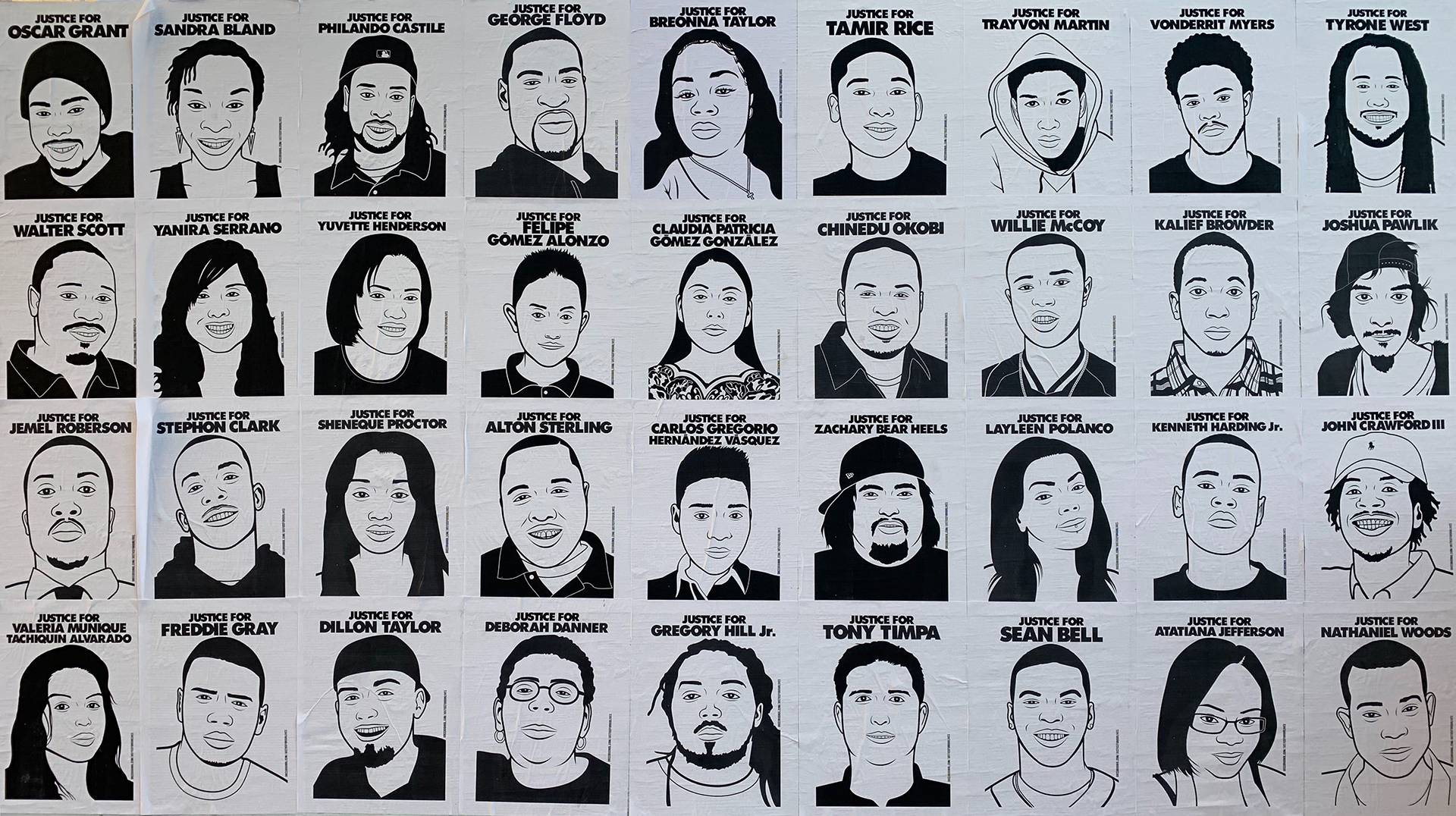
Just in the past decade, we've seen outrage over the killing of black people by police erupt in protests across the nation, from Oakland to New York to Ferguson to Baltimore to Minneapolis. The list could go on.
To many of those at recent protests, the words "I can't breathe" are an articulation of widespread oppression faced by black Americans in the U.S. It's a cry, yet again, for another kind of vaccine to another kind of disease.
"The phrase 'I can't breathe' signifies the asphyxiation of Black people in this country," Oakland resident Brooke Pearson summarized at a recent protest. She, too, had the words "I can't breathe," written on her face mask.
"There’s a likelihood that I could contract COVID and die," she said. "But I could also have my rights taken away from me by law enforcement, and I could be killed at the hands of law enforcement, and they would be treated with impunity."
Pearson said she's from Louisville and also wants justice for Breonna Taylor. Louisville police officers shot and killed Taylor, a 26-year-old emergency medical technician, on March 13 when they executed a no-knock search warrant at her home. Taylor’s boyfriend, Kenneth Walker said he thought police were intruders and fired at them. The FBI is investigating the incident and Taylor’s family has filed a wrongful death lawsuit.
In California, law enforcement officers killed 1,063 people between Jan. 1, 2009 and Jan. 1, 2019, according to data reported to the state Department of Justice. Of those slayings, only three led to the criminal prosecution of an officer.
Hispanic people (the state's categorization) accounted for about 45% of those deaths and white people for 30%.
Nearly 20% of those killed by police were African Americans, even though African Americans make up only 6.5% of California's total population.
Of those 1,063 killings, only three were found to be criminal homicides.
The following timeline details just a few of these killings at the hands law enforcement officers over the past decade. Many have generated significant public outrage and some have even prompted policy and legislative reforms. Although we primarily focused on Bay Area deaths, most happened in the context of national events and, in some instances, have shaped that context.
This is far from a comprehensive list of local police killings, but we hope to begin to answer the question asked by so many protesting: Why haven't things changed?