Sexual assault in jail. Domestic violence complaints against an officer ignored. Knocked-out teeth followed by a cover-up.
Throw in tens of thousands of stolen bullets, an illegal chokehold, falsified police reports and cavorting with sex workers, and you've got an emerging picture of what California's new police transparency law has revealed in its first six months.
Those cases involving California peace officers are some of the incidents recently made public due to a landmark transparency law that undid decades of secrecy surrounding police internal affairs files.
But six months after Senate Bill 1421 went into effect, some of the state’s largest law enforcement agencies haven’t provided a single record.
Some law enforcement organizations are charging high fees for records, destroying documents and even ignoring court orders to produce the files.
'Dragging Their Feet'
The law, authored by state Sen. Nancy Skinner, D-Berkeley, covers records of shootings by officers, severe uses of force and confirmed cases of sexual assault and dishonesty by officers. Skinner said the revelations that have come out so far are proof that the law is working to shed sunlight on police misconduct.
But she said it’s troubling that major state agencies, such as the California Highway Patrol, which employs more than 7,300 officers, haven’t yet produced a single record.
“If the state agencies themselves are acting like they're above the law, that's absolutely the wrong model and the wrong example to set for the rest of the local government agencies up and down the state,” Skinner said.
Skinner said she plans to call for oversight hearings to push for full disclosure.
“We'll have to start being more proactive about really poking them if they're dragging their feet,” she said.
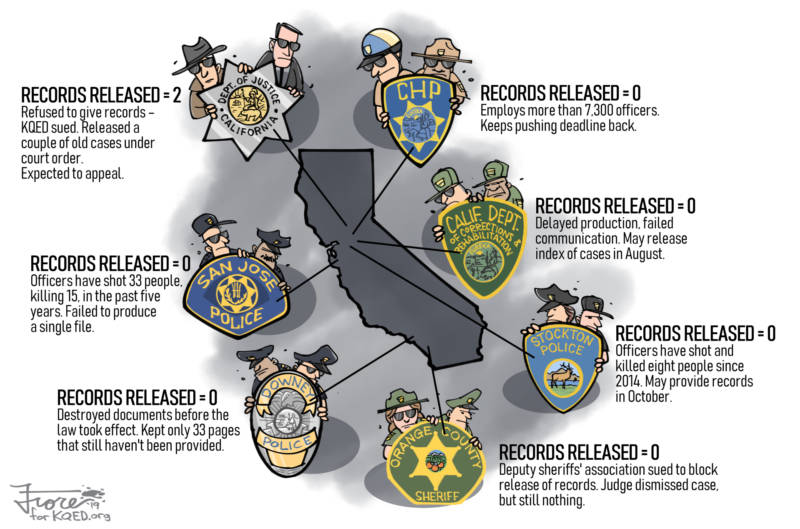
Officials with many law enforcement agencies insist they’ve done nothing wrong, saying they are trying to release records as best they can. They also dispute that there is anything improper about the records that have been destroyed.
Los Angeles County Sheriff Alex Villanueva acknowledged earlier this year that public records requests were "stacking up." He has said he’s asked the county Board of Supervisors for funding to hire more people to handle requests.
"People are asking for the world," he said. His office did not respond to requests to comment for this story.
After a San Francisco judge ordered the state Department of Justice to release SB 1421-related records in May, the agency issued two dated internal investigations into misconduct by state agents. The department has since failed to provide additional records.
The California Attorney General’s Office is expected to soon appeal the judge’s ruling, arguing that it shouldn’t have to provide the files it has on local agencies and otherwise seeking to narrow the records it is required to release.
KQED joined that case in March and is arguing for broad access to the records the state Department of Justice holds from law enforcement agencies across California.
“This project, this reporting, and the revelations we’ve seen in these documents should give victims — and all Californians — a belief in the power of journalism’s sunlight,” said Ethan Lindsey, executive editor of KQED News, adding that some state agencies have yet to provide a single record. “Hopefully this work will help convince them that this data is of legitimate public interest.”
Some of the largest local law enforcement agencies in California have also been slow to respond.
At a recent San Francisco Police Commission meeting, deputy public defenders addressed the difficulty they’ve been having getting records on officer dishonesty from the Bay Area’s largest police department.
“All it takes to support charges and hold individuals in jail is testimony by police officers,” said law student Will Kirkland, who is interning for the public defender. “Of course many officers in San Francisco are honest and have records of integrity. But for the minority of officers who don't, their word is still being relied upon to keep people locked up. And that's why we are simply requesting compliance with the law.”
SFPD has released only partial documentation from four shootings by officers and no disciplinary records. The department has said promptly releasing the files is too taxing, and it has invoked a dozen extensions. A department spokesman said SFPD is hiring 11 people to respond to requests.