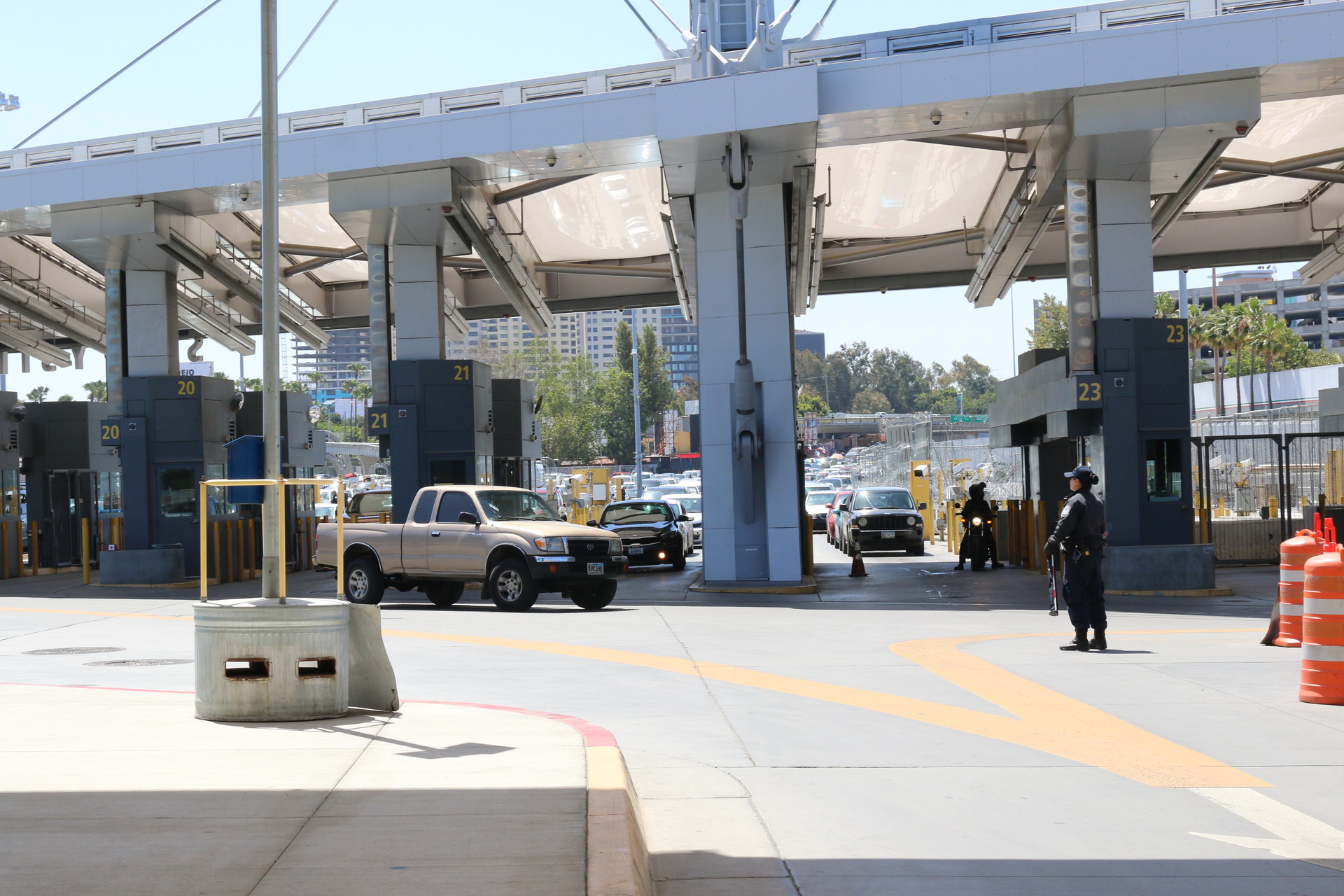
On a recent Friday at the San Ysidro Port of Entry, the modern, well-lit pedestrian crossing bustled with travelers on their way from Tijuana into San Diego. As they waited in line for a border officer to inspect their passports or other documents, another line began forming in a separate part of the building. This one was for asylum-seekers.
In this room, hidden from the routine flow of traffic, men, women and small children from Africa, the Caribbean and Central America stood in silence — single file, with their hands behind their backs. They waited for an officer to take them down several flights of stairs to the port basement, where they would be placed in a holding cell while U.S. Customs and Border Protection (CBP) decided where they would go next.
In late May, KQED got a rare glimpse inside CBP’s Admissibility Enforcement Unit, the basement of the San Ysidro Port of Entry where asylum-seekers attempting to enter the U.S. legally from Tijuana are initially processed. Under CBP standards, people should generally not be held in such facilities for more than 72 hours, but the time limit is often exceeded. Migrants told KQED they were recently detained there for weeks.
Asylum-seeking migrants often travel for weeks or even months to get to the U.S.-Mexico border. But officials say they are overwhelmed and can process only a limited number of requests each day, so the migrants put their names on an informal list and then wait in Tijuana — sometimes for months — until it’s their turn to return to the port of entry and ask for asylum. As large numbers of asylum-seekers arrive here, the basement has become ground zero for what the agency describes as a crisis.
Four asylum-seekers recently detained here told KQED that border officers denied them food, delayed medical treatment, used physical force against them or other detainees and pressured them to sign paperwork that would trigger their return to Mexico. While KQED was not able to independently verify the accounts from asylum-seekers, several individuals repeated the same observations in separate interviews.
A CBP spokeswoman denied those allegations, calling them unsubstantiated, and said the agency “treats those in its custody with dignity and respect and provides multiple avenues to report any misconduct.” She said the agency investigates all formal complaints.
The San Ysidro Port of Entry
Every day, 34,000 people walk north through the San Ysidro Port of Entry’s pedestrian crossings, and 45,000 cars move through its vehicle inspection lines, according to CBP. With 19% of all traffic coming into the United States here, San Ysidro is the busiest land border crossing in the Western Hemisphere.
The port’s underground facility looks like a jail, but cleaner. White cinder block walls enclose hallways with surveillance cameras. The floor is gray linoleum with drains. Migrants first undergo a medical screening. People with contagious illnesses, transgender migrants and other vulnerable detainees must be isolated, according to CBP.