Novelist Karen Tei Yamashita on the Relevance of Japanese Internment Today
Airdate: Monday, July 20, 2026 at 10 AM
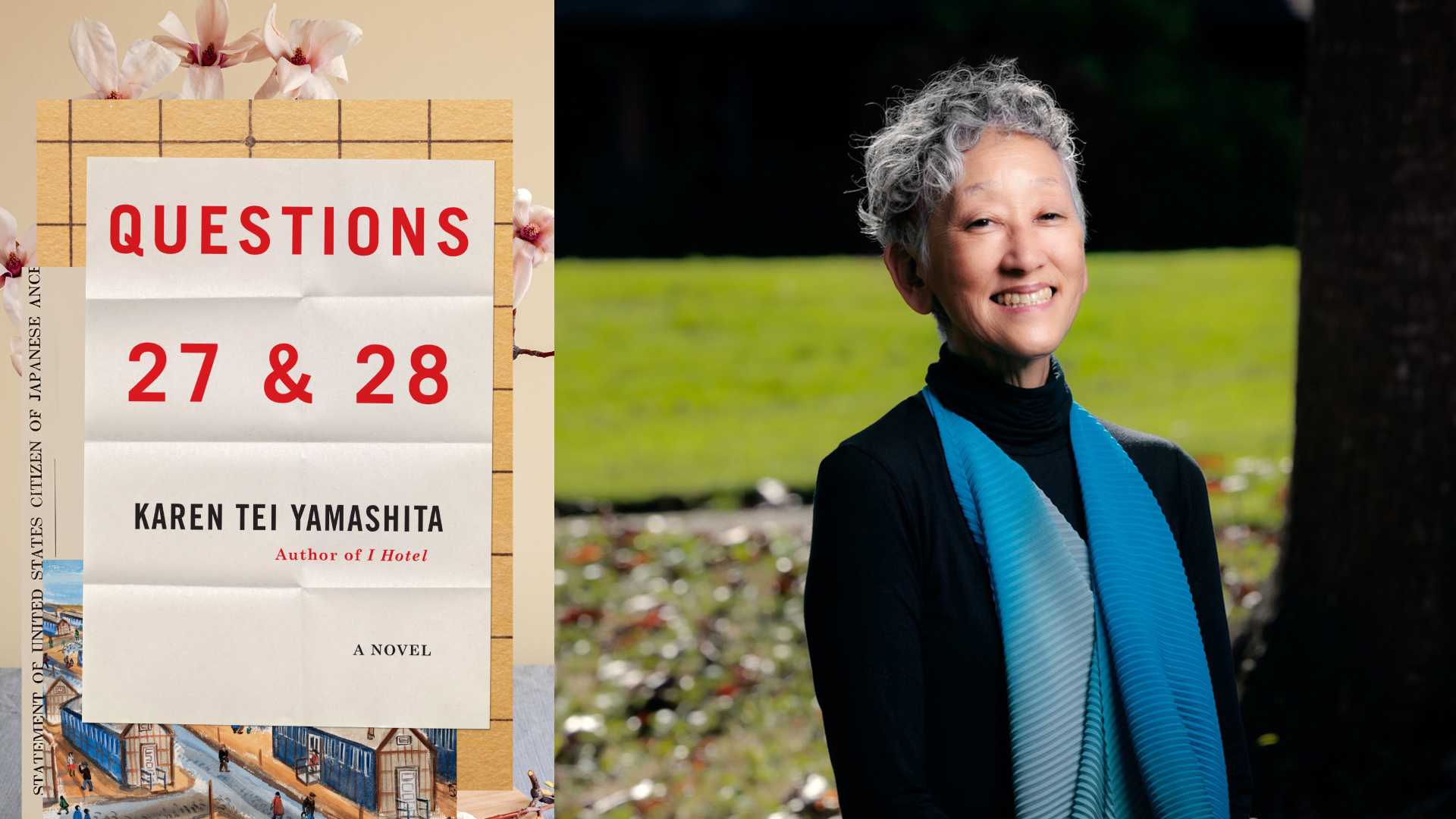
During World War II, the US government asked the Japanese American citizens it interned two questions: Would you serve in the US armed forces wherever ordered? And would you swear “unqualified allegiance” to the U.S. and forswear any allegiance to Japan’s emperor? Those two so-called loyalty questions animate acclaimed novelist Karen Tei Yamashita’s latest book, which explores that historical period of state-sanctioned violence against immigrants and citizens alike — and how this notion of “loyalty” divided, antagonized, imprisoned and expelled Japanese Americans during World War II, with long-term ramifications. Following three generations of Japanese Americans before, during and after internment, the novel is formatted as the archived letters, poetry and oral histories of Japanese Americans real and imagined. We’ll talk with Yamashita about her own family’s story and about the novel’s unfortunate relevance today. It’s called “Questions 27 & 28.”
Guest:
- Karen Tei Yamashita, professor, UC Santa Cruz; author, “Questions 27 & 28″
Episode Transcript
This is a computer-generated transcript. While our team has reviewed it, there may be errors.
Mina Kim: Welcome to Forum. I’m Mina Kim.
During World War II, the U.S. government forced the Japanese American citizens it was imprisoning to answer two questions: Would you serve in the U.S. armed forces wherever ordered? And would you swear unqualified allegiance to the U.S. and forswear any allegiance to Japan’s emperor?
The so-called loyalty questions caused division and pain and are at the center of acclaimed novelist Karen Tei Yamashita’s new novel called Questions 27 and 28. She joins me now to talk about examining internment through those two questions and the unfortunate relevance of that period today.
And listeners, how did the World War II incarceration of Japanese Americans shape your own family story? What parallels do you see with our current moment?
Karen, welcome to Forum.
Karen Tei Yamashita: Thank you.
Mina Kim: So, for listeners who might not be familiar, can you first remind us what the purpose of the U.S. government’s so-called loyalty questionnaire was at the time?
Karen Tei Yamashita: Well, at the time, these folks were incarcerated, 125,000 of them, two-thirds of them were citizens. And I think, quite frankly, the government and the military realized that they had made a mistake, and they needed to release these folks, either to serve in the military or to carry on lives outside of the West Coast.
Mina Kim: So it was really a condition of release, then, to answer them?
Karen Tei Yamashita: I believe so.
Mina Kim: Yeah. How did your parents, who were incarcerated at Topaz in Utah, answer those questions?
Karen Tei Yamashita: Well, they answered yes, yes. And I believe that all of their answers to these questions — anyone who answered them — were qualified. They were qualified answers to very complicated questions, which divided the community.
So no one really answered yes, and no one really answered no if you think about their reasons for answering.
For my family, my parents wanted to leave. They wanted to get on with their lives and work outside. My father wanted to continue his education. And many chose to say yes, yes. Others chose to serve in the military. Others answered no.
But my family, by and large, said yes. And whether they believed in their answers or not, they wanted to leave camp.
Mina Kim: Yeah. And as you say, unlikely that they answered them either way with their whole being.
But for those who did answer no, reasons that have been given are that it was in protest of their unconstitutional incarceration, right? Or perhaps even that, yes, they did feel like this was a country that had betrayed them, and they felt more of a connection.
What happened to the so-called No-No Boys, which was a derogatory slur applied to them, right?
Karen Tei Yamashita: Well, the No-No Boys who were resisters were in prison for the duration of the war. And some of the no-nos were sent to Department of Justice camps. They were physically in prison also for the rest of the internment.
And then the families were sent to a place called Tule Lake, which was in Northern California. It became a segregation prison.
Many of them were forced to renounce their citizenship, if they had citizenship, or to repatriate to Japan. So several thousand of them were put on ships, and they returned to Japan.
Mina Kim: Yeah. Can you say a little bit more about how these questions divided and really antagonized the Japanese Americans in the camps?
Karen Tei Yamashita: Well, at the time, there were many discussions within the blocks about how people should answer. And I think there were movements to try to get everyone to answer in the same way.
But, of course, people wanted to answer independently, and they had different reasons for their answers.
And yes, it completely divided the camps and the folks in them. It put them at loggerheads. It put them against each other. Families were divided. Friendships were broken.
Mina Kim: Yeah. You talk about how the Japanese American Citizens League encouraged yes, yes, in the sense that Japanese Americans needed to show that they were 200% American.
And then, of course, we talked about the sort of opposite feeling and view of the people who answered no. I can imagine that must have been incredibly difficult.
Karen Tei Yamashita: Incredibly difficult, yeah.
And also, these were differences that moved through the community for generations and many years later, until the deaths of these folks.
Mina Kim: Yeah.
Let me invite listeners into the conversation. How would you answer Questions 27 and 28? How did internment shape your own family story? What parallels do you see with our current moment?
You can tell us by emailing [email protected], finding us on Discord, Bluesky, Facebook, or Instagram at KQED Forum, or by calling 866-733-6786.
So I want to talk to you about the lasting impacts of that. As you say, what have been some of the ways that has still affected Japanese Americans and maybe even more broadly, the status of Asian Americans in the U.S. today?
Karen Tei Yamashita: Well, as you know, in the ’80s there was a movement for reparations. During that period of time, Japanese Americans worked to get reparations and an apology from the United States government, which they did succeed in doing at the end of the ’80s.
But in order to do that, they had to be politically savvy about how to convince the American government and Congress that this could be done. And so they foregrounded the loyalty of Japanese Americans, especially in the military.
Mina Kim: Mm-hmm.
Karen Tei Yamashita: At the same time, those folks who resisted wanted to say, “Hey, we resisted, and we had our constitutional rights removed, and this was wrong.”
So there were a number of movements that were working in concert to try to get reparations, but also with different political agendas. Those agendas got in the way of each other.
But I would say that those folks who had protested, who were no-nos for all the different reasons, maybe took their stories and put them aside in order that we would get a positive reaction to the possibility for reparations.
And for myself, I had a play at the time that I was putting on at East West Players in Los Angeles. It was about a nationalist position that was taken by the Brazilian Japanese, and it was pretty negative.
Mako had asked me at East West Players, “Let’s go forward with the play.”
And I said, “I think we’re going to remove it for the time being because it may show that there was a nationalist position of pro-Japan nationalism.”
Mina Kim: Yeah, so you really felt that pressure.
You have also connected these questions to the model minority myth. How so, Karen?
Mina Kim: Yeah, so you really felt that pressure.
You have also connected these questions to the model minority myth. How so, Karen?
Karen Tei Yamashita: Well, think about it. If you’re 200% loyal, you’ve got to be the best citizens in the world, right?
Mina Kim: Yeah.
Karen Tei Yamashita: So I wondered how that affected who we were in school, who we were as citizens, how we projected ourselves and reproduced our vision of who we are.
Mina Kim: Yeah.
Karen Tei Yamashita: Absolutely. We couldn’t be bad. We would be sent to Japan. It was Siberia.
Mina Kim: Yeah, for so many. I mean, being asked to forswear allegiance to the emperor when they had no connection — it just goes to show the assumptions that people made.
Tell me what exploring internment through these two questions allowed you to do, or how it made you see internment in a different way, or opened up new ways to see it.
Karen Tei Yamashita: Well, I wondered first about the questions themselves. They divided my community for years, until now.
But I also wondered where they came from. I assumed they were questions that came out of sociology and anthropology. We ask questions, we take data, and we figure out the numbers. And this is important work, right?
Similarly, in this case, you ask questions. These questions were also used to serve as a kind of database for how many Japanese were so-called loyal and how many were not, what their ages were, what generation they were, how educated they were.
The questionnaire is actually much longer. It’s not just Questions 27 and 28.
Mina Kim: Right. Those were the final — yeah, those are…
Karen Tei Yamashita: Yeah. Those are the questions that were most potent to answer.
But the questionnaire is banal in many ways. It tells us where you were born, how old you were, where you were educated, what magazines you read, whether you had spent any time in Japan, your citizenship — all of those things.
So they were able to compile very, very detailed data.
Mina Kim: Of who people were.
We’ll have more with Karen Tei Yamashita after the break. Stay with us.
I’m Mina Kim. You’re listening to Forum.