This partial transcript was computer-generated. While our team has reviewed it, there may be errors.
Mina Kim: Welcome to Forum. I’m Mina Kim.
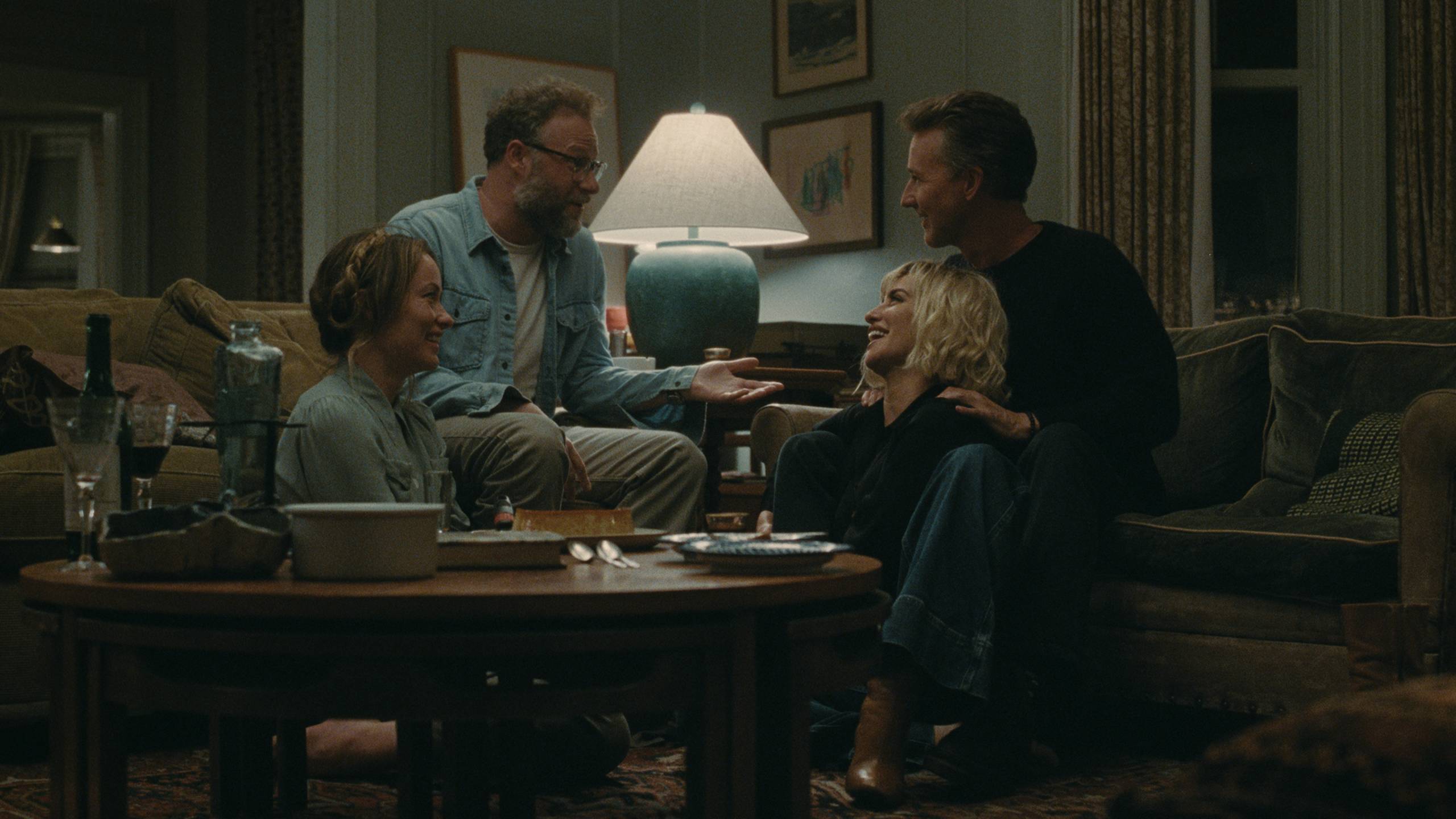
A new film directed by Olivia Wilde called The Invite stars her and Seth Rogen as a married couple, and Edward Norton and Penélope Cruz as the neighbors from upstairs coming to dinner for the first time. Over the course of a single night in Wilde and Rogen’s San Francisco apartment, the four manage to surface marriage’s deepest resentments and greatest capacities for intimacy. Based on a screenplay by Will McCormack and Rashida Jones, adapted from a Spanish film by Cesc Gay, The Invite grapples with how to reinvent a relationship that’s turned stale and bitter. Olivia Wilde and Edward Norton join me now. Olivia, welcome to Forum.
Olivia Wilde: Thank you.
Mina Kim: And Edward, it’s great to have you back on Forum.
Edward Norton: Yes. Too long.
Mina Kim: Since Motherless Brooklyn. So, Olivia, our entire Forum team saw The Invite together when it premiered at the San Francisco Film Festival, and we could not stop talking about it afterward — about the two of your performances and, of course, the very relatable relationship issues the film tackles. Tell me what drew you to this story.
Olivia Wilde: Well, first of all, that screening at the Castro was one of our best. I’m so happy you all saw it there. What an incredible theater. I was so drawn to this story in its original form — Cesc’s film, which was based on the play he wrote and directed. I thought, what a great story, what a simple and powerful idea, and what an opportunity to gather a group of artists together and adapt it into something that feels really specific and personal to us in this moment. To make the American version feel specific to a lot of our cultural idiosyncrasies around relationships. It felt like a wonderful challenge and an opportunity to work with some of my favorite people in the world.
Mina Kim: What about relationships felt so modern and present to you right now?
Olivia Wilde: I think everyone today is dealing with a kind of isolationism, and we’ve become unfamiliar with friction. The idea of an unpredictable social experience is something quite foreign to most of us. Through social media and everything else, we curate our lives so completely that we sanitize them of all spontaneity — even the way we use GPS to get from point A to point B. We don’t leave much room for mistakes or discovery. And I think that relates to relationships, to meeting new people, to being forced to feel seen in ways that are maybe very uncomfortable.
For this couple, they’re in a very tense place, nearing what I think of as contempt — the sort of point of no return. They haven’t been socializing much, partly to avoid being witnessed. And this night is about being forced to acknowledge the tension they’ve been sitting on top of, and being witnessed by two people who completely change their minds about what’s possible — as individuals and within relationships.
Mina Kim: Edward, what made you want to get involved in a project like this?
Edward Norton: I had also seen Cesc’s film. In Spain it was called Sentimental, and I think we got to see ourselves as the couple upstairs. Everything Olivia said — it was hysterical and tender, very Spanish in its inflections and language and the idiosyncrasies of the characters. But it struck me exactly the same way: what he had done was create this armature that you could hang any four people on. You could hang couples from any culture on it and revisit and reimagine it in infinite ways.
It’s a funny comparison, but think about something like Hamlet — I saw a great production of it at the RSC in Stratford last summer — and ask how it still works in different ways four hundred years later. It’s because it’s a meditation on existential uncertainty and grief and all of it. Actors bring themselves into it, directors bring themselves into it, and they reinterpret and reimagine it contextually. And I think what Cesc had addressed — the difficulty of, as Esther Perel says, eroticism in a long-term relationship, and honesty — is also universal and timeless. The prospect of doing our own spin on it was really delightful to me.
And candidly, when I watch something and love it, I do this thing where I go, oh god, what would I have done with that? I start projecting a film that doesn’t exist in my head. And literally when I was going through that exercise, I thought of Seth. He was one of the first people I thought of — he’s an old friend, we’ve done other things together. And I loved Olivia’s films. I loved Booksmart. I loved Don’t Worry Darling. When I heard she was going to do this, a huge part of the draw was Olivia and Seth, and then Penélope, who I’ve been friends with for almost thirty years. The chemistry of what Olivia was proposing was just too exciting to pass up. I think I jumped through the phone before she was finished.
Mina Kim: Well, let’s talk about that spin, that chemistry. Olivia, you play Angela, the host of this dinner party. Tell us a little about her.
Olivia Wilde: Angela is riddled with anxiety, a people-pleaser to a fault. She’s someone desperately hungry to be seen. She went to art school, didn’t do anything with her degree, is a frustrated artist who channeled all that creativity into creating a home. She married Joe — they’ve been together twenty years, married for fifteen. She gave everything up thinking it would make her lovable, make her safe, that it was the life they were choosing together. And she’s arrived at this midlife crisis of understanding that she’s completely unsatisfied in every way, and she resents him deeply for it. Until this particular night, she hasn’t really come to the realization that she too bears some responsibility for giving up what she always dreamed she’d have. She’s struggling to connect with her own eroticism, her own identity. She’s lost — but she’s also a really emotional and vulnerable person, very porous, very susceptible to the energy around her. Just being around Edward and Penélope’s characters lights her up. It’s like she’s suddenly overtaken by this awareness of what’s possible. You can see it energizing her, rocking her world.
Mina Kim: She completely springs this dinner party on her husband Joe, played by Seth Rogen — the last thing he wants to do that night. And the dinner is with the upstairs neighbors, played by Edward Norton and Penélope Cruz. Edward, your character is Hawk, an ex-firefighter living upstairs with his girlfriend Piña, played by Penélope Cruz. What called you to Hawk?
Edward Norton: I like characters with unsuspected depth. I like characters with secrets, who are holding onto something that, when you examine it later, you realize was always there underneath what you were seeing. This story kind of unpeels that.
Olivia and I talked a lot. In Cesc’s film the man upstairs is indeed a firefighter, but they don’t lean into it much — it’s noted but not developed. Olivia was amazing with all of us in saying: I really want to treat each of these characters as an empty frame that we can each fill with ourselves, bring our own baggage to, our own memory drawer of insights and stories and ideas about character.
My character’s name wasn’t Hawk in our script. That came from real life. There’s a real Hawk — he’s a friend of mine, someone who changed his own name based on his initials in his midlife. A lot of people rolled their eyes at it, but he went forward with it for his own reasons. I told Olivia that story, and she was like, no — Hawk. That is great. So we came up with this idea of a person who has changed his life and changed his name. And then we developed what his secret was, doing the old acting school exercise of: what is he carrying? I liked the idea of someone who seems one way and then hits you by surprise with what his other layers are.
Mina Kim: I want to dig into that experimental process. Right after the break, we’re talking with Edward Norton and Olivia Wilde about their new film, The Invite. Stay with us for more. This is Forum. I’m Mina Kim.