This partial transcript was computer-generated. While our team has reviewed it, there may be errors.
Lesley McClurg: Welcome to Forum. I’m Lesley McClurg. I’m in today for Mina Kim.
Yosemite. My family visited every summer when I was growing up. I loved it. Half Dome, Yosemite Falls, riding my bike through the campgrounds—those are all really strong memories. Luckily, none of my memories are colored by the really long lines and parking lot headaches that visitors are experiencing this year.
Let’s talk about what’s going on and maybe how you can avoid these headaches and potentially even find other truly wild experiences in other parts of California that are just as beautiful.
We’re joined by Sarah Wright. She is KQED’s outdoors engagement reporter. Welcome, Sarah.
Sarah Wright: Thanks so much.
Lesley McClurg: So what’s going on? Why did Yosemite get rid of its car reservation system this year?
Sarah Wright: Yeah. So when they announced the change in late February of this year, the National Park Service said that they had evaluated traffic patterns, parking, visitor use, all of these items from 2025, and they had decided that this reservation system that we’ve had since 2019, essentially, did not need to occur this year.
When I asked for more details about what this data was and what it showed, I didn’t get a response. But the park had indicated to other media outlets and to me that they didn’t see high demand for Yosemite as a problem. They were like, this is a normal function of a national park. We’re not worried. We’re going to forge ahead.
Lesley McClurg: So before, how did it work? What would people do to make a reservation?
Sarah Wright: Yeah. So basically, you would log on and sign up for a timed entry. That allowed visitors to have a slot when they were guaranteed to be able to get into the park.
The idea behind this was basically just to spread out visitation, not only across days to get rid of these long lines on peak weekend days, but also across hours so that these 9, 10, 11 a.m. peak times to get into the park wouldn’t have people sitting in traffic for 3 or 4 hours.
Lesley McClurg: And so what did park employees and visitors say about how it was working?
Sarah Wright: So I experienced this. I went to the park with the timed entry, I believe it was in 2021. And it was pretty seamless. I think I got the reservation a month or so in advance, and I was kind of reassured knowing that I was going to get into the park. I was going to be able to find parking at trailheads. I didn’t feel like I had to change my itinerary in response to crowds.
And folks this year have told me that that has changed a bit on peak weekends. Now they’re seeing these long wait times, and it’s really difficult to get parking in the Valley in particular on these peak weekend days during these peak hours.
Lesley McClurg: Is there a push then to bring the system back?
Sarah Wright: Yeah. I’ve talked to a few advocates, even local business owners, who say that even though they are getting a lot of business with this open park, they want the reservation system back—not only to make people’s visitor experience more seamless.
I mean, they have tour times to hit, right? Waiting in line isn’t ideal. They’re also worried about harm to the park. Lots of these wilderness areas and national forests have permitting systems for a reason, and it’s to disperse visitation and the impact that visitors have on parks across time and across distance.
They’re worried that the very thing people are coming for is being degraded by so many people coming all at once.
Lesley McClurg: And are we seeing that? Are we seeing more trash or maybe people damaging the park or hurting the wildlife?
Sarah Wright: Yeah. Particularly last year during the government shutdown, that was kind of the first time there wasn’t a reservation system for a while. There were lots of reports of trash at various national parks, lots of reports of damage to things like open meadows, people parking illegally, and ending up overusing trails or areas that you really shouldn’t be driving vehicles over or bringing massive amounts of people into.
So there were definitely reports of the effects of overcrowding, not only on the visitor experience but also on the park itself.
Lesley McClurg: It’s almost like we’re loving Yosemite to death—or not there yet, but potentially doing damage to the park.
What about the fact that there are a lot fewer park employees? How is that affecting the park experience?
Sarah Wright: Yeah. It’s had a big effect ever since last February, when many park rangers were fired or not hired for seasonal work.
There have been fewer and fewer people around in the park—these enforcement rangers who are able to educate first and then also ticket and enforce rules for people who aren’t following them.
When I was there during the government shutdown, I saw rangers here and there. They definitely were around. But I sensed this sort of air of, okay, we can do whatever we want among visitors. And I think once somebody sees somebody breaking the rules, they’re more inclined to break the rules themselves.
So having staff around to educate, to be at the front of a trailhead and say, “Hey, you need to put your snacks away or else the squirrels are going to come eat them,” I found that super helpful because it puts that little reminder in your head of what to do and how to behave.
Lesley McClurg: And not just the squirrels, but the bears. There’s some real danger if people aren’t safe with their food, etc.
Are we seeing similar stories at other national parks across the country because of the changes under the Trump administration?
Sarah Wright: Yeah. There were a couple of other parks that also dropped their reservation systems this year, and all parks have really been affected by these staffing cuts.
And that’s not even to mention the Trump policies last year and this year around signage at national parks. There was this whole movement to take down signs or cover up signs that Trump deemed disparaged Americans.
That was actually recently struck down in the courts, so we’ll see if there’s going to be any sort of restoration of those signs or what’s going to happen next.
But speaking to park superintendents and folks who work in parks at all levels across the nation, there’s been this era of fear, uncertainty, and insecurity for park rangers who just really aren’t sure if their jobs are secure, what’s going to happen next, and how they can carry out their mission to conserve and welcome people to parks.
Lesley McClurg: To these really beautiful places.
Well, visitors who purchase the annual America the Beautiful Pass will notice that Trump’s face is on this year’s pass. Have other presidents done this? How unprecedented is this move?
Sarah Wright: It’s unprecedented.
The pass has historically featured flora and fauna from one of the national parks. I have one from last year. It features the roseate spoonbill from the Everglades, and I actually got to go to the Everglades last year. I didn’t see the spoonbill, but I was looking for it the whole time because it was on my pass.
So this is very much a different move, and a lot of people have complained about Trump’s face on the pass. Some companies have even started selling sleeves so that people can cover it up in their wallets.
But just be aware, if you’re planning on doing that, you shouldn’t alter the pass itself because you could accidentally void it. So don’t mess with the plastic, but go ahead and cover it up if that’s what you’d like to do.
Lesley McClurg: I imagine that some audience members are going to hear this and be like, okay, I’m not going to Yosemite this summer. It sounds terrible.
Are there still ways to find solitude in the park?
Sarah Wright: Absolutely. And look, if you’ve never been to Yosemite or if you’ve had these plans for months, you should go. It’s amazing. It’s always worth it. I have a fun time every time I go to Yosemite.
But the summer right now in particular—the snow has almost melted—so go to the high peaks, the higher parts of Yosemite. Get out of the Valley if you’ve already experienced the Valley. It’s iconic. It’s beautiful. But the rest of the park is huge. It has so much to offer, and right now in the summer is the time to experience it.
That would be my first recommendation: get out of the Valley.
My second recommendation would be to bring things that help keep you independent. Bring your own bike so that if you find a parking spot, you can bike around. There are also bikes for rent in the Valley.
You could consider taking public transit to get there. YARTS offers buses that go into the park every single day. Bring your own food. That will save you money and time when you’re waiting in line at vendors in the park.
There are lots of ways to insulate yourself against these crowds. Just make sure you’re doing everything within the rules. Store your food away from bears. Make sure you’re parking somewhere you’re allowed to park for long periods of time. All that sort of stuff.
But there are definitely ways to experience and love the park. Chief among those is trying to go during off-peak times. If you can go on a weekday, if you can go early in the morning or later in the evening, that’s all going to help as well.
Lesley McClurg: Just slow down there a little bit. You brushed on it, but on the public transportation options, where can you take public transportation from? Do you have as much freedom when you’re there? What if you want to camp and you don’t have a car? Give us kind of a lay of the land.
Sarah Wright: Yeah. So the main public transit agency is called YARTS. These are big buses, and they’re actually super comfy, nice coach buses. They have lots of space for luggage underneath, so you can even bring all of the camping equipment you want to bring.
They come from both sides of Yosemite. You can come from the Eastern Sierra side, or you can come from places like Merced on the west side. There is overnight parking where the bus depots are, so if you want to leave your car there, you can do that.
And the coolest thing that I learned this year is that if you take public transit into Yosemite, you get access to the backpacker campgrounds. These are basically first-come, first-served walk-in campgrounds in the park, and you are guaranteed 3 consecutive nights—1 night at each backpacker campground.
These are pretty low-cost campgrounds that you can just walk into with your stuff.
Lesley McClurg: Like what kind of cost?
Sarah Wright: I want to say—oh gosh, I’d have to check—I want to say it’s under $20. So pretty great for Yosemite Valley.
These are the same iconic campgrounds that everybody else is staying in. You get to walk right up with your stuff. You can stay there. You can have a lovely time. You just have to move the next night to a different one.
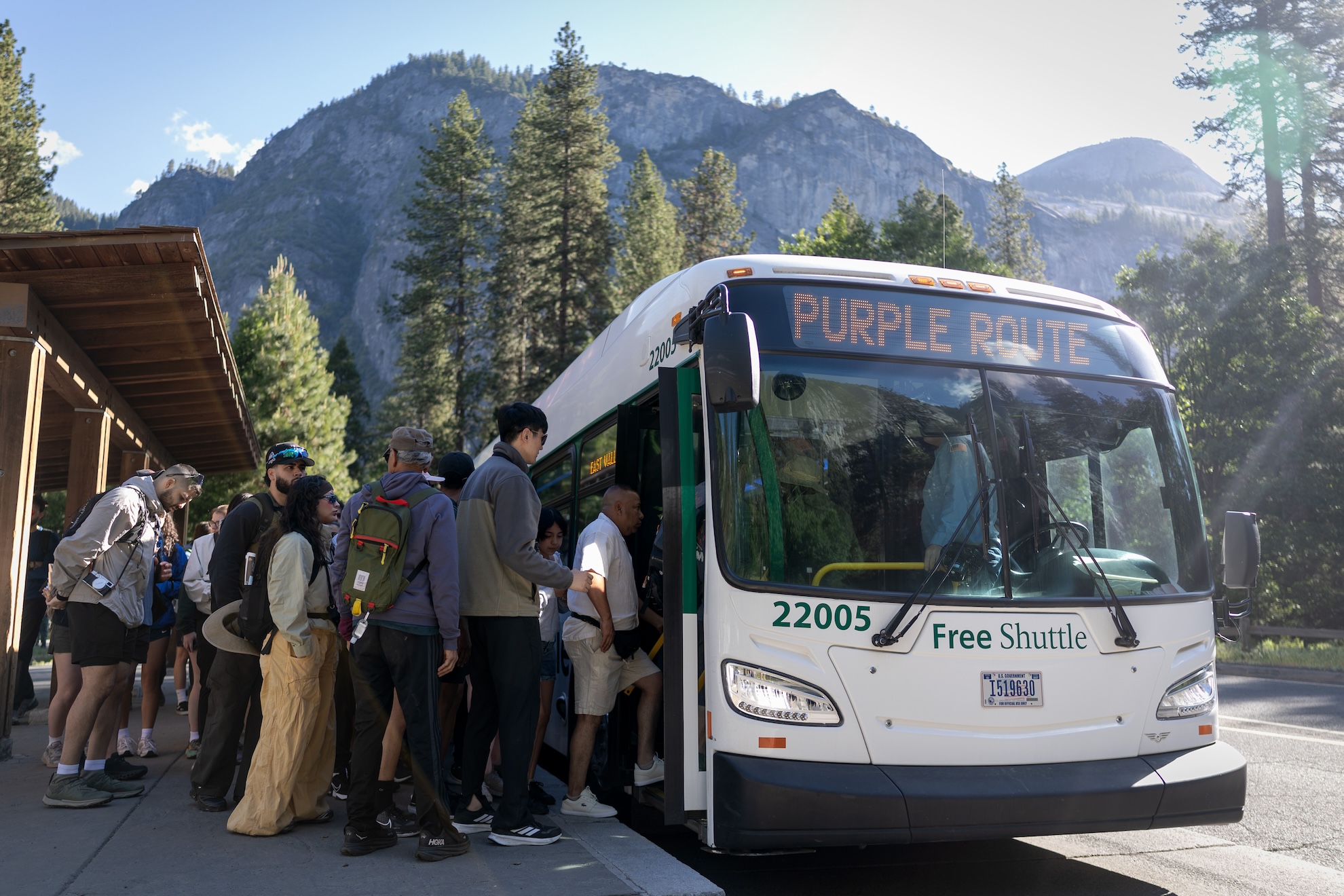
There are shuttles within the park that can take you around to the various campgrounds. In the Valley itself, there’s also a Valley shuttle, which most people take anyway because driving a car is kind of crazy in the Valley.
So it’s really not that different of an experience without a car. And if you are mainly sticking to these main trailheads, it’s totally doable via public transit.
Lesley McClurg: We are talking about this summer’s massive crowds at places like Yosemite National Park. We’re hearing about some alternatives and some good advice from Sarah Wright. She is our KQED outdoors engagement reporter.
We would love to hear from you. Have you been to Yosemite this year? Tell us about your visit. What was it like? Maybe what’s the best campsite you’ve ever stayed at in California? Was it in Yosemite, or was it somewhere else? Maybe there’s an unexpectedly beautiful place that you’ve discovered in the state that you’re willing to share with other listeners.
Email your comments and questions: [email protected]. You can find us on all the social platforms—Discord, Bluesky, Facebook. We’re @KQEDForum. Or you can just give us a call: 866-733-6786. Again, 866-733-6786.
We’ll be right back after this break.