This partial transcript was computer-generated. While our team has reviewed it, there may be errors.
Guy Marzorati: Welcome to Forum. I’m Guy Marzorati, in for Alexis Madrigal.
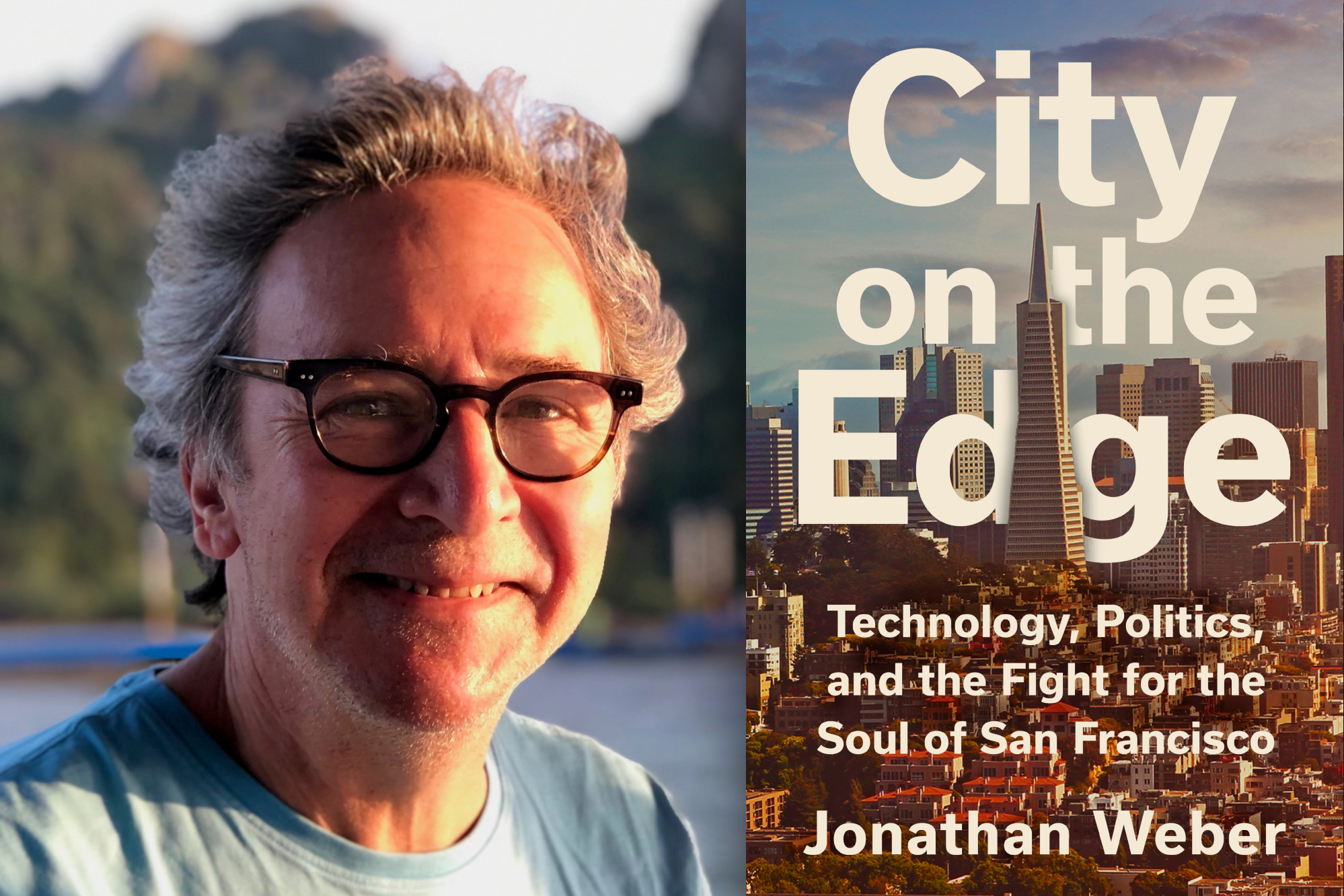
In San Francisco, rents are spiking and home prices are surging as the city awaits the IPOs of booming AI companies. A recent Business Insider headline declared: “Last Call for Ordinary People Trying to Buy a House in San Francisco.” Jonathan Weber has seen it all before. His new book, City on the Edge: Technology, Politics, and the Fight for the Soul of San Francisco, catalogs past tech booms and busts and the imprint they left on the city. Jonathan Weber, welcome to Forum.
Jonathan Weber: Thank you, Guy. Great to be here.
Guy Marzorati: Great to have you. You chronicle two tech booms in this book and their effects on San Francisco. What feels similar, and what feels different this time around with AI?
Jonathan Weber: The AI boom definitely feels similar in important ways to the dot-com bubble, which I chronicle in the book, and also to the smartphone-driven boom that really began around 2010. In both cases, one similarity is the speed at which things develop. In each instance, the frenzy around these opportunities — or perceived opportunities — among investors develops very quickly, and there’s a fear of missing the big thing, so people rush in. With the current AI situation, the investing mania really only began a year or two ago at most. Similarly, in those earlier bubbles, over just a couple of years, you had a massive shift in both the vibe and the financial characteristics of the industry.
There’s also a leveling up each time in the sheer amount of money involved. We’re now talking about companies worth trillions of dollars, which back in 1990 would have seemed insane. A big funding round in 1990 might have been $50 million. Now a big funding round is a billion dollars. The scale has fundamentally changed.
One way in which this moment feels different is that the job impact of this boom is much less clear. In the earlier booms, San Francisco was a magnet — tens of thousands of people moved to the city to take advantage of the opportunities. In the current AI boom, you’re actually seeing a decline in employment in traditional tech industries, because AI is taking jobs from older software companies. So the employment impact on the city is mixed, and the impact on population, downtown businesses, street life, and the spirit of the city is also more complicated.
Guy Marzorati: This boom has also coincided with a new mayor in San Francisco, Daniel Lurie. Do you see his first eighteen months as intertwined in any way with what’s happening with AI?
Jonathan Weber: Mayor Lurie has benefited tremendously from the rise of AI coinciding with his term in office — though he can’t really claim credit for it. This was all underway before he was elected. Even back in 2023, Y Combinator chose to return to in-person work in San Francisco rather than Silicon Valley, which I thought was an interesting indicator. OpenAI was already getting big. The AI boom was developing well before Lurie was elected.
That said, I do think Lurie has done a good job so far. He’s harvested a certain amount of low-hanging fruit in terms of how the city is run, and he’s generated a lot of goodwill through his earnest, straightforward demeanor. That has coincided with the rise of the AI industry in a mutually beneficial way. Lurie has been aided by the economic boost from AI, and the AI companies have gained more confidence in the city from the sense that there’s a new mayor who is getting his arms around things.
Guy Marzorati: How do you separate what’s really changed on the ground from a vibe shift? Lurie would point to crime being down, homelessness being down. And public opinion polling seemed to show that resident perceptions of the city’s direction flipped almost overnight when he took office.
Jonathan Weber: A vibe shift is a big part of it, and he can claim some credit for that — his personality contributes to it. But most of the policy changes that have made a difference, including the falling crime rate, were actually happening before he was elected. Former mayor London Breed, in my conversations with her for the book, expressed some frustration that Lurie was getting credit for things that were really underway during her tenure. I think that’s a fair point on her part.
Guy Marzorati: You cover the terms of four or five different mayors going back to the nineties. Have you seen anything like what we’re seeing with Lurie in his first eighteen months? His approval is at around seventy-five percent, and virtually everything he put on the ballot in June passed. Any historical comparison?
Jonathan Weber: The closest comparison is probably when Willie Brown was elected in 1995. When Mayor Brown first took office, he was extremely popular. There was a feeling that the city’s favored political son had come home and assumed his proper place at the head of what he himself called the “city family” — a term I think is a useful descriptor of the San Francisco political system. There was a similar optimism when he took office, but it dissipated fairly quickly, foundering on the political divisions that have been splitting the city for a long time.
Guy Marzorati: You write that Lurie’s election in 2024 marked a real departure from the city family era. Have you seen that in how he’s actually governed?
Jonathan Weber: That’s a good question, and I’m not sure there’s been a huge departure in practice. He’s been a fairly consensus-seeking mayor — not terribly confrontational. He’s tried to bring people along with him and maintain something of a “we’re all in this together” spirit. So I’m not sure there’s too large a difference on that front.
Guy Marzorati: At the same time, we’re seeing these companies on the verge of enormous IPOs, while Lurie is trying to balance a budget with a $600 million shortfall and seeking a Muni bailout on the ballot. How do you see these two things happening in concert — this accumulation of tremendous wealth alongside city finances that still seem fairly precarious?
Jonathan Weber: The difficulty the city faces — and that all California cities face — is that it’s really handicapped by Prop 13. Without Prop 13, the dramatic rise in real estate values over many years would have produced a corresponding increase in tax revenues. But because property taxes are capped, that doesn’t happen in the same way. As a result, the city has become very reliant on business taxes to fund social services and other things. And those business taxes are controversial — in some cases, they’re taxes that don’t exist in most other jurisdictions, which makes it easy for companies to simply leave town to avoid them.
Logically, what you’d want to do is tax the wealth of AI companies and the individuals making enormous fortunes, and use that money to address the problems that wealth creates — namely, displacement. But it’s not that simple. The city can’t impose income taxes under state law. It can’t impose higher property taxes under state law. The main tool available is higher business taxes, and that risks driving companies out. That’s essentially what the overpaid executive tax that was recently on the ballot was all about.
Guy Marzorati: If there are limits on how the city can capture the success of these companies through taxes, what other lessons do you think city leaders should take from the past booms you’ve explored?
Jonathan Weber: The main lesson is almost an inverse one — it has less to do with what to do during the boom and more to do with what to do on the other side of it. Every boom is followed by, if not an outright bust, a much slower period. And those slower periods are actually the moments when the city has the best chance to catch up on some of its problems. Housing and homelessness, for example, are extremely hard to address when real estate prices are through the roof. When prices come down, that’s the window to make some moves. I think there were missed opportunities, particularly in the 2000s, to get ahead of some of these issues.
Guy Marzorati: That was difficult this last time around too, right? Because the bust, such as it was, was pretty brief after the pandemic.
Jonathan Weber: The pandemic was a genuinely novel situation that I don’t think anyone was able to see around the corners on very well. Initially, everyone thought the whole economy was going to collapse. Then after a month or two, it became clear that wasn’t going to happen — on the contrary, there was a gigantic boom in tech because everyone was stuck at home and had to use technology to live their lives. And then that bubble deflated very quickly. There were just a lot of unusual and rapid developments during the pandemic, and I’m honestly not sure what the lessons are from that period.
Guy Marzorati: We’re talking with Jonathan Weber, longtime tech journalist, about his new book, City on the Edge: Technology, Politics, and the Fight for the Soul of San Francisco. We want to hear from you. What do you think about the relationship between the tech industry and San Francisco? In what ways does tech define the city, and in what ways does the city define tech? We’d also love to hear from anyone who was part of the early tech scene here — what memories you have of that era, and how you think civic leaders have managed the industry over the years. Call us at 866-733-6786, email [email protected], or find us on Bluesky, Instagram, or Discord at KQED Forum. We’ll take a short break and continue our conversation with Jonathan Weber when we come back. Stay with us.