This partial transcript was computer-generated. While our team has reviewed it, there may be errors.
Rachael Myrow: From KQED, this is Forum. I’m Rachael Myrow, in for Mina Kim.
One first-time director made a feature for $2,000—no actors, no cameras—and showed it at Tribeca. A more established director, Gareth Edwards of Rogue One fame, told Hollywood insiders at Amazon’s AI on the Lot event in May, quote, “I view it like having a second-unit director who is a billionaire on acid,” unquote—as in tasteless, but well-resourced and up for anything.
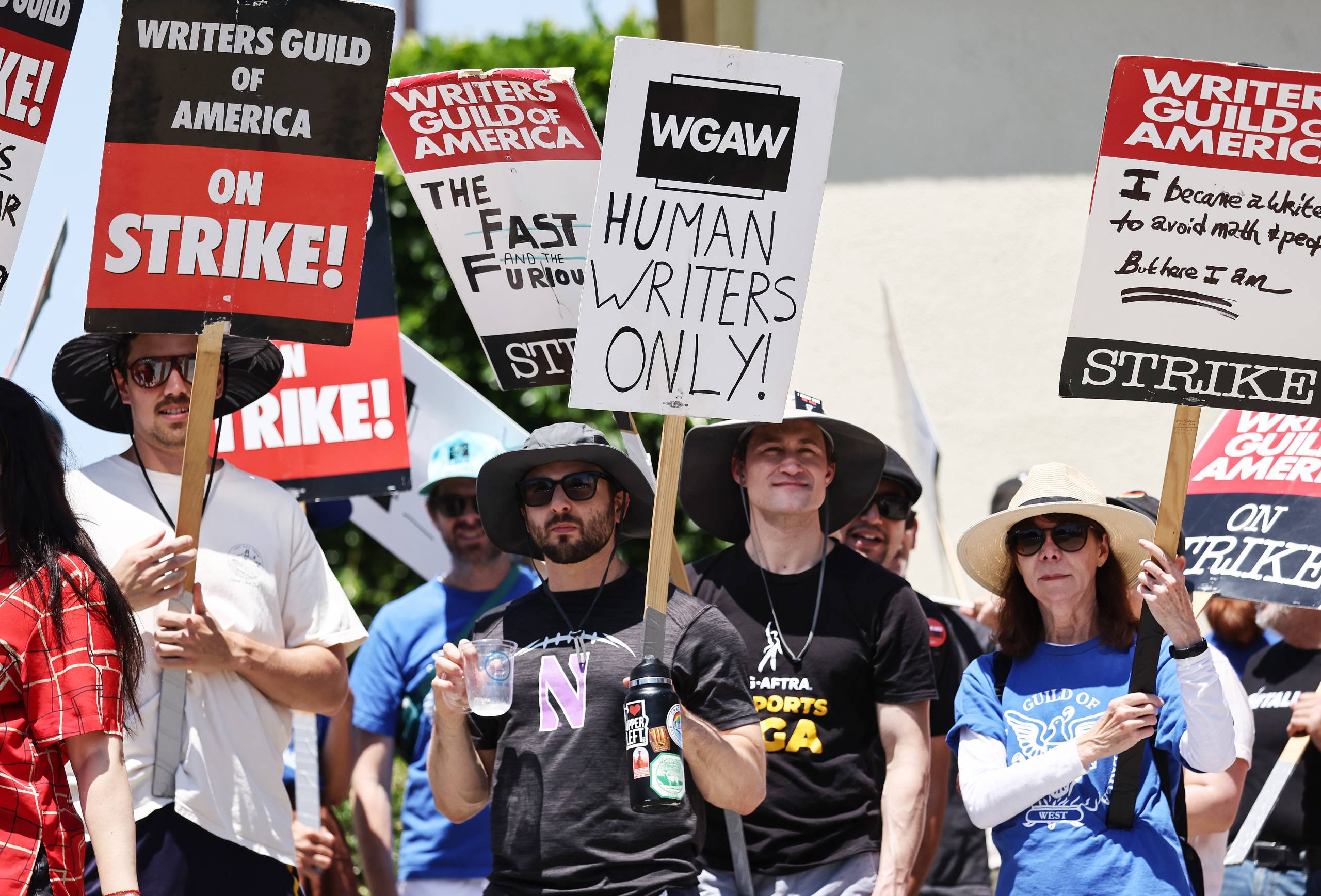
But if you’re an actor who’s not a superstar, or a set designer, or a visual effects specialist, AI might sound like a death knell for your career and the careers of thousands of others. Is it? And where does the audience—us—factor into all of this?
This hour, we start with Steven Zeitchik, senior editor of technology and politics for The Hollywood Reporter. Steven, thank you so much for being here.
Steven Zeitchik: Thank you for having me, Rachael.
Rachael Myrow: So set the stage, if you will, for us—maybe the soundstage. What are the most exciting and/or alarming things a moviemaker can do these days with AI?
Steven Zeitchik: It’s a very interesting question, and the answer, I think, is often the same thing. We can get into it for a second.
You allude to this Iranian movie that premiered at the Tribeca Festival in New York last week, and it was really quite a striking example. I was in the theater watching it, and this British-Iranian filmmaker and engineer had never really made a feature that was released. He made a 75-minute movie that, while not a contiguous narrative by any stretch, was about the Tehran protests in January 2026.
Nonetheless, it had a certain cinematic quality and certainly a storytelling aspect to it. Basically, he sat in his apartment generating images and putting them together. He told little snippets of different stories about people undergoing the protests, things he had read about, and stuff he had written. He really directed the film as he would have had he had $10 million to go to Morocco and reconstruct it.
But in the end, he didn’t have that. He had, as you noted, $2,000 and was able to create an entire piece of cinema without ever leaving his apartment.
So in that regard, I think it’s very exciting. Someone who doesn’t have the budget, doesn’t have the means, doesn’t have the contacts, or, in this case, doesn’t have access to the region, can make a full film that we could see in theaters as if they did.
The downside is: What does that mean for all the people who would normally be making that film? The physical production folks? What about someone who could have gone and made that movie and decides not to because it’s easier? What does it mean when we take filmmaking out of the analog realm and out of the hands of humans and put it largely in the hands of a model? Sure, there’s a director and storyteller at the helm, but what happens to everyone else?
Rachael Myrow: Well, we’re talking, by the way, about Dreams of Violets by Ash Kusha. I’m curious: How did the audience react? You were there in the room.
Steven Zeitchik: The audience was fairly enthusiastic, I would say. Now, you could imagine that folks who were opposed to it wouldn’t have shown up. It wasn’t like there were protests or anything. People were very respectful and interested.
I will say, when the credits rolled and it was just his name over and over again—because, again, you don’t really need a crew—it was a little funny in the room. Gareth, all due respect, is obviously a big Hollywood director, and he’s going to use AI as a first AD. But if you’re an indie filmmaker, you’re going to use it as your first, second, and third AD, as your director, as your producer, as your writer, as your actor. You’re going to use it for everything.
So it was a little funny when you were expecting a crew to be credited or actors to be noted, and it just ended up being the same person over and over again. That got some titters.
But apart from that, people were engaged and very curious. Folks had either played with the tools themselves or were film fans wondering about the future of the art form. You had a lot of people coming up afterward. In fact, it spilled out onto the street. I would say a dozen people wanted to query him about it. Curiosity was a big hallmark of the moment.
Rachael Myrow: So this is one use-case scenario, right? From soup to nuts, essentially. But how are other, perhaps more established, players in the business using AI?
Steven Zeitchik: There’s a real spectrum. I’m glad we were able to talk about this film because it’s a kind of micro-indie, extreme end of the spectrum.
A little further over on that spectrum, the next night there was something called the Runway AI Film Festival in New York. It’ll be in Los Angeles this week. That featured slightly more established filmmakers using the tools, maybe not entirely, but somewhat comprehensively, to generate shorts that were then screened as part of Runway AI at Lincoln Center.
As you move further down the spectrum to more established filmmakers, you have more and more people using AI as tools for their own storytelling.
I’ll give listeners two quick examples they might relate to.
One is Jon Erwin, who did a show called House of David, I believe on Amazon—a historical, biblical period piece. Instead of recreating everything by hand or through expensive production methods, he used a lot of AI tools and plans to continue doing so. He just founded a company with Amazon’s backing that’s going to focus on that.
He’s a pretty traditional storyteller. He uses actors and crews. But for some of the larger reconstructions, we’re likely going to see AI used not just for his shows and movies, but for a lot of other people’s projects as well, if he has his druthers.
Another creator many listeners will know is Matt Stone, of Trey Parker and Matt Stone fame, with South Park, The Book of Mormon, and other cultural touchstones. He has a company called Deep Voodoo that’s been around for 6 or 7 years.
Their mantra is interesting because they’re not just trying to replace physical sets. They’re trying to do things that, as Matt says, a human can’t do. He says, “People talk about AI doing your taxes. I have a human who can do my taxes. I want to use it to do something you can’t do.”
For example, if people watched Ted, the streaming series based on the movie, they used it for de-aging effects. Folks who watch South Park may remember a Trump deepfake at the beginning of last season. That was made with Deep Voodoo.
These are genre uses—creative uses—in horror, comedy, and beyond. It’s AI in the context of traditional entertainment, doing things that aren’t replacing what we’d ordinarily shoot, but actually expanding what’s possible.
Rachael Myrow: You mentioned Runway a couple moments ago. There’s a genuine gold rush on from the Silicon Valley perspective: Runway, Luma, ByteDance, Black Forest Labs.
For folks who don’t know a diffusion model from a drive-in, who are these companies? What do they do? And are they actually delivering on their big promises?
Steven Zeitchik: Excellent question. It’s important to distinguish among them because they’re not all doing the same things.
Broadly speaking, there are a number of companies devoted to video generation. Think about the way many people use ChatGPT to help write an email or a memo, or use AI tools to help with coding.
You can already use video-generation tools—Google has Veo, for example—but companies like Runway and Luma are particularly focused on filmmaker-centric video generation.
Essentially, the way you’d use ChatGPT to help write a thank-you note to your Aunt Dottie, you would use these tools to help create a scene.
Their sales pitch to Hollywood—and really to anyone who wants to make movies—is that they’ve trained their models on enormous amounts of material. If you’d like to have a horse run through an open field for your Western, or a spaceship travel through the cosmos for your sci-fi picture, they’ve trained on millions and millions of images and videos across the history of cinema. Now you can use those tools to create your own.
Rachael Myrow: We are talking with Steve Zeitchik, senior editor for technology and politics at The Hollywood Reporter. He’s also the author of Mind and Iron, a humanist newsletter about our glorious AI future. I am adding the word “glorious,” I guess.
We’re talking about the burgeoning use of AI in filmmaking and the effect that all of this is having on industry professionals, audiences, and the business of Hollywood.
We want to hear from you, dear listener. Do you work in Hollywood? How is AI affecting your job? How do you feel about the use of AI in filmmaking? Are there things you think AI should not be used for?
Do you work in AI? What do you think we need to understand about how it’s being used in film and entertainment?
Email your comments and questions to [email protected]. Find us on Discord, BlueSky, Facebook, and Instagram. We’re @KQEDForum.
Or give us a call. Go the traditional route. Call now at 866-733-6786. That’s 866-733-6786.
Whatever you do, though, don’t touch that dial.