This partial transcript was computer-generated. While our team has reviewed it, there may be errors.
Lesley McClurg: Welcome to Forum. I’m Lesley McClurg. I’m in today for Mina Kim.
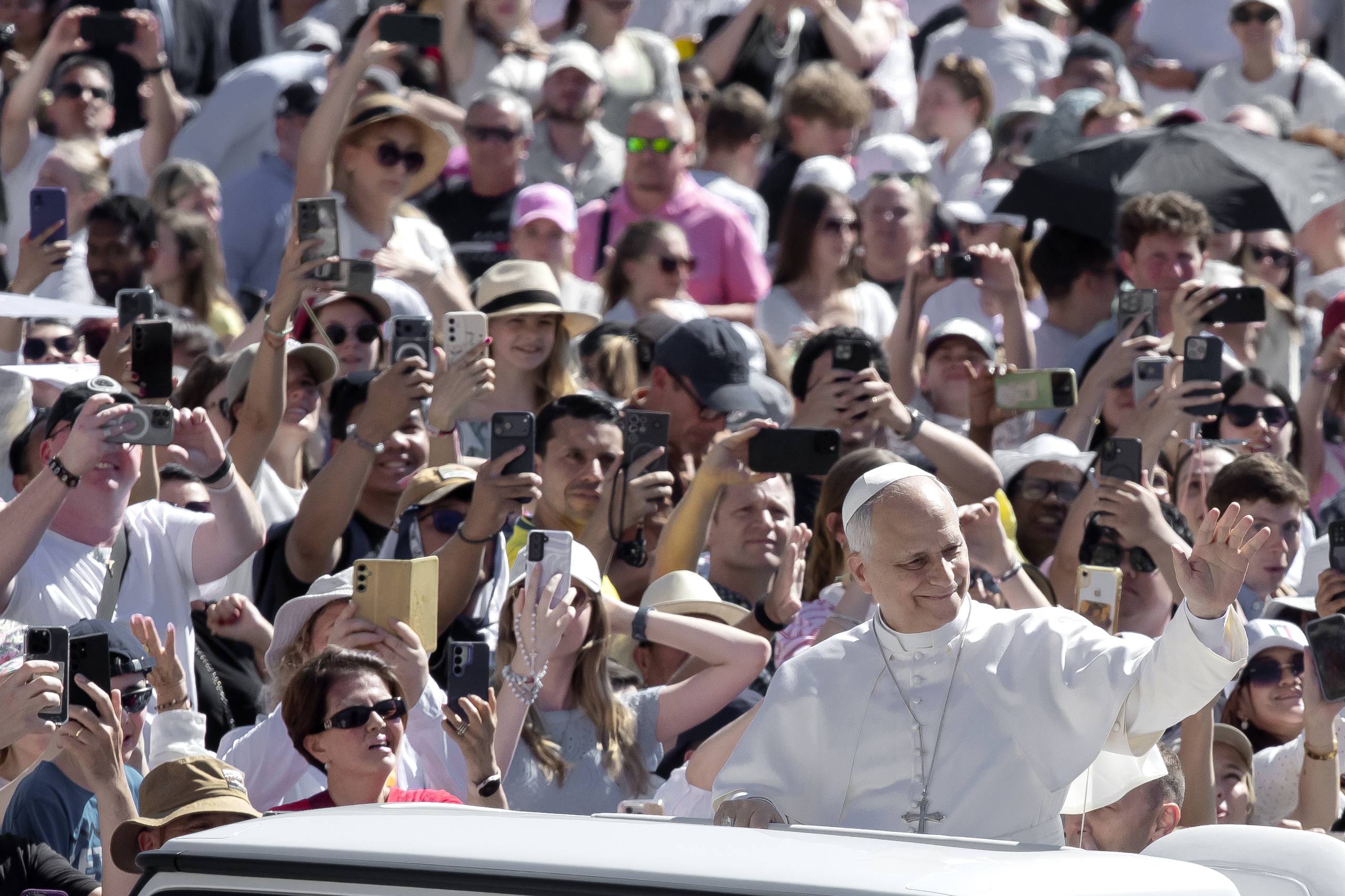
Religion may be on the upswing in America. After many, many, many years of people leaving the church, they are starting to pray again.
President Trump (clip): There has been a tremendous renewal in religion, faith, Christianity, and belief in God. Tremendous renewal.
Lesley McClurg: President Trump is not the only one talking about a revival. Vice President JD Vance’s new book about his conversion to Catholicism comes out tomorrow. Some preachers are claiming that their churches are absolutely packed, and religious influencers are really growing in popularity.
So is there really a renaissance going on?
We’re going to talk about it with Lauren Jackson. She is deputy editor for newsletters and the host of Believing at The New York Times. And Ryan Burge is professor of practice at Washington University and author of Graphs About Religion. Welcome to you both.
Lauren, before we talk about this current trend, I’d love to go back in time for a moment. Let’s talk about the real loss of faith that we’ve seen over the last few decades. How long have Christian churches been losing congregants?
Lauren Jackson: Hi. Thank you so much for having me.
This is the big question when we think about religion in America. I have lots of thoughts on it. I know Ryan, who is here, has lots of thoughts on it. But to answer your question about the decline over the last few decades, about 90 percent of the country was religious even as recently as the 1990s. Ryan, I want to be mindful that he is the expert here when it comes to religious statistics, so if I get anything wrong, I’m excited for him to jump in and fact-check.
We really saw that most of the country, the vast majority of the country, was religious in the 1990s. In about 1995, we started to see what became a really precipitous drop in the number of people, particularly Christians, who identified as religious and attended a house of worship or church each week.
We saw this really dramatic decline from about 90 percent of the country down to about two-thirds of the country over the last 3 decades. Then something really dramatic started to shift. In about 2020, we started to get an indication that the precipitous decline that many sociologists and demographers thought would continue was actually leveling off.
I really want to stress that this is a pause in secularization, not necessarily a reversal, and that’s the contested question. But that pause is nonetheless really fascinating, and I think that’s why we’re all here today: to think together about this.
Lesley McClurg: Tell me about some language that I think is kind of fascinating in this trend: “the Great Dechurching” and “the nones.” This is nones, N-O-N-E-S, like, you know, you can’t have none of that. What do these terms mean, and how do they reflect this trend?
Lauren Jackson: Yeah. I think some people, when they think about leaving a religion, might presume that you go from being religious to suddenly becoming an atheist. That’s just really not the case.
The nones try to capture in religious statistics this broad category of people who either formally identify as atheists, identify as agnostics, or simply identify as nothing in particular. For whatever reason, your church, synagogue, or house of worship didn’t fit for you, and you left. You stopped identifying with it.
Religious statistics are necessarily flattening. We have to figure out how to put millions and millions of people, who have very specific faith trajectories, into categories. That’s necessarily going to be a little reductive because everyone’s journey is different.
The nones category is an attempt to classify those who do not attend a house of worship regularly and would not say they have a religious affiliation.
Lesley McClurg: We’d love to invite listeners into the conversation. I’m curious: Have you been drawn to religion recently? Or maybe did you leave the church in recent decades? Did you follow either one of these trends? Tell us why. Tell us your story. What drove you in either direction?
You can email your comments and questions to [email protected]. You can find us on Discord, BlueSky, Facebook, and Instagram. We’re @KQEDForum. Or you can jump on the phone right now and give us a call at 866-733-6786. Again, that’s 866-733-6786.
Ryan, what are you seeing in the data? Do you agree that we are having either a secularism pause or a resurgence?
Ryan Burge: Yeah, I would definitely agree with Lauren. It’s a pause. We can’t say it’s a resurgence because that would mean the numbers are moving in the other direction.
The share of Americans who are Christians is 63 percent today. It was 63 percent in 2020. The share who are nonreligious is right around 30 percent today. It was 30 percent 5 years ago.
But here’s what no one’s really thinking about with this whole thing: generational replacement.
Baby boomers are between 60 and 80 years old right now, and they’re fairly religious. Only 18 percent identify as nonreligious. A lot of them go to church on a regular basis—about 35 to 40 percent.
They’re not going to be around forever. In the next 15 to 20 years, most boomers are going to be gone. Who’s going to replace them in this demographic pyramid? The answer is Gen Z, who are 42 percent nonreligious. More than half of them never attend religious services. Or Gen Alpha, whose religiosity we don’t yet fully know, but every indication suggests they will be even less religious than Gen Z.
So when you’re replacing a generation that’s 20 percent nonreligious with one that’s 45 percent nonreligious, the aggregate number of nones is going to have to rise unless something happens in American religion that we’ve never seen in the history of modern polling: a massive revival where tens of millions of people find faith again and come back to church.
I’m not saying that’s impossible. I’m just saying we’ve never seen it before in the history of modern polling. So the number is going to have to go up from here as baby boomers die off and are replaced by younger adults.
Lesley McClurg: Lauren, if we look at these two trends, what is driving them in either direction? It sounds like we’re not going to have a massive revival according to the numbers, especially if boomers are leaving us and churches aren’t necessarily gaining younger replacements. But what drove people away from church, and what may be leading some people to come back, even if there isn’t a massive revival happening?
Lauren Jackson: Yeah. It’s a complex and multifaceted answer. Again, I want to foreground the subjectivity of people’s different reasons. I can speak to some trend lines, and I think other people on this call can as well.
I also want to stress that this idea of revival sounds really compelling. I understand why people want to think about it and explore it. It feels like something is shifting.
Ryan just so accurately and helpfully outlined why we might not be seeing that in aggregate. If you look at the national level, we’re not necessarily seeing a revival. But we are seeing, in smaller pockets and anecdotal spaces—and I really want to stress that these are singular examples, anecdotes, and I don’t want to blow them out into something they’re not—we are seeing enough examples, particularly in elite culture, of religion becoming more salient and more visible.
I’m thinking about Hollywood. I’m thinking about Silicon Valley. I’m thinking about the White House. I think people are looking around and asking, “What’s going on?”
To answer your question about what happened and why, I think it was a mix of factors.
A generation came of age in a digital era where there was a ubiquity of choice. People were suddenly exposed to many different ways of being an adult. Globalization also meant a higher degree of mobility for upwardly mobile white-collar professionals, who left their communities and families.
We know that the ties that bind people to religious communities are often rooted in family and relational ties. As those connections fractured, it became harder to maintain those religious affiliations.
It’s also often a very demanding thing to be part of a religious community. If you leave the community that binds you, it’s difficult to recreate that in a new city or a new place.
A mix of factors meant that a lot of people left over the last 3 decades.
As for why people are coming back, I really don’t want to say that people are coming back, because on a national level we don’t have evidence that it’s a significant trend we should be stressing. Some people are returning, certainly, but not in a way that shows up nationally.
I do think there are 3 things that have made this more salient in terms of people coming back—
Lesley McClurg: We’re going to list those 3 things right after this break because we’ve got to go to the break. Stay with us, and we’ll be right back with Lauren.