This partial transcript was computer-generated. While our team has reviewed it, there may be errors.
Mina Kim: From KQED, welcome to Forum. I’m Mina Kim.
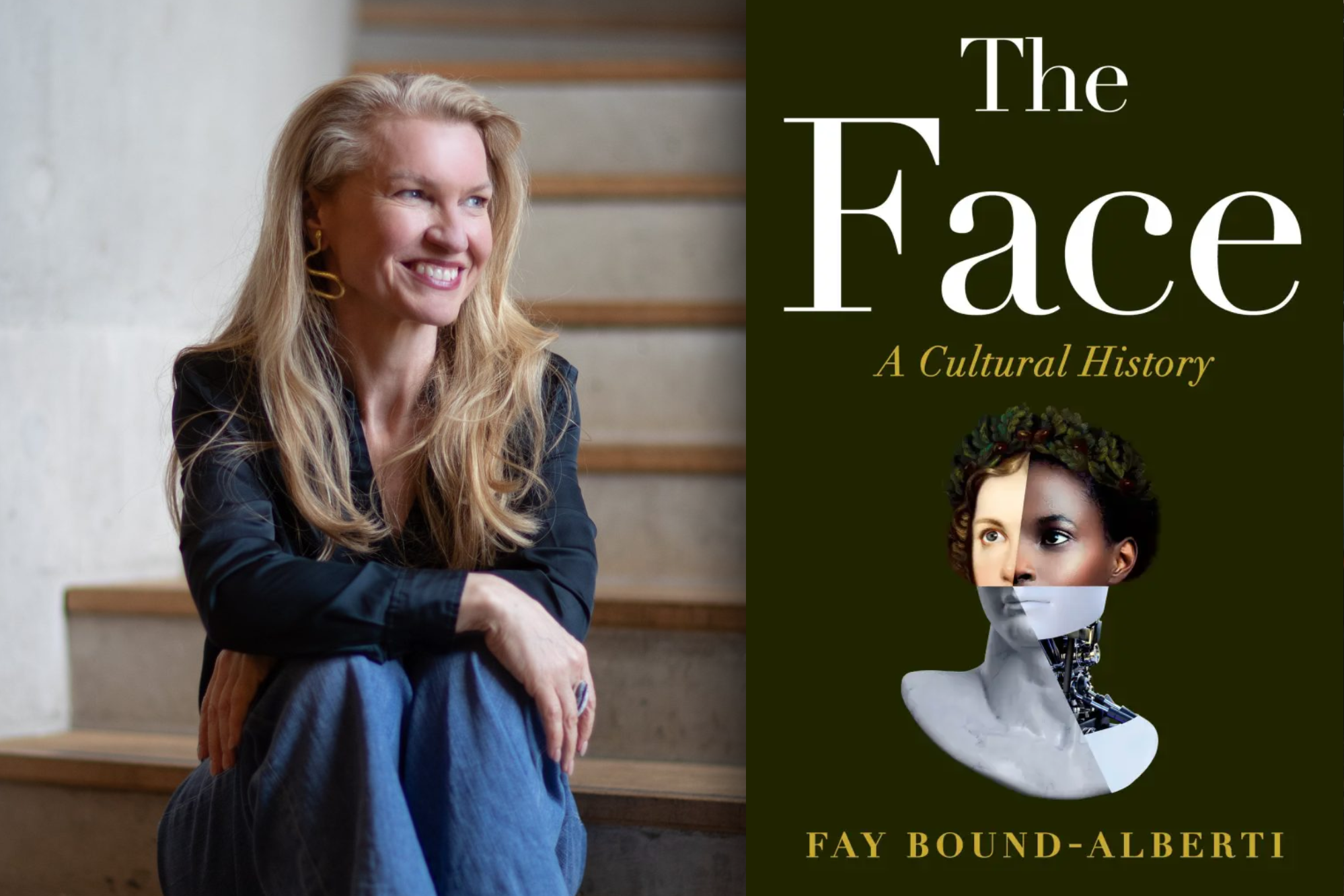
The face is just one part of our body, and yet it has been treated as a stand-in for the self, a marker of who we are. But historian Fay Bound-Alberti says it hasn’t always been this way. In her new book, The Face: A Cultural History, Bound-Alberti charts how the face has become foundational to how we understand and scrutinize others and ourselves — and how new technologies, from portraits to facial recognition software, have shaped the importance we place on the face throughout history. She also shares what it’s been like to study all this as someone with a condition known as face blindness, where she struggles to recognize faces.
Fay Bound-Alberti is professor of modern history at King’s College London, where she founded the Centre for Technology and the Body. Welcome to Forum, Fay.
Fay Bound-Alberti: Thank you very much, Mina. Lovely to be here.
Mina Kim: I understand you found out you had face blindness while researching this book?
Fay Bound-Alberti: Yes. Like most people, I didn’t really know what it was — I hadn’t really heard about it. But when I started delving into the history of the face and trying to understand why we think it’s so important today in our digital age, I realized I was failing many of the tests used to evaluate face blindness. That led me on a kind of mapping of what the face means and has meant in history, but also what it means to me personally. It was a dual discovery.
Mina Kim: Did it help you make sense of experiences you’d had all your life?
Fay Bound-Alberti: Yes, totally. I’ve had so many embarrassing moments as a child and as an adult because I don’t recognize people solely by their faces. But the book is also partly arguing that the reason we focus on the face as the primary way to recognize people is itself a product of history — it’s the fact that the face has become so tangled up with individualism and identity. There are also lots of other ways we might know a person: through gait, smell, movement, and so on. So I put the history of prosopagnosia, or face blindness, in that broader context.
Mina Kim: Is that primarily how you do identify people — through gait or smell?
Fay Bound-Alberti: Yes, absolutely. I tell a story in the book about going to pick up my daughter from nursery when she was about two and a half. As anyone who’s picked up children from nursery will know, you go in and there are lots of other adults waiting, and then a surge of little children rushes toward you. I remember seeing this little surge of small girls and thinking — what dress was she wearing, what hair ties? — and panicking because they all looked quite similar to me, actually interchangeable. I was trying to work out which one was my child. At some point she got close enough that I could smell her hair, I put my hands on her face, and I knew it was her.
That was really one of the first times I was aware of what was happening. But because I didn’t know I had face blindness, or even that face blindness was a thing, I didn’t understand it. I’ve often been confused. Other people seem to understand more about what’s going on in social situations and feel less anxious at parties. But now I know what it is, and that’s actually helpful — I’ve had conversations with neuroscientists and psychologists studying face blindness, and I’m able to contribute to the conversation about what it means.
Mina Kim: It’s estimated to affect about two percent of the population?
Fay Bound-Alberti: About two percent. It’s a bell curve — two percent are face blind, and then two percent at the other end are super-recognizers, who have their own club and work for the FBI and things like that. At the not-cool end is me. But we don’t actually know how many people have it, because we don’t do regular testing. And there are degrees, of course — some people don’t even recognize their own spouses.
The reason I probably didn’t recognize my daughter was that young children have quite unformed faces. It’s only in adulthood that faces become much more distinctive. But I still have the same problem — I’ve failed to recognize boyfriends, colleagues. It’s just something I now know enough about to say: hey, if I walk past you in the street the day after we’ve spoken, I’m not being a snob. I’m just not seeing you. But it’s embarrassing.
Mina Kim: We often hear people say they’re “bad with faces.” And I want to ask our listeners if that resonates. You even mentioned that sometimes you’ll catch a reflection of yourself and wonder who that person staring back at you is.
Fay Bound-Alberti: Absolutely. I’ll be in a department store thinking, why is that middle-aged woman staring at me? And then — oh, it’s me. I don’t have the ability to summon a face to mind. I can’t picture what faces look like, including my own. When I see myself in the mirror, I usually know it’s me, but it’s not an image I can retain.
Mina Kim: And I think you’ve suggested — not quite in these words — that face blindness has played a role in drawing you to this topic, and maybe even made it easier for you to see the face as just a body part, or at least to question the outsized importance we place on it.
Fay Bound-Alberti: Yes, exactly. Thinking about why the face matters so much now — and how most of us feel bad about our faces at some point, particularly in the social media age, with the massive increase in cosmetic surgery post-COVID — it actually enables me to think more broadly about what constitutes a person. I’ve never seen the face as the ultimate representation of someone’s identity. In the book I talk about how this modern notion of “facehood” has come into being — this idea that a single face equals a unique social identity, locked in by law and by our relationships. I’ve never had that, either about myself or about others. I think not having it allowed me to think more expansively about how we know people, and why the face has become so peculiarly important.
Mina Kim: Listeners, how do you feel about your own face? Have you ever struggled with how your face looked, or thought about changing it? Has your relationship with your face changed over time? Do you think we place too much importance on it — especially if you’re someone who struggles to recognize faces as Fay does? Email us at [email protected], find us on Discord, Bluesky, Facebook, or Instagram at KQED Forum, or call us at 866-733-6786.
I will say — and you do give a nod to this — the face is pretty remarkable in one particular way. It’s the only part of the body where all our senses come together, right?
Fay Bound-Alberti: Yes, exactly. All our senses converge in the face. But fundamentally, the most important role of the face is communication — not just through speech, but through the incredible range of facial expressions humans have, more than any other animal on the planet, even more than our primate relatives. We simply have so many more muscles. And those muscles evolved because we began living in larger and larger social groups, allowing for increasingly nuanced emotional expression.
That’s actually one of the reasons Botox is quite problematic. It limits our ability to express — and while that may reduce some social anxiety, there’s also the possibility that not being able to use those muscles may actually affect how we feel, numbing our emotional experience. There are all sorts of interesting questions around facial expression.
And of course, when we think about people we love, we always think about their faces. The face is a fundamental part of being human. It’s just that we’ve attached to it a status and a value — tied to what it looks like — that is disproportionate and often simply wrong.
Mina Kim: I can understand why we connect the face with the self so deeply, because it is the site of emotional expression and communication. But as you say, we’ve also attached meaning to what a face looks like. Right after the break, we’ll get into how — throughout history — it’s usually been the most wealthy and powerful who get to define what counts as a good face.
Listeners, join the conversation at [email protected], on Discord, Bluesky, Facebook, or Instagram at KQED Forum, or call us at 866-733-6786. More with Fay Bound-Alberti, author of The Face: A Cultural History, right after the break. Stay with us.