This partial transcript was computer-generated. While our team has reviewed it, there may be errors.
Mina Kim: Welcome to Forum. I’m Mina Kim.
What does it mean to be American, and who gets to decide? These are questions that both animate Ben Rhodes’ new book and have driven debates about American identity throughout history. For Rhodes, former national security adviser and speechwriter for President Obama, speeches have been a powerful way to present competing visions of who belongs in America. Here’s Donald Trump’s second inaugural address.
[CLIP]
Donald Trump: We now have a government that cannot manage even a simple crisis at home, while at the same time stumbling into a continuing catalog of catastrophic events abroad. It fails to protect our magnificent, law-abiding American citizens, but provides sanctuary and protection for dangerous criminals — many from prisons and mental institutions — who have illegally entered our country from all over the world.
[END CLIP]
Mina Kim: And here’s then-candidate Barack Obama.
[CLIP]
Barack Obama: I have brothers, sisters, nieces, nephews, uncles, and cousins of every race and every hue scattered across three continents. And for as long as I live, I will never forget that in no other country on earth is my story even possible. It’s a story that hasn’t made me the most conventional of candidates, but it is a story that has seared into my genetic makeup the idea that this nation is more than the sum of its parts — that out of many, we are truly one.
[END CLIP]
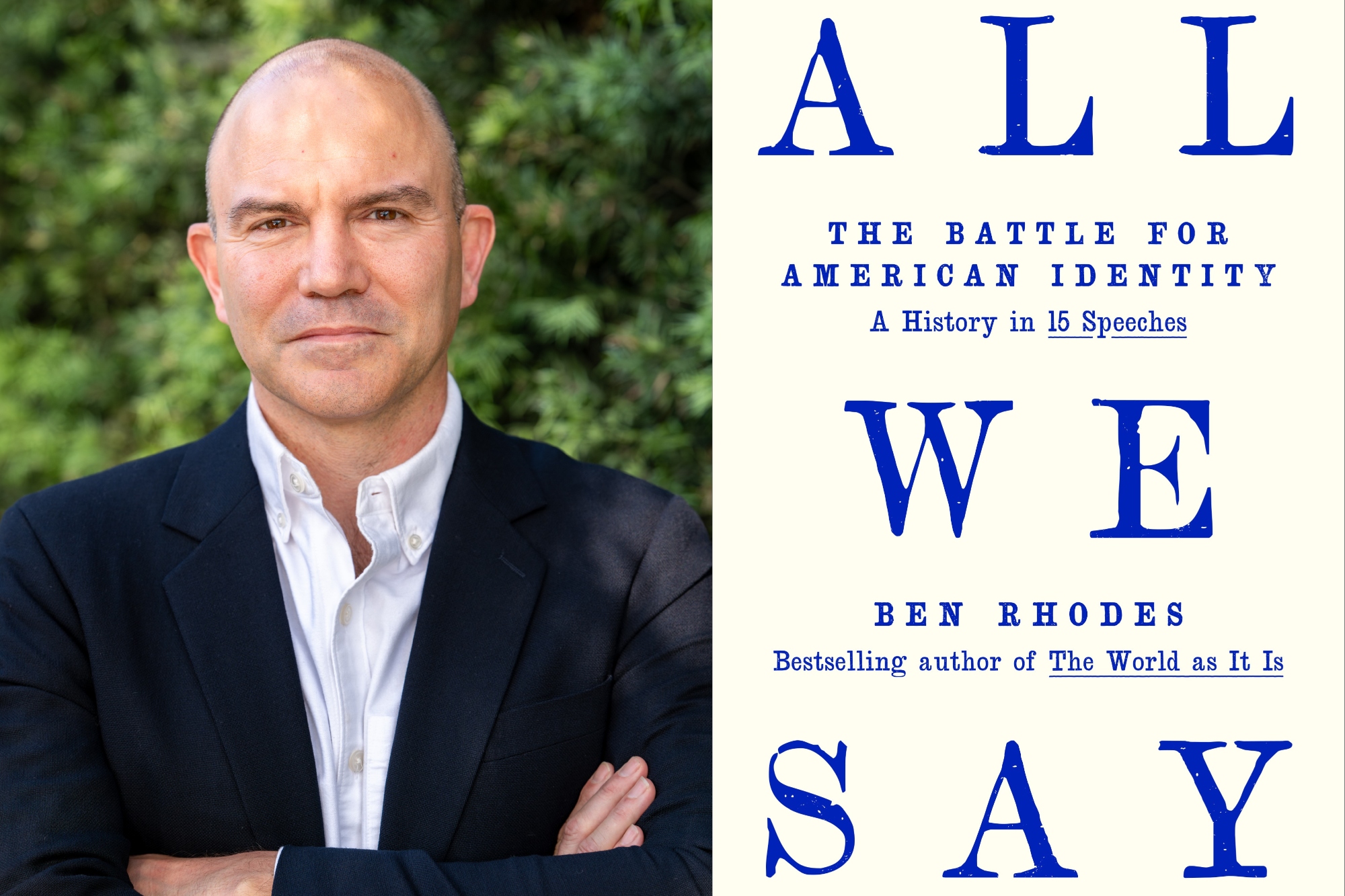
Mina Kim: Ben Rhodes’ new book is called All We Say: The Battle for American Identity, A History in Fifteen Speeches. Ben joins me now. Welcome to Forum.
Ben Rhodes: Thanks so much, Mina. It’s great to be here.
Mina Kim: That Obama clip we just played — it’s from his so-called race speech, which he gave in response to the controversy that erupted over statements made by his pastor, Reverend Wright. You were in the room. What was that experience like, and what was Obama trying to achieve with it?
Ben Rhodes: People may remember that in the spring of 2008, when Obama seemed to be on his way to the Democratic nomination, clips emerged of his pastor, Jeremiah Wright — who had married him and Michelle and baptized his children — excoriating America. He called America a racist nation. He said 9/11 was a case of America’s chickens coming home to roost. This became an early instance of virality in politics. Suddenly those clips were everywhere. We were sinking in the polls. It was a true emergency.
Obama decided to give what we’d shorthandeded as the race speech — he needed to address not just Reverend Wright, but step back and address the broader subtext of the racial singularity of his candidacy. We prepared a draft. Jon Favreau, my colleague, was the chief speechwriter on that draft and sent it to Obama. Usually what you got back were maybe some handwritten notes, things he wanted to insert, some line edits. But the next morning, Favreau said to me, “You have to look at this.” I looked over his shoulder, and there were a few paragraphs in black — untouched — and then page after page of red track changes. It’s the only time Obama literally typed up the speech himself. He pulled an all-nighter writing it. It just came out of him. I don’t know why it was track changes — I don’t know if he didn’t know how to accept them or if he was showing off — but reading it, I recognized it as a personal wrestling with race in a way I’d never seen before.
What he was trying to achieve — and you heard some of it in that clip — was to unpack the idea that race has been used to divide us against one another. There’s an identity politics in all directions in this country that focuses on people’s differences. In one of the most quoted passages, he talks about how he could no more disown Reverend Wright — a man who had done incredible good in his community, who had served as a marine — than he could disown his white grandmother, who loved him and raised him but had also said racist things that made him cringe. What he was speaking to is the fact that all of us encompass complexity, and we should not just see the worst in each other. He describes the Black experience of structural inequality, but then he describes a white working class that, in his words, “does not feel particularly privileged by its race.” He talks about jobs being shipped overseas, about people’s concerns over crime being dismissed as racist. He’s saying: if we could just embody each other’s experiences, we’d see we have far more in common than the things that divide us. And that’s quite a contrast to the Trump clip and the Trump message.
Mina Kim: Quite a contrast also to how you open the book. You don’t open with the race speech — you open with JD Vance’s speech at the Claremont Institute, a conservative think tank here in California. Why that one?
Ben Rhodes: Because the origin of the book, for me, grew out of thinking over the past decade about the fact that Trump and Obama both represent two competing stories that have been in battle with each other since the beginning of this country. One is a kind of inherited American exceptionalism — the idea that we are essentially the inheritors of Western traditions, a white Christian nation, and that others can be here but must subordinate themselves to a predominant identity. The other is a more progressive exceptionalism — that we are dedicated to the creed of the Declaration of Independence, that all men are created equal, and that American history is the struggle to close the gap between that reality and that ideal.
JD Vance comes along while I’m pretty well into the book and gives a speech that takes this head-on. He says we are not a creedal nation. We are not defined by the sentence in the Declaration of Independence that says all men are created equal — that’s far too broad a basis for an identity. He says we are a particular place with a particular people and a particular way of life. He’s articulating a more exclusionary nationalism, and in a way I found interesting, because Vance is good at saying things in the most inarguable-sounding way. And yet when you interrogate the phrase, you think: well, we’re not a particular place — we were thirteen states on the East Coast when we started, and I’m sitting here talking to you in California, which was a distant outpost of the Spanish empire populated by indigenous people. We’re not a particular people — Americans today look nothing like the Americans of those original thirteen states. And we’re not a particular way of life — I mean, how many ways of life are there in San Francisco alone?
I’m obviously taking a position here, but I think it was useful that Vance articulated what a lot of people believe: that America is a fixed identity. I believe the opposite — that it’s an evolutionary identity, one that Obama and many others in my book represent.
Mina Kim: A fixed identity that says others can be here, but should subordinate themselves and show gratitude.
Ben Rhodes: Yes. That word — gratitude — really jumped out to me. He essentially said that if you’re an immigrant, you should not criticize America in a certain way. He actually called out Zohran Mamdani for making a fairly anodyne statement about the need for America to continue to make progress. That jumped out to me, too, because Frederick Douglass has a line I cite at the beginning of the book — I’m paraphrasing — but essentially: the highest form of patriotism is to criticize the nation, because you’re holding it to account. You’re saying, I actually believe in the words written down, that all men are created equal. I believe America is the story it tells about itself. Active criticism, because you love what America is supposed to be — that, to me, is the highest form of patriotism, not simply expressing gratitude and saluting the flag at a football game.
Mina Kim: You say it was Ben Franklin’s closing argument on behalf of the Constitution that unlocked it all for you — that it essentially set up the competing arguments we’ve been discussing?
Ben Rhodes: Yes. What was so perfect about the Franklin speech is that he was chosen to give the closing argument at the Constitutional Convention, just before everyone was asked to sign. And Franklin gives a speech in which he doesn’t even mention anything in the Constitution — which is quite remarkable. He talks about the need for compromise. He says: if you assemble a group of people in a room, you have all their different wisdom, but also their different prejudices and selfish interests. If you want to make a union out of that assembly, nobody’s going to get everything they want. It was that spirit of compromise that made a United States possible and set up a government capable of accommodating our differences and adjudicating them.
At the same time, we compromised on really significant things — slavery chief among them, the nature of citizenship and who could access it. Immigration was largely left to the states. What I realized in reviewing that speech is that we started from a position of compromise, but the things we compromised on set in motion a debate that has been ongoing ever since. Everything that follows in the book traces different perspectives on that debate.
And Franklin himself modeled how he thought this should work. His very next public act was to petition Congress — after it was established — to abolish slavery. So Franklin is clearly signaling: this is not originalism. The Constitution is not fixed. What we did was set up a government through which we can fix what’s wrong with America.
Mina Kim: He used the words of the Constitution to defend the abolition of slavery — and you talk about that as a rhetorical device that has since been used by people who shared that vision, particularly Martin Luther King. I want to play a bit of him using the language of the Declaration of Independence and the founding documents to advance his vision of a more equal America.
[CLIP]
Martin Luther King Jr.: So even though we face the difficulties of today and tomorrow, I still have a dream. It is a dream deeply rooted in the American dream. I have a dream that one day this nation will rise up and live out the true meaning of its creed: “We hold these truths to be self-evident, that all men are created equal.”
[END CLIP]
Mina Kim: Listeners, we’re talking with Ben Rhodes. What do you think of the way he’s framing these competing visions of America? And what’s a speech about America or the American promise that has moved you? Call us at 866-733-6786, email [email protected], or find us on Discord, Bluesky, Facebook, or Instagram at KQED Forum. More after the break. I’m Mina Kim.