This partial transcript was computer-generated. While our team has reviewed it, there may be errors.
Mina Kim: Welcome to Forum. I’m Mina Kim.
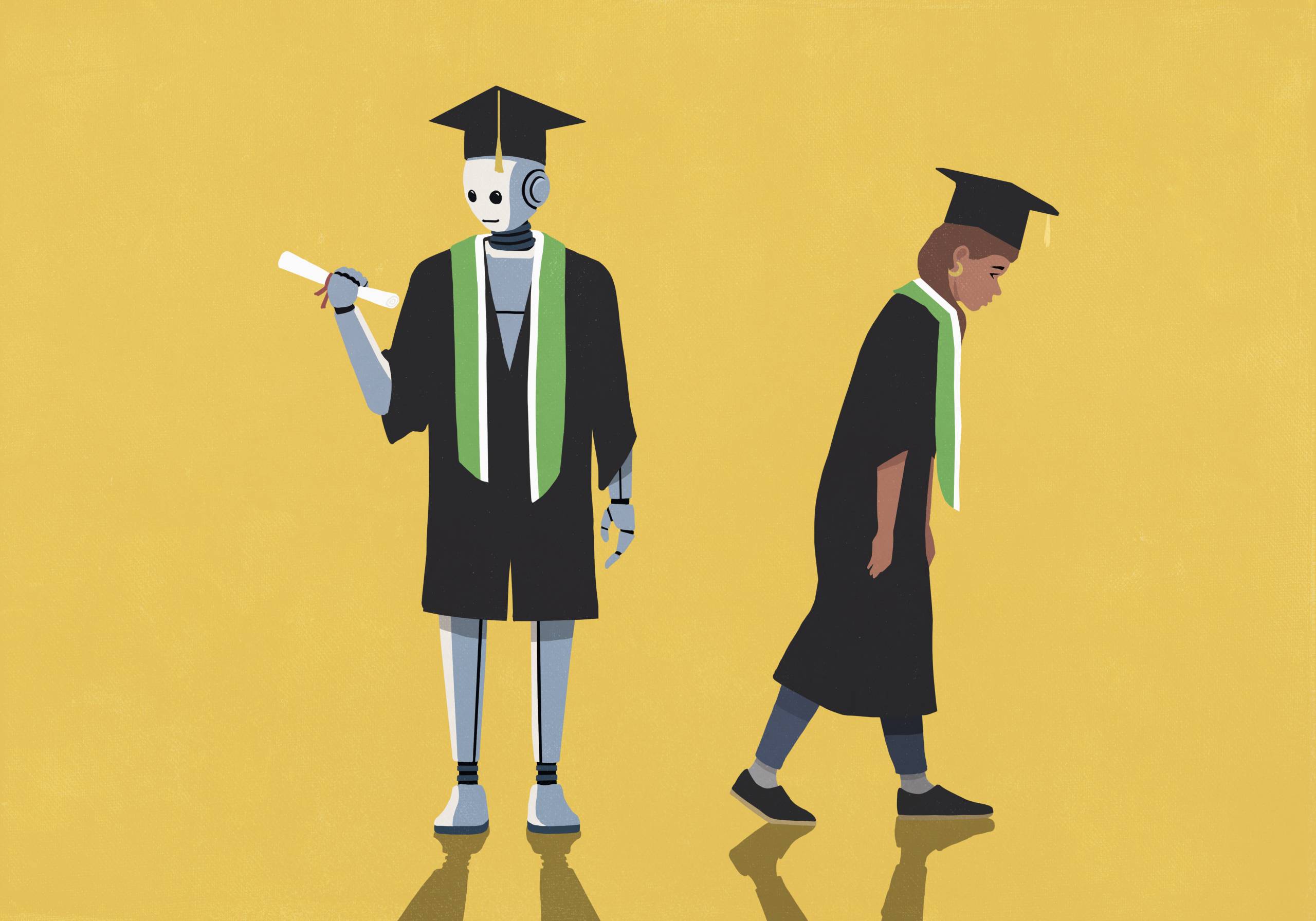
For the past few weeks, New Yorker staff writer Jay Caspian Kang has been writing about whether his nine-year-old daughter will go to college nine years from now. And if she does, what her college experience might be like, given advances in AI, demographic shifts that predict a steep enrollment drop, and growing skepticism about the value of a college degree these days.
He’s been doing a lot of research, talking to a lot of people for his series of columns examining the pressures facing higher education, and he joins me now to tell us what he learned.
And listeners, are you questioning whether a college education will be worth it in the coming years?
Jay, thanks so much for coming on Forum.
Jay Caspian Kang: Oh, thank you for having me.
Mina Kim: So the series of columns began with you asking if your nine-year-old will even be attending college less than a decade from now, in 2035.
And I have to admit, it was a question that sort of startled me because I also have two kids around your daughter’s age, and a teenager as well. Even with everything I’ve read and the conversations I’ve hosted here on the show about the transformative potential of AI, I have not questioned whether they would go to college.
I think I was still operating from my own experience of college as an inevitability. When I was applying in the nineties, it was like, “Of course I’m going to go to college.”
Was that what it was like for you?
Jay Caspian Kang: Yeah. I mean, I think the general idea was that if you don’t go to college, you’re going to end up in a terrible financial situation, right? There’s an implicit threat there, which, to put it as frankly as possible, was: if you don’t go to college, you’re going to end up homeless.
Mina Kim: Is this something your parents said to you?
Jay Caspian Kang: Yeah, maybe.
When I was sixteen or seventeen, I did think, “Well, maybe I just won’t go to college.” I was reading a lot of Jack Kerouac and stuff. And I think the message put into my head was: you have to go, and everybody goes. If you don’t go, you’re going to have a terrible life.
Mina Kim: Yeah. You won’t be able to find a job. Everyone wants to see that you have a degree. All that kind of stuff.
Jay Caspian Kang: Right. Right. This entire world of upward mobility and all these jobs won’t be open to you anymore.
I think that, even without AI, that has changed quite a bit for young people in America. The idea that college is inevitable if you’re from a certain demographic or your parents have a certain level of educational attainment—we’re talking about middle-class, upper-middle-class, and wealthier families—that college is simply part of the path of every eighteen-year-old, I think that’s loosened a bit. Not entirely, obviously, and not in any dramatic way, but a little bit.
The attitude has shifted from, “Of course you’re going to college because it’s a wonderful experience and it’s going to turn you into a fully realized human being,” to something much more cynical. For many eighteen-year-olds now, it’s more like, “I just need this credential.” I don’t see the same sense of inevitability or spiritual value attached to college anymore.
My thinking was: okay, we have these macro trends, and then we have the introduction of AI. Is it really so inevitable that this nine-year-old who sits on the couch reading comic books all day is going to go to college? Do I actually need to keep contributing to this 529 plan? That was the thinking behind it.
Mina Kim: I know these macro trends preceded the current AI discussion.
I guess I had this idea that there would always be something special about college—that I’d be exposed to things I hadn’t thought about, learned about, or could even conceive of. That I’d build relationships with people who had dedicated their lives to becoming experts in something, and with students I never would have met in my high school environment.
So, A, you’re saying that specialness is fading, and B, you’re talking about this broader disillusionment.
How much do you think AI has contributed to that disillusionment about college being worth pursuing—or worth the high cost?
Jay Caspian Kang: We’re still in the very early stages of that. But I do think that, for a lot of people, the combination of rampant AI-assisted cheating at all levels has been significant. When I first heard about it, I was somewhat skeptical because my rule when thinking about academics—and I don’t mean this pejoratively—is that academics tend to complain about everything. So I thought maybe this was another example of that.
But then I looked into it more deeply. It’s so rampant. I talked to many professors for this series, and the stories they told me were really heartbreaking. They couldn’t even get students to read fifteen pages of something that, ten years ago, students would have loved reading.
They were begging students, saying things like, “I don’t even care what you write about it. I just want you to have a thought. I want you to have a feeling about it. Let’s talk about that.” And even then, they would receive obviously AI-generated work.
As that reality sinks in, and as people continue asking whether AI is going to replace us—which has become a huge theme in commencement speeches, where students are now booing whenever AI gets mentioned—it makes all of these existing concerns feel much more urgent.
That’s why so many people are talking about college and AI right now. All the problems that already existed, AI has stepped on the neck of them and turned them into an emergency.
Mina Kim: I really liked your column, “The Despair of the Professor in the Age of AI.” Actually, it made me sad. You quote professor Jane Sloan Peters, who says:
“There are these waves of relief that wash over me when I see misspellings and poor grammatical structure in sentences, when I can tell they’re really working through it themselves.”
What did professors tell you about what it feels like, especially for those who see teaching not just as research but as inspiring students and helping them struggle through ideas they’ve never encountered before?
Jay Caspian Kang: There’s a professor from Grambling State University in Louisiana who’s a theater professor. He told me he’s tried everything—blue-book exams, handwritten in-class assignments, oral examinations, oral assessments. But what he really wants is for students to read something like August Wilson’s Fences, or even just watch the movie adaptation, and have some kind of reaction to it.
He thinks that if students want to be actors or playwrights, they need to know this work. They need to be inspired by something that serves as a foundation of American theater. And he says that over the past five years, it’s become incredibly difficult to get students to engage with that material because they’re constantly taking the easiest route.
As someone who’s a writer, and someone who was inspired by many books growing up—even though I was a pretty poor student—I still found things I read that became deeply important to me.
So it’s heartbreaking to hear. That exchange—reading something, being inspired by it—it doesn’t have to happen in a classroom. You can find books at the library. You can discover ideas on your own. But for a lot of kids, it does happen in the classroom.
Mina Kim: And through college.
Jay Caspian Kang: Right. Exactly. We went to college, at least in part, hoping that would happen. Even if another motivation was not wanting to end up on the street. You hoped that somewhere along the way you’d encounter something transformative.
To hear professors say that this part of their job—the part that gets them out of bed in the morning—is becoming so much harder, that’s really sad. Sometimes all they want is one or two students a year to genuinely connect with an idea. I found those accounts very emotionally moving as well.
Mina Kim: We’re talking with Jay Caspian Kang, listeners, about questions surrounding the viability of the American university system in the age of AI and the broader shifts that have made higher education increasingly vulnerable.
And I want to invite you into the conversation. Are you questioning whether a college education will be worth it in the coming years? Do you attend or work at a college or university? How has AI already affected your campus? What do you think makes college special or valuable? And how would you like to see colleges evolve to meet the AI age, if you don’t think they should become obsolete?
Email [email protected]. Find us on Discord, Bluesky, Facebook, or Instagram at @KQEDForum, or call us at 866-733-6786. That’s 866-733-6786.
Do you feel like, with AI, that experience you’ve had—where a professor awakened your mind or exposed you to something meaningful—is less likely for your kid ten years from now?
Jay Caspian Kang: I hope not. I’d hope those texts still exist and that the existential and important questions they raise are still there.
But I do think that if people aren’t careful, if we’re not intentional right now, the idea that reading can be replaced by chatbot summaries is something schools—and really society—need to guard against very seriously. The problem is that AI tends to average everything down to a single interpretation.
It creates sameness. For me, one of the most important things I read in college was the Bhagavad Gita. It changed my life. It made me think differently about duty, about what Arjuna is thinking on the battlefield.
I still think about it all the time. If all you get is a chatbot summary—one interpretation that an AI has decided is the most probable or most acceptable—then you’ve lost something.
There’s no interpretation anymore. There’s no inquiry. It’s just: “This is what it’s about.” Everyone accepts the same reading. And then the whole point of reading and intellectual inquiry is lost because you’re simply being handed the conclusion you’re supposed to reach.
Mina Kim: A listener on Discord is touching on that point.
Steve writes:
“We need to improve critical-thinking skills and fact-checking skills before students even get to college. We need to cultivate commonsense faculties grounded in the real world, to which LLMs are entirely blind, and train humans to do and be what AI inherently cannot.”
We’ll have more with Jay Caspian Kang after the break.
Stay with us, listeners. This is Forum. I’m Mina Kim.