This partial transcript was computer-generated. While our team has reviewed it, there may be errors.
Mina Kim: Welcome to Forum. I’m Mina Kim.
President Trump abruptly ended an interview with Meet the Press‘s Kristen Welker that aired yesterday after she challenged the president for repeatedly saying, without evidence, that the 2020 election was rigged and as he went after California’s primary election vote count.
President Trump (clip): There’s a lot about this. Listen to me. Tremendous evidence. There’s nothing but evidence. The election was rigged. It was a dirty election.
Kristen Welker: Mr. President, you’ve never presented evidence—
President Trump: It’s happening right now in California. Right. Right now. Look at what’s happening in California. It’s four days.
Kristen Welker: Where’s the evidence to that? Republicans are doing well in California.
President Trump: No, they’re not. They’re dropping fast because it’s a rigged election. Let me tell you, it’s four days, and they aren’t even close to coming up with—
Kristen Welker: That’s how they count.
President Trump: Why are they doing that? Because they’re cheating on the election.
Kristen Welker: Do you have evidence to support that?
President Trump: All I have to do is look.
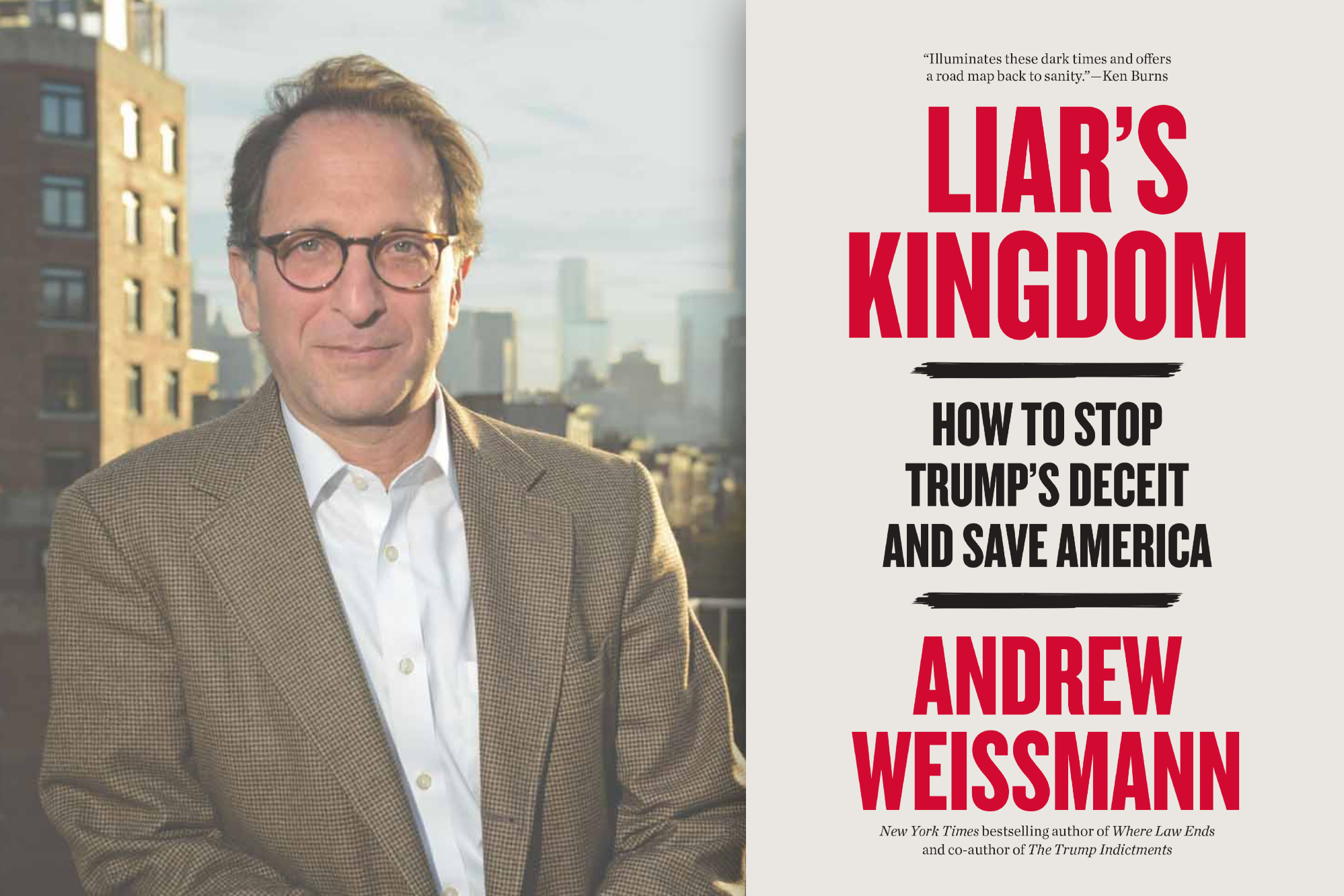
Mina Kim: Former federal prosecutor Andrew Weissmann says our body politic is now riddled with lies, misrepresentations, distortions, and half-truths that undermine our rights and democratic institutions. In his new book, Liar’s Kingdom, he makes the case for reform.
Andrew Weissmann joins me now. Welcome to Forum.
Andrew Weissmann: Thank you so much for having me.
Mina Kim: I have to ask: after writing this book, what was your reaction to the president’s behavior in this interview that aired yesterday?
Andrew Weissmann: Well, I normally would say it’s Exhibit A, but there are so many exhibits. It just underscores how much we in this country really have to think about systemic reform.
Unlike other countries, we allow our politicians and candidates for office to lie to us. Again, I’m not talking about opinions, and I’m not talking about mistakes. I’m talking about intentional falsehoods.
We allow politicians to lie to us when we regulate, either through criminal law or civil law or both, so many other kinds of lying—whether it’s corporate executives, lying to Congress, lying to banks. There are so many ways in which we prohibit lying, but we don’t hold politicians accountable when they lie to us.
Mina Kim: Talk about how, as you say, we are awash in lies, and the effect of that—the crisis you’re perceiving in this moment as a result.
Andrew Weissmann: Sure. This is one where we can actually look at the data.
In my book, there are too many laws to discuss all of them, but I use one that is especially topical given the clip you just played, which is the president of the United States saying there was material fraud in the 2020 election. Now he’s saying there’s fraud in California elections.
Approximately two-thirds of Republicans believe that. But, as Kristen Welker pointed out, no evidence—none—has been presented of any fraud.
So we have this situation where people are believing these claims. That raises an issue I discuss in the book, though it’s probably the least original part of it: we are living in such media bubbles that people are only confronted with what they want to hear.
The old-school view was that the answer to false speech is more true speech—that the friction between competing ideas and rational debate would eventually lead people to understand that false claims are false. We’re not in that media environment anymore.
And that environment is only going to get worse with AI and the ability to receive news that is tailored specifically to you.
Mina Kim: The election fraud lie, in particular, is a foundational example for you of the corrosive effects of lying on democracy and government institutions.
Andrew, can you help us wrap our minds around everything that has grown out of the president repeatedly saying that the 2020 election was stolen and fraudulent?
Andrew Weissmann: When you think about what holds a country together—what is the glue that keeps us together—there has to be, maybe not 100 percent, but at least a sufficient number of people who are grounded in reality and share a commitment to basic facts.
Then, obviously, there can be healthy debate about policy choices and what to do about those facts. That’s what democracy and the First Amendment are all about.
But here, what we’re seeing is so corrosive to the rule of law and to the idea that institutions are helpful to all of us. You have adjectives and adverbs masquerading as factual statements.
The good news—if there is any—is that we can look overseas to reputable democracies that have found ways forward. They hold politicians accountable through due process, and if they’re found to have intentionally lied, there are repercussions.
Those repercussions can be criminal penalties, or in some cases, they can be barred from holding office if they are found to have intentionally lied about something material.
Mina Kim: I want to invite listeners into the conversation.
We’re talking with Andrew Weissmann, author of Liar’s Kingdom, MSNBC legal analyst, co-host of the podcast Main Justice, and a professor at NYU Law School.
You may also be familiar with him as lead prosecutor in the Mueller investigation into Russian interference in the 2016 election. He was chief of the Fraud Section at the Department of Justice, general counsel of the FBI under President Obama, and leader of the Enron Task Force under President George W. Bush.
Listeners, how much does political lying trouble you? What do you want to ask Andrew about protecting the United States from liars and cheaters?
You can email [email protected], find us on Discord, BlueSky, Facebook, or Instagram at @KQEDForum, or call us at 866-733-6786. That’s 866-733-6786.
Do you then want to criminalize election-related lying, as one example? And if so, how would you go about doing it?
I imagine there would be all kinds of arguments—and there have been arguments in the past—about how to regulate lying without infringing on free speech and related rights.
Andrew Weissmann: Sure. Let me address the First Amendment and free speech aspect first, because that’s usually the first question people have: How is this consistent with this country’s strong and important tradition of protecting free speech?
What I would say is that the Supreme Court, in various decisions and through various justices, has pointed out that intentionally false speech is not itself protected.
You can think of numerous examples. Let’s go back to Enron, which you referenced. The Enron executives were criminally charged and civilly sued for making intentionally false statements about the company’s financial health. That’s not a violation of the First Amendment. That’s fraudulent speech.
The Supreme Court, most recently in United States v. Alvarez, recognized that fraudulent speech is not protected and that both civil and criminal regulation can exist.
When Rudy Giuliani made false statements about two Georgia election workers, they sued him for defamation and won. No one argues that defamation law violates the First Amendment.
In fact, defamation laws exist precisely because you can be held liable for knowingly false statements.
I’m sure at this station, just as at MSNBC and other reputable news organizations, there are standards departments that ensure information is accurate and sourced. One reason for that is journalistic integrity, but another is to avoid defamation liability.
No one considers those safeguards improper under the First Amendment.
Now, there is always some chilling effect and some degree of deterrence, but it would apply only to intentionally false speech, particularly when made by a public official.
That’s step one.
Step two, which I discuss at length in the book, is that I’m enough of a lawyer to think about both the upsides and downsides of any proposal.
You can look at examples and ask: Is this going to open the floodgates? Is it going to lead to abuse?
There is certainly a concern about abuse. In my view, we can see the current Department of Justice engaging in that kind of abuse when it pursued cases involving James Comey, the Southern Poverty Law Center, and when it sought to charge six members of Congress, though a grand jury declined to do so.
So the concern is real.
But one thing you can look at is not only other countries, where that abuse has not occurred, but also individual states. Let’s take my home state of New York.
Every state is entitled to create its own laws. We often call the states the laboratories of democracy.
In New York, one law provides that if any public official—elected or appointed—is convicted of a felony, that person is automatically removed from office without further review because such conduct is considered fundamentally incompatible with public service.
You don’t see widespread abuse of that law. One safeguard is that a felony conviction requires meeting the highest burden of proof in our legal system.
So there are ways to protect against the downsides.
It’s a great question because whenever you’re thinking about reform, you always have to ask: What are the benefits? What are the risks? And if there are risks, how do you guard against them?
Mina Kim: More with Andrew Weissmann right after the break. This is Forum. I’m Mina Kim.