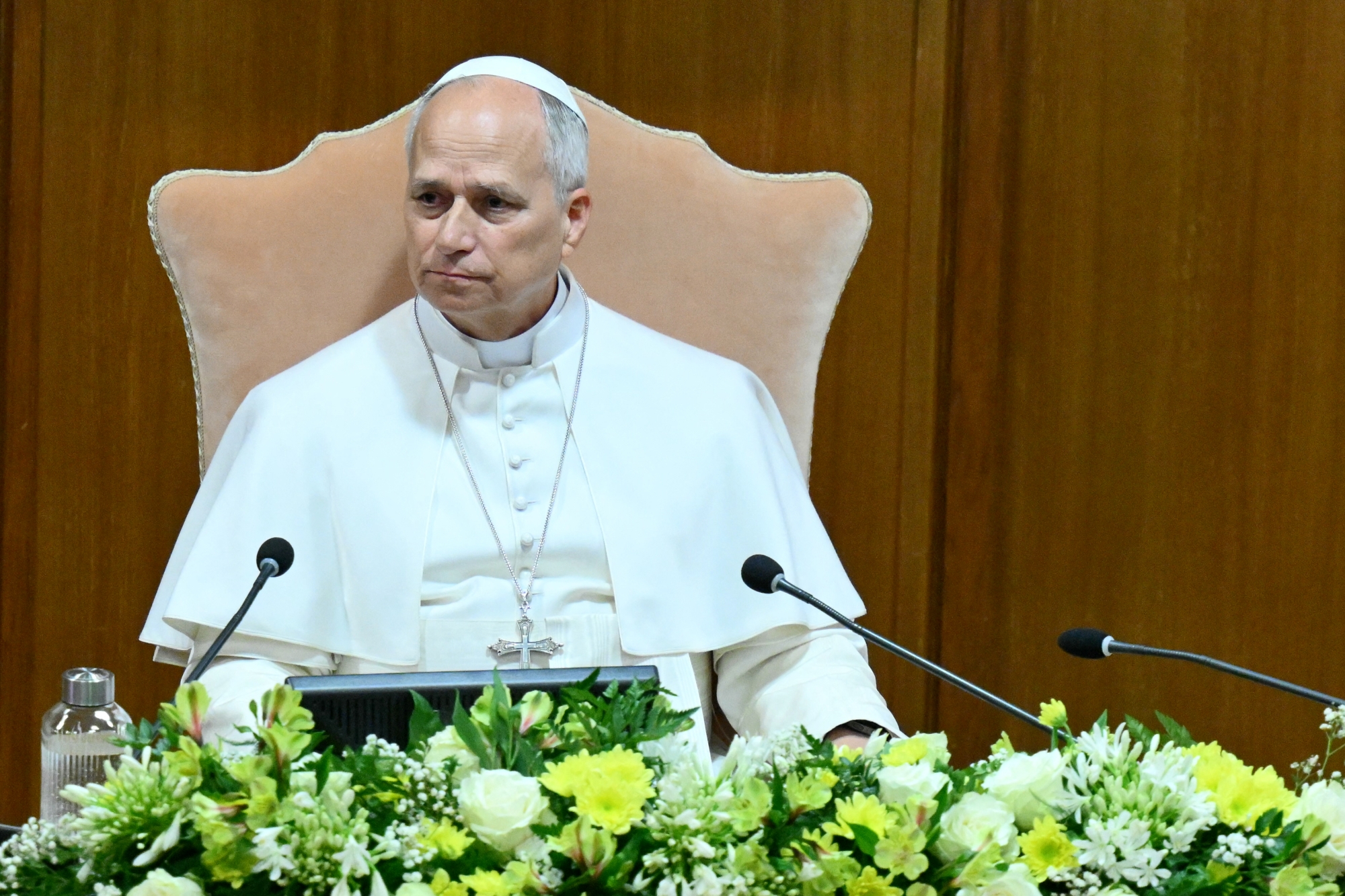
Mina Kim: From Vatican City, the pope urged tech companies and policymakers worldwide to place morality and human dignity over profit. This hour, we look at how that message is being received in Silicon Valley and break down the pope’s guidance. Listeners, do you think the pope’s recommendations will have any effect on the development and deployment of AI? Joining me is Cade Metz, a technology reporter for The New York Times. Thanks so much for being with us, Cade.
Cade Metz: Glad to be here.
Mina Kim: Also with us is Kim Daniels, director of the Initiative on Catholic Social Thought and Public Life at Georgetown University. Kim, really glad to have you with us too.
Kim Daniels: Great to be here.
Mina Kim: So, Cade, you’ve covered technology for more than thirty years. How often do you get to write about the pope?
Cade Metz: I have to say, I think this is the first time, and it was very exciting. I grew up Catholic, and my mother — knowing that this has been my area of interest for so long — made jokes about me potentially covering this. And of course, it had to happen.
Mina Kim: What was her joke?
Cade Metz: As a teenager, I didn’t exactly love showing up to Catholic mass every Sunday. But as she points out, it was a great education, and I’m glad I can bring it to bear at this moment.
Mina Kim: It is an unusual intersection, that’s for sure. Kim, how does this kind of messaging fit with the Vatican’s broader history of encyclicals?
Kim Daniels: What Pope Leo is doing here is offering a people-first vision for AI, and that’s really at the center of two millennia of the Church’s history. How do we put human dignity at the center? How do we make sure we’re focusing on the most vulnerable among us and thinking about what it means to be a flourishing human being? For Pope Leo, this is part and parcel of what it means to be Catholic and to bring our faith into public life.
Mina Kim: And just remind us — what is an encyclical? It’s been described as one of the most important papal documents.
Kim Daniels: An encyclical is a letter addressed to all Catholics and to all people of goodwill around the world. It’s not just an internal document. It’s an authoritative papal teaching that Catholics are meant to take seriously, but it’s also intended to be in dialogue with the world — and dialogue isn’t just speaking, it’s also listening. This is an effort to continue a conversation the Vatican and the Church have been involved in for a long time, and to bring the physical and institutional presence of a Church of 1.4 billion people — the most multicultural and multilingual institution in the world — to bear on one of the most important conversations we’re having right now.
Mina Kim: Talk about that top-line message, Kim — putting humans first when it comes to AI and the importance of human dignity. Can you help us understand the core of Pope Leo’s message?
Kim Daniels: In Catholic teaching, every person possesses inherent dignity — not because we’re useful or efficient or productive, but simply by virtue of being a person. Pope Leo identifies as what he calls “particularly insidious” an ideology suggesting that every person must justify or earn their own worth — that those who are more effective or optimized or efficient are somehow worth more. He says this assumption is built into too many AI systems right now, and we can’t follow through on that. We have to ensure that the human person — understood in all our limits and all our beauty and magnificence, but understood as having inherent dignity — is at the center of conversations about artificial intelligence.
Mina Kim: Pope Leo chose the name Leo, and many have noted that his predecessor of the same name, in the late nineteenth century, also wrote an encyclical about the industrial revolution. Do you see this as one of those fundamentally era-disrupting moments, comparable to what the industrial revolution was?
Kim Daniels: Very much so. Pope Leo was very intentional about the name he took. I was there in Saint Peter’s Square last year when he walked out on the balcony, and when Catholics heard “Pope Leo the Fourteenth,” we knew the reference back to Pope Leo the Thirteenth and his major document, Rerum Novarum, which responded to the Industrial Revolution by insisting that even in the face of economic and social transformation, people had to come first. And Pope Leo, just two days after his election last year, said explicitly that he saw himself as called to respond to the new things of our time — the digital revolution and the development of artificial intelligence. Very intentional, and I think it’s a real contribution to that conversation.
Mina Kim: Can you talk about what he means by the dignity of work, and why we need to remember that — not just the dignity of humanity?
Kim Daniels: The dignity of work is one of the central principles of Catholic social teaching. The idea is that work has inherent human dignity — it’s part of our creativity, part of us participating in the life of our world and our own human lives. It’s part of what it means to be human. What we do shapes who we are. Pope Leo is not against artificial intelligence or technology, but he says AI should empower and complement workers — not deskill them, not surveil them. We should always come back to the dignity inherent in what it means to be creative, to work.
Mina Kim: I want to invite listeners into the conversation. What do you think of the pope’s message? Do you think it should have an effect on the development of AI? Are Pope Leo’s warnings resonating with you? Are you Catholic, or do you work in AI? You can email us at [email protected], find us on Discord, Bluesky, Facebook, or Instagram at KQED Forum, or call us at 866-733-6786. Cade, given everything Kim is describing — the core of Catholic teaching — were you surprised that the pope decided AI was the thing to weigh in on? Or do you think this really does rise to the level of something the pope should address?
Cade Metz: It not only rises to that level — he indicated from the very beginning of his papacy that this was a personal interest. In a way, we knew this was coming. It’s clearly important to him personally, but it’s also undeniably important for the Catholic Church to take a stand on. And it’s important not just for the Church, but for society writ large. Whether you’re Catholic or not, that notion that work is important to human dignity is undeniably true. This is how so many people live their lives — through the importance of their work. If you take away people’s work, how human are they really? It’s a question I ask myself all the time, covering this field. And that message is not one Silicon Valley has taken to heart — we could talk about that. But again, whether you’re Catholic or not, that message needs to be delivered.
Mina Kim: Kim, do you think this message will have an impact? I want to eventually dig in with Cade about what impact it might have in Silicon Valley, but broadly — what does it matter for the pope to weigh in on AI?
Kim Daniels: I think it matters a great deal. Just look at what we’ve seen over these past few months — the unease developing among people, whether it’s students groaning at commencement speakers who mention AI, workers wondering how their jobs will be transformed, or parents wondering how their children’s education will change. There’s been a growing unease, and not just in this country. What Pope Leo does is bring first principles, a moral vocabulary, and a framework to the conversation. It’s distinctively Catholic in one sense, but as Cade pointed out, the ideas of human dignity, the dignity of work, and care for the vulnerable cross religious traditions — and resonate with people of no religious tradition at all. So I think it’ll have a tremendous impact. It’s a really important addition to the conversation.
Mina Kim: Listener Alex on Discord writes: “Various flavors of hardcore traditionalist ideologies are very strongly against AI for philosophical reasons far deeper than most of what you hear in the mainstream. It’s perhaps the single clearest point of agreement and potential alignment between the various wings of populist politics these days.” What do you make of that, Kim? Do you think his analysis is right?
Kim Daniels: I think it’s true that there are many different visions of AI among people from different perspectives. One interesting thing about the Catholic Church, of course, is that it’s famously “here comes everybody” — a lot of different perspectives, people who are resistant to technology and people who embrace it. But we share core beliefs around human dignity and around what it means to be a flourishing human being. Yes, there are people who really reject technology. But Pope Leo is not rejecting it out of hand. This is not a Luddite document, or something very negative — in fact, he’s quite positive. He says technology exhibits our creativity. The point is that we have to be clear-eyed about it. Technology isn’t neutral, and we have to approach it with that clarity.