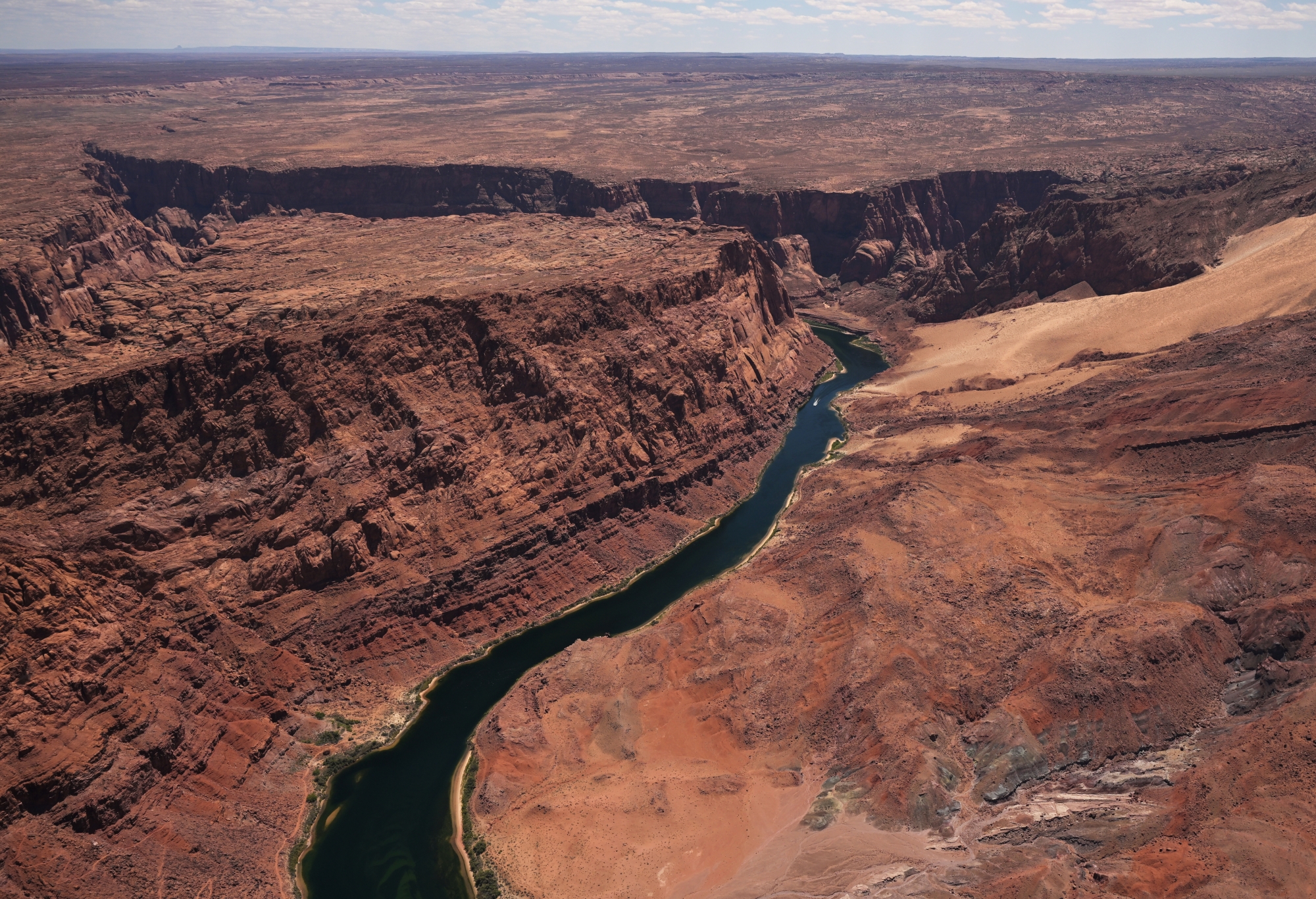
This partial transcript was computer-generated. While our team has reviewed it, there may be errors.
Lesley McClurg: Welcome to Forum. I’m Lesley McClurg, in today for Mina Kim. The Colorado River has made the West as we know it possible. It’s allowed millions of people to live in the desert, turned dry farmland green, and helped fuel cities like Los Angeles, Phoenix, and Las Vegas. But there is not enough water in the river to go around. Rising temperatures, decades of overuse, and a long-term drying trend are all shrinking the Colorado River system and pushing major reservoirs to historic lows. States across the West are now fighting over how to share what’s left. So where do we go from here?
We’re joined by Luke Runyon, co-director of the Water Desk at the Center for Environmental Journalism at the University of Colorado. Welcome, Luke.
Luke Runyon: Hi, thanks so much for having me.
Lesley McClurg: It’s been a rough year for the river. There’s currently a drought — give us a sense of how bad it is.
Luke Runyon: We’re really gearing up for a pretty unprecedented year in the Colorado River Basin. We’ve had some bad years in recent memory, and this one is shaping up to be even worse. The drought of record for the basin was set back in 2002 — really dry, unprecedented conditions. This year is threatening to break that record in terms of water supply for the region. We had very low snowpack across the Rocky Mountains, where the Colorado River and its main tributaries begin, along with record warm temperatures over the winter and into the spring. A March heat wave sapped whatever snowpack remained, pushing the timing of everything up. We’re now approaching a summer that could be very hot and very dry for the Colorado River Basin.
Lesley McClurg: What does that look like on the ground? Has the river itself visibly changed? Are there parts that could actually dry up?
Luke Runyon: Yes. I live here in western Colorado, in Grand Junction, which is one of the cities the Colorado River flows through. Already this season we’ve seen really low levels — conditions you’d normally expect in late summer, in September, are happening in April and May, when the river is supposed to be getting its annual rise. You’re seeing it in the river itself, and also in its largest reservoirs, Lakes Powell and Mead. These are the two largest reservoirs in the country. A lot of people rely on them for their water supply, and both are taking a significant hit this year.
Lesley McClurg: How is the water divided up among farming, cities, and different regions — who’s using the most?
Luke Runyon: It’s a mix of uses throughout the Southwest. Agriculture is the single largest user of Colorado River water — depending on how you measure it, somewhere between seventy-five and eighty percent of the total. A lot of that is in heavily farmed areas in Southern California and Southern Arizona, which produce much of the winter vegetables we see throughout the country, along with many other crops year-round. Municipalities make up roughly fifteen to twenty percent, and that includes some very large urban areas — Los Angeles, the Phoenix metro, and in the upper basin, cities like Salt Lake City, Albuquerque, and Denver that rely on the Colorado River for a portion of their supply. The remainder goes to miscellaneous industrial uses. There’s also been a lot of talk about data center expansion in the Southwest, which is an emerging and growing use of Colorado River water.
Lesley McClurg: Federal officials are now stepping in because the states can’t agree on what to do. They’re discussing scenarios that would dramatically reduce how much water states receive in the coming years. How serious is this moment? Are we talking about incremental, year-by-year conservation changes, or are we looking at radical shifts in how the West uses water going forward?
Luke Runyon: A lot of people describe this as a slow-moving train wreck, because these problems have been visible for at least the last couple of decades. We’ve long known the Colorado River is over-allocated and over-prescribed, but regional leaders haven’t been able to agree on the scale of cuts needed to live within the means of a shrinking river. Because of that, they’ve been locked in a stalemate for the past several years — the seven states that rely on the river unable to adequately reduce their usage.
Now the federal government has realized that this stalemate is threatening the infrastructure it manages. Large dams like Hoover and Glen Canyon are losing hydropower production and approaching levels where it would be physically impossible to move water through them. That threat is real, and I think it’s pushing the federal government to come to the table and essentially force the states’ hands — saying, if you can’t come to an agreement on how to cut, we may have to make those decisions for you.
Lesley McClurg: What specifically is the Bureau of Reclamation proposing?
Luke Runyon: We’ve seen a few different proposals over the last six months or so. The latest from the Bureau of Reclamation would place the largest burden of cutbacks on the lower basin states — California, Arizona, and Nevada. Those states also put forward their own proposal, which would cut a little over three million acre-feet over the next few years. The federal plan would institute steeper cuts on a faster timeline. Right now there’s still real uncertainty about which plan will end up ruling the day.
Lesley McClurg: How unprecedented is it for the federal government to step in like this? Historically, the states have managed to work things out on their own.
Luke Runyon: I’d say the federal government is still somewhat reluctantly stepping in — nobody really wants to own this problem. It doesn’t divide neatly along partisan lines, with a mix of states and politics at play. The Trump administration isn’t eager to take over the Colorado River as a problem area. But the hydrologic conditions are forcing everyone’s hand. The river is getting so low, and demand isn’t declining at the same pace. Physically, we just don’t have the water to meet everyone’s needs.
In the past, the federal government has often pressured states to reach agreement through threats and regulatory leverage, but it has never firmly put its hand on the spigot to start ratcheting back water deliveries. We’ll see if that’s where we’re headed.
Lesley McClurg: The river is obviously home not just to cities and golf courses, but to immense wildlife. People raft, fish, boat on Powell and Mead — what do these low levels mean for recreation, habitat, and fisheries?
Luke Runyon: The low levels are really threatening the region’s recreation economy. Here in the upper basin where I live, whitewater rafting is an iconic part of the western summer economy. This year, the season is just going to be so short that outfitters are really wringing their hands, wondering how to bring tourists in now when conditions are decent rather than later in the summer during peak vacation season.
At the large reservoirs, Lake Powell is normally a motorboater’s paradise — wakeboarding, houseboating across the reservoir. Right now there’s only one usable boat ramp at Lake Powell because of how low it is. When you’re in a canyon, once the water level drops past a certain point, the boat ramps essentially fall off a cliff. The National Park Service is scrambling right now to keep boat ramps viable as Powell approaches these record lows.
Lesley McClurg: I’ve been on those houseboats — it’s really hard to imagine those beautiful canyons becoming inaccessible. In our final few minutes before the break: Native tribes have legal rights to Colorado River water as well, but have historically been excluded from key decisions. Are they being included in current negotiations?
Luke Runyon: It’s hard to generalize, because some tribes have been included. Particularly in the lower basin, there are tribes with access to quite a bit of Colorado River water, and they’ve been somewhat involved because state and federal leaders see their water as part of the potential solution. But there are thirty Native American tribes throughout the Colorado River Basin, and they have not all been at the table.
Leading up to these negotiations, states and the federal government made a lot of promises that this time would be different — that they would more meaningfully include tribes, bringing their economic, cultural, and spiritual interests into the discussions. From the tribes I’ve spoken with, that simply has not been the case. And I think it’s a significant disappointment for tribes at this critical moment.
Lesley McClurg: We’ve been talking about the Colorado River drought with Luke Runyon, co-director of the Water Desk at the Center for Environmental Journalism at the University of Colorado. We’ll be right back after this break. I’m Lesley McClurg — stay with us.