This partial transcript was computer-generated. While our team has reviewed it, there may be errors.
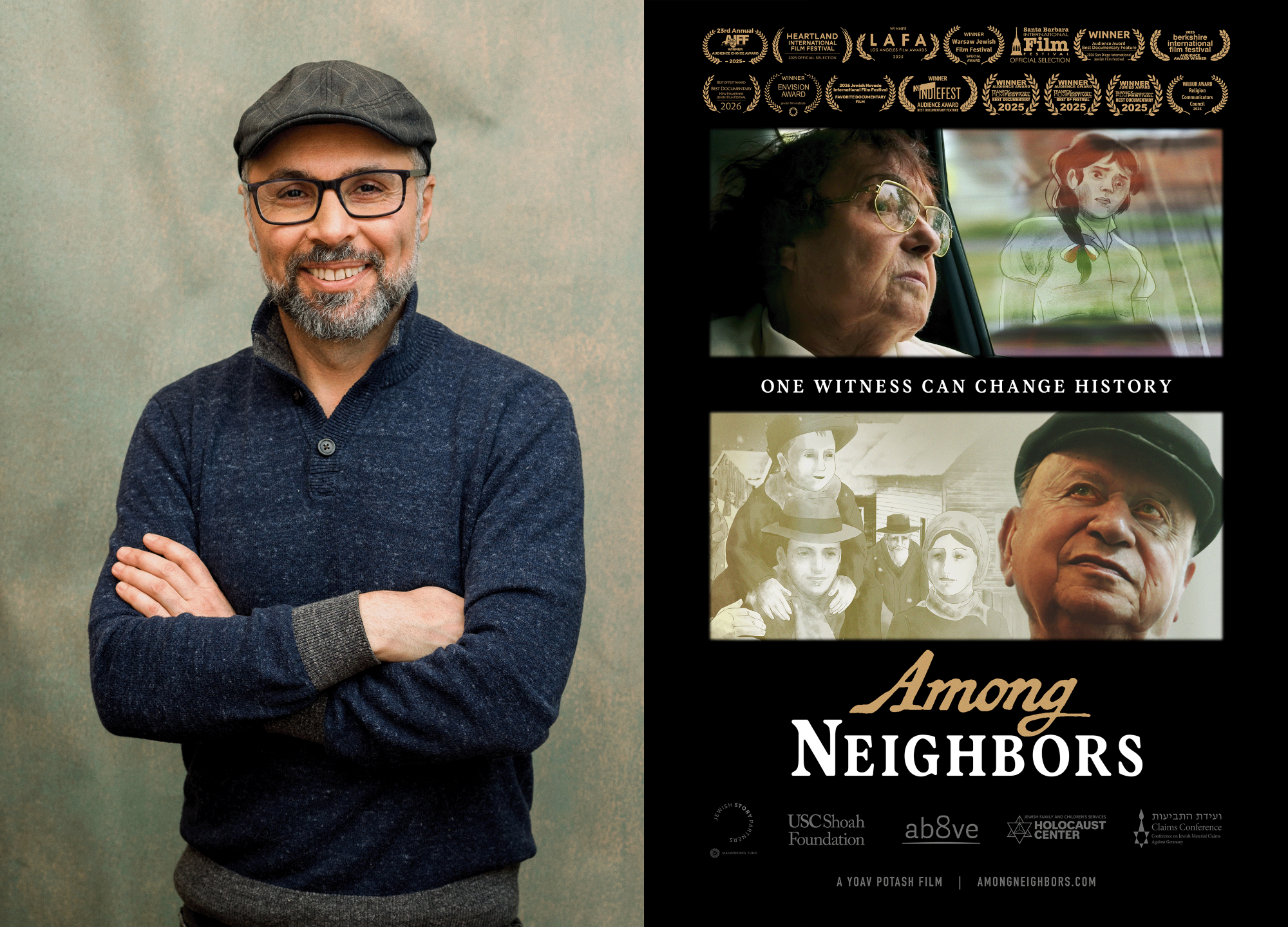
Lesley McClurg: Welcome to Forum. I’m Lesley McClurg, in today for Alexis Madrigal. For centuries, Poland was home to one of the largest Jewish communities in the world. But after the Holocaust, some Jews who managed to survive the war and finally returned to their hometowns discovered their nightmare was far from over. The documentary Among Neighbors tells their stories through eyewitness testimony and animation. It’s a beautiful film — heart-wrenching. It follows an aging Polish woman haunted by what she witnessed as a child after the war, and her effort to find a long-lost Jewish friend she lost track of. The film is drawing international attention both for its incredible storytelling and the fierce political reaction it sparked in Poland. Bay Area filmmaker Yoav Potash joins us now. Welcome.
Yoav Potash: Thank you. Pleasure to be here. I listen to Forum all the time.
Lesley McClurg: How did you come to this story?
Yoav Potash: It all began one day in 2014 when Anita Friedman — a real pillar of the Jewish community here in the Bay Area and the executive director of Jewish Family and Children’s Services, among other things — called me and said, “Do you want to go to Poland?” I said, “Why?” And she said, “We’re rededicating the cemetery in what was my father’s shtetl.” A shtetl is an Eastern European Jewish village. If you think of Fiddler on the Roof, that’s basically what a shtetl is. I said yes, because I’d seen Fiddler on the Roof as a kid and I knew about shtetls — and I also knew they had ceased to exist. The ostensible reason, of course, was the Holocaust. But I was interested to see a shtetl, or what remained of one.
From the start, I upped the ante and said, “If you’re going to bring me all the way to Poland, how about instead of only filming this rededication ceremony, I’ll also knock on doors and try to find the oldest residents of the town, and ask them about the era when about two-thirds of the residents were Jewish?” Today, of course, there are zero Jews left. That’s how it all began. And during that first trip, something happened that made me realize this was going to be bigger and deeper than I had imagined.
Lesley McClurg: We’re going to hear a clip from the Friedmans from that first trip — Anita Friedman, who you just mentioned, and her son Aaron.
Yoav Potash: Just a small correction before we play it: what they’re about to describe actually occurred before I got involved. I came in in 2014. What we’re about to hear is from when they first went to the town on their own — without me — in 2005, to explore their family roots.
Lesley McClurg: Let’s hear it.
Anita Friedman (clip): I always knew from my parents that the firehouse used to be the synagogue. It was the center of Jewish life.
Aaron Friedman Tartakovsky (clip): We started taking pictures, and all of a sudden we were approached by two men. We didn’t know what they were saying, but they started grabbing for the cameras.
Anita Friedman (clip): They got very aggressive. They started to push my sons around.
Aaron Friedman Tartakovsky (clip): I did catch the word jid, which means Jew. We had a guide with us — a translator — who turned to us and said, “We need to leave now. They know you’re Jews.” We got in the van and took off. I remember sitting in stunned silence, and how frightened my mother was. Even as a fourteen-year-old kid, I thought: this town has something to hide.
Lesley McClurg: What does this town have to hide?
Yoav Potash: That’s what I stumbled into on that first trip. Talking to the elders around town, a lot of them kind of saw me as a Jewish ambassador — “Oh, here comes this Jewish guy with a camera.” They remembered when Jews used to live there, when they used to play with them, visit the Jewish shopkeepers who would toss candy to the children. They were really excited to have a vessel for these memories, especially in their final years.
But the pivotal moment came with one woman in particular who stood in her doorway for the entire interview. We knocked on her door; she never invited us in, but she never told us to leave either. She just started talking. And she was the first person to say that Jews were killed in this town six months after World War Two. Which meant it wasn’t the Nazis — it was local people. That shook me. It was so different from all the Holocaust stories I’d read or seen in films. It crystallized for me that this needed to be a standalone documentary. The story of a small town with a rich, vibrant, shared Jewish-Polish past — and a horrible dark secret about how that past met its ultimate end, not at the hands of the Nazis, but at the hands of their neighbors.
Lesley McClurg: Had that been reported before? You said you were shocked. As you were reporting, did you find that story had been revealed elsewhere, or was this really new information?
Yoav Potash: I don’t claim to be the first to discover this type of story. Over the years I learned this was part of a broader phenomenon — the deeply hostile environment Jews encountered after World War Two. It was extremely dangerous to be a Jew in Poland even after the Nazis were gone. The pot of antisemitism had not only been stirred up, it had been given more fuel. There were weapons everywhere after years of war. And Polish people had moved into what seemed like abandoned Jewish homes, so there were complicated dynamics at play. When Holocaust survivors came stumbling back to these towns, Poles were not welcoming them — to say the least. Those who wanted to do right by the survivors would rush out to warn them: “Don’t come back. It’s too dangerous. They will kill you.” And then there were those who carried out the violence themselves.
I don’t have an exact number for how many Jews were killed this way, but it happened all over Poland — especially in small shtetls, where there was no Allied presence. But it happened in cities too. The largest such incident came six months after the one documented in my film — a full year after the end of the war — when over forty Jews were killed in a single day in the city of Kielce.
It’s horrific, but I think this chapter hadn’t been closely examined in part because filmmakers drawn to Holocaust stories tend to look for light within the darkness — a hero who comes in and saves people. Think of a film like Schindler’s List. That’s a great film, but Schindler was the exception, not the rule. My film ventures into much grayer territory — Polish complicity, and even the ways Poles did help Jews, which were sometimes not so selfless. Sometimes it was done for money, and sometimes in deeply inhumane ways.
In the film, we tell the story of a Holocaust survivor who was hidden for two years by a Polish family. Our impulse is to think: how heroic, how brave, how selfless — they could have been killed for doing that. All of that is true. And yet they were doing it for money, and as he described it, he was kept like an animal in a cage. That forces us to look at the question of heroism through a new lens, and to accept that things aren’t always as simple as we wish they could be.
Lesley McClurg: Let’s hear from him now. This is Yaacov Goldstein — the survivor you just mentioned — describing the moment he emerged from that attic.
Yaacov Goldstein (clip): Strangely enough, it was the first time I had seen the sky and the sun in almost two years. It was the middle of summer. The light was blinding. But then, almost immediately after I came out, two German soldiers came and got me. They took me to the German police. The two policemen immediately ordered me to put down my belongings. Then they saw that I was circumcised. They knew I was Jewish, and they decided immediately to kill me. They pushed me against a wall, and the rifles were already raised. For me, this was the end.
Lesley McClurg: We’ll hear more from Yoav Potash — and what really happened to Yaacov Goldstein, who did survive — after the break. We’re talking about the documentary Among Neighbors. Stay with us.