This partial transcript was computer-generated. While our team has reviewed it, there may be errors.
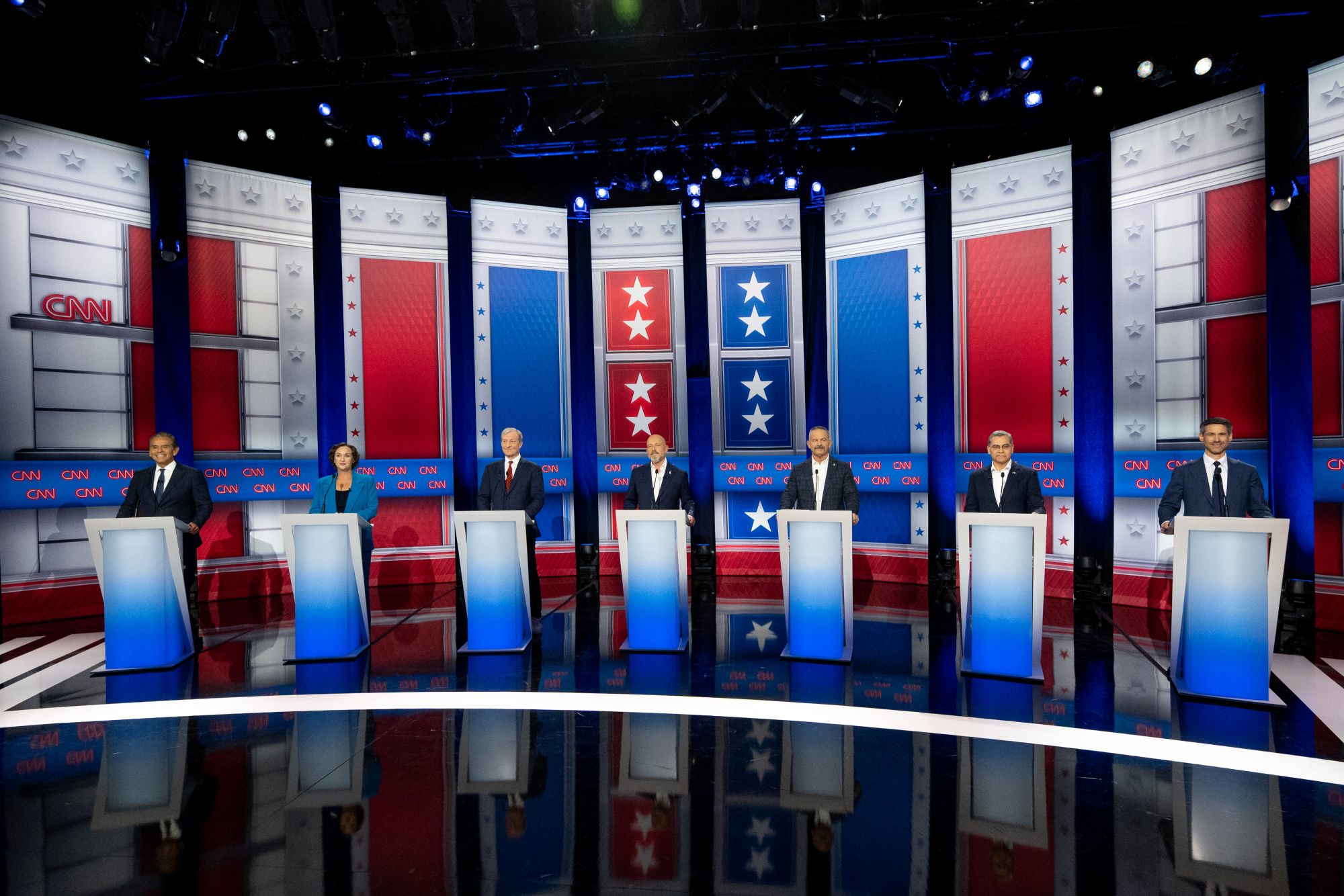
Mina Kim: Welcome to Forum. I’m Mina Kim. The dynamics of the California governor’s race have changed in recent weeks. A new Democratic Party poll this week finds Republican Steve Hilton and Democrat Javier Becerra leading with just over twenty percent of the vote, and Democrat Tom Steyer within striking distance at fifteen percent. Primary election ballots have been in voters’ hands since they were mailed out more than two weeks ago, but Democrats seem less eager than Republicans to turn them in — suggesting that many remain undecided, or are holding on to their ballots until a clear Democratic front-runner emerges, out of fear that two Republicans will advance to November. Joining me to talk about voter trends and the state of the race are Marisa Lagos and Guy Marzorati, our correspondents for KQED’s California Politics and Government desk. Welcome, you two.
Guy Marzorati: Good morning.
Marisa Lagos: Good morning.
Mina Kim: Also with us is Paul Mitchell, vice president of Political Data Inc. Paul, thanks so much for being here.
Paul Mitchell: Thanks for having me.
Mina Kim: And Melanie Mason, California bureau chief for Politico. Hi, Melanie.
Melanie Mason: Hi. Good morning.
Mina Kim: Paul, let me start with you. Republicans are voting earlier than Democrats this time around — is that what your latest analysis of voter trend data is showing?
Paul Mitchell: Republicans are performing better than Democrats right now in these early ballots. The raw numbers aren’t that far off from 2022, but the percentages show a real Republican closing of the gap. In 2022, Democratic turnout was about twenty-five points higher than Republican turnout. Now it’s down to about four points. That said, I don’t think it necessarily means alarm bells for Democrats yet. There’s a lot of evidence that some of the highest-propensity older Democratic voters are simply holding on to their ballots, probably because they’re trying to figure out the right way to vote in the governor’s race.
Mina Kim: What do you mean by “the right way to vote”?
Paul Mitchell: Folks who have been following the news have seen a lot of discussion about Democratic fears that the top two candidates in the governor’s race could both be Republicans, essentially boxing Democrats out of the general election. I think that risk has been significantly reduced, and we can talk about why — but voters are still very keyed into it. I ran a poll showing that seventy-five percent of Democratic voters are afraid two Republicans might make the runoff. The people who have already voted cite things like, “I voted for the candidate who was highest in the polls,” or “I voted for whoever I thought would make sure two Republicans don’t make the runoff.” There’s this prevailing sentiment of: we can’t afford to get it wrong, so we’re going to wait and see where our vote will have the best impact.
Mina Kim: Marisa, do you think that’s what’s driving the slower rate of ballot returns among Democrats?
Marisa Lagos: Yeah. I feel like something interesting has happened over the past six years or so — Democratic voters are almost thinking about voting as strategically as they are about just voting for who they like. We really saw this in 2020 with the urgent question of electability and who could beat Trump. I think it’s continued in state races since then, with voters trying to game out candidate viability. And I just don’t think that’s how we should vote. You should vote for who you like, because polls can be wrong. For a moment there — which the national media hasn’t let go of — there was this scare among Democrats that two Republicans could make it. As Paul said, it’s not impossible, but it’s very unlikely. I would urge people to vote their heart, because you can’t know what other people are going to do.
Mina Kim: Melanie, what do you make of this strategy of waiting until a clear Democratic front-runner emerges?
Melanie Mason: It’s wild to me that we’re talking about Democrats worrying about viability in California. If there’s anywhere Democrats should feel free to vote their hearts, it’s in a blue state like this. But I think Paul and Marisa are exactly right — especially among highly engaged voters who have been following this closely. The anxiety of “there might not be a Democrat on the November ballot” has really taken hold, even if that’s not where the race actually stands right now. I also think another reason these engaged voters are holding on is that they know better than most how volatile this race has been — how wildly it has swung between front-runners. The fact that we’re talking about Javier Becerra as a front-runner is not something we would have said six weeks ago. Because of that, I think they’re waiting to see if there will be any more dramatic swings before June second.
Mina Kim: Guy, talk about why this race has remained so unsettled. What are some of the driving factors?
Guy Marzorati: From the beginning, it really shaped up as a contest defined by who wasn’t running. The big early storylines were Kamala Harris saying she wasn’t running for governor, Alex Padilla saying he wasn’t running, Rob Bonta not running. So we were left with a field without a standout. Coming off Newsom, who had political star power before he was even governor, and before him Jerry Brown and Schwarzenegger — we just didn’t have that in this field. It remained wide open, and it became almost incumbent on candidates to prove their viability more than to make a policy pitch to voters. We’ve seen a focus on prediction markets and other ways people are gauging where other voters will land. And I think in terms of Democrats holding out, you also have to look at the Eric Swalwell implosion — he was seen as a Democratic front-runner for a time, and his collapse has given Democrats even more reason to say, “I want to wait until I have all the information before making this decision.” I also think the media — ourselves included — bear some responsibility. This top-two storyline —
Marisa Lagos: (ahem) Paul. (ahem)
Guy Marzorati: — we planted that worm in voters’ brains about the possibility of two Republicans making it through.
Mina Kim: It wasn’t statistically impossible, though.
Guy Marzorati: No, it wasn’t. The high-water mark was maybe a one-in-five chance — Paul can correct me. But look, we were all searching for storylines in a race that had seemed very sleepy for many months. And what’s a more irresistible storyline than two Republicans making it into the general election in the largest blue state in America?
Mina Kim: Just a quick reminder to listeners that you can join this conversation at 866-733-6786, by email at [email protected], or find us on Discord, Bluesky, Facebook, or Instagram at KQED Forum. We want to know: if you’ve voted, who did you vote for? If you haven’t, why not? Are you satisfied with the field of candidates? What issues matter most to you in this race?
Paul, you were saying the concern about Democrats being shut out has largely abated. Tell us why it was initially seen as a real possibility, and where things stand now.
Paul Mitchell: First, it was always mathematically unlikely. I think a lot of people interpreted me as saying it was going to happen — what I was actually trying to do was put some numbers to a debate between people saying it was a hundred percent certain and people saying it was a zero percent chance. One in five was roughly where it stood for a good portion of the time, before Trump endorsed Hilton. But I do want to push back a little on the idea that the media coverage was irresponsible. I think the attention on this risk — low as it was — was actually valuable, and probably influenced how Sacramento organizations decided to mobilize and how voters organized. It’s easy in hindsight to call it overblown, but — and I apologize for this strained metaphor — it’s a bit like the Titanic. Rusty Hicks, the chair of the California Democratic Party, and others were flagging a low-probability but potentially catastrophic event. There was real behavior change in the race because of it. Now it looks like clear sailing, but I don’t want us to look back in six months and dismiss the people who were sounding the alarm.
Mina Kim: So are the polls now giving us a more definitive picture of who the top two candidates will be?
Paul Mitchell: What they’re giving us most clearly is a picture of the Republican side. Steve Hilton has taken a very large lead, and Chad Bianco has dropped into the single digits — which opens up room for Democrats to slot into second or even third place. It removes the fear of Bianco and Hilton essentially tying around eighteen percent each while Democrats split their votes evenly, which is precisely what would have been needed for a top-two Republican scenario. In a sense, Donald Trump did Democrats a favor by endorsing Hilton and creating that gap on the Republican side.
Mina Kim: Andy writes in: “I haven’t sent my ballot in yet because I’m agonizing over who to vote for. I want to vote for Katie Porter, but I’m afraid that Porter and Becerra will split the vote and a Republican might slip through. Should I vote for Becerra since he’s ahead in the polls, even though Katie is who I actually want?”
Marisa Lagos: I mean — vote for Katie Porter! Every single person I’ve talked to in the last week who is in this exact situation wants to vote for Katie Porter. So many people in my life — regular people, not political obsessives — have come to me with this exact dilemma. It’s fascinating. Is it likely, if you believe the polling, that she makes the top two? Probably not. I’d be curious to hear what Paul and Melanie think about the Democratic Party poll and its accuracy. But look — this does feel like a three-way race for the top two spots: Becerra, Steyer, and Hilton. So if you want to vote strategically as a Democrat, maybe you’re choosing between Steyer and Becerra. As a reporter, I’ll say I would love to see two Democrats in the runoff — the odds of Hilton actually winning in November are so low, and a Becerra-Steyer race would feel like a real contest rather than a coronation after the primary. But if people genuinely want Porter or one of the other candidates, maybe they should just vote for them.
Mina Kim: We want to hear what you think, listeners. Do you agree with Marisa? We’re talking about the California governor’s race — June second is just around the corner, and many voters appear to be either undecided or holding out. A new poll finds Republican Steve Hilton and Democrat Javier Becerra virtually tied for the lead, with Steyer within striking distance. We’ll talk more right after the break. I’m Mina Kim.