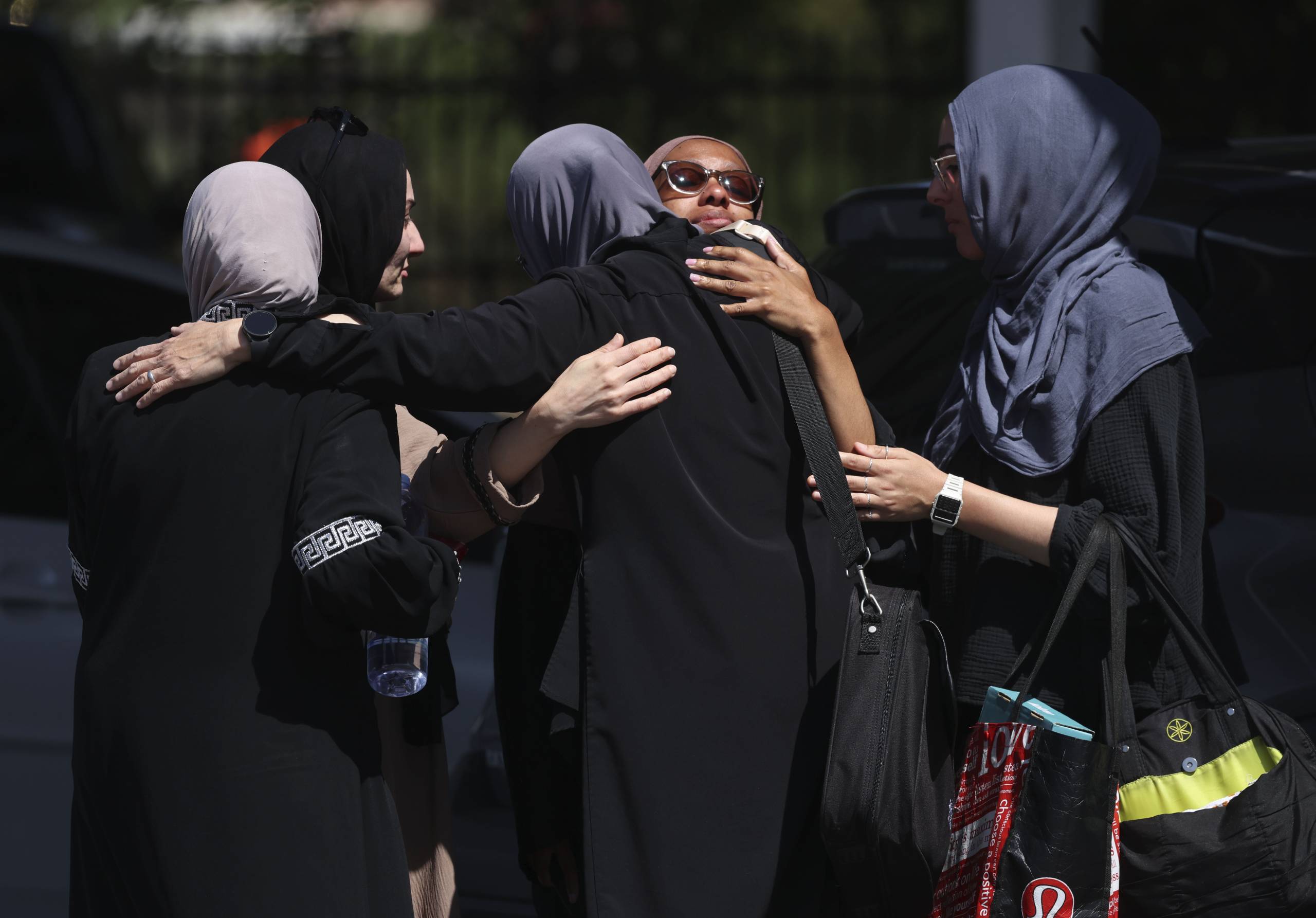
This partial transcript was computer-generated. While our team has reviewed it, there may be errors.
Mina Kim: Welcome to Forum. I’m Mina Kim.
The Islamic Center of San Diego holds prayers five times a day. It has a grocery store, sports facilities, and a primary school. But on Monday, it was the site of a deadly mass shooting. Nine-year-old Odai Shanah told Reuters he heard gunfire and hid in a closet with his classmates until authorities escorted them out of the mosque.
Odai Shanah (clip): And then we saw a bunch of bad stuff — people laying down — and, yeah, bad stuff. I felt a bit scared. My legs were shaking, my hands, and my head was, like, hurting me a lot. I felt like a rock.
Mina Kim: Three men were killed trying to protect the center and its children from two teenage gunmen, leaving a community stunned and grieving. Joining me first is Tazheen Nizam, executive director of the Council on American Islamic Relations San Diego. Tazheen, thank you so much for coming on and talking with us today.
Tazheen Nizam: Thank you for having me.
Mina Kim: The Islamic Center is in the Claremont neighborhood. What can you tell us about what it means to you and others, and the role it plays in the community?
Tazheen Nizam: The Islamic Center is sort of the heart of San Diego. It is a welcoming space — open to Muslims for prayers, for dialogue, for connecting with the community. It’s a school. It’s a place that people who have lived in San Diego for almost forty years have been going to. It has been the heart of San Diego.
Not only is the Muslim community invited there, but the doors of the Islamic Center have always been open to non-Muslim community members as well — people who are there to learn about Muslims and Islam, people who are there to connect with the imam, his staff, and the other imams connected to the masjid. Law enforcement often stops by. Interfaith community members are often there. People connected to the social justice movement often come to speak to the imam or host events. So it’s a space for the entire San Diego community, not just the Muslim community.
Mina Kim: Can you tell me where you were and what happened when you learned about the shooting?
Tazheen Nizam: I was far away, actually. I was at a meeting with a school district, talking about bullying issues our kids face, when I received a text from one of our staff members who was at the office. Our office is very close to the Islamic Center. When he received the message, he messaged me — and for a moment, I couldn’t understand what he was saying. I’m like, wait — UCSD? ICSD? I had to call him again, and he said no, ICSD. And then I just went into auto mode. I got in my car and drove, and I have no idea how I got here.
When I arrived, there was police tape over a quarter-mile perimeter around the Islamic Center — along the main street and the cross street. There was no way to get close, so I parked about a quarter mile away and literally ran as far as I could before law enforcement stopped me. And anyone who knows me knows I’m a very inactive person, so it was a miracle in itself that I could run a quarter mile.
Mina Kim: What a scene you must have witnessed. For a place as bustling as you’ve described — what can you tell us about the three men who were killed? All three have been credited with diverting the attention of the attackers and saving many lives.
Tazheen Nizam: Heroes. Shahids — martyrs. That’s the word that comes to mind when you think about them.
Our security officer went head-on at these attackers, and I would consider his actions the most significant mitigating factor. Otherwise, the shooters would have reached the school — which they later attempted, but were stopped by the other two heroes.
Officer Amin had been a fixture outside the Islamic Center for seven years. When the kids came to school, he was friendly with them — like a friend to them. Anyone who came there, the first pair of eyes you met were Officer Amin’s, with his smiling face welcoming the community. He was the security guard, yes, but also a kinder, gentler human being who welcomed people with warmth. He was truly a fixture of that community.
The other two individuals were also so deeply part of the community. AbulEzz and his family have been part of the Islamic Center since its inception, almost forty years ago. His children grew up with many community members. He and his wife cooked for the masjid. He was there at the store, and he’d let the little kids slide on their tabs. He made soup for the masjid during Ramadan and other times — so much love and contribution, right up until his last moment. He was there to protect the community, to shield the children and the Islamic Center. Such a hero.
And brother Awad — his wife works at the Islamic Center as a kindergarten teacher and was on the premises. When he saw the alert about an active shooter at the Islamic Center, he heard the gunshots from across the way and ran in to check on the community, to help the people trapped inside. And he lost his life doing that.
Mina Kim: What are the people around you saying and feeling? What are you hearing from them about how they are trying to process this, Tazheen?
Tazheen Nizam: Loss. Devastation. Those are the immediate reactions. It’s going to be a long, drawn-out process to recover from this. The loss the community has faced is immense.
These three are amazing heroes, but there are other heroes we need to elevate too — the teachers who stepped up and protected the children, kept them quiet, kept them in their classrooms while all of this was unfolding on the premises. Because of their efforts, the children were safer. But those teachers also have to deal with the trauma — the survival, the process, the involvement in such a violent incident. They’re going to have to work through all of that.
And the little ones — most of them are under ten. How will they remember all of this? How will they feel the impact long term? How will they ever be able to come back to the Islamic Center, to their school, and feel safe again in those same classrooms? I worry about all of that. These are real concerns that parents, teachers, and the broader community all share for the people who survived.
The imam who was there, the office staff who had gunshots flying over them and somehow, miraculously, were saved — all of it is a lot to process.
Mina Kim: Do you know if the Islamic Center is increasing security? Would you like to see that happen?
Tazheen Nizam: In terms of necessity, yes. The healing and recovery is going to happen on many fronts — the emotional, obviously, but also the physical. The Islamic Center is in a very residential neighborhood, with homes right across the street, so those neighbors also have concerns about security.
For the Islamic Center itself, the immediate steps are figuring out how to reopen for the community — they’re trying to do that today — and how to arrange three funerals at the same time.
As for security more broadly: in the post-9/11 era, everybody thought about security. But in the last six or seven years, since the Christchurch shooting, the Islamic Center brought on Officer Amin as the first line of defense. There are other measures in place too — a fence was built, cameras are installed throughout — but increasing security going forward is going to be a multi-step, multi-agency process. The Islamic Center will lead that effort, but we’re going to need support from law enforcement, policymakers, county agencies, and others to help the community feel whole and safe again in that space.
Mina Kim: We’re talking about the aftermath of Monday’s shooting at the Islamic Center of San Diego. Two teenage gunmen killed three people: Amin Abdullah, a security guard; Mansour Kaziha, a store manager at the mosque; and Nadir Awad, whose wife also teaches there.
We’re talking with Tazheen Nizam, executive director of the Council on American Islamic Relations San Diego, and we also want to welcome our KPBS listeners joining us today from the San Diego area.
Listeners, what is your reaction to the shooting? Is your community on alert? What questions do you have about what happened? Have you noticed a rise in anti-Muslim incidents and Islamophobia — and what do you think is driving it? You can email us at [email protected], and you can find us on our social channels at KQED Forum — we’re on Discord, Bluesky, Facebook, and Instagram. We’ll have more right after the break. This is Forum. I’m Mina Kim.