This partial transcript was computer-generated. While our team has reviewed it, there may be errors.
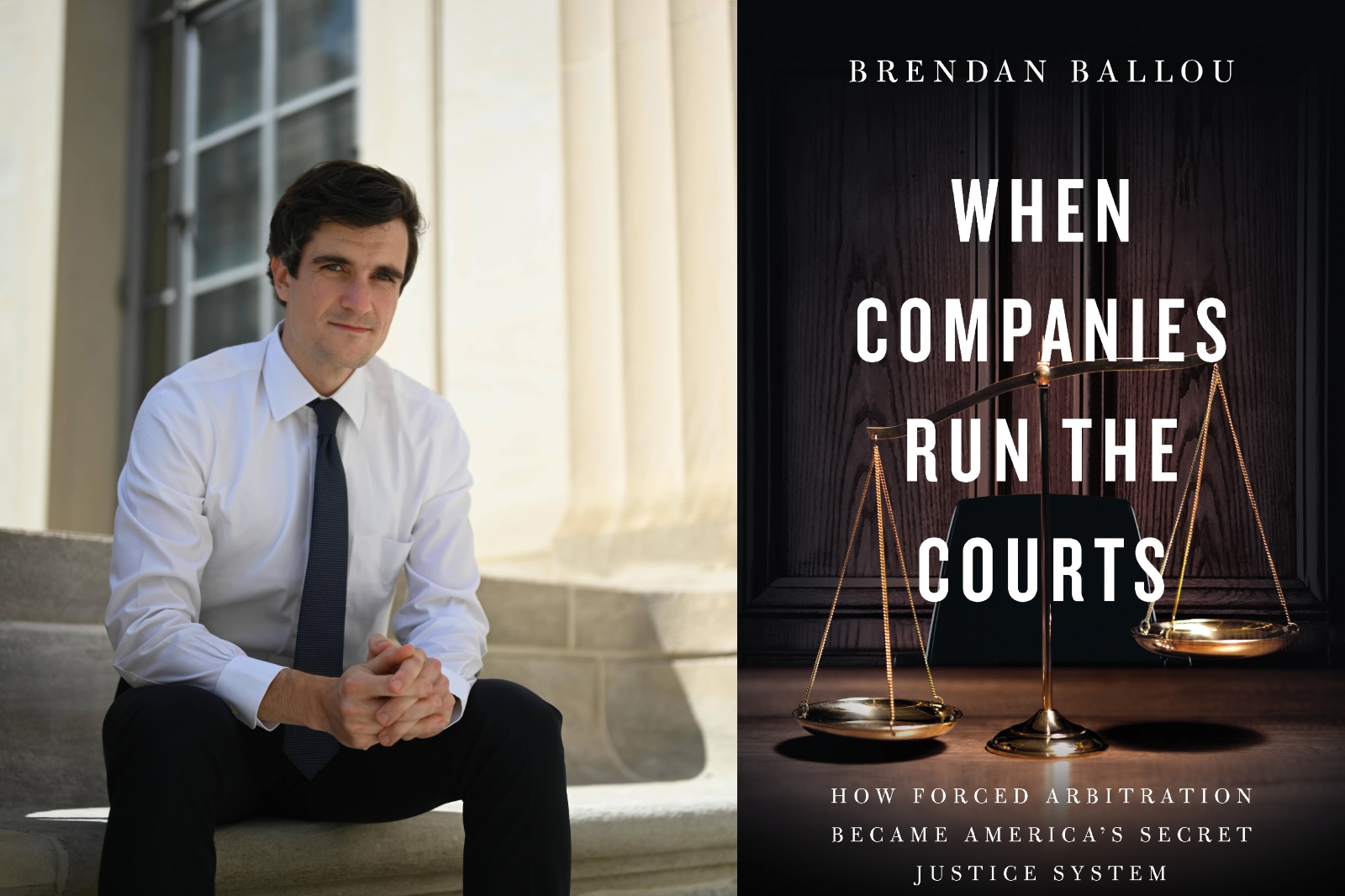
Mina Kim: Welcome to Forum. I’m Mina Kim. If you’ve signed up for a credit card, the warranty on a product, or accepted a job, you’ve likely agreed at some point to arbitration to settle any disputes rather than go through the courts. Forced arbitration promises to be a faster, easier way to reach resolution, but it’s a process that Brendan Ballou, a former federal prosecutor, says is too often biased in favor of corporations. In this system, decisions are hidden from the public and cannot be appealed, he writes. Judges decide their own powers and are often paid for by the companies they’re supposed to judge. Ballou’s new book is When Companies Run the Courts. Listeners, do you think forced arbitration is flawed? What’s been your experience? Brendan, welcome to Forum.
Brendan Ballou: Thank you so much for having me.
Mina Kim: Well, you said forced arbitration touches virtually every part of our lives. How often are we being asked to agree to arbitration?
Brendan Ballou: Well, the most recent studies say that there are more forced arbitration agreements than there are American citizens, and I think that probably dramatically understates the number of agreements. So about eighty percent of Fortune 500 companies use forced arbitration either with their consumers or employees. At least sixty million private sector workers are bound by forced arbitration. And if you just sort of think anecdotally about your own life, all the little click-to-accept agreements that you have when you buy a new product online or even visit a website — overwhelmingly, I would say those agreements increasingly have forced arbitration terms.
Mina Kim: And so, basically, the overall effect is that it’s just much harder to bring a case to court against a company that has this. Right? That it was, you know, something that we had the right to do maybe a few generations ago more frequently than we do now.
Brendan Ballou: Absolutely. And I think to the extent that people feel that companies are increasingly beyond the reach of the law, it’s because they literally are, and forced arbitration is the explanation. So, you know, just to set a baseline here — when we’re talking about forced arbitration, and you teed this up very, very clearly — we’re talking about a private alternative to the traditional justice system. So instead of having a judge, you have what’s called a private arbitrator decide the case. But importantly, that decision is binding, and yet the decision-making process, the proceedings, are in secret. As you say, they can’t be appealed. And I think most importantly — and I think this kind of gets to the heart of why the system so often fails — is the arbitrator is often paid for by the company getting sued. And so they have a natural incentive to rule for the party that is effectively their employer.
Mina Kim: So to help us understand these features of forced arbitration in a real-life example, you tell the story of the Piccolos. Can you explain what happened to them when they visited Walt Disney World?
Brendan Ballou: Absolutely. So the Piccolos were a couple that, as you said, wanted to go to Walt Disney World. Jeffrey Piccolo’s wife, Kanokporn Tangsuan, had severe allergies, and so they had to be very careful about where they were going to eat. They went to this sort of faux Irish pub and, at least according to their subsequent allegations, were very careful about what they ordered. They repeatedly asked the wait staff for assurances that the food would be allergen-free. They were repeatedly assured that it would be. Very tragically, it was not. And Tangsuan died of anaphylactic shock shortly thereafter. The problem for Jeffrey Piccolo was that when he tried to sue for wrongful death, Disney actually moved to compel Piccolo into arbitration — among other reasons because he had signed an arbitration agreement as part of his Disney+ account several years earlier.
Mina Kim: So wait a second. He signed up for a streaming service and by doing so gave up the right to ever bring Disney to court if they went to a theme park?
Brendan Ballou: Exactly. And increasingly, companies have been arguing — and arguing successfully — that arbitration agreements in seemingly unrelated contracts can nevertheless bind you. You know, you have stories about a woman who was allegedly racially discriminated against at a Walmart, forced into arbitration because she had signed up for their gig delivery service several months or several years prior. You have an example of a father who had to arbitrate the wrongful death of his son, who was murdered at an Airbnb, because he himself had an Airbnb contract. So, you know, there are all sorts of agreements that we’re signing every day that may bind us in ways that we might not even expect or foresee.
Mina Kim: Let me invite listeners into the conversation. What questions do you have about forced arbitration, and what are your reactions to the stories that you’re hearing? Have you ever been forced into arbitration? What was that process like for you? Or maybe you’re an arbitrator or have represented clients in arbitration — what would you like to tell us? You can email [email protected], find us on Discord, Blue Sky, Facebook, or Instagram at KQED Forum, or by calling 866-733-6786. 866-733-6786.
So, Brendan, this is often how people find out that they agreed to forced arbitration, right — when they have a moment where they do want to make a complaint or try to sue a company.
Brendan Ballou: Exactly. And I think we don’t really realize the extent to which we’re signing away our rights, because it’s not just that you have to pursue arbitration and can’t go into court. Very often, these agreements require that you go to arbitration individually. And the reason that that matters is it effectively kills class actions — the cases that you bring when hundreds or thousands or millions of people are harmed in the same way. When you have to bring your case in arbitration individually, it makes it economically unaffordable to pursue justice for all but the most serious or deadly harms.
Mina Kim: Is there a good reason to create more obstacles to class action lawsuits? You know, we hear about how state courts can be overloaded by these things in some places.
Brendan Ballou: Yeah. Absolutely. And, you know, I think that has been a sort of meme in American consciousness for several decades — this idea of a litigation explosion that’s burdening courts and companies that we’re ultimately footing the bill for. Whether or not that is true, I think it’s important for your listeners to understand that millions of dollars have been spent to get you to have that belief. And in fact, the most thorough studies that we’ve got on the supposed litigation explosion that precipitated this attack on class actions suggest that the litigation explosion may never have occurred, or didn’t occur the way that we thought.
So there was a great study, from, I believe, 1978 to 1984, which was sort of the key moment when cases supposedly took off. It turns out that the growth in cases — and there was a growth in cases — was actually driven in large part not by people suing companies, but by the government suing people. There was a renewed emphasis on suing Social Security beneficiaries and veterans to try to claw back their various benefits. The explosion, such as it occurred for companies, was actually just limited to asbestos litigation. And in fact, the kinds of cases that companies normally care about — securities cases, antitrust cases, and so forth — actually declined over that period of time. So, you know, there has been this long-standing argument that because of this growth in litigation, we need to pare back or destroy class actions. I’m not sure the history really backs that up.
Mina Kim: I was asking you earlier about how people often find out that they’ve agreed to forced arbitration. Can you put some fault on the person for not reading the terms of service? Like, how hard is it to often find that you are agreeing to this in terms of service agreements?
Brendan Ballou: Well, it’s hard, and unfortunately the Supreme Court has made it harder. The Montana legislature back in the nineties passed a law that said that if you’re going to have a forced arbitration agreement in your contract, you have to say so on the first page of the agreement. The Supreme Court actually invalidated that law and, somewhat ironically, said that it discriminated against arbitration agreements for doing that. So, you know, oftentimes these agreements are really buried in contracts, and courts have made it so.
Mina Kim: So walk us through, in the Piccolos’ case, what is different about resolving a case like this in arbitration as opposed to in a courtroom?
Brendan Ballou: Yeah. So, you know, when you think about the features of a courtroom — or the rule of law more generally — they’re so fundamental that oftentimes they don’t even really occur to you. And one of the most important is that proceedings happen by and large in public. That makes sure that the proceedings are fair, that they’re like other proceedings, that there aren’t hidden side deals. And importantly, when a judge makes a mistake, that judge’s opinion can generally be appealed to somebody else to try to correct that error.
None of those things necessarily happen in forced arbitration. Proceedings are in secret. Decisions are not public — oftentimes they’re not even shared. And it’s actually harder to appeal the decision of a private arbitrator than it is to appeal the decision of a judge. And I think all of this goes to the core of the rule of law. If there is a core to the rule of law, it’s that similar cases are treated similarly. And when you have law developing in isolation and in secret, people can’t draw on the decisions of past cases. You really sort of lose the core of what the rule of law is, and decisions become increasingly arbitrary.
Mina Kim: So what about the process itself? Like, can you bring evidence? What is the procedure like?
Brendan Ballou: Yeah. It’s a great question. The answer — and it’s a very standard lawyer answer — is it depends. There’s a huge variation across arbitration companies, the companies that actually provide arbitration, and the kinds of cases, about what somebody can get. Can you file procedural motions? Can you get discovery? Can you do depositions? In some cases, yes. In some cases, no. And importantly, it’s private companies that provide arbitrators, and those companies have to get business themselves. So oftentimes, they will have to evolve or change their rules so that they are going to be able to get large corporate business. And in fact, you have some extreme examples — for instance, of a gig company working with a smaller, less reputable arbitration provider to literally write the rules of the arbitration process together, and then forcing all of their gig users onto that arbitration platform.
Mina Kim: So you’re saying that the company can pick the arbitrator and is sometimes even paying for that particular arbitration company. I mean, you give us an extreme example here with Google as well. But basically, what you’re describing sounds like a really intense conflict of interest. Is that something that has to be disclosed?
Brendan Ballou: No. Not necessarily. And I’ll say, as a practicing lawyer, I have appeared in front of arbitrators representing clients. And by and large, overwhelmingly, the arbitrators that I’ve appeared in front of are trying to do the right thing. But the natural economic incentives of how arbitration works naturally incline arbitrators towards a certain direction. And you see it in the statistics — overwhelmingly, consumers and employees lose.
Mina Kim: We’re talking with Brendan Ballou about forced arbitration and how forced arbitration clauses appear in everything from employment contracts to credit card terms, and the impacts they can have on workers and consumers — and also how an arbitration procedure can be carried out. Listeners, you can share your questions at 866-733-6786, on our social channels — Discord, Blue Sky, Facebook, or Instagram at KQED Forum — or by emailing [email protected]. Brendan’s new book is When Companies Run the Courts: How Forced Arbitration Became America’s Secret Justice System. More with him and with you after the break. I’m Mina Kim.