This partial transcript was computer-generated. While our team has reviewed it, there may be errors.
Lesley McClurg: Welcome to Forum. I’m Lesley McClurg. I’m in today for Mina Kim.
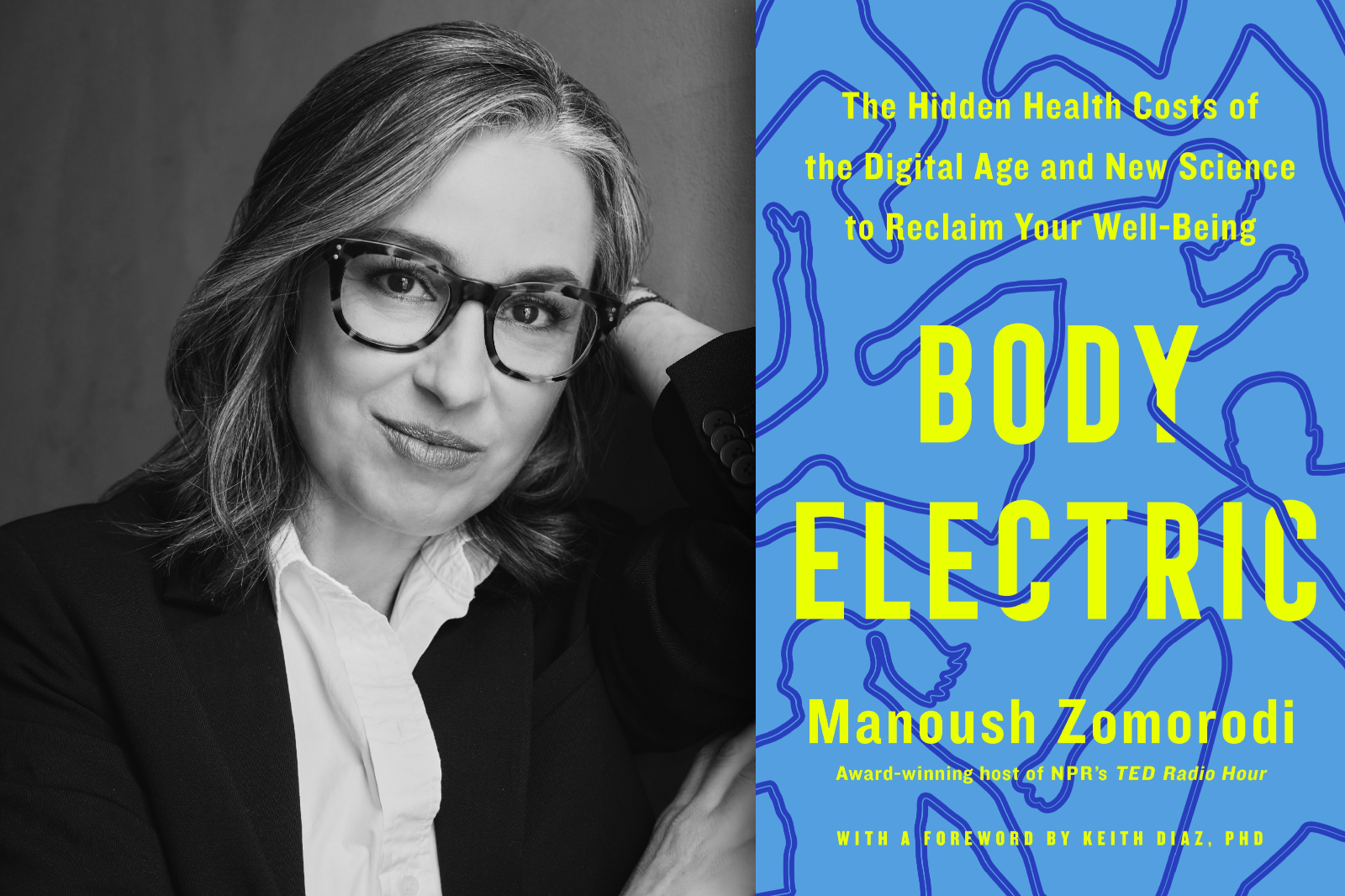
We all spend most of our lives sitting — at desks, in cars, on couches — staring at screens. New research shows that all that sedentary time is really hard on our bodies and on our minds. In her new book, Body Electric, journalist Manoush Zomorodi argues that the problem isn’t just how much we sit; it’s that we’ve built a world that makes movement optional.
So what would it actually take to build movement back into our lives? And can it counteract all those hours we spend hunched over our phones and laptops? Let’s talk about it. Welcome, Manoush.
Manoush Zomorodi: Thanks so much for having me, Lesley. Great to be here.
Lesley McClurg: I imagine you wrote this book because you were feeling all the aches and pains of sitting too much. What was going on in your own life?
Manoush Zomorodi: Well, you know, I think we’ve been doing this for a while now, right? But things truly peaked during the pandemic, when not only were we all working remotely, but our entire social lives moved onto screens. Absolutely everything required sitting and being in front of a piece of glass, essentially.
And for me, I was like, I don’t understand why I’m so tired. I’m safe, I’m healthy — why do I feel like all I can do is crawl over to the couch at the end of the day to check my phone again or maybe watch some Netflix?
And it’s not like things improved that much once the world opened back up. My job went fully remote, and I think a lot of people thought, “Oh, I don’t have to go to that event in person. I’ll just join on Zoom.” We’ve built a world around sitting and being on a screen.
I felt like we’d heard so much about the mental health effects of being online too much or using social media, but to me, the problem felt very physical. I felt drained. My eyes hurt. My shoulders were curved in. I felt like a boiled shrimp curled over.
And I really wanted to understand: Was this just me? Certainly, anecdotally, a lot of people around me were saying, “I am just exhausted.” So I wanted to know, health-wise, what was going on here, and also biologically, what happens in our bodies when we conform to the tools we use through technology.
Because what does technology do through the ages? It makes our lives more efficient. But we’ve essentially engineered movement out of our days.
Lesley McClurg: So then is the problem really sitting? Is that the argument you’re making? Or is it the screen?
Manoush Zomorodi: Well, that’s what I wanted to find out.
The first thing I heard was that, yes, the sitting is a problem. Every day, the average nineteen-year-old now moves as much as the average sixty-year-old. And three in four American adults have at least one chronic disease, many of them preventable. Type 2 diabetes has doubled among young people over the past twenty years.
So yes, we’ve all heard “sitting is the new smoking,” but I think adding screens to the equation has essentially added insult to injury.
I started looking into the research of a physiologist at Columbia University Medical Center named Keith Diaz. Keith’s mission in life is to find out the minimum amount of movement the human body needs so that all this sitting doesn’t send us to an early grave. So he’s setting the bar very, very low.
And he found in his lab that five minutes of gentle movement for every thirty minutes of prolonged sitting and screen time had outsized effects. It slashed blood sugar and blood pressure. It really made a difference in people’s physical health.
When I asked him why, he explained that when we sit, you have to think of your legs and torso as being bent or kinked, kind of like a garden hose. And you know how with a garden hose, the water starts to back up and pressure builds? That’s a problem.
We need blood flow to keep moving because the muscles in our legs need stimulation to pull lipids and glucose out of our blood, release blood pressure, and push oxygen up to the brain.
Now, you asked where screens fit into this. As I did more research, I learned about a relatively new field of study around interoception. Interoception is basically the body’s way of telling the brain what we need.
Some of that is subconscious. Like, “Take another breath.” We don’t consciously hear that; it just happens. Other times it’s more obvious: you’re sweating, so you take off your jacket.
But when we’re looking at a screen, that interoception can get sort of cut off, as it were. I definitely saw this happening to me. I would get so sucked into what was happening in my Google Docs that I’d forget to go to the bathroom, or I’d stand up and realize my left foot had fallen asleep.
Researchers are starting to see that all that screen time takes our interoception — pardon the metaphor — offline, and that’s one of the reasons we end up stuck sitting for hours, scrolling, typing, and staring at screens.
Lesley McClurg: And so if we walk — that’s the headline — if we move for five minutes every thirty minutes, we counteract this sort of shrimp position and unkink everything?
You painted this picture of everything getting stuck. And sometimes when I stand up, I literally fall over. You can tell my legs are not ready to take on my body weight.
Manoush Zomorodi: They’re like, “What are you doing?”
Lesley McClurg: Exactly. Like, “Whoa, whoa, whoa. Let’s sit back down.”
But five minutes — I’ve tried this, and I actually find it surprisingly hard to stand up from my desk. If I walk around the building, I’ve timed it. It’s five minutes. Do you actually do it? Do you really interrupt yourself?
Manoush Zomorodi: Alright, so I have to tell you the journey because this explains everything.
When I first talked to Keith Diaz, I was like, “This is amazing. You found the formula: move gently for five minutes every half hour.”
And he said, “I don’t think people can do this. I think it’s too difficult.”
But he invited me up to his lab at Columbia University to try it. So for one day, I sat at a desk with my laptop as usual. I got a lunch break and a couple bathroom breaks. They monitored my glucose, heart rate, and all kinds of other metrics. I took surveys about my concentration levels and so on.
Then I came back another day, and Keith’s assistant guided me over to a treadmill every thirty minutes. I walked at two miles per hour — basically a stroll. They took all the same measurements again.
And I was shocked at the difference.
I’m a relatively healthy person, Lesley, but my blood glucose was cut in half. My blood pressure dropped by five points. My mood remained steady throughout the day when I took movement breaks. My ability to concentrate was much better, and I rated the quality of my work higher on the day I took breaks.
So I was convinced. I thought, “This is extraordinary. Let’s see if other people can do it.”
We ended up partnering NPR and Columbia University Medical Center on a global clinical trial, and more than twenty thousand people joined us.
Participants could choose to take five-minute movement breaks every half hour, every hour, or every two hours because we wanted to test what was actually feasible. This was a self-reported study, and it’s still in peer review right now.
What we found was that people who committed to taking the breaks were able to stick with them for two weeks. Eighty percent of participants stuck with it. Eighty-two percent said they actually enjoyed taking the breaks, and they reported up to a twenty-eight percent reduction in fatigue.
We also heard that people could focus better again and felt more positive and optimistic.
Some people integrated breaks into their lives by doing what I like to call the “Zoom and shuffle,” where you’re on a Zoom call and just pacing back and forth. Maybe your camera’s off. Maybe you’re the weirdo who leaves it on.
Other people saw it as an invitation to step away from their devices entirely because they found they were more efficient once they returned to their desks.
And that brings me to the most surprising finding: productivity was not harmed during the study. In fact, it rose slightly.
We’ve been trained since kindergarten to sit still and look straight ahead, and that’s what we’ve defined as diligence and good work. We even have software that tracks people’s keyboard movement and where their cursor is in a document.
But what we actually need to do is embrace interruptions because the human body is not a machine. It needs movement.
Lesley McClurg: Suzanne writes, “I highly recommend walking on a desk treadmill. My treadmill lies flat under a raised desk, and I usually walk three hours a day broken into hour-long segments. I can read, type, and do almost everything I did while sitting.”
So you’ve just said we’re actually more productive. You’ve given me a whole book full of reasons why this is better for me, and yet I still have a hard time doing it. I’m always like, “Oh, I’ll just finish this one more email.”
So do you actually do it now?
Manoush Zomorodi: Yes, I do. And here’s the good news: you don’t need to be religious about it.
What we found was that people who succeeded in sticking with it showed themselves some grace. If you’re in flow, knock yourself out. Keep going if you want to.
What we really learned is that this isn’t about an exercise habit. It’s about a human habit.
Even people who took just four breaks a day still saw mood and focus benefits.
I think we’re so conditioned to think, “I’ve got to kill it at the gym in the morning.” But unfortunately, if you sit the rest of the day, that doesn’t really offset it.
Or people say, “Well, I have a standing desk.” But unfortunately, if you don’t move, a standing desk can eventually become detrimental too.
This is about accepting our physical limitations and understanding that our minds and bodies are interconnected. Taking breaks feels counterintuitive at first, but once you start feeling good in your body during the day — and you notice that you’re cognitively sharper — the rewards reinforce the habit on their own.
Lesley McClurg: Noelle on Discord writes, “I was part of the study. I took the breaks every half hour. I did feel better after the breaks.”
We’re talking about the impact of screens and all that sitting with author and radio host Manoush Zomorodi. Her new book is Body Electric: The Hidden Health Costs of the Digital Age and the New Science to Reclaim Your Well-Being.
We’ll be right back after this break. I’m Lesley McClurg. Stay with us.