This partial transcript was computer-generated. While our team has reviewed it, there may be errors.
Lesley McClurg: Welcome to Forum. I’m Lesley McClurg. I’m in today for Mina Kim. America has a meat problem. We raise billions—billions—of animals every year, many of them in pretty grim conditions. And the whole system is a major driver of climate change. But what if we could make meat differently, using science, so it tastes just as good but doesn’t cause so much harm?
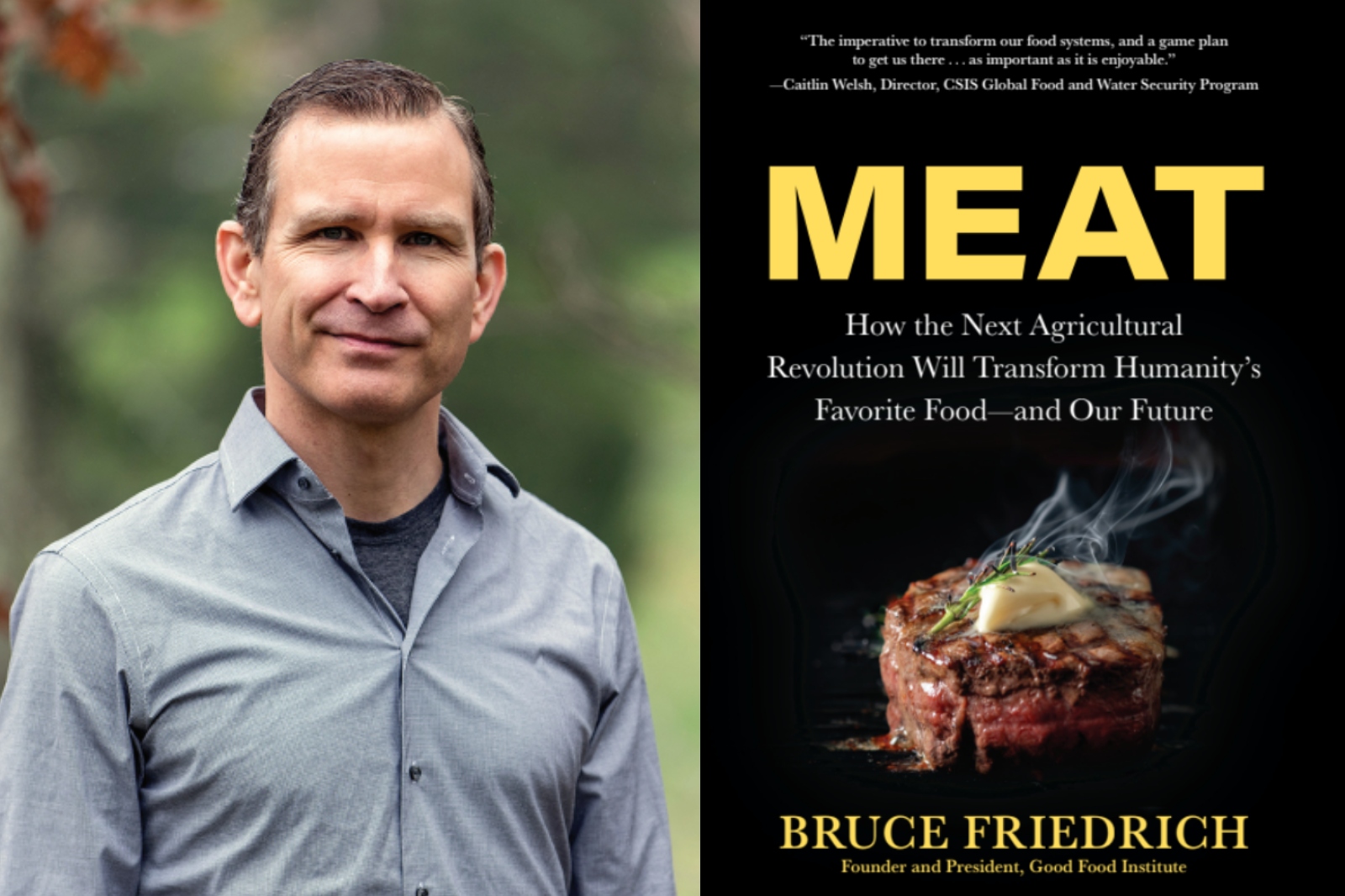
That’s the argument from Bruce Friedrich, author of Meat: How the Next Agricultural Revolution Will Transform Humanity’s Favorite Food and Our Future. He’s also the cofounder and president of the Good Food Institute. Welcome, Bruce.
Bruce Friedrich: Hey, thank you so much, Lesley. I’m delighted to be here.
Lesley McClurg: You make a pretty explicit point right from the top that this is not about inspiring us to eat more tofu instead of our filet mignons. But why not? Why not just try to get us to eat more vegetarian options or adopt vegetarian diets?
Bruce Friedrich: Well, that is the strategy of people who are concerned about meat’s cost to animals and the environment and other issues, and that’s what people have been saying for more than 50 years. The book that got me interested in these topics, Diet for a Small Planet, was written 55 years ago, in 1971. And yet, every year since 1961—which is when the UN Food and Agriculture Organization started tracking—we’ve hit a new global record for meat production and consumption.
There were small dips—mad cow disease, COVID, African swine fever—but if you look at the overall trajectory, it’s as though those blips didn’t happen. And if you include aquaculture—farm-raised fish—those blips disappear entirely. So, reducing consumption is perfectly acceptable. It worked for me. It’s worked for a lot of people.
Lesley McClurg: You’re a vegetarian or a vegan?
Bruce Friedrich: Yeah. But as a global strategy, it works about as well as saying everybody should just consume less as our fossil fuel strategy. Sure, let’s invest in energy efficiency, better transit, all of that—but at the end of the day, as long as global GDP rises, people consume more energy. And they also consume more meat.
That’s what the data shows over the last 70 years. And essentially 100% of agricultural economists agree: as long as affluence and population grow, meat production will keep increasing. So our solution is to take a page from renewable energy and electric vehicles. Yes, encourage less consumption—but also make the meat people love in a way that avoids the harms.
Lesley McClurg: Do you think meat consumption is culturally driven? Biologically driven? Why can’t we stop eating hamburgers?
Bruce Friedrich: My guess is it’s largely biological. Our brains are wired to seek calorie-dense foods. Historically, we didn’t know when our next meal would come, so if something is high in fat and calories, we’re drawn to it. Our taste buds evolved that way, and people really love meat.
But we can still make meat differently. We can make it from plants, or grow the fat and protein directly without raising animals. As these technologies scale, they can become cost-competitive—same product, safer, cleaner, and potentially cheaper. It’s the same theory as renewable energy, applied to food.
Lesley McClurg: We’ll get into those alternative meats in a moment, but first let’s lay the groundwork on conventional meat. You describe the current system as deeply inefficient—that we’re essentially throwing calories away. Walk us through that.
Bruce Friedrich: Even on the most efficient industrial farms—which have been improving for decades—the best-performing animal is the chicken. And it still takes about nine calories of feed to produce one calorie of chicken meat.
Lesley McClurg: Meaning you feed them nine calories to get one back.
Bruce Friedrich: Exactly. Most of those calories go toward keeping the animal alive. So that’s nine times the land, water, pesticides, and other inputs. People worry—rightly—about food waste. Roughly 40% of global calories are wasted. But with meat, the inefficiency is even greater. If you want 100 calories of chicken, you need 900 calories of feed. That’s effectively 800% food waste.
The issue is, that argument hasn’t convinced people. It’s been around since Diet for a Small Planet, and yet consumption keeps rising.
Lesley McClurg: Do you think most people even know about that inefficiency? It doesn’t seem central to public debate.
Bruce Friedrich: I think the environmental argument—closely tied to that inefficiency—has gotten a lot of attention. It’s not just the feed; it’s the entire system. You grow more crops, transport them, process them, ship feed, run farms, transport animals, run slaughterhouses. Each step uses energy and creates pollution.
But when it comes to actual choices—what people order at a restaurant or buy at a store—those concerns often fade. It’s what Daniel Kahneman called “System 1” thinking: immediate, instinctive decisions. People prioritize taste and satisfaction over ethics, even if they care about those issues in theory.
Lesley McClurg: A listener is asking: why is meat consumption still rising so quickly?
Bruce Friedrich: It’s one of the clearest patterns in economics: as people get wealthier, they eat more meat. There are also cultural and social factors—status, tradition—but those are hard to change. What we can do is offer better alternatives that reduce land use, emissions, and harm to animals while still giving people the foods they enjoy.
Lesley McClurg: You’re motivated in part by the environmental footprint. What are the climate impacts of this growing meat consumption?
Bruce Friedrich: There are two main areas: land use and emissions. Animal agriculture is the number one source of methane emissions, which is about 85 times more potent than CO₂ in the short term. It’s also a major source of nitrous oxide, which is nearly 300 times more potent.
Studies show that even modest adoption of alternative proteins could have huge impacts. At 10% adoption, you’d get emissions reductions equivalent to eliminating all airplanes. At 20%, it’s like switching all cars and light trucks to electric vehicles. At 50%, you’re looking at 5 to 6 gigatons of emissions reductions and hundreds of millions of hectares of land freed up.
If we don’t change course, the World Resources Institute estimates we’ll need an additional 3 billion hectares of land by 2050—more than all remaining arable land—which would mean massive deforestation.
Lesley McClurg: You say the environmental argument doesn’t always work, but I think I might skip the meat on my salad today and go with tofu.
We’re talking with Bruce Friedrich about his new book, Meat: How the Next Agricultural Revolution Will Transform Humanity’s Favorite Food and Our Future. We’ll be right back after the break to dive into these alternative meats and whether they can really solve the problem. Stay with us.