Coming early next year to the former Fauna and Flora spaces in the historic Oakland Floral Depot building are two bars and a restaurant by the team behind The Kon-Tiki. Christ Aivaliotis and Matt Regan, the duo behind the Oakland tiki bar, are expanding just a few blocks away from their first venture.
The Kon-Tiki's New Bar and Restaurant Promises 'American Tropical' Fantasy
The team behind The Kon-Tiki plans to transform the former Fauna and Flora spaces into a new restaurant that is ‘more nautical than tropical.’

A drink at The Kon Tiki which will be expanding to the former Fauna bar. (Tarik Kazaleh)
More on Tiki Bars
“Since it’s two spaces, we are going to turn Fauna into a Tiki bar, sort of an extension of The Kon-Tiki for the people who make it to this corridor to see a show or for First Friday.” Aivaliotis says. Featuring an abbreviated menu of their flagship location, the bar will be named The Kon-Tiki Room at Palmetto, Palmetto being the restaurant that’ll take over the former Flora space. The restaurant will have its own separate bar and a food menu that Aivaliotis calls “classic Americana with a steakhouse feeling,” which will be headed by chef Manny Bonilla of The Kon-Tiki.
Aivaliotis, a former bar manager at Flora, is shaping Palmetto’s bar program after what he calls the “canon of cocktails codified after prohibition.” “Those cocktails made with fresh juices and the best spirits that you could find,” he explains. “And we’ll do steakhouse martinis and Manhattans.”
The Kon-Tiki team hopes to open both spaces around late January next year barring any permit issues and the cosmetic fixes that’ll reflect the duo’s somewhat divergent and miscellaneous inspiration points. Aivaliotis and Reagan mentioned aesthetics ranging from American tropical and Miami pastels to “a place where Indiana Jones would be fanning himself off or something,” says Aivaliotis.
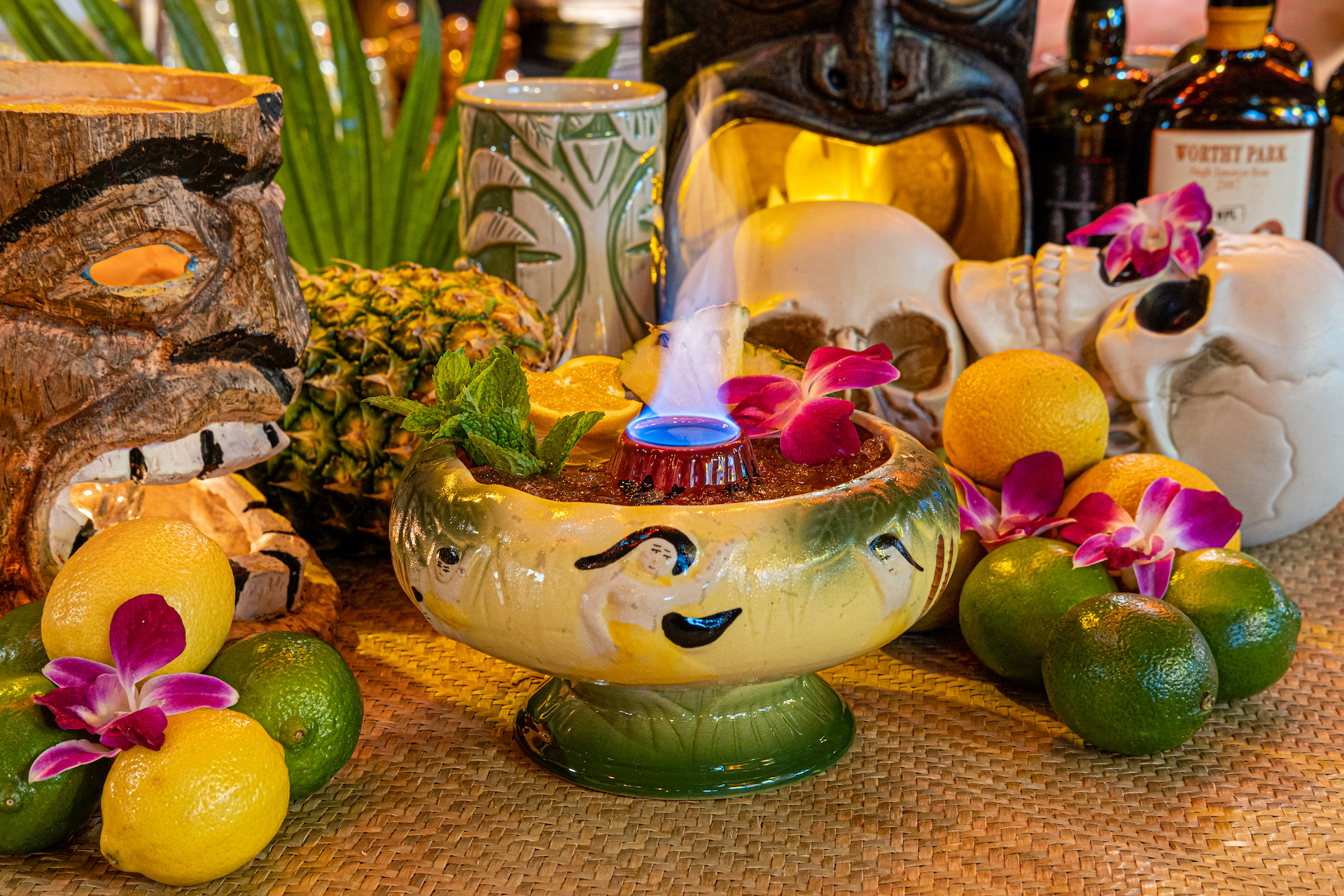
In an era where nostalgia is a crux for consumption, it’s interesting to consider who exactly will get to be wistfully nostalgic in this space. Whether it’s about Indiana Jones and his adventures or within fantasies of Polynesian island life, the kitchy aesthetics of tiki hold insidious origins. Tiki bars, which have had a long standing presence in the Bay Area, have enjoyed a resurgence as of late since their 1930s debut and their 1960s, post-World War II heyday.
“For us, it was really important to not be trying to project some sort of fantasia of cultural appropriation that came on the heels of colonialism,” Avialiotis says. “It was really important to think about our point of reference being the tiki bar itself. That it was a cultural phenomenon that is specifically American that did draw on all these cultures in a way that was problematic. So towards that end, we tried to source art that made you think of tiki but not any sort of specific Polynesian place.”
Their food menu is also a place Avialiotis points to as different than the more problematic versions of tiki bars where Chinese food is served under a loose appropriative “Asian” umbrella. “What we wanted to do to differentiate ourselves was to create a food menu that spoke to being a relevant restaurant,” he explains “Thinking about how our meat is sourced, what vegetables are in season and how are they prepared.”
Having said all that, Avialiotis distinguishes The Kon-Tiki Room at Palmetto from the original Kon-Tiki as more nautical than tropical and says, “The idea will be that you’re stepping off of a boat into a little shanty town and you’re just drinking booch at the local bar at the shanty town.” While it’ll be challenging to turn a glimmering art deco building into a “shanty town”, equally as troublesome is that intention in the first place.
According to its owners, the Kon-Tiki so far has been well-received by Oakland residents and issues of around tiki’s less palatable origins have been limited to a letter to the editor at the East Bay Express, specifically regarding two alcoholic drinks named “Virgin’s Downfall” and “Virgin’s Suicide” at the Kon-Tiki. “An important distinction that gets overlooked is there’s an apostrophe,” Avialiotis explains, “It’s not sacrificing a virgin. It’s the thing that a virgin is sacrificing. So it’s sort of a stupid wordplay. It’s not the downfall because the virgin is thrown in the volcano, it’s what the virgin has given up.” Reagan also adds that virgin is not a gendered term but it’s hard to imagine those drink names existing without ire at non-tiki menus in town.
“Am I going to put a drink with the name virgin [and] apostrophe “s” on it at the new restaurant?” Avialiotis asks. “Probably not.”