The First Oscars Lasted 15 Minutes — Plus Other Surprises From 95 Years of Awards
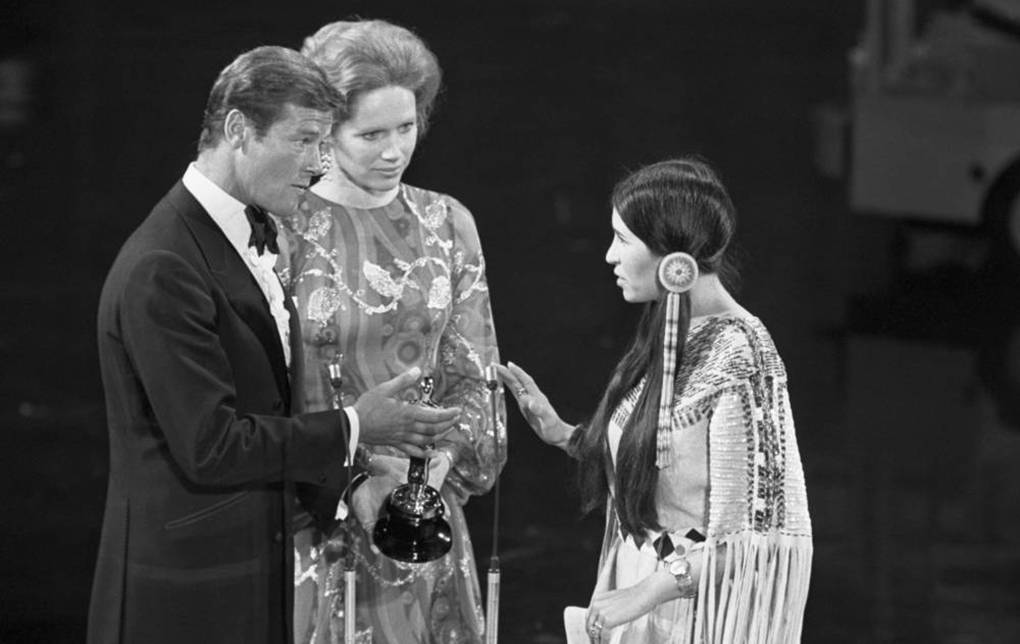
Sacheen Littlefeather, Who Gave Marlon Brando's Oscar Rejection Speech, Dies at 75
Film Academy Apologizes to Sacheen Littlefeather for Mistreatment at 1973 Oscars
5 Most Unexpected Moments in Oscars' History
Rita Moreno on 'West Side Story' and Becoming the Role Model She Needed
Brando, Fonda and Beyond: How Celebs Rallied Around the Alcatraz Occupation
Player sponsored by
window.__IS_SSR__=true
window.__INITIAL_STATE__={
"attachmentsReducer": {
"audio_0": {
"type": "attachments",
"id": "audio_0",
"imgSizes": {
"kqedFullSize": {
"file": "https://ww2.kqed.org/news/wp-content/themes/KQED-unified/img/audio_bgs/background0.jpg"
}
}
},
"audio_1": {
"type": "attachments",
"id": "audio_1",
"imgSizes": {
"kqedFullSize": {
"file": "https://ww2.kqed.org/news/wp-content/themes/KQED-unified/img/audio_bgs/background1.jpg"
}
}
},
"audio_2": {
"type": "attachments",
"id": "audio_2",
"imgSizes": {
"kqedFullSize": {
"file": "https://ww2.kqed.org/news/wp-content/themes/KQED-unified/img/audio_bgs/background2.jpg"
}
}
},
"audio_3": {
"type": "attachments",
"id": "audio_3",
"imgSizes": {
"kqedFullSize": {
"file": "https://ww2.kqed.org/news/wp-content/themes/KQED-unified/img/audio_bgs/background3.jpg"
}
}
},
"audio_4": {
"type": "attachments",
"id": "audio_4",
"imgSizes": {
"kqedFullSize": {
"file": "https://ww2.kqed.org/news/wp-content/themes/KQED-unified/img/audio_bgs/background4.jpg"
}
}
},
"placeholder": {
"type": "attachments",
"id": "placeholder",
"imgSizes": {
"thumbnail": {
"file": "https://cdn.kqed.org/wp-content/uploads/2024/12/KQED-Default-Image-816638274-2000x1333-1-160x107.jpg",
"width": 160,
"height": 107,
"mimeType": "image/jpeg"
},
"medium": {
"file": "https://cdn.kqed.org/wp-content/uploads/2024/12/KQED-Default-Image-816638274-2000x1333-1-800x533.jpg",
"width": 800,
"height": 533,
"mimeType": "image/jpeg"
},
"medium_large": {
"file": "https://cdn.kqed.org/wp-content/uploads/2024/12/KQED-Default-Image-816638274-2000x1333-1-768x512.jpg",
"width": 768,
"height": 512,
"mimeType": "image/jpeg"
},
"large": {
"file": "https://cdn.kqed.org/wp-content/uploads/2024/12/KQED-Default-Image-816638274-2000x1333-1-1020x680.jpg",
"width": 1020,
"height": 680,
"mimeType": "image/jpeg"
},
"1536x1536": {
"file": "https://cdn.kqed.org/wp-content/uploads/2024/12/KQED-Default-Image-816638274-2000x1333-1-1536x1024.jpg",
"width": 1536,
"height": 1024,
"mimeType": "image/jpeg"
},
"fd-lrg": {
"file": "https://cdn.kqed.org/wp-content/uploads/2024/12/KQED-Default-Image-816638274-2000x1333-1-1536x1024.jpg",
"width": 1536,
"height": 1024,
"mimeType": "image/jpeg"
},
"fd-med": {
"file": "https://cdn.kqed.org/wp-content/uploads/2024/12/KQED-Default-Image-816638274-2000x1333-1-1020x680.jpg",
"width": 1020,
"height": 680,
"mimeType": "image/jpeg"
},
"fd-sm": {
"file": "https://cdn.kqed.org/wp-content/uploads/2024/12/KQED-Default-Image-816638274-2000x1333-1-800x533.jpg",
"width": 800,
"height": 533,
"mimeType": "image/jpeg"
},
"post-thumbnail": {
"file": "https://cdn.kqed.org/wp-content/uploads/2024/12/KQED-Default-Image-816638274-2000x1333-1-672x372.jpg",
"width": 672,
"height": 372,
"mimeType": "image/jpeg"
},
"twentyfourteen-full-width": {
"file": "https://cdn.kqed.org/wp-content/uploads/2024/12/KQED-Default-Image-816638274-2000x1333-1-1038x576.jpg",
"width": 1038,
"height": 576,
"mimeType": "image/jpeg"
},
"xxsmall": {
"file": "https://cdn.kqed.org/wp-content/uploads/2024/12/KQED-Default-Image-816638274-2000x1333-1-160x107.jpg",
"width": 160,
"height": 107,
"mimeType": "image/jpeg"
},
"xsmall": {
"file": "https://cdn.kqed.org/wp-content/uploads/2024/12/KQED-Default-Image-816638274-2000x1333-1-672x372.jpg",
"width": 672,
"height": 372,
"mimeType": "image/jpeg"
},
"small": {
"file": "https://cdn.kqed.org/wp-content/uploads/2024/12/KQED-Default-Image-816638274-2000x1333-1-672x372.jpg",
"width": 672,
"height": 372,
"mimeType": "image/jpeg"
},
"xlarge": {
"file": "https://cdn.kqed.org/wp-content/uploads/2024/12/KQED-Default-Image-816638274-2000x1333-1-1020x680.jpg",
"width": 1020,
"height": 680,
"mimeType": "image/jpeg"
},
"full-width": {
"file": "https://cdn.kqed.org/wp-content/uploads/2024/12/KQED-Default-Image-816638274-2000x1333-1-1920x1280.jpg",
"width": 1920,
"height": 1280,
"mimeType": "image/jpeg"
},
"guest-author-32": {
"file": "https://cdn.kqed.org/wp-content/uploads/2025/01/KQED-Default-Image-816638274-1333x1333-1-160x160.jpg",
"width": 32,
"height": 32,
"mimeType": "image/jpeg"
},
"guest-author-50": {
"file": "https://cdn.kqed.org/wp-content/uploads/2025/01/KQED-Default-Image-816638274-1333x1333-1-160x160.jpg",
"width": 50,
"height": 50,
"mimeType": "image/jpeg"
},
"guest-author-64": {
"file": "https://cdn.kqed.org/wp-content/uploads/2025/01/KQED-Default-Image-816638274-1333x1333-1-160x160.jpg",
"width": 64,
"height": 64,
"mimeType": "image/jpeg"
},
"guest-author-96": {
"file": "https://cdn.kqed.org/wp-content/uploads/2025/01/KQED-Default-Image-816638274-1333x1333-1-160x160.jpg",
"width": 96,
"height": 96,
"mimeType": "image/jpeg"
},
"guest-author-128": {
"file": "https://cdn.kqed.org/wp-content/uploads/2025/01/KQED-Default-Image-816638274-1333x1333-1-160x160.jpg",
"width": 128,
"height": 128,
"mimeType": "image/jpeg"
},
"detail": {
"file": "https://cdn.kqed.org/wp-content/uploads/2025/01/KQED-Default-Image-816638274-1333x1333-1-160x160.jpg",
"width": 160,
"height": 160,
"mimeType": "image/jpeg"
},
"kqedFullSize": {
"file": "https://cdn.kqed.org/wp-content/uploads/2024/12/KQED-Default-Image-816638274-2000x1333-1.jpg",
"width": 2000,
"height": 1333
}
}
},
"arts_13926048": {
"type": "attachments",
"id": "arts_13926048",
"meta": {
"index": "attachments_1716263798",
"site": "arts",
"id": "13926048",
"found": true
},
"parent": 13926047,
"imgSizes": {
"twentyfourteen-full-width": {
"file": "https://ww2.kqed.org/app/uploads/sites/2/2023/03/banquet2_custom-f20ca080aed9902f80aee627e82f303352386806-scaled-e1678396109842-1038x576.jpg",
"width": 1038,
"mimeType": "image/jpeg",
"height": 576
},
"thumbnail": {
"file": "https://ww2.kqed.org/app/uploads/sites/2/2023/03/banquet2_custom-f20ca080aed9902f80aee627e82f303352386806-scaled-e1678396109842-160x96.jpg",
"width": 160,
"mimeType": "image/jpeg",
"height": 96
},
"post-thumbnail": {
"file": "https://ww2.kqed.org/app/uploads/sites/2/2023/03/banquet2_custom-f20ca080aed9902f80aee627e82f303352386806-scaled-e1678396109842-672x372.jpg",
"width": 672,
"mimeType": "image/jpeg",
"height": 372
},
"kqedFullSize": {
"file": "https://ww2.kqed.org/app/uploads/sites/2/2023/03/banquet2_custom-f20ca080aed9902f80aee627e82f303352386806-scaled-e1678396109842.jpg",
"width": 1920,
"height": 1155
},
"2048x2048": {
"file": "https://ww2.kqed.org/app/uploads/sites/2/2023/03/banquet2_custom-f20ca080aed9902f80aee627e82f303352386806-2048x1232.jpg",
"width": 2048,
"mimeType": "image/jpeg",
"height": 1232
},
"large": {
"file": "https://ww2.kqed.org/app/uploads/sites/2/2023/03/banquet2_custom-f20ca080aed9902f80aee627e82f303352386806-scaled-e1678396109842-1020x614.jpg",
"width": 1020,
"mimeType": "image/jpeg",
"height": 614
},
"1536x1536": {
"file": "https://ww2.kqed.org/app/uploads/sites/2/2023/03/banquet2_custom-f20ca080aed9902f80aee627e82f303352386806-scaled-e1678396109842-1536x924.jpg",
"width": 1536,
"mimeType": "image/jpeg",
"height": 924
},
"full-width": {
"file": "https://ww2.kqed.org/app/uploads/sites/2/2023/03/banquet2_custom-f20ca080aed9902f80aee627e82f303352386806-1920x1155.jpg",
"width": 1920,
"mimeType": "image/jpeg",
"height": 1155
},
"medium": {
"file": "https://ww2.kqed.org/app/uploads/sites/2/2023/03/banquet2_custom-f20ca080aed9902f80aee627e82f303352386806-scaled-e1678396109842-800x481.jpg",
"width": 800,
"mimeType": "image/jpeg",
"height": 481
},
"medium_large": {
"file": "https://ww2.kqed.org/app/uploads/sites/2/2023/03/banquet2_custom-f20ca080aed9902f80aee627e82f303352386806-scaled-e1678396109842-768x462.jpg",
"width": 768,
"mimeType": "image/jpeg",
"height": 462
}
},
"publishDate": 1678391179,
"modified": 1678396237,
"caption": "The first Oscar presentation and banquet was held in the Blossom Room of the Hollywood Roosevelt Hotel in May 1929.",
"description": null,
"title": "The first Oscar presentation and banquet was held in the Blossom Room of the Hollywood Roosevelt Hotel in May 1929.",
"credit": "Academy of Motion Picture Arts and Sciences",
"status": "inherit",
"altTag": "A room of men and women dressed in 1930s evening attire sit at dining tables in a large hall. Festive decorations hang from the ceiling.",
"isLoading": false,
"fetchFailed": false
},
"arts_13919955": {
"type": "attachments",
"id": "arts_13919955",
"meta": {
"index": "attachments_1716263798",
"site": "arts",
"id": "13919955",
"found": true
},
"parent": 13919954,
"imgSizes": {
"twentyfourteen-full-width": {
"file": "https://ww2.kqed.org/app/uploads/sites/2/2022/10/littlefeather.getty-37467f6e8d66e0c73d4fd3c1f2e3bee15b78b907-1038x576.jpg",
"width": 1038,
"mimeType": "image/jpeg",
"height": 576
},
"thumbnail": {
"file": "https://ww2.kqed.org/app/uploads/sites/2/2022/10/littlefeather.getty-37467f6e8d66e0c73d4fd3c1f2e3bee15b78b907-160x120.jpg",
"width": 160,
"mimeType": "image/jpeg",
"height": 120
},
"post-thumbnail": {
"file": "https://ww2.kqed.org/app/uploads/sites/2/2022/10/littlefeather.getty-37467f6e8d66e0c73d4fd3c1f2e3bee15b78b907-672x372.jpg",
"width": 672,
"mimeType": "image/jpeg",
"height": 372
},
"kqedFullSize": {
"file": "https://ww2.kqed.org/app/uploads/sites/2/2022/10/littlefeather.getty-37467f6e8d66e0c73d4fd3c1f2e3bee15b78b907-scaled-e1664820901801.jpg",
"width": 1920,
"height": 1440
},
"2048x2048": {
"file": "https://ww2.kqed.org/app/uploads/sites/2/2022/10/littlefeather.getty-37467f6e8d66e0c73d4fd3c1f2e3bee15b78b907-2048x1536.jpg",
"width": 2048,
"mimeType": "image/jpeg",
"height": 1536
},
"large": {
"file": "https://ww2.kqed.org/app/uploads/sites/2/2022/10/littlefeather.getty-37467f6e8d66e0c73d4fd3c1f2e3bee15b78b907-1020x765.jpg",
"width": 1020,
"mimeType": "image/jpeg",
"height": 765
},
"1536x1536": {
"file": "https://ww2.kqed.org/app/uploads/sites/2/2022/10/littlefeather.getty-37467f6e8d66e0c73d4fd3c1f2e3bee15b78b907-1536x1152.jpg",
"width": 1536,
"mimeType": "image/jpeg",
"height": 1152
},
"full-width": {
"file": "https://ww2.kqed.org/app/uploads/sites/2/2022/10/littlefeather.getty-37467f6e8d66e0c73d4fd3c1f2e3bee15b78b907-1920x1440.jpg",
"width": 1920,
"mimeType": "image/jpeg",
"height": 1440
},
"medium": {
"file": "https://ww2.kqed.org/app/uploads/sites/2/2022/10/littlefeather.getty-37467f6e8d66e0c73d4fd3c1f2e3bee15b78b907-800x600.jpg",
"width": 800,
"mimeType": "image/jpeg",
"height": 600
},
"medium_large": {
"file": "https://ww2.kqed.org/app/uploads/sites/2/2022/10/littlefeather.getty-37467f6e8d66e0c73d4fd3c1f2e3bee15b78b907-768x576.jpg",
"width": 768,
"mimeType": "image/jpeg",
"height": 576
}
},
"publishDate": 1664820762,
"modified": 1664821010,
"caption": "Sacheen Littlefeather on stage at AMPAS Presents 'An Evening with Sacheen Littlefeather,' at the Academy Museum of Motion Pictures on Sept. 17, 2022 in Los Angeles.",
"description": null,
"title": "Sacheen Littlefeather on stage at AMPAS Presents 'An Evening with Sacheen Littlefeather,' at the Academy Museum of Motion Pictures on Sept. 17, 2022 in Los Angeles.",
"credit": "Frazer Harrison/Getty Images",
"status": "inherit",
"altTag": "A senior Indigenous woman points her finger in the air as she talks on stage.",
"isLoading": false,
"fetchFailed": false
},
"arts_13917705": {
"type": "attachments",
"id": "arts_13917705",
"meta": {
"index": "attachments_1716263798",
"site": "arts",
"id": "13917705",
"found": true
},
"parent": 13917695,
"imgSizes": {
"twentyfourteen-full-width": {
"file": "https://ww2.kqed.org/app/uploads/sites/2/2022/08/GettyImages-515575596_1920-1038x576.jpg",
"width": 1038,
"mimeType": "image/jpeg",
"height": 576
},
"thumbnail": {
"file": "https://ww2.kqed.org/app/uploads/sites/2/2022/08/GettyImages-515575596_1920-160x107.jpg",
"width": 160,
"mimeType": "image/jpeg",
"height": 107
},
"post-thumbnail": {
"file": "https://ww2.kqed.org/app/uploads/sites/2/2022/08/GettyImages-515575596_1920-672x372.jpg",
"width": 672,
"mimeType": "image/jpeg",
"height": 372
},
"kqedFullSize": {
"file": "https://ww2.kqed.org/app/uploads/sites/2/2022/08/GettyImages-515575596_1920.jpg",
"width": 1920,
"height": 1285
},
"large": {
"file": "https://ww2.kqed.org/app/uploads/sites/2/2022/08/GettyImages-515575596_1920-1020x683.jpg",
"width": 1020,
"mimeType": "image/jpeg",
"height": 683
},
"1536x1536": {
"file": "https://ww2.kqed.org/app/uploads/sites/2/2022/08/GettyImages-515575596_1920-1536x1028.jpg",
"width": 1536,
"mimeType": "image/jpeg",
"height": 1028
},
"medium": {
"file": "https://ww2.kqed.org/app/uploads/sites/2/2022/08/GettyImages-515575596_1920-800x535.jpg",
"width": 800,
"mimeType": "image/jpeg",
"height": 535
},
"medium_large": {
"file": "https://ww2.kqed.org/app/uploads/sites/2/2022/08/GettyImages-515575596_1920-768x514.jpg",
"width": 768,
"mimeType": "image/jpeg",
"height": 514
}
},
"publishDate": 1660670378,
"modified": 1660670455,
"caption": "At the 1973 Academy Awards, Sacheen Littlefeather refuses the Academy Award for Best Actor on behalf of Marlon Brando who won for his role in 'The Godfather.' She carries a letter from Brando in which he explains he refused the award in protest of American treatment of the Native Americans.",
"description": null,
"title": "GettyImages-515575596_1920",
"credit": "Bettmann / Getty Images",
"status": "inherit",
"altTag": "Woman in Native dress faces white man and woman holding Oscar statue",
"isLoading": false,
"fetchFailed": false
},
"arts_13911229": {
"type": "attachments",
"id": "arts_13911229",
"meta": {
"index": "attachments_1716263798",
"site": "arts",
"id": "13911229",
"found": true
},
"parent": 13911228,
"imgSizes": {
"twentyfourteen-full-width": {
"file": "https://ww2.kqed.org/app/uploads/sites/2/2022/03/gettyimages-645725528_custom-6ce00fa5f23d730d95f0835abd9e49c7797a73ca-1038x576.jpg",
"width": 1038,
"mimeType": "image/jpeg",
"height": 576
},
"thumbnail": {
"file": "https://ww2.kqed.org/app/uploads/sites/2/2022/03/gettyimages-645725528_custom-6ce00fa5f23d730d95f0835abd9e49c7797a73ca-160x112.jpg",
"width": 160,
"mimeType": "image/jpeg",
"height": 112
},
"post-thumbnail": {
"file": "https://ww2.kqed.org/app/uploads/sites/2/2022/03/gettyimages-645725528_custom-6ce00fa5f23d730d95f0835abd9e49c7797a73ca-672x372.jpg",
"width": 672,
"mimeType": "image/jpeg",
"height": 372
},
"kqedFullSize": {
"file": "https://ww2.kqed.org/app/uploads/sites/2/2022/03/gettyimages-645725528_custom-6ce00fa5f23d730d95f0835abd9e49c7797a73ca-scaled-e1648507265644.jpg",
"width": 1920,
"height": 1343
},
"2048x2048": {
"file": "https://ww2.kqed.org/app/uploads/sites/2/2022/03/gettyimages-645725528_custom-6ce00fa5f23d730d95f0835abd9e49c7797a73ca-2048x1432.jpg",
"width": 2048,
"mimeType": "image/jpeg",
"height": 1432
},
"large": {
"file": "https://ww2.kqed.org/app/uploads/sites/2/2022/03/gettyimages-645725528_custom-6ce00fa5f23d730d95f0835abd9e49c7797a73ca-1020x713.jpg",
"width": 1020,
"mimeType": "image/jpeg",
"height": 713
},
"1536x1536": {
"file": "https://ww2.kqed.org/app/uploads/sites/2/2022/03/gettyimages-645725528_custom-6ce00fa5f23d730d95f0835abd9e49c7797a73ca-1536x1074.jpg",
"width": 1536,
"mimeType": "image/jpeg",
"height": 1074
},
"full-width": {
"file": "https://ww2.kqed.org/app/uploads/sites/2/2022/03/gettyimages-645725528_custom-6ce00fa5f23d730d95f0835abd9e49c7797a73ca-1920x1342.jpg",
"width": 1920,
"mimeType": "image/jpeg",
"height": 1342
},
"medium": {
"file": "https://ww2.kqed.org/app/uploads/sites/2/2022/03/gettyimages-645725528_custom-6ce00fa5f23d730d95f0835abd9e49c7797a73ca-800x559.jpg",
"width": 800,
"mimeType": "image/jpeg",
"height": 559
},
"medium_large": {
"file": "https://ww2.kqed.org/app/uploads/sites/2/2022/03/gettyimages-645725528_custom-6ce00fa5f23d730d95f0835abd9e49c7797a73ca-768x537.jpg",
"width": 768,
"mimeType": "image/jpeg",
"height": 537
}
},
"publishDate": 1648506185,
"modified": 1648507313,
"caption": "'La La Land' producer Jordan Horowitz holds up the winner card reading actual Best Picture winner 'Moonlight' with actor Warren Beatty and host Jimmy Kimmel onstage during the Academy Awards in 2017.",
"description": null,
"title": "'La La Land' producer Jordan Horowitz holds up the winner card reading actual Best Picture winner 'Moonlight' with actor Warren Beatty and host Jimmy Kimmel onstage during the Academy Awards in 2017.",
"credit": "Kevin Winter/Getty Images",
"status": "inherit",
"altTag": null,
"isLoading": false,
"fetchFailed": false
},
"arts_13898389": {
"type": "attachments",
"id": "arts_13898389",
"meta": {
"index": "attachments_1716263798",
"site": "arts",
"id": "13898389",
"found": true
},
"parent": 13898388,
"imgSizes": {
"twentyfourteen-full-width": {
"file": "https://ww2.kqed.org/app/uploads/sites/2/2021/06/a-photo-of-rita-moreno-bts-of-west-side-story-from-the-film-rita-moreno-just-a-girl-who-decided-to-go-for-it-courtesy-of-mgm-media-licensing.s_wide-d92519ebd3a1d3d70c48f77a80dc45ca06bed806-1038x576.jpe",
"width": 1038,
"mimeType": "image/jpeg",
"height": 576
},
"thumbnail": {
"file": "https://ww2.kqed.org/app/uploads/sites/2/2021/06/a-photo-of-rita-moreno-bts-of-west-side-story-from-the-film-rita-moreno-just-a-girl-who-decided-to-go-for-it-courtesy-of-mgm-media-licensing.s_wide-d92519ebd3a1d3d70c48f77a80dc45ca06bed806-160x90.jpe",
"width": 160,
"mimeType": "image/jpeg",
"height": 90
},
"post-thumbnail": {
"file": "https://ww2.kqed.org/app/uploads/sites/2/2021/06/a-photo-of-rita-moreno-bts-of-west-side-story-from-the-film-rita-moreno-just-a-girl-who-decided-to-go-for-it-courtesy-of-mgm-media-licensing.s_wide-d92519ebd3a1d3d70c48f77a80dc45ca06bed806-672x372.jpe",
"width": 672,
"mimeType": "image/jpeg",
"height": 372
},
"kqedFullSize": {
"file": "https://ww2.kqed.org/app/uploads/sites/2/2021/06/a-photo-of-rita-moreno-bts-of-west-side-story-from-the-film-rita-moreno-just-a-girl-who-decided-to-go-for-it-courtesy-of-mgm-media-licensing.s_wide-d92519ebd3a1d3d70c48f77a80dc45ca06bed806.jpe",
"width": 1717,
"height": 966
},
"large": {
"file": "https://ww2.kqed.org/app/uploads/sites/2/2021/06/a-photo-of-rita-moreno-bts-of-west-side-story-from-the-film-rita-moreno-just-a-girl-who-decided-to-go-for-it-courtesy-of-mgm-media-licensing.s_wide-d92519ebd3a1d3d70c48f77a80dc45ca06bed806-1020x574.jpe",
"width": 1020,
"mimeType": "image/jpeg",
"height": 574
},
"1536x1536": {
"file": "https://ww2.kqed.org/app/uploads/sites/2/2021/06/a-photo-of-rita-moreno-bts-of-west-side-story-from-the-film-rita-moreno-just-a-girl-who-decided-to-go-for-it-courtesy-of-mgm-media-licensing.s_wide-d92519ebd3a1d3d70c48f77a80dc45ca06bed806-1536x864.jpe",
"width": 1536,
"mimeType": "image/jpeg",
"height": 864
},
"medium": {
"file": "https://ww2.kqed.org/app/uploads/sites/2/2021/06/a-photo-of-rita-moreno-bts-of-west-side-story-from-the-film-rita-moreno-just-a-girl-who-decided-to-go-for-it-courtesy-of-mgm-media-licensing.s_wide-d92519ebd3a1d3d70c48f77a80dc45ca06bed806-800x450.jpe",
"width": 800,
"mimeType": "image/jpeg",
"height": 450
},
"medium_large": {
"file": "https://ww2.kqed.org/app/uploads/sites/2/2021/06/a-photo-of-rita-moreno-bts-of-west-side-story-from-the-film-rita-moreno-just-a-girl-who-decided-to-go-for-it-courtesy-of-mgm-media-licensing.s_wide-d92519ebd3a1d3d70c48f77a80dc45ca06bed806-768x432.jpe",
"width": 768,
"mimeType": "image/jpeg",
"height": 432
}
},
"publishDate": 1623093934,
"modified": 1623095571,
"caption": "Rita Moreno won an Academy Award for best supporting actress for her portrayal of Anita in the 1961 film 'West Side Story.'",
"description": "Rita Moreno won an Academy Award for best supporting actress for her portrayal of Anita in the 1961 film 'West Side Story.'",
"title": "Rita Moreno won an Academy Award for best supporting actress for her portrayal of Anita in the 1961 film 'West Side Story.'",
"credit": "Courtesy of MGM Media Licensing",
"status": "inherit",
"altTag": "Rita Moreno won an Academy Award for best supporting actress for her portrayal of Anita in the 1961 film 'West Side Story.'",
"isLoading": false,
"fetchFailed": false
},
"arts_13870035": {
"type": "attachments",
"id": "arts_13870035",
"meta": {
"index": "attachments_1716263798",
"site": "arts",
"id": "13870035",
"found": true
},
"parent": 13869074,
"imgSizes": {
"twentyfourteen-full-width": {
"file": "https://ww2.kqed.org/app/uploads/sites/2/2019/11/GettyImages-515575596-1020x683_Resized-1020x576.jpg",
"width": 1020,
"mimeType": "image/jpeg",
"height": 576
},
"thumbnail": {
"file": "https://ww2.kqed.org/app/uploads/sites/2/2019/11/GettyImages-515575596-1020x683_Resized-160x101.jpg",
"width": 160,
"mimeType": "image/jpeg",
"height": 101
},
"post-thumbnail": {
"file": "https://ww2.kqed.org/app/uploads/sites/2/2019/11/GettyImages-515575596-1020x683_Resized-672x372.jpg",
"width": 672,
"mimeType": "image/jpeg",
"height": 372
},
"kqedFullSize": {
"file": "https://ww2.kqed.org/app/uploads/sites/2/2019/11/GettyImages-515575596-1020x683_Resized.jpg",
"width": 1020,
"height": 644
},
"large": {
"file": "https://ww2.kqed.org/app/uploads/sites/2/2019/11/GettyImages-515575596-1020x683_Resized-1020x644.jpg",
"width": 1020,
"mimeType": "image/jpeg",
"height": 644
},
"medium": {
"file": "https://ww2.kqed.org/app/uploads/sites/2/2019/11/GettyImages-515575596-1020x683_Resized-800x505.jpg",
"width": 800,
"mimeType": "image/jpeg",
"height": 505
},
"medium_large": {
"file": "https://ww2.kqed.org/app/uploads/sites/2/2019/11/GettyImages-515575596-1020x683_Resized-768x485.jpg",
"width": 768,
"mimeType": "image/jpeg",
"height": 485
}
},
"publishDate": 1574119448,
"modified": 1574119465,
"caption": "At the 1973 Academy Awards, Sacheen Littlefeather refuses the Academy Award for Best Actor on behalf of Marlon Brando who won for his role in The Godfather. She carries a letter from Brando in which he explains he refused the award in protest of American treatment of the Native Americans.",
"description": "Sacheen Littlefeather turns down an Academy Award on behalf of Marlon Brando, 1973.",
"title": "Sacheen Littlefeather Refuses Marlon Brando's Academy Award",
"credit": null,
"status": "inherit",
"isLoading": false,
"fetchFailed": false
}
},
"audioPlayerReducer": {
"postId": "stream_live",
"isPaused": true,
"isPlaying": false,
"pfsActive": false,
"pledgeModalIsOpen": true,
"playerDrawerIsOpen": false,
"liveAudioPlayStartedAt": 0,
"liveAudioPlayContext": ""
},
"authorsReducer": {
"byline_arts_13926047": {
"type": "authors",
"id": "byline_arts_13926047",
"meta": {
"override": true
},
"slug": "byline_arts_13926047",
"name": "Mandalit del Barco",
"isLoading": false
},
"byline_arts_13919954": {
"type": "authors",
"id": "byline_arts_13919954",
"meta": {
"override": true
},
"slug": "byline_arts_13919954",
"name": "NPR Staff",
"isLoading": false
},
"byline_arts_13917695": {
"type": "authors",
"id": "byline_arts_13917695",
"meta": {
"override": true
},
"slug": "byline_arts_13917695",
"name": "Jake Coyle, Associated Press",
"isLoading": false
},
"byline_arts_13911228": {
"type": "authors",
"id": "byline_arts_13911228",
"meta": {
"override": true
},
"slug": "byline_arts_13911228",
"name": "Fi O'Reilly",
"isLoading": false
},
"byline_arts_13898388": {
"type": "authors",
"id": "byline_arts_13898388",
"meta": {
"override": true
},
"slug": "byline_arts_13898388",
"name": "Terry Gross",
"isLoading": false
},
"ralexandra": {
"type": "authors",
"id": "11242",
"meta": {
"index": "authors_1716337520",
"id": "11242",
"found": true
},
"name": "Rae Alexandra",
"firstName": "Rae",
"lastName": "Alexandra",
"slug": "ralexandra",
"email": "ralexandra@kqed.org",
"display_author_email": true,
"staff_mastheads": [],
"title": "Reporter/Producer",
"bio": "Rae Alexandra is a Reporter/Producer for KQED Arts & Culture, and the creator/author of the \u003ca href=\"https://www.kqed.org/arts/program/rebel-girls-from-bay-area-history\">Rebel Girls From Bay Area History\u003c/a> and \u003ca href=\"https://www.kqed.org/bizarrebayarea\">Bizarre Bay Area\u003c/a> series. Her debut book, \u003ca href=\"https://citylights.com/politics-current-events-history/unsung-heroines35-women-who-changed/\">Unsung Heroines: 35 Women Who Changed the Bay Area\u003c/a> was published by City Lights in March 2026. In 2023, Rae was awarded an SPJ Excellence in Journalism Award for Arts & Culture. Rae was born and raised in Wales and subsequently — even after two decades in Northern California — still uses phrases that regularly baffle her coworkers.",
"avatar": "https://secure.gravatar.com/avatar/edfee8176c80cc0a382b051190f5341997df378a934a5774dcb0977732dfd401?s=600&d=blank&r=g",
"twitter": null,
"bluesky": null,
"facebook": null,
"instagram": null,
"linkedin": null,
"sites": [
{
"site": "arts",
"roles": [
"subscriber"
]
},
{
"site": "news",
"roles": [
"subscriber"
]
},
{
"site": "pop",
"roles": [
"subscriber"
]
},
{
"site": "bayareabites",
"roles": [
"subscriber"
]
},
{
"site": "science",
"roles": [
"subscriber"
]
}
],
"headData": {
"title": "Rae Alexandra | KQED",
"description": "Reporter/Producer",
"ogImgSrc": "https://secure.gravatar.com/avatar/edfee8176c80cc0a382b051190f5341997df378a934a5774dcb0977732dfd401?s=600&d=blank&r=g",
"twImgSrc": "https://secure.gravatar.com/avatar/edfee8176c80cc0a382b051190f5341997df378a934a5774dcb0977732dfd401?s=600&d=blank&r=g"
},
"isLoading": false,
"link": "/author/ralexandra"
}
},
"pagesReducer": {
"arts_tag_marlon-brando": {
"type": "terms",
"id": "arts_9200",
"meta": {
"index": "terms_1716263798",
"site": "arts",
"id": "9200",
"score": 10.404627
},
"featImg": null,
"name": "Marlon Brando",
"description": null,
"taxonomy": "tag",
"headData": {
"twImgId": null,
"twTitle": null,
"ogTitle": null,
"ogImgId": null,
"twDescription": null,
"description": null,
"title": "Marlon Brando Archives | KQED Arts",
"ogDescription": null
},
"ttid": 9212,
"slug": "marlon-brando",
"isLoading": false,
"title": "Marlon Brando",
"pageMeta": {
"site": "arts",
"WpPageTemplate": "page-topic-editorial",
"currentPage": 1
},
"blocks": [
{
"blockName": "kqed/post-list",
"attrs": {
"layout": "cardArticle2",
"query": "posts/arts?tag=marlon-brando",
"seeMore": false,
"paginated": true,
"page": 1
}
},
{
"blockName": "kqed/ad"
}
]
}
},
"pfsSessionReducer": {},
"postsReducer": {
"stream_live": {
"type": "live",
"id": "stream_live",
"audioUrl": "https://streams.kqed.org/kqedradio",
"title": "Live Stream",
"excerpt": "Live Stream information currently unavailable.",
"link": "/radio",
"featImg": "",
"label": {
"name": "KQED Live",
"link": "/"
}
},
"stream_kqedNewscast": {
"type": "posts",
"id": "stream_kqedNewscast",
"audioUrl": "https://www.kqed.org/.stream/anon/radio/RDnews/newscast.mp3?_=1",
"title": "KQED Newscast",
"featImg": "",
"label": {
"name": "88.5 FM",
"link": "/"
}
},
"arts_13926047": {
"type": "posts",
"id": "arts_13926047",
"meta": {
"index": "posts_1716263798",
"site": "arts",
"id": "13926047",
"score": null,
"sort": [
1678471846000
]
},
"parent": 0,
"labelTerm": {
"site": "arts",
"term": 137
},
"blocks": [],
"publishDate": 1678471846,
"format": "standard",
"title": "The First Oscars Lasted 15 Minutes — Plus Other Surprises From 95 Years of Awards",
"headTitle": "The First Oscars Lasted 15 Minutes — Plus Other Surprises From 95 Years of Awards | KQED",
"content": "\u003cp>You read that right — just 15 minutes. The first Academy Awards ceremony was held on May 1929, in the Blossom Room of the Hollywood Roosevelt Hotel. At the end of a private black-tie banquet, leading man Douglas Fairbanks announced the first ever winners of the golden statuettes.\u003c/p>\n\u003cp>All the recipients that year were silent movies, except one: \u003ca href=\"https://www.youtube.com/watch?v=yFaZOaLTkN0\">\u003cem>The Jazz Singer\u003c/em>\u003c/a>\u003cem>,\u003c/em> starring Al Jolson. \u003ca href=\"https://www.youtube.com/watch?v=zXOlmo943Vc\">The top prize in 1929 \u003c/a>went to \u003cem>Wings\u003c/em>, an airplane film similar to one of this year’s best picture nominees, \u003cem>Top Gun: Maverick\u003c/em>.\u003c/p>\n\u003cp>The following year, the Academy Award for Outstanding Production went to a war movie, \u003ca href=\"https://www.youtube.com/watch?v=grapXipP3fM\">\u003cem>All Quiet on the Western Front\u003c/em>\u003c/a> (a remake of that film is also a contender this year). \u003ca href=\"https://www.youtube.com/watch?v=Kt0mgFtdQwk\">Newsreel footage from 1930\u003c/a> captured the head of MGM, Louis B. Mayer, solemnly congratulating the movie’s producer Carl Laemmle, saying, “Sorry I didn’t win it, Mr. Laemmle. I know of no one I’d rather have beat me than you.”\u003c/p>\n\u003cp>https://www.youtube.com/watch?v=Kt0mgFtdQwk\u003c/p>\n\u003cp>As the silent movie era ended and the talkies began, Mayer had dreamed up the idea of an Academy for \u003ca href=\"https://www.findinglostangeles.com/all-content/2019/1/7/hollywoodland\">Hollywoodland\u003c/a>, as it was first known.\u003c/p>\n\u003cp>[ad fullwidth]\u003c/p>\n\u003cp>“He was afraid of the union movement that was kind of moving across the country, and he didn’t want the film industry to be unionized,” says Bruce Davis, a former CEO of the Academy for 30 years\u003cem>. “\u003c/em>So he thought, ‘Somehow, we’ll have this organization, and we’ll all just come to meetings and talk about our griefs and problems.’”\u003c/p>\n\u003cp>[aside postid='arts_13925866']Davis, author of \u003ca href=\"https://press.uchicago.edu/ucp/books/book/distributed/A/bo184793529.html\">\u003cem>The Academy and the Award\u003c/em>\u003c/a>\u003cem>, \u003c/em>says in the late 1920s, writers, directors, actors and other members of the new Academy didn’t trust Mayer’s group of anti-union studio bigwigs. They soon formed their guilds, and Davis says the Academy nearly folded in 1933.\u003c/p>\n\u003cp>“Finally, the Academy had to agree to get out of the labor business entirely,” says Davis.\u003c/p>\n\u003cp>Instead, the organization focused on handing out Oscars, as the statuettes were later nicknamed. \u003ca href=\"https://www.oldtimeradiodownloads.com/variety/academy-award-ceremonies/academy-award-ceremony-1947\">Radio stations\u003c/a> and newsreels began highlighting the ceremonies to movie fans captivated by Hollywood’s glitz and glamor.\u003c/p>\n\u003cp>In 1939, Hattie McDaniel became the first African American actor to win an Oscar for her role as Mammy in \u003cem>Gone With the Wind\u003c/em>. McDaniel rose from her seat at a segregated table to accept the award for best supporting actress.\u003c/p>\n\u003cp>https://www.youtube.com/watch?v=e7t4pTNZshA&t=3s\u003c/p>\n\u003cp>“I sincerely hope I shall always be a credit to my race and to the motion picture industry,” she said, wiping away her tears.\u003c/p>\n\u003cp>Over the years, the Oscars have included scandals and feuds … like the famous rivalry between sisters Joan Fontaine and Olivia de Havilland, who despised each other and vied for the best actress Oscar in 1942. (\u003ca href=\"https://www.youtube.com/watch?v=4tOZ-IU7izg\">Fontaine won\u003c/a> for her role in the Alfred Hitchcock film \u003cem>Suspicion\u003c/em>.)\u003c/p>\n\u003cp>The ceremonies continued during the infamous McCarthy era when many Hollywood writers were blacklisted as suspected communists. All of that was upended in 1957 when the winner of the best motion picture was announced: \u003ca href=\"https://www.youtube.com/watch?v=c2KdnI1N8AU\">Robert Rich, writer of \u003cem>The Brave One\u003c/em>\u003c/a>, a story about a Mexican boy and his pet bull.\u003c/p>\n\u003cp>[aside postid='arts_13925431']Someone else accepted the award on his behalf. “Then no one could find this guy. And that’s because he did not exist,” says Michael Schulman, a staff writer for the \u003cem>New Yorker \u003c/em>and author of the new book \u003ca href=\"https://www.npr.org/2023/02/22/1158513159/oscar-wars-michael-schulman-academy-awards-controversies\">\u003cem>Oscar Wars: A History of Hollywood in Gold, Sweat, and Tears\u003c/em>.\u003c/a>\u003c/p>\n\u003cp>Robert Rich was a pseudonym for screenwriter \u003ca href=\"https://www.npr.org/2008/06/17/91576667/trumbo-a-blacklisted-writer-in-his-own-words\">Dalton Trumbo\u003c/a>, who was imprisoned for defying the House Un-American Activities Committee.\u003c/p>\n\u003cp>“He realized there was a contradiction, that all of these people — suspected communists — were blacklisted, and yet they were all working,” says Schulman. “They were writing movies under fake names, and now they were winning awards.”\u003c/p>\n\u003cp>Schulman says that was one of the many Hollywood scandals the Oscars have exposed.\u003c/p>\n\u003cp>In \u003ca href=\"https://www.youtube.com/watch?v=iOtp4dli7-4\">1953, the Oscars began being broadcast on television, with host Bob Hope\u003c/a>, who quipped, “Isn’t it exciting to know that a lot of these glamorous stars are going to be in your homes tonight? Television, where movies go to die.”\u003c/p>\n\u003cp>The ceremonies are notorious for running long. But in 1959, the show ended up 20 minutes short. \u003ca href=\"https://www.youtube.com/watch?v=2riKdGOdU3E\">So emcee Jerry Lewis had to ad-lib\u003c/a> with shticks and bits to fill the airtime.\u003c/p>\n\u003cp>https://www.youtube.com/watch?v=2riKdGOdU3E\u003c/p>\n\u003cp>“We would like to now do 300 choruses of ‘There’s No Business Like Show Business,’” he said before taking the baton to lead the orchestra at the Pantages Theatre.\u003c/p>\n\u003cp>“Lewis invited all of the winners and participants from the show back up on stage, and they’re feeling like idiots. So they started dancing with each other,” chuckles Davis. “And still, it wouldn’t go off. Then people start sneaking off the stage.”\u003c/p>\n\u003cp>\u003ca href=\"https://interviews.televisionacademy.com/news/interview-clip-jerry-lewis-discusses-1959s-short-academy-awards-telecast\">For the remaining minutes\u003c/a>, NBC cut to a rerun of a sportscast.\u003c/p>\n\u003cp>Davis says one of the most poignant moments in Oscars history was when \u003ca href=\"https://www.youtube.com/watch?v=J3Pl-qvA1X8\">Charlie Chaplin, who had started in silent movies, won a lifetime achievement award in 1972\u003c/a>.\u003c/p>\n\u003cp>https://www.youtube.com/watch?v=J3Pl-qvA1X8\u003c/p>\n\u003cp>“He had been almost driven out of the country because his politics were seen to be too far left for the American public,” says Davis. “So to have him come back to receive an honorary award and be embraced by the entire industry was clearly a very moving thing.”\u003c/p>\n\u003cp>The audience gave Chaplin a 12-minute standing ovation.\u003c/p>\n\u003cp>The following year, the crowd booed when \u003ca href=\"https://www.youtube.com/watch?v=2QUacU0I4yU\">Marlon Brando sent Sacheen Littlefeather to the stage to decline his best actor award\u003c/a> because of “the treatment of the American Indians” by the film industry.\u003c/p>\n\u003cp>https://www.youtube.com/watch?v=2QUacU0I4yU\u003c/p>\n\u003cp>Years later, \u003ca href=\"https://www.npr.org/2022/10/03/1126515900/sacheen-littlefeather-marlon-brando-dies\">Littlefeather recalled being escorted offstage at the Oscars by security guards\u003c/a>. She said that for years Hollywood boycotted her, calling it being “red-listed.” Finally, nearly 50 years later, the Academy officially apologized to Littlefeather for the abuse she subsequently endured because of her Oscars appearance.\u003c/p>\n\u003cp>In 1974, the Oscars audience shrieked when gay activist \u003ca href=\"https://www.youtube.com/watch?v=EWBc-ir6IFM\">Robert Opel dashed across the stage naked\u003c/a>. The streaker prompted presenter David Niven to quip, “Probably the only laugh that man will ever get in his life is by stripping off and showing his shortcomings.”\u003c/p>\n\u003cp>https://www.youtube.com/watch?v=EWBc-ir6IFM\u003c/p>\n\u003cp>In 1985, \u003ca href=\"https://www.youtube.com/watch?v=u_8nAvU0T5Y\">best actress winner Sally Field\u003c/a> gave one of the Oscars’ most unforgettable speeches. “I can’t deny the fact that you like me,” she gushed. “Right now, you like me!”\u003c/p>\n\u003cp>Schulman says there have been other cringe moments, like the opening number in 1989, which included \u003ca href=\"https://www.youtube.com/watch?v=9mronRVvdmw\">actor Rob Lowe singing a duet with a live-action Snow White\u003c/a>.\u003c/p>\n\u003cp>Schulman says the 11-minute, over-the-top opening was a flop for flamboyant producer Allan Carr, who had previously produced the musicals \u003cem>Grease\u003c/em> and \u003cem>La Cage aux Folles\u003c/em>.\u003c/p>\n\u003cp>“When it went bad, there was a scapegoat effect,” says Schulman. “He was essentially ostracized within days. And he never recovered. It destroyed his career. It destroyed his life.”\u003c/p>\n\u003cp>In the last decade, the Oscars had a racial reckoning after being criticized for not giving awards to actors and filmmakers of color. \u003ca href=\"https://www.npr.org/2016/01/25/464244160/a-conversation-with-the-creator-of-oscarssowhite\">The #OscarsSoWhite movement\u003c/a> led to this \u003ca href=\"https://www.youtube.com/watch?v=GCQn_FkFElI&t=2s\">2017 mixup\u003c/a>:\u003c/p>\n\u003cp>https://www.youtube.com/watch?v=GCQn_FkFElI&t=2s\u003c/p>\n\u003cp>“There was a rookie from Pricewaterhouse that year who was a little too enthusiastic about being backstage with all of the stars and clearly took his mind off his job,” explains Davis. “He handed the presenter the wrong envelope.”\u003c/p>\n\u003cp>[aside postid='arts_13911018']Onstage, presenter Warren Beatty looked at the envelope puzzled. Then Faye Dunaway announced the final winner of the night: \u003cem>La La Land\u003c/em>.\u003c/p>\n\u003cp>Producer Jordan Horowitz accepted the award at first, surrounded by his cast. Then, after much confusion onstage, he returned to the mic.\u003c/p>\n\u003cp>“I’m sorry, no. There’s a mistake: \u003cem>Moonlight\u003c/em>. You guys won best picture,” Horowitz said before showing a card with the correct winner to the cameras. “This is not a joke. \u003cem>Moonlight\u003c/em> has won best picture.”\u003c/p>\n\u003cp>Last year, the winners were overshadowed by a confrontation with best actor nominee \u003ca href=\"https://www.youtube.com/watch?v=myjEoDypUD8\">Will Smith, who strode onstage and smacked presenter Chris Rock \u003c/a>after he had made a joke about Smith’s wife’s hair.\u003c/p>\n\u003cp>https://www.youtube.com/watch?v=myjEoDypUD8\u003c/p>\n\u003cp>After delivering the slap seen and heard around the world, Smith sat down in his seat and roared expletives at Rock. Smith won the best actor award for starring in \u003cem>King Richard\u003c/em>, but \u003ca href=\"https://www.npr.org/2022/04/08/1091681181/the-academy-bans-will-smith-for-10-years-for-chris-rock-slap\">the Academy punished him by banning him from its events for 10 years\u003c/a>.\u003c/p>\n\u003cp>[ad floatright]\u003c/p>\n\u003cp>Schulman says anything can happen during a live event, “Whether it’s a burst of anger with the slap or just something really moving, someone living their dream.” He says so much of the Oscars “are wrapped in this kind of celebrity, like ‘you-like-me’ absurdity, and then boom! Something happens that shocks your system a little bit.”\u003c/p>\n\u003cdiv class=\"fullattribution\">\u003cem>Copyright 2023 NPR. To see more, \u003ca href=\"https://www.npr.org\" target=\"_blank\" rel=\"noopener\">visit NPR\u003c/a>.\u003cimg decoding=\"async\" src=\"https://www.google-analytics.com/__utm.gif?utmac=UA-5828686-4&utmdt=The+first+Oscars+lasted+15+minutes+%E2%80%94+plus+other+surprises+from+95+years+of+awards&utme=8(APIKey)9(MDAxOTAwOTE4MDEyMTkxMDAzNjczZDljZA004)\">\u003c/em>\u003c/div>\n\n",
"stats": {
"hasVideo": true,
"hasChartOrMap": false,
"hasAudio": false,
"hasPolis": false,
"wordCount": 1579,
"hasGoogleForm": false,
"hasGallery": false,
"hasHearkenModule": false,
"iframeSrcs": [],
"paragraphCount": 41
},
"modified": 1705005756,
"excerpt": "Ahead of this Sunday’s Academy Awards, we look back on the surprises, the scandals, the slap and — yes — even the streaker.",
"headData": {
"twImgId": "",
"twTitle": "The First Oscars Lasted 15 Minutes — Plus Other Surprises From 95 Years of Awards",
"socialTitle": "The Oscars’ 10 Most Surprising Moments%%page%% %%sep%% KQED",
"ogTitle": "The First Oscars Lasted 15 Minutes — Plus Other Surprises From 95 Years of Awards",
"ogImgId": "",
"twDescription": "",
"description": "Ahead of this Sunday’s Academy Awards, we look back on the surprises, the scandals, the slap and — yes — even the streaker.",
"title": "The Oscars’ 10 Most Surprising Moments | KQED",
"ogDescription": "",
"schema": {
"@context": "https://schema.org",
"@type": "Article",
"headline": "The First Oscars Lasted 15 Minutes — Plus Other Surprises From 95 Years of Awards",
"datePublished": "2023-03-10T10:10:46-08:00",
"dateModified": "2024-01-11T12:42:36-08:00",
"image": "https://cdn.kqed.org/wp-content/uploads/2020/02/KQED-OG-Image@1x.png"
}
},
"guestAuthors": [],
"slug": "the-first-oscars-lasted-15-minutes-plus-other-surprises-from-95-years-of-awards",
"status": "publish",
"nprApiLink": "http://api.npr.org/query?id=1162052588&apiKey=MDAxOTAwOTE4MDEyMTkxMDAzNjczZDljZA004",
"templateType": "standard",
"nprStoryDate": "Thu, 09 Mar 2023 12:08:22 -0500",
"excludeFromSiteSearch": "Include",
"nprLastModifiedDate": "Thu, 09 Mar 2023 13:16:59 -0500",
"featuredImageType": "standard",
"nprHtmlLink": "https://www.npr.org/2023/03/09/1162052588/oscars-academy-award-scandal-slap?ft=nprml&f=1162052588",
"nprImageAgency": " Academy of Motion Picture Arts and Sciences",
"nprStoryId": "1162052588",
"nprByline": "Mandalit del Barco",
"sticky": false,
"showOnAuthorArchivePages": "No",
"articleAge": "0",
"nprRetrievedStory": "1",
"nprPubDate": "Thu, 09 Mar 2023 13:17:00 -0500",
"path": "/arts/13926047/the-first-oscars-lasted-15-minutes-plus-other-surprises-from-95-years-of-awards",
"audioTrackLength": null,
"parsedContent": [
{
"type": "contentString",
"content": "\u003cdiv class=\"post-body\">\u003cp>\u003cp>You read that right — just 15 minutes. The first Academy Awards ceremony was held on May 1929, in the Blossom Room of the Hollywood Roosevelt Hotel. At the end of a private black-tie banquet, leading man Douglas Fairbanks announced the first ever winners of the golden statuettes.\u003c/p>\n\u003cp>All the recipients that year were silent movies, except one: \u003ca href=\"https://www.youtube.com/watch?v=yFaZOaLTkN0\">\u003cem>The Jazz Singer\u003c/em>\u003c/a>\u003cem>,\u003c/em> starring Al Jolson. \u003ca href=\"https://www.youtube.com/watch?v=zXOlmo943Vc\">The top prize in 1929 \u003c/a>went to \u003cem>Wings\u003c/em>, an airplane film similar to one of this year’s best picture nominees, \u003cem>Top Gun: Maverick\u003c/em>.\u003c/p>\n\u003cp>The following year, the Academy Award for Outstanding Production went to a war movie, \u003ca href=\"https://www.youtube.com/watch?v=grapXipP3fM\">\u003cem>All Quiet on the Western Front\u003c/em>\u003c/a> (a remake of that film is also a contender this year). \u003ca href=\"https://www.youtube.com/watch?v=Kt0mgFtdQwk\">Newsreel footage from 1930\u003c/a> captured the head of MGM, Louis B. Mayer, solemnly congratulating the movie’s producer Carl Laemmle, saying, “Sorry I didn’t win it, Mr. Laemmle. I know of no one I’d rather have beat me than you.”\u003c/p>\u003c/p>\u003cp>\u003cspan class='utils-parseShortcode-shortcodes-__youtubeShortcode__embedYoutube'>\n \u003cspan class='utils-parseShortcode-shortcodes-__youtubeShortcode__embedYoutubeInside'>\n \u003ciframe\n loading='lazy'\n class='utils-parseShortcode-shortcodes-__youtubeShortcode__youtubePlayer'\n type='text/html'\n src='//www.youtube.com/embed/Kt0mgFtdQwk'\n title='//www.youtube.com/embed/Kt0mgFtdQwk'\n allowfullscreen='true'\n style='border:0;'>\u003c/iframe>\n \u003c/span>\n \u003c/span>\u003c/p>\u003cp>\u003cp>As the silent movie era ended and the talkies began, Mayer had dreamed up the idea of an Academy for \u003ca href=\"https://www.findinglostangeles.com/all-content/2019/1/7/hollywoodland\">Hollywoodland\u003c/a>, as it was first known.\u003c/p>\n\u003cp>\u003c/p>\u003c/div>",
"attributes": {
"named": {},
"numeric": []
}
},
{
"type": "component",
"content": "",
"name": "ad",
"attributes": {
"named": {
"label": "fullwidth"
},
"numeric": [
"fullwidth"
]
}
},
{
"type": "contentString",
"content": "\u003cdiv class=\"post-body\">\u003cp>\u003c/p>\n\u003cp>“He was afraid of the union movement that was kind of moving across the country, and he didn’t want the film industry to be unionized,” says Bruce Davis, a former CEO of the Academy for 30 years\u003cem>. “\u003c/em>So he thought, ‘Somehow, we’ll have this organization, and we’ll all just come to meetings and talk about our griefs and problems.’”\u003c/p>\n\u003cp>\u003c/p>\u003c/div>",
"attributes": {
"named": {},
"numeric": []
}
},
{
"type": "component",
"content": "",
"name": "aside",
"attributes": {
"named": {
"postid": "arts_13925866",
"label": ""
},
"numeric": []
}
},
{
"type": "contentString",
"content": "\u003cdiv class=\"post-body\">\u003cp>Davis, author of \u003ca href=\"https://press.uchicago.edu/ucp/books/book/distributed/A/bo184793529.html\">\u003cem>The Academy and the Award\u003c/em>\u003c/a>\u003cem>, \u003c/em>says in the late 1920s, writers, directors, actors and other members of the new Academy didn’t trust Mayer’s group of anti-union studio bigwigs. They soon formed their guilds, and Davis says the Academy nearly folded in 1933.\u003c/p>\n\u003cp>“Finally, the Academy had to agree to get out of the labor business entirely,” says Davis.\u003c/p>\n\u003cp>Instead, the organization focused on handing out Oscars, as the statuettes were later nicknamed. \u003ca href=\"https://www.oldtimeradiodownloads.com/variety/academy-award-ceremonies/academy-award-ceremony-1947\">Radio stations\u003c/a> and newsreels began highlighting the ceremonies to movie fans captivated by Hollywood’s glitz and glamor.\u003c/p>\n\u003cp>In 1939, Hattie McDaniel became the first African American actor to win an Oscar for her role as Mammy in \u003cem>Gone With the Wind\u003c/em>. McDaniel rose from her seat at a segregated table to accept the award for best supporting actress.\u003c/p>\u003c/p>\u003cp>\u003cspan class='utils-parseShortcode-shortcodes-__youtubeShortcode__embedYoutube'>\n \u003cspan class='utils-parseShortcode-shortcodes-__youtubeShortcode__embedYoutubeInside'>\n \u003ciframe\n loading='lazy'\n class='utils-parseShortcode-shortcodes-__youtubeShortcode__youtubePlayer'\n type='text/html'\n src='//www.youtube.com/embed/e7t4pTNZshA'\n title='//www.youtube.com/embed/e7t4pTNZshA'\n allowfullscreen='true'\n style='border:0;'>\u003c/iframe>\n \u003c/span>\n \u003c/span>\u003c/p>\u003cp>\u003cp>“I sincerely hope I shall always be a credit to my race and to the motion picture industry,” she said, wiping away her tears.\u003c/p>\n\u003cp>Over the years, the Oscars have included scandals and feuds … like the famous rivalry between sisters Joan Fontaine and Olivia de Havilland, who despised each other and vied for the best actress Oscar in 1942. (\u003ca href=\"https://www.youtube.com/watch?v=4tOZ-IU7izg\">Fontaine won\u003c/a> for her role in the Alfred Hitchcock film \u003cem>Suspicion\u003c/em>.)\u003c/p>\n\u003cp>The ceremonies continued during the infamous McCarthy era when many Hollywood writers were blacklisted as suspected communists. All of that was upended in 1957 when the winner of the best motion picture was announced: \u003ca href=\"https://www.youtube.com/watch?v=c2KdnI1N8AU\">Robert Rich, writer of \u003cem>The Brave One\u003c/em>\u003c/a>, a story about a Mexican boy and his pet bull.\u003c/p>\n\u003cp>\u003c/p>\u003c/div>",
"attributes": {
"named": {},
"numeric": []
}
},
{
"type": "component",
"content": "",
"name": "aside",
"attributes": {
"named": {
"postid": "arts_13925431",
"label": ""
},
"numeric": []
}
},
{
"type": "contentString",
"content": "\u003cdiv class=\"post-body\">\u003cp>Someone else accepted the award on his behalf. “Then no one could find this guy. And that’s because he did not exist,” says Michael Schulman, a staff writer for the \u003cem>New Yorker \u003c/em>and author of the new book \u003ca href=\"https://www.npr.org/2023/02/22/1158513159/oscar-wars-michael-schulman-academy-awards-controversies\">\u003cem>Oscar Wars: A History of Hollywood in Gold, Sweat, and Tears\u003c/em>.\u003c/a>\u003c/p>\n\u003cp>Robert Rich was a pseudonym for screenwriter \u003ca href=\"https://www.npr.org/2008/06/17/91576667/trumbo-a-blacklisted-writer-in-his-own-words\">Dalton Trumbo\u003c/a>, who was imprisoned for defying the House Un-American Activities Committee.\u003c/p>\n\u003cp>“He realized there was a contradiction, that all of these people — suspected communists — were blacklisted, and yet they were all working,” says Schulman. “They were writing movies under fake names, and now they were winning awards.”\u003c/p>\n\u003cp>Schulman says that was one of the many Hollywood scandals the Oscars have exposed.\u003c/p>\n\u003cp>In \u003ca href=\"https://www.youtube.com/watch?v=iOtp4dli7-4\">1953, the Oscars began being broadcast on television, with host Bob Hope\u003c/a>, who quipped, “Isn’t it exciting to know that a lot of these glamorous stars are going to be in your homes tonight? Television, where movies go to die.”\u003c/p>\n\u003cp>The ceremonies are notorious for running long. But in 1959, the show ended up 20 minutes short. \u003ca href=\"https://www.youtube.com/watch?v=2riKdGOdU3E\">So emcee Jerry Lewis had to ad-lib\u003c/a> with shticks and bits to fill the airtime.\u003c/p>\u003c/p>\u003cp>\u003cspan class='utils-parseShortcode-shortcodes-__youtubeShortcode__embedYoutube'>\n \u003cspan class='utils-parseShortcode-shortcodes-__youtubeShortcode__embedYoutubeInside'>\n \u003ciframe\n loading='lazy'\n class='utils-parseShortcode-shortcodes-__youtubeShortcode__youtubePlayer'\n type='text/html'\n src='//www.youtube.com/embed/2riKdGOdU3E'\n title='//www.youtube.com/embed/2riKdGOdU3E'\n allowfullscreen='true'\n style='border:0;'>\u003c/iframe>\n \u003c/span>\n \u003c/span>\u003c/p>\u003cp>\u003cp>“We would like to now do 300 choruses of ‘There’s No Business Like Show Business,’” he said before taking the baton to lead the orchestra at the Pantages Theatre.\u003c/p>\n\u003cp>“Lewis invited all of the winners and participants from the show back up on stage, and they’re feeling like idiots. So they started dancing with each other,” chuckles Davis. “And still, it wouldn’t go off. Then people start sneaking off the stage.”\u003c/p>\n\u003cp>\u003ca href=\"https://interviews.televisionacademy.com/news/interview-clip-jerry-lewis-discusses-1959s-short-academy-awards-telecast\">For the remaining minutes\u003c/a>, NBC cut to a rerun of a sportscast.\u003c/p>\n\u003cp>Davis says one of the most poignant moments in Oscars history was when \u003ca href=\"https://www.youtube.com/watch?v=J3Pl-qvA1X8\">Charlie Chaplin, who had started in silent movies, won a lifetime achievement award in 1972\u003c/a>.\u003c/p>\u003c/p>\u003cp>\u003cspan class='utils-parseShortcode-shortcodes-__youtubeShortcode__embedYoutube'>\n \u003cspan class='utils-parseShortcode-shortcodes-__youtubeShortcode__embedYoutubeInside'>\n \u003ciframe\n loading='lazy'\n class='utils-parseShortcode-shortcodes-__youtubeShortcode__youtubePlayer'\n type='text/html'\n src='//www.youtube.com/embed/J3Pl-qvA1X8'\n title='//www.youtube.com/embed/J3Pl-qvA1X8'\n allowfullscreen='true'\n style='border:0;'>\u003c/iframe>\n \u003c/span>\n \u003c/span>\u003c/p>\u003cp>\u003cp>“He had been almost driven out of the country because his politics were seen to be too far left for the American public,” says Davis. “So to have him come back to receive an honorary award and be embraced by the entire industry was clearly a very moving thing.”\u003c/p>\n\u003cp>The audience gave Chaplin a 12-minute standing ovation.\u003c/p>\n\u003cp>The following year, the crowd booed when \u003ca href=\"https://www.youtube.com/watch?v=2QUacU0I4yU\">Marlon Brando sent Sacheen Littlefeather to the stage to decline his best actor award\u003c/a> because of “the treatment of the American Indians” by the film industry.\u003c/p>\u003c/p>\u003cp>\u003cspan class='utils-parseShortcode-shortcodes-__youtubeShortcode__embedYoutube'>\n \u003cspan class='utils-parseShortcode-shortcodes-__youtubeShortcode__embedYoutubeInside'>\n \u003ciframe\n loading='lazy'\n class='utils-parseShortcode-shortcodes-__youtubeShortcode__youtubePlayer'\n type='text/html'\n src='//www.youtube.com/embed/2QUacU0I4yU'\n title='//www.youtube.com/embed/2QUacU0I4yU'\n allowfullscreen='true'\n style='border:0;'>\u003c/iframe>\n \u003c/span>\n \u003c/span>\u003c/p>\u003cp>\u003cp>Years later, \u003ca href=\"https://www.npr.org/2022/10/03/1126515900/sacheen-littlefeather-marlon-brando-dies\">Littlefeather recalled being escorted offstage at the Oscars by security guards\u003c/a>. She said that for years Hollywood boycotted her, calling it being “red-listed.” Finally, nearly 50 years later, the Academy officially apologized to Littlefeather for the abuse she subsequently endured because of her Oscars appearance.\u003c/p>\n\u003cp>In 1974, the Oscars audience shrieked when gay activist \u003ca href=\"https://www.youtube.com/watch?v=EWBc-ir6IFM\">Robert Opel dashed across the stage naked\u003c/a>. The streaker prompted presenter David Niven to quip, “Probably the only laugh that man will ever get in his life is by stripping off and showing his shortcomings.”\u003c/p>\u003c/p>\u003cp>\u003cspan class='utils-parseShortcode-shortcodes-__youtubeShortcode__embedYoutube'>\n \u003cspan class='utils-parseShortcode-shortcodes-__youtubeShortcode__embedYoutubeInside'>\n \u003ciframe\n loading='lazy'\n class='utils-parseShortcode-shortcodes-__youtubeShortcode__youtubePlayer'\n type='text/html'\n src='//www.youtube.com/embed/EWBc-ir6IFM'\n title='//www.youtube.com/embed/EWBc-ir6IFM'\n allowfullscreen='true'\n style='border:0;'>\u003c/iframe>\n \u003c/span>\n \u003c/span>\u003c/p>\u003cp>\u003cp>In 1985, \u003ca href=\"https://www.youtube.com/watch?v=u_8nAvU0T5Y\">best actress winner Sally Field\u003c/a> gave one of the Oscars’ most unforgettable speeches. “I can’t deny the fact that you like me,” she gushed. “Right now, you like me!”\u003c/p>\n\u003cp>Schulman says there have been other cringe moments, like the opening number in 1989, which included \u003ca href=\"https://www.youtube.com/watch?v=9mronRVvdmw\">actor Rob Lowe singing a duet with a live-action Snow White\u003c/a>.\u003c/p>\n\u003cp>Schulman says the 11-minute, over-the-top opening was a flop for flamboyant producer Allan Carr, who had previously produced the musicals \u003cem>Grease\u003c/em> and \u003cem>La Cage aux Folles\u003c/em>.\u003c/p>\n\u003cp>“When it went bad, there was a scapegoat effect,” says Schulman. “He was essentially ostracized within days. And he never recovered. It destroyed his career. It destroyed his life.”\u003c/p>\n\u003cp>In the last decade, the Oscars had a racial reckoning after being criticized for not giving awards to actors and filmmakers of color. \u003ca href=\"https://www.npr.org/2016/01/25/464244160/a-conversation-with-the-creator-of-oscarssowhite\">The #OscarsSoWhite movement\u003c/a> led to this \u003ca href=\"https://www.youtube.com/watch?v=GCQn_FkFElI&t=2s\">2017 mixup\u003c/a>:\u003c/p>\u003c/p>\u003cp>\u003cspan class='utils-parseShortcode-shortcodes-__youtubeShortcode__embedYoutube'>\n \u003cspan class='utils-parseShortcode-shortcodes-__youtubeShortcode__embedYoutubeInside'>\n \u003ciframe\n loading='lazy'\n class='utils-parseShortcode-shortcodes-__youtubeShortcode__youtubePlayer'\n type='text/html'\n src='//www.youtube.com/embed/GCQn_FkFElI'\n title='//www.youtube.com/embed/GCQn_FkFElI'\n allowfullscreen='true'\n style='border:0;'>\u003c/iframe>\n \u003c/span>\n \u003c/span>\u003c/p>\u003cp>\u003cp>“There was a rookie from Pricewaterhouse that year who was a little too enthusiastic about being backstage with all of the stars and clearly took his mind off his job,” explains Davis. “He handed the presenter the wrong envelope.”\u003c/p>\n\u003cp>\u003c/p>\u003c/div>",
"attributes": {
"named": {},
"numeric": []
}
},
{
"type": "component",
"content": "",
"name": "aside",
"attributes": {
"named": {
"postid": "arts_13911018",
"label": ""
},
"numeric": []
}
},
{
"type": "contentString",
"content": "\u003cdiv class=\"post-body\">\u003cp>Onstage, presenter Warren Beatty looked at the envelope puzzled. Then Faye Dunaway announced the final winner of the night: \u003cem>La La Land\u003c/em>.\u003c/p>\n\u003cp>Producer Jordan Horowitz accepted the award at first, surrounded by his cast. Then, after much confusion onstage, he returned to the mic.\u003c/p>\n\u003cp>“I’m sorry, no. There’s a mistake: \u003cem>Moonlight\u003c/em>. You guys won best picture,” Horowitz said before showing a card with the correct winner to the cameras. “This is not a joke. \u003cem>Moonlight\u003c/em> has won best picture.”\u003c/p>\n\u003cp>Last year, the winners were overshadowed by a confrontation with best actor nominee \u003ca href=\"https://www.youtube.com/watch?v=myjEoDypUD8\">Will Smith, who strode onstage and smacked presenter Chris Rock \u003c/a>after he had made a joke about Smith’s wife’s hair.\u003c/p>\u003c/p>\u003cp>\u003cspan class='utils-parseShortcode-shortcodes-__youtubeShortcode__embedYoutube'>\n \u003cspan class='utils-parseShortcode-shortcodes-__youtubeShortcode__embedYoutubeInside'>\n \u003ciframe\n loading='lazy'\n class='utils-parseShortcode-shortcodes-__youtubeShortcode__youtubePlayer'\n type='text/html'\n src='//www.youtube.com/embed/myjEoDypUD8'\n title='//www.youtube.com/embed/myjEoDypUD8'\n allowfullscreen='true'\n style='border:0;'>\u003c/iframe>\n \u003c/span>\n \u003c/span>\u003c/p>\u003cp>\u003cp>After delivering the slap seen and heard around the world, Smith sat down in his seat and roared expletives at Rock. Smith won the best actor award for starring in \u003cem>King Richard\u003c/em>, but \u003ca href=\"https://www.npr.org/2022/04/08/1091681181/the-academy-bans-will-smith-for-10-years-for-chris-rock-slap\">the Academy punished him by banning him from its events for 10 years\u003c/a>.\u003c/p>\n\u003cp>\u003c/p>\u003c/div>",
"attributes": {
"named": {},
"numeric": []
}
},
{
"type": "component",
"content": "",
"name": "ad",
"attributes": {
"named": {
"label": "floatright"
},
"numeric": [
"floatright"
]
}
},
{
"type": "contentString",
"content": "\u003cdiv class=\"post-body\">\u003cp>\u003c/p>\n\u003cp>Schulman says anything can happen during a live event, “Whether it’s a burst of anger with the slap or just something really moving, someone living their dream.” He says so much of the Oscars “are wrapped in this kind of celebrity, like ‘you-like-me’ absurdity, and then boom! Something happens that shocks your system a little bit.”\u003c/p>\n\u003cdiv class=\"fullattribution\">\u003cem>Copyright 2023 NPR. To see more, \u003ca href=\"https://www.npr.org\" target=\"_blank\" rel=\"noopener\">visit NPR\u003c/a>.\u003cimg decoding=\"async\" src=\"https://www.google-analytics.com/__utm.gif?utmac=UA-5828686-4&utmdt=The+first+Oscars+lasted+15+minutes+%E2%80%94+plus+other+surprises+from+95+years+of+awards&utme=8(APIKey)9(MDAxOTAwOTE4MDEyMTkxMDAzNjczZDljZA004)\">\u003c/em>\u003c/div>\n\n\u003c/div>\u003c/p>",
"attributes": {
"named": {},
"numeric": []
}
}
],
"link": "/arts/13926047/the-first-oscars-lasted-15-minutes-plus-other-surprises-from-95-years-of-awards",
"authors": [
"byline_arts_13926047"
],
"categories": [
"arts_1",
"arts_74",
"arts_75"
],
"tags": [
"arts_3701",
"arts_11323",
"arts_549",
"arts_977",
"arts_17088",
"arts_9200",
"arts_3178",
"arts_3698"
],
"affiliates": [
"arts_137"
],
"featImg": "arts_13926048",
"label": "arts_137"
},
"arts_13919954": {
"type": "posts",
"id": "arts_13919954",
"meta": {
"index": "posts_1716263798",
"site": "arts",
"id": "13919954",
"score": null,
"sort": [
1664821380000
]
},
"parent": 0,
"labelTerm": {
"site": "arts",
"term": 137
},
"blocks": [],
"publishDate": 1664821380,
"format": "standard",
"title": "Sacheen Littlefeather, Who Gave Marlon Brando's Oscar Rejection Speech, Dies at 75",
"headTitle": "Sacheen Littlefeather, Who Gave Marlon Brando’s Oscar Rejection Speech, Dies at 75 | KQED",
"content": "\u003cp>Sacheen Littlefeather, the Native American actress and activist who declined Marlon Brando’s best actor Oscar in 1973, has died, the Academy of Motion Picture Arts and Sciences announced Sunday night. She was 75.\u003c/p>\n\u003cp>The academy \u003ca href=\"https://twitter.com/TheAcademy/status/1576750133802303490?cxt=HHwWhICwjZH53uErAAAA\" target=\"_blank\" rel=\"noopener noreferrer\">announced\u003c/a> Littlefeather’s death on its Twitter account. No cause of death was immediately given but multiple news outlets reported that Littlefeather had been suffering from breast cancer.\u003c/p>\n\u003cp>https://twitter.com/TheAcademy/status/1576750133802303490?cxt=HHwWhICwjZH53uErAAAA\u003c/p>\n\u003cp>Born Marie Louise Cruz on Nov. 14, 1946 in Salinas, Calif., Littlefeather later changed her name in her 20s as she explored her Native American heritage and became an activist.\u003c/p>\n\u003cp>[aside postid='arts_13917695']On March 27, 1973, she provided one of the most dramatic moments in Oscar history. As Brando’s name was read for winning best actor for his role in \u003cem>The Godfather\u003c/em>, Littlefeather took to the stage wearing moccasins and a buckskin dress to politely offer Brando’s regrets for refusing the award because of Hollywood’s treatment and portrayal of Native Americans.\u003c/p>\n\u003cp>[ad fullwidth]\u003c/p>\n\u003cp>Her speech to decline the Oscar on behalf of Brando was met by a mixture of boos and cheers. She said she saw the actor John Wayne being restrained from rushing the stage while she was on, \u003ca href=\"https://www.latimes.com/entertainment-arts/movies/story/2022-10-02/sacheen-littlefeather-dies-oscars-the-godfather-marlon-brando-academy\" target=\"_blank\" rel=\"noopener noreferrer\">\u003cem>The Los Angeles Times\u003c/em> reported\u003c/a>.\u003c/p>\n\u003cp>This past August, \u003ca href=\"https://www.npr.org/2022/08/16/1117762253/academy-apologizes-to-sacheen-littlefeather-for-mistreatment-over-1973-oscar-pro\" target=\"_blank\" rel=\"noopener noreferrer\">NPR’s Mandalit Del Barco reported\u003c/a> on an interview that Littlefeather gave to member station KQED in 2020 about the speech and its fallout.\u003c/p>\n\u003cp>“People were making money off of that racism of the Hollywood Indian. Of course, they’re going to boo. They don’t want their evening interrupted.”\u003c/p>\n\u003cp>Littlefeather said she was escorted offstage at the Oscars by a team of security guards. She said that for years Hollywood boycotted her, calling it being red listed.\u003c/p>\n\u003cp>[aside postid='news_11818318']Earlier this year and nearly 50 years later, the academy officially apologized to Littlefeather for the abuse she subsequently endured because of her Oscars appearance. In a June letter from former academy President David Rubin, the academy acknowledged the “unwarranted and unjustified” abuse she experienced.\u003c/p>\n\u003cp>\u003c/p>\n\u003cp>Brando later acknowledged regret for the position he had put Littlefeather in, according to \u003cem>The Los Angeles\u003c/em> \u003cem>Times\u003c/em>. “I was distressed that people should have booed and whistled and stomped, even though perhaps it was directed at myself,” he told then-talk show host Dick Cavett. “They should have at least had the courtesy to listen to her.”\u003c/p>\n\u003cdiv class=\"fullattribution\">\u003cem>Copyright 2022 NPR. To see more, \u003ca href=\"https://www.latimes.com/entertainment-arts/movies/story/2022-10-02/sacheen-littlefeather-dies-oscars-the-godfather-marlon-brando-academy\" target=\"_blank\" rel=\"noopener noreferrer\">visit NPR\u003c/a>.\u003cimg decoding=\"async\" src=\"https://www.google-analytics.com/__utm.gif?utmac=UA-5828686-4&utmdt=Sacheen+Littlefeather%2C+who+gave+Marlon+Brando%27s+Oscar+rejection+speech%2C+dies+at+75&utme=8(APIKey)9(MDAxOTAwOTE4MDEyMTkxMDAzNjczZDljZA004)\">\u003c/em>\u003c/div>\n\n",
"stats": {
"hasVideo": false,
"hasChartOrMap": false,
"hasAudio": false,
"hasPolis": false,
"wordCount": 422,
"hasGoogleForm": false,
"hasGallery": false,
"hasHearkenModule": false,
"iframeSrcs": [],
"paragraphCount": 12
},
"modified": 1705006308,
"excerpt": "In 1973, Littlefeather helped Brando protest Hollywood's treatment of Indigenous people, both onscreen and off.",
"headData": {
"twImgId": "",
"twTitle": "",
"ogTitle": "",
"ogImgId": "",
"twDescription": "",
"description": "In 1973, Littlefeather helped Brando protest Hollywood's treatment of Indigenous people, both onscreen and off.",
"title": "Sacheen Littlefeather, Who Gave Marlon Brando's Oscar Rejection Speech, Dies at 75 | KQED",
"ogDescription": "",
"schema": {
"@context": "https://schema.org",
"@type": "Article",
"headline": "Sacheen Littlefeather, Who Gave Marlon Brando's Oscar Rejection Speech, Dies at 75",
"datePublished": "2022-10-03T11:23:00-07:00",
"dateModified": "2024-01-11T12:51:48-08:00",
"image": "https://cdn.kqed.org/wp-content/uploads/2020/02/KQED-OG-Image@1x.png"
}
},
"guestAuthors": [],
"slug": "sacheen-littlefeather-who-gave-marlon-brandos-oscar-rejection-speech-dies-at-75",
"status": "publish",
"nprApiLink": "http://api.npr.org/query?id=1126515900&apiKey=MDAxOTAwOTE4MDEyMTkxMDAzNjczZDljZA004",
"templateType": "standard",
"nprStoryDate": "Mon, 03 Oct 2022 02:51:00 -0400",
"excludeFromSiteSearch": "Include",
"nprLastModifiedDate": "Mon, 03 Oct 2022 09:57:52 -0400",
"featuredImageType": "standard",
"nprHtmlLink": "https://www.npr.org/2022/10/03/1126515900/sacheen-littlefeather-marlon-brando-dies?ft=nprml&f=1126515900",
"nprImageAgency": "Getty Images",
"nprStoryId": "1126515900",
"nprByline": "NPR Staff",
"sticky": false,
"nprImageCredit": "Frazer Harrison",
"showOnAuthorArchivePages": "No",
"nprRetrievedStory": "1",
"nprPubDate": "Mon, 03 Oct 2022 09:57:00 -0400",
"path": "/arts/13919954/sacheen-littlefeather-who-gave-marlon-brandos-oscar-rejection-speech-dies-at-75",
"audioTrackLength": null,
"parsedContent": [
{
"type": "contentString",
"content": "\u003cdiv class=\"post-body\">\u003cp>\u003cp>Sacheen Littlefeather, the Native American actress and activist who declined Marlon Brando’s best actor Oscar in 1973, has died, the Academy of Motion Picture Arts and Sciences announced Sunday night. She was 75.\u003c/p>\n\u003cp>The academy \u003ca href=\"https://twitter.com/TheAcademy/status/1576750133802303490?cxt=HHwWhICwjZH53uErAAAA\" target=\"_blank\" rel=\"noopener noreferrer\">announced\u003c/a> Littlefeather’s death on its Twitter account. No cause of death was immediately given but multiple news outlets reported that Littlefeather had been suffering from breast cancer.\u003c/p>\u003c/p>\u003c/div>",
"attributes": {
"named": {},
"numeric": []
}
},
{
"type": "component",
"content": "",
"name": "singleTwitterStatus",
"attributes": {
"named": {
"id": "1576750133802303490"
},
"numeric": []
}
},
{
"type": "contentString",
"content": "\u003cdiv class=\"post-body\">\u003cp>\n\u003cp>Born Marie Louise Cruz on Nov. 14, 1946 in Salinas, Calif., Littlefeather later changed her name in her 20s as she explored her Native American heritage and became an activist.\u003c/p>\n\u003cp>\u003c/p>\u003c/div>",
"attributes": {
"named": {},
"numeric": []
}
},
{
"type": "component",
"content": "",
"name": "aside",
"attributes": {
"named": {
"postid": "arts_13917695",
"label": ""
},
"numeric": []
}
},
{
"type": "contentString",
"content": "\u003cdiv class=\"post-body\">\u003cp>On March 27, 1973, she provided one of the most dramatic moments in Oscar history. As Brando’s name was read for winning best actor for his role in \u003cem>The Godfather\u003c/em>, Littlefeather took to the stage wearing moccasins and a buckskin dress to politely offer Brando’s regrets for refusing the award because of Hollywood’s treatment and portrayal of Native Americans.\u003c/p>\n\u003cp>\u003c/p>\u003c/div>",
"attributes": {
"named": {},
"numeric": []
}
},
{
"type": "component",
"content": "",
"name": "ad",
"attributes": {
"named": {
"label": "fullwidth"
},
"numeric": [
"fullwidth"
]
}
},
{
"type": "contentString",
"content": "\u003cdiv class=\"post-body\">\u003cp>\u003c/p>\n\u003cp>Her speech to decline the Oscar on behalf of Brando was met by a mixture of boos and cheers. She said she saw the actor John Wayne being restrained from rushing the stage while she was on, \u003ca href=\"https://www.latimes.com/entertainment-arts/movies/story/2022-10-02/sacheen-littlefeather-dies-oscars-the-godfather-marlon-brando-academy\" target=\"_blank\" rel=\"noopener noreferrer\">\u003cem>The Los Angeles Times\u003c/em> reported\u003c/a>.\u003c/p>\n\u003cp>This past August, \u003ca href=\"https://www.npr.org/2022/08/16/1117762253/academy-apologizes-to-sacheen-littlefeather-for-mistreatment-over-1973-oscar-pro\" target=\"_blank\" rel=\"noopener noreferrer\">NPR’s Mandalit Del Barco reported\u003c/a> on an interview that Littlefeather gave to member station KQED in 2020 about the speech and its fallout.\u003c/p>\n\u003cp>“People were making money off of that racism of the Hollywood Indian. Of course, they’re going to boo. They don’t want their evening interrupted.”\u003c/p>\n\u003cp>Littlefeather said she was escorted offstage at the Oscars by a team of security guards. She said that for years Hollywood boycotted her, calling it being red listed.\u003c/p>\n\u003cp>\u003c/p>\u003c/div>",
"attributes": {
"named": {},
"numeric": []
}
},
{
"type": "component",
"content": "",
"name": "aside",
"attributes": {
"named": {
"postid": "news_11818318",
"label": ""
},
"numeric": []
}
},
{
"type": "contentString",
"content": "\u003cdiv class=\"post-body\">\u003cp>Earlier this year and nearly 50 years later, the academy officially apologized to Littlefeather for the abuse she subsequently endured because of her Oscars appearance. In a June letter from former academy President David Rubin, the academy acknowledged the “unwarranted and unjustified” abuse she experienced.\u003c/p>\n\u003cp>\u003c/p>\n\u003cp>Brando later acknowledged regret for the position he had put Littlefeather in, according to \u003cem>The Los Angeles\u003c/em> \u003cem>Times\u003c/em>. “I was distressed that people should have booed and whistled and stomped, even though perhaps it was directed at myself,” he told then-talk show host Dick Cavett. “They should have at least had the courtesy to listen to her.”\u003c/p>\n\u003cdiv class=\"fullattribution\">\u003cem>Copyright 2022 NPR. To see more, \u003ca href=\"https://www.latimes.com/entertainment-arts/movies/story/2022-10-02/sacheen-littlefeather-dies-oscars-the-godfather-marlon-brando-academy\" target=\"_blank\" rel=\"noopener noreferrer\">visit NPR\u003c/a>.\u003cimg decoding=\"async\" src=\"https://www.google-analytics.com/__utm.gif?utmac=UA-5828686-4&utmdt=Sacheen+Littlefeather%2C+who+gave+Marlon+Brando%27s+Oscar+rejection+speech%2C+dies+at+75&utme=8(APIKey)9(MDAxOTAwOTE4MDEyMTkxMDAzNjczZDljZA004)\">\u003c/em>\u003c/div>\n\n\u003c/div>\u003c/p>",
"attributes": {
"named": {},
"numeric": []
}
}
],
"link": "/arts/13919954/sacheen-littlefeather-who-gave-marlon-brandos-oscar-rejection-speech-dies-at-75",
"authors": [
"byline_arts_13919954"
],
"categories": [
"arts_1",
"arts_235",
"arts_1564"
],
"tags": [
"arts_3701",
"arts_7005",
"arts_9200",
"arts_3178"
],
"affiliates": [
"arts_137"
],
"featImg": "arts_13919955",
"label": "arts_137"
},
"arts_13917695": {
"type": "posts",
"id": "arts_13917695",
"meta": {
"index": "posts_1716263798",
"site": "arts",
"id": "13917695",
"score": null,
"sort": [
1660672736000
]
},
"parent": 0,
"labelTerm": {
"site": "arts"
},
"blocks": [],
"publishDate": 1660672736,
"format": "standard",
"title": "Film Academy Apologizes to Sacheen Littlefeather for Mistreatment at 1973 Oscars",
"headTitle": "Film Academy Apologizes to Sacheen Littlefeather for Mistreatment at 1973 Oscars | KQED",
"content": "\u003cp>Nearly 50 years after Sacheen Littlefeather stood on the Academy Awards stage on behalf of Marlon Brando to speak about the depiction of Native Americans in Hollywood films, the Academy of Motion Pictures Arts and Sciences apologized to her for the abuse she endured.\u003c/p>\n\u003cp>On Aug. 15, the Academy Museum of Motion Pictures said that it will host Littlefeather, now 75, for an evening of “conversation, healing and celebration” on Sept. 17.\u003c/p>\n\u003cp>[aside postID='news_11800021,arts_13869074,news_11897041,news_11788540'] When Brando won best actor for \u003ci>The Godfather\u003c/i>, Littlefeather, wearing buckskin dress and moccasins, took the stage, becoming the first Native American woman ever to do so at the Academy Awards. In a 60-second speech, she explained that Brando could not accept the award due to “the treatment of American Indians today by the film industry.”\u003c/p>\n\u003cp>Some in the audience booed her. John Wayne, who was backstage at the time, was reportedly furious. The 1973 Oscars were held during the American Indian Movement’s \u003ca href=\"https://www.history.com/this-day-in-history/aim-occupation-of-wounded-knee-begins\" target=\"_blank\" rel=\"noopener noreferrer\">two-month occupation of Wounded Knee\u003c/a> in South Dakota. In the years since, Littlefeather has said she’s been mocked, discriminated against and personally attacked for her brief Academy Awards appearance.\u003c/p>\n\u003cp>In making the announcement, the Academy Museum shared a letter sent June 18 to Littlefeather by David Rubin, academy president, about the iconic Oscar moment. Rubin called Littlefeather’s speech “a powerful statement that continues to remind us of the necessity of respect and the importance of human dignity.”\u003c/p>\n\u003cp>[ad fullwidth]\u003c/p>\n\u003cp>“The abuse you endured because of this statement was unwarranted and unjustified,” wrote Rubin. “The emotional burden you have lived through and the cost to your own career in our industry are irreparable. For too long the courage you showed has been unacknowledged. For this, we offer both our deepest apologies and our sincere admiration.”\u003c/p>\n\u003cfigure id=\"attachment_13917706\" class=\"wp-caption aligncenter\" style=\"max-width: 2560px\">\u003cimg loading=\"lazy\" decoding=\"async\" class=\"size-full wp-image-13917706\" src=\"https://ww2.kqed.org/app/uploads/sites/2/2022/08/GettyImages-1408780562-scaled.jpg\" alt=\"People sit on chairs facing left, one has a 'Blackfeet Nation' banner\" width=\"2560\" height=\"1678\" srcset=\"https://cdn.kqed.org/wp-content/uploads/sites/2/2022/08/GettyImages-1408780562-scaled.jpg 2560w, https://cdn.kqed.org/wp-content/uploads/sites/2/2022/08/GettyImages-1408780562-800x524.jpg 800w, https://cdn.kqed.org/wp-content/uploads/sites/2/2022/08/GettyImages-1408780562-1020x669.jpg 1020w, https://cdn.kqed.org/wp-content/uploads/sites/2/2022/08/GettyImages-1408780562-160x105.jpg 160w, https://cdn.kqed.org/wp-content/uploads/sites/2/2022/08/GettyImages-1408780562-768x503.jpg 768w, https://cdn.kqed.org/wp-content/uploads/sites/2/2022/08/GettyImages-1408780562-1536x1007.jpg 1536w, https://cdn.kqed.org/wp-content/uploads/sites/2/2022/08/GettyImages-1408780562-2048x1342.jpg 2048w, https://cdn.kqed.org/wp-content/uploads/sites/2/2022/08/GettyImages-1408780562-1920x1258.jpg 1920w\" sizes=\"(max-width: 2560px) 100vw, 2560px\">\u003cfigcaption class=\"wp-caption-text\">From left, Aurora Mamea, Sacheen Littlefeather and Jonathan Lucero attend a ceremony to commemorate the 50th anniversary of the Native American occupation of Alcatraz Island in San Francisco on Nov. 20, 2019. Littlefeather briefly occupied the island along with Lucero. \u003ccite>(Paul Chinn/The San Francisco Chronicle via Getty Images)\u003c/cite>\u003c/figcaption>\u003c/figure>\n\u003cp>Littlefeather, in a statement, said it is “profoundly heartening to see how much has changed since I did not accept the Academy Award 50 years ago.”\u003c/p>\n\u003cp>“Regarding the Academy’s apology to me, we Indians are very patient people—it’s only been 50 years!” said Littlefeather. “We need to keep our sense of humor about this at all times. It’s our method of survival.”\u003c/p>\n\u003cp>At the Academy Museum event in Los Angeles, Littlefeather will sit for a conversation with producer Bird Runningwater, co-chair of the academy’s Indigenous Alliance.\u003c/p>\n\u003cp>In \u003ca href=\"https://omny.fm/shows/academy/1973-marlon-brando-cannot-accept-this-very-generou\" target=\"_blank\" rel=\"noopener noreferrer\">a podcast\u003c/a> earlier this year with Jacqueline Stewart, a film scholar and director of the Academy Museum, Littlefeather reflected on what compelled her to speak out in 1973.\u003c/p>\n\u003cp>“I felt that there should be Native people, Black people, Asian people, Chicano people—I felt there should be an inclusion of everyone,” said Littlefeather. “A rainbow of people that should be involved in creating their own image.”\u003c/p>\n\u003cp>\u003c/p>\n\u003cp>\u003ci>Copyright 2022 \u003ca href=\"https://apnews.com/\" target=\"_blank\" rel=\"noopener noreferrer\">Associated Press\u003c/a>.\u003c/i>\u003c/p>\n\n",
"stats": {
"hasVideo": false,
"hasChartOrMap": false,
"hasAudio": false,
"hasPolis": false,
"wordCount": 541,
"hasGoogleForm": false,
"hasGallery": false,
"hasHearkenModule": false,
"iframeSrcs": [],
"paragraphCount": 14
},
"modified": 1705006487,
"excerpt": "The apology came nearly 50 years after she spoke out against depictions of Native Americans in Hollywood films.",
"headData": {
"twImgId": "",
"twTitle": "",
"ogTitle": "",
"ogImgId": "",
"twDescription": "",
"description": "The apology came nearly 50 years after she spoke out against depictions of Native Americans in Hollywood films.",
"title": "Film Academy Apologizes to Sacheen Littlefeather for Mistreatment at 1973 Oscars | KQED",
"ogDescription": "",
"schema": {
"@context": "https://schema.org",
"@type": "Article",
"headline": "Film Academy Apologizes to Sacheen Littlefeather for Mistreatment at 1973 Oscars",
"datePublished": "2022-08-16T10:58:56-07:00",
"dateModified": "2024-01-11T12:54:47-08:00",
"image": "https://cdn.kqed.org/wp-content/uploads/2020/02/KQED-OG-Image@1x.png"
}
},
"guestAuthors": [],
"slug": "sacheen-littlefeather-1973-oscars-academy-apology",
"status": "publish",
"templateType": "standard",
"nprByline": "Jake Coyle, Associated Press",
"excludeFromSiteSearch": "Include",
"featuredImageType": "standard",
"sticky": false,
"showOnAuthorArchivePages": "No",
"path": "/arts/13917695/sacheen-littlefeather-1973-oscars-academy-apology",
"audioTrackLength": null,
"parsedContent": [
{
"type": "contentString",
"content": "\u003cdiv class=\"post-body\">\u003cp>\u003cp>Nearly 50 years after Sacheen Littlefeather stood on the Academy Awards stage on behalf of Marlon Brando to speak about the depiction of Native Americans in Hollywood films, the Academy of Motion Pictures Arts and Sciences apologized to her for the abuse she endured.\u003c/p>\n\u003cp>On Aug. 15, the Academy Museum of Motion Pictures said that it will host Littlefeather, now 75, for an evening of “conversation, healing and celebration” on Sept. 17.\u003c/p>\n\u003cp>\u003c/p>\u003c/div>",
"attributes": {
"named": {},
"numeric": []
}
},
{
"type": "component",
"content": "",
"name": "aside",
"attributes": {
"named": {
"postid": "news_11800021,arts_13869074,news_11897041,news_11788540",
"label": ""
},
"numeric": []
}
},
{
"type": "contentString",
"content": "\u003cdiv class=\"post-body\">\u003cp> When Brando won best actor for \u003ci>The Godfather\u003c/i>, Littlefeather, wearing buckskin dress and moccasins, took the stage, becoming the first Native American woman ever to do so at the Academy Awards. In a 60-second speech, she explained that Brando could not accept the award due to “the treatment of American Indians today by the film industry.”\u003c/p>\n\u003cp>Some in the audience booed her. John Wayne, who was backstage at the time, was reportedly furious. The 1973 Oscars were held during the American Indian Movement’s \u003ca href=\"https://www.history.com/this-day-in-history/aim-occupation-of-wounded-knee-begins\" target=\"_blank\" rel=\"noopener noreferrer\">two-month occupation of Wounded Knee\u003c/a> in South Dakota. In the years since, Littlefeather has said she’s been mocked, discriminated against and personally attacked for her brief Academy Awards appearance.\u003c/p>\n\u003cp>In making the announcement, the Academy Museum shared a letter sent June 18 to Littlefeather by David Rubin, academy president, about the iconic Oscar moment. Rubin called Littlefeather’s speech “a powerful statement that continues to remind us of the necessity of respect and the importance of human dignity.”\u003c/p>\n\u003cp>\u003c/p>\u003c/div>",
"attributes": {
"named": {},
"numeric": []
}
},
{
"type": "component",
"content": "",
"name": "ad",
"attributes": {
"named": {
"label": "fullwidth"
},
"numeric": [
"fullwidth"
]
}
},
{
"type": "contentString",
"content": "\u003cdiv class=\"post-body\">\u003cp>\u003c/p>\n\u003cp>“The abuse you endured because of this statement was unwarranted and unjustified,” wrote Rubin. “The emotional burden you have lived through and the cost to your own career in our industry are irreparable. For too long the courage you showed has been unacknowledged. For this, we offer both our deepest apologies and our sincere admiration.”\u003c/p>\n\u003cfigure id=\"attachment_13917706\" class=\"wp-caption aligncenter\" style=\"max-width: 2560px\">\u003cimg loading=\"lazy\" decoding=\"async\" class=\"size-full wp-image-13917706\" src=\"https://ww2.kqed.org/app/uploads/sites/2/2022/08/GettyImages-1408780562-scaled.jpg\" alt=\"People sit on chairs facing left, one has a 'Blackfeet Nation' banner\" width=\"2560\" height=\"1678\" srcset=\"https://cdn.kqed.org/wp-content/uploads/sites/2/2022/08/GettyImages-1408780562-scaled.jpg 2560w, https://cdn.kqed.org/wp-content/uploads/sites/2/2022/08/GettyImages-1408780562-800x524.jpg 800w, https://cdn.kqed.org/wp-content/uploads/sites/2/2022/08/GettyImages-1408780562-1020x669.jpg 1020w, https://cdn.kqed.org/wp-content/uploads/sites/2/2022/08/GettyImages-1408780562-160x105.jpg 160w, https://cdn.kqed.org/wp-content/uploads/sites/2/2022/08/GettyImages-1408780562-768x503.jpg 768w, https://cdn.kqed.org/wp-content/uploads/sites/2/2022/08/GettyImages-1408780562-1536x1007.jpg 1536w, https://cdn.kqed.org/wp-content/uploads/sites/2/2022/08/GettyImages-1408780562-2048x1342.jpg 2048w, https://cdn.kqed.org/wp-content/uploads/sites/2/2022/08/GettyImages-1408780562-1920x1258.jpg 1920w\" sizes=\"(max-width: 2560px) 100vw, 2560px\">\u003cfigcaption class=\"wp-caption-text\">From left, Aurora Mamea, Sacheen Littlefeather and Jonathan Lucero attend a ceremony to commemorate the 50th anniversary of the Native American occupation of Alcatraz Island in San Francisco on Nov. 20, 2019. Littlefeather briefly occupied the island along with Lucero. \u003ccite>(Paul Chinn/The San Francisco Chronicle via Getty Images)\u003c/cite>\u003c/figcaption>\u003c/figure>\n\u003cp>Littlefeather, in a statement, said it is “profoundly heartening to see how much has changed since I did not accept the Academy Award 50 years ago.”\u003c/p>\n\u003cp>“Regarding the Academy’s apology to me, we Indians are very patient people—it’s only been 50 years!” said Littlefeather. “We need to keep our sense of humor about this at all times. It’s our method of survival.”\u003c/p>\n\u003cp>At the Academy Museum event in Los Angeles, Littlefeather will sit for a conversation with producer Bird Runningwater, co-chair of the academy’s Indigenous Alliance.\u003c/p>\n\u003cp>In \u003ca href=\"https://omny.fm/shows/academy/1973-marlon-brando-cannot-accept-this-very-generou\" target=\"_blank\" rel=\"noopener noreferrer\">a podcast\u003c/a> earlier this year with Jacqueline Stewart, a film scholar and director of the Academy Museum, Littlefeather reflected on what compelled her to speak out in 1973.\u003c/p>\n\u003cp>“I felt that there should be Native people, Black people, Asian people, Chicano people—I felt there should be an inclusion of everyone,” said Littlefeather. “A rainbow of people that should be involved in creating their own image.”\u003c/p>\n\u003cp>\u003c/p>\n\u003cp>\u003ci>Copyright 2022 \u003ca href=\"https://apnews.com/\" target=\"_blank\" rel=\"noopener noreferrer\">Associated Press\u003c/a>.\u003c/i>\u003c/p>\n\n\u003c/div>\u003c/p>",
"attributes": {
"named": {},
"numeric": []
}
}
],
"link": "/arts/13917695/sacheen-littlefeather-1973-oscars-academy-apology",
"authors": [
"byline_arts_13917695"
],
"categories": [
"arts_1",
"arts_74"
],
"tags": [
"arts_10278",
"arts_4681",
"arts_9200",
"arts_3178"
],
"featImg": "arts_13917705",
"label": "arts"
},
"arts_13911228": {
"type": "posts",
"id": "arts_13911228",
"meta": {
"index": "posts_1716263798",
"site": "arts",
"id": "13911228",
"score": null,
"sort": [
1648507549000
]
},
"parent": 0,
"labelTerm": {
"site": "arts",
"term": 137
},
"blocks": [],
"publishDate": 1648507549,
"format": "standard",
"title": "5 Most Unexpected Moments in Oscars' History",
"headTitle": "5 Most Unexpected Moments in Oscars’ History | KQED",
"content": "\u003cp>This year’s face slap of Chris Rock by Will Smith was just the latest bizarre moment in the history of the Academy Awards.\u003c/p>\n\u003cp>[aside postid='pop_105648']From Roberto Benigni climbing across the theater’s chairs between him and his statuette to \u003ca href=\"https://pagesix.com/article/bjork-swan-dress-oscars-2001/\" target=\"_blank\" rel=\"noopener noreferrer\">Björk laying eggs on the red carpet\u003c/a>, Oscar ceremonies often go off script, sometimes spectacularly so.\u003c/p>\n\u003cp>We look back to five cases of the best-laid plans going awry, in ways serious, slapstick and slapdash.\u003c/p>\n\u003ch3>\u003cstrong>An early night\u003c/strong>\u003c/h3>\n\u003cp>https://www.youtube.com/watch?v=2riKdGOdU3E\u003c/p>\n\u003cp>That the Oscars ran too short might seem improbable as we now regularly approach a three-and-a-half-hour run time, but that is exactly what happened during the 31st Academy Awards in 1959. In an ultimately overzealous effort to make sure the show ran on time, the show’s producer Jerry Wald began cutting numbers from the show, leading the ceremony to end 20 minutes short of its intended two-hour run. Host Jerry Lewis and several other celebrities were left to improvise before NBC cut to a rerun of a sports broadcast.\u003c/p>\n\u003ch3>\u003cstrong>An Oscar he did refuse\u003c/strong>\u003c/h3>\n\u003cp>https://www.youtube.com/watch?v=2QUacU0I4yU\u003c/p>\n\u003cp>[ad fullwidth]\u003c/p>\n\u003cp>While politically charged speeches may be par for the course nowadays, that was not the case in 1973, when Sacheen Littlefeather endured taunts and jeers as she took the stage to reject an Oscar on behalf of best actor winner Marlon Brando. Littlefeather, an Apache actress, said Brando “very regretfully cannot accept this very generous award. And the reasons for this being are the treatment of American Indians today by the film industry … and also with recent happenings at Wounded Knee. I beg at this time that I have not intruded upon this evening and that we will in the future, our hearts and our understandings will meet with love and generosity.”\u003c/p>\n\u003cp>[aside postid='arts_13869074']To make the event even more surreal, Western star John Wayne—who spent a large portion of his career pretending to slaughter Native Americans on-screen—\u003ca href=\"https://www.theglobeandmail.com/arts/awards-and-festivals/film-awards/sacheen-littlefeather-marlon-brandos-one-time-oscars-accomplice-on-how-hollywood-has-changed/article28901215/\" target=\"_blank\" rel=\"noopener noreferrer\">was backstage wanting to remove Littlefeather before she spoke, according to an interview she gave in later years.\u003c/a>\u003c/p>\n\u003cp>After the ceremony, Littlefeather read to journalists \u003ca href=\"https://archive.nytimes.com/www.nytimes.com/packages/html/movies/bestpictures/godfather-ar3.html\" target=\"_blank\" rel=\"noopener noreferrer\">the full 15-page speech Brando had prepared\u003c/a>. The speech is credited with bringing more attention to the Wounded Knee standoff between the Oglala and the United States government.\u003c/p>\n\u003ch3>\u003cstrong>“Nothing to Hide”\u003c/strong>\u003c/h3>\n\u003cp>https://www.youtube.com/watch?v=EWBc-ir6IFM\u003c/p>\n\u003cp>Gay rights activist Robert Opel didn’t worry too much about what he was going to wear to the 1974 Academy Awards, opting instead to streak the stage wearing nothing more than his mustache—just before the award ceremony announced the winner for best picture. Opel, no stranger to public nudity, would later bare it all at a Los Angeles City Council meeting—interrupting a debate on outlawing nudity on public beaches—and even run for president as a nudist under the slogan “Nothing to Hide.”\u003c/p>\n\u003cp>After Opel’s brief performance, host David Niven offered the devastating quip, “Isn’t it fascinating to think that probably the only laugh that man will ever get in life is by stripping off and showing his shortcomings?”\u003c/p>\n\u003ch3>\u003cstrong>Sometimes the risk doesn’t pay off\u003c/strong>\u003c/h3>\n\u003cp>https://www.youtube.com/watch?v=9mronRVvdmw\u003c/p>\n\u003cp>The most alarming part of this incident might be that it was planned. The 61st Academy Awards opened with an 11-minute song and dance number starring Rob Lowe and Eileen Bowman as Snow White and featured lavish costumes, plenty of sparkles, and little to no relevance to the rest of the show.\u003c/p>\n\u003ch3>\u003cstrong>And the winner is…?\u003c/strong>\u003c/h3>\n\u003cp>https://www.youtube.com/watch?v=GCQn_FkFElI\u003c/p>\n\u003cp>\u003c/p>\n\u003cp>In 2012 a photograph of the still very alive film producer Jan Chapman was featured during the In Memoriam segment, and Faye Dunaway and Warren Beatty announced that \u003cem>La La Land\u003c/em> had won best picture. The cast and crew of the film, which had already won 12 other awards, were ecstatic as they crowded the stage. But after thanking his family and the Academy, producer Jordan Horowitz quickly returned to the microphone and announced that there had been a mistake: \u003ca href=\"https://www.npr.org/2017/02/27/517563215/la-la-land-producer-reacts-to-best-picture-blunder\" target=\"_blank\" rel=\"noopener noreferrer\">\u003cem>Moonlight\u003c/em> had won best picture\u003c/a>. Amid the chaos that ensued Beatty explained that he and Dunaway had been given the card from the previous award: Emma Stone, in \u003cem>La La Land\u003c/em>.\u003c/p>\n\u003cdiv class=\"fullattribution\">\u003cem>Copyright 2022 NPR. To see more, visit \u003ca href=\"https://www.npr.org\" target=\"_blank\" rel=\"noopener noreferrer\">NPR\u003c/a>.\u003cimg decoding=\"async\" src=\"https://www.google-analytics.com/__utm.gif?utmac=UA-5828686-4&utmdt=5+most+unexpected+moments+in+Oscars%27+history&utme=8(APIKey)9(MDAxOTAwOTE4MDEyMTkxMDAzNjczZDljZA004)\">\u003c/em>\u003c/div>\n\n",
"stats": {
"hasVideo": true,
"hasChartOrMap": false,
"hasAudio": false,
"hasPolis": false,
"wordCount": 747,
"hasGoogleForm": false,
"hasGallery": false,
"hasHearkenModule": false,
"iframeSrcs": [],
"paragraphCount": 13
},
"modified": 1705007039,
"excerpt": "One year the telecast was too short. During another Rob Lowe sang with Snow White. Oscar can go weirdly off-script.",
"headData": {
"twImgId": "",
"twTitle": "",
"ogTitle": "",
"ogImgId": "",
"twDescription": "",
"description": "One year the telecast was too short. During another Rob Lowe sang with Snow White. Oscar can go weirdly off-script.",
"title": "5 Most Unexpected Moments in Oscars' History | KQED",
"ogDescription": "",
"schema": {
"@context": "https://schema.org",
"@type": "Article",
"headline": "5 Most Unexpected Moments in Oscars' History",
"datePublished": "2022-03-28T15:45:49-07:00",
"dateModified": "2024-01-11T13:03:59-08:00",
"image": "https://cdn.kqed.org/wp-content/uploads/2020/02/KQED-OG-Image@1x.png"
}
},
"guestAuthors": [],
"slug": "5-most-unexpected-moments-in-oscars-history",
"status": "publish",
"nprApiLink": "http://api.npr.org/query?id=1089171857&apiKey=MDAxOTAwOTE4MDEyMTkxMDAzNjczZDljZA004",
"templateType": "standard",
"nprStoryDate": "Mon, 28 Mar 2022 16:07:53 -0400",
"excludeFromSiteSearch": "Include",
"nprLastModifiedDate": "Mon, 28 Mar 2022 16:17:57 -0400",
"featuredImageType": "standard",
"nprHtmlLink": "https://www.npr.org/2022/03/28/1089171857/from-snow-white-to-streakers-5-of-the-oscars-most-unexpected-moments?ft=nprml&f=1089171857",
"nprImageAgency": "Getty Images",
"nprStoryId": "1089171857",
"nprByline": "Fi O'Reilly",
"sticky": false,
"nprImageCredit": "Kevin Winter",
"showOnAuthorArchivePages": "No",
"nprRetrievedStory": "1",
"nprPubDate": "Mon, 28 Mar 2022 16:17:00 -0400",
"path": "/arts/13911228/5-most-unexpected-moments-in-oscars-history",
"audioTrackLength": null,
"parsedContent": [
{
"type": "contentString",
"content": "\u003cdiv class=\"post-body\">\u003cp>\u003cp>This year’s face slap of Chris Rock by Will Smith was just the latest bizarre moment in the history of the Academy Awards.\u003c/p>\n\u003cp>\u003c/p>\u003c/div>",
"attributes": {
"named": {},
"numeric": []
}
},
{
"type": "component",
"content": "",
"name": "aside",
"attributes": {
"named": {
"postid": "pop_105648",
"label": ""
},
"numeric": []
}
},
{
"type": "contentString",
"content": "\u003cdiv class=\"post-body\">\u003cp>From Roberto Benigni climbing across the theater’s chairs between him and his statuette to \u003ca href=\"https://pagesix.com/article/bjork-swan-dress-oscars-2001/\" target=\"_blank\" rel=\"noopener noreferrer\">Björk laying eggs on the red carpet\u003c/a>, Oscar ceremonies often go off script, sometimes spectacularly so.\u003c/p>\n\u003cp>We look back to five cases of the best-laid plans going awry, in ways serious, slapstick and slapdash.\u003c/p>\n\u003ch3>\u003cstrong>An early night\u003c/strong>\u003c/h3>\u003c/p>\u003cp>\u003cspan class='utils-parseShortcode-shortcodes-__youtubeShortcode__embedYoutube'>\n \u003cspan class='utils-parseShortcode-shortcodes-__youtubeShortcode__embedYoutubeInside'>\n \u003ciframe\n loading='lazy'\n class='utils-parseShortcode-shortcodes-__youtubeShortcode__youtubePlayer'\n type='text/html'\n src='//www.youtube.com/embed/2riKdGOdU3E'\n title='//www.youtube.com/embed/2riKdGOdU3E'\n allowfullscreen='true'\n style='border:0;'>\u003c/iframe>\n \u003c/span>\n \u003c/span>\u003c/p>\u003cp>\u003cp>That the Oscars ran too short might seem improbable as we now regularly approach a three-and-a-half-hour run time, but that is exactly what happened during the 31st Academy Awards in 1959. In an ultimately overzealous effort to make sure the show ran on time, the show’s producer Jerry Wald began cutting numbers from the show, leading the ceremony to end 20 minutes short of its intended two-hour run. Host Jerry Lewis and several other celebrities were left to improvise before NBC cut to a rerun of a sports broadcast.\u003c/p>\n\u003ch3>\u003cstrong>An Oscar he did refuse\u003c/strong>\u003c/h3>\u003c/p>\u003cp>\u003cspan class='utils-parseShortcode-shortcodes-__youtubeShortcode__embedYoutube'>\n \u003cspan class='utils-parseShortcode-shortcodes-__youtubeShortcode__embedYoutubeInside'>\n \u003ciframe\n loading='lazy'\n class='utils-parseShortcode-shortcodes-__youtubeShortcode__youtubePlayer'\n type='text/html'\n src='//www.youtube.com/embed/2QUacU0I4yU'\n title='//www.youtube.com/embed/2QUacU0I4yU'\n allowfullscreen='true'\n style='border:0;'>\u003c/iframe>\n \u003c/span>\n \u003c/span>\u003c/p>\u003cp>\u003cp>\u003c/p>\u003c/div>",
"attributes": {
"named": {},
"numeric": []
}
},
{
"type": "component",
"content": "",
"name": "ad",
"attributes": {
"named": {
"label": "fullwidth"
},
"numeric": [
"fullwidth"
]
}
},
{
"type": "contentString",
"content": "\u003cdiv class=\"post-body\">\u003cp>\u003c/p>\n\u003cp>While politically charged speeches may be par for the course nowadays, that was not the case in 1973, when Sacheen Littlefeather endured taunts and jeers as she took the stage to reject an Oscar on behalf of best actor winner Marlon Brando. Littlefeather, an Apache actress, said Brando “very regretfully cannot accept this very generous award. And the reasons for this being are the treatment of American Indians today by the film industry … and also with recent happenings at Wounded Knee. I beg at this time that I have not intruded upon this evening and that we will in the future, our hearts and our understandings will meet with love and generosity.”\u003c/p>\n\u003cp>\u003c/p>\u003c/div>",
"attributes": {
"named": {},
"numeric": []
}
},
{
"type": "component",
"content": "",
"name": "aside",
"attributes": {
"named": {
"postid": "arts_13869074",
"label": ""
},
"numeric": []
}
},
{
"type": "contentString",
"content": "\u003cdiv class=\"post-body\">\u003cp>To make the event even more surreal, Western star John Wayne—who spent a large portion of his career pretending to slaughter Native Americans on-screen—\u003ca href=\"https://www.theglobeandmail.com/arts/awards-and-festivals/film-awards/sacheen-littlefeather-marlon-brandos-one-time-oscars-accomplice-on-how-hollywood-has-changed/article28901215/\" target=\"_blank\" rel=\"noopener noreferrer\">was backstage wanting to remove Littlefeather before she spoke, according to an interview she gave in later years.\u003c/a>\u003c/p>\n\u003cp>After the ceremony, Littlefeather read to journalists \u003ca href=\"https://archive.nytimes.com/www.nytimes.com/packages/html/movies/bestpictures/godfather-ar3.html\" target=\"_blank\" rel=\"noopener noreferrer\">the full 15-page speech Brando had prepared\u003c/a>. The speech is credited with bringing more attention to the Wounded Knee standoff between the Oglala and the United States government.\u003c/p>\n\u003ch3>\u003cstrong>“Nothing to Hide”\u003c/strong>\u003c/h3>\u003c/p>\u003cp>\u003cspan class='utils-parseShortcode-shortcodes-__youtubeShortcode__embedYoutube'>\n \u003cspan class='utils-parseShortcode-shortcodes-__youtubeShortcode__embedYoutubeInside'>\n \u003ciframe\n loading='lazy'\n class='utils-parseShortcode-shortcodes-__youtubeShortcode__youtubePlayer'\n type='text/html'\n src='//www.youtube.com/embed/EWBc-ir6IFM'\n title='//www.youtube.com/embed/EWBc-ir6IFM'\n allowfullscreen='true'\n style='border:0;'>\u003c/iframe>\n \u003c/span>\n \u003c/span>\u003c/p>\u003cp>\u003cp>Gay rights activist Robert Opel didn’t worry too much about what he was going to wear to the 1974 Academy Awards, opting instead to streak the stage wearing nothing more than his mustache—just before the award ceremony announced the winner for best picture. Opel, no stranger to public nudity, would later bare it all at a Los Angeles City Council meeting—interrupting a debate on outlawing nudity on public beaches—and even run for president as a nudist under the slogan “Nothing to Hide.”\u003c/p>\n\u003cp>After Opel’s brief performance, host David Niven offered the devastating quip, “Isn’t it fascinating to think that probably the only laugh that man will ever get in life is by stripping off and showing his shortcomings?”\u003c/p>\n\u003ch3>\u003cstrong>Sometimes the risk doesn’t pay off\u003c/strong>\u003c/h3>\u003c/p>\u003cp>\u003cspan class='utils-parseShortcode-shortcodes-__youtubeShortcode__embedYoutube'>\n \u003cspan class='utils-parseShortcode-shortcodes-__youtubeShortcode__embedYoutubeInside'>\n \u003ciframe\n loading='lazy'\n class='utils-parseShortcode-shortcodes-__youtubeShortcode__youtubePlayer'\n type='text/html'\n src='//www.youtube.com/embed/9mronRVvdmw'\n title='//www.youtube.com/embed/9mronRVvdmw'\n allowfullscreen='true'\n style='border:0;'>\u003c/iframe>\n \u003c/span>\n \u003c/span>\u003c/p>\u003cp>\u003cp>The most alarming part of this incident might be that it was planned. The 61st Academy Awards opened with an 11-minute song and dance number starring Rob Lowe and Eileen Bowman as Snow White and featured lavish costumes, plenty of sparkles, and little to no relevance to the rest of the show.\u003c/p>\n\u003ch3>\u003cstrong>And the winner is…?\u003c/strong>\u003c/h3>\u003c/p>\u003cp>\u003cspan class='utils-parseShortcode-shortcodes-__youtubeShortcode__embedYoutube'>\n \u003cspan class='utils-parseShortcode-shortcodes-__youtubeShortcode__embedYoutubeInside'>\n \u003ciframe\n loading='lazy'\n class='utils-parseShortcode-shortcodes-__youtubeShortcode__youtubePlayer'\n type='text/html'\n src='//www.youtube.com/embed/GCQn_FkFElI'\n title='//www.youtube.com/embed/GCQn_FkFElI'\n allowfullscreen='true'\n style='border:0;'>\u003c/iframe>\n \u003c/span>\n \u003c/span>\u003c/p>\u003cp>\u003cp>\u003c/p>\n\u003cp>In 2012 a photograph of the still very alive film producer Jan Chapman was featured during the In Memoriam segment, and Faye Dunaway and Warren Beatty announced that \u003cem>La La Land\u003c/em> had won best picture. The cast and crew of the film, which had already won 12 other awards, were ecstatic as they crowded the stage. But after thanking his family and the Academy, producer Jordan Horowitz quickly returned to the microphone and announced that there had been a mistake: \u003ca href=\"https://www.npr.org/2017/02/27/517563215/la-la-land-producer-reacts-to-best-picture-blunder\" target=\"_blank\" rel=\"noopener noreferrer\">\u003cem>Moonlight\u003c/em> had won best picture\u003c/a>. Amid the chaos that ensued Beatty explained that he and Dunaway had been given the card from the previous award: Emma Stone, in \u003cem>La La Land\u003c/em>.\u003c/p>\n\u003cdiv class=\"fullattribution\">\u003cem>Copyright 2022 NPR. To see more, visit \u003ca href=\"https://www.npr.org\" target=\"_blank\" rel=\"noopener noreferrer\">NPR\u003c/a>.\u003cimg decoding=\"async\" src=\"https://www.google-analytics.com/__utm.gif?utmac=UA-5828686-4&utmdt=5+most+unexpected+moments+in+Oscars%27+history&utme=8(APIKey)9(MDAxOTAwOTE4MDEyMTkxMDAzNjczZDljZA004)\">\u003c/em>\u003c/div>\n\n\u003c/div>\u003c/p>",
"attributes": {
"named": {},
"numeric": []
}
}
],
"link": "/arts/13911228/5-most-unexpected-moments-in-oscars-history",
"authors": [
"byline_arts_13911228"
],
"categories": [
"arts_1",
"arts_74",
"arts_75"
],
"tags": [
"arts_3701",
"arts_977",
"arts_17088",
"arts_9200",
"arts_3178",
"arts_3698"
],
"affiliates": [
"arts_137"
],
"featImg": "arts_13911229",
"label": "arts_137"
},
"arts_13898388": {
"type": "posts",
"id": "arts_13898388",
"meta": {
"index": "posts_1716263798",
"site": "arts",
"id": "13898388",
"score": null,
"sort": [
1623095957000
]
},
"parent": 0,
"labelTerm": {
"site": "arts",
"term": 137
},
"blocks": [],
"publishDate": 1623095957,
"format": "standard",
"title": "Rita Moreno on 'West Side Story' and Becoming the Role Model She Needed",
"headTitle": "Rita Moreno on ‘West Side Story’ and Becoming the Role Model She Needed | KQED",
"content": "\u003cp>Actor Rita Moreno never had an on-screen, Latina role model as a child. “There was no such thing then,” she says. “Certainly not for little Puerto Rican girls like me.”\u003c/p>\n\u003cp>That changed when Moreno, who moved with her mother to the U.S. mainland from Puerto Rico in 1936 and spent years working as a contract player for MGM, landed her breakout role as Anita in the 1961 film \u003cem>West Side Story\u003c/em>.\u003c/p>\n\u003cp>“What was important about Anita to me—and still is—is that Anita, believe it or not, was the only part I ever remember where I represented Hispanics in a dignified and positive way,” she says. “It represented a lot of breakthroughs for young actors of Hispanic origin.”\u003c/p>\n\u003cp>But Moreno nearly didn’t take the part. Just before she signed the \u003cem>West Side Story \u003c/em>contract, she remembered a troubling verse in the song “\u003ca href=\"https://www.youtube.com/watch?v=tNN4WsEk984\" target=\"_blank\" rel=\"noopener noreferrer\">America\u003c/a>” in which she’d have to sing: “Puerto Rico. You ugly island, island of tropic diseases.”\u003c/p>\n\u003cp>“And it suddenly occurred to me, Oh my God, I can’t sing that! … I can’t do this to my people,” she says.\u003c/p>\n\u003cp>[ad fullwidth]\u003c/p>\n\u003cp>Moreno says she was “this close” to turning the role down before Stephen Sondheim, at the request of a producer, changed the lyric to: “Puerto Rico, my heart’s devotion, let it sink back in the ocean.”\u003c/p>\n\u003cp>“And that’s how Stephen Sondheim saved me from turning down this magnificent role,” she says.\u003c/p>\n\u003cp>https://www.youtube.com/watch?v=YhSKk-cvblc\u003c/p>\n\u003cp>After becoming the first Latina actor to win an Oscar for \u003cem>West Side Story, \u003c/em>Moreno expected more opportunities to follow. Instead, she was offered stereotyped roles as gang members and housewives.\u003c/p>\n\u003cp>“It was the heartbreak of my life,” Moreno says. She turned down the parts she thought were offensive or too insignificant, and wound up not making another movie for seven years.\u003c/p>\n\u003cp>But eventually Moreno’s career got back on track. She appeared on Broadway, was an original cast member of the children’s show \u003cem>The Electric Company\u003c/em> and later co-starred in the HBO prison series \u003cem>Oz\u003c/em>. In 1977 she became the first Latina performer to achieve EGOT status as a winner of an Emmy, Grammy, Oscar and Tony Award.\u003c/p>\n\u003cp>The new PBS \u003cem>American Masters\u003c/em> documentary, \u003ca href=\"https://www.pbs.org/wnet/americanmasters/rita-moreno-the-girl-who-decided-to-go-for-it-about/11654/\" target=\"_blank\" rel=\"noopener noreferrer\">\u003cem>Just a\u003c/em> \u003cem>Girl Who Decided to Go for It,\u003c/em>\u003c/a>\u003cem> c\u003c/em>hronicles Moreno’s early life and her storied career. In it, she opens up about her experiences with racism and sexual assault in Hollywood\u003cem>. \u003c/em>Moreno appears in the forthcoming Steven Spielberg film adaptation of \u003cem>West Side Story, \u003c/em>for which she also serves as an executive producer.\u003c/p>\n\u003cp>https://www.youtube.com/watch?v=t84GEdvTLVQ\u003c/p>\n\u003chr>\n\u003ch3>\u003cstrong>Interview Highlights \u003c/strong>\u003c/h3>\n\u003cp>\u003cstrong>On the roles MGM cast her in at the beginning of her career\u003c/strong>\u003c/p>\n\u003cp>I got native girls. I got Pacific Island parts, I got Egyptian girl parts, anything but just acting roles. They were all very specific. They all called for an accent or two that I wasn’t even familiar with. So I made up my own accents, thinking that that would enhance the parts. They all sounded Puerto Rican, actually. … I always sounded like this because it’s the only accent I understood and nobody ever said, “What are you doing? What the hell is that?” Because I would have answered, “Well, I’m trying to provide a foundation for this, this girl, this part.” But nobody asked. Nobody cared. It’s so odd when I look back.\u003c/p>\n\u003cp>\u003cstrong>On how the 1961 version of \u003c/strong>\u003cem>\u003cstrong>West Side Story\u003c/strong>\u003c/em>\u003cstrong> resonated\u003c/strong>\u003c/p>\n\u003cp>The fact that there was a person playing a \u003cem>Puertorriqueña\u003c/em> in a huge, successful musical was enough for a lot of Hispanics—not just Puerto Ricans—in this country to be thrilled to pieces. The fact that there were mistakes made … was also almost beyond the point, because we were just so glad to be paid attention to for a change. This was an extraordinary, extraordinary experience in every possible way. And it helped to inform a lot of people who were not Hispanic about what we were about—and that was important and absolutely fabulous. There were people, particularly in Puerto Rico, who were not thrilled because they felt that depicting Puerto Ricans as gang members was offensive and insulting. I think they missed the part about \u003cem>Romeo and Juliet, \u003c/em>which I thought was the genius of this. And here we are many, many, many years later with another edition of this film about to be released in December—by the way, when I will, literally, the day before we open, be 90 years old.\u003c/p>\n\u003cp>\u003cstrong>On having to darken her skin for film roles \u003c/strong>\u003c/p>\n\u003cp>I rarely, rarely ever saw my own color when I did movies. When I first went to MGM, I played a Cajun girl from New Orleans. So they actually used my own skin color. But as I got older and had more of a career, I kept getting darker and darker and darker. … [\u003cem>West Side Story\u003c/em>] was worse. That was like mud. … It was so thick and it was so dark that our faces would streak and show our real color underneath. And I remember saying to a makeup man once, “I don’t know why I have to be this color. … This is not my color.” And he actually said to me as he was making me up, “What are you, racist?” Well, talk about nonplussed. I didn’t even know what to say to him.\u003c/p>\n\u003cp>\u003cstrong>On the allegation that her Hollywood agent raped her early in her career\u003c/strong>\u003c/p>\n\u003cp>The very first time I spoke about it was when I did the documentary. I mentioned it in my book, also my biography, but it’s heartbreaking. By the way, I ran into this man, this agent, about five years ago in Palm Springs because it turned out he had booked me in a concert that I was going to do there. And I saw his face and I thought, oh, my God, it’s him. And you know what he told me without being asked? He said, “I’m sorry I didn’t make you pregnant, because that was the whole idea. … Then you would be beholden to me forever.” … I was speechless. I was absolutely speechless, I just said, “Excuse me.” And I left the room. I was dumbstruck. What do you say? “You cur, you bastard, you son of a bitch.” What do you say? … You know what, I’m glad I didn’t [say anything], because that would have probably opened too many doors.\u003c/p>\n\u003cp>\u003cstrong>On dating Marlon Brando and Elvis Presley \u003c/strong>\u003c/p>\n\u003cp>[aside postid='arts_13881446']I saw [Marlon Brando] as a person who was very strong. I had a very warped and twisted notion of what a real man was like. To me, that was Marlon. He was it. He was the king of movies and the king of everything. And on top of that, we had an extraordinary sexual relationship. So that kind of helped. …\u003c/p>\n\u003cp>I dated Elvis to make Marlon jealous. So for a short while there, I had the two kings of different things, show business royalty. And it was to make Marlon jealous, really. And he was a sweet fellow. He was very simple and he was boring, Elvis.\u003c/p>\n\u003cp>\u003cstrong>On her toxic relationship with Brando and her attempted suicide \u003c/strong>\u003c/p>\n\u003cp>My relationship with Marlon depended on what was happening at my psychotherapist’s. He would be very helpful. And then I would succumb to Marlon’s charms and go back to him for the 20th time. The only thing that really stopped it—and that was my intention at the time—was my attempted suicide. I couldn’t take being humiliated anymore. And I found that I was my own worst enemy. So it was my intention. The objective of this attempted suicide was to get rid of this relationship. …\u003c/p>\n\u003cp>[When I survived] I would never try that again. I absolutely knew I would never, ever try such a thing again. It’s so against my nature. And my doctor said to me, my therapist, he said, “You can never, ever, ever see Marlon again, because the next time you may not be as lucky.” And he made Marlon write me a letter about, “This is it, Rita, I’m sorry for everything, all the things I’ve done. This is a letter of goodbye. I will never see you again.” By the way, six months later, he called me on the phone and we became friends.\u003c/p>\n\u003cp>\u003cstrong>On being unhappy in her marriage to Leonard Gordon\u003c/strong>\u003c/p>\n\u003cp>I really did love him, but what happened was … sometimes people make contracts with each other that are never verbalized or spoken. In my case, it was “I’ll be a wonderful little girl and amuse you and make you happy if you will be my daddy and my protector and take care of me.” That’s what our contract really was, and the day that I decided I wanted to start growing up is when the marriage got into trouble, and that literally started in our seventh year. I remember talking divorce with him at that time. And of course, we didn’t, and I didn’t and that was that. But I was unhappy for a very, very, very long time.\u003c/p>\n\u003cp>\u003cstrong>On being on her own after Gordon died\u003c/strong>\u003c/p>\n\u003cp>I blossomed. I absolutely blossomed. I’m a person whose biggest hobby is laughing. Truly, I love laughter. I love humor. I love being raucous, which is one of the things that really annoyed my husband. He called it “my show business self.” And all of that was now up for grabs. I could be anyone I wanted to be. I could be what I felt. I wanted to be what I needed to be. And it was grand. Absolutely. I didn’t look back. Not one second, which is fascinating to me. I have not looked back.\u003c/p>\n\u003cp>[ad floatright]\u003c/p>\n\u003cp>\u003cem>Lauren Krenzel and Seth Kelley produced and edited this interview for broadcast. Bridget Bentz, Molly Seavy-Nesper and Beth Novey adapted it for the web.\u003c/em>\u003c/p>\n\u003cdiv class=\"fullattribution\">\u003cem>Copyright 2021 Fresh Air. To see more, visit \u003ca href=\"http://www.npr.org/programs/fresh-air/\" target=\"_blank\" rel=\"noopener noreferrer\">Fresh Air\u003c/a>.\u003cimg decoding=\"async\" src=\"https://www.google-analytics.com/__utm.gif?utmac=UA-5828686-4&utmdt=Rita+Moreno+On+%27West+Side+Story%27+And+Becoming+The+Role+Model+She+Needed+&utme=8(APIKey)9(MDAxOTAwOTE4MDEyMTkxMDAzNjczZDljZA004)\">\u003c/em>\u003c/div>\n\n",
"stats": {
"hasVideo": true,
"hasChartOrMap": false,
"hasAudio": false,
"hasPolis": false,
"wordCount": 1783,
"hasGoogleForm": false,
"hasGallery": false,
"hasHearkenModule": false,
"iframeSrcs": [],
"paragraphCount": 32
},
"modified": 1705008261,
"excerpt": "Moreno talks about her life, before the premiere of PBS American Masters documentary, 'Just a Girl Who Decided to Go for it.'",
"headData": {
"twImgId": "",
"twTitle": "",
"ogTitle": "",
"ogImgId": "",
"twDescription": "",
"description": "Moreno talks about her life, before the premiere of PBS American Masters documentary, 'Just a Girl Who Decided to Go for it.'",
"title": "Rita Moreno on 'West Side Story' and Becoming the Role Model She Needed | KQED",
"ogDescription": "",
"schema": {
"@context": "https://schema.org",
"@type": "Article",
"headline": "Rita Moreno on 'West Side Story' and Becoming the Role Model She Needed",
"datePublished": "2021-06-07T12:59:17-07:00",
"dateModified": "2024-01-11T13:24:21-08:00",
"image": "https://cdn.kqed.org/wp-content/uploads/2020/02/KQED-OG-Image@1x.png"
}
},
"guestAuthors": [],
"slug": "rita-moreno-on-west-side-story-and-becoming-the-role-model-she-needed",
"status": "publish",
"nprApiLink": "http://api.npr.org/query?id=1003905260&apiKey=MDAxOTAwOTE4MDEyMTkxMDAzNjczZDljZA004",
"templateType": "standard",
"nprStoryDate": "Mon, 07 Jun 2021 13:38:30 -0400",
"nprLastModifiedDate": "Mon, 07 Jun 2021 15:09:19 -0400",
"featuredImageType": "standard",
"nprHtmlLink": "https://www.npr.org/2021/06/07/1003905260/rita-moreno-on-west-side-story-and-becoming-the-role-model-she-needed?ft=nprml&f=1003905260",
"nprAudio": "https://ondemand.npr.org/anon.npr-mp3/npr/fa/2021/06/20210607_fa_01.mp3?orgId=427869011&topicId=1137&d=2676&p=13&story=1003905260&ft=nprml&f=1003905260",
"nprImageAgency": "Courtesy of MGM Media Licensing",
"nprAudioM3u": "http://api.npr.org/m3u/11004045896-2f78fa.m3u?orgId=427869011&topicId=1137&d=2676&p=13&story=1003905260&ft=nprml&f=1003905260",
"nprStoryId": "1003905260",
"nprByline": "Terry Gross",
"sticky": false,
"nprRetrievedStory": "1",
"nprPubDate": "Mon, 07 Jun 2021 15:09:00 -0400",
"path": "/arts/13898388/rita-moreno-on-west-side-story-and-becoming-the-role-model-she-needed",
"audioUrl": "https://ondemand.npr.org/anon.npr-mp3/npr/fa/2021/06/20210607_fa_01.mp3?orgId=427869011&topicId=1137&d=2676&p=13&story=1003905260&ft=nprml&f=1003905260",
"audioTrackLength": null,
"parsedContent": [
{
"type": "contentString",
"content": "\u003cdiv class=\"post-body\">\u003cp>\u003cp>Actor Rita Moreno never had an on-screen, Latina role model as a child. “There was no such thing then,” she says. “Certainly not for little Puerto Rican girls like me.”\u003c/p>\n\u003cp>That changed when Moreno, who moved with her mother to the U.S. mainland from Puerto Rico in 1936 and spent years working as a contract player for MGM, landed her breakout role as Anita in the 1961 film \u003cem>West Side Story\u003c/em>.\u003c/p>\n\u003cp>“What was important about Anita to me—and still is—is that Anita, believe it or not, was the only part I ever remember where I represented Hispanics in a dignified and positive way,” she says. “It represented a lot of breakthroughs for young actors of Hispanic origin.”\u003c/p>\n\u003cp>But Moreno nearly didn’t take the part. Just before she signed the \u003cem>West Side Story \u003c/em>contract, she remembered a troubling verse in the song “\u003ca href=\"https://www.youtube.com/watch?v=tNN4WsEk984\" target=\"_blank\" rel=\"noopener noreferrer\">America\u003c/a>” in which she’d have to sing: “Puerto Rico. You ugly island, island of tropic diseases.”\u003c/p>\n\u003cp>“And it suddenly occurred to me, Oh my God, I can’t sing that! … I can’t do this to my people,” she says.\u003c/p>\n\u003cp>\u003c/p>\u003c/div>",
"attributes": {
"named": {},
"numeric": []
}
},
{
"type": "component",
"content": "",
"name": "ad",
"attributes": {
"named": {
"label": "fullwidth"
},
"numeric": [
"fullwidth"
]
}
},
{
"type": "contentString",
"content": "\u003cdiv class=\"post-body\">\u003cp>\u003c/p>\n\u003cp>Moreno says she was “this close” to turning the role down before Stephen Sondheim, at the request of a producer, changed the lyric to: “Puerto Rico, my heart’s devotion, let it sink back in the ocean.”\u003c/p>\n\u003cp>“And that’s how Stephen Sondheim saved me from turning down this magnificent role,” she says.\u003c/p>\u003c/p>\u003cp>\u003cspan class='utils-parseShortcode-shortcodes-__youtubeShortcode__embedYoutube'>\n \u003cspan class='utils-parseShortcode-shortcodes-__youtubeShortcode__embedYoutubeInside'>\n \u003ciframe\n loading='lazy'\n class='utils-parseShortcode-shortcodes-__youtubeShortcode__youtubePlayer'\n type='text/html'\n src='//www.youtube.com/embed/YhSKk-cvblc'\n title='//www.youtube.com/embed/YhSKk-cvblc'\n allowfullscreen='true'\n style='border:0;'>\u003c/iframe>\n \u003c/span>\n \u003c/span>\u003c/p>\u003cp>\u003cp>After becoming the first Latina actor to win an Oscar for \u003cem>West Side Story, \u003c/em>Moreno expected more opportunities to follow. Instead, she was offered stereotyped roles as gang members and housewives.\u003c/p>\n\u003cp>“It was the heartbreak of my life,” Moreno says. She turned down the parts she thought were offensive or too insignificant, and wound up not making another movie for seven years.\u003c/p>\n\u003cp>But eventually Moreno’s career got back on track. She appeared on Broadway, was an original cast member of the children’s show \u003cem>The Electric Company\u003c/em> and later co-starred in the HBO prison series \u003cem>Oz\u003c/em>. In 1977 she became the first Latina performer to achieve EGOT status as a winner of an Emmy, Grammy, Oscar and Tony Award.\u003c/p>\n\u003cp>The new PBS \u003cem>American Masters\u003c/em> documentary, \u003ca href=\"https://www.pbs.org/wnet/americanmasters/rita-moreno-the-girl-who-decided-to-go-for-it-about/11654/\" target=\"_blank\" rel=\"noopener noreferrer\">\u003cem>Just a\u003c/em> \u003cem>Girl Who Decided to Go for It,\u003c/em>\u003c/a>\u003cem> c\u003c/em>hronicles Moreno’s early life and her storied career. In it, she opens up about her experiences with racism and sexual assault in Hollywood\u003cem>. \u003c/em>Moreno appears in the forthcoming Steven Spielberg film adaptation of \u003cem>West Side Story, \u003c/em>for which she also serves as an executive producer.\u003c/p>\u003c/p>\u003cp>\u003cspan class='utils-parseShortcode-shortcodes-__youtubeShortcode__embedYoutube'>\n \u003cspan class='utils-parseShortcode-shortcodes-__youtubeShortcode__embedYoutubeInside'>\n \u003ciframe\n loading='lazy'\n class='utils-parseShortcode-shortcodes-__youtubeShortcode__youtubePlayer'\n type='text/html'\n src='//www.youtube.com/embed/t84GEdvTLVQ'\n title='//www.youtube.com/embed/t84GEdvTLVQ'\n allowfullscreen='true'\n style='border:0;'>\u003c/iframe>\n \u003c/span>\n \u003c/span>\u003c/p>\u003cp>\u003chr>\n\u003ch3>\u003cstrong>Interview Highlights \u003c/strong>\u003c/h3>\n\u003cp>\u003cstrong>On the roles MGM cast her in at the beginning of her career\u003c/strong>\u003c/p>\n\u003cp>I got native girls. I got Pacific Island parts, I got Egyptian girl parts, anything but just acting roles. They were all very specific. They all called for an accent or two that I wasn’t even familiar with. So I made up my own accents, thinking that that would enhance the parts. They all sounded Puerto Rican, actually. … I always sounded like this because it’s the only accent I understood and nobody ever said, “What are you doing? What the hell is that?” Because I would have answered, “Well, I’m trying to provide a foundation for this, this girl, this part.” But nobody asked. Nobody cared. It’s so odd when I look back.\u003c/p>\n\u003cp>\u003cstrong>On how the 1961 version of \u003c/strong>\u003cem>\u003cstrong>West Side Story\u003c/strong>\u003c/em>\u003cstrong> resonated\u003c/strong>\u003c/p>\n\u003cp>The fact that there was a person playing a \u003cem>Puertorriqueña\u003c/em> in a huge, successful musical was enough for a lot of Hispanics—not just Puerto Ricans—in this country to be thrilled to pieces. The fact that there were mistakes made … was also almost beyond the point, because we were just so glad to be paid attention to for a change. This was an extraordinary, extraordinary experience in every possible way. And it helped to inform a lot of people who were not Hispanic about what we were about—and that was important and absolutely fabulous. There were people, particularly in Puerto Rico, who were not thrilled because they felt that depicting Puerto Ricans as gang members was offensive and insulting. I think they missed the part about \u003cem>Romeo and Juliet, \u003c/em>which I thought was the genius of this. And here we are many, many, many years later with another edition of this film about to be released in December—by the way, when I will, literally, the day before we open, be 90 years old.\u003c/p>\n\u003cp>\u003cstrong>On having to darken her skin for film roles \u003c/strong>\u003c/p>\n\u003cp>I rarely, rarely ever saw my own color when I did movies. When I first went to MGM, I played a Cajun girl from New Orleans. So they actually used my own skin color. But as I got older and had more of a career, I kept getting darker and darker and darker. … [\u003cem>West Side Story\u003c/em>] was worse. That was like mud. … It was so thick and it was so dark that our faces would streak and show our real color underneath. And I remember saying to a makeup man once, “I don’t know why I have to be this color. … This is not my color.” And he actually said to me as he was making me up, “What are you, racist?” Well, talk about nonplussed. I didn’t even know what to say to him.\u003c/p>\n\u003cp>\u003cstrong>On the allegation that her Hollywood agent raped her early in her career\u003c/strong>\u003c/p>\n\u003cp>The very first time I spoke about it was when I did the documentary. I mentioned it in my book, also my biography, but it’s heartbreaking. By the way, I ran into this man, this agent, about five years ago in Palm Springs because it turned out he had booked me in a concert that I was going to do there. And I saw his face and I thought, oh, my God, it’s him. And you know what he told me without being asked? He said, “I’m sorry I didn’t make you pregnant, because that was the whole idea. … Then you would be beholden to me forever.” … I was speechless. I was absolutely speechless, I just said, “Excuse me.” And I left the room. I was dumbstruck. What do you say? “You cur, you bastard, you son of a bitch.” What do you say? … You know what, I’m glad I didn’t [say anything], because that would have probably opened too many doors.\u003c/p>\n\u003cp>\u003cstrong>On dating Marlon Brando and Elvis Presley \u003c/strong>\u003c/p>\n\u003cp>\u003c/p>\u003c/div>",
"attributes": {
"named": {},
"numeric": []
}
},
{
"type": "component",
"content": "",
"name": "aside",
"attributes": {
"named": {
"postid": "arts_13881446",
"label": ""
},
"numeric": []
}
},
{
"type": "contentString",
"content": "\u003cdiv class=\"post-body\">\u003cp>I saw [Marlon Brando] as a person who was very strong. I had a very warped and twisted notion of what a real man was like. To me, that was Marlon. He was it. He was the king of movies and the king of everything. And on top of that, we had an extraordinary sexual relationship. So that kind of helped. …\u003c/p>\n\u003cp>I dated Elvis to make Marlon jealous. So for a short while there, I had the two kings of different things, show business royalty. And it was to make Marlon jealous, really. And he was a sweet fellow. He was very simple and he was boring, Elvis.\u003c/p>\n\u003cp>\u003cstrong>On her toxic relationship with Brando and her attempted suicide \u003c/strong>\u003c/p>\n\u003cp>My relationship with Marlon depended on what was happening at my psychotherapist’s. He would be very helpful. And then I would succumb to Marlon’s charms and go back to him for the 20th time. The only thing that really stopped it—and that was my intention at the time—was my attempted suicide. I couldn’t take being humiliated anymore. And I found that I was my own worst enemy. So it was my intention. The objective of this attempted suicide was to get rid of this relationship. …\u003c/p>\n\u003cp>[When I survived] I would never try that again. I absolutely knew I would never, ever try such a thing again. It’s so against my nature. And my doctor said to me, my therapist, he said, “You can never, ever, ever see Marlon again, because the next time you may not be as lucky.” And he made Marlon write me a letter about, “This is it, Rita, I’m sorry for everything, all the things I’ve done. This is a letter of goodbye. I will never see you again.” By the way, six months later, he called me on the phone and we became friends.\u003c/p>\n\u003cp>\u003cstrong>On being unhappy in her marriage to Leonard Gordon\u003c/strong>\u003c/p>\n\u003cp>I really did love him, but what happened was … sometimes people make contracts with each other that are never verbalized or spoken. In my case, it was “I’ll be a wonderful little girl and amuse you and make you happy if you will be my daddy and my protector and take care of me.” That’s what our contract really was, and the day that I decided I wanted to start growing up is when the marriage got into trouble, and that literally started in our seventh year. I remember talking divorce with him at that time. And of course, we didn’t, and I didn’t and that was that. But I was unhappy for a very, very, very long time.\u003c/p>\n\u003cp>\u003cstrong>On being on her own after Gordon died\u003c/strong>\u003c/p>\n\u003cp>I blossomed. I absolutely blossomed. I’m a person whose biggest hobby is laughing. Truly, I love laughter. I love humor. I love being raucous, which is one of the things that really annoyed my husband. He called it “my show business self.” And all of that was now up for grabs. I could be anyone I wanted to be. I could be what I felt. I wanted to be what I needed to be. And it was grand. Absolutely. I didn’t look back. Not one second, which is fascinating to me. I have not looked back.\u003c/p>\n\u003cp>\u003c/p>\u003c/div>",
"attributes": {
"named": {},
"numeric": []
}
},
{
"type": "component",
"content": "",
"name": "ad",
"attributes": {
"named": {
"label": "floatright"
},
"numeric": [
"floatright"
]
}
},
{
"type": "contentString",
"content": "\u003cdiv class=\"post-body\">\u003cp>\u003c/p>\n\u003cp>\u003cem>Lauren Krenzel and Seth Kelley produced and edited this interview for broadcast. Bridget Bentz, Molly Seavy-Nesper and Beth Novey adapted it for the web.\u003c/em>\u003c/p>\n\u003cdiv class=\"fullattribution\">\u003cem>Copyright 2021 Fresh Air. To see more, visit \u003ca href=\"http://www.npr.org/programs/fresh-air/\" target=\"_blank\" rel=\"noopener noreferrer\">Fresh Air\u003c/a>.\u003cimg decoding=\"async\" src=\"https://www.google-analytics.com/__utm.gif?utmac=UA-5828686-4&utmdt=Rita+Moreno+On+%27West+Side+Story%27+And+Becoming+The+Role+Model+She+Needed+&utme=8(APIKey)9(MDAxOTAwOTE4MDEyMTkxMDAzNjczZDljZA004)\">\u003c/em>\u003c/div>\n\n\u003c/div>\u003c/p>",
"attributes": {
"named": {},
"numeric": []
}
}
],
"link": "/arts/13898388/rita-moreno-on-west-side-story-and-becoming-the-role-model-she-needed",
"authors": [
"byline_arts_13898388"
],
"categories": [
"arts_1",
"arts_74"
],
"tags": [
"arts_2798",
"arts_5747",
"arts_9200",
"arts_4244",
"arts_905",
"arts_5422"
],
"affiliates": [
"arts_137"
],
"featImg": "arts_13898389",
"label": "arts_137"
},
"arts_13869074": {
"type": "posts",
"id": "arts_13869074",
"meta": {
"index": "posts_1716263798",
"site": "arts",
"id": "13869074",
"score": null,
"sort": [
1574118010000
]
},
"parent": 0,
"labelTerm": {
"site": "arts"
},
"blocks": [],
"publishDate": 1574118010,
"format": "standard",
"title": "Brando, Fonda and Beyond: How Celebs Rallied Around the Alcatraz Occupation",
"headTitle": "Brando, Fonda and Beyond: How Celebs Rallied Around the Alcatraz Occupation | KQED",
"content": "\u003cp>It was a moment that would become seared into American cultural history. Sacheen Littlefeather, an Apache and the President of the National Native American Affirmative Image Committee, stepped onto the 1973 Academy Awards stage, and very politely refused to take Marlon Brando’s Best Actor Oscar for \u003cem>The Godfather\u003c/em>, from a bemused-looking Roger Moore.\u003c/p>\n\u003cp>When Littlefeather calmly explained that Brando was unable to “accept this very generous award” because of “the treatment of American Indians today by the film industry and on television in movie re-runs,” boos immediately erupted in some corners of the room. Littlefeather stayed calm, offering a simple “Excuse me,” before audience cheers drowned out the objections.\u003c/p>\n\u003cp>https://www.youtube.com/watch?v=2QUacU0I4yU\u003c/p>\n\u003cp>It had been two years since the “\u003ca href=\"https://www.history.com/news/native-american-activists-occupy-alcatraz-island-45-years-ago\" target=\"_blank\" rel=\"noopener noreferrer\">Indians of All Tribes\u003c/a>” had ceased their 19-month occupation of Alcatraz, but Brando had visited the island during that period and become so deeply concerned about the Native American cause, he remained outspoken on their behalf for the rest of his life.\u003c/p>\n\u003cp>[aside postid='arts_13889944']“I don’t think that people generally realize what the motion picture industry has done to the American Indian,” \u003ca href=\"https://www.youtube.com/watch?v=LAPDQ5MlLxE\" target=\"_blank\" rel=\"noopener noreferrer\">Brando told Dick Cavett\u003c/a> in 1973. “How deeply these people are injured… Children… seeing Indians represented as savage, vicious, ugly, nasty, treacherous, drunken. They grow up with only a negative image of themselves and it lasts a lifetime.”\u003c/p>\n\u003cp>[ad fullwidth]\u003c/p>\n\u003cp>Brando’s engagement was a perfect example of how support for Indigenous rights underwent a momentous and visible shift during one of the most socially turbulent times in recent American history. “For centuries, most Americans and their government believed Indians were an obstacle to national progress or, by the mid-twentieth century, anachronisms which had no place in the modern world,” writes Sherry L. Smith in \u003ca href=\"https://www.amazon.com/Hippies-Indians-Fight-Red-Power/dp/0199855595\" target=\"_blank\" rel=\"noopener noreferrer\">\u003cem>Hippies, Indians and the Fight For Red Power\u003c/em>\u003c/a>. “Extinguishing all remnants of native life characterized federal policy by the 1950s. By the 1960s, they found support outside their communities.”\u003c/p>\n\u003cp>A major factor in garnering that support was the Alcatraz occupation and the celebrities who went out of their way to draw attention to it and offer financial support. Creedence Clearwater Revival, for example, donated $10,000 that, among other things, enabled activists to buy a boat (reportedly dubbed “\u003ca href=\"https://www.history.com/news/native-american-activists-occupy-alcatraz-island-45-years-ago\" target=\"_blank\" rel=\"noopener noreferrer\">The Clearwater\u003c/a>“) to get supplies to and from the island.\u003c/p>\n\u003cp>Jane Fonda also \u003ca href=\"https://books.google.com/books?id=vHHbsjThmKAC&pg=PA258&lpg=PA258&dq=jane+fonda+donated+generators+to+alcatraz&source=bl&ots=_LWUGlGHM8&sig=ACfU3U1cVED2zNFNKWvXfFauMLAX_i_kcA&hl=en&sa=X&ved=2ahUKEwjzwfrkpdnlAhXJGDQIHbuuBA8Q6AEwDnoECAoQAQ#v=onepage&q=jane%20fonda%20donated%20generators%20to%20alcatraz&f=false\" target=\"_blank\" rel=\"noopener noreferrer\">spent a night on Alcatraz\u003c/a>, reportedly bringing her own sleeping bag, smoking weed with the occupiers, and donating a rototiller for gardening, as well as six generators—much needed at the time, after Alcatraz’s power was cut by the \u003ca href=\"https://www.gsa.gov/blog/2016/06/17/Celebrating-67-Years-of-American-Service\" target=\"_blank\" rel=\"noopener noreferrer\">General Services Administration\u003c/a>.\u003c/p>\n\u003cp>[aside postid='arts_13882943']“She got on the Indian bandwagon, but did not come to Alcatraz empty-handed like a lot of big shots,” a Blackfoot activist named \u003ca href=\"https://books.google.com/books?id=vHHbsjThmKAC&pg=PA258&lpg=PA258&dq=jane+fonda+donated+generators+to+alcatraz&source=bl&ots=_LWUGlGHM8&sig=ACfU3U1cVED2zNFNKWvXfFauMLAX_i_kcA&hl=en&sa=X&ved=2ahUKEwjzwfrkpdnlAhXJGDQIHbuuBA8Q6AEwDnoECAoQAQ#v=onepage&q=jane%20fonda%20donated%20generators%20to%20alcatraz&f=false\" target=\"_blank\" rel=\"noopener noreferrer\">Morris later noted\u003c/a> of Fonda. “She was an answer to the Alcatraz Indian prayers, giving us some light and refrigeration.”\u003c/p>\n\u003cp>Fonda subsequently visited Sacramento’s State Assembly to support a resolution to turn Alcatraz into a Native American cultural center. The measure passed but was later defeated in the Senate.\u003c/p>\n\u003cp>Because of this kind of celebrity involvement, prominent talk shows got on board too. Dick Cavett talked about the occupation, and Grace Thorpe, the negotiator and PR person for the Alcatraz protesters was a guest on the \u003cem>Merv Griffin Show\u003c/em>. Griffin also filmed a short segment on the island.\u003c/p>\n\u003cp>While most of the occupation’s famous supporters made perfect sense—a visit from comedian and civil rights activist Dick Gregory shocked no-one, Gregory having previously gone to jail for supporting \u003ca href=\"https://newsmaven.io/indiancountrytoday/archive/dick-gregory-friend-of-indian-country-walks-on-cBcL_NPYfkWwoLtcs7wMOg/\" target=\"_blank\" rel=\"noopener noreferrer\">“fish-in” protests\u003c/a> by Pacific-Northwest tribes—others were more surprising.\u003c/p>\n\u003cfigure id=\"attachment_13869598\" class=\"wp-caption alignright\" style=\"max-width: 300px\">\u003cimg loading=\"lazy\" decoding=\"async\" class=\"size-full wp-image-13869598\" src=\"https://ww2.kqed.org/arts/wp-content/uploads/sites/2/2019/11/MPW-92135.jpg\" alt=\"'Flap' starred Anthony Quinn and referenced the Alcatraz occupation in its promotional materials.\" width=\"300\" height=\"589\" srcset=\"https://cdn.kqed.org/wp-content/uploads/sites/2/2019/11/MPW-92135.jpg 300w, https://cdn.kqed.org/wp-content/uploads/sites/2/2019/11/MPW-92135-160x314.jpg 160w\" sizes=\"(max-width: 300px) 100vw, 300px\">\u003cfigcaption class=\"wp-caption-text\">‘Flap’ starred Anthony Quinn and referenced the Alcatraz occupation in its promotional materials.\u003c/figcaption>\u003c/figure>\n\u003cp>\u003ca href=\"https://www.imdb.com/name/nm0000063/?ref_=nv_sr_1?ref_=nv_sr_1\" target=\"_blank\" rel=\"noopener noreferrer\">Anthony Quinn \u003c/a>took a break from filming \u003cem>Flap \u003c/em>near Stockton, to make a high profile visit to the island. As an actor of Mexican-Irish descent who played Indigenous people throughout his movie career, Quinn’s position was, by 2019 standards, a problematic one. \u003cem>Flap\u003c/em> itself was based on a book titled \u003cem>Nobody Loves a Drunken Indian, \u003c/em>written by \u003ca href=\"https://www.fantasticfiction.com/h/clair-huffaker/\" target=\"_blank\" rel=\"noopener noreferrer\">Clair Huffaker\u003c/a>, a white man who traditionally wrote about the Old West.\u003c/p>\n\u003cp>But the movie took major steps to sympathize with the plight of marginalized Native people and set Quinn’s Flapping Eagle character up as a hero facing impossible odds. Promotion for the movie capitalized on the Alcatraz occupation, with posters that read: “A warning to the Mayor: \u003cem>Flap\u003c/em> is here! The Indians have already claimed Alcatraz. City Hall may be next. You have been warned.”\u003c/p>\n\u003cp>After his Alcatraz visit, Quinn, who financially contributed to Native American causes, \u003ca href=\"https://books.google.com/books?id=ovASzp51gmcC&pg=PA96&lpg=PA96&dq=Hippies,+Indians+and+the+Fight+For+Red+Power+anthony+quinn&source=bl&ots=3p9I_pi8uS&sig=ACfU3U065XJCFs0ntmTWH5gjCqcyHkN8tA&hl=en&sa=X&ved=2ahUKEwiDx8GhyOXlAhWVvJ4KHYuyD8gQ6AEwCXoECAkQAQ#v=onepage&q=Hippies%2C%20Indians%20and%20the%20Fight%20For%20Red%20Power%20anthony%20quinn&f=false\" target=\"_blank\" rel=\"noopener noreferrer\">told a press conference\u003c/a> he was \u003ca href=\"https://cdnc.ucr.edu/?a=d&d=DS19691215.2.39&e=-------en--20--1--txt-txIN--------1\" target=\"_blank\" rel=\"noopener noreferrer\">impressed\u003c/a> by the occupiers’ aims. “Alcatraz is a small price,” he said, “for all the sins we committed and indignities we forced on the Indians.”\u003c/p>\n\u003cp>Back on the mainland, the counterculture was rallying too. On December 12, 1969, a benefit for the occupiers took place at Stanford’s Memorial Chapel, headlined by \u003ca href=\"https://en.wikipedia.org/wiki/Buffy_Sainte-Marie\" target=\"_blank\" rel=\"noopener noreferrer\">Buffy Sainte-Marie\u003c/a>. (The singer went on to be the first Indigenous person to win an Academy Award, for writing 1982’s “\u003ca href=\"https://www.youtube.com/watch?v=rLCk066o9sU\" target=\"_blank\" rel=\"noopener noreferrer\">Up Where We Belong\u003c/a>.”)\u003c/p>\n\u003cp>In addition, Berkeley’s Malvina Reynolds (most famous for writing the hit “\u003ca href=\"https://www.youtube.com/watch?v=XUwUp-D_VV0\" target=\"_blank\" rel=\"noopener noreferrer\">Little Boxes\u003c/a>“) donated $1,000 in royalties from her song “Alcatraz (Pelican Island)” towards the San Francisco American Indian Center, which had \u003ca href=\"https://news.sfsu.edu/news-story/professor-lead-re-establishment-american-indian-cultural-center\" target=\"_blank\" rel=\"noopener noreferrer\">burned down\u003c/a> shortly before the occupation began. “Alcatraz isn’t good enough for them,” Reynolds noted at the time, “but it certainly is a first step.”\u003c/p>\n\u003cp>https://www.youtube.com/watch?v=1FPjQbXvazY\u003c/p>\n\u003cp>As noted in \u003cem>Hippies, Indians and the Fight For Red Power, \u003c/em>much of the progress made for Native visibility in the ’70s may not have occurred without the protesters’ time on the island, and the high profile support it prompted. “In terms of capturing national and even international attention,” the book states. “Alcatraz stands out as a critical turning point for Indian reform. It provided the opportunity and the focus for non-Indian supporters to find a place and a purpose to which they could contribute.”\u003c/p>\n\u003cp>\u003c/p>\n\u003cp>For both activists and progressively-minded celebrities, it stands as a rousing and inspiring example to this day.\u003c/p>\n\n",
"stats": {
"hasVideo": true,
"hasChartOrMap": false,
"hasAudio": false,
"hasPolis": false,
"wordCount": 1099,
"hasGoogleForm": false,
"hasGallery": false,
"hasHearkenModule": false,
"iframeSrcs": [],
"paragraphCount": 20
},
"modified": 1705021808,
"excerpt": "The Alcatraz occupation marked a major turning point in the public perception of Native American activism—and support from actors like Marlon Brando, Jane Fonda and Anthony Quinn was a factor in that.",
"headData": {
"twImgId": "",
"twTitle": "",
"ogTitle": "",
"ogImgId": "",
"twDescription": "",
"description": "The Alcatraz occupation marked a major turning point in the public perception of Native American activism—and support from actors like Marlon Brando, Jane Fonda and Anthony Quinn was a factor in that.",
"title": "Brando, Fonda and Beyond: How Celebs Rallied Around the Alcatraz Occupation | KQED",
"ogDescription": "",
"schema": {
"@context": "https://schema.org",
"@type": "Article",
"headline": "Brando, Fonda and Beyond: How Celebs Rallied Around the Alcatraz Occupation",
"datePublished": "2019-11-18T15:00:10-08:00",
"dateModified": "2024-01-11T17:10:08-08:00",
"image": "https://cdn.kqed.org/wp-content/uploads/2020/02/KQED-OG-Image@1x.png"
}
},
"guestAuthors": [],
"slug": "brando-fonda-and-beyond-how-celebs-rallied-around-the-alcatraz-occupation",
"status": "publish",
"templateType": "standard",
"excludeFromSiteSearch": "Include",
"featuredImageType": "standard",
"sticky": false,
"path": "/arts/13869074/brando-fonda-and-beyond-how-celebs-rallied-around-the-alcatraz-occupation",
"audioTrackLength": null,
"parsedContent": [
{
"type": "contentString",
"content": "\u003cdiv class=\"post-body\">\u003cp>\u003cp>It was a moment that would become seared into American cultural history. Sacheen Littlefeather, an Apache and the President of the National Native American Affirmative Image Committee, stepped onto the 1973 Academy Awards stage, and very politely refused to take Marlon Brando’s Best Actor Oscar for \u003cem>The Godfather\u003c/em>, from a bemused-looking Roger Moore.\u003c/p>\n\u003cp>When Littlefeather calmly explained that Brando was unable to “accept this very generous award” because of “the treatment of American Indians today by the film industry and on television in movie re-runs,” boos immediately erupted in some corners of the room. Littlefeather stayed calm, offering a simple “Excuse me,” before audience cheers drowned out the objections.\u003c/p>\u003c/p>\u003cp>\u003cspan class='utils-parseShortcode-shortcodes-__youtubeShortcode__embedYoutube'>\n \u003cspan class='utils-parseShortcode-shortcodes-__youtubeShortcode__embedYoutubeInside'>\n \u003ciframe\n loading='lazy'\n class='utils-parseShortcode-shortcodes-__youtubeShortcode__youtubePlayer'\n type='text/html'\n src='//www.youtube.com/embed/2QUacU0I4yU'\n title='//www.youtube.com/embed/2QUacU0I4yU'\n allowfullscreen='true'\n style='border:0;'>\u003c/iframe>\n \u003c/span>\n \u003c/span>\u003c/p>\u003cp>\u003cp>It had been two years since the “\u003ca href=\"https://www.history.com/news/native-american-activists-occupy-alcatraz-island-45-years-ago\" target=\"_blank\" rel=\"noopener noreferrer\">Indians of All Tribes\u003c/a>” had ceased their 19-month occupation of Alcatraz, but Brando had visited the island during that period and become so deeply concerned about the Native American cause, he remained outspoken on their behalf for the rest of his life.\u003c/p>\n\u003cp>\u003c/p>\u003c/div>",
"attributes": {
"named": {},
"numeric": []
}
},
{
"type": "component",
"content": "",
"name": "aside",
"attributes": {
"named": {
"postid": "arts_13889944",
"label": ""
},
"numeric": []
}
},
{
"type": "contentString",
"content": "\u003cdiv class=\"post-body\">\u003cp>“I don’t think that people generally realize what the motion picture industry has done to the American Indian,” \u003ca href=\"https://www.youtube.com/watch?v=LAPDQ5MlLxE\" target=\"_blank\" rel=\"noopener noreferrer\">Brando told Dick Cavett\u003c/a> in 1973. “How deeply these people are injured… Children… seeing Indians represented as savage, vicious, ugly, nasty, treacherous, drunken. They grow up with only a negative image of themselves and it lasts a lifetime.”\u003c/p>\n\u003cp>\u003c/p>\u003c/div>",
"attributes": {
"named": {},
"numeric": []
}
},
{
"type": "component",
"content": "",
"name": "ad",
"attributes": {
"named": {
"label": "fullwidth"
},
"numeric": [
"fullwidth"
]
}
},
{
"type": "contentString",
"content": "\u003cdiv class=\"post-body\">\u003cp>\u003c/p>\n\u003cp>Brando’s engagement was a perfect example of how support for Indigenous rights underwent a momentous and visible shift during one of the most socially turbulent times in recent American history. “For centuries, most Americans and their government believed Indians were an obstacle to national progress or, by the mid-twentieth century, anachronisms which had no place in the modern world,” writes Sherry L. Smith in \u003ca href=\"https://www.amazon.com/Hippies-Indians-Fight-Red-Power/dp/0199855595\" target=\"_blank\" rel=\"noopener noreferrer\">\u003cem>Hippies, Indians and the Fight For Red Power\u003c/em>\u003c/a>. “Extinguishing all remnants of native life characterized federal policy by the 1950s. By the 1960s, they found support outside their communities.”\u003c/p>\n\u003cp>A major factor in garnering that support was the Alcatraz occupation and the celebrities who went out of their way to draw attention to it and offer financial support. Creedence Clearwater Revival, for example, donated $10,000 that, among other things, enabled activists to buy a boat (reportedly dubbed “\u003ca href=\"https://www.history.com/news/native-american-activists-occupy-alcatraz-island-45-years-ago\" target=\"_blank\" rel=\"noopener noreferrer\">The Clearwater\u003c/a>“) to get supplies to and from the island.\u003c/p>\n\u003cp>Jane Fonda also \u003ca href=\"https://books.google.com/books?id=vHHbsjThmKAC&pg=PA258&lpg=PA258&dq=jane+fonda+donated+generators+to+alcatraz&source=bl&ots=_LWUGlGHM8&sig=ACfU3U1cVED2zNFNKWvXfFauMLAX_i_kcA&hl=en&sa=X&ved=2ahUKEwjzwfrkpdnlAhXJGDQIHbuuBA8Q6AEwDnoECAoQAQ#v=onepage&q=jane%20fonda%20donated%20generators%20to%20alcatraz&f=false\" target=\"_blank\" rel=\"noopener noreferrer\">spent a night on Alcatraz\u003c/a>, reportedly bringing her own sleeping bag, smoking weed with the occupiers, and donating a rototiller for gardening, as well as six generators—much needed at the time, after Alcatraz’s power was cut by the \u003ca href=\"https://www.gsa.gov/blog/2016/06/17/Celebrating-67-Years-of-American-Service\" target=\"_blank\" rel=\"noopener noreferrer\">General Services Administration\u003c/a>.\u003c/p>\n\u003cp>\u003c/p>\u003c/div>",
"attributes": {
"named": {},
"numeric": []
}
},
{
"type": "component",
"content": "",
"name": "aside",
"attributes": {
"named": {
"postid": "arts_13882943",
"label": ""
},
"numeric": []
}
},
{
"type": "contentString",
"content": "\u003cdiv class=\"post-body\">\u003cp>“She got on the Indian bandwagon, but did not come to Alcatraz empty-handed like a lot of big shots,” a Blackfoot activist named \u003ca href=\"https://books.google.com/books?id=vHHbsjThmKAC&pg=PA258&lpg=PA258&dq=jane+fonda+donated+generators+to+alcatraz&source=bl&ots=_LWUGlGHM8&sig=ACfU3U1cVED2zNFNKWvXfFauMLAX_i_kcA&hl=en&sa=X&ved=2ahUKEwjzwfrkpdnlAhXJGDQIHbuuBA8Q6AEwDnoECAoQAQ#v=onepage&q=jane%20fonda%20donated%20generators%20to%20alcatraz&f=false\" target=\"_blank\" rel=\"noopener noreferrer\">Morris later noted\u003c/a> of Fonda. “She was an answer to the Alcatraz Indian prayers, giving us some light and refrigeration.”\u003c/p>\n\u003cp>Fonda subsequently visited Sacramento’s State Assembly to support a resolution to turn Alcatraz into a Native American cultural center. The measure passed but was later defeated in the Senate.\u003c/p>\n\u003cp>Because of this kind of celebrity involvement, prominent talk shows got on board too. Dick Cavett talked about the occupation, and Grace Thorpe, the negotiator and PR person for the Alcatraz protesters was a guest on the \u003cem>Merv Griffin Show\u003c/em>. Griffin also filmed a short segment on the island.\u003c/p>\n\u003cp>While most of the occupation’s famous supporters made perfect sense—a visit from comedian and civil rights activist Dick Gregory shocked no-one, Gregory having previously gone to jail for supporting \u003ca href=\"https://newsmaven.io/indiancountrytoday/archive/dick-gregory-friend-of-indian-country-walks-on-cBcL_NPYfkWwoLtcs7wMOg/\" target=\"_blank\" rel=\"noopener noreferrer\">“fish-in” protests\u003c/a> by Pacific-Northwest tribes—others were more surprising.\u003c/p>\n\u003cfigure id=\"attachment_13869598\" class=\"wp-caption alignright\" style=\"max-width: 300px\">\u003cimg loading=\"lazy\" decoding=\"async\" class=\"size-full wp-image-13869598\" src=\"https://ww2.kqed.org/arts/wp-content/uploads/sites/2/2019/11/MPW-92135.jpg\" alt=\"'Flap' starred Anthony Quinn and referenced the Alcatraz occupation in its promotional materials.\" width=\"300\" height=\"589\" srcset=\"https://cdn.kqed.org/wp-content/uploads/sites/2/2019/11/MPW-92135.jpg 300w, https://cdn.kqed.org/wp-content/uploads/sites/2/2019/11/MPW-92135-160x314.jpg 160w\" sizes=\"(max-width: 300px) 100vw, 300px\">\u003cfigcaption class=\"wp-caption-text\">‘Flap’ starred Anthony Quinn and referenced the Alcatraz occupation in its promotional materials.\u003c/figcaption>\u003c/figure>\n\u003cp>\u003ca href=\"https://www.imdb.com/name/nm0000063/?ref_=nv_sr_1?ref_=nv_sr_1\" target=\"_blank\" rel=\"noopener noreferrer\">Anthony Quinn \u003c/a>took a break from filming \u003cem>Flap \u003c/em>near Stockton, to make a high profile visit to the island. As an actor of Mexican-Irish descent who played Indigenous people throughout his movie career, Quinn’s position was, by 2019 standards, a problematic one. \u003cem>Flap\u003c/em> itself was based on a book titled \u003cem>Nobody Loves a Drunken Indian, \u003c/em>written by \u003ca href=\"https://www.fantasticfiction.com/h/clair-huffaker/\" target=\"_blank\" rel=\"noopener noreferrer\">Clair Huffaker\u003c/a>, a white man who traditionally wrote about the Old West.\u003c/p>\n\u003cp>But the movie took major steps to sympathize with the plight of marginalized Native people and set Quinn’s Flapping Eagle character up as a hero facing impossible odds. Promotion for the movie capitalized on the Alcatraz occupation, with posters that read: “A warning to the Mayor: \u003cem>Flap\u003c/em> is here! The Indians have already claimed Alcatraz. City Hall may be next. You have been warned.”\u003c/p>\n\u003cp>After his Alcatraz visit, Quinn, who financially contributed to Native American causes, \u003ca href=\"https://books.google.com/books?id=ovASzp51gmcC&pg=PA96&lpg=PA96&dq=Hippies,+Indians+and+the+Fight+For+Red+Power+anthony+quinn&source=bl&ots=3p9I_pi8uS&sig=ACfU3U065XJCFs0ntmTWH5gjCqcyHkN8tA&hl=en&sa=X&ved=2ahUKEwiDx8GhyOXlAhWVvJ4KHYuyD8gQ6AEwCXoECAkQAQ#v=onepage&q=Hippies%2C%20Indians%20and%20the%20Fight%20For%20Red%20Power%20anthony%20quinn&f=false\" target=\"_blank\" rel=\"noopener noreferrer\">told a press conference\u003c/a> he was \u003ca href=\"https://cdnc.ucr.edu/?a=d&d=DS19691215.2.39&e=-------en--20--1--txt-txIN--------1\" target=\"_blank\" rel=\"noopener noreferrer\">impressed\u003c/a> by the occupiers’ aims. “Alcatraz is a small price,” he said, “for all the sins we committed and indignities we forced on the Indians.”\u003c/p>\n\u003cp>Back on the mainland, the counterculture was rallying too. On December 12, 1969, a benefit for the occupiers took place at Stanford’s Memorial Chapel, headlined by \u003ca href=\"https://en.wikipedia.org/wiki/Buffy_Sainte-Marie\" target=\"_blank\" rel=\"noopener noreferrer\">Buffy Sainte-Marie\u003c/a>. (The singer went on to be the first Indigenous person to win an Academy Award, for writing 1982’s “\u003ca href=\"https://www.youtube.com/watch?v=rLCk066o9sU\" target=\"_blank\" rel=\"noopener noreferrer\">Up Where We Belong\u003c/a>.”)\u003c/p>\n\u003cp>In addition, Berkeley’s Malvina Reynolds (most famous for writing the hit “\u003ca href=\"https://www.youtube.com/watch?v=XUwUp-D_VV0\" target=\"_blank\" rel=\"noopener noreferrer\">Little Boxes\u003c/a>“) donated $1,000 in royalties from her song “Alcatraz (Pelican Island)” towards the San Francisco American Indian Center, which had \u003ca href=\"https://news.sfsu.edu/news-story/professor-lead-re-establishment-american-indian-cultural-center\" target=\"_blank\" rel=\"noopener noreferrer\">burned down\u003c/a> shortly before the occupation began. “Alcatraz isn’t good enough for them,” Reynolds noted at the time, “but it certainly is a first step.”\u003c/p>\u003c/p>\u003cp>\u003cspan class='utils-parseShortcode-shortcodes-__youtubeShortcode__embedYoutube'>\n \u003cspan class='utils-parseShortcode-shortcodes-__youtubeShortcode__embedYoutubeInside'>\n \u003ciframe\n loading='lazy'\n class='utils-parseShortcode-shortcodes-__youtubeShortcode__youtubePlayer'\n type='text/html'\n src='//www.youtube.com/embed/1FPjQbXvazY'\n title='//www.youtube.com/embed/1FPjQbXvazY'\n allowfullscreen='true'\n style='border:0;'>\u003c/iframe>\n \u003c/span>\n \u003c/span>\u003c/p>\u003cp>\u003cp>As noted in \u003cem>Hippies, Indians and the Fight For Red Power, \u003c/em>much of the progress made for Native visibility in the ’70s may not have occurred without the protesters’ time on the island, and the high profile support it prompted. “In terms of capturing national and even international attention,” the book states. “Alcatraz stands out as a critical turning point for Indian reform. It provided the opportunity and the focus for non-Indian supporters to find a place and a purpose to which they could contribute.”\u003c/p>\n\u003cp>\u003c/p>\n\u003cp>For both activists and progressively-minded celebrities, it stands as a rousing and inspiring example to this day.\u003c/p>\n\n\u003c/div>\u003c/p>",
"attributes": {
"named": {},
"numeric": []
}
}
],
"link": "/arts/13869074/brando-fonda-and-beyond-how-celebs-rallied-around-the-alcatraz-occupation",
"authors": [
"11242"
],
"categories": [
"arts_7862",
"arts_74",
"arts_235",
"arts_75"
],
"tags": [
"arts_3701",
"arts_1118",
"arts_2388",
"arts_9200",
"arts_3178",
"arts_3698"
],
"featImg": "arts_13870035",
"label": "arts"
}
},
"podcastsReducer": {
"isFetching": false,
"fetchFailed": false,
"hasFetched": false,
"podcasts": {}
},
"radioProgramsReducer": {
"isFetching": false,
"fetchFailed": false,
"hasFetched": false,
"radioPrograms": {}
},
"radioSearchSegmentsReducer": {},
"programsReducer": {
"all-things-considered": {
"id": "all-things-considered",
"title": "All Things Considered",
"info": "Every weekday, \u003cem>All Things Considered\u003c/em> hosts Robert Siegel, Audie Cornish, Ari Shapiro, and Kelly McEvers present the program's trademark mix of news, interviews, commentaries, reviews, and offbeat features. Michel Martin hosts on the weekends.",
"airtime": "MON-FRI 1pm-2pm, 4:30pm-6:30pm\u003cbr />SAT-SUN 5pm-6pm",
"imageSrc": "https://cdn.kqed.org/wp-content/uploads/2024/04/All-Things-Considered-Podcast-Tile-360x360-1.jpg",
"officialWebsiteLink": "https://www.npr.org/programs/all-things-considered/",
"meta": {
"site": "news",
"source": "npr"
},
"link": "/radio/program/all-things-considered"
},
"american-suburb-podcast": {
"id": "american-suburb-podcast",
"title": "American Suburb: The Podcast",
"tagline": "The flip side of gentrification, told through one town",
"info": "Gentrification is changing cities across America, forcing people from neighborhoods they have long called home. Call them the displaced. Now those priced out of the Bay Area are looking for a better life in an unlikely place. American Suburb follows this migration to one California town along the Delta, 45 miles from San Francisco. But is this once sleepy suburb ready for them?",
"imageSrc": "https://cdn.kqed.org/wp-content/uploads/2024/04/American-Suburb-Podcast-Tile-703x703-1.jpg",
"officialWebsiteLink": "/news/series/american-suburb-podcast",
"meta": {
"site": "news",
"source": "kqed",
"order": 19
},
"link": "/news/series/american-suburb-podcast/",
"subscribe": {
"npr": "https://rpb3r.app.goo.gl/RBrW",
"apple": "https://itunes.apple.com/WebObjects/MZStore.woa/wa/viewPodcast?mt=2&id=1287748328",
"tuneIn": "https://tunein.com/radio/American-Suburb-p1086805/",
"rss": "https://ww2.kqed.org/news/series/american-suburb-podcast/feed/podcast",
"google": "https://podcasts.google.com/feed/aHR0cHM6Ly9mZWVkcy5tZWdhcGhvbmUuZm0vS1FJTkMzMDExODgxNjA5"
}
},
"baycurious": {
"id": "baycurious",
"title": "Bay Curious",
"tagline": "Exploring the Bay Area, one question at a time",
"info": "KQED’s new podcast, Bay Curious, gets to the bottom of the mysteries — both profound and peculiar — that give the Bay Area its unique identity. And we’ll do it with your help! You ask the questions. You decide what Bay Curious investigates. And you join us on the journey to find the answers.",
"imageSrc": "https://cdn.kqed.org/wp-content/uploads/2024/04/Bay-Curious-Podcast-Tile-703x703-1.jpg",
"imageAlt": "KQED Bay Curious",
"officialWebsiteLink": "/news/series/baycurious",
"meta": {
"site": "news",
"source": "kqed",
"order": 3
},
"link": "/podcasts/baycurious",
"subscribe": {
"apple": "https://podcasts.apple.com/us/podcast/bay-curious/id1172473406",
"npr": "https://www.npr.org/podcasts/500557090/bay-curious",
"rss": "https://ww2.kqed.org/news/category/bay-curious-podcast/feed/podcast",
"amazon": "https://music.amazon.com/podcasts/9a90d476-aa04-455d-9a4c-0871ed6216d4/bay-curious",
"stitcher": "https://www.stitcher.com/podcast/kqed/bay-curious",
"spotify": "https://open.spotify.com/show/6O76IdmhixfijmhTZLIJ8k"
}
},
"bbc-world-service": {
"id": "bbc-world-service",
"title": "BBC World Service",
"info": "The day's top stories from BBC News compiled twice daily in the week, once at weekends.",
"airtime": "MON-FRI 9pm-10pm, TUE-FRI 1am-2am",
"imageSrc": "https://cdn.kqed.org/wp-content/uploads/2024/04/BBC-World-Service-Podcast-Tile-360x360-1.jpg",
"officialWebsiteLink": "https://www.bbc.co.uk/sounds/play/live:bbc_world_service",
"meta": {
"site": "news",
"source": "BBC World Service"
},
"link": "/radio/program/bbc-world-service",
"subscribe": {
"apple": "https://itunes.apple.com/us/podcast/global-news-podcast/id135067274?mt=2",
"tuneIn": "https://tunein.com/radio/BBC-World-Service-p455581/",
"rss": "https://podcasts.files.bbci.co.uk/p02nq0gn.rss"
}
},
"californiareport": {
"id": "californiareport",
"title": "The California Report",
"tagline": "California, day by day",
"info": "KQED’s statewide radio news program providing daily coverage of issues, trends and public policy decisions.",
"imageSrc": "https://cdn.kqed.org/wp-content/uploads/2024/04/The-California-Report-Podcast-Tile-703x703-1.jpg",
"imageAlt": "KQED The California Report",
"officialWebsiteLink": "/californiareport",
"meta": {
"site": "news",
"source": "kqed",
"order": 8
},
"link": "/californiareport",
"subscribe": {
"apple": "https://podcasts.apple.com/us/podcast/kqeds-the-california-report/id79681292",
"amazon": "https://music.amazon.com/podcasts/26099305-72af-4542-9dde-ac1807fe36d5/kqed-s-the-california-report",
"npr": "https://www.npr.org/podcasts/432285393/the-california-report",
"stitcher": "https://www.stitcher.com/podcast/kqedfm-kqeds-the-california-report-podcast-8838",
"rss": "https://ww2.kqed.org/news/tag/tcram/feed/podcast"
}
},
"californiareportmagazine": {
"id": "californiareportmagazine",
"title": "The California Report Magazine",
"tagline": "Your state, your stories",
"info": "Every week, The California Report Magazine takes you on a road trip for the ears: to visit the places and meet the people who make California unique. The in-depth storytelling podcast from the California Report.",
"airtime": "FRI 4:30pm-5pm, 6:30pm-7pm, 11pm-11:30pm",
"imageSrc": "https://cdn.kqed.org/wp-content/uploads/2024/04/The-California-Report-Magazine-Podcast-Tile-703x703-1.jpg",
"imageAlt": "KQED The California Report Magazine",
"officialWebsiteLink": "/californiareportmagazine",
"meta": {
"site": "news",
"source": "kqed",
"order": 10
},
"link": "/californiareportmagazine",
"subscribe": {
"apple": "https://podcasts.apple.com/us/podcast/the-california-report-magazine/id1314750545",
"google": "https://podcasts.google.com/feed/aHR0cHM6Ly9mZWVkcy5tZWdhcGhvbmUuZm0vS1FJTkM3NjkwNjk1OTAz",
"npr": "https://www.npr.org/podcasts/564733126/the-california-report-magazine",
"stitcher": "https://www.stitcher.com/podcast/kqed/the-california-report-magazine",
"rss": "https://ww2.kqed.org/news/tag/tcrmag/feed/podcast"
}
},
"city-arts": {
"id": "city-arts",
"title": "City Arts & Lectures",
"info": "A one-hour radio program to hear celebrated writers, artists and thinkers address contemporary ideas and values, often discussing the creative process. Please note: tapes or transcripts are not available",
"imageSrc": "https://ww2.kqed.org/radio/wp-content/uploads/sites/50/2018/05/cityartsandlecture-300x300.jpg",
"officialWebsiteLink": "https://www.cityarts.net/",
"airtime": "SUN 1pm-2pm, TUE 10pm, WED 1am",
"meta": {
"site": "news",
"source": "City Arts & Lectures"
},
"link": "https://www.cityarts.net",
"subscribe": {
"tuneIn": "https://tunein.com/radio/City-Arts-and-Lectures-p692/",
"rss": "https://www.cityarts.net/feed/"
}
},
"closealltabs": {
"id": "closealltabs",
"title": "Close All Tabs",
"tagline": "Your irreverent guide to the trends redefining our world",
"info": "Close All Tabs breaks down how digital culture shapes our world through thoughtful insights and irreverent humor.",
"imageSrc": "https://cdn.kqed.org/wp-content/uploads/2025/02/CAT_2_Tile-scaled.jpg",
"imageAlt": "KQED Close All Tabs",
"officialWebsiteLink": "/podcasts/closealltabs",
"meta": {
"site": "news",
"source": "kqed",
"order": 1
},
"link": "/podcasts/closealltabs",
"subscribe": {
"apple": "https://podcasts.apple.com/us/podcast/close-all-tabs/id214663465",
"rss": "https://feeds.megaphone.fm/KQINC6993880386",
"amazon": "https://music.amazon.com/podcasts/92d9d4ac-67a3-4eed-b10a-fb45d45b1ef2/close-all-tabs",
"spotify": "https://open.spotify.com/show/6LAJFHnGK1pYXYzv6SIol6?si=deb0cae19813417c"
}
},
"code-switch-life-kit": {
"id": "code-switch-life-kit",
"title": "Code Switch / Life Kit",
"info": "\u003cem>Code Switch\u003c/em>, which listeners will hear in the first part of the hour, has fearless and much-needed conversations about race. Hosted by journalists of color, the show tackles the subject of race head-on, exploring how it impacts every part of society — from politics and pop culture to history, sports and more.\u003cbr />\u003cbr />\u003cem>Life Kit\u003c/em>, which will be in the second part of the hour, guides you through spaces and feelings no one prepares you for — from finances to mental health, from workplace microaggressions to imposter syndrome, from relationships to parenting. The show features experts with real world experience and shares their knowledge. Because everyone needs a little help being human.\u003cbr />\u003cbr />\u003ca href=\"https://www.npr.org/podcasts/510312/codeswitch\">\u003cem>Code Switch\u003c/em> offical site and podcast\u003c/a>\u003cbr />\u003ca href=\"https://www.npr.org/lifekit\">\u003cem>Life Kit\u003c/em> offical site and podcast\u003c/a>\u003cbr />",
"airtime": "SUN 9pm-10pm",
"imageSrc": "https://cdn.kqed.org/wp-content/uploads/2024/04/Code-Switch-Life-Kit-Podcast-Tile-360x360-1.jpg",
"meta": {
"site": "radio",
"source": "npr"
},
"link": "/radio/program/code-switch-life-kit",
"subscribe": {
"apple": "https://podcasts.apple.com/podcast/1112190608?mt=2&at=11l79Y&ct=nprdirectory",
"google": "https://podcasts.google.com/feed/aHR0cHM6Ly93d3cubnByLm9yZy9yc3MvcG9kY2FzdC5waHA_aWQ9NTEwMzEy",
"spotify": "https://open.spotify.com/show/3bExJ9JQpkwNhoHvaIIuyV",
"rss": "https://feeds.npr.org/510312/podcast.xml"
}
},
"commonwealth-club": {
"id": "commonwealth-club",
"title": "Commonwealth Club of California Podcast",
"info": "The Commonwealth Club of California is the nation's oldest and largest public affairs forum. As a non-partisan forum, The Club brings to the public airwaves diverse viewpoints on important topics. The Club's weekly radio broadcast - the oldest in the U.S., dating back to 1924 - is carried across the nation on public radio stations and is now podcasting. Our website archive features audio of our recent programs, as well as selected speeches from our long and distinguished history. This podcast feed is usually updated twice a week and is always un-edited.",
"airtime": "THU 10pm, FRI 1am",
"imageSrc": "https://cdn.kqed.org/wp-content/uploads/2024/04/Commonwealth-Club-Podcast-Tile-360x360-1.jpg",
"officialWebsiteLink": "https://www.commonwealthclub.org/podcasts",
"meta": {
"site": "news",
"source": "Commonwealth Club of California"
},
"link": "/radio/program/commonwealth-club",
"subscribe": {
"apple": "https://itunes.apple.com/us/podcast/commonwealth-club-of-california-podcast/id976334034?mt=2",
"google": "https://podcasts.google.com/feed/aHR0cDovL3d3dy5jb21tb253ZWFsdGhjbHViLm9yZy9hdWRpby9wb2RjYXN0L3dlZWtseS54bWw",
"tuneIn": "https://tunein.com/radio/Commonwealth-Club-of-California-p1060/"
}
},
"forum": {
"id": "forum",
"title": "Forum",
"tagline": "The conversation starts here",
"info": "KQED’s live call-in program discussing local, state, national and international issues, as well as in-depth interviews.",
"airtime": "MON-FRI 9am-11am, 10pm-11pm",
"imageSrc": "https://cdn.kqed.org/wp-content/uploads/2024/04/Forum-Podcast-Tile-703x703-1.jpg",
"imageAlt": "KQED Forum with Mina Kim and Alexis Madrigal",
"officialWebsiteLink": "/forum",
"meta": {
"site": "news",
"source": "kqed",
"order": 9
},
"link": "/forum",
"subscribe": {
"apple": "https://podcasts.apple.com/us/podcast/kqeds-forum/id73329719",
"google": "https://podcasts.google.com/feed/aHR0cHM6Ly9mZWVkcy5tZWdhcGhvbmUuZm0vS1FJTkM5NTU3MzgxNjMz",
"npr": "https://www.npr.org/podcasts/432307980/forum",
"stitcher": "https://www.stitcher.com/podcast/kqedfm-kqeds-forum-podcast",
"rss": "https://feeds.megaphone.fm/KQINC9557381633"
}
},
"freakonomics-radio": {
"id": "freakonomics-radio",
"title": "Freakonomics Radio",
"info": "Freakonomics Radio is a one-hour award-winning podcast and public-radio project hosted by Stephen Dubner, with co-author Steve Levitt as a regular guest. It is produced in partnership with WNYC.",
"imageSrc": "https://ww2.kqed.org/news/wp-content/uploads/sites/10/2018/05/freakonomicsRadio.png",
"officialWebsiteLink": "http://freakonomics.com/",
"airtime": "SUN 1am-2am, SAT 3pm-4pm",
"meta": {
"site": "radio",
"source": "WNYC"
},
"link": "/radio/program/freakonomics-radio",
"subscribe": {
"npr": "https://rpb3r.app.goo.gl/4s8b",
"apple": "https://itunes.apple.com/us/podcast/freakonomics-radio/id354668519",
"tuneIn": "https://tunein.com/podcasts/WNYC-Podcasts/Freakonomics-Radio-p272293/",
"rss": "https://feeds.feedburner.com/freakonomicsradio"
}
},
"fresh-air": {
"id": "fresh-air",
"title": "Fresh Air",
"info": "Hosted by Terry Gross, \u003cem>Fresh Air from WHYY\u003c/em> is the Peabody Award-winning weekday magazine of contemporary arts and issues. One of public radio's most popular programs, Fresh Air features intimate conversations with today's biggest luminaries.",
"airtime": "MON-FRI 7pm-8pm",
"imageSrc": "https://cdn.kqed.org/wp-content/uploads/2024/04/Fresh-Air-Podcast-Tile-360x360-1.jpg",
"officialWebsiteLink": "https://www.npr.org/programs/fresh-air/",
"meta": {
"site": "radio",
"source": "npr"
},
"link": "/radio/program/fresh-air",
"subscribe": {
"npr": "https://rpb3r.app.goo.gl/4s8b",
"apple": "https://itunes.apple.com/WebObjects/MZStore.woa/wa/viewPodcast?s=143441&mt=2&id=214089682&at=11l79Y&ct=nprdirectory",
"tuneIn": "https://tunein.com/radio/Fresh-Air-p17/",
"rss": "https://feeds.npr.org/381444908/podcast.xml"
}
},
"here-and-now": {
"id": "here-and-now",
"title": "Here & Now",
"info": "A live production of NPR and WBUR Boston, in collaboration with stations across the country, Here & Now reflects the fluid world of news as it's happening in the middle of the day, with timely, in-depth news, interviews and conversation. Hosted by Robin Young, Jeremy Hobson and Tonya Mosley.",
"airtime": "MON-THU 11am-12pm",
"imageSrc": "https://cdn.kqed.org/wp-content/uploads/2024/04/Here-And-Now-Podcast-Tile-360x360-1.jpg",
"officialWebsiteLink": "http://www.wbur.org/hereandnow",
"meta": {
"site": "news",
"source": "npr"
},
"link": "/radio/program/here-and-now",
"subsdcribe": {
"apple": "https://itunes.apple.com/WebObjects/MZStore.woa/wa/viewPodcast?mt=2&id=426698661",
"tuneIn": "https://tunein.com/radio/Here--Now-p211/",
"rss": "https://feeds.npr.org/510051/podcast.xml"
}
},
"hidden-brain": {
"id": "hidden-brain",
"title": "Hidden Brain",
"info": "Shankar Vedantam uses science and storytelling to reveal the unconscious patterns that drive human behavior, shape our choices and direct our relationships.",
"imageSrc": "https://ww2.kqed.org/radio/wp-content/uploads/sites/50/2018/05/hiddenbrain.jpg",
"officialWebsiteLink": "https://www.npr.org/series/423302056/hidden-brain",
"airtime": "SUN 7pm-8pm",
"meta": {
"site": "news",
"source": "NPR"
},
"link": "/radio/program/hidden-brain",
"subscribe": {
"apple": "https://itunes.apple.com/us/podcast/hidden-brain/id1028908750?mt=2",
"tuneIn": "https://tunein.com/podcasts/Science-Podcasts/Hidden-Brain-p787503/",
"rss": "https://feeds.npr.org/510308/podcast.xml"
}
},
"how-i-built-this": {
"id": "how-i-built-this",
"title": "How I Built This with Guy Raz",
"info": "Guy Raz dives into the stories behind some of the world's best known companies. How I Built This weaves a narrative journey about innovators, entrepreneurs and idealists—and the movements they built.",
"imageSrc": "https://ww2.kqed.org/news/wp-content/uploads/sites/10/2018/05/howIBuiltThis.png",
"officialWebsiteLink": "https://www.npr.org/podcasts/510313/how-i-built-this",
"airtime": "SUN 7:30pm-8pm",
"meta": {
"site": "news",
"source": "npr"
},
"link": "/radio/program/how-i-built-this",
"subscribe": {
"npr": "https://rpb3r.app.goo.gl/3zxy",
"apple": "https://itunes.apple.com/us/podcast/how-i-built-this-with-guy-raz/id1150510297?mt=2",
"tuneIn": "https://tunein.com/podcasts/Arts--Culture-Podcasts/How-I-Built-This-p910896/",
"rss": "https://feeds.npr.org/510313/podcast.xml"
}
},
"hyphenacion": {
"id": "hyphenacion",
"title": "Hyphenación",
"tagline": "Where conversation and cultura meet",
"info": "What kind of no sabo word is Hyphenación? For us, it’s about living within a hyphenation. Like being a third-gen Mexican-American from the Texas border now living that Bay Area Chicano life. Like Xorje! Each week we bring together a couple of hyphenated Latinos to talk all about personal life choices: family, careers, relationships, belonging … everything is on the table. ",
"imageSrc": "https://cdn.kqed.org/wp-content/uploads/2025/03/Hyphenacion_FinalAssets_PodcastTile.png",
"imageAlt": "KQED Hyphenación",
"officialWebsiteLink": "/podcasts/hyphenacion",
"meta": {
"site": "news",
"source": "kqed",
"order": 15
},
"link": "/podcasts/hyphenacion",
"subscribe": {
"apple": "https://podcasts.apple.com/us/podcast/hyphenaci%C3%B3n/id1191591838",
"spotify": "https://open.spotify.com/show/2p3Fifq96nw9BPcmFdIq0o?si=39209f7b25774f38",
"youtube": "https://www.youtube.com/c/kqedarts",
"amazon": "https://music.amazon.com/podcasts/6c3dd23c-93fb-4aab-97ba-1725fa6315f1/hyphenaci%C3%B3n",
"rss": "https://feeds.megaphone.fm/KQINC2275451163"
}
},
"jerrybrown": {
"id": "jerrybrown",
"title": "The Political Mind of Jerry Brown",
"tagline": "Lessons from a lifetime in politics",
"info": "The Political Mind of Jerry Brown brings listeners the wisdom of the former Governor, Mayor, and presidential candidate. Scott Shafer interviewed Brown for more than 40 hours, covering the former governor's life and half-century in the political game – and Brown has some lessons he'd like to share. ",
"imageSrc": "https://cdn.kqed.org/wp-content/uploads/2024/04/The-Political-Mind-of-Jerry-Brown-Podcast-Tile-703x703-1.jpg",
"imageAlt": "KQED The Political Mind of Jerry Brown",
"officialWebsiteLink": "/podcasts/jerrybrown",
"meta": {
"site": "news",
"source": "kqed",
"order": 18
},
"link": "/podcasts/jerrybrown",
"subscribe": {
"npr": "https://www.npr.org/podcasts/790253322/the-political-mind-of-jerry-brown",
"apple": "https://itunes.apple.com/us/podcast/id1492194549",
"rss": "https://ww2.kqed.org/news/series/jerrybrown/feed/podcast/",
"tuneIn": "http://tun.in/pjGcK",
"stitcher": "https://www.stitcher.com/podcast/kqed/the-political-mind-of-jerry-brown",
"spotify": "https://open.spotify.com/show/54C1dmuyFyKMFttY6X2j6r?si=K8SgRCoISNK6ZbjpXrX5-w",
"amazon": "https://music.amazon.com/podcasts/44420f75-3b0e-4301-ab3b-16da6b09e543/the-political-mind-of-jerry-brown"
}
},
"latino-usa": {
"id": "latino-usa",
"title": "Latino USA",
"airtime": "MON 1am-2am, SUN 6pm-7pm",
"info": "Latino USA, the radio journal of news and culture, is the only national, English-language radio program produced from a Latino perspective.",
"imageSrc": "https://ww2.kqed.org/radio/wp-content/uploads/sites/50/2018/04/latinoUsa.jpg",
"officialWebsiteLink": "http://latinousa.org/",
"meta": {
"site": "news",
"source": "npr"
},
"link": "/radio/program/latino-usa",
"subscribe": {
"npr": "https://rpb3r.app.goo.gl/xtTd",
"apple": "https://itunes.apple.com/WebObjects/MZStore.woa/wa/viewPodcast?s=143441&mt=2&id=79681317&at=11l79Y&ct=nprdirectory",
"tuneIn": "https://tunein.com/radio/Latino-USA-p621/",
"rss": "https://feeds.npr.org/510016/podcast.xml"
}
},
"marketplace": {
"id": "marketplace",
"title": "Marketplace",
"info": "Our flagship program, helmed by Kai Ryssdal, examines what the day in money delivered, through stories, conversations, newsworthy numbers and more. Updated Monday through Friday at about 3:30 p.m. PT.",
"airtime": "MON-FRI 4pm-4:30pm, MON-WED 6:30pm-7pm",
"imageSrc": "https://cdn.kqed.org/wp-content/uploads/2024/04/Marketplace-Podcast-Tile-360x360-1.jpg",
"officialWebsiteLink": "https://www.marketplace.org/",
"meta": {
"site": "news",
"source": "American Public Media"
},
"link": "/radio/program/marketplace",
"subscribe": {
"apple": "https://itunes.apple.com/WebObjects/MZStore.woa/wa/viewPodcast?s=143441&mt=2&id=201853034&at=11l79Y&ct=nprdirectory",
"tuneIn": "https://tunein.com/radio/APM-Marketplace-p88/",
"rss": "https://feeds.publicradio.org/public_feeds/marketplace-pm/rss/rss"
}
},
"masters-of-scale": {
"id": "masters-of-scale",
"title": "Masters of Scale",
"info": "Masters of Scale is an original podcast in which LinkedIn co-founder and Greylock Partner Reid Hoffman sets out to describe and prove theories that explain how great entrepreneurs take their companies from zero to a gazillion in ingenious fashion.",
"airtime": "Every other Wednesday June 12 through October 16 at 8pm (repeats Thursdays at 2am)",
"imageSrc": "https://cdn.kqed.org/wp-content/uploads/2024/04/Masters-of-Scale-Podcast-Tile-360x360-1.jpg",
"officialWebsiteLink": "https://mastersofscale.com/",
"meta": {
"site": "radio",
"source": "WaitWhat"
},
"link": "/radio/program/masters-of-scale",
"subscribe": {
"apple": "http://mastersofscale.app.link/",
"rss": "https://rss.art19.com/masters-of-scale"
}
},
"mindshift": {
"id": "mindshift",
"title": "MindShift",
"tagline": "A podcast about the future of learning and how we raise our kids",
"info": "The MindShift podcast explores the innovations in education that are shaping how kids learn. Hosts Ki Sung and Katrina Schwartz introduce listeners to educators, researchers, parents and students who are developing effective ways to improve how kids learn. We cover topics like how fed-up administrators are developing surprising tactics to deal with classroom disruptions; how listening to podcasts are helping kids develop reading skills; the consequences of overparenting; and why interdisciplinary learning can engage students on all ends of the traditional achievement spectrum. This podcast is part of the MindShift education site, a division of KQED News. KQED is an NPR/PBS member station based in San Francisco. You can also visit the MindShift website for episodes and supplemental blog posts or tweet us \u003ca href=\"https://twitter.com/MindShiftKQED\">@MindShiftKQED\u003c/a> or visit us at \u003ca href=\"/mindshift\">MindShift.KQED.org\u003c/a>",
"imageSrc": "https://cdn.kqed.org/wp-content/uploads/2024/04/Mindshift-Podcast-Tile-703x703-1.jpg",
"imageAlt": "KQED MindShift: How We Will Learn",
"officialWebsiteLink": "/mindshift/",
"meta": {
"site": "news",
"source": "kqed",
"order": 12
},
"link": "/podcasts/mindshift",
"subscribe": {
"apple": "https://podcasts.apple.com/us/podcast/mindshift-podcast/id1078765985",
"google": "https://podcasts.google.com/feed/aHR0cHM6Ly9mZWVkcy5tZWdhcGhvbmUuZm0vS1FJTkM1NzY0NjAwNDI5",
"npr": "https://www.npr.org/podcasts/464615685/mind-shift-podcast",
"stitcher": "https://www.stitcher.com/podcast/kqed/stories-teachers-share",
"spotify": "https://open.spotify.com/show/0MxSpNYZKNprFLCl7eEtyx"
}
},
"morning-edition": {
"id": "morning-edition",
"title": "Morning Edition",
"info": "\u003cem>Morning Edition\u003c/em> takes listeners around the country and the world with multi-faceted stories and commentaries every weekday. Hosts Steve Inskeep, David Greene and Rachel Martin bring you the latest breaking news and features to prepare you for the day.",
"airtime": "MON-FRI 3am-9am",
"imageSrc": "https://cdn.kqed.org/wp-content/uploads/2024/04/Morning-Edition-Podcast-Tile-360x360-1.jpg",
"officialWebsiteLink": "https://www.npr.org/programs/morning-edition/",
"meta": {
"site": "news",
"source": "npr"
},
"link": "/radio/program/morning-edition"
},
"onourwatch": {
"id": "onourwatch",
"title": "On Our Watch",
"tagline": "Deeply-reported investigative journalism",
"info": "For decades, the process for how police police themselves has been inconsistent – if not opaque. In some states, like California, these proceedings were completely hidden. After a new police transparency law unsealed scores of internal affairs files, our reporters set out to examine these cases and the shadow world of police discipline. On Our Watch brings listeners into the rooms where officers are questioned and witnesses are interrogated to find out who this system is really protecting. Is it the officers, or the public they've sworn to serve?",
"imageSrc": "https://cdn.kqed.org/wp-content/uploads/2024/04/On-Our-Watch-Podcast-Tile-703x703-1.jpg",
"imageAlt": "On Our Watch from NPR and KQED",
"officialWebsiteLink": "/podcasts/onourwatch",
"meta": {
"site": "news",
"source": "kqed",
"order": 11
},
"link": "/podcasts/onourwatch",
"subscribe": {
"apple": "https://podcasts.apple.com/podcast/id1567098962",
"google": "https://podcasts.google.com/feed/aHR0cHM6Ly9mZWVkcy5ucHIub3JnLzUxMDM2MC9wb2RjYXN0LnhtbD9zYz1nb29nbGVwb2RjYXN0cw",
"npr": "https://rpb3r.app.goo.gl/onourwatch",
"spotify": "https://open.spotify.com/show/0OLWoyizopu6tY1XiuX70x",
"tuneIn": "https://tunein.com/radio/On-Our-Watch-p1436229/",
"stitcher": "https://www.stitcher.com/show/on-our-watch",
"rss": "https://feeds.npr.org/510360/podcast.xml"
}
},
"on-the-media": {
"id": "on-the-media",
"title": "On The Media",
"info": "Our weekly podcast explores how the media 'sausage' is made, casts an incisive eye on fluctuations in the marketplace of ideas, and examines threats to the freedom of information and expression in America and abroad. For one hour a week, the show tries to lift the veil from the process of \"making media,\" especially news media, because it's through that lens that we see the world and the world sees us",
"airtime": "SUN 2pm-3pm, MON 12am-1am",
"imageSrc": "https://ww2.kqed.org/radio/wp-content/uploads/sites/50/2018/04/onTheMedia.png",
"officialWebsiteLink": "https://www.wnycstudios.org/shows/otm",
"meta": {
"site": "news",
"source": "wnyc"
},
"link": "/radio/program/on-the-media",
"subscribe": {
"apple": "https://itunes.apple.com/us/podcast/on-the-media/id73330715?mt=2",
"tuneIn": "https://tunein.com/radio/On-the-Media-p69/",
"rss": "http://feeds.wnyc.org/onthemedia"
}
},
"pbs-newshour": {
"id": "pbs-newshour",
"title": "PBS NewsHour",
"info": "Analysis, background reports and updates from the PBS NewsHour putting today's news in context.",
"airtime": "MON-FRI 3pm-4pm",
"imageSrc": "https://cdn.kqed.org/wp-content/uploads/2024/04/PBS-News-Hour-Podcast-Tile-360x360-1.jpg",
"officialWebsiteLink": "https://www.pbs.org/newshour/",
"meta": {
"site": "news",
"source": "pbs"
},
"link": "/radio/program/pbs-newshour",
"subscribe": {
"apple": "https://itunes.apple.com/us/podcast/pbs-newshour-full-show/id394432287?mt=2",
"tuneIn": "https://tunein.com/radio/PBS-NewsHour---Full-Show-p425698/",
"rss": "https://www.pbs.org/newshour/feeds/rss/podcasts/show"
}
},
"perspectives": {
"id": "perspectives",
"title": "Perspectives",
"tagline": "KQED's series of daily listener commentaries since 1991",
"info": "KQED's series of daily listener commentaries since 1991.",
"imageSrc": "https://cdn.kqed.org/wp-content/uploads/2025/01/Perspectives_Tile_Final.jpg",
"imageAlt": "KQED Perspectives",
"officialWebsiteLink": "/perspectives/",
"meta": {
"site": "radio",
"source": "kqed",
"order": 14
},
"link": "/perspectives",
"subscribe": {
"apple": "https://podcasts.apple.com/us/podcast/id73801135",
"npr": "https://www.npr.org/podcasts/432309616/perspectives",
"rss": "https://ww2.kqed.org/perspectives/category/perspectives/feed/",
"google": "https://podcasts.google.com/feed/aHR0cHM6Ly93dzIua3FlZC5vcmcvcGVyc3BlY3RpdmVzL2NhdGVnb3J5L3BlcnNwZWN0aXZlcy9mZWVkLw"
}
},
"planet-money": {
"id": "planet-money",
"title": "Planet Money",
"info": "The economy explained. Imagine you could call up a friend and say, Meet me at the bar and tell me what's going on with the economy. Now imagine that's actually a fun evening.",
"airtime": "SUN 3pm-4pm",
"imageSrc": "https://ww2.kqed.org/radio/wp-content/uploads/sites/50/2018/04/planetmoney.jpg",
"officialWebsiteLink": "https://www.npr.org/sections/money/",
"meta": {
"site": "news",
"source": "npr"
},
"link": "/radio/program/planet-money",
"subscribe": {
"npr": "https://rpb3r.app.goo.gl/M4f5",
"apple": "https://itunes.apple.com/us/podcast/planet-money/id290783428?mt=2",
"tuneIn": "https://tunein.com/podcasts/Business--Economics-Podcasts/Planet-Money-p164680/",
"rss": "https://feeds.npr.org/510289/podcast.xml"
}
},
"politicalbreakdown": {
"id": "politicalbreakdown",
"title": "Political Breakdown",
"tagline": "Politics from a personal perspective",
"info": "Political Breakdown is a new series that explores the political intersection of California and the nation. Each week hosts Scott Shafer and Marisa Lagos are joined with a new special guest to unpack politics -- with personality — and offer an insider’s glimpse at how politics happens.",
"airtime": "THU 6:30pm-7pm",
"imageSrc": "https://cdn.kqed.org/wp-content/uploads/2024/04/Political-Breakdown-2024-Podcast-Tile-703x703-1.jpg",
"imageAlt": "KQED Political Breakdown",
"officialWebsiteLink": "/podcasts/politicalbreakdown",
"meta": {
"site": "radio",
"source": "kqed",
"order": 5
},
"link": "/podcasts/politicalbreakdown",
"subscribe": {
"apple": "https://podcasts.apple.com/us/podcast/political-breakdown/id1327641087",
"amazon": "https://music.amazon.com/podcasts/e0c2d153-ad36-4c8d-901d-f1da6a724824/political-breakdown",
"npr": "https://www.npr.org/podcasts/572155894/political-breakdown",
"stitcher": "https://www.stitcher.com/podcast/kqed/political-breakdown",
"spotify": "https://open.spotify.com/show/07RVyIjIdk2WDuVehvBMoN",
"rss": "https://ww2.kqed.org/news/tag/political-breakdown/feed/podcast"
}
},
"possible": {
"id": "possible",
"title": "Possible",
"info": "Possible is hosted by entrepreneur Reid Hoffman and writer Aria Finger. Together in Possible, Hoffman and Finger lead enlightening discussions about building a brighter collective future. The show features interviews with visionary guests like Trevor Noah, Sam Altman and Janette Sadik-Khan. Possible paints an optimistic portrait of the world we can create through science, policy, business, art and our shared humanity. It asks: What if everything goes right for once? How can we get there? Each episode also includes a short fiction story generated by advanced AI GPT-4, serving as a thought-provoking springboard to speculate how humanity could leverage technology for good.",
"airtime": "SUN 2pm",
"imageSrc": "https://cdn.kqed.org/wp-content/uploads/2024/04/Possible-Podcast-Tile-360x360-1.jpg",
"officialWebsiteLink": "https://www.possible.fm/",
"meta": {
"site": "news",
"source": "Possible"
},
"link": "/radio/program/possible",
"subscribe": {
"apple": "https://podcasts.apple.com/us/podcast/possible/id1677184070",
"spotify": "https://open.spotify.com/show/730YpdUSNlMyPQwNnyjp4k"
}
},
"pri-the-world": {
"id": "pri-the-world",
"title": "PRI's The World: Latest Edition",
"info": "Each weekday, host Marco Werman and his team of producers bring you the world's most interesting stories in an hour of radio that reminds us just how small our planet really is.",
"airtime": "MON-FRI 2pm-3pm",
"imageSrc": "https://cdn.kqed.org/wp-content/uploads/2024/04/The-World-Podcast-Tile-360x360-1.jpg",
"officialWebsiteLink": "https://www.pri.org/programs/the-world",
"meta": {
"site": "news",
"source": "PRI"
},
"link": "/radio/program/pri-the-world",
"subscribe": {
"apple": "https://itunes.apple.com/us/podcast/pris-the-world-latest-edition/id278196007?mt=2",
"tuneIn": "https://tunein.com/podcasts/News--Politics-Podcasts/PRIs-The-World-p24/",
"rss": "http://feeds.feedburner.com/pri/theworld"
}
},
"radiolab": {
"id": "radiolab",
"title": "Radiolab",
"info": "A two-time Peabody Award-winner, Radiolab is an investigation told through sounds and stories, and centered around one big idea. In the Radiolab world, information sounds like music and science and culture collide. Hosted by Jad Abumrad and Robert Krulwich, the show is designed for listeners who demand skepticism, but appreciate wonder. WNYC Studios is the producer of other leading podcasts including Freakonomics Radio, Death, Sex & Money, On the Media and many more.",
"airtime": "SUN 12am-1am, SAT 2pm-3pm",
"imageSrc": "https://ww2.kqed.org/radio/wp-content/uploads/sites/50/2018/04/radiolab1400.png",
"officialWebsiteLink": "https://www.wnycstudios.org/shows/radiolab/",
"meta": {
"site": "science",
"source": "WNYC"
},
"link": "/radio/program/radiolab",
"subscribe": {
"apple": "https://itunes.apple.com/us/podcast/radiolab/id152249110?mt=2",
"tuneIn": "https://tunein.com/radio/RadioLab-p68032/",
"rss": "https://feeds.wnyc.org/radiolab"
}
},
"reveal": {
"id": "reveal",
"title": "Reveal",
"info": "Created by The Center for Investigative Reporting and PRX, Reveal is public radios first one-hour weekly radio show and podcast dedicated to investigative reporting. Credible, fact based and without a partisan agenda, Reveal combines the power and artistry of driveway moment storytelling with data-rich reporting on critically important issues. The result is stories that inform and inspire, arming our listeners with information to right injustices, hold the powerful accountable and improve lives.Reveal is hosted by Al Letson and showcases the award-winning work of CIR and newsrooms large and small across the nation. In a radio and podcast market crowded with choices, Reveal focuses on important and often surprising stories that illuminate the world for our listeners.",
"airtime": "SAT 4pm-5pm",
"imageSrc": "https://ww2.kqed.org/radio/wp-content/uploads/sites/50/2018/04/reveal300px.png",
"officialWebsiteLink": "https://www.revealnews.org/episodes/",
"meta": {
"site": "news",
"source": "npr"
},
"link": "/radio/program/reveal",
"subscribe": {
"apple": "https://itunes.apple.com/us/podcast/reveal/id886009669",
"tuneIn": "https://tunein.com/radio/Reveal-p679597/",
"rss": "http://feeds.revealradio.org/revealpodcast"
}
},
"rightnowish": {
"id": "rightnowish",
"title": "Rightnowish",
"tagline": "Art is where you find it",
"info": "Rightnowish digs into life in the Bay Area right now… ish. Journalist Pendarvis Harshaw takes us to galleries painted on the sides of liquor stores in West Oakland. We'll dance in warehouses in the Bayview, make smoothies with kids in South Berkeley, and listen to classical music in a 1984 Cutlass Supreme in Richmond. Every week, Pen talks to movers and shakers about how the Bay Area shapes what they create, and how they shape the place we call home.",
"imageSrc": "https://cdn.kqed.org/wp-content/uploads/2024/04/Rightnowish-Podcast-Tile-500x500-1.jpg",
"imageAlt": "KQED Rightnowish with Pendarvis Harshaw",
"officialWebsiteLink": "/podcasts/rightnowish",
"meta": {
"site": "arts",
"source": "kqed",
"order": 16
},
"link": "/podcasts/rightnowish",
"subscribe": {
"npr": "https://www.npr.org/podcasts/721590300/rightnowish",
"rss": "https://ww2.kqed.org/arts/programs/rightnowish/feed/podcast",
"apple": "https://podcasts.apple.com/us/podcast/rightnowish/id1482187648",
"stitcher": "https://www.stitcher.com/podcast/kqed/rightnowish",
"google": "https://podcasts.google.com/feed/aHR0cHM6Ly9mZWVkcy5tZWdhcGhvbmUuZm0vS1FJTkMxMjU5MTY3NDc4",
"spotify": "https://open.spotify.com/show/7kEJuafTzTVan7B78ttz1I"
}
},
"science-friday": {
"id": "science-friday",
"title": "Science Friday",
"info": "Science Friday is a weekly science talk show, broadcast live over public radio stations nationwide. Each week, the show focuses on science topics that are in the news and tries to bring an educated, balanced discussion to bear on the scientific issues at hand. Panels of expert guests join host Ira Flatow, a veteran science journalist, to discuss science and to take questions from listeners during the call-in portion of the program.",
"airtime": "FRI 11am-1pm",
"imageSrc": "https://cdn.kqed.org/wp-content/uploads/2024/04/Science-Friday-Podcast-Tile-360x360-1.jpg",
"officialWebsiteLink": "https://www.wnycstudios.org/shows/science-friday",
"meta": {
"site": "news",
"source": "npr"
},
"link": "/radio/program/science-friday",
"subscribe": {
"apple": "https://itunes.apple.com/WebObjects/MZStore.woa/wa/viewPodcast?s=143441&mt=2&id=73329284&at=11l79Y&ct=nprdirectory",
"tuneIn": "https://tunein.com/radio/Science-Friday-p394/",
"rss": "http://feeds.wnyc.org/science-friday"
}
},
"snap-judgment": {
"id": "snap-judgment",
"title": "Snap Judgment",
"tagline": "Real stories with killer beats",
"info": "The Snap Judgment radio show and podcast mixes real stories with killer beats to produce cinematic, dramatic radio. Snap's musical brand of storytelling dares listeners to see the world through the eyes of another. This is storytelling... with a BEAT!! Snap first aired on public radio stations nationwide in July 2010. Today, Snap Judgment airs on over 450 public radio stations and is brought to the airwaves by KQED & PRX.",
"airtime": "SAT 1pm-2pm, 9pm-10pm",
"imageSrc": "https://cdn.kqed.org/wp-content/uploads/2024/05/Snap-Judgment-Podcast-Tile-703x703-1.jpg",
"imageAlt": "KQED Snap Judgment",
"officialWebsiteLink": "https://snapjudgment.org",
"meta": {
"site": "arts",
"source": "kqed",
"order": 4
},
"link": "https://snapjudgment.org",
"subscribe": {
"apple": "https://podcasts.apple.com/us/podcast/snap-judgment/id283657561",
"npr": "https://www.npr.org/podcasts/449018144/snap-judgment",
"stitcher": "https://www.pandora.com/podcast/snap-judgment/PC:241?source=stitcher-sunset",
"spotify": "https://open.spotify.com/show/3Cct7ZWmxHNAtLgBTqjC5v",
"rss": "https://snap.feed.snapjudgment.org/"
}
},
"soldout": {
"id": "soldout",
"title": "SOLD OUT: Rethinking Housing in America",
"tagline": "A new future for housing",
"info": "Sold Out: Rethinking Housing in America",
"imageSrc": "https://cdn.kqed.org/wp-content/uploads/2024/04/Sold-Out-Podcast-Tile-703x703-1.jpg",
"imageAlt": "KQED Sold Out: Rethinking Housing in America",
"officialWebsiteLink": "/podcasts/soldout",
"meta": {
"site": "news",
"source": "kqed",
"order": 13
},
"link": "/podcasts/soldout",
"subscribe": {
"npr": "https://www.npr.org/podcasts/911586047/s-o-l-d-o-u-t-a-new-future-for-housing",
"apple": "https://podcasts.apple.com/us/podcast/introducing-sold-out-rethinking-housing-in-america/id1531354937",
"rss": "https://feeds.megaphone.fm/soldout",
"spotify": "https://open.spotify.com/show/38dTBSk2ISFoPiyYNoKn1X",
"stitcher": "https://www.stitcher.com/podcast/kqed/sold-out-rethinking-housing-in-america",
"tunein": "https://tunein.com/radio/SOLD-OUT-Rethinking-Housing-in-America-p1365871/"
}
},
"spooked": {
"id": "spooked",
"title": "Spooked",
"tagline": "True-life supernatural stories",
"info": "",
"imageSrc": "https://cdn.kqed.org/wp-content/uploads/2024/10/Spooked-Podcast-Tile-703x703-1.jpg",
"imageAlt": "KQED Spooked",
"officialWebsiteLink": "https://spookedpodcast.org/",
"meta": {
"site": "news",
"source": "kqed",
"order": 7
},
"link": "https://spookedpodcast.org/",
"subscribe": {
"apple": "https://podcasts.apple.com/us/podcast/spooked/id1279361017",
"npr": "https://www.npr.org/podcasts/549547848/snap-judgment-presents-spooked",
"spotify": "https://open.spotify.com/show/76571Rfl3m7PLJQZKQIGCT",
"rss": "https://feeds.simplecast.com/TBotaapn"
}
},
"tech-nation": {
"id": "tech-nation",
"title": "Tech Nation Radio Podcast",
"info": "Tech Nation is a weekly public radio program, hosted by Dr. Moira Gunn. Founded in 1993, it has grown from a simple interview show to a multi-faceted production, featuring conversations with noted technology and science leaders, and a weekly science and technology-related commentary.",
"airtime": "FRI 10pm",
"imageSrc": "https://cdn.kqed.org/wp-content/uploads/2024/04/Tech-Nation-Radio-Podcast-Tile-360x360-1.jpg",
"officialWebsiteLink": "http://technation.podomatic.com/",
"meta": {
"site": "science",
"source": "Tech Nation Media"
},
"link": "/radio/program/tech-nation",
"subscribe": {
"rss": "https://technation.podomatic.com/rss2.xml"
}
},
"ted-radio-hour": {
"id": "ted-radio-hour",
"title": "TED Radio Hour",
"info": "The TED Radio Hour is a journey through fascinating ideas, astonishing inventions, fresh approaches to old problems, and new ways to think and create.",
"airtime": "SUN 3pm-4pm, SAT 10pm-11pm",
"imageSrc": "https://ww2.kqed.org/radio/wp-content/uploads/sites/50/2018/04/tedRadioHour.jpg",
"officialWebsiteLink": "https://www.npr.org/programs/ted-radio-hour/?showDate=2018-06-22",
"meta": {
"site": "news",
"source": "npr"
},
"link": "/radio/program/ted-radio-hour",
"subscribe": {
"npr": "https://rpb3r.app.goo.gl/8vsS",
"apple": "https://itunes.apple.com/WebObjects/MZStore.woa/wa/viewPodcast?s=143441&mt=2&id=523121474&at=11l79Y&ct=nprdirectory",
"tuneIn": "https://tunein.com/radio/TED-Radio-Hour-p418021/",
"rss": "https://feeds.npr.org/510298/podcast.xml"
}
},
"thebay": {
"id": "thebay",
"title": "The Bay",
"tagline": "Local news to keep you rooted",
"info": "Host Devin Katayama walks you through the biggest story of the day with reporters and newsmakers.",
"imageSrc": "https://cdn.kqed.org/wp-content/uploads/2024/04/The-Bay-Podcast-Tile-703x703-1.jpg",
"imageAlt": "KQED The Bay",
"officialWebsiteLink": "/podcasts/thebay",
"meta": {
"site": "radio",
"source": "kqed",
"order": 2
},
"link": "/podcasts/thebay",
"subscribe": {
"apple": "https://podcasts.apple.com/us/podcast/the-bay/id1350043452",
"amazon": "https://music.amazon.com/podcasts/d800ea4c-7a2c-42f2-b861-edaf78a5db0b/the-bay",
"npr": "https://www.npr.org/podcasts/586725995/the-bay",
"stitcher": "https://www.stitcher.com/podcast/kqed/the-bay",
"spotify": "https://open.spotify.com/show/4BIKBKIujizLHlIlBNaAqQ",
"rss": "https://feeds.megaphone.fm/KQINC8259786327"
}
},
"thelatest": {
"id": "thelatest",
"title": "The Latest",
"tagline": "Trusted local news in real time",
"info": "",
"imageSrc": "https://cdn.kqed.org/wp-content/uploads/2025/05/The-Latest-2025-Podcast-Tile-703x703-1.jpg",
"imageAlt": "KQED The Latest",
"officialWebsiteLink": "/thelatest",
"meta": {
"site": "news",
"source": "kqed",
"order": 6
},
"link": "/thelatest",
"subscribe": {
"apple": "https://podcasts.apple.com/us/podcast/the-latest-from-kqed/id1197721799",
"npr": "https://www.npr.org/podcasts/1257949365/the-latest-from-k-q-e-d",
"spotify": "https://open.spotify.com/show/5KIIXMgM9GTi5AepwOYvIZ?si=bd3053fec7244dba",
"rss": "https://feeds.megaphone.fm/KQINC9137121918"
}
},
"theleap": {
"id": "theleap",
"title": "The Leap",
"tagline": "What if you closed your eyes, and jumped?",
"info": "Stories about people making dramatic, risky changes, told by award-winning public radio reporter Judy Campbell.",
"imageSrc": "https://cdn.kqed.org/wp-content/uploads/2024/04/The-Leap-Podcast-Tile-703x703-1.jpg",
"imageAlt": "KQED The Leap",
"officialWebsiteLink": "/podcasts/theleap",
"meta": {
"site": "news",
"source": "kqed",
"order": 17
},
"link": "/podcasts/theleap",
"subscribe": {
"apple": "https://podcasts.apple.com/us/podcast/the-leap/id1046668171",
"npr": "https://www.npr.org/podcasts/447248267/the-leap",
"stitcher": "https://www.stitcher.com/podcast/kqed/the-leap",
"spotify": "https://open.spotify.com/show/3sSlVHHzU0ytLwuGs1SD1U",
"rss": "https://ww2.kqed.org/news/programs/the-leap/feed/podcast"
}
},
"the-moth-radio-hour": {
"id": "the-moth-radio-hour",
"title": "The Moth Radio Hour",
"info": "Since its launch in 1997, The Moth has presented thousands of true stories, told live and without notes, to standing-room-only crowds worldwide. Moth storytellers stand alone, under a spotlight, with only a microphone and a roomful of strangers. The storyteller and the audience embark on a high-wire act of shared experience which is both terrifying and exhilarating. Since 2008, The Moth podcast has featured many of our favorite stories told live on Moth stages around the country. For information on all of our programs and live events, visit themoth.org.",
"airtime": "SAT 8pm-9pm and SUN 11am-12pm",
"imageSrc": "https://ww2.kqed.org/radio/wp-content/uploads/sites/50/2018/04/theMoth.jpg",
"officialWebsiteLink": "https://themoth.org/",
"meta": {
"site": "arts",
"source": "prx"
},
"link": "/radio/program/the-moth-radio-hour",
"subscribe": {
"apple": "https://itunes.apple.com/us/podcast/the-moth-podcast/id275699983?mt=2",
"tuneIn": "https://tunein.com/radio/The-Moth-p273888/",
"rss": "http://feeds.themoth.org/themothpodcast"
}
},
"the-new-yorker-radio-hour": {
"id": "the-new-yorker-radio-hour",
"title": "The New Yorker Radio Hour",
"info": "The New Yorker Radio Hour is a weekly program presented by the magazine's editor, David Remnick, and produced by WNYC Studios and The New Yorker. Each episode features a diverse mix of interviews, profiles, storytelling, and an occasional burst of humor inspired by the magazine, and shaped by its writers, artists, and editors. This isn't a radio version of a magazine, but something all its own, reflecting the rich possibilities of audio storytelling and conversation. Theme music for the show was composed and performed by Merrill Garbus of tUnE-YArDs.",
"airtime": "SAT 10am-11am",
"imageSrc": "https://cdn.kqed.org/wp-content/uploads/2024/04/The-New-Yorker-Podcast-Tile-360x360-1.jpg",
"officialWebsiteLink": "https://www.wnycstudios.org/shows/tnyradiohour",
"meta": {
"site": "arts",
"source": "WNYC"
},
"link": "/radio/program/the-new-yorker-radio-hour",
"subscribe": {
"apple": "https://itunes.apple.com/us/podcast/id1050430296",
"tuneIn": "https://tunein.com/podcasts/WNYC-Podcasts/New-Yorker-Radio-Hour-p803804/",
"rss": "https://feeds.feedburner.com/newyorkerradiohour"
}
},
"the-sam-sanders-show": {
"id": "the-sam-sanders-show",
"title": "The Sam Sanders Show",
"info": "One of public radio's most dynamic voices, Sam Sanders helped launch The NPR Politics Podcast and hosted NPR's hit show It's Been A Minute. Now, the award-winning host returns with something brand new, The Sam Sanders Show. Every week, Sam Sanders and friends dig into the culture that shapes our lives: what's driving the biggest trends, how artists really think, and even the memes you can't stop scrolling past. Sam is beloved for his way of unpacking the world and bringing you up close to fresh currents and engaging conversations. The Sam Sanders Show is smart, funny and always a good time.",
"airtime": "FRI 12-1pm AND SAT 11am-12pm",
"imageSrc": "https://cdn.kqed.org/wp-content/uploads/2025/11/The-Sam-Sanders-Show-Podcast-Tile-400x400-1.jpg",
"officialWebsiteLink": "https://www.kcrw.com/shows/the-sam-sanders-show/latest",
"meta": {
"site": "arts",
"source": "KCRW"
},
"link": "https://www.kcrw.com/shows/the-sam-sanders-show/latest",
"subscribe": {
"rss": "https://feed.cdnstream1.com/zjb/feed/download/ac/28/59/ac28594c-e1d0-4231-8728-61865cdc80e8.xml"
}
},
"the-splendid-table": {
"id": "the-splendid-table",
"title": "The Splendid Table",
"info": "\u003cem>The Splendid Table\u003c/em> hosts our nation's conversations about cooking, sustainability and food culture.",
"imageSrc": "https://cdn.kqed.org/wp-content/uploads/2024/04/The-Splendid-Table-Podcast-Tile-360x360-1.jpg",
"officialWebsiteLink": "https://www.splendidtable.org/",
"airtime": "SUN 10-11 pm",
"meta": {
"site": "radio",
"source": "npr"
},
"link": "/radio/program/the-splendid-table"
},
"this-american-life": {
"id": "this-american-life",
"title": "This American Life",
"info": "This American Life is a weekly public radio show, heard by 2.2 million people on more than 500 stations. Another 2.5 million people download the weekly podcast. It is hosted by Ira Glass, produced in collaboration with Chicago Public Media, delivered to stations by PRX The Public Radio Exchange, and has won all of the major broadcasting awards.",
"airtime": "SAT 12pm-1pm, 7pm-8pm",
"imageSrc": "https://ww2.kqed.org/radio/wp-content/uploads/sites/50/2018/04/thisAmericanLife.png",
"officialWebsiteLink": "https://www.thisamericanlife.org/",
"meta": {
"site": "news",
"source": "wbez"
},
"link": "/radio/program/this-american-life",
"subscribe": {
"apple": "https://itunes.apple.com/WebObjects/MZStore.woa/wa/viewPodcast?s=143441&mt=2&id=201671138&at=11l79Y&ct=nprdirectory",
"rss": "https://www.thisamericanlife.org/podcast/rss.xml"
}
},
"tinydeskradio": {
"id": "tinydeskradio",
"title": "Tiny Desk Radio",
"info": "We're bringing the best of Tiny Desk to the airwaves, only on public radio.",
"airtime": "SUN 8pm and SAT 9pm",
"imageSrc": "https://cdn.kqed.org/wp-content/uploads/2025/04/300x300-For-Member-Station-Logo-Tiny-Desk-Radio-@2x.png",
"officialWebsiteLink": "https://www.npr.org/series/g-s1-52030/tiny-desk-radio",
"meta": {
"site": "news",
"source": "npr"
},
"link": "/radio/program/tinydeskradio",
"subscribe": {
"rss": "https://feeds.npr.org/g-s1-52030/rss.xml"
}
},
"wait-wait-dont-tell-me": {
"id": "wait-wait-dont-tell-me",
"title": "Wait Wait... Don't Tell Me!",
"info": "Peter Sagal and Bill Kurtis host the weekly NPR News quiz show alongside some of the best and brightest news and entertainment personalities.",
"airtime": "SUN 10am-11am, SAT 11am-12pm, SAT 6pm-7pm",
"imageSrc": "https://cdn.kqed.org/wp-content/uploads/2024/04/Wait-Wait-Podcast-Tile-300x300-1.jpg",
"officialWebsiteLink": "https://www.npr.org/programs/wait-wait-dont-tell-me/",
"meta": {
"site": "news",
"source": "npr"
},
"link": "/radio/program/wait-wait-dont-tell-me",
"subscribe": {
"npr": "https://rpb3r.app.goo.gl/Xogv",
"apple": "https://itunes.apple.com/WebObjects/MZStore.woa/wa/viewPodcast?s=143441&mt=2&id=121493804&at=11l79Y&ct=nprdirectory",
"tuneIn": "https://tunein.com/radio/Wait-Wait-Dont-Tell-Me-p46/",
"rss": "https://feeds.npr.org/344098539/podcast.xml"
}
},
"weekend-edition-saturday": {
"id": "weekend-edition-saturday",
"title": "Weekend Edition Saturday",
"info": "Weekend Edition Saturday wraps up the week's news and offers a mix of analysis and features on a wide range of topics, including arts, sports, entertainment, and human interest stories. The two-hour program is hosted by NPR's Peabody Award-winning Scott Simon.",
"airtime": "SAT 5am-10am",
"imageSrc": "https://cdn.kqed.org/wp-content/uploads/2024/04/Weekend-Edition-Podcast-Tile-360x360-1.jpg",
"officialWebsiteLink": "https://www.npr.org/programs/weekend-edition-saturday/",
"meta": {
"site": "news",
"source": "npr"
},
"link": "/radio/program/weekend-edition-saturday"
},
"weekend-edition-sunday": {
"id": "weekend-edition-sunday",
"title": "Weekend Edition Sunday",
"info": "Weekend Edition Sunday features interviews with newsmakers, artists, scientists, politicians, musicians, writers, theologians and historians. The program has covered news events from Nelson Mandela's 1990 release from a South African prison to the capture of Saddam Hussein.",
"airtime": "SUN 5am-10am",
"imageSrc": "https://cdn.kqed.org/wp-content/uploads/2024/04/Weekend-Edition-Podcast-Tile-360x360-1.jpg",
"officialWebsiteLink": "https://www.npr.org/programs/weekend-edition-sunday/",
"meta": {
"site": "news",
"source": "npr"
},
"link": "/radio/program/weekend-edition-sunday"
}
},
"racesReducer": {},
"racesGenElectionReducer": {},
"racesGenElection2026Reducer": {},
"racesGenElection2026PresidentialReducer": {},
"radioSchedulesReducer": {},
"listsReducer": {
"posts/arts?tag=marlon-brando": {
"isFetching": false,
"latestQuery": {
"from": 0,
"size": 12
},
"vitalsOnly": false,
"totalRequested": 6,
"isLoading": false,
"isLoadingMore": true,
"total": {
"value": 6,
"relation": "eq"
},
"items": [
"arts_13926047",
"arts_13919954",
"arts_13917695",
"arts_13911228",
"arts_13898388",
"arts_13869074"
],
"complete": true
}
},
"recallGuideReducer": {
"intros": {},
"policy": {},
"candidates": {}
},
"savedArticleReducer": {
"articles": [],
"status": {}
},
"newslettersReducer": {
"isFetching": false,
"fetchFailed": false,
"hasFetched": false,
"newsletters": {},
"isSubscribing": false,
"isUnsubscribing": false,
"subscribedNewsletters": {}
},
"termsReducer": {
"about": {
"name": "About",
"type": "terms",
"id": "about",
"slug": "about",
"link": "/about",
"taxonomy": "site"
},
"arts": {
"name": "Arts & Culture",
"grouping": [
"arts",
"pop",
"trulyca"
],
"description": "KQED Arts provides daily in-depth coverage of the Bay Area's music, art, film, performing arts, literature and arts news, as well as cultural commentary and criticism.",
"type": "terms",
"id": "arts",
"slug": "arts",
"link": "/arts",
"taxonomy": "site"
},
"artschool": {
"name": "Art School",
"parent": "arts",
"type": "terms",
"id": "artschool",
"slug": "artschool",
"link": "/artschool",
"taxonomy": "site"
},
"bayareabites": {
"name": "KQED food",
"grouping": [
"food",
"bayareabites",
"checkplease"
],
"parent": "food",
"type": "terms",
"id": "bayareabites",
"slug": "bayareabites",
"link": "/food",
"taxonomy": "site"
},
"bayareahiphop": {
"name": "Bay Area Hiphop",
"type": "terms",
"id": "bayareahiphop",
"slug": "bayareahiphop",
"link": "/bayareahiphop",
"taxonomy": "site"
},
"campaign21": {
"name": "Campaign 21",
"type": "terms",
"id": "campaign21",
"slug": "campaign21",
"link": "/campaign21",
"taxonomy": "site"
},
"careers": {
"name": "Careers",
"type": "terms",
"id": "careers",
"slug": "careers",
"link": "/careers",
"taxonomy": "site"
},
"checkplease": {
"name": "KQED food",
"grouping": [
"food",
"bayareabites",
"checkplease"
],
"parent": "food",
"type": "terms",
"id": "checkplease",
"slug": "checkplease",
"link": "/food",
"taxonomy": "site"
},
"education": {
"name": "Education",
"grouping": [
"education"
],
"type": "terms",
"id": "education",
"slug": "education",
"link": "/education",
"taxonomy": "site"
},
"elections": {
"name": "Elections",
"type": "terms",
"id": "elections",
"slug": "elections",
"link": "/elections",
"taxonomy": "site"
},
"events": {
"name": "Events",
"type": "terms",
"id": "events",
"slug": "events",
"link": "/events",
"taxonomy": "site"
},
"event": {
"name": "Event",
"alias": "events",
"type": "terms",
"id": "event",
"slug": "event",
"link": "/event",
"taxonomy": "site"
},
"filmschoolshorts": {
"name": "Film School Shorts",
"type": "terms",
"id": "filmschoolshorts",
"slug": "filmschoolshorts",
"link": "/filmschoolshorts",
"taxonomy": "site"
},
"food": {
"name": "KQED food",
"grouping": [
"food",
"bayareabites",
"checkplease"
],
"type": "terms",
"id": "food",
"slug": "food",
"link": "/food",
"taxonomy": "site"
},
"forum": {
"name": "Forum",
"relatedContentQuery": "posts/forum?",
"parent": "news",
"type": "terms",
"id": "forum",
"slug": "forum",
"link": "/forum",
"taxonomy": "site"
},
"futureofyou": {
"name": "Future of You",
"grouping": [
"science",
"futureofyou"
],
"parent": "science",
"type": "terms",
"id": "futureofyou",
"slug": "futureofyou",
"link": "/futureofyou",
"taxonomy": "site"
},
"jpepinheart": {
"name": "KQED food",
"relatedContentQuery": "posts/food,bayareabites,checkplease",
"parent": "food",
"type": "terms",
"id": "jpepinheart",
"slug": "jpepinheart",
"link": "/food",
"taxonomy": "site"
},
"liveblog": {
"name": "Live Blog",
"type": "terms",
"id": "liveblog",
"slug": "liveblog",
"link": "/liveblog",
"taxonomy": "site"
},
"livetv": {
"name": "Live TV",
"parent": "tv",
"type": "terms",
"id": "livetv",
"slug": "livetv",
"link": "/livetv",
"taxonomy": "site"
},
"lowdown": {
"name": "The Lowdown",
"relatedContentQuery": "posts/lowdown?",
"parent": "news",
"type": "terms",
"id": "lowdown",
"slug": "lowdown",
"link": "/lowdown",
"taxonomy": "site"
},
"mindshift": {
"name": "Mindshift",
"parent": "news",
"description": "MindShift explores the future of education by highlighting the innovative – and sometimes counterintuitive – ways educators and parents are helping all children succeed.",
"type": "terms",
"id": "mindshift",
"slug": "mindshift",
"link": "/mindshift",
"taxonomy": "site"
},
"news": {
"name": "News",
"grouping": [
"news",
"forum"
],
"type": "terms",
"id": "news",
"slug": "news",
"link": "/news",
"taxonomy": "site"
},
"newsletters": {
"name": "newsletters",
"type": "terms",
"id": "newsletters",
"slug": "newsletters",
"link": "/newsletters",
"taxonomy": "site"
},
"perspectives": {
"name": "Perspectives",
"parent": "radio",
"type": "terms",
"id": "perspectives",
"slug": "perspectives",
"link": "/perspectives",
"taxonomy": "site"
},
"podcasts": {
"name": "Podcasts",
"type": "terms",
"id": "podcasts",
"slug": "podcasts",
"link": "/podcasts",
"taxonomy": "site"
},
"pop": {
"name": "Pop",
"parent": "arts",
"type": "terms",
"id": "pop",
"slug": "pop",
"link": "/pop",
"taxonomy": "site"
},
"pressroom": {
"name": "Pressroom",
"type": "terms",
"id": "pressroom",
"slug": "pressroom",
"link": "/pressroom",
"taxonomy": "site"
},
"quest": {
"name": "Quest",
"parent": "science",
"type": "terms",
"id": "quest",
"slug": "quest",
"link": "/quest",
"taxonomy": "site"
},
"radio": {
"name": "Radio",
"grouping": [
"forum",
"perspectives"
],
"description": "Listen to KQED Public Radio – home of Forum and The California Report – on 88.5 FM in San Francisco, 89.3 FM in Sacramento, 88.3 FM in Santa Rosa and 88.1 FM in Martinez.",
"type": "terms",
"id": "radio",
"slug": "radio",
"link": "/radio",
"taxonomy": "site"
},
"root": {
"name": "KQED",
"image": "https://ww2.kqed.org/app/uploads/2020/02/KQED-OG-Image@1x.png",
"imageWidth": 1200,
"imageHeight": 630,
"headData": {
"title": "KQED | News, Radio, Podcasts, TV | Public Media for Northern California",
"description": "KQED provides public radio, television, and independent reporting on issues that matter to the Bay Area. We’re the NPR and PBS member station for Northern California."
},
"type": "terms",
"id": "root",
"slug": "root",
"link": "/root",
"taxonomy": "site"
},
"science": {
"name": "Science",
"grouping": [
"science",
"futureofyou"
],
"description": "KQED Science brings you award-winning science and environment coverage from the Bay Area and beyond.",
"type": "terms",
"id": "science",
"slug": "science",
"link": "/science",
"taxonomy": "site"
},
"stateofhealth": {
"name": "State of Health",
"parent": "science",
"type": "terms",
"id": "stateofhealth",
"slug": "stateofhealth",
"link": "/stateofhealth",
"taxonomy": "site"
},
"support": {
"name": "Support",
"type": "terms",
"id": "support",
"slug": "support",
"link": "/support",
"taxonomy": "site"
},
"thedolist": {
"name": "The Do List",
"parent": "arts",
"type": "terms",
"id": "thedolist",
"slug": "thedolist",
"link": "/thedolist",
"taxonomy": "site"
},
"trulyca": {
"name": "Truly CA",
"grouping": [
"arts",
"pop",
"trulyca"
],
"parent": "arts",
"type": "terms",
"id": "trulyca",
"slug": "trulyca",
"link": "/trulyca",
"taxonomy": "site"
},
"tv": {
"name": "TV",
"type": "terms",
"id": "tv",
"slug": "tv",
"link": "/tv",
"taxonomy": "site"
},
"voterguide": {
"name": "Voter Guide",
"parent": "elections",
"alias": "elections",
"type": "terms",
"id": "voterguide",
"slug": "voterguide",
"link": "/voterguide",
"taxonomy": "site"
},
"guiaelectoral": {
"name": "Guia Electoral",
"parent": "elections",
"alias": "elections",
"type": "terms",
"id": "guiaelectoral",
"slug": "guiaelectoral",
"link": "/guiaelectoral",
"taxonomy": "site"
},
"arts_tag_marlon-brando": {
"isLoading": true
},
"arts_9200": {
"type": "terms",
"id": "arts_9200",
"meta": {
"index": "terms_1716263798",
"site": "arts",
"id": "9200",
"found": true
},
"relationships": {},
"featImg": null,
"name": "Marlon Brando",
"description": null,
"taxonomy": "tag",
"headData": {
"twImgId": null,
"twTitle": null,
"ogTitle": null,
"ogImgId": null,
"twDescription": null,
"description": null,
"title": "Marlon Brando Archives | KQED Arts",
"ogDescription": null
},
"ttid": 9212,
"slug": "marlon-brando",
"isLoading": false,
"link": "/arts/tag/marlon-brando"
},
"arts_1": {
"type": "terms",
"id": "arts_1",
"meta": {
"index": "terms_1716263798",
"site": "arts",
"id": "1",
"found": true
},
"relationships": {},
"featImg": null,
"name": "Arts",
"description": null,
"taxonomy": "category",
"headData": {
"twImgId": null,
"twTitle": null,
"ogTitle": null,
"ogImgId": null,
"twDescription": null,
"description": null,
"title": "Arts Archives | KQED Arts",
"ogDescription": null
},
"ttid": 1,
"slug": "arts",
"isLoading": false,
"link": "/arts/category/arts"
},
"arts_74": {
"type": "terms",
"id": "arts_74",
"meta": {
"index": "terms_1716263798",
"site": "arts",
"id": "74",
"found": true
},
"relationships": {},
"featImg": null,
"name": "Movies",
"description": null,
"taxonomy": "category",
"headData": {
"twImgId": null,
"twTitle": null,
"ogTitle": null,
"ogImgId": null,
"twDescription": null,
"description": null,
"title": "Movies Archives | KQED Arts",
"ogDescription": null
},
"ttid": 75,
"slug": "movies",
"isLoading": false,
"link": "/arts/category/movies"
},
"arts_75": {
"type": "terms",
"id": "arts_75",
"meta": {
"index": "terms_1716263798",
"site": "arts",
"id": "75",
"found": true
},
"relationships": {},
"featImg": null,
"name": "Pop Culture",
"description": null,
"taxonomy": "category",
"headData": {
"twImgId": null,
"twTitle": null,
"ogTitle": null,
"ogImgId": null,
"twDescription": null,
"description": null,
"title": "Pop Culture Archives | KQED Arts",
"ogDescription": null
},
"ttid": 76,
"slug": "popculture",
"isLoading": false,
"link": "/arts/category/popculture"
},
"arts_3701": {
"type": "terms",
"id": "arts_3701",
"meta": {
"index": "terms_1716263798",
"site": "arts",
"id": "3701",
"found": true
},
"relationships": {},
"featImg": null,
"name": "academy awards",
"description": null,
"taxonomy": "tag",
"headData": {
"twImgId": null,
"twTitle": null,
"ogTitle": null,
"ogImgId": null,
"twDescription": null,
"description": null,
"title": "academy awards Archives | KQED Arts",
"ogDescription": null
},
"ttid": 3713,
"slug": "academy-awards",
"isLoading": false,
"link": "/arts/tag/academy-awards"
},
"arts_11323": {
"type": "terms",
"id": "arts_11323",
"meta": {
"index": "terms_1716263798",
"site": "arts",
"id": "11323",
"found": true
},
"relationships": {},
"featImg": null,
"name": "celebrities",
"description": null,
"taxonomy": "tag",
"headData": {
"twImgId": null,
"twTitle": null,
"ogTitle": null,
"ogImgId": null,
"twDescription": null,
"description": null,
"title": "celebrities Archives | KQED Arts",
"ogDescription": null
},
"ttid": 11335,
"slug": "celebrities",
"isLoading": false,
"link": "/arts/tag/celebrities"
},
"arts_549": {
"type": "terms",
"id": "arts_549",
"meta": {
"index": "terms_1716263798",
"site": "arts",
"id": "549",
"found": true
},
"relationships": {},
"featImg": null,
"name": "comedy",
"description": null,
"taxonomy": "tag",
"headData": {
"twImgId": null,
"twTitle": null,
"ogTitle": null,
"ogImgId": null,
"twDescription": null,
"description": null,
"title": "comedy Archives | KQED Arts",
"ogDescription": null
},
"ttid": 550,
"slug": "comedy",
"isLoading": false,
"link": "/arts/tag/comedy"
},
"arts_977": {
"type": "terms",
"id": "arts_977",
"meta": {
"index": "terms_1716263798",
"site": "arts",
"id": "977",
"found": true
},
"relationships": {},
"name": "Film",
"slug": "film",
"taxonomy": "tag",
"description": null,
"featImg": null,
"headData": {
"title": "Film Archives | KQED Arts",
"description": null,
"ogTitle": null,
"ogDescription": null,
"ogImgId": null,
"twTitle": null,
"twDescription": null,
"twImgId": null
},
"ttid": 995,
"isLoading": false,
"link": "/arts/tag/film"
},
"arts_17088": {
"type": "terms",
"id": "arts_17088",
"meta": {
"index": "terms_1716263798",
"site": "arts",
"id": "17088",
"found": true
},
"relationships": {},
"featImg": null,
"name": "La La Land",
"description": null,
"taxonomy": "tag",
"headData": {
"twImgId": null,
"twTitle": null,
"ogTitle": null,
"ogImgId": null,
"twDescription": null,
"description": null,
"title": "La La Land Archives | KQED Arts",
"ogDescription": null
},
"ttid": 17100,
"slug": "la-la-land",
"isLoading": false,
"link": "/arts/tag/la-la-land"
},
"arts_3178": {
"type": "terms",
"id": "arts_3178",
"meta": {
"index": "terms_1716263798",
"site": "arts",
"id": "3178",
"found": true
},
"relationships": {},
"featImg": null,
"name": "native american",
"description": null,
"taxonomy": "tag",
"headData": {
"twImgId": null,
"twTitle": null,
"ogTitle": null,
"ogImgId": null,
"twDescription": null,
"description": null,
"title": "native american Archives | KQED Arts",
"ogDescription": null
},
"ttid": 3190,
"slug": "native-american",
"isLoading": false,
"link": "/arts/tag/native-american"
},
"arts_3698": {
"type": "terms",
"id": "arts_3698",
"meta": {
"index": "terms_1716263798",
"site": "arts",
"id": "3698",
"found": true
},
"relationships": {},
"featImg": null,
"name": "oscars",
"description": null,
"taxonomy": "tag",
"headData": {
"twImgId": null,
"twTitle": null,
"ogTitle": null,
"ogImgId": null,
"twDescription": null,
"description": null,
"title": "oscars Archives | KQED Arts",
"ogDescription": null
},
"ttid": 3710,
"slug": "oscars",
"isLoading": false,
"link": "/arts/tag/oscars"
},
"arts_137": {
"type": "terms",
"id": "arts_137",
"meta": {
"index": "terms_1716263798",
"site": "arts",
"id": "137",
"found": true
},
"relationships": {},
"featImg": "https://ww2.kqed.org/app/uploads/sites/2/2014/04/logo-npr-lg1.png",
"name": "NPR",
"description": null,
"taxonomy": "affiliate",
"headData": {
"twImgId": null,
"twTitle": null,
"ogTitle": null,
"ogImgId": null,
"twDescription": null,
"description": null,
"title": "NPR Archives | KQED Arts",
"ogDescription": null
},
"ttid": 138,
"slug": "npr",
"isLoading": false,
"link": "/arts/affiliate/npr"
},
"arts_235": {
"type": "terms",
"id": "arts_235",
"meta": {
"index": "terms_1716263798",
"site": "arts",
"id": "235",
"found": true
},
"relationships": {},
"featImg": null,
"name": "News",
"description": null,
"taxonomy": "category",
"headData": {
"twImgId": null,
"twTitle": null,
"ogTitle": null,
"ogImgId": null,
"twDescription": null,
"description": null,
"title": "News Archives | KQED Arts",
"ogDescription": null
},
"ttid": 236,
"slug": "news",
"isLoading": false,
"link": "/arts/category/news"
},
"arts_1564": {
"type": "terms",
"id": "arts_1564",
"meta": {
"index": "terms_1716263798",
"site": "arts",
"id": "1564",
"found": true
},
"relationships": {},
"featImg": null,
"name": "Remembrance",
"description": null,
"taxonomy": "category",
"headData": {
"twImgId": null,
"twTitle": null,
"ogTitle": null,
"ogImgId": null,
"twDescription": null,
"description": null,
"title": "Remembrance Archives | KQED Arts",
"ogDescription": null
},
"ttid": 1576,
"slug": "remembrance",
"isLoading": false,
"link": "/arts/category/remembrance"
},
"arts_7005": {
"type": "terms",
"id": "arts_7005",
"meta": {
"index": "terms_1716263798",
"site": "arts",
"id": "7005",
"found": true
},
"relationships": {},
"featImg": null,
"name": "Indigenous",
"description": null,
"taxonomy": "tag",
"headData": {
"twImgId": null,
"twTitle": null,
"ogTitle": null,
"ogImgId": null,
"twDescription": null,
"description": null,
"title": "Indigenous Archives | KQED Arts",
"ogDescription": null
},
"ttid": 7017,
"slug": "indigenous",
"isLoading": false,
"link": "/arts/tag/indigenous"
},
"arts_10278": {
"type": "terms",
"id": "arts_10278",
"meta": {
"index": "terms_1716263798",
"site": "arts",
"id": "10278",
"found": true
},
"relationships": {},
"featImg": null,
"name": "featured-arts",
"description": null,
"taxonomy": "tag",
"headData": {
"twImgId": null,
"twTitle": null,
"ogTitle": null,
"ogImgId": null,
"twDescription": null,
"description": null,
"title": "featured-arts Archives | KQED Arts",
"ogDescription": null
},
"ttid": 10290,
"slug": "featured-arts",
"isLoading": false,
"link": "/arts/tag/featured-arts"
},
"arts_4681": {
"type": "terms",
"id": "arts_4681",
"meta": {
"index": "terms_1716263798",
"site": "arts",
"id": "4681",
"found": true
},
"relationships": {},
"featImg": null,
"name": "los angeles",
"description": null,
"taxonomy": "tag",
"headData": {
"twImgId": null,
"twTitle": null,
"ogTitle": null,
"ogImgId": null,
"twDescription": null,
"description": null,
"title": "los angeles Archives | KQED Arts",
"ogDescription": null
},
"ttid": 4693,
"slug": "los-angeles",
"isLoading": false,
"link": "/arts/tag/los-angeles"
},
"arts_2798": {
"type": "terms",
"id": "arts_2798",
"meta": {
"index": "terms_1716263798",
"site": "arts",
"id": "2798",
"found": true
},
"relationships": {},
"name": "#MeToo",
"slug": "metoo",
"taxonomy": "tag",
"description": null,
"featImg": null,
"headData": {
"title": "#MeToo | KQED Arts",
"description": null,
"ogTitle": null,
"ogDescription": null,
"ogImgId": null,
"twTitle": null,
"twDescription": null,
"twImgId": null
},
"ttid": 2810,
"isLoading": false,
"link": "/arts/tag/metoo"
},
"arts_5747": {
"type": "terms",
"id": "arts_5747",
"meta": {
"index": "terms_1716263798",
"site": "arts",
"id": "5747",
"found": true
},
"relationships": {},
"featImg": null,
"name": "latinx",
"description": null,
"taxonomy": "tag",
"headData": {
"twImgId": null,
"twTitle": null,
"ogTitle": null,
"ogImgId": null,
"twDescription": null,
"description": null,
"title": "latinx Archives | KQED Arts",
"ogDescription": null
},
"ttid": 5759,
"slug": "latinx",
"isLoading": false,
"link": "/arts/tag/latinx"
},
"arts_4244": {
"type": "terms",
"id": "arts_4244",
"meta": {
"index": "terms_1716263798",
"site": "arts",
"id": "4244",
"found": true
},
"relationships": {},
"featImg": null,
"name": "Puerto Rico",
"description": null,
"taxonomy": "tag",
"headData": {
"twImgId": null,
"twTitle": null,
"ogTitle": null,
"ogImgId": null,
"twDescription": null,
"description": null,
"title": "Puerto Rico Archives | KQED Arts",
"ogDescription": null
},
"ttid": 4256,
"slug": "puerto-rico",
"isLoading": false,
"link": "/arts/tag/puerto-rico"
},
"arts_905": {
"type": "terms",
"id": "arts_905",
"meta": {
"index": "terms_1716263798",
"site": "arts",
"id": "905",
"found": true
},
"relationships": {},
"featImg": null,
"name": "rock",
"description": null,
"taxonomy": "tag",
"headData": {
"twImgId": null,
"twTitle": null,
"ogTitle": null,
"ogImgId": null,
"twDescription": null,
"description": null,
"title": "rock Archives | KQED Arts",
"ogDescription": null
},
"ttid": 923,
"slug": "rock",
"isLoading": false,
"link": "/arts/tag/rock"
},
"arts_5422": {
"type": "terms",
"id": "arts_5422",
"meta": {
"index": "terms_1716263798",
"site": "arts",
"id": "5422",
"found": true
},
"relationships": {},
"featImg": null,
"name": "television",
"description": null,
"taxonomy": "tag",
"headData": {
"twImgId": null,
"twTitle": null,
"ogTitle": null,
"ogImgId": null,
"twDescription": null,
"description": null,
"title": "television Archives | KQED Arts",
"ogDescription": null
},
"ttid": 5434,
"slug": "television",
"isLoading": false,
"link": "/arts/tag/television"
},
"arts_7862": {
"type": "terms",
"id": "arts_7862",
"meta": {
"index": "terms_1716263798",
"site": "arts",
"id": "7862",
"found": true
},
"relationships": {},
"featImg": null,
"name": "History",
"description": null,
"taxonomy": "category",
"headData": {
"twImgId": null,
"twTitle": null,
"ogTitle": null,
"ogImgId": null,
"twDescription": null,
"description": null,
"title": "History Archives | KQED Arts",
"ogDescription": null
},
"ttid": 7874,
"slug": "history",
"isLoading": false,
"link": "/arts/category/history"
},
"arts_1118": {
"type": "terms",
"id": "arts_1118",
"meta": {
"index": "terms_1716263798",
"site": "arts",
"id": "1118",
"found": true
},
"relationships": {},
"featImg": null,
"name": "featured",
"description": null,
"taxonomy": "tag",
"headData": {
"twImgId": null,
"twTitle": null,
"ogTitle": null,
"ogImgId": null,
"twDescription": null,
"description": null,
"title": "featured Archives | KQED Arts",
"ogDescription": null
},
"ttid": 1135,
"slug": "featured",
"isLoading": false,
"link": "/arts/tag/featured"
},
"arts_2388": {
"type": "terms",
"id": "arts_2388",
"meta": {
"index": "terms_1716263798",
"site": "arts",
"id": "2388",
"found": true
},
"relationships": {},
"featImg": null,
"name": "Jane Fonda",
"description": null,
"taxonomy": "tag",
"headData": {
"twImgId": null,
"twTitle": null,
"ogTitle": null,
"ogImgId": null,
"twDescription": null,
"description": null,
"title": "Jane Fonda Archives | KQED Arts",
"ogDescription": null
},
"ttid": 2400,
"slug": "jane-fonda",
"isLoading": false,
"link": "/arts/tag/jane-fonda"
}
},
"userPermissionsReducer": {
"wpLoggedIn": false
},
"eventsReducer": {},
"fssReducer": {},
"tvDailyScheduleReducer": {},
"tvWeeklyScheduleReducer": {},
"tvPrimetimeScheduleReducer": {},
"tvMonthlyScheduleReducer": {},
"userAccountReducer": {
"user": {
"email": null,
"emailStatus": "EMAIL_UNVALIDATED",
"loggedStatus": "LOGGED_OUT",
"loggingChecked": false,
"articles": [],
"firstName": null,
"lastName": null,
"phoneNumber": null,
"fetchingMembership": false,
"membershipError": false,
"memberships": [
{
"id": null,
"startDate": null,
"firstName": null,
"lastName": null,
"familyNumber": null,
"memberNumber": null,
"memberSince": null,
"expirationDate": null,
"pfsEligible": false,
"isSustaining": false,
"membershipLevel": "Prospect",
"membershipStatus": "Non Member",
"lastGiftDate": null,
"renewalDate": null,
"lastDonationAmount": null
}
]
},
"authModal": {
"isOpen": false,
"view": "LANDING_VIEW"
},
"error": null
},
"youthMediaReducer": {},
"checkPleaseReducer": {
"filterData": {
"region": {
"key": "Restaurant Region",
"filters": [
"Any Region"
]
},
"cuisine": {
"key": "Restaurant Cuisine",
"filters": [
"Any Cuisine"
]
}
},
"restaurantDataById": {},
"restaurantIdsSorted": [],
"error": null
},
"userAgentReducer": {
"userAgent": "Mozilla/5.0 AppleWebKit/537.36 (KHTML, like Gecko; compatible; ClaudeBot/1.0; +claudebot@anthropic.com)",
"isBot": true
},
"requestOutcomesReducer": {
"notFound": []
}
}