window.__IS_SSR__=true
window.__INITIAL_STATE__={
"attachmentsReducer": {
"audio_0": {
"type": "attachments",
"id": "audio_0",
"imgSizes": {
"kqedFullSize": {
"file": "https://ww2.kqed.org/news/wp-content/themes/KQED-unified/img/audio_bgs/background0.jpg"
}
}
},
"audio_1": {
"type": "attachments",
"id": "audio_1",
"imgSizes": {
"kqedFullSize": {
"file": "https://ww2.kqed.org/news/wp-content/themes/KQED-unified/img/audio_bgs/background1.jpg"
}
}
},
"audio_2": {
"type": "attachments",
"id": "audio_2",
"imgSizes": {
"kqedFullSize": {
"file": "https://ww2.kqed.org/news/wp-content/themes/KQED-unified/img/audio_bgs/background2.jpg"
}
}
},
"audio_3": {
"type": "attachments",
"id": "audio_3",
"imgSizes": {
"kqedFullSize": {
"file": "https://ww2.kqed.org/news/wp-content/themes/KQED-unified/img/audio_bgs/background3.jpg"
}
}
},
"audio_4": {
"type": "attachments",
"id": "audio_4",
"imgSizes": {
"kqedFullSize": {
"file": "https://ww2.kqed.org/news/wp-content/themes/KQED-unified/img/audio_bgs/background4.jpg"
}
}
},
"placeholder": {
"type": "attachments",
"id": "placeholder",
"imgSizes": {
"thumbnail": {
"file": "https://cdn.kqed.org/wp-content/uploads/2024/12/KQED-Default-Image-816638274-2000x1333-1-160x107.jpg",
"width": 160,
"height": 107,
"mimeType": "image/jpeg"
},
"medium": {
"file": "https://cdn.kqed.org/wp-content/uploads/2024/12/KQED-Default-Image-816638274-2000x1333-1-800x533.jpg",
"width": 800,
"height": 533,
"mimeType": "image/jpeg"
},
"medium_large": {
"file": "https://cdn.kqed.org/wp-content/uploads/2024/12/KQED-Default-Image-816638274-2000x1333-1-768x512.jpg",
"width": 768,
"height": 512,
"mimeType": "image/jpeg"
},
"large": {
"file": "https://cdn.kqed.org/wp-content/uploads/2024/12/KQED-Default-Image-816638274-2000x1333-1-1020x680.jpg",
"width": 1020,
"height": 680,
"mimeType": "image/jpeg"
},
"1536x1536": {
"file": "https://cdn.kqed.org/wp-content/uploads/2024/12/KQED-Default-Image-816638274-2000x1333-1-1536x1024.jpg",
"width": 1536,
"height": 1024,
"mimeType": "image/jpeg"
},
"fd-lrg": {
"file": "https://cdn.kqed.org/wp-content/uploads/2024/12/KQED-Default-Image-816638274-2000x1333-1-1536x1024.jpg",
"width": 1536,
"height": 1024,
"mimeType": "image/jpeg"
},
"fd-med": {
"file": "https://cdn.kqed.org/wp-content/uploads/2024/12/KQED-Default-Image-816638274-2000x1333-1-1020x680.jpg",
"width": 1020,
"height": 680,
"mimeType": "image/jpeg"
},
"fd-sm": {
"file": "https://cdn.kqed.org/wp-content/uploads/2024/12/KQED-Default-Image-816638274-2000x1333-1-800x533.jpg",
"width": 800,
"height": 533,
"mimeType": "image/jpeg"
},
"post-thumbnail": {
"file": "https://cdn.kqed.org/wp-content/uploads/2024/12/KQED-Default-Image-816638274-2000x1333-1-672x372.jpg",
"width": 672,
"height": 372,
"mimeType": "image/jpeg"
},
"twentyfourteen-full-width": {
"file": "https://cdn.kqed.org/wp-content/uploads/2024/12/KQED-Default-Image-816638274-2000x1333-1-1038x576.jpg",
"width": 1038,
"height": 576,
"mimeType": "image/jpeg"
},
"xxsmall": {
"file": "https://cdn.kqed.org/wp-content/uploads/2024/12/KQED-Default-Image-816638274-2000x1333-1-160x107.jpg",
"width": 160,
"height": 107,
"mimeType": "image/jpeg"
},
"xsmall": {
"file": "https://cdn.kqed.org/wp-content/uploads/2024/12/KQED-Default-Image-816638274-2000x1333-1-672x372.jpg",
"width": 672,
"height": 372,
"mimeType": "image/jpeg"
},
"small": {
"file": "https://cdn.kqed.org/wp-content/uploads/2024/12/KQED-Default-Image-816638274-2000x1333-1-672x372.jpg",
"width": 672,
"height": 372,
"mimeType": "image/jpeg"
},
"xlarge": {
"file": "https://cdn.kqed.org/wp-content/uploads/2024/12/KQED-Default-Image-816638274-2000x1333-1-1020x680.jpg",
"width": 1020,
"height": 680,
"mimeType": "image/jpeg"
},
"full-width": {
"file": "https://cdn.kqed.org/wp-content/uploads/2024/12/KQED-Default-Image-816638274-2000x1333-1-1920x1280.jpg",
"width": 1920,
"height": 1280,
"mimeType": "image/jpeg"
},
"guest-author-32": {
"file": "https://cdn.kqed.org/wp-content/uploads/2025/01/KQED-Default-Image-816638274-1333x1333-1-160x160.jpg",
"width": 32,
"height": 32,
"mimeType": "image/jpeg"
},
"guest-author-50": {
"file": "https://cdn.kqed.org/wp-content/uploads/2025/01/KQED-Default-Image-816638274-1333x1333-1-160x160.jpg",
"width": 50,
"height": 50,
"mimeType": "image/jpeg"
},
"guest-author-64": {
"file": "https://cdn.kqed.org/wp-content/uploads/2025/01/KQED-Default-Image-816638274-1333x1333-1-160x160.jpg",
"width": 64,
"height": 64,
"mimeType": "image/jpeg"
},
"guest-author-96": {
"file": "https://cdn.kqed.org/wp-content/uploads/2025/01/KQED-Default-Image-816638274-1333x1333-1-160x160.jpg",
"width": 96,
"height": 96,
"mimeType": "image/jpeg"
},
"guest-author-128": {
"file": "https://cdn.kqed.org/wp-content/uploads/2025/01/KQED-Default-Image-816638274-1333x1333-1-160x160.jpg",
"width": 128,
"height": 128,
"mimeType": "image/jpeg"
},
"detail": {
"file": "https://cdn.kqed.org/wp-content/uploads/2025/01/KQED-Default-Image-816638274-1333x1333-1-160x160.jpg",
"width": 160,
"height": 160,
"mimeType": "image/jpeg"
},
"kqedFullSize": {
"file": "https://cdn.kqed.org/wp-content/uploads/2024/12/KQED-Default-Image-816638274-2000x1333-1.jpg",
"width": 2000,
"height": 1333
}
}
},
"arts_13983411": {
"type": "attachments",
"id": "arts_13983411",
"meta": {
"index": "attachments_1716263798",
"site": "arts",
"id": "13983411",
"found": true
},
"title": "pili nut pie",
"publishDate": 1762296799,
"status": "inherit",
"parent": 0,
"modified": 1762297322,
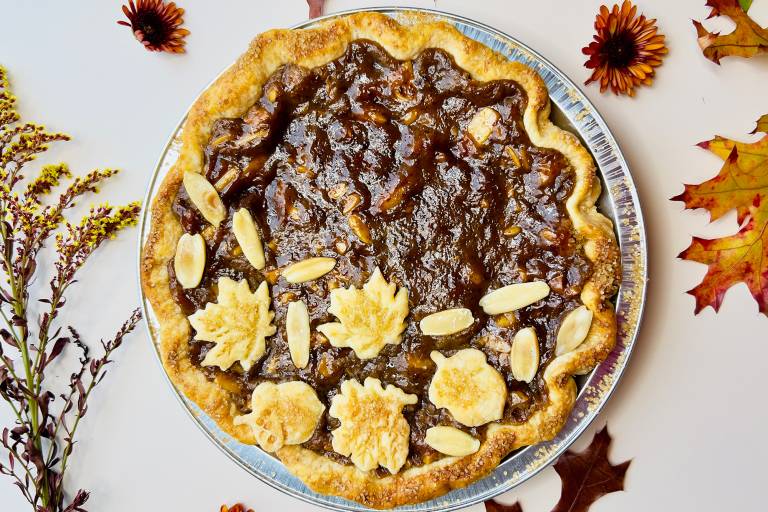
"caption": "Homebaked by Sweet Condesa's maple pili nut pie is a Filipino spin on pecan pie, inspired by the popular Filipino snack of candied pili nuts. The home-based bakery is selling a limited number of pies for Thanksgiving.",
"credit": "Aeden Nicholas Gabriel, courtesy of Homebaked by Sweet Condesa",
"altTag": "Overhead shot of a festive holiday pie with a glistening brown filling, topped with pieces of dough shaped like maple leaves.",
"description": null,
"imgSizes": {
"thumbnail": {
"file": "https://cdn.kqed.org/wp-content/uploads/sites/2/2025/11/pili-nut-pie-160x107.jpg",
"width": 160,
"height": 107,
"mimeType": "image/jpeg"
},
"medium_large": {
"file": "https://cdn.kqed.org/wp-content/uploads/sites/2/2025/11/pili-nut-pie-768x512.jpg",
"width": 768,
"height": 512,
"mimeType": "image/jpeg"
},
"1536x1536": {
"file": "https://cdn.kqed.org/wp-content/uploads/sites/2/2025/11/pili-nut-pie-1536x1025.jpg",
"width": 1536,
"height": 1025,
"mimeType": "image/jpeg"
},
"post-thumbnail": {
"file": "https://cdn.kqed.org/wp-content/uploads/sites/2/2025/11/pili-nut-pie-672x372.jpg",
"width": 672,
"height": 372,
"mimeType": "image/jpeg"
},
"twentyfourteen-full-width": {
"file": "https://cdn.kqed.org/wp-content/uploads/sites/2/2025/11/pili-nut-pie-1038x576.jpg",
"width": 1038,
"height": 576,
"mimeType": "image/jpeg"
},
"npr-cds-wide": {
"file": "https://cdn.kqed.org/wp-content/uploads/sites/2/2025/11/pili-nut-pie-1200x675.jpg",
"width": 1200,
"height": 675,
"mimeType": "image/jpeg"
},
"kqedFullSize": {
"file": "https://cdn.kqed.org/wp-content/uploads/sites/2/2025/11/pili-nut-pie.jpg",
"width": 2000,
"height": 1334
}
},
"isLoading": false,
"fetchFailed": false
},
"arts_13983252": {
"type": "attachments",
"id": "arts_13983252",
"meta": {
"index": "attachments_1716263798",
"site": "arts",
"id": "13983252",
"found": true
},
"title": "2 - Eating_crop",
"publishDate": 1761869740,
"status": "inherit",
"parent": 13983249,
"modified": 1761869861,
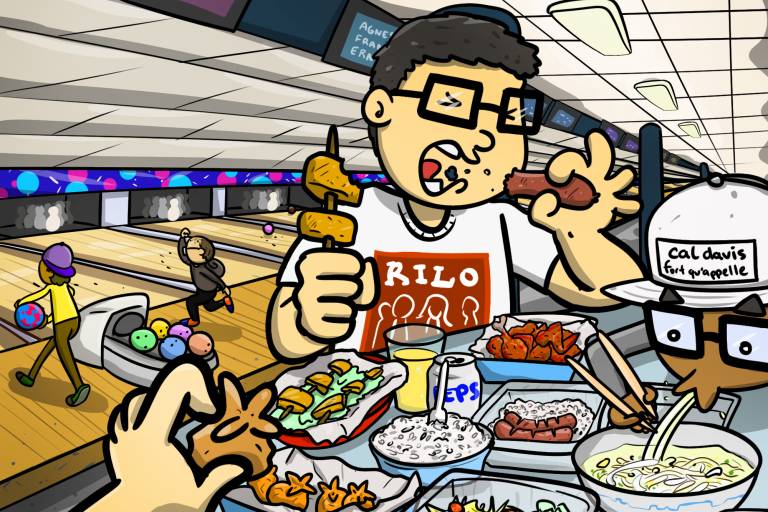
"caption": "Located inside the Castro Village Bowl bowling alley, the Lucky Lane 33 Cafe specializes in Lao and Thai dishes like Lao sausage, nam khao (crispy rice ball salad) and papaya salad.",
"credit": "Raynato Castro",
"altTag": "Illustration: Two men eating a spread of food inside a bowling alley.",
"description": null,
"imgSizes": {
"thumbnail": {
"file": "https://cdn.kqed.org/wp-content/uploads/sites/2/2025/10/2-Eating_crop-160x107.jpg",
"width": 160,
"height": 107,
"mimeType": "image/jpeg"
},
"medium_large": {
"file": "https://cdn.kqed.org/wp-content/uploads/sites/2/2025/10/2-Eating_crop-768x512.jpg",
"width": 768,
"height": 512,
"mimeType": "image/jpeg"
},
"1536x1536": {
"file": "https://cdn.kqed.org/wp-content/uploads/sites/2/2025/10/2-Eating_crop-1536x1024.jpg",
"width": 1536,
"height": 1024,
"mimeType": "image/jpeg"
},
"post-thumbnail": {
"file": "https://cdn.kqed.org/wp-content/uploads/sites/2/2025/10/2-Eating_crop-672x372.jpg",
"width": 672,
"height": 372,
"mimeType": "image/jpeg"
},
"twentyfourteen-full-width": {
"file": "https://cdn.kqed.org/wp-content/uploads/sites/2/2025/10/2-Eating_crop-1038x576.jpg",
"width": 1038,
"height": 576,
"mimeType": "image/jpeg"
},
"npr-cds-wide": {
"file": "https://cdn.kqed.org/wp-content/uploads/sites/2/2025/10/2-Eating_crop-1200x675.jpg",
"width": 1200,
"height": 675,
"mimeType": "image/jpeg"
},
"kqedFullSize": {
"file": "https://cdn.kqed.org/wp-content/uploads/sites/2/2025/10/2-Eating_crop.jpg",
"width": 2000,
"height": 1333
}
},
"isLoading": false,
"fetchFailed": false
},
"arts_13983048": {
"type": "attachments",
"id": "arts_13983048",
"meta": {
"index": "attachments_1716263798",
"site": "arts",
"id": "13983048",
"found": true
},
"title": "251018-FILIPINODANCEPARTY00196_TV-KQED",
"publishDate": 1761753572,
"status": "inherit",
"parent": 0,
"modified": 1761775431,
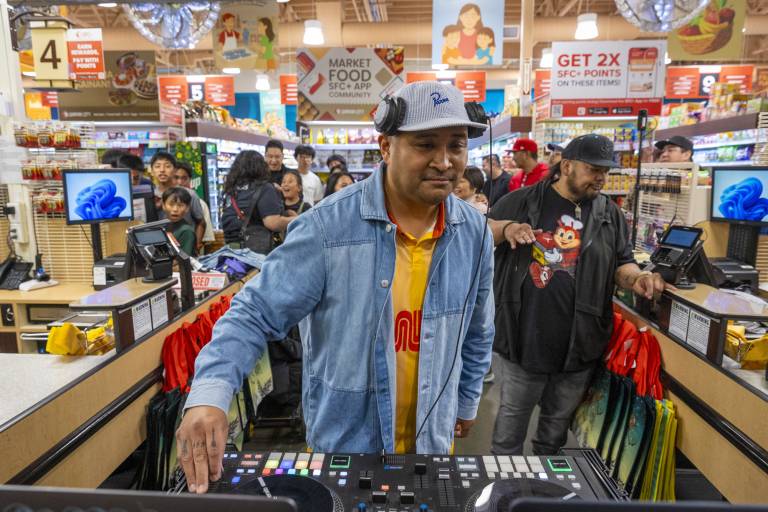
"caption": "DJ Boogie Brown performs a set during a dance party at Seafood City in Daly City on October 18, 2025. Seafood City, a Filipino supermarket chain, has been celebrating Filipino American History Month by throwing late-night DJ parties at store locations around the U.S.",
"credit": "Tâm Vũ/KQED",
"altTag": "A DJ in a blue denim shirt works the turntable inside a crowded grocery store.",
"description": null,
"imgSizes": {
"thumbnail": {
"file": "https://cdn.kqed.org/wp-content/uploads/sites/2/2025/10/251018-FILIPINODANCEPARTY00196_TV-KQED-160x107.jpg",
"width": 160,
"height": 107,
"mimeType": "image/jpeg"
},
"medium_large": {
"file": "https://cdn.kqed.org/wp-content/uploads/sites/2/2025/10/251018-FILIPINODANCEPARTY00196_TV-KQED-768x512.jpg",
"width": 768,
"height": 512,
"mimeType": "image/jpeg"
},
"1536x1536": {
"file": "https://cdn.kqed.org/wp-content/uploads/sites/2/2025/10/251018-FILIPINODANCEPARTY00196_TV-KQED-1536x1024.jpg",
"width": 1536,
"height": 1024,
"mimeType": "image/jpeg"
},
"post-thumbnail": {
"file": "https://cdn.kqed.org/wp-content/uploads/sites/2/2025/10/251018-FILIPINODANCEPARTY00196_TV-KQED-672x372.jpg",
"width": 672,
"height": 372,
"mimeType": "image/jpeg"
},
"twentyfourteen-full-width": {
"file": "https://cdn.kqed.org/wp-content/uploads/sites/2/2025/10/251018-FILIPINODANCEPARTY00196_TV-KQED-1038x576.jpg",
"width": 1038,
"height": 576,
"mimeType": "image/jpeg"
},
"npr-cds-wide": {
"file": "https://cdn.kqed.org/wp-content/uploads/sites/2/2025/10/251018-FILIPINODANCEPARTY00196_TV-KQED-1600x900.jpg",
"width": 1600,
"height": 900,
"mimeType": "image/jpeg"
},
"kqedFullSize": {
"file": "https://cdn.kqed.org/wp-content/uploads/sites/2/2025/10/251018-FILIPINODANCEPARTY00196_TV-KQED.jpg",
"width": 2000,
"height": 1333
}
},
"isLoading": false,
"fetchFailed": false
},
"arts_13979699": {
"type": "attachments",
"id": "arts_13979699",
"meta": {
"index": "attachments_1716263798",
"site": "arts",
"id": "13979699",
"found": true
},
"title": "jack o lanterns",
"publishDate": 1754597713,
"status": "inherit",
"parent": 13979698,
"modified": 1756934950,
"caption": "Illuminated jack-o’-lanterns at Filoli’s ‘Nightfall’ event. ",
"credit": "Courtesy of Filoli Historic House and Garden",
"altTag": "Scores of jack-o-lanterns lie arranged outside at night, on and around bales of hay.",
"description": null,
"imgSizes": {
"thumbnail": {
"file": "https://cdn.kqed.org/wp-content/uploads/sites/2/2025/08/jack-o-lanterns-160x107.jpg",
"width": 160,
"height": 107,
"mimeType": "image/jpeg"
},
"medium_large": {
"file": "https://cdn.kqed.org/wp-content/uploads/sites/2/2025/08/jack-o-lanterns-768x512.jpg",
"width": 768,
"height": 512,
"mimeType": "image/jpeg"
},
"1536x1536": {
"file": "https://cdn.kqed.org/wp-content/uploads/sites/2/2025/08/jack-o-lanterns-1536x1024.jpg",
"width": 1536,
"height": 1024,
"mimeType": "image/jpeg"
},
"post-thumbnail": {
"file": "https://cdn.kqed.org/wp-content/uploads/sites/2/2025/08/jack-o-lanterns-672x372.jpg",
"width": 672,
"height": 372,
"mimeType": "image/jpeg"
},
"twentyfourteen-full-width": {
"file": "https://cdn.kqed.org/wp-content/uploads/sites/2/2025/08/jack-o-lanterns-1038x576.jpg",
"width": 1038,
"height": 576,
"mimeType": "image/jpeg"
},
"kqedFullSize": {
"file": "https://cdn.kqed.org/wp-content/uploads/sites/2/2025/08/jack-o-lanterns.jpg",
"width": 2000,
"height": 1333
}
},
"isLoading": false,
"fetchFailed": false
},
"arts_13982931": {
"type": "attachments",
"id": "arts_13982931",
"meta": {
"index": "attachments_1716263798",
"site": "arts",
"id": "13982931",
"found": true
},
"title": "jungdon katsu",
"publishDate": 1761586352,
"status": "inherit",
"parent": 13982928,
"modified": 1761586491,
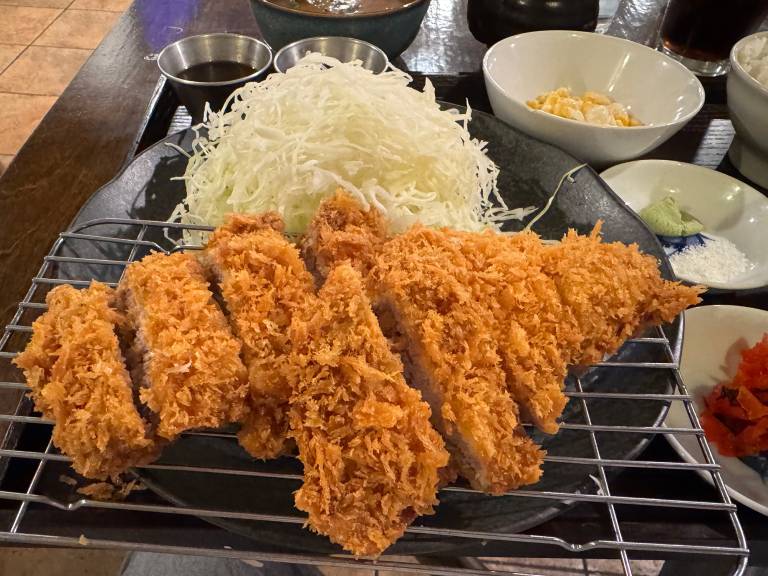
"caption": "Jungdon Katsu's Danville restaurant was one of the East Bay's only specialized tonkatsu restaurants. The restaurant was closed, at least temporarily, by a fire on Oct. 20, 2025.",
"credit": "Luke Tsai/KQED",
"altTag": "Fried pork cutlet served on a wire rack, with a pile of shredded cabbage on the side.",
"description": null,
"imgSizes": {
"thumbnail": {
"file": "https://cdn.kqed.org/wp-content/uploads/sites/2/2025/10/jungdon-katsu-160x120.jpg",
"width": 160,
"height": 120,
"mimeType": "image/jpeg"
},
"medium_large": {
"file": "https://cdn.kqed.org/wp-content/uploads/sites/2/2025/10/jungdon-katsu-768x576.jpg",
"width": 768,
"height": 576,
"mimeType": "image/jpeg"
},
"1536x1536": {
"file": "https://cdn.kqed.org/wp-content/uploads/sites/2/2025/10/jungdon-katsu-1536x1153.jpg",
"width": 1536,
"height": 1153,
"mimeType": "image/jpeg"
},
"post-thumbnail": {
"file": "https://cdn.kqed.org/wp-content/uploads/sites/2/2025/10/jungdon-katsu-672x372.jpg",
"width": 672,
"height": 372,
"mimeType": "image/jpeg"
},
"twentyfourteen-full-width": {
"file": "https://cdn.kqed.org/wp-content/uploads/sites/2/2025/10/jungdon-katsu-1038x576.jpg",
"width": 1038,
"height": 576,
"mimeType": "image/jpeg"
},
"npr-cds-wide": {
"file": "https://cdn.kqed.org/wp-content/uploads/sites/2/2025/10/jungdon-katsu-1600x900.jpg",
"width": 1600,
"height": 900,
"mimeType": "image/jpeg"
},
"kqedFullSize": {
"file": "https://cdn.kqed.org/wp-content/uploads/sites/2/2025/10/jungdon-katsu.jpg",
"width": 2000,
"height": 1501
}
},
"isLoading": false,
"fetchFailed": false
},
"arts_13980884": {
"type": "attachments",
"id": "arts_13980884",
"meta": {
"index": "attachments_1716263798",
"site": "arts",
"id": "13980884",
"found": true
},
"title": "250822_STUNNAMAN02_ 0002_GH-KQED",
"publishDate": 1756830161,
"status": "inherit",
"parent": 0,
"modified": 1761255559,
"caption": "Stunnaman02, a San Francisco rapper and entrepreneur, takes a bite of his signature salad at Cali’s Sports Bar in Berkeley on August 22, 2025.",
"credit": "Gustavo Hernandez/KQED",
"altTag": "Man wearing a blue and red cap, like a superhero, eats a large forkful of salad.",
"description": null,
"imgSizes": {
"thumbnail": {
"file": "https://cdn.kqed.org/wp-content/uploads/sites/2/2025/09/250822_STUNNAMAN02_-0002_GH-KQED-160x107.jpg",
"width": 160,
"height": 107,
"mimeType": "image/jpeg"
},
"medium_large": {
"file": "https://cdn.kqed.org/wp-content/uploads/sites/2/2025/09/250822_STUNNAMAN02_-0002_GH-KQED-768x512.jpg",
"width": 768,
"height": 512,
"mimeType": "image/jpeg"
},
"1536x1536": {
"file": "https://cdn.kqed.org/wp-content/uploads/sites/2/2025/09/250822_STUNNAMAN02_-0002_GH-KQED-1536x1024.jpg",
"width": 1536,
"height": 1024,
"mimeType": "image/jpeg"
},
"post-thumbnail": {
"file": "https://cdn.kqed.org/wp-content/uploads/sites/2/2025/09/250822_STUNNAMAN02_-0002_GH-KQED-672x372.jpg",
"width": 672,
"height": 372,
"mimeType": "image/jpeg"
},
"twentyfourteen-full-width": {
"file": "https://cdn.kqed.org/wp-content/uploads/sites/2/2025/09/250822_STUNNAMAN02_-0002_GH-KQED-1038x576.jpg",
"width": 1038,
"height": 576,
"mimeType": "image/jpeg"
},
"kqedFullSize": {
"file": "https://cdn.kqed.org/wp-content/uploads/sites/2/2025/09/250822_STUNNAMAN02_-0002_GH-KQED.jpg",
"width": 2000,
"height": 1333
}
},
"isLoading": false,
"fetchFailed": false
},
"arts_13982364": {
"type": "attachments",
"id": "arts_13982364",
"meta": {
"index": "attachments_1716263798",
"site": "arts",
"id": "13982364",
"found": true
},
"title": "ldc by thomas vo3",
"publishDate": 1760460078,
"status": "inherit",
"parent": 13982348,
"modified": 1760461213,
"caption": "Shane Stanbridge (left) and C-Y Chia closed Lion Dance Cafe, their Oakland vegan Singaporean restaurant, in April of 2024. The chefs' self-published cookbook, 'Authentic, Not Traditional,' will feature all of the restaurant's greatest hits.",
"credit": "Thomas Vo, courtesy of Lion Dance Cafe",
"altTag": "A couple holding chopsticks to pick at a plate of food poses for a portrait.",
"description": null,
"imgSizes": {
"thumbnail": {
"file": "https://cdn.kqed.org/wp-content/uploads/sites/2/2025/10/ldc-by-thomas-vo3-160x120.jpg",
"width": 160,
"height": 120,
"mimeType": "image/jpeg"
},
"medium_large": {
"file": "https://cdn.kqed.org/wp-content/uploads/sites/2/2025/10/ldc-by-thomas-vo3-768x578.jpg",
"width": 768,
"height": 578,
"mimeType": "image/jpeg"
},
"1536x1536": {
"file": "https://cdn.kqed.org/wp-content/uploads/sites/2/2025/10/ldc-by-thomas-vo3-1536x1156.jpg",
"width": 1536,
"height": 1156,
"mimeType": "image/jpeg"
},
"post-thumbnail": {
"file": "https://cdn.kqed.org/wp-content/uploads/sites/2/2025/10/ldc-by-thomas-vo3-672x372.jpg",
"width": 672,
"height": 372,
"mimeType": "image/jpeg"
},
"twentyfourteen-full-width": {
"file": "https://cdn.kqed.org/wp-content/uploads/sites/2/2025/10/ldc-by-thomas-vo3-1038x576.jpg",
"width": 1038,
"height": 576,
"mimeType": "image/jpeg"
},
"kqedFullSize": {
"file": "https://cdn.kqed.org/wp-content/uploads/sites/2/2025/10/ldc-by-thomas-vo3.jpg",
"width": 2000,
"height": 1505
}
},
"isLoading": false,
"fetchFailed": false
},
"arts_13982242": {
"type": "attachments",
"id": "arts_13982242",
"meta": {
"index": "attachments_1716263798",
"site": "arts",
"id": "13982242",
"found": true
},
"title": "531F4329-7D4E-4E40-B137-8316736F9CE1",
"publishDate": 1759958836,
"status": "inherit",
"parent": 13982236,
"modified": 1759958996,
"caption": "Simon (left) and Eric Cheung pose for a portrait in front of their Bernal Heights restaurant, Go Duck Yourself. The brothers' new Chinese barbecue deli in the Tenderloin is expected to open in October 2025.",
"credit": "Courtesy of Go Duck Yourself",
"altTag": "Two Asian men in black stand in front of a restaurant. The sign in the window reads, \"Go Duck Yourself.\"",
"description": null,
"imgSizes": {
"thumbnail": {
"file": "https://cdn.kqed.org/wp-content/uploads/sites/2/2025/10/531F4329-7D4E-4E40-B137-8316736F9CE1-160x120.jpg",
"width": 160,
"height": 120,
"mimeType": "image/jpeg"
},
"medium_large": {
"file": "https://cdn.kqed.org/wp-content/uploads/sites/2/2025/10/531F4329-7D4E-4E40-B137-8316736F9CE1-768x576.jpg",
"width": 768,
"height": 576,
"mimeType": "image/jpeg"
},
"1536x1536": {
"file": "https://cdn.kqed.org/wp-content/uploads/sites/2/2025/10/531F4329-7D4E-4E40-B137-8316736F9CE1-1536x1152.jpg",
"width": 1536,
"height": 1152,
"mimeType": "image/jpeg"
},
"post-thumbnail": {
"file": "https://cdn.kqed.org/wp-content/uploads/sites/2/2025/10/531F4329-7D4E-4E40-B137-8316736F9CE1-672x372.jpg",
"width": 672,
"height": 372,
"mimeType": "image/jpeg"
},
"twentyfourteen-full-width": {
"file": "https://cdn.kqed.org/wp-content/uploads/sites/2/2025/10/531F4329-7D4E-4E40-B137-8316736F9CE1-1038x576.jpg",
"width": 1038,
"height": 576,
"mimeType": "image/jpeg"
},
"kqedFullSize": {
"file": "https://cdn.kqed.org/wp-content/uploads/sites/2/2025/10/531F4329-7D4E-4E40-B137-8316736F9CE1.jpg",
"width": 2000,
"height": 1500
}
},
"isLoading": false,
"fetchFailed": false
},
"arts_13957311": {
"type": "attachments",
"id": "arts_13957311",
"meta": {
"index": "attachments_1716263798",
"site": "arts",
"id": "13957311",
"found": true
},
"parent": 13957305,
"imgSizes": {
"twentyfourteen-full-width": {
"file": "https://cdn.kqed.org/wp-content/uploads/sites/2/2024/05/duan-chun-zhen_fried-rice-1038x576.jpg",
"width": 1038,
"mimeType": "image/jpeg",
"height": 576
},
"thumbnail": {
"file": "https://cdn.kqed.org/wp-content/uploads/sites/2/2024/05/duan-chun-zhen_fried-rice-160x120.jpg",
"width": 160,
"mimeType": "image/jpeg",
"height": 120
},
"post-thumbnail": {
"file": "https://cdn.kqed.org/wp-content/uploads/sites/2/2024/05/duan-chun-zhen_fried-rice-672x372.jpg",
"width": 672,
"mimeType": "image/jpeg",
"height": 372
},
"kqedFullSize": {
"file": "https://cdn.kqed.org/wp-content/uploads/sites/2/2024/05/duan-chun-zhen_fried-rice.jpg",
"width": 1920,
"height": 1440
},
"large": {
"file": "https://cdn.kqed.org/wp-content/uploads/sites/2/2024/05/duan-chun-zhen_fried-rice-1020x765.jpg",
"width": 1020,
"mimeType": "image/jpeg",
"height": 765
},
"1536x1536": {
"file": "https://cdn.kqed.org/wp-content/uploads/sites/2/2024/05/duan-chun-zhen_fried-rice-1536x1152.jpg",
"width": 1536,
"mimeType": "image/jpeg",
"height": 1152
},
"medium": {
"file": "https://cdn.kqed.org/wp-content/uploads/sites/2/2024/05/duan-chun-zhen_fried-rice-800x600.jpg",
"width": 800,
"mimeType": "image/jpeg",
"height": 600
},
"medium_large": {
"file": "https://cdn.kqed.org/wp-content/uploads/sites/2/2024/05/duan-chun-zhen_fried-rice-768x576.jpg",
"width": 768,
"mimeType": "image/jpeg",
"height": 576
}
},
"publishDate": 1715036256,
"modified": 1715036331,
"caption": "Duan Chun Zhen will have a booth at this year's festival. Pictured here is the Cupertino restaurant's fried rice with pork chop.",
"description": null,
"title": "duan chun zhen_fried rice",
"credit": "Luke Tsai",
"status": "inherit",
"altTag": "A bowl of egg fried rice topped with fried chop.",
"isLoading": false,
"fetchFailed": false
},
"arts_13982100": {
"type": "attachments",
"id": "arts_13982100",
"meta": {
"index": "attachments_1716263798",
"site": "arts",
"id": "13982100",
"found": true
},
"title": "ClubWaziema-crop",
"publishDate": 1759450997,
"status": "inherit",
"parent": 13982096,
"modified": 1759451115,
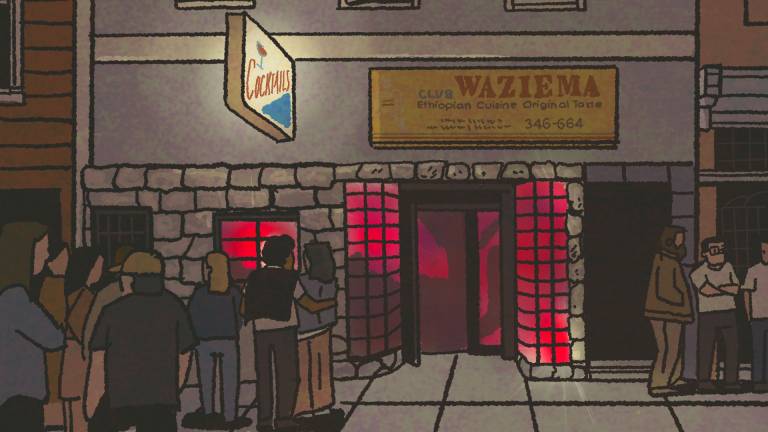
"caption": "In a former life, Club Waziema was a legendary jazz club called Club Morocco.",
"credit": "Thien Pham",
"altTag": "Illustration: Exterior of a bar with a crowd of people outside. The sign says, \"Cocktails\".",
"description": null,
"imgSizes": {
"thumbnail": {
"file": "https://cdn.kqed.org/wp-content/uploads/sites/2/2025/10/ClubWaziema-crop-160x90.jpg",
"width": 160,
"height": 90,
"mimeType": "image/jpeg"
},
"medium_large": {
"file": "https://cdn.kqed.org/wp-content/uploads/sites/2/2025/10/ClubWaziema-crop-768x432.jpg",
"width": 768,
"height": 432,
"mimeType": "image/jpeg"
},
"1536x1536": {
"file": "https://cdn.kqed.org/wp-content/uploads/sites/2/2025/10/ClubWaziema-crop-1536x864.jpg",
"width": 1536,
"height": 864,
"mimeType": "image/jpeg"
},
"post-thumbnail": {
"file": "https://cdn.kqed.org/wp-content/uploads/sites/2/2025/10/ClubWaziema-crop-672x372.jpg",
"width": 672,
"height": 372,
"mimeType": "image/jpeg"
},
"twentyfourteen-full-width": {
"file": "https://cdn.kqed.org/wp-content/uploads/sites/2/2025/10/ClubWaziema-crop-1038x576.jpg",
"width": 1038,
"height": 576,
"mimeType": "image/jpeg"
},
"kqedFullSize": {
"file": "https://cdn.kqed.org/wp-content/uploads/sites/2/2025/10/ClubWaziema-crop.jpg",
"width": 1920,
"height": 1080
}
},
"isLoading": false,
"fetchFailed": false
},
"arts_13981582": {
"type": "attachments",
"id": "arts_13981582",
"meta": {
"index": "attachments_1716263798",
"site": "arts",
"id": "13981582",
"found": true
},
"title": "250918-TEENFASHIONSTUDENTS_02223_TV-KQEd",
"publishDate": 1758561043,
"status": "inherit",
"parent": 0,
"modified": 1759282127,
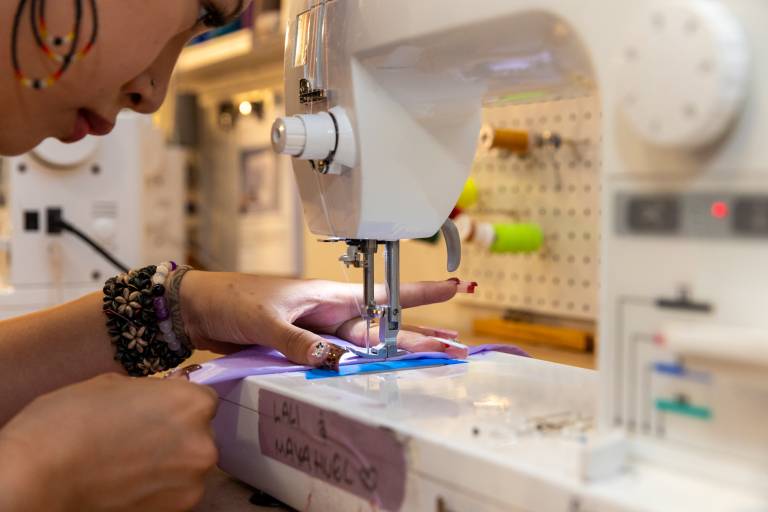
"caption": "Kylie Didrickson sews part of her dress at Oakland School for the Arts on Sept. 18, 2025. Students at the Oakland charter school partnered with 11 of the city’s top chefs to design original couture garments inspired by the chefs’ flavors, ingredients and personal stories.",
"credit": "Tâm Vũ/KQED",
"altTag": "Close-up photo of a teenage girl concentrating as she leans over a sewing machine, hemming a piece of fabric.",
"description": null,
"imgSizes": {
"thumbnail": {
"file": "https://cdn.kqed.org/wp-content/uploads/sites/2/2025/09/250918-TEENFASHIONSTUDENTS_02223_TV-KQEd-160x107.jpg",
"width": 160,
"height": 107,
"mimeType": "image/jpeg"
},
"medium_large": {
"file": "https://cdn.kqed.org/wp-content/uploads/sites/2/2025/09/250918-TEENFASHIONSTUDENTS_02223_TV-KQEd-768x512.jpg",
"width": 768,
"height": 512,
"mimeType": "image/jpeg"
},
"1536x1536": {
"file": "https://cdn.kqed.org/wp-content/uploads/sites/2/2025/09/250918-TEENFASHIONSTUDENTS_02223_TV-KQEd-1536x1024.jpg",
"width": 1536,
"height": 1024,
"mimeType": "image/jpeg"
},
"post-thumbnail": {
"file": "https://cdn.kqed.org/wp-content/uploads/sites/2/2025/09/250918-TEENFASHIONSTUDENTS_02223_TV-KQEd-672x372.jpg",
"width": 672,
"height": 372,
"mimeType": "image/jpeg"
},
"twentyfourteen-full-width": {
"file": "https://cdn.kqed.org/wp-content/uploads/sites/2/2025/09/250918-TEENFASHIONSTUDENTS_02223_TV-KQEd-1038x576.jpg",
"width": 1038,
"height": 576,
"mimeType": "image/jpeg"
},
"kqedFullSize": {
"file": "https://cdn.kqed.org/wp-content/uploads/sites/2/2025/09/250918-TEENFASHIONSTUDENTS_02223_TV-KQEd.jpg",
"width": 2000,
"height": 1333
}
},
"isLoading": false,
"fetchFailed": false
},
"arts_13981937": {
"type": "attachments",
"id": "arts_13981937",
"meta": {
"index": "attachments_1716263798",
"site": "arts",
"id": "13981937",
"found": true
},
"title": "Aleena Thomas pouring a meter chai",
"publishDate": 1759260331,
"status": "inherit",
"parent": 13981935,
"modified": 1759280759,
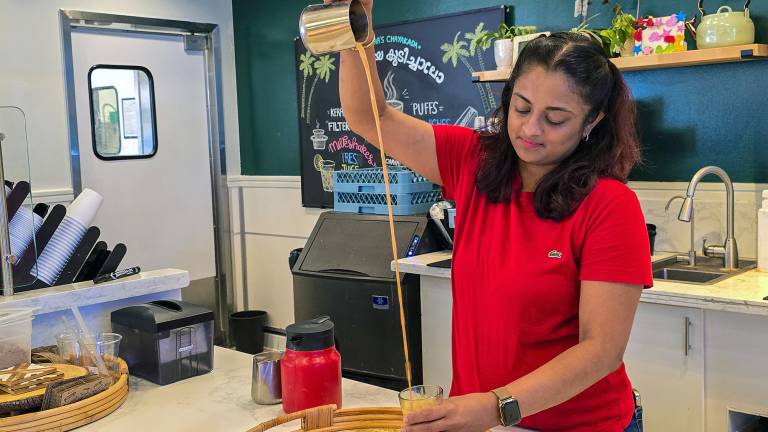
"caption": "Chayakada owner Aleena Thomas pours a cup of traditional Kerala-style meter chai. Thomas' San Jose shop claims to be the first Kerala-style chai cafe in the United States.",
"credit": "Octavio Peña",
"altTag": "Woman in a red t-shirt prepares a cup of chai, a thin stream of the milky tea pouring into the cup from a great height.",
"description": null,
"imgSizes": {
"thumbnail": {
"file": "https://cdn.kqed.org/wp-content/uploads/sites/2/2025/09/Aleena-Thomas-pouring-a-meter-chai-160x90.jpg",
"width": 160,
"height": 90,
"mimeType": "image/jpeg"
},
"medium_large": {
"file": "https://cdn.kqed.org/wp-content/uploads/sites/2/2025/09/Aleena-Thomas-pouring-a-meter-chai-768x432.jpg",
"width": 768,
"height": 432,
"mimeType": "image/jpeg"
},
"1536x1536": {
"file": "https://cdn.kqed.org/wp-content/uploads/sites/2/2025/09/Aleena-Thomas-pouring-a-meter-chai-1536x865.jpg",
"width": 1536,
"height": 865,
"mimeType": "image/jpeg"
},
"post-thumbnail": {
"file": "https://cdn.kqed.org/wp-content/uploads/sites/2/2025/09/Aleena-Thomas-pouring-a-meter-chai-672x372.jpg",
"width": 672,
"height": 372,
"mimeType": "image/jpeg"
},
"twentyfourteen-full-width": {
"file": "https://cdn.kqed.org/wp-content/uploads/sites/2/2025/09/Aleena-Thomas-pouring-a-meter-chai-1038x576.jpg",
"width": 1038,
"height": 576,
"mimeType": "image/jpeg"
},
"kqedFullSize": {
"file": "https://cdn.kqed.org/wp-content/uploads/sites/2/2025/09/Aleena-Thomas-pouring-a-meter-chai.jpg",
"width": 2000,
"height": 1126
}
},
"isLoading": false,
"fetchFailed": false
}
},
"audioPlayerReducer": {
"postId": "stream_live",
"isPaused": true,
"isPlaying": false,
"pfsActive": false,
"pledgeModalIsOpen": true,
"playerDrawerIsOpen": false,
"liveAudioPlayStartedAt": 0,
"liveAudioPlayContext": ""
},
"authorsReducer": {
"byline_arts_13982936": {
"type": "authors",
"id": "byline_arts_13982936",
"meta": {
"override": true
},
"slug": "byline_arts_13982936",
"name": "Kiki Sideris, Associated Press",
"isLoading": false
},
"ltsai": {
"type": "authors",
"id": "11743",
"meta": {
"index": "authors_1716337520",
"id": "11743",
"found": true
},
"name": "Luke Tsai",
"firstName": "Luke",
"lastName": "Tsai",
"slug": "ltsai",
"email": "ltsai@kqed.org",
"display_author_email": true,
"staff_mastheads": [
"arts"
],
"title": "Food Editor",
"bio": "Luke Tsai is KQED's food editor and resident stinky tofu connoisseur. Prior to KQED, he was an editor at Eater SF, \u003cem>San Francisco \u003c/em>magazine, and the \u003cem>East Bay Express\u003c/em>, and his work has also appeared in TASTE, the \u003cem>San Francisco Chronicle\u003c/em>, and the \u003cem>Best Food Writing\u003c/em> anthology. When he isn't writing or editing, you'll find him eating most everything he can get his hands on.",
"avatar": "https://secure.gravatar.com/avatar/1e59b45bf191526e7339d6ba46e33a57b2030d25c27660ecc64ea3cb863e34f7?s=600&d=blank&r=g",
"twitter": "theluketsai",
"bluesky": null,
"facebook": null,
"instagram": null,
"linkedin": null,
"sites": [
{
"site": "",
"roles": [
"editor"
]
},
{
"site": "arts",
"roles": [
"administrator"
]
},
{
"site": "news",
"roles": [
"editor",
"contributor"
]
},
{
"site": "bayareabites",
"roles": [
"editor"
]
},
{
"site": "food",
"roles": [
"editor"
]
}
],
"headData": {
"title": "Luke Tsai | KQED",
"description": "Food Editor",
"ogImgSrc": "https://secure.gravatar.com/avatar/1e59b45bf191526e7339d6ba46e33a57b2030d25c27660ecc64ea3cb863e34f7?s=600&d=blank&r=g",
"twImgSrc": "https://secure.gravatar.com/avatar/1e59b45bf191526e7339d6ba46e33a57b2030d25c27660ecc64ea3cb863e34f7?s=600&d=blank&r=g"
},
"isLoading": false,
"link": "/author/ltsai"
},
"tpham": {
"type": "authors",
"id": "11753",
"meta": {
"index": "authors_1716337520",
"id": "11753",
"found": true
},
"name": "Thien Pham",
"firstName": "Thien",
"lastName": "Pham",
"slug": "tpham",
"email": "thiendog@gmail.com",
"display_author_email": false,
"staff_mastheads": [],
"title": "KQED Contributor",
"bio": null,
"avatar": "https://secure.gravatar.com/avatar/a5b4729969ad46d88e7b9ec9dd4f3fa6af84dd0fa8fa91f01d8d9481694999bc?s=600&d=blank&r=g",
"twitter": null,
"bluesky": null,
"facebook": null,
"instagram": null,
"linkedin": null,
"sites": [
{
"site": "arts",
"roles": [
"contributor"
]
}
],
"headData": {
"title": "Thien Pham | KQED",
"description": "KQED Contributor",
"ogImgSrc": "https://secure.gravatar.com/avatar/a5b4729969ad46d88e7b9ec9dd4f3fa6af84dd0fa8fa91f01d8d9481694999bc?s=600&d=blank&r=g",
"twImgSrc": "https://secure.gravatar.com/avatar/a5b4729969ad46d88e7b9ec9dd4f3fa6af84dd0fa8fa91f01d8d9481694999bc?s=600&d=blank&r=g"
},
"isLoading": false,
"link": "/author/tpham"
},
"rockyrivera": {
"type": "authors",
"id": "11846",
"meta": {
"index": "authors_1716337520",
"id": "11846",
"found": true
},
"name": "Rocky Rivera",
"firstName": "Rocky",
"lastName": "Rivera",
"slug": "rockyrivera",
"email": "ms.rocky.rivera@gmail.com",
"display_author_email": false,
"staff_mastheads": [],
"title": "KQED Contributor",
"bio": "Rocky Rivera is a journalist, emcee, author and activist from San Francisco. She has released four albums through her label, Beatrock Music, and a ten-volume mixtape series with DJ Roza. She released her first book in 2021, entitled \u003cem>Snakeskin: Essays by Rocky Rivera\u003c/em>. Her latest album dropped in September 2024 and is called \"Long Kiss Goodnight\" with emcee/producer Otayo Dubb. She currently writes the Frisco Foodies column as a love letter to her hometown.",
"avatar": "https://secure.gravatar.com/avatar/946241ee2c59e6040607dfc75240d91b?s=600&d=blank&r=g",
"twitter": null,
"facebook": "https://m.facebook.com/rockyriveramusic",
"instagram": "https://instagram.com/rockyrivera",
"linkedin": "https://www.linkedin.com/in/krishtinedeleon/",
"sites": [
{
"site": "arts",
"roles": [
"author"
]
}
],
"headData": {
"title": "Rocky Rivera | KQED",
"description": "KQED Contributor",
"ogImgSrc": "https://secure.gravatar.com/avatar/946241ee2c59e6040607dfc75240d91b?s=600&d=blank&r=g",
"twImgSrc": "https://secure.gravatar.com/avatar/946241ee2c59e6040607dfc75240d91b?s=600&d=blank&r=g"
},
"isLoading": false,
"link": "/author/rockyrivera"
},
"opena": {
"type": "authors",
"id": "11903",
"meta": {
"index": "authors_1716337520",
"id": "11903",
"found": true
},
"name": "Octavio Peña",
"firstName": "Octavio",
"lastName": "Peña",
"slug": "opena",
"email": "octaviopenagutierrez@gmail.com",
"display_author_email": false,
"staff_mastheads": [],
"title": "KQED Contributor",
"bio": null,
"avatar": "https://secure.gravatar.com/avatar/62850791380238ea3945ee72a3d56056477904792b41daaf11effa8780bab75d?s=600&d=blank&r=g",
"twitter": null,
"bluesky": null,
"facebook": null,
"instagram": null,
"linkedin": null,
"sites": [
{
"site": "arts",
"roles": [
"contributor"
]
}
],
"headData": {
"title": "Octavio Peña | KQED",
"description": "KQED Contributor",
"ogImgSrc": "https://secure.gravatar.com/avatar/62850791380238ea3945ee72a3d56056477904792b41daaf11effa8780bab75d?s=600&d=blank&r=g",
"twImgSrc": "https://secure.gravatar.com/avatar/62850791380238ea3945ee72a3d56056477904792b41daaf11effa8780bab75d?s=600&d=blank&r=g"
},
"isLoading": false,
"link": "/author/opena"
},
"rcastro": {
"type": "authors",
"id": "12029",
"meta": {
"index": "authors_1716337520",
"id": "12029",
"found": true
},
"name": "Raynato Castro",
"firstName": "Raynato",
"lastName": "Castro",
"slug": "rcastro",
"email": "rcastrodds@gmail.com",
"display_author_email": false,
"staff_mastheads": [],
"title": "KQED Contributor",
"bio": null,
"avatar": "https://secure.gravatar.com/avatar/bc9f1f13dc825c80cdf5963339a8c47f4a021d21376fc3a141ac91685ee054e1?s=600&d=blank&r=g",
"twitter": null,
"bluesky": null,
"facebook": null,
"instagram": null,
"linkedin": null,
"sites": [
{
"site": "arts",
"roles": [
"contributor"
]
}
],
"headData": {
"title": "Raynato Castro | KQED",
"description": "KQED Contributor",
"ogImgSrc": "https://secure.gravatar.com/avatar/bc9f1f13dc825c80cdf5963339a8c47f4a021d21376fc3a141ac91685ee054e1?s=600&d=blank&r=g",
"twImgSrc": "https://secure.gravatar.com/avatar/bc9f1f13dc825c80cdf5963339a8c47f4a021d21376fc3a141ac91685ee054e1?s=600&d=blank&r=g"
},
"isLoading": false,
"link": "/author/rcastro"
}
},
"pagesReducer": {
"arts_tag_food": {
"type": "terms",
"id": "arts_1297",
"meta": {
"index": "terms_1716263798",
"site": "arts",
"id": "1297",
"score": 7.4243016
},
"featImg": null,
"name": "food",
"description": null,
"taxonomy": "tag",
"headData": {
"twImgId": null,
"twTitle": null,
"ogTitle": null,
"ogImgId": null,
"twDescription": null,
"description": null,
"title": "food Archives | KQED Arts",
"ogDescription": null
},
"ttid": 1309,
"slug": "food",
"isLoading": false,
"title": "food",
"pageMeta": {
"site": "arts",
"WpPageTemplate": "page-topic-editorial",
"currentPage": 6
},
"blocks": [
{
"blockName": "kqed/post-list",
"attrs": {
"layout": "cardArticle2",
"query": "posts/arts?tag=food",
"seeMore": false,
"paginated": true,
"page": 6
}
},
{
"blockName": "kqed/ad"
}
]
}
},
"pfsSessionReducer": {},
"postsReducer": {
"stream_live": {
"type": "live",
"id": "stream_live",
"audioUrl": "https://streams.kqed.org/kqedradio",
"title": "Live Stream",
"excerpt": "Live Stream information currently unavailable.",
"link": "/radio",
"featImg": "",
"label": {
"name": "KQED Live",
"link": "/"
}
},
"stream_kqedNewscast": {
"type": "posts",
"id": "stream_kqedNewscast",
"audioUrl": "https://www.kqed.org/.stream/anon/radio/RDnews/newscast.mp3?_=1",
"title": "KQED Newscast",
"featImg": "",
"label": {
"name": "88.5 FM",
"link": "/"
}
},
"arts_13983413": {
"type": "posts",
"id": "arts_13983413",
"meta": {
"index": "posts_1716263798",
"site": "arts",
"id": "13983413",
"score": null,
"sort": [
1762298599000
]
},
"guestAuthors": [],
"slug": "sweet-condesa-filipino-pies-thanksgiving-2025",
"title": "The Bay Area’s ‘Pinay Pie Lady’ Is Back, Just in Time for Thanksgiving",
"publishDate": 1762298599,
"format": "standard",
"headTitle": "The Bay Area’s ‘Pinay Pie Lady’ Is Back, Just in Time for Thanksgiving | KQED",
"labelTerm": {},
"content": "\u003cp>Two years ago, Melody Lorenzo, aka the Bay Area’s “\u003ca href=\"https://www.kqed.org/arts/13938798/filipino-christmas-pies-sweet-condesa-sf-pinay-pie-lady\">Pinay Pie Lady\u003c/a>,” put on what she thought was going to be her last holiday pie sale. It was the culmination of years of creative tinkering at her bakery, Sweet Condesa, which took classic \u003ca href=\"https://www.kqed.org/arts/tag/filipino-food\">Filipino\u003c/a> desserts like halo-halo, bibingka and queso de bola, and \u003ca href=\"https://sf.eater.com/2020/11/9/21557156/sweet-condesa-filipino-bakery-ube-calamansi-turon-pie-thanksgiving-oakland\">recast them into the format of an all-American pie\u003c/a>.\u003c/p>\n\u003cp>The pies were wildly popular. But at the time, Lorenzo’s lease on her commercial kitchen was set to expire in a few months, and she was, quite frankly, burned out after seven years of fighting to keep her business afloat.\u003c/p>\n\u003cp>“I was trying to take care of myself,” Lorenzo says. “Ever since the pandemic, I’d been on a hustle mode — like, I don’t shut off, basically.”\u003c/p>\n\u003cp>Lorenzo shut Sweet Condesa down officially last summer and stepped away from baking altogether for a year. Still, the desire to create never left her. She’d walk to her neighborhood farmers market, and people would recognize her as “Sweet Condesa” and tell her how much they’d enjoyed her desserts.\u003c/p>\n\u003cp>“I know I made an impact,” she says.\u003c/p>\n\u003cfigure id=\"attachment_13983409\" class=\"wp-caption alignnone\" style=\"max-width: 2000px\">\u003cimg loading=\"lazy\" decoding=\"async\" class=\"size-full wp-image-13983409\" src=\"https://cdn.kqed.org/wp-content/uploads/sites/2/2025/11/Headshot-photo-by-Melissa-de-Mata.jpg\" alt=\"A Filipino woman poses for a portrait while holding a coffee mug, sitting on a wooden bench in some lush green garden setting.\" width=\"2000\" height=\"2000\" srcset=\"https://cdn.kqed.org/wp-content/uploads/sites/2/2025/11/Headshot-photo-by-Melissa-de-Mata.jpg 2000w, https://cdn.kqed.org/wp-content/uploads/sites/2/2025/11/Headshot-photo-by-Melissa-de-Mata-160x160.jpg 160w, https://cdn.kqed.org/wp-content/uploads/sites/2/2025/11/Headshot-photo-by-Melissa-de-Mata-768x768.jpg 768w, https://cdn.kqed.org/wp-content/uploads/sites/2/2025/11/Headshot-photo-by-Melissa-de-Mata-1536x1536.jpg 1536w\" sizes=\"auto, (max-width: 2000px) 100vw, 2000px\">\u003cfigcaption class=\"wp-caption-text\">Melody Lorenzo is the founder of Sweet Condesa — now rebranded as Homebaked by Sweet Condesa. The home-based cottage food business specializes in Filipino-inspired desserts. \u003ccite>(Melissa de Mata, courtesy of Homebaked by Sweet Condesa)\u003c/cite>\u003c/figcaption>\u003c/figure>\n\u003cp>She started thinking whether there might be a way she could start her business up again, but in a smaller-scale, more sustainable way.\u003c/p>\n\u003cp>[ad fullwidth]\u003c/p>\n\u003cp>So, just in time for Thanksgiving, Lorenzo has relaunched her business as “\u003ca href=\"https://www.homebakedbysweetcondesa.com/\">Homebaked by Sweet Condesa\u003c/a>,” a bakery that she runs out of her home kitchen in San Francisco’s Outer Sunset neighborhood. To start out, she’ll sell her Filipino baked treats, like guava bars and ube pie-chunk cookies at pop-ups held once or twice a month, mostly at \u003ca href=\"https://www.instagram.com/ballastcoffee/?hl=en\">Ballast Coffee\u003c/a>, a Filipino-owned coffee shop in West Portal.\u003c/p>\n\u003cp>And yes, of course, she will be selling Thanksgiving pies.\u003c/p>\n\u003cp>“I wanted it to be more fun again — no expectations, no sales goals,” Lorenzo says. “I just want to share my creations again with the community, not feel forced to keep going because I need to make X amount of money to afford my overhead.”\u003c/p>\n\u003cp>Because of the restrictions on \u003ca href=\"https://www.kqed.org/bayareabites/117095/a-new-law-would-legalize-selling-home-cooked-food-in-california\">cottage food businesses\u003c/a> like hers, Lorenzo is in the process of reworking many of her most popular desserts to make them shelf-stable — so, no more custard-based calamansi or halo-halo pies for now. But the limitations haven’t deterred Lorenzo from her original mission to incorporate traditional Filipino flavors into her dessert repertoire.\u003c/p>\n\u003cfigure id=\"attachment_13983412\" class=\"wp-caption alignnone\" style=\"max-width: 2000px\">\u003cimg loading=\"lazy\" decoding=\"async\" class=\"size-full wp-image-13983412\" src=\"https://cdn.kqed.org/wp-content/uploads/sites/2/2025/11/sweet-condesa-pie-hero-shot.jpg\" alt=\"A spread of desserts on a festival holiday table decorated with autumn foliage. There are two pies and a cornbread-like cake topped with toasted coconut flakes.\" width=\"2000\" height=\"1334\" srcset=\"https://cdn.kqed.org/wp-content/uploads/sites/2/2025/11/sweet-condesa-pie-hero-shot.jpg 2000w, https://cdn.kqed.org/wp-content/uploads/sites/2/2025/11/sweet-condesa-pie-hero-shot-160x107.jpg 160w, https://cdn.kqed.org/wp-content/uploads/sites/2/2025/11/sweet-condesa-pie-hero-shot-768x512.jpg 768w, https://cdn.kqed.org/wp-content/uploads/sites/2/2025/11/sweet-condesa-pie-hero-shot-1536x1025.jpg 1536w\" sizes=\"auto, (max-width: 2000px) 100vw, 2000px\">\u003cfigcaption class=\"wp-caption-text\">Sweet Condesa’s Thanksgiving offerings, from left to right: dulce de leche bibingka cornbread, peach mango cobbler pie, and maple pili nut pie. \u003ccite>(Aeden Nicholas Gabriel, courtesy of Homebaked by Sweet Condesa)\u003c/cite>\u003c/figcaption>\u003c/figure>\n\u003cp>For Thanksgiving, she’s reworked one of her popular pie recipes — her peach mango cobbler pie ($65 for a nine-inch pie) — and created another new pie from scratch. The former, of course, is a play on a Filipino fast-food classic: Jollibee’s signature peach mango hand pie, which was Lorenzo’s go-to when she was growing up in the Philippines. Her version features home-made peach-mango jam, a graham cracker crust and a streusel topping for extra crunch. It’s particularly delicious served warm with a scoop of vanilla ice cream on top, Lorenzo says.\u003c/p>\n\u003cp>The new pie, a maple pili nut pie ($80), is Lorenzo’s Filipino twist on pecan pie. It’s similarly caramelized and gooey, but instead of pecans, she uses pili nuts — a slender, creamy nut with a macadamia-like texture that’s indigenous to the Philippines.\u003c/p>\n\u003cp>Candied pili nuts are a popular snack on the islands. “I wanted to recreate that into a pie that has a similar flavor,” Lorenzo explains.\u003c/p>\n\u003cp>Both pies are egg-free — another concession to cottage food regulations, but also a boon for folks with egg allergies.\u003c/p>\n\u003cfigure id=\"attachment_13983410\" class=\"wp-caption alignnone\" style=\"max-width: 1500px\">\u003cimg loading=\"lazy\" decoding=\"async\" class=\"size-full wp-image-13983410\" src=\"https://cdn.kqed.org/wp-content/uploads/sites/2/2025/11/pili-nut-pie-slice.jpg\" alt=\"A caramel-y brown pie, with a single slice cut out and served on a plate.\" width=\"1500\" height=\"2000\" srcset=\"https://cdn.kqed.org/wp-content/uploads/sites/2/2025/11/pili-nut-pie-slice.jpg 1500w, https://cdn.kqed.org/wp-content/uploads/sites/2/2025/11/pili-nut-pie-slice-160x213.jpg 160w, https://cdn.kqed.org/wp-content/uploads/sites/2/2025/11/pili-nut-pie-slice-768x1024.jpg 768w, https://cdn.kqed.org/wp-content/uploads/sites/2/2025/11/pili-nut-pie-slice-1152x1536.jpg 1152w\" sizes=\"auto, (max-width: 1500px) 100vw, 1500px\">\u003cfigcaption class=\"wp-caption-text\">The maple pili nut pie has a similar nuttiness and caramelized quality as a pecan pie. \u003ccite>(Aeden Nicholas Gabriel, courtesy of Homebaked by Sweet Condesa)\u003c/cite>\u003c/figcaption>\u003c/figure>\n\u003cp>\u003cspan style=\"font-weight: 400\">[aside postID='arts_13983119,arts_13978355,arts_13937608']\u003c/span>In addition to the pies, Lorenzo is also selling a third Thanksgiving dessert, a dulce de leche bibingka cornbread ($55) — which, as its name implies, is a cross between American cornbread and the traditional Filipino coconut rice cake known as bibingka.\u003c/p>\n\u003cp>All of Sweet Condesa’s Thanksgiving treats are \u003ca href=\"https://www.hotplate.com/homebakedbysweetcondesa\">available for online preorder\u003c/a> starting at 2 p.m. on Tuesday, Nov. 4. And since Lorenzo is just baking out of her home kitchen now, supplies will be even more limited than in the past: She expects she’ll only be able to bake a total of 40 or 50 pies this year. But if all goes well, she might be able to increase her output for Christmas pie season, by which time she hopes to have found a way to rework that calamansi pie.\u003c/p>\n\u003cp>“I’m just trying to make it work so I can offer [my pies] again,” she says. “The people who found out are just super excited.”\u003c/p>\n\u003chr>\n\u003cp>\u003ci>\u003ca href=\"https://www.homebakedbysweetcondesa.com/\">Homebaked by Sweet Condesa’s\u003c/a> Thanksgiving desserts are available for \u003c/i>\u003ca href=\"https://www.hotplate.com/homebakedbysweetcondesa\">\u003ci>online pre-order\u003c/i>\u003c/a>\u003ci>, starting at 2 p.m. on November 4. Pickup options are on Wednesday, Nov. 26, 10 a.m.–noon at Ballast Coffee (329 W. Portal Ave., San Francisco), and 3–5 p.m. at Mestiza (214 Townsend St., San Francisco). Supplies are very limited.\u003c/i>\u003c/p>\n\u003cp>\u003c/p>\n\u003cp>\u003ci>Sweet Condesa’s next Ballast Coffee pop-ups will be Nov. 15 and Nov. 22, 11 a.m.–1 p.m.\u003c/i>\u003c/p>\n\n",
"blocks": [],
"excerpt": "Sweet Condesa returns with a new lineup of Filipino-inspired treats.",
"status": "publish",
"parent": 0,
"modified": 1762299452,
"stats": {
"hasAudio": false,
"hasVideo": false,
"hasChartOrMap": false,
"iframeSrcs": [],
"hasGoogleForm": false,
"hasGallery": false,
"hasHearkenModule": false,
"hasPolis": false,
"paragraphCount": 21,
"wordCount": 987
},
"headData": {
"title": "Sweet Condesa's Filipino Pies Are Back, Just in Time for Thanksgiving | KQED",
"description": "Sweet Condesa returns with a new lineup of Filipino-inspired treats.",
"ogTitle": "The Bay Area’s ‘Pinay Pie Lady’ Is Back, Just in Time for Thanksgiving",
"ogDescription": "",
"ogImgId": "",
"twTitle": "The Bay Area’s ‘Pinay Pie Lady’ Is Back, Just in Time for Thanksgiving",
"twDescription": "",
"twImgId": "",
"socialTitle": "Sweet Condesa's Filipino Pies Are Back, Just in Time for Thanksgiving %%page%% %%sep%% KQED",
"schema": {
"@context": "https://schema.org",
"@type": "Article",
"headline": "The Bay Area’s ‘Pinay Pie Lady’ Is Back, Just in Time for Thanksgiving",
"datePublished": "2025-11-04T15:23:19-08:00",
"dateModified": "2025-11-04T15:37:32-08:00",
"image": "https://cdn.kqed.org/wp-content/uploads/2020/02/KQED-OG-Image@1x.png"
}
},
"primaryCategory": {
"termId": 12276,
"slug": "food",
"name": "Food"
},
"source": "The Do List",
"sourceUrl": "https://www.kqed.org/thedolist",
"sticky": false,
"nprStoryId": "kqed-13983413",
"templateType": "standard",
"featuredImageType": "standard",
"excludeFromSiteSearch": "Include",
"articleAge": "0",
"path": "/arts/13983413/sweet-condesa-filipino-pies-thanksgiving-2025",
"audioTrackLength": null,
"parsedContent": [
{
"type": "contentString",
"content": "\u003cdiv class=\"post-body\">\u003cp>\u003cp>Two years ago, Melody Lorenzo, aka the Bay Area’s “\u003ca href=\"https://www.kqed.org/arts/13938798/filipino-christmas-pies-sweet-condesa-sf-pinay-pie-lady\">Pinay Pie Lady\u003c/a>,” put on what she thought was going to be her last holiday pie sale. It was the culmination of years of creative tinkering at her bakery, Sweet Condesa, which took classic \u003ca href=\"https://www.kqed.org/arts/tag/filipino-food\">Filipino\u003c/a> desserts like halo-halo, bibingka and queso de bola, and \u003ca href=\"https://sf.eater.com/2020/11/9/21557156/sweet-condesa-filipino-bakery-ube-calamansi-turon-pie-thanksgiving-oakland\">recast them into the format of an all-American pie\u003c/a>.\u003c/p>\n\u003cp>The pies were wildly popular. But at the time, Lorenzo’s lease on her commercial kitchen was set to expire in a few months, and she was, quite frankly, burned out after seven years of fighting to keep her business afloat.\u003c/p>\n\u003cp>“I was trying to take care of myself,” Lorenzo says. “Ever since the pandemic, I’d been on a hustle mode — like, I don’t shut off, basically.”\u003c/p>\n\u003cp>Lorenzo shut Sweet Condesa down officially last summer and stepped away from baking altogether for a year. Still, the desire to create never left her. She’d walk to her neighborhood farmers market, and people would recognize her as “Sweet Condesa” and tell her how much they’d enjoyed her desserts.\u003c/p>\n\u003cp>“I know I made an impact,” she says.\u003c/p>\n\u003cfigure id=\"attachment_13983409\" class=\"wp-caption alignnone\" style=\"max-width: 2000px\">\u003cimg loading=\"lazy\" decoding=\"async\" class=\"size-full wp-image-13983409\" src=\"https://cdn.kqed.org/wp-content/uploads/sites/2/2025/11/Headshot-photo-by-Melissa-de-Mata.jpg\" alt=\"A Filipino woman poses for a portrait while holding a coffee mug, sitting on a wooden bench in some lush green garden setting.\" width=\"2000\" height=\"2000\" srcset=\"https://cdn.kqed.org/wp-content/uploads/sites/2/2025/11/Headshot-photo-by-Melissa-de-Mata.jpg 2000w, https://cdn.kqed.org/wp-content/uploads/sites/2/2025/11/Headshot-photo-by-Melissa-de-Mata-160x160.jpg 160w, https://cdn.kqed.org/wp-content/uploads/sites/2/2025/11/Headshot-photo-by-Melissa-de-Mata-768x768.jpg 768w, https://cdn.kqed.org/wp-content/uploads/sites/2/2025/11/Headshot-photo-by-Melissa-de-Mata-1536x1536.jpg 1536w\" sizes=\"auto, (max-width: 2000px) 100vw, 2000px\">\u003cfigcaption class=\"wp-caption-text\">Melody Lorenzo is the founder of Sweet Condesa — now rebranded as Homebaked by Sweet Condesa. The home-based cottage food business specializes in Filipino-inspired desserts. \u003ccite>(Melissa de Mata, courtesy of Homebaked by Sweet Condesa)\u003c/cite>\u003c/figcaption>\u003c/figure>\n\u003cp>She started thinking whether there might be a way she could start her business up again, but in a smaller-scale, more sustainable way.\u003c/p>\n\u003cp>\u003c/p>\u003c/div>",
"attributes": {
"named": {},
"numeric": []
}
},
{
"type": "component",
"content": "",
"name": "ad",
"attributes": {
"named": {
"label": "fullwidth"
},
"numeric": [
"fullwidth"
]
}
},
{
"type": "contentString",
"content": "\u003cdiv class=\"post-body\">\u003cp>\u003c/p>\n\u003cp>So, just in time for Thanksgiving, Lorenzo has relaunched her business as “\u003ca href=\"https://www.homebakedbysweetcondesa.com/\">Homebaked by Sweet Condesa\u003c/a>,” a bakery that she runs out of her home kitchen in San Francisco’s Outer Sunset neighborhood. To start out, she’ll sell her Filipino baked treats, like guava bars and ube pie-chunk cookies at pop-ups held once or twice a month, mostly at \u003ca href=\"https://www.instagram.com/ballastcoffee/?hl=en\">Ballast Coffee\u003c/a>, a Filipino-owned coffee shop in West Portal.\u003c/p>\n\u003cp>And yes, of course, she will be selling Thanksgiving pies.\u003c/p>\n\u003cp>“I wanted it to be more fun again — no expectations, no sales goals,” Lorenzo says. “I just want to share my creations again with the community, not feel forced to keep going because I need to make X amount of money to afford my overhead.”\u003c/p>\n\u003cp>Because of the restrictions on \u003ca href=\"https://www.kqed.org/bayareabites/117095/a-new-law-would-legalize-selling-home-cooked-food-in-california\">cottage food businesses\u003c/a> like hers, Lorenzo is in the process of reworking many of her most popular desserts to make them shelf-stable — so, no more custard-based calamansi or halo-halo pies for now. But the limitations haven’t deterred Lorenzo from her original mission to incorporate traditional Filipino flavors into her dessert repertoire.\u003c/p>\n\u003cfigure id=\"attachment_13983412\" class=\"wp-caption alignnone\" style=\"max-width: 2000px\">\u003cimg loading=\"lazy\" decoding=\"async\" class=\"size-full wp-image-13983412\" src=\"https://cdn.kqed.org/wp-content/uploads/sites/2/2025/11/sweet-condesa-pie-hero-shot.jpg\" alt=\"A spread of desserts on a festival holiday table decorated with autumn foliage. There are two pies and a cornbread-like cake topped with toasted coconut flakes.\" width=\"2000\" height=\"1334\" srcset=\"https://cdn.kqed.org/wp-content/uploads/sites/2/2025/11/sweet-condesa-pie-hero-shot.jpg 2000w, https://cdn.kqed.org/wp-content/uploads/sites/2/2025/11/sweet-condesa-pie-hero-shot-160x107.jpg 160w, https://cdn.kqed.org/wp-content/uploads/sites/2/2025/11/sweet-condesa-pie-hero-shot-768x512.jpg 768w, https://cdn.kqed.org/wp-content/uploads/sites/2/2025/11/sweet-condesa-pie-hero-shot-1536x1025.jpg 1536w\" sizes=\"auto, (max-width: 2000px) 100vw, 2000px\">\u003cfigcaption class=\"wp-caption-text\">Sweet Condesa’s Thanksgiving offerings, from left to right: dulce de leche bibingka cornbread, peach mango cobbler pie, and maple pili nut pie. \u003ccite>(Aeden Nicholas Gabriel, courtesy of Homebaked by Sweet Condesa)\u003c/cite>\u003c/figcaption>\u003c/figure>\n\u003cp>For Thanksgiving, she’s reworked one of her popular pie recipes — her peach mango cobbler pie ($65 for a nine-inch pie) — and created another new pie from scratch. The former, of course, is a play on a Filipino fast-food classic: Jollibee’s signature peach mango hand pie, which was Lorenzo’s go-to when she was growing up in the Philippines. Her version features home-made peach-mango jam, a graham cracker crust and a streusel topping for extra crunch. It’s particularly delicious served warm with a scoop of vanilla ice cream on top, Lorenzo says.\u003c/p>\n\u003cp>The new pie, a maple pili nut pie ($80), is Lorenzo’s Filipino twist on pecan pie. It’s similarly caramelized and gooey, but instead of pecans, she uses pili nuts — a slender, creamy nut with a macadamia-like texture that’s indigenous to the Philippines.\u003c/p>\n\u003cp>Candied pili nuts are a popular snack on the islands. “I wanted to recreate that into a pie that has a similar flavor,” Lorenzo explains.\u003c/p>\n\u003cp>Both pies are egg-free — another concession to cottage food regulations, but also a boon for folks with egg allergies.\u003c/p>\n\u003cfigure id=\"attachment_13983410\" class=\"wp-caption alignnone\" style=\"max-width: 1500px\">\u003cimg loading=\"lazy\" decoding=\"async\" class=\"size-full wp-image-13983410\" src=\"https://cdn.kqed.org/wp-content/uploads/sites/2/2025/11/pili-nut-pie-slice.jpg\" alt=\"A caramel-y brown pie, with a single slice cut out and served on a plate.\" width=\"1500\" height=\"2000\" srcset=\"https://cdn.kqed.org/wp-content/uploads/sites/2/2025/11/pili-nut-pie-slice.jpg 1500w, https://cdn.kqed.org/wp-content/uploads/sites/2/2025/11/pili-nut-pie-slice-160x213.jpg 160w, https://cdn.kqed.org/wp-content/uploads/sites/2/2025/11/pili-nut-pie-slice-768x1024.jpg 768w, https://cdn.kqed.org/wp-content/uploads/sites/2/2025/11/pili-nut-pie-slice-1152x1536.jpg 1152w\" sizes=\"auto, (max-width: 1500px) 100vw, 1500px\">\u003cfigcaption class=\"wp-caption-text\">The maple pili nut pie has a similar nuttiness and caramelized quality as a pecan pie. \u003ccite>(Aeden Nicholas Gabriel, courtesy of Homebaked by Sweet Condesa)\u003c/cite>\u003c/figcaption>\u003c/figure>\n\u003cp>\u003cspan style=\"font-weight: 400\">\u003c/p>\u003c/div>",
"attributes": {
"named": {},
"numeric": []
}
},
{
"type": "component",
"content": "",
"name": "aside",
"attributes": {
"named": {
"postid": "arts_13983119,arts_13978355,arts_13937608",
"label": ""
},
"numeric": []
}
},
{
"type": "contentString",
"content": "\u003cdiv class=\"post-body\">\u003cp>\u003c/span>In addition to the pies, Lorenzo is also selling a third Thanksgiving dessert, a dulce de leche bibingka cornbread ($55) — which, as its name implies, is a cross between American cornbread and the traditional Filipino coconut rice cake known as bibingka.\u003c/p>\n\u003cp>All of Sweet Condesa’s Thanksgiving treats are \u003ca href=\"https://www.hotplate.com/homebakedbysweetcondesa\">available for online preorder\u003c/a> starting at 2 p.m. on Tuesday, Nov. 4. And since Lorenzo is just baking out of her home kitchen now, supplies will be even more limited than in the past: She expects she’ll only be able to bake a total of 40 or 50 pies this year. But if all goes well, she might be able to increase her output for Christmas pie season, by which time she hopes to have found a way to rework that calamansi pie.\u003c/p>\n\u003cp>“I’m just trying to make it work so I can offer [my pies] again,” she says. “The people who found out are just super excited.”\u003c/p>\n\u003chr>\n\u003cp>\u003ci>\u003ca href=\"https://www.homebakedbysweetcondesa.com/\">Homebaked by Sweet Condesa’s\u003c/a> Thanksgiving desserts are available for \u003c/i>\u003ca href=\"https://www.hotplate.com/homebakedbysweetcondesa\">\u003ci>online pre-order\u003c/i>\u003c/a>\u003ci>, starting at 2 p.m. on November 4. Pickup options are on Wednesday, Nov. 26, 10 a.m.–noon at Ballast Coffee (329 W. Portal Ave., San Francisco), and 3–5 p.m. at Mestiza (214 Townsend St., San Francisco). Supplies are very limited.\u003c/i>\u003c/p>\n\u003cp>\u003c/p>\n\u003cp>\u003ci>Sweet Condesa’s next Ballast Coffee pop-ups will be Nov. 15 and Nov. 22, 11 a.m.–1 p.m.\u003c/i>\u003c/p>\n\n\u003c/div>\u003c/p>",
"attributes": {
"named": {},
"numeric": []
}
}
],
"link": "/arts/13983413/sweet-condesa-filipino-pies-thanksgiving-2025",
"authors": [
"11743"
],
"programs": [
"arts_140"
],
"categories": [
"arts_1",
"arts_12276",
"arts_22313"
],
"tags": [
"arts_10278",
"arts_14183",
"arts_1297",
"arts_1146",
"arts_6062",
"arts_585"
],
"featImg": "arts_13983411",
"label": "source_arts_13983413"
},
"arts_13983249": {
"type": "posts",
"id": "arts_13983249",
"meta": {
"index": "posts_1716263798",
"site": "arts",
"id": "13983249",
"score": null,
"sort": [
1761870258000
]
},
"guestAuthors": [],
"slug": "late-night-lao-thai-food-bowling-alley-castro-valley",
"title": "The East Bay’s Best Late-Night Lao Restaurant Is Inside a Bowling Alley",
"publishDate": 1761870258,
"format": "aside",
"headTitle": "The East Bay’s Best Late-Night Lao Restaurant Is Inside a Bowling Alley | KQED",
"labelTerm": {},
"content": "\u003cfigure id=\"attachment_13983253\" class=\"wp-caption alignnone\" style=\"max-width: 2000px\">\u003cimg loading=\"lazy\" decoding=\"async\" class=\"size-full wp-image-13983253\" src=\"https://cdn.kqed.org/wp-content/uploads/sites/2/2025/10/2-Eating.jpg\" alt=\"Illustration: Two men eating a spread of food inside a bowling alley.\" width=\"2000\" height=\"2000\" srcset=\"https://cdn.kqed.org/wp-content/uploads/sites/2/2025/10/2-Eating.jpg 2000w, https://cdn.kqed.org/wp-content/uploads/sites/2/2025/10/2-Eating-160x160.jpg 160w, https://cdn.kqed.org/wp-content/uploads/sites/2/2025/10/2-Eating-768x768.jpg 768w, https://cdn.kqed.org/wp-content/uploads/sites/2/2025/10/2-Eating-1536x1536.jpg 1536w\" sizes=\"auto, (max-width: 2000px) 100vw, 2000px\" />\u003cfigcaption class=\"wp-caption-text\">Located inside the Castro Village Bowl bowling alley, the Lucky Lane 33 Cafe specializes in Lao and Thai dishes like Lao sausage, nam khao (crispy rice ball salad) and papaya salad. \u003ccite>(Raynato Castro)\u003c/cite>\u003c/figcaption>\u003c/figure>\n\u003cp>\u003ca href=\"https://www.kqed.org/arts/tag/the-midnight-diners\">\u003ci>The Midnight Diners\u003c/i>\u003c/a>\u003ci> is a regular collaboration between KQED food editor Luke Tsai and graphic novelist \u003c/i>\u003ca href=\"https://www.instagram.com/thiendog/?hl=en\">\u003ci>Thien Pham\u003c/i>\u003c/a>\u003ci>. Follow them each week as they explore the hot pot restaurants, taco carts and 24-hour casino buffets that make up the Bay Area’s after-hours dining scene. This week, guest artist — and competitive league bowler — Raynato Castro joined the fray.\u003c/i>\u003c/p>\n\u003cp>A few minutes before 9 o’clock on a recent Saturday night, the line of prospective customers that looped around the Castro Village Bowl parking lot was as long and as energized as any nightclub queue. Inside, a pair of burly armed guards in full tactical gear scanned each person with metal detectors with the brusque efficiency of a TSA screening.\u003c/p>\n\u003cp>Once we got past the security checkpoint, though, the vibe could scarcely have been more cheerful and family-friendly — your typical bowling alley mix of young couples, chatty teens and heavy-set dudes in baseball caps. We’d all come for the Castro Valley bowling alley’s Friday and Saturday night “unlimited bowling” promotion: a $20 cover charge, shoe-rental inclusive, to bowl as many games as we could squeeze in between 9 and 11 p.m.\u003c/p>\n\u003cp>It is, my bowling-conversant friends tell me, about as good a deal as you can find in the Bay Area. And Castro Village Bowl is one of the region’s last remaining independent bowling alleys.\u003c/p>\n\u003cp>Of course, we had another mission, too: We’d heard that Lucky Lane 33 Cafe, the snack bar inside the bowling alley, doubles as one of the finest Laotian and Thai restaurants in the East Bay — almost certainly the best that stays open past 10 p.m. most nights. The idea of racking up a slew of strikes while munching on nam khao and funky, fish sauce–spiked papaya salad? Impossible to resist.\u003c/p>\n\u003cp>Unfortunately, we’d miscalculated. As it turns out, Lucky Lane 33 \u003ci>does \u003c/i>stay open late for these weekend unlimited bowling nights. But it stops serving its Lao-Thai menu (the whole reason we’d come!) after 8. There was no turning back, though. We’d already paid the cover charge and picked out our bowling balls. So all we could do was choose from the cafe’s other food offerings — quite a vast selection, it turns out. Lucky Lane is just a concessions window in the middle of the bowling alley, and yes, it sells your obligatory hot dogs, chicken strips, jalapeño poppers and mozzarella sticks. But even without dipping into the Lao specials, we were able to order a mostly Asian-leaning spread that far exceeded our expectations for bowling alley food.\u003c/p>\n\u003cfigure id=\"attachment_13983254\" class=\"wp-caption alignnone\" style=\"max-width: 2000px\">\u003cimg loading=\"lazy\" decoding=\"async\" class=\"size-full wp-image-13983254\" src=\"https://cdn.kqed.org/wp-content/uploads/sites/2/2025/10/1-Ordering.jpg\" alt=\"Illustration: A customer ordering at the food window inside a bowling alley.\" width=\"2000\" height=\"2000\" srcset=\"https://cdn.kqed.org/wp-content/uploads/sites/2/2025/10/1-Ordering.jpg 2000w, https://cdn.kqed.org/wp-content/uploads/sites/2/2025/10/1-Ordering-160x160.jpg 160w, https://cdn.kqed.org/wp-content/uploads/sites/2/2025/10/1-Ordering-768x768.jpg 768w, https://cdn.kqed.org/wp-content/uploads/sites/2/2025/10/1-Ordering-1536x1536.jpg 1536w\" sizes=\"auto, (max-width: 2000px) 100vw, 2000px\" />\u003cfigcaption class=\"wp-caption-text\">Lucky Lane 33 looks like a typical bowling alley concession stand — albeit one with an unusually large menu. \u003ccite>(Raynato Castro)\u003c/cite>\u003c/figcaption>\u003c/figure>\n\u003cp>Who knew, for instance, that crab rangoon makes for an ideal hand-held bowling snack? Yes, these fried wontons are purely an \u003ca href=\"https://www.foodrepublic.com/1494147/chinese-american-origin-story-crab-rangoon/\">American invention\u003c/a>, but something about the crunch of the wrappers and the burst of hot, savory cream cheese filling hit just right when we gobbled these down between frames. And while the pork skewers we ordered were a bit bland and dry, I feel confident declaring that the Thai angel wings were the best chicken wings I’ve ever had at a bowling alley — bite-sized but plump and super-crispy, coated with a sweet and spicy glaze that satisfied our craving for fish sauce.\u003c/p>\n\u003cp>Maybe because we’d seemed so sad about not being able to order off the Lao menu, the owner did offer us a plate of homemade, sesame seed–flecked Lao-style beef jerky, which was as crunchy as thick potato chip shards. Also proffered: a bag of Thai lotus cookies shaped like beautiful flowers — nutty, sesame seed–tinged, incredibly tasty flowers — at least until I dropped the entire bag onto the ground and they all shattered into a hundred tiny pieces. We also ordered a sleeve of tater tots because why not.\u003c/p>\n\u003cp>But all this was just a teaser. The good news is that Lucky Lane 33 serves its more specialized Lao-Thai menu until closing time every other night — as late as 10:30 p.m. on Wednesdays and Thursdays, for instance. So when we came back again the following week, we were able to eat our fill of all those pungent, spicy Lao flavors we’d been craving.\u003c/p>\n\u003cp>We knew the place was legit when we ordered the Lao-style papaya salad and the owner asked us not just how spicy we wanted it, but exactly how many chilies we wanted. Three, it turns out, was the perfect number — right at the limit of our tolerance, and hot enough to light up all of the pleasure synapses in our brains. On the owner’s suggestion, we ordered a bag of chicken cracklings to eat with the salad, and the combination of flavors and textures was as wonderful as she’d promised.\u003c/p>\n\u003cp>\u003cspan style=\"color: #2b2b2b;font-weight: 400\">\u003cb>\u003cstrong>\u003cspan style=\"font-weight: 400\">[aside postID='arts_13982096,arts_13974383,arts_13968142']\u003c/span>\u003c/strong>\u003c/b>\u003c/span>On and on went the parade of deliciousness. Nam khao, aka crispy rice ball salad, was a bright and limey delight, generously studded with pork skin and squishy, pink fermented pork sausage. The khao piak sen, a clear-brothed chicken noodle soup, tasted like something a home cook would whip up to cure your hangover. And my favorite, the Lao sausages, were thick, snappy, well-charred specimens — coarse-ground and lemongrassy, delicious over white rice.\u003c/p>\n\u003cp>We asked the owner if they happened to have any jeow som, the famously habit-forming, spicy-funky Lao condiment, and it turns out Lucky Lane makes its own in-house — it’s not on the menu, but Thai and Laotian customers know to ask for it. She handed us a tub, and it was amazing: bright, tangy heat balanced against a deep fish sauce funk, with an extra hit of ginger for good measure. Delicious as a dip for the sausages and the beef jerky, or as a topping for plain rice — for anything, really.\u003c/p>\n\u003cp>As for the actual bowling, our night went the predetermined way you might expect it to go, given that one of us had brought his own bowling shoes and a bag of five (!) bowling balls, and started the evening by giving an extended lecture about “radius of gyration.” The rest of us, who’d learned everything we knew from bowling anime and children’s birthday parties, didn’t fare quite as well.\u003c/p>\n\u003cp>Still, we kept getting up there, with fish sauce on our breath and a sense of hope and promise in our hearts. Because the thing about bowling is there’s always the next frame. There’s always a second ball. And if that doesn’t work out, a bite of Lao sausage and jeow som will ease even the most miserable performance.\u003c/p>\n\u003chr />\n\u003cp>\u003ci>Lucky Lane 33 Cafe is located inside Castro Village Bowl at 3501 Village Dr. in Castro Valley. The restaurant is open Mondays and Tuesdays 4–9 p.m., Wednesday through Friday 4–10:30 p.m., Saturday 1–10:30 p.m. and Sunday 1–9 p.m. On Friday and Saturday nights, when the bowling alley has its late-night “unlimited bowling” promotion, the kitchen stops serving its Lao and Thai menu after 8 p.m.\u003c/i>\u003c/p>\n",
"blocks": [],
"excerpt": "As it turns out, Lao sausages and crispy rice ball salad are the tastiest bowling snacks.",
"status": "publish",
"parent": 0,
"modified": 1789163574,
"stats": {
"hasAudio": false,
"hasVideo": false,
"hasChartOrMap": false,
"iframeSrcs": [],
"hasGoogleForm": false,
"hasGallery": false,
"hasHearkenModule": false,
"hasPolis": false,
"paragraphCount": 15,
"wordCount": 1241
},
"headData": {
"title": "The East Bay’s Best Late-Night Lao Restaurant Is Inside a Bowling Alley | KQED",
"description": "As it turns out, Lao sausages and crispy rice ball salad are the tastiest bowling snacks.",
"ogTitle": "",
"ogDescription": "",
"ogImgId": "",
"twTitle": "",
"twDescription": "",
"twImgId": "",
"schema": {
"@context": "https://schema.org",
"@type": "Article",
"headline": "The East Bay’s Best Late-Night Lao Restaurant Is Inside a Bowling Alley",
"datePublished": "2025-10-30T17:24:18-07:00",
"dateModified": "2026-09-11T14:52:54-07:00",
"image": "https://cdn.kqed.org/wp-content/uploads/2020/02/KQED-OG-Image@1x.png"
}
},
"primaryCategory": {
"termId": 12276,
"slug": "food",
"name": "Food"
},
"source": "The Midnight Diners",
"sourceUrl": "https://www.kqed.org/arts/tag/the-midnight-diners",
"sticky": false,
"nprStoryId": "kqed-13983249",
"templateType": "standard",
"featuredImageType": "standard",
"excludeFromSiteSearch": "Include",
"articleAge": "0",
"path": "/arts/13983249/late-night-lao-thai-food-bowling-alley-castro-valley",
"audioTrackLength": null,
"parsedContent": [
{
"type": "contentString",
"content": "\u003cdiv class=\"post-body\">\u003cp>\u003cfigure id=\"attachment_13983253\" class=\"wp-caption alignnone\" style=\"max-width: 2000px\">\u003cimg loading=\"lazy\" decoding=\"async\" class=\"size-full wp-image-13983253\" src=\"https://cdn.kqed.org/wp-content/uploads/sites/2/2025/10/2-Eating.jpg\" alt=\"Illustration: Two men eating a spread of food inside a bowling alley.\" width=\"2000\" height=\"2000\" srcset=\"https://cdn.kqed.org/wp-content/uploads/sites/2/2025/10/2-Eating.jpg 2000w, https://cdn.kqed.org/wp-content/uploads/sites/2/2025/10/2-Eating-160x160.jpg 160w, https://cdn.kqed.org/wp-content/uploads/sites/2/2025/10/2-Eating-768x768.jpg 768w, https://cdn.kqed.org/wp-content/uploads/sites/2/2025/10/2-Eating-1536x1536.jpg 1536w\" sizes=\"auto, (max-width: 2000px) 100vw, 2000px\" />\u003cfigcaption class=\"wp-caption-text\">Located inside the Castro Village Bowl bowling alley, the Lucky Lane 33 Cafe specializes in Lao and Thai dishes like Lao sausage, nam khao (crispy rice ball salad) and papaya salad. \u003ccite>(Raynato Castro)\u003c/cite>\u003c/figcaption>\u003c/figure>\n\u003cp>\u003ca href=\"https://www.kqed.org/arts/tag/the-midnight-diners\">\u003ci>The Midnight Diners\u003c/i>\u003c/a>\u003ci> is a regular collaboration between KQED food editor Luke Tsai and graphic novelist \u003c/i>\u003ca href=\"https://www.instagram.com/thiendog/?hl=en\">\u003ci>Thien Pham\u003c/i>\u003c/a>\u003ci>. Follow them each week as they explore the hot pot restaurants, taco carts and 24-hour casino buffets that make up the Bay Area’s after-hours dining scene. This week, guest artist — and competitive league bowler — Raynato Castro joined the fray.\u003c/i>\u003c/p>\n\u003cp>A few minutes before 9 o’clock on a recent Saturday night, the line of prospective customers that looped around the Castro Village Bowl parking lot was as long and as energized as any nightclub queue. Inside, a pair of burly armed guards in full tactical gear scanned each person with metal detectors with the brusque efficiency of a TSA screening.\u003c/p>\n\u003cp>Once we got past the security checkpoint, though, the vibe could scarcely have been more cheerful and family-friendly — your typical bowling alley mix of young couples, chatty teens and heavy-set dudes in baseball caps. We’d all come for the Castro Valley bowling alley’s Friday and Saturday night “unlimited bowling” promotion: a $20 cover charge, shoe-rental inclusive, to bowl as many games as we could squeeze in between 9 and 11 p.m.\u003c/p>\n\u003cp>It is, my bowling-conversant friends tell me, about as good a deal as you can find in the Bay Area. And Castro Village Bowl is one of the region’s last remaining independent bowling alleys.\u003c/p>\n\u003cp>Of course, we had another mission, too: We’d heard that Lucky Lane 33 Cafe, the snack bar inside the bowling alley, doubles as one of the finest Laotian and Thai restaurants in the East Bay — almost certainly the best that stays open past 10 p.m. most nights. The idea of racking up a slew of strikes while munching on nam khao and funky, fish sauce–spiked papaya salad? Impossible to resist.\u003c/p>\n\u003cp>Unfortunately, we’d miscalculated. As it turns out, Lucky Lane 33 \u003ci>does \u003c/i>stay open late for these weekend unlimited bowling nights. But it stops serving its Lao-Thai menu (the whole reason we’d come!) after 8. There was no turning back, though. We’d already paid the cover charge and picked out our bowling balls. So all we could do was choose from the cafe’s other food offerings — quite a vast selection, it turns out. Lucky Lane is just a concessions window in the middle of the bowling alley, and yes, it sells your obligatory hot dogs, chicken strips, jalapeño poppers and mozzarella sticks. But even without dipping into the Lao specials, we were able to order a mostly Asian-leaning spread that far exceeded our expectations for bowling alley food.\u003c/p>\n\u003cfigure id=\"attachment_13983254\" class=\"wp-caption alignnone\" style=\"max-width: 2000px\">\u003cimg loading=\"lazy\" decoding=\"async\" class=\"size-full wp-image-13983254\" src=\"https://cdn.kqed.org/wp-content/uploads/sites/2/2025/10/1-Ordering.jpg\" alt=\"Illustration: A customer ordering at the food window inside a bowling alley.\" width=\"2000\" height=\"2000\" srcset=\"https://cdn.kqed.org/wp-content/uploads/sites/2/2025/10/1-Ordering.jpg 2000w, https://cdn.kqed.org/wp-content/uploads/sites/2/2025/10/1-Ordering-160x160.jpg 160w, https://cdn.kqed.org/wp-content/uploads/sites/2/2025/10/1-Ordering-768x768.jpg 768w, https://cdn.kqed.org/wp-content/uploads/sites/2/2025/10/1-Ordering-1536x1536.jpg 1536w\" sizes=\"auto, (max-width: 2000px) 100vw, 2000px\" />\u003cfigcaption class=\"wp-caption-text\">Lucky Lane 33 looks like a typical bowling alley concession stand — albeit one with an unusually large menu. \u003ccite>(Raynato Castro)\u003c/cite>\u003c/figcaption>\u003c/figure>\n\u003cp>Who knew, for instance, that crab rangoon makes for an ideal hand-held bowling snack? Yes, these fried wontons are purely an \u003ca href=\"https://www.foodrepublic.com/1494147/chinese-american-origin-story-crab-rangoon/\">American invention\u003c/a>, but something about the crunch of the wrappers and the burst of hot, savory cream cheese filling hit just right when we gobbled these down between frames. And while the pork skewers we ordered were a bit bland and dry, I feel confident declaring that the Thai angel wings were the best chicken wings I’ve ever had at a bowling alley — bite-sized but plump and super-crispy, coated with a sweet and spicy glaze that satisfied our craving for fish sauce.\u003c/p>\n\u003cp>Maybe because we’d seemed so sad about not being able to order off the Lao menu, the owner did offer us a plate of homemade, sesame seed–flecked Lao-style beef jerky, which was as crunchy as thick potato chip shards. Also proffered: a bag of Thai lotus cookies shaped like beautiful flowers — nutty, sesame seed–tinged, incredibly tasty flowers — at least until I dropped the entire bag onto the ground and they all shattered into a hundred tiny pieces. We also ordered a sleeve of tater tots because why not.\u003c/p>\n\u003cp>But all this was just a teaser. The good news is that Lucky Lane 33 serves its more specialized Lao-Thai menu until closing time every other night — as late as 10:30 p.m. on Wednesdays and Thursdays, for instance. So when we came back again the following week, we were able to eat our fill of all those pungent, spicy Lao flavors we’d been craving.\u003c/p>\n\u003cp>We knew the place was legit when we ordered the Lao-style papaya salad and the owner asked us not just how spicy we wanted it, but exactly how many chilies we wanted. Three, it turns out, was the perfect number — right at the limit of our tolerance, and hot enough to light up all of the pleasure synapses in our brains. On the owner’s suggestion, we ordered a bag of chicken cracklings to eat with the salad, and the combination of flavors and textures was as wonderful as she’d promised.\u003c/p>\n\u003cp>\u003cspan style=\"color: #2b2b2b;font-weight: 400\">\u003cb>\u003cstrong>\u003cspan style=\"font-weight: 400\">\u003c/p>\u003c/div>",
"attributes": {
"named": {},
"numeric": []
}
},
{
"type": "component",
"content": "",
"name": "aside",
"attributes": {
"named": {
"postid": "arts_13982096,arts_13974383,arts_13968142",
"label": ""
},
"numeric": []
}
},
{
"type": "contentString",
"content": "\u003cdiv class=\"post-body\">\u003cp>\u003c/span>\u003c/strong>\u003c/b>\u003c/span>On and on went the parade of deliciousness. Nam khao, aka crispy rice ball salad, was a bright and limey delight, generously studded with pork skin and squishy, pink fermented pork sausage. The khao piak sen, a clear-brothed chicken noodle soup, tasted like something a home cook would whip up to cure your hangover. And my favorite, the Lao sausages, were thick, snappy, well-charred specimens — coarse-ground and lemongrassy, delicious over white rice.\u003c/p>\n\u003cp>We asked the owner if they happened to have any jeow som, the famously habit-forming, spicy-funky Lao condiment, and it turns out Lucky Lane makes its own in-house — it’s not on the menu, but Thai and Laotian customers know to ask for it. She handed us a tub, and it was amazing: bright, tangy heat balanced against a deep fish sauce funk, with an extra hit of ginger for good measure. Delicious as a dip for the sausages and the beef jerky, or as a topping for plain rice — for anything, really.\u003c/p>\n\u003cp>As for the actual bowling, our night went the predetermined way you might expect it to go, given that one of us had brought his own bowling shoes and a bag of five (!) bowling balls, and started the evening by giving an extended lecture about “radius of gyration.” The rest of us, who’d learned everything we knew from bowling anime and children’s birthday parties, didn’t fare quite as well.\u003c/p>\n\u003cp>Still, we kept getting up there, with fish sauce on our breath and a sense of hope and promise in our hearts. Because the thing about bowling is there’s always the next frame. There’s always a second ball. And if that doesn’t work out, a bite of Lao sausage and jeow som will ease even the most miserable performance.\u003c/p>\n\u003chr />\n\u003cp>\u003ci>Lucky Lane 33 Cafe is located inside Castro Village Bowl at 3501 Village Dr. in Castro Valley. The restaurant is open Mondays and Tuesdays 4–9 p.m., Wednesday through Friday 4–10:30 p.m., Saturday 1–10:30 p.m. and Sunday 1–9 p.m. On Friday and Saturday nights, when the bowling alley has its late-night “unlimited bowling” promotion, the kitchen stops serving its Lao and Thai menu after 8 p.m.\u003c/i>\u003c/p>\n\u003c/div>\u003c/p>",
"attributes": {
"named": {},
"numeric": []
}
}
],
"link": "/arts/13983249/late-night-lao-thai-food-bowling-alley-castro-valley",
"authors": [
"11743",
"12029"
],
"series": [
"arts_22316"
],
"categories": [
"arts_1",
"arts_12276"
],
"tags": [
"arts_5569",
"arts_10278",
"arts_1297",
"arts_8805",
"arts_21928"
],
"featImg": "arts_13983252",
"label": "source_arts_13983249"
},
"arts_13983119": {
"type": "posts",
"id": "arts_13983119",
"meta": {
"index": "posts_1716263798",
"site": "arts",
"id": "13983119",
"score": null,
"sort": [
1761779175000
]
},
"guestAuthors": [],
"slug": "seafood-city-filipino-supermarket-dj-dance-party-daly-city",
"title": "The Bay Area’s Hottest Club Is a Filipino Supermarket",
"publishDate": 1761779175,
"format": "standard",
"headTitle": "The Bay Area’s Hottest Club Is a Filipino Supermarket | KQED",
"labelTerm": {},
"content": "\u003cp>At nine o’clock on a recent Saturday night, the \u003ca href=\"https://www.kqed.org/arts/tag/daly-city\">Daly City\u003c/a> parking lot is packed, and a line crawls down half a block while pop music blares through the front doors. I grip my daughter’s hand and lead her through the sea of people, praying we don’t get separated in the chaos. Then, “Love Me” by Fia drops, and the whole crowd sways in unison, a group of girls in front serenading each other with the chorus.\u003c/p>\n\u003cp>It’s a typical night at the club, except we aren’t at a nightclub tonight. Instead, we’re at the brand new Seafood City supermarket at St. Francis Square, and the packed area I’m making a beeline for is the snack aisle, not the women’s bathroom on Ladies’ Night. Off to the side, the hungry crowd lines up patiently for pancit, kwek kwek (batter-fried quail eggs) and BBQ on a stick. Meanwhile, a lone shopper pulls up to the one checkout aisle that’s open with a full basket of groceries. I glance at him in equal parts pity and amusement, wondering if it’s the worst day for him to go grocery shopping or the best. But the truth is, no one seems bothered that the supermarket has erupted into an all-out dance party. Everyone is having the time of their lives.\u003c/p>\n\u003cp>These days, it seems that clubs are \u003ci>out\u003c/i>, and Filipino grocery stores are \u003ci>in\u003c/i>. All you need are comfortable shoes, an appetite for street food and a brave friend to join you in the line dance when a Tita beckons.\u003c/p>\n\u003cfigure id=\"attachment_13983051\" class=\"wp-caption alignnone\" style=\"max-width: 2000px\">\u003cimg loading=\"lazy\" decoding=\"async\" class=\"size-full wp-image-13983051\" src=\"https://cdn.kqed.org/wp-content/uploads/sites/2/2025/10/251018-FILIPINODANCEPARTY00288_TV-KQED.jpg\" alt=\"A Black party attendee dances in the middle of a circle that's formed in the middle of a supermarket.\" width=\"2000\" height=\"1333\" srcset=\"https://cdn.kqed.org/wp-content/uploads/sites/2/2025/10/251018-FILIPINODANCEPARTY00288_TV-KQED.jpg 2000w, https://cdn.kqed.org/wp-content/uploads/sites/2/2025/10/251018-FILIPINODANCEPARTY00288_TV-KQED-160x107.jpg 160w, https://cdn.kqed.org/wp-content/uploads/sites/2/2025/10/251018-FILIPINODANCEPARTY00288_TV-KQED-768x512.jpg 768w, https://cdn.kqed.org/wp-content/uploads/sites/2/2025/10/251018-FILIPINODANCEPARTY00288_TV-KQED-1536x1024.jpg 1536w\" sizes=\"auto, (max-width: 2000px) 100vw, 2000px\">\u003cfigcaption class=\"wp-caption-text\">Paul Harrell (center) dances in the circle that’s formed inside the store. \u003ccite>(Tâm Vũ/KQED)\u003c/cite>\u003c/figcaption>\u003c/figure>\n\u003cp>For the entire month of October, which happens to be Filipino American History Month, videos of this “Late Night Market Madness” party series have been popping up all over social media, showing a similar scene at Seafood City locations around the country: Bay Area luminaries \u003ca href=\"https://www.kqed.org/arts/13938479/p-lo-filipino-food-bay-area-hella-hungry\">P-Lo\u003c/a> and \u003ca href=\"https://www.instagram.com/noodz/reels/?hl=en\">DJ Noodles\u003c/a> flexed their Filipino star power at Eagle Rock Plaza in L.A., and DJs in Seattle hyped up the crowd with a Backstreet Boys singalong.\u003c/p>\n\u003cp>But the whole thing started in Daly City. The supermarket dance parties were the brainchild of Vallejo-raised JP Breganza, who DJed his first Seafood City gig in September to kick off the store’s new night market series. Videos of those first parties — shot by the Filipino American nonprofit \u003ca href=\"https://www.instagram.com/sf_kollective/?hl=en\">SF Kollective\u003c/a>, which co-organized several of the events — immediately went viral. \u003ca href=\"https://www.instagram.com/p/DOQs-t2kRWS/?hl=en\">In the videos\u003c/a>, the store isn’t as crowded as it would get for the later editions. But you can see random shoppers, and even Seafood City employees, getting down to Breganza’s perfectly curated set of danceable \u003ca href=\"https://www.undiscoveredsf.com/blog/2019/8/15/what-is-original-pilipino-music-opm\">Original Pilipino Music\u003c/a> (OPM), \u003ca href=\"https://en.wikipedia.org/wiki/Budots\">budots\u003c/a> tracks from Bandcamp, and other songs that he scoured obscure Facebook DJ groups to find — all with the goal of hyping up an intergenerational crowd. He always ended by playing his favorite Filipino alt-rock band, Mayonnaise.\u003c/p>\n\u003cp>[ad fullwidth]\u003c/p>\n\u003cp>“That whole set was to celebrate Filipino-dom in its entirety,” Breganza says about his selection of artists not usually heard outside of the Philippines.\u003c/p>\n\u003cp>The unique grocery store partnership might have never happened if Breganza hadn’t started thinking outside the box, going out of his way to play DJ sets in the most random places: an all-night \u003ca href=\"https://www.instagram.com/p/DMxwnKvxd8C/?hl=en\">Street Fighter 2 gaming session\u003c/a>, on a \u003ca href=\"https://www.instagram.com/p/DMUjanNOjG-/?hl=en\">cliffside\u003c/a>, and even at a \u003ca href=\"https://www.instagram.com/p/DOF9Hu1Dv3-/?hl=en\">driving range\u003c/a>. “I don’t like the club,” he says. “I don’t like what it offers, the environment that it brings and what it enables.\u003c/p>\n\u003cfigure id=\"attachment_13983057\" class=\"wp-caption alignnone\" style=\"max-width: 2000px\">\u003cimg loading=\"lazy\" decoding=\"async\" class=\"size-full wp-image-13983057\" src=\"https://cdn.kqed.org/wp-content/uploads/sites/2/2025/10/18250511275_SUNDOWNCINEMAOCT00785_TV-KQED.jpg\" alt=\"A DJ poses for a portrait at his turntable, which is set up inside a grocery store.\" width=\"2000\" height=\"1333\" srcset=\"https://cdn.kqed.org/wp-content/uploads/sites/2/2025/10/18250511275_SUNDOWNCINEMAOCT00785_TV-KQED.jpg 2000w, https://cdn.kqed.org/wp-content/uploads/sites/2/2025/10/18250511275_SUNDOWNCINEMAOCT00785_TV-KQED-160x107.jpg 160w, https://cdn.kqed.org/wp-content/uploads/sites/2/2025/10/18250511275_SUNDOWNCINEMAOCT00785_TV-KQED-768x512.jpg 768w, https://cdn.kqed.org/wp-content/uploads/sites/2/2025/10/18250511275_SUNDOWNCINEMAOCT00785_TV-KQED-1536x1024.jpg 1536w\" sizes=\"auto, (max-width: 2000px) 100vw, 2000px\">\u003cfigcaption class=\"wp-caption-text\">JP Breganza, the Filipino American DJ who spearheaded Seafood City’s popular dance party series, poses for a portrait at the supermarket’s Daly City location. \u003ccite>(Tâm Vũ/KQED)\u003c/cite>\u003c/figcaption>\u003c/figure>\n\u003cp>He began recording his more low-key live sets and posting them online. “Honestly speaking, I was being petty to the DJ community, saying [the scene] is oversaturated and that there’s nowhere to play. And I’m the type of person to go, ‘Well, have you played under a tree or on top of a rock?’”\u003c/p>\n\u003cp>In July, someone commented on one of those videos, “You should do this at Seafood City.” Breganza thought it was a dumb idea — but also exactly the kind of thing he was willing to try. Of course, every Filipino kid growing up in the States has memories of buying groceries at Seafood City, which has been a staple in Filipino American enclaves, especially in California, since the late ’80s. It was usually out of necessity, though, and not recreational. Still, Breganza reposted the comment, tagging Jollibee, Island Pacific Supermarket and Seafood City. Seafood City bit first, and the rest was history: Five hours later, they’d booked him for the series of night market events they were about to promote.\u003c/p>\n\u003cfigure id=\"attachment_13983055\" class=\"wp-caption alignnone\" style=\"max-width: 2000px\">\u003cimg loading=\"lazy\" decoding=\"async\" class=\"size-full wp-image-13983055\" src=\"https://cdn.kqed.org/wp-content/uploads/sites/2/2025/10/251018-FILIPINODANCEPARTY01006_TV-KQED.jpg\" alt=\"A crowd lined up outside a Seafood City supermarket at nighttime.\" width=\"2000\" height=\"1333\" srcset=\"https://cdn.kqed.org/wp-content/uploads/sites/2/2025/10/251018-FILIPINODANCEPARTY01006_TV-KQED.jpg 2000w, https://cdn.kqed.org/wp-content/uploads/sites/2/2025/10/251018-FILIPINODANCEPARTY01006_TV-KQED-160x107.jpg 160w, https://cdn.kqed.org/wp-content/uploads/sites/2/2025/10/251018-FILIPINODANCEPARTY01006_TV-KQED-768x512.jpg 768w, https://cdn.kqed.org/wp-content/uploads/sites/2/2025/10/251018-FILIPINODANCEPARTY01006_TV-KQED-1536x1024.jpg 1536w\" sizes=\"auto, (max-width: 2000px) 100vw, 2000px\">\u003cfigcaption class=\"wp-caption-text\">A crowd of attendees lining up outside the Daly City grocery store. \u003ccite>(Tâm Vũ/KQED)\u003c/cite>\u003c/figcaption>\u003c/figure>\n\u003cp>But at its core, the Seafood City dance party craze that Breganza started isn’t \u003ci>just \u003c/i>about DJing in an unusual location. Growing up in the Bay Area’s Filipino American community, he says Daly City always had a special place in his heart. It’s the place he associates with the huge Filipino family parties where he watched his aunties and cousins and grandparents interact. “Whenever I went to Daly City, I always knew it was gonna be a big party. I had no idea who was going to be there,” he remembers. “I’m going to see all the aunties and uncles that I still don’t know their names because there’s so many of them. That’s also where I meet all the kids. I was absorbing it all.”\u003c/p>\n\u003cp>\u003cspan style=\"font-weight: 400\">[aside postID='arts_13977860,arts_13959765,arts_13938479']\u003c/span>As the youngest among his family friends, Breganza was used to peeking in during these house parties and seeing people learn how to play a video game or set up turntables for a dance in the garage. That was exactly the type of intergenerational atmosphere he wanted to recreate at Seafood City. After all those treks between Vallejo and Daly City when he was growing up, it made sense for his set to pay homage to what he calls a “\u003ca href=\"https://www.instagram.com/jpbreganza/reel/DPr-nh2EjAG/?hl=en\">home that once was\u003c/a>.”\u003c/p>\n\u003cp>It wasn’t until the day of the first gig that Breganza learned that Seafood City would be shutting down two checkstands, and that he would actually be spinning inside of the store during store hours. That setup changed everything. “I brought the loudest speakers, just to make sure I filled up the whole store,” he says, explaining how he brought his own equipment for the two-hour drive from Rancho Cordova, where he now lives. “The most important part for me was also for the employees to experience it, because they’re not built for the nightlife and they need the music. I’m giving them a piece of home.”\u003c/p>\n\u003cfigure id=\"attachment_13983052\" class=\"wp-caption alignnone\" style=\"max-width: 2000px\">\u003cimg loading=\"lazy\" decoding=\"async\" class=\"size-full wp-image-13983052\" src=\"https://cdn.kqed.org/wp-content/uploads/sites/2/2025/10/251018-FILIPINODANCEPARTY00383_TV-KQED.jpg\" alt=\"A cashier rings up a customer inside a busy supermarket.\" width=\"2000\" height=\"1333\" srcset=\"https://cdn.kqed.org/wp-content/uploads/sites/2/2025/10/251018-FILIPINODANCEPARTY00383_TV-KQED.jpg 2000w, https://cdn.kqed.org/wp-content/uploads/sites/2/2025/10/251018-FILIPINODANCEPARTY00383_TV-KQED-160x107.jpg 160w, https://cdn.kqed.org/wp-content/uploads/sites/2/2025/10/251018-FILIPINODANCEPARTY00383_TV-KQED-768x512.jpg 768w, https://cdn.kqed.org/wp-content/uploads/sites/2/2025/10/251018-FILIPINODANCEPARTY00383_TV-KQED-1536x1024.jpg 1536w\" sizes=\"auto, (max-width: 2000px) 100vw, 2000px\">\u003cfigcaption class=\"wp-caption-text\">Jasmin San Jose, a cashier, rings up a customer in the middle of one of Seafood City’s late-night DJ parties. \u003ccite>(Tâm Vũ/KQED)\u003c/cite>\u003c/figcaption>\u003c/figure>\n\u003cp>For other Filipino Americans who came out to the Seafood City parties after they’d turned into a full-blown phenomenon, the supermarket blowouts felt like more than just another store promotion. On the night I visited, DJ Illyst from San José was one of the DJs on deck, and she had, of course, never spun at a grocery store during the year and a half that she’d been DJing professionally. “It feels like a family party. Doing all the line dances, the singalongs — there’s way more energy than going to the club,” she says.\u003c/p>\n\u003cp>Meanwhile, Steph Balon, executive director of the nonprofit \u003ca href=\"https://kapwakulturalcenter.org/\">Kapwa Kultural Center & Café\u003c/a>, was there in the crowd with her nine-year-old son, Koa, for the second night in a row. The previous night, when DJ Cutso was on the turntables, Koa had felt the spirit of the song so intensely that “before I knew it, he was gone,” Balon recalls. Eventually, she found him on top of the checkstand, dancing his heart out for the cheering crowd. It made Balon think about her own childhood growing up between San Ramon and the Peninsula. She remembers how at family parties, everyone would dance in a circle, egged on by their aunts and uncles. Now, her son was getting to partake in the same coming-of-age ritual. Only it was on a larger scale — and at the grocery store of all places.\u003c/p>\n\u003cfigure id=\"attachment_13983047\" class=\"wp-caption alignnone\" style=\"max-width: 2000px\">\u003cimg loading=\"lazy\" decoding=\"async\" class=\"size-full wp-image-13983047\" src=\"https://cdn.kqed.org/wp-content/uploads/sites/2/2025/10/251018-FILIPINODANCEPARTY00040_TV-KQED.jpg\" alt=\"Four young children eating a spread of Filipino street food in a supermarket food court.\" width=\"2000\" height=\"1333\" srcset=\"https://cdn.kqed.org/wp-content/uploads/sites/2/2025/10/251018-FILIPINODANCEPARTY00040_TV-KQED.jpg 2000w, https://cdn.kqed.org/wp-content/uploads/sites/2/2025/10/251018-FILIPINODANCEPARTY00040_TV-KQED-160x107.jpg 160w, https://cdn.kqed.org/wp-content/uploads/sites/2/2025/10/251018-FILIPINODANCEPARTY00040_TV-KQED-768x512.jpg 768w, https://cdn.kqed.org/wp-content/uploads/sites/2/2025/10/251018-FILIPINODANCEPARTY00040_TV-KQED-1536x1024.jpg 1536w\" sizes=\"auto, (max-width: 2000px) 100vw, 2000px\">\u003cfigcaption class=\"wp-caption-text\">Four young children take a break from the dance party to enjoy a spread of Filipino street food in the Seafood City food court. \u003ccite>(Tâm Vũ/KQED)\u003c/cite>\u003c/figcaption>\u003c/figure>\n\u003cp>Now that the events’ popularity has spread all the way to L.A., Las Vegas and Houston, with flashier, more famous DJs, I ask Breganza whether he minds that Seafood City has taken his “dumb idea” and run with it. But Breganza says, “It was never about [claiming] it’s my terrain.” He’s just happy that the idea to spin a set in every Filipino enclave has taken off — with or without him.\u003c/p>\n\u003cp>“I want to work on a project where I can curate regional sound amongst the Filipino community,” he says of his ultimate goal. “What if the Houston DJs were playing chopped-and-screwed versions of OPM, or Chicago was playing house versions?”\u003c/p>\n\u003cp>For now, he’s focusing on the Bay Area, and instilling a sense of Filipino pride along with that early ’90s family party nostalgia. Starting with these Daly City supermarket gigs, he’s already done just that, turning a “dumb idea” into a brilliant marketing partnership — and also something much deeper. Whether it’s creating that perfect love ballad mashup for his set or grabbing the mic to entertain shoppers and workers alike, Breganza doesn’t want the important stuff to get lost in the virality of the moment, or competition between different Seafood City locations.\u003c/p>\n\u003cfigure id=\"attachment_13983050\" class=\"wp-caption alignnone\" style=\"max-width: 2000px\">\u003cimg loading=\"lazy\" decoding=\"async\" class=\"size-full wp-image-13983050\" src=\"https://cdn.kqed.org/wp-content/uploads/sites/2/2025/10/251018-FILIPINODANCEPARTY00264_TV-KQED.jpg\" alt=\"A crowd of Filipino Americans dancing and singing inside a grocery store.\" width=\"2000\" height=\"1333\" srcset=\"https://cdn.kqed.org/wp-content/uploads/sites/2/2025/10/251018-FILIPINODANCEPARTY00264_TV-KQED.jpg 2000w, https://cdn.kqed.org/wp-content/uploads/sites/2/2025/10/251018-FILIPINODANCEPARTY00264_TV-KQED-160x107.jpg 160w, https://cdn.kqed.org/wp-content/uploads/sites/2/2025/10/251018-FILIPINODANCEPARTY00264_TV-KQED-768x512.jpg 768w, https://cdn.kqed.org/wp-content/uploads/sites/2/2025/10/251018-FILIPINODANCEPARTY00264_TV-KQED-1536x1024.jpg 1536w\" sizes=\"auto, (max-width: 2000px) 100vw, 2000px\">\u003cfigcaption class=\"wp-caption-text\">Alyssa Borland (front) dances during DJ Boogie Brown’s set. \u003ccite>(Tâm Vũ/KQED)\u003c/cite>\u003c/figcaption>\u003c/figure>\n\u003cp>As SF Kollective co-founder Dean Urriza \u003ca href=\"https://www.instagram.com/reel/DQUGtLPEa5Y/?utm_source=ig_web_copy_link&igsh=MzRlODBiNWFlZA==\">recently pointed out\u003c/a> on Instagram: “This is and always will be about community, and showing up for each other, not showing out.”\u003c/p>\n\u003cp>What Breganza hopes to provide, then, is that missing piece — that feeling of being among family, even with people you’ve never met. On the night I came out to Seafood City, I’d brought four cousins with me. We all grew up in Daly City when our Lola and Lolo immigrated from the Philippines in the mid-’80s. For us, the party was a chance to relive childhood memories one Filipino love ballad at a time — in true Filipino tradition, with plenty of delicious food to share with our neighbors and friends.\u003c/p>\n\u003chr>\n\u003cp>[ad floatright]\u003c/p>\n\u003cp>\u003ci>The final Late Night Madness dance parties for Filipino American History Month will be on Oct. 31 and Nov. 1 from 8 p.m.–midnight at the Daly City Seafood City (1420 Southgate Ave.). Since the event coincides with Halloween, guests who come in their best Filipino costumes will get a free BBQ meal. \u003c/i>\u003ca href=\"https://www.instagram.com/sosyalstages/?hl=en\">\u003ci>Sosyal Stages\u003c/i>\u003c/a>\u003ci> will be spinning EDM. The event is all ages, and entry is free.\u003c/i>\u003c/p>\n\n",
"blocks": [],
"excerpt": "For Filipino Americans, dance parties at the Seafood City in Daly City are more than just a viral sensation.",
"status": "publish",
"parent": 0,
"modified": 1761845437,
"stats": {
"hasAudio": false,
"hasVideo": false,
"hasChartOrMap": false,
"iframeSrcs": [],
"hasGoogleForm": false,
"hasGallery": false,
"hasHearkenModule": false,
"hasPolis": false,
"paragraphCount": 22,
"wordCount": 1987
},
"headData": {
"title": "The Bay Area’s Hottest Dance Parties Are at a Filipino Supermarket | KQED",
"description": "For Filipino Americans, dance parties at the Seafood City in Daly City are more than just a viral sensation.",
"ogTitle": "The Bay Area’s Hottest Club Is a Filipino Supermarket",
"ogDescription": "",
"ogImgId": "",
"twTitle": "The Bay Area’s Hottest Club Is a Filipino Supermarket",
"twDescription": "",
"twImgId": "",
"socialTitle": "The Bay Area’s Hottest Dance Parties Are at a Filipino Supermarket %%page%% %%sep%% KQED",
"schema": {
"@context": "https://schema.org",
"@type": "Article",
"headline": "The Bay Area’s Hottest Club Is a Filipino Supermarket",
"datePublished": "2025-10-29T16:06:15-07:00",
"dateModified": "2025-10-30T10:30:37-07:00",
"image": "https://cdn.kqed.org/wp-content/uploads/2020/02/KQED-OG-Image@1x.png"
}
},
"primaryCategory": {
"termId": 1,
"slug": "arts",
"name": "Arts"
},
"source": "Arts & Culture",
"sourceUrl": "https://www.kqed.org/arts",
"sticky": false,
"nprStoryId": "kqed-13983119",
"templateType": "standard",
"featuredImageType": "standard",
"excludeFromSiteSearch": "Include",
"articleAge": "0",
"path": "/arts/13983119/seafood-city-filipino-supermarket-dj-dance-party-daly-city",
"audioTrackLength": null,
"parsedContent": [
{
"type": "contentString",
"content": "\u003cdiv class=\"post-body\">\u003cp>\u003cp>At nine o’clock on a recent Saturday night, the \u003ca href=\"https://www.kqed.org/arts/tag/daly-city\">Daly City\u003c/a> parking lot is packed, and a line crawls down half a block while pop music blares through the front doors. I grip my daughter’s hand and lead her through the sea of people, praying we don’t get separated in the chaos. Then, “Love Me” by Fia drops, and the whole crowd sways in unison, a group of girls in front serenading each other with the chorus.\u003c/p>\n\u003cp>It’s a typical night at the club, except we aren’t at a nightclub tonight. Instead, we’re at the brand new Seafood City supermarket at St. Francis Square, and the packed area I’m making a beeline for is the snack aisle, not the women’s bathroom on Ladies’ Night. Off to the side, the hungry crowd lines up patiently for pancit, kwek kwek (batter-fried quail eggs) and BBQ on a stick. Meanwhile, a lone shopper pulls up to the one checkout aisle that’s open with a full basket of groceries. I glance at him in equal parts pity and amusement, wondering if it’s the worst day for him to go grocery shopping or the best. But the truth is, no one seems bothered that the supermarket has erupted into an all-out dance party. Everyone is having the time of their lives.\u003c/p>\n\u003cp>These days, it seems that clubs are \u003ci>out\u003c/i>, and Filipino grocery stores are \u003ci>in\u003c/i>. All you need are comfortable shoes, an appetite for street food and a brave friend to join you in the line dance when a Tita beckons.\u003c/p>\n\u003cfigure id=\"attachment_13983051\" class=\"wp-caption alignnone\" style=\"max-width: 2000px\">\u003cimg loading=\"lazy\" decoding=\"async\" class=\"size-full wp-image-13983051\" src=\"https://cdn.kqed.org/wp-content/uploads/sites/2/2025/10/251018-FILIPINODANCEPARTY00288_TV-KQED.jpg\" alt=\"A Black party attendee dances in the middle of a circle that's formed in the middle of a supermarket.\" width=\"2000\" height=\"1333\" srcset=\"https://cdn.kqed.org/wp-content/uploads/sites/2/2025/10/251018-FILIPINODANCEPARTY00288_TV-KQED.jpg 2000w, https://cdn.kqed.org/wp-content/uploads/sites/2/2025/10/251018-FILIPINODANCEPARTY00288_TV-KQED-160x107.jpg 160w, https://cdn.kqed.org/wp-content/uploads/sites/2/2025/10/251018-FILIPINODANCEPARTY00288_TV-KQED-768x512.jpg 768w, https://cdn.kqed.org/wp-content/uploads/sites/2/2025/10/251018-FILIPINODANCEPARTY00288_TV-KQED-1536x1024.jpg 1536w\" sizes=\"auto, (max-width: 2000px) 100vw, 2000px\">\u003cfigcaption class=\"wp-caption-text\">Paul Harrell (center) dances in the circle that’s formed inside the store. \u003ccite>(Tâm Vũ/KQED)\u003c/cite>\u003c/figcaption>\u003c/figure>\n\u003cp>For the entire month of October, which happens to be Filipino American History Month, videos of this “Late Night Market Madness” party series have been popping up all over social media, showing a similar scene at Seafood City locations around the country: Bay Area luminaries \u003ca href=\"https://www.kqed.org/arts/13938479/p-lo-filipino-food-bay-area-hella-hungry\">P-Lo\u003c/a> and \u003ca href=\"https://www.instagram.com/noodz/reels/?hl=en\">DJ Noodles\u003c/a> flexed their Filipino star power at Eagle Rock Plaza in L.A., and DJs in Seattle hyped up the crowd with a Backstreet Boys singalong.\u003c/p>\n\u003cp>But the whole thing started in Daly City. The supermarket dance parties were the brainchild of Vallejo-raised JP Breganza, who DJed his first Seafood City gig in September to kick off the store’s new night market series. Videos of those first parties — shot by the Filipino American nonprofit \u003ca href=\"https://www.instagram.com/sf_kollective/?hl=en\">SF Kollective\u003c/a>, which co-organized several of the events — immediately went viral. \u003ca href=\"https://www.instagram.com/p/DOQs-t2kRWS/?hl=en\">In the videos\u003c/a>, the store isn’t as crowded as it would get for the later editions. But you can see random shoppers, and even Seafood City employees, getting down to Breganza’s perfectly curated set of danceable \u003ca href=\"https://www.undiscoveredsf.com/blog/2019/8/15/what-is-original-pilipino-music-opm\">Original Pilipino Music\u003c/a> (OPM), \u003ca href=\"https://en.wikipedia.org/wiki/Budots\">budots\u003c/a> tracks from Bandcamp, and other songs that he scoured obscure Facebook DJ groups to find — all with the goal of hyping up an intergenerational crowd. He always ended by playing his favorite Filipino alt-rock band, Mayonnaise.\u003c/p>\n\u003cp>\u003c/p>\u003c/div>",
"attributes": {
"named": {},
"numeric": []
}
},
{
"type": "component",
"content": "",
"name": "ad",
"attributes": {
"named": {
"label": "fullwidth"
},
"numeric": [
"fullwidth"
]
}
},
{
"type": "contentString",
"content": "\u003cdiv class=\"post-body\">\u003cp>\u003c/p>\n\u003cp>“That whole set was to celebrate Filipino-dom in its entirety,” Breganza says about his selection of artists not usually heard outside of the Philippines.\u003c/p>\n\u003cp>The unique grocery store partnership might have never happened if Breganza hadn’t started thinking outside the box, going out of his way to play DJ sets in the most random places: an all-night \u003ca href=\"https://www.instagram.com/p/DMxwnKvxd8C/?hl=en\">Street Fighter 2 gaming session\u003c/a>, on a \u003ca href=\"https://www.instagram.com/p/DMUjanNOjG-/?hl=en\">cliffside\u003c/a>, and even at a \u003ca href=\"https://www.instagram.com/p/DOF9Hu1Dv3-/?hl=en\">driving range\u003c/a>. “I don’t like the club,” he says. “I don’t like what it offers, the environment that it brings and what it enables.\u003c/p>\n\u003cfigure id=\"attachment_13983057\" class=\"wp-caption alignnone\" style=\"max-width: 2000px\">\u003cimg loading=\"lazy\" decoding=\"async\" class=\"size-full wp-image-13983057\" src=\"https://cdn.kqed.org/wp-content/uploads/sites/2/2025/10/18250511275_SUNDOWNCINEMAOCT00785_TV-KQED.jpg\" alt=\"A DJ poses for a portrait at his turntable, which is set up inside a grocery store.\" width=\"2000\" height=\"1333\" srcset=\"https://cdn.kqed.org/wp-content/uploads/sites/2/2025/10/18250511275_SUNDOWNCINEMAOCT00785_TV-KQED.jpg 2000w, https://cdn.kqed.org/wp-content/uploads/sites/2/2025/10/18250511275_SUNDOWNCINEMAOCT00785_TV-KQED-160x107.jpg 160w, https://cdn.kqed.org/wp-content/uploads/sites/2/2025/10/18250511275_SUNDOWNCINEMAOCT00785_TV-KQED-768x512.jpg 768w, https://cdn.kqed.org/wp-content/uploads/sites/2/2025/10/18250511275_SUNDOWNCINEMAOCT00785_TV-KQED-1536x1024.jpg 1536w\" sizes=\"auto, (max-width: 2000px) 100vw, 2000px\">\u003cfigcaption class=\"wp-caption-text\">JP Breganza, the Filipino American DJ who spearheaded Seafood City’s popular dance party series, poses for a portrait at the supermarket’s Daly City location. \u003ccite>(Tâm Vũ/KQED)\u003c/cite>\u003c/figcaption>\u003c/figure>\n\u003cp>He began recording his more low-key live sets and posting them online. “Honestly speaking, I was being petty to the DJ community, saying [the scene] is oversaturated and that there’s nowhere to play. And I’m the type of person to go, ‘Well, have you played under a tree or on top of a rock?’”\u003c/p>\n\u003cp>In July, someone commented on one of those videos, “You should do this at Seafood City.” Breganza thought it was a dumb idea — but also exactly the kind of thing he was willing to try. Of course, every Filipino kid growing up in the States has memories of buying groceries at Seafood City, which has been a staple in Filipino American enclaves, especially in California, since the late ’80s. It was usually out of necessity, though, and not recreational. Still, Breganza reposted the comment, tagging Jollibee, Island Pacific Supermarket and Seafood City. Seafood City bit first, and the rest was history: Five hours later, they’d booked him for the series of night market events they were about to promote.\u003c/p>\n\u003cfigure id=\"attachment_13983055\" class=\"wp-caption alignnone\" style=\"max-width: 2000px\">\u003cimg loading=\"lazy\" decoding=\"async\" class=\"size-full wp-image-13983055\" src=\"https://cdn.kqed.org/wp-content/uploads/sites/2/2025/10/251018-FILIPINODANCEPARTY01006_TV-KQED.jpg\" alt=\"A crowd lined up outside a Seafood City supermarket at nighttime.\" width=\"2000\" height=\"1333\" srcset=\"https://cdn.kqed.org/wp-content/uploads/sites/2/2025/10/251018-FILIPINODANCEPARTY01006_TV-KQED.jpg 2000w, https://cdn.kqed.org/wp-content/uploads/sites/2/2025/10/251018-FILIPINODANCEPARTY01006_TV-KQED-160x107.jpg 160w, https://cdn.kqed.org/wp-content/uploads/sites/2/2025/10/251018-FILIPINODANCEPARTY01006_TV-KQED-768x512.jpg 768w, https://cdn.kqed.org/wp-content/uploads/sites/2/2025/10/251018-FILIPINODANCEPARTY01006_TV-KQED-1536x1024.jpg 1536w\" sizes=\"auto, (max-width: 2000px) 100vw, 2000px\">\u003cfigcaption class=\"wp-caption-text\">A crowd of attendees lining up outside the Daly City grocery store. \u003ccite>(Tâm Vũ/KQED)\u003c/cite>\u003c/figcaption>\u003c/figure>\n\u003cp>But at its core, the Seafood City dance party craze that Breganza started isn’t \u003ci>just \u003c/i>about DJing in an unusual location. Growing up in the Bay Area’s Filipino American community, he says Daly City always had a special place in his heart. It’s the place he associates with the huge Filipino family parties where he watched his aunties and cousins and grandparents interact. “Whenever I went to Daly City, I always knew it was gonna be a big party. I had no idea who was going to be there,” he remembers. “I’m going to see all the aunties and uncles that I still don’t know their names because there’s so many of them. That’s also where I meet all the kids. I was absorbing it all.”\u003c/p>\n\u003cp>\u003cspan style=\"font-weight: 400\">\u003c/p>\u003c/div>",
"attributes": {
"named": {},
"numeric": []
}
},
{
"type": "component",
"content": "",
"name": "aside",
"attributes": {
"named": {
"postid": "arts_13977860,arts_13959765,arts_13938479",
"label": ""
},
"numeric": []
}
},
{
"type": "contentString",
"content": "\u003cdiv class=\"post-body\">\u003cp>\u003c/span>As the youngest among his family friends, Breganza was used to peeking in during these house parties and seeing people learn how to play a video game or set up turntables for a dance in the garage. That was exactly the type of intergenerational atmosphere he wanted to recreate at Seafood City. After all those treks between Vallejo and Daly City when he was growing up, it made sense for his set to pay homage to what he calls a “\u003ca href=\"https://www.instagram.com/jpbreganza/reel/DPr-nh2EjAG/?hl=en\">home that once was\u003c/a>.”\u003c/p>\n\u003cp>It wasn’t until the day of the first gig that Breganza learned that Seafood City would be shutting down two checkstands, and that he would actually be spinning inside of the store during store hours. That setup changed everything. “I brought the loudest speakers, just to make sure I filled up the whole store,” he says, explaining how he brought his own equipment for the two-hour drive from Rancho Cordova, where he now lives. “The most important part for me was also for the employees to experience it, because they’re not built for the nightlife and they need the music. I’m giving them a piece of home.”\u003c/p>\n\u003cfigure id=\"attachment_13983052\" class=\"wp-caption alignnone\" style=\"max-width: 2000px\">\u003cimg loading=\"lazy\" decoding=\"async\" class=\"size-full wp-image-13983052\" src=\"https://cdn.kqed.org/wp-content/uploads/sites/2/2025/10/251018-FILIPINODANCEPARTY00383_TV-KQED.jpg\" alt=\"A cashier rings up a customer inside a busy supermarket.\" width=\"2000\" height=\"1333\" srcset=\"https://cdn.kqed.org/wp-content/uploads/sites/2/2025/10/251018-FILIPINODANCEPARTY00383_TV-KQED.jpg 2000w, https://cdn.kqed.org/wp-content/uploads/sites/2/2025/10/251018-FILIPINODANCEPARTY00383_TV-KQED-160x107.jpg 160w, https://cdn.kqed.org/wp-content/uploads/sites/2/2025/10/251018-FILIPINODANCEPARTY00383_TV-KQED-768x512.jpg 768w, https://cdn.kqed.org/wp-content/uploads/sites/2/2025/10/251018-FILIPINODANCEPARTY00383_TV-KQED-1536x1024.jpg 1536w\" sizes=\"auto, (max-width: 2000px) 100vw, 2000px\">\u003cfigcaption class=\"wp-caption-text\">Jasmin San Jose, a cashier, rings up a customer in the middle of one of Seafood City’s late-night DJ parties. \u003ccite>(Tâm Vũ/KQED)\u003c/cite>\u003c/figcaption>\u003c/figure>\n\u003cp>For other Filipino Americans who came out to the Seafood City parties after they’d turned into a full-blown phenomenon, the supermarket blowouts felt like more than just another store promotion. On the night I visited, DJ Illyst from San José was one of the DJs on deck, and she had, of course, never spun at a grocery store during the year and a half that she’d been DJing professionally. “It feels like a family party. Doing all the line dances, the singalongs — there’s way more energy than going to the club,” she says.\u003c/p>\n\u003cp>Meanwhile, Steph Balon, executive director of the nonprofit \u003ca href=\"https://kapwakulturalcenter.org/\">Kapwa Kultural Center & Café\u003c/a>, was there in the crowd with her nine-year-old son, Koa, for the second night in a row. The previous night, when DJ Cutso was on the turntables, Koa had felt the spirit of the song so intensely that “before I knew it, he was gone,” Balon recalls. Eventually, she found him on top of the checkstand, dancing his heart out for the cheering crowd. It made Balon think about her own childhood growing up between San Ramon and the Peninsula. She remembers how at family parties, everyone would dance in a circle, egged on by their aunts and uncles. Now, her son was getting to partake in the same coming-of-age ritual. Only it was on a larger scale — and at the grocery store of all places.\u003c/p>\n\u003cfigure id=\"attachment_13983047\" class=\"wp-caption alignnone\" style=\"max-width: 2000px\">\u003cimg loading=\"lazy\" decoding=\"async\" class=\"size-full wp-image-13983047\" src=\"https://cdn.kqed.org/wp-content/uploads/sites/2/2025/10/251018-FILIPINODANCEPARTY00040_TV-KQED.jpg\" alt=\"Four young children eating a spread of Filipino street food in a supermarket food court.\" width=\"2000\" height=\"1333\" srcset=\"https://cdn.kqed.org/wp-content/uploads/sites/2/2025/10/251018-FILIPINODANCEPARTY00040_TV-KQED.jpg 2000w, https://cdn.kqed.org/wp-content/uploads/sites/2/2025/10/251018-FILIPINODANCEPARTY00040_TV-KQED-160x107.jpg 160w, https://cdn.kqed.org/wp-content/uploads/sites/2/2025/10/251018-FILIPINODANCEPARTY00040_TV-KQED-768x512.jpg 768w, https://cdn.kqed.org/wp-content/uploads/sites/2/2025/10/251018-FILIPINODANCEPARTY00040_TV-KQED-1536x1024.jpg 1536w\" sizes=\"auto, (max-width: 2000px) 100vw, 2000px\">\u003cfigcaption class=\"wp-caption-text\">Four young children take a break from the dance party to enjoy a spread of Filipino street food in the Seafood City food court. \u003ccite>(Tâm Vũ/KQED)\u003c/cite>\u003c/figcaption>\u003c/figure>\n\u003cp>Now that the events’ popularity has spread all the way to L.A., Las Vegas and Houston, with flashier, more famous DJs, I ask Breganza whether he minds that Seafood City has taken his “dumb idea” and run with it. But Breganza says, “It was never about [claiming] it’s my terrain.” He’s just happy that the idea to spin a set in every Filipino enclave has taken off — with or without him.\u003c/p>\n\u003cp>“I want to work on a project where I can curate regional sound amongst the Filipino community,” he says of his ultimate goal. “What if the Houston DJs were playing chopped-and-screwed versions of OPM, or Chicago was playing house versions?”\u003c/p>\n\u003cp>For now, he’s focusing on the Bay Area, and instilling a sense of Filipino pride along with that early ’90s family party nostalgia. Starting with these Daly City supermarket gigs, he’s already done just that, turning a “dumb idea” into a brilliant marketing partnership — and also something much deeper. Whether it’s creating that perfect love ballad mashup for his set or grabbing the mic to entertain shoppers and workers alike, Breganza doesn’t want the important stuff to get lost in the virality of the moment, or competition between different Seafood City locations.\u003c/p>\n\u003cfigure id=\"attachment_13983050\" class=\"wp-caption alignnone\" style=\"max-width: 2000px\">\u003cimg loading=\"lazy\" decoding=\"async\" class=\"size-full wp-image-13983050\" src=\"https://cdn.kqed.org/wp-content/uploads/sites/2/2025/10/251018-FILIPINODANCEPARTY00264_TV-KQED.jpg\" alt=\"A crowd of Filipino Americans dancing and singing inside a grocery store.\" width=\"2000\" height=\"1333\" srcset=\"https://cdn.kqed.org/wp-content/uploads/sites/2/2025/10/251018-FILIPINODANCEPARTY00264_TV-KQED.jpg 2000w, https://cdn.kqed.org/wp-content/uploads/sites/2/2025/10/251018-FILIPINODANCEPARTY00264_TV-KQED-160x107.jpg 160w, https://cdn.kqed.org/wp-content/uploads/sites/2/2025/10/251018-FILIPINODANCEPARTY00264_TV-KQED-768x512.jpg 768w, https://cdn.kqed.org/wp-content/uploads/sites/2/2025/10/251018-FILIPINODANCEPARTY00264_TV-KQED-1536x1024.jpg 1536w\" sizes=\"auto, (max-width: 2000px) 100vw, 2000px\">\u003cfigcaption class=\"wp-caption-text\">Alyssa Borland (front) dances during DJ Boogie Brown’s set. \u003ccite>(Tâm Vũ/KQED)\u003c/cite>\u003c/figcaption>\u003c/figure>\n\u003cp>As SF Kollective co-founder Dean Urriza \u003ca href=\"https://www.instagram.com/reel/DQUGtLPEa5Y/?utm_source=ig_web_copy_link&igsh=MzRlODBiNWFlZA==\">recently pointed out\u003c/a> on Instagram: “This is and always will be about community, and showing up for each other, not showing out.”\u003c/p>\n\u003cp>What Breganza hopes to provide, then, is that missing piece — that feeling of being among family, even with people you’ve never met. On the night I came out to Seafood City, I’d brought four cousins with me. We all grew up in Daly City when our Lola and Lolo immigrated from the Philippines in the mid-’80s. For us, the party was a chance to relive childhood memories one Filipino love ballad at a time — in true Filipino tradition, with plenty of delicious food to share with our neighbors and friends.\u003c/p>\n\u003chr>\n\u003cp>\u003c/p>\u003c/div>",
"attributes": {
"named": {},
"numeric": []
}
},
{
"type": "component",
"content": "",
"name": "ad",
"attributes": {
"named": {
"label": "floatright"
},
"numeric": [
"floatright"
]
}
},
{
"type": "contentString",
"content": "\u003cdiv class=\"post-body\">\u003cp>\u003c/p>\n\u003cp>\u003ci>The final Late Night Madness dance parties for Filipino American History Month will be on Oct. 31 and Nov. 1 from 8 p.m.–midnight at the Daly City Seafood City (1420 Southgate Ave.). Since the event coincides with Halloween, guests who come in their best Filipino costumes will get a free BBQ meal. \u003c/i>\u003ca href=\"https://www.instagram.com/sosyalstages/?hl=en\">\u003ci>Sosyal Stages\u003c/i>\u003c/a>\u003ci> will be spinning EDM. The event is all ages, and entry is free.\u003c/i>\u003c/p>\n\n\u003c/div>\u003c/p>",
"attributes": {
"named": {},
"numeric": []
}
}
],
"link": "/arts/13983119/seafood-city-filipino-supermarket-dj-dance-party-daly-city",
"authors": [
"11846"
],
"programs": [
"arts_140"
],
"categories": [
"arts_1",
"arts_12276",
"arts_235"
],
"tags": [
"arts_2854",
"arts_2852",
"arts_10278",
"arts_2855",
"arts_14183",
"arts_1176",
"arts_1297",
"arts_822",
"arts_585"
],
"featImg": "arts_13983048",
"label": "source_arts_13983119"
},
"arts_13982936": {
"type": "posts",
"id": "arts_13982936",
"meta": {
"index": "posts_1716263798",
"site": "arts",
"id": "13982936",
"score": null,
"sort": [
1761588704000
]
},
"guestAuthors": [],
"slug": "what-to-cook-with-pumpkin-waste-halloween-jack-o-lanterns",
"title": "Halloween Pumpkin Waste Is a Methane Problem — But Chefs Have Solutions",
"publishDate": 1761588704,
"format": "standard",
"headTitle": "Halloween Pumpkin Waste Is a Methane Problem — But Chefs Have Solutions | KQED",
"labelTerm": {
"site": "arts"
},
"content": "\u003cp>Don’t let your Halloween pumpkin haunt the landfill this November.\u003c/p>\n\u003cp>More than 1 billion pounds (454 million kilograms) of \u003ca href=\"https://www.kqed.org/bayareabites/tag/pumpkins\">pumpkins\u003c/a> rot in U.S. landfills each year after \u003ca href=\"https://www.kqed.org/arts/tag/halloween\">Halloween\u003c/a>, according to the Department of Energy.\u003c/p>\n\u003cp>Yours doesn’t have to go to waste. Experts told us your pumpkins can be eaten, composted or even fed to animals. Here’s how.\u003c/p>\n\u003ch2>Cooking with pumpkin waste\u003c/h2>\n\u003cp>If you’re carving a jack-o’-lantern, don’t throw away the skin or innards — every part is edible.\u003c/p>\n\u003cp>After carving, you can cube the excess flesh — the thick part between the outer skin and the inner pulp that holds the seeds — for soups and stews, says Carleigh Bodrug, a chef known for cooking with common food scraps. You can also puree it and add a tablespoon to your dog’s dinner for extra nutrients. And pumpkin chunks can be frozen for future use.\u003c/p>\n\u003cp>[ad fullwidth]\u003c/p>\n\u003cp>“The seeds are a nutritional gold mine,” Bodrug said. They’re packed with protein, magnesium, zinc and healthy fats, according to a 2022 study in the journal \u003cem>Plants\u003c/em>.\u003c/p>\n\u003cp>One of Bodrug’s recipes involves removing the seeds, rinsing and roasting them with cinnamon for a crunchy snack or salad topper. Then you can use the stringy guts to make a pumpkin puree for muffins. This version differs from canned purees in grocery stores — which typically use a different type of pumpkin or squash — because carving pumpkins have stringier innards and a milder flavor. A carving pumpkin’s guts can still be used for baking — you’ll just have to amp up the seasoning to boost the flavor.\u003c/p>\n\u003cp>[aside postid='bayareabites_137871']If you don’t want to eat your pumpkins, you can donate them to a local farm, which might use them to feed pigs, chickens and other animals.\u003c/p>\n\u003cp>Edible parts should be collected while you’re carving and before it’s painted, decorated or left on your porch for weeks. Paint and wax aren’t food-safe, and bacteria and mold can grow on the skin in outdoor climates.\u003c/p>\n\u003cp>Once you’ve cooked what you can and donated what’s safe to feed, composting the rest is the easiest way to keep it out of the landfill.\u003c/p>\n\u003cp>“That way, even though they’re not safe to eat, they can still give back to the earth,” Bodrug said.\u003c/p>\n\u003cfigure id=\"attachment_13982939\" class=\"wp-caption aligncenter\" style=\"max-width: 2000px\">\u003cimg loading=\"lazy\" decoding=\"async\" class=\"size-full wp-image-13982939\" src=\"https://cdn.kqed.org/wp-content/uploads/sites/2/2025/10/pumpkin-faces.png\" alt=\"Three large, carved jack-o-lanterns sit lit up on a porch, with two smaller versions either side.\" width=\"2000\" height=\"1124\" srcset=\"https://cdn.kqed.org/wp-content/uploads/sites/2/2025/10/pumpkin-faces.png 2000w, https://cdn.kqed.org/wp-content/uploads/sites/2/2025/10/pumpkin-faces-160x90.png 160w, https://cdn.kqed.org/wp-content/uploads/sites/2/2025/10/pumpkin-faces-768x432.png 768w, https://cdn.kqed.org/wp-content/uploads/sites/2/2025/10/pumpkin-faces-1536x863.png 1536w, https://cdn.kqed.org/wp-content/uploads/sites/2/2025/10/pumpkin-faces-1600x900.png 1600w\" sizes=\"auto, (max-width: 2000px) 100vw, 2000px\">\u003cfigcaption class=\"wp-caption-text\">After carving, excess pumpkin flesh can be used in soups and stews. \u003ccite>(Wildcat Dunny/Flickr)\u003c/cite>\u003c/figcaption>\u003c/figure>\n\u003ch2>Composting at home or donating to a farm\u003c/h2>\n\u003cp>Composting pumpkins keeps them out of methane-emitting landfills and turns them into nutrient-rich soil instead. You can do this at home or drop them off at a local farm, compost collection bin or drop-off site.\u003c/p>\n\u003cp>“A large percentage of what ends up going to the landfill is stuff that could have been composted,” said Dante Sclafani, compost coordinator at Queens County Farm in New York. “So even just cutting down something like pumpkins could really help curb how many garbage bags you’re putting out every week.”\u003c/p>\n\u003cp>Before composting, remove any candles, plastic, glitter, or other decorations — they can contaminate the compost. A little glitter or paint won’t ruin the pile, but it’s best to get it as clean as possible before tossing it in. Then, chop up the pumpkin in 1-inch (2.5-centimeter) pieces so it can break down easier.\u003c/p>\n\u003cp>“Pumpkins are full of water, so it’s important to maintain a good balance of dried leaves, wood chips, sawdust, shredded newspaper, cardboard, straw — anything that’s a dry organic material — in your compost bin,” Sclafani said. If you don’t maintain this balance, your compost might start to stink.\u003c/p>\n\u003cp>[aside postid='arts_13966641']According to the Environmental Protection Agency, a healthy compost pile should include a mix of “greens” — like pumpkin scraps and food waste — and “browns” like dry leaves, straw or cardboard, in roughly a three-to-one ratio. That balance helps the pile break down faster and prevents odors.\u003c/p>\n\u003cp>And if your pumpkin’s been sitting on the porch all month? That’s actually ideal. “It’s never too far gone for compost,” Sclafani said. “Even if it’s mushy or moldy, that actually helps, because the fungus speeds up decomposition.”\u003c/p>\n\u003cp>“Composting anything organic is better than throwing it out because you’re not creating more refuse in landfills, you’re not creating methane gas,” said Laura Graney, the farm’s education director.\u003c/p>\n\u003cp>Graney said autumn on the farm is the perfect opportunity to teach kids about composting since it gives them a sense of power in the face of big environmental challenges.\u003c/p>\n\u003cp>“Even though they’re little, composting helps them feel like they can make a difference,” Graney said. “They take that message home to their families, and that’s how we spread the word.”\u003c/p>\n\u003chr>\n\u003cp>\u003c/p>\n\u003cp>\u003cem>The Associated Press’ climate and environmental coverage receives financial support from multiple private foundations. AP is solely responsible for all content. Find AP’s standards for working with philanthropies, a list of supporters and funded coverage areas at AP.org.\u003c/em>\u003c/p>\n\n",
"blocks": [],
"excerpt": "More than 1 billion pounds of pumpkins rot in U.S. landfills every year after Halloween.",
"status": "publish",
"parent": 0,
"modified": 1761597519,
"stats": {
"hasAudio": false,
"hasVideo": false,
"hasChartOrMap": false,
"iframeSrcs": [],
"hasGoogleForm": false,
"hasGallery": false,
"hasHearkenModule": false,
"hasPolis": false,
"paragraphCount": 23,
"wordCount": 908
},
"headData": {
"title": "The Best Way to Dispose of Pumpkin Waste This Halloween | KQED",
"description": "More than 1 billion pounds of pumpkins rot in U.S. landfills every year after Halloween.",
"ogTitle": "Halloween Pumpkin Waste Is a Methane Problem, But Chefs Have Solutions",
"ogDescription": "",
"ogImgId": "",
"twTitle": "Halloween Pumpkin Waste Is a Methane Problem, But Chefs Have Solutions",
"twDescription": "",
"twImgId": "",
"socialTitle": "The Best Way to Dispose of Pumpkin Waste This Halloween %%page%% %%sep%% KQED",
"schema": {
"@context": "https://schema.org",
"@type": "Article",
"headline": "Halloween Pumpkin Waste Is a Methane Problem — But Chefs Have Solutions",
"datePublished": "2025-10-27T11:11:44-07:00",
"dateModified": "2025-10-27T13:38:39-07:00",
"image": "https://cdn.kqed.org/wp-content/uploads/2020/02/KQED-OG-Image@1x.png"
}
},
"primaryCategory": {
"termId": 12276,
"slug": "food",
"name": "Food"
},
"sticky": false,
"nprByline": "Kiki Sideris, Associated Press",
"nprStoryId": "kqed-13982936",
"templateType": "standard",
"featuredImageType": "standard",
"excludeFromSiteSearch": "Include",
"showOnAuthorArchivePages": "No",
"articleAge": "0",
"path": "/arts/13982936/what-to-cook-with-pumpkin-waste-halloween-jack-o-lanterns",
"audioTrackLength": null,
"parsedContent": [
{
"type": "contentString",
"content": "\u003cdiv class=\"post-body\">\u003cp>\u003cp>Don’t let your Halloween pumpkin haunt the landfill this November.\u003c/p>\n\u003cp>More than 1 billion pounds (454 million kilograms) of \u003ca href=\"https://www.kqed.org/bayareabites/tag/pumpkins\">pumpkins\u003c/a> rot in U.S. landfills each year after \u003ca href=\"https://www.kqed.org/arts/tag/halloween\">Halloween\u003c/a>, according to the Department of Energy.\u003c/p>\n\u003cp>Yours doesn’t have to go to waste. Experts told us your pumpkins can be eaten, composted or even fed to animals. Here’s how.\u003c/p>\n\u003ch2>Cooking with pumpkin waste\u003c/h2>\n\u003cp>If you’re carving a jack-o’-lantern, don’t throw away the skin or innards — every part is edible.\u003c/p>\n\u003cp>After carving, you can cube the excess flesh — the thick part between the outer skin and the inner pulp that holds the seeds — for soups and stews, says Carleigh Bodrug, a chef known for cooking with common food scraps. You can also puree it and add a tablespoon to your dog’s dinner for extra nutrients. And pumpkin chunks can be frozen for future use.\u003c/p>\n\u003cp>\u003c/p>\u003c/div>",
"attributes": {
"named": {},
"numeric": []
}
},
{
"type": "component",
"content": "",
"name": "ad",
"attributes": {
"named": {
"label": "fullwidth"
},
"numeric": [
"fullwidth"
]
}
},
{
"type": "contentString",
"content": "\u003cdiv class=\"post-body\">\u003cp>\u003c/p>\n\u003cp>“The seeds are a nutritional gold mine,” Bodrug said. They’re packed with protein, magnesium, zinc and healthy fats, according to a 2022 study in the journal \u003cem>Plants\u003c/em>.\u003c/p>\n\u003cp>One of Bodrug’s recipes involves removing the seeds, rinsing and roasting them with cinnamon for a crunchy snack or salad topper. Then you can use the stringy guts to make a pumpkin puree for muffins. This version differs from canned purees in grocery stores — which typically use a different type of pumpkin or squash — because carving pumpkins have stringier innards and a milder flavor. A carving pumpkin’s guts can still be used for baking — you’ll just have to amp up the seasoning to boost the flavor.\u003c/p>\n\u003cp>\u003c/p>\u003c/div>",
"attributes": {
"named": {},
"numeric": []
}
},
{
"type": "component",
"content": "",
"name": "aside",
"attributes": {
"named": {
"postid": "bayareabites_137871",
"label": ""
},
"numeric": []
}
},
{
"type": "contentString",
"content": "\u003cdiv class=\"post-body\">\u003cp>If you don’t want to eat your pumpkins, you can donate them to a local farm, which might use them to feed pigs, chickens and other animals.\u003c/p>\n\u003cp>Edible parts should be collected while you’re carving and before it’s painted, decorated or left on your porch for weeks. Paint and wax aren’t food-safe, and bacteria and mold can grow on the skin in outdoor climates.\u003c/p>\n\u003cp>Once you’ve cooked what you can and donated what’s safe to feed, composting the rest is the easiest way to keep it out of the landfill.\u003c/p>\n\u003cp>“That way, even though they’re not safe to eat, they can still give back to the earth,” Bodrug said.\u003c/p>\n\u003cfigure id=\"attachment_13982939\" class=\"wp-caption aligncenter\" style=\"max-width: 2000px\">\u003cimg loading=\"lazy\" decoding=\"async\" class=\"size-full wp-image-13982939\" src=\"https://cdn.kqed.org/wp-content/uploads/sites/2/2025/10/pumpkin-faces.png\" alt=\"Three large, carved jack-o-lanterns sit lit up on a porch, with two smaller versions either side.\" width=\"2000\" height=\"1124\" srcset=\"https://cdn.kqed.org/wp-content/uploads/sites/2/2025/10/pumpkin-faces.png 2000w, https://cdn.kqed.org/wp-content/uploads/sites/2/2025/10/pumpkin-faces-160x90.png 160w, https://cdn.kqed.org/wp-content/uploads/sites/2/2025/10/pumpkin-faces-768x432.png 768w, https://cdn.kqed.org/wp-content/uploads/sites/2/2025/10/pumpkin-faces-1536x863.png 1536w, https://cdn.kqed.org/wp-content/uploads/sites/2/2025/10/pumpkin-faces-1600x900.png 1600w\" sizes=\"auto, (max-width: 2000px) 100vw, 2000px\">\u003cfigcaption class=\"wp-caption-text\">After carving, excess pumpkin flesh can be used in soups and stews. \u003ccite>(Wildcat Dunny/Flickr)\u003c/cite>\u003c/figcaption>\u003c/figure>\n\u003ch2>Composting at home or donating to a farm\u003c/h2>\n\u003cp>Composting pumpkins keeps them out of methane-emitting landfills and turns them into nutrient-rich soil instead. You can do this at home or drop them off at a local farm, compost collection bin or drop-off site.\u003c/p>\n\u003cp>“A large percentage of what ends up going to the landfill is stuff that could have been composted,” said Dante Sclafani, compost coordinator at Queens County Farm in New York. “So even just cutting down something like pumpkins could really help curb how many garbage bags you’re putting out every week.”\u003c/p>\n\u003cp>Before composting, remove any candles, plastic, glitter, or other decorations — they can contaminate the compost. A little glitter or paint won’t ruin the pile, but it’s best to get it as clean as possible before tossing it in. Then, chop up the pumpkin in 1-inch (2.5-centimeter) pieces so it can break down easier.\u003c/p>\n\u003cp>“Pumpkins are full of water, so it’s important to maintain a good balance of dried leaves, wood chips, sawdust, shredded newspaper, cardboard, straw — anything that’s a dry organic material — in your compost bin,” Sclafani said. If you don’t maintain this balance, your compost might start to stink.\u003c/p>\n\u003cp>\u003c/p>\u003c/div>",
"attributes": {
"named": {},
"numeric": []
}
},
{
"type": "component",
"content": "",
"name": "aside",
"attributes": {
"named": {
"postid": "arts_13966641",
"label": ""
},
"numeric": []
}
},
{
"type": "contentString",
"content": "\u003cdiv class=\"post-body\">\u003cp>According to the Environmental Protection Agency, a healthy compost pile should include a mix of “greens” — like pumpkin scraps and food waste — and “browns” like dry leaves, straw or cardboard, in roughly a three-to-one ratio. That balance helps the pile break down faster and prevents odors.\u003c/p>\n\u003cp>And if your pumpkin’s been sitting on the porch all month? That’s actually ideal. “It’s never too far gone for compost,” Sclafani said. “Even if it’s mushy or moldy, that actually helps, because the fungus speeds up decomposition.”\u003c/p>\n\u003cp>“Composting anything organic is better than throwing it out because you’re not creating more refuse in landfills, you’re not creating methane gas,” said Laura Graney, the farm’s education director.\u003c/p>\n\u003cp>Graney said autumn on the farm is the perfect opportunity to teach kids about composting since it gives them a sense of power in the face of big environmental challenges.\u003c/p>\n\u003cp>“Even though they’re little, composting helps them feel like they can make a difference,” Graney said. “They take that message home to their families, and that’s how we spread the word.”\u003c/p>\n\u003chr>\n\u003cp>\u003c/p>\n\u003cp>\u003cem>The Associated Press’ climate and environmental coverage receives financial support from multiple private foundations. AP is solely responsible for all content. Find AP’s standards for working with philanthropies, a list of supporters and funded coverage areas at AP.org.\u003c/em>\u003c/p>\n\n\u003c/div>\u003c/p>",
"attributes": {
"named": {},
"numeric": []
}
}
],
"link": "/arts/13982936/what-to-cook-with-pumpkin-waste-halloween-jack-o-lanterns",
"authors": [
"byline_arts_13982936"
],
"categories": [
"arts_1",
"arts_22351",
"arts_12276"
],
"tags": [
"arts_1297",
"arts_1206"
],
"featImg": "arts_13979699",
"label": "arts"
},
"arts_13982928": {
"type": "posts",
"id": "arts_13982928",
"meta": {
"index": "posts_1716263798",
"site": "arts",
"id": "13982928",
"score": null,
"sort": [
1761586995000
]
},
"guestAuthors": [],
"slug": "jungdon-katsu-fire-best-tonkatsu-danville-emeryville",
"title": "A Fire Shuts Down One of the Bay Area’s Best Tonkatsu Restaurants",
"publishDate": 1761586995,
"format": "standard",
"headTitle": "A Fire Shuts Down One of the Bay Area’s Best Tonkatsu Restaurants | KQED",
"labelTerm": {},
"content": "\u003cp>A late-night fire at a downtown \u003ca href=\"https://www.kqed.org/news/tag/danville\">Danville\u003c/a> strip mall has shut down one of the Bay Area’s top restaurants specializing in tonkatsu, or Japanese-style fried pork cutlets.\u003c/p>\n\u003cp>\u003ca href=\"https://www.jungdonkatsu.com/\">Jungdon Katsu\u003c/a> first opened mid-pandemic in 2022 as a tiny ghost kitchen takeout operation in Emeryville. Almost immediately, the shop’s juicy, preternaturally crunchy pork cutlets gained a loyal following — the \u003ci>San Francisco Chronicle \u003c/i>restaurant critic Cesar Hernandez called them “exceptional and satisfying” in a \u003ca href=\"https://www.sfchronicle.com/food/restaurants/article/jungdon-katsu-17618778.php\">rave review\u003c/a>. Last year, owner Joyce Kim \u003ca href=\"https://www.sfchronicle.com/food/restaurants/article/favorite-katsu-bay-area-new-restaurant-19760638.php\">opened the larger, sit-down version of the restaurant\u003c/a> in Danville, sharing a space with Taru Sushi, the sushi spot she’d run at that location with a business partner since 2016.\u003c/p>\n\u003cp>Jungdon and Taru were two of the several businesses that closed indefinitely after the \u003ca href=\"https://www.danvillesanramon.com/fire-wildfire/2025/10/21/businesses-shut-down-after-fire-damages-building-in-downtown-danville/\">Oct. 20 fire\u003c/a>. Reached by phone, Nicole Kim, the owner’s daughter, tells KQED it’s unclear whether the Danville restaurant will ever be able to reopen. Even though the Jungdon space wasn’t caught in the blaze, the whole building suffered so much structural damage that there’s no way for customers to safely enter the restaurant.\u003c/p>\n\u003cp>“Luckily, no one got hurt,” Kim says. “It just feels really weird because my mom worked really, really hard to get to this point [for it to be lost], all because of this stupid fire.”\u003c/p>\n\u003cfigure id=\"attachment_13982930\" class=\"wp-caption alignnone\" style=\"max-width: 2000px\">\u003cimg loading=\"lazy\" decoding=\"async\" class=\"size-full wp-image-13982930\" src=\"https://cdn.kqed.org/wp-content/uploads/sites/2/2025/10/jungdon-katsu-exterior.jpg\" alt='Exterior courtyard of a restaurant. The banner in front reads \"Jung Don Katsu.\" ' width=\"2000\" height=\"1500\" srcset=\"https://cdn.kqed.org/wp-content/uploads/sites/2/2025/10/jungdon-katsu-exterior.jpg 2000w, https://cdn.kqed.org/wp-content/uploads/sites/2/2025/10/jungdon-katsu-exterior-160x120.jpg 160w, https://cdn.kqed.org/wp-content/uploads/sites/2/2025/10/jungdon-katsu-exterior-768x576.jpg 768w, https://cdn.kqed.org/wp-content/uploads/sites/2/2025/10/jungdon-katsu-exterior-1536x1152.jpg 1536w\" sizes=\"auto, (max-width: 2000px) 100vw, 2000px\">\u003cfigcaption class=\"wp-caption-text\">The exterior courtyard at Jungdon’s Danville location. \u003ccite>(Luke Tsai/KQED)\u003c/cite>\u003c/figcaption>\u003c/figure>\n\u003cp>For now, she says, her mother is trying to stay positive. Even before the fire, the Kims had already started working on building out a new full-fledged restaurant in Emeryville, at 6485 Hollis St. — a process they’re now trying to fast-track so they can open in the next month or two. Kim has also started a \u003ca href=\"https://www.gofundme.com/f/help-rebuild-taru-sushi-and-jungdon-katsu\">GoFundMe campaign\u003c/a> to help tide the business over during this transition — and, especially, to support workers at the Danville restaurant who now likely have to find new jobs.\u003c/p>\n\u003cp>[ad fullwidth]\u003c/p>\n\u003cp>In the meantime, Jungdon fans can get their fix at the Emeryville ghost kitchen location, which remains open for takeout.\u003c/p>\n\u003cp>Jungdon serves several varieties of breaded deep-fried meat, including menchi katsu (made with ground pork) and chicken katsu. But the pork katsu is the dish that made it a destination restaurant, with long lines out the door nearly every night at the Danville sit-down location.\u003c/p>\n\u003cp>[aside postID='arts_13980829,arts_13971770,arts_13959432']You can find tonkatsu on the menu at most all-purpose Japanese restaurants, and the fried pork cutlets feature prominently at curry shops and casual cafes, where they’re often served in sandwich form. But specialized katsu shops that serve the fried cutlets the way they do in Japan — piping hot on a wire rack, with a mound of thinly shredded cabbage on the side — are extremely rare in the Bay Area. In the East Bay, in particular, Jungdon Katsu was basically one of one.\u003c/p>\n\u003cp>During dinner service, the elder Kim would pound and bread each batch of katsu to order, using fresh panko breadcrumbs to make the shaggy breading puff out outrageously. For dine-in customers, the percussive \u003ci>thud-thud-thud\u003c/i> of Kim pounding each pork cutlet into tender submission made for a comforting soundtrack to the meal.\u003c/p>\n\u003cp>Kim first fell in love with pork katsu in her native Korea, and at the new Emeryville location, she’s working on adding a thinner, sauce-soaked version of the dish to the menu — what Koreans call “old-fashioned katsu.”\u003c/p>\n\u003cp>\u003c/p>\n\u003cp>Nicole Kim, the daughter, says the family is hoping for the best as far as reopening the Danville restaurant is concerned. If that proves to be impossible, they’ll explore the possibility of opening a new location closer to that part of the East Bay, perhaps in Dublin.\u003c/p>\n\n",
"blocks": [],
"excerpt": "Jungdon Katsu’s owner hopes to open a new sit-down location in Emeryville.",
"status": "publish",
"parent": 0,
"modified": 1761587184,
"stats": {
"hasAudio": false,
"hasVideo": false,
"hasChartOrMap": false,
"iframeSrcs": [],
"hasGoogleForm": false,
"hasGallery": false,
"hasHearkenModule": false,
"hasPolis": false,
"paragraphCount": 13,
"wordCount": 647
},
"headData": {
"title": "A Top Tonkatsu Restaurant in Danville Shut Down by Fire | KQED",
"description": "Jungdon Katsu’s owner hopes to open a new sit-down location in Emeryville.",
"ogTitle": "A Fire Shuts Down One of the Bay Area’s Best Tonkatsu Restaurants",
"ogDescription": "",
"ogImgId": "",
"twTitle": "A Fire Shuts Down One of the Bay Area’s Best Tonkatsu Restaurants",
"twDescription": "",
"twImgId": "",
"socialTitle": "A Top Tonkatsu Restaurant in Danville Shut Down by Fire %%page%% %%sep%% KQED",
"schema": {
"@context": "https://schema.org",
"@type": "Article",
"headline": "A Fire Shuts Down One of the Bay Area’s Best Tonkatsu Restaurants",
"datePublished": "2025-10-27T10:43:15-07:00",
"dateModified": "2025-10-27T10:46:24-07:00",
"image": "https://cdn.kqed.org/wp-content/uploads/2020/02/KQED-OG-Image@1x.png"
}
},
"primaryCategory": {
"termId": 12276,
"slug": "food",
"name": "Food"
},
"source": "Food",
"sourceUrl": "https://www.kqed.org/food",
"sticky": false,
"nprStoryId": "kqed-13982928",
"templateType": "standard",
"featuredImageType": "standard",
"excludeFromSiteSearch": "Include",
"articleAge": "0",
"path": "/arts/13982928/jungdon-katsu-fire-best-tonkatsu-danville-emeryville",
"audioTrackLength": null,
"parsedContent": [
{
"type": "contentString",
"content": "\u003cdiv class=\"post-body\">\u003cp>\u003cp>A late-night fire at a downtown \u003ca href=\"https://www.kqed.org/news/tag/danville\">Danville\u003c/a> strip mall has shut down one of the Bay Area’s top restaurants specializing in tonkatsu, or Japanese-style fried pork cutlets.\u003c/p>\n\u003cp>\u003ca href=\"https://www.jungdonkatsu.com/\">Jungdon Katsu\u003c/a> first opened mid-pandemic in 2022 as a tiny ghost kitchen takeout operation in Emeryville. Almost immediately, the shop’s juicy, preternaturally crunchy pork cutlets gained a loyal following — the \u003ci>San Francisco Chronicle \u003c/i>restaurant critic Cesar Hernandez called them “exceptional and satisfying” in a \u003ca href=\"https://www.sfchronicle.com/food/restaurants/article/jungdon-katsu-17618778.php\">rave review\u003c/a>. Last year, owner Joyce Kim \u003ca href=\"https://www.sfchronicle.com/food/restaurants/article/favorite-katsu-bay-area-new-restaurant-19760638.php\">opened the larger, sit-down version of the restaurant\u003c/a> in Danville, sharing a space with Taru Sushi, the sushi spot she’d run at that location with a business partner since 2016.\u003c/p>\n\u003cp>Jungdon and Taru were two of the several businesses that closed indefinitely after the \u003ca href=\"https://www.danvillesanramon.com/fire-wildfire/2025/10/21/businesses-shut-down-after-fire-damages-building-in-downtown-danville/\">Oct. 20 fire\u003c/a>. Reached by phone, Nicole Kim, the owner’s daughter, tells KQED it’s unclear whether the Danville restaurant will ever be able to reopen. Even though the Jungdon space wasn’t caught in the blaze, the whole building suffered so much structural damage that there’s no way for customers to safely enter the restaurant.\u003c/p>\n\u003cp>“Luckily, no one got hurt,” Kim says. “It just feels really weird because my mom worked really, really hard to get to this point [for it to be lost], all because of this stupid fire.”\u003c/p>\n\u003cfigure id=\"attachment_13982930\" class=\"wp-caption alignnone\" style=\"max-width: 2000px\">\u003cimg loading=\"lazy\" decoding=\"async\" class=\"size-full wp-image-13982930\" src=\"https://cdn.kqed.org/wp-content/uploads/sites/2/2025/10/jungdon-katsu-exterior.jpg\" alt='Exterior courtyard of a restaurant. The banner in front reads \"Jung Don Katsu.\" ' width=\"2000\" height=\"1500\" srcset=\"https://cdn.kqed.org/wp-content/uploads/sites/2/2025/10/jungdon-katsu-exterior.jpg 2000w, https://cdn.kqed.org/wp-content/uploads/sites/2/2025/10/jungdon-katsu-exterior-160x120.jpg 160w, https://cdn.kqed.org/wp-content/uploads/sites/2/2025/10/jungdon-katsu-exterior-768x576.jpg 768w, https://cdn.kqed.org/wp-content/uploads/sites/2/2025/10/jungdon-katsu-exterior-1536x1152.jpg 1536w\" sizes=\"auto, (max-width: 2000px) 100vw, 2000px\">\u003cfigcaption class=\"wp-caption-text\">The exterior courtyard at Jungdon’s Danville location. \u003ccite>(Luke Tsai/KQED)\u003c/cite>\u003c/figcaption>\u003c/figure>\n\u003cp>For now, she says, her mother is trying to stay positive. Even before the fire, the Kims had already started working on building out a new full-fledged restaurant in Emeryville, at 6485 Hollis St. — a process they’re now trying to fast-track so they can open in the next month or two. Kim has also started a \u003ca href=\"https://www.gofundme.com/f/help-rebuild-taru-sushi-and-jungdon-katsu\">GoFundMe campaign\u003c/a> to help tide the business over during this transition — and, especially, to support workers at the Danville restaurant who now likely have to find new jobs.\u003c/p>\n\u003cp>\u003c/p>\u003c/div>",
"attributes": {
"named": {},
"numeric": []
}
},
{
"type": "component",
"content": "",
"name": "ad",
"attributes": {
"named": {
"label": "fullwidth"
},
"numeric": [
"fullwidth"
]
}
},
{
"type": "contentString",
"content": "\u003cdiv class=\"post-body\">\u003cp>\u003c/p>\n\u003cp>In the meantime, Jungdon fans can get their fix at the Emeryville ghost kitchen location, which remains open for takeout.\u003c/p>\n\u003cp>Jungdon serves several varieties of breaded deep-fried meat, including menchi katsu (made with ground pork) and chicken katsu. But the pork katsu is the dish that made it a destination restaurant, with long lines out the door nearly every night at the Danville sit-down location.\u003c/p>\n\u003cp>\u003c/p>\u003c/div>",
"attributes": {
"named": {},
"numeric": []
}
},
{
"type": "component",
"content": "",
"name": "aside",
"attributes": {
"named": {
"postid": "arts_13980829,arts_13971770,arts_13959432",
"label": ""
},
"numeric": []
}
},
{
"type": "contentString",
"content": "\u003cdiv class=\"post-body\">\u003cp>You can find tonkatsu on the menu at most all-purpose Japanese restaurants, and the fried pork cutlets feature prominently at curry shops and casual cafes, where they’re often served in sandwich form. But specialized katsu shops that serve the fried cutlets the way they do in Japan — piping hot on a wire rack, with a mound of thinly shredded cabbage on the side — are extremely rare in the Bay Area. In the East Bay, in particular, Jungdon Katsu was basically one of one.\u003c/p>\n\u003cp>During dinner service, the elder Kim would pound and bread each batch of katsu to order, using fresh panko breadcrumbs to make the shaggy breading puff out outrageously. For dine-in customers, the percussive \u003ci>thud-thud-thud\u003c/i> of Kim pounding each pork cutlet into tender submission made for a comforting soundtrack to the meal.\u003c/p>\n\u003cp>Kim first fell in love with pork katsu in her native Korea, and at the new Emeryville location, she’s working on adding a thinner, sauce-soaked version of the dish to the menu — what Koreans call “old-fashioned katsu.”\u003c/p>\n\u003cp>\u003c/p>\n\u003cp>Nicole Kim, the daughter, says the family is hoping for the best as far as reopening the Danville restaurant is concerned. If that proves to be impossible, they’ll explore the possibility of opening a new location closer to that part of the East Bay, perhaps in Dublin.\u003c/p>\n\n\u003c/div>\u003c/p>",
"attributes": {
"named": {},
"numeric": []
}
}
],
"link": "/arts/13982928/jungdon-katsu-fire-best-tonkatsu-danville-emeryville",
"authors": [
"11743"
],
"categories": [
"arts_1",
"arts_12276"
],
"tags": [
"arts_5569",
"arts_6357",
"arts_10278",
"arts_2841",
"arts_1297",
"arts_21732"
],
"featImg": "arts_13982931",
"label": "source_arts_13982928"
},
"arts_13982793": {
"type": "posts",
"id": "arts_13982793",
"meta": {
"index": "posts_1716263798",
"site": "arts",
"id": "13982793",
"score": null,
"sort": [
1761258895000
]
},
"guestAuthors": [],
"slug": "bay-area-healthy-rap-stunnaman02-larry-june-eat-a-salad",
"title": "Meet the Bay Area Rappers Who Want You to Eat a Salad",
"publishDate": 1761258895,
"format": "standard",
"headTitle": "Meet the Bay Area Rappers Who Want You to Eat a Salad | KQED",
"labelTerm": {},
"content": "\u003cp>[dropcap]A[/dropcap]sk any San Francisco teenager from my generation what they did after school in the ’90s and it would most likely go something like this: bumming a cig off campus, splitting a super suiza from El Farolito with friends, and turning on \u003ca href=\"https://www.kqed.org/arts/13933590/california-music-channel-hip-hop-friday-andy-kawanami-chuy-gomez\">California Music Channel\u003c/a> to watch videos from local rap stars who never got love from MTV.\u003c/p>\n\u003cp>I felt proud of hometown heroes like RBL Posse, Messy Marv and San Quinn, who sold cassette tapes out of the trunk of their cars, making a name for themselves — and Frisco — without the backing of major record labels. Back then, much of Bay Area rap reflected the violence of the drug trade and the values of exploitative capitalism. If the music was inspirational, it was about how to be a gangster or a successful drug lord. And if someone rapped about food, it was largely as a way to woo women. “You wanna eat \u003ca href=\"https://www.kqed.org/arts/13958926/nations-burgers-pies-late-night-diner-san-pablo\">Nation’s\u003c/a>? Crab at \u003ca href=\"https://www.kqed.org/arts/13900855/garlic-noodles-sf-bay-area-iconic-foods-thanh-long-smellys\">Crustacean’s\u003c/a>?” Quinn raps on “Wassup.” “Tiger prawns, butterflied shrimp, it must be nice living like this.”\u003c/p>\n\u003cp>These days, however, there’s a new wave of Bay Area rappers pushing a different kind of aspirational lifestyle — one that’s focused on açaí bowls, organic vegetables and physical fitness rather than a life of crime. Frisco rapper Larry June was the first to double down on this new brand of wellness hip-hop, with song lyrics that reference his own self-imposed health regimen: daily fasting until 1 p.m. followed by fresh-squeezed orange juice (made from \u003ca href=\"https://www.grammy.com/news/rapper-larry-june-interview-alchemist-the-great-escape-new-album\">35 oranges\u003c/a>, to be exact) that he might savor at a crib in \u003ca href=\"https://www.youtube.com/watch?v=pRkKo0HhWcY\">Sausalito\u003c/a> with exquisite views and “\u003ca href=\"https://www.youtube.com/watch?v=ZaOtLwOkRow\">expensive couches\u003c/a>.” In “Dear Winter,” he raps, “Eat some blueberries in the mornin’, a little raw spinach / If you don’t know nun’ about me, you know I’m gon’ get it…move like a beast do / pulp in my orange juice.”\u003c/p>\n\u003cp>Indeed, Larry June may be the first rapper to make “\u003ca href=\"https://www.instagram.com/midnightorganicbrand/?hl=en\">Healthy & Organic\u003c/a>” his personal brand.\u003c/p>\n\u003cfigure id=\"attachment_13929276\" class=\"wp-caption alignnone\" style=\"max-width: 1024px\">\u003cimg loading=\"lazy\" decoding=\"async\" class=\"size-full wp-image-13929276\" src=\"https://cdn.kqed.org/wp-content/uploads/sites/2/2023/05/GettyImages-1471382956.jpg\" alt=\"Larry June raps into the microphone on a big festival stage. He's wearing a bucket hat, designer sunglasses and a bandana and is smiling.\" width=\"1024\" height=\"683\" srcset=\"https://cdn.kqed.org/wp-content/uploads/sites/2/2023/05/GettyImages-1471382956.jpg 1024w, https://cdn.kqed.org/wp-content/uploads/sites/2/2023/05/GettyImages-1471382956-800x534.jpg 800w, https://cdn.kqed.org/wp-content/uploads/sites/2/2023/05/GettyImages-1471382956-1020x680.jpg 1020w, https://cdn.kqed.org/wp-content/uploads/sites/2/2023/05/GettyImages-1471382956-160x107.jpg 160w, https://cdn.kqed.org/wp-content/uploads/sites/2/2023/05/GettyImages-1471382956-768x512.jpg 768w\" sizes=\"auto, (max-width: 1024px) 100vw, 1024px\">\u003cfigcaption class=\"wp-caption-text\">Larry June performs at 2023 Rolling Loud Los Angeles at Hollywood Park Grounds on March 4, 2023, in Inglewood, California. \u003ccite>(Photo by Timothy Norris/WireImage)\u003c/cite>\u003c/figcaption>\u003c/figure>\n\u003cp>But June isn’t the only Bay Area rapper advocating a healthy lifestyle. About eight years ago, “Don Toriano” Gordon of Fully Loaded decided to go vegan after \u003ca href=\"https://sf.eater.com/2023/11/27/23943793/vegan-mob-san-francisco-black-owned\">a health scare\u003c/a> related to his previous street lifestyle. Eventually, Gordon launched Vegan Mob, a plant-based soul food and barbecue food truck that quickly emerged as \u003ca href=\"https://www.kqed.org/arts/13895209/vegan-mob-oakland-mission-sf-expansion-food-truck-toriano-gordon-senor-sisig-vegano\">one of the most popular Black-owned vegan businesses\u003c/a> in the Bay. Now, he’s writing songs about his new diet, too. “I don’t want that shit if it ain’t plant-based,” he \u003ca href=\"https://www.youtube.com/watch?v=vXLo889RZnE\">raps\u003c/a> in “Vegan Mob.” “See you gnaw that pork and steak / Wonder why you ain’t in shape.”\u003c/p>\n\u003cp>[ad fullwidth]\u003c/p>\n\u003cp>Maybe the most outspoken member of this new wave is Jordan Gomes, aka Stunnaman02. Though Stunnaman had already had certified hits like “Big Steppin’” (which even has an official 49ers’ remix), his catchy 2024 ode to his love of leafy greens, “Eat a Salad,” is what put him in the pantheon of health-conscious Frisco rappers. In the song, Stunnaman extols the nutritious properties of fresh ingredients like “lemon, lime, honey … agave if you’re vegan.” To promote the single, he posted videos of himself performing custom verses that were essentially recipes for different salads he would prepare on camera — Asian chicken, watermelon and Tajin, and even a \u003ca href=\"https://www.instagram.com/p/C5m343ILmGW/\">quinoa salad \u003c/a>\u003ci>soup\u003c/i>.\u003c/p>\n\u003cp>Then, last month, Stunnaman released another healthy slap, “Veggies,” and shot the music video inside L.A. grocery stores, where he goes through the produce aisles naming the benefits of various fruits, vegetables and spices: “If I need the antioxidants, I nibble on cacao / Turmeric with the ginger it could really cleanse your bowels.”\u003c/p>\n\u003cfigure id=\"attachment_13980887\" class=\"wp-caption alignnone\" style=\"max-width: 2000px\">\u003cimg loading=\"lazy\" decoding=\"async\" class=\"size-full wp-image-13980887\" src=\"https://cdn.kqed.org/wp-content/uploads/sites/2/2025/09/250829_HEALTHYEATS_GH-8-KQED.jpg\" alt=\"College students walk on the sidewalk in front of Cali's Sports Bar.\" width=\"2000\" height=\"1333\" srcset=\"https://cdn.kqed.org/wp-content/uploads/sites/2/2025/09/250829_HEALTHYEATS_GH-8-KQED.jpg 2000w, https://cdn.kqed.org/wp-content/uploads/sites/2/2025/09/250829_HEALTHYEATS_GH-8-KQED-160x107.jpg 160w, https://cdn.kqed.org/wp-content/uploads/sites/2/2025/09/250829_HEALTHYEATS_GH-8-KQED-768x512.jpg 768w, https://cdn.kqed.org/wp-content/uploads/sites/2/2025/09/250829_HEALTHYEATS_GH-8-KQED-1536x1024.jpg 1536w\" sizes=\"auto, (max-width: 2000px) 100vw, 2000px\">\u003cfigcaption class=\"wp-caption-text\">The entrance to Cali’s Sports Bar & Kitchen in Berkeley, which features Stunnaman02’s signature salad and dressing on its menu. \u003ccite>(Gustavo Hernandez/KQED)\u003c/cite>\u003c/figcaption>\u003c/figure>\n\u003cp>Now, Stunnaman has parlayed his newfound status as a hip-hop health influencer into a burgeoning side hustle. In August, he created his own signature salad at Cali’s Sports Bar in Berkeley, in collaboration with owner Wilson Wong. Made with ingredients that don’t trigger the rapper’s eczema, the salad features a choice of grilled or fried chicken, a bed of romaine lettuce and arugula, sliced onions, a custom lemon-pepper hot honey vinaigrette and a side of vegan ranch, which he loves to drizzle on top with the dressing. Stunnaman also has his own \u003ca href=\"https://www.instagram.com/big02juice/\">juice brand\u003c/a>. And he collaborates with local restaurants like Square Pie Guys, which recently released a Stunnaman-inspired “\u003ca href=\"https://www.instagram.com/reel/DQDmVVgkX5q/\">salad pizza\u003c/a>.”\u003c/p>\n\u003cp>With his black mock neck polo and pulled-back dreads, Stunnaman has the energy of a celebrity trainer, complete with the catchy mantra (“We Still Winnin’!”). He says he’s been paying attention to nutrition since he was a kid — a response to struggles with his eczema and his weight. And as the first and last person in his family to be born and raised in San Francisco, he pushes more than just healthy living. He was raised to prize “knowledge of self,” one of the seven principles of Kwanzaa and a focus of John Muir Elementary’s African cultural enrichment program.\u003c/p>\n\u003cp>“All the children my age [who went to John Muir], majority melanated children, we’re learning about not just the knowledge of self, but the history of Africa. We had to call all our elders ‘auntie’ or ‘uncle,’” he recalls.\u003c/p>\n\u003cp>While attending St. Mary’s College, he traced his genealogy four generations back on his mother’s side, finding Narragansett Native American ancestry as well as Angolan by way of Cape Verde. After seeing a picture of his Native maternal great-grandfather, Stunnaman was pleased to find his ancestor was also Black, just like him. He credits his mother and grandmother for instilling that pride in him, breathing affirmations into his everyday life that he now pays forward in his raps.\u003c/p>\n\u003cp>In fact, Stunnaman believes he’s been “sent here from another dimension to restore the collective equilibrium through holistic methods,” as he puts it in the intro to “Eat a Salad.” Having been raised Christian, he also credits God.\u003c/p>\n\u003cfigure id=\"attachment_13980885\" class=\"wp-caption alignnone\" style=\"max-width: 2000px\">\u003cimg loading=\"lazy\" decoding=\"async\" class=\"size-full wp-image-13980885\" src=\"https://cdn.kqed.org/wp-content/uploads/sites/2/2025/09/250822_STUNNAMAN02_-0016_GH-KQED.jpg\" alt=\"A fried chicken salad and a tray of chicken wings displayed on a counter.\" width=\"2000\" height=\"1333\" srcset=\"https://cdn.kqed.org/wp-content/uploads/sites/2/2025/09/250822_STUNNAMAN02_-0016_GH-KQED.jpg 2000w, https://cdn.kqed.org/wp-content/uploads/sites/2/2025/09/250822_STUNNAMAN02_-0016_GH-KQED-160x107.jpg 160w, https://cdn.kqed.org/wp-content/uploads/sites/2/2025/09/250822_STUNNAMAN02_-0016_GH-KQED-768x512.jpg 768w, https://cdn.kqed.org/wp-content/uploads/sites/2/2025/09/250822_STUNNAMAN02_-0016_GH-KQED-1536x1024.jpg 1536w\" sizes=\"auto, (max-width: 2000px) 100vw, 2000px\">\u003cfigcaption class=\"wp-caption-text\">The “Stunna Salad” and “Winnin Wings” are both part of a menu collaboration between Stunnaman02 and Cali’s Sports Bar. \u003ccite>(Gustavo Hernandez/KQED)\u003c/cite>\u003c/figcaption>\u003c/figure>\n\u003cp>You might think that with its farmers market ethos, the Bay Area would have a long history of vegetable-themed rap. But prior to the recent trend, the last time I remember hearing a rap song about salad was Dead Prez’s 2001 anthem “Be Healthy,” which, somewhat cringily, rhymed “crouton” and “futon.” Before that, “healthy rap” mostly existed in the lines of rappers who claimed the Five Percent Nation and were taught to “\u003ca href=\"https://en.wikipedia.org/wiki/How_to_Eat_to_Live\">eat to live\u003c/a>” by Elijah Muhammad’s book series of the same name, which promotes vegetarianism and avoiding pork and processed foods. These teachings deeply influenced rappers like KRS-One, Rakim and Poor Righteous Teachers. In the ’90s, A Tribe Called Quest’s “Ham n Eggs” rails about the high-cholesterol soul food diets their grannies raised them on, and how difficult it was to make better food choices. It was my first time seeing that kind of health-focused pushback in hip-hop lyrics. But this was mostly all on the East Coast.\u003c/p>\n\u003cp>\u003cspan style=\"font-weight: 400\">[aside postID='arts_13955802,arts_13907726,arts_13921079']\u003c/span>Meanwhile, Berkeley and San Francisco were at the forefront of the natural food movement, going back to the hippie counterculture and “back to the land” movements of the ’70s. When Alice Waters opened Chez Panisse in Berkeley in 1971, it helped kick off a national farm-to-table movement that crowned Northern California the mecca of healthy food. Eating organic, biking and yoga all became part of the region’s political and moral identity. And the Black Panthers’ \u003ca href=\"https://www.kqed.org/arts/13867337/the-black-panther-partys-free-breakfast-program-a-50-year-old-blueprint\">Free Breakfast Program\u003c/a> emphasized the importance of children eating a healthy breakfast — especially if they lived in a low-income neighborhood. For whatever reason, though, not much of these food politics were reflected in the early years of Bay Area hip-hop.\u003c/p>\n\u003cp>In any case, Stunnaman, who’s 31, admits that he didn’t listen to much rap during its “Golden Age.” “No shade to no Frisco rappers, but I ain’t really listen to rap music until I was like eight or nine,” he says. Instead, he’d request the Disney Channel or Michael Jackson whenever he had the chance.\u003c/p>\n\u003cp>Still, he pays homage: “If it wasn’t for RBL Posse, it wasn’t for Cellski, there would be no ‘Big Steppin’.’ What’s reflected in Stunnaman’s music, then, is a rich tapestry of his experience, and a community-minded focus. He really does want his people to eat healthier and take better care of themselves.\u003c/p>\n\u003cp>Slowly but surely, his message seems to be making a difference. On the day of our meeting, Stunnaman was getting ready to shoot a collab video with the popular food influencer Michael Torres, aka GrubwithMike.\u003c/p>\n\u003cp>“When his song ‘Eat a Salad’ came out, I thought [Stunnaman] was talking to me,” Torres says, explaining how he’d struggled with his weight — and how Stunnaman’s music helped inspire him to change his diet. Now, he says, “If I wasn’t doing foodie stuff, I’d damn near be a vegan. Like, I’d be super healthy, bro.”\u003c/p>\n\u003cfigure id=\"attachment_13980883\" class=\"wp-caption alignnone\" style=\"max-width: 2000px\">\u003cimg loading=\"lazy\" decoding=\"async\" class=\"size-full wp-image-13980883\" src=\"https://cdn.kqed.org/wp-content/uploads/sites/2/2025/09/250822_STUNNAMAN02_-0001_GH-KQED.jpg\" alt=\"A Black man, shirtless besides a blue and red superhero cape, poses with a fierce expression while holding a bowl of salad.\" width=\"2000\" height=\"1333\" srcset=\"https://cdn.kqed.org/wp-content/uploads/sites/2/2025/09/250822_STUNNAMAN02_-0001_GH-KQED.jpg 2000w, https://cdn.kqed.org/wp-content/uploads/sites/2/2025/09/250822_STUNNAMAN02_-0001_GH-KQED-160x107.jpg 160w, https://cdn.kqed.org/wp-content/uploads/sites/2/2025/09/250822_STUNNAMAN02_-0001_GH-KQED-768x512.jpg 768w, https://cdn.kqed.org/wp-content/uploads/sites/2/2025/09/250822_STUNNAMAN02_-0001_GH-KQED-1536x1024.jpg 1536w\" sizes=\"auto, (max-width: 2000px) 100vw, 2000px\">\u003cfigcaption class=\"wp-caption-text\">Stunnaman02 has made salad and personal fitness his personal brand — and a big part of his community-minded message. \u003ccite>(Gustavo Hernandez/KQED)\u003c/cite>\u003c/figcaption>\u003c/figure>\n\u003cp>“The OGs are either locked up or they are unfortunately on drugs. With that being the case, we’ve got to help them,” Stunnaman says, pointing out the consequences of poor lifestyle decisions by some elders in the Black community. “That’s why we got Larry June. Because we’ve seen what it was. We’ve seen the product of when you don’t have any discipline with the intake of your vices.”\u003c/p>\n\u003cp>Speaking of vices, when I finally sat down to try Stunnaman’s signature salad, I opted for the grilled chicken instead of the fried cutlets or wing combo I typically order, inspired by our conversation about making better choices. I poured the tangy, caper-flecked dressing all over my lettuce, dabbing a little ranch on there like Stunnaman suggested. With all that good health advice, it didn’t hurt to make it taste good too. Sometimes the medicine goes down better with a little song and dance on the side.\u003c/p>\n\u003chr>\n\u003cp>[ad floatright]\u003c/p>\n\u003cp>\u003cem>Rocky Rivera is a journalist, emcee, author and activist from San Francisco. She has released four albums through her label, Beatrock Music, and a ten-volume mixtape series with DJ Roza — her most recent album, \u003c/em>Long Kiss Goodnight\u003cem>, dropped in Sept. 2024. She released her first book, entitled \u003c/em>Snakeskin: Essays by Rocky Rivera\u003cem>, in 2021.\u003c/em>\u003c/p>\n\n",
"blocks": [],
"excerpt": "Some of the most popular rappers in the Bay are building their personal brand around orange juice, turmeric and leafy greens.",
"status": "publish",
"parent": 0,
"modified": 1761278053,
"stats": {
"hasAudio": false,
"hasVideo": false,
"hasChartOrMap": false,
"iframeSrcs": [],
"hasGoogleForm": false,
"hasGallery": false,
"hasHearkenModule": false,
"hasPolis": false,
"paragraphCount": 23,
"wordCount": 1963
},
"headData": {
"title": "The Bay Area Rappers Who Love Salad and Healthy Eating | KQED",
"description": "Some of the most popular rappers in the Bay are building their personal brand around orange juice, turmeric and leafy greens.",
"ogTitle": "Meet the Bay Area Rappers Who Want You to Eat a Salad",
"ogDescription": "",
"ogImgId": "",
"twTitle": "Meet the Bay Area Rappers Who Want You to Eat a Salad",
"twDescription": "",
"twImgId": "",
"socialTitle": "The Bay Area Rappers Who Love Salad and Healthy Eating %%page%% %%sep%% KQED",
"schema": {
"@context": "https://schema.org",
"@type": "Article",
"headline": "Meet the Bay Area Rappers Who Want You to Eat a Salad",
"datePublished": "2025-10-23T15:34:55-07:00",
"dateModified": "2025-10-23T20:54:13-07:00",
"image": "https://cdn.kqed.org/wp-content/uploads/2020/02/KQED-OG-Image@1x.png"
}
},
"primaryCategory": {
"termId": 12276,
"slug": "food",
"name": "Food"
},
"source": "Frisco Foodies",
"sourceUrl": "https://www.kqed.org/arts/tag/frisco-foodies",
"sticky": false,
"nprStoryId": "kqed-13982793",
"templateType": "standard",
"featuredImageType": "standard",
"excludeFromSiteSearch": "Include",
"articleAge": "0",
"path": "/arts/13982793/bay-area-healthy-rap-stunnaman02-larry-june-eat-a-salad",
"audioTrackLength": null,
"parsedContent": [
{
"type": "contentString",
"content": "\u003cdiv class=\"post-body\">\u003cp>\u003cp>\u003c/p>\u003cp>\u003cspan class=\"utils-parseShortcode-shortcodes-__dropcapShortcode__dropcap\">A\u003c/span>\u003c/p>\u003cp>sk any San Francisco teenager from my generation what they did after school in the ’90s and it would most likely go something like this: bumming a cig off campus, splitting a super suiza from El Farolito with friends, and turning on \u003ca href=\"https://www.kqed.org/arts/13933590/california-music-channel-hip-hop-friday-andy-kawanami-chuy-gomez\">California Music Channel\u003c/a> to watch videos from local rap stars who never got love from MTV.\u003c/p>\n\u003cp>I felt proud of hometown heroes like RBL Posse, Messy Marv and San Quinn, who sold cassette tapes out of the trunk of their cars, making a name for themselves — and Frisco — without the backing of major record labels. Back then, much of Bay Area rap reflected the violence of the drug trade and the values of exploitative capitalism. If the music was inspirational, it was about how to be a gangster or a successful drug lord. And if someone rapped about food, it was largely as a way to woo women. “You wanna eat \u003ca href=\"https://www.kqed.org/arts/13958926/nations-burgers-pies-late-night-diner-san-pablo\">Nation’s\u003c/a>? Crab at \u003ca href=\"https://www.kqed.org/arts/13900855/garlic-noodles-sf-bay-area-iconic-foods-thanh-long-smellys\">Crustacean’s\u003c/a>?” Quinn raps on “Wassup.” “Tiger prawns, butterflied shrimp, it must be nice living like this.”\u003c/p>\n\u003cp>These days, however, there’s a new wave of Bay Area rappers pushing a different kind of aspirational lifestyle — one that’s focused on açaí bowls, organic vegetables and physical fitness rather than a life of crime. Frisco rapper Larry June was the first to double down on this new brand of wellness hip-hop, with song lyrics that reference his own self-imposed health regimen: daily fasting until 1 p.m. followed by fresh-squeezed orange juice (made from \u003ca href=\"https://www.grammy.com/news/rapper-larry-june-interview-alchemist-the-great-escape-new-album\">35 oranges\u003c/a>, to be exact) that he might savor at a crib in \u003ca href=\"https://www.youtube.com/watch?v=pRkKo0HhWcY\">Sausalito\u003c/a> with exquisite views and “\u003ca href=\"https://www.youtube.com/watch?v=ZaOtLwOkRow\">expensive couches\u003c/a>.” In “Dear Winter,” he raps, “Eat some blueberries in the mornin’, a little raw spinach / If you don’t know nun’ about me, you know I’m gon’ get it…move like a beast do / pulp in my orange juice.”\u003c/p>\n\u003cp>Indeed, Larry June may be the first rapper to make “\u003ca href=\"https://www.instagram.com/midnightorganicbrand/?hl=en\">Healthy & Organic\u003c/a>” his personal brand.\u003c/p>\n\u003cfigure id=\"attachment_13929276\" class=\"wp-caption alignnone\" style=\"max-width: 1024px\">\u003cimg loading=\"lazy\" decoding=\"async\" class=\"size-full wp-image-13929276\" src=\"https://cdn.kqed.org/wp-content/uploads/sites/2/2023/05/GettyImages-1471382956.jpg\" alt=\"Larry June raps into the microphone on a big festival stage. He's wearing a bucket hat, designer sunglasses and a bandana and is smiling.\" width=\"1024\" height=\"683\" srcset=\"https://cdn.kqed.org/wp-content/uploads/sites/2/2023/05/GettyImages-1471382956.jpg 1024w, https://cdn.kqed.org/wp-content/uploads/sites/2/2023/05/GettyImages-1471382956-800x534.jpg 800w, https://cdn.kqed.org/wp-content/uploads/sites/2/2023/05/GettyImages-1471382956-1020x680.jpg 1020w, https://cdn.kqed.org/wp-content/uploads/sites/2/2023/05/GettyImages-1471382956-160x107.jpg 160w, https://cdn.kqed.org/wp-content/uploads/sites/2/2023/05/GettyImages-1471382956-768x512.jpg 768w\" sizes=\"auto, (max-width: 1024px) 100vw, 1024px\">\u003cfigcaption class=\"wp-caption-text\">Larry June performs at 2023 Rolling Loud Los Angeles at Hollywood Park Grounds on March 4, 2023, in Inglewood, California. \u003ccite>(Photo by Timothy Norris/WireImage)\u003c/cite>\u003c/figcaption>\u003c/figure>\n\u003cp>But June isn’t the only Bay Area rapper advocating a healthy lifestyle. About eight years ago, “Don Toriano” Gordon of Fully Loaded decided to go vegan after \u003ca href=\"https://sf.eater.com/2023/11/27/23943793/vegan-mob-san-francisco-black-owned\">a health scare\u003c/a> related to his previous street lifestyle. Eventually, Gordon launched Vegan Mob, a plant-based soul food and barbecue food truck that quickly emerged as \u003ca href=\"https://www.kqed.org/arts/13895209/vegan-mob-oakland-mission-sf-expansion-food-truck-toriano-gordon-senor-sisig-vegano\">one of the most popular Black-owned vegan businesses\u003c/a> in the Bay. Now, he’s writing songs about his new diet, too. “I don’t want that shit if it ain’t plant-based,” he \u003ca href=\"https://www.youtube.com/watch?v=vXLo889RZnE\">raps\u003c/a> in “Vegan Mob.” “See you gnaw that pork and steak / Wonder why you ain’t in shape.”\u003c/p>\n\u003cp>\u003c/p>\u003c/div>",
"attributes": {
"named": {},
"numeric": []
}
},
{
"type": "component",
"content": "",
"name": "ad",
"attributes": {
"named": {
"label": "fullwidth"
},
"numeric": [
"fullwidth"
]
}
},
{
"type": "contentString",
"content": "\u003cdiv class=\"post-body\">\u003cp>\u003c/p>\n\u003cp>Maybe the most outspoken member of this new wave is Jordan Gomes, aka Stunnaman02. Though Stunnaman had already had certified hits like “Big Steppin’” (which even has an official 49ers’ remix), his catchy 2024 ode to his love of leafy greens, “Eat a Salad,” is what put him in the pantheon of health-conscious Frisco rappers. In the song, Stunnaman extols the nutritious properties of fresh ingredients like “lemon, lime, honey … agave if you’re vegan.” To promote the single, he posted videos of himself performing custom verses that were essentially recipes for different salads he would prepare on camera — Asian chicken, watermelon and Tajin, and even a \u003ca href=\"https://www.instagram.com/p/C5m343ILmGW/\">quinoa salad \u003c/a>\u003ci>soup\u003c/i>.\u003c/p>\n\u003cp>Then, last month, Stunnaman released another healthy slap, “Veggies,” and shot the music video inside L.A. grocery stores, where he goes through the produce aisles naming the benefits of various fruits, vegetables and spices: “If I need the antioxidants, I nibble on cacao / Turmeric with the ginger it could really cleanse your bowels.”\u003c/p>\n\u003cfigure id=\"attachment_13980887\" class=\"wp-caption alignnone\" style=\"max-width: 2000px\">\u003cimg loading=\"lazy\" decoding=\"async\" class=\"size-full wp-image-13980887\" src=\"https://cdn.kqed.org/wp-content/uploads/sites/2/2025/09/250829_HEALTHYEATS_GH-8-KQED.jpg\" alt=\"College students walk on the sidewalk in front of Cali's Sports Bar.\" width=\"2000\" height=\"1333\" srcset=\"https://cdn.kqed.org/wp-content/uploads/sites/2/2025/09/250829_HEALTHYEATS_GH-8-KQED.jpg 2000w, https://cdn.kqed.org/wp-content/uploads/sites/2/2025/09/250829_HEALTHYEATS_GH-8-KQED-160x107.jpg 160w, https://cdn.kqed.org/wp-content/uploads/sites/2/2025/09/250829_HEALTHYEATS_GH-8-KQED-768x512.jpg 768w, https://cdn.kqed.org/wp-content/uploads/sites/2/2025/09/250829_HEALTHYEATS_GH-8-KQED-1536x1024.jpg 1536w\" sizes=\"auto, (max-width: 2000px) 100vw, 2000px\">\u003cfigcaption class=\"wp-caption-text\">The entrance to Cali’s Sports Bar & Kitchen in Berkeley, which features Stunnaman02’s signature salad and dressing on its menu. \u003ccite>(Gustavo Hernandez/KQED)\u003c/cite>\u003c/figcaption>\u003c/figure>\n\u003cp>Now, Stunnaman has parlayed his newfound status as a hip-hop health influencer into a burgeoning side hustle. In August, he created his own signature salad at Cali’s Sports Bar in Berkeley, in collaboration with owner Wilson Wong. Made with ingredients that don’t trigger the rapper’s eczema, the salad features a choice of grilled or fried chicken, a bed of romaine lettuce and arugula, sliced onions, a custom lemon-pepper hot honey vinaigrette and a side of vegan ranch, which he loves to drizzle on top with the dressing. Stunnaman also has his own \u003ca href=\"https://www.instagram.com/big02juice/\">juice brand\u003c/a>. And he collaborates with local restaurants like Square Pie Guys, which recently released a Stunnaman-inspired “\u003ca href=\"https://www.instagram.com/reel/DQDmVVgkX5q/\">salad pizza\u003c/a>.”\u003c/p>\n\u003cp>With his black mock neck polo and pulled-back dreads, Stunnaman has the energy of a celebrity trainer, complete with the catchy mantra (“We Still Winnin’!”). He says he’s been paying attention to nutrition since he was a kid — a response to struggles with his eczema and his weight. And as the first and last person in his family to be born and raised in San Francisco, he pushes more than just healthy living. He was raised to prize “knowledge of self,” one of the seven principles of Kwanzaa and a focus of John Muir Elementary’s African cultural enrichment program.\u003c/p>\n\u003cp>“All the children my age [who went to John Muir], majority melanated children, we’re learning about not just the knowledge of self, but the history of Africa. We had to call all our elders ‘auntie’ or ‘uncle,’” he recalls.\u003c/p>\n\u003cp>While attending St. Mary’s College, he traced his genealogy four generations back on his mother’s side, finding Narragansett Native American ancestry as well as Angolan by way of Cape Verde. After seeing a picture of his Native maternal great-grandfather, Stunnaman was pleased to find his ancestor was also Black, just like him. He credits his mother and grandmother for instilling that pride in him, breathing affirmations into his everyday life that he now pays forward in his raps.\u003c/p>\n\u003cp>In fact, Stunnaman believes he’s been “sent here from another dimension to restore the collective equilibrium through holistic methods,” as he puts it in the intro to “Eat a Salad.” Having been raised Christian, he also credits God.\u003c/p>\n\u003cfigure id=\"attachment_13980885\" class=\"wp-caption alignnone\" style=\"max-width: 2000px\">\u003cimg loading=\"lazy\" decoding=\"async\" class=\"size-full wp-image-13980885\" src=\"https://cdn.kqed.org/wp-content/uploads/sites/2/2025/09/250822_STUNNAMAN02_-0016_GH-KQED.jpg\" alt=\"A fried chicken salad and a tray of chicken wings displayed on a counter.\" width=\"2000\" height=\"1333\" srcset=\"https://cdn.kqed.org/wp-content/uploads/sites/2/2025/09/250822_STUNNAMAN02_-0016_GH-KQED.jpg 2000w, https://cdn.kqed.org/wp-content/uploads/sites/2/2025/09/250822_STUNNAMAN02_-0016_GH-KQED-160x107.jpg 160w, https://cdn.kqed.org/wp-content/uploads/sites/2/2025/09/250822_STUNNAMAN02_-0016_GH-KQED-768x512.jpg 768w, https://cdn.kqed.org/wp-content/uploads/sites/2/2025/09/250822_STUNNAMAN02_-0016_GH-KQED-1536x1024.jpg 1536w\" sizes=\"auto, (max-width: 2000px) 100vw, 2000px\">\u003cfigcaption class=\"wp-caption-text\">The “Stunna Salad” and “Winnin Wings” are both part of a menu collaboration between Stunnaman02 and Cali’s Sports Bar. \u003ccite>(Gustavo Hernandez/KQED)\u003c/cite>\u003c/figcaption>\u003c/figure>\n\u003cp>You might think that with its farmers market ethos, the Bay Area would have a long history of vegetable-themed rap. But prior to the recent trend, the last time I remember hearing a rap song about salad was Dead Prez’s 2001 anthem “Be Healthy,” which, somewhat cringily, rhymed “crouton” and “futon.” Before that, “healthy rap” mostly existed in the lines of rappers who claimed the Five Percent Nation and were taught to “\u003ca href=\"https://en.wikipedia.org/wiki/How_to_Eat_to_Live\">eat to live\u003c/a>” by Elijah Muhammad’s book series of the same name, which promotes vegetarianism and avoiding pork and processed foods. These teachings deeply influenced rappers like KRS-One, Rakim and Poor Righteous Teachers. In the ’90s, A Tribe Called Quest’s “Ham n Eggs” rails about the high-cholesterol soul food diets their grannies raised them on, and how difficult it was to make better food choices. It was my first time seeing that kind of health-focused pushback in hip-hop lyrics. But this was mostly all on the East Coast.\u003c/p>\n\u003cp>\u003cspan style=\"font-weight: 400\">\u003c/p>\u003c/div>",
"attributes": {
"named": {},
"numeric": []
}
},
{
"type": "component",
"content": "",
"name": "aside",
"attributes": {
"named": {
"postid": "arts_13955802,arts_13907726,arts_13921079",
"label": ""
},
"numeric": []
}
},
{
"type": "contentString",
"content": "\u003cdiv class=\"post-body\">\u003cp>\u003c/span>Meanwhile, Berkeley and San Francisco were at the forefront of the natural food movement, going back to the hippie counterculture and “back to the land” movements of the ’70s. When Alice Waters opened Chez Panisse in Berkeley in 1971, it helped kick off a national farm-to-table movement that crowned Northern California the mecca of healthy food. Eating organic, biking and yoga all became part of the region’s political and moral identity. And the Black Panthers’ \u003ca href=\"https://www.kqed.org/arts/13867337/the-black-panther-partys-free-breakfast-program-a-50-year-old-blueprint\">Free Breakfast Program\u003c/a> emphasized the importance of children eating a healthy breakfast — especially if they lived in a low-income neighborhood. For whatever reason, though, not much of these food politics were reflected in the early years of Bay Area hip-hop.\u003c/p>\n\u003cp>In any case, Stunnaman, who’s 31, admits that he didn’t listen to much rap during its “Golden Age.” “No shade to no Frisco rappers, but I ain’t really listen to rap music until I was like eight or nine,” he says. Instead, he’d request the Disney Channel or Michael Jackson whenever he had the chance.\u003c/p>\n\u003cp>Still, he pays homage: “If it wasn’t for RBL Posse, it wasn’t for Cellski, there would be no ‘Big Steppin’.’ What’s reflected in Stunnaman’s music, then, is a rich tapestry of his experience, and a community-minded focus. He really does want his people to eat healthier and take better care of themselves.\u003c/p>\n\u003cp>Slowly but surely, his message seems to be making a difference. On the day of our meeting, Stunnaman was getting ready to shoot a collab video with the popular food influencer Michael Torres, aka GrubwithMike.\u003c/p>\n\u003cp>“When his song ‘Eat a Salad’ came out, I thought [Stunnaman] was talking to me,” Torres says, explaining how he’d struggled with his weight — and how Stunnaman’s music helped inspire him to change his diet. Now, he says, “If I wasn’t doing foodie stuff, I’d damn near be a vegan. Like, I’d be super healthy, bro.”\u003c/p>\n\u003cfigure id=\"attachment_13980883\" class=\"wp-caption alignnone\" style=\"max-width: 2000px\">\u003cimg loading=\"lazy\" decoding=\"async\" class=\"size-full wp-image-13980883\" src=\"https://cdn.kqed.org/wp-content/uploads/sites/2/2025/09/250822_STUNNAMAN02_-0001_GH-KQED.jpg\" alt=\"A Black man, shirtless besides a blue and red superhero cape, poses with a fierce expression while holding a bowl of salad.\" width=\"2000\" height=\"1333\" srcset=\"https://cdn.kqed.org/wp-content/uploads/sites/2/2025/09/250822_STUNNAMAN02_-0001_GH-KQED.jpg 2000w, https://cdn.kqed.org/wp-content/uploads/sites/2/2025/09/250822_STUNNAMAN02_-0001_GH-KQED-160x107.jpg 160w, https://cdn.kqed.org/wp-content/uploads/sites/2/2025/09/250822_STUNNAMAN02_-0001_GH-KQED-768x512.jpg 768w, https://cdn.kqed.org/wp-content/uploads/sites/2/2025/09/250822_STUNNAMAN02_-0001_GH-KQED-1536x1024.jpg 1536w\" sizes=\"auto, (max-width: 2000px) 100vw, 2000px\">\u003cfigcaption class=\"wp-caption-text\">Stunnaman02 has made salad and personal fitness his personal brand — and a big part of his community-minded message. \u003ccite>(Gustavo Hernandez/KQED)\u003c/cite>\u003c/figcaption>\u003c/figure>\n\u003cp>“The OGs are either locked up or they are unfortunately on drugs. With that being the case, we’ve got to help them,” Stunnaman says, pointing out the consequences of poor lifestyle decisions by some elders in the Black community. “That’s why we got Larry June. Because we’ve seen what it was. We’ve seen the product of when you don’t have any discipline with the intake of your vices.”\u003c/p>\n\u003cp>Speaking of vices, when I finally sat down to try Stunnaman’s signature salad, I opted for the grilled chicken instead of the fried cutlets or wing combo I typically order, inspired by our conversation about making better choices. I poured the tangy, caper-flecked dressing all over my lettuce, dabbing a little ranch on there like Stunnaman suggested. With all that good health advice, it didn’t hurt to make it taste good too. Sometimes the medicine goes down better with a little song and dance on the side.\u003c/p>\n\u003chr>\n\u003cp>\u003c/p>\u003c/div>",
"attributes": {
"named": {},
"numeric": []
}
},
{
"type": "component",
"content": "",
"name": "ad",
"attributes": {
"named": {
"label": "floatright"
},
"numeric": [
"floatright"
]
}
},
{
"type": "contentString",
"content": "\u003cdiv class=\"post-body\">\u003cp>\u003c/p>\n\u003cp>\u003cem>Rocky Rivera is a journalist, emcee, author and activist from San Francisco. She has released four albums through her label, Beatrock Music, and a ten-volume mixtape series with DJ Roza — her most recent album, \u003c/em>Long Kiss Goodnight\u003cem>, dropped in Sept. 2024. She released her first book, entitled \u003c/em>Snakeskin: Essays by Rocky Rivera\u003cem>, in 2021.\u003c/em>\u003c/p>\n\n\u003c/div>\u003c/p>",
"attributes": {
"named": {},
"numeric": []
}
}
],
"link": "/arts/13982793/bay-area-healthy-rap-stunnaman02-larry-june-eat-a-salad",
"authors": [
"11846"
],
"categories": [
"arts_1",
"arts_12276",
"arts_69",
"arts_235"
],
"tags": [
"arts_8505",
"arts_1270",
"arts_10278",
"arts_1297",
"arts_18971",
"arts_9337",
"arts_974",
"arts_1146",
"arts_16222",
"arts_14087"
],
"featImg": "arts_13980884",
"label": "source_arts_13982793"
},
"arts_13982348": {
"type": "posts",
"id": "arts_13982348",
"meta": {
"index": "posts_1716263798",
"site": "arts",
"id": "13982348",
"score": null,
"sort": [
1760461630000
]
},
"guestAuthors": [],
"slug": "lion-dance-cafe-cookbook-vegan-singaporean-food-oakland",
"title": "Lion Dance Cafe’s Vegan Singaporean Cookbook Will Be Its Parting Gift to the Bay",
"publishDate": 1760461630,
"format": "standard",
"headTitle": "Lion Dance Cafe’s Vegan Singaporean Cookbook Will Be Its Parting Gift to the Bay | KQED",
"labelTerm": {},
"content": "\u003cp>Over the course of its four-year run in downtown \u003ca href=\"https://www.kqed.org/arts/tag/oakland\">Oakland\u003c/a>, \u003ca href=\"https://www.instagram.com/liondancecafe/?hl=en\">Lion Dance Cafe\u003c/a> was a one-of-a-kind spot. The only 100% plant-based Singaporean restaurant in the Bay Area, it had a punk-rock aesthetic and drew consistent lines around the block; it was wildly popular among vegans and omnivores alike.\u003c/p>\n\u003cp>Fans of the restaurant were understandably heartbroken, then, when chef-owners C-Y Chia and Shane Stanbridge \u003ca href=\"https://www.instagram.com/p/C5WORhkxFTb/?igsh=MzRlODBiNWFlZA%3D%3D\">announced last spring\u003c/a> that they were closing the restaurant and preparing to move to Singapore to allow Chia to be closer to their family. Since then, the chefs have kept busy with a steady stream of pop-up collaborations. Now, they’re ready to leave the Bay with one final parting gift: a self-published Lion Dance Cafe cookbook called \u003ci>Authentic, Not Traditional\u003c/i> that will allow longtime customers to make the restaurant’s famed \u003ca href=\"https://www.sfchronicle.com/restaurants/article/The-best-sandwich-in-the-Bay-Area-is-vegan-14497120.php\">shaobing sandwiches\u003c/a> and rich coconut laksa at home.\u003c/p>\n\u003cp>Chia and Stanbridge have spent the better part of this past year writing, recipe-testing, and photographing the book. Now, as the final step, they’ve launched a \u003ca href=\"https://www.kickstarter.com/projects/cychia/lion-dance-cafe-cookbook-authentic-not-traditional\">crowdfunding campaign \u003c/a> to get the cookbooks printed and shipped by early next year.\u003c/p>\n\u003cfigure id=\"attachment_13982366\" class=\"wp-caption alignnone\" style=\"max-width: 2000px\">\u003cimg loading=\"lazy\" decoding=\"async\" class=\"size-full wp-image-13982366\" src=\"https://cdn.kqed.org/wp-content/uploads/sites/2/2025/10/analog-cam-bts-1.jpg\" alt=\"Rice, peanuts, sambal and assorted vegetables, served on pandan leaves.\" width=\"2000\" height=\"1326\" srcset=\"https://cdn.kqed.org/wp-content/uploads/sites/2/2025/10/analog-cam-bts-1.jpg 2000w, https://cdn.kqed.org/wp-content/uploads/sites/2/2025/10/analog-cam-bts-1-160x106.jpg 160w, https://cdn.kqed.org/wp-content/uploads/sites/2/2025/10/analog-cam-bts-1-768x509.jpg 768w, https://cdn.kqed.org/wp-content/uploads/sites/2/2025/10/analog-cam-bts-1-1536x1018.jpg 1536w\" sizes=\"auto, (max-width: 2000px) 100vw, 2000px\">\u003cfigcaption class=\"wp-caption-text\">Lion Dance Cafe’s vegan nasi lemak, as photographed for the chefs’ upcoming cookbook. \u003ccite>(Courtesy of Lion Dance Cafe)\u003c/cite>\u003c/figcaption>\u003c/figure>\n\u003cp>Reached by phone, Chia and Stanbridge explained that the book’s name, \u003ci>Authentic, Not Traditional\u003c/i>, is a nod to the challenge so many immigrant and diasporic chefs face any time they’re cooking their home cuisine. “A lot of times, people who come from the same place as you say, ‘This is not authentic because it’s not like my mom’s,’” Chia says.\u003c/p>\n\u003cp>But Chia says they’ve never tried to pass off the food at Lion Dance as “traditional.” Since its early pop-up days, the restaurant has always been a mix of different sensibilities, including Stanbridge’s Italian American background, and flavors and ingredients specific to the Bay Area. In Singapore, Chia notes, there are dozens of styles of laksa, and none of them are traditionally vegan.\u003c/p>\n\u003cp>[ad fullwidth]\u003c/p>\n\u003cp>“This is authentic to us,” Chia says about the recipes in the cookbook. “It’s genuinely a representation of our most honest form of cooking.”\u003c/p>\n\u003cp>Among other things, \u003ci>Authentic, Not Traditional\u003c/i> will be the only purely vegan Singaporean cookbook that the chefs are aware of. The hope, Chia says, is that fans of the restaurant will be able to recreate their favorite dishes, but also that people who’ve never heard of Lion Dance Cafe will be attracted to the book — say, folks who want to get into vegan cooking, “but books about veggie burgers are not speaking to them.”\u003c/p>\n\u003cfigure id=\"attachment_13982367\" class=\"wp-caption alignnone\" style=\"max-width: 2000px\">\u003cimg loading=\"lazy\" decoding=\"async\" class=\"size-full wp-image-13982367\" src=\"https://cdn.kqed.org/wp-content/uploads/sites/2/2025/10/Mockup-seitan-shaobing.jpg\" alt=\"Two-page spread from a cookbook shows a recipe for a char siu seitan shaobing sandwich.\" width=\"2000\" height=\"1546\" srcset=\"https://cdn.kqed.org/wp-content/uploads/sites/2/2025/10/Mockup-seitan-shaobing.jpg 2000w, https://cdn.kqed.org/wp-content/uploads/sites/2/2025/10/Mockup-seitan-shaobing-160x124.jpg 160w, https://cdn.kqed.org/wp-content/uploads/sites/2/2025/10/Mockup-seitan-shaobing-768x594.jpg 768w, https://cdn.kqed.org/wp-content/uploads/sites/2/2025/10/Mockup-seitan-shaobing-1536x1187.jpg 1536w\" sizes=\"auto, (max-width: 2000px) 100vw, 2000px\">\u003cfigcaption class=\"wp-caption-text\">A recipe for Lion Dance Cafe’s char siu seitan shaobing sandwich, from the forthcoming cookbook. \u003ccite>(Courtesy of Lion Dance Cafe)\u003c/cite>\u003c/figcaption>\u003c/figure>\n\u003cp>Chia and Stanbridge were approached by traditional publishers, but after hearing the experiences of other chefs, they decided that self-publishing would give them the creative control to make the book they wanted. For instance, they’ve included little winks and nods to their regular customers that a traditional cookbook publisher would likely have cut.\u003c/p>\n\u003cp>Besides, Chia says, making the book themselves seemed more in keeping with the restaurant’s DIY ethos anyway. After all, long before its chefs were nominated for a James Beard Award, Lion Dance \u003ca href=\"https://www.sfchronicle.com/restaurants/article/The-best-sandwich-in-the-Bay-Area-is-vegan-14497120.php\">first made a name for itself\u003c/a> as an underground pop-up located inside punk club Eli’s Mile High. So, Stanbridge, who has a background in photography and cinematography, shot all the food photos for \u003ci>Authentic, Not Traditional\u003c/i>. Chia did almost all of the food styling. “We borrowed lights from a friend,” Stanbridge says. “We had fun working with props that were in the restaurant already to convey a sense of the place.”\u003c/p>\n\u003cp>Being able to control the timing of the book was also important. Chia and Stanbridge expect to move to Singapore by April of next year, and they wanted to leave the cookbook as a parting gift to their Bay Area regulars — not have it get stuck in production for another year or two.\u003c/p>\n\u003cfigure id=\"attachment_13982365\" class=\"wp-caption alignnone\" style=\"max-width: 1326px\">\u003cimg loading=\"lazy\" decoding=\"async\" class=\"size-full wp-image-13982365\" src=\"https://cdn.kqed.org/wp-content/uploads/sites/2/2025/10/cy-bts1.jpg\" alt=\"A behind-the-scenes image of a chef arranging a plate of food for a photo shoot.\" width=\"1326\" height=\"2000\" srcset=\"https://cdn.kqed.org/wp-content/uploads/sites/2/2025/10/cy-bts1.jpg 1326w, https://cdn.kqed.org/wp-content/uploads/sites/2/2025/10/cy-bts1-160x241.jpg 160w, https://cdn.kqed.org/wp-content/uploads/sites/2/2025/10/cy-bts1-768x1158.jpg 768w, https://cdn.kqed.org/wp-content/uploads/sites/2/2025/10/cy-bts1-1018x1536.jpg 1018w\" sizes=\"auto, (max-width: 1326px) 100vw, 1326px\">\u003cfigcaption class=\"wp-caption-text\">Chia arranges a plate of food for a cookbook photo shoot. \u003ccite>(Courtesy of Lion Dance Cafe)\u003c/cite>\u003c/figcaption>\u003c/figure>\n\u003cp>To help choose which recipes to include in the cookbook, the chefs crowdsourced a list of customer favorites, which turned out to be slightly overwhelming, they say, because of how often the restaurant changed its menu. The shaobing sandwiches alone had dozens of variations — so many that they started numbering them (e.g., \u003ca href=\"https://www.instagram.com/p/CyB-nnQyv5b/?hl=en&img_index=1\">#74, “the tomato one”\u003c/a>). Other customers requested even deeper cuts, Chia says, like “that one shrub you had on the menu for one week three years ago.”\u003c/p>\n\u003cp>The chefs decided to whittle the cookbook down to 100 greatest hits, which is still a work in progress:. “Even now, we’re still 20 recipes over,” Stanbridge admits.\u003c/p>\n\u003cp>The final version of the book will cover several variations of those shaobing sandwiches. (One of Stanbridge’s proudest accomplishments is coming up with a no-knead recipe that allows home cooks to recreate the springy, focaccia-like shaobing itself without any special equipment.) The book will also include recipes for Lion Dance’s vegan laksa, sticky pandan nian gao and fiery sambals — all the crowd favorites.\u003c/p>\n\u003cp>Meanwhile, the chefs say a handful of independent bookstores have expressed interest in eventually carrying the book. For now, however, the only certain way for fans of the restaurant to secure a copy is through the \u003ca href=\"https://www.kickstarter.com/projects/cychia/lion-dance-cafe-cookbook-authentic-not-traditional\">Kickstarter campaign\u003c/a>.\u003c/p>\n\u003cp>The good news is that with a little more than two weeks to go, Chia and Stanbridge have already surpassed their $37,500 goal. Extra funds will allow them to plan a little farewell book tour in February, once the book has gone out into the world.\u003c/p>\n\u003cp>Chia says they didn’t grow up in the U.S., so they never had a high school yearbook — but the cookbook will be a little bit like that for them, full of sweet quotes from regulars and friends they’ve made in the Bay Area food community.\u003c/p>\n\u003cp>[ad floatright]\u003c/p>\n\u003cp>“We’re leaving in five, six months after spending our whole adult lives here,” Chia says. “It’s very bittersweet.”\u003c/p>\n\n",
"blocks": [],
"excerpt": "The Oakland chefs behind ‘Authentic, Not Traditional’ are crowdfunding the last part of their production costs.",
"status": "publish",
"parent": 0,
"modified": 1760461771,
"stats": {
"hasAudio": false,
"hasVideo": false,
"hasChartOrMap": false,
"iframeSrcs": [],
"hasGoogleForm": false,
"hasGallery": false,
"hasHearkenModule": false,
"hasPolis": false,
"paragraphCount": 19,
"wordCount": 1082
},
"headData": {
"title": "Lion Dance Cafe Is Publishing a Vegan Singaporean Cookbook | KQED",
"description": "The Oakland chefs behind ‘Authentic, Not Traditional’ are crowdfunding the last part of their production costs.",
"ogTitle": "Lion Dance Cafe’s Vegan Singaporean Cookbook Will Be Its Parting Gift to the Bay",
"ogDescription": "",
"ogImgId": "",
"twTitle": "Lion Dance Cafe’s Vegan Singaporean Cookbook Will Be Its Parting Gift to the Bay",
"twDescription": "",
"twImgId": "",
"socialTitle": "Lion Dance Cafe Is Publishing a Vegan Singaporean Cookbook%%page%% %%sep%% KQED",
"schema": {
"@context": "https://schema.org",
"@type": "Article",
"headline": "Lion Dance Cafe’s Vegan Singaporean Cookbook Will Be Its Parting Gift to the Bay",
"datePublished": "2025-10-14T10:07:10-07:00",
"dateModified": "2025-10-14T10:09:31-07:00",
"image": "https://cdn.kqed.org/wp-content/uploads/2020/02/KQED-OG-Image@1x.png"
}
},
"primaryCategory": {
"termId": 12276,
"slug": "food",
"name": "Food"
},
"source": "Food",
"sourceUrl": "https://www.kqed.org/food",
"sticky": false,
"nprStoryId": "kqed-13982348",
"templateType": "standard",
"featuredImageType": "standard",
"excludeFromSiteSearch": "Include",
"articleAge": "0",
"path": "/arts/13982348/lion-dance-cafe-cookbook-vegan-singaporean-food-oakland",
"audioTrackLength": null,
"parsedContent": [
{
"type": "contentString",
"content": "\u003cdiv class=\"post-body\">\u003cp>\u003cp>Over the course of its four-year run in downtown \u003ca href=\"https://www.kqed.org/arts/tag/oakland\">Oakland\u003c/a>, \u003ca href=\"https://www.instagram.com/liondancecafe/?hl=en\">Lion Dance Cafe\u003c/a> was a one-of-a-kind spot. The only 100% plant-based Singaporean restaurant in the Bay Area, it had a punk-rock aesthetic and drew consistent lines around the block; it was wildly popular among vegans and omnivores alike.\u003c/p>\n\u003cp>Fans of the restaurant were understandably heartbroken, then, when chef-owners C-Y Chia and Shane Stanbridge \u003ca href=\"https://www.instagram.com/p/C5WORhkxFTb/?igsh=MzRlODBiNWFlZA%3D%3D\">announced last spring\u003c/a> that they were closing the restaurant and preparing to move to Singapore to allow Chia to be closer to their family. Since then, the chefs have kept busy with a steady stream of pop-up collaborations. Now, they’re ready to leave the Bay with one final parting gift: a self-published Lion Dance Cafe cookbook called \u003ci>Authentic, Not Traditional\u003c/i> that will allow longtime customers to make the restaurant’s famed \u003ca href=\"https://www.sfchronicle.com/restaurants/article/The-best-sandwich-in-the-Bay-Area-is-vegan-14497120.php\">shaobing sandwiches\u003c/a> and rich coconut laksa at home.\u003c/p>\n\u003cp>Chia and Stanbridge have spent the better part of this past year writing, recipe-testing, and photographing the book. Now, as the final step, they’ve launched a \u003ca href=\"https://www.kickstarter.com/projects/cychia/lion-dance-cafe-cookbook-authentic-not-traditional\">crowdfunding campaign \u003c/a> to get the cookbooks printed and shipped by early next year.\u003c/p>\n\u003cfigure id=\"attachment_13982366\" class=\"wp-caption alignnone\" style=\"max-width: 2000px\">\u003cimg loading=\"lazy\" decoding=\"async\" class=\"size-full wp-image-13982366\" src=\"https://cdn.kqed.org/wp-content/uploads/sites/2/2025/10/analog-cam-bts-1.jpg\" alt=\"Rice, peanuts, sambal and assorted vegetables, served on pandan leaves.\" width=\"2000\" height=\"1326\" srcset=\"https://cdn.kqed.org/wp-content/uploads/sites/2/2025/10/analog-cam-bts-1.jpg 2000w, https://cdn.kqed.org/wp-content/uploads/sites/2/2025/10/analog-cam-bts-1-160x106.jpg 160w, https://cdn.kqed.org/wp-content/uploads/sites/2/2025/10/analog-cam-bts-1-768x509.jpg 768w, https://cdn.kqed.org/wp-content/uploads/sites/2/2025/10/analog-cam-bts-1-1536x1018.jpg 1536w\" sizes=\"auto, (max-width: 2000px) 100vw, 2000px\">\u003cfigcaption class=\"wp-caption-text\">Lion Dance Cafe’s vegan nasi lemak, as photographed for the chefs’ upcoming cookbook. \u003ccite>(Courtesy of Lion Dance Cafe)\u003c/cite>\u003c/figcaption>\u003c/figure>\n\u003cp>Reached by phone, Chia and Stanbridge explained that the book’s name, \u003ci>Authentic, Not Traditional\u003c/i>, is a nod to the challenge so many immigrant and diasporic chefs face any time they’re cooking their home cuisine. “A lot of times, people who come from the same place as you say, ‘This is not authentic because it’s not like my mom’s,’” Chia says.\u003c/p>\n\u003cp>But Chia says they’ve never tried to pass off the food at Lion Dance as “traditional.” Since its early pop-up days, the restaurant has always been a mix of different sensibilities, including Stanbridge’s Italian American background, and flavors and ingredients specific to the Bay Area. In Singapore, Chia notes, there are dozens of styles of laksa, and none of them are traditionally vegan.\u003c/p>\n\u003cp>\u003c/p>\u003c/div>",
"attributes": {
"named": {},
"numeric": []
}
},
{
"type": "component",
"content": "",
"name": "ad",
"attributes": {
"named": {
"label": "fullwidth"
},
"numeric": [
"fullwidth"
]
}
},
{
"type": "contentString",
"content": "\u003cdiv class=\"post-body\">\u003cp>\u003c/p>\n\u003cp>“This is authentic to us,” Chia says about the recipes in the cookbook. “It’s genuinely a representation of our most honest form of cooking.”\u003c/p>\n\u003cp>Among other things, \u003ci>Authentic, Not Traditional\u003c/i> will be the only purely vegan Singaporean cookbook that the chefs are aware of. The hope, Chia says, is that fans of the restaurant will be able to recreate their favorite dishes, but also that people who’ve never heard of Lion Dance Cafe will be attracted to the book — say, folks who want to get into vegan cooking, “but books about veggie burgers are not speaking to them.”\u003c/p>\n\u003cfigure id=\"attachment_13982367\" class=\"wp-caption alignnone\" style=\"max-width: 2000px\">\u003cimg loading=\"lazy\" decoding=\"async\" class=\"size-full wp-image-13982367\" src=\"https://cdn.kqed.org/wp-content/uploads/sites/2/2025/10/Mockup-seitan-shaobing.jpg\" alt=\"Two-page spread from a cookbook shows a recipe for a char siu seitan shaobing sandwich.\" width=\"2000\" height=\"1546\" srcset=\"https://cdn.kqed.org/wp-content/uploads/sites/2/2025/10/Mockup-seitan-shaobing.jpg 2000w, https://cdn.kqed.org/wp-content/uploads/sites/2/2025/10/Mockup-seitan-shaobing-160x124.jpg 160w, https://cdn.kqed.org/wp-content/uploads/sites/2/2025/10/Mockup-seitan-shaobing-768x594.jpg 768w, https://cdn.kqed.org/wp-content/uploads/sites/2/2025/10/Mockup-seitan-shaobing-1536x1187.jpg 1536w\" sizes=\"auto, (max-width: 2000px) 100vw, 2000px\">\u003cfigcaption class=\"wp-caption-text\">A recipe for Lion Dance Cafe’s char siu seitan shaobing sandwich, from the forthcoming cookbook. \u003ccite>(Courtesy of Lion Dance Cafe)\u003c/cite>\u003c/figcaption>\u003c/figure>\n\u003cp>Chia and Stanbridge were approached by traditional publishers, but after hearing the experiences of other chefs, they decided that self-publishing would give them the creative control to make the book they wanted. For instance, they’ve included little winks and nods to their regular customers that a traditional cookbook publisher would likely have cut.\u003c/p>\n\u003cp>Besides, Chia says, making the book themselves seemed more in keeping with the restaurant’s DIY ethos anyway. After all, long before its chefs were nominated for a James Beard Award, Lion Dance \u003ca href=\"https://www.sfchronicle.com/restaurants/article/The-best-sandwich-in-the-Bay-Area-is-vegan-14497120.php\">first made a name for itself\u003c/a> as an underground pop-up located inside punk club Eli’s Mile High. So, Stanbridge, who has a background in photography and cinematography, shot all the food photos for \u003ci>Authentic, Not Traditional\u003c/i>. Chia did almost all of the food styling. “We borrowed lights from a friend,” Stanbridge says. “We had fun working with props that were in the restaurant already to convey a sense of the place.”\u003c/p>\n\u003cp>Being able to control the timing of the book was also important. Chia and Stanbridge expect to move to Singapore by April of next year, and they wanted to leave the cookbook as a parting gift to their Bay Area regulars — not have it get stuck in production for another year or two.\u003c/p>\n\u003cfigure id=\"attachment_13982365\" class=\"wp-caption alignnone\" style=\"max-width: 1326px\">\u003cimg loading=\"lazy\" decoding=\"async\" class=\"size-full wp-image-13982365\" src=\"https://cdn.kqed.org/wp-content/uploads/sites/2/2025/10/cy-bts1.jpg\" alt=\"A behind-the-scenes image of a chef arranging a plate of food for a photo shoot.\" width=\"1326\" height=\"2000\" srcset=\"https://cdn.kqed.org/wp-content/uploads/sites/2/2025/10/cy-bts1.jpg 1326w, https://cdn.kqed.org/wp-content/uploads/sites/2/2025/10/cy-bts1-160x241.jpg 160w, https://cdn.kqed.org/wp-content/uploads/sites/2/2025/10/cy-bts1-768x1158.jpg 768w, https://cdn.kqed.org/wp-content/uploads/sites/2/2025/10/cy-bts1-1018x1536.jpg 1018w\" sizes=\"auto, (max-width: 1326px) 100vw, 1326px\">\u003cfigcaption class=\"wp-caption-text\">Chia arranges a plate of food for a cookbook photo shoot. \u003ccite>(Courtesy of Lion Dance Cafe)\u003c/cite>\u003c/figcaption>\u003c/figure>\n\u003cp>To help choose which recipes to include in the cookbook, the chefs crowdsourced a list of customer favorites, which turned out to be slightly overwhelming, they say, because of how often the restaurant changed its menu. The shaobing sandwiches alone had dozens of variations — so many that they started numbering them (e.g., \u003ca href=\"https://www.instagram.com/p/CyB-nnQyv5b/?hl=en&img_index=1\">#74, “the tomato one”\u003c/a>). Other customers requested even deeper cuts, Chia says, like “that one shrub you had on the menu for one week three years ago.”\u003c/p>\n\u003cp>The chefs decided to whittle the cookbook down to 100 greatest hits, which is still a work in progress:. “Even now, we’re still 20 recipes over,” Stanbridge admits.\u003c/p>\n\u003cp>The final version of the book will cover several variations of those shaobing sandwiches. (One of Stanbridge’s proudest accomplishments is coming up with a no-knead recipe that allows home cooks to recreate the springy, focaccia-like shaobing itself without any special equipment.) The book will also include recipes for Lion Dance’s vegan laksa, sticky pandan nian gao and fiery sambals — all the crowd favorites.\u003c/p>\n\u003cp>Meanwhile, the chefs say a handful of independent bookstores have expressed interest in eventually carrying the book. For now, however, the only certain way for fans of the restaurant to secure a copy is through the \u003ca href=\"https://www.kickstarter.com/projects/cychia/lion-dance-cafe-cookbook-authentic-not-traditional\">Kickstarter campaign\u003c/a>.\u003c/p>\n\u003cp>The good news is that with a little more than two weeks to go, Chia and Stanbridge have already surpassed their $37,500 goal. Extra funds will allow them to plan a little farewell book tour in February, once the book has gone out into the world.\u003c/p>\n\u003cp>Chia says they didn’t grow up in the U.S., so they never had a high school yearbook — but the cookbook will be a little bit like that for them, full of sweet quotes from regulars and friends they’ve made in the Bay Area food community.\u003c/p>\n\u003cp>\u003c/p>\u003c/div>",
"attributes": {
"named": {},
"numeric": []
}
},
{
"type": "component",
"content": "",
"name": "ad",
"attributes": {
"named": {
"label": "floatright"
},
"numeric": [
"floatright"
]
}
},
{
"type": "contentString",
"content": "\u003cdiv class=\"post-body\">\u003cp>\u003c/p>\n\u003cp>“We’re leaving in five, six months after spending our whole adult lives here,” Chia says. “It’s very bittersweet.”\u003c/p>\n\n\u003c/div>\u003c/p>",
"attributes": {
"named": {},
"numeric": []
}
}
],
"link": "/arts/13982348/lion-dance-cafe-cookbook-vegan-singaporean-food-oakland",
"authors": [
"11743"
],
"categories": [
"arts_1",
"arts_12276"
],
"tags": [
"arts_16106",
"arts_10278",
"arts_1297",
"arts_1143",
"arts_6772",
"arts_14087"
],
"featImg": "arts_13982364",
"label": "source_arts_13982348"
},
"arts_13982236": {
"type": "posts",
"id": "arts_13982236",
"meta": {
"index": "posts_1716263798",
"site": "arts",
"id": "13982236",
"score": null,
"sort": [
1759959782000
]
},
"guestAuthors": [],
"slug": "hing-lung-new-chinese-barbecue-roast-duck-tenderloin-quack-house-chinatown",
"title": "A Quintessential SF Chinatown Barbecue Shop Moves to the Tenderloin",
"publishDate": 1759959782,
"format": "standard",
"headTitle": "A Quintessential SF Chinatown Barbecue Shop Moves to the Tenderloin | KQED",
"labelTerm": {},
"content": "\u003cp>For more than four decades, Hing Lung Company was one of the crown jewels of San Francisco \u003ca href=\"https://www.kqed.org/arts/tag/chinatown\">Chinatown\u003c/a>. The cramped, slightly dingy, old-school Cantonese butcher shop consistently cranked out some of the juiciest roast duck and crispiest-skinned siu yuk (roast pork belly) in town. Because the shop didn’t have any seating to speak of, popping open a takeout carton of its luscious, wonderfully fatty roast duck in your parked car, or huddled on the sidewalk, was one of those quintessential San Francisco dining experiences.\u003c/p>\n\u003cp>It was the end of an era, then, when Hing Lung \u003ca href=\"https://www.sfchronicle.com/food/restaurants/article/hing-lung-chinatown-moving-19387517.php\">shuttered its Stockton Street storefront\u003c/a> last April, citing long, drawn-out rent negotiations with the landlord that fell through in the end.\u003c/p>\n\u003cp>The closure was especially bittersweet as it came right when brothers Eric and Simon Cheung were poised to bring the legacy business — which they \u003ca href=\"https://www.sfchronicle.com/food/article/Brothers-reinvent-their-father-s-meat-shop-in-12375005.php\">took over from their father, Wing, a decade ago\u003c/a> — to a new level of mainstream success. That same month, the Cheung brothers opened Go Duck Yourself, a swanky sit-down Chinese barbecue restaurant in Bernal Heights, to \u003ca href=\"https://www.kqed.org/arts/13968986/best-dishes-bay-area-2024\">rave\u003c/a> \u003ca href=\"https://www.sfchronicle.com/food/restaurants/article/go-duck-yourself-chinatown-19797728.php\">reviews\u003c/a>. And if all goes according to plan, the newest addition to the brothers’ roast meats empire will open in the Tenderloin in the next couple of weeks: a casual deli-style barbecue counter called Quack House.\u003c/p>\n\u003cfigure id=\"attachment_13968998\" class=\"wp-caption alignnone\" style=\"max-width: 2000px\">\u003cimg loading=\"lazy\" decoding=\"async\" class=\"size-full wp-image-13968998\" src=\"https://cdn.kqed.org/wp-content/uploads/sites/2/2024/12/go-duck-yourself-duck.jpg\" alt=\"A plate of Cantonese roast duck.\" width=\"2000\" height=\"1500\" srcset=\"https://cdn.kqed.org/wp-content/uploads/sites/2/2024/12/go-duck-yourself-duck.jpg 2000w, https://cdn.kqed.org/wp-content/uploads/sites/2/2024/12/go-duck-yourself-duck-800x600.jpg 800w, https://cdn.kqed.org/wp-content/uploads/sites/2/2024/12/go-duck-yourself-duck-1020x765.jpg 1020w, https://cdn.kqed.org/wp-content/uploads/sites/2/2024/12/go-duck-yourself-duck-160x120.jpg 160w, https://cdn.kqed.org/wp-content/uploads/sites/2/2024/12/go-duck-yourself-duck-768x576.jpg 768w, https://cdn.kqed.org/wp-content/uploads/sites/2/2024/12/go-duck-yourself-duck-1536x1152.jpg 1536w, https://cdn.kqed.org/wp-content/uploads/sites/2/2024/12/go-duck-yourself-duck-1920x1440.jpg 1920w\" sizes=\"auto, (max-width: 2000px) 100vw, 2000px\">\u003cfigcaption class=\"wp-caption-text\">Go Duck Yourself’s signature Cantonese roast duck. At Quack House, the duck will also be available as a to-go rice plate. \u003ccite>(Luke Tsai/KQED)\u003c/cite>\u003c/figcaption>\u003c/figure>\n\u003cp>Just like the old Hing Lung, Quack House won’t have any dine-in seating and will focus exclusively on quick-service to-go items — barbecue rice plates, whole ducks and chickens, and other Cantonese-style roast meats and charcuterie sold by the pound.\u003c/p>\n\u003cp>Patricia Tien — Eric’s wife and a spokesperson for the business — acknowledges that it was sad to leave Chinatown behind. The Cheung brothers’ father passed away three years ago, and the Stockton Street storefront was really his legacy.\u003c/p>\n\u003cp>[ad fullwidth]\u003c/p>\n\u003cp>“We didn’t abandon you,” she says, addressing Hing Lung’s longtime customers directly. “We fought really hard to make Chinatown work.”\u003c/p>\n\u003cp>In the end, Tien says, the building was just in too poor physical condition to justify the rent the landlords were demanding. “Every time it rained outside, it would rain in our kitchen. It would drip down into the oil pot, and you would get burned,” she recalls. “We worked like that for five or six years.”\u003c/p>\n\u003cfigure id=\"attachment_13982243\" class=\"wp-caption alignnone\" style=\"max-width: 2000px\">\u003cimg loading=\"lazy\" decoding=\"async\" class=\"size-full wp-image-13982243\" src=\"https://cdn.kqed.org/wp-content/uploads/sites/2/2025/10/CE7F71C2-DF88-40EC-971B-CA7A80189AE1.jpg\" alt=\"A plate of crispy roast pork belly, cut into slics and packed in a to-go container.\" width=\"2000\" height=\"2000\" srcset=\"https://cdn.kqed.org/wp-content/uploads/sites/2/2025/10/CE7F71C2-DF88-40EC-971B-CA7A80189AE1.jpg 2000w, https://cdn.kqed.org/wp-content/uploads/sites/2/2025/10/CE7F71C2-DF88-40EC-971B-CA7A80189AE1-160x160.jpg 160w, https://cdn.kqed.org/wp-content/uploads/sites/2/2025/10/CE7F71C2-DF88-40EC-971B-CA7A80189AE1-768x768.jpg 768w, https://cdn.kqed.org/wp-content/uploads/sites/2/2025/10/CE7F71C2-DF88-40EC-971B-CA7A80189AE1-1536x1536.jpg 1536w\" sizes=\"auto, (max-width: 2000px) 100vw, 2000px\">\u003cfigcaption class=\"wp-caption-text\">A siu yuk, or crispy-skinned pork belly, rice plate packed for takeout. \u003ccite>(Courtesy of Go Duck Yourself)\u003c/cite>\u003c/figcaption>\u003c/figure>\n\u003cp>In many ways, though, Quack House will mark a return to those old Hing Lung roots. The new brick-lined Tenderloin location — former home of the upscale \u003ca href=\"https://www.instagram.com/p/BqlMRaVH95d/?hl=en\">Meraki Market\u003c/a> — will be more modern-looking than the Stockton Street butcher shop and will rely on tablet stations instead of having customers line up at the counter to order deli-style. But customers who complained that you couldn’t grab a quick, affordable meal for one person at the sit-down restaurant in Bernal Heights will be heartened by the return of those rice plates, which will be priced at $18–$20 for rice, greens and a quarter pound of meat.\u003c/p>\n\u003cp>[aside postID='arts_13976695,arts_13981793,arts_13968986']Home cooks will also be able to buy a variety of Chinese cured sausages, Chinese bacon and pressed salted duck, just like they could in the old Hing Lung days. And there will be some more modern twists as well, including a pork jerky sandwich the chefs are working on.\u003c/p>\n\u003cp>The more central Tenderloin location will also allow Quack House to offer delivery service further into the Richmond and Sunset districts, where a lot of Hing Lung’s customers live. And of course it also won’t be too far away from Chinatown either.\u003c/p>\n\u003cp>Tien says that many of Hing Lung’s old customers have already trekked out to Bernal Heights to visit Go Duck Yourself at least once or twice. “When they come, we get two different reactions. One is that the prices are really high compared to what we had in Chinatown,” Tien says. “But we also have another reaction, which is, ‘Good for you guys.’ This kind of food \u003ci>should\u003c/i> be praised more, and you should really promote this to the Western world.”\u003c/p>\n\u003cp>Tien says most of the old Chinatown customers wind up feeling happy with their Go Duck Yourself experience — happy, she says, that the restaurant didn’t “white down the food.”\u003c/p>\n\u003cfigure id=\"attachment_13982244\" class=\"wp-caption alignnone\" style=\"max-width: 2000px\">\u003cimg loading=\"lazy\" decoding=\"async\" class=\"size-full wp-image-13982244\" src=\"https://cdn.kqed.org/wp-content/uploads/sites/2/2025/10/946D1353-A981-43FC-8BF2-B826D21A6BB9.jpg\" alt=\"Two chefs work in a busy Chinese restaurant kitchen.\" width=\"2000\" height=\"1271\" srcset=\"https://cdn.kqed.org/wp-content/uploads/sites/2/2025/10/946D1353-A981-43FC-8BF2-B826D21A6BB9.jpg 2000w, https://cdn.kqed.org/wp-content/uploads/sites/2/2025/10/946D1353-A981-43FC-8BF2-B826D21A6BB9-160x102.jpg 160w, https://cdn.kqed.org/wp-content/uploads/sites/2/2025/10/946D1353-A981-43FC-8BF2-B826D21A6BB9-768x488.jpg 768w, https://cdn.kqed.org/wp-content/uploads/sites/2/2025/10/946D1353-A981-43FC-8BF2-B826D21A6BB9-1536x976.jpg 1536w\" sizes=\"auto, (max-width: 2000px) 100vw, 2000px\">\u003cfigcaption class=\"wp-caption-text\">The Cheung brothers at work in the kitchen at their Bernal Heights restaurant. \u003ccite>(Courtesy of Go Duck Yourself)\u003c/cite>\u003c/figcaption>\u003c/figure>\n\u003cp>For now, the Cheung brothers are retiring the Hing Lung name — in part to mark a new beginning, and also because there are so many other Chinese businesses called “Hing Lung” (meaning “prosperous”) in the Bay Area. But the new restaurant will be an homage to the original Hing Lung in many ways, including the (newly restored) original signage and a display of old photos.\u003c/p>\n\u003cp>The Cheungs also haven’t ruled out the possibility of opening a new shop in Chinatown at some point in the future. If they do? They might just have to roll out the Hing Lung name once again.\u003c/p>\n\u003chr>\n\u003cp>\u003c/p>\n\u003cp>\u003ci>Quack House is located at 927 Post St. in San Francisco. The owners hope to open sometime in October 2025. \u003c/i>\u003c/p>\n\n",
"blocks": [],
"excerpt": "Quack House is the newest addition to the Hing Lung Co. roast duck empire.",
"status": "publish",
"parent": 0,
"modified": 1759959782,
"stats": {
"hasAudio": false,
"hasVideo": false,
"hasChartOrMap": false,
"iframeSrcs": [],
"hasGoogleForm": false,
"hasGallery": false,
"hasHearkenModule": false,
"hasPolis": false,
"paragraphCount": 17,
"wordCount": 932
},
"headData": {
"title": "Hing Lung Owners Open New Chinese BBQ Shop in the Tenderloin | KQED",
"description": "Quack House is the newest addition to the Hing Lung Co. roast duck empire.",
"ogTitle": "A Quintessential SF Chinatown Barbecue Shop Moves to the Tenderloin",
"ogDescription": "",
"ogImgId": "",
"twTitle": "A Quintessential SF Chinatown Barbecue Shop Moves to the Tenderloin",
"twDescription": "",
"twImgId": "",
"socialTitle": "Hing Lung Owners Open New Chinese BBQ Shop in the Tenderloin %%page%% %%sep%% KQED",
"schema": {
"@context": "https://schema.org",
"@type": "Article",
"headline": "A Quintessential SF Chinatown Barbecue Shop Moves to the Tenderloin",
"datePublished": "2025-10-08T14:43:02-07:00",
"dateModified": "2025-10-08T14:43:02-07:00",
"image": "https://cdn.kqed.org/wp-content/uploads/2020/02/KQED-OG-Image@1x.png"
}
},
"primaryCategory": {
"termId": 12276,
"slug": "food",
"name": "Food"
},
"source": "Food",
"sourceUrl": "https://www.kqed.org/food",
"sticky": false,
"nprStoryId": "kqed-13982236",
"templateType": "standard",
"featuredImageType": "standard",
"excludeFromSiteSearch": "Include",
"articleAge": "0",
"path": "/arts/13982236/hing-lung-new-chinese-barbecue-roast-duck-tenderloin-quack-house-chinatown",
"audioTrackLength": null,
"parsedContent": [
{
"type": "contentString",
"content": "\u003cdiv class=\"post-body\">\u003cp>\u003cp>For more than four decades, Hing Lung Company was one of the crown jewels of San Francisco \u003ca href=\"https://www.kqed.org/arts/tag/chinatown\">Chinatown\u003c/a>. The cramped, slightly dingy, old-school Cantonese butcher shop consistently cranked out some of the juiciest roast duck and crispiest-skinned siu yuk (roast pork belly) in town. Because the shop didn’t have any seating to speak of, popping open a takeout carton of its luscious, wonderfully fatty roast duck in your parked car, or huddled on the sidewalk, was one of those quintessential San Francisco dining experiences.\u003c/p>\n\u003cp>It was the end of an era, then, when Hing Lung \u003ca href=\"https://www.sfchronicle.com/food/restaurants/article/hing-lung-chinatown-moving-19387517.php\">shuttered its Stockton Street storefront\u003c/a> last April, citing long, drawn-out rent negotiations with the landlord that fell through in the end.\u003c/p>\n\u003cp>The closure was especially bittersweet as it came right when brothers Eric and Simon Cheung were poised to bring the legacy business — which they \u003ca href=\"https://www.sfchronicle.com/food/article/Brothers-reinvent-their-father-s-meat-shop-in-12375005.php\">took over from their father, Wing, a decade ago\u003c/a> — to a new level of mainstream success. That same month, the Cheung brothers opened Go Duck Yourself, a swanky sit-down Chinese barbecue restaurant in Bernal Heights, to \u003ca href=\"https://www.kqed.org/arts/13968986/best-dishes-bay-area-2024\">rave\u003c/a> \u003ca href=\"https://www.sfchronicle.com/food/restaurants/article/go-duck-yourself-chinatown-19797728.php\">reviews\u003c/a>. And if all goes according to plan, the newest addition to the brothers’ roast meats empire will open in the Tenderloin in the next couple of weeks: a casual deli-style barbecue counter called Quack House.\u003c/p>\n\u003cfigure id=\"attachment_13968998\" class=\"wp-caption alignnone\" style=\"max-width: 2000px\">\u003cimg loading=\"lazy\" decoding=\"async\" class=\"size-full wp-image-13968998\" src=\"https://cdn.kqed.org/wp-content/uploads/sites/2/2024/12/go-duck-yourself-duck.jpg\" alt=\"A plate of Cantonese roast duck.\" width=\"2000\" height=\"1500\" srcset=\"https://cdn.kqed.org/wp-content/uploads/sites/2/2024/12/go-duck-yourself-duck.jpg 2000w, https://cdn.kqed.org/wp-content/uploads/sites/2/2024/12/go-duck-yourself-duck-800x600.jpg 800w, https://cdn.kqed.org/wp-content/uploads/sites/2/2024/12/go-duck-yourself-duck-1020x765.jpg 1020w, https://cdn.kqed.org/wp-content/uploads/sites/2/2024/12/go-duck-yourself-duck-160x120.jpg 160w, https://cdn.kqed.org/wp-content/uploads/sites/2/2024/12/go-duck-yourself-duck-768x576.jpg 768w, https://cdn.kqed.org/wp-content/uploads/sites/2/2024/12/go-duck-yourself-duck-1536x1152.jpg 1536w, https://cdn.kqed.org/wp-content/uploads/sites/2/2024/12/go-duck-yourself-duck-1920x1440.jpg 1920w\" sizes=\"auto, (max-width: 2000px) 100vw, 2000px\">\u003cfigcaption class=\"wp-caption-text\">Go Duck Yourself’s signature Cantonese roast duck. At Quack House, the duck will also be available as a to-go rice plate. \u003ccite>(Luke Tsai/KQED)\u003c/cite>\u003c/figcaption>\u003c/figure>\n\u003cp>Just like the old Hing Lung, Quack House won’t have any dine-in seating and will focus exclusively on quick-service to-go items — barbecue rice plates, whole ducks and chickens, and other Cantonese-style roast meats and charcuterie sold by the pound.\u003c/p>\n\u003cp>Patricia Tien — Eric’s wife and a spokesperson for the business — acknowledges that it was sad to leave Chinatown behind. The Cheung brothers’ father passed away three years ago, and the Stockton Street storefront was really his legacy.\u003c/p>\n\u003cp>\u003c/p>\u003c/div>",
"attributes": {
"named": {},
"numeric": []
}
},
{
"type": "component",
"content": "",
"name": "ad",
"attributes": {
"named": {
"label": "fullwidth"
},
"numeric": [
"fullwidth"
]
}
},
{
"type": "contentString",
"content": "\u003cdiv class=\"post-body\">\u003cp>\u003c/p>\n\u003cp>“We didn’t abandon you,” she says, addressing Hing Lung’s longtime customers directly. “We fought really hard to make Chinatown work.”\u003c/p>\n\u003cp>In the end, Tien says, the building was just in too poor physical condition to justify the rent the landlords were demanding. “Every time it rained outside, it would rain in our kitchen. It would drip down into the oil pot, and you would get burned,” she recalls. “We worked like that for five or six years.”\u003c/p>\n\u003cfigure id=\"attachment_13982243\" class=\"wp-caption alignnone\" style=\"max-width: 2000px\">\u003cimg loading=\"lazy\" decoding=\"async\" class=\"size-full wp-image-13982243\" src=\"https://cdn.kqed.org/wp-content/uploads/sites/2/2025/10/CE7F71C2-DF88-40EC-971B-CA7A80189AE1.jpg\" alt=\"A plate of crispy roast pork belly, cut into slics and packed in a to-go container.\" width=\"2000\" height=\"2000\" srcset=\"https://cdn.kqed.org/wp-content/uploads/sites/2/2025/10/CE7F71C2-DF88-40EC-971B-CA7A80189AE1.jpg 2000w, https://cdn.kqed.org/wp-content/uploads/sites/2/2025/10/CE7F71C2-DF88-40EC-971B-CA7A80189AE1-160x160.jpg 160w, https://cdn.kqed.org/wp-content/uploads/sites/2/2025/10/CE7F71C2-DF88-40EC-971B-CA7A80189AE1-768x768.jpg 768w, https://cdn.kqed.org/wp-content/uploads/sites/2/2025/10/CE7F71C2-DF88-40EC-971B-CA7A80189AE1-1536x1536.jpg 1536w\" sizes=\"auto, (max-width: 2000px) 100vw, 2000px\">\u003cfigcaption class=\"wp-caption-text\">A siu yuk, or crispy-skinned pork belly, rice plate packed for takeout. \u003ccite>(Courtesy of Go Duck Yourself)\u003c/cite>\u003c/figcaption>\u003c/figure>\n\u003cp>In many ways, though, Quack House will mark a return to those old Hing Lung roots. The new brick-lined Tenderloin location — former home of the upscale \u003ca href=\"https://www.instagram.com/p/BqlMRaVH95d/?hl=en\">Meraki Market\u003c/a> — will be more modern-looking than the Stockton Street butcher shop and will rely on tablet stations instead of having customers line up at the counter to order deli-style. But customers who complained that you couldn’t grab a quick, affordable meal for one person at the sit-down restaurant in Bernal Heights will be heartened by the return of those rice plates, which will be priced at $18–$20 for rice, greens and a quarter pound of meat.\u003c/p>\n\u003cp>\u003c/p>\u003c/div>",
"attributes": {
"named": {},
"numeric": []
}
},
{
"type": "component",
"content": "",
"name": "aside",
"attributes": {
"named": {
"postid": "arts_13976695,arts_13981793,arts_13968986",
"label": ""
},
"numeric": []
}
},
{
"type": "contentString",
"content": "\u003cdiv class=\"post-body\">\u003cp>Home cooks will also be able to buy a variety of Chinese cured sausages, Chinese bacon and pressed salted duck, just like they could in the old Hing Lung days. And there will be some more modern twists as well, including a pork jerky sandwich the chefs are working on.\u003c/p>\n\u003cp>The more central Tenderloin location will also allow Quack House to offer delivery service further into the Richmond and Sunset districts, where a lot of Hing Lung’s customers live. And of course it also won’t be too far away from Chinatown either.\u003c/p>\n\u003cp>Tien says that many of Hing Lung’s old customers have already trekked out to Bernal Heights to visit Go Duck Yourself at least once or twice. “When they come, we get two different reactions. One is that the prices are really high compared to what we had in Chinatown,” Tien says. “But we also have another reaction, which is, ‘Good for you guys.’ This kind of food \u003ci>should\u003c/i> be praised more, and you should really promote this to the Western world.”\u003c/p>\n\u003cp>Tien says most of the old Chinatown customers wind up feeling happy with their Go Duck Yourself experience — happy, she says, that the restaurant didn’t “white down the food.”\u003c/p>\n\u003cfigure id=\"attachment_13982244\" class=\"wp-caption alignnone\" style=\"max-width: 2000px\">\u003cimg loading=\"lazy\" decoding=\"async\" class=\"size-full wp-image-13982244\" src=\"https://cdn.kqed.org/wp-content/uploads/sites/2/2025/10/946D1353-A981-43FC-8BF2-B826D21A6BB9.jpg\" alt=\"Two chefs work in a busy Chinese restaurant kitchen.\" width=\"2000\" height=\"1271\" srcset=\"https://cdn.kqed.org/wp-content/uploads/sites/2/2025/10/946D1353-A981-43FC-8BF2-B826D21A6BB9.jpg 2000w, https://cdn.kqed.org/wp-content/uploads/sites/2/2025/10/946D1353-A981-43FC-8BF2-B826D21A6BB9-160x102.jpg 160w, https://cdn.kqed.org/wp-content/uploads/sites/2/2025/10/946D1353-A981-43FC-8BF2-B826D21A6BB9-768x488.jpg 768w, https://cdn.kqed.org/wp-content/uploads/sites/2/2025/10/946D1353-A981-43FC-8BF2-B826D21A6BB9-1536x976.jpg 1536w\" sizes=\"auto, (max-width: 2000px) 100vw, 2000px\">\u003cfigcaption class=\"wp-caption-text\">The Cheung brothers at work in the kitchen at their Bernal Heights restaurant. \u003ccite>(Courtesy of Go Duck Yourself)\u003c/cite>\u003c/figcaption>\u003c/figure>\n\u003cp>For now, the Cheung brothers are retiring the Hing Lung name — in part to mark a new beginning, and also because there are so many other Chinese businesses called “Hing Lung” (meaning “prosperous”) in the Bay Area. But the new restaurant will be an homage to the original Hing Lung in many ways, including the (newly restored) original signage and a display of old photos.\u003c/p>\n\u003cp>The Cheungs also haven’t ruled out the possibility of opening a new shop in Chinatown at some point in the future. If they do? They might just have to roll out the Hing Lung name once again.\u003c/p>\n\u003chr>\n\u003cp>\u003c/p>\n\u003cp>\u003ci>Quack House is located at 927 Post St. in San Francisco. The owners hope to open sometime in October 2025. \u003c/i>\u003c/p>\n\n\u003c/div>\u003c/p>",
"attributes": {
"named": {},
"numeric": []
}
}
],
"link": "/arts/13982236/hing-lung-new-chinese-barbecue-roast-duck-tenderloin-quack-house-chinatown",
"authors": [
"11743"
],
"categories": [
"arts_1",
"arts_12276"
],
"tags": [
"arts_13831",
"arts_2654",
"arts_21727",
"arts_10278",
"arts_1297",
"arts_1146",
"arts_1020"
],
"featImg": "arts_13982242",
"label": "source_arts_13982236"
},
"arts_13982137": {
"type": "posts",
"id": "arts_13982137",
"meta": {
"index": "posts_1716263798",
"site": "arts",
"id": "13982137",
"score": null,
"sort": [
1759780333000
]
},
"guestAuthors": [],
"slug": "best-deals-cupertino-restaurant-week-chinese-taiwanese-food",
"title": "Love Asian Food? The First Cupertino Restaurant Week Is Your Treasure Trove",
"publishDate": 1759780333,
"format": "standard",
"headTitle": "Love Asian Food? The First Cupertino Restaurant Week Is Your Treasure Trove | KQED",
"labelTerm": {},
"content": "\u003cp>Techie \u003ca href=\"https://www.kqed.org/arts/tag/cupertino\">Cupertino\u003c/a> doesn’t \u003ci>usually\u003c/i> register in the San Francisco- and Oakland-centric discussions of top Bay Area food cities — unless, of course, you’re a hardcore Asian food connoisseur. In that case, you probably already know that Cupertino’s suburban strip malls are home to some of the Bay Area’s finest noodle shops, jook joints and hot pot emporiums.\u003c/p>\n\u003cp>[aside postID='arts_13897830,arts_13957666']If that’s your comfort food sweet spot, you may want to check out Cupertino’s \u003ca href=\"https://www.cupertino.gov/Your-City/Divisions/Economic-Development/Restaurant-Week\">first ever restaurant week\u003c/a>, which the city is hosting to celebrate its 70th anniversary. The weeklong extravaganza of discounted meal deals from more than 20 participating restaurants will run Oct. 6–12.\u003c/p>\n\u003cp>Cupertino is the beating heart of the \u003ca href=\"https://www.kqed.org/arts/13897830/taiwanese-restaurants-silicon-valley-cupertino-tech\">South Bay’s vibrant Taiwanese food scene\u003c/a>, so it’s no surprise that the cuisine is well represented in this promotion. Duan’s Kitchen, one of the area’s better beef noodle soup shops, is offering free items for customers who spend at least $25 (fried fishcake) or $50 (one of the better Taiwanese-style pork chops around). And Chicha San Chen, probably the trendiest among the city’s roughly five bajillion \u003ca href=\"https://www.kqed.org/arts/13957666/best-boba-shops-bay-area-berkeley-cupertino-sf\">boba shops\u003c/a>, will host free Lishan oolong tea tastings for customers who \u003ca href=\"https://chichasanchennorcal.com/reservation/ola/services/lishan-oolong-tea-tasting\">sign up in advance\u003c/a>.\u003c/p>\n\u003cfigure id=\"attachment_13957736\" class=\"wp-caption alignnone\" style=\"max-width: 1920px\">\u003cimg loading=\"lazy\" decoding=\"async\" class=\"size-full wp-image-13957736\" src=\"https://cdn.kqed.org/wp-content/uploads/sites/2/2024/05/chicha-san-chen_crop.jpg\" alt=\"Two boba drinks on a park bench.\" width=\"1920\" height=\"1080\" srcset=\"https://cdn.kqed.org/wp-content/uploads/sites/2/2024/05/chicha-san-chen_crop.jpg 1920w, https://cdn.kqed.org/wp-content/uploads/sites/2/2024/05/chicha-san-chen_crop-800x450.jpg 800w, https://cdn.kqed.org/wp-content/uploads/sites/2/2024/05/chicha-san-chen_crop-1020x574.jpg 1020w, https://cdn.kqed.org/wp-content/uploads/sites/2/2024/05/chicha-san-chen_crop-160x90.jpg 160w, https://cdn.kqed.org/wp-content/uploads/sites/2/2024/05/chicha-san-chen_crop-768x432.jpg 768w, https://cdn.kqed.org/wp-content/uploads/sites/2/2024/05/chicha-san-chen_crop-1536x864.jpg 1536w\" sizes=\"auto, (max-width: 1920px) 100vw, 1920px\">\u003cfigcaption class=\"wp-caption-text\">Cupertino’s Chicha San Chen is the current title holder for buzziest boba shop in the Bay. \u003ccite>(Luke Tsai/KQED)\u003c/cite>\u003c/figcaption>\u003c/figure>\n\u003cp>If hot pot is more your speed, the Cupertino branch of HaiDiLao — the \u003ca href=\"https://www.kqed.org/arts/13970445/haidilao-hot-pot-fremont-late-night\">glitzy hot pot mega-chain\u003c/a> — and individual mini-pot specialist \u003ca href=\"https://www.homeeat.com/cupertino\">Home Eat\u003c/a> will both offer discounted meals this week.\u003c/p>\n\u003cp>Bargain hunters craving something other than East Asian cuisine will have plenty of options too — say, Aqui Cal-Mex’s $3 appetizer sampler or the 25% discount on all of the Indian pizzas at Curry Pizza House.\u003c/p>\n\u003cp>[ad fullwidth]\u003c/p>\n\u003cp>\u003c/p>\n\u003cp>See the Cupertino Restaurant Week \u003ca href=\"https://www.cupertino.gov/Your-City/Divisions/Economic-Development/Restaurant-Week\">promotion page\u003c/a> for a complete list of participating restaurants.\u003c/p>\n\n",
"blocks": [],
"excerpt": "The Silicon Valley suburb celebrates its 70th anniversary with a weeklong feast.",
"status": "publish",
"parent": 0,
"modified": 1759780333,
"stats": {
"hasAudio": false,
"hasVideo": false,
"hasChartOrMap": false,
"iframeSrcs": [],
"hasGoogleForm": false,
"hasGallery": false,
"hasHearkenModule": false,
"hasPolis": false,
"paragraphCount": 8,
"wordCount": 332
},
"headData": {
"title": "The Best Deals of Cupertino Restaurant Week | KQED",
"description": "The Silicon Valley suburb celebrates its 70th anniversary with a weeklong feast.",
"ogTitle": "Love Asian Food? The First Cupertino Restaurant Week Is Your Treasure Trove",
"ogDescription": "",
"ogImgId": "",
"twTitle": "Love Asian Food? The First Cupertino Restaurant Week Is Your Treasure Trove",
"twDescription": "",
"twImgId": "",
"socialTitle": "The Best Deals of Cupertino Restaurant Week %%page%% %%sep%% KQED",
"schema": {
"@context": "https://schema.org",
"@type": "Article",
"headline": "Love Asian Food? The First Cupertino Restaurant Week Is Your Treasure Trove",
"datePublished": "2025-10-06T12:52:13-07:00",
"dateModified": "2025-10-06T12:52:13-07:00",
"image": "https://cdn.kqed.org/wp-content/uploads/2020/02/KQED-OG-Image@1x.png"
}
},
"primaryCategory": {
"termId": 12276,
"slug": "food",
"name": "Food"
},
"source": "The Do List",
"sourceUrl": "https://www.kqed.org/thedolist",
"sticky": false,
"nprStoryId": "kqed-13982137",
"templateType": "standard",
"featuredImageType": "standard",
"excludeFromSiteSearch": "Include",
"articleAge": "0",
"path": "/arts/13982137/best-deals-cupertino-restaurant-week-chinese-taiwanese-food",
"audioTrackLength": null,
"parsedContent": [
{
"type": "contentString",
"content": "\u003cdiv class=\"post-body\">\u003cp>\u003cp>Techie \u003ca href=\"https://www.kqed.org/arts/tag/cupertino\">Cupertino\u003c/a> doesn’t \u003ci>usually\u003c/i> register in the San Francisco- and Oakland-centric discussions of top Bay Area food cities — unless, of course, you’re a hardcore Asian food connoisseur. In that case, you probably already know that Cupertino’s suburban strip malls are home to some of the Bay Area’s finest noodle shops, jook joints and hot pot emporiums.\u003c/p>\n\u003cp>\u003c/p>\u003c/div>",
"attributes": {
"named": {},
"numeric": []
}
},
{
"type": "component",
"content": "",
"name": "aside",
"attributes": {
"named": {
"postid": "arts_13897830,arts_13957666",
"label": ""
},
"numeric": []
}
},
{
"type": "contentString",
"content": "\u003cdiv class=\"post-body\">\u003cp>If that’s your comfort food sweet spot, you may want to check out Cupertino’s \u003ca href=\"https://www.cupertino.gov/Your-City/Divisions/Economic-Development/Restaurant-Week\">first ever restaurant week\u003c/a>, which the city is hosting to celebrate its 70th anniversary. The weeklong extravaganza of discounted meal deals from more than 20 participating restaurants will run Oct. 6–12.\u003c/p>\n\u003cp>Cupertino is the beating heart of the \u003ca href=\"https://www.kqed.org/arts/13897830/taiwanese-restaurants-silicon-valley-cupertino-tech\">South Bay’s vibrant Taiwanese food scene\u003c/a>, so it’s no surprise that the cuisine is well represented in this promotion. Duan’s Kitchen, one of the area’s better beef noodle soup shops, is offering free items for customers who spend at least $25 (fried fishcake) or $50 (one of the better Taiwanese-style pork chops around). And Chicha San Chen, probably the trendiest among the city’s roughly five bajillion \u003ca href=\"https://www.kqed.org/arts/13957666/best-boba-shops-bay-area-berkeley-cupertino-sf\">boba shops\u003c/a>, will host free Lishan oolong tea tastings for customers who \u003ca href=\"https://chichasanchennorcal.com/reservation/ola/services/lishan-oolong-tea-tasting\">sign up in advance\u003c/a>.\u003c/p>\n\u003cfigure id=\"attachment_13957736\" class=\"wp-caption alignnone\" style=\"max-width: 1920px\">\u003cimg loading=\"lazy\" decoding=\"async\" class=\"size-full wp-image-13957736\" src=\"https://cdn.kqed.org/wp-content/uploads/sites/2/2024/05/chicha-san-chen_crop.jpg\" alt=\"Two boba drinks on a park bench.\" width=\"1920\" height=\"1080\" srcset=\"https://cdn.kqed.org/wp-content/uploads/sites/2/2024/05/chicha-san-chen_crop.jpg 1920w, https://cdn.kqed.org/wp-content/uploads/sites/2/2024/05/chicha-san-chen_crop-800x450.jpg 800w, https://cdn.kqed.org/wp-content/uploads/sites/2/2024/05/chicha-san-chen_crop-1020x574.jpg 1020w, https://cdn.kqed.org/wp-content/uploads/sites/2/2024/05/chicha-san-chen_crop-160x90.jpg 160w, https://cdn.kqed.org/wp-content/uploads/sites/2/2024/05/chicha-san-chen_crop-768x432.jpg 768w, https://cdn.kqed.org/wp-content/uploads/sites/2/2024/05/chicha-san-chen_crop-1536x864.jpg 1536w\" sizes=\"auto, (max-width: 1920px) 100vw, 1920px\">\u003cfigcaption class=\"wp-caption-text\">Cupertino’s Chicha San Chen is the current title holder for buzziest boba shop in the Bay. \u003ccite>(Luke Tsai/KQED)\u003c/cite>\u003c/figcaption>\u003c/figure>\n\u003cp>If hot pot is more your speed, the Cupertino branch of HaiDiLao — the \u003ca href=\"https://www.kqed.org/arts/13970445/haidilao-hot-pot-fremont-late-night\">glitzy hot pot mega-chain\u003c/a> — and individual mini-pot specialist \u003ca href=\"https://www.homeeat.com/cupertino\">Home Eat\u003c/a> will both offer discounted meals this week.\u003c/p>\n\u003cp>Bargain hunters craving something other than East Asian cuisine will have plenty of options too — say, Aqui Cal-Mex’s $3 appetizer sampler or the 25% discount on all of the Indian pizzas at Curry Pizza House.\u003c/p>\n\u003cp>\u003c/p>\u003c/div>",
"attributes": {
"named": {},
"numeric": []
}
},
{
"type": "component",
"content": "",
"name": "ad",
"attributes": {
"named": {
"label": "fullwidth"
},
"numeric": [
"fullwidth"
]
}
},
{
"type": "contentString",
"content": "\u003cdiv class=\"post-body\">\u003cp>\u003c/p>\n\u003cp>\u003c/p>\n\u003cp>See the Cupertino Restaurant Week \u003ca href=\"https://www.cupertino.gov/Your-City/Divisions/Economic-Development/Restaurant-Week\">promotion page\u003c/a> for a complete list of participating restaurants.\u003c/p>\n\n\u003c/div>\u003c/p>",
"attributes": {
"named": {},
"numeric": []
}
}
],
"link": "/arts/13982137/best-deals-cupertino-restaurant-week-chinese-taiwanese-food",
"authors": [
"11743"
],
"programs": [
"arts_140"
],
"categories": [
"arts_1",
"arts_12276",
"arts_22313"
],
"tags": [
"arts_21727",
"arts_6902",
"arts_10278",
"arts_1297",
"arts_3001",
"arts_585"
],
"featImg": "arts_13957311",
"label": "source_arts_13982137"
},
"arts_13982096": {
"type": "posts",
"id": "arts_13982096",
"meta": {
"index": "posts_1716263798",
"site": "arts",
"id": "13982096",
"score": null,
"sort": [
1759451501000
]
},
"guestAuthors": [],
"slug": "club-waziema-ethiopian-dive-bar-san-francisco-all-you-can-eat-veggie-combo-late-night",
"title": "This Ethiopian Dive Bar’s Most Surprising Hit Is Its All-You-Can-Eat Veggie Combo",
"publishDate": 1759451501,
"format": "aside",
"headTitle": "This Ethiopian Dive Bar’s Most Surprising Hit Is Its All-You-Can-Eat Veggie Combo | KQED",
"labelTerm": {
"term": 22316,
"site": "arts"
},
"content": "\u003cfigure id=\"attachment_13982101\" class=\"wp-caption alignnone\" style=\"max-width: 1920px\">\u003cimg loading=\"lazy\" decoding=\"async\" class=\"size-full wp-image-13982101\" src=\"https://cdn.kqed.org/wp-content/uploads/sites/2/2025/10/ClubWaziema2.jpg\" alt=\"Illustration: Two men sit at a bar counter devouring plates of Ethiopian food.\" width=\"1920\" height=\"1920\" srcset=\"https://cdn.kqed.org/wp-content/uploads/sites/2/2025/10/ClubWaziema2.jpg 1920w, https://cdn.kqed.org/wp-content/uploads/sites/2/2025/10/ClubWaziema2-160x160.jpg 160w, https://cdn.kqed.org/wp-content/uploads/sites/2/2025/10/ClubWaziema2-768x768.jpg 768w, https://cdn.kqed.org/wp-content/uploads/sites/2/2025/10/ClubWaziema2-1536x1536.jpg 1536w\" sizes=\"auto, (max-width: 1920px) 100vw, 1920px\">\u003cfigcaption class=\"wp-caption-text\">Mostly known as a friendly neighborhood dive bar, Club Waziema also serves solid Ethiopian food — including an all-you-can-eat veggie combo. \u003ccite>(Thien Pham)\u003c/cite>\u003c/figcaption>\u003c/figure>\n\u003cp>You wouldn’t think \u003ca href=\"https://www.instagram.com/clubwaziema/?hl=en\">Club Waziema\u003c/a> even serves \u003ca href=\"https://www.kqed.org/arts/tag/food\">food\u003c/a>.\u003c/p>\n\u003cp>We rolled up to the ancient Divisadero Street watering hole at a little past nine o’clock on a Friday night, drawn by Waziema’s reputation as San Francisco’s \u003ca href=\"https://www.sfgate.com/sf-culture/article/club-waziema-dive-bar-19473205.php\">best and only Ethiopian dive bar\u003c/a>. Inside the crowded, dimly lit room, the jukebox blared the opening chords of Metallica’s “Enter Sandman” while a gaggle of half-tipsy twentysomethings ordered “whatever red wine” and three vodka cranberries at the long, curved bar. (“Perfect order,” the bartender quipped.)\u003c/p>\n\u003cp>The place has that homey, lived-in quality that all the best dive bars have, with its gorgeous, red-velvet damask wallpaper, \u003ca href=\"https://www.sfchronicle.com/restaurants/article/Club-Waziema-San-Francisco-s-finest-Ethiopian-13207234.php\">rumored to date back to the 1940s\u003c/a>. Framed photos of legends like Louis Armstrong and Marvin Gaye who played there during the bar’s heyday as a jazz club in the ’60s and ’70s, when it was called Club Morocco, line the walls.\u003c/p>\n\u003cp>These days, Club Waziema isn’t really a jazz club anymore (though it does host a lot of \u003ca href=\"https://www.instagram.com/clubwaziema/?hl=en\">trendy underground DJ shows\u003c/a>). A busy pool table occupies the elevated stage area where B.B. King once sang the blues. But like a proper neighborhood dive, the whole place buzzes with laughter and loud conversation, everyone throwing back Red Stripes and decently cheap cocktails.\u003c/p>\n\u003cp>Only when we looked carefully did we notice that a handful of customers were bent over heaping mounds of Ethiopian food, served, charmingly, on those red, \u003ca href=\"https://www.thrillist.com/eat/nation/chinese-plate-design-history\">swirly-patterned melamine plates\u003c/a> you can find in every Chinese American household.\u003c/p>\n\u003cp>[ad fullwidth]\u003c/p>\n\u003cp>Yes, as it turns out, Waziema is also one of the best-loved Ethiopian restaurants in the city, though it doesn’t much advertise that fact. There’s no obvious signage — no mention of food on the chalkboard drinks menu. But if you ask about it, a bartender will hand you a laminated menu, noting helpfully that the last call for food is at 10 p.m. (The bar itself stays open until 2 a.m.)\u003c/p>\n\u003cp>About that food menu: It’s probably the most concise that I’ve encountered in the Bay Area’s venerable \u003ca href=\"https://www.kqed.org/arts/13978846/new-ethiopian-eritrean-restaurants-bay-area-san-francisco-oakland\">Ethiopian restaurant scene\u003c/a> — but also, to be fair, the most extensive Ethiopian menu I’ve seen at a dive bar. All told, there are nine dishes listed, but it’s really more like four, since the entire vegetarian side of the menu comes included in the $18 veggie combo. It’s hard to see why you wouldn’t just order that — \u003ci>especially\u003c/i> since it turns out to be ALL YOU CAN EAT. (Though again, there’s nothing on the menu to indicate this.) We ordered one of those and one meat combo — which came with our choice of two out of three meat offerings — and we’d essentially ordered the entire menu.\u003c/p>\n\u003cfigure id=\"attachment_13982103\" class=\"wp-caption alignnone\" style=\"max-width: 1920px\">\u003cimg loading=\"lazy\" decoding=\"async\" class=\"size-full wp-image-13982103\" src=\"https://cdn.kqed.org/wp-content/uploads/sites/2/2025/10/ClubWaziema.jpg\" alt='Illustration: Exterior of a bar with a crowd of people outside. The sign says, \"Cocktails\".' width=\"1920\" height=\"1920\" srcset=\"https://cdn.kqed.org/wp-content/uploads/sites/2/2025/10/ClubWaziema.jpg 1920w, https://cdn.kqed.org/wp-content/uploads/sites/2/2025/10/ClubWaziema-160x160.jpg 160w, https://cdn.kqed.org/wp-content/uploads/sites/2/2025/10/ClubWaziema-768x768.jpg 768w, https://cdn.kqed.org/wp-content/uploads/sites/2/2025/10/ClubWaziema-1536x1536.jpg 1536w\" sizes=\"auto, (max-width: 1920px) 100vw, 1920px\">\u003cfigcaption class=\"wp-caption-text\">In a former life, Club Waziema was a legendary jazz club called Club Morocco. \u003ccite>(Thien Pham)\u003c/cite>\u003c/figcaption>\u003c/figure>\n\u003cp>Our favorite was the berbere-tinged beef stew (aka sega wot), which was wonderfully tender and rich. There was also a solid version of lamb tibs, that killer combination of seared lamb and sauteed onions that goes so perfectly with soft, tangy injera. On the veggie combo side, we loved the atakilt wat, listed on the menu as “veggie stew,” even though it was all potatoes; somehow the cabbage and carrots had gone missing. What amazing potatoes, though — perfectly cooked, sauce-slicked, incredibly tasty. We also loved the softly stewed red lentils (misir wot), which was the most spice-forward and aggressively seasoned dish.\u003c/p>\n\u003cp>Look, you can find Ethiopian food in Oakland or San Jose that has brighter flavors and more intense, intricate spicing. The kitchen definitely goes easy on the heat, even in that misir wot, to keep things accessible for Club Waziema’s multiethnic, largely non-Ethiopian crowd.\u003c/p>\n\u003cp>\u003cspan style=\"color: #2b2b2b;font-weight: 400\">\u003cb>\u003cstrong>\u003cspan style=\"font-weight: 400\">[aside postID='arts_13981034,arts_13977177,arts_13972197']\u003c/span>\u003c/strong>\u003c/b>\u003c/span>But the food is \u003ci>good\u003c/i>, and not just unexpectedly good for what you can get at a dive bar at 10 o’clock at night, though it certainly is that. The stews come out piping hot, piled atop a half-round of house-made injera on one of those Chinese plates. The extra injera on the side is fresh and still slightly warm, not cold and clammy like you get sometimes even at much fancier Ethiopian restaurants.\u003c/p>\n\u003cp>More than anything, the spread reminded me of home food — the kind of casual, generous plate an auntie might hand you when you visit her at her house, a bottle of honey wine already uncorked.\u003c/p>\n\u003cp>We got even more of that home feeling when we asked for seconds — because again, that veggie combo is \u003ci>all you can eat\u003c/i>. When the owner, Nebiat, came over to check on us toward the end of the night, we asked if we could have some more of the red lentils and the potatoes we’d so thoroughly enjoyed. When she came back, she apologized that they were already all out of the potatoes, but she’d ladled an extra-large scoop of lentils onto our plate — something cozy and belly-warming to fill us up before we headed back out into the night.\u003c/p>\n\u003chr>\n\u003cp>\u003c/p>\n\u003cp>\u003ca href=\"https://www.instagram.com/clubwaziema/?hl=en\">\u003ci>Club Waziema\u003c/i>\u003c/a>\u003ci> is open Tuesday through Saturday, 6 p.m.–2 a.m., at 543 Divisadero St. in San Francisco. Last call for food is at 10 p.m.\u003c/i>\u003c/p>\n\n",
"blocks": [],
"excerpt": "Club Waziema is one of SF’s classic neighborhood dives — and serves great misir wat and beef stew too.",
"status": "publish",
"parent": 0,
"modified": 1759547485,
"stats": {
"hasAudio": false,
"hasVideo": false,
"hasChartOrMap": false,
"iframeSrcs": [],
"hasGoogleForm": false,
"hasGallery": false,
"hasHearkenModule": false,
"hasPolis": false,
"paragraphCount": 15,
"wordCount": 947
},
"headData": {
"title": "Club Waziema's Late-Night AYCE Ethiopian Veggie Combo in SF | KQED",
"description": "Club Waziema is one of SF’s classic neighborhood dives — and serves great misir wat and beef stew too.",
"ogTitle": "This Ethiopian Dive Bar’s Most Surprising Hit Is Its All-You-Can-Eat Veggie Combo",
"ogDescription": "",
"ogImgId": "",
"twTitle": "This Ethiopian Dive Bar’s Most Surprising Hit Is Its All-You-Can-Eat Veggie Combo",
"twDescription": "",
"twImgId": "",
"socialTitle": "Club Waziema's Late-Night AYCE Ethiopian Veggie Combo in SF %%page%% %%sep%% KQED",
"schema": {
"@context": "https://schema.org",
"@type": "Article",
"headline": "This Ethiopian Dive Bar’s Most Surprising Hit Is Its All-You-Can-Eat Veggie Combo",
"datePublished": "2025-10-02T17:31:41-07:00",
"dateModified": "2025-10-03T20:11:25-07:00",
"image": "https://cdn.kqed.org/wp-content/uploads/2020/02/KQED-OG-Image@1x.png"
}
},
"primaryCategory": {
"termId": 12276,
"slug": "food",
"name": "Food"
},
"sticky": false,
"nprStoryId": "kqed-13982096",
"templateType": "standard",
"featuredImageType": "standard",
"excludeFromSiteSearch": "Include",
"articleAge": "0",
"path": "/arts/13982096/club-waziema-ethiopian-dive-bar-san-francisco-all-you-can-eat-veggie-combo-late-night",
"audioTrackLength": null,
"parsedContent": [
{
"type": "contentString",
"content": "\u003cdiv class=\"post-body\">\u003cp>\u003cfigure id=\"attachment_13982101\" class=\"wp-caption alignnone\" style=\"max-width: 1920px\">\u003cimg loading=\"lazy\" decoding=\"async\" class=\"size-full wp-image-13982101\" src=\"https://cdn.kqed.org/wp-content/uploads/sites/2/2025/10/ClubWaziema2.jpg\" alt=\"Illustration: Two men sit at a bar counter devouring plates of Ethiopian food.\" width=\"1920\" height=\"1920\" srcset=\"https://cdn.kqed.org/wp-content/uploads/sites/2/2025/10/ClubWaziema2.jpg 1920w, https://cdn.kqed.org/wp-content/uploads/sites/2/2025/10/ClubWaziema2-160x160.jpg 160w, https://cdn.kqed.org/wp-content/uploads/sites/2/2025/10/ClubWaziema2-768x768.jpg 768w, https://cdn.kqed.org/wp-content/uploads/sites/2/2025/10/ClubWaziema2-1536x1536.jpg 1536w\" sizes=\"auto, (max-width: 1920px) 100vw, 1920px\">\u003cfigcaption class=\"wp-caption-text\">Mostly known as a friendly neighborhood dive bar, Club Waziema also serves solid Ethiopian food — including an all-you-can-eat veggie combo. \u003ccite>(Thien Pham)\u003c/cite>\u003c/figcaption>\u003c/figure>\n\u003cp>You wouldn’t think \u003ca href=\"https://www.instagram.com/clubwaziema/?hl=en\">Club Waziema\u003c/a> even serves \u003ca href=\"https://www.kqed.org/arts/tag/food\">food\u003c/a>.\u003c/p>\n\u003cp>We rolled up to the ancient Divisadero Street watering hole at a little past nine o’clock on a Friday night, drawn by Waziema’s reputation as San Francisco’s \u003ca href=\"https://www.sfgate.com/sf-culture/article/club-waziema-dive-bar-19473205.php\">best and only Ethiopian dive bar\u003c/a>. Inside the crowded, dimly lit room, the jukebox blared the opening chords of Metallica’s “Enter Sandman” while a gaggle of half-tipsy twentysomethings ordered “whatever red wine” and three vodka cranberries at the long, curved bar. (“Perfect order,” the bartender quipped.)\u003c/p>\n\u003cp>The place has that homey, lived-in quality that all the best dive bars have, with its gorgeous, red-velvet damask wallpaper, \u003ca href=\"https://www.sfchronicle.com/restaurants/article/Club-Waziema-San-Francisco-s-finest-Ethiopian-13207234.php\">rumored to date back to the 1940s\u003c/a>. Framed photos of legends like Louis Armstrong and Marvin Gaye who played there during the bar’s heyday as a jazz club in the ’60s and ’70s, when it was called Club Morocco, line the walls.\u003c/p>\n\u003cp>These days, Club Waziema isn’t really a jazz club anymore (though it does host a lot of \u003ca href=\"https://www.instagram.com/clubwaziema/?hl=en\">trendy underground DJ shows\u003c/a>). A busy pool table occupies the elevated stage area where B.B. King once sang the blues. But like a proper neighborhood dive, the whole place buzzes with laughter and loud conversation, everyone throwing back Red Stripes and decently cheap cocktails.\u003c/p>\n\u003cp>Only when we looked carefully did we notice that a handful of customers were bent over heaping mounds of Ethiopian food, served, charmingly, on those red, \u003ca href=\"https://www.thrillist.com/eat/nation/chinese-plate-design-history\">swirly-patterned melamine plates\u003c/a> you can find in every Chinese American household.\u003c/p>\n\u003cp>\u003c/p>\u003c/div>",
"attributes": {
"named": {},
"numeric": []
}
},
{
"type": "component",
"content": "",
"name": "ad",
"attributes": {
"named": {
"label": "fullwidth"
},
"numeric": [
"fullwidth"
]
}
},
{
"type": "contentString",
"content": "\u003cdiv class=\"post-body\">\u003cp>\u003c/p>\n\u003cp>Yes, as it turns out, Waziema is also one of the best-loved Ethiopian restaurants in the city, though it doesn’t much advertise that fact. There’s no obvious signage — no mention of food on the chalkboard drinks menu. But if you ask about it, a bartender will hand you a laminated menu, noting helpfully that the last call for food is at 10 p.m. (The bar itself stays open until 2 a.m.)\u003c/p>\n\u003cp>About that food menu: It’s probably the most concise that I’ve encountered in the Bay Area’s venerable \u003ca href=\"https://www.kqed.org/arts/13978846/new-ethiopian-eritrean-restaurants-bay-area-san-francisco-oakland\">Ethiopian restaurant scene\u003c/a> — but also, to be fair, the most extensive Ethiopian menu I’ve seen at a dive bar. All told, there are nine dishes listed, but it’s really more like four, since the entire vegetarian side of the menu comes included in the $18 veggie combo. It’s hard to see why you wouldn’t just order that — \u003ci>especially\u003c/i> since it turns out to be ALL YOU CAN EAT. (Though again, there’s nothing on the menu to indicate this.) We ordered one of those and one meat combo — which came with our choice of two out of three meat offerings — and we’d essentially ordered the entire menu.\u003c/p>\n\u003cfigure id=\"attachment_13982103\" class=\"wp-caption alignnone\" style=\"max-width: 1920px\">\u003cimg loading=\"lazy\" decoding=\"async\" class=\"size-full wp-image-13982103\" src=\"https://cdn.kqed.org/wp-content/uploads/sites/2/2025/10/ClubWaziema.jpg\" alt='Illustration: Exterior of a bar with a crowd of people outside. The sign says, \"Cocktails\".' width=\"1920\" height=\"1920\" srcset=\"https://cdn.kqed.org/wp-content/uploads/sites/2/2025/10/ClubWaziema.jpg 1920w, https://cdn.kqed.org/wp-content/uploads/sites/2/2025/10/ClubWaziema-160x160.jpg 160w, https://cdn.kqed.org/wp-content/uploads/sites/2/2025/10/ClubWaziema-768x768.jpg 768w, https://cdn.kqed.org/wp-content/uploads/sites/2/2025/10/ClubWaziema-1536x1536.jpg 1536w\" sizes=\"auto, (max-width: 1920px) 100vw, 1920px\">\u003cfigcaption class=\"wp-caption-text\">In a former life, Club Waziema was a legendary jazz club called Club Morocco. \u003ccite>(Thien Pham)\u003c/cite>\u003c/figcaption>\u003c/figure>\n\u003cp>Our favorite was the berbere-tinged beef stew (aka sega wot), which was wonderfully tender and rich. There was also a solid version of lamb tibs, that killer combination of seared lamb and sauteed onions that goes so perfectly with soft, tangy injera. On the veggie combo side, we loved the atakilt wat, listed on the menu as “veggie stew,” even though it was all potatoes; somehow the cabbage and carrots had gone missing. What amazing potatoes, though — perfectly cooked, sauce-slicked, incredibly tasty. We also loved the softly stewed red lentils (misir wot), which was the most spice-forward and aggressively seasoned dish.\u003c/p>\n\u003cp>Look, you can find Ethiopian food in Oakland or San Jose that has brighter flavors and more intense, intricate spicing. The kitchen definitely goes easy on the heat, even in that misir wot, to keep things accessible for Club Waziema’s multiethnic, largely non-Ethiopian crowd.\u003c/p>\n\u003cp>\u003cspan style=\"color: #2b2b2b;font-weight: 400\">\u003cb>\u003cstrong>\u003cspan style=\"font-weight: 400\">\u003c/p>\u003c/div>",
"attributes": {
"named": {},
"numeric": []
}
},
{
"type": "component",
"content": "",
"name": "aside",
"attributes": {
"named": {
"postid": "arts_13981034,arts_13977177,arts_13972197",
"label": ""
},
"numeric": []
}
},
{
"type": "contentString",
"content": "\u003cdiv class=\"post-body\">\u003cp>\u003c/span>\u003c/strong>\u003c/b>\u003c/span>But the food is \u003ci>good\u003c/i>, and not just unexpectedly good for what you can get at a dive bar at 10 o’clock at night, though it certainly is that. The stews come out piping hot, piled atop a half-round of house-made injera on one of those Chinese plates. The extra injera on the side is fresh and still slightly warm, not cold and clammy like you get sometimes even at much fancier Ethiopian restaurants.\u003c/p>\n\u003cp>More than anything, the spread reminded me of home food — the kind of casual, generous plate an auntie might hand you when you visit her at her house, a bottle of honey wine already uncorked.\u003c/p>\n\u003cp>We got even more of that home feeling when we asked for seconds — because again, that veggie combo is \u003ci>all you can eat\u003c/i>. When the owner, Nebiat, came over to check on us toward the end of the night, we asked if we could have some more of the red lentils and the potatoes we’d so thoroughly enjoyed. When she came back, she apologized that they were already all out of the potatoes, but she’d ladled an extra-large scoop of lentils onto our plate — something cozy and belly-warming to fill us up before we headed back out into the night.\u003c/p>\n\u003chr>\n\u003cp>\u003c/p>\n\u003cp>\u003ca href=\"https://www.instagram.com/clubwaziema/?hl=en\">\u003ci>Club Waziema\u003c/i>\u003c/a>\u003ci> is open Tuesday through Saturday, 6 p.m.–2 a.m., at 543 Divisadero St. in San Francisco. Last call for food is at 10 p.m.\u003c/i>\u003c/p>\n\n\u003c/div>\u003c/p>",
"attributes": {
"named": {},
"numeric": []
}
}
],
"link": "/arts/13982096/club-waziema-ethiopian-dive-bar-san-francisco-all-you-can-eat-veggie-combo-late-night",
"authors": [
"11743",
"11753"
],
"series": [
"arts_22316"
],
"categories": [
"arts_1",
"arts_12276"
],
"tags": [
"arts_22245",
"arts_22438",
"arts_21761",
"arts_10278",
"arts_1297",
"arts_8805",
"arts_22437",
"arts_1146",
"arts_21928"
],
"featImg": "arts_13982100",
"label": "arts_22316"
},
"arts_13981914": {
"type": "posts",
"id": "arts_13981914",
"meta": {
"index": "posts_1716263798",
"site": "arts",
"id": "13981914",
"score": null,
"sort": [
1759330850000
]
},
"guestAuthors": [],
"slug": "oakland-osa-fashion-show-cuisine-and-couture-restaurants-food",
"title": "Plantain Peels, Sugar and Style: Oakland Teens Weave Food Into Fashion",
"publishDate": 1759330850,
"format": "audio",
"headTitle": "Plantain Peels, Sugar and Style: Oakland Teens Weave Food Into Fashion | KQED",
"labelTerm": {
"site": "arts"
},
"content": "\u003cp>Two o’clock in the afternoon is a cursed hour at most high schools in America — a time when tired teenagers mentally check out, eager to be anywhere but a classroom. But on a recent Thursday afternoon, Stephanie Verrières’ fashion design class at the \u003ca href=\"https://www.kqed.org/arts/tag/oakland-school-for-the-arts\">Oakland School for the Arts\u003c/a> (OSA) is a vision of happy, controlled chaos.\u003c/p>\n\u003cp>Inside a crowded art studio, clusters of teens drape dresses onto mannequins and hand-sew intricate beadwork onto bodices. Student designers talk shop over the rat-a-tat of multiple sewing machines. Sprawled on the sidewalk just outside the school, girls dye swatches of fabric by dunking them into a bucket of red wine.\u003c/p>\n\u003cp>Meanwhile, the chef at one of Oakland’s trendiest restaurants has dropped in for a visit. He checks in with a student, musing how they might run plantain peels through a tortilla press — and then \u003cem>braid \u003c/em>them.\u003c/p>\n\u003cp>[ad fullwidth]\u003c/p>\n\u003cp>All this productive energy is in service of the students’ first big project of the year, \u003ca href=\"https://www.visitoakland.com/event/cuisine-and-couture-%7C-oakland-style/34241/\">Cuisine and Couture\u003c/a>, a collaboration between OSA — a public charter school for grades 6–12 located inside the Fox Theater building in downtown Oakland — and Visit Oakland, the city’s tourism bureau. Verrières paired her 20 high school students with 11 of Oakland’s top chefs representing the city’s diverse culinary scene, from trendy, big-name restaurants like Popoca and Parche to longtime community staples like El Huarache Azteca.\u003c/p>\n\u003cp>The students’ task? To create a food-themed high-fashion outfit inspired by their chef’s restaurant.\u003c/p>\n\u003cfigure id=\"attachment_13981871\" class=\"wp-caption aligncenter\" style=\"max-width: 2000px\">\u003cimg loading=\"lazy\" decoding=\"async\" class=\"size-full wp-image-13981871\" src=\"https://cdn.kqed.org/wp-content/uploads/sites/2/2025/09/250918-teenfashionstudents_02671_TV_qed.jpg\" alt=\"\" width=\"2000\" height=\"1333\" srcset=\"https://cdn.kqed.org/wp-content/uploads/sites/2/2025/09/250918-teenfashionstudents_02671_TV_qed.jpg 2000w, https://cdn.kqed.org/wp-content/uploads/sites/2/2025/09/250918-teenfashionstudents_02671_TV_qed-160x107.jpg 160w, https://cdn.kqed.org/wp-content/uploads/sites/2/2025/09/250918-teenfashionstudents_02671_TV_qed-768x512.jpg 768w, https://cdn.kqed.org/wp-content/uploads/sites/2/2025/09/250918-teenfashionstudents_02671_TV_qed-1536x1024.jpg 1536w\" sizes=\"auto, (max-width: 2000px) 100vw, 2000px\">\u003cfigcaption class=\"wp-caption-text\">Fashion design teacher Stephanie Verrières poses for a portrait in her classroom at the Oakland School for the Arts . \u003ccite>(Tâm Vũ/KQED)\u003c/cite>\u003c/figcaption>\u003c/figure>\n\u003cp>On Oct. 12, Cuisine and Couture will cap off the third annual \u003ca href=\"https://www.visitoakland.com/oakland-style/\">Oakland Style Week\u003c/a> with a fashion show in the Oakland Museum of California’s outdoor garden, featuring OSA student models walking the runway to show off each designer’s work. The chefs will be on hand, too, plying guests with dishes created especially for the occasion. And the tables will be adorned with miniature dresses designed by OSA middle school students, inspired by the participating restaurants.\u003c/p>\n\u003cp>The runway show will conclude weeks of close collaboration between the students and the chefs — of stories, ingredients and even baby photos shared. All told, the event is meant to be a love letter to \u003ca href=\"https://www.kqed.org/arts/13967120/oakland-best-food-city-america-chef-responses\">Oakland’s much-vaunted food scene\u003c/a> and a celebration of the Town’s talented young artists. For many of them, the project has been a way to dive deeply into someone else’s culture — and, in many cases, to make a much deeper connection to their own.\u003c/p>\n\u003ch2>A delicious idea\u003c/h2>\n\u003cp>The Cuisine and Couture project came about when Visit Oakland PR director Renee Roberts approached Verrières with the idea of OSA putting on a fashion show at a food event. As it turns out, Verrières remembered taking part in something similar when she was just starting out as a designer — a 2007 \u003ca href=\"https://www.sfgate.com/style/article/Fundraiser-turns-foodies-into-fashionistas-2537728.php\">fundraising gala\u003c/a> where the runway looks were inspired by some of San Francisco’s most famous restaurants.\u003c/p>\n\u003cp>Paired with legendary French chef Hubert Keller, Verrières and her design partner created an elaborate evening gown with black-eyed peas and red peppercorns on the bodice, as an homage to Keller’s now-closed flagship restaurant, Fleur de Lys. To represent the tequila lounge Tres Agaves (which has also since closed), they designed a cocktail dress made out of lime rinds and tequila labels.\u003c/p>\n\u003cfigure id=\"attachment_13981591\" class=\"wp-caption aligncenter\" style=\"max-width: 2000px\">\u003cimg loading=\"lazy\" decoding=\"async\" class=\"size-full wp-image-13981591\" src=\"https://cdn.kqed.org/wp-content/uploads/sites/2/2025/09/250918-TEENFASHIONSTUDENTS_02786_TV-KQEd.jpg\" alt=\"\" width=\"2000\" height=\"1333\" srcset=\"https://cdn.kqed.org/wp-content/uploads/sites/2/2025/09/250918-TEENFASHIONSTUDENTS_02786_TV-KQEd.jpg 2000w, https://cdn.kqed.org/wp-content/uploads/sites/2/2025/09/250918-TEENFASHIONSTUDENTS_02786_TV-KQEd-160x107.jpg 160w, https://cdn.kqed.org/wp-content/uploads/sites/2/2025/09/250918-TEENFASHIONSTUDENTS_02786_TV-KQEd-768x512.jpg 768w, https://cdn.kqed.org/wp-content/uploads/sites/2/2025/09/250918-TEENFASHIONSTUDENTS_02786_TV-KQEd-1536x1024.jpg 1536w\" sizes=\"auto, (max-width: 2000px) 100vw, 2000px\">\u003cfigcaption class=\"wp-caption-text\">Verrières supervises students \u003cspan style=\"font-weight: 400\">Isadora Oznowicz (left) and Sadie McMahon\u003c/span> as they use red wine to dye fabric. \u003ccite>(Tâm Vũ/KQED)\u003c/cite>\u003c/figcaption>\u003c/figure>\n\u003cp>“For me as a designer, it was such a great opportunity to get out of my own world and get into someone else’s,” Verrières recalls.\u003c/p>\n\u003cp>When Verrières pitched an Oakland-centric version of the event featuring designs by OSA students, Roberts was sold — and so were all of the chefs she spoke to. Within a day, she lined up all 11 restaurants to participate. “That moment for the designers to see their fashion parading down that runway is going to be magical,” she says. “People not from Oakland will see it and fall in love with Oakland.”\u003c/p>\n\u003cp>Now in her third year at OSA, Verrières first pursued a career in fashion in the early aughts. \u003ca href=\"https://www.verrieressako.com/aboutus\">Verrières & Sako\u003c/a>, the Oakland-based label she co-founded, has won awards and dressed celebrities for major \u003ca href=\"https://www.instagram.com/p/C3D-IFsy8Q-/?hl=en\">red carpet events\u003c/a>, including \u003ca href=\"https://www.instagram.com/luzpenatv/reel/C4ZmwpoLsGv/\">the Oscars\u003c/a>.\u003c/p>\n\u003cfigure id=\"attachment_13981590\" class=\"wp-caption aligncenter\" style=\"max-width: 2000px\">\u003cimg loading=\"lazy\" decoding=\"async\" class=\"size-full wp-image-13981590\" src=\"https://cdn.kqed.org/wp-content/uploads/sites/2/2025/09/250918-TEENFASHIONSTUDENTS_02718_TV-KQEd.jpg\" alt=\"\" width=\"2000\" height=\"1333\" srcset=\"https://cdn.kqed.org/wp-content/uploads/sites/2/2025/09/250918-TEENFASHIONSTUDENTS_02718_TV-KQEd.jpg 2000w, https://cdn.kqed.org/wp-content/uploads/sites/2/2025/09/250918-TEENFASHIONSTUDENTS_02718_TV-KQEd-160x107.jpg 160w, https://cdn.kqed.org/wp-content/uploads/sites/2/2025/09/250918-TEENFASHIONSTUDENTS_02718_TV-KQEd-768x512.jpg 768w, https://cdn.kqed.org/wp-content/uploads/sites/2/2025/09/250918-TEENFASHIONSTUDENTS_02718_TV-KQEd-1536x1024.jpg 1536w\" sizes=\"auto, (max-width: 2000px) 100vw, 2000px\">\u003cfigcaption class=\"wp-caption-text\">Rolls of fabric in OSA’s cozy but well-stocked fashion design studio. \u003ccite>(Tâm Vũ/KQED)\u003c/cite>\u003c/figcaption>\u003c/figure>\n\u003cp>“When I started out, fashion was still a thing. It was hot, and there were still a lot of great opportunities,” Verrières says. Now, fabric stores across the Bay Area are closing down, and clothing manufacturers and fashion designers are all leaving the region.\u003c/p>\n\u003cp>So while she’s still active as a designer herself, Verrières leapt at the opportunity to become the chair of OSA’s fashion program, and to help nurture the Bay Area’s next generation of homegrown talent — though the majority of her students don’t wind up going into the fashion industry.\u003c/p>\n\u003cp>But at a time when \u003ca href=\"https://calmatters.org/commentary/2022/02/arts-education-is-woefully-underfunded-in-california-schools/\">budget cuts\u003c/a> have \u003ca href=\"https://edsource.org/2022/addressing-the-crisis-in-arts-and-music-education-in-california/664798\">decimated arts education\u003c/a> at many public schools in the Bay Area, it’s a rare luxury for OSA students to be able to spend two and a half hours a day, four days a week, pursuing their chosen artistic path, whether it be vocal music, audio engineering or set design.\u003c/p>\n\u003cp>The \u003ca href=\"https://www.oakarts.org/ARTS-PATHWAYS/DESIGN-VISUAL-MEDIA-ARTS/Fashion-Design/\">fashion design track\u003c/a> is in particularly high demand. The school no longer uses an audition-based enrollment process, but Verrières’ classroom simply isn’t big enough to support more than 20 young designers. The waitlist is over 200 students long.\u003c/p>\n\u003ch2>Food as fashion and fashion as food\u003c/h2>\n\u003cp>There is, it turns out, a long history of food-inspired fashion. A 2023 retrospective on the trend, \u003ca href=\"https://www.fitnyc.edu/museum/exhibitions/food-and-fashion/index.php\">\u003cem>Food & Fashion\u003c/em>\u003c/a> at New York’s Museum at FIT, included a gloriously unhinged \u003ca href=\"https://www.instagram.com/p/CyDn8ZwurkU/\">corn cob hat\u003c/a> (a hot look in 1941, apparently) by legendary Chicago milliner Bes-Ben, a \u003ca href=\"https://fashionmuseum.fitnyc.edu/objects/83856/dress?ctx=a9d69b2303bff40e33a4de6c0749b0a4b1d0d3ea&idx=19\">Baby Ruth candy bar–themed\u003c/a> disposable paper dress from 1968, an ’80s-era \u003ca href=\"https://www.flickr.com/photos/museumatfit/52972304156/in/album-72177720309029985\">edible string bikini\u003c/a>, and a Surrealist \u003ca href=\"https://www.flickr.com/photos/museumatfit/53199573328/in/album-72177720309029985\">fried-egg dress\u003c/a> with a baguette headpiece, like something out of \u003cem>Alice in Wonderland\u003c/em>.\u003c/p>\n\u003cp>The \u003ca href=\"https://www.youtube.com/watch?v=efTLpRGkrC0\">Salon du Chocolat\u003c/a>, an annual Parisian trade expo for chocolatiers, includes a runway show with edible couture outfits made almost entirely \u003ca href=\"https://www.amusingplanet.com/2012/03/edible-dresses-made-from-chocolate-at.html\">out of chocolate\u003c/a>. And many of the fashion world’s most prominent designers were notorious foodies in their day. Famously, Karl Lagerfeld once staged a big \u003ca href=\"https://www.theguardian.com/fashion/fashion-blog/2014/mar/04/supermarket-karl-lagerfeld-chanel-collection-paris\">Chanel runway show\u003c/a> inside a (fake) supermarket. Christian Dior even \u003ca href=\"https://www.vogue.com/article/dior-cookbook-recipes-plaza-athenee-paris\">wrote a whole cookbook\u003c/a>. (“I know lots of recipes, and, who knows, one day I might need something to fall back on,” \u003ca href=\"https://www.nytimes.com/2002/08/18/magazine/the-last-temptation-of-christian.html\">he once mused\u003c/a>. “We could do a Dior ham or a Dior roast beef, perhaps?”)\u003c/p>\n\u003cfigure id=\"attachment_13981868\" class=\"wp-caption aligncenter\" style=\"max-width: 2000px\">\u003cimg loading=\"lazy\" decoding=\"async\" class=\"size-full wp-image-13981868\" src=\"https://cdn.kqed.org/wp-content/uploads/sites/2/2025/09/250918-teenfashionstudents_02180_TV_qed.jpg\" alt=\"\" width=\"2000\" height=\"1333\" srcset=\"https://cdn.kqed.org/wp-content/uploads/sites/2/2025/09/250918-teenfashionstudents_02180_TV_qed.jpg 2000w, https://cdn.kqed.org/wp-content/uploads/sites/2/2025/09/250918-teenfashionstudents_02180_TV_qed-160x107.jpg 160w, https://cdn.kqed.org/wp-content/uploads/sites/2/2025/09/250918-teenfashionstudents_02180_TV_qed-768x512.jpg 768w, https://cdn.kqed.org/wp-content/uploads/sites/2/2025/09/250918-teenfashionstudents_02180_TV_qed-1536x1024.jpg 1536w\" sizes=\"auto, (max-width: 2000px) 100vw, 2000px\">\u003cfigcaption class=\"wp-caption-text\">Beatrice Hunt (left) and Luxmi Chakrabarti work on a hoop dress inspired by the circular shape of traditional Ethiopian baskets and injera. \u003ccite>(Tâm Vũ/KQED)\u003c/cite>\u003c/figcaption>\u003c/figure>\n\u003cp>In that way, Oakland’s Cuisine and Couture is part of a long lineage. And what Verrières’ students are learning is that the worlds of food and fashion intersect much more than they might have expected. Both deal with texture, building layers, engaging multiple senses. (“The chefs were so impressed that my students knew the term ‘ombre,’” Verrières recalls.) Both require a whole toolbox of technical skills.\u003c/p>\n\u003cp>And though some people will never see both food and fashion as anything more than purely utilitarian — generic business casual khakis, or a fast food burger that fills you up — they can also be powerful instruments of storytelling.\u003c/p>\n\u003cp>As participating chef Michele McQueen of Town Fare puts it, “Fashion is obviously an expression of art, but the feeling that goes into why you made these pair of pants or this dress — what you were trying to evoke, what were you trying to make people feel when they see it. That’s the same as what we’re trying to make people feel when they eat our food.”[aside postID=arts_13981754 hero='https://ww2.kqed.org/app/uploads/sites/2/2020/03/RyanNicoleAustin_COVER.jpg']The highlight of the project, then, has been the rich conversations between the students and chefs. “[The chefs are] showing childhood art that they did, where they like to shop, how they plate their food,” Verrières says. “[The students are] getting history lessons. Like, ‘Oh, this is a curry leaf.’ ‘This is what turmeric is.’ It’s so much more than just a lesson in fashion.”\u003c/p>\n\u003cp>The students have translated these food talks into their designs in a variety of ways. Sophomores Isadora Oznowicz and Sadie McMahon were taken with the pink napkins at Mama Oakland — and since the Italian restaurant is known for its wine selection, they decided to dip pieces of fabric into red wine. They came out just the right shade of pink.\u003c/p>\n\u003cp>Senior Annabella Ventresco and junior Mila Rukavina, meanwhile, visited pastry chefs Monique and Paul Feybesse at their new Oakland bakery, Tarts de Feybesse, for an impromptu lesson in how to pipe pastry cream — a technique they’ll use to incorporate pipeable whipped clay in their design. Their garment is a scalloped, tiered skirt topped with sugar on the edges — “very Marie Antoinette,” Verrières says.\u003c/p>\n\u003cp>“There are currently 17 layers in the skirt alone, and so that’s kind of in reference to the way they make the pastries,” Ventresco explains.\u003c/p>\n\u003cfigure id=\"attachment_13981584\" class=\"wp-caption aligncenter\" style=\"max-width: 2000px\">\u003cimg loading=\"lazy\" decoding=\"async\" class=\"size-full wp-image-13981584\" src=\"https://cdn.kqed.org/wp-content/uploads/sites/2/2025/09/250918-TEENFASHIONSTUDENTS_02336_TV-KQEd.jpg\" alt=\"\" width=\"2000\" height=\"1333\" srcset=\"https://cdn.kqed.org/wp-content/uploads/sites/2/2025/09/250918-TEENFASHIONSTUDENTS_02336_TV-KQEd.jpg 2000w, https://cdn.kqed.org/wp-content/uploads/sites/2/2025/09/250918-TEENFASHIONSTUDENTS_02336_TV-KQEd-160x107.jpg 160w, https://cdn.kqed.org/wp-content/uploads/sites/2/2025/09/250918-TEENFASHIONSTUDENTS_02336_TV-KQEd-768x512.jpg 768w, https://cdn.kqed.org/wp-content/uploads/sites/2/2025/09/250918-TEENFASHIONSTUDENTS_02336_TV-KQEd-1536x1024.jpg 1536w\" sizes=\"auto, (max-width: 2000px) 100vw, 2000px\">\u003cfigcaption class=\"wp-caption-text\">Annabella Ventresco (left) and Mila Rukavina sew details onto the pastry shop–inspired dress they are collaborating on. \u003ccite>(Tâm Vũ/KQED)\u003c/cite>\u003c/figcaption>\u003c/figure>\n\u003cp>And yes, there will — hopefully — be braided plantain peels, inspired by the Colombian restaurant Parche, though ninth grader Luxmi Chakrabarti notes that the plantains are still undergoing some research and development. The idea, however, will be to turn the peels into little decorative elements that she’ll attach to the top of the dress.\u003c/p>\n\u003cp>For some of Verrières’ students, the collaborations mean diving headfirst into cultures completely different from their own. Before she paired up with Mela Bistro chef Adiam Tsegaye, 9th grader Beatrice Hunt had never eaten \u003ca href=\"https://www.kqed.org/arts/13978846/new-ethiopian-eritrean-restaurants-bay-area-san-francisco-oakland\">Ethiopian food\u003c/a>.\u003c/p>\n\u003cp>Now, after multiple visits to the restaurant, she loves the cuisine and the way the tangy injera complements the colorful stews. Her design is a hoop skirt inspired by the fact that Ethiopian food is served in a circle — circular baskets, as well as the rounds of injera. The outside of the skirt is made entirely out of circular placemats, which she’s hand-dyed with beet juice and turmeric.\u003c/p>\n\u003cp>But perhaps the most rewarding part of the project is the way it has given many of the students an opportunity to connect with their \u003cem>own\u003c/em> identity and heritage in a meaningful way.\u003c/p>\n\u003cfigure id=\"attachment_13981583\" class=\"wp-caption aligncenter\" style=\"max-width: 2000px\">\u003cimg loading=\"lazy\" decoding=\"async\" class=\"size-full wp-image-13981583\" src=\"https://cdn.kqed.org/wp-content/uploads/sites/2/2025/09/250918-TEENFASHIONSTUDENTS_02324_TV-KQEd.jpg\" alt=\"\" width=\"2000\" height=\"1333\" srcset=\"https://cdn.kqed.org/wp-content/uploads/sites/2/2025/09/250918-TEENFASHIONSTUDENTS_02324_TV-KQEd.jpg 2000w, https://cdn.kqed.org/wp-content/uploads/sites/2/2025/09/250918-TEENFASHIONSTUDENTS_02324_TV-KQEd-160x107.jpg 160w, https://cdn.kqed.org/wp-content/uploads/sites/2/2025/09/250918-TEENFASHIONSTUDENTS_02324_TV-KQEd-768x512.jpg 768w, https://cdn.kqed.org/wp-content/uploads/sites/2/2025/09/250918-TEENFASHIONSTUDENTS_02324_TV-KQEd-1536x1024.jpg 1536w\" sizes=\"auto, (max-width: 2000px) 100vw, 2000px\">\u003cfigcaption class=\"wp-caption-text\">Owner and chef of Town Fare Cafe, Michele McQueen (left) records a video with OSA senior Olu Thomas. \u003ccite>(Tâm Vũ/KQED)\u003c/cite>\u003c/figcaption>\u003c/figure>\n\u003cp>Olu Thomas, a senior, says he immediately gravitated toward Town Fare and its chef, Michele McQueen, who, like Thomas, is Black. He’s now translating her restaurant’s story into a sharp-looking suit made out of gray canvas that echoes Town Fare’s Brutalist concrete interior, plus a scarf inspired by its collard greens salad. Rachel Kiechel, also a senior, grew up around Dominican cuisine thanks to her aunt, so she was excited to work with Nelson German at alaMar — to chart, through her design, the chef’s journey from the Dominican Republic to New York to the Bay.\u003c/p>\n\u003cp>Kylie Didrickson, a ninth grader and fourth-year OSA fashion design student, partnered with Crystal Wahpepah after learning that the chef’s Fruitvale business, \u003ca href=\"https://www.kqed.org/arts/13903531/wahpepahs-kitchen-fruitvale-indigenous-restaurant\">Wahpepah’s Kitchen\u003c/a>, was the first Indigenous restaurant to open in Oakland. Didrickson is part Indigenous herself — her father, who is Alaskan Native, went to the same after-school program at Oakland’s Intertribal Friendship House that Wahpepah attended while growing up.\u003c/p>\n\u003cp>When Didrickson saw the all-Native menu at Wahpepah’s Kitchen, she says, “It felt so bold, and almost like it was meant for me in a way.”\u003c/p>\n\u003cp>During their first meeting, the chef told Didrickson stories about the time she’d traveled to Alaska to eat whale meat with the Native people there. She suggested ingredients that Didrickson might incorporate into the garment: berries, dried beans and mini violas, a purple edible flower that Wahpepah sources from a Native-owned farm in Oregon. A member of the Kickapoo Tribe of Oklahoma, Wahpepah says she mostly encouraged Didrickson to emphasize her cuisine’s vibrant colors.\u003c/p>\n\u003cfigure id=\"attachment_13981869\" class=\"wp-caption aligncenter\" style=\"max-width: 2000px\">\u003cimg loading=\"lazy\" decoding=\"async\" class=\"size-full wp-image-13981869\" src=\"https://cdn.kqed.org/wp-content/uploads/sites/2/2025/09/250918-teenfashionstudents_02504_TV_qed.jpg\" alt=\"\" width=\"2000\" height=\"1333\" srcset=\"https://cdn.kqed.org/wp-content/uploads/sites/2/2025/09/250918-teenfashionstudents_02504_TV_qed.jpg 2000w, https://cdn.kqed.org/wp-content/uploads/sites/2/2025/09/250918-teenfashionstudents_02504_TV_qed-160x107.jpg 160w, https://cdn.kqed.org/wp-content/uploads/sites/2/2025/09/250918-teenfashionstudents_02504_TV_qed-768x512.jpg 768w, https://cdn.kqed.org/wp-content/uploads/sites/2/2025/09/250918-teenfashionstudents_02504_TV_qed-1536x1024.jpg 1536w\" sizes=\"auto, (max-width: 2000px) 100vw, 2000px\">\u003cfigcaption class=\"wp-caption-text\">Ninth grade student Kylie Didrickson’s design is inspired by chef Crystal Wahpepah’s Native heritage — as well as her own. \u003ccite>(Tâm Vũ/KQED)\u003c/cite>\u003c/figcaption>\u003c/figure>\n\u003cp>Meanwhile, when Didrickson looked around the restaurant, she kept seeing things that reminded her of the Native women in her family. The mural of a Kickapoo woman wearing a traditional, bright purple dress became the inspiration for the top Didrickson is designing. But it also made her think about the photo of her grandmother she keeps on her refrigerator. “I never got to meet her, but I always thought she was so pretty,” she says. Why not incorporate the long red dress and orange ribbons that Didrickson’s grandma wears in the photo into her design as well?\u003c/p>\n\u003cp>Didrickson has been passionate about fashion and makeup for as long as she can remember, but because she didn’t know of any Native designers, she never really thought about expressing that part of her identity in her art.\u003c/p>\n\u003cp>Now, she says, “I feel like whatever I do in life, I want to incorporate some of myself in it. I want to add a part of myself into every piece I make.”\u003c/p>\n\u003ch2>A two-way collaboration\u003c/h2>\n\u003cp>As much as the students have found inspiration from the chefs, the effect has been reciprocal. Paul Iglesias and Sophia Akbar, the husband-and-wife team behind Parche and Jaji, have even found themselves tweaking their menu for the Cuisine and Couture gala in response to their students’ evolving designs.\u003c/p>\n\u003cp>Iglesias, for instance, saw that his student collaborator, Chakrabarti, was inspired to incorporate the look of a sorbet she’d eaten at Parche into the design of her colorful blue and red dress. Now he’s thinking about perhaps adding a savory sorbet element to the dish he’ll be serving. Akbar, whose contemporary Afghan restaurant Jaji opened earlier this year, decided to adjust her dish after seeing how much dried fruit her student had incorporated into her piece.\u003c/p>\n\u003cfigure id=\"attachment_13981587\" class=\"wp-caption aligncenter\" style=\"max-width: 2000px\">\u003cimg loading=\"lazy\" decoding=\"async\" class=\"size-full wp-image-13981587\" src=\"https://cdn.kqed.org/wp-content/uploads/sites/2/2025/09/250918-TEENFASHIONSTUDENTS_02480_TV-KQEd.jpg\" alt=\"\" width=\"2000\" height=\"1333\" srcset=\"https://cdn.kqed.org/wp-content/uploads/sites/2/2025/09/250918-TEENFASHIONSTUDENTS_02480_TV-KQEd.jpg 2000w, https://cdn.kqed.org/wp-content/uploads/sites/2/2025/09/250918-TEENFASHIONSTUDENTS_02480_TV-KQEd-160x107.jpg 160w, https://cdn.kqed.org/wp-content/uploads/sites/2/2025/09/250918-TEENFASHIONSTUDENTS_02480_TV-KQEd-768x512.jpg 768w, https://cdn.kqed.org/wp-content/uploads/sites/2/2025/09/250918-TEENFASHIONSTUDENTS_02480_TV-KQEd-1536x1024.jpg 1536w\" sizes=\"auto, (max-width: 2000px) 100vw, 2000px\">\u003cfigcaption class=\"wp-caption-text\">Parche chef Paul Iglesias (left) checks out ninth grader Luxmi Chakrabarti’s mood board. \u003ccite>(Tâm Vũ/KQED)\u003c/cite>\u003c/figcaption>\u003c/figure>\n\u003cp>“It’s art at its purest,” Iglesias says of the way designers and chefs, students and mentors, are coming together to create something magical that will exist only for that moment — one bite, one stroll down the runway.\u003c/p>\n\u003cp>Or, as Akbar puts it, “It’s a lot more of an interesting pairing than talking to your typical winemaker.”\u003c/p>\n\u003cp>And of course, as an event put on by the tourism bureau, Cuisine and Couture is meant to be a platform to show Oakland in the best possible light, at a time when news headlines about the city are often bleak. alaMar’s German says he has been so impressed by the wealth of creative, talented artists at OSA. For him, the food and fashion event will be proof that “Oakland is not hopeless.”\u003c/p>\n\u003cp>“There’s so much still here that’s positive and beautiful,” he says. “And now it’s our time to really shine.”\u003c/p>\n\u003cfigure id=\"attachment_13981586\" class=\"wp-caption aligncenter\" style=\"max-width: 2000px\">\u003cimg loading=\"lazy\" decoding=\"async\" class=\"size-full wp-image-13981586\" src=\"https://cdn.kqed.org/wp-content/uploads/sites/2/2025/09/250918-TEENFASHIONSTUDENTS_02439_TV-KQEd.jpg\" alt=\"\" width=\"2000\" height=\"1333\" srcset=\"https://cdn.kqed.org/wp-content/uploads/sites/2/2025/09/250918-TEENFASHIONSTUDENTS_02439_TV-KQEd.jpg 2000w, https://cdn.kqed.org/wp-content/uploads/sites/2/2025/09/250918-TEENFASHIONSTUDENTS_02439_TV-KQEd-160x107.jpg 160w, https://cdn.kqed.org/wp-content/uploads/sites/2/2025/09/250918-TEENFASHIONSTUDENTS_02439_TV-KQEd-768x512.jpg 768w, https://cdn.kqed.org/wp-content/uploads/sites/2/2025/09/250918-TEENFASHIONSTUDENTS_02439_TV-KQEd-1536x1024.jpg 1536w\" sizes=\"auto, (max-width: 2000px) 100vw, 2000px\">\u003cfigcaption class=\"wp-caption-text\">aLamar chef Nelson German (left) and 12th grade OSA student Ruby Kiechel discuss Kiechel’s design.. \u003ccite>(Tâm Vũ/KQED)\u003c/cite>\u003c/figcaption>\u003c/figure>\n\u003cp>It’s the project’s richly textured, multidimensional aspect that makes the project feel especially Oakland to Verrières — the way that so many different neighborhoods and food genres are represented, and how her students have peeled back so many layers of culture and history and cuisine. “You couldn’t do this in San Francisco,” she says, laughing.\u003c/p>\n\u003cp>In just a couple of weeks, Verrières hopes everyone in Oakland who loves food, culture and creativity will come out to see what her students have made with their own two hands. The gasps of delight when a model walks out wearing a dress made of corn husks, or sugar, or spray-painted pasta. The poignant moment when each pair of chefs and student designers walks down the makeshift runway together, side by side. The way, perhaps, the whole Town will rise to its feet to give them their flowers.\u003c/p>\n\u003chr>\n\u003cp>\u003ca href=\"https://www.visitoakland.com/oakland-style/cuisine-couture/\">\u003cem>Cuisine and Couture\u003c/em>\u003c/a>\u003cem> will take place on Sunday, Oct. 12, from 11:30 a.m.–1:30 p.m., at the Oakland Museum of California (1000 Oak St., Oakland). \u003c/em>\u003ca href=\"https://www.eventbrite.com/e/cuisine-and-couture-tickets-1530841571349\">\u003cem>Tickets\u003c/em>\u003c/a>\u003cem> ($25–$75) are available online until sold out.\u003c/em>\u003c/p>\n\u003cp>[ad floatright]\u003c/p>\n",
"blocks": [],
"excerpt": "At the first-ever Cuisine and Couture, students at the Oakland School for the Arts team up with some of Oakland’s top chefs to celebrate the local food scene. ",
"status": "publish",
"parent": 0,
"modified": 1761673510,
"stats": {
"hasAudio": false,
"hasVideo": false,
"hasChartOrMap": false,
"iframeSrcs": [],
"hasGoogleForm": false,
"hasGallery": false,
"hasHearkenModule": false,
"hasPolis": false,
"paragraphCount": 46,
"wordCount": 2981
},
"headData": {
"title": "OSA Teen Fashion Designers Draw Inspiration From Oakland Chefs | KQED",
"description": "At the first-ever Cuisine and Couture, students at the Oakland School for the Arts team up with some of Oakland’s top chefs to celebrate the local food scene. ",
"ogTitle": "Plantain Peels, Sugar and Style: Oakland Teens Weave Food Into Fashion",
"ogDescription": "",
"ogImgId": "",
"twTitle": "Plantain Peels, Sugar and Style: Oakland Teens Weave Food Into Fashion",
"twDescription": "",
"twImgId": "",
"socialTitle": "OSA Teen Fashion Designers Draw Inspiration From Oakland Chefs %%page%% %%sep%% KQED",
"schema": {
"@context": "https://schema.org",
"@type": "Article",
"headline": "Plantain Peels, Sugar and Style: Oakland Teens Weave Food Into Fashion",
"datePublished": "2025-10-01T08:00:50-07:00",
"dateModified": "2025-10-28T10:45:10-07:00",
"image": "https://cdn.kqed.org/wp-content/uploads/2020/02/KQED-OG-Image@1x.png"
}
},
"primaryCategory": {
"termId": 12276,
"slug": "food",
"name": "Food"
},
"audioUrl": "https://traffic.omny.fm/d/clips/0af137ef-751e-4b19-a055-aaef00d2d578/ffca7e9f-6831-4[…]f-aaef00f5a073/c062945f-5e1e-4a5f-845e-b36b013df4b9/audio.mp3",
"sticky": false,
"nprStoryId": "kqed-13981914",
"templateType": "standard",
"featuredImageType": "standard",
"excludeFromSiteSearch": "Include",
"articleAge": "0",
"path": "/arts/13981914/oakland-osa-fashion-show-cuisine-and-couture-restaurants-food",
"audioTrackLength": null,
"parsedContent": [
{
"type": "contentString",
"content": "\u003cdiv class=\"post-body\">\u003cp>\u003cp>Two o’clock in the afternoon is a cursed hour at most high schools in America — a time when tired teenagers mentally check out, eager to be anywhere but a classroom. But on a recent Thursday afternoon, Stephanie Verrières’ fashion design class at the \u003ca href=\"https://www.kqed.org/arts/tag/oakland-school-for-the-arts\">Oakland School for the Arts\u003c/a> (OSA) is a vision of happy, controlled chaos.\u003c/p>\n\u003cp>Inside a crowded art studio, clusters of teens drape dresses onto mannequins and hand-sew intricate beadwork onto bodices. Student designers talk shop over the rat-a-tat of multiple sewing machines. Sprawled on the sidewalk just outside the school, girls dye swatches of fabric by dunking them into a bucket of red wine.\u003c/p>\n\u003cp>Meanwhile, the chef at one of Oakland’s trendiest restaurants has dropped in for a visit. He checks in with a student, musing how they might run plantain peels through a tortilla press — and then \u003cem>braid \u003c/em>them.\u003c/p>\n\u003cp>\u003c/p>\u003c/div>",
"attributes": {
"named": {},
"numeric": []
}
},
{
"type": "component",
"content": "",
"name": "ad",
"attributes": {
"named": {
"label": "fullwidth"
},
"numeric": [
"fullwidth"
]
}
},
{
"type": "contentString",
"content": "\u003cdiv class=\"post-body\">\u003cp>\u003c/p>\n\u003cp>All this productive energy is in service of the students’ first big project of the year, \u003ca href=\"https://www.visitoakland.com/event/cuisine-and-couture-%7C-oakland-style/34241/\">Cuisine and Couture\u003c/a>, a collaboration between OSA — a public charter school for grades 6–12 located inside the Fox Theater building in downtown Oakland — and Visit Oakland, the city’s tourism bureau. Verrières paired her 20 high school students with 11 of Oakland’s top chefs representing the city’s diverse culinary scene, from trendy, big-name restaurants like Popoca and Parche to longtime community staples like El Huarache Azteca.\u003c/p>\n\u003cp>The students’ task? To create a food-themed high-fashion outfit inspired by their chef’s restaurant.\u003c/p>\n\u003cfigure id=\"attachment_13981871\" class=\"wp-caption aligncenter\" style=\"max-width: 2000px\">\u003cimg loading=\"lazy\" decoding=\"async\" class=\"size-full wp-image-13981871\" src=\"https://cdn.kqed.org/wp-content/uploads/sites/2/2025/09/250918-teenfashionstudents_02671_TV_qed.jpg\" alt=\"\" width=\"2000\" height=\"1333\" srcset=\"https://cdn.kqed.org/wp-content/uploads/sites/2/2025/09/250918-teenfashionstudents_02671_TV_qed.jpg 2000w, https://cdn.kqed.org/wp-content/uploads/sites/2/2025/09/250918-teenfashionstudents_02671_TV_qed-160x107.jpg 160w, https://cdn.kqed.org/wp-content/uploads/sites/2/2025/09/250918-teenfashionstudents_02671_TV_qed-768x512.jpg 768w, https://cdn.kqed.org/wp-content/uploads/sites/2/2025/09/250918-teenfashionstudents_02671_TV_qed-1536x1024.jpg 1536w\" sizes=\"auto, (max-width: 2000px) 100vw, 2000px\">\u003cfigcaption class=\"wp-caption-text\">Fashion design teacher Stephanie Verrières poses for a portrait in her classroom at the Oakland School for the Arts . \u003ccite>(Tâm Vũ/KQED)\u003c/cite>\u003c/figcaption>\u003c/figure>\n\u003cp>On Oct. 12, Cuisine and Couture will cap off the third annual \u003ca href=\"https://www.visitoakland.com/oakland-style/\">Oakland Style Week\u003c/a> with a fashion show in the Oakland Museum of California’s outdoor garden, featuring OSA student models walking the runway to show off each designer’s work. The chefs will be on hand, too, plying guests with dishes created especially for the occasion. And the tables will be adorned with miniature dresses designed by OSA middle school students, inspired by the participating restaurants.\u003c/p>\n\u003cp>The runway show will conclude weeks of close collaboration between the students and the chefs — of stories, ingredients and even baby photos shared. All told, the event is meant to be a love letter to \u003ca href=\"https://www.kqed.org/arts/13967120/oakland-best-food-city-america-chef-responses\">Oakland’s much-vaunted food scene\u003c/a> and a celebration of the Town’s talented young artists. For many of them, the project has been a way to dive deeply into someone else’s culture — and, in many cases, to make a much deeper connection to their own.\u003c/p>\n\u003ch2>A delicious idea\u003c/h2>\n\u003cp>The Cuisine and Couture project came about when Visit Oakland PR director Renee Roberts approached Verrières with the idea of OSA putting on a fashion show at a food event. As it turns out, Verrières remembered taking part in something similar when she was just starting out as a designer — a 2007 \u003ca href=\"https://www.sfgate.com/style/article/Fundraiser-turns-foodies-into-fashionistas-2537728.php\">fundraising gala\u003c/a> where the runway looks were inspired by some of San Francisco’s most famous restaurants.\u003c/p>\n\u003cp>Paired with legendary French chef Hubert Keller, Verrières and her design partner created an elaborate evening gown with black-eyed peas and red peppercorns on the bodice, as an homage to Keller’s now-closed flagship restaurant, Fleur de Lys. To represent the tequila lounge Tres Agaves (which has also since closed), they designed a cocktail dress made out of lime rinds and tequila labels.\u003c/p>\n\u003cfigure id=\"attachment_13981591\" class=\"wp-caption aligncenter\" style=\"max-width: 2000px\">\u003cimg loading=\"lazy\" decoding=\"async\" class=\"size-full wp-image-13981591\" src=\"https://cdn.kqed.org/wp-content/uploads/sites/2/2025/09/250918-TEENFASHIONSTUDENTS_02786_TV-KQEd.jpg\" alt=\"\" width=\"2000\" height=\"1333\" srcset=\"https://cdn.kqed.org/wp-content/uploads/sites/2/2025/09/250918-TEENFASHIONSTUDENTS_02786_TV-KQEd.jpg 2000w, https://cdn.kqed.org/wp-content/uploads/sites/2/2025/09/250918-TEENFASHIONSTUDENTS_02786_TV-KQEd-160x107.jpg 160w, https://cdn.kqed.org/wp-content/uploads/sites/2/2025/09/250918-TEENFASHIONSTUDENTS_02786_TV-KQEd-768x512.jpg 768w, https://cdn.kqed.org/wp-content/uploads/sites/2/2025/09/250918-TEENFASHIONSTUDENTS_02786_TV-KQEd-1536x1024.jpg 1536w\" sizes=\"auto, (max-width: 2000px) 100vw, 2000px\">\u003cfigcaption class=\"wp-caption-text\">Verrières supervises students \u003cspan style=\"font-weight: 400\">Isadora Oznowicz (left) and Sadie McMahon\u003c/span> as they use red wine to dye fabric. \u003ccite>(Tâm Vũ/KQED)\u003c/cite>\u003c/figcaption>\u003c/figure>\n\u003cp>“For me as a designer, it was such a great opportunity to get out of my own world and get into someone else’s,” Verrières recalls.\u003c/p>\n\u003cp>When Verrières pitched an Oakland-centric version of the event featuring designs by OSA students, Roberts was sold — and so were all of the chefs she spoke to. Within a day, she lined up all 11 restaurants to participate. “That moment for the designers to see their fashion parading down that runway is going to be magical,” she says. “People not from Oakland will see it and fall in love with Oakland.”\u003c/p>\n\u003cp>Now in her third year at OSA, Verrières first pursued a career in fashion in the early aughts. \u003ca href=\"https://www.verrieressako.com/aboutus\">Verrières & Sako\u003c/a>, the Oakland-based label she co-founded, has won awards and dressed celebrities for major \u003ca href=\"https://www.instagram.com/p/C3D-IFsy8Q-/?hl=en\">red carpet events\u003c/a>, including \u003ca href=\"https://www.instagram.com/luzpenatv/reel/C4ZmwpoLsGv/\">the Oscars\u003c/a>.\u003c/p>\n\u003cfigure id=\"attachment_13981590\" class=\"wp-caption aligncenter\" style=\"max-width: 2000px\">\u003cimg loading=\"lazy\" decoding=\"async\" class=\"size-full wp-image-13981590\" src=\"https://cdn.kqed.org/wp-content/uploads/sites/2/2025/09/250918-TEENFASHIONSTUDENTS_02718_TV-KQEd.jpg\" alt=\"\" width=\"2000\" height=\"1333\" srcset=\"https://cdn.kqed.org/wp-content/uploads/sites/2/2025/09/250918-TEENFASHIONSTUDENTS_02718_TV-KQEd.jpg 2000w, https://cdn.kqed.org/wp-content/uploads/sites/2/2025/09/250918-TEENFASHIONSTUDENTS_02718_TV-KQEd-160x107.jpg 160w, https://cdn.kqed.org/wp-content/uploads/sites/2/2025/09/250918-TEENFASHIONSTUDENTS_02718_TV-KQEd-768x512.jpg 768w, https://cdn.kqed.org/wp-content/uploads/sites/2/2025/09/250918-TEENFASHIONSTUDENTS_02718_TV-KQEd-1536x1024.jpg 1536w\" sizes=\"auto, (max-width: 2000px) 100vw, 2000px\">\u003cfigcaption class=\"wp-caption-text\">Rolls of fabric in OSA’s cozy but well-stocked fashion design studio. \u003ccite>(Tâm Vũ/KQED)\u003c/cite>\u003c/figcaption>\u003c/figure>\n\u003cp>“When I started out, fashion was still a thing. It was hot, and there were still a lot of great opportunities,” Verrières says. Now, fabric stores across the Bay Area are closing down, and clothing manufacturers and fashion designers are all leaving the region.\u003c/p>\n\u003cp>So while she’s still active as a designer herself, Verrières leapt at the opportunity to become the chair of OSA’s fashion program, and to help nurture the Bay Area’s next generation of homegrown talent — though the majority of her students don’t wind up going into the fashion industry.\u003c/p>\n\u003cp>But at a time when \u003ca href=\"https://calmatters.org/commentary/2022/02/arts-education-is-woefully-underfunded-in-california-schools/\">budget cuts\u003c/a> have \u003ca href=\"https://edsource.org/2022/addressing-the-crisis-in-arts-and-music-education-in-california/664798\">decimated arts education\u003c/a> at many public schools in the Bay Area, it’s a rare luxury for OSA students to be able to spend two and a half hours a day, four days a week, pursuing their chosen artistic path, whether it be vocal music, audio engineering or set design.\u003c/p>\n\u003cp>The \u003ca href=\"https://www.oakarts.org/ARTS-PATHWAYS/DESIGN-VISUAL-MEDIA-ARTS/Fashion-Design/\">fashion design track\u003c/a> is in particularly high demand. The school no longer uses an audition-based enrollment process, but Verrières’ classroom simply isn’t big enough to support more than 20 young designers. The waitlist is over 200 students long.\u003c/p>\n\u003ch2>Food as fashion and fashion as food\u003c/h2>\n\u003cp>There is, it turns out, a long history of food-inspired fashion. A 2023 retrospective on the trend, \u003ca href=\"https://www.fitnyc.edu/museum/exhibitions/food-and-fashion/index.php\">\u003cem>Food & Fashion\u003c/em>\u003c/a> at New York’s Museum at FIT, included a gloriously unhinged \u003ca href=\"https://www.instagram.com/p/CyDn8ZwurkU/\">corn cob hat\u003c/a> (a hot look in 1941, apparently) by legendary Chicago milliner Bes-Ben, a \u003ca href=\"https://fashionmuseum.fitnyc.edu/objects/83856/dress?ctx=a9d69b2303bff40e33a4de6c0749b0a4b1d0d3ea&idx=19\">Baby Ruth candy bar–themed\u003c/a> disposable paper dress from 1968, an ’80s-era \u003ca href=\"https://www.flickr.com/photos/museumatfit/52972304156/in/album-72177720309029985\">edible string bikini\u003c/a>, and a Surrealist \u003ca href=\"https://www.flickr.com/photos/museumatfit/53199573328/in/album-72177720309029985\">fried-egg dress\u003c/a> with a baguette headpiece, like something out of \u003cem>Alice in Wonderland\u003c/em>.\u003c/p>\n\u003cp>The \u003ca href=\"https://www.youtube.com/watch?v=efTLpRGkrC0\">Salon du Chocolat\u003c/a>, an annual Parisian trade expo for chocolatiers, includes a runway show with edible couture outfits made almost entirely \u003ca href=\"https://www.amusingplanet.com/2012/03/edible-dresses-made-from-chocolate-at.html\">out of chocolate\u003c/a>. And many of the fashion world’s most prominent designers were notorious foodies in their day. Famously, Karl Lagerfeld once staged a big \u003ca href=\"https://www.theguardian.com/fashion/fashion-blog/2014/mar/04/supermarket-karl-lagerfeld-chanel-collection-paris\">Chanel runway show\u003c/a> inside a (fake) supermarket. Christian Dior even \u003ca href=\"https://www.vogue.com/article/dior-cookbook-recipes-plaza-athenee-paris\">wrote a whole cookbook\u003c/a>. (“I know lots of recipes, and, who knows, one day I might need something to fall back on,” \u003ca href=\"https://www.nytimes.com/2002/08/18/magazine/the-last-temptation-of-christian.html\">he once mused\u003c/a>. “We could do a Dior ham or a Dior roast beef, perhaps?”)\u003c/p>\n\u003cfigure id=\"attachment_13981868\" class=\"wp-caption aligncenter\" style=\"max-width: 2000px\">\u003cimg loading=\"lazy\" decoding=\"async\" class=\"size-full wp-image-13981868\" src=\"https://cdn.kqed.org/wp-content/uploads/sites/2/2025/09/250918-teenfashionstudents_02180_TV_qed.jpg\" alt=\"\" width=\"2000\" height=\"1333\" srcset=\"https://cdn.kqed.org/wp-content/uploads/sites/2/2025/09/250918-teenfashionstudents_02180_TV_qed.jpg 2000w, https://cdn.kqed.org/wp-content/uploads/sites/2/2025/09/250918-teenfashionstudents_02180_TV_qed-160x107.jpg 160w, https://cdn.kqed.org/wp-content/uploads/sites/2/2025/09/250918-teenfashionstudents_02180_TV_qed-768x512.jpg 768w, https://cdn.kqed.org/wp-content/uploads/sites/2/2025/09/250918-teenfashionstudents_02180_TV_qed-1536x1024.jpg 1536w\" sizes=\"auto, (max-width: 2000px) 100vw, 2000px\">\u003cfigcaption class=\"wp-caption-text\">Beatrice Hunt (left) and Luxmi Chakrabarti work on a hoop dress inspired by the circular shape of traditional Ethiopian baskets and injera. \u003ccite>(Tâm Vũ/KQED)\u003c/cite>\u003c/figcaption>\u003c/figure>\n\u003cp>In that way, Oakland’s Cuisine and Couture is part of a long lineage. And what Verrières’ students are learning is that the worlds of food and fashion intersect much more than they might have expected. Both deal with texture, building layers, engaging multiple senses. (“The chefs were so impressed that my students knew the term ‘ombre,’” Verrières recalls.) Both require a whole toolbox of technical skills.\u003c/p>\n\u003cp>And though some people will never see both food and fashion as anything more than purely utilitarian — generic business casual khakis, or a fast food burger that fills you up — they can also be powerful instruments of storytelling.\u003c/p>\n\u003cp>As participating chef Michele McQueen of Town Fare puts it, “Fashion is obviously an expression of art, but the feeling that goes into why you made these pair of pants or this dress — what you were trying to evoke, what were you trying to make people feel when they see it. That’s the same as what we’re trying to make people feel when they eat our food.”\u003c/p>\u003c/div>",
"attributes": {
"named": {},
"numeric": []
}
},
{
"type": "component",
"content": "",
"name": "aside",
"attributes": {
"named": {
"postid": "arts_13981754",
"hero": "https://ww2.kqed.org/app/uploads/sites/2/2020/03/RyanNicoleAustin_COVER.jpg",
"label": ""
},
"numeric": []
}
},
{
"type": "contentString",
"content": "\u003cdiv class=\"post-body\">\u003cp>The highlight of the project, then, has been the rich conversations between the students and chefs. “[The chefs are] showing childhood art that they did, where they like to shop, how they plate their food,” Verrières says. “[The students are] getting history lessons. Like, ‘Oh, this is a curry leaf.’ ‘This is what turmeric is.’ It’s so much more than just a lesson in fashion.”\u003c/p>\n\u003cp>The students have translated these food talks into their designs in a variety of ways. Sophomores Isadora Oznowicz and Sadie McMahon were taken with the pink napkins at Mama Oakland — and since the Italian restaurant is known for its wine selection, they decided to dip pieces of fabric into red wine. They came out just the right shade of pink.\u003c/p>\n\u003cp>Senior Annabella Ventresco and junior Mila Rukavina, meanwhile, visited pastry chefs Monique and Paul Feybesse at their new Oakland bakery, Tarts de Feybesse, for an impromptu lesson in how to pipe pastry cream — a technique they’ll use to incorporate pipeable whipped clay in their design. Their garment is a scalloped, tiered skirt topped with sugar on the edges — “very Marie Antoinette,” Verrières says.\u003c/p>\n\u003cp>“There are currently 17 layers in the skirt alone, and so that’s kind of in reference to the way they make the pastries,” Ventresco explains.\u003c/p>\n\u003cfigure id=\"attachment_13981584\" class=\"wp-caption aligncenter\" style=\"max-width: 2000px\">\u003cimg loading=\"lazy\" decoding=\"async\" class=\"size-full wp-image-13981584\" src=\"https://cdn.kqed.org/wp-content/uploads/sites/2/2025/09/250918-TEENFASHIONSTUDENTS_02336_TV-KQEd.jpg\" alt=\"\" width=\"2000\" height=\"1333\" srcset=\"https://cdn.kqed.org/wp-content/uploads/sites/2/2025/09/250918-TEENFASHIONSTUDENTS_02336_TV-KQEd.jpg 2000w, https://cdn.kqed.org/wp-content/uploads/sites/2/2025/09/250918-TEENFASHIONSTUDENTS_02336_TV-KQEd-160x107.jpg 160w, https://cdn.kqed.org/wp-content/uploads/sites/2/2025/09/250918-TEENFASHIONSTUDENTS_02336_TV-KQEd-768x512.jpg 768w, https://cdn.kqed.org/wp-content/uploads/sites/2/2025/09/250918-TEENFASHIONSTUDENTS_02336_TV-KQEd-1536x1024.jpg 1536w\" sizes=\"auto, (max-width: 2000px) 100vw, 2000px\">\u003cfigcaption class=\"wp-caption-text\">Annabella Ventresco (left) and Mila Rukavina sew details onto the pastry shop–inspired dress they are collaborating on. \u003ccite>(Tâm Vũ/KQED)\u003c/cite>\u003c/figcaption>\u003c/figure>\n\u003cp>And yes, there will — hopefully — be braided plantain peels, inspired by the Colombian restaurant Parche, though ninth grader Luxmi Chakrabarti notes that the plantains are still undergoing some research and development. The idea, however, will be to turn the peels into little decorative elements that she’ll attach to the top of the dress.\u003c/p>\n\u003cp>For some of Verrières’ students, the collaborations mean diving headfirst into cultures completely different from their own. Before she paired up with Mela Bistro chef Adiam Tsegaye, 9th grader Beatrice Hunt had never eaten \u003ca href=\"https://www.kqed.org/arts/13978846/new-ethiopian-eritrean-restaurants-bay-area-san-francisco-oakland\">Ethiopian food\u003c/a>.\u003c/p>\n\u003cp>Now, after multiple visits to the restaurant, she loves the cuisine and the way the tangy injera complements the colorful stews. Her design is a hoop skirt inspired by the fact that Ethiopian food is served in a circle — circular baskets, as well as the rounds of injera. The outside of the skirt is made entirely out of circular placemats, which she’s hand-dyed with beet juice and turmeric.\u003c/p>\n\u003cp>But perhaps the most rewarding part of the project is the way it has given many of the students an opportunity to connect with their \u003cem>own\u003c/em> identity and heritage in a meaningful way.\u003c/p>\n\u003cfigure id=\"attachment_13981583\" class=\"wp-caption aligncenter\" style=\"max-width: 2000px\">\u003cimg loading=\"lazy\" decoding=\"async\" class=\"size-full wp-image-13981583\" src=\"https://cdn.kqed.org/wp-content/uploads/sites/2/2025/09/250918-TEENFASHIONSTUDENTS_02324_TV-KQEd.jpg\" alt=\"\" width=\"2000\" height=\"1333\" srcset=\"https://cdn.kqed.org/wp-content/uploads/sites/2/2025/09/250918-TEENFASHIONSTUDENTS_02324_TV-KQEd.jpg 2000w, https://cdn.kqed.org/wp-content/uploads/sites/2/2025/09/250918-TEENFASHIONSTUDENTS_02324_TV-KQEd-160x107.jpg 160w, https://cdn.kqed.org/wp-content/uploads/sites/2/2025/09/250918-TEENFASHIONSTUDENTS_02324_TV-KQEd-768x512.jpg 768w, https://cdn.kqed.org/wp-content/uploads/sites/2/2025/09/250918-TEENFASHIONSTUDENTS_02324_TV-KQEd-1536x1024.jpg 1536w\" sizes=\"auto, (max-width: 2000px) 100vw, 2000px\">\u003cfigcaption class=\"wp-caption-text\">Owner and chef of Town Fare Cafe, Michele McQueen (left) records a video with OSA senior Olu Thomas. \u003ccite>(Tâm Vũ/KQED)\u003c/cite>\u003c/figcaption>\u003c/figure>\n\u003cp>Olu Thomas, a senior, says he immediately gravitated toward Town Fare and its chef, Michele McQueen, who, like Thomas, is Black. He’s now translating her restaurant’s story into a sharp-looking suit made out of gray canvas that echoes Town Fare’s Brutalist concrete interior, plus a scarf inspired by its collard greens salad. Rachel Kiechel, also a senior, grew up around Dominican cuisine thanks to her aunt, so she was excited to work with Nelson German at alaMar — to chart, through her design, the chef’s journey from the Dominican Republic to New York to the Bay.\u003c/p>\n\u003cp>Kylie Didrickson, a ninth grader and fourth-year OSA fashion design student, partnered with Crystal Wahpepah after learning that the chef’s Fruitvale business, \u003ca href=\"https://www.kqed.org/arts/13903531/wahpepahs-kitchen-fruitvale-indigenous-restaurant\">Wahpepah’s Kitchen\u003c/a>, was the first Indigenous restaurant to open in Oakland. Didrickson is part Indigenous herself — her father, who is Alaskan Native, went to the same after-school program at Oakland’s Intertribal Friendship House that Wahpepah attended while growing up.\u003c/p>\n\u003cp>When Didrickson saw the all-Native menu at Wahpepah’s Kitchen, she says, “It felt so bold, and almost like it was meant for me in a way.”\u003c/p>\n\u003cp>During their first meeting, the chef told Didrickson stories about the time she’d traveled to Alaska to eat whale meat with the Native people there. She suggested ingredients that Didrickson might incorporate into the garment: berries, dried beans and mini violas, a purple edible flower that Wahpepah sources from a Native-owned farm in Oregon. A member of the Kickapoo Tribe of Oklahoma, Wahpepah says she mostly encouraged Didrickson to emphasize her cuisine’s vibrant colors.\u003c/p>\n\u003cfigure id=\"attachment_13981869\" class=\"wp-caption aligncenter\" style=\"max-width: 2000px\">\u003cimg loading=\"lazy\" decoding=\"async\" class=\"size-full wp-image-13981869\" src=\"https://cdn.kqed.org/wp-content/uploads/sites/2/2025/09/250918-teenfashionstudents_02504_TV_qed.jpg\" alt=\"\" width=\"2000\" height=\"1333\" srcset=\"https://cdn.kqed.org/wp-content/uploads/sites/2/2025/09/250918-teenfashionstudents_02504_TV_qed.jpg 2000w, https://cdn.kqed.org/wp-content/uploads/sites/2/2025/09/250918-teenfashionstudents_02504_TV_qed-160x107.jpg 160w, https://cdn.kqed.org/wp-content/uploads/sites/2/2025/09/250918-teenfashionstudents_02504_TV_qed-768x512.jpg 768w, https://cdn.kqed.org/wp-content/uploads/sites/2/2025/09/250918-teenfashionstudents_02504_TV_qed-1536x1024.jpg 1536w\" sizes=\"auto, (max-width: 2000px) 100vw, 2000px\">\u003cfigcaption class=\"wp-caption-text\">Ninth grade student Kylie Didrickson’s design is inspired by chef Crystal Wahpepah’s Native heritage — as well as her own. \u003ccite>(Tâm Vũ/KQED)\u003c/cite>\u003c/figcaption>\u003c/figure>\n\u003cp>Meanwhile, when Didrickson looked around the restaurant, she kept seeing things that reminded her of the Native women in her family. The mural of a Kickapoo woman wearing a traditional, bright purple dress became the inspiration for the top Didrickson is designing. But it also made her think about the photo of her grandmother she keeps on her refrigerator. “I never got to meet her, but I always thought she was so pretty,” she says. Why not incorporate the long red dress and orange ribbons that Didrickson’s grandma wears in the photo into her design as well?\u003c/p>\n\u003cp>Didrickson has been passionate about fashion and makeup for as long as she can remember, but because she didn’t know of any Native designers, she never really thought about expressing that part of her identity in her art.\u003c/p>\n\u003cp>Now, she says, “I feel like whatever I do in life, I want to incorporate some of myself in it. I want to add a part of myself into every piece I make.”\u003c/p>\n\u003ch2>A two-way collaboration\u003c/h2>\n\u003cp>As much as the students have found inspiration from the chefs, the effect has been reciprocal. Paul Iglesias and Sophia Akbar, the husband-and-wife team behind Parche and Jaji, have even found themselves tweaking their menu for the Cuisine and Couture gala in response to their students’ evolving designs.\u003c/p>\n\u003cp>Iglesias, for instance, saw that his student collaborator, Chakrabarti, was inspired to incorporate the look of a sorbet she’d eaten at Parche into the design of her colorful blue and red dress. Now he’s thinking about perhaps adding a savory sorbet element to the dish he’ll be serving. Akbar, whose contemporary Afghan restaurant Jaji opened earlier this year, decided to adjust her dish after seeing how much dried fruit her student had incorporated into her piece.\u003c/p>\n\u003cfigure id=\"attachment_13981587\" class=\"wp-caption aligncenter\" style=\"max-width: 2000px\">\u003cimg loading=\"lazy\" decoding=\"async\" class=\"size-full wp-image-13981587\" src=\"https://cdn.kqed.org/wp-content/uploads/sites/2/2025/09/250918-TEENFASHIONSTUDENTS_02480_TV-KQEd.jpg\" alt=\"\" width=\"2000\" height=\"1333\" srcset=\"https://cdn.kqed.org/wp-content/uploads/sites/2/2025/09/250918-TEENFASHIONSTUDENTS_02480_TV-KQEd.jpg 2000w, https://cdn.kqed.org/wp-content/uploads/sites/2/2025/09/250918-TEENFASHIONSTUDENTS_02480_TV-KQEd-160x107.jpg 160w, https://cdn.kqed.org/wp-content/uploads/sites/2/2025/09/250918-TEENFASHIONSTUDENTS_02480_TV-KQEd-768x512.jpg 768w, https://cdn.kqed.org/wp-content/uploads/sites/2/2025/09/250918-TEENFASHIONSTUDENTS_02480_TV-KQEd-1536x1024.jpg 1536w\" sizes=\"auto, (max-width: 2000px) 100vw, 2000px\">\u003cfigcaption class=\"wp-caption-text\">Parche chef Paul Iglesias (left) checks out ninth grader Luxmi Chakrabarti’s mood board. \u003ccite>(Tâm Vũ/KQED)\u003c/cite>\u003c/figcaption>\u003c/figure>\n\u003cp>“It’s art at its purest,” Iglesias says of the way designers and chefs, students and mentors, are coming together to create something magical that will exist only for that moment — one bite, one stroll down the runway.\u003c/p>\n\u003cp>Or, as Akbar puts it, “It’s a lot more of an interesting pairing than talking to your typical winemaker.”\u003c/p>\n\u003cp>And of course, as an event put on by the tourism bureau, Cuisine and Couture is meant to be a platform to show Oakland in the best possible light, at a time when news headlines about the city are often bleak. alaMar’s German says he has been so impressed by the wealth of creative, talented artists at OSA. For him, the food and fashion event will be proof that “Oakland is not hopeless.”\u003c/p>\n\u003cp>“There’s so much still here that’s positive and beautiful,” he says. “And now it’s our time to really shine.”\u003c/p>\n\u003cfigure id=\"attachment_13981586\" class=\"wp-caption aligncenter\" style=\"max-width: 2000px\">\u003cimg loading=\"lazy\" decoding=\"async\" class=\"size-full wp-image-13981586\" src=\"https://cdn.kqed.org/wp-content/uploads/sites/2/2025/09/250918-TEENFASHIONSTUDENTS_02439_TV-KQEd.jpg\" alt=\"\" width=\"2000\" height=\"1333\" srcset=\"https://cdn.kqed.org/wp-content/uploads/sites/2/2025/09/250918-TEENFASHIONSTUDENTS_02439_TV-KQEd.jpg 2000w, https://cdn.kqed.org/wp-content/uploads/sites/2/2025/09/250918-TEENFASHIONSTUDENTS_02439_TV-KQEd-160x107.jpg 160w, https://cdn.kqed.org/wp-content/uploads/sites/2/2025/09/250918-TEENFASHIONSTUDENTS_02439_TV-KQEd-768x512.jpg 768w, https://cdn.kqed.org/wp-content/uploads/sites/2/2025/09/250918-TEENFASHIONSTUDENTS_02439_TV-KQEd-1536x1024.jpg 1536w\" sizes=\"auto, (max-width: 2000px) 100vw, 2000px\">\u003cfigcaption class=\"wp-caption-text\">aLamar chef Nelson German (left) and 12th grade OSA student Ruby Kiechel discuss Kiechel’s design.. \u003ccite>(Tâm Vũ/KQED)\u003c/cite>\u003c/figcaption>\u003c/figure>\n\u003cp>It’s the project’s richly textured, multidimensional aspect that makes the project feel especially Oakland to Verrières — the way that so many different neighborhoods and food genres are represented, and how her students have peeled back so many layers of culture and history and cuisine. “You couldn’t do this in San Francisco,” she says, laughing.\u003c/p>\n\u003cp>In just a couple of weeks, Verrières hopes everyone in Oakland who loves food, culture and creativity will come out to see what her students have made with their own two hands. The gasps of delight when a model walks out wearing a dress made of corn husks, or sugar, or spray-painted pasta. The poignant moment when each pair of chefs and student designers walks down the makeshift runway together, side by side. The way, perhaps, the whole Town will rise to its feet to give them their flowers.\u003c/p>\n\u003chr>\n\u003cp>\u003ca href=\"https://www.visitoakland.com/oakland-style/cuisine-couture/\">\u003cem>Cuisine and Couture\u003c/em>\u003c/a>\u003cem> will take place on Sunday, Oct. 12, from 11:30 a.m.–1:30 p.m., at the Oakland Museum of California (1000 Oak St., Oakland). \u003c/em>\u003ca href=\"https://www.eventbrite.com/e/cuisine-and-couture-tickets-1530841571349\">\u003cem>Tickets\u003c/em>\u003c/a>\u003cem> ($25–$75) are available online until sold out.\u003c/em>\u003c/p>\n\u003cp>\u003c/p>\u003c/div>",
"attributes": {
"named": {},
"numeric": []
}
},
{
"type": "component",
"content": "",
"name": "ad",
"attributes": {
"named": {
"label": "floatright"
},
"numeric": [
"floatright"
]
}
},
{
"type": "contentString",
"content": "\u003cdiv class=\"post-body\">\u003cp>\u003c/p>\n\u003c/div>\u003c/p>",
"attributes": {
"named": {},
"numeric": []
}
}
],
"link": "/arts/13981914/oakland-osa-fashion-show-cuisine-and-couture-restaurants-food",
"authors": [
"11743"
],
"categories": [
"arts_1",
"arts_76",
"arts_12276",
"arts_235"
],
"tags": [
"arts_22040",
"arts_1696",
"arts_10278",
"arts_1297",
"arts_1143",
"arts_4693"
],
"featImg": "arts_13981582",
"label": "arts"
},
"arts_13981935": {
"type": "posts",
"id": "arts_13981935",
"meta": {
"index": "posts_1716263798",
"site": "arts",
"id": "13981935",
"score": null,
"sort": [
1759264979000
]
},
"guestAuthors": [],
"slug": "chai-cafe-san-jose-kerala-chayakada-indian-tea",
"title": "The Bay Area’s First Kerala-Style Chai Shop Opens in San José",
"publishDate": 1759264979,
"format": "standard",
"headTitle": "The Bay Area’s First Kerala-Style Chai Shop Opens in San José | KQED",
"labelTerm": {},
"content": "\u003cp>At \u003ca href=\"https://www.instagram.com/chayakada.us/?hl=en\">Chayakada\u003c/a> in \u003ca href=\"https://www.kqed.org/arts/tag/san-jose\">San José\u003c/a>, chai baristas juggle a meter-long stream of tea through the air like master \u003ca href=\"https://www.youtube.com/watch?v=dGy0kbk6gYc\">waterbenders\u003c/a>, effortlessly filling each cup to the brim with hot, frothy chai.\u003c/p>\n\u003cp>On a recent Sunday afternoon, the shop was buzzing with late-2000s pop hits while friends sipped chai huddled around tables loaded with egg puffs and boardgames. Open since June, the cafe takes its name from the chaya kada, a kind of small tea shop or tea stall found in the state of Kerala, India. Chayakada \u003ca href=\"https://www.instagram.com/p/DKosIfpxmuB/\">claims to be the first one\u003c/a> in the United States — a small slice of South India tucked away in a South San José strip mall.\u003c/p>\n\u003cp>Owner Aleena Thomas got her start in the food business in 2023, when she quit her job as a program manager at Meta to open Bread Bae, a San José–based ghost kitchen operation focused on baked goods and chai from Kerala. Thomas grew up in Kuwait, but has fond memories of visiting her grandparents and uncles in Kerala. She became nostalgic for the food from her childhood and wanted to share it with others who might be feeling the same way. And while there were \u003ca href=\"https://tastecooking.com/the-rise-of-kerala-cuisine-in-america-cannot-go-unnoticed/\">other restaurants\u003c/a> specializing in the food of Kerala, there weren’t any Kerala-style chai bars.\u003c/p>\n\u003cp>“We didn’t have a single chaya kada in all of America. I was like, ‘Wow, this is crazy,’” says Thomas. “How come we don’t have one? I wanted to have that in the U.S.”\u003c/p>\n\u003cfigure id=\"attachment_13981957\" class=\"wp-caption alignnone\" style=\"max-width: 2000px\">\u003cimg loading=\"lazy\" decoding=\"async\" class=\"size-full wp-image-13981957\" src=\"https://cdn.kqed.org/wp-content/uploads/sites/2/2025/09/Saffron-Meter-Chai.jpg\" alt=\"Overhead view of a cup of very frothy chai.\" width=\"2000\" height=\"1333\" srcset=\"https://cdn.kqed.org/wp-content/uploads/sites/2/2025/09/Saffron-Meter-Chai.jpg 2000w, https://cdn.kqed.org/wp-content/uploads/sites/2/2025/09/Saffron-Meter-Chai-160x107.jpg 160w, https://cdn.kqed.org/wp-content/uploads/sites/2/2025/09/Saffron-Meter-Chai-768x512.jpg 768w, https://cdn.kqed.org/wp-content/uploads/sites/2/2025/09/Saffron-Meter-Chai-1536x1024.jpg 1536w\" sizes=\"auto, (max-width: 2000px) 100vw, 2000px\">\u003cfigcaption class=\"wp-caption-text\">The special, meter-high pouring technique results in an extra-frothy cup of chai. \u003ccite>(Octavio Peña)\u003c/cite>\u003c/figcaption>\u003c/figure>\n\u003cp>Chaya kadas are known for meter chai, a style of tea preparation that involves pouring the tea from a great height to aerate the drink. Thomas suggests the pouring method may have started as a way to attract customers to the tea stalls. But the technique isn’t just for show — it helps create a thick layer of froth in the chai glass, imparting a smoother mouthfeel. The height of the pour also \u003ca href=\"https://www.thekitchn.com/does-pouring-height-make-a-difference-in-coffee-taste-255299\">cools the drink\u003c/a> to a temperature where the tongue can detect more flavors.\u003c/p>\n\u003cp>[ad fullwidth]\u003c/p>\n\u003cp>“Before we had coffee machines and frothers, you needed to get air into your beverages,” says Thomas. “Most of the people who do it are taller than I am and have longer arms. So their arm actually goes up to a meter. I don’t know if my wingspan is that large. We try to get it as far as we can.”\u003c/p>\n\u003cp>It isn’t just the eye-catching pour that makes Chayakada’s drinks special. The cafe is one of the \u003ca href=\"https://www.kqed.org/arts/13932089/indian-coffee-roaster-kaveri-berkeley\">few Bay Area spots\u003c/a> sourcing its tea and coffee from small farms in India. The coffee is from \u003ca href=\"https://www.instagram.com/lemilscoffee/\">Le Mils\u003c/a>, a Bay Area roastery that gets its coffee beans from the owners’ family farm in Chikmanglur. Chayakada is also one of the only shops in the Bay Area that serves traditional Indian filter coffee, a sweet, chicory-infused drink.\u003c/p>\n\u003cfigure id=\"attachment_13981958\" class=\"wp-caption alignnone\" style=\"max-width: 2000px\">\u003cimg loading=\"lazy\" decoding=\"async\" class=\"size-full wp-image-13981958\" src=\"https://cdn.kqed.org/wp-content/uploads/sites/2/2025/09/Egg-Puffs.jpg\" alt='A display tray of crispy, golden-brown pastries labeled \"Egg Puffs.\"' width=\"2000\" height=\"1333\" srcset=\"https://cdn.kqed.org/wp-content/uploads/sites/2/2025/09/Egg-Puffs.jpg 2000w, https://cdn.kqed.org/wp-content/uploads/sites/2/2025/09/Egg-Puffs-160x107.jpg 160w, https://cdn.kqed.org/wp-content/uploads/sites/2/2025/09/Egg-Puffs-768x512.jpg 768w, https://cdn.kqed.org/wp-content/uploads/sites/2/2025/09/Egg-Puffs-1536x1024.jpg 1536w\" sizes=\"auto, (max-width: 2000px) 100vw, 2000px\">\u003cfigcaption class=\"wp-caption-text\">A tray of egg puffs, one of the traditional Kerala-style street snacks served at Chayakada. \u003ccite>(Octavio Peña)\u003c/cite>\u003c/figcaption>\u003c/figure>\n\u003cp>As for the Kerala-style chai, Thomas believes a lot of people don’t see the full spectrum of the drink. “If somebody asks, ‘What’s your favorite chai?’’’ she says. “You’re like, I’m not really sure, what Starbucks gives me?” She wants people to understand that, as with coffee, you can alter a chai’s flavor intensity, roast level and sweetness. At Chayakada’s chai counter, you can also get your tea flavored with saffron, masala, white chocolate or salted caramel. For customers looking to take their chai game to the next level, Thomas offers tea blending and tasting workshops.\u003c/p>\n\u003cp>Chayakada serves the same street food snacks typically found in a traditional chaya kada in Kerala. Specifically, the menu is reflective of the cuisine of the Malayali people who are native to Kerala and make up a majority of its population. The most popular dish is a puff pastry that envelops a boiled egg and caramelized onions. A close second is the pazhampori, which Thomas likens to a plantain tempura. Heartier options include goat biryani, fish cutlets and slow-roasted beef sandwiches. There’s also a large selection of curries served alongside Kerala staples like porotta (a flaky flatbread) and kappa puzhukku (mashed tapioca).\u003c/p>\n\u003cfigure id=\"attachment_13981959\" class=\"wp-caption alignnone\" style=\"max-width: 2000px\">\u003cimg loading=\"lazy\" decoding=\"async\" class=\"size-full wp-image-13981959\" src=\"https://cdn.kqed.org/wp-content/uploads/sites/2/2025/09/Roast-beef-sandwich.jpg\" alt=\"Toasted sandwich filled with saucy shredded beef.\" width=\"2000\" height=\"1126\" srcset=\"https://cdn.kqed.org/wp-content/uploads/sites/2/2025/09/Roast-beef-sandwich.jpg 2000w, https://cdn.kqed.org/wp-content/uploads/sites/2/2025/09/Roast-beef-sandwich-160x90.jpg 160w, https://cdn.kqed.org/wp-content/uploads/sites/2/2025/09/Roast-beef-sandwich-768x432.jpg 768w, https://cdn.kqed.org/wp-content/uploads/sites/2/2025/09/Roast-beef-sandwich-1536x865.jpg 1536w\" sizes=\"auto, (max-width: 2000px) 100vw, 2000px\">\u003cfigcaption class=\"wp-caption-text\">A Kerala-style sandwich filled with shredded, slow-roasted beef. \u003ccite>(Octavio Peña)\u003c/cite>\u003c/figcaption>\u003c/figure>\n\u003cp>“There’s no other place doing this,” says Thomas. “So, I want to make sure authentic food is served first. Eventually, we could add some fusion flare. Right now, I want people to understand I’m not just Indian, we’re Malayali.”\u003c/p>\n\u003cp>\u003cspan style=\"font-weight: 400\">[aside postID='arts_13955884,arts_13912706,arts_13969923']\u003c/span>Thomas is a walking encyclopedia when it comes to the history of chaya kadas in Kerala. The tea shops first appeared in Kerala during the 19th century, when \u003ca href=\"https://www.keralatourism.org/munnar/munnar-history.php\">tea plantations were established in the rural town of Munnar\u003c/a>, and soon spread all across Kerala. “For every chaya kada, there’s a community that is built with it,” says Thomas. In particular, the tea stalls in Kerala have a history of being places of congregation where patrons commonly read the newspaper out loud, making them places for lively social and political discourse. The intermingling of people from different castes at chaya kadas is even credited with helping to ease caste barriers in the region.\u003c/p>\n\u003cp>Thomas continues the tradition of chaya kadas being more than a place to sip tea. “I have a 4-year-old,” says Thomas. With that parental mindset, she designed Chayakada so that guests of all ages could enjoy it. The shop features a mini library, foosball, boardgames and carrom — a popular Indian tabletop game. She has a Bring-Your-Own-Boardgame policy to encourage crowds to come in and kick back. She’s even hosted Charades nights, tea party–themed birthday parties and an Onam celebration.\u003c/p>\n\u003cfigure id=\"attachment_13981960\" class=\"wp-caption alignnone\" style=\"max-width: 2000px\">\u003cimg loading=\"lazy\" decoding=\"async\" class=\"size-full wp-image-13981960\" src=\"https://cdn.kqed.org/wp-content/uploads/sites/2/2025/09/Aleena-Thomas-Owner.jpg\" alt='A woman poses in front of a green plant wall with a neon sign that reads, \"Chai yeah.\"' width=\"2000\" height=\"1126\" srcset=\"https://cdn.kqed.org/wp-content/uploads/sites/2/2025/09/Aleena-Thomas-Owner.jpg 2000w, https://cdn.kqed.org/wp-content/uploads/sites/2/2025/09/Aleena-Thomas-Owner-160x90.jpg 160w, https://cdn.kqed.org/wp-content/uploads/sites/2/2025/09/Aleena-Thomas-Owner-768x432.jpg 768w, https://cdn.kqed.org/wp-content/uploads/sites/2/2025/09/Aleena-Thomas-Owner-1536x865.jpg 1536w\" sizes=\"auto, (max-width: 2000px) 100vw, 2000px\">\u003cfigcaption class=\"wp-caption-text\">Thomas poses for a portrait inside Chayakada, her San Jose tea shop. \u003ccite>(Octavio Peña)\u003c/cite>\u003c/figcaption>\u003c/figure>\n\u003cp>Chayakada is only a few months old, but it has already hooked a community of regulars who pack the dining room during high tea for a late-afternoon snack. Thomas says that half of her customers come in already familiar with chaya kadas and Malayali cuisine. She enjoys having the opportunity to introduce the food to those unfamiliar.\u003c/p>\n\u003cp>“America is considered a coffee country,” says Thomas. “There’s millions of people who are tea drinkers. I really want to get chai to where coffee stands.”\u003c/p>\n\u003chr>\n\u003cp>[ad floatright]\u003c/p>\n\u003cp>\u003ca href=\"https://www.instagram.com/chayakada.us/?hl=en\">\u003ci>Chayakada\u003c/i>\u003c/a>\u003ci> (117 Bernal Rd. Ste. 80, San Jose) is open Wednesday through Monday, 9 a.m.–9 p.m., except Mondays when the shop closes at 7 p.m.\u003c/i>\u003c/p>\n\n",
"blocks": [],
"excerpt": "Chayakada has wowed customers with its showy meter chai, authentic street snacks and friendly atmosphere.",
"status": "publish",
"parent": 0,
"modified": 1759280779,
"stats": {
"hasAudio": false,
"hasVideo": false,
"hasChartOrMap": false,
"iframeSrcs": [],
"hasGoogleForm": false,
"hasGallery": false,
"hasHearkenModule": false,
"hasPolis": false,
"paragraphCount": 17,
"wordCount": 1176
},
"headData": {
"title": "The Bay Area’s First Kerala-Style Chai Shop Opens in San José | KQED",
"description": "Chayakada has wowed customers with its showy meter chai, authentic street snacks and friendly atmosphere.",
"ogTitle": "",
"ogDescription": "",
"ogImgId": "",
"twTitle": "",
"twDescription": "",
"twImgId": "",
"schema": {
"@context": "https://schema.org",
"@type": "Article",
"headline": "The Bay Area’s First Kerala-Style Chai Shop Opens in San José",
"datePublished": "2025-09-30T13:42:59-07:00",
"dateModified": "2025-09-30T18:06:19-07:00",
"image": "https://cdn.kqed.org/wp-content/uploads/2020/02/KQED-OG-Image@1x.png"
}
},
"primaryCategory": {
"termId": 12276,
"slug": "food",
"name": "Food"
},
"source": "Food",
"sourceUrl": "https://www.kqed.org/food",
"sticky": false,
"nprStoryId": "kqed-13981935",
"templateType": "standard",
"featuredImageType": "standard",
"excludeFromSiteSearch": "Include",
"articleAge": "0",
"path": "/arts/13981935/chai-cafe-san-jose-kerala-chayakada-indian-tea",
"audioTrackLength": null,
"parsedContent": [
{
"type": "contentString",
"content": "\u003cdiv class=\"post-body\">\u003cp>\u003cp>At \u003ca href=\"https://www.instagram.com/chayakada.us/?hl=en\">Chayakada\u003c/a> in \u003ca href=\"https://www.kqed.org/arts/tag/san-jose\">San José\u003c/a>, chai baristas juggle a meter-long stream of tea through the air like master \u003ca href=\"https://www.youtube.com/watch?v=dGy0kbk6gYc\">waterbenders\u003c/a>, effortlessly filling each cup to the brim with hot, frothy chai.\u003c/p>\n\u003cp>On a recent Sunday afternoon, the shop was buzzing with late-2000s pop hits while friends sipped chai huddled around tables loaded with egg puffs and boardgames. Open since June, the cafe takes its name from the chaya kada, a kind of small tea shop or tea stall found in the state of Kerala, India. Chayakada \u003ca href=\"https://www.instagram.com/p/DKosIfpxmuB/\">claims to be the first one\u003c/a> in the United States — a small slice of South India tucked away in a South San José strip mall.\u003c/p>\n\u003cp>Owner Aleena Thomas got her start in the food business in 2023, when she quit her job as a program manager at Meta to open Bread Bae, a San José–based ghost kitchen operation focused on baked goods and chai from Kerala. Thomas grew up in Kuwait, but has fond memories of visiting her grandparents and uncles in Kerala. She became nostalgic for the food from her childhood and wanted to share it with others who might be feeling the same way. And while there were \u003ca href=\"https://tastecooking.com/the-rise-of-kerala-cuisine-in-america-cannot-go-unnoticed/\">other restaurants\u003c/a> specializing in the food of Kerala, there weren’t any Kerala-style chai bars.\u003c/p>\n\u003cp>“We didn’t have a single chaya kada in all of America. I was like, ‘Wow, this is crazy,’” says Thomas. “How come we don’t have one? I wanted to have that in the U.S.”\u003c/p>\n\u003cfigure id=\"attachment_13981957\" class=\"wp-caption alignnone\" style=\"max-width: 2000px\">\u003cimg loading=\"lazy\" decoding=\"async\" class=\"size-full wp-image-13981957\" src=\"https://cdn.kqed.org/wp-content/uploads/sites/2/2025/09/Saffron-Meter-Chai.jpg\" alt=\"Overhead view of a cup of very frothy chai.\" width=\"2000\" height=\"1333\" srcset=\"https://cdn.kqed.org/wp-content/uploads/sites/2/2025/09/Saffron-Meter-Chai.jpg 2000w, https://cdn.kqed.org/wp-content/uploads/sites/2/2025/09/Saffron-Meter-Chai-160x107.jpg 160w, https://cdn.kqed.org/wp-content/uploads/sites/2/2025/09/Saffron-Meter-Chai-768x512.jpg 768w, https://cdn.kqed.org/wp-content/uploads/sites/2/2025/09/Saffron-Meter-Chai-1536x1024.jpg 1536w\" sizes=\"auto, (max-width: 2000px) 100vw, 2000px\">\u003cfigcaption class=\"wp-caption-text\">The special, meter-high pouring technique results in an extra-frothy cup of chai. \u003ccite>(Octavio Peña)\u003c/cite>\u003c/figcaption>\u003c/figure>\n\u003cp>Chaya kadas are known for meter chai, a style of tea preparation that involves pouring the tea from a great height to aerate the drink. Thomas suggests the pouring method may have started as a way to attract customers to the tea stalls. But the technique isn’t just for show — it helps create a thick layer of froth in the chai glass, imparting a smoother mouthfeel. The height of the pour also \u003ca href=\"https://www.thekitchn.com/does-pouring-height-make-a-difference-in-coffee-taste-255299\">cools the drink\u003c/a> to a temperature where the tongue can detect more flavors.\u003c/p>\n\u003cp>\u003c/p>\u003c/div>",
"attributes": {
"named": {},
"numeric": []
}
},
{
"type": "component",
"content": "",
"name": "ad",
"attributes": {
"named": {
"label": "fullwidth"
},
"numeric": [
"fullwidth"
]
}
},
{
"type": "contentString",
"content": "\u003cdiv class=\"post-body\">\u003cp>\u003c/p>\n\u003cp>“Before we had coffee machines and frothers, you needed to get air into your beverages,” says Thomas. “Most of the people who do it are taller than I am and have longer arms. So their arm actually goes up to a meter. I don’t know if my wingspan is that large. We try to get it as far as we can.”\u003c/p>\n\u003cp>It isn’t just the eye-catching pour that makes Chayakada’s drinks special. The cafe is one of the \u003ca href=\"https://www.kqed.org/arts/13932089/indian-coffee-roaster-kaveri-berkeley\">few Bay Area spots\u003c/a> sourcing its tea and coffee from small farms in India. The coffee is from \u003ca href=\"https://www.instagram.com/lemilscoffee/\">Le Mils\u003c/a>, a Bay Area roastery that gets its coffee beans from the owners’ family farm in Chikmanglur. Chayakada is also one of the only shops in the Bay Area that serves traditional Indian filter coffee, a sweet, chicory-infused drink.\u003c/p>\n\u003cfigure id=\"attachment_13981958\" class=\"wp-caption alignnone\" style=\"max-width: 2000px\">\u003cimg loading=\"lazy\" decoding=\"async\" class=\"size-full wp-image-13981958\" src=\"https://cdn.kqed.org/wp-content/uploads/sites/2/2025/09/Egg-Puffs.jpg\" alt='A display tray of crispy, golden-brown pastries labeled \"Egg Puffs.\"' width=\"2000\" height=\"1333\" srcset=\"https://cdn.kqed.org/wp-content/uploads/sites/2/2025/09/Egg-Puffs.jpg 2000w, https://cdn.kqed.org/wp-content/uploads/sites/2/2025/09/Egg-Puffs-160x107.jpg 160w, https://cdn.kqed.org/wp-content/uploads/sites/2/2025/09/Egg-Puffs-768x512.jpg 768w, https://cdn.kqed.org/wp-content/uploads/sites/2/2025/09/Egg-Puffs-1536x1024.jpg 1536w\" sizes=\"auto, (max-width: 2000px) 100vw, 2000px\">\u003cfigcaption class=\"wp-caption-text\">A tray of egg puffs, one of the traditional Kerala-style street snacks served at Chayakada. \u003ccite>(Octavio Peña)\u003c/cite>\u003c/figcaption>\u003c/figure>\n\u003cp>As for the Kerala-style chai, Thomas believes a lot of people don’t see the full spectrum of the drink. “If somebody asks, ‘What’s your favorite chai?’’’ she says. “You’re like, I’m not really sure, what Starbucks gives me?” She wants people to understand that, as with coffee, you can alter a chai’s flavor intensity, roast level and sweetness. At Chayakada’s chai counter, you can also get your tea flavored with saffron, masala, white chocolate or salted caramel. For customers looking to take their chai game to the next level, Thomas offers tea blending and tasting workshops.\u003c/p>\n\u003cp>Chayakada serves the same street food snacks typically found in a traditional chaya kada in Kerala. Specifically, the menu is reflective of the cuisine of the Malayali people who are native to Kerala and make up a majority of its population. The most popular dish is a puff pastry that envelops a boiled egg and caramelized onions. A close second is the pazhampori, which Thomas likens to a plantain tempura. Heartier options include goat biryani, fish cutlets and slow-roasted beef sandwiches. There’s also a large selection of curries served alongside Kerala staples like porotta (a flaky flatbread) and kappa puzhukku (mashed tapioca).\u003c/p>\n\u003cfigure id=\"attachment_13981959\" class=\"wp-caption alignnone\" style=\"max-width: 2000px\">\u003cimg loading=\"lazy\" decoding=\"async\" class=\"size-full wp-image-13981959\" src=\"https://cdn.kqed.org/wp-content/uploads/sites/2/2025/09/Roast-beef-sandwich.jpg\" alt=\"Toasted sandwich filled with saucy shredded beef.\" width=\"2000\" height=\"1126\" srcset=\"https://cdn.kqed.org/wp-content/uploads/sites/2/2025/09/Roast-beef-sandwich.jpg 2000w, https://cdn.kqed.org/wp-content/uploads/sites/2/2025/09/Roast-beef-sandwich-160x90.jpg 160w, https://cdn.kqed.org/wp-content/uploads/sites/2/2025/09/Roast-beef-sandwich-768x432.jpg 768w, https://cdn.kqed.org/wp-content/uploads/sites/2/2025/09/Roast-beef-sandwich-1536x865.jpg 1536w\" sizes=\"auto, (max-width: 2000px) 100vw, 2000px\">\u003cfigcaption class=\"wp-caption-text\">A Kerala-style sandwich filled with shredded, slow-roasted beef. \u003ccite>(Octavio Peña)\u003c/cite>\u003c/figcaption>\u003c/figure>\n\u003cp>“There’s no other place doing this,” says Thomas. “So, I want to make sure authentic food is served first. Eventually, we could add some fusion flare. Right now, I want people to understand I’m not just Indian, we’re Malayali.”\u003c/p>\n\u003cp>\u003cspan style=\"font-weight: 400\">\u003c/p>\u003c/div>",
"attributes": {
"named": {},
"numeric": []
}
},
{
"type": "component",
"content": "",
"name": "aside",
"attributes": {
"named": {
"postid": "arts_13955884,arts_13912706,arts_13969923",
"label": ""
},
"numeric": []
}
},
{
"type": "contentString",
"content": "\u003cdiv class=\"post-body\">\u003cp>\u003c/span>Thomas is a walking encyclopedia when it comes to the history of chaya kadas in Kerala. The tea shops first appeared in Kerala during the 19th century, when \u003ca href=\"https://www.keralatourism.org/munnar/munnar-history.php\">tea plantations were established in the rural town of Munnar\u003c/a>, and soon spread all across Kerala. “For every chaya kada, there’s a community that is built with it,” says Thomas. In particular, the tea stalls in Kerala have a history of being places of congregation where patrons commonly read the newspaper out loud, making them places for lively social and political discourse. The intermingling of people from different castes at chaya kadas is even credited with helping to ease caste barriers in the region.\u003c/p>\n\u003cp>Thomas continues the tradition of chaya kadas being more than a place to sip tea. “I have a 4-year-old,” says Thomas. With that parental mindset, she designed Chayakada so that guests of all ages could enjoy it. The shop features a mini library, foosball, boardgames and carrom — a popular Indian tabletop game. She has a Bring-Your-Own-Boardgame policy to encourage crowds to come in and kick back. She’s even hosted Charades nights, tea party–themed birthday parties and an Onam celebration.\u003c/p>\n\u003cfigure id=\"attachment_13981960\" class=\"wp-caption alignnone\" style=\"max-width: 2000px\">\u003cimg loading=\"lazy\" decoding=\"async\" class=\"size-full wp-image-13981960\" src=\"https://cdn.kqed.org/wp-content/uploads/sites/2/2025/09/Aleena-Thomas-Owner.jpg\" alt='A woman poses in front of a green plant wall with a neon sign that reads, \"Chai yeah.\"' width=\"2000\" height=\"1126\" srcset=\"https://cdn.kqed.org/wp-content/uploads/sites/2/2025/09/Aleena-Thomas-Owner.jpg 2000w, https://cdn.kqed.org/wp-content/uploads/sites/2/2025/09/Aleena-Thomas-Owner-160x90.jpg 160w, https://cdn.kqed.org/wp-content/uploads/sites/2/2025/09/Aleena-Thomas-Owner-768x432.jpg 768w, https://cdn.kqed.org/wp-content/uploads/sites/2/2025/09/Aleena-Thomas-Owner-1536x865.jpg 1536w\" sizes=\"auto, (max-width: 2000px) 100vw, 2000px\">\u003cfigcaption class=\"wp-caption-text\">Thomas poses for a portrait inside Chayakada, her San Jose tea shop. \u003ccite>(Octavio Peña)\u003c/cite>\u003c/figcaption>\u003c/figure>\n\u003cp>Chayakada is only a few months old, but it has already hooked a community of regulars who pack the dining room during high tea for a late-afternoon snack. Thomas says that half of her customers come in already familiar with chaya kadas and Malayali cuisine. She enjoys having the opportunity to introduce the food to those unfamiliar.\u003c/p>\n\u003cp>“America is considered a coffee country,” says Thomas. “There’s millions of people who are tea drinkers. I really want to get chai to where coffee stands.”\u003c/p>\n\u003chr>\n\u003cp>\u003c/p>\u003c/div>",
"attributes": {
"named": {},
"numeric": []
}
},
{
"type": "component",
"content": "",
"name": "ad",
"attributes": {
"named": {
"label": "floatright"
},
"numeric": [
"floatright"
]
}
},
{
"type": "contentString",
"content": "\u003cdiv class=\"post-body\">\u003cp>\u003c/p>\n\u003cp>\u003ca href=\"https://www.instagram.com/chayakada.us/?hl=en\">\u003ci>Chayakada\u003c/i>\u003c/a>\u003ci> (117 Bernal Rd. Ste. 80, San Jose) is open Wednesday through Monday, 9 a.m.–9 p.m., except Mondays when the shop closes at 7 p.m.\u003c/i>\u003c/p>\n\n\u003c/div>\u003c/p>",
"attributes": {
"named": {},
"numeric": []
}
}
],
"link": "/arts/13981935/chai-cafe-san-jose-kerala-chayakada-indian-tea",
"authors": [
"11903"
],
"categories": [
"arts_1",
"arts_12276",
"arts_235"
],
"tags": [
"arts_20950",
"arts_10278",
"arts_1297",
"arts_4670",
"arts_16154",
"arts_1084"
],
"featImg": "arts_13981937",
"label": "source_arts_13981935"
}
},
"podcastsReducer": {
"isFetching": false,
"fetchFailed": false,
"hasFetched": false,
"podcasts": {}
},
"radioProgramsReducer": {
"isFetching": false,
"fetchFailed": false,
"hasFetched": false,
"radioPrograms": {}
},
"radioSearchSegmentsReducer": {},
"programsReducer": {
"all-things-considered": {
"id": "all-things-considered",
"title": "All Things Considered",
"info": "Every weekday, \u003cem>All Things Considered\u003c/em> hosts Robert Siegel, Audie Cornish, Ari Shapiro, and Kelly McEvers present the program's trademark mix of news, interviews, commentaries, reviews, and offbeat features. Michel Martin hosts on the weekends.",
"airtime": "MON-FRI 1pm-2pm, 4:30pm-6:30pm\u003cbr />SAT-SUN 5pm-6pm",
"imageSrc": "https://cdn.kqed.org/wp-content/uploads/2024/04/All-Things-Considered-Podcast-Tile-360x360-1.jpg",
"officialWebsiteLink": "https://www.npr.org/programs/all-things-considered/",
"meta": {
"site": "news",
"source": "npr"
},
"link": "/radio/program/all-things-considered"
},
"american-suburb-podcast": {
"id": "american-suburb-podcast",
"title": "American Suburb: The Podcast",
"tagline": "The flip side of gentrification, told through one town",
"info": "Gentrification is changing cities across America, forcing people from neighborhoods they have long called home. Call them the displaced. Now those priced out of the Bay Area are looking for a better life in an unlikely place. American Suburb follows this migration to one California town along the Delta, 45 miles from San Francisco. But is this once sleepy suburb ready for them?",
"imageSrc": "https://cdn.kqed.org/wp-content/uploads/2024/04/American-Suburb-Podcast-Tile-703x703-1.jpg",
"officialWebsiteLink": "/news/series/american-suburb-podcast",
"meta": {
"site": "news",
"source": "kqed",
"order": 19
},
"link": "/news/series/american-suburb-podcast/",
"subscribe": {
"npr": "https://rpb3r.app.goo.gl/RBrW",
"apple": "https://itunes.apple.com/WebObjects/MZStore.woa/wa/viewPodcast?mt=2&id=1287748328",
"tuneIn": "https://tunein.com/radio/American-Suburb-p1086805/",
"rss": "https://ww2.kqed.org/news/series/american-suburb-podcast/feed/podcast",
"google": "https://podcasts.google.com/feed/aHR0cHM6Ly9mZWVkcy5tZWdhcGhvbmUuZm0vS1FJTkMzMDExODgxNjA5"
}
},
"baycurious": {
"id": "baycurious",
"title": "Bay Curious",
"tagline": "Exploring the Bay Area, one question at a time",
"info": "KQED’s new podcast, Bay Curious, gets to the bottom of the mysteries — both profound and peculiar — that give the Bay Area its unique identity. And we’ll do it with your help! You ask the questions. You decide what Bay Curious investigates. And you join us on the journey to find the answers.",
"imageSrc": "https://cdn.kqed.org/wp-content/uploads/2024/04/Bay-Curious-Podcast-Tile-703x703-1.jpg",
"imageAlt": "KQED Bay Curious",
"officialWebsiteLink": "/news/series/baycurious",
"meta": {
"site": "news",
"source": "kqed",
"order": 3
},
"link": "/podcasts/baycurious",
"subscribe": {
"apple": "https://podcasts.apple.com/us/podcast/bay-curious/id1172473406",
"npr": "https://www.npr.org/podcasts/500557090/bay-curious",
"rss": "https://ww2.kqed.org/news/category/bay-curious-podcast/feed/podcast",
"amazon": "https://music.amazon.com/podcasts/9a90d476-aa04-455d-9a4c-0871ed6216d4/bay-curious",
"stitcher": "https://www.stitcher.com/podcast/kqed/bay-curious",
"spotify": "https://open.spotify.com/show/6O76IdmhixfijmhTZLIJ8k"
}
},
"bbc-world-service": {
"id": "bbc-world-service",
"title": "BBC World Service",
"info": "The day's top stories from BBC News compiled twice daily in the week, once at weekends.",
"airtime": "MON-FRI 9pm-10pm, TUE-FRI 1am-2am",
"imageSrc": "https://cdn.kqed.org/wp-content/uploads/2024/04/BBC-World-Service-Podcast-Tile-360x360-1.jpg",
"officialWebsiteLink": "https://www.bbc.co.uk/sounds/play/live:bbc_world_service",
"meta": {
"site": "news",
"source": "BBC World Service"
},
"link": "/radio/program/bbc-world-service",
"subscribe": {
"apple": "https://itunes.apple.com/us/podcast/global-news-podcast/id135067274?mt=2",
"tuneIn": "https://tunein.com/radio/BBC-World-Service-p455581/",
"rss": "https://podcasts.files.bbci.co.uk/p02nq0gn.rss"
}
},
"californiareport": {
"id": "californiareport",
"title": "The California Report",
"tagline": "California, day by day",
"info": "KQED’s statewide radio news program providing daily coverage of issues, trends and public policy decisions.",
"imageSrc": "https://cdn.kqed.org/wp-content/uploads/2024/04/The-California-Report-Podcast-Tile-703x703-1.jpg",
"imageAlt": "KQED The California Report",
"officialWebsiteLink": "/californiareport",
"meta": {
"site": "news",
"source": "kqed",
"order": 8
},
"link": "/californiareport",
"subscribe": {
"apple": "https://podcasts.apple.com/us/podcast/kqeds-the-california-report/id79681292",
"amazon": "https://music.amazon.com/podcasts/26099305-72af-4542-9dde-ac1807fe36d5/kqed-s-the-california-report",
"npr": "https://www.npr.org/podcasts/432285393/the-california-report",
"stitcher": "https://www.stitcher.com/podcast/kqedfm-kqeds-the-california-report-podcast-8838",
"rss": "https://ww2.kqed.org/news/tag/tcram/feed/podcast"
}
},
"californiareportmagazine": {
"id": "californiareportmagazine",
"title": "The California Report Magazine",
"tagline": "Your state, your stories",
"info": "Every week, The California Report Magazine takes you on a road trip for the ears: to visit the places and meet the people who make California unique. The in-depth storytelling podcast from the California Report.",
"airtime": "FRI 4:30pm-5pm, 6:30pm-7pm, 11pm-11:30pm",
"imageSrc": "https://cdn.kqed.org/wp-content/uploads/2024/04/The-California-Report-Magazine-Podcast-Tile-703x703-1.jpg",
"imageAlt": "KQED The California Report Magazine",
"officialWebsiteLink": "/californiareportmagazine",
"meta": {
"site": "news",
"source": "kqed",
"order": 10
},
"link": "/californiareportmagazine",
"subscribe": {
"apple": "https://podcasts.apple.com/us/podcast/the-california-report-magazine/id1314750545",
"google": "https://podcasts.google.com/feed/aHR0cHM6Ly9mZWVkcy5tZWdhcGhvbmUuZm0vS1FJTkM3NjkwNjk1OTAz",
"npr": "https://www.npr.org/podcasts/564733126/the-california-report-magazine",
"stitcher": "https://www.stitcher.com/podcast/kqed/the-california-report-magazine",
"rss": "https://ww2.kqed.org/news/tag/tcrmag/feed/podcast"
}
},
"city-arts": {
"id": "city-arts",
"title": "City Arts & Lectures",
"info": "A one-hour radio program to hear celebrated writers, artists and thinkers address contemporary ideas and values, often discussing the creative process. Please note: tapes or transcripts are not available",
"imageSrc": "https://ww2.kqed.org/radio/wp-content/uploads/sites/50/2018/05/cityartsandlecture-300x300.jpg",
"officialWebsiteLink": "https://www.cityarts.net/",
"airtime": "SUN 1pm-2pm, TUE 10pm, WED 1am",
"meta": {
"site": "news",
"source": "City Arts & Lectures"
},
"link": "https://www.cityarts.net",
"subscribe": {
"tuneIn": "https://tunein.com/radio/City-Arts-and-Lectures-p692/",
"rss": "https://www.cityarts.net/feed/"
}
},
"closealltabs": {
"id": "closealltabs",
"title": "Close All Tabs",
"tagline": "Your irreverent guide to the trends redefining our world",
"info": "Close All Tabs breaks down how digital culture shapes our world through thoughtful insights and irreverent humor.",
"imageSrc": "https://cdn.kqed.org/wp-content/uploads/2025/02/CAT_2_Tile-scaled.jpg",
"imageAlt": "KQED Close All Tabs",
"officialWebsiteLink": "/podcasts/closealltabs",
"meta": {
"site": "news",
"source": "kqed",
"order": 1
},
"link": "/podcasts/closealltabs",
"subscribe": {
"apple": "https://podcasts.apple.com/us/podcast/close-all-tabs/id214663465",
"rss": "https://feeds.megaphone.fm/KQINC6993880386",
"amazon": "https://music.amazon.com/podcasts/92d9d4ac-67a3-4eed-b10a-fb45d45b1ef2/close-all-tabs",
"spotify": "https://open.spotify.com/show/6LAJFHnGK1pYXYzv6SIol6?si=deb0cae19813417c"
}
},
"code-switch-life-kit": {
"id": "code-switch-life-kit",
"title": "Code Switch / Life Kit",
"info": "\u003cem>Code Switch\u003c/em>, which listeners will hear in the first part of the hour, has fearless and much-needed conversations about race. Hosted by journalists of color, the show tackles the subject of race head-on, exploring how it impacts every part of society — from politics and pop culture to history, sports and more.\u003cbr />\u003cbr />\u003cem>Life Kit\u003c/em>, which will be in the second part of the hour, guides you through spaces and feelings no one prepares you for — from finances to mental health, from workplace microaggressions to imposter syndrome, from relationships to parenting. The show features experts with real world experience and shares their knowledge. Because everyone needs a little help being human.\u003cbr />\u003cbr />\u003ca href=\"https://www.npr.org/podcasts/510312/codeswitch\">\u003cem>Code Switch\u003c/em> offical site and podcast\u003c/a>\u003cbr />\u003ca href=\"https://www.npr.org/lifekit\">\u003cem>Life Kit\u003c/em> offical site and podcast\u003c/a>\u003cbr />",
"airtime": "SUN 9pm-10pm",
"imageSrc": "https://cdn.kqed.org/wp-content/uploads/2024/04/Code-Switch-Life-Kit-Podcast-Tile-360x360-1.jpg",
"meta": {
"site": "radio",
"source": "npr"
},
"link": "/radio/program/code-switch-life-kit",
"subscribe": {
"apple": "https://podcasts.apple.com/podcast/1112190608?mt=2&at=11l79Y&ct=nprdirectory",
"google": "https://podcasts.google.com/feed/aHR0cHM6Ly93d3cubnByLm9yZy9yc3MvcG9kY2FzdC5waHA_aWQ9NTEwMzEy",
"spotify": "https://open.spotify.com/show/3bExJ9JQpkwNhoHvaIIuyV",
"rss": "https://feeds.npr.org/510312/podcast.xml"
}
},
"commonwealth-club": {
"id": "commonwealth-club",
"title": "Commonwealth Club of California Podcast",
"info": "The Commonwealth Club of California is the nation's oldest and largest public affairs forum. As a non-partisan forum, The Club brings to the public airwaves diverse viewpoints on important topics. The Club's weekly radio broadcast - the oldest in the U.S., dating back to 1924 - is carried across the nation on public radio stations and is now podcasting. Our website archive features audio of our recent programs, as well as selected speeches from our long and distinguished history. This podcast feed is usually updated twice a week and is always un-edited.",
"airtime": "THU 10pm, FRI 1am",
"imageSrc": "https://cdn.kqed.org/wp-content/uploads/2024/04/Commonwealth-Club-Podcast-Tile-360x360-1.jpg",
"officialWebsiteLink": "https://www.commonwealthclub.org/podcasts",
"meta": {
"site": "news",
"source": "Commonwealth Club of California"
},
"link": "/radio/program/commonwealth-club",
"subscribe": {
"apple": "https://itunes.apple.com/us/podcast/commonwealth-club-of-california-podcast/id976334034?mt=2",
"google": "https://podcasts.google.com/feed/aHR0cDovL3d3dy5jb21tb253ZWFsdGhjbHViLm9yZy9hdWRpby9wb2RjYXN0L3dlZWtseS54bWw",
"tuneIn": "https://tunein.com/radio/Commonwealth-Club-of-California-p1060/"
}
},
"forum": {
"id": "forum",
"title": "Forum",
"tagline": "The conversation starts here",
"info": "KQED’s live call-in program discussing local, state, national and international issues, as well as in-depth interviews.",
"airtime": "MON-FRI 9am-11am, 10pm-11pm",
"imageSrc": "https://cdn.kqed.org/wp-content/uploads/2024/04/Forum-Podcast-Tile-703x703-1.jpg",
"imageAlt": "KQED Forum with Mina Kim and Alexis Madrigal",
"officialWebsiteLink": "/forum",
"meta": {
"site": "news",
"source": "kqed",
"order": 9
},
"link": "/forum",
"subscribe": {
"apple": "https://podcasts.apple.com/us/podcast/kqeds-forum/id73329719",
"google": "https://podcasts.google.com/feed/aHR0cHM6Ly9mZWVkcy5tZWdhcGhvbmUuZm0vS1FJTkM5NTU3MzgxNjMz",
"npr": "https://www.npr.org/podcasts/432307980/forum",
"stitcher": "https://www.stitcher.com/podcast/kqedfm-kqeds-forum-podcast",
"rss": "https://feeds.megaphone.fm/KQINC9557381633"
}
},
"freakonomics-radio": {
"id": "freakonomics-radio",
"title": "Freakonomics Radio",
"info": "Freakonomics Radio is a one-hour award-winning podcast and public-radio project hosted by Stephen Dubner, with co-author Steve Levitt as a regular guest. It is produced in partnership with WNYC.",
"imageSrc": "https://ww2.kqed.org/news/wp-content/uploads/sites/10/2018/05/freakonomicsRadio.png",
"officialWebsiteLink": "http://freakonomics.com/",
"airtime": "SUN 1am-2am, SAT 3pm-4pm",
"meta": {
"site": "radio",
"source": "WNYC"
},
"link": "/radio/program/freakonomics-radio",
"subscribe": {
"npr": "https://rpb3r.app.goo.gl/4s8b",
"apple": "https://itunes.apple.com/us/podcast/freakonomics-radio/id354668519",
"tuneIn": "https://tunein.com/podcasts/WNYC-Podcasts/Freakonomics-Radio-p272293/",
"rss": "https://feeds.feedburner.com/freakonomicsradio"
}
},
"fresh-air": {
"id": "fresh-air",
"title": "Fresh Air",
"info": "Hosted by Terry Gross, \u003cem>Fresh Air from WHYY\u003c/em> is the Peabody Award-winning weekday magazine of contemporary arts and issues. One of public radio's most popular programs, Fresh Air features intimate conversations with today's biggest luminaries.",
"airtime": "MON-FRI 7pm-8pm",
"imageSrc": "https://cdn.kqed.org/wp-content/uploads/2024/04/Fresh-Air-Podcast-Tile-360x360-1.jpg",
"officialWebsiteLink": "https://www.npr.org/programs/fresh-air/",
"meta": {
"site": "radio",
"source": "npr"
},
"link": "/radio/program/fresh-air",
"subscribe": {
"npr": "https://rpb3r.app.goo.gl/4s8b",
"apple": "https://itunes.apple.com/WebObjects/MZStore.woa/wa/viewPodcast?s=143441&mt=2&id=214089682&at=11l79Y&ct=nprdirectory",
"tuneIn": "https://tunein.com/radio/Fresh-Air-p17/",
"rss": "https://feeds.npr.org/381444908/podcast.xml"
}
},
"here-and-now": {
"id": "here-and-now",
"title": "Here & Now",
"info": "A live production of NPR and WBUR Boston, in collaboration with stations across the country, Here & Now reflects the fluid world of news as it's happening in the middle of the day, with timely, in-depth news, interviews and conversation. Hosted by Robin Young, Jeremy Hobson and Tonya Mosley.",
"airtime": "MON-THU 11am-12pm",
"imageSrc": "https://cdn.kqed.org/wp-content/uploads/2024/04/Here-And-Now-Podcast-Tile-360x360-1.jpg",
"officialWebsiteLink": "http://www.wbur.org/hereandnow",
"meta": {
"site": "news",
"source": "npr"
},
"link": "/radio/program/here-and-now",
"subsdcribe": {
"apple": "https://itunes.apple.com/WebObjects/MZStore.woa/wa/viewPodcast?mt=2&id=426698661",
"tuneIn": "https://tunein.com/radio/Here--Now-p211/",
"rss": "https://feeds.npr.org/510051/podcast.xml"
}
},
"hidden-brain": {
"id": "hidden-brain",
"title": "Hidden Brain",
"info": "Shankar Vedantam uses science and storytelling to reveal the unconscious patterns that drive human behavior, shape our choices and direct our relationships.",
"imageSrc": "https://ww2.kqed.org/radio/wp-content/uploads/sites/50/2018/05/hiddenbrain.jpg",
"officialWebsiteLink": "https://www.npr.org/series/423302056/hidden-brain",
"airtime": "SUN 7pm-8pm",
"meta": {
"site": "news",
"source": "NPR"
},
"link": "/radio/program/hidden-brain",
"subscribe": {
"apple": "https://itunes.apple.com/us/podcast/hidden-brain/id1028908750?mt=2",
"tuneIn": "https://tunein.com/podcasts/Science-Podcasts/Hidden-Brain-p787503/",
"rss": "https://feeds.npr.org/510308/podcast.xml"
}
},
"how-i-built-this": {
"id": "how-i-built-this",
"title": "How I Built This with Guy Raz",
"info": "Guy Raz dives into the stories behind some of the world's best known companies. How I Built This weaves a narrative journey about innovators, entrepreneurs and idealists—and the movements they built.",
"imageSrc": "https://ww2.kqed.org/news/wp-content/uploads/sites/10/2018/05/howIBuiltThis.png",
"officialWebsiteLink": "https://www.npr.org/podcasts/510313/how-i-built-this",
"airtime": "SUN 7:30pm-8pm",
"meta": {
"site": "news",
"source": "npr"
},
"link": "/radio/program/how-i-built-this",
"subscribe": {
"npr": "https://rpb3r.app.goo.gl/3zxy",
"apple": "https://itunes.apple.com/us/podcast/how-i-built-this-with-guy-raz/id1150510297?mt=2",
"tuneIn": "https://tunein.com/podcasts/Arts--Culture-Podcasts/How-I-Built-This-p910896/",
"rss": "https://feeds.npr.org/510313/podcast.xml"
}
},
"hyphenacion": {
"id": "hyphenacion",
"title": "Hyphenación",
"tagline": "Where conversation and cultura meet",
"info": "What kind of no sabo word is Hyphenación? For us, it’s about living within a hyphenation. Like being a third-gen Mexican-American from the Texas border now living that Bay Area Chicano life. Like Xorje! Each week we bring together a couple of hyphenated Latinos to talk all about personal life choices: family, careers, relationships, belonging … everything is on the table. ",
"imageSrc": "https://cdn.kqed.org/wp-content/uploads/2025/03/Hyphenacion_FinalAssets_PodcastTile.png",
"imageAlt": "KQED Hyphenación",
"officialWebsiteLink": "/podcasts/hyphenacion",
"meta": {
"site": "news",
"source": "kqed",
"order": 15
},
"link": "/podcasts/hyphenacion",
"subscribe": {
"apple": "https://podcasts.apple.com/us/podcast/hyphenaci%C3%B3n/id1191591838",
"spotify": "https://open.spotify.com/show/2p3Fifq96nw9BPcmFdIq0o?si=39209f7b25774f38",
"youtube": "https://www.youtube.com/c/kqedarts",
"amazon": "https://music.amazon.com/podcasts/6c3dd23c-93fb-4aab-97ba-1725fa6315f1/hyphenaci%C3%B3n",
"rss": "https://feeds.megaphone.fm/KQINC2275451163"
}
},
"jerrybrown": {
"id": "jerrybrown",
"title": "The Political Mind of Jerry Brown",
"tagline": "Lessons from a lifetime in politics",
"info": "The Political Mind of Jerry Brown brings listeners the wisdom of the former Governor, Mayor, and presidential candidate. Scott Shafer interviewed Brown for more than 40 hours, covering the former governor's life and half-century in the political game – and Brown has some lessons he'd like to share. ",
"imageSrc": "https://cdn.kqed.org/wp-content/uploads/2024/04/The-Political-Mind-of-Jerry-Brown-Podcast-Tile-703x703-1.jpg",
"imageAlt": "KQED The Political Mind of Jerry Brown",
"officialWebsiteLink": "/podcasts/jerrybrown",
"meta": {
"site": "news",
"source": "kqed",
"order": 18
},
"link": "/podcasts/jerrybrown",
"subscribe": {
"npr": "https://www.npr.org/podcasts/790253322/the-political-mind-of-jerry-brown",
"apple": "https://itunes.apple.com/us/podcast/id1492194549",
"rss": "https://ww2.kqed.org/news/series/jerrybrown/feed/podcast/",
"tuneIn": "http://tun.in/pjGcK",
"stitcher": "https://www.stitcher.com/podcast/kqed/the-political-mind-of-jerry-brown",
"spotify": "https://open.spotify.com/show/54C1dmuyFyKMFttY6X2j6r?si=K8SgRCoISNK6ZbjpXrX5-w",
"amazon": "https://music.amazon.com/podcasts/44420f75-3b0e-4301-ab3b-16da6b09e543/the-political-mind-of-jerry-brown"
}
},
"latino-usa": {
"id": "latino-usa",
"title": "Latino USA",
"airtime": "MON 1am-2am, SUN 6pm-7pm",
"info": "Latino USA, the radio journal of news and culture, is the only national, English-language radio program produced from a Latino perspective.",
"imageSrc": "https://ww2.kqed.org/radio/wp-content/uploads/sites/50/2018/04/latinoUsa.jpg",
"officialWebsiteLink": "http://latinousa.org/",
"meta": {
"site": "news",
"source": "npr"
},
"link": "/radio/program/latino-usa",
"subscribe": {
"npr": "https://rpb3r.app.goo.gl/xtTd",
"apple": "https://itunes.apple.com/WebObjects/MZStore.woa/wa/viewPodcast?s=143441&mt=2&id=79681317&at=11l79Y&ct=nprdirectory",
"tuneIn": "https://tunein.com/radio/Latino-USA-p621/",
"rss": "https://feeds.npr.org/510016/podcast.xml"
}
},
"marketplace": {
"id": "marketplace",
"title": "Marketplace",
"info": "Our flagship program, helmed by Kai Ryssdal, examines what the day in money delivered, through stories, conversations, newsworthy numbers and more. Updated Monday through Friday at about 3:30 p.m. PT.",
"airtime": "MON-FRI 4pm-4:30pm, MON-WED 6:30pm-7pm",
"imageSrc": "https://cdn.kqed.org/wp-content/uploads/2024/04/Marketplace-Podcast-Tile-360x360-1.jpg",
"officialWebsiteLink": "https://www.marketplace.org/",
"meta": {
"site": "news",
"source": "American Public Media"
},
"link": "/radio/program/marketplace",
"subscribe": {
"apple": "https://itunes.apple.com/WebObjects/MZStore.woa/wa/viewPodcast?s=143441&mt=2&id=201853034&at=11l79Y&ct=nprdirectory",
"tuneIn": "https://tunein.com/radio/APM-Marketplace-p88/",
"rss": "https://feeds.publicradio.org/public_feeds/marketplace-pm/rss/rss"
}
},
"masters-of-scale": {
"id": "masters-of-scale",
"title": "Masters of Scale",
"info": "Masters of Scale is an original podcast in which LinkedIn co-founder and Greylock Partner Reid Hoffman sets out to describe and prove theories that explain how great entrepreneurs take their companies from zero to a gazillion in ingenious fashion.",
"airtime": "Every other Wednesday June 12 through October 16 at 8pm (repeats Thursdays at 2am)",
"imageSrc": "https://cdn.kqed.org/wp-content/uploads/2024/04/Masters-of-Scale-Podcast-Tile-360x360-1.jpg",
"officialWebsiteLink": "https://mastersofscale.com/",
"meta": {
"site": "radio",
"source": "WaitWhat"
},
"link": "/radio/program/masters-of-scale",
"subscribe": {
"apple": "http://mastersofscale.app.link/",
"rss": "https://rss.art19.com/masters-of-scale"
}
},
"mindshift": {
"id": "mindshift",
"title": "MindShift",
"tagline": "A podcast about the future of learning and how we raise our kids",
"info": "The MindShift podcast explores the innovations in education that are shaping how kids learn. Hosts Ki Sung and Katrina Schwartz introduce listeners to educators, researchers, parents and students who are developing effective ways to improve how kids learn. We cover topics like how fed-up administrators are developing surprising tactics to deal with classroom disruptions; how listening to podcasts are helping kids develop reading skills; the consequences of overparenting; and why interdisciplinary learning can engage students on all ends of the traditional achievement spectrum. This podcast is part of the MindShift education site, a division of KQED News. KQED is an NPR/PBS member station based in San Francisco. You can also visit the MindShift website for episodes and supplemental blog posts or tweet us \u003ca href=\"https://twitter.com/MindShiftKQED\">@MindShiftKQED\u003c/a> or visit us at \u003ca href=\"/mindshift\">MindShift.KQED.org\u003c/a>",
"imageSrc": "https://cdn.kqed.org/wp-content/uploads/2024/04/Mindshift-Podcast-Tile-703x703-1.jpg",
"imageAlt": "KQED MindShift: How We Will Learn",
"officialWebsiteLink": "/mindshift/",
"meta": {
"site": "news",
"source": "kqed",
"order": 12
},
"link": "/podcasts/mindshift",
"subscribe": {
"apple": "https://podcasts.apple.com/us/podcast/mindshift-podcast/id1078765985",
"google": "https://podcasts.google.com/feed/aHR0cHM6Ly9mZWVkcy5tZWdhcGhvbmUuZm0vS1FJTkM1NzY0NjAwNDI5",
"npr": "https://www.npr.org/podcasts/464615685/mind-shift-podcast",
"stitcher": "https://www.stitcher.com/podcast/kqed/stories-teachers-share",
"spotify": "https://open.spotify.com/show/0MxSpNYZKNprFLCl7eEtyx"
}
},
"morning-edition": {
"id": "morning-edition",
"title": "Morning Edition",
"info": "\u003cem>Morning Edition\u003c/em> takes listeners around the country and the world with multi-faceted stories and commentaries every weekday. Hosts Steve Inskeep, David Greene and Rachel Martin bring you the latest breaking news and features to prepare you for the day.",
"airtime": "MON-FRI 3am-9am",
"imageSrc": "https://cdn.kqed.org/wp-content/uploads/2024/04/Morning-Edition-Podcast-Tile-360x360-1.jpg",
"officialWebsiteLink": "https://www.npr.org/programs/morning-edition/",
"meta": {
"site": "news",
"source": "npr"
},
"link": "/radio/program/morning-edition"
},
"onourwatch": {
"id": "onourwatch",
"title": "On Our Watch",
"tagline": "Deeply-reported investigative journalism",
"info": "For decades, the process for how police police themselves has been inconsistent – if not opaque. In some states, like California, these proceedings were completely hidden. After a new police transparency law unsealed scores of internal affairs files, our reporters set out to examine these cases and the shadow world of police discipline. On Our Watch brings listeners into the rooms where officers are questioned and witnesses are interrogated to find out who this system is really protecting. Is it the officers, or the public they've sworn to serve?",
"imageSrc": "https://cdn.kqed.org/wp-content/uploads/2024/04/On-Our-Watch-Podcast-Tile-703x703-1.jpg",
"imageAlt": "On Our Watch from NPR and KQED",
"officialWebsiteLink": "/podcasts/onourwatch",
"meta": {
"site": "news",
"source": "kqed",
"order": 11
},
"link": "/podcasts/onourwatch",
"subscribe": {
"apple": "https://podcasts.apple.com/podcast/id1567098962",
"google": "https://podcasts.google.com/feed/aHR0cHM6Ly9mZWVkcy5ucHIub3JnLzUxMDM2MC9wb2RjYXN0LnhtbD9zYz1nb29nbGVwb2RjYXN0cw",
"npr": "https://rpb3r.app.goo.gl/onourwatch",
"spotify": "https://open.spotify.com/show/0OLWoyizopu6tY1XiuX70x",
"tuneIn": "https://tunein.com/radio/On-Our-Watch-p1436229/",
"stitcher": "https://www.stitcher.com/show/on-our-watch",
"rss": "https://feeds.npr.org/510360/podcast.xml"
}
},
"on-the-media": {
"id": "on-the-media",
"title": "On The Media",
"info": "Our weekly podcast explores how the media 'sausage' is made, casts an incisive eye on fluctuations in the marketplace of ideas, and examines threats to the freedom of information and expression in America and abroad. For one hour a week, the show tries to lift the veil from the process of \"making media,\" especially news media, because it's through that lens that we see the world and the world sees us",
"airtime": "SUN 2pm-3pm, MON 12am-1am",
"imageSrc": "https://ww2.kqed.org/radio/wp-content/uploads/sites/50/2018/04/onTheMedia.png",
"officialWebsiteLink": "https://www.wnycstudios.org/shows/otm",
"meta": {
"site": "news",
"source": "wnyc"
},
"link": "/radio/program/on-the-media",
"subscribe": {
"apple": "https://itunes.apple.com/us/podcast/on-the-media/id73330715?mt=2",
"tuneIn": "https://tunein.com/radio/On-the-Media-p69/",
"rss": "http://feeds.wnyc.org/onthemedia"
}
},
"pbs-newshour": {
"id": "pbs-newshour",
"title": "PBS NewsHour",
"info": "Analysis, background reports and updates from the PBS NewsHour putting today's news in context.",
"airtime": "MON-FRI 3pm-4pm",
"imageSrc": "https://cdn.kqed.org/wp-content/uploads/2024/04/PBS-News-Hour-Podcast-Tile-360x360-1.jpg",
"officialWebsiteLink": "https://www.pbs.org/newshour/",
"meta": {
"site": "news",
"source": "pbs"
},
"link": "/radio/program/pbs-newshour",
"subscribe": {
"apple": "https://itunes.apple.com/us/podcast/pbs-newshour-full-show/id394432287?mt=2",
"tuneIn": "https://tunein.com/radio/PBS-NewsHour---Full-Show-p425698/",
"rss": "https://www.pbs.org/newshour/feeds/rss/podcasts/show"
}
},
"perspectives": {
"id": "perspectives",
"title": "Perspectives",
"tagline": "KQED's series of daily listener commentaries since 1991",
"info": "KQED's series of daily listener commentaries since 1991.",
"imageSrc": "https://cdn.kqed.org/wp-content/uploads/2025/01/Perspectives_Tile_Final.jpg",
"imageAlt": "KQED Perspectives",
"officialWebsiteLink": "/perspectives/",
"meta": {
"site": "radio",
"source": "kqed",
"order": 14
},
"link": "/perspectives",
"subscribe": {
"apple": "https://podcasts.apple.com/us/podcast/id73801135",
"npr": "https://www.npr.org/podcasts/432309616/perspectives",
"rss": "https://ww2.kqed.org/perspectives/category/perspectives/feed/",
"google": "https://podcasts.google.com/feed/aHR0cHM6Ly93dzIua3FlZC5vcmcvcGVyc3BlY3RpdmVzL2NhdGVnb3J5L3BlcnNwZWN0aXZlcy9mZWVkLw"
}
},
"planet-money": {
"id": "planet-money",
"title": "Planet Money",
"info": "The economy explained. Imagine you could call up a friend and say, Meet me at the bar and tell me what's going on with the economy. Now imagine that's actually a fun evening.",
"airtime": "SUN 3pm-4pm",
"imageSrc": "https://ww2.kqed.org/radio/wp-content/uploads/sites/50/2018/04/planetmoney.jpg",
"officialWebsiteLink": "https://www.npr.org/sections/money/",
"meta": {
"site": "news",
"source": "npr"
},
"link": "/radio/program/planet-money",
"subscribe": {
"npr": "https://rpb3r.app.goo.gl/M4f5",
"apple": "https://itunes.apple.com/us/podcast/planet-money/id290783428?mt=2",
"tuneIn": "https://tunein.com/podcasts/Business--Economics-Podcasts/Planet-Money-p164680/",
"rss": "https://feeds.npr.org/510289/podcast.xml"
}
},
"politicalbreakdown": {
"id": "politicalbreakdown",
"title": "Political Breakdown",
"tagline": "Politics from a personal perspective",
"info": "Political Breakdown is a new series that explores the political intersection of California and the nation. Each week hosts Scott Shafer and Marisa Lagos are joined with a new special guest to unpack politics -- with personality — and offer an insider’s glimpse at how politics happens.",
"airtime": "THU 6:30pm-7pm",
"imageSrc": "https://cdn.kqed.org/wp-content/uploads/2024/04/Political-Breakdown-2024-Podcast-Tile-703x703-1.jpg",
"imageAlt": "KQED Political Breakdown",
"officialWebsiteLink": "/podcasts/politicalbreakdown",
"meta": {
"site": "radio",
"source": "kqed",
"order": 5
},
"link": "/podcasts/politicalbreakdown",
"subscribe": {
"apple": "https://podcasts.apple.com/us/podcast/political-breakdown/id1327641087",
"amazon": "https://music.amazon.com/podcasts/e0c2d153-ad36-4c8d-901d-f1da6a724824/political-breakdown",
"npr": "https://www.npr.org/podcasts/572155894/political-breakdown",
"stitcher": "https://www.stitcher.com/podcast/kqed/political-breakdown",
"spotify": "https://open.spotify.com/show/07RVyIjIdk2WDuVehvBMoN",
"rss": "https://ww2.kqed.org/news/tag/political-breakdown/feed/podcast"
}
},
"possible": {
"id": "possible",
"title": "Possible",
"info": "Possible is hosted by entrepreneur Reid Hoffman and writer Aria Finger. Together in Possible, Hoffman and Finger lead enlightening discussions about building a brighter collective future. The show features interviews with visionary guests like Trevor Noah, Sam Altman and Janette Sadik-Khan. Possible paints an optimistic portrait of the world we can create through science, policy, business, art and our shared humanity. It asks: What if everything goes right for once? How can we get there? Each episode also includes a short fiction story generated by advanced AI GPT-4, serving as a thought-provoking springboard to speculate how humanity could leverage technology for good.",
"airtime": "SUN 2pm",
"imageSrc": "https://cdn.kqed.org/wp-content/uploads/2024/04/Possible-Podcast-Tile-360x360-1.jpg",
"officialWebsiteLink": "https://www.possible.fm/",
"meta": {
"site": "news",
"source": "Possible"
},
"link": "/radio/program/possible",
"subscribe": {
"apple": "https://podcasts.apple.com/us/podcast/possible/id1677184070",
"spotify": "https://open.spotify.com/show/730YpdUSNlMyPQwNnyjp4k"
}
},
"pri-the-world": {
"id": "pri-the-world",
"title": "PRI's The World: Latest Edition",
"info": "Each weekday, host Marco Werman and his team of producers bring you the world's most interesting stories in an hour of radio that reminds us just how small our planet really is.",
"airtime": "MON-FRI 2pm-3pm",
"imageSrc": "https://cdn.kqed.org/wp-content/uploads/2024/04/The-World-Podcast-Tile-360x360-1.jpg",
"officialWebsiteLink": "https://www.pri.org/programs/the-world",
"meta": {
"site": "news",
"source": "PRI"
},
"link": "/radio/program/pri-the-world",
"subscribe": {
"apple": "https://itunes.apple.com/us/podcast/pris-the-world-latest-edition/id278196007?mt=2",
"tuneIn": "https://tunein.com/podcasts/News--Politics-Podcasts/PRIs-The-World-p24/",
"rss": "http://feeds.feedburner.com/pri/theworld"
}
},
"radiolab": {
"id": "radiolab",
"title": "Radiolab",
"info": "A two-time Peabody Award-winner, Radiolab is an investigation told through sounds and stories, and centered around one big idea. In the Radiolab world, information sounds like music and science and culture collide. Hosted by Jad Abumrad and Robert Krulwich, the show is designed for listeners who demand skepticism, but appreciate wonder. WNYC Studios is the producer of other leading podcasts including Freakonomics Radio, Death, Sex & Money, On the Media and many more.",
"airtime": "SUN 12am-1am, SAT 2pm-3pm",
"imageSrc": "https://ww2.kqed.org/radio/wp-content/uploads/sites/50/2018/04/radiolab1400.png",
"officialWebsiteLink": "https://www.wnycstudios.org/shows/radiolab/",
"meta": {
"site": "science",
"source": "WNYC"
},
"link": "/radio/program/radiolab",
"subscribe": {
"apple": "https://itunes.apple.com/us/podcast/radiolab/id152249110?mt=2",
"tuneIn": "https://tunein.com/radio/RadioLab-p68032/",
"rss": "https://feeds.wnyc.org/radiolab"
}
},
"reveal": {
"id": "reveal",
"title": "Reveal",
"info": "Created by The Center for Investigative Reporting and PRX, Reveal is public radios first one-hour weekly radio show and podcast dedicated to investigative reporting. Credible, fact based and without a partisan agenda, Reveal combines the power and artistry of driveway moment storytelling with data-rich reporting on critically important issues. The result is stories that inform and inspire, arming our listeners with information to right injustices, hold the powerful accountable and improve lives.Reveal is hosted by Al Letson and showcases the award-winning work of CIR and newsrooms large and small across the nation. In a radio and podcast market crowded with choices, Reveal focuses on important and often surprising stories that illuminate the world for our listeners.",
"airtime": "SAT 4pm-5pm",
"imageSrc": "https://ww2.kqed.org/radio/wp-content/uploads/sites/50/2018/04/reveal300px.png",
"officialWebsiteLink": "https://www.revealnews.org/episodes/",
"meta": {
"site": "news",
"source": "npr"
},
"link": "/radio/program/reveal",
"subscribe": {
"apple": "https://itunes.apple.com/us/podcast/reveal/id886009669",
"tuneIn": "https://tunein.com/radio/Reveal-p679597/",
"rss": "http://feeds.revealradio.org/revealpodcast"
}
},
"rightnowish": {
"id": "rightnowish",
"title": "Rightnowish",
"tagline": "Art is where you find it",
"info": "Rightnowish digs into life in the Bay Area right now… ish. Journalist Pendarvis Harshaw takes us to galleries painted on the sides of liquor stores in West Oakland. We'll dance in warehouses in the Bayview, make smoothies with kids in South Berkeley, and listen to classical music in a 1984 Cutlass Supreme in Richmond. Every week, Pen talks to movers and shakers about how the Bay Area shapes what they create, and how they shape the place we call home.",
"imageSrc": "https://cdn.kqed.org/wp-content/uploads/2024/04/Rightnowish-Podcast-Tile-500x500-1.jpg",
"imageAlt": "KQED Rightnowish with Pendarvis Harshaw",
"officialWebsiteLink": "/podcasts/rightnowish",
"meta": {
"site": "arts",
"source": "kqed",
"order": 16
},
"link": "/podcasts/rightnowish",
"subscribe": {
"npr": "https://www.npr.org/podcasts/721590300/rightnowish",
"rss": "https://ww2.kqed.org/arts/programs/rightnowish/feed/podcast",
"apple": "https://podcasts.apple.com/us/podcast/rightnowish/id1482187648",
"stitcher": "https://www.stitcher.com/podcast/kqed/rightnowish",
"google": "https://podcasts.google.com/feed/aHR0cHM6Ly9mZWVkcy5tZWdhcGhvbmUuZm0vS1FJTkMxMjU5MTY3NDc4",
"spotify": "https://open.spotify.com/show/7kEJuafTzTVan7B78ttz1I"
}
},
"science-friday": {
"id": "science-friday",
"title": "Science Friday",
"info": "Science Friday is a weekly science talk show, broadcast live over public radio stations nationwide. Each week, the show focuses on science topics that are in the news and tries to bring an educated, balanced discussion to bear on the scientific issues at hand. Panels of expert guests join host Ira Flatow, a veteran science journalist, to discuss science and to take questions from listeners during the call-in portion of the program.",
"airtime": "FRI 11am-1pm",
"imageSrc": "https://cdn.kqed.org/wp-content/uploads/2024/04/Science-Friday-Podcast-Tile-360x360-1.jpg",
"officialWebsiteLink": "https://www.wnycstudios.org/shows/science-friday",
"meta": {
"site": "news",
"source": "npr"
},
"link": "/radio/program/science-friday",
"subscribe": {
"apple": "https://itunes.apple.com/WebObjects/MZStore.woa/wa/viewPodcast?s=143441&mt=2&id=73329284&at=11l79Y&ct=nprdirectory",
"tuneIn": "https://tunein.com/radio/Science-Friday-p394/",
"rss": "http://feeds.wnyc.org/science-friday"
}
},
"snap-judgment": {
"id": "snap-judgment",
"title": "Snap Judgment",
"tagline": "Real stories with killer beats",
"info": "The Snap Judgment radio show and podcast mixes real stories with killer beats to produce cinematic, dramatic radio. Snap's musical brand of storytelling dares listeners to see the world through the eyes of another. This is storytelling... with a BEAT!! Snap first aired on public radio stations nationwide in July 2010. Today, Snap Judgment airs on over 450 public radio stations and is brought to the airwaves by KQED & PRX.",
"airtime": "SAT 1pm-2pm, 9pm-10pm",
"imageSrc": "https://cdn.kqed.org/wp-content/uploads/2024/05/Snap-Judgment-Podcast-Tile-703x703-1.jpg",
"imageAlt": "KQED Snap Judgment",
"officialWebsiteLink": "https://snapjudgment.org",
"meta": {
"site": "arts",
"source": "kqed",
"order": 4
},
"link": "https://snapjudgment.org",
"subscribe": {
"apple": "https://podcasts.apple.com/us/podcast/snap-judgment/id283657561",
"npr": "https://www.npr.org/podcasts/449018144/snap-judgment",
"stitcher": "https://www.pandora.com/podcast/snap-judgment/PC:241?source=stitcher-sunset",
"spotify": "https://open.spotify.com/show/3Cct7ZWmxHNAtLgBTqjC5v",
"rss": "https://snap.feed.snapjudgment.org/"
}
},
"soldout": {
"id": "soldout",
"title": "SOLD OUT: Rethinking Housing in America",
"tagline": "A new future for housing",
"info": "Sold Out: Rethinking Housing in America",
"imageSrc": "https://cdn.kqed.org/wp-content/uploads/2024/04/Sold-Out-Podcast-Tile-703x703-1.jpg",
"imageAlt": "KQED Sold Out: Rethinking Housing in America",
"officialWebsiteLink": "/podcasts/soldout",
"meta": {
"site": "news",
"source": "kqed",
"order": 13
},
"link": "/podcasts/soldout",
"subscribe": {
"npr": "https://www.npr.org/podcasts/911586047/s-o-l-d-o-u-t-a-new-future-for-housing",
"apple": "https://podcasts.apple.com/us/podcast/introducing-sold-out-rethinking-housing-in-america/id1531354937",
"rss": "https://feeds.megaphone.fm/soldout",
"spotify": "https://open.spotify.com/show/38dTBSk2ISFoPiyYNoKn1X",
"stitcher": "https://www.stitcher.com/podcast/kqed/sold-out-rethinking-housing-in-america",
"tunein": "https://tunein.com/radio/SOLD-OUT-Rethinking-Housing-in-America-p1365871/"
}
},
"spooked": {
"id": "spooked",
"title": "Spooked",
"tagline": "True-life supernatural stories",
"info": "",
"imageSrc": "https://cdn.kqed.org/wp-content/uploads/2024/10/Spooked-Podcast-Tile-703x703-1.jpg",
"imageAlt": "KQED Spooked",
"officialWebsiteLink": "https://spookedpodcast.org/",
"meta": {
"site": "news",
"source": "kqed",
"order": 7
},
"link": "https://spookedpodcast.org/",
"subscribe": {
"apple": "https://podcasts.apple.com/us/podcast/spooked/id1279361017",
"npr": "https://www.npr.org/podcasts/549547848/snap-judgment-presents-spooked",
"spotify": "https://open.spotify.com/show/76571Rfl3m7PLJQZKQIGCT",
"rss": "https://feeds.simplecast.com/TBotaapn"
}
},
"tech-nation": {
"id": "tech-nation",
"title": "Tech Nation Radio Podcast",
"info": "Tech Nation is a weekly public radio program, hosted by Dr. Moira Gunn. Founded in 1993, it has grown from a simple interview show to a multi-faceted production, featuring conversations with noted technology and science leaders, and a weekly science and technology-related commentary.",
"airtime": "FRI 10pm",
"imageSrc": "https://cdn.kqed.org/wp-content/uploads/2024/04/Tech-Nation-Radio-Podcast-Tile-360x360-1.jpg",
"officialWebsiteLink": "http://technation.podomatic.com/",
"meta": {
"site": "science",
"source": "Tech Nation Media"
},
"link": "/radio/program/tech-nation",
"subscribe": {
"rss": "https://technation.podomatic.com/rss2.xml"
}
},
"ted-radio-hour": {
"id": "ted-radio-hour",
"title": "TED Radio Hour",
"info": "The TED Radio Hour is a journey through fascinating ideas, astonishing inventions, fresh approaches to old problems, and new ways to think and create.",
"airtime": "SUN 3pm-4pm, SAT 10pm-11pm",
"imageSrc": "https://ww2.kqed.org/radio/wp-content/uploads/sites/50/2018/04/tedRadioHour.jpg",
"officialWebsiteLink": "https://www.npr.org/programs/ted-radio-hour/?showDate=2018-06-22",
"meta": {
"site": "news",
"source": "npr"
},
"link": "/radio/program/ted-radio-hour",
"subscribe": {
"npr": "https://rpb3r.app.goo.gl/8vsS",
"apple": "https://itunes.apple.com/WebObjects/MZStore.woa/wa/viewPodcast?s=143441&mt=2&id=523121474&at=11l79Y&ct=nprdirectory",
"tuneIn": "https://tunein.com/radio/TED-Radio-Hour-p418021/",
"rss": "https://feeds.npr.org/510298/podcast.xml"
}
},
"thebay": {
"id": "thebay",
"title": "The Bay",
"tagline": "Local news to keep you rooted",
"info": "Host Devin Katayama walks you through the biggest story of the day with reporters and newsmakers.",
"imageSrc": "https://cdn.kqed.org/wp-content/uploads/2024/04/The-Bay-Podcast-Tile-703x703-1.jpg",
"imageAlt": "KQED The Bay",
"officialWebsiteLink": "/podcasts/thebay",
"meta": {
"site": "radio",
"source": "kqed",
"order": 2
},
"link": "/podcasts/thebay",
"subscribe": {
"apple": "https://podcasts.apple.com/us/podcast/the-bay/id1350043452",
"amazon": "https://music.amazon.com/podcasts/d800ea4c-7a2c-42f2-b861-edaf78a5db0b/the-bay",
"npr": "https://www.npr.org/podcasts/586725995/the-bay",
"stitcher": "https://www.stitcher.com/podcast/kqed/the-bay",
"spotify": "https://open.spotify.com/show/4BIKBKIujizLHlIlBNaAqQ",
"rss": "https://feeds.megaphone.fm/KQINC8259786327"
}
},
"thelatest": {
"id": "thelatest",
"title": "The Latest",
"tagline": "Trusted local news in real time",
"info": "",
"imageSrc": "https://cdn.kqed.org/wp-content/uploads/2025/05/The-Latest-2025-Podcast-Tile-703x703-1.jpg",
"imageAlt": "KQED The Latest",
"officialWebsiteLink": "/thelatest",
"meta": {
"site": "news",
"source": "kqed",
"order": 6
},
"link": "/thelatest",
"subscribe": {
"apple": "https://podcasts.apple.com/us/podcast/the-latest-from-kqed/id1197721799",
"npr": "https://www.npr.org/podcasts/1257949365/the-latest-from-k-q-e-d",
"spotify": "https://open.spotify.com/show/5KIIXMgM9GTi5AepwOYvIZ?si=bd3053fec7244dba",
"rss": "https://feeds.megaphone.fm/KQINC9137121918"
}
},
"theleap": {
"id": "theleap",
"title": "The Leap",
"tagline": "What if you closed your eyes, and jumped?",
"info": "Stories about people making dramatic, risky changes, told by award-winning public radio reporter Judy Campbell.",
"imageSrc": "https://cdn.kqed.org/wp-content/uploads/2024/04/The-Leap-Podcast-Tile-703x703-1.jpg",
"imageAlt": "KQED The Leap",
"officialWebsiteLink": "/podcasts/theleap",
"meta": {
"site": "news",
"source": "kqed",
"order": 17
},
"link": "/podcasts/theleap",
"subscribe": {
"apple": "https://podcasts.apple.com/us/podcast/the-leap/id1046668171",
"npr": "https://www.npr.org/podcasts/447248267/the-leap",
"stitcher": "https://www.stitcher.com/podcast/kqed/the-leap",
"spotify": "https://open.spotify.com/show/3sSlVHHzU0ytLwuGs1SD1U",
"rss": "https://ww2.kqed.org/news/programs/the-leap/feed/podcast"
}
},
"the-moth-radio-hour": {
"id": "the-moth-radio-hour",
"title": "The Moth Radio Hour",
"info": "Since its launch in 1997, The Moth has presented thousands of true stories, told live and without notes, to standing-room-only crowds worldwide. Moth storytellers stand alone, under a spotlight, with only a microphone and a roomful of strangers. The storyteller and the audience embark on a high-wire act of shared experience which is both terrifying and exhilarating. Since 2008, The Moth podcast has featured many of our favorite stories told live on Moth stages around the country. For information on all of our programs and live events, visit themoth.org.",
"airtime": "SAT 8pm-9pm and SUN 11am-12pm",
"imageSrc": "https://ww2.kqed.org/radio/wp-content/uploads/sites/50/2018/04/theMoth.jpg",
"officialWebsiteLink": "https://themoth.org/",
"meta": {
"site": "arts",
"source": "prx"
},
"link": "/radio/program/the-moth-radio-hour",
"subscribe": {
"apple": "https://itunes.apple.com/us/podcast/the-moth-podcast/id275699983?mt=2",
"tuneIn": "https://tunein.com/radio/The-Moth-p273888/",
"rss": "http://feeds.themoth.org/themothpodcast"
}
},
"the-new-yorker-radio-hour": {
"id": "the-new-yorker-radio-hour",
"title": "The New Yorker Radio Hour",
"info": "The New Yorker Radio Hour is a weekly program presented by the magazine's editor, David Remnick, and produced by WNYC Studios and The New Yorker. Each episode features a diverse mix of interviews, profiles, storytelling, and an occasional burst of humor inspired by the magazine, and shaped by its writers, artists, and editors. This isn't a radio version of a magazine, but something all its own, reflecting the rich possibilities of audio storytelling and conversation. Theme music for the show was composed and performed by Merrill Garbus of tUnE-YArDs.",
"airtime": "SAT 10am-11am",
"imageSrc": "https://cdn.kqed.org/wp-content/uploads/2024/04/The-New-Yorker-Podcast-Tile-360x360-1.jpg",
"officialWebsiteLink": "https://www.wnycstudios.org/shows/tnyradiohour",
"meta": {
"site": "arts",
"source": "WNYC"
},
"link": "/radio/program/the-new-yorker-radio-hour",
"subscribe": {
"apple": "https://itunes.apple.com/us/podcast/id1050430296",
"tuneIn": "https://tunein.com/podcasts/WNYC-Podcasts/New-Yorker-Radio-Hour-p803804/",
"rss": "https://feeds.feedburner.com/newyorkerradiohour"
}
},
"the-sam-sanders-show": {
"id": "the-sam-sanders-show",
"title": "The Sam Sanders Show",
"info": "One of public radio's most dynamic voices, Sam Sanders helped launch The NPR Politics Podcast and hosted NPR's hit show It's Been A Minute. Now, the award-winning host returns with something brand new, The Sam Sanders Show. Every week, Sam Sanders and friends dig into the culture that shapes our lives: what's driving the biggest trends, how artists really think, and even the memes you can't stop scrolling past. Sam is beloved for his way of unpacking the world and bringing you up close to fresh currents and engaging conversations. The Sam Sanders Show is smart, funny and always a good time.",
"airtime": "FRI 12-1pm AND SAT 11am-12pm",
"imageSrc": "https://cdn.kqed.org/wp-content/uploads/2025/11/The-Sam-Sanders-Show-Podcast-Tile-400x400-1.jpg",
"officialWebsiteLink": "https://www.kcrw.com/shows/the-sam-sanders-show/latest",
"meta": {
"site": "arts",
"source": "KCRW"
},
"link": "https://www.kcrw.com/shows/the-sam-sanders-show/latest",
"subscribe": {
"rss": "https://feed.cdnstream1.com/zjb/feed/download/ac/28/59/ac28594c-e1d0-4231-8728-61865cdc80e8.xml"
}
},
"the-splendid-table": {
"id": "the-splendid-table",
"title": "The Splendid Table",
"info": "\u003cem>The Splendid Table\u003c/em> hosts our nation's conversations about cooking, sustainability and food culture.",
"imageSrc": "https://cdn.kqed.org/wp-content/uploads/2024/04/The-Splendid-Table-Podcast-Tile-360x360-1.jpg",
"officialWebsiteLink": "https://www.splendidtable.org/",
"airtime": "SUN 10-11 pm",
"meta": {
"site": "radio",
"source": "npr"
},
"link": "/radio/program/the-splendid-table"
},
"this-american-life": {
"id": "this-american-life",
"title": "This American Life",
"info": "This American Life is a weekly public radio show, heard by 2.2 million people on more than 500 stations. Another 2.5 million people download the weekly podcast. It is hosted by Ira Glass, produced in collaboration with Chicago Public Media, delivered to stations by PRX The Public Radio Exchange, and has won all of the major broadcasting awards.",
"airtime": "SAT 12pm-1pm, 7pm-8pm",
"imageSrc": "https://ww2.kqed.org/radio/wp-content/uploads/sites/50/2018/04/thisAmericanLife.png",
"officialWebsiteLink": "https://www.thisamericanlife.org/",
"meta": {
"site": "news",
"source": "wbez"
},
"link": "/radio/program/this-american-life",
"subscribe": {
"apple": "https://itunes.apple.com/WebObjects/MZStore.woa/wa/viewPodcast?s=143441&mt=2&id=201671138&at=11l79Y&ct=nprdirectory",
"rss": "https://www.thisamericanlife.org/podcast/rss.xml"
}
},
"tinydeskradio": {
"id": "tinydeskradio",
"title": "Tiny Desk Radio",
"info": "We're bringing the best of Tiny Desk to the airwaves, only on public radio.",
"airtime": "SUN 8pm and SAT 9pm",
"imageSrc": "https://cdn.kqed.org/wp-content/uploads/2025/04/300x300-For-Member-Station-Logo-Tiny-Desk-Radio-@2x.png",
"officialWebsiteLink": "https://www.npr.org/series/g-s1-52030/tiny-desk-radio",
"meta": {
"site": "news",
"source": "npr"
},
"link": "/radio/program/tinydeskradio",
"subscribe": {
"rss": "https://feeds.npr.org/g-s1-52030/rss.xml"
}
},
"wait-wait-dont-tell-me": {
"id": "wait-wait-dont-tell-me",
"title": "Wait Wait... Don't Tell Me!",
"info": "Peter Sagal and Bill Kurtis host the weekly NPR News quiz show alongside some of the best and brightest news and entertainment personalities.",
"airtime": "SUN 10am-11am, SAT 11am-12pm, SAT 6pm-7pm",
"imageSrc": "https://cdn.kqed.org/wp-content/uploads/2024/04/Wait-Wait-Podcast-Tile-300x300-1.jpg",
"officialWebsiteLink": "https://www.npr.org/programs/wait-wait-dont-tell-me/",
"meta": {
"site": "news",
"source": "npr"
},
"link": "/radio/program/wait-wait-dont-tell-me",
"subscribe": {
"npr": "https://rpb3r.app.goo.gl/Xogv",
"apple": "https://itunes.apple.com/WebObjects/MZStore.woa/wa/viewPodcast?s=143441&mt=2&id=121493804&at=11l79Y&ct=nprdirectory",
"tuneIn": "https://tunein.com/radio/Wait-Wait-Dont-Tell-Me-p46/",
"rss": "https://feeds.npr.org/344098539/podcast.xml"
}
},
"weekend-edition-saturday": {
"id": "weekend-edition-saturday",
"title": "Weekend Edition Saturday",
"info": "Weekend Edition Saturday wraps up the week's news and offers a mix of analysis and features on a wide range of topics, including arts, sports, entertainment, and human interest stories. The two-hour program is hosted by NPR's Peabody Award-winning Scott Simon.",
"airtime": "SAT 5am-10am",
"imageSrc": "https://cdn.kqed.org/wp-content/uploads/2024/04/Weekend-Edition-Podcast-Tile-360x360-1.jpg",
"officialWebsiteLink": "https://www.npr.org/programs/weekend-edition-saturday/",
"meta": {
"site": "news",
"source": "npr"
},
"link": "/radio/program/weekend-edition-saturday"
},
"weekend-edition-sunday": {
"id": "weekend-edition-sunday",
"title": "Weekend Edition Sunday",
"info": "Weekend Edition Sunday features interviews with newsmakers, artists, scientists, politicians, musicians, writers, theologians and historians. The program has covered news events from Nelson Mandela's 1990 release from a South African prison to the capture of Saddam Hussein.",
"airtime": "SUN 5am-10am",
"imageSrc": "https://cdn.kqed.org/wp-content/uploads/2024/04/Weekend-Edition-Podcast-Tile-360x360-1.jpg",
"officialWebsiteLink": "https://www.npr.org/programs/weekend-edition-sunday/",
"meta": {
"site": "news",
"source": "npr"
},
"link": "/radio/program/weekend-edition-sunday"
}
},
"racesReducer": {},
"racesGenElectionReducer": {},
"racesGenElection2026Reducer": {},
"radioSchedulesReducer": {},
"listsReducer": {
"posts/arts?tag=food": {
"isFetching": false,
"latestQuery": {
"from": 60,
"size": 12
},
"vitalsOnly": false,
"totalRequested": 12,
"isLoading": false,
"isLoadingMore": true,
"total": {
"value": 481,
"relation": "eq"
},
"items": [
"arts_13983413",
"arts_13983249",
"arts_13983119",
"arts_13982936",
"arts_13982928",
"arts_13982793",
"arts_13982348",
"arts_13982236",
"arts_13982137",
"arts_13982096",
"arts_13981914",
"arts_13981935"
],
"complete": true
}
},
"recallGuideReducer": {
"intros": {},
"policy": {},
"candidates": {}
},
"savedArticleReducer": {
"articles": [],
"status": {}
},
"newslettersReducer": {
"isFetching": false,
"fetchFailed": false,
"hasFetched": false,
"newsletters": {},
"isSubscribing": false,
"isUnsubscribing": false,
"subscribedNewsletters": {}
},
"termsReducer": {
"about": {
"name": "About",
"type": "terms",
"id": "about",
"slug": "about",
"link": "/about",
"taxonomy": "site"
},
"arts": {
"name": "Arts & Culture",
"grouping": [
"arts",
"pop",
"trulyca"
],
"description": "KQED Arts provides daily in-depth coverage of the Bay Area's music, art, film, performing arts, literature and arts news, as well as cultural commentary and criticism.",
"type": "terms",
"id": "arts",
"slug": "arts",
"link": "/arts",
"taxonomy": "site"
},
"artschool": {
"name": "Art School",
"parent": "arts",
"type": "terms",
"id": "artschool",
"slug": "artschool",
"link": "/artschool",
"taxonomy": "site"
},
"bayareabites": {
"name": "KQED food",
"grouping": [
"food",
"bayareabites",
"checkplease"
],
"parent": "food",
"type": "terms",
"id": "bayareabites",
"slug": "bayareabites",
"link": "/food",
"taxonomy": "site"
},
"bayareahiphop": {
"name": "Bay Area Hiphop",
"type": "terms",
"id": "bayareahiphop",
"slug": "bayareahiphop",
"link": "/bayareahiphop",
"taxonomy": "site"
},
"campaign21": {
"name": "Campaign 21",
"type": "terms",
"id": "campaign21",
"slug": "campaign21",
"link": "/campaign21",
"taxonomy": "site"
},
"careers": {
"name": "Careers",
"type": "terms",
"id": "careers",
"slug": "careers",
"link": "/careers",
"taxonomy": "site"
},
"checkplease": {
"name": "KQED food",
"grouping": [
"food",
"bayareabites",
"checkplease"
],
"parent": "food",
"type": "terms",
"id": "checkplease",
"slug": "checkplease",
"link": "/food",
"taxonomy": "site"
},
"education": {
"name": "Education",
"grouping": [
"education"
],
"type": "terms",
"id": "education",
"slug": "education",
"link": "/education",
"taxonomy": "site"
},
"elections": {
"name": "Elections",
"type": "terms",
"id": "elections",
"slug": "elections",
"link": "/elections",
"taxonomy": "site"
},
"events": {
"name": "Events",
"type": "terms",
"id": "events",
"slug": "events",
"link": "/events",
"taxonomy": "site"
},
"event": {
"name": "Event",
"alias": "events",
"type": "terms",
"id": "event",
"slug": "event",
"link": "/event",
"taxonomy": "site"
},
"filmschoolshorts": {
"name": "Film School Shorts",
"type": "terms",
"id": "filmschoolshorts",
"slug": "filmschoolshorts",
"link": "/filmschoolshorts",
"taxonomy": "site"
},
"food": {
"name": "KQED food",
"grouping": [
"food",
"bayareabites",
"checkplease"
],
"type": "terms",
"id": "food",
"slug": "food",
"link": "/food",
"taxonomy": "site"
},
"forum": {
"name": "Forum",
"relatedContentQuery": "posts/forum?",
"parent": "news",
"type": "terms",
"id": "forum",
"slug": "forum",
"link": "/forum",
"taxonomy": "site"
},
"futureofyou": {
"name": "Future of You",
"grouping": [
"science",
"futureofyou"
],
"parent": "science",
"type": "terms",
"id": "futureofyou",
"slug": "futureofyou",
"link": "/futureofyou",
"taxonomy": "site"
},
"jpepinheart": {
"name": "KQED food",
"relatedContentQuery": "posts/food,bayareabites,checkplease",
"parent": "food",
"type": "terms",
"id": "jpepinheart",
"slug": "jpepinheart",
"link": "/food",
"taxonomy": "site"
},
"liveblog": {
"name": "Live Blog",
"type": "terms",
"id": "liveblog",
"slug": "liveblog",
"link": "/liveblog",
"taxonomy": "site"
},
"livetv": {
"name": "Live TV",
"parent": "tv",
"type": "terms",
"id": "livetv",
"slug": "livetv",
"link": "/livetv",
"taxonomy": "site"
},
"lowdown": {
"name": "The Lowdown",
"relatedContentQuery": "posts/lowdown?",
"parent": "news",
"type": "terms",
"id": "lowdown",
"slug": "lowdown",
"link": "/lowdown",
"taxonomy": "site"
},
"mindshift": {
"name": "Mindshift",
"parent": "news",
"description": "MindShift explores the future of education by highlighting the innovative – and sometimes counterintuitive – ways educators and parents are helping all children succeed.",
"type": "terms",
"id": "mindshift",
"slug": "mindshift",
"link": "/mindshift",
"taxonomy": "site"
},
"news": {
"name": "News",
"grouping": [
"news",
"forum"
],
"type": "terms",
"id": "news",
"slug": "news",
"link": "/news",
"taxonomy": "site"
},
"newsletters": {
"name": "newsletters",
"type": "terms",
"id": "newsletters",
"slug": "newsletters",
"link": "/newsletters",
"taxonomy": "site"
},
"perspectives": {
"name": "Perspectives",
"parent": "radio",
"type": "terms",
"id": "perspectives",
"slug": "perspectives",
"link": "/perspectives",
"taxonomy": "site"
},
"podcasts": {
"name": "Podcasts",
"type": "terms",
"id": "podcasts",
"slug": "podcasts",
"link": "/podcasts",
"taxonomy": "site"
},
"pop": {
"name": "Pop",
"parent": "arts",
"type": "terms",
"id": "pop",
"slug": "pop",
"link": "/pop",
"taxonomy": "site"
},
"pressroom": {
"name": "Pressroom",
"type": "terms",
"id": "pressroom",
"slug": "pressroom",
"link": "/pressroom",
"taxonomy": "site"
},
"quest": {
"name": "Quest",
"parent": "science",
"type": "terms",
"id": "quest",
"slug": "quest",
"link": "/quest",
"taxonomy": "site"
},
"radio": {
"name": "Radio",
"grouping": [
"forum",
"perspectives"
],
"description": "Listen to KQED Public Radio – home of Forum and The California Report – on 88.5 FM in San Francisco, 89.3 FM in Sacramento, 88.3 FM in Santa Rosa and 88.1 FM in Martinez.",
"type": "terms",
"id": "radio",
"slug": "radio",
"link": "/radio",
"taxonomy": "site"
},
"root": {
"name": "KQED",
"image": "https://ww2.kqed.org/app/uploads/2020/02/KQED-OG-Image@1x.png",
"imageWidth": 1200,
"imageHeight": 630,
"headData": {
"title": "KQED | News, Radio, Podcasts, TV | Public Media for Northern California",
"description": "KQED provides public radio, television, and independent reporting on issues that matter to the Bay Area. We’re the NPR and PBS member station for Northern California."
},
"type": "terms",
"id": "root",
"slug": "root",
"link": "/root",
"taxonomy": "site"
},
"science": {
"name": "Science",
"grouping": [
"science",
"futureofyou"
],
"description": "KQED Science brings you award-winning science and environment coverage from the Bay Area and beyond.",
"type": "terms",
"id": "science",
"slug": "science",
"link": "/science",
"taxonomy": "site"
},
"stateofhealth": {
"name": "State of Health",
"parent": "science",
"type": "terms",
"id": "stateofhealth",
"slug": "stateofhealth",
"link": "/stateofhealth",
"taxonomy": "site"
},
"support": {
"name": "Support",
"type": "terms",
"id": "support",
"slug": "support",
"link": "/support",
"taxonomy": "site"
},
"thedolist": {
"name": "The Do List",
"parent": "arts",
"type": "terms",
"id": "thedolist",
"slug": "thedolist",
"link": "/thedolist",
"taxonomy": "site"
},
"trulyca": {
"name": "Truly CA",
"grouping": [
"arts",
"pop",
"trulyca"
],
"parent": "arts",
"type": "terms",
"id": "trulyca",
"slug": "trulyca",
"link": "/trulyca",
"taxonomy": "site"
},
"tv": {
"name": "TV",
"type": "terms",
"id": "tv",
"slug": "tv",
"link": "/tv",
"taxonomy": "site"
},
"voterguide": {
"name": "Voter Guide",
"parent": "elections",
"alias": "elections",
"type": "terms",
"id": "voterguide",
"slug": "voterguide",
"link": "/voterguide",
"taxonomy": "site"
},
"guiaelectoral": {
"name": "Guia Electoral",
"parent": "elections",
"alias": "elections",
"type": "terms",
"id": "guiaelectoral",
"slug": "guiaelectoral",
"link": "/guiaelectoral",
"taxonomy": "site"
},
"arts_tag_food": {
"isLoading": true
},
"arts_1297": {
"type": "terms",
"id": "arts_1297",
"meta": {
"index": "terms_1716263798",
"site": "arts",
"id": "1297",
"found": true
},
"relationships": {},
"featImg": null,
"name": "food",
"description": null,
"taxonomy": "tag",
"headData": {
"twImgId": null,
"twTitle": null,
"ogTitle": null,
"ogImgId": null,
"twDescription": null,
"description": null,
"title": "food Archives | KQED Arts",
"ogDescription": null
},
"ttid": 1309,
"slug": "food",
"isLoading": false,
"link": "/arts/tag/food"
},
"source_arts_13983413": {
"type": "terms",
"id": "source_arts_13983413",
"meta": {
"override": true
},
"name": "The Do List",
"link": "https://www.kqed.org/thedolist",
"isLoading": false
},
"source_arts_13983249": {
"type": "terms",
"id": "source_arts_13983249",
"meta": {
"override": true
},
"name": "The Midnight Diners",
"link": "https://www.kqed.org/arts/tag/the-midnight-diners",
"isLoading": false
},
"source_arts_13983119": {
"type": "terms",
"id": "source_arts_13983119",
"meta": {
"override": true
},
"name": "Arts & Culture",
"link": "https://www.kqed.org/arts",
"isLoading": false
},
"source_arts_13982928": {
"type": "terms",
"id": "source_arts_13982928",
"meta": {
"override": true
},
"name": "Food",
"link": "https://www.kqed.org/food",
"isLoading": false
},
"source_arts_13982793": {
"type": "terms",
"id": "source_arts_13982793",
"meta": {
"override": true
},
"name": "Frisco Foodies",
"link": "https://www.kqed.org/arts/tag/frisco-foodies",
"isLoading": false
},
"source_arts_13982348": {
"type": "terms",
"id": "source_arts_13982348",
"meta": {
"override": true
},
"name": "Food",
"link": "https://www.kqed.org/food",
"isLoading": false
},
"source_arts_13982236": {
"type": "terms",
"id": "source_arts_13982236",
"meta": {
"override": true
},
"name": "Food",
"link": "https://www.kqed.org/food",
"isLoading": false
},
"source_arts_13982137": {
"type": "terms",
"id": "source_arts_13982137",
"meta": {
"override": true
},
"name": "The Do List",
"link": "https://www.kqed.org/thedolist",
"isLoading": false
},
"source_arts_13981935": {
"type": "terms",
"id": "source_arts_13981935",
"meta": {
"override": true
},
"name": "Food",
"link": "https://www.kqed.org/food",
"isLoading": false
},
"arts_140": {
"type": "terms",
"id": "arts_140",
"meta": {
"index": "terms_1716263798",
"site": "arts",
"id": "140",
"found": true
},
"relationships": {},
"name": "The Do List",
"slug": "the-do-list",
"taxonomy": "program",
"description": null,
"featImg": "https://cdn.kqed.org/wp-content/uploads/sites/2/2015/11/The-Do-LIst-logo-2014-horizontal-015.png",
"headData": {
"title": "The Do List Archives | KQED Arts",
"description": null,
"ogTitle": null,
"ogDescription": null,
"ogImgId": null,
"twTitle": null,
"twDescription": null,
"twImgId": null
},
"ttid": 141,
"isLoading": false,
"link": "/arts/program/the-do-list"
},
"arts_1": {
"type": "terms",
"id": "arts_1",
"meta": {
"index": "terms_1716263798",
"site": "arts",
"id": "1",
"found": true
},
"relationships": {},
"featImg": null,
"name": "Arts",
"description": null,
"taxonomy": "category",
"headData": {
"twImgId": null,
"twTitle": null,
"ogTitle": null,
"ogImgId": null,
"twDescription": null,
"description": null,
"title": "Arts Archives | KQED Arts",
"ogDescription": null
},
"ttid": 1,
"slug": "arts",
"isLoading": false,
"link": "/arts/category/arts"
},
"arts_12276": {
"type": "terms",
"id": "arts_12276",
"meta": {
"index": "terms_1716263798",
"site": "arts",
"id": "12276",
"found": true
},
"relationships": {},
"featImg": null,
"name": "Food",
"description": null,
"taxonomy": "category",
"headData": {
"twImgId": null,
"twTitle": null,
"ogTitle": null,
"ogImgId": null,
"twDescription": null,
"description": "Explore the Bay Area culinary scene through KQED's food stories, recipes, dining experiences, and stories from the diverse tastemakers that define the Bay's cuisines.",
"title": "Bay Area Food Archives, Articles, News, and Reviews | KQED",
"ogDescription": null
},
"ttid": 12288,
"slug": "food",
"isLoading": false,
"link": "/arts/category/food"
},
"arts_22313": {
"type": "terms",
"id": "arts_22313",
"meta": {
"index": "terms_1716263798",
"site": "arts",
"id": "22313",
"found": true
},
"relationships": {},
"name": "The Do List",
"slug": "the-do-list",
"taxonomy": "category",
"description": null,
"featImg": null,
"headData": {
"title": "The Do List | KQED Arts",
"description": null,
"ogTitle": null,
"ogDescription": null,
"ogImgId": null,
"twTitle": null,
"twDescription": null,
"twImgId": null
},
"ttid": 22325,
"isLoading": false,
"link": "/arts/category/the-do-list"
},
"arts_10278": {
"type": "terms",
"id": "arts_10278",
"meta": {
"index": "terms_1716263798",
"site": "arts",
"id": "10278",
"found": true
},
"relationships": {},
"featImg": null,
"name": "featured-arts",
"description": null,
"taxonomy": "tag",
"headData": {
"twImgId": null,
"twTitle": null,
"ogTitle": null,
"ogImgId": null,
"twDescription": null,
"description": null,
"title": "featured-arts Archives | KQED Arts",
"ogDescription": null
},
"ttid": 10290,
"slug": "featured-arts",
"isLoading": false,
"link": "/arts/tag/featured-arts"
},
"arts_14183": {
"type": "terms",
"id": "arts_14183",
"meta": {
"index": "terms_1716263798",
"site": "arts",
"id": "14183",
"found": true
},
"relationships": {},
"featImg": null,
"name": "Filipino food",
"description": null,
"taxonomy": "tag",
"headData": {
"twImgId": null,
"twTitle": null,
"ogTitle": null,
"ogImgId": null,
"twDescription": null,
"description": null,
"title": "Filipino food Archives | KQED Arts",
"ogDescription": null
},
"ttid": 14195,
"slug": "filipino-food",
"isLoading": false,
"link": "/arts/tag/filipino-food"
},
"arts_1146": {
"type": "terms",
"id": "arts_1146",
"meta": {
"index": "terms_1716263798",
"site": "arts",
"id": "1146",
"found": true
},
"relationships": {},
"featImg": null,
"name": "San Francisco",
"description": null,
"taxonomy": "tag",
"headData": {
"twImgId": null,
"twTitle": null,
"ogTitle": null,
"ogImgId": null,
"twDescription": null,
"description": null,
"title": "San Francisco Archives | KQED Arts",
"ogDescription": null
},
"ttid": 701,
"slug": "san-francisco",
"isLoading": false,
"link": "/arts/tag/san-francisco"
},
"arts_6062": {
"type": "terms",
"id": "arts_6062",
"meta": {
"index": "terms_1716263798",
"site": "arts",
"id": "6062",
"found": true
},
"relationships": {},
"featImg": null,
"name": "thanksgiving",
"description": null,
"taxonomy": "tag",
"headData": {
"twImgId": null,
"twTitle": null,
"ogTitle": null,
"ogImgId": null,
"twDescription": null,
"description": null,
"title": "thanksgiving Archives | KQED Arts",
"ogDescription": null
},
"ttid": 6074,
"slug": "thanksgiving",
"isLoading": false,
"link": "/arts/tag/thanksgiving"
},
"arts_585": {
"type": "terms",
"id": "arts_585",
"meta": {
"index": "terms_1716263798",
"site": "arts",
"id": "585",
"found": true
},
"relationships": {},
"featImg": null,
"name": "thedolist",
"description": null,
"taxonomy": "tag",
"headData": {
"twImgId": null,
"twTitle": null,
"ogTitle": null,
"ogImgId": null,
"twDescription": null,
"description": null,
"title": "thedolist Archives | KQED Arts",
"ogDescription": null
},
"ttid": 590,
"slug": "thedolist",
"isLoading": false,
"link": "/arts/tag/thedolist"
},
"arts_21866": {
"type": "terms",
"id": "arts_21866",
"meta": {
"index": "terms_1716263798",
"site": "arts",
"id": "21866",
"found": true
},
"relationships": {},
"featImg": null,
"name": "Arts and Culture",
"description": null,
"taxonomy": "interest",
"headData": {
"twImgId": null,
"twTitle": null,
"ogTitle": null,
"ogImgId": null,
"twDescription": null,
"description": null,
"title": "Arts and Culture Archives | KQED Arts",
"ogDescription": null
},
"ttid": 21878,
"slug": "arts-and-culture",
"isLoading": false,
"link": "/arts/interest/arts-and-culture"
},
"arts_21865": {
"type": "terms",
"id": "arts_21865",
"meta": {
"index": "terms_1716263798",
"site": "arts",
"id": "21865",
"found": true
},
"relationships": {},
"featImg": null,
"name": "Food and Drink",
"description": null,
"taxonomy": "interest",
"headData": {
"twImgId": null,
"twTitle": null,
"ogTitle": null,
"ogImgId": null,
"twDescription": null,
"description": null,
"title": "Food and Drink Archives | KQED Arts",
"ogDescription": null
},
"ttid": 21877,
"slug": "food-and-drink",
"isLoading": false,
"link": "/arts/interest/food-and-drink"
},
"arts_21859": {
"type": "terms",
"id": "arts_21859",
"meta": {
"index": "terms_1716263798",
"site": "arts",
"id": "21859",
"found": true
},
"relationships": {},
"featImg": null,
"name": "San Francisco",
"description": null,
"taxonomy": "interest",
"headData": {
"twImgId": null,
"twTitle": null,
"ogTitle": null,
"ogImgId": null,
"twDescription": null,
"description": null,
"title": "San Francisco Archives | KQED Arts",
"ogDescription": null
},
"ttid": 21871,
"slug": "san-francisco",
"isLoading": false,
"link": "/arts/interest/san-francisco"
},
"arts_22316": {
"type": "terms",
"id": "arts_22316",
"meta": {
"index": "terms_1716263798",
"site": "arts",
"id": "22316",
"found": true
},
"relationships": {},
"name": "The Midnight Diners",
"slug": "midnight-diners",
"taxonomy": "series",
"description": null,
"featImg": null,
"headData": {
"title": "The Midnight Diners | KQED Arts",
"description": null,
"ogTitle": null,
"ogDescription": null,
"ogImgId": null,
"twTitle": null,
"twDescription": null,
"twImgId": null
},
"ttid": 22328,
"isLoading": false,
"link": "/arts/series/midnight-diners"
},
"arts_5569": {
"type": "terms",
"id": "arts_5569",
"meta": {
"index": "terms_1716263798",
"site": "arts",
"id": "5569",
"found": true
},
"relationships": {},
"featImg": null,
"name": "east bay",
"description": null,
"taxonomy": "tag",
"headData": {
"twImgId": null,
"twTitle": null,
"ogTitle": null,
"ogImgId": null,
"twDescription": null,
"description": null,
"title": "east bay Archives | KQED Arts",
"ogDescription": null
},
"ttid": 5581,
"slug": "east-bay",
"isLoading": false,
"link": "/arts/tag/east-bay"
},
"arts_8805": {
"type": "terms",
"id": "arts_8805",
"meta": {
"index": "terms_1716263798",
"site": "arts",
"id": "8805",
"found": true
},
"relationships": {},
"featImg": null,
"name": "late night",
"description": null,
"taxonomy": "tag",
"headData": {
"twImgId": null,
"twTitle": null,
"ogTitle": null,
"ogImgId": null,
"twDescription": null,
"description": null,
"title": "late night Archives | KQED Arts",
"ogDescription": null
},
"ttid": 8817,
"slug": "late-night",
"isLoading": false,
"link": "/arts/tag/late-night"
},
"arts_21928": {
"type": "terms",
"id": "arts_21928",
"meta": {
"index": "terms_1716263798",
"site": "arts",
"id": "21928",
"found": true
},
"relationships": {},
"featImg": null,
"name": "The Midnight Diners",
"description": "The Midnight Diners is a regular collaboration between KQED food editor Luke Tsai and artist Thien Pham. Follow them each week as they explore the hot pot restaurants, taco carts and 24-hour casino buffets that make up the Bay Area’s after-hours dining scene.",
"taxonomy": "tag",
"headData": {
"twImgId": null,
"twTitle": null,
"ogTitle": null,
"ogImgId": null,
"twDescription": null,
"description": "The Midnight Diners is a regular collaboration between KQED food editor Luke Tsai and artist Thien Pham. Follow them each week as they explore the hot pot restaurants, taco carts and 24-hour casino buffets that make up the Bay Area’s after-hours dining scene.",
"title": "The Midnight Diners Archives | KQED Arts",
"ogDescription": null
},
"ttid": 21940,
"slug": "the-midnight-diners",
"isLoading": false,
"link": "/arts/tag/the-midnight-diners"
},
"arts_21871": {
"type": "terms",
"id": "arts_21871",
"meta": {
"index": "terms_1716263798",
"site": "arts",
"id": "21871",
"found": true
},
"relationships": {},
"featImg": null,
"name": "East Bay",
"description": null,
"taxonomy": "interest",
"headData": {
"twImgId": null,
"twTitle": null,
"ogTitle": null,
"ogImgId": null,
"twDescription": null,
"description": null,
"title": "East Bay Archives | KQED Arts",
"ogDescription": null
},
"ttid": 21883,
"slug": "east-bay",
"isLoading": false,
"link": "/arts/interest/east-bay"
},
"arts_235": {
"type": "terms",
"id": "arts_235",
"meta": {
"index": "terms_1716263798",
"site": "arts",
"id": "235",
"found": true
},
"relationships": {},
"featImg": null,
"name": "News",
"description": null,
"taxonomy": "category",
"headData": {
"twImgId": null,
"twTitle": null,
"ogTitle": null,
"ogImgId": null,
"twDescription": null,
"description": null,
"title": "News Archives | KQED Arts",
"ogDescription": null
},
"ttid": 236,
"slug": "news",
"isLoading": false,
"link": "/arts/category/news"
},
"arts_2854": {
"type": "terms",
"id": "arts_2854",
"meta": {
"index": "terms_1716263798",
"site": "arts",
"id": "2854",
"found": true
},
"relationships": {},
"featImg": null,
"name": "daly city",
"description": null,
"taxonomy": "tag",
"headData": {
"twImgId": null,
"twTitle": null,
"ogTitle": null,
"ogImgId": null,
"twDescription": null,
"description": null,
"title": "daly city Archives | KQED Arts",
"ogDescription": null
},
"ttid": 2866,
"slug": "daly-city",
"isLoading": false,
"link": "/arts/tag/daly-city"
},
"arts_2852": {
"type": "terms",
"id": "arts_2852",
"meta": {
"index": "terms_1716263798",
"site": "arts",
"id": "2852",
"found": true
},
"relationships": {},
"featImg": null,
"name": "DJs",
"description": null,
"taxonomy": "tag",
"headData": {
"twImgId": null,
"twTitle": null,
"ogTitle": null,
"ogImgId": null,
"twDescription": null,
"description": null,
"title": "DJs Archives | KQED Arts",
"ogDescription": null
},
"ttid": 2864,
"slug": "djs",
"isLoading": false,
"link": "/arts/tag/djs"
},
"arts_2855": {
"type": "terms",
"id": "arts_2855",
"meta": {
"index": "terms_1716263798",
"site": "arts",
"id": "2855",
"found": true
},
"relationships": {},
"featImg": null,
"name": "Filipino",
"description": null,
"taxonomy": "tag",
"headData": {
"twImgId": null,
"twTitle": null,
"ogTitle": null,
"ogImgId": null,
"twDescription": null,
"description": null,
"title": "Filipino Archives | KQED Arts",
"ogDescription": null
},
"ttid": 2867,
"slug": "filipino",
"isLoading": false,
"link": "/arts/tag/filipino"
},
"arts_1176": {
"type": "terms",
"id": "arts_1176",
"meta": {
"index": "terms_1716263798",
"site": "arts",
"id": "1176",
"found": true
},
"relationships": {},
"featImg": null,
"name": "Filipino-American",
"description": null,
"taxonomy": "tag",
"headData": {
"twImgId": null,
"twTitle": null,
"ogTitle": null,
"ogImgId": null,
"twDescription": null,
"description": null,
"title": "Filipino-American Archives | KQED Arts",
"ogDescription": null
},
"ttid": 1188,
"slug": "filipino-american",
"isLoading": false,
"link": "/arts/tag/filipino-american"
},
"arts_822": {
"type": "terms",
"id": "arts_822",
"meta": {
"index": "terms_1716263798",
"site": "arts",
"id": "822",
"found": true
},
"relationships": {},
"featImg": null,
"name": "photography",
"description": null,
"taxonomy": "tag",
"headData": {
"twImgId": null,
"twTitle": null,
"ogTitle": null,
"ogImgId": null,
"twDescription": null,
"description": null,
"title": "photography Archives | KQED Arts",
"ogDescription": null
},
"ttid": 840,
"slug": "photography",
"isLoading": false,
"link": "/arts/tag/photography"
},
"arts_21879": {
"type": "terms",
"id": "arts_21879",
"meta": {
"index": "terms_1716263798",
"site": "arts",
"id": "21879",
"found": true
},
"relationships": {},
"featImg": null,
"name": "Entertainment",
"description": null,
"taxonomy": "interest",
"headData": {
"twImgId": null,
"twTitle": null,
"ogTitle": null,
"ogImgId": null,
"twDescription": null,
"description": null,
"title": "Entertainment Archives | KQED Arts",
"ogDescription": null
},
"ttid": 21891,
"slug": "entertainment",
"isLoading": false,
"link": "/arts/interest/entertainment"
},
"arts_21870": {
"type": "terms",
"id": "arts_21870",
"meta": {
"index": "terms_1716263798",
"site": "arts",
"id": "21870",
"found": true
},
"relationships": {},
"featImg": null,
"name": "Events",
"description": null,
"taxonomy": "interest",
"headData": {
"twImgId": null,
"twTitle": null,
"ogTitle": null,
"ogImgId": null,
"twDescription": null,
"description": null,
"title": "Events Archives | KQED Arts",
"ogDescription": null
},
"ttid": 21882,
"slug": "events",
"isLoading": false,
"link": "/arts/interest/events"
},
"arts_21874": {
"type": "terms",
"id": "arts_21874",
"meta": {
"index": "terms_1716263798",
"site": "arts",
"id": "21874",
"found": true
},
"relationships": {},
"featImg": null,
"name": "Peninsula",
"description": null,
"taxonomy": "interest",
"headData": {
"twImgId": null,
"twTitle": null,
"ogTitle": null,
"ogImgId": null,
"twDescription": null,
"description": null,
"title": "Peninsula Archives | KQED Arts",
"ogDescription": null
},
"ttid": 21886,
"slug": "peninsula",
"isLoading": false,
"link": "/arts/interest/peninsula"
},
"arts_22351": {
"type": "terms",
"id": "arts_22351",
"meta": {
"index": "terms_1716263798",
"site": "arts",
"id": "22351",
"found": true
},
"relationships": {},
"name": "Climate",
"slug": "climate",
"taxonomy": "category",
"description": null,
"featImg": null,
"headData": {
"title": "Climate | KQED Arts",
"description": null,
"ogTitle": null,
"ogDescription": null,
"ogImgId": null,
"twTitle": null,
"twDescription": null,
"twImgId": null
},
"ttid": 22363,
"isLoading": false,
"link": "/arts/category/climate"
},
"arts_1206": {
"type": "terms",
"id": "arts_1206",
"meta": {
"index": "terms_1716263798",
"site": "arts",
"id": "1206",
"found": true
},
"relationships": {},
"featImg": null,
"name": "halloween",
"description": null,
"taxonomy": "tag",
"headData": {
"twImgId": null,
"twTitle": null,
"ogTitle": null,
"ogImgId": null,
"twDescription": null,
"description": null,
"title": "halloween Archives | KQED Arts",
"ogDescription": null
},
"ttid": 1218,
"slug": "halloween",
"isLoading": false,
"link": "/arts/tag/halloween"
},
"arts_21868": {
"type": "terms",
"id": "arts_21868",
"meta": {
"index": "terms_1716263798",
"site": "arts",
"id": "21868",
"found": true
},
"relationships": {},
"featImg": null,
"name": "California",
"description": null,
"taxonomy": "interest",
"headData": {
"twImgId": null,
"twTitle": null,
"ogTitle": null,
"ogImgId": null,
"twDescription": null,
"description": null,
"title": "California Archives | KQED Arts",
"ogDescription": null
},
"ttid": 21880,
"slug": "california",
"isLoading": false,
"link": "/arts/interest/california"
},
"arts_21880": {
"type": "terms",
"id": "arts_21880",
"meta": {
"index": "terms_1716263798",
"site": "arts",
"id": "21880",
"found": true
},
"relationships": {},
"featImg": null,
"name": "Climate",
"description": null,
"taxonomy": "interest",
"headData": {
"twImgId": null,
"twTitle": null,
"ogTitle": null,
"ogImgId": null,
"twDescription": null,
"description": null,
"title": "Climate Archives | KQED Arts",
"ogDescription": null
},
"ttid": 21892,
"slug": "climate",
"isLoading": false,
"link": "/arts/interest/climate"
},
"arts_6357": {
"type": "terms",
"id": "arts_6357",
"meta": {
"index": "terms_1716263798",
"site": "arts",
"id": "6357",
"found": true
},
"relationships": {},
"featImg": null,
"name": "emeryville",
"description": null,
"taxonomy": "tag",
"headData": {
"twImgId": null,
"twTitle": null,
"ogTitle": null,
"ogImgId": null,
"twDescription": null,
"description": null,
"title": "emeryville Archives | KQED Arts",
"ogDescription": null
},
"ttid": 6369,
"slug": "emeryville",
"isLoading": false,
"link": "/arts/tag/emeryville"
},
"arts_2841": {
"type": "terms",
"id": "arts_2841",
"meta": {
"index": "terms_1716263798",
"site": "arts",
"id": "2841",
"found": true
},
"relationships": {},
"featImg": null,
"name": "fires",
"description": null,
"taxonomy": "tag",
"headData": {
"twImgId": null,
"twTitle": null,
"ogTitle": null,
"ogImgId": null,
"twDescription": null,
"description": null,
"title": "fires Archives | KQED Arts",
"ogDescription": null
},
"ttid": 2853,
"slug": "fires",
"isLoading": false,
"link": "/arts/tag/fires"
},
"arts_21732": {
"type": "terms",
"id": "arts_21732",
"meta": {
"index": "terms_1716263798",
"site": "arts",
"id": "21732",
"found": true
},
"relationships": {},
"featImg": null,
"name": "japanese food",
"description": null,
"taxonomy": "tag",
"headData": {
"twImgId": null,
"twTitle": null,
"ogTitle": null,
"ogImgId": null,
"twDescription": null,
"description": null,
"title": "japanese food Archives | KQED Arts",
"ogDescription": null
},
"ttid": 21744,
"slug": "japanese-food",
"isLoading": false,
"link": "/arts/tag/japanese-food"
},
"arts_69": {
"type": "terms",
"id": "arts_69",
"meta": {
"index": "terms_1716263798",
"site": "arts",
"id": "69",
"found": true
},
"relationships": {},
"featImg": null,
"name": "Music",
"description": null,
"taxonomy": "category",
"headData": {
"twImgId": null,
"twTitle": null,
"ogTitle": null,
"ogImgId": null,
"twDescription": null,
"description": null,
"title": "Music Archives | KQED Arts",
"ogDescription": null
},
"ttid": 70,
"slug": "music",
"isLoading": false,
"link": "/arts/category/music"
},
"arts_8505": {
"type": "terms",
"id": "arts_8505",
"meta": {
"index": "terms_1716263798",
"site": "arts",
"id": "8505",
"found": true
},
"relationships": {},
"featImg": null,
"name": "bay area hip-hop",
"description": null,
"taxonomy": "tag",
"headData": {
"twImgId": null,
"twTitle": null,
"ogTitle": null,
"ogImgId": null,
"twDescription": null,
"description": null,
"title": "bay area hip-hop Archives | KQED Arts",
"ogDescription": null
},
"ttid": 8517,
"slug": "bay-area-hip-hop",
"isLoading": false,
"link": "/arts/tag/bay-area-hip-hop"
},
"arts_1270": {
"type": "terms",
"id": "arts_1270",
"meta": {
"index": "terms_1716263798",
"site": "arts",
"id": "1270",
"found": true
},
"relationships": {},
"featImg": null,
"name": "Berkeley",
"description": null,
"taxonomy": "tag",
"headData": {
"twImgId": null,
"twTitle": null,
"ogTitle": null,
"ogImgId": null,
"twDescription": null,
"description": null,
"title": "Berkeley Archives | KQED Arts",
"ogDescription": null
},
"ttid": 1282,
"slug": "berkeley",
"isLoading": false,
"link": "/arts/tag/berkeley"
},
"arts_18971": {
"type": "terms",
"id": "arts_18971",
"meta": {
"index": "terms_1716263798",
"site": "arts",
"id": "18971",
"found": true
},
"relationships": {},
"featImg": null,
"name": "frisco foodies",
"description": null,
"taxonomy": "tag",
"headData": {
"twImgId": null,
"twTitle": null,
"ogTitle": null,
"ogImgId": null,
"twDescription": null,
"description": null,
"title": "frisco foodies Archives | KQED Arts",
"ogDescription": null
},
"ttid": 18983,
"slug": "frisco-foodies",
"isLoading": false,
"link": "/arts/tag/frisco-foodies"
},
"arts_9337": {
"type": "terms",
"id": "arts_9337",
"meta": {
"index": "terms_1716263798",
"site": "arts",
"id": "9337",
"found": true
},
"relationships": {},
"featImg": null,
"name": "larry june",
"description": null,
"taxonomy": "tag",
"headData": {
"twImgId": null,
"twTitle": null,
"ogTitle": null,
"ogImgId": null,
"twDescription": null,
"description": null,
"title": "larry june Archives | KQED Arts",
"ogDescription": null
},
"ttid": 9349,
"slug": "larry-june",
"isLoading": false,
"link": "/arts/tag/larry-june"
},
"arts_974": {
"type": "terms",
"id": "arts_974",
"meta": {
"index": "terms_1716263798",
"site": "arts",
"id": "974",
"found": true
},
"relationships": {},
"featImg": null,
"name": "rap",
"description": null,
"taxonomy": "tag",
"headData": {
"twImgId": null,
"twTitle": null,
"ogTitle": null,
"ogImgId": null,
"twDescription": null,
"description": null,
"title": "rap Archives | KQED Arts",
"ogDescription": null
},
"ttid": 992,
"slug": "rap",
"isLoading": false,
"link": "/arts/tag/rap"
},
"arts_16222": {
"type": "terms",
"id": "arts_16222",
"meta": {
"index": "terms_1716263798",
"site": "arts",
"id": "16222",
"found": true
},
"relationships": {},
"featImg": null,
"name": "Stunnaman02",
"description": null,
"taxonomy": "tag",
"headData": {
"twImgId": null,
"twTitle": null,
"ogTitle": null,
"ogImgId": null,
"twDescription": null,
"description": null,
"title": "Stunnaman02 Archives | KQED Arts",
"ogDescription": null
},
"ttid": 16234,
"slug": "stunnaman02",
"isLoading": false,
"link": "/arts/tag/stunnaman02"
},
"arts_14087": {
"type": "terms",
"id": "arts_14087",
"meta": {
"index": "terms_1716263798",
"site": "arts",
"id": "14087",
"found": true
},
"relationships": {},
"featImg": null,
"name": "vegan",
"description": null,
"taxonomy": "tag",
"headData": {
"twImgId": null,
"twTitle": null,
"ogTitle": null,
"ogImgId": null,
"twDescription": null,
"description": null,
"title": "vegan Archives | KQED Arts",
"ogDescription": null
},
"ttid": 14099,
"slug": "vegan",
"isLoading": false,
"link": "/arts/tag/vegan"
},
"arts_21872": {
"type": "terms",
"id": "arts_21872",
"meta": {
"index": "terms_1716263798",
"site": "arts",
"id": "21872",
"found": true
},
"relationships": {},
"featImg": null,
"name": "Berkeley",
"description": null,
"taxonomy": "interest",
"headData": {
"twImgId": null,
"twTitle": null,
"ogTitle": null,
"ogImgId": null,
"twDescription": null,
"description": null,
"title": "Berkeley Archives | KQED Arts",
"ogDescription": null
},
"ttid": 21884,
"slug": "berkeley",
"isLoading": false,
"link": "/arts/interest/berkeley"
},
"arts_16106": {
"type": "terms",
"id": "arts_16106",
"meta": {
"index": "terms_1716263798",
"site": "arts",
"id": "16106",
"found": true
},
"relationships": {},
"featImg": null,
"name": "cookbook",
"description": null,
"taxonomy": "tag",
"headData": {
"twImgId": null,
"twTitle": null,
"ogTitle": null,
"ogImgId": null,
"twDescription": null,
"description": null,
"title": "cookbook Archives | KQED Arts",
"ogDescription": null
},
"ttid": 16118,
"slug": "cookbook",
"isLoading": false,
"link": "/arts/tag/cookbook"
},
"arts_1143": {
"type": "terms",
"id": "arts_1143",
"meta": {
"index": "terms_1716263798",
"site": "arts",
"id": "1143",
"found": true
},
"relationships": {},
"featImg": null,
"name": "Oakland",
"description": null,
"taxonomy": "tag",
"headData": {
"twImgId": null,
"twTitle": null,
"ogTitle": null,
"ogImgId": null,
"twDescription": null,
"description": null,
"title": "Oakland Archives | KQED Arts",
"ogDescription": null
},
"ttid": 692,
"slug": "oakland",
"isLoading": false,
"link": "/arts/tag/oakland"
},
"arts_6772": {
"type": "terms",
"id": "arts_6772",
"meta": {
"index": "terms_1716263798",
"site": "arts",
"id": "6772",
"found": true
},
"relationships": {},
"featImg": null,
"name": "singapore",
"description": null,
"taxonomy": "tag",
"headData": {
"twImgId": null,
"twTitle": null,
"ogTitle": null,
"ogImgId": null,
"twDescription": null,
"description": null,
"title": "singapore Archives | KQED Arts",
"ogDescription": null
},
"ttid": 6784,
"slug": "singapore",
"isLoading": false,
"link": "/arts/tag/singapore"
},
"arts_21860": {
"type": "terms",
"id": "arts_21860",
"meta": {
"index": "terms_1716263798",
"site": "arts",
"id": "21860",
"found": true
},
"relationships": {},
"featImg": null,
"name": "Oakland",
"description": null,
"taxonomy": "interest",
"headData": {
"twImgId": null,
"twTitle": null,
"ogTitle": null,
"ogImgId": null,
"twDescription": null,
"description": null,
"title": "Oakland Archives | KQED Arts",
"ogDescription": null
},
"ttid": 21872,
"slug": "oakland",
"isLoading": false,
"link": "/arts/interest/oakland"
},
"arts_13831": {
"type": "terms",
"id": "arts_13831",
"meta": {
"index": "terms_1716263798",
"site": "arts",
"id": "13831",
"found": true
},
"relationships": {},
"featImg": null,
"name": "barbecue",
"description": null,
"taxonomy": "tag",
"headData": {
"twImgId": null,
"twTitle": null,
"ogTitle": null,
"ogImgId": null,
"twDescription": null,
"description": null,
"title": "barbecue Archives | KQED Arts",
"ogDescription": null
},
"ttid": 13843,
"slug": "barbecue",
"isLoading": false,
"link": "/arts/tag/barbecue"
},
"arts_2654": {
"type": "terms",
"id": "arts_2654",
"meta": {
"index": "terms_1716263798",
"site": "arts",
"id": "2654",
"found": true
},
"relationships": {},
"featImg": null,
"name": "chinatown",
"description": null,
"taxonomy": "tag",
"headData": {
"twImgId": null,
"twTitle": null,
"ogTitle": null,
"ogImgId": null,
"twDescription": null,
"description": null,
"title": "chinatown Archives | KQED Arts",
"ogDescription": null
},
"ttid": 2666,
"slug": "chinatown",
"isLoading": false,
"link": "/arts/tag/chinatown"
},
"arts_21727": {
"type": "terms",
"id": "arts_21727",
"meta": {
"index": "terms_1716263798",
"site": "arts",
"id": "21727",
"found": true
},
"relationships": {},
"featImg": null,
"name": "chinese food",
"description": null,
"taxonomy": "tag",
"headData": {
"twImgId": null,
"twTitle": null,
"ogTitle": null,
"ogImgId": null,
"twDescription": null,
"description": null,
"title": "chinese food Archives | KQED Arts",
"ogDescription": null
},
"ttid": 21739,
"slug": "chinese-food",
"isLoading": false,
"link": "/arts/tag/chinese-food"
},
"arts_1020": {
"type": "terms",
"id": "arts_1020",
"meta": {
"index": "terms_1716263798",
"site": "arts",
"id": "1020",
"found": true
},
"relationships": {},
"featImg": null,
"name": "Tenderloin",
"description": null,
"taxonomy": "tag",
"headData": {
"twImgId": null,
"twTitle": null,
"ogTitle": null,
"ogImgId": null,
"twDescription": null,
"description": null,
"title": "Tenderloin Archives | KQED Arts",
"ogDescription": null
},
"ttid": 1037,
"slug": "tenderloin",
"isLoading": false,
"link": "/arts/tag/tenderloin"
},
"arts_6902": {
"type": "terms",
"id": "arts_6902",
"meta": {
"index": "terms_1716263798",
"site": "arts",
"id": "6902",
"found": true
},
"relationships": {},
"featImg": null,
"name": "Cupertino",
"description": null,
"taxonomy": "tag",
"headData": {
"twImgId": null,
"twTitle": null,
"ogTitle": null,
"ogImgId": null,
"twDescription": null,
"description": null,
"title": "Cupertino Archives | KQED Arts",
"ogDescription": null
},
"ttid": 6914,
"slug": "cupertino",
"isLoading": false,
"link": "/arts/tag/cupertino"
},
"arts_3001": {
"type": "terms",
"id": "arts_3001",
"meta": {
"index": "terms_1716263798",
"site": "arts",
"id": "3001",
"found": true
},
"relationships": {},
"featImg": null,
"name": "silicon valley",
"description": null,
"taxonomy": "tag",
"headData": {
"twImgId": null,
"twTitle": null,
"ogTitle": null,
"ogImgId": null,
"twDescription": null,
"description": null,
"title": "silicon valley Archives | KQED Arts",
"ogDescription": null
},
"ttid": 3013,
"slug": "silicon-valley",
"isLoading": false,
"link": "/arts/tag/silicon-valley"
},
"arts_21861": {
"type": "terms",
"id": "arts_21861",
"meta": {
"index": "terms_1716263798",
"site": "arts",
"id": "21861",
"found": true
},
"relationships": {},
"featImg": null,
"name": "South Bay",
"description": null,
"taxonomy": "interest",
"headData": {
"twImgId": null,
"twTitle": null,
"ogTitle": null,
"ogImgId": null,
"twDescription": null,
"description": null,
"title": "South Bay Archives | KQED Arts",
"ogDescription": null
},
"ttid": 21873,
"slug": "south-bay",
"isLoading": false,
"link": "/arts/interest/south-bay"
},
"arts_22245": {
"type": "terms",
"id": "arts_22245",
"meta": {
"index": "terms_1716263798",
"site": "arts",
"id": "22245",
"found": true
},
"relationships": {},
"name": "bar",
"slug": "bar",
"taxonomy": "tag",
"description": null,
"featImg": null,
"headData": {
"title": "bar Archives | KQED Arts",
"description": null,
"ogTitle": null,
"ogDescription": null,
"ogImgId": null,
"twTitle": null,
"twDescription": null,
"twImgId": null
},
"ttid": 22257,
"isLoading": false,
"link": "/arts/tag/bar"
},
"arts_22438": {
"type": "terms",
"id": "arts_22438",
"meta": {
"index": "terms_1716263798",
"site": "arts",
"id": "22438",
"found": true
},
"relationships": {},
"name": "clubs",
"slug": "clubs",
"taxonomy": "tag",
"description": null,
"featImg": null,
"headData": {
"title": "clubs | KQED Arts",
"description": null,
"ogTitle": null,
"ogDescription": null,
"ogImgId": null,
"twTitle": null,
"twDescription": null,
"twImgId": null
},
"ttid": 22450,
"isLoading": false,
"link": "/arts/tag/clubs"
},
"arts_21761": {
"type": "terms",
"id": "arts_21761",
"meta": {
"index": "terms_1716263798",
"site": "arts",
"id": "21761",
"found": true
},
"relationships": {},
"featImg": null,
"name": "ethiopian food",
"description": null,
"taxonomy": "tag",
"headData": {
"twImgId": null,
"twTitle": null,
"ogTitle": null,
"ogImgId": null,
"twDescription": null,
"description": null,
"title": "ethiopian food Archives | KQED Arts",
"ogDescription": null
},
"ttid": 21773,
"slug": "ethiopian-food",
"isLoading": false,
"link": "/arts/tag/ethiopian-food"
},
"arts_22437": {
"type": "terms",
"id": "arts_22437",
"meta": {
"index": "terms_1716263798",
"site": "arts",
"id": "22437",
"found": true
},
"relationships": {},
"name": "nightclubs",
"slug": "nightclubs",
"taxonomy": "tag",
"description": null,
"featImg": null,
"headData": {
"title": "nightclubs | KQED Arts",
"description": null,
"ogTitle": null,
"ogDescription": null,
"ogImgId": null,
"twTitle": null,
"twDescription": null,
"twImgId": null
},
"ttid": 22449,
"isLoading": false,
"link": "/arts/tag/nightclubs"
},
"arts_76": {
"type": "terms",
"id": "arts_76",
"meta": {
"index": "terms_1716263798",
"site": "arts",
"id": "76",
"found": true
},
"relationships": {},
"featImg": null,
"name": "Fashion/Design",
"description": null,
"taxonomy": "category",
"headData": {
"twImgId": null,
"twTitle": null,
"ogTitle": null,
"ogImgId": null,
"twDescription": null,
"description": null,
"title": "Fashion/Design Archives | KQED Arts",
"ogDescription": null
},
"ttid": 77,
"slug": "design",
"isLoading": false,
"link": "/arts/category/design"
},
"arts_22040": {
"type": "terms",
"id": "arts_22040",
"meta": {
"index": "terms_1716263798",
"site": "arts",
"id": "22040",
"found": true
},
"relationships": {},
"featImg": null,
"name": "arts",
"description": null,
"taxonomy": "tag",
"headData": {
"twImgId": null,
"twTitle": null,
"ogTitle": null,
"ogImgId": null,
"twDescription": null,
"description": null,
"title": "arts Archives | KQED Arts",
"ogDescription": null
},
"ttid": 22052,
"slug": "arts",
"isLoading": false,
"link": "/arts/tag/arts"
},
"arts_1696": {
"type": "terms",
"id": "arts_1696",
"meta": {
"index": "terms_1716263798",
"site": "arts",
"id": "1696",
"found": true
},
"relationships": {},
"featImg": null,
"name": "fashion",
"description": null,
"taxonomy": "tag",
"headData": {
"twImgId": null,
"twTitle": null,
"ogTitle": null,
"ogImgId": null,
"twDescription": null,
"description": null,
"title": "fashion Archives | KQED Arts",
"ogDescription": null
},
"ttid": 1708,
"slug": "fashion",
"isLoading": false,
"link": "/arts/tag/fashion"
},
"arts_4693": {
"type": "terms",
"id": "arts_4693",
"meta": {
"index": "terms_1716263798",
"site": "arts",
"id": "4693",
"found": true
},
"relationships": {},
"featImg": null,
"name": "Oakland School for the Arts",
"description": null,
"taxonomy": "tag",
"headData": {
"twImgId": null,
"twTitle": null,
"ogTitle": null,
"ogImgId": null,
"twDescription": null,
"description": null,
"title": "Oakland School for the Arts Archives | KQED Arts",
"ogDescription": null
},
"ttid": 4705,
"slug": "oakland-school-for-the-arts",
"isLoading": false,
"link": "/arts/tag/oakland-school-for-the-arts"
},
"arts_21876": {
"type": "terms",
"id": "arts_21876",
"meta": {
"index": "terms_1716263798",
"site": "arts",
"id": "21876",
"found": true
},
"relationships": {},
"featImg": null,
"name": "Education",
"description": null,
"taxonomy": "interest",
"headData": {
"twImgId": null,
"twTitle": null,
"ogTitle": null,
"ogImgId": null,
"twDescription": null,
"description": null,
"title": "Education Archives | KQED Arts",
"ogDescription": null
},
"ttid": 21888,
"slug": "education",
"isLoading": false,
"link": "/arts/interest/education"
},
"arts_20950": {
"type": "terms",
"id": "arts_20950",
"meta": {
"index": "terms_1716263798",
"site": "arts",
"id": "20950",
"found": true
},
"relationships": {},
"featImg": null,
"name": "coffee shops",
"description": null,
"taxonomy": "tag",
"headData": {
"twImgId": null,
"twTitle": null,
"ogTitle": null,
"ogImgId": null,
"twDescription": null,
"description": null,
"title": "coffee shops Archives | KQED Arts",
"ogDescription": null
},
"ttid": 20962,
"slug": "coffee-shops",
"isLoading": false,
"link": "/arts/tag/coffee-shops"
},
"arts_4670": {
"type": "terms",
"id": "arts_4670",
"meta": {
"index": "terms_1716263798",
"site": "arts",
"id": "4670",
"found": true
},
"relationships": {},
"featImg": null,
"name": "Indian",
"description": null,
"taxonomy": "tag",
"headData": {
"twImgId": null,
"twTitle": null,
"ogTitle": null,
"ogImgId": null,
"twDescription": null,
"description": null,
"title": "Indian Archives | KQED Arts",
"ogDescription": null
},
"ttid": 4682,
"slug": "indian",
"isLoading": false,
"link": "/arts/tag/indian"
},
"arts_16154": {
"type": "terms",
"id": "arts_16154",
"meta": {
"index": "terms_1716263798",
"site": "arts",
"id": "16154",
"found": true
},
"relationships": {},
"featImg": null,
"name": "Indian diaspora",
"description": null,
"taxonomy": "tag",
"headData": {
"twImgId": null,
"twTitle": null,
"ogTitle": null,
"ogImgId": null,
"twDescription": null,
"description": null,
"title": "Indian diaspora Archives | KQED Arts",
"ogDescription": null
},
"ttid": 16166,
"slug": "indian-diaspora",
"isLoading": false,
"link": "/arts/tag/indian-diaspora"
},
"arts_1084": {
"type": "terms",
"id": "arts_1084",
"meta": {
"index": "terms_1716263798",
"site": "arts",
"id": "1084",
"found": true
},
"relationships": {},
"featImg": null,
"name": "San Jose",
"description": null,
"taxonomy": "tag",
"headData": {
"twImgId": null,
"twTitle": null,
"ogTitle": null,
"ogImgId": null,
"twDescription": null,
"description": null,
"title": "San Jose Archives | KQED Arts",
"ogDescription": null
},
"ttid": 1101,
"slug": "san-jose",
"isLoading": false,
"link": "/arts/tag/san-jose"
}
},
"userPermissionsReducer": {
"wpLoggedIn": false
},
"eventsReducer": {},
"fssReducer": {},
"tvDailyScheduleReducer": {},
"tvWeeklyScheduleReducer": {},
"tvPrimetimeScheduleReducer": {},
"tvMonthlyScheduleReducer": {},
"userAccountReducer": {
"user": {
"email": null,
"emailStatus": "EMAIL_UNVALIDATED",
"loggedStatus": "LOGGED_OUT",
"loggingChecked": false,
"articles": [],
"firstName": null,
"lastName": null,
"phoneNumber": null,
"fetchingMembership": false,
"membershipError": false,
"memberships": [
{
"id": null,
"startDate": null,
"firstName": null,
"lastName": null,
"familyNumber": null,
"memberNumber": null,
"memberSince": null,
"expirationDate": null,
"pfsEligible": false,
"isSustaining": false,
"membershipLevel": "Prospect",
"membershipStatus": "Non Member",
"lastGiftDate": null,
"renewalDate": null,
"lastDonationAmount": null
}
]
},
"authModal": {
"isOpen": false,
"view": "LANDING_VIEW"
},
"error": null
},
"youthMediaReducer": {},
"checkPleaseReducer": {
"filterData": {
"region": {
"key": "Restaurant Region",
"filters": [
"Any Region"
]
},
"cuisine": {
"key": "Restaurant Cuisine",
"filters": [
"Any Cuisine"
]
}
},
"restaurantDataById": {},
"restaurantIdsSorted": [],
"error": null
},
"userAgentReducer": {
"userAgent": "Mozilla/5.0 AppleWebKit/537.36 (KHTML, like Gecko; compatible; ClaudeBot/1.0; +claudebot@anthropic.com)",
"isBot": true
},
"requestOutcomesReducer": {
"notFound": []
}
}